

Sample Category Title
Fed Bostic advocates patience as restrictiveness is working
Atlanta Fed President Raphael Bostic projected a sense of confidence in the current monetary policies during his speech on Monday, suggesting the potential for patience as restrictive strategy seems to be yielding desired outcomes.
Bostic noted, "I have the view that we can be patient — our policy right now is clearly in the restrictive territory," adding that the economy's signs of slowing down indicate that the policy is achieving its intended effect.
The Atlanta Fed President pointed out that underlying data for prices "is actually telling a very positive story." Bostic believes that momentum is building in the disinflationary trend, stating, "We have got that momentum going. You could see inflation getting back to 2% without having to do more."
Despite his overall optimistic outlook, Bostic did note that he would be concerned if expectations for consumer-price increases became "unanchored." This situation would necessitate further action from policymakers. However, he expressed confidence that "inflation is still moving steadily back to target" and that inflation expectations are centered around 2%.
Bostic summed up his stance by stating, "I am comfortable being patient."
GBP/USD Aims Upside Break, UK Employment Report Next
Key Highlights
- GBP/USD started a fresh increase from the 1.2600 support.
- A key bullish trend line is forming with support near 1.2735 on the 4-hour chart.
- EUR/USD is eyeing a major upside break above 1.1000.
- USD/JPY started a downside correction below the 142.80 support.
GBP/USD Technical Analysis
The British Pound found support near the 1.2600 zone against the US Dollar. GBP/USD climbed higher and retested the main resistance at 1.2850.
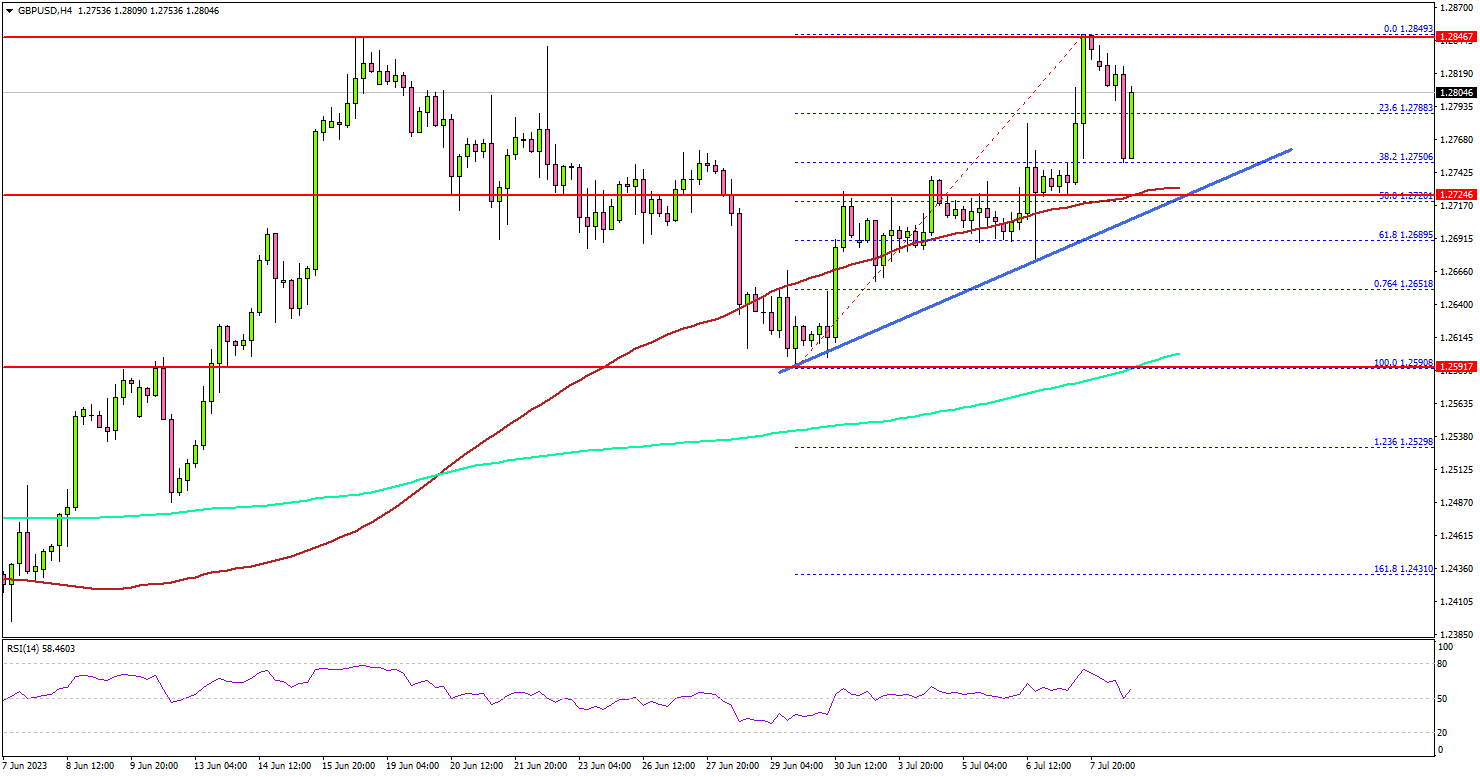
Looking at the 4-hour chart, the pair settled above the 1.2750 level, the 200 simple moving average (green, 4 hours), and the 100 simple moving average (red, 4 hours).
However, the bears are still active near the 1.2850 resistance. The pair is now consolidating gains below 1.2850. There is a key bullish trend line forming with support near 1.2735 and the 100 simple moving average (red, 4 hours) on the same chart.
The next major support is near the 1.2690 level. If there is a downside break below the 1.2690 support, the pair could decline toward the 1.2650 level. The main support is still near 1.2600.
On the upside, the first major resistance is near the 1.2850 level. The next major resistance is near 1.2880. If there is a move above the 1.2880 resistance, the pair could rise toward 1.2965. Any more gains might send the pair toward the 1.3000 level.
Looking at EUR/USD, the pair is showing positive signs and it seems like the bulls could aim for a clear move above the 1.1000 resistance.
Economic Releases
- UK Claimant Count Change for June 2023 – Forecast -4.0K, versus -13.6K previous.
- UK ILO Unemployment Rate for May 2023 (3M) – Forecast 3.8%, versus 3.8% previous.
USD/JPY Technical: At Risk of a Minor Bounce Before Bearish Tone Resumes
- Medium-term uptrend of USD/JPY in place since 16 January 2023 at risk of breakdown.
- Steep decline from last Thursday, 6 July 2023 has reached oversold condition.
- Minor bounce cannot be ruled out at this juncture above 140.60 support.
- Watch the 142.50/142.80 intermediate resistance zone.
This is a follow-up on our prior analysis “USD/JPY surged to a 7-month high, but fundamentals diverge” published on 23 June 2023. We have highlighted the risks of the overextended rally exhibited in the USD/JPY seen in the past six weeks as it approached a key resistance zone of 145.50/146.10.
The price actions of the USD/JPY have indeed staged a retreat right below 145.50 (the lower limit of the key resistance zone) as it printed an intraday high of 145.07 on 30 June 2023 and dropped by 379 pips to hit a low of 141.28 in yesterday, 10 July US session.
Medium-term uptrend from 16 January 2023 is at risk of breakdown
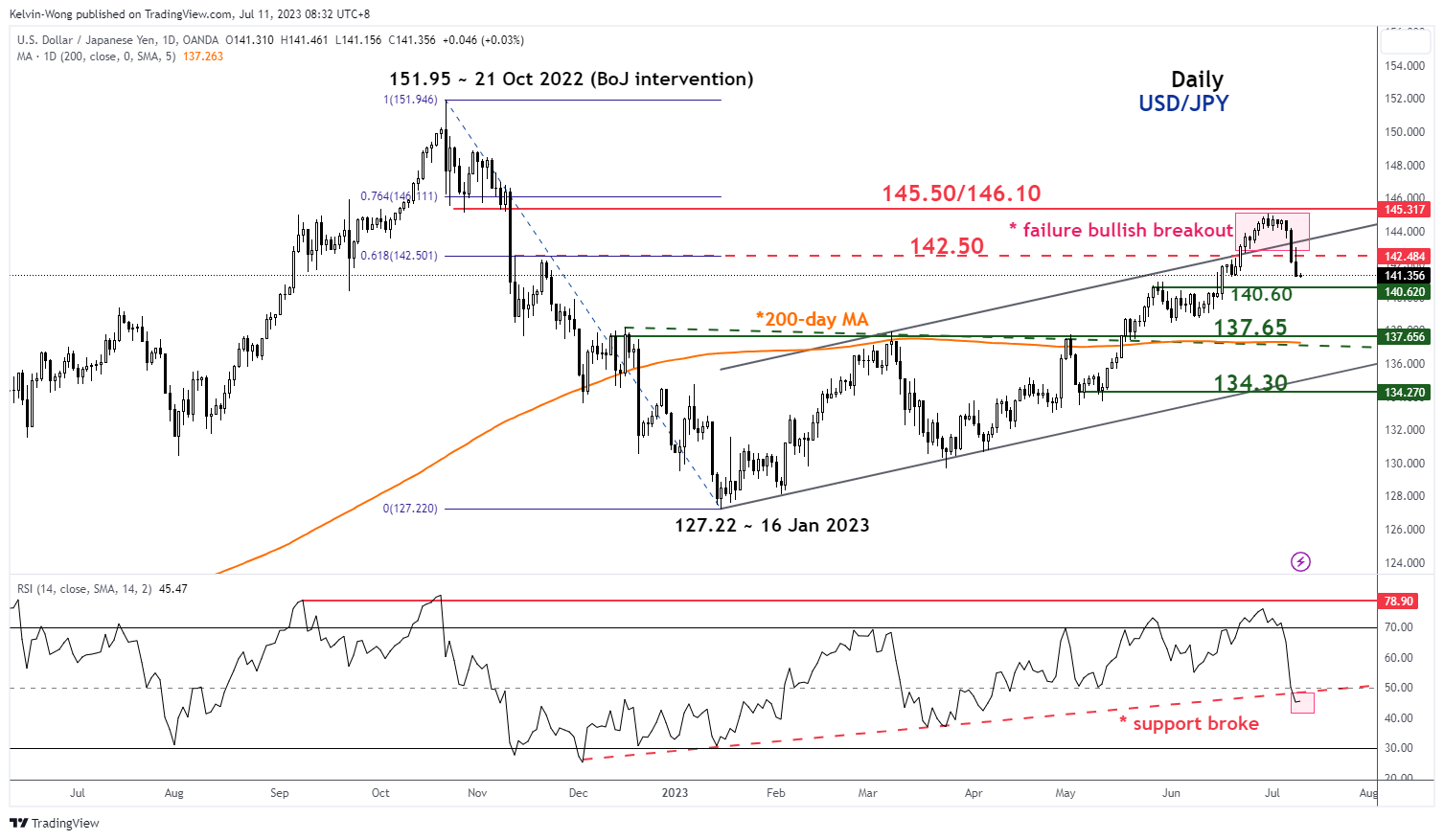
Fig 1: US/JPY medium-term trend as of 11 Jul 2023 (Source: TradingView, click to enlarge chart)
Two key observations have emerged that indicated that the ongoing medium-term uptrend phase of the USD/JPY in place since the 16 January 2023 low of 127.22 may have reached its terminal point on 30 June 2023 which in turn may see the start of a multi-week corrective down move.
Firstly, price actions have reintegrated below 142.50 (the pull-back support of the upper boundary of the medium-term ascending channel where price actions pierced above it on 22 June 2023) which suggests that the prior bullish breakout is likely a failure.
Secondly, the daily RSI has broken below a key parallel ascending trendline support at the 48 level, indicating that medium-term upside momentum has waned.
A minor bounce cannot be ruled out as the decline reached short-term oversold condition
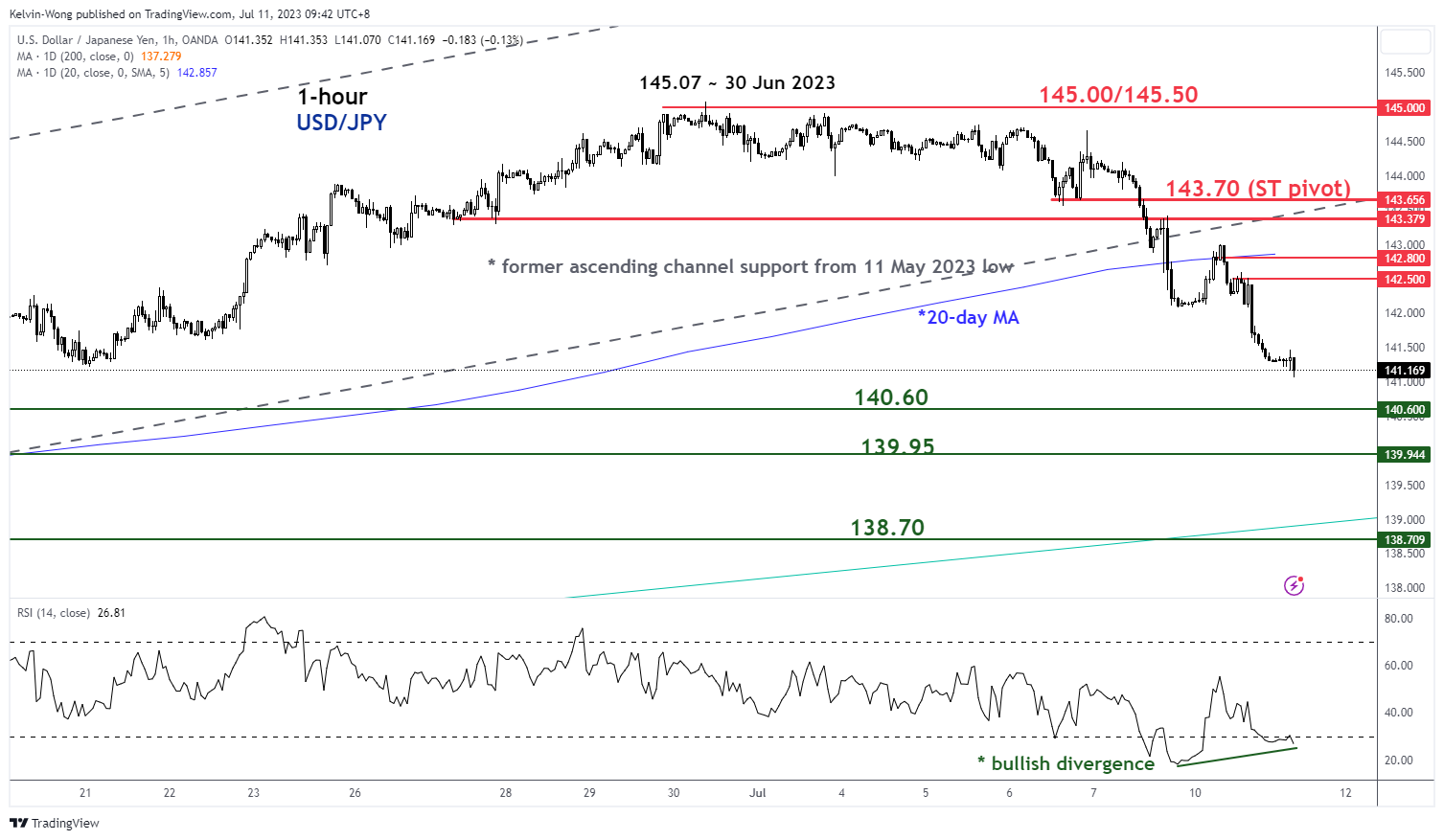
Fig 2: US/JPY minor short-term trend as of 11 Jul 2023 (Source: TradingView, click to enlarge chart)
In the realm of technical analysis, price actions of tradable financial instruments do not evolve in a vertical fashion but oscillate within a trend.
As seen on the 1-hour chart of the USD/JPY, the steep decline since last Thursday, 6 July 2023 minor high of 144.65 has led the hourly RSI to reach an oversold condition (below the 30 level) and flashed out a bullish divergence observation (higher low in RSI but lower low in parallel price actions).
These current observations have emerged as the decline in price actions is coming close to 140.60 key intermediate support (see daily chart).
Hence if the 140.60 intermediate support manages to hold, a minor bounce may unfold with intermediate resistances coming in at 142.50 and 142.80 (20-day moving average). The key short-term pivotal resistance will be at 143.70 to maintain the ongoing short-term downtrend phase in place since the 30 June 2023 high of 145.07.
On the other hand, a break below 140.60 exposes the next supports at 139.95 and 138.70.
USDCHF Wave Analysis
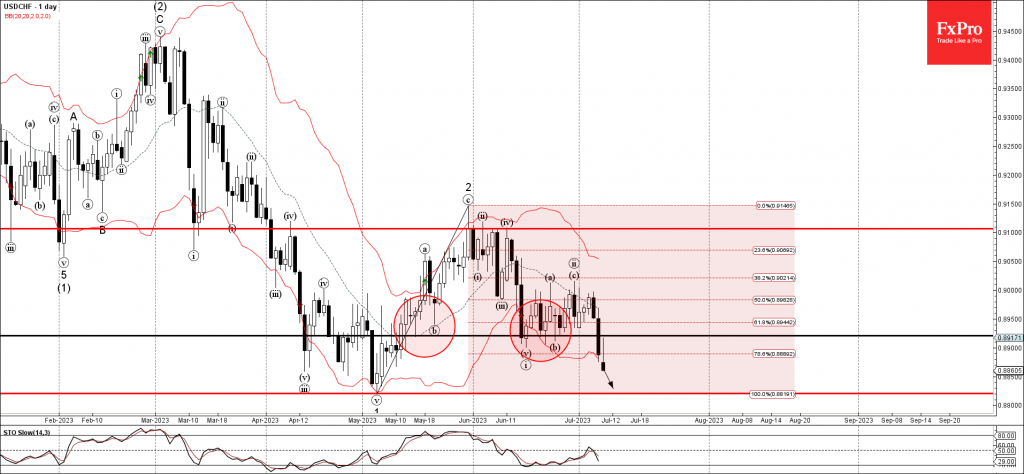
- USDCHF broke support level 0.8920
- Likely to fall to support level 0.8820
USDCHF currency pair recently broke the support level 0.8920, which has been reversing the pair from the start of May.
The breakout of the support level 0.8920 coincided with the breakout of the 61.8% Fibonacci correction of the ABC wave 2 from the start to the end of May.
Given the clear multi-year downtrend, USDCHF can be expected to fall further toward the next support level 0.8820 (low of the impulse wave 1 from the start of May).
USDJPY Wave Analysis
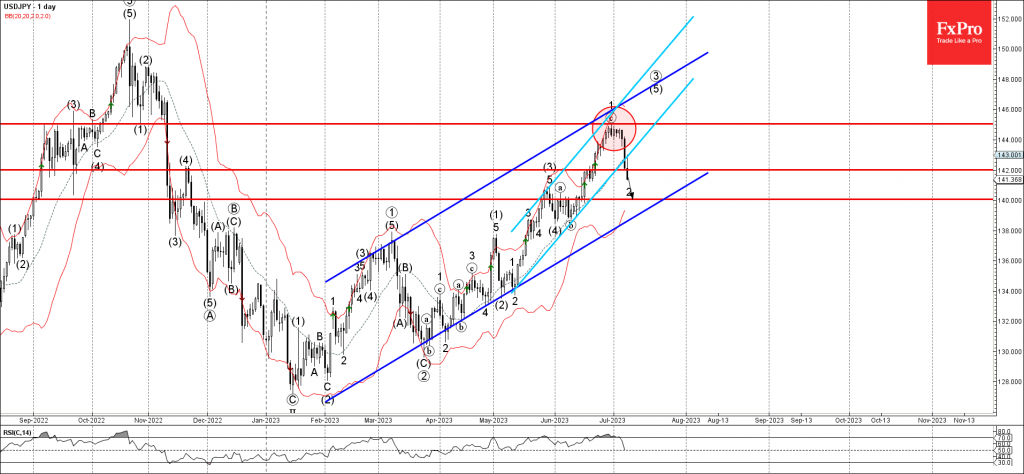
- USDJPY broke support level 142.00
- Likely to fall to support level 140.00
USDJPY currency pair recently broke the support level 142.00, coinciding with the support trendline of the narrow daily up channel from May.
The breakout of the support level 142.00 accelerated the active short-term correction 2, which belongs to the higher impulse wave (5) from May.
Given the widespread dollar sales, USDJPY can be expected to fall further toward the next support level 140.00 (target price for the completion of the active wave 2).
EUR/USD Rises on Stats
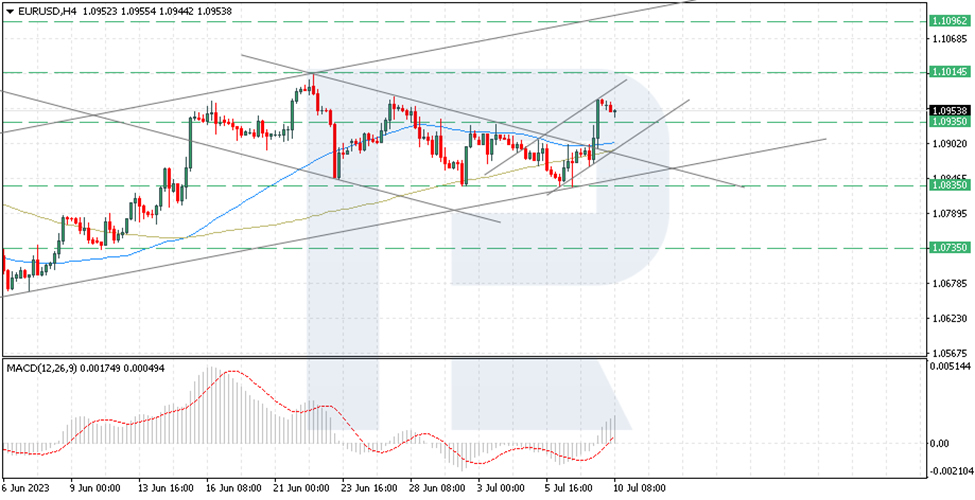
The market's most traded currency pair rose to the level of 1.0960 by Monday.
EUR/USD strengthened due to the weakness of the US dollar. Investors were disappointed by the flow of statistical data from the US labour market for June.
To be specific, the number of non-farm payrolls increased by only 209 thousand against the May value of 306 thousand. In private business, the number of jobs increased by 149 thousand, while in the public sector, it rose by 60 thousand. The unemployment rate remained at 3.6%. Average wages increased by 4.4% y/y against the forecast of 4.2%.
Market participants were counting on strong employment data to help them understand the future actions of the US Federal Reserve.
Technical analysis of EUR/USD:
On the H4 chart, EUR/USD secured above the upper boundary of a descending correction channel after a failed test of the support level. The price is above the moving averages, which indicates growing pressure from the buyers. The correction is expected to end at 1.0935, after which the quotes might rise to the nearest resistance level at 1.1015. Technically, this scenario is confirmed by the MACD: its signal line has secured above the zero level, and the histogram has been growing for 14 periods. A negative scenario for buyers would be a break of the lower boundary of the medium-term ascending channel with the price consolidating under the level of 1.0835.
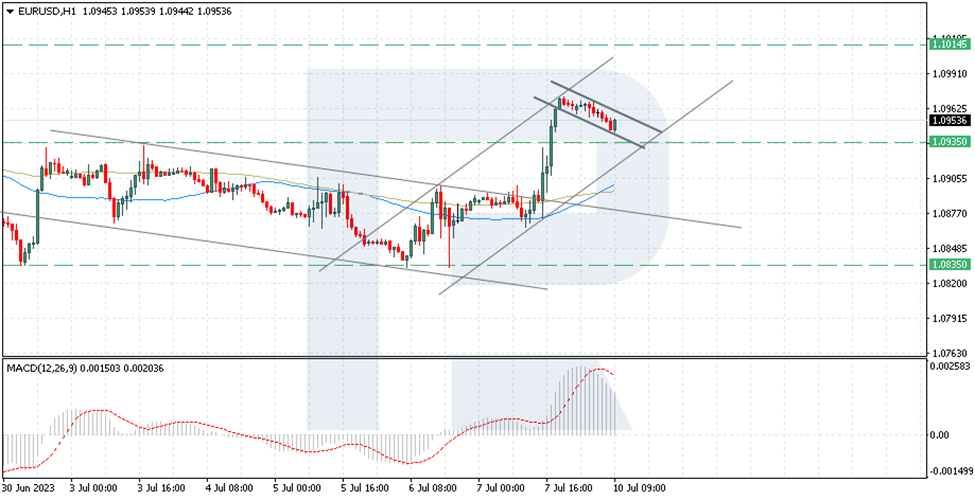
On the H1 chart, EUR/USD is correcting within a bullish flag pattern. The target of this move is 1.0955. The completion of the pattern is expected with a breakout of the upper boundary of the descending channel and the price securing above 1.0965. The moving averages also indicate the presence of an uptrend, with a crossover that occurred on 10 July 2023. Technically, the MACD does not confirm the scenario of EURUSD growth. Moreover, there is a risk of forming a bearish divergence after a steep increase to 1.0955. With such a scenario, there is potential for a decline by the divergence. However, if the bearish divergence is broken again, such behaviour should be interpreted as a weakness on the sellers' part.
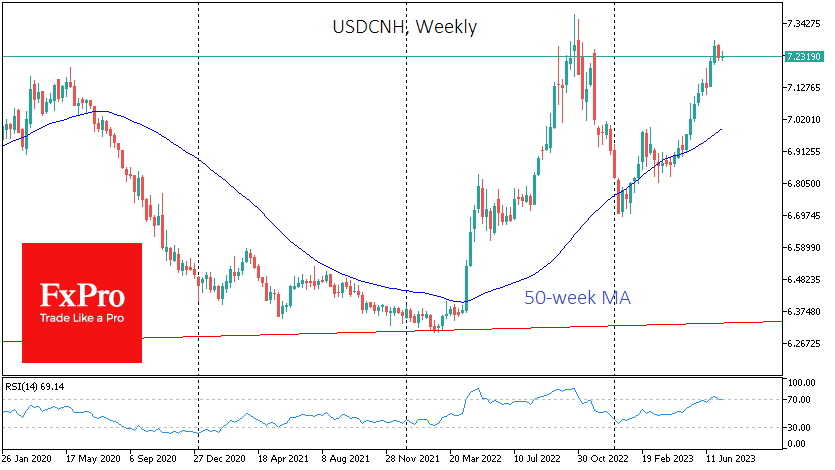
Weak China Inflation Leaves Yuan Weak
A further slowdown in China’s inflation is increasingly raising concerns about the Celestial Empire’s economic growth, which could be bad for the rest of the world.
June data showed that CPI fell from 0.2% y/y to 0.2% y/y and PPI from 4.6% y/y to 5.4% y/y. The data were weaker than expected at 0.2% y/y and -5.0% y/y, respectively, highlighting the persistence of deflationary pressures in the country and reflecting weak consumer and corporate demand, respectively.
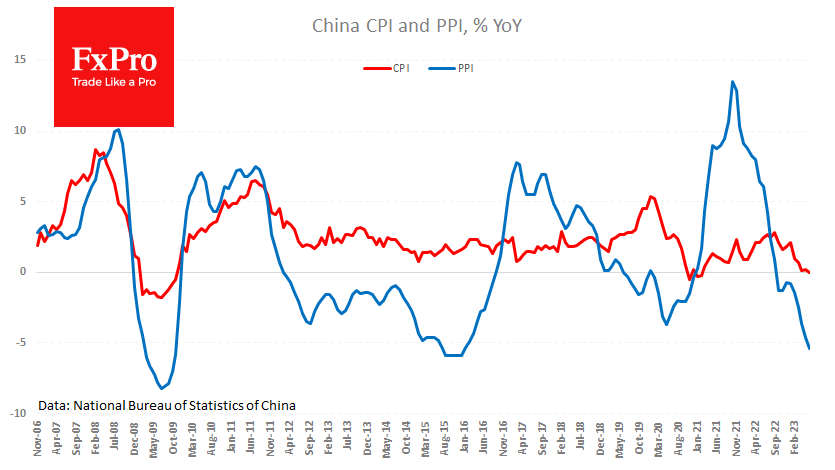
The weak inflation figures are fuelling speculation about further stimulus from the Chinese government. Given the size of the Chinese economy, news about it impacts global market dynamics.
China’s weakness is bad news for markets until it triggers the Government stimulus measures. But we are still hearing nothing new about them, so markets remain nervous.
Moreover, today’s news adds to the pressure on the yuan. In a classic case of weak inflation, the central bank tends to cut interest rates, sending capital in search of higher yields in overseas debt markets. Alternatively, the central bank may try to stimulate the economy through a weaker yuan, thereby increasing export competitiveness and imported inflation.
In other words, USDCNH is unlikely to have peaked late last month. It will likely continue its uptrend to levels above 7.30 unless there is a significant change in the economic data.
Fed Daly: We need to raise rates to bridle the economy more
San Francisco Fed President Mary Daly acknowledged that while inflation appears to be slowing, it remains far too elevated. In an interview held at the Brookings Institution in Washington, D.C., Daly indicated the need for further measures to counteract inflationary pressures.
She affirmed, "I think it's a very reasonable projection to say a couple of more rate hikes will be necessary."
Daly reflected on the resilience of the U.S. economy, which has shown surprising strength despite ongoing economic challenges. The robust data, according to Daly, signal a clear need for intervention: "We need to raise rates to bridle that economy more."
"With labor market still strong, inflation high, risks of doing too little are outweighing risks of doing too much," she added.
Nevertheless, "It's appropriate to slow the pace of rate hikes."
BoE Bailey: My pre-occupation at the moment is inflation
BoE Governor Andrew Bailey, in a speech delivered today, expressed his deep concern over the current inflation rate, which he described as "unacceptably high."
Bailey stated, "My pre-occupation at the moment is inflation. Currently at 8.7% in the latest data, consumer price inflation is unacceptably high, and we must bring it down to the 2% target."
In response to these inflationary pressures, Bailey highlighted that monetary policy has been tightened. "Over the last twenty months, we have raised Bank Rate by nearly five percentage points," he said.
He expressed expectation for underlying inflationary pressures to ease off as headline inflation recedes, adding that "some of that tightening is still to come through the policy pipeline."
However, Bailey made it clear that the Monetary Policy Committee remains vigilant, monitoring various economic developments, notably in the labour market, wage growth, and services price inflation, "to assess whether pressures are proving more persistent."