

Sample Category Title
Will Analysts Get NFP Right This Time?
Economists are more optimistic about how many jobs were created in the US last month. But, that might be an over-correction from consistently underestimating the resilience of the labor market this year. But, there are other factors that make predicting Friday's release a little more difficult, meaning there is more chance for volatility in the markets.
Because of the holidays earlier in the week, several key pre-NFP labor data points have been delayed. That includes ADP and JOLTS numbers. The latter is particularly important because of why the number of jobs has been consistently underestimated. All of this feeds into expectations for what the Fed might do in the coming meetings, as focus now switches to the labor market.
Why are they wrong so often?
The US labor market is in a somewhat unique situation, which we've been talking about all year. The number of open job spots far exceeds the number of people looking for work. That means that NFP numbers don't depend so much on economic factors, as personal decisions, which can be more arbitrary.
For example, the unemployment distribution in the US is not even. Nebraska has an unemployment rate of 1.9%, and, along with the Dakotas is desperate for workers. California and the District of Columbia have the highest unemployment rates, with few job opportunities. But, people are reluctant to move from the cities to the rural areas where there are vacancies. Just how many people decide to uproot and move isn't a factor that is consistent, or economically predictable, since the reasons for staying or moving are often personal.
Future trends
The last JOLTS release showed that the number of open jobs actually increased, widening the gap between openings and seekers. If that pattern persisted through late spring, then that could exaggerate the problem of accurately predicting the NFP number this time around.
The other factor is the Fed, which so far has been focused almost exclusively on inflation. That is, ignoring the second part of its mandate on maintaining full employment. The jobless rate has been pretty consistently below structural level, leading to tightness in the labor market. That pushes up labor costs, which can translate to persistently high inflation. This is a problem that Fed officials are increasingly talking about, and could indicate that the Fed will keep hiking even as inflation comes closer to target.
What the data says
The consensus is that June NFP will come in at 250K, below the 339K reported in the prior month. But the unemployment rate is expected to remain steady at 3.7%, with an unchanged participation rate.
Where focus could be turning to is the average hourly earnings, which are forecast to show growth of 4.1% annual, compared to 4.3% prior. The issue is that inflation was last reported at 4.0%, meaning that labor costs could soon be rising faster than inflation. The Fed is likely to see that as a problem, and therefore markets could react more to this figure. Higher labor costs would imply a higher chance of Fed hikes in the future.
ETHUSD Pulls Back from 2-month Peak
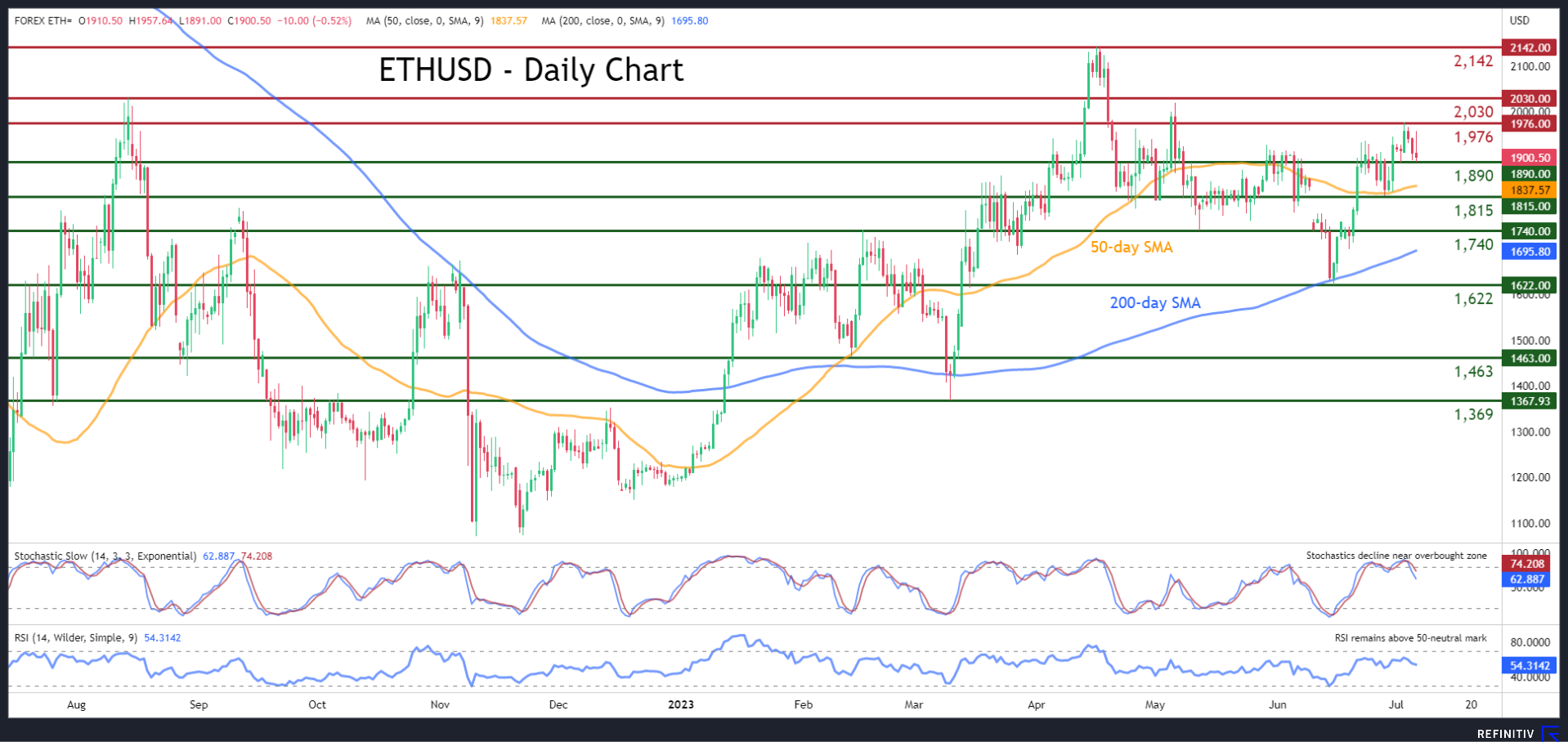
ETHUSD (Ethereum) had been in a steady advance since mid-June, posting a fresh two-month high of 1,976 on Monday. However, the digital coin quickly surrendered some gains, with the bears currently attacking the 1,900 region.
The momentum indicators currently suggest that bullish forces are subsiding but have not totally surrendered yet. Specifically, the stochastic oscillator is ticking down near its overbought zone, while the RSI is losing some ground but holds comfortably above its 50-neutral mark.
Should sellers try to push the price lower, the recent support of 1,890 could act as the first line of defense. Dipping beneath that wall, the price might slide towards the 50-day simple moving average (SMA), a violation of which could open the door for the 1,815 hurdle. Even lower, the May bottom of 1,740 may prove to be the next obstacle for sellers to overcome.
On the flipside, bullish actions could propel the price towards the recent two-month high of 1,976. If that barricade fails, the bulls might aim for the August 2022 peak of 2,030. Failing to halt there, the digital coin could ascend to challenge the one-year high of 2,142.
Overall, ETHUSD has been experiencing a correction from its recent high, but it has failed to post a fresh lower low so far. If that scenario materializes, we could see further losses for Ethereum.
GBPAUD at 17-Month High But Bearish Pressure Intensifies
GBPAUD has almost completed a 17-month long round-trip as it is currently testing the January 28, 2022 high. It has been an impressive 20% rally since the September 2022 lows with the price action religiously obeying the September 26, 2022 upward sloping trendline. The recent pattern of higher highs remains in place, but the June 12 lower low is not a positive signal for the bulls.
In addition, the momentum indicators are showing rally exhaustion signs. The Average Directional Movement Index (ADX) is hovering around its 25-threshold and hence remains in waiting mode, and the RSI stands above its 50-midpoint but it has probably peaked. In the meantime, the stochastic oscillator has broken below its moving average, opening the door to a bearish signal. More interestingly, a bearish divergence has formed as the higher highs in GBPAUD have been met by lower highs in the stochastic.
Should the GBPAUD bears try to recapture the market reins, they would turn their attention to September 26, 2022 upward sloping trendline and the 1.8724-1.8820 range, defined by the October 11, 2018 high and the 50-day simple moving average (SMA). Even lower, the 1.8517-1.8553 area, populated by the 78.6% Fibonacci retracement of the January 28, 2022 – September 26, 2022 downtrend and 100-day SMA, could prove tougher to crack than currently envisaged by the bulls.
On the flip side, the bulls must be feeling very confident and hence preparing to break the 1.9183-1.9220 area. If successful, they will have the chance to register a new 2023 high and the highest print since May 7, 2020. They could then set their eyes on the December 16, 2019 high at 1.9521.
To conclude, GBPAUD bulls are firmly in control but there are increasing signs that the bears could soon have their chance to record a sizeable correction.
Strong ADP Jobs report Shakes Stocks, Boosts USD
ADP released another super strong job report for the US, noting private sector employment growth of 497k in June. This is more than double the expected 226k growth and completely contradicts the idea that the world’s largest economy has entered or is close to a deep recession.
A gain of almost half a million jobs in one month promises a noticeable boost to Americans’ income and spending, the main driver of US GDP. Although the APD data has repeatedly contradicted official statistics, it is one of the most influential labour market indicators ahead of tomorrow’s official release.
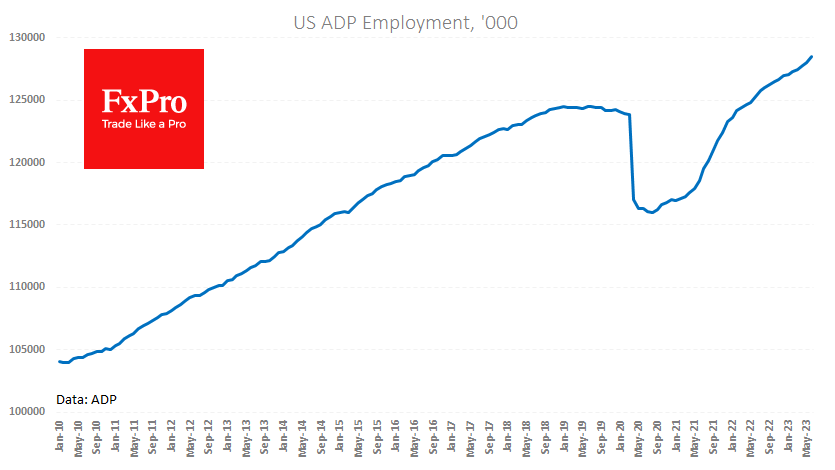
If the official statistics confirm the current data, markets should be prepared for further decisive rate hikes. And that could be bad news for equity indices as rising bond yields become increasingly attractive on a risk/reward basis, increasing the chances of a correction in the Nasdaq100 and other major indices.
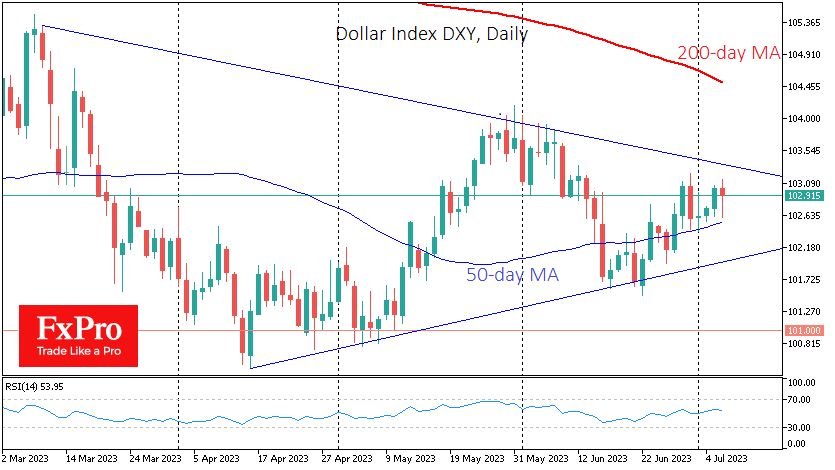
At the same time, a strong labour market could revive interest in the dollar, which has recently lost ground. The Dollar Index rose 0.3% immediately after the ADP release, recouping much of its intraday losses. However, this move could be extended as the DXY defends a position above its 50-day moving average, confirming a bullish medium-term trend.
Fed Logan advocates for more restrictive monetary policy
Dallas President Fed Lorie Logan has voiced concerns about inflation and suggested that a more restrictive monetary policy may be necessary. She indicated that, based on the recent economic data and the Fed's dual-mandate goals, it would have been fitting to raise the federal funds target range FOMC June meeting.
However, Logan pointed out the "challenging and uncertain environment," arguing that "it can make sense to skip a meeting and move more gradually."
Logan expressed deep concerns about whether inflation will return to target levels in a timely and sustainable manner. She further noted, "the continuing outlook for above-target inflation and a stronger-than-expected labor market calls for more-restrictive monetary policy."
On the notion of a delayed impact from past policy actions, Logan expressed skepticism, saying, "I'm skeptical about the potential for large additional effects from this channel." This stance challenges the widely held view that policy measures often take time to influence the economy, suggesting the need for swift action in addressing the current economic issues.
ADP Report Another Huge Blow to Fed Pause Hopes, Jobless Claims in Line
Federal Reserve policymakers may well be dreading tomorrow's jobs report now after today's ADP number once again obliterated estimates, coming in more than double the consensus forecast.
That's almost become the norm on payrolls day but FOMC policymakers, along with investors, may have been hoping the tide would now turn after such as intense tightening cycle over the last 18 months. But if the ADP report is anything to go by, we're headed for another red-hot jobs report.
If a rate hike this month wasn't already nailed on, it probably is now. The ADP isn't often a great precursor to the NFP number but this is a report you simply can't ignore. I'm sure everyone will be revising up their expectations on the back of it and wondering just how much longer this labour market resilience can last. How high must rates go?
Jobless claims crept up again but were just about in line with expectations and still probably lower than what many will have anticipated at this stage. Next up is JOLTS and it will take something seriously shocking to bring balance back to this debate. It's no longer a question of if the Fed hikes this month but how many more after that?
Despite positive momentum, Oil falls short once more
Oil prices are retreating in risk-averse trade today. The ADP report has clearly had a negative impact given it likely means we're facing another red-hot jobs report tomorrow and the prospect of higher rates for longer.
It also came at an opportune time, with the price flirting with the peak from two weeks ago, only to turn south having fallen just shy of surpassing it. That means we're seen yet another failed new high or low in recent weeks and the gradual consolidation, roughly between $72-$77 is still in play.
This time it was close and there was good momentum going into the ADP release but it seems the jobs number was just too big. A repeat performance tomorrow could cement that and undo the efforts of the Saudis and Russians earlier this week in seeking to drive the price higher.
Is Gold vulnerable to another big break?
Gold's brief rebound is seemingly over, with the price already struggling around $1,930-$1,940 before ADP delivered a hammer blow to it. The yellow metal is back trading just above $1,900, a level that's now looking very vulnerable ahead of tomorrow's jobs report.
If it manages to hold above in the interim, a hot report could be the straw that breaks the camel's back. Suddenly it will become a question of whether another hike in September is unavoidable against the backdrop of such a hot labour market. These aren't the only figures that matter but they do significantly weaken the case for another pause.
XAU/USD: Gold Falls Sharply on Upbeat US Private Sector Payroll Data
Gold price fell sharply on Thursday, after US ADP private payrolls rose way above expectations in June (497K vs 228K f/c and downwardly revised May figure from 278K to 267K).
Upbeat data point to strong labor market, despite growing fears of recession, due to high borrowing cost and improve the overall sentiment, prompting traders into riskier assets, which lifted the dollar index
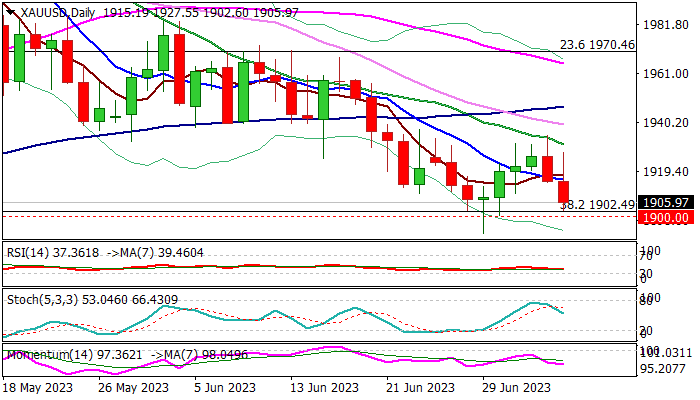
The yellow metal was down over $20 immediately after release of US ADP report and cracked the upper boundary of strong support zone between $1902 and $1892 (Fibo 38.2% of $1614/$2080 / psychological / June 29 spike low).
Sustained break through $1900 support zone would generate strong bearish signal for continuation of larger downtrend, paused for a mild correction during the past week and expose targets at $1863/$1847 (200DMA (Fibo 50% of $1614/$2080).
Weak technical picture on daily chart (14-momentum in negative territory / most of MA’s in bearish configuration) add to bearish near-term outlook, though strong headwinds are still to be expected at $1900 zone.
Near-term action needs to stay below 10DMA ($1916) to keep fresh bears in play and guard upper pivots at $1930/34 (falling 20DMA / July 5 top).
Traders will wait for Friday’s release of US non-farm payrolls data for June, to get more details about the condition of US labor market.
Res: 1916; 1930; 1934; 1946.
Sup: 1900; 1892; 1871; 1863.
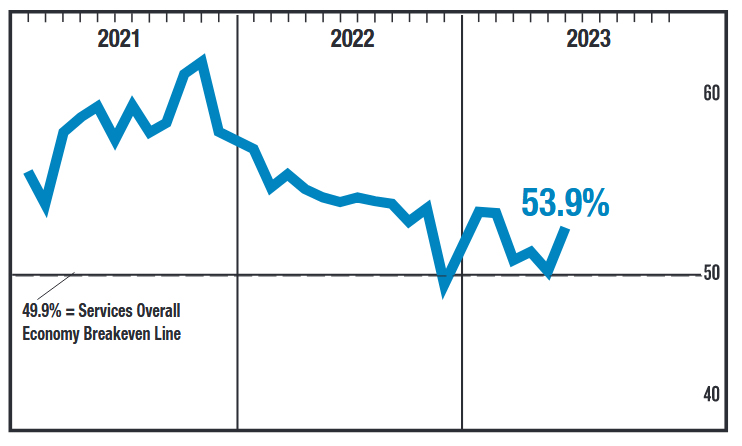
US ISM services rose to 53.9, corresponds to 1.4% annualized GDP growth
US ISM Services PMI rose from 50.3 to 53.9 in June, above expectation of 51.3. Business activity/production jumped from 51.5 to 59.2. New orders rose from 52.9 to 55.5 Employment rose from 49.2 to 53.1. Prices dropped from 56.2 to 54.1.
ISM said, "The past relationship between the Services PMI and the overall economy indicates that the Services PMI for June (53.9 percent) corresponds to a 1.4-percent increase in real gross domestic product (GDP) on an annualized basis."
Sunset Market Commentary
Markets:
Markets took off this morning where they ended yesterday: by selling bonds. The move started as US traders returned from the 4th of July Holiday and accelerated a first time after a technical break of the 10y yield above 3.85/3.87%. FOMC Minutes delivered a second blow by showing more disagreement than expected over the Fed’s skip strategy. Some favoured a 25 bps rate hike, but accepted the status quo. Minutes showed a lot of references to resilient inflation and resilient growth with the influential staff now reducing the odds of a recession later this year to 50/50. Most Fed governors are now in the camp of at least two more rate hikes this year, as Fed Chair Powell also confirmed at a conference at the end of last month. For the umpteenth time this cycle, markets are positioned very dovish confirmed to Fed talk. For the umpteenth time, they have to reposition higher. Interestingly, the long end of the curve is suffering as well with real yields driving the move. Markets come to terms with the (even) higher for (even) longer idea with the theoretical concept of neutral rate (equilibrium rate given price stability and full employment) being rethought. Instead of the long-assumed 2.5% for the US, it is likely going to be higher. Core bonds immediately found themselves on a slippery slope this morning with early US eco releases making it a triple whammy. The US ADP labour market report showed another astonishing amount of net job gains (+497k vs +225k expected) in June while US jobless claims more or less leveled (248k from 239k vs 245k expected) below the psychologic 250k barrier. US yields add 5 bps (30-yr) to 15 bps (2-yr) at the time of writing. The US 2-yr yield broke through 5%, setting a new cycle peak at 5.12% (highest since 2006). The next target stands at 5.26% which is the 2006 high. The US 10-yr yield pushed above 4%, eying the YTD high at 4.09%. UK Gilts and German Bunds joined the sell-off. UK yields rise by more than 10 bps across the curve. The UK 2-yr and 10-yr yields set new cycle highs at respectively 5.5% and 4.66%. German yields increase by 8.1 bps to 12.2 bps with the belly of the curve underperforming the wings. From a technical point of view, the German 10-yr yield finally leaves key resistance at 2.56% behind. The YTD/cycle high stands at 2.77%. Rising real rates are taking their toll on stock markets. Main European benchmarks lose more than 1.5%. In FX space, it’s again very quiet amongst majors. Sterling slightly outperforms both the euro and the dollar. Moves in cable (GBP/USD) and EUR/USD are technically insignificant, but EUR/GBP tested the 0.8518 YTD low. The Japanese yen is stuck between risk-off flows and rising core bond yields. The US non-manufacturing ISM and JOLTS job openings will still be released later today with official payrolls on offer tomorrow.
News & Views:
The UK June Decision Maker Panel survey (DMP) showed that realized output price inflation slowed from 7.6% in May to 6.9% in June. The DMP covers prices from firms across the whole economy, not just consumer-facing firms. The trend decline develops rather slowly (3-month moving average 7.3% from 7.6%). Over the next year, businesses expect output price inflation to ‘fall’ to 4.9%, down from 5.1% May. One-year ahead CPI inflation expectations decreased to 5.7% from 5.9%. However, expectations for three-year ahead CPI inflation increased slightly (by 0.2 ppts) to 3.7%. Current CPI perceptions of firms were close to the 8.7% actual CPI. Annual unit cost growth was unchanged at 9.4% while expected unit cost growth again accelerated from 6.4% to 6.9%. Expected wage growth was also slightly higher at 5.3%. 47% of firms reported that the overall level of uncertainty facing their business was high or very high. Both sales and price uncertainty increased slightly in the monthly series, although the three-month moving averages decreased for both series. Price uncertainty remains at relatively high levels.
The US trade deficit narrowed from $74.5bn to $69bn in May. The decline occurred as imports (0.8% M/M) dropped much faster than exports (-2.3% Y/Y), with the decline mainly driven by consumer goods and industrial supplies. The goods balance deficit improved from $96.2bn to $91,26bn. At the same time the US services balance improved slightly further from $21.58bn to $22,28bn. The petroleum balance eased slightly from $2.98bn to $2.34bn. The US petroleum balance already trades in positive territory since March last year.