Sample Category Title
USD/JPY Daily Outlook
Daily Pivots: (S1) 143.53; (P) 144.10; (R1) 144.63; More...
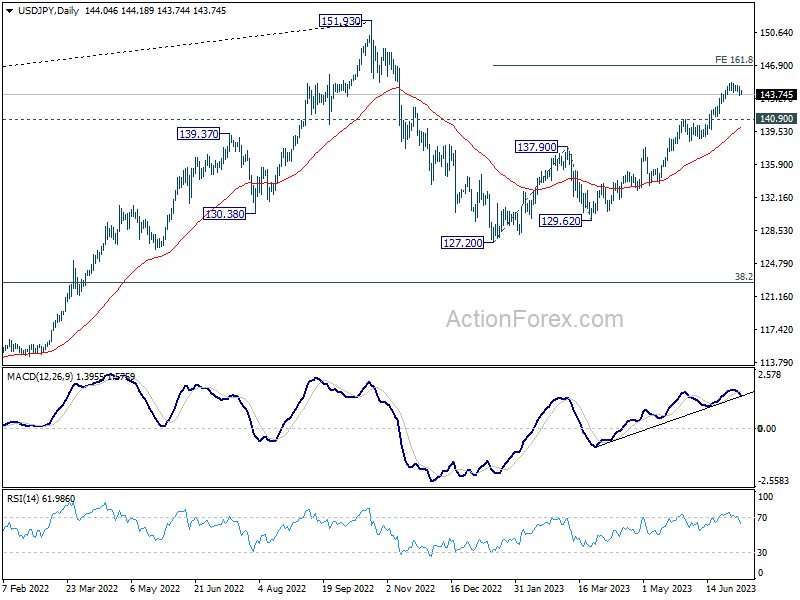
Intraday bias in USD/JPY remains neutral at this point. Correction from 145.06 is in progress and break of 143.54 will turn bias to the downside for deeper fall. Still, overall outlook remains bullish with 140.90 resistance turned support intact. Break of 145.06 will resume larger rise to 161.8% projection of 127.20 to 137.90 from 129.62 at 146.93.
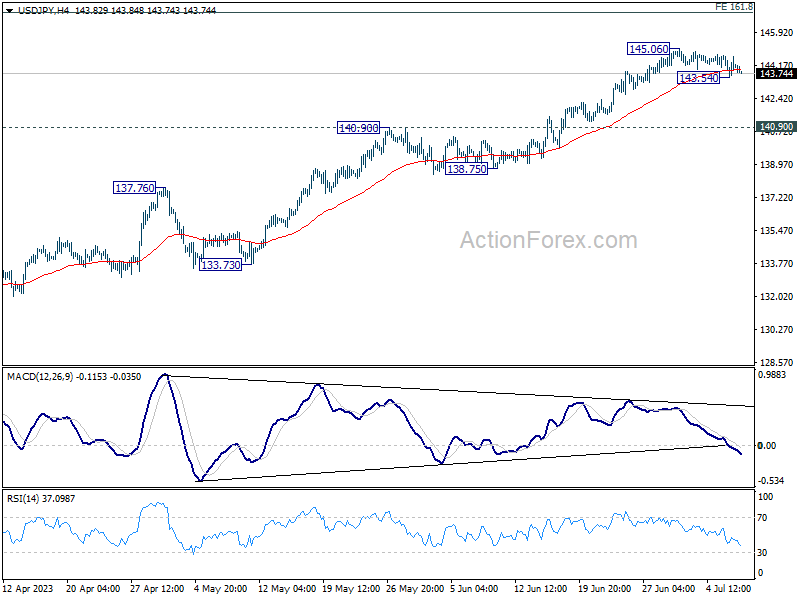
In the bigger picture, rise from 127.20 is currently seen as the second leg of the corrective pattern from 151.93 high. Further rally is expected as long as 138.75 support holds, to retest 151.93. But strong resistance could be seen there to limit upside. Break of 138.75 will indicate the the third leg has started back towards 127.20.
Risk-Off Sentiment Grips Markets ahead of NFP, But Currencies Mixed
Markets are firmly entrenched in a risk-off mode as focus shifts to impending US Non-Farm Payroll data. Expectations for two additional Fed hikes have been gaining traction this week following a string of strong employment data. The deep pullback in US equities overnight extended into Asian trading hours. Concurrently, benchmark 10-year yield managed to close above 4% level and continues to remain strong in Asia. Despite these significant developments, the currency markets are yet to reflect the shifts in sentiment noticeably.
At the moment, New Zealand Dollar stands out as the week's top performer, while its fellow commodity currencies, Canadian and Australian Dollars, find themselves at the opposite end of the spectrum. Both Euro and Swiss Franc are leaning towards weakness, whereas Sterling shines as the second-best performer. Dollar's performance appears mixed, with Yen showcasing slight outperformance, even amidst the robust surge in US yields. Today's job data is expected to provide a more precise directional cue for currencies for the remainder of the month.
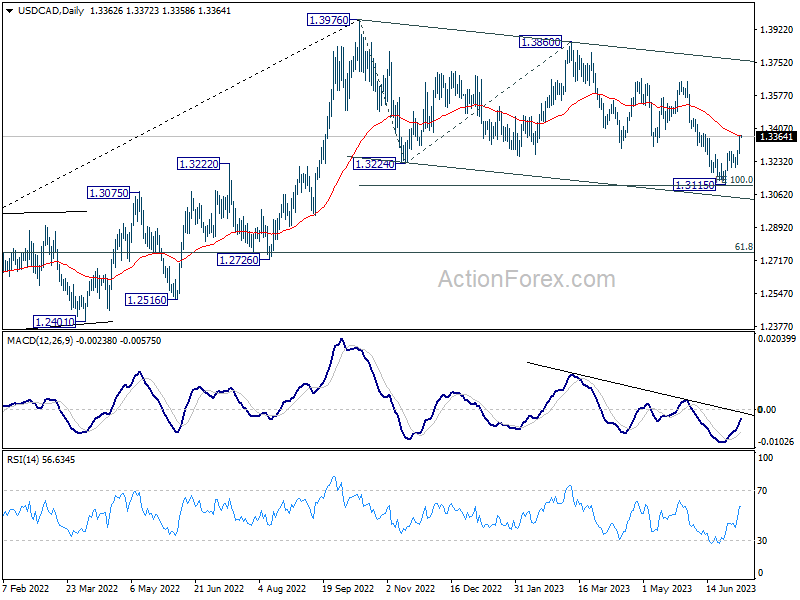
From a technical perspective, the USD/CAD pair is one to watch, particularly as both US and Canada are slated to release their job data today. It's now pressing 55D EMA (now at 1.3369) as rebound form 1.3115 short term bottom accelerated higher yesterday. Sustained break of this EMA will bolster the case that could corrective pattern from 1.3976 has completed with three waves down to 1.3115. In this case, stronger rally would be seen back to 1.3860/3976 resistance zone later in the month. Meanwhile, rejection by the EMA will maintain near term bearishness through 1.3115 low at a later stage. We'll know which one it goes pretty soon.
In Asia, at the time of writing, Nikkei is down -0.54%. Hong Kong HSI is down -1.03%. China Shanghai SSE is down -0.36%. Singapore Strait Times is down -0.38%. Japan 10-year JGB yield is up 0.0304 at 0.442. Overnight, DOW dropped -1.07%. S&P 500 dropped -0.79%. NASDAQ dropped -0.82%. 10-year yield rose 0.096 to 4.041.
BoJ's Uchida cautions against premature policy shift
BoJ Deputy Governor Shinichi Uchida voiced caution over a hasty shift in monetary policy amid current economic climate. In an interview with Nikkei, Uchida emphasized that Japan was far from needing to hastily raise interest rates.
"The risk of missing the opportunity to achieve our 2% target with a premature policy shift is bigger than that of being too late in tightening policy and allowing inflation to continue running above 2%," Uchida explained.
Uchida noted the budding changes in Japanese companies' behavior, which have been rooted in the country's deflationary period. He stressed the importance of nurturing these developments with care. However, he cautioned that uncertainty remains high over inflation outlook, including impact of pricing behaviors and wage hikes by companies.
"We have not reached a point where we can foresee the 2 percent price stability target can be attained stably and sustainably," Uchida said. He also recognized the burden placed on households due to more than 2% rise in core CPI, reinforcing the importance of supporting the economy with current monetary easing to stabilize inflation at 2%, in tandem with wage growth.
Uchida also touched on foreign exchange rates, noting the unwanted uncertainty caused by Yen's rapid and one-sided depreciation. He highlighted the importance of stable foreign exchange rates, which should reflect economic and financial fundamentals. "The BOJ will coordinate with the government, and closely monitor developments in the foreign exchange market and their impact on the economy and prices," he added.
Japan's nominal wages surge, yet real wages and household spending stumble
Japanese workers saw their nominal wages surge 2.5% yoy in May, significantly surpassing expected increase of 1.2% yoy. Regular pay, which includes basic salaries, rose by an impressive 1.8% yoy, marking the highest gain since February 1995. Meanwhile, overtime and other non-regular pay saw a modest increase of 0.4% yoy, while special pay including bonuses skyrocketed by 22.2% yoy.
However, inflation-adjusted real wage index tells a different story. It dropped by -1.2% yoy in May, marking a 14-month declining streak. The reduction, nonetheless, was less severe than -3.2% yoy drop experienced a month earlier. This appears to mirror the effects of pay raise agreements established during this year's "shunto" spring labor-management negotiations.
Despite these wage increases, separate data revealed that Japanese household spending fell -4.0% yoy in May , outpacing median market forecast for a -2.4% yoy drop. This decline extended for the third month and affected a range of expenses from food to clothing to transportation. On a seasonally adjusted monthly basis, household spending dipped by -1.1% mom, This represents the fourth consecutive month of decline.
Bets on two more Fed hikes gaining traction ahead of NFP
Financial markets are awaiting with bated breath today's US non-farm payrolls data, as labor market tightness continues to be a crucial variable in shaping Fed future policy trajectory. Market consensus predicts a healthy growth of 220k jobs in June, while unemployment rate is forecast to remain steady at 3.70%. Average hourly earnings are projected to see a moderate increase of 0.3% mom.
With the backdrop of this week's related data, risks appear to be tilted towards a positive surprise. ADP reported private employment growth of 497k, which is almost double the anticipated 250k. ISM services employment bounced back from 49.2 to 53.1, while ISM manufacturing employment slipped from 51.4 to 48.1. The robust surge in service sector seems capable of more than compensating for the downturn in manufacturing sector.
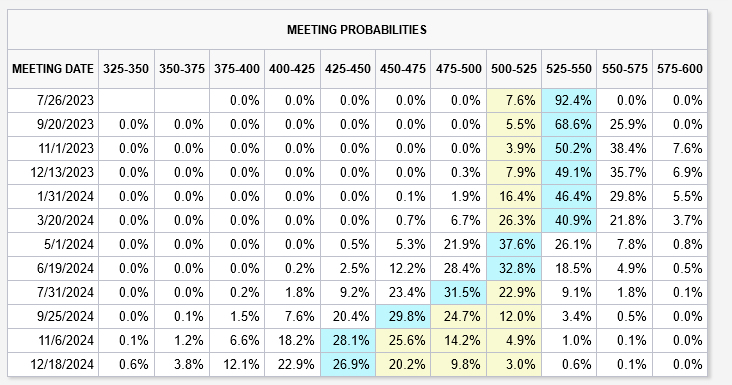
Ahead of the job report, Fed funds futures are pricing in a 92.4% likelihood of an additional 25 bps hike, which would bring rates to 5.25-5.50% at FOMC meeting in July.
Market participants appear to remain somewhat skeptical of FOMC members' "strong majority" opinion that two or more rate hikes are necessary in 2023. However, probability of more tightening beyond July is gaining traction. Chance of interest rate reaching 5.50-5.75% in November currently stands at 46%.
Simultaneously, expectation for the first rate cut continues to be deferred, with odds remaining below 50% until March 2024.
Elsewhere
Swiss unemployment rate and foreign currency reserves, Germany industrial production, France trade balance and Italy retail sales will be released in European session. Canada will also publish job data in US session.
USD/JPY Daily Outlook
Daily Pivots: (S1) 143.53; (P) 144.10; (R1) 144.63; More...
Intraday bias in USD/JPY remains neutral at this point. Correction from 145.06 is in progress and break of 143.54 will turn bias to the downside for deeper fall. Still, overall outlook remains bullish with 140.90 resistance turned support intact. Break of 145.06 will resume larger rise to 161.8% projection of 127.20 to 137.90 from 129.62 at 146.93.
In the bigger picture, rise from 127.20 is currently seen as the second leg of the corrective pattern from 151.93 high. Further rally is expected as long as 138.75 support holds, to retest 151.93. But strong resistance could be seen there to limit upside. Break of 138.75 will indicate the the third leg has started back towards 127.20.
Economic Indicators Update
| GMT | Ccy | Events | Actual | Forecast | Previous | Revised |
|---|---|---|---|---|---|---|
| 23:30 | JPY | Labor Cash Earnings Y/Y May | 2.50% | 1.20% | 1.00% | 0.80% |
| 23:30 | JPY | Overall Household Spending Y/Y May | -4.00% | -2.40% | -4.40% | |
| 05:00 | JPY | Leading Economic Index May P | 109.5% | 97.50% | 96.80% | |
| 05:45 | CHF | Unemployment Rate Jun | 2.00% | 2.00% | ||
| 06:00 | EUR | Germany Industrial Production M/M May | 0.10% | 0.30% | ||
| 06:45 | EUR | France Trade Balance (EUR) May | -9.5B | -9.7B | ||
| 07:00 | CHF | Foreign Currency Reserves (CHF) Jun | 734B | |||
| 08:00 | EUR | Italy Retail Sales M/M May | 0.10% | 0.20% | ||
| 12:30 | USD | Nonfarm Payrolls Jun | 220K | 339K | ||
| 12:30 | USD | Unemployment Rate Jun | 3.70% | 3.70% | ||
| 12:30 | USD | Average Hourly Earnings M/M Jun | 0.30% | 0.30% | ||
| 12:30 | CAD | Net Change in Employment Jun | 19.8K | -17.3K | ||
| 12:30 | CAD | Unemployment Rate Jun | 5.30% | 5.20% | ||
| 14:00 | CAD | Ivey PMI Jun | 50.9 | 53.5 |
Bets on two more Fed hikes gaining traction ahead of NFP
Financial markets are awaiting with bated breath today's US non-farm payrolls data, as labor market tightness continues to be a crucial variable in shaping Fed future policy trajectory. Market consensus predicts a healthy growth of 220k jobs in June, while unemployment rate is forecast to remain steady at 3.70%. Average hourly earnings are projected to see a moderate increase of 0.3% mom.
With the backdrop of this week's related data, risks appear to be tilted towards a positive surprise. ADP reported private employment growth of 497k, which is almost double the anticipated 250k. ISM services employment bounced back from 49.2 to 53.1, while ISM manufacturing employment slipped from 51.4 to 48.1. The robust surge in service sector seems capable of more than compensating for the downturn in manufacturing sector.
Ahead of the job report, Fed funds futures are pricing in a 92.4% likelihood of an additional 25 bps hike, which would bring rates to 5.25-5.50% at FOMC meeting in July.
Market participants appear to remain somewhat skeptical of FOMC members' "strong majority" opinion that two or more rate hikes are necessary in 2023. However, probability of more tightening beyond July is gaining traction. Chance of interest rate reaching 5.50-5.75% in November currently stands at 46%.
Simultaneously, expectation for the first rate cut continues to be deferred, with odds remaining below 50% until March 2024.
Japan’s nominal wages surge, yet real wages and household spending stumble
Japanese workers saw their nominal wages surge 2.5% yoy in May, significantly surpassing expected increase of 1.2% yoy. Regular pay, which includes basic salaries, rose by an impressive 1.8% yoy, marking the highest gain since February 1995. Meanwhile, overtime and other non-regular pay saw a modest increase of 0.4% yoy, while special pay including bonuses skyrocketed by 22.2% yoy.
However, inflation-adjusted real wage index tells a different story. It dropped by -1.2% yoy in May, marking a 14-month declining streak. The reduction, nonetheless, was less severe than -3.2% yoy drop experienced a month earlier. This appears to mirror the effects of pay raise agreements established during this year's "shunto" spring labor-management negotiations.
Despite these wage increases, separate data revealed that Japanese household spending fell -4.0% yoy in May , outpacing median market forecast for a -2.4% yoy drop. This decline extended for the third month and affected a range of expenses from food to clothing to transportation. On a seasonally adjusted monthly basis, household spending dipped by -1.1% mom, This represents the fourth consecutive month of decline.
BoJ’s Uchida cautions against premature policy shift
BoJ Deputy Governor Shinichi Uchida voiced caution over a hasty shift in monetary policy amid current economic climate. In an interview with Nikkei, Uchida emphasized that Japan was far from needing to hastily raise interest rates.
"The risk of missing the opportunity to achieve our 2% target with a premature policy shift is bigger than that of being too late in tightening policy and allowing inflation to continue running above 2%," Uchida explained.
Uchida noted the budding changes in Japanese companies' behavior, which have been rooted in the country's deflationary period. He stressed the importance of nurturing these developments with care. However, he cautioned that uncertainty remains high over inflation outlook, including impact of pricing behaviors and wage hikes by companies.
"We have not reached a point where we can foresee the 2 percent price stability target can be attained stably and sustainably," Uchida said. He also recognized the burden placed on households due to more than 2% rise in core CPI, reinforcing the importance of supporting the economy with current monetary easing to stabilize inflation at 2%, in tandem with wage growth.
Uchida also touched on foreign exchange rates, noting the unwanted uncertainty caused by Yen's rapid and one-sided depreciation. He highlighted the importance of stable foreign exchange rates, which should reflect economic and financial fundamentals. "The BOJ will coordinate with the government, and closely monitor developments in the foreign exchange market and their impact on the economy and prices," he added.
Cliff Notes: A Short Pause as Central Banks Near Expected Peak Rates
Key insights from the week that was.
Seeing need for time to assess the outlook after a cumulative 400bps of tightening since last May, the RBA decided to leave the cash rate unchanged in July. As discussed by Chief Economist Bill Evans, this outcome reflects a clear preference from the Board to base their next decision on updated staff forecasts and the quarterly inflation report. We do not believe this decision will give way to a prolonged pause. Instead, in August, the Board will be faced with another elevated read on inflation. We expect the headline and trimmed mean inflation measures to print at 6.3%yr and 6.1%yr respectively in Q2, more than twice the top-end of the RBA’s 2-3% medium-term inflation target.
With Governor Lowe having recently cited persistent upside risks to inflation, we believe such an outcome will lead the RBA to act in August and September, resulting in a 4.60% cash rate in September which we see as the peak. The economic consequences of such a contractionary policy stance are, in our view, material, with GDP growth to slow to just 0.6%yr in 2023 and remain well below trend in 2024 at 1.0%yr. A series of rate cuts from May 2024 through late-2025 will be required to return GDP growth to trend. For more detail on Australia’s outlook, see our latest edition of Market Outlook.
Despite the anticipated further tightening and weak outlook for activity, this week’s housing market updates were generally constructive. CoreLogic’s home value index managed to post another broad-based gain in June, at least in part thanks to weak turnover. The rise in housing finance approvals in May further highlighted borrowers interest in the market; but, whether this uptrend can be sustained given elevated and rising interest rates remains an open question. A sizeable pipeline of work is currently holding up housing construction but, abstracting for high-rise volatility, dwelling approvals' weak trend suggests housing construction activity will decline over the coming year. Housing supply is therefore likely to remain constrained to end-2024 and beyond, supporting the level of both prices and rents.
Offshore, the US was in focus this week.
The FOMC minutes emphasised that June's pause came as members sought to assess the lagged impact of tightening thus far. The decision was unanimous, though Fedspeak suggests some members were in favour of a hike – overnight Dallas Fed President Logan opined that it would have been “entirely appropriate to raise the federal funds target range at the FOMC's June meeting”.
The revised dot plot from the June meeting suggests only two members of the Committee are comfortable to leave the fed funds rate where it is, with the median expectation being two more hikes this year. However, apparent in the minute’s Committee discussion is the high degree of uncertainty clouding the outlook. As an example, while nonfarm payrolls continue to show strong momentum, averaging 339k per month the past year, other measures of employment are much softer. In particular, household employment has averaged 202k and job openings have declined by 2mn positions since March 2022, albeit from a stellar peak of 12mn.
Other forward-looking indicators of activity and employment are troubled by month-to-month volatility. The ISM services survey is a case in point. Both the headline and employment measures were robust in June, respectively 53.9 and 53.1. However, over the past year, they have each traded wide ranges, 49.2-54.0 for employment and 49.2-56.4 for activity. Also, at its current level, the activity measure is 2.8pts below the average of the 5 years preceding the pandemic. On that basis, it is unsurprising that the price measures from the ISM surveys continue to retreat, pointing to a sustained downtrend in inflation.
The ISM manufacturing survey meanwhile was unquestionably weak in June, deteriorating to 46.0, a full 8pts below the 5-year pre-pandemic average. Further, June’s weakness was broad based, as production, employment, export orders and prices all deteriorated. All manufacturing sub-indices are now in contractionary territory. While there was an improvement in new orders in the month, the sub-index is almost 11pts below its 5-year pre-COVID average.
Of the other US data to hand, new factory orders rose a modest 0.3%mth, though ex-transportation, factory orders slipped 0.5%mth. The strong 3.8%mth jump in transportation reflects broad global trends: an uptick in car manufacturing as manufacturers seek to fulfill a backlog of existing orders; and the ramping up of EV production. Residential construction spending meanwhile grew 2.1%mth in April, driving a 0.9%mth increase in total spending. Increased demand for housing and limited inventory warrant continued growth in residential construction.
Out late last Friday, China’s official NBS PMIs are also worthy of note. Both the services and manufacturing PMIs were in line with the market’s downbeat expectations at 53.2 and 49.0 and so were taken as further evidence of downside risks to the outlook. However, contrasted against the above outcomes for the US as well as China’s pre-pandemic experience, these outcomes actually speak of resilience – the NBS manufacturing survey being just 1.5pts below the average of the 5 years to 2019 against the US ISM’s -8pts. In stark contrast to the US data, Chinese manufacturing also continues to expand capacity, fixed asset investment in May up 6%yr year-to-date. Within the sector, value add is also on the rise, high-tech sector investment growing 15%yr year-to-date.
Those in the market anticipating a surge in policy measures from Chinese authorities are therefore likely to be disappointed as progress towards the Central Government’s long-term ambitions continue to be made. Instead a multi-faceted but passive approach is likely to incentivise local government authorities, SOEs and the private sector to move the economy forward.
USD/JPY Could Resume Rally, US NFP Report Next
Key Highlights
- USD/JPY remained stable above 143.50 and eyes a fresh rally.
- It is facing a key declining channel with resistance near 144.65 on the 4-hour chart.
- EUR/USD failed to clear 1.0920 and started another decline.
- The US nonfarm payrolls could change by 225K in June 2023, down from 339K.
USD/JPY Technical Analysis
The US Dollar started a downside correction from 145.00 against the Japanese Yen. USD/JPY tested the 143.50 zone and recently started a fresh increase.
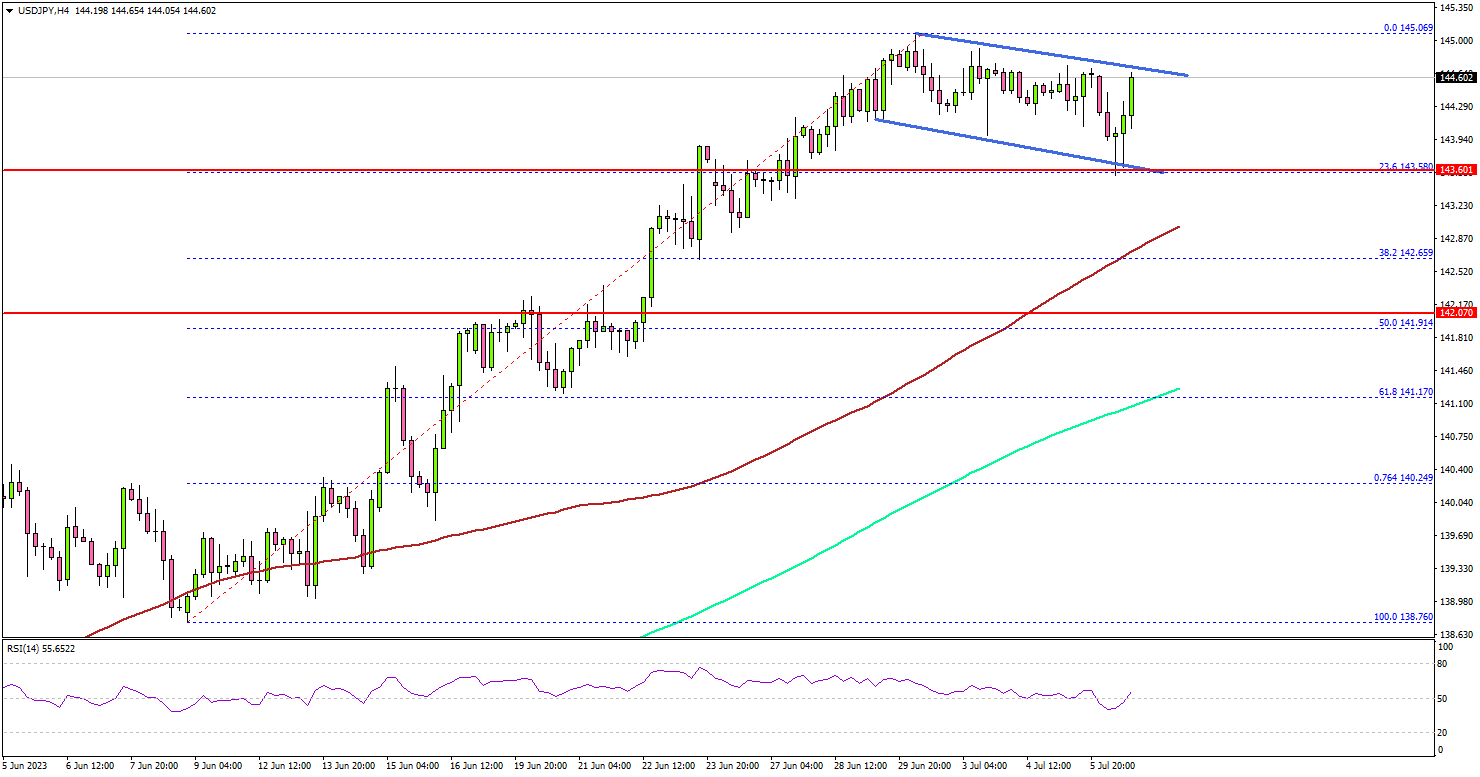
Looking at the 4-hour chart, the pair remained stable above 143.50, the 200 simple moving average (green, 4 hours), and the 100 simple moving average (red, 4 hours). The pair tested the 23.6% Fib retracement level of the upward move from the 138.76 swing low to the 145.06 high.
It is now rising and trading above the 144.00 level. It is facing a key declining channel with resistance near 144.65 on the same chart.
The next major resistance is near 145.00. If there is a move above the 145.00 resistance, the pair could rise toward 145.80. Any more gains might send the pair toward the 146.20 level.
Immediate support is near the 143.50 zone. The next major support is near the 142.80 level or the 100 simple moving average (red, 4 hours). If there is a downside break below the 142.80 support, the pair could decline toward the 50% Fib retracement level of the upward move from the 138.76 swing low to the 145.06 high or 142.00.
Looking at EUR/USD, the pair struggled to clear the 1.0920 resistance zone and the bears were able to push it lower once again.
Economic Releases
- US nonfarm payrolls for June 2023 – Forecast 225K, versus 339K previous.
- US Unemployment Rate for June 2023 - Forecast 3.6%, versus 3.7% previous.
- Canada’s employment Change for June 2023 – Forecast 20K, versus -17.3K previous.
- Canada’s Unemployment Rate April 2023 - Forecast 5.3%, versus 5.2% previous.
Dow Jones Wave Analysis
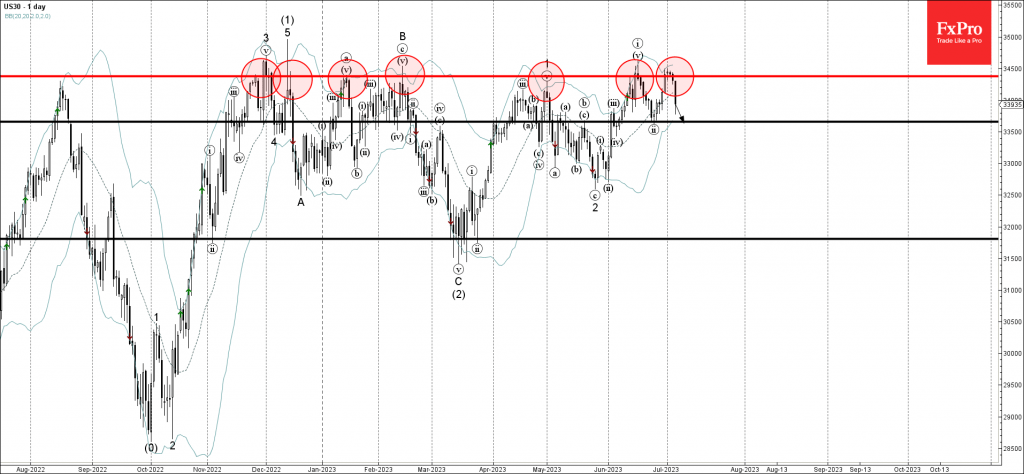
- Dow Jones reversed from powerful resistance level 34370.00
- Likely to fall to support level 33655.00
Dow Jones index recently reversed down from the powerful resistance level 34370.00, which has been repeatedly reversing the index from last November
The resistance level 34370.00 was further strengthened by the upper daily Bollinger Band.
Given the strength of the resistance level 34370.00, Dow Jones index can be expected to fall further toward the next support level 33655.00 (low of the previous minor correction (ii)).
GBPCAD Wave Analysis
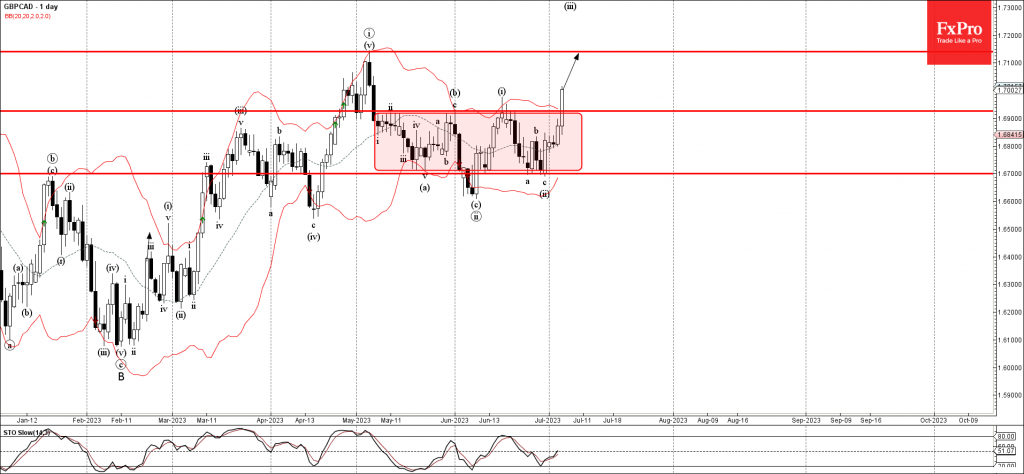
- GBPCAD broke sideways price range
- Likely to rise to resistance level 1.7140
GBPCAD currency pair recently broke out of the narrow sideways price range inside which the pair has been trading from the start of May.
The breakout of this price range accelerated the active impulse waves (iii) and iii – which belong to the multi-month impulse sequence C from February.
Given the prevailing daily uptrend, GBPCAD currency pair can be expected to rise further toward the next resistance level 1.7140 (previous monthly high from May).
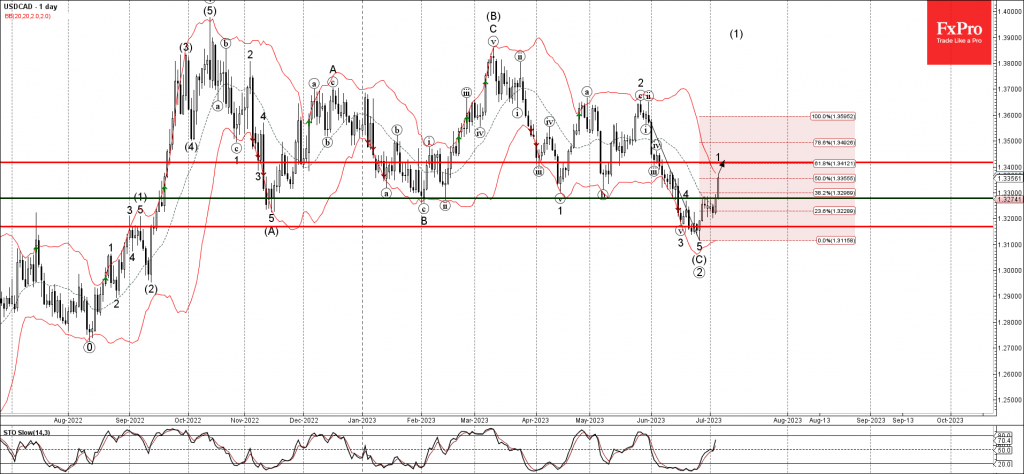
USDCAD Wave Analysis
- USDCAD broke resistance level 1.3300
- Likely to rise to resistance level 1.3400
USDCAD currency pair continues to rise inside the minor impulse wave 1, which recently broke the resistance level 1.3300 (which has been reversing the pair from last week).
The breakout of the resistance level 1.3300 coincided with the breakout of the 38.2% Fibonacci correction of the downward impulse from May.
Given the strongly bullish USD sentiment, USDCAD currency pair can be expected to rise further toward the next resistance level 1.3400 (target price for the completion of the active impulse wave 1).