Sample Category Title
USD/JPY Mid-Day Outlook
Daily Pivots: (S1) 144.26; (P) 144.49; (R1) 144.91; More...
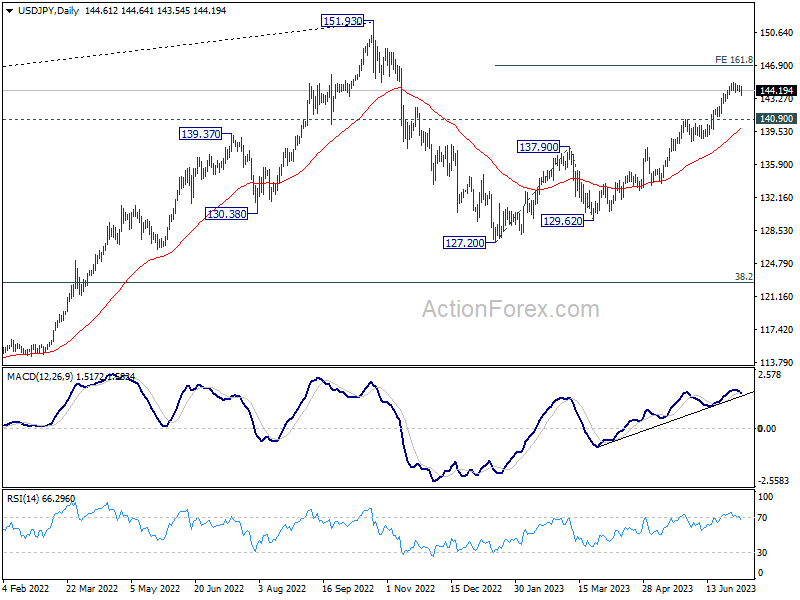
Intraday bias in USD/JPY is turned neutral again as it recovered quickly after dipping to 143.54. Overall outlook remains bullish with 140.90 resistance turned support intact. Break of 145.06 will resume larger rise to 161.8% projection of 127.20 to 137.90 from 129.62 at 146.93. On the downside, break of 143.54 will turn bias to the downside for deeper correction.
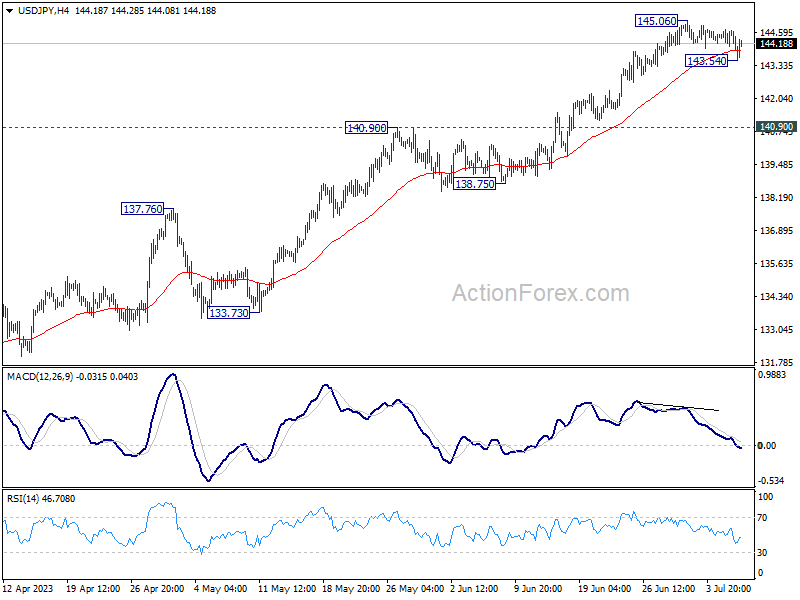
In the bigger picture, rise from 127.20 is currently seen as the second leg of the corrective pattern from 151.93 high. Further rally is expected as long as 138.75 support holds, to retest 151.93. But strong resistance could be seen there to limit upside. Break of 138.75 will indicate the the third leg has started back towards 127.20.
Strong ADP Shoots Yield Higher and Hammers Stocks, But Dollar Indecisive
Today's release of US ADP jobs data, showing stellar job growth yet continuing slowdown in wage growth, has left Dollar traders seemingly indecisive. Treasury yields have surged post-release, with 2-year year yield hitting its highest level since 2007 and benchmark 10-year yield breaking 4% threshold. US futures have also seen a tumble, driven by expectations of extended Fed tightening. However, Dollar's rebound against Yen has been mild at best, and the greenback is facing an uphill struggle against Euro and Sterling. This indicates a complex interplay of risk aversion and rising yields on Dollar.
The more consistent development is that Canadian Dollar's extended selloff, and Australian Dollar is also trading lower. On the other hand, Sterling has emerged as the front-runner for the day, supported by continued buying against Euro during European trading session. Euro and Swiss Franc are also on the firmer side. Yen suffers some selloff in early US session and looks vulnerable to further decline ahead.
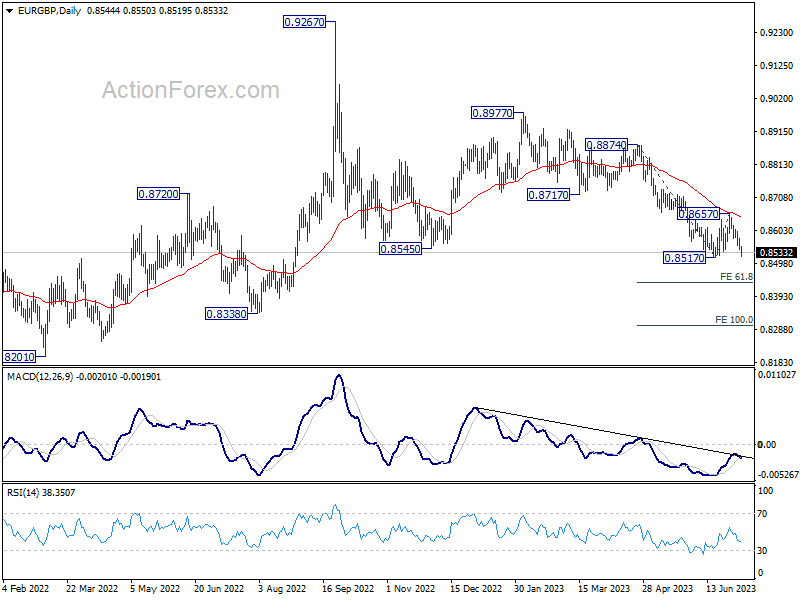
Technically, EUR/GBP looks ready to break through 0.8517 support to resume the decline from 0.8977. In this case, next target will be 61.8% projection of 0.8874 to 0.8517 from 0.8650 at 0.8436. GBP/JPY might take the lead on breaking through 183.99 temporary top. GBP/USD could follow later and breaks through 1.2847 resistance.
In Europe, at the time of writing, FTSE is down -1.69%. DAX is down -1.64%. CAC is down -2.31%. Germany 10-year yield is up 0.1261 at 2.607. Earlier in Asia, Nikkei dropped -1.70%. Hong Kong HSI dropped -3.02%. China Shanghai SSE dropped -0.54%. Singapore Strait Times dropped -1.10%. Japan 10-year JGB yield rose 0.0246 to 0.412.
US ADP surged 497k, but wages growth continues to ebb
US ADP private employment grew 497k in June, well above expectation of 250k. By industry, goods-producing jobs increased 124k while service-providing jobs rose 373k. By establishment size, small companies added 299k jobs, medium companies added 183k, large companies cut -8k.
Annual pay growth of job-stayers slowed from 6.6% yoy to 6.4% yoy. For job-changers, pay gains slowed for the 12th straight month to 11.2% yoy, slowest pace since October 2021.
"Consumer-facing service industries had a strong June, aligning to push job creation higher than expected," said Nela Richardson, chief economist, ADP. "But wage growth continues to ebb in these same industries, and hiring likely is cresting after a late-cycle surge."
US initial jobless claims rose to 248k, slightly below expectation
US initial jobless claims rose 12k to 248k in the week ending July 1, slightly below expectation of 249k. Four-week moving average of initial claims dropped -3.5k to 253k.
Continuing claims dropped -13k to 1720k in the week ending June 24. Four-week moving average of continuing claims dropped -9k to 1747k.
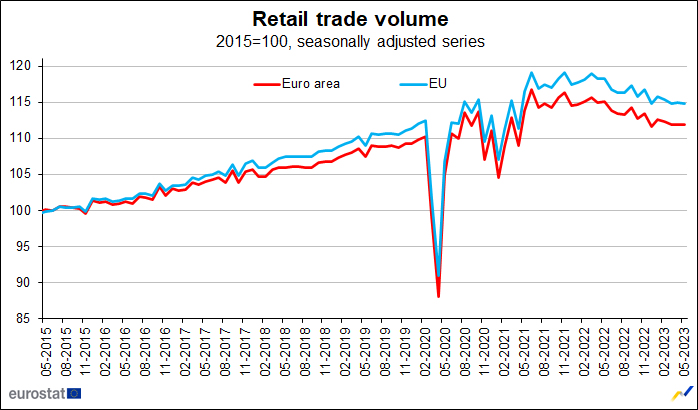
Eurozone retail sales flat in May, EU down -0.1% mom
Eurozone retail sales volume was unchanged in May, compared with the prior month. Volume of retail trade decreased by -0.5% mom for food, drinks and tobacco and by -0.3% mom for automotive fuels, while it increased by 0.1% mom for non-food products.
EU retail sales fell -0.1% mom. Among Member States for which data are available, the largest monthly decreases in the total retail trade volume were registered in Slovenia (-5.3%), Luxembourg (-4.5%) and Poland (-3.7%). The highest increases were observed in Romania (+3.3%), Portugal (+3.2%) and Sweden (+1.6%).
BoE Bailey can't tell when interest rates start to come down
In an interview with BBC's Newsround, BoE Governor Andrew Bailey retrained from providing a definite timeline for potential decreases in interest rates. Instead, he emphasized the necessity of bringing inflation under control.
"I can't give you a date as to when interest rates start to come down because that really depends upon what happens over the period of time ahead, but getting inflation down is the most important thing that we have to do," Bailey stated.
Offering a glimmer of optimism, Bailey noted a discernible reduction in inflation. He predicted a noticeable fall in inflation rates and affirmed the bank's dedication to lowering it to their target level of 2%.
Inflation "has already started to come down and I expect ... quite a marked fall in inflation, we'll notice it. What we have to do is set the interest rate to get it all the way down to 2%," he expounded.
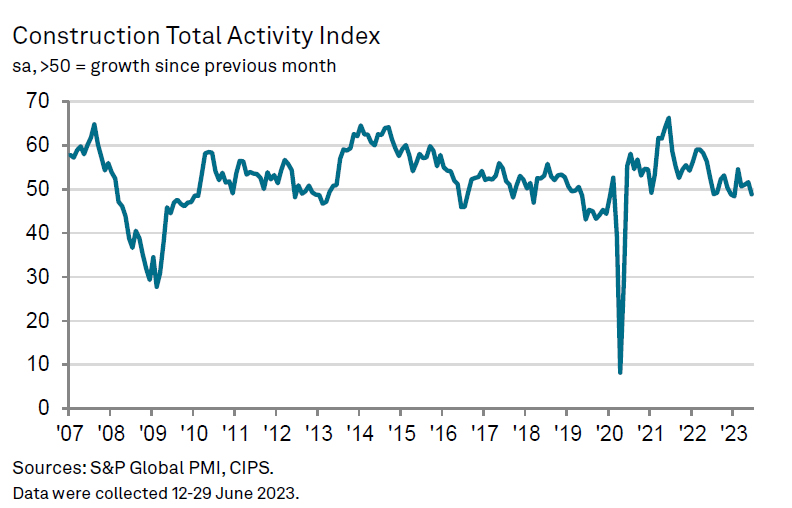
UK PMI construction fell to 48.9, contracts on rising borrowing costs and weaker housing market
UK's construction sector faced a downturn in June as PMI fell from 51.6 in May to 48.9, falling short of 50.9 expectation. This marks the first contraction in construction activity in five months, driven primarily by the fastest decline in residential work witnessed in over three years.
Tim Moore, Economics Director at S&P Global Market Intelligence, explained the contraction, stating, "Weaker housing market conditions in the wake of higher borrowing costs acted as a major constraint on UK construction output in June." According to him, the steep downturn in residential work since May 2020—excluding the slump during lockdown—has been the most rapid in over 14 years.
On a positive note, input prices decreased for the first time since January 2010, a potential silver lining for the construction sector. Additionally, supplier performance improved at its fastest pace in 14 years, signalling some resilience despite the prevailing industry headwinds. However, recent contraction raises concerns about the health of construction sector amidst rising borrowing costs and a cooling housing market.
USD/JPY Mid-Day Outlook
Daily Pivots: (S1) 144.26; (P) 144.49; (R1) 144.91; More...
Intraday bias in USD/JPY is turned neutral again as it recovered quickly after dipping to 143.54. Overall outlook remains bullish with 140.90 resistance turned support intact. Break of 145.06 will resume larger rise to 161.8% projection of 127.20 to 137.90 from 129.62 at 146.93. On the downside, break of 143.54 will turn bias to the downside for deeper correction.
In the bigger picture, rise from 127.20 is currently seen as the second leg of the corrective pattern from 151.93 high. Further rally is expected as long as 138.75 support holds, to retest 151.93. But strong resistance could be seen there to limit upside. Break of 138.75 will indicate the the third leg has started back towards 127.20.
Economic Indicators Update
| GMT | Ccy | Events | Actual | Forecast | Previous | Revised |
|---|---|---|---|---|---|---|
| 01:30 | AUD | Trade Balance (AUD) May | 11.79B | 10.70B | 11.16B | |
| 06:00 | EUR | Germany Factory Orders M/M May | 6.40% | 1.50% | -0.40% | 0.20% |
| 08:30 | GBP | Construction PMI Jun | 48.9 | 50.9 | 51.6 | |
| 09:00 | EUR | Eurozone Retail Sales M/M May | 0.00% | 0.20% | 0.00% | |
| 11:30 | USD | Challenger Job Cuts Jun | 25.20% | 286.70% | ||
| 12:15 | USD | ADP Employment Change Jun | 497K | 250K | 278K | 267K |
| 12:30 | USD | Initial Jobless Claims (Jun 30) | 248K | 249K | 239K | 236K |
| 12:30 | USD | Trade Balance (USD) May | -69.0B | -68.2B | -74.6B | |
| 12:30 | CAD | Trade Balance (CAD) May | -3.4B | 1.5B | 1.9B | 0.9B |
| 13:45 | USD | Services PMI Jun F | 54.1 | 54.1 | ||
| 14:00 | USD | ISM Services PMI Jun | 51.3 | 50.3 | ||
| 14:30 | USD | Crude Oil Inventories | -2.0M | -9.6M |
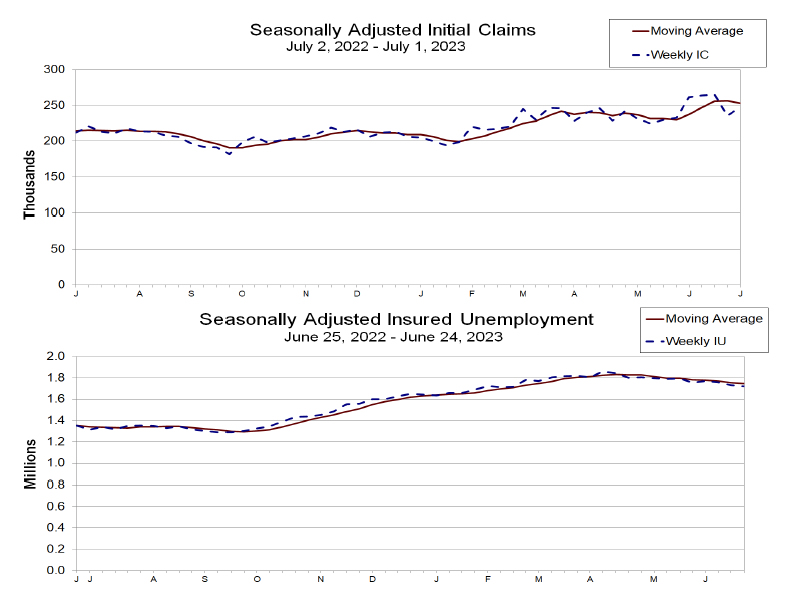
US initial jobless claims rose to 248k, slightly below expectation
US initial jobless claims rose 12k to 248k in the week ending July 1, slightly below expectation of 249k. Four-week moving average of initial claims dropped -3.5k to 253k.
Continuing claims dropped -13k to 1720k in the week ending June 24. Four-week moving average of continuing claims dropped -9k to 1747k.
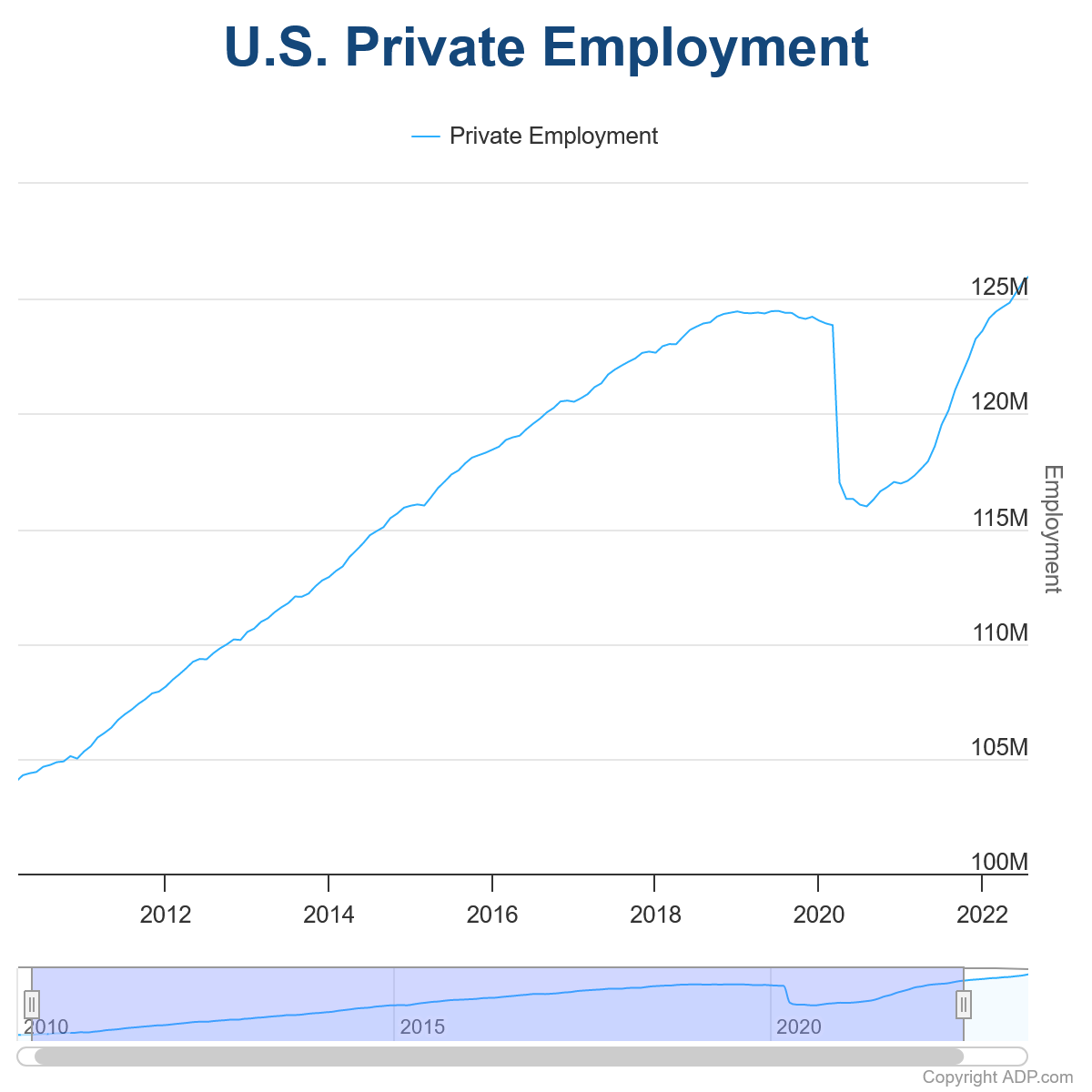
US ADP surged 497k, but wages growth continues to ebb
US ADP private employment grew 497k in June, well above expectation of 250k. By industry, goods-producing jobs increased 124k while service-providing jobs rose 373k. By establishment size, small companies added 299k jobs, medium companies added 183k, large companies cut -8k.
Annual pay growth of job-stayers slowed from 6.6% yoy to 6.4% yoy. For job-changers, pay gains slowed for the 12th straight month to 11.2% yoy, slowest pace since October 2021.
"Consumer-facing service industries had a strong June, aligning to push job creation higher than expected," said Nela Richardson, chief economist, ADP. "But wage growth continues to ebb in these same industries, and hiring likely is cresting after a late-cycle surge."
Nasdaq100’s Correction? Confirmation Needed
Since the second half of last month, US indices have been struggling to grow. Closing on a strong note at the end of the half-year could trigger a severe correction or even be the first step towards a prolonged decline.
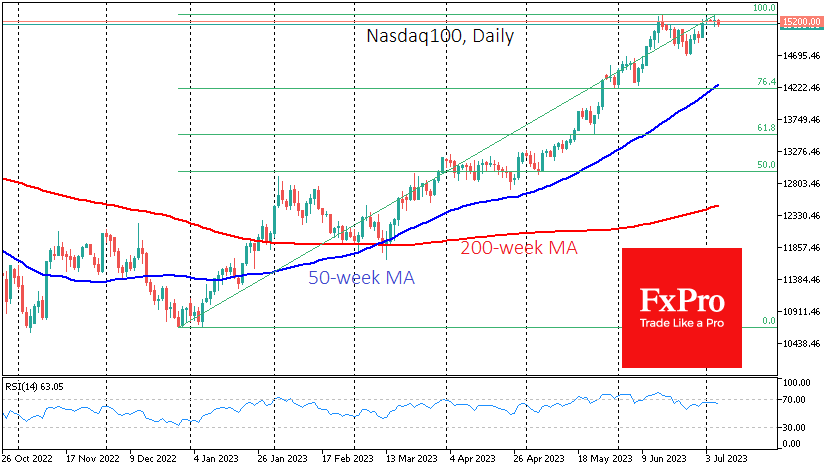
The US Nasdaq 100 index ended the half year with the strongest gain in its history, up almost 40%. The index paused or exhausted its momentum near the 15200 level, which also served as a turning point for the bears in January and March-April last year. This level was also a significant resistance line from July to August 2021.
A complete correction of the year-to-date rally in the Nasdaq100 can go as far as 13500 (61.8% of the rally), but a lesser pullback to 14200 (76.4%) is theoretically possible. Markets need a trigger for such a move, and the Fed’s hawkish tone is not seen as an appropriate reason to sell stocks.
On a weekly timeframe, the index has been in the over-bought territory on the RSI for the past month and a half. For traders and investors, the risk of a full-blown correction increases as soon as the buoyant growth falters. The signal that a correction has begun in the markets would be a sharp drop in the RSI to below 70 from the current 73. A gradual cooling is unlikely to be seen as such a signal.
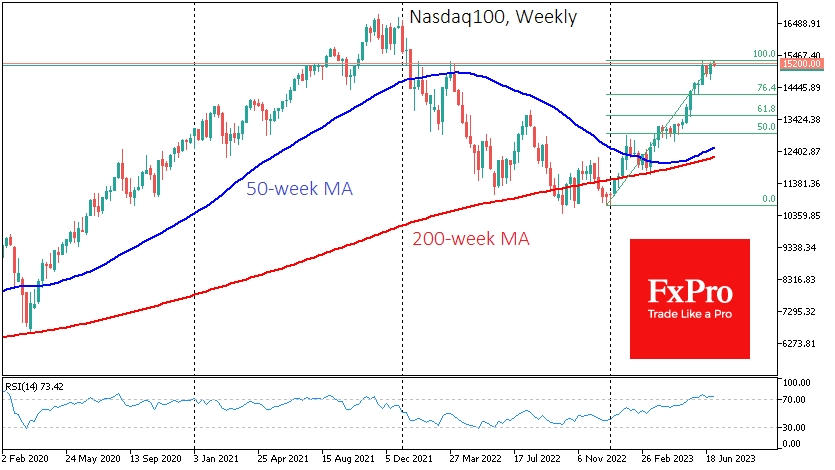
Perhaps only news of economic contraction or weak quarterly earnings could trigger it. If the recession is severe enough and the Fed does not reverse course, the Nasdaq100 can return to its long-term 50 or even 200-week averages, now at 12500 and 12200, respectively.
However, a bearish reversal needs confirmation, which could be another scramble this week and next.
Bitcoin Wandering in the Range
Market picture
The cryptocurrency market lost another 0.5% of its capitalisation overnight, to 1.2 trillion. Most losses came on Wednesday afternoon, while capitalisation has risen since Thursday morning. Since last May, the market has failed to develop growth when it reaches levels above 1.22.
The main benchmark and psychological obstacle in this upward march is Bitcoin’s $30K level. It manages to go higher within local impulses for a while, but this only strengthens the local selling. Technically, Bitcoin never managed to break out of the narrow corridor, turning from decline to rise with the start of active trading on Thursday.
This resistance is temporary, and after some consolidation, we should expect a new test of this resistance. At the same time, one should not write off what is happening in the global equity markets. In spring, Bitcoin gained in March on the problems of regional US banks. Still, if the pressure on stocks increases due to the economic slowdown, the correlation between stocks and cryptocurrencies will be positive again.

News background
The Stablecoin sector has yet to fully benefit from Bitcoin’s rally to annual highs, drawing attention from Fitch.
In June, aggregate trading volume on centralised cryptocurrency exchanges rose for the first time since March. According to CCData, the figure rose 14.2% to $2.71 trillion.
In Australia, the offices of Binance were searched as part of an ongoing investigation into the crypto exchange’s activities in the country. An Australian Securities and Investments Commission (ASIC) spokesperson said the regulator’s probe into the company is ongoing.
Authorities in Denmark have ordered Saxo Bank to curtail cryptocurrency trading. All digital asset positions must be eliminated by 2024, as cryptocurrency trading is not on banks’ list of permitted activities.
Kenya has introduced a 3% tax on cryptocurrency transactions. According to a UN report, Kenya has the fifth highest global adoption of cryptocurrencies, with 8.5% of the country’s population owning them.
Eurozone retail sales flat in May, EU down -0.1% mom
Eurozone retail sales volume was unchanged in May, compared with the prior month. Volume of retail trade decreased by -0.5% mom for food, drinks and tobacco and by -0.3% mom for automotive fuels, while it increased by 0.1% mom for non-food products.
EU retail sales fell -0.1% mom. Among Member States for which data are available, the largest monthly decreases in the total retail trade volume were registered in Slovenia (-5.3%), Luxembourg (-4.5%) and Poland (-3.7%). The highest increases were observed in Romania (+3.3%), Portugal (+3.2%) and Sweden (+1.6%).
BoE Bailey can’t tell when interest rates start to come down
In an interview with BBC's Newsround, BoE Governor Andrew Bailey retrained from providing a definite timeline for potential decreases in interest rates. Instead, he emphasized the necessity of bringing inflation under control.
"I can't give you a date as to when interest rates start to come down because that really depends upon what happens over the period of time ahead, but getting inflation down is the most important thing that we have to do," Bailey stated.
Offering a glimmer of optimism, Bailey noted a discernible reduction in inflation. He predicted a noticeable fall in inflation rates and affirmed the bank's dedication to lowering it to their target level of 2%.
Inflation "has already started to come down and I expect ... quite a marked fall in inflation, we'll notice it. What we have to do is set the interest rate to get it all the way down to 2%," he expounded.
UK PMI construction fell to 48.9, contracts on rising borrowing costs and weaker housing market
UK's construction sector faced a downturn in June as PMI fell from 51.6 in May to 48.9, falling short of 50.9 expectation. This marks the first contraction in construction activity in five months, driven primarily by the fastest decline in residential work witnessed in over three years.
Tim Moore, Economics Director at S&P Global Market Intelligence, explained the contraction, stating, "Weaker housing market conditions in the wake of higher borrowing costs acted as a major constraint on UK construction output in June." According to him, the steep downturn in residential work since May 2020—excluding the slump during lockdown—has been the most rapid in over 14 years.
On a positive note, input prices decreased for the first time since January 2010, a potential silver lining for the construction sector. Additionally, supplier performance improved at its fastest pace in 14 years, signalling some resilience despite the prevailing industry headwinds. However, recent contraction raises concerns about the health of construction sector amidst rising borrowing costs and a cooling housing market.
Gold Strives for Support
USD/JPY seeks support
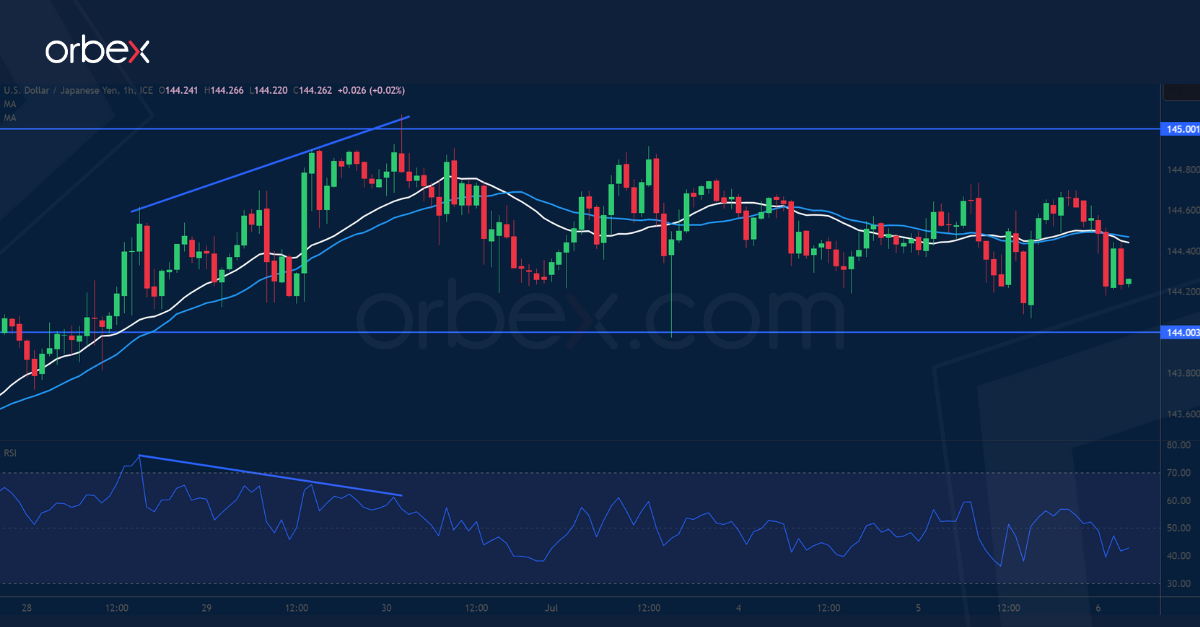
The US dollar steadies as minutes from the Fed policy meeting cement expectations of another rate hike. The pair has hit resistance at 145.00 from last November’s liquidation. A bearish RSI divergence suggests a deceleration in the upward momentum and could carry significant weight in this supply zone. 144.00 is the first support and its breach would force leveraged long positions to close and trigger a correction. 142.30 over the 20-day SMA would be a key level to expect buyers to return and keep the bullish bias intact.
XAU/USD hits resistance
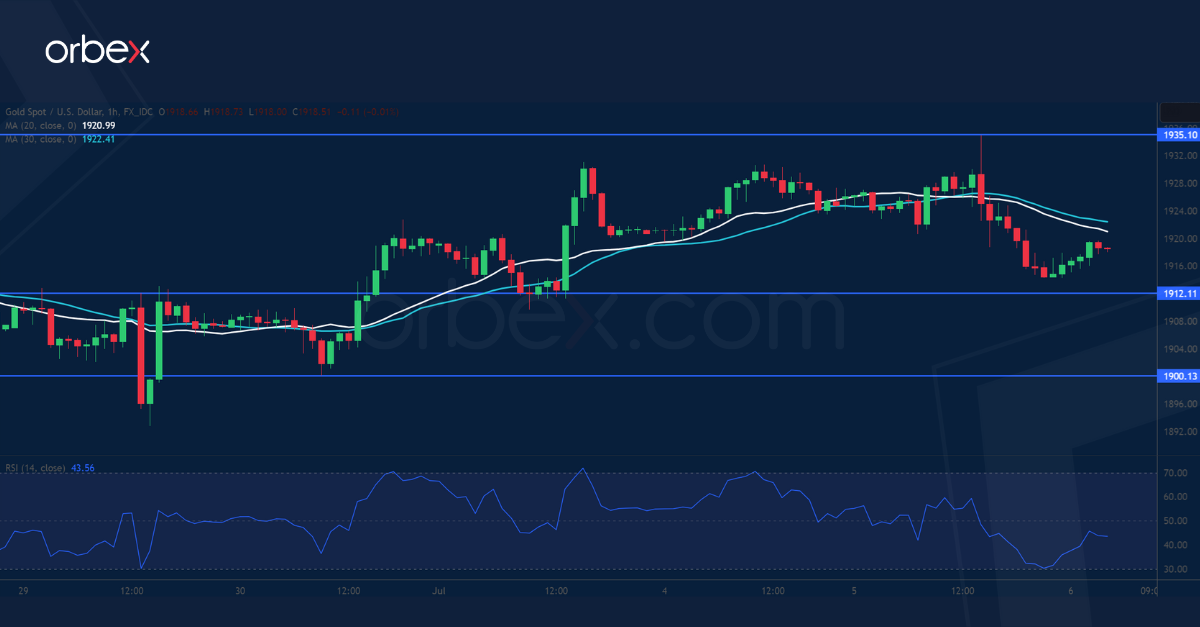
Bullion slid after upbeat FOMC minutes pushed US Treasury yields higher. The price seems to have secured a foothold around the psychological level of 1900 and a series of higher lows combined with a tentative break above 1930 suggest mounting buying pressure. But the precious metal needs a decisive close above 1935 which coincides with dynamic resistance of the 20-day SMA to flush out the remaining selling interests and extend the rebound to 1955. On the downside, 1912 is the immediate support to keep momentum intact.
US Oil tests key resistance
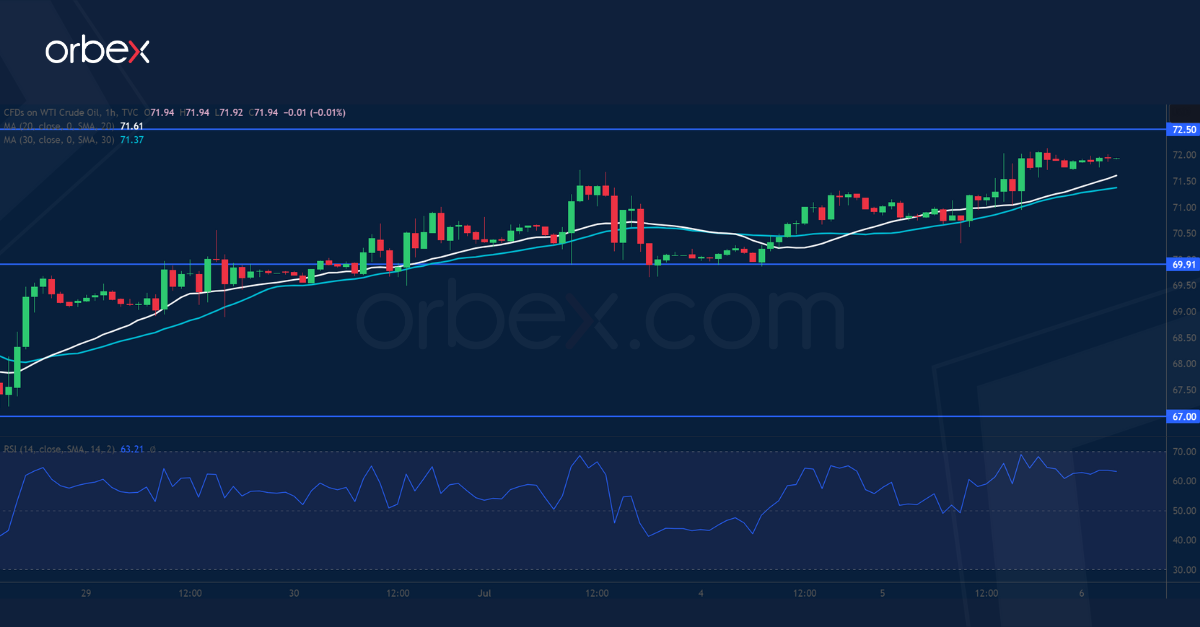
WTI crude capitalises on Saudi Arabia's announcement to extend its output cuts into August. A bounce off the critical floor of 67.00 and above the psychological level of 70.00 shows that the buy side has not thrown in the towel yet. The narrowing consolidation is due for a breakout which will dictate the next directional move. The previous swing high of 72.50 is a major hurdle to lift before they could hope for a sustained recovery. 69.90 is the first support and 67.00 the bulls’ last stronghold to prevent a bearish continuation.