Sample Category Title
US initial jobless claims rose 2k to 229k
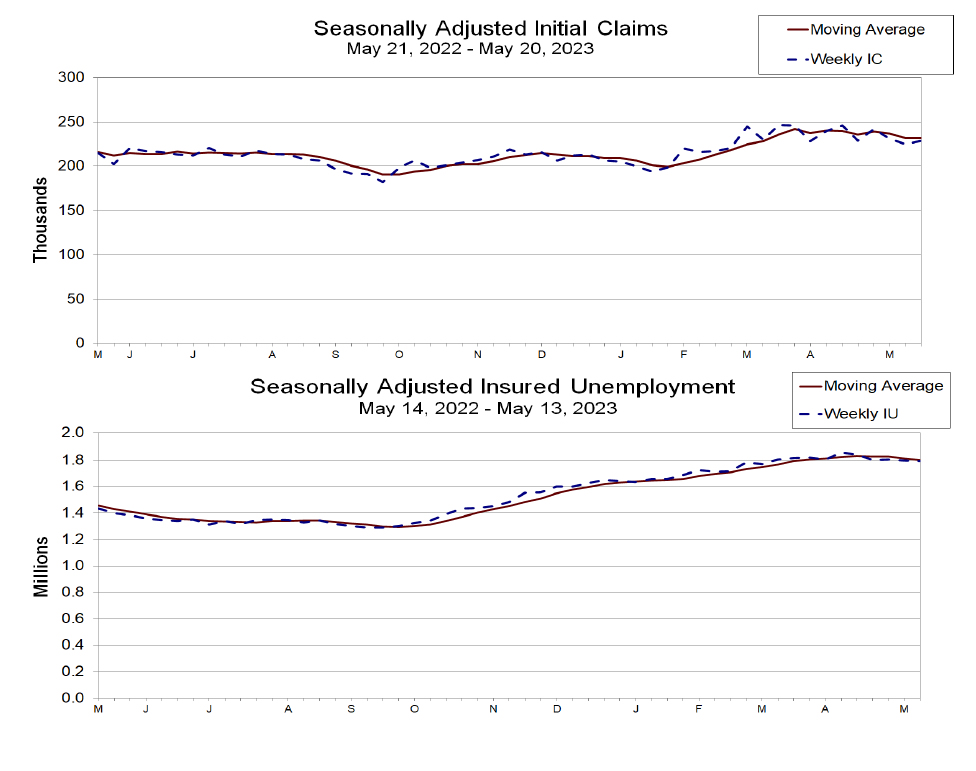
US initial jobless claims rose 4k to 229k in the week ending May 20, below expectation of 253k. Four-week moving average of initial claims was unchanged at 232k.
Continuing claims dropped -5k to 1794k in the week ending May 13. Four-week moving average of continuing claims dropped -12k to 1800k.
EUR/USD: Euro Falls to Two-Month Low vs Dollar as Bears Gain Pace
The Euro extends fresh bear-leg after ending a brief consolidation and hit two-month low in European session on Thursday.
Rising dollar on expectations that the Fed would remain in a hawkish mode and debt ceiling uncertainty, keep the single currency under pressure, while signals that German economy was in recession in the first quarter of 2023, added to negative outlook.
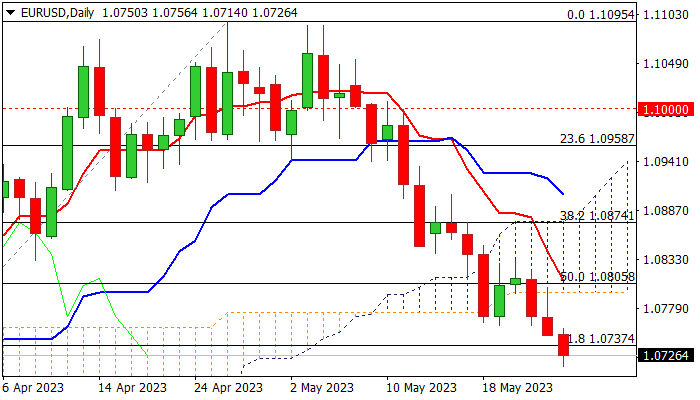
Fresh bears broke through pivotal Fibo support at 0.7374 (61.8% of 1.0516/1.1095 rally) with daily close below this level to confirm signal and open way for test of targets at 1.0700/1.0652 (psychological/Fibo 76.4%).
Rising bearish momentum and pressure from thickening daily cloud above the price, contribute to bearish signals, which are likely to be partially offset by opposite signals from deeply oversold stochastic.
Consolidation would just provide better selling opportunities, as overall picture is bearish and fundamentals were so far negative for the euro, with upticks to be capped under key 1.0800 resistance zone (daily cloud top/falling 10DMA).
Res: 1.0772; 1.0800; 1.0831; 1.0874.
Sup: 1.0700; 1.0652; 1.0631; 1.0600.
Dollar Index: Dollar May Rise Further on Debt Ceiling Uncertainty and Signals of More Fed Rate Hikes
The dollar index keeps firm bullish stance and hit ten-week high on Thursday, driven by growing uncertainty over so far unsuccessful talks about raising US debt ceiling ahead of June 1 deadline, when the Treasury will run out of money.
The minutes of Fed’s last policy meeting added to dollar’s positive sentiment as the policymakers left all options open, despite signals of pausing tightening cycle for the rest of the year.
Inflationary pressures are still high, as inflation is running at more than two times the Fed’s 2% target, which keeps the central bank alerted, while risk to economic growth rose significantly on high borrowing cost and tightening credit conditions after several banks collapsed in past few months that supports dovish approach to monetary policy in coming months.
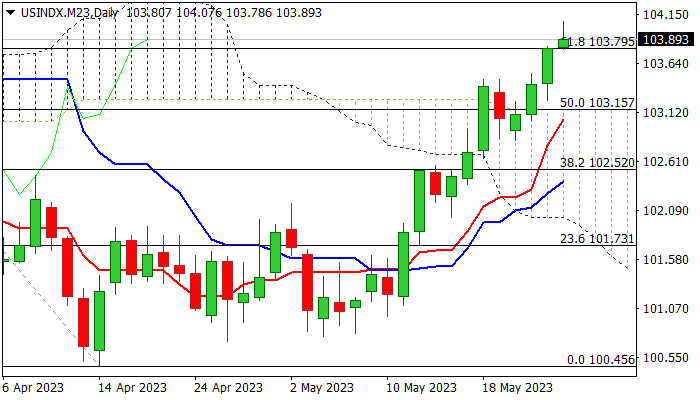
The picture on daily chart is firmly bullish but overbought, suggesting that bulls are likely to face strong headwinds on approach to targets at 104.58/66 (Fibo 76.4% of 105.85/100.45 / base of thick weekly cloud).
Shallow consolidation ahead of fresh push higher would be likely scenario on persisting favored fundamentals, with extended dips to stall above the top of thick daily cloud (103.15) and keep near-term bias with bulls.
Caution on break of daily cloud top (103.15, reinforced by rising daily Tenkan-sen) and loss of 102.83 pivot (May 22 trough) which may sideline bulls and increase risk of deeper pullback.
Res: 104.07; 104.66; 105.00; 105.56.
Sup: 103.79; 103.45; 103.15; 102.83.
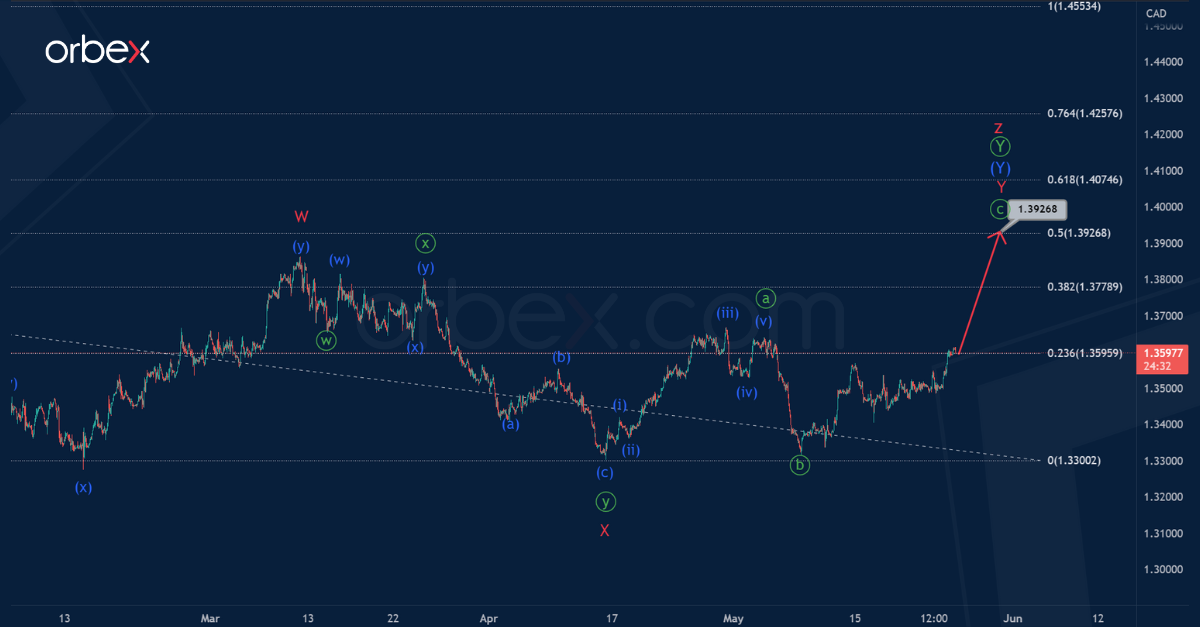
USD/CAD: We Are Witing for Completion of Intermediate Wave (Y) Near 1.392
Most likely, the USDCAD pair forms a global triple zigzag marked with cycle waves w-x-y-x-z.
At the time of writing, the final actionary leg is being built – the sub-wave z. Apparently, it takes the form of a primary double zigzag Ⓦ-Ⓧ-Ⓨ, where the sub-waves Ⓦ-Ⓧ are formed.
Now we are seeing the development of the final wave Ⓨ. It can end in the form of a double zigzag (W)-(X)-(Y) near 1.392. At that level, it will be at 50% of actionary zigzag wave Ⓦ.
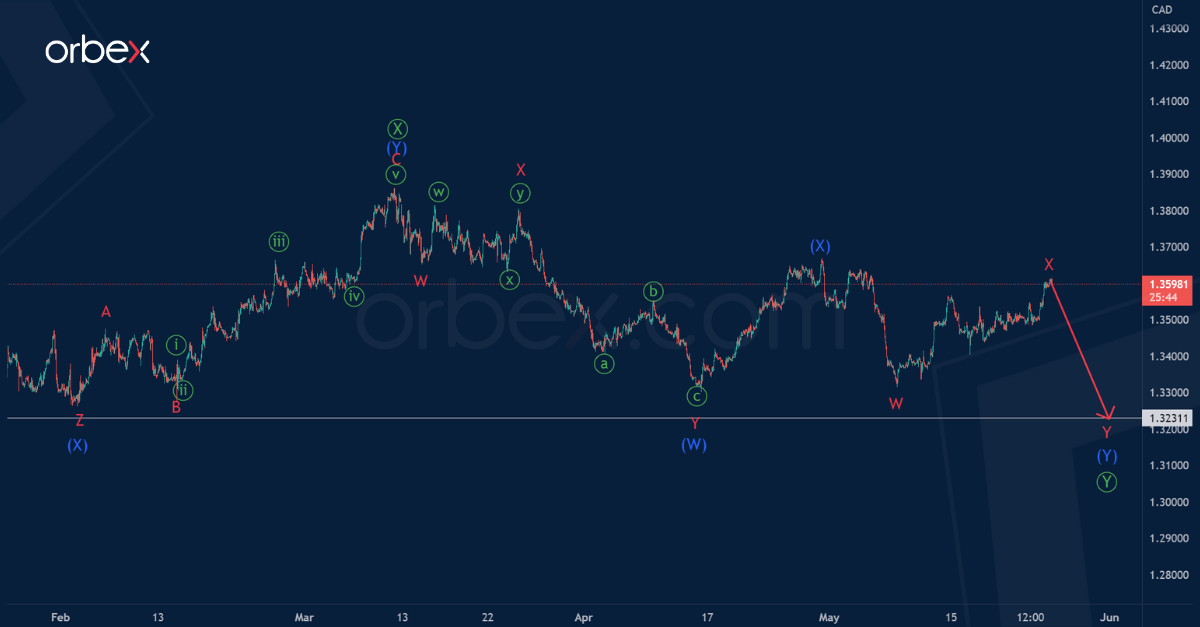
In an alternative scenario, we can expect the construction of a primary double zigzag Ⓦ-Ⓧ-Ⓨ. It is the beginning in a larger corrective pattern.
There is a high probability that the primary waves Ⓦ-Ⓧ are completed. In the near future, a continuation of the bearish primary wave Ⓨ is expected, which will take the structure of a double zigzag (W)-(X)-(Y).
The primary wave Ⓨ, taking the form of a minor double zigzag, may end at the minimum of the wave Ⓦ, near the price level of 1.323.
ECB de Guindos: Will continue tightening path to overcome high inflation
ECB Vice President Luis de Guindos told lawmakers in Brussels today, "Our future decisions will ensure that the policy rates will be brought to levels sufficiently restrictive to achieve a timely return of inflation to our 2% medium-term target." Then, interest rates will be "kept at those levels for as long as necessary," he said.
"Within less than a year we have raised the key interest rate by 375 basis points so far, stopped net purchases of bonds, and will probably stop reinvesting via the APP program from July," he said. "And the ECB Governing Council will continue on this monetary tightening path to overcome high inflation."
"As the energy crisis fades, governments should roll back the related support measures promptly and in a concerted manner to avoid driving up medium-term inflationary pressures, which would call for a stronger monetary policy response," de Guindos added.
Separately, Governing Council member, Bostjan Vasle, said "Further interest-rate increases will be needed."
"But they'll be smaller than they were in the past. We're approaching the level of rates that's restrictive enough to bring inflation back toward 2%. Fiscal — including wage policy — and monetary policies will have to be linked to a greater extent than in the past," Vasle noted.
Euro Dips Lower on Weak German Data
- Germany’s GDP contracts in Q1
- German consumer confidence remains deeply pessimistic
- FOMC minutes shows uncertainty over rate path
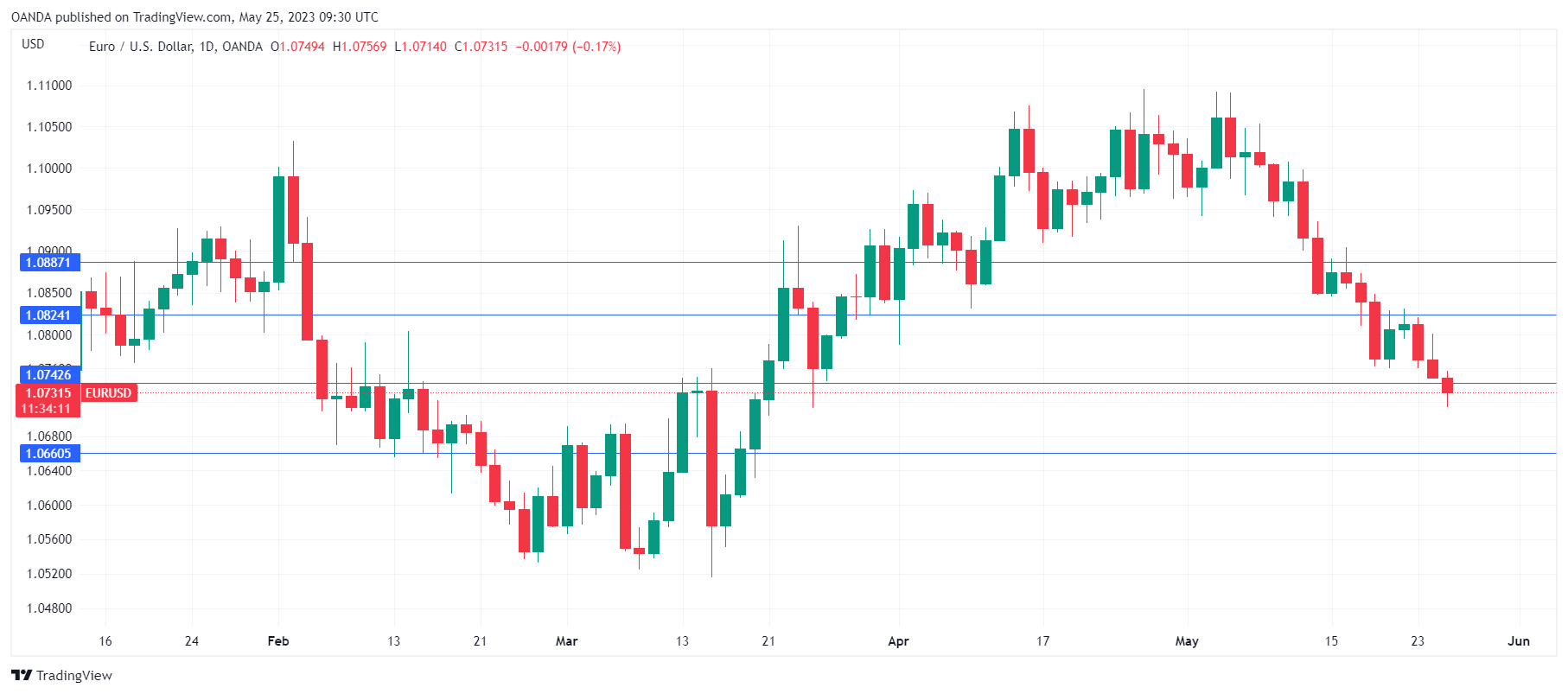
EUR/USD is down for a third straight day. In the European session, EUR/USD is trading at 1.0727, down 0.21%.
German GDP contracts in Q1
Germany’s economy contracted by 0.3% in the first quarter, after a 0.0% in Q4 2020, which was also the estimate. The GDP report noted that German consumers are spending less and government expenditures were also down due to the discontinuation of Covid vaccines and tests. Germany is the largest economy in the eurozone, and the decline in growth is an ominous sign of the strength of the eurozone economy. The eurozone continues to grapple with high inflation and rising interest rates, which are weighing on economic activity.
Germany released Gfk Consumer Confidence for June, which remains mired in negative territory. The reading of -24.2 was up from a downwardly revised -25.8 and just below the estimate of -24.0. This release follows a soft Ifo Business Climate, which fell to 91.7, following a downwardly revised 93.4 and shy of the estimate of 93.0 points. This was the first decline after a six-month expansion. Business expectations dropped from 91.7 to 88.6 and missed the estimate of 91.9 points.
The data points to businesses and consumers remaining pessimistic about economic conditions. Businesses are concerned about banking turmoil in the US, a rocky Chinese reopening and a struggling eurozone economy all weighing on sentiment. Consumers are unhappy about the cost-of-living crisis and have cut back on spending.
Fed divided over interest rate path
The FOMC minutes indicated that the Fed’s rate path is not clear. Fed officials were divided at the May meeting, with some members seeing a need for further increases as inflation was not falling fast enough. Other members argued that the economy was cooling and there was no need for more tightening. The vote to hike rates by 25 basis points was unanimous and the members agreed that inflation was unacceptably high and was declining slower than expected.
EUR/USD Technical
- There is resistance at 1.0824 and 1.0887
- EUR/USD is testing support at 1.0742. Below, there is support at 1.0660
AUDUSD Pauses Decline But Bears Still in Control
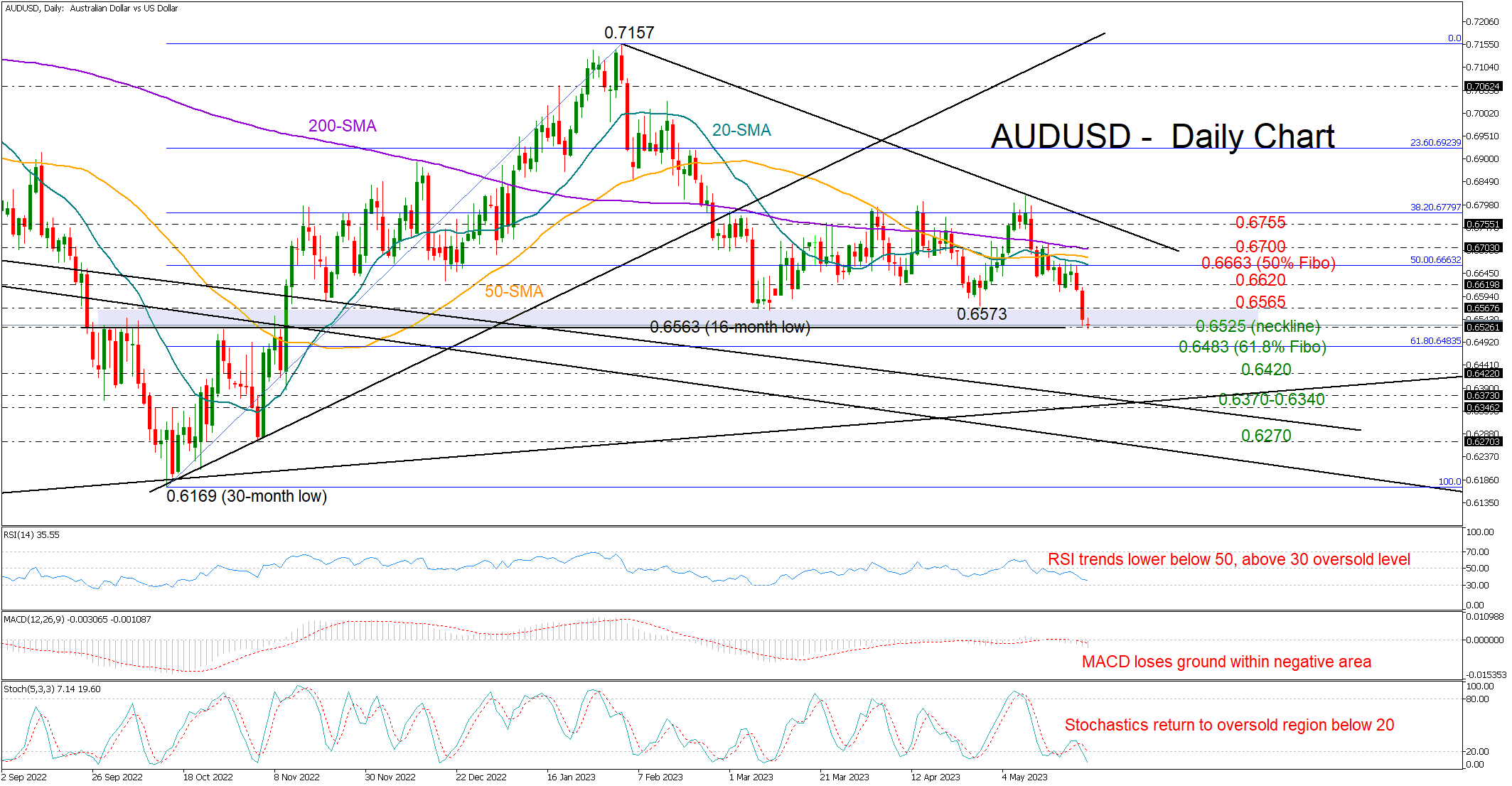
AUDUSD plummeted to a six-month low on Wednesday to find support around the key 0.6525 area, which is the broken neckline of the inverse head and shoulders pattern registered last Autumn.
From a technical perspective, the bearish wave has more room to run as the falling RSI has yet to reach its 30 oversold level, while the Stochastic oscillator has flipped backwards to re-enter the oversold region below 20. The MACD keeps decelerating within the negative zone, sending bearish vibes as well.
Trend signals are also discouraging, with the price having declined below its simple moving averages (SMAs) to violate the 0.6565 floor of the short-term range.
Should sellers claim the 0.6525 base, the pair may initially test the 61.8% Fibonacci retracement of the previous upleg at 0.6483 before falling aggressively towards the 0.6420 region taken from Autumn 2022 and May 2020. Even lower, the 0.6370-0.6340 territory could be of greater importance as the tentative support trendline from 2020 lows intersects the descending line from August 2021 within this zone. If the downfall continues, the next destination could be the 0.6270 bar.
On the upside, the bulls might need to overcome the 0.6565-0.6620 zone in order to challenge the 20-day SMA and the 50% Fibonacci of 0.6663. A decisive close above the 200-day SMA at 0.6700 could provide direct access to the tentative resistance trendline currently seen around 0.6755.
All in all, AUDUSD may experience more selling in the coming sessions, but for that to happen, the 0.6525 floor should collapse.
GBP/JPY Daily Outlook
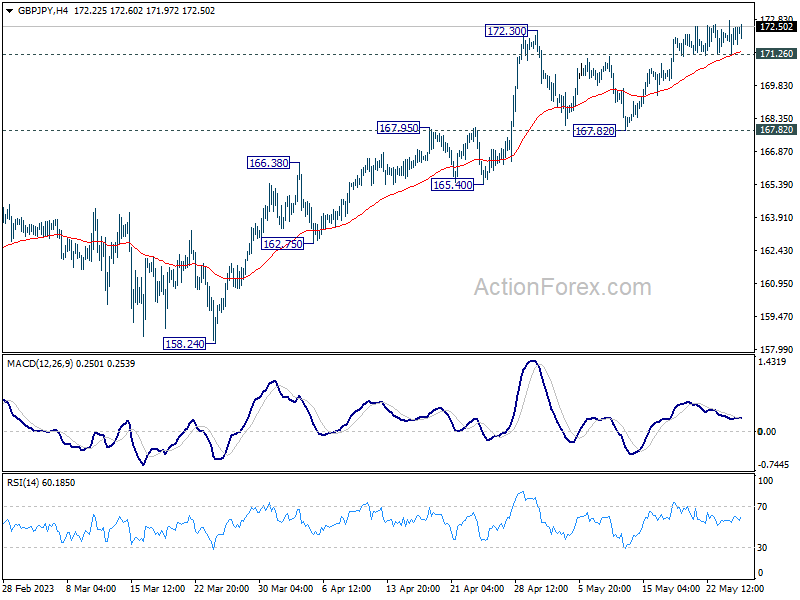
Daily Pivots: (S1) 171.53; (P) 172.16; (R1) 173.10; More...
No change in GBP/JPY's outlook and further rise is expected with 171.26 minor support intact. Current rally should target 100% projection of 148.93 to 172.11 from 155.33 at 178.51. Nevertheless, break of 171.26 minor support will delay the bullish case, and turn bias to the downside for deeper retreat.
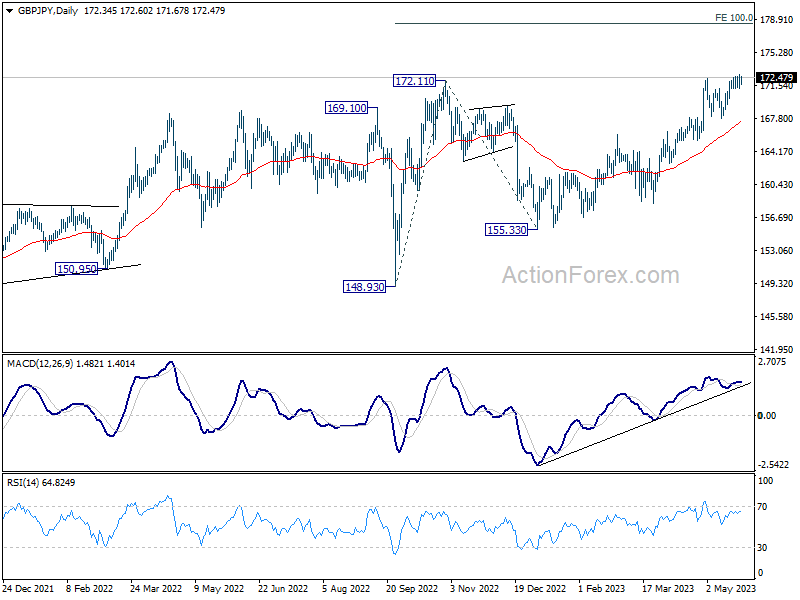
In the bigger picture, focus stays on 172.11 resistance (2022 high). Decisive break there will resume whole up trend from 123.94 (2020 low). Next target will be 161.8% projection of 122.75 (2016 low) to 156.59 (2018 high) from 123.94 at 178.69. Nevertheless, firm break of 165.40 support will indicate rejection by 172.11 and extend the corrective pattern from there with another falling leg.
EUR/JPY Daily Outlook
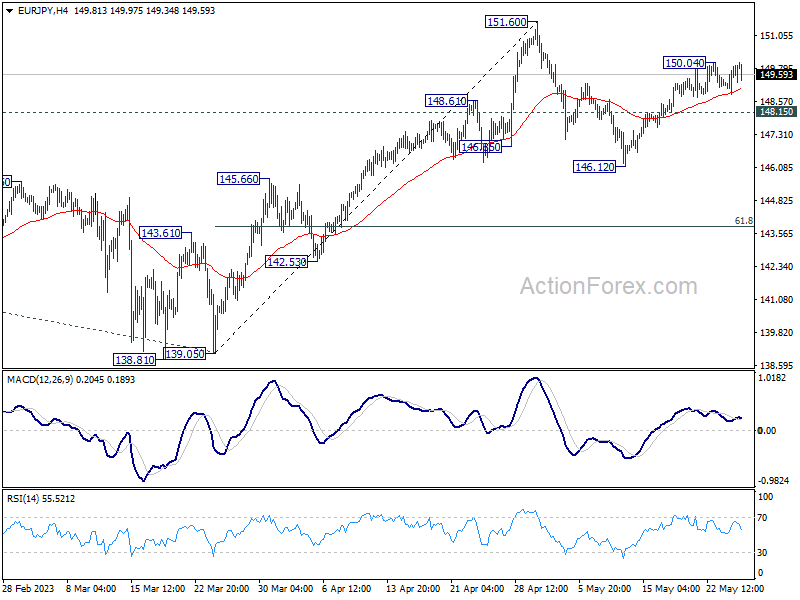
Daily Pivots: (S1) 149.20; (P) 149.57; (R1) 150.30; More....
Intraday bias in EUR/JPY stays neutral first. On the upside, break of 150.04 will extend the rebound from 146.12 to retest 151.60 high. Decisive break there will resume larger up trend. On the downside, however, break of 148.15 minor support should extend the corrective pattern from 151.60 with another falling leg through 146.12.
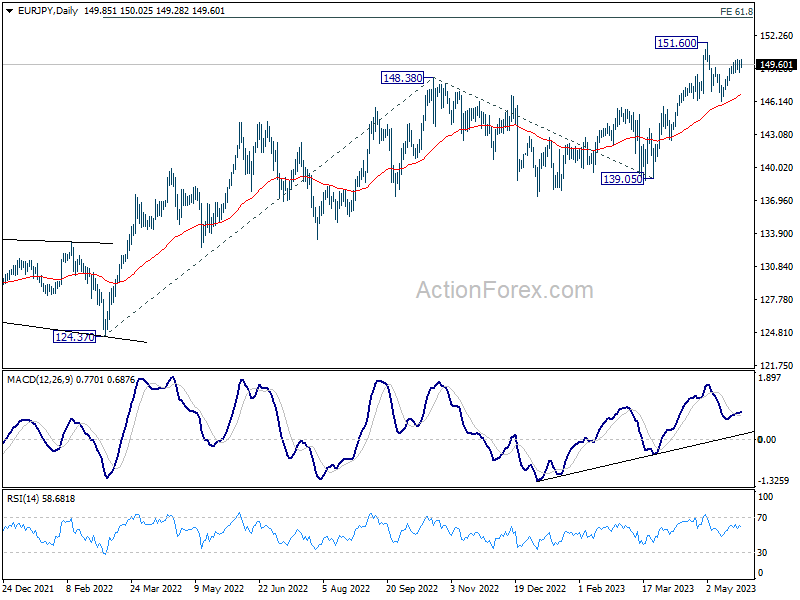
In the bigger picture, rise from 114.42 (2020 low) is in progress. Next target is 61.8% projection of 124.37 to 148.38 from 138.81 at 153.64. Sustained break there will pave the way to 100% projection at 162.82. For now, medium term outlook will remain bullish as long as 139.05 support holds, even in case of deep pull back.
EUR/GBP Daily Outlook
Daily Pivots: (S1) 0.8659; (P) 0.8684; (R1) 0.8720; More...
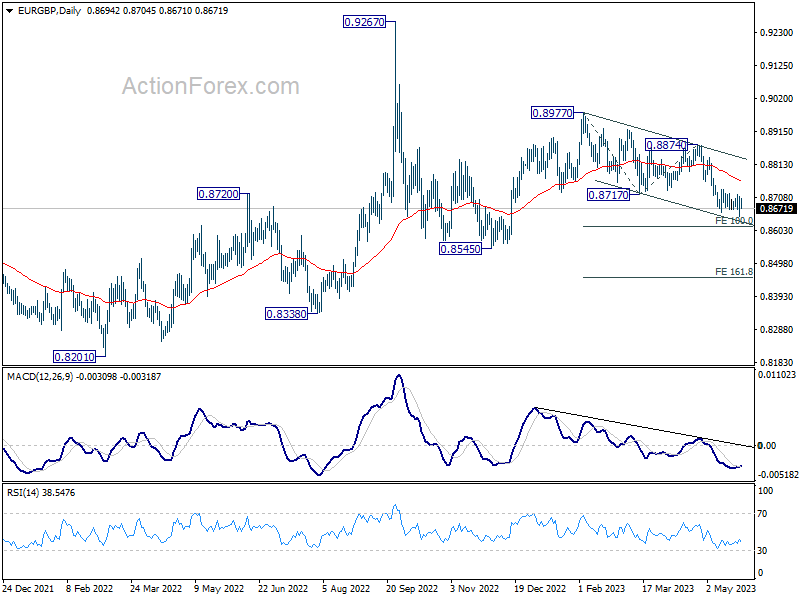
Some volatility is seen in EUR/GBP with loss of downside momentum. But still, further decline is in favor as long as 0.8717 resistance holds. Current fall from 0.8977 should target 100% projection of 0.8977 to 0.8717 from 0.8874 at 0.8614. On the upside, however, break of 0.8717 will indicate short term bottoming, and turn bias back to the upside for stronger rebound.
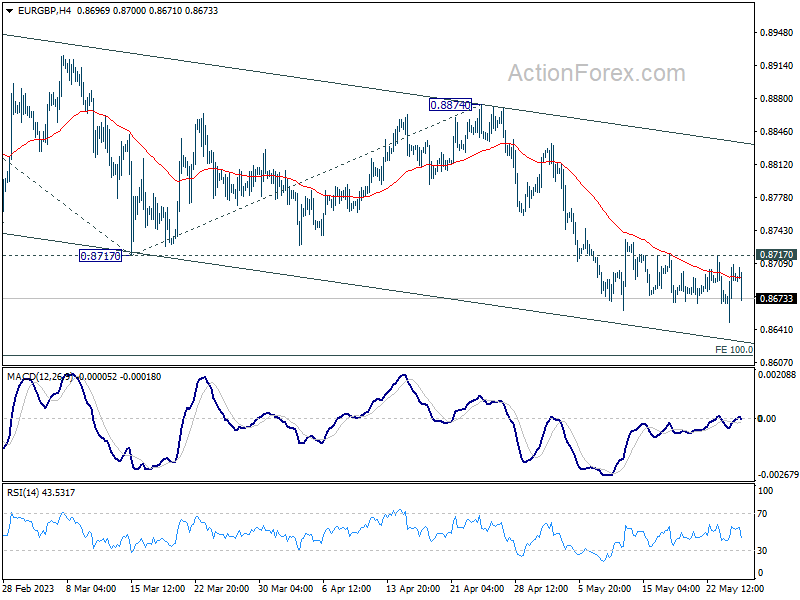
In the bigger picture, current development argues that whole decline from 0.9267 (2022 high) is still in progress. This is part of the long term range pattern from 0.9499 (2020 high). Deeper fall would be seen through 0.8545 support. This will now remain the favored case as long as 0.8874 resistance holds.