

Sample Category Title
Forex and Cryptocurrency Forecast
EUR/USD: Fed rate Divination Continues
The dollar seems to be either weakening or not. On the one hand, the DXY dollar index updated a two-month low on April 4, falling below the support of 101.50, and EUR/USD rose to a new high of 1.0972. On the other hand, the pair returned by the end of last week to where it had already been on March 23 and 31.
DXY continues to be pressured by poor US macro statistics. The country's GDP growth for Q4 2022 was 2.6%, which is lower than both the forecast and the previous value (2.7%). Business activity in March continued to decline at an accelerated pace: the PMI index in the manufacturing sector fell to 46.3 against the forecast of 47.5 and 47.7 in February, and it fell to 51.2 in the services sector (forecast 54.5, February value 55.1). New orders for industrial goods fell by 0.7% in February, worse than the forecast of 0.5% once again. And this despite the fact that they had already fallen by 2.1% a month earlier. The JOLTs job market report showed a decline in the number of open vacancies to 9.9 million, the lowest figure in the last two years.
The US Bureau of Labor Statistics released its March employment report on Friday, March 07. The number of new jobs created outside the agricultural sector (NFP) in the United States, with a forecast of 240K, in reality fell to 236K. This figure was significantly higher in February and amounted to 326K. But the unemployment rate fell from 3.6% to 3.5%, which slightly supported the US currency (on the thin market, DXY rose above 102.00). However, the main reaction of the market to these data will follow only next week. April 07 in Europe, the USA and a number of other countries was a day off, Good Friday. Europe takes a break on Easter Monday, April 10 as well. The last time NFP was released on Good Friday was in 2021, and then, despite a sharp jump in this indicator, the delayed market response was very restrained.
Of course, all of the above indicators may lead to adjustments in market expectations for the US Federal Reserve rate. However, the next FOMC (Federal Open Market Committee) meeting will be held only on May 03, and many more significant statistics will be released before then. The weak state of the economy may cool the hawkish ardor of the FOMC members and force them to take a break in tightening monetary policy, leaving the rate at the same level of 5.00%. At the moment, according to the CME Group FedWatch Tool, there is a 52.7% chance of another rate hike of 25 basis points (bp).
EUR/USD closed last week at 1.0901. At the time of writing this review, on the evening of Friday, April 07, the opinions of analysts are divided almost equally: 35% of them expect further weakening of the dollar, 35% - its strengthening, and the remaining 30% have taken a neutral position. Among the oscillators on D1, 90% are colored green, another 10% are gray neutral. Among trend indicators, 75% recommend buying, 15% - selling. The nearest support for the pair is located at 1.0885, 1.0860, then 1.0740-1.0760, 1.0675-1.0710, 1.0620 and 1.0490-1.0530. Bulls will meet resistance at 1.0925, then 1.0955, 1.0985-1.1030, 1.1110, 1.1230, 1.1280 and 1.1355-1.1390.
Retail sales in the Eurozone will be announced this week on Monday April 11. The next day, important data on consumer inflation (CPI ) in the US will be released. The minutes of the March FOMC meeting will also be published on Wednesday. On Thursday, the CPI values in Germany, the number of initial jobless claims in the US and the US Producer Price Index (PPI) will be known. On Friday, we will have a whole package of statistics on retail sales in the US.

GBP/USD: PMI Gives Investors Hope
Against the backdrop of a weakened dollar, GBP/USD feels quite good, and the pound made another high on April 04, reaching a high of 1.2525. It has not traded this high since the beginning of June 2022. However, then there was a slight correction, and the pair completed the five-day period at the level of 1.2414, returning to the values of mid-December 2022 - the second half of January 2023.
As a matter of fact, the UK economy, like the US, had nothing to brag about last week. The index of business activity (PMI) in the manufacturing sector of the country, published on April 3, showed a decrease from 49.3 to 47.9 points (with a forecast of 48.0). PMI values in the services sector and the composite value of this Index also turned out to be lower than the previous values - 52.9/53.5 and 52.2/53.1, respectively. However, the fact that both of these Indexes are holding above the 50.0 mark gives investors hope that the British economy is able to avoid a recession. This, in turn, supports the position of the national currency.
At the moment, 40% of experts side with the pound, the same number (40%) have taken a wait-and-see position, only 20% have turned out to side with the dollar. Among the oscillators on D1, the balance of power is as follows: 90% vote in favor of green and 10% have turned red. Among the trend indicators, the advantage is on the side of the greens, they have 85%, the enemy has 15%. Support levels and zones for the pair are 1.2390, 1.2330, 1.2275, 1.2200, 1.2145, 1.2075-1.2085, 1.2000-1.2025, 1.1960, 1.1900-1.1920, 1.1800-1.1840. When the pair moves north, it will face resistance at levels 1.2450, 1.2510-1.2525, 1.2575-1.2610, 1.2700, 1.2750 and 1.2940.
In terms of the UK economy, there are two speeches by Bank of England (BoE) Governor Andrew Bailey next week on Wednesday April 12. On Thursday, April 13, there will be data on production volumes in the manufacturing industry, as well as on the country's GDP. As a reminder, Monday April 10 is Easter Bank Holiday in the United Kingdom.
USD/JPY: BoJ Remains Ultra Soft
This time the dynamics of USD/JPY as a whole corresponded (as it should be, mirrored) to what its "colleagues" in DXY were doing. At the beginning of the week, it fell from a height of 133.75 and recorded a local low of 130.60 on April 5. And then it went up, reaching 132.37 in a thin market and a sluggish US employment report. The last chord of the week sounded a bit lower, at 132.14.
As far as Japan's monetary policy is concerned, nothing has changed here: external influencers still hope for its tightening, domestic influencers say that the ultra-soft, dovish rate remains unchanged. Thus, on Friday, April 7, Kristalina Georgieva, Managing Director of the International Monetary Fund (IMF), gently hinted that "it is appropriate to make the Bank of Japan's monetary policy more flexible." And Japanese Finance Minister Shunichi Suzuki on Friday praised the efforts of the outgoing Governor of the Bank of Japan (BoJ) Haruhiko Kuroda and expressed the hope that under the new leadership, the Central Bank "will continue to support its adequate and expedient policy."
We wrote in our previous review that Societe Generale economists expect that any steps to change the BoJ rate can be taken no earlier than June. The comments of their colleagues from ANZ Bank look similar. "In the near term, [BOJ] policy change looks unlikely," they wrote. And if changes do occur, then, according to ANZ Bank forecasts, they can be expected only after Q2 of this year.
As for the immediate prospects for USD/JPY, at the moment 55% of experts vote for the further movement of the pair to the north, and 45% point in the opposite direction. Among the oscillators on D1, 25% point south, the same number look in the opposite direction, and 50% are neutral. For trend indicators, 40% point to the north, the remaining 60% point to the south. The nearest support level is located in the zone 131.85-132.00, then there are levels and zones 131.25, 130.50-130.60, 129.70-130.00, 128.00-128.15 and 127.20. Resistance levels and zones are 132.80-133.00, 133.60-133.75, 134.35, 135.00-135.35, 135.90-136.00, 137.00, 137.50 and 137.90-138.00.
As for the release of any important statistics on the state of the Japanese economy, it is not expected this week.
CRYPTOCURRENCIES: $29,000 Resistance Has Never Been Taken
The beginning of the previous review sounded like this: "The crisis that crippled Silvergate, Silicon Valley Bank (SVB) and Signature and hit Credit Suisse has certainly helped the crypto market by reminding what decentralized finance was created for. However, investors' fears about a new wave of the banking crisis in the US and Europe are gradually fading away, which is clearly seen on the BTC/USD chart. If during the March 10-17 rally, digital gold gained almost 45% in weight, it has been unsuccessfully trying to storm the important $29,000 resistance for the last two weeks. […] BTC is supported by the $26,500 level."
This was written seven days ago, but even now everything said remains relevant. The only amendment is that the fluctuation range narrowed even more last week, and the local low was fixed at $27,190. Triggers are needed to break through this range in one direction or another, they have not yet been observed.
As already mentioned, the crypto market, especially bitcoin, was supported by the banking crisis and the worsening macroeconomic environment in general. However, the industry continues to be under regulatory pressure from US government agencies, which have now been joined by their UK colleagues. As a result, on the one hand, we are seeing a decrease in BTC liquidity to a 10-month low, and on the other, an increase in trading volumes.
According to a CNBC survey of industry influencers, the market remains bullish on the future of the first cryptocurrency at this stage. According to the analytical company Glassnode, its attractiveness continues to increase. Experts from this company note that a surge in trader activity was recorded in the second half of last year, when bitcoin fell to $15,000, and a similar trend is observed in 2023. Thus, the number of unique addresses on the bitcoin network with a balance of at least one coin has reached 992,243. The number of addresses controlling from 100 to 1000 BTC is 14,004. The four largest whales hold between 100,000 and 1 million BTC, including the Binance and Bitfinex exchanges, which control 248,597 and 178,010 bitcoins, respectively. At the same time, it is possible that one of these four whales is the US government. According to Dune analysts, the total stock of the first cryptocurrency in the US authorities is 205,515 BTC: more than 1% of the coin issue (mostly these assets were obtained during confiscation from criminals).
Representatives of the Derebit platform confirm the general bullish attitude. According to them, open interest in bitcoin derivatives continues to grow steadily. Derebit stressed that most of the positions are open to buy, as investors continue to believe in the potential of the crypto market's flagship.
In parallel with the growing attractiveness of digital assets for investors, their attractiveness for criminals is also growing. Cybercriminals have stolen $255.8 million in digital currencies since the beginning of the year. At the same time, "only" $8.8 million was stolen in January, 3.5 times more - $35.5 million in February, and the figure rose to $211.5 million in March.
A crypto analyst known as Stockmoney Lizards analyzed the dynamics of the flagship crypto asset. In his opinion, the asset's monthly chart looks promising and indicates the potential for further growth. The expert's assumptions are supported by the readings of the RSI indicator. Stockmoney Lizards believes that the current market situation is very similar to the period from 2017 to 2020, when a steady upward trend began to form, and that bitcoin will soon be able to reach the key $47,000 mark.
Another well-known analyst, Michael Van De Poppe, shares this view. According to the expert, buyers are still in control of the situation. If bitcoin quotes remain above $25,000 for some time, we can count on a potential increase up to the level of $40,000.
Charles Edwards, founder of hedge fund Capriole Investments, has noted a "familiar" bullish signal on the SLRV Ribbons metric. SLRV Ribbons is a tool to measure the potential return of bitcoin. It analyzes the interaction of two moving averages. When the short-term 30-day MA crosses the long-term 150-day MA, bitcoin is in the beginning of a bullish phase. This metric is "as simple as it gets," Edwards tweeted. "It is currently repeating classic bullish behavior with a crossover in early 2023." The specialist added that although SLRV Ribbons is a relatively new tool, tests have proven its reliability and ability to increase the return on investments in BTC.
SLRV is not the only metric that gave the founder of Capriole Investments a sense of déjà vu this month. The Bitcoin Yardstick tool shows a retracement of bitcoin's market value relative to hashrate, but still classifies BTC as "cheap" at current prices. "Bitcoin Yardstick is drawing a very familiar signature to the 2019 lows," Edwards commented on the indicator readings. At the beginning of that year, after exiting the "cheap" zone, BTC/USD saw only one brief drop during the crisis caused by the start of the COVID-19 pandemic in March 2020. At the moment, according to indicators, price targets for BTC are fixed at $35,000.
Moving from short-term to long-term, Arthur Hayes, the former CEO of BitMEX crypto exchange, was the biggest optimist here, citing $1 million per coin as a target for bitcoin. He was prompted to do so by the news that the People's Bank of China lowered the required reserve ratios (RRR) for all banks by 0.25%. (For reference: The required reserve ratio is the statutory share of a commercial bank's liabilities on attracted deposits. When this rate is lowered, the amount of funds that commercial banks can provide for lending or investment increases.
At the time of this writing, Friday evening, April 07, BTC/USD is clearly still very far from reaching $1 million and is currently trading at $27,860. The total capitalization of the crypto market is $1.177 trillion ($1.185 trillion a week ago). The Crypto Fear & Greed Index has risen by just one point in seven days, from 63 to 64, and is still in the Greed zone.
And finally, a few words about the main altcoin, ethereum. The long-awaited Shanghai hard fork will take place on its network on April 12, which will allow validators to withdraw coins frozen for staking. At the moment, their volume is 18 million ETH, or 15% of the total supply.
To reduce potential pressure on the price and not overload the network, those wishing to exit staking will be forced to stand in line. The maximum daily outflow is limited to 2,200 transactions or 70k coins. Most likely, this queue will be quite long. And much of this is due to U.S. regulators, which put even more pressure on ethereum than bitcoin. Here are pre-trial proceedings with the Kraken and Coinbase crypto exchanges to refuse staking, and the SEC's desire to assign ETH the status of a security. All this, of course, despite the hard fork, reduces the attractiveness of this asset for investors, and makes the prospects for ethereum very vague. Well-known trader and analyst Benjamin Cowen believes that the best time to buy ethereum will be when ETH/BTC falls into the range from 0.03 to 0.04 (currently 0.067). The analyst assures that he will wait for these figures, and only then will he make an appropriate investment decision.
Summary 4/10 – 4/14
Monday, Apr 10, 2023
| GMT | Ccy | Events | Consensus | Previous |
|---|---|---|---|---|
| 23:50 | JPY | Current Account (JPY) Feb | 1.42T | 0.22T |
| 05:00 | JPY | Eco Watchers Survey: Current Mar | 50.4 | 52 |
| 05:00 | JPY | Consumer Confidence Index Mar | 31.6 | 31.1 |
| 14:00 | USD | Wholesale Inventories Feb F | 0.20% | 0.20% |
| GMT | Ccy | Events | |
|---|---|---|---|
| 23:50 | JPY | Current Account (JPY) Feb | |
| Forecast: 1.42T | Previous: 0.22T | ||
| 05:00 | JPY | Eco Watchers Survey: Current Mar | |
| Forecast: 50.4 | Previous: 52 | ||
| 05:00 | JPY | Consumer Confidence Index Mar | |
| Forecast: 31.6 | Previous: 31.1 | ||
| 14:00 | USD | Wholesale Inventories Feb F | |
| Forecast: 0.20% | Previous: 0.20% | ||
Tuesday, Apr 11, 2023
| GMT | Ccy | Events | Consensus | Previous |
|---|---|---|---|---|
| 00:30 | AUD | Westpac Consumer Confidence Apr | 0.00% | |
| 01:30 | AUD | NAB Business Conditions Mar | 17 | |
| 01:30 | AUD | NAB Business Confidence Mar | -4 | |
| 01:30 | CNY | CPI Y/Y Mar | 1.00% | 1.00% |
| 01:30 | CNY | PPI Y/Y Mar | -2.50% | -1.40% |
| 06:00 | JPY | Machine Tool Orders Y/Y Mar P | -10.70% | |
| 08:30 | EUR | Sentix Investor Confidence (Apr) | -14 | -11.1 |
| 09:00 | EUR | Eurozone Retail Sales M/M Mar | -0.80% | 0.30% |
| 10:00 | USD | NFIB Business Optimism Index Mar | 89.6 | 90.9 |
| 23:50 | JPY | Bank Lending Y/Y Mar | 3.60% | 3.30% |
| 23:50 | JPY | PPI Y/Y Mar | 7.10% | 8.20% |
| 23:50 | JPY | Machinery Orders M/M Feb | -7.80% | 9.50% |
| GMT | Ccy | Events | |
|---|---|---|---|
| 00:30 | AUD | Westpac Consumer Confidence Apr | |
| Forecast: | Previous: 0.00% | ||
| 01:30 | AUD | NAB Business Conditions Mar | |
| Forecast: | Previous: 17 | ||
| 01:30 | AUD | NAB Business Confidence Mar | |
| Forecast: | Previous: -4 | ||
| 01:30 | CNY | CPI Y/Y Mar | |
| Forecast: 1.00% | Previous: 1.00% | ||
| 01:30 | CNY | PPI Y/Y Mar | |
| Forecast: -2.50% | Previous: -1.40% | ||
| 06:00 | JPY | Machine Tool Orders Y/Y Mar P | |
| Forecast: | Previous: -10.70% | ||
| 08:30 | EUR | Sentix Investor Confidence (Apr) | |
| Forecast: -14 | Previous: -11.1 | ||
| 09:00 | EUR | Eurozone Retail Sales M/M Mar | |
| Forecast: -0.80% | Previous: 0.30% | ||
| 10:00 | USD | NFIB Business Optimism Index Mar | |
| Forecast: 89.6 | Previous: 90.9 | ||
| 23:50 | JPY | Bank Lending Y/Y Mar | |
| Forecast: 3.60% | Previous: 3.30% | ||
| 23:50 | JPY | PPI Y/Y Mar | |
| Forecast: 7.10% | Previous: 8.20% | ||
| 23:50 | JPY | Machinery Orders M/M Feb | |
| Forecast: -7.80% | Previous: 9.50% | ||
Wednesday, Apr 12, 2023
| GMT | Ccy | Events | Consensus | Previous |
|---|---|---|---|---|
| 12:30 | USD | CPI M/M Mar | 0.30% | 0.40% |
| 12:30 | USD | CPI Y/Y Mar | 5.20% | 6.00% |
| 12:30 | USD | CPi Core M/M Mar | 0.40% | 0.50% |
| 12:30 | USD | CPi Core Y/Y Mar | 5.60% | 5.50% |
| 14:00 | CAD | BoC Interest Rate Decision | 4.50% | 4.50% |
| 14:30 | USD | Crude Oil Inventories | -3.7M | |
| 15:00 | CAD | BoC Press Conference | ||
| 18:00 | USD | FOMC Minutes | ||
| 23:50 | JPY | Money Supply M2+CD Y/Y Mar | 2.50% | 2.60% |
| GMT | Ccy | Events | |
|---|---|---|---|
| 12:30 | USD | CPI M/M Mar | |
| Forecast: 0.30% | Previous: 0.40% | ||
| 12:30 | USD | CPI Y/Y Mar | |
| Forecast: 5.20% | Previous: 6.00% | ||
| 12:30 | USD | CPi Core M/M Mar | |
| Forecast: 0.40% | Previous: 0.50% | ||
| 12:30 | USD | CPi Core Y/Y Mar | |
| Forecast: 5.60% | Previous: 5.50% | ||
| 14:00 | CAD | BoC Interest Rate Decision | |
| Forecast: 4.50% | Previous: 4.50% | ||
| 14:30 | USD | Crude Oil Inventories | |
| Forecast: | Previous: -3.7M | ||
| 15:00 | CAD | BoC Press Conference | |
| Forecast: | Previous: | ||
| 18:00 | USD | FOMC Minutes | |
| Forecast: | Previous: | ||
| 23:50 | JPY | Money Supply M2+CD Y/Y Mar | |
| Forecast: 2.50% | Previous: 2.60% | ||
Thursday, Apr 13, 2023
| GMT | Ccy | Events | Consensus | Previous |
|---|---|---|---|---|
| 01:00 | AUD | Consumer Inflation Expectations Apr | 5.00% | |
| 01:30 | AUD | Employment Change Mar | 20.0K | 64.6K |
| 01:30 | AUD | Unemployment Rate Mar | 3.60% | 3.50% |
| 03:00 | CNY | Trade Balance (USD) Mar | 40.0B | 116.9B |
| 03:00 | CNY | Exports Y/Y Mar | 3.10% | -6.80% |
| 03:00 | CNY | Imports Y/Y Mar | 3.90% | -10.20% |
| 06:00 | EUR | Germany CPI M/M Mar F | 0.80% | 0.80% |
| 06:00 | EUR | Germany CPI Y/Y Mar F | 7.40% | 7.40% |
| 06:00 | GBP | GDP M/M Feb | 0.10% | 0.30% |
| 06:00 | GBP | Index of Services 3M/3M Feb | -0.20% | 0.00% |
| 06:00 | GBP | Industrial Production M/M Feb | 0.30% | -0.30% |
| 06:00 | GBP | Industrial Production Y/Y Feb | -3.70% | -4.30% |
| 06:00 | GBP | Manufacturing Production M/M Feb | 0.30% | -0.40% |
| 06:00 | GBP | Manufacturing Production Y/Y Feb | -4.70% | -5.20% |
| 06:00 | GBP | Goods Trade Balance (GBP) Feb | -17.0B | -17.9B |
| 08:00 | EUR | Italy Industrial Output M/M Feb | 0.50% | -0.70% |
| 09:00 | EUR | Eurozone Industrial Production M/M Feb | 1.00% | 0.70% |
| 11:00 | GBP | NIESR GDP Estimate (3M) Mar | -0.10% | -0.10% |
| 12:30 | USD | PPI M/M Mar | 0.10% | -0.10% |
| 12:30 | USD | PPI Y/Y Mar | 3.10% | 4.60% |
| 12:30 | USD | PPI Core M/M Mar | 0.20% | 0.00% |
| 12:30 | USD | PPI Core Y/Y Mar | 3.30% | 4.40% |
| 12:30 | USD | Initial Jobless Claims (Apr 7) | 235K | 228K |
| 14:30 | USD | Natural Gas Storage | -23B | |
| 22:30 | NZD | Business NZ PMI Mar | 51 | 52 |
| GMT | Ccy | Events | |
|---|---|---|---|
| 01:00 | AUD | Consumer Inflation Expectations Apr | |
| Forecast: | Previous: 5.00% | ||
| 01:30 | AUD | Employment Change Mar | |
| Forecast: 20.0K | Previous: 64.6K | ||
| 01:30 | AUD | Unemployment Rate Mar | |
| Forecast: 3.60% | Previous: 3.50% | ||
| 03:00 | CNY | Trade Balance (USD) Mar | |
| Forecast: 40.0B | Previous: 116.9B | ||
| 03:00 | CNY | Exports Y/Y Mar | |
| Forecast: 3.10% | Previous: -6.80% | ||
| 03:00 | CNY | Imports Y/Y Mar | |
| Forecast: 3.90% | Previous: -10.20% | ||
| 06:00 | EUR | Germany CPI M/M Mar F | |
| Forecast: 0.80% | Previous: 0.80% | ||
| 06:00 | EUR | Germany CPI Y/Y Mar F | |
| Forecast: 7.40% | Previous: 7.40% | ||
| 06:00 | GBP | GDP M/M Feb | |
| Forecast: 0.10% | Previous: 0.30% | ||
| 06:00 | GBP | Index of Services 3M/3M Feb | |
| Forecast: -0.20% | Previous: 0.00% | ||
| 06:00 | GBP | Industrial Production M/M Feb | |
| Forecast: 0.30% | Previous: -0.30% | ||
| 06:00 | GBP | Industrial Production Y/Y Feb | |
| Forecast: -3.70% | Previous: -4.30% | ||
| 06:00 | GBP | Manufacturing Production M/M Feb | |
| Forecast: 0.30% | Previous: -0.40% | ||
| 06:00 | GBP | Manufacturing Production Y/Y Feb | |
| Forecast: -4.70% | Previous: -5.20% | ||
| 06:00 | GBP | Goods Trade Balance (GBP) Feb | |
| Forecast: -17.0B | Previous: -17.9B | ||
| 08:00 | EUR | Italy Industrial Output M/M Feb | |
| Forecast: 0.50% | Previous: -0.70% | ||
| 09:00 | EUR | Eurozone Industrial Production M/M Feb | |
| Forecast: 1.00% | Previous: 0.70% | ||
| 11:00 | GBP | NIESR GDP Estimate (3M) Mar | |
| Forecast: -0.10% | Previous: -0.10% | ||
| 12:30 | USD | PPI M/M Mar | |
| Forecast: 0.10% | Previous: -0.10% | ||
| 12:30 | USD | PPI Y/Y Mar | |
| Forecast: 3.10% | Previous: 4.60% | ||
| 12:30 | USD | PPI Core M/M Mar | |
| Forecast: 0.20% | Previous: 0.00% | ||
| 12:30 | USD | PPI Core Y/Y Mar | |
| Forecast: 3.30% | Previous: 4.40% | ||
| 12:30 | USD | Initial Jobless Claims (Apr 7) | |
| Forecast: 235K | Previous: 228K | ||
| 14:30 | USD | Natural Gas Storage | |
| Forecast: | Previous: -23B | ||
| 22:30 | NZD | Business NZ PMI Mar | |
| Forecast: 51 | Previous: 52 | ||
Friday, Apr 14, 2023
| GMT | Ccy | Events | Consensus | Previous |
|---|---|---|---|---|
| 06:30 | CHF | Producer and Import Prices M/M Mar | -0.20% | -0.20% |
| 06:30 | CHF | Producer and Import Prices Y/Y Mar | 2.70% | 2.70% |
| 12:30 | CAD | Manufacturing Sales M/M Feb | -2.50% | 4.10% |
| 12:30 | USD | Retail Sales M/M Mar | -0.50% | -0.40% |
| 12:30 | USD | Retail Sales ex Autos M/M Mar | -0.40% | -0.10% |
| 12:30 | USD | Import Price Index M/M Mar | -0.20% | -0.10% |
| 13:15 | USD | Industrial Production M/M Mar | 0.20% | 0.00% |
| 14:00 | USD | Michigan Consumer Sentiment Index Apr P | 62.7 | 62 |
| 14:00 | USD | Business Inventories Feb | 0.20% | -0.10% |
| GMT | Ccy | Events | |
|---|---|---|---|
| 06:30 | CHF | Producer and Import Prices M/M Mar | |
| Forecast: -0.20% | Previous: -0.20% | ||
| 06:30 | CHF | Producer and Import Prices Y/Y Mar | |
| Forecast: 2.70% | Previous: 2.70% | ||
| 12:30 | CAD | Manufacturing Sales M/M Feb | |
| Forecast: -2.50% | Previous: 4.10% | ||
| 12:30 | USD | Retail Sales M/M Mar | |
| Forecast: -0.50% | Previous: -0.40% | ||
| 12:30 | USD | Retail Sales ex Autos M/M Mar | |
| Forecast: -0.40% | Previous: -0.10% | ||
| 12:30 | USD | Import Price Index M/M Mar | |
| Forecast: -0.20% | Previous: -0.10% | ||
| 13:15 | USD | Industrial Production M/M Mar | |
| Forecast: 0.20% | Previous: 0.00% | ||
| 14:00 | USD | Michigan Consumer Sentiment Index Apr P | |
| Forecast: 62.7 | Previous: 62 | ||
| 14:00 | USD | Business Inventories Feb | |
| Forecast: 0.20% | Previous: -0.10% | ||
Week Ahead – Can CPI, Retail Sales, and Bank Earnings Derail Fed Rate Hike Odds?
US
The US labor market is softening, but still remains tight and that should keep the door open for policymakers to raise rates again at the May 3rd policy meeting. The focus now shifts to whether disinflation trends can get back on track. The March inflation report is expected to show a slower monthly pace of 0.2%, down from 0.4%, while headline inflation reading is expected at 5.2% year on year, down from February’s 6.0%. The March Retail Sales report is also expected to show another soft month of spending.
The Fed minutes will be dissected and so will a handful of Fed speakers comments that might contain clues that policymakers are nearing the end of this tightening cycle. Fed’s Williams speaks on Monday, Fed’s Goolsbee, Harker, and Kashkari talk on Tuesday. Wednesday contains an appearance by Fed’s Barkin.
Earnings season is here and Wall Street will pay close attention to what the big banks have to say. JPMorgan, Wells Fargo, and Citigroup will not only give their assessment on their own balance sheets and the health of the US consumer, but also whether they saw significant flows stemming from the turmoil triggered by SVB and others.
Eurozone
Next week isn’t just shortened following the Easter weekend, it’s also light on hard-hitting economic data. The ECB accounts will be of interest considering recent events and the central bank’s decision to hike by 50 basis point amid the banking turmoil. But with information at the time a little light, we may not be able to gauge too much from the minutes over the longer-term.
UK
The long bank holiday weekend means it’s going to be a slow start to the week with Wednesday bringing the first event of note, a speech from BoE Governor Andrew Bailey in Washington. From there, GDP on Thursday is accompanied by a bunch of tier three indicators, as well as an appearance from BoE Chief Economist Huw Pill, with Silvana Tenreyro also appearing on Friday.
Russia
Very little of note next week apart from CPI inflation data on Wednesday, which is expected to mark a very substantial annual drop coming a year on from the invasion and sanctions.
South Africa
A very quiet week with no major economic releases or events. The following weeks will be spent judging whether the SARB had legitimate cause for concern when hiking by 50 basis points in March.
Turkey
A selection of interesting economic releases due next week, most notably the current account which is deeply in deficit despite apparent attempts to correct it. Just another example of the monetary policy experiment failing to deliver on what it promised. That aside we’ll get labour market figures on Monday.
Switzerland
Another very quiet week which starts with a bank holiday on Monday and contains only PPI data on Friday.
China
It will be a busy week filled with money supply, credit inflation, trade data and home prices in China. Expectations are for the banks to have provided more support to the economy and that aggregate financing picked up in March. Inflation is expected to remain steady at 1.0% and deflationary pressures will weigh on PPI, paving the way for the PBOC to cut rates. Trade data is expected to show continued weakness with both imports and exports.
India
After the RBI refrained from raising rates, inflation is now expected to fall back into the RBI’s target range. The March inflation report is expected to drop from 6.44% to 5.76%, back in the 2-6% RBI target range. March trade data is also expected.
Australia
Australia will have multiple economic releases, with the main one being the March employment report. The employment change is expected to slow from a 64.6K pace to 20.0K, as the unemployment rate ticks higher to 3.6%. Earlier in the week, Westpac consumer confidence and NAB business confidence will be released.
New Zealand
New Zealand has a relatively quiet week with the exception of the release of card spending data, manufacturing PMI, and Net migration.
Japan
Several releases will occur with Japan, but nothing really stands out. Some attention will fall on PPI as that recently was stuck near 41-year highs but has started to come down. Core machine orders will also be watched as those readings are expected to soften.
Singapore
The April policy decision by the Monetary Authority of Singapore could see further tightening as pricing pressures remain persistent. This would be the sixth straight time in a row that they will tighten policy, but possibly the last time in this cycle. The advance release of Q1 GDP is due: q/q 0.2% expected v 0.1% prior; Y/Y: 0.7% expected v 2.1% prior. Growth should have been supported by household spending and improving exports.
Markets
Energy
The surprise OPEC+ output cut continues to dominate price action in oil markets. The reduction was substantial but pre-emptive which has left traders questioning whether this was just a price issue or a belief that the global economy is heading for a difficult period. Crude prices have held onto the initial gains and have been in consolidation since having failed to break beyond the highs of the range they traded in from early December to mid-March.
There have been some bullish calls on oil prices but it’s worth remembering that there’s a reason oil prices were struggling to fully recover the losses in the aftermath of the banking turmoil. Tighter credit conditions mean a slower economy, even recession, and lower demand. The extent of that at this point isn’t clear though and only when it is can we properly judge what the price impact of the cuts is.
Gold
The outlook for gold is closely tied to that of US yields which have fallen considerably in the aftermath of the banking turmoil and are falling once more as recession fears resurface. That’s helped propel gold above $2,000, a level above which it has only ever spent a handful of days. The yellow metal may have record-high ambitions having overcome that psychological resistance but that may depend on yields slipping further.
Whether that comes from recession fears, lower inflation, increasing labour market slack, or a combination of these, investors are becoming increasingly confident that the Fed is done and will be forced to reverse course a few times later in the year.
Crypto
Bitcoin has been consolidating for a few weeks now after surging amid the banking mini-crisis. That it’s managed to hold those gains for this long is encouraging, even if the trigger for the initial rally isn’t particularly clear. Still, it continues to trade not far from $30,000 and a break above here would be a big psychological boost. Ethereum has been gaining traction ahead of a major upgrade that is expected to let holders more easily access their tokens.
Sunday, April 9
Economic Data/Events:
- China money supply, new yuan loans to be released this week
- Easter Sunday.
Monday, April 10
Economic Data/Events:
- US wholesale inventories
- China aggregate financing
- Top global finance officials and central bankers speak at IMF/World Bank spring meetings in Washington
- New Zealand home sales
- Singapore GDP
- Turkey current account
- ECB governing council member Pablo Hernandez de Cos speaks at Brookings Institute event in Washington.
- Fed’s Williams takes part in a moderated discussion hosted by the Economics Review at New York University.
- Financial markets closed in Canada, Australia and most of Europe for Easter Monday.
Tuesday, April 11
Economic Data/Events:
- US President Biden begins visit to Northern Ireland and Ireland.
- Australia consumer confidence
- China PPI, CPI
- Eurozone retail sales
- Mexico international reserves, industrial production
- South Africa manufacturing production
- Taiwan trade, CPI
- Turkey industrial production
- Swiss parliament to discuss the Credit Suisse/UBS deal and changes in regulation in two-day special session.
- IMF world economic outlook, global financial stability reports released during spring meeting
- USDA’s World Agricultural Supply/Demand Estimates (WASDE) released.
- Fed’s Goolsbee speaks at the Economic Club of Chicago forum luncheon.
- Fed’s Kashkari will take part in a moderated town hall hosted by Montana State University in Bozeman.
- Fed’s Harker discusses the economic outlook at an event hosted by the Wharton Business School.
Wednesday, April 12
Economic Data/Events:
- US FOMC minutes, CPI
- Canada rate decision
- India industrial production, CPI
- Japan machinery orders, PPI
- Russia CPI
- G-20 finance ministers and central bank governors meeting in Washington
- ECB’s Villeroy speaks at Peterson Institute meeting in Washington.
- Canada Fin Min Freeland speaks
- RBA’s Bullock speaks on WEAI monetary panel at University of Melbourne.
- ECB’s De Cos and BOE Gov Bailey speak at Institute of International Finance event in Washington.
- ECB’s de Guindos attends an event organized by Asociacion para el Progreso de Dirección in Madrid.
- Fed’s Barkin speaks at an annual conference on investing in the rural economy hosted by his bank.
Thursday, April 13
Economic Data/Events:
- US PPI, initial jobless claims
- Australia unemployment
- China trade
- Eurozone industrial production
- Germany CPI
- Italy industrial production
- Japan M2 money stock
- UK industrial production
- BOC Gov Macklem speaks on economic growth and inflation
- ECB’s Nagel speaks on global economy
- Italy Istat releases monthly economic note.
- BOE chief economist Pill speaks about the UK economy and monetary policy at MNI conference.
Friday, April 14
Economic Data/Events:
- US retail sales, business inventories, industrial production, University of Michigan consumer sentiment
- Bank Earnings from JPMorgan, Wells Fargo and Citigroup
- Canada existing home sales
- France CPI
- India trade
- New Zealand PMI
- Poland CPI
- Spain CPI
- BOE’s Tenreyro speaks on inflation panel at IMF/World Bank meetings
- ECB’s Nagel speaks on “getting inflation under control” at Peterson Institute meeting.
- BOJ’s Shimizu speaks about Japan’s economy and labor market.
- France’s Constitutional Council will review President Macron’s controversial pension reform.
- Some Eastern European financial markets are closed for Orthodox Good Friday
Sovereign Rating Updates:
- Portugal (Fitch)
- Czech Republic (S&P)
- Romania (S&P)
- European Union (Moody’s)
- Israel (Moody’s)
Weekly Economic & Financial Commentary: OPEC+ Surprises With Production Cuts
Summary
United States: Labor Market is Strong but Loosening
- Data this week broadly added evidence that the labor market is loosening. Employers added jobs at the slowest pace since 2020 in March, job openings fell and an upward trend in initial jobless claims has emerged. The weaker direction suggests the end of the Fed's tightening cycle may be in sight.
- Next week: CPI (Wed), Retail Sales (Fri), Industrial Production (Fri)
International: Policy Divergence Down Under
- The Reserve Bank of Australia (RBA) paused its rate hike cycle this week, holding its policy rate at 3.60%, citing the cumulative tightening to date, evidence that inflation has peaked and a cautious outlook for consumer spending. We expect the current policy rate to be the peak for this cycle and do not expect RBA easing until well into 2024. The Reserve Bank of New Zealand (RBNZ) was more hawkish, raising its policy rate 50 bps to 5.25%, saying that inflation is still too high and persistent. We expect some modest further tightening from the RBNZ, and we see a final 25 bps hike to 5.50% at the May monetary policy announcement.
- Next week: Bank of Canada Policy Rate (Wed), Australian Employment (Thu), U.K. GDP (Thu)
Credit Market Insights: Households Foresee Higher Mortgage Rates
- Last Tuesday, the Federal Reserve Bank of New York released the findings from its 2023 Survey of Consumer Expectations (SCE) Housing Survey. Despite lower mortgage rates in recent weeks, households anticipate financing costs to trend higher over the next year.
Topic of the Week: OPEC+ Surprises With Production Cuts
- The Organization of the Petroleum Exporting Countries (OPEC) surprised markets early this week by cutting production in an effort to boost oil prices after the latest selloff. The production cuts could lead to renewed inflationary pressures in the United States and other parts of the world.
Fundamentals Point to Rising EUR/USD – For Now
After coming back from parity late last year, the Euro has been steadily rising for months. As it's getting close to the technically significant 1.1000 handle, it's worth having a look at the fundamentals. Is there enough drive to push through the resistance point, or will technicals be able to overcome fundamentals?
The main theme so far has been, "never bet against the central bank". On the other hand, that doesn't mean the central banks' plans will actually work out. The currency pair has been driven by the two central banks dealing with essentially the same domestic problem: Inflation. But European inflation is different from US inflation, and the difference in policies from the two central banks has driven a rather large swing in the EURUSD.
Returning to the norm
For most of its existence, the Euro has been valued at more than the dollar, leaving the pair well above parity. The sudden drop in the Euro with respect to the dollar coincided with the Fed's aggressive move higher in interest rates while the ECB waited several months to start hiking. Now that both central banks are talking about "normalization", does that mean the pair is going to return to their "normal" level above parity?
There is still a little bit left for the central banks to do before they reach "normal" according to their own estimates. The Fed is expected to hike at least once more in this cycle. The ECB is talking about at least 50-75bps more of tightening. That means the gap between the interest rates of the respective economies that created the move lower in the Euro is expected to close a little bit more. That could help support a stronger Euro over the coming months.
Before we can get back to normal
That scenario supposes the central banks are right about their future predictions. Given their track record, including predicting "transitory inflation" just recently, betting on central bank forecasts seems just as foolhardy as betting against their policy. A "hard landing" recession, either coincident or provoked by higher interest rates, could significantly shake up this scenario.
The Fed has hiked substantially more than the ECB, meaning that it has more room to cut in the event of a recession. While this would be expected to weaken the dollar more, its status as the reserve currency and safe haven could keep it stronger than the shared currency. The other thing is that while there are quite a few forecasts of a recession in the US, the consensus on a "hard landing" in Europe is much less firm.
There needs to be a bubble for it to burst
The US has seen a strong post-pandemic rebound, with unemployment falling to and remaining near historic lows. Europe, on the other hand, has struggled to take off, has been limited by the energy disruptions from the war in Ukraine, and is largely seen hampered by regulations that make it hard for businesses to quickly adjust to changes in the economic situation. In other words, Europe has less of a distance to fall if it comes to a recession, implying the ECB can keep rates higher.
If inflation in the two economies flatten out, the ECB has reason to raise more than the Fed, implying a stronger Euro. If there is a dual recession, then the central banks could move in tandem, minimizing the impact on the currency pair. But a recession in the US and Europe avoiding a significant drop in GDP could give the EURUSD some strong impetus through the end of the year.
EURNZD Wave Analysis
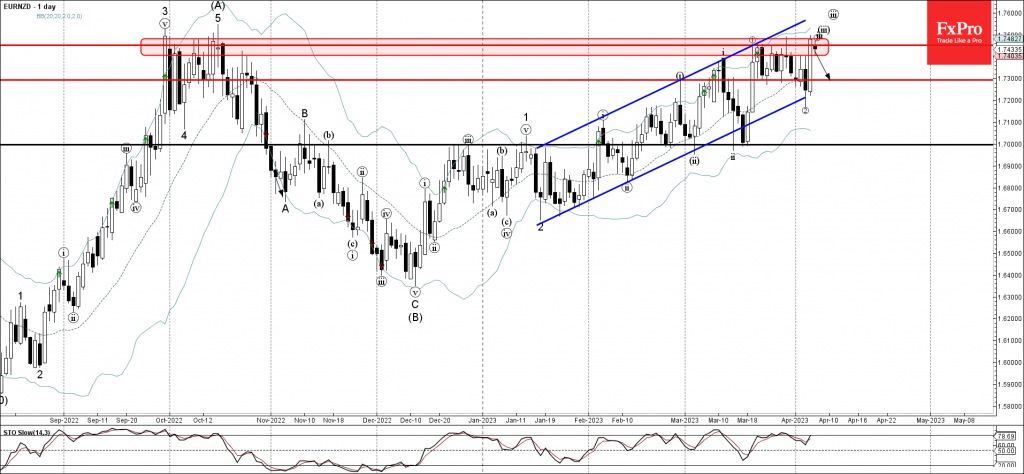
- EURNZD reversed from long-term resistance level 1.7450
- Likely to fall to support level 1.7300
EURNZD recently reversed down from the major, long-term resistance level 1.7450 (which has been steadily reversing the price from the end of September) standing near the upper daily Bollinger Band.
The downward reversal from the resistance level 1.7450 stopped the previous short-term impulse waves (iii), 3 and (C).
Given the bearish divergence on the daily Stochastic, EURNZD can then be expected to fall further toward the next support level 1.7300.
NZDCHF Wave Analysis
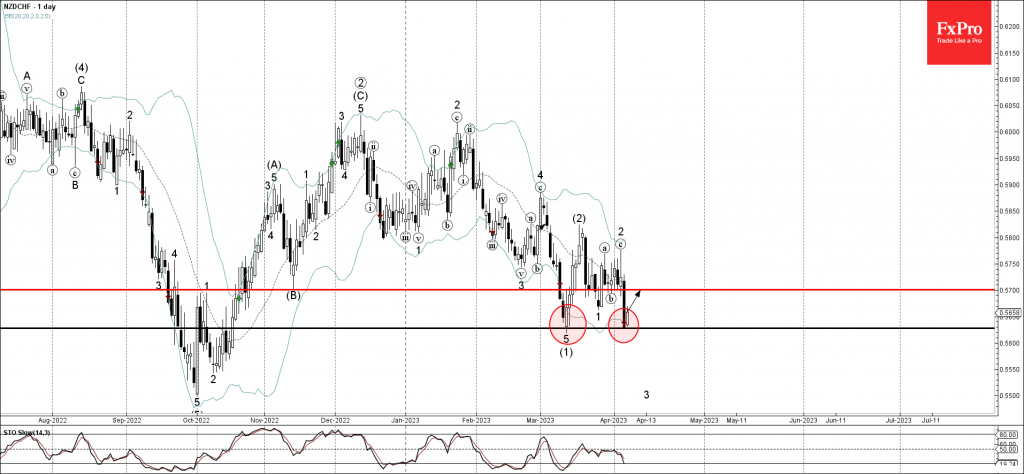
- NZDCHF reversed from key support level 0.5630
- Likely to rise to resistance level 0.5700
NZDCHF recently reversed up from the key support level 0.5630 (previous monthly low from the middle of March) intersecting with the lower daily Bollinger Band.
The upward reversal from the support level 0.5630 stopped the previous short-term impulse wave 3 – which belongs to the intermediate impulse wave (3) from March.
Given the oversold daily Stochastic, NZDCHF can then be expected to rise further toward the next resistance level 0.5700.
US NFP grew 236k in Mar, unemployment rate ticked down to 3.5%
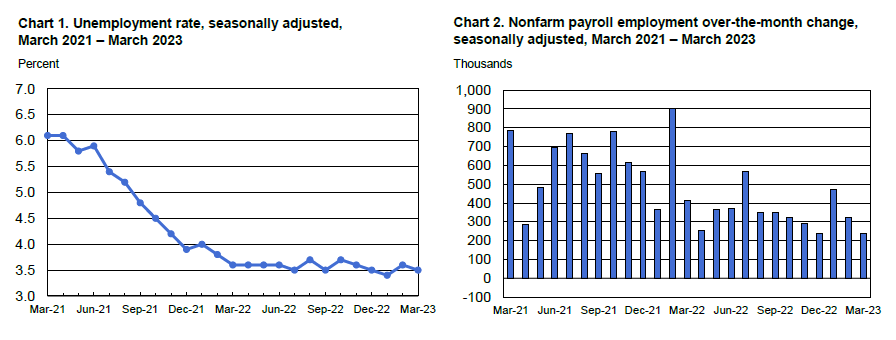
US non-farm payroll employment rose 236k in March, above expectation of 228k. That's compared to average monthly gain of 334k over the prior 6 months.
Unemployment rate dropped from 3.6% to 3.5%, below expectation of 3.6%. Participation rate rose 0.1% to 62.6%.
Average hourly earnings rose 0.3% mom, matched expectations. Over the past 12 months, average hourly earnings rose 4.2% yoy. Average workweek edged down by -0.1% hours.
Full US non-farm payroll release here.
Week Ahead – US CPI Data, Fed Minutes, and BoC Decision on Investors’ Radar
Next week starts on a quiet note as Monday is Easter Monday for most economies on our radar. That said, the calendar becomes heavier as the days pass by, with the spotlight probably falling on the US CPI numbers for March, the minutes from the latest FOMC gathering, and the BoC decision. The US data will probably constitute another piece of information in the riddle of whether the Fed should hit the hike button one last time in May, while the BoC decision may reveal whether this will be the major central bank to hit the cut button first.
Will the US CPIs and Fed minutes corroborate the pivot view?
At the start of this week, investors timidly started tilting the scale towards another rate hike by the Fed at its upcoming gathering in May, but a streak of disappointing US data thereafter revived doubts on what could be the wisest choice at the upcoming gathering.
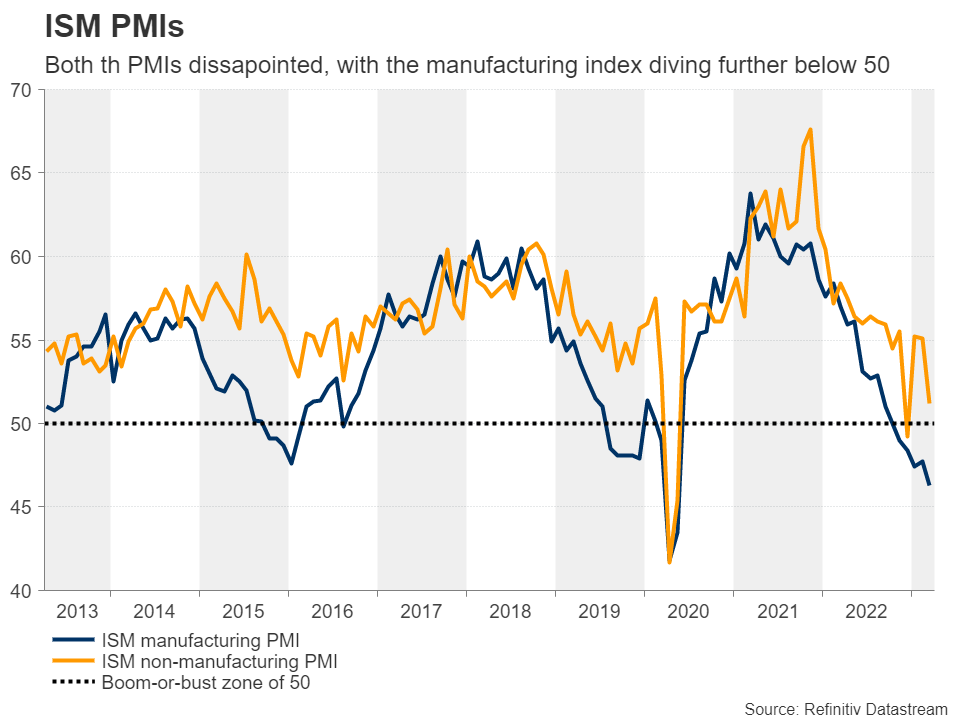
Both the ISM manufacturing and non-manufacturing PMI survey disappointed on all fronts, from employment to prices, with the outlook of the labor market becoming dimmer after job openings for February slipped to their lowest in nearly two years and after the ADP report revealed that the private sector gained fewer than expected jobs in March and much less than it did in February.
With all that in mind, market participants are now evenly split on whether the Fed should deliver one last 25bps hike in May or stay sidelined, anticipating a series of reductions to start in the summer, with interest rates seen ending 2023 at around 4.2%.
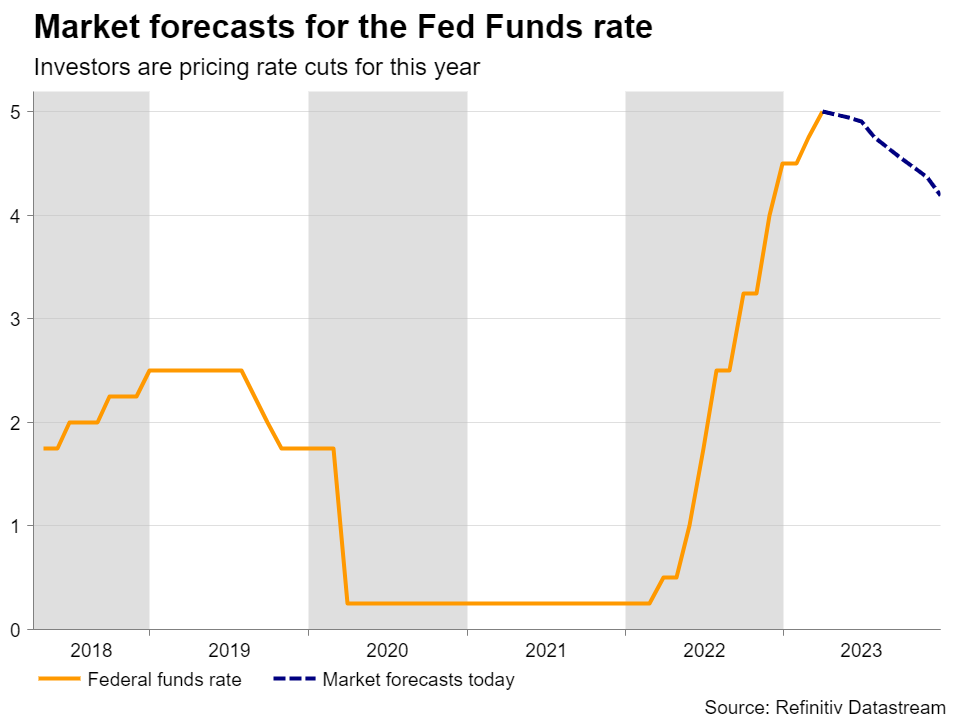
On Wednesday, the CPI data for March are scheduled to be released, while later in the same day, the Fed will publish the minutes of its latest gathering, where officials hiked by 25bps, but changed their forward guidance to note that future increments ‘may’ be warranted. Coming in the midst of concerns about the stability of the banking system, the word ‘may’ was the key to opening the door for a potential pause as soon as at the next gathering, even as the new “dot plot” and several policymakers in the aftermath of the meeting continued indicating that another hike is likely.
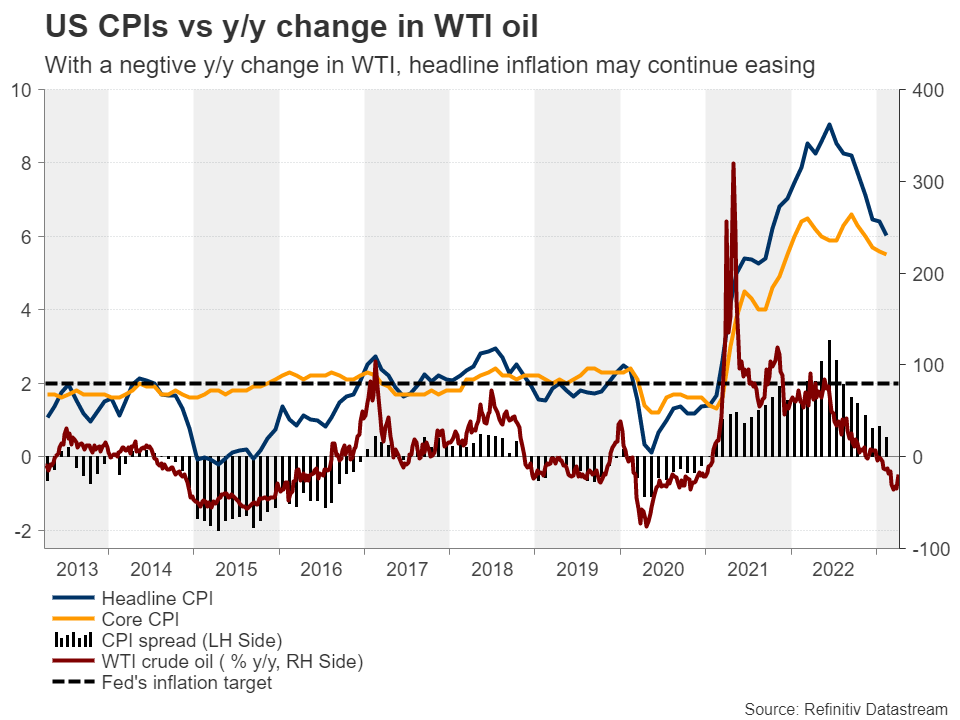
Investors seem to ignore anything that pushes against their view and pay more attention to reaffirmations. Thus, they may dig into the minutes to see whether officials discussed the possibility of a pause. Further slowdown in inflation and even the slightest glimpse in the minutes hinting at a the likelihood of a pause, could add extra credence to the market’s view, thereby sending Treasury yields and the US dollar lower.
The big question is how Wall Street traders will interpret the information. Up until this week, bad data was good for stocks on the thinking that lower interest rates will result in pricier valuations. However, that theme changed this week, with equity indices coming under pressure on fears that the US may be entering a deeper-than-previously-feared downturn.
As for the rest of the US data, Thursday brings the US PPIs for the month, while the last test for dollar traders during next week will come in the form of the US retail sales and industrial production for March, as well as the preliminary UoM consumer sentiment index for April, all to be released on Friday.
Will the BoC be the first major central bank to start cutting rates?
Wednesday will not be a busy day for dollar traders only. Those having the loonie in their portfolios will have to stay in front of their screens when the BoC decides on interest rates. At their last meeting, Canadian policymakers decided to keep interest rates unchanged, becoming the first major central bank to hit the pause button in this tightening crusade. Although in its statement, the BoC reiterated it remains prepared to increase rates further if needed, it also said that the latest data remains in line with the Bank’s expectations that CPI inflation will come down to around 3% in the middle of the year.
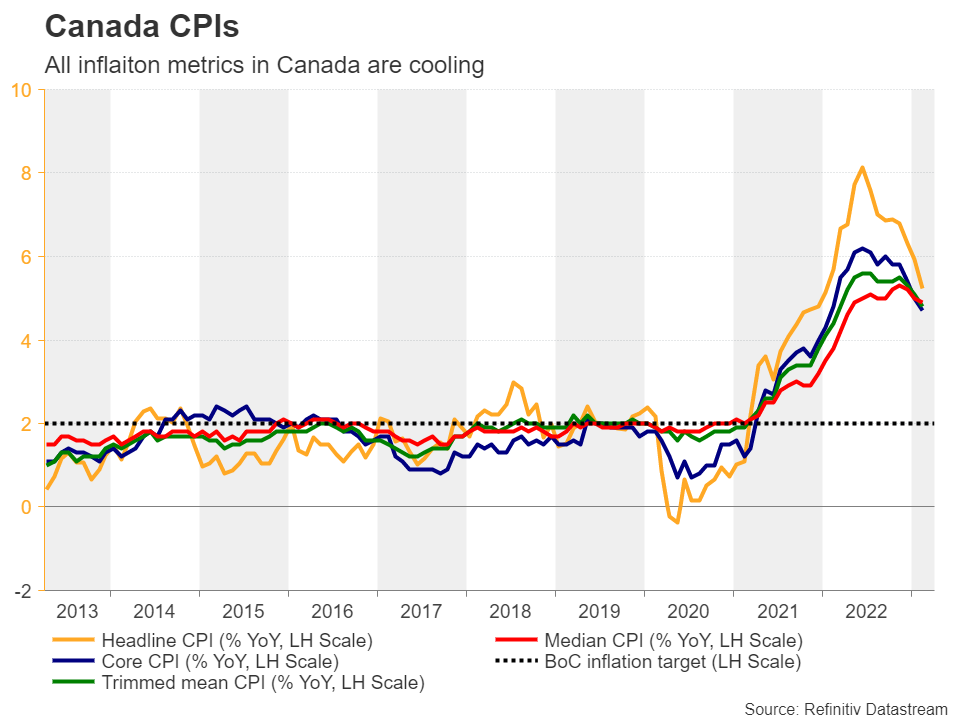
Post-meeting data showed that most inflation metrics in Canada slowed by more than expected in February, reaffirming the Bank’s view and prompting investors to assign a 15% chance of a rate cut as soon as at next week’s gathering, with the remaining 85% pointing to no action. This means that if officials decide to keep interest rates untouched, any market reaction may come from hints and clues regarding the Bank’s future course of action. So, anything suggesting that they could start cutting rates soon could add pressure to the Canadian dollar.
Aussie awaits Australia’s jobs report and China’s inflation numbers
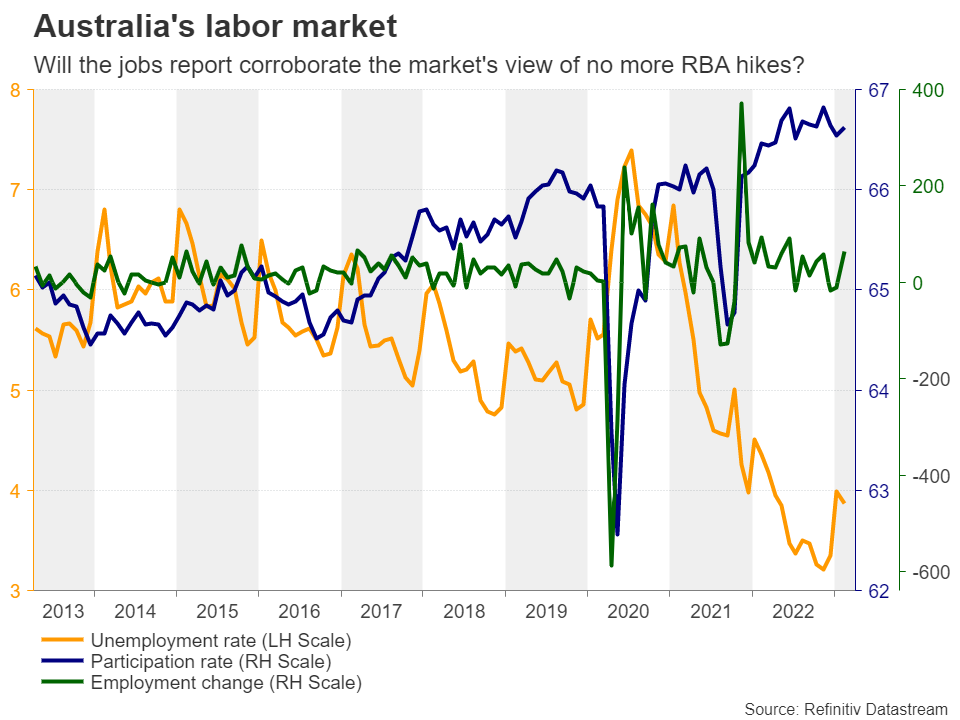
With the RBA standing pat on Tuesday but noting that some further tightening may be needed, aussie traders may pay extra attention to the Australian employment report for March scheduled to be released on Thursday, but also on the Chinese CPI and PPI data, which come on Tuesday, as the world’s second largest economy is Australia’s main trading partner.
The Chinese CPI is forecast to have accelerated notably, but the PPI is expected to have remained well into the negative territory. The former could be due to increasing domestic demand after the economy’s reopening from the COVID-related restrictions, but putting the latter into the equation, it may be hard to identify whether Chinese exports to Australia will fuel Australian inflation. China’s overall trade balance data are coming out on Thursday.
Currently investors are almost fully convinced that the RBA will not deliver any other rate increases. On the contrary, they are nearly fully pricing in a quarter-point rate reduction by the end of this year, and a weak jobs report could justify that view, thereby hurting the already-wounded aussie even more, especially against its New Zealand counterpart, which benefited this week from the RBNZ’s decision to hike by 50bps and signal that more hikes are on the cards.
Other releases on tap
From the Eurozone, retail sales and industrial production for February are coming on Tuesday and Thursday, while on Thursday, traders will also get the industrial and manufacturing production figures, the monthly GDP, and the trade balance, all for February. With the BoE expected to deliver more than 25bps worth of additional rate increments before it takes the sidelines, pound traders may seek reaffirmation in these releases.