Sample Category Title
Sunset Market Commentary
Markets
Monday: manufacturing ISM. Tuesday: JOLTS job openings. Wednesday: ADP employment change & non-manufacturing ISM. Today: weekly jobless claims. Four in a row when it comes to disappointing US eco data. Four in a row as well when it comes to a (positive) reaction from US Treasuries. Even on today’s mostly ignored weekly jobless claims series. Claims fell from a significantly upwardly revised 246k last week to 228k (vs 200k expected). Continuing claims rose to 1823k, the highest level since mid-December 2021. US Treasuries tested this week’s highs, but claims lack weight to really push through existing technical boundaries. The same happened yesterday after ADP & services ISM though the starting point of Treasuries’ push higher was obviously lower. Tomorrow’s payrolls risk delivering a fifth consecutive disappointment and might have the force to break technical levels, especially ahead of the long Easter weekend and with US CPI inflation lining up next Wednesday. US yields currently lose 3.8 bps (5-yr) to 2.5 bps (30-yr). The US 2-yr yield tested the March lows between 3.55% and 3.71% but avoided again a drop (3.76%). The US 5-yr yield tested the 3.3%/3.23% support (currently 3.34%) and the US 10-yr yield is testing 3.29%/3.28% support. German Bund yields are today unnerved with volatility in the US with yield changes varying between +0.8 bps (2-yr) and -1.4 bps (10-yr). The European eco calendar only contained second tier figures like February German production data (positive surprise at 2% M/M), but we retain comments from ECB chief economist Lane. He told Cyprus News Agency that “if the baseline we developed before the banking stress holds up, it will be appropriate to have a further policy rate increase in May.” The European economy is performing relatively well this year with core inflation being sticky. European money markets after this week’s correction attach a 90% probability to a 25 bps rate hike at the May 4 policy meeting with a final 25 bps hike discounted somewhere over summer. European stock markets outperform main US indices. The latter since yesterday no longer profit from the lower yield environment but start worrying about (US) recession risks. In the same vein, the EUR/USD-rally ran out of steam above 1.09. The IMF today warned that its global growth outlook for the next 5 years is the weakest in more than 30 years’ time. For 2023, global GDP will likely expand by less than 3%. A more detailed spring outlook will be released next week (Apr 11). Despite the bleak growth outlook, high inflation means that central banks must continue to raise interest rates, as long as financial stability pressures remain limited after recent banking industry upheaval in the US and Switzerland, IMF chief Georgieva said.
News Headlines
The Bank of England’s monthly Decision Maker Panel showed that businesses in March expected their output prices (B2B and B2C) to increase by 5.3% on average in the year ahead. That’s down 0.1 ppt from the previous month. The 3-month average also fell by 0.1 ppt do 5.5% compared to the 6.6% peak seen in September. CPI expectations also eased by 0.1 ppt to 5.8% for the year ahead but rose from 3.4% to 3.5% for the three-year ahead period. Wages are seen rising by 5.6% in one year’s time (+0.1 ppt) compared to realized annual wage growth of 6.5%. Regarding monetary policy, CFO’s anticipate one more 25 bps rate hike. Overall business uncertainty continued to decline with 47% of the firms reporting the level as high or very high compared to 53% in February.
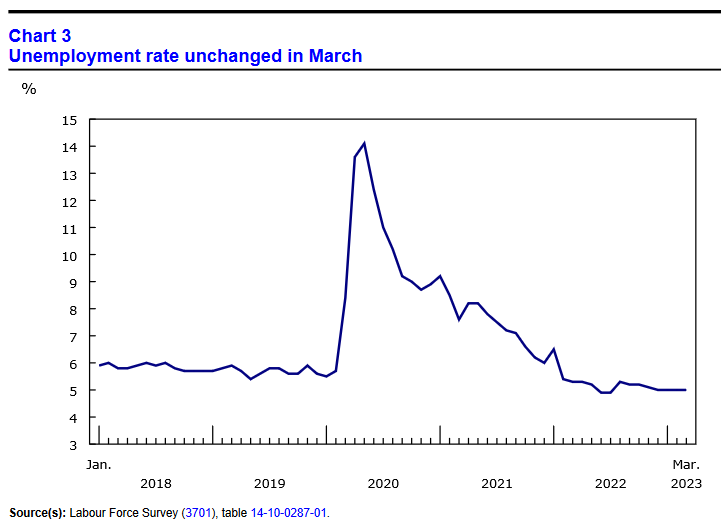
Canadian employment growth again surpassed expectations. The net change amounted to 34.7k in March vs the 7.5k consensus estimate. Job creation was about evenly distributed between full timers (+18.8k) and part timers (15.9k). The unemployment rate stabilized at 5%, the lowest on record barring the summer months in 2022 (4.9%). It defied expectations for a small uptick to 5.1%, in part thanks due the participation rate easing a tad to 65.6%. Wages grew 5.2%. That’s down from 5.4% last month but still even above the 4-5% range policymakers said was inconsistent with getting inflation back to target. The report offers little support for the Canadian dollar though. USD/CAD even trades a little higher for the day around 1.347. Money markets don’t assume a tighter-than-anticipated labour market report will get the Bank of Canada to hike again next week after pausing the cycle in March at 4.5%. A first rate cut is instead priced in for September.
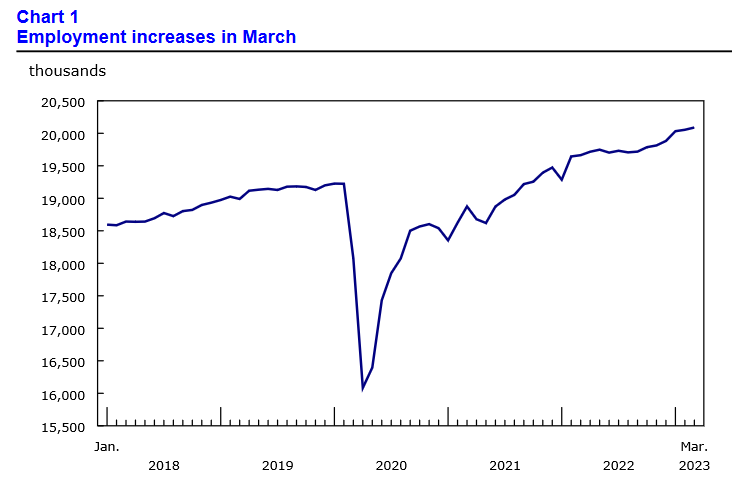
Canada’s Labour Market Surges Again
The Canadian labour market added 35k positions in March, with full-time employment up 18.8k and part-time employment up 15.9k.
The unemployment rate held steady at 5.0% and the participation rate fell 0.1 percentage points to 65.6%.
By industry, employment was up in transportation/warehousing (+41k), business, building and other support services (+31k), and finance, insurance, real estate, rental and leasing (+19k). Losses were seen in construction (-19k), other personal/repair services (-11k), and natural resources (-11k).
Lastly, total hours worked were up 0.4% month-on-month and wages were up 5.3% year-on-year (vs 5.4% in February).
Key Implications
The Canadian jobs market shows no sign of slowing. Today's gain of 35k jobs extends the streak of monthly employment gains to seven months, bringing the tally to 382k jobs gained over that time. Looking beyond the headline, the fundamentals remain solid. Workers continue to clock in more hours every week and their wages are rising. With all the jobs gained in the private sector (although nearly half were part-time), there is strong underlying momentum that continues to build in the Canadian economy.
The Bank of Canada knows the economy is running too hot. Continued labour market strength is boosting the incomes of Canadians, enabling them to increase their spending notwithstanding the high interest rate environment. Today's report corroborates the signal we have been getting from credit/debit card spending data, and supports our forecast for Canadian GDP to come in around 2% for the first quarter of 2023. That is not the kind of growth the BoC wants to see when it is trying to ensure that inflation gets back to target. Although today's report isn't enough to get the Bank off the sidelines, the fact that nothing so far seems to be able to crack the Canadian jobs market juggernaut must be worrying.
USD/JPY Mid-Day Outlook
Daily Pivots: (S1) 130.70; (P) 131.27; (R1) 131.91; More...
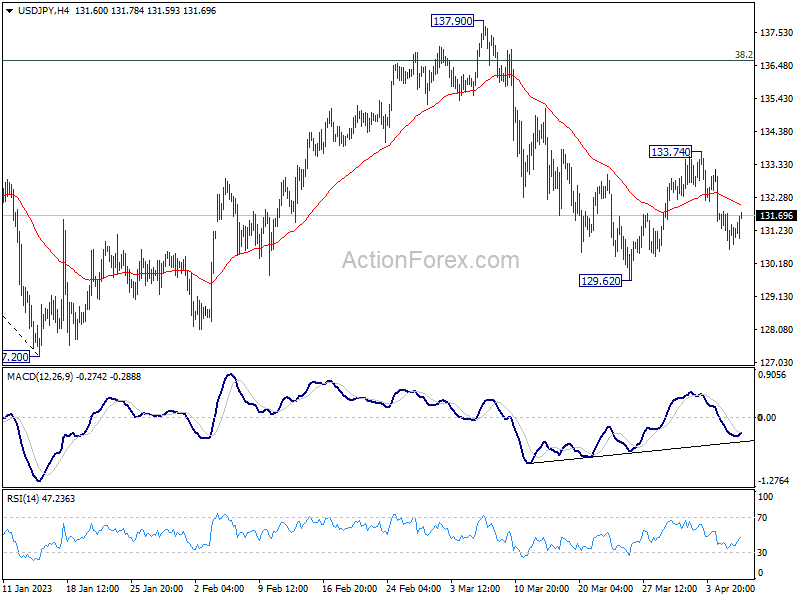
Intraday bias in USD/JPY is turned neutral with 4 hour MACD crossed above signal line. On the downside, break of 129.62 support will resume the whole decline from 137.90 to retest 127.20 low. On the upside, however, above 133.74 resistance will turn bias back to the upside for another rise. Overall, eventual downside break out is expected as long as 137.90 resistance holds.
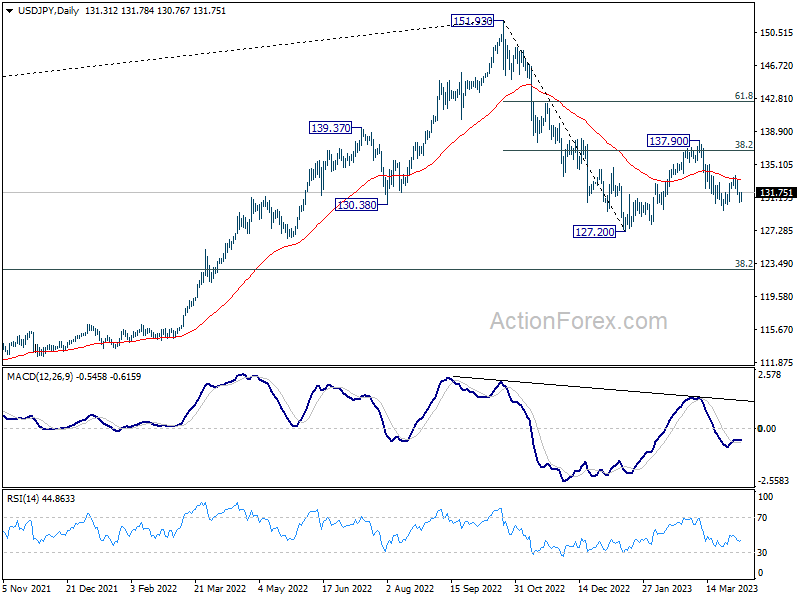
In the bigger picture, corrective pattern from 127.20 might be extending. But after all, down trend from 151.93 is expected to resume at a later stage. Break of 127.20 will resume this down trend and target 61.8% projection of 151.93 to 127.20 from 137.90 at 122.61. This will now be the favored case as long as 137.90 resistance holds.
USD/CHF Mid-Day Outlook
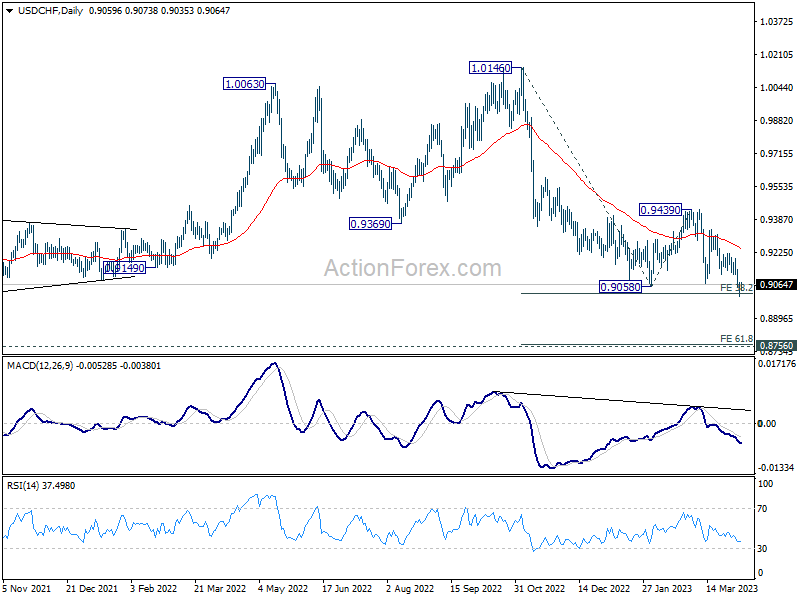
Daily Pivots: (S1) 0.9029; (P) 0.9053; (R1) 0.9090; More...
Intraday bias in USD/CHF is turned neutral first with a temporary low formed at 0.9005. Further decline is expected as long as 0.9118 resistance holds. Break of 0.9005 and sustained trading below 38.2% projection of 1.0146 to 0.9058 from 0.9439 at 0.9023 will extend the down trend from 1.0146 to 61.8% projection at 0.8767.
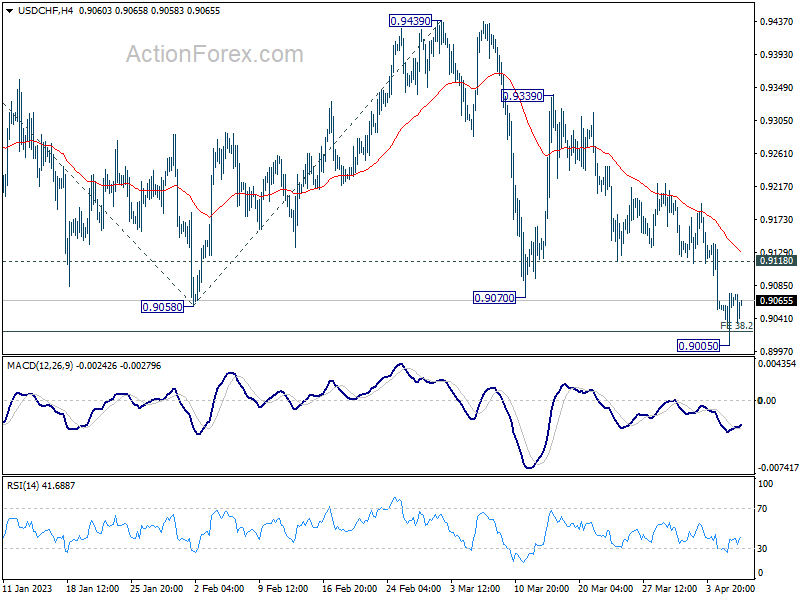
In the bigger picture, outlook will stay bearish as long as 0.9439 resistance holds, and fall from 1.1046 (2022 high) is still in progress. Prior rejection by 55 week EMA was a medium term bearish sign. Sustained of 0.9058 will resume such decline towards 0.8756 support (2021 low). But overall, this fall is still as a leg in the long term range pattern from 1.0342 (2016 high). So, downside should be contained by 0.8756 to bring reversal.
GBP/USD Mid-Day Outlook
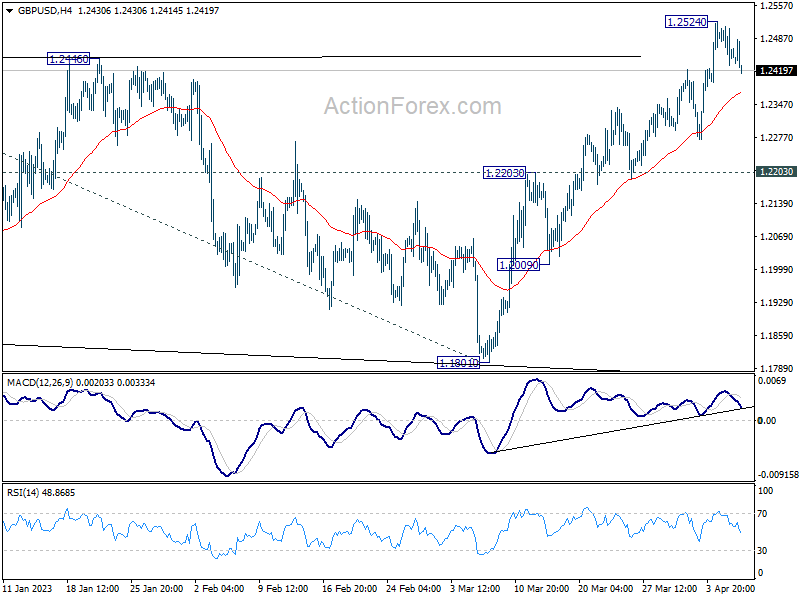
Daily Pivots: (S1) 1.2425; (P) 1.2469; (R1) 1.2506; More...
Intraday bias in GBP/USD remains neutral for consolidations below 1.2524 temporary top. Downside of retreat should be contained above 1.2203 resistance turned support to bring another rally. Break of 1.2524 will target 1.2759 fibonacci level first. Firm break there will target 61.8% projection of 1.0351 to 1.2445 from 1.1801 at 1.3095.
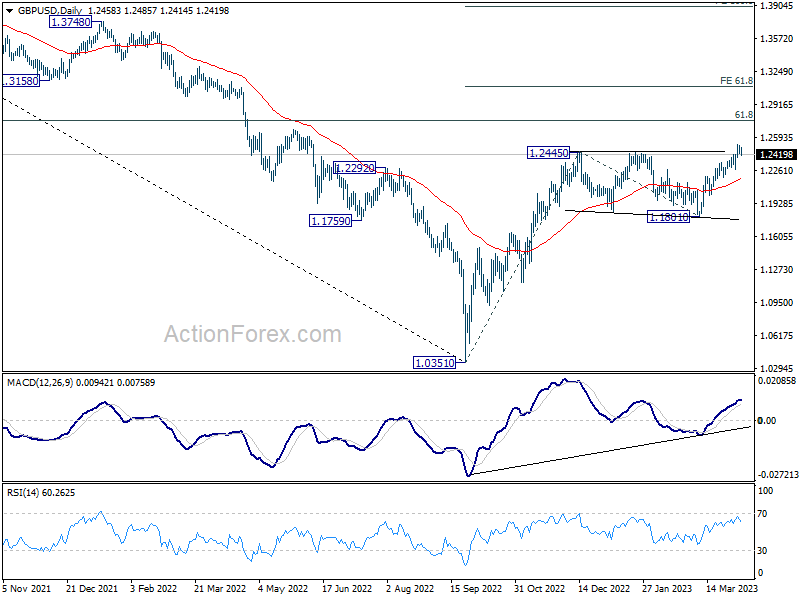
In the bigger picture, the rise from 1.0351 medium term term bottom (2022 low) is in progress for 61.8% retracement of 1.4248 (2021 high) to 1.0351 at 1.2759. Sustained break there will add to the case of long term bullish trend reversal. Further break of 61.8% projection of 1.0351 to 1.2445 from 1.1801 at 1.3095 could prompt upside acceleration to 100% projection at 1.3895. For now, this will remain the favored case as long as 1.1801 support holds, even in case of deep pull back.
EUR/USD Mid-Day Outlook
Daily Pivots: (S1) 1.0875; (P) 1.0923; (R1) 1.0954; More...
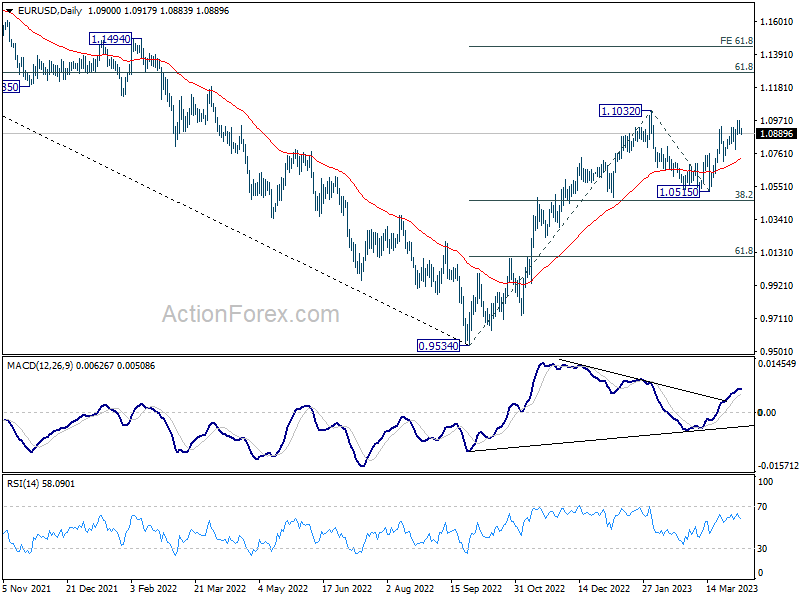
Intraday bias in EUR/USD remains neutral for consolidation below 1.0972 temporary low. Further rise is expected as long as 1.0787 support holds. Above 1.0972 will resume the rally from 1.0515 to retest 01.1032 high. Firm break there will resume larger up trend from 0.9534. However, break of 1.0787 will turn bias back to the downside for 1.0711 support instead.
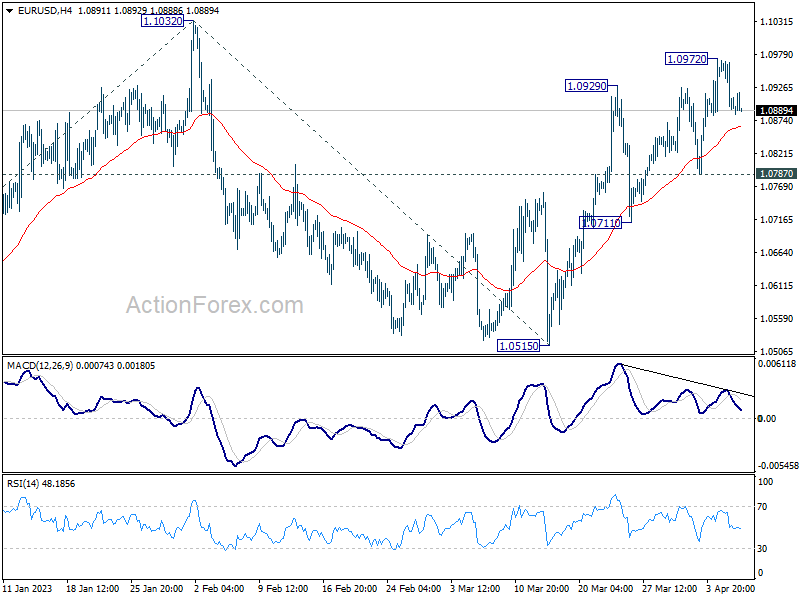
In the bigger picture, rise from 0.9534 (2022 low) is in progress with 38.2% retracement of 0.9534 to 1.1032 at 1.0460 intact. The strong support from 55 week EMA (now at 1.0625) was also a medium term bullish sign. Next target is 61.8% retracement of 1.2348 (2021 high) to 0.9534 at 1.1273. Sustained break there will solidify the case of bullish trend reversal and target 1.2348 resistance next (2021 high).
Mild Risk-Off Sentiment Prevails as Markets Digest US Jobless Claims Data
Trading activity leans mildly toward risk aversion as US jobless claims data underscores concerns over a slowdown in the job market. Stock futures and treasury yields are trading modestly lower, but overall market movements remain limited, suggesting many traders may already be in a holiday mindset. Canadian Dollar also appears unfazed by better-than-expected employment figures.
For the week, Aussie stands as the weakest performer, followed by Dollar, which is experiencing a slight recovery today. New Zealand Dollar, currently the third weakest, has reversed most gains following RBNZ rate hike. European majors exhibit mixed performance, with Sterling holding a marginal advantage.
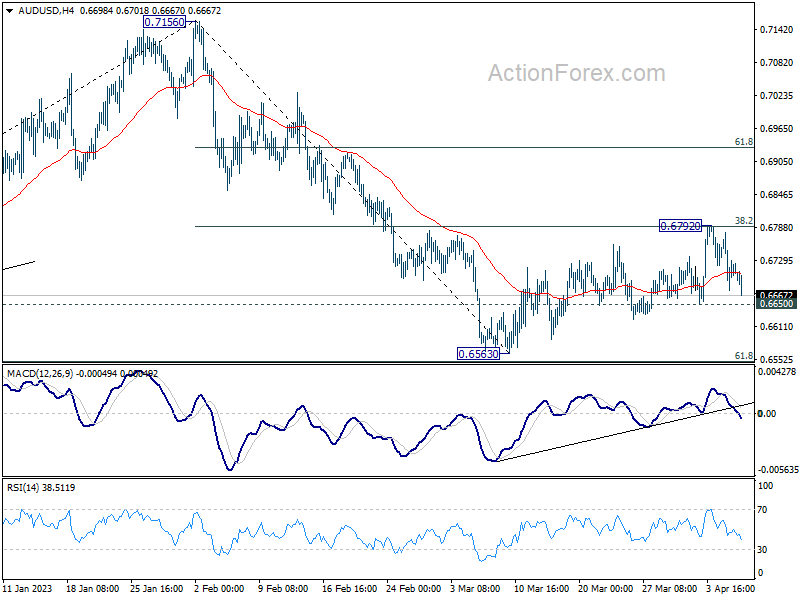
As the trading session progresses, it remains to be seen whether the risk-off sentiment will intensify and push AUD/USD below the 0.6650 minor support level. Such a development would suggest that the corrective recovery from 0.6563 has concluded and that the broader downtrend from 0.7156 is set to resume, potentially breaking the 0.6563 low.
In Europe, at the time of writing, FTSE is up 0.91%. DAX is up 0.33%. CAC is up 0.24%. Germany 10-year yield is down -0.0019 at 2.166. Earlier in Asia, Nikkei dropped -1.22%. Hong Kong HSI rose 0.28%. China Shanghai SSE rose 0.00%. Singapore Strait Times dropped -0.55%. Japan 10-year JGB yield rose 0.0013 to 0.471.
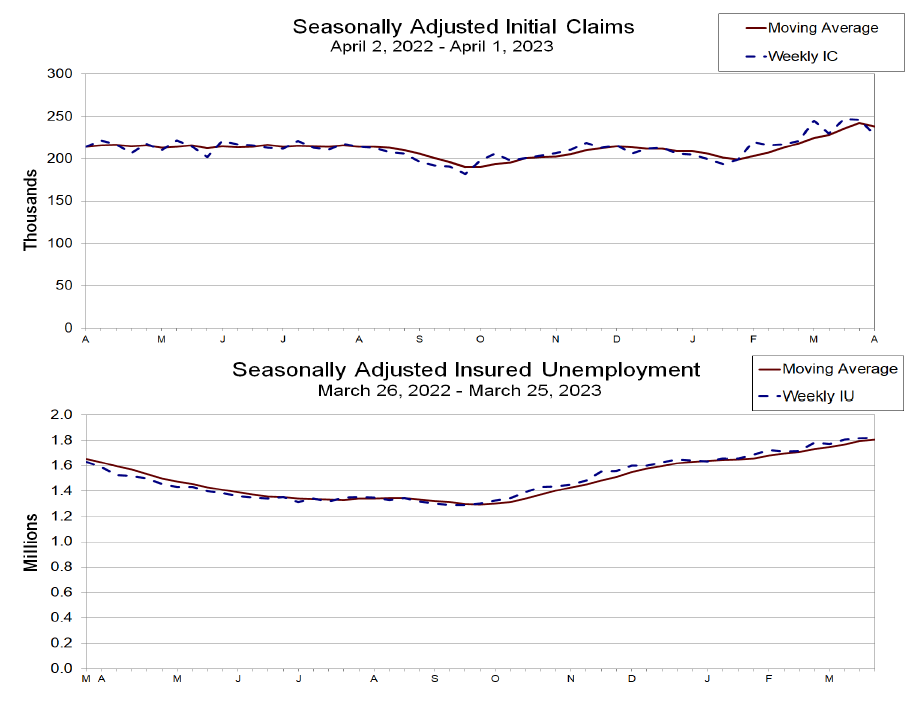
US initial jobless claims rose to 228k, continuing claims highest since late 2021
US initial jobless claims dropped -18k to 228k in the week ending April 1, above expectation of 200k. Four-week moving average of continuing claims dropped -4k to 238k.
Continuing claims rose 6k to 1823k in the week ending March 25, highest level since December 11, 2021. Four-week moving average continuing claims rose 10.5k to 1804k, highest since November 13, 2021.
Canada employment grew 34.7k in Mar, unemployment rate unchanged at 5%
Canada employment grew 34.7k in March, well above expectation of 10.2k. Employment gains in March were concentrated among private sector employees (+35,000; +0.3%). There was little change in the number of public sector employees and self-employed workers.
Unemployment rate was unchanged at 5.0%, better than expectation of 5.1%. That's just above the record low of 4.9% recorded in June and July of 2022. Total hours worked rose 0.4% mom, 1.6% yoy. Average hourly wages rose 4.% yoy.
ECB Lane: Appropriate to hike further if baseline holds up
In an interview with Cyprus News Agency, ECB Chief Economist Philip Lane stressed the importance of being data-dependent and scientific in deciding on a potential interest rate hike at the May meeting. He explained, "if the baseline we developed before the banking stress holds up, it will be appropriate to have a further increase in May. However, we need to be data-dependent about the assessment of whether that baseline still holds true at the time of our May meeting."
Lane highlighted three factors that will influence the May decision: the inflation outlook, assessing the underlying dynamic of inflation, and the speed at which interest rate increases are restricting the economy and bringing down inflation. He urged focusing on understanding every data point instead of predicting the decision, stating, "rather than asking me what the next interest rate decision will be, the focus should be on understanding every data point that comes in."
Responding to a question regarding OPEC's production, the ECB Chief Economist note that the movement in oil prices should be weighed against the context of a large drop in recent months and a significant ongoing reduction in gas prices. Lane emphasized the importance of monitoring how the rest of the economy responds to the energy dynamic and analyzing the incoming data until the day of the May meeting.
UK PMI construction dropped to 50.7, mixed fortunes in the sector
UK PMI Construction dropped from 54.6 to 50.7 in March, below expectation of 53.6, indicating a mixed picture for the industry.
Tim Moore, Economics Director at S&P Global Market Intelligence, explained that civil engineering and commercial projects saw a sustained rebound in output levels and improved tender opportunities, leading to the strongest rate of job creation in five months.
However, a sharp decline in house building raised concerns, as subdued demand and rising interest rates contributed to the steepest fall in housing activity in almost three years.
Despite these challenges, overall expectations for construction output in the coming year remain positive, with survey respondents citing improved availability of construction inputs and expectations for moderating purchasing price inflation.
China Caixin PMI services rose to 57.8, highest since Nov 2020
China's Caixin PMI Services index exceeded expectations in March, rising from 55.0 to 57.8, marking the highest level since November 2020. The data revealed sharp increases in activity, sales, and employment, with the services sector showing stronger expansion compared to the manufacturing sector. Business confidence remained historically strong, while input price inflation reached a seven-month high. The PMI Composite also experienced a slight increase from 54.2 to 54.5, reaching its highest point since June 2022.
Wang Zhe, Senior Economist at Caixin Insight Group said: "Production, demand and employment all grew, with the services sector showing a stronger expansion, whereas manufacturing activity turned comparatively sluggish. Input costs and prices charged remained stable, and businesses were highly optimistic."
EUR/USD Mid-Day Outlook
Daily Pivots: (S1) 1.0875; (P) 1.0923; (R1) 1.0954; More...
Intraday bias in EUR/USD remains neutral for consolidation below 1.0972 temporary low. Further rise is expected as long as 1.0787 support holds. Above 1.0972 will resume the rally from 1.0515 to retest 01.1032 high. Firm break there will resume larger up trend from 0.9534. However, break of 1.0787 will turn bias back to the downside for 1.0711 support instead.
In the bigger picture, rise from 0.9534 (2022 low) is in progress with 38.2% retracement of 0.9534 to 1.1032 at 1.0460 intact. The strong support from 55 week EMA (now at 1.0625) was also a medium term bullish sign. Next target is 61.8% retracement of 1.2348 (2021 high) to 0.9534 at 1.1273. Sustained break there will solidify the case of bullish trend reversal and target 1.2348 resistance next (2021 high).
Economic Indicators Update
| GMT | Ccy | Events | Actual | Forecast | Previous | Revised |
|---|---|---|---|---|---|---|
| 01:30 | AUD | Trade Balance (AUD) Feb | 13.87B | 11.12B | 11.69B | 11.27B |
| 01:45 | CNY | Caixin Services PMI Mar | 57.8 | 55 | 55 | |
| 05:45 | CHF | Unemployment Rate Mar | 1.90% | 1.90% | 1.90% | |
| 06:00 | EUR | Germany Industrial Production Feb | 2.00% | -0.40% | 3.50% | 3.70% |
| 07:00 | CHF | Foreign Currency Reserves (CHF) Mar | 743B | 771B | 770B | |
| 08:30 | GBP | Construction PMI Mar | 50.7 | 53.6 | 54.6 | |
| 11:30 | USD | Challenger Job Cuts Mar | 319.40% | 410.10% | ||
| 12:30 | USD | Initial Jobless Claims (Mar 31) | 228K | 200K | 198K | 246K |
| 12:30 | CAD | Net Change in Employment Mar | 34.7K | 10.2K | 21.8K | |
| 12:30 | CAD | Unemployment Rate Mar | 5.00% | 5.10% | 5.00% | |
| 14:00 | CAD | Ivey PMI Mar | 52 | 51.6 | ||
| 14:30 | USD | Natural Gas Storage | -20B | -47B |
US initial jobless claims rose to 228k, continuing claims highest since late 2021
US initial jobless claims dropped -18k to 228k in the week ending April 1, above expectation of 200k. Four-week moving average of continuing claims dropped -4k to 238k.
Continuing claims rose 6k to 1823k in the week ending March 25, highest level since December 11, 2021. Four-week moving average continuing claims rose 10.5k to 1804k, highest since November 13, 2021.
Canada employment grew 34.7k in Mar, unemployment rate unchanged at 5%
Canada employment grew 34.7k in March, well above expectation of 10.2k. Employment gains in March were concentrated among private sector employees (+35,000; +0.3%). There was little change in the number of public sector employees and self-employed workers.
Unemployment rate was unchanged at 5.0%, better than expectation of 5.1%. That's just above the record low of 4.9% recorded in June and July of 2022. Total hours worked rose 0.4% mom, 1.6% yoy. Average hourly wages rose 4.% yoy.
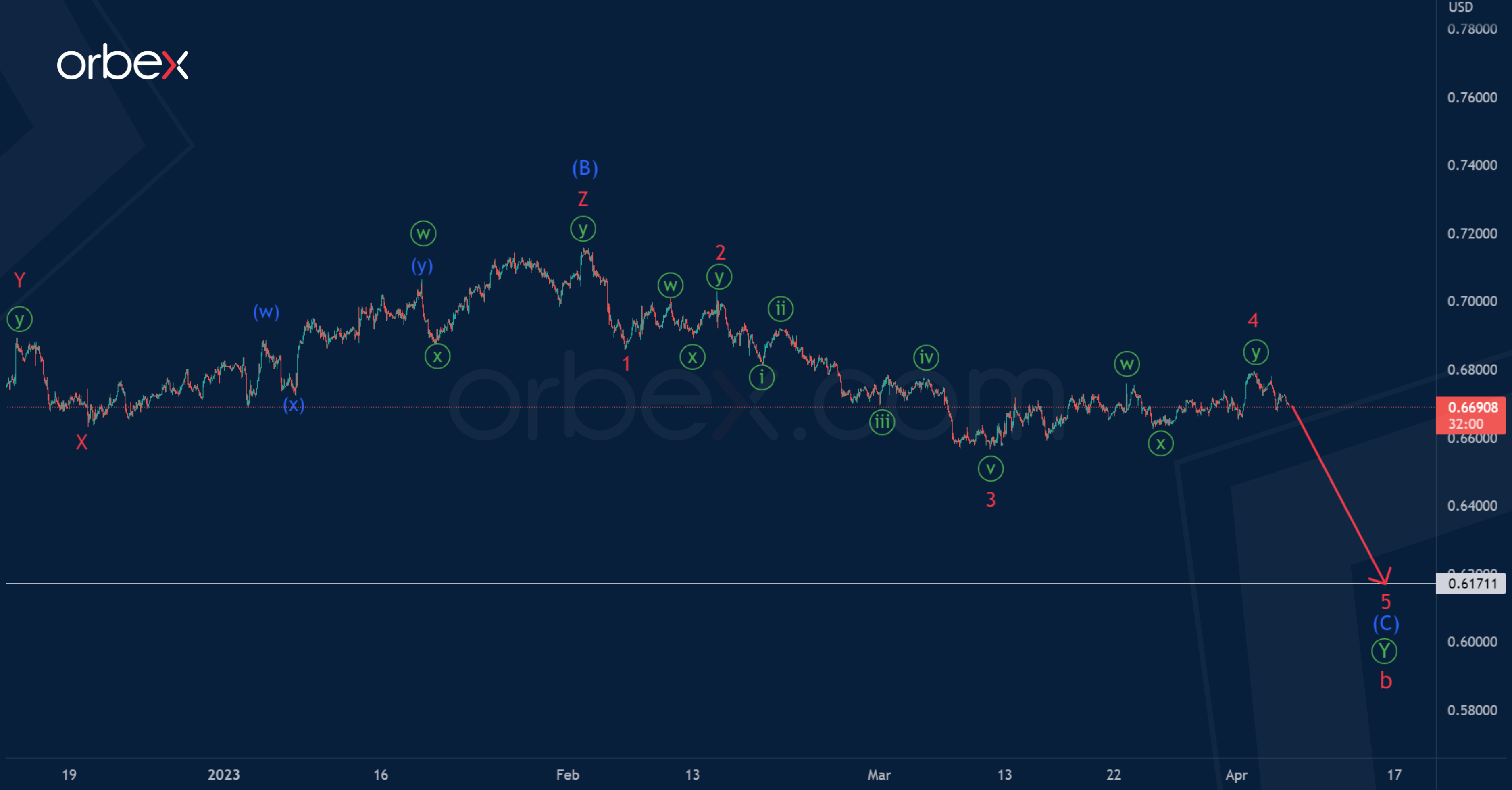
AUD/USD: Correction 4 Completed, Waiting for a Drop in Impulse 5
In the long term, AUDUSD seems to be forming a global correction b of the cycle degree, taking the structure of the primary double zigzag.
As part of the actionary wave, two parts can be completed an impulse (A) and an intermediate correction (B) in the form of a triple zigzag W-X-Y-X-Z.
At the moment, an impulse (C) can be built, consisting of minor sub-waves 1-2-3-4-5.
It is assumed that impulse (C), like the previous impulse (A), will end at a minimum of 0.617.
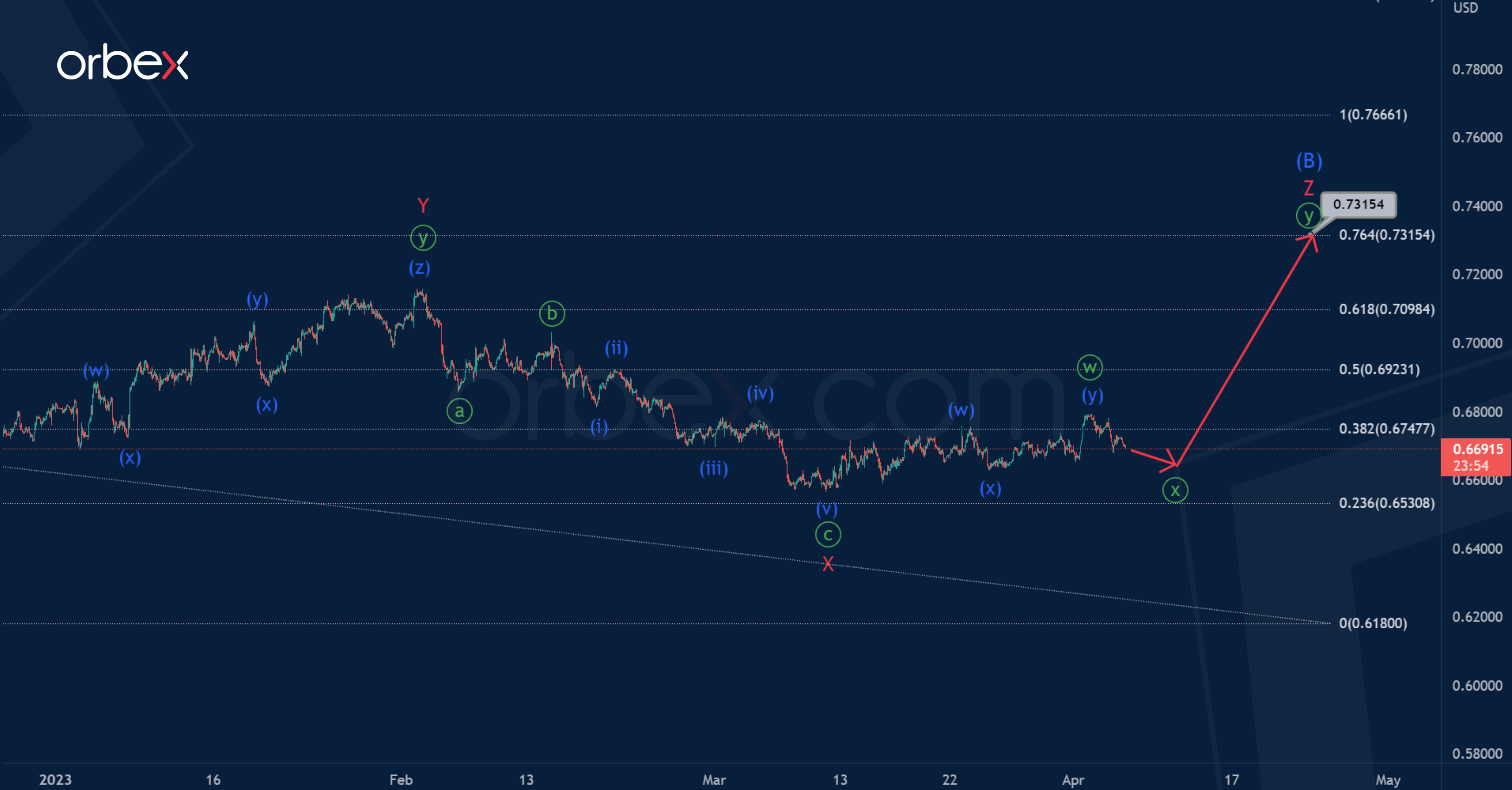
Let's look at the second scenario, in which you can see the incomplete intermediate correction (B).
There is a possibility that the correction (B) will take the form of a triple zigzag W-X-Y-X-Z, as in the first scenario, but its end will be slightly higher.
Most likely, in the last section we see the construction of a minor wave Z. This wave may end in the form of a minute double zigzag near 0.731.
At that level, correction (B) will be at 76.4% of impulse (A).