

Sample Category Title
Subdued Trading Continues, Yen Down on Dovish New BoJ Governor
Today's trading remains relatively subdued, as many markets are still closed for holidays. Canadian and US Dollars are showing mild strength, while Yen struggles as the weakest currency, followed by New Zealand Dollar and Euro. Sterling, Australian Dollar, and Swiss Franc exhibit mixed performance. Most pairs and crosses stay within Friday's range, except for Yen pairs, which have been influenced by new BoJ Governor Kazuo Ueda's dovish comments.
The week ahead is packed with events, including the BoC's rate decision, which may not prompt significant volatility. Meanwhile, Dollar anticipates key data releases such as CPI, PPI, retail sales, and the University of Michigan Consumer Sentiment, along with FOMC minutes. In other regions, UK GDP and Australian employment data releases are expected to carry more weight than others.
Dollar braces for CPI release, a look at EUR/USD and DXY
This week promises to be eventful for Dollar, with key data releases including CPI, PPI, retail sales, and University of Michigan Consumer Sentiment. Additionally, Fed will publish minutes from March FOMC meeting, and numerous policymakers are expected to share their views on the economy and interest rates.
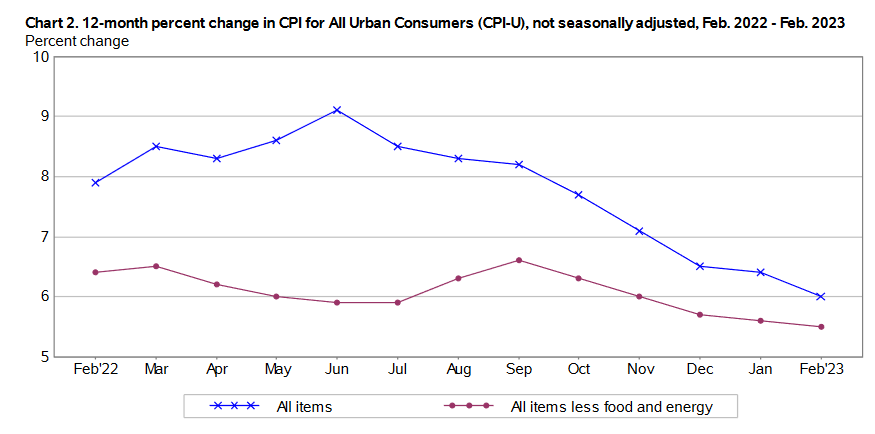
Specifically, headline CPI is forecasted to drop further from 6% to 5.2% in March. This marks a significant improvement from last year's 9.1% peak in July and represents the ninth consecutive month of cooling consumer inflation. If realized, the headline CPI reading would be the lowest since June 2021's 5.0%, nearly two years ago. Conversely, core CPI is projected to tick up from 5.5% to 5.6%, breaking the five-month downtrend since September last year.
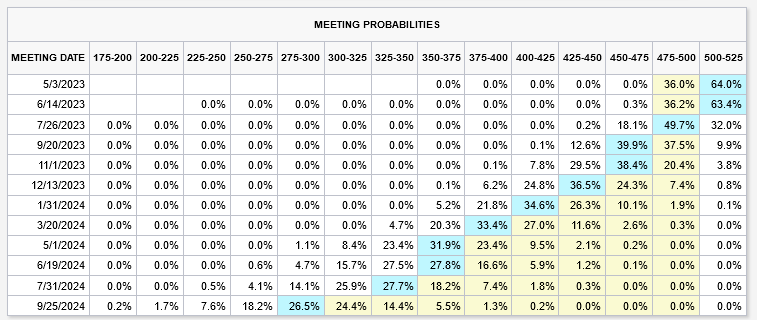
Following last week's robust job data, traders have increased bets on a 25bps rate hike in May, with over a 60% chance. However, whether Fed opts for one, two, or no additional rate hikes may not make a significant difference. The primary focus is when Fed will start reversing course and cutting interest rates, which largely depends on how quickly core inflation falls back to a level consistent with price stability or remains stuck above the Fed's target.
Presently, fed fund futures indicate a nearly 70% chance of a cut back to 4.50-4.75% in July, far from the Fed's own projections. According to the March dot plot, only one policymaker envisions rates ending below 5% this year.
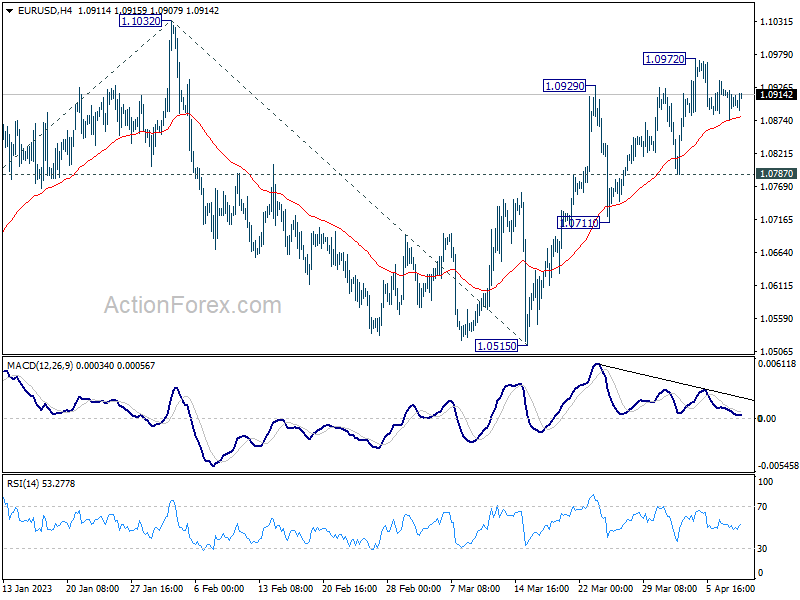
EUR/USD began losing upside momentum last week, stalling before 1.0320 resistance. It appears that a clear downside surprise in core CPI is needed to push EUR/USD past 1.0320 to resume the larger uptrend from the 2020 low at 0.9534. Conversely, breaking 1.0787 support will extend the consolidation pattern from 1.0320 with a third leg back towards 1.0515 support.
In parallel, for Dollar index, intense selling pressure is required to push DXY below 100.82 low to resume the downtrend from 114.77. Breaking above 103.44 resistance will extend the consolidation pattern from 100.82 with another upleg towards 105.88 resistance.
Gold falls below 2000 as expectations of anther Fed hike firm up
Gold dipped below 2000 as near-term pullback extended into Asian session, with many markets still on holiday. Shift appears to be driven by growing market conviction that Fed will implement another 25bps hike in May, as fed fund futures now indicate a 66% probability. This sentiment follows last week's robust US non-farm payroll report. However, expectations could still change after release of March CPI data and FOMC minutes on Wednesday.
Technically, a short-term top for Gold may have formed at 2032.05, evidenced by a bearish divergence in 4-hour MACD. Rally from 1084.48 might have completed a five-wave sequence and stalled just ahead of key resistance zone between 2070.06 and 2074.84 record high.
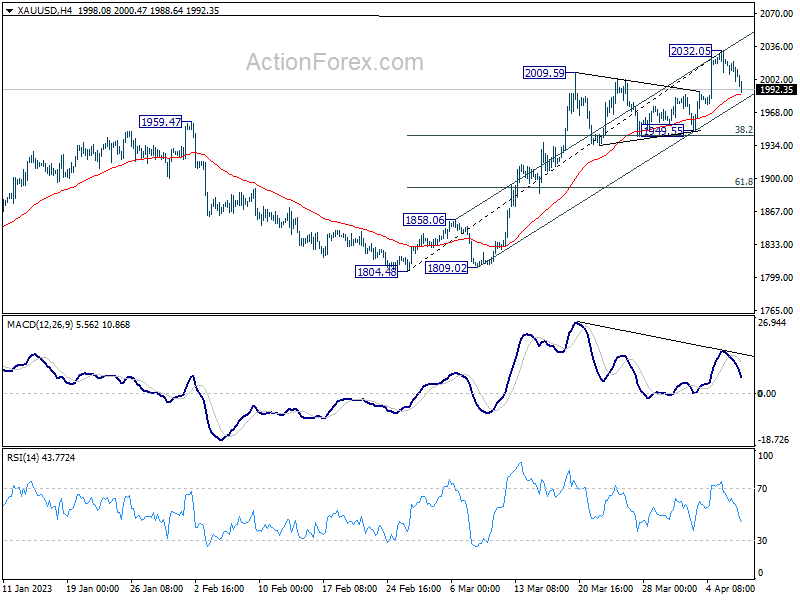
Considering this, a deeper pullback is now anticipated. Crucial near-term support level can be found at 38.2% retracement of 1804.48 to 2032.05 at 1945.11 which is in proximity to 1949.55 support level. As long as this support zone holds, current price action from 2032.05 should be regarded as a brief corrective phase, and a rally to new record highs is expected sooner rather than later.
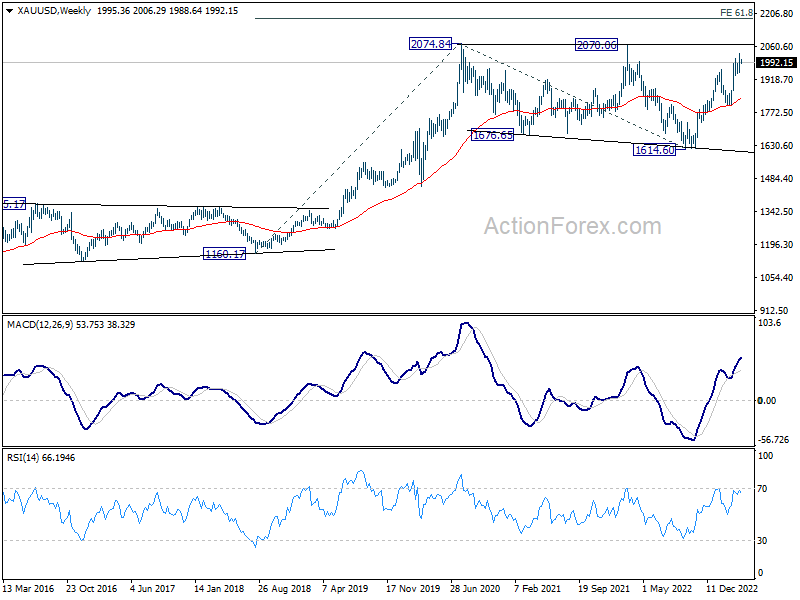
However, sustained break of 1945.11/1949.55 support zone could signal a deeper fall in underway, possibly extending the long-term consolidation pattern from 2074.84 with another downward leg. In this scenario, gold prices could decline to 61.8% retracement of 1804.48 to 2032.05 at 1894.41 or even further towards 1084.48.
BoC expected to hold steady: Loonie's fate lies in oil prices and US data
Bank of Canada (BoC) is widely anticipated to maintain its pause this week, leaving interest rates unchanged at a 15-year high of 4.50%. Governor Macklem has emphasized that there's no need for additional rate hikes if the economy unfolds according to central bank's projections, which forecast stalling growth for the rest of the year, subsequently cooling inflation. Macklem also stated that an "accumulation of evidence" would be required before considering resuming tightening.
Consequently, it's unlikely that BoC's announcement on Wednesday or Macklem's speech on Thursday will trigger significant volatility in Canadian Dollar. Instead, Loonie is expected to be more reactive to developments in oil prices, as WTI crude remains stuck around 80 mark. Additionally, the currency could be influenced by US CPI data and the release of FOMC minutes when paired against the greenback.
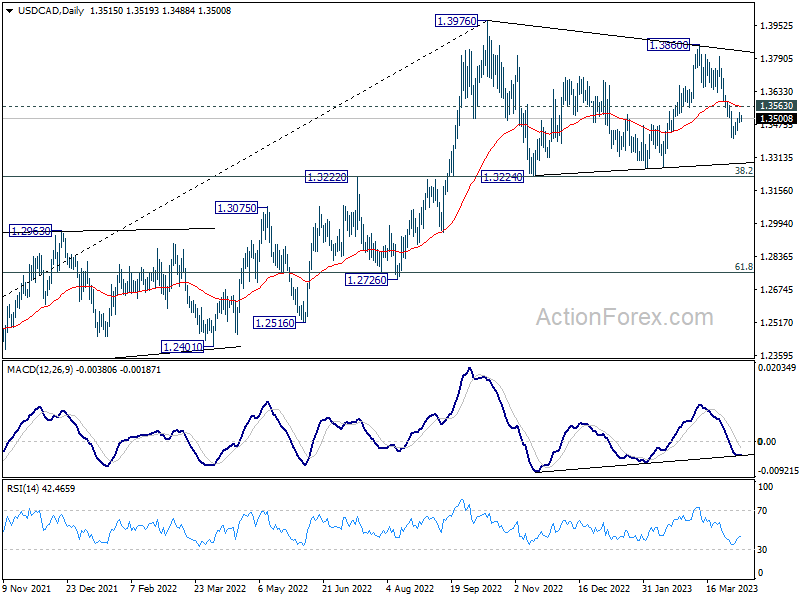
From a technical perspective, USD/CAD appears to be in the third leg of the corrective pattern from 1.3967. Deeper decline is expected as long as 1.3563 minor resistance holds. However, robust support is anticipated around 1.3224, which should contain the downside and complete the pattern. On the other hand, a sustained break of 1.3563 and 55-day EMA (now at 1.3562) would likely result in a stronger rally back towards 1.3860 resistance level. Ultimately, the larger uptrend is envisaged to resume through 1.3976 at a later stage.
BoJ Ueda stands firm on monetary easing and negative rates
In his first press conference as new Bank of Japan Governor, Kazuo Ueda stated that the central bank will maintain its massive stimulus program, echoing the stance of the previous leadership. Ueda commented, "The BOJ's current monetary easing is a very powerful one. We need to strive, as we have done so far, to appropriately grasp economic, price, and financial developments to see whether trend inflation will stably and sustainably achieve 2%."
The governor acknowledged the side-effects of the BOJ's negative rates, particularly on banks, but noted that banks seem to have sufficient buffers and financial intermediation is functioning. Ueda emphasized the necessity of maintaining negative rates, stating, "Given trend inflation has yet to hit 2%, it's appropriate to maintain negative rates."
Regarding Yield Curve Control (YCC), Ueda said, "When looking at current economic, price, and financial developments, it's appropriate to maintain YCC for now." He added that any major changes to YCC should be determined by evaluating the economic, price, and financial trends, while also weighing the benefits and costs of the policy.
Ueda noted some positive signs in inflation and wages, saying, "Trend inflation is rising somewhat. There's also some positive signs in wages. There's a good chance this will lead to stable, sustained achievement of higher, trend inflation."
GBP/JPY Daily Outlook
Daily Pivots: (S1) 163.63; (P) 164.00; (R1) 164.43; More...
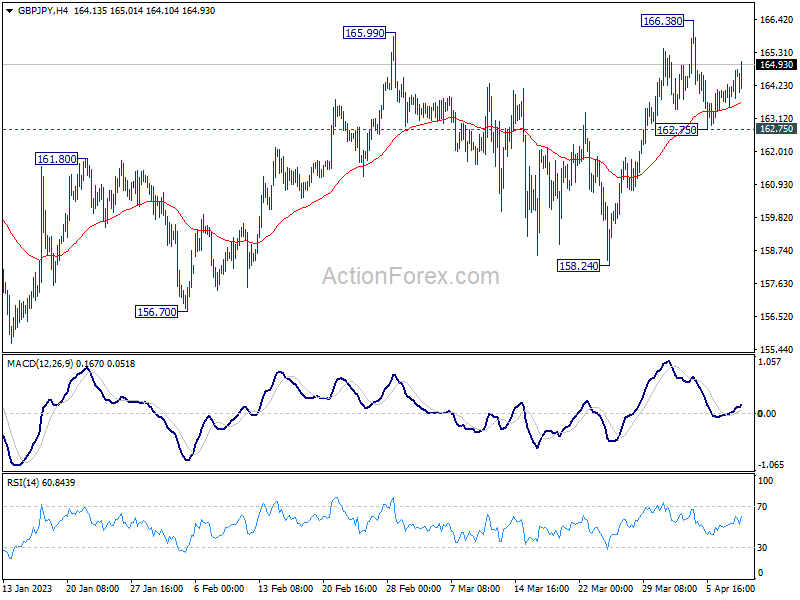
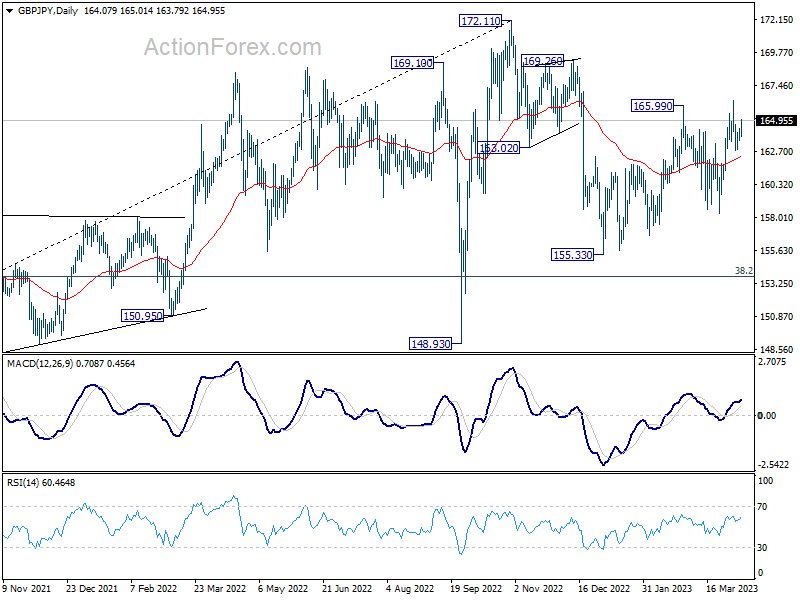
GBP/JPY recovers higher today but stays below 166.38 resistance. Intraday bias remains neutral at this point. On the upside, break of 166.38, and sustained trading above 165.99 resistance will resume the whole rebound from 155.33 to 169.26 resistance next. On the downside, however, break of 162.75 minor support will mix up the outlook and turn intraday bias to the downside for 158.24 support instead.
In the bigger picture, as long as 38.2% retracement of 123.94 (2020 low) to 172.11 (2022 high) at 153.70 holds, medium term bullishness is retained. That is, larger up trend from 123.94 (2020 low) is still in progress. Break of 172.11 high to resume such up trend is expected at a later stage.
Economic Indicators Update
| GMT | Ccy | Events | Actual | Forecast | Previous | Revised |
|---|---|---|---|---|---|---|
| 23:50 | JPY | Current Account (JPY) Feb | 1.09T | 1.42T | 0.22T | 0.20T |
| 05:00 | JPY | Consumer Confidence Index Mar | 33.9 | 31.6 | 31.1 | |
| 06:00 | JPY | Eco Watchers Survey: Current Mar | 53.3 | 50.4 | 52 | |
| 14:00 | USD | Wholesale Inventories Feb F | 0.20% | 0.20% |
Australian Dollar Flat in Holiday-Thin Trading, Business and Consumer Confidence Releases Next
Markets await Australian confidence indicators
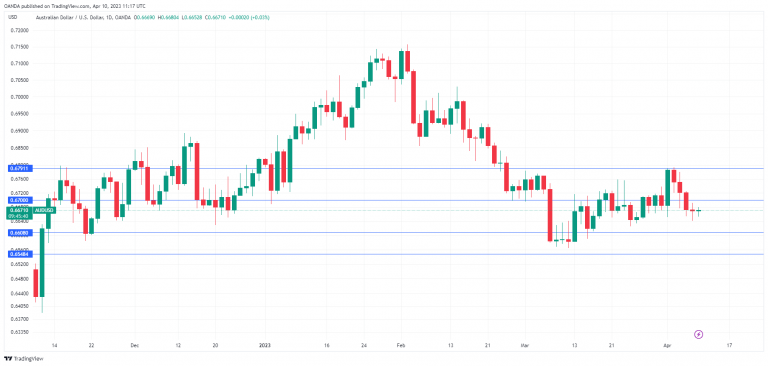
AUD/USD is flat on Monday, as Australia is closed for a bank holiday. There are no Australian releases and no tier-1 events in the US today, which means it should be an uneventful day for the Aussie.
The combination of high interest rates and high inflation has been a double whammy that has dampened confidence in the Australian private sector. Will we get some good news on Tuesday from consumer and business confidence releases? The markets seem to think so. Westpac Consumer Sentiment was flat in March but the market consensus is 0.8% for April. Businesses have been in a sour mood, with NAB Business Confidence managing only one gain in the past five months. The forecast for the March reading is zero, following -4 in April. Confidence indicators are an important gauge of the health of the economy, as strong confidence levels often translate into increased spending.
Last week ended with the US employment report, which indicated that the labour market remains quite strong, dashing the expectations of some that the labour market was showing cracks. The economy added 236,000 jobs in March, close to the estimate of 240,000 and softer than the upwardly revised 326,000 reading in February. Unemployment remains very low and dipped to 3.5%, down from 3.6%. Wage growth eased to 4.2% y/y, vs. 4.6% prior and 4.3% anticipated.
The jobs report indicated that the labour market is cooling, and the Fed will no doubt be pleased that its moves to slow the economy and curb inflation are bearing fruit. Fed policy makers want to see deceleration, but in an orderly and gradual manner so that Fed rate policy results in a soft landing. That will be no simple feat, and the worry is that the job market will suddenly lose its balance and employment data will fall sharply. Ahead of the NFP report, the odds of a 25-bp rate hike in May were 52%, and this has jumped to 65%, with a 35% chance of a pause. This shows that the markets feel that the Fed needs to raise rates some more in order to cool down the strong labour market.
AUD/USD Technical
- The round number of 0.6700 is a weak resistance line. Next, there is resistance at 0.6791
- AUD/USD has support at 0.6608 and 0.6548
BoJ Ueda stands firm on monetary easing and negative rates
In his first press conference as new Bank of Japan Governor, Kazuo Ueda stated that the central bank will maintain its massive stimulus program, echoing the stance of the previous leadership. Ueda commented, "The BOJ's current monetary easing is a very powerful one. We need to strive, as we have done so far, to appropriately grasp economic, price, and financial developments to see whether trend inflation will stably and sustainably achieve 2%."
The governor acknowledged the side-effects of the BOJ's negative rates, particularly on banks, but noted that banks seem to have sufficient buffers and financial intermediation is functioning. Ueda emphasized the necessity of maintaining negative rates, stating, "Given trend inflation has yet to hit 2%, it's appropriate to maintain negative rates."
Regarding Yield Curve Control (YCC), Ueda said, "When looking at current economic, price, and financial developments, it's appropriate to maintain YCC for now." He added that any major changes to YCC should be determined by evaluating the economic, price, and financial trends, while also weighing the benefits and costs of the policy.
Ueda noted some positive signs in inflation and wages, saying, "Trend inflation is rising somewhat. There's also some positive signs in wages. There's a good chance this will lead to stable, sustained achievement of higher, trend inflation."
Weaker Data Will Be Much Appreciated at the Halls of the Bank of England
With the UK banking sector surviving the March developments – a sign of good banking regulations or clever hedging from UK banks – the focus remains squarely on economic developments. Inflation remains a proper thorn in BoE’s side that will become even bigger if this week’s data send the wrong message. Could the pound continue to outperform the euro and other major currencies despite the dovish stance by the BoE?
BoE's inflation problem
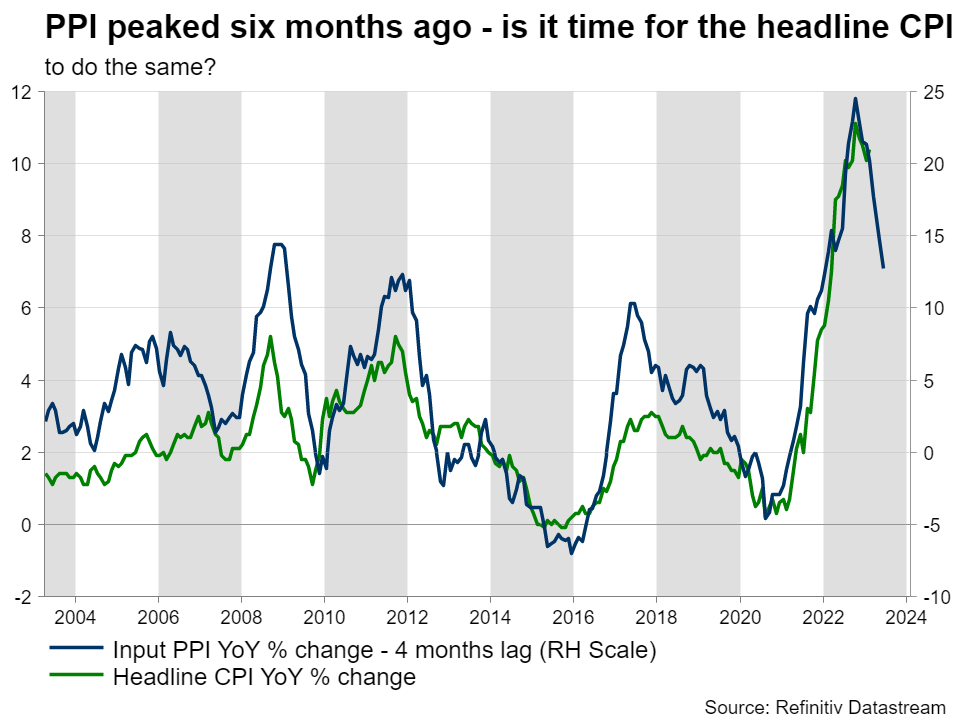
The BoE remains the most intriguing case among the key central banks globally. Despite having the worst inflation rates in the developed world, the BoE maintains its mostly dovish stance. One could argue that the Bank has raised rates by a total of 400 bps in the past 1.5 years, but the data readings are undeniable. February inflation produced an upside surprise and printed again above 10%, even though the rest of the world continues to see a drop in headline inflation rates. We would have expected a plethora of hawkish comments to follow, but the BoE members did not meet our expectations. We understand the reasons behind their reluctance to push rates even higher and instead opting to wait for the already announced monetary policy decisions to impact the real economy. However, here lies a big risk for the BoE. As inflation remains high, it becomes entrenched in wage agreements and the public’s mindset. This creates a vicious cycle that could potentially require further effort and higher rates by the BoE to be untangled.
Production data to give clearer picture about growth in the first quarter of 2023
At the recent testimony by Fed chairman Powell, there was a barrage of questions, mostly from Republican politicians, that the Fed is engineering a slowdown to get inflation in check. While this remains to be seen for the Fed, we have the feeling that this is exactly what the BoE is hoping for. Their wish appears to have come true as the fourth quarter GDP figures showed a barely expanding economy and initial evidence points to an equally weak first quarter of 2023. On Thursday, we will get the February industrial and manufacturing production details. These year-on-year figures have been plateauing at a deeply negative territory, increasing concerns that the targeted slowdown might prove deeper than initially envisaged.
Retail sales keep the BoE on its toes
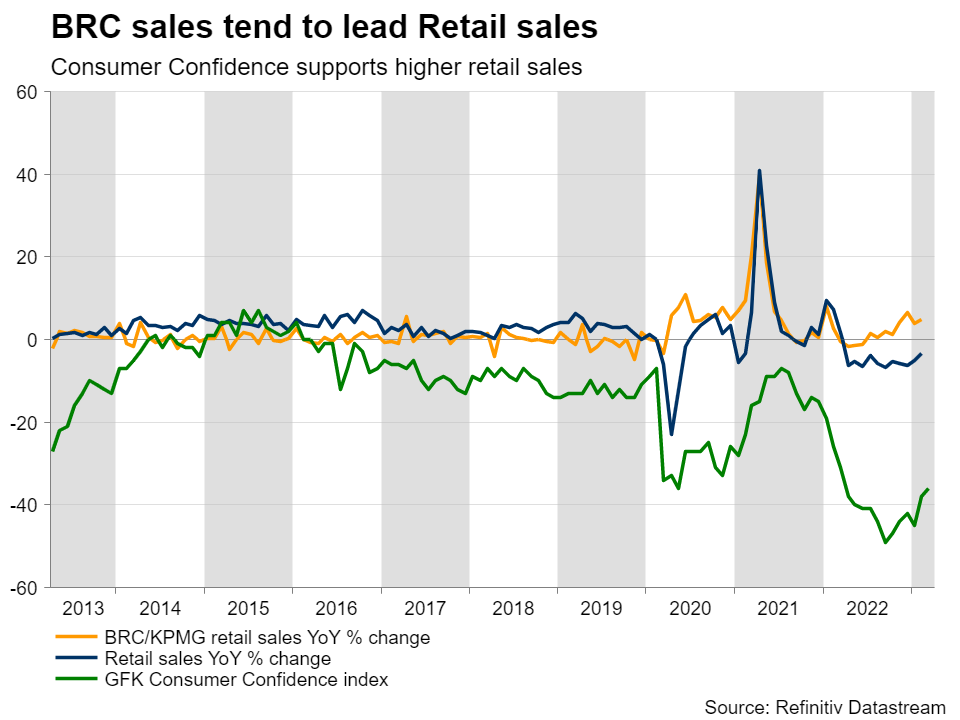
Retail sales could potentially create another upset for the BoE. The BRC retail sales indicator is released on Tuesday morning and barring a major disappointment, it is expected to confirm that the retail sales figures are on an upwards path. If we add to the mix the decent pace of increase in average earnings, then the BoE is expected to have a hard time affecting consumer appetite or limiting the pricing power by the main retailers, unless it increases interest rates significantly or the economy enters a recession.
The housing sector matters for the BoE
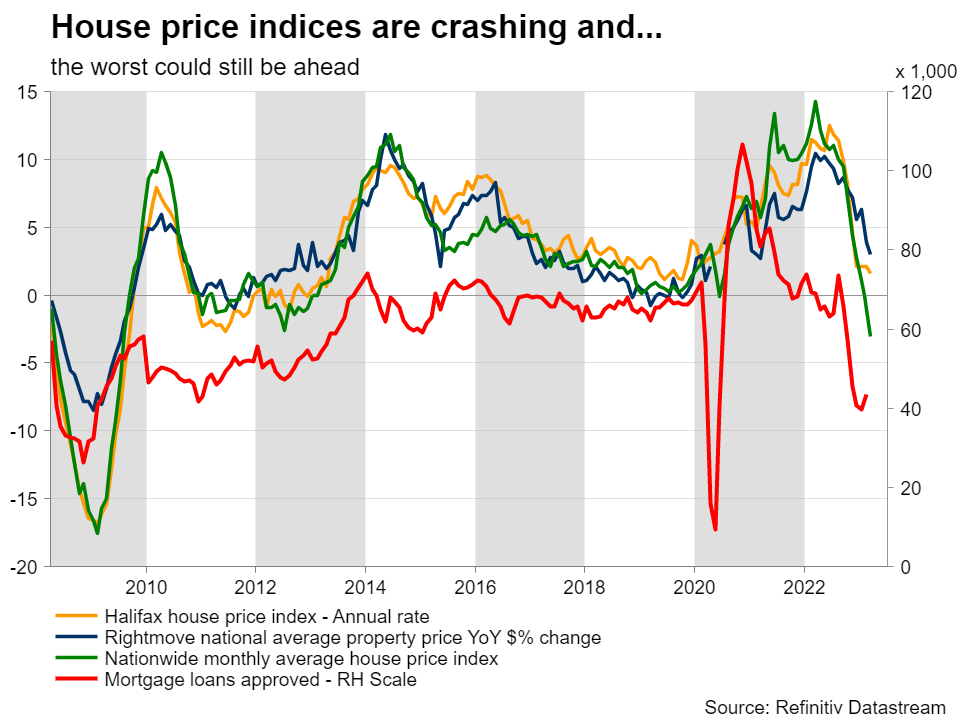
Central banks have to make decisions for the entire economy, but sometimes certain sectors carry more weight in the decision-making process. For example, the housing sector in the UK is a significant economic factor and a sizeable source of private wealth. As seen in the US, this sector tends to get disproportionately affected by higher interest rates as mortgage lending in the UK has crashed. The RICS house price balance print for March will be published on Thursday and an improvement is forecast. While such an outcome will not necessarily mean that house prices will start to recover, it could be an initial sign that prices are potentially close to the bottom of the current downward move.
Pound needs a boost
The pound has been the star of the show since the start of the year. It has managed to outperform most major currencies despite the hesitant BoE stance. This outperformance is also significant from an economic standpoint as it reduces imported inflation, but makes UK products and services more expensive internationally, denting even further the weak growth outlook.
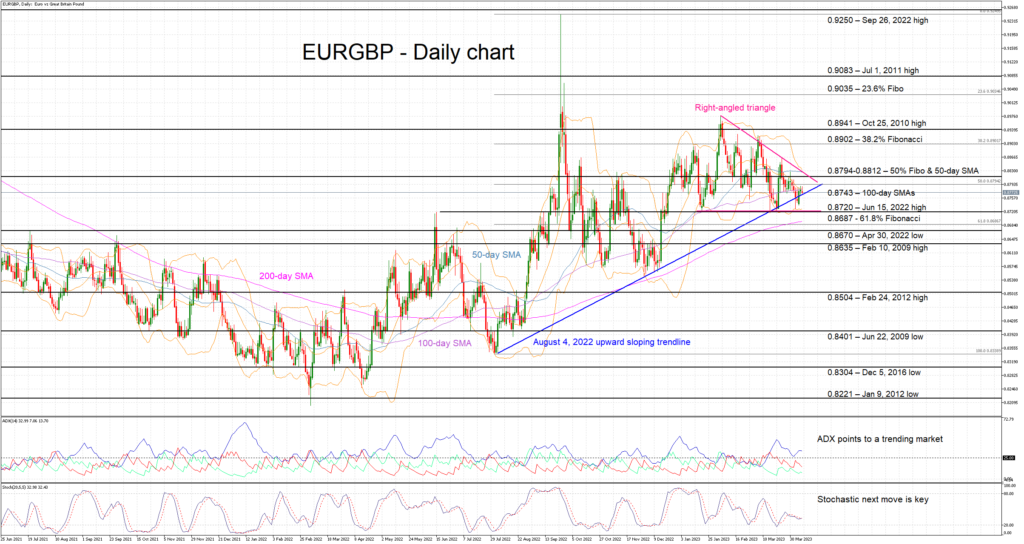
The euro/pound pair has been on an upward path since the March 2022 lows, but pound bulls have lately found the courage to stage a small comeback. It has not been a straightforward path as they had to clear some key levels on the way down. The pair is currently fighting with the August 4, 2022 upward sloping trendline and a potential break of this support line could open the door for a move towards the 0.8635 area. Pound bulls could also potentially count on the developing right-angled triangle for further bearish pressure. On the other hand, euro bulls would love a retest of the 0.8900 area provided that they break the 0.8800 midpoint of the recent range.
Can a Sidelined Bank of Canada Prove Positive for the Loonie?
In March, the Bank of Canada became the first major central bank to stop raising interest rates, with investors now assigning a small probability for a rate reduction at Wednesday’s gathering. What will policymakers decide, what signals will they provide with regards to their future course of action, and how may the loonie respond?
BoC expected to stand pat but to cut rates later this year
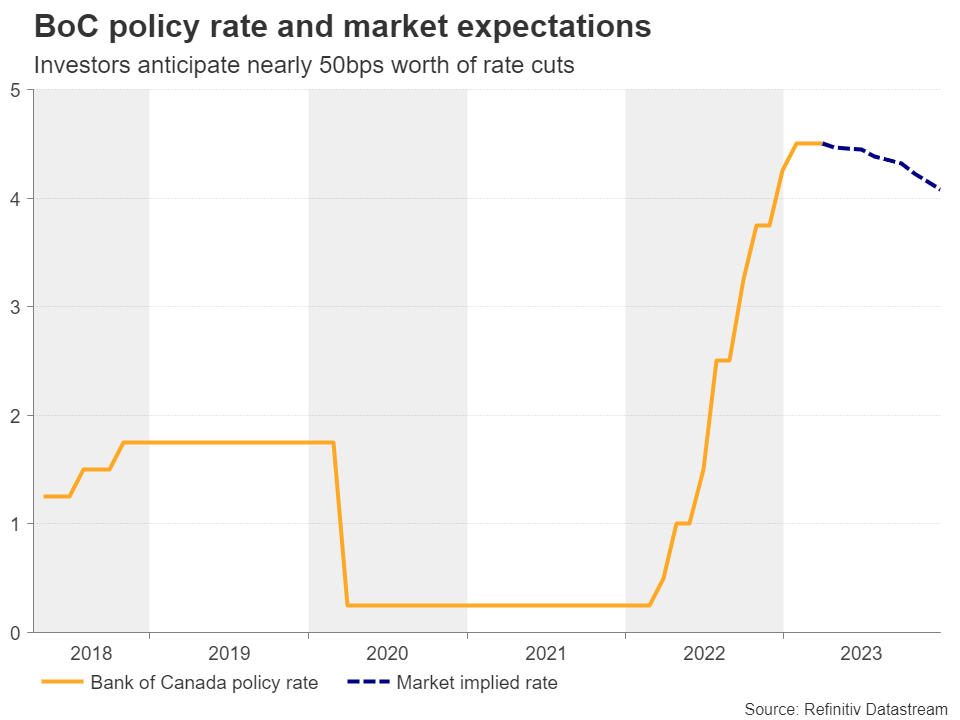
At its last meeting in March, the Bank of Canada decided to keep its policy rate untouched at 4.5%, becoming the first major central bank to hit the pause button in this race to bring inflation to heel. Although in their statement policymakers re terated that they remain prepared to increase rates further if needed, they also noted that data remains in line with their expectations that CPI inflation will come down to around 3% in the middle of the year.
Post-meeting data showed that most inflation metrics in Canada slowed by more than expected in February, reaffirming the Bank’s view and prompting investors to assign an almost 15% chance of a rate cut as soon as at next week’s gathering, with the remaining pointing to no action. They are also anticipating nearly 50bps worth of rate reductions by December, although most economists polled by Reuters believe that the Bank will stay sidelined through the whole of 2023.
Recent data does not justify rate cut bets
However, last Thursday, the employment report for March confirmed that the labor market remains tight, a view already shared by the BoC’s business outlook survey, which was released a few days earlier. What’s more, according to the same survey, half of Canadian businesses anticipated a mild recession next year, which is fewer than the prior survey showed. As for inflation, although firms’ expectations moderated, they still see inflation well above 2% until at least 2025.
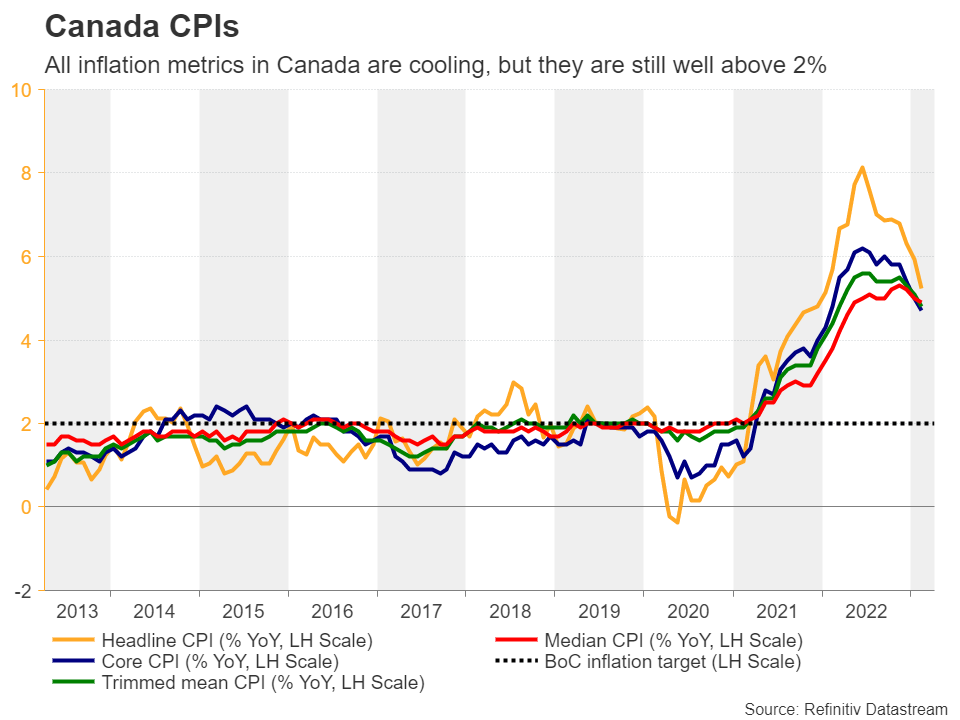
All this corroborates investors’ view that the Bank is more likely to stay on hold at this week’s gathering. However, it does not justify expectations of rate reductions. Yes, the full effect of prior hikes is not yet fully transmitted to the real economy, but there is no evidence that inflation will return to 2% soon and allow the Bank to start considering rate reductions.
Clues about future decisions to be the main driver for loonie
Putting everything together, all this means that if the Bank indeed decides to stand pat, the Canadian dollar is unlikely to be moved by the rate decision per se. Traders are likely to focus on the accompanying statement and the updated economic projections for clues and hints on whether rate cuts are indeed possible this year. Anything confirming their view could weigh on the loonie.
However, according to the data, that doesn’t seem to be the most likely outcome. Officials have ample reasons to push against rate reductions this year, which could help the Canadian currency gain ground. Now, whether the currency can hold onto its strength may depend on whether market participants will put full trust in the Bank’s words or continue pricing in some basis points worth of cuts by the end of this year.
Dollar/loonie stays below medium-term uptrend line
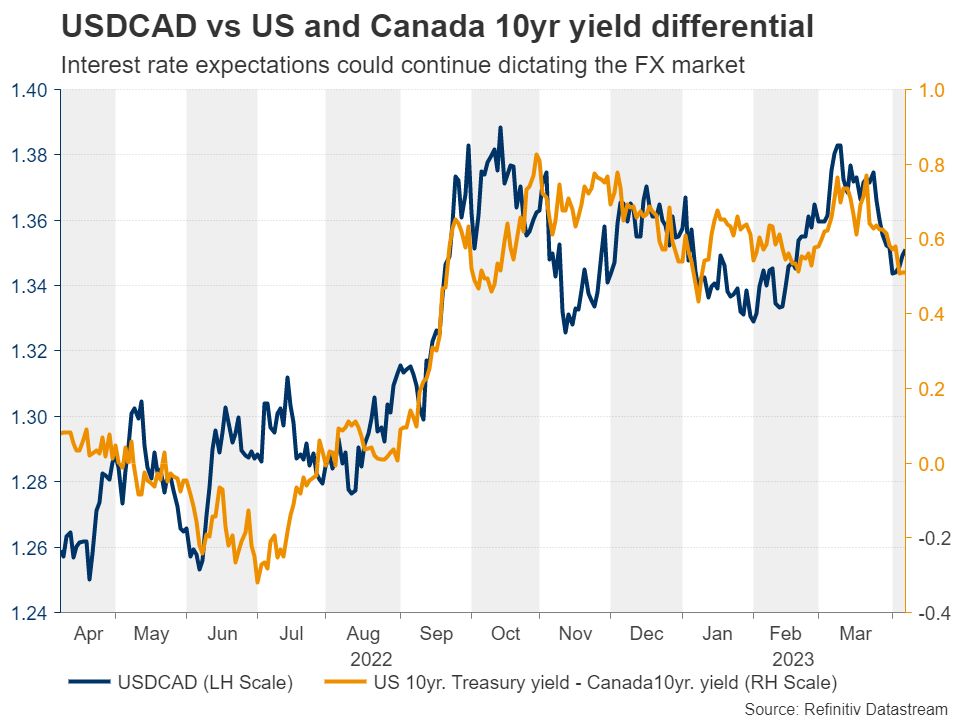
Dollar/loonie was in recovery mode the last few days, but today, it hit resistance at the crossroads of the uptrend line drawn from the low of June 8, the 1.3525 level, and the 100-day EMA. This implies that the sellers could soon jump back into the action. If so, they may easily overcome the low of April 4 at 1.3400 and drive the battle toward the key support area of 1.3230. If there are no buyers to be found near that zone either, a break could pave the way for a test at a longer-term uptrend line, drawn from the low of June 1, 2021.
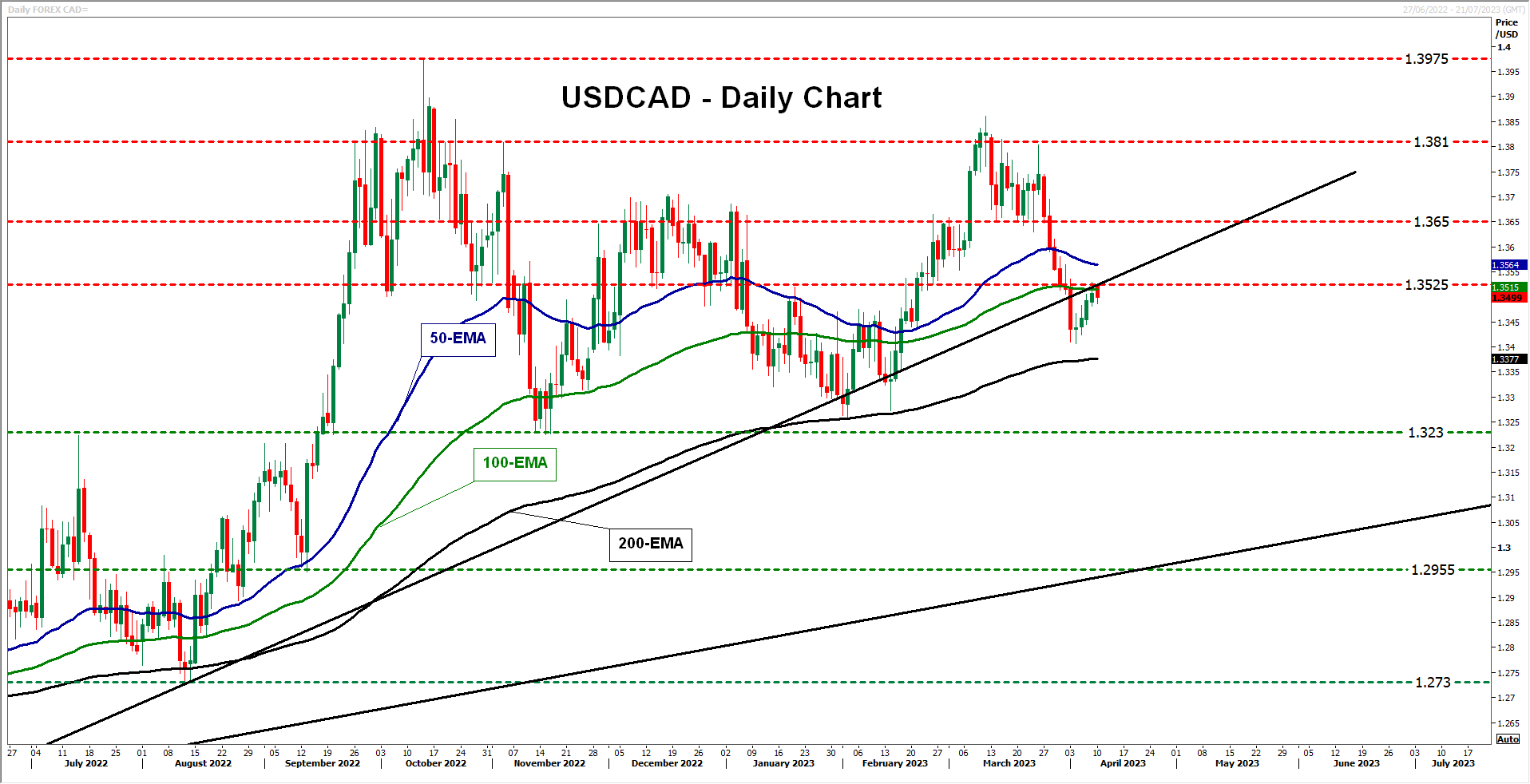
The move signaling that the bulls have gained the upper hand again may be a recovery above the 1.3650 zone. Dollar/loonie would be above all the plotted moving averages, and above the uptrend line drawn from the low of June 8, allowing the bulls to climb to the 1.3810 barrier. The break of that barrier could carry extensions towards the 1.3980 zone, the pair’s highest point since May 2020, reached on October 13.
EUR/USD: Bullish Bias Above 10DMA
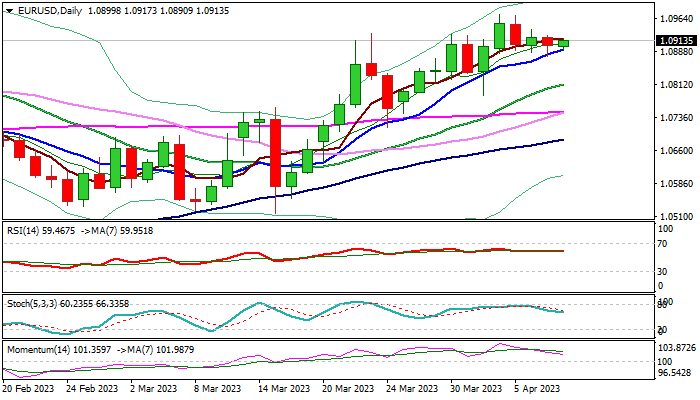
The Euro remains constructive but holding within a narrow range for the third straight day, on Easter-holiday thinned market.
The price action continues to hold above rising 10DMA (1.0892), keeping bullish bias for retest of last week’s top (1.0973) and attack at psychological 1.10 barrier, which guards key resistance at 1.1032 (2023 high, posted on Feb 2).
Technical studies on daily chart are mixed, with moving averages in full bullish setup and positive momentum fading, which lacks clearer direction signal.
Immediate focus is expected to remain at the upside while the price stays above 10DMA, with extended dips to be contained at 1.0800 zone, to keep bulls intact.
Conversely, loss of 1.08 handle would weaken near-term structure and risk test of pivotal supports at 1.0757/13 (daily Ichimoku cloud top / Mar 24 higher low).
Res: 1.0973; 1.1000; 1.1020; 1.1032.
Sup: 1.0892; 1.0811; 1.0788; 1.0757.
WTI Oil: Narrow Consolidation Likely to Precede Fresh Push Higher
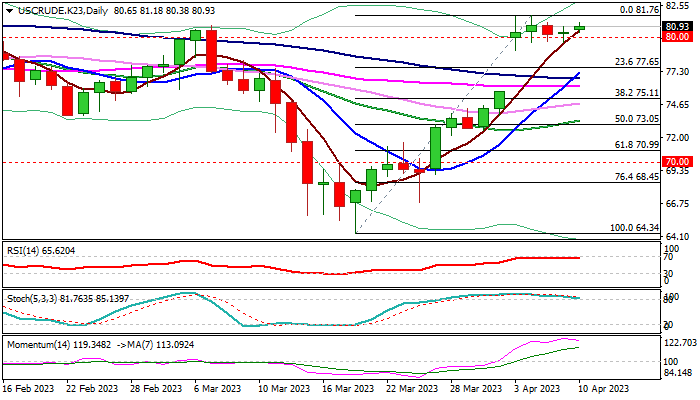
WTI oil price is holding in extended consolidation within $80.00/$81.00 range for the fifth straight day, after last Monday’s opening with gap higher of nearly 6%.
Bulls continue to hold strong gains, sparked by surprise decision by OPEC+ group to further cut production, which so far fully offset demand concerns on persisting recession warnings.
Holiday lowered volumes keep the action within a tight range, but the price holds recent gains and consolidating just under new multi-week high that continue to fuel positive environment and boost expectations for further advance.
Broken $80 barrier reverted to strong support which contained several attacks last week, keeping immediate bulls intact for probe through new top at $81.76 and extension towards significant barriers at $82.64 (2023 high) and $83.42 (falling 200DMA).
On the other hand, overextended daily studies suggest that price may hold in extended consolidation or enter correction, in case that $80 support is lost.
Bulls are expected to remain in play as long as last week’s gap is unfilled, with extended dips to be contained by rising 10DMA ($77.21).
Res: 81.21; 81.76; 82.64; 83.32.
Sup: 80.00; 79.62; 78.98; 77.65.
Dollar braces for CPI release, a look at EUR/USD and DXY
This week promises to be eventful for Dollar, with key data releases including CPI, PPI, retail sales, and University of Michigan Consumer Sentiment. Additionally, Fed will publish minutes from March FOMC meeting, and numerous policymakers are expected to share their views on the economy and interest rates.
Specifically, headline CPI is forecasted to drop further from 6% to 5.2% in March. This marks a significant improvement from last year's 9.1% peak in July and represents the ninth consecutive month of cooling consumer inflation. If realized, the headline CPI reading would be the lowest since June 2021's 5.0%, nearly two years ago. Conversely, core CPI is projected to tick up from 5.5% to 5.6%, breaking the five-month downtrend since September last year.
Following last week's robust job data, traders have increased bets on a 25bps rate hike in May, with over a 60% chance. However, whether Fed opts for one, two, or no additional rate hikes may not make a significant difference. The primary focus is when Fed will start reversing course and cutting interest rates, which largely depends on how quickly core inflation falls back to a level consistent with price stability or remains stuck above the Fed's target.
Presently, fed fund futures indicate a nearly 70% chance of a cut back to 4.50-4.75% in July, far from the Fed's own projections. According to the March dot plot, only one policymaker envisions rates ending below 5% this year.
EUR/USD began losing upside momentum last week, stalling before 1.0320 resistance. It appears that a clear downside surprise in core CPI is needed to push EUR/USD past 1.0320 to resume the larger uptrend from the 2020 low at 0.9534. Conversely, breaking 1.0787 support will extend the consolidation pattern from 1.0320 with a third leg back towards 1.0515 support.
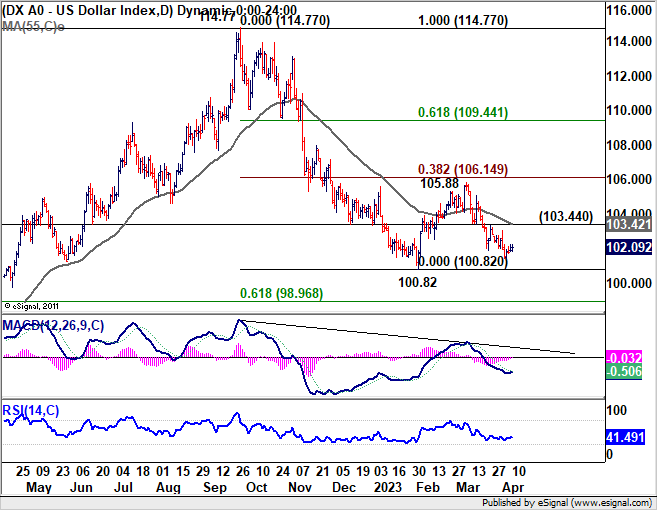
In parallel, for Dollar index, intense selling pressure is required to push DXY below 100.82 low to resume the downtrend from 114.77. Breaking above 103.44 resistance will extend the consolidation pattern from 100.82 with another upleg towards 105.88 resistance.
USDJPY Gives Up Gains, Eyes 132 Level
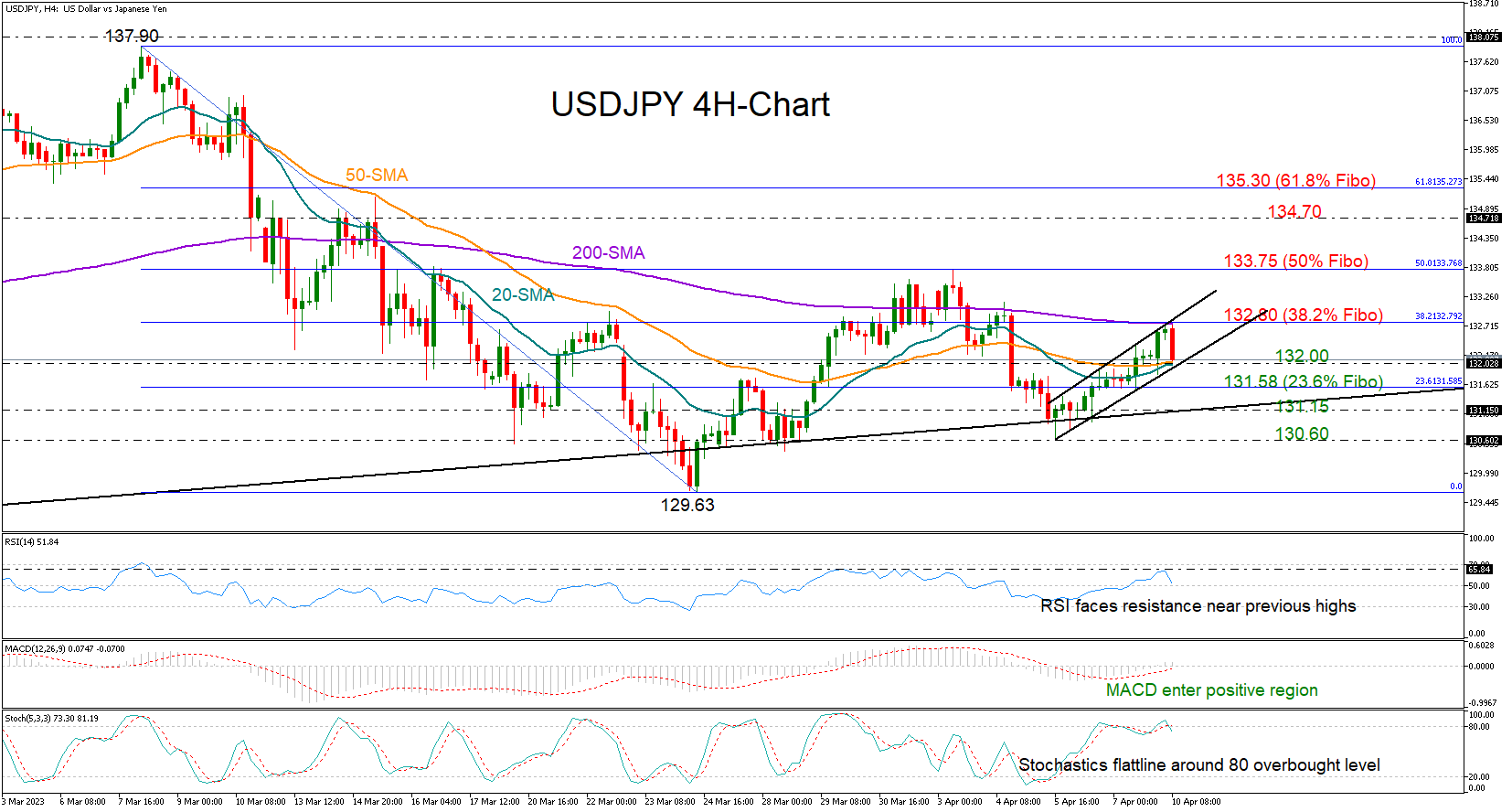
USDJPY gained extra ground within the 132.00 region on a relatively quiet day on Monday as several major markets remained closed for the Easter holidays.
Despite the encouraging start to the day, the bullish correction ran out of steam soon after touching the 200-period exponential moving average (EMA) on the four-hour chart and the familiar resistance of 132.80, which represents the 38.2% Fibonacci retracement of the 137.90-129.63 downleg. The pair also seems to have reversed near the upper boundary of a tight bullish channel.
With the Stochastic oscillator hovering within the overbought zone and the RSI coming under pressure near its previous highs, we cannot rule out a downside move. Yet, only a decisive close below the 132.00 number, where the 20- and 50-period EMAs are located, could confirm an extension towards the 23.6% Fibonacci level of 131.58. If the bears breach the support trendline from January’s lows at 131.15 too, the decline could reach the 130.60 handle, while deeper, the door would open for the March trough of 129.63.
On the upside, the pair will need a successful close above the 132.80 bar for a quick advance up to the 50% Fibonacci mark of 133.75. Another step higher could add more fuel to the rally, bringing the 134.70-135.30 constraining zone next into view.
In summary, USDJPY could remain under pressure in the short term, though only a break below 132.00 would signal a bearish continuation.
Crypto Market Continues to Trade Sideways
Market Picture
Bitcoin gained 1.9% over the past seven days to $28.3K. Ethereum gained 4% to $1860. Other top ten altcoins showed mixed dynamics, ranging from a 1.4% decline (XRP) to a 6.2% gain (Dogecoin).
The total capitalisation of the crypto market, according to CoinMarketCap, rose 2% over the week to $1.185 trillion.
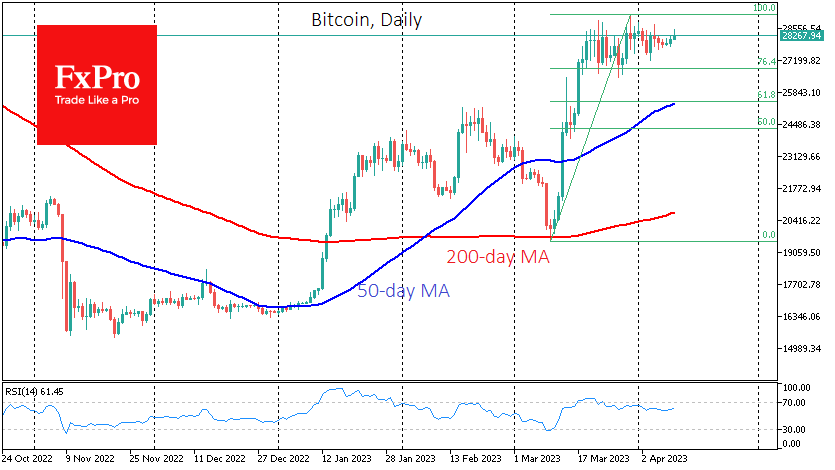
Bitcoin has been consolidating sideways, around $28K, for three weeks now. On Monday morning, the price briefly spiked above $28.5K in a thin market. On the daily timeframe, the range has narrowed since the beginning of the month, forming a bullish triangle. It is believed that the price will continue to move toward the breakout, with a rise above $29K opening the way to $35K, while a break below $27.5K may pave the way to $25.5K.
The latest recalculation of Bitcoin’s mining difficulty showed a new record, up 2.23% to 47.89T. The average hash rate for roughly two weeks since the last recalculation was also a record 342.16 EH/s. The 25% increase in the hash rate since the beginning of the year indicates growing confidence in the network.
New Background
SkyBridge Capital founder Anthony Scaramucci confirmed his bullish prediction that Bitcoin would reach $100K within three years. He has put BTC at $1 million by 2030, as has Ark Invest CEO Katie Wood.
Tether, the issuer of the first USDT stablecoin, announced that its SimpleSwap exchange service users can now trade pairs with Euro Tether (EURT) and Tether Gold (XAUT).
At the end of 2022, only 0.53% of investors worldwide paid taxes from digital asset transactions, Divly calculated. Finland (4.03%) and Australia (3.65%) had the highest percentage of these taxpayers.
According to CertiK’s report, blockchain projects lost more than $320 million to hacking and fraud in the first quarter of the year.
According to BitRiver, Russia became the world’s second-largest cryptocurrency mining country for the first time in Q1, with 1GW of mining capacity in operation. The US remains the leader with 3-4GW.