Sample Category Title
Fed Bullard: Lasting impact of OPEC production cut a question
St. Louis Fed President James Bullard told Bloomberg TV that OPEC's production cut was "a surprise." But he added, "whether it will have a lasting impact I think is an open question."
He noted the challenges in tracking oil prices, admitting that fluctuations "might feed into inflation and make our job a little bit more difficult."
Regarding the current state of the global economy, Bullard pointed out that he had already expected higher oil prices given China's faster-than-anticipated recovery and Europe narrowly avoiding a recession. He also cited strong US data as a bullish factor for the oil market.
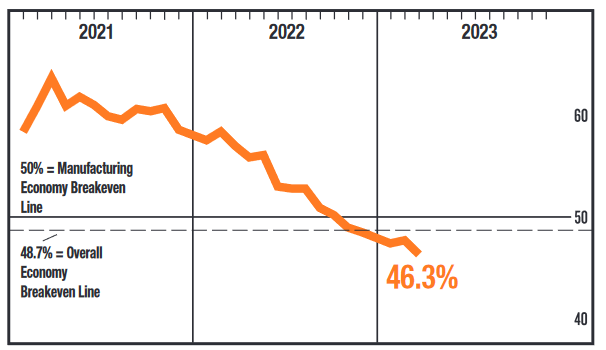
US ISM manufacturing dropped to 46.3, fifth month of contraction
ISM Manufacturing PMI dropped from 47.7 to 46.3 in March, below expectation of 47.5. This is the fifth month of contraction and continuation of a downward trend that began in June 2022. The Manufacturing PMI is at its lowest level since May 2020, when it registered 43.5 percent.
Looking at some details, new orders dropped from 47.0 to 44.3. Production rose from 47.3 to 47.8. Prices dropped from 51.3 to 49.2. Employment dropped notably from 49.1 to 46.9.
The past relationship between the Manufacturing PMI and the overall economy indicates that the March reading (46.3 percent) corresponds to a change of minus-0.9 percent in real gross domestic product (GDP) on an annualized basis.
Sunset Market Commentary
Markets
At the start of trading this morning, key question was whether the calm that gradually returned to markets last week, would again be overthrown by a new ‘event risk’ as OPEC+ this weekend surprised with an additional 1.1 mln bpd oil production cut. After an initial jump to $86 b/p, Brent oil during the European session tentatively found a new equilibrium near $84/85 p/b. As was the case in Asia, the reaction on European equity markets was modest. The EuroStoxx 50 currently trades little changed, holding within reach of the early March top north of 4300. So, the OPEC decision didn’t trigger a hard, outright risk-off repositioning. US indices also maintained most of Friday’s solid gains. To put things in perspective, at $84 p/b, Brent trades well off the levels near $70 from two weeks ago. However, it is still perfectly in the sideways trading range that dominated trading between mid-November and early March. Still, interest rate markets apparently give some more weight to the impact on inflation rather than on potential negative consequences for growth. US and German yields this morning rose up to 7/8 bps. Especially the rise in European yields lost some momentum intraday. German yields are gaining between 5 bps (2-y) and little changed bps (30-y). The German 10-y yield stays below the 2.40% resistance. The 2-y came within reach of the 2.77/83 recent peak levels, but no new test occurred. European money markets almost fully discount an additional 25 bps ECB hike in May and see the peak rate (slightly) above 3.5% in summer. US Treasuries slightly underperform Bunds with US yields rising between 7 bps (2-y) and 2.5 bps (30-y). After finishing this report, the US manufacturing ISM will still be published. (Some) activity indices might be negatively affect by the financial turmoil. However, as this is gradually moving to the back ground, we are cautious to draw any firm conclusions anyway.
In Asia this morning it looked that dollar could become a beneficiary of the OPEC story. DXY briefly surpassed the 103 level at the start of European dealings. However, as the broader market reaction stay modest and orderly, new USD selling kicked in. The index already more than reversed initially gains (currently 102.4 area). Similar story for EUR/USD. The pair briefly tested bids below 1.08 this morning, but is again changing hands near 1.088. The yen underperformance in Asia is also largely undone with USD/JPY (133.0) trading little changed compared to Friday’s close. Oil and commodity related currencies including the Canadian dollar (USD/CAD 1.345) and the Norwegian krone (EUR/NOK 11.25 from 11.356 close on Friday), the Aussie dollar (AUD/USD 0.677 from 0.6685) and to a lesser extent the kiwi dollar (0.628) are today’s outperformers. CE currencies again show remarkable strength (EUR/PLN 4.669, EUR/HUF 379.0). At EUR/CZK 23.45, the Czech krona even nears the early March multi-year peak.
News Headlines
Swiss inflation rose by 0.2% m/m in March, bringing the yearly figure down from 3.4% to 2.9%, Federal Statistical Office data showed today. The data surprised to the downside (3.2% y/y expected). Core inflation eased from 2.4% to 2.2%, defying a 2.5% consensus estimate. The biggest contributors to the monthly advance were, amongst others, international package holidays, air transport and fruiting vegetables. The biggest monthly drops were seen in supplementary accommodation, heating oil and berries. While inflation is still above the Swiss National Bank’s 2% inflation target, the downward surprise and especially the unexpected deceleration in core inflation does trigger a kneejerk downleg in Swiss swap yields today. The front end of the curve drops up to 4 bps and more. The long end adds more than 3 bps. The Swiss franc loses some territory with EUR/CHF advancing from 0.992 to 0.995.
Inflation in Turkey fell more than expected, but that’s about it. At 50.51% (vs 51.25% anticipated) from 55.18%, prices still rise at a stupendously fast pace and at tenfold the central bank’s target. Monthly readings are still well above 2%. Core inflation decelerated from 50.58% to 47.36%, in line with the analyst estimate. The slowdown is largely an energy story and risks are that it may stop soon anyway. Fiscal spending in the aftermath of the earthquake is unlikely to end before the presidential elections on May 14. Meanwhile, monetary policy is extremely easy. With rates at 8.5%, real rates are well below zero. And as the Turkish lira continues to depreciate to ever new lows, imported inflation will continue to rise. The lira loses again today. EUR/TRY left intraday lows at around 20.69 to trade at 20.89 currently. USD/TRY is on track for a new record high close (19.20).
XAU/USD: Gold Keeps Firm Tone But Still Holding in a Range and Looking for Fresh Signals
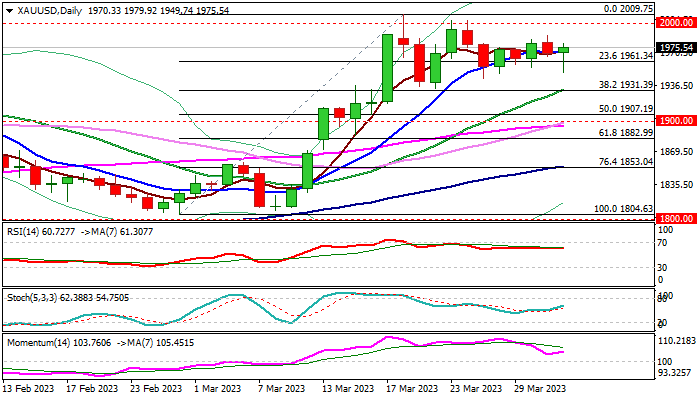
Gold bounces back after short-lived negative reaction on OPEC’s surprise decision which temporarily inflated dollar.
Renewed strength pushes the price back to the middle of the near-term range ($2009/$1944) established after multiple rejections above $2000, but strong bids were found at $1945/50 zone, limiting pullback and keeping larger bulls intact.
Extended consolidation with prevailing bullish bias, look as likely near-term scenario, as the metal looks for fresh direction signals.
The price remains resilient despite renewed risk appetite on fading banking fears, but may face headwinds on growing expectations for the Fed’s 0.25% rate hike in May which would hurt demand for interest-free metal.
Positive factors for gold are bullish technical studies on daily chart and a large March’s monthly candle which formed bullish engulfing pattern, as well as solid safe-haven demand on fragile global economic and geopolitical situation.
On the other hand, stubbornly high inflation increases possibilities of further rate hikes and higher terminal rate that would make dollar more attractive and add pressure on the yellow metal.
Initial supports lay at $1961/45 zone (Fibo 23.6% retracement of $1804/$2009 rally/recent range floor) followed by $1932/32 (20DMA/Fibo 38.2%) and pivotal $1907/00 zone (50% retracement/psychological) loss of which would confirm top ($2009) and signal reversal.
Conversely, firm break above $2000 barrier would generate initial signal of bullish continuation and open way for test of record highs at $2070/74).
Res: 1987; 2000; 2009; 2037.
Sup: 1961; 1944; 1931; 1918.
US 500 Index Ticks Up Above 4,000 and Medium-Term Uptrend Lines
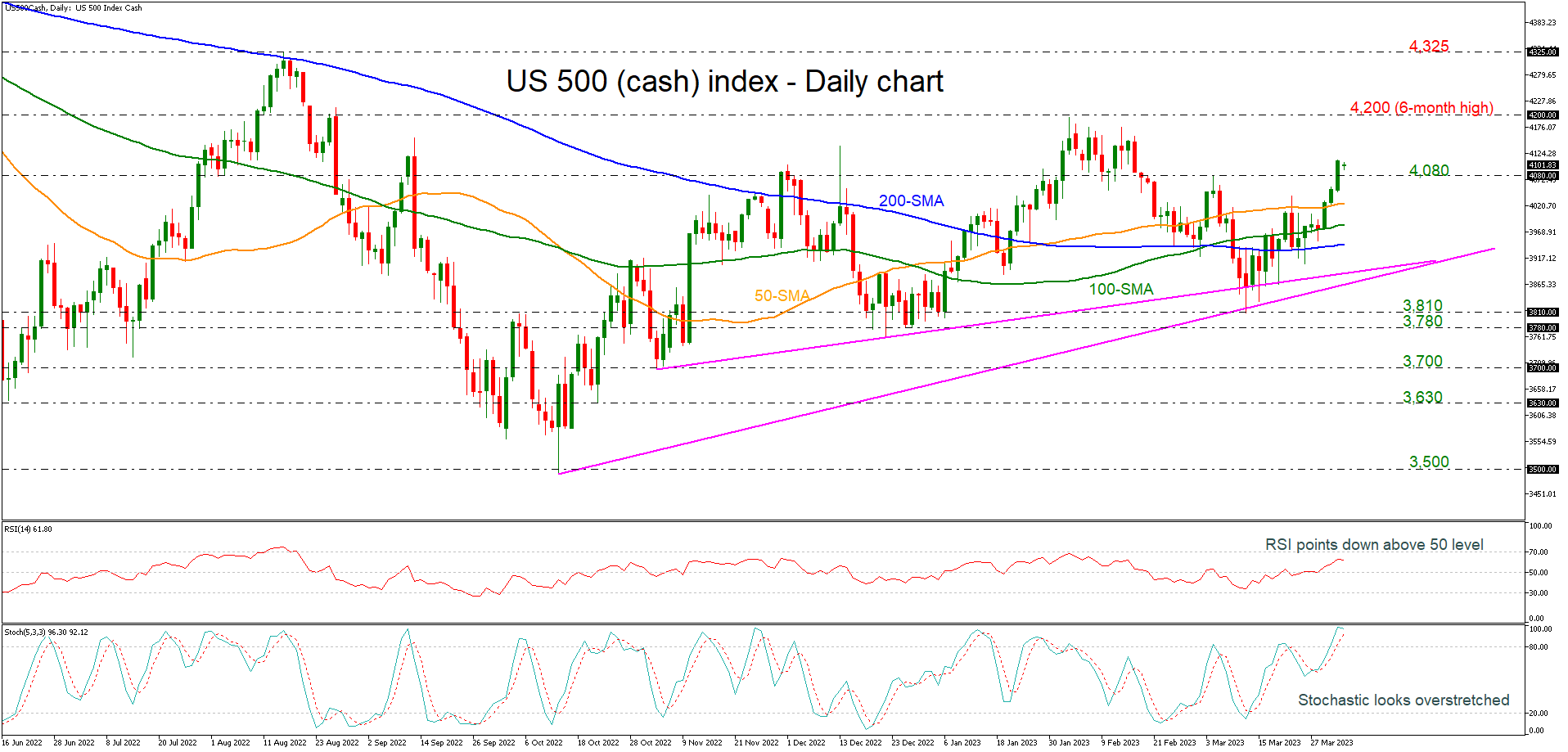
The US 500 cash index has surged more than 3.5% over the last three days, overcoming the 4,100 level. However, the technical oscillators appear overbought. The RSI is pointing down in the positive territory, while the stochastic is turning lower above the 80 level, suggesting that the bullish move in the market may come to an end soon. Also, the index is still standing above the simple moving averages (SMAs) and the medium-term uptrend lines.
Should the index manage to strengthen its positive momentum, the next resistance could come around 4,200, which is a six-month peak. A break above it would shift the bias to a more bullish one and open the way towards the 4,325 barrier.
However, if prices are unable to remain above 4,080, the risk would shift back to the downside, with the 50- the 100, and the 200-day SMAs at 4,027, 3,980 and 3,940 respectively, once again coming into focus, as well as the ascending trend lines around 3,900.
To conclude, the outlook remains positive since prices hold above all the moving average lines and the recent upside rally stays in place.
EUR/USD Daily Outlook
Daily Pivots: (S1) 1.0811; (P) 1.0869; (R1) 1.0900; More...
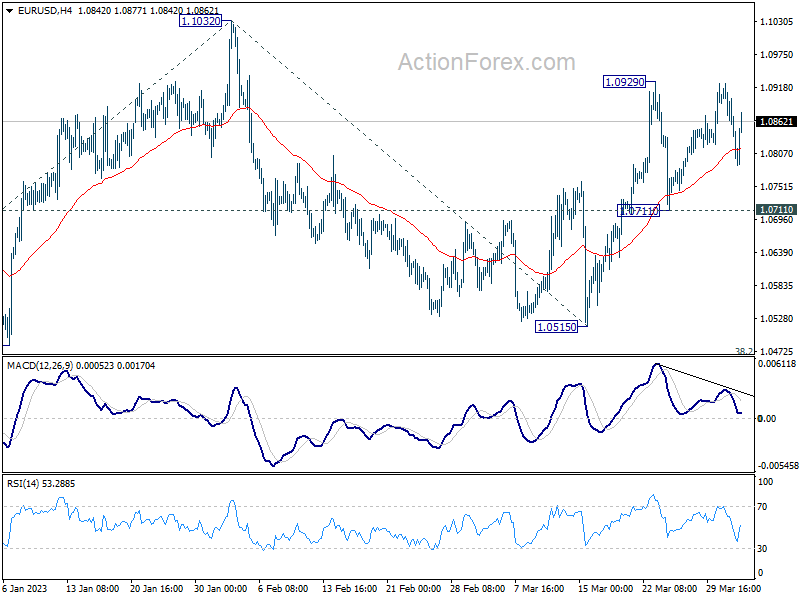
EUR/USD is staying in consolidation from 1.0929 and intraday bias remains neutral first. Further rally is in favor with 1.0711 support intact. On the upside, break of 1.0929 will resume the rally from 1.0515 to retest 1.1032 high. Decisive break there will resume larger up trend from 0.9534 to 1.1273 fibonacci level next. On the downside, though, break of 1.0711 will turn bias to the downside to extend the corrective pattern from 1.1032 with another decline.
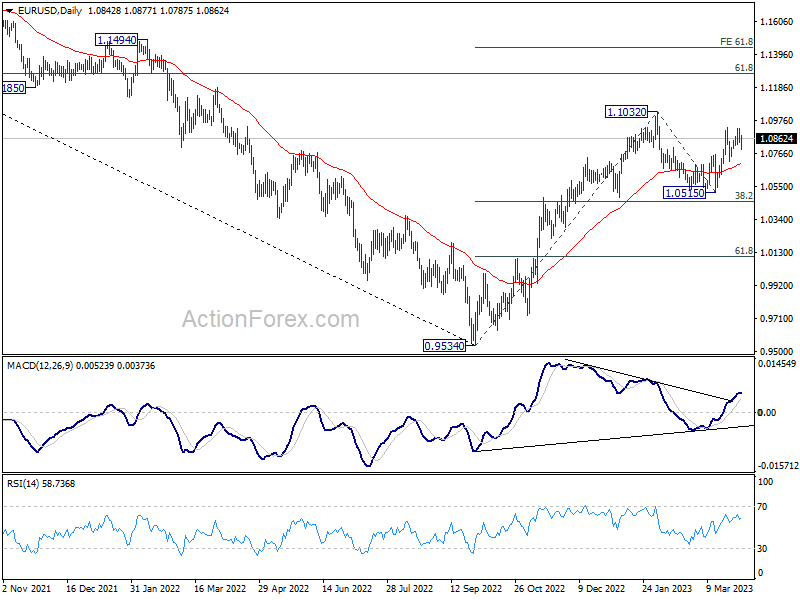
In the bigger picture, rise from 0.9534 (2022 low) is in progress with 38.2% retracement of 0.9534 to 1.1032 at 1.0460 intact. The strong support from 55 week EMA (now at 1.0625) was also a medium term bullish sign. Next target is 61.8% retracement of 1.2348 (2021 high) to 0.9534 at 1.1273. Sustained break there will solidify the case of bullish trend reversal and target 1.2348 resistance next (2021 high).
GBP/USD Mid-Day Outlook
Daily Pivots: (S1) 1.2296; (P) 1.2360; (R1) 1.2394; More...
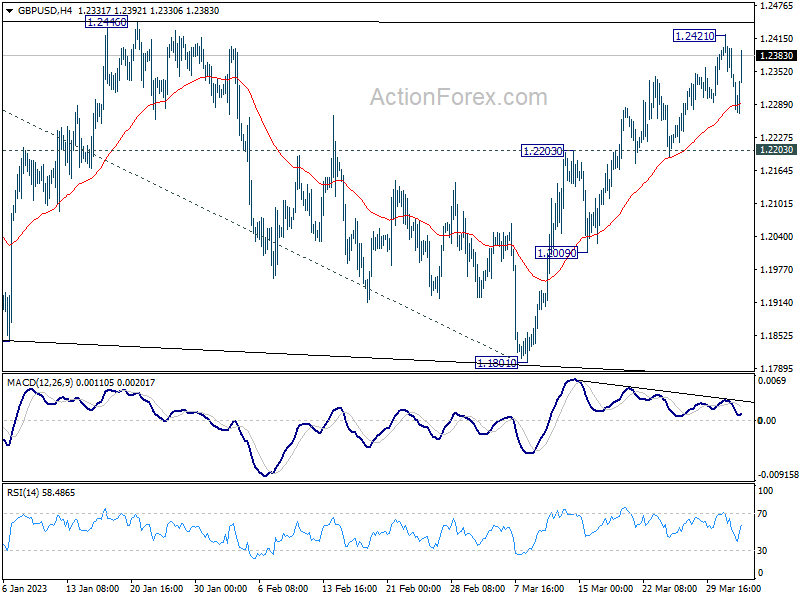
Intraday bias in GBP/USD remains neutral and further rise is in favor with 1.2203 resistance turned support intact. On the upside, decisive break of 1.2445/6 resistance zone will resume larger rally from 1.0351, and target 1.2759 fibonacci level. However, break of 1.2203 resistance turned support will extend the corrective pattern from 1.2445 with another falling leg, and turn bias back to the downside.
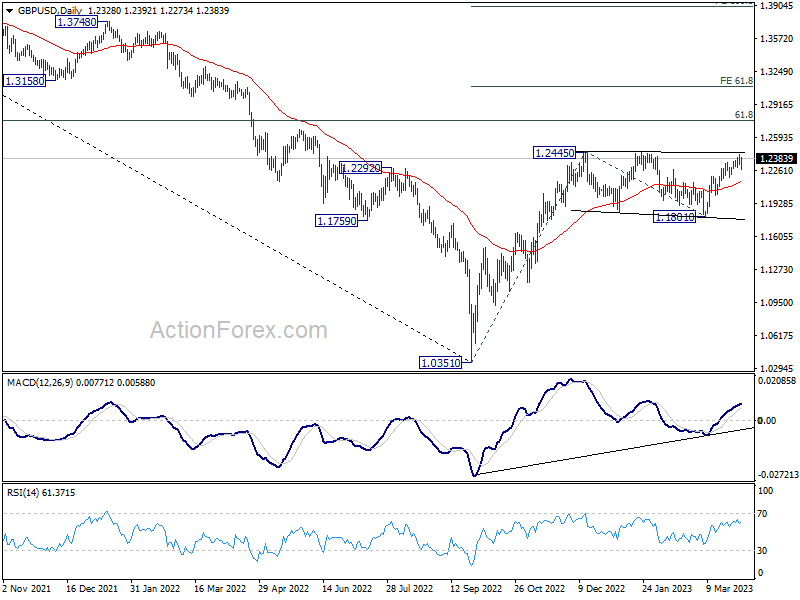
In the bigger picture, the rise from 1.0351 medium term term bottom (2022 low) is in progress for 61.8% retracement of 1.4248 (2021 high) to 1.0351 at 1.2759. Sustained break there will add to the case of long term bullish trend reversal. Further break of 61.8% projection of 1.0351 to 1.2445 from 1.1801 at 1.3095 could prompt upside acceleration to 100% projection at 1.3895. For now, this will remain the favored case as long as 1.1801 support holds, even in case of deep pull back.
USD/CHF Mid-Day Outlook
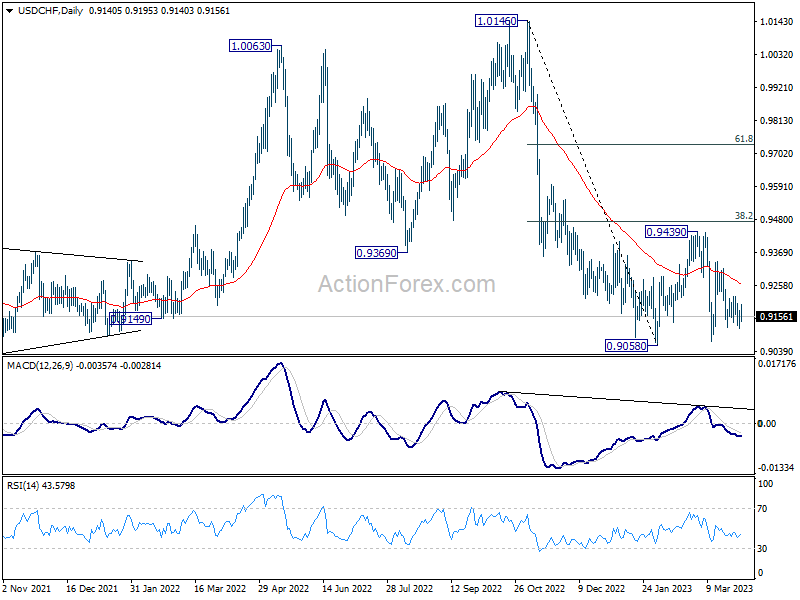
Daily Pivots: (S1) 0.9119; (P) 0.9149; (R1) 0.9181; More...
USD/CHF is still extending the corrective pattern from 0.9058 low. Intraday bias remains neutral for the moment. Another rise cannot be ruled out. But upside should be limited by 0.9474 fibonacci level. On the downside, firm break of 0.9058 will resume larger down trend from 1.1046.
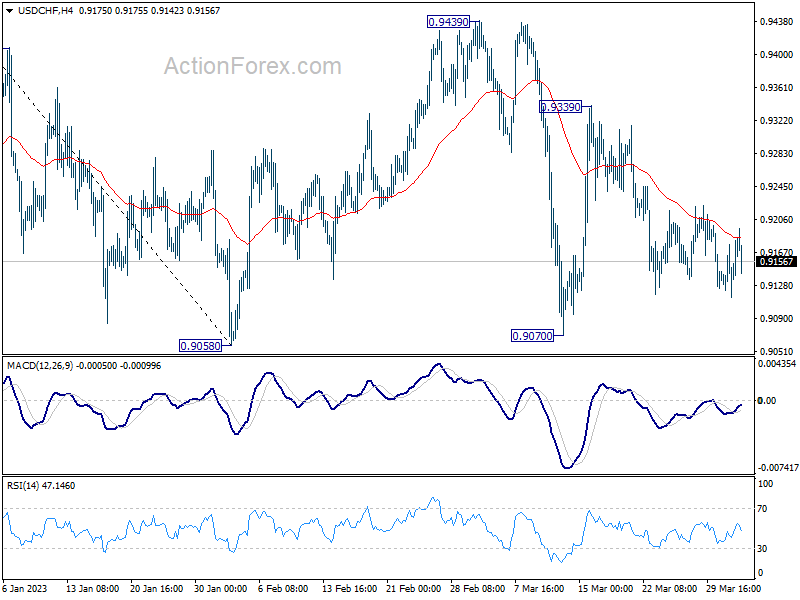
In the bigger picture, fall from 1.1046 (2022 high) should still be in progress with 38.2% retracement of 1.0146 to 0.9058 at 0.9474 intact. Prior rejection by 55 week EMA was a medium term bearish sign. Break of 0.9058 will resume such decline towards 0.8756 support (2021 low). But overall, this fall is still as a leg in the long term range pattern from 1.0342 (2016 high). So, downside should be contained by 0.8756 to bring reversal.
USD/JPY Mid-Day Outlook
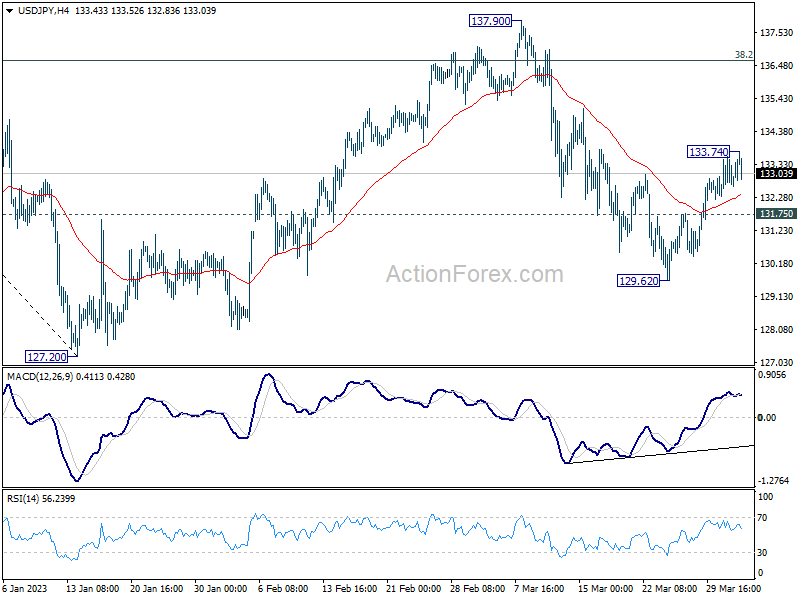
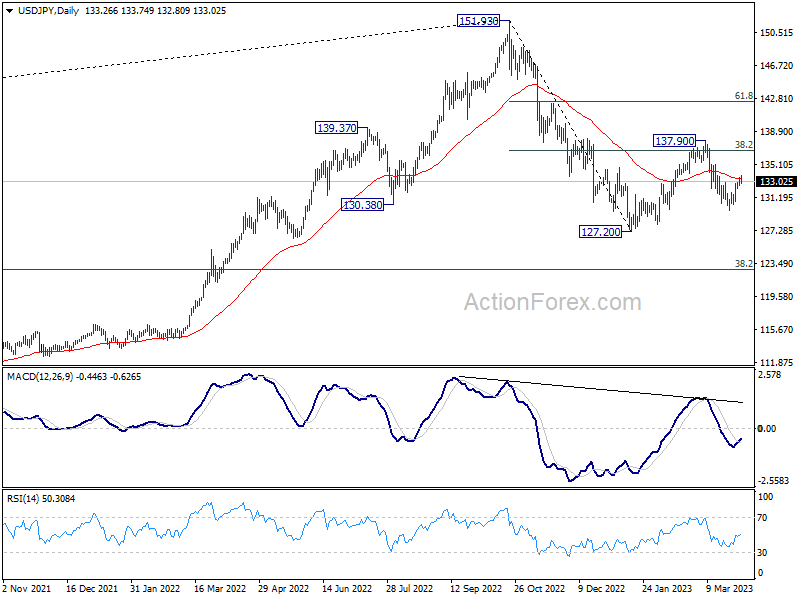
Daily Pivots: (S1) 132.40; (P) 132.99; (R1) 133.40; More...
A temporary top is formed at 133.74 in USD/JPY and intraday bias is turned neutral first. Rise from 129.62 is seen as the third leg of the corrective pattern from 127.20. Sustained break of 55 day EMA (now at 133.43) will target 137.90 resistance. On the downside, break of 131.75 minor support will turn bias to the downside for 129.62 first. Break there will bring retest of 127.20 low.
In the bigger picture, corrective pattern from 127.20 might be extending. But after all, down trend from 151.93 is expected to resume at a later stage. Break of 127.20 will resume this down trend and target 61.8% projection of 151.93 to 127.20 from 137.90 at 122.61. This will now be the favored case as long as 137.90 resistance holds.
USD/CHF – Swiss Franc Steady, Inflation Lower Than Expected
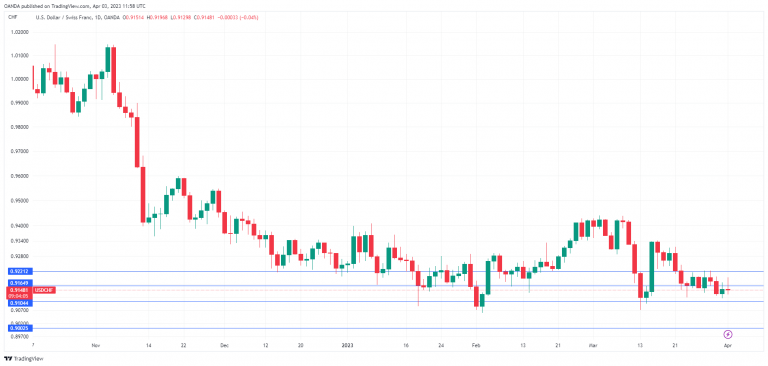
USD/CHF is unchanged in the European session, trading at 0.9150. The Swissie pushed higher earlier but has given up those gains.
Switzerland’s inflation rate fell to 2.9%, down from 3.4%, and the drop could make the Swiss central bank think twice about another rate hike in June. The US releases ISM Manufacturing PMI, which is expected to post another decline, with an estimate of 47.7 points.
Swiss inflation underperforms
Swiss inflation fell to 2.9% y/y in March, down from 3.4% in February and below the estimate of 3.2%. On a monthly basis, inflation slipped to 0.2% in March, vs. 0.7% prior and 0.4% anticipated. The driver behind the drop was lower fuel costs. Switzerland’s inflation levels may be the envy of other major economies, but the Swiss National Bank (SNB) finds itself in a tough fight, given that inflation has exceeded its 0%-2% target for over a year.
The SNB has been very aggressive, relatively speaking, with its rate policy in order to contain inflation. The SNB delivered a 50-basis point hike in March, marking a fourth straight increase which brought the cash rate to 1.5%. The rate hike helped propel the Swiss franc in March when it gained 2.5% against the US dollar.
What’s next for the SNB? The next meeting isn’t until June, and prior to the inflation release, there was a reasonable likelihood of another rate hike. The unexpected drop in CPI could complicate that decision, as policymakers will have to give thought to a 25-bp hike or even a pause in rates, as the economy is showing signs of weakness. GDP was flat in the fourth quarter, and last week’s numbers were soft. The KOF Economic Barometer fell to 98.2, down from 98.9 and below the estimate of 100.5 points. Retail sales posted a weak gain of 0.3%, better than the prior release of -1.7% but shy of the forecast of 1.9%. If inflation continues to head south, policy makers will have their excuse to ease up on the pace of rates and give the economy a break.
Weak manufacturing remains a global problem, as the Russian invasion of Ukraine and China’s zero-Covid policy disrupted supply chains and dampened demand. On Friday, Swiss manufacturing PMI dipped to 47.0 in March, down from 48.9 in February which was also the consensus forecast. US ISM Manufacturing PMI will be released later today and is expected to weaken to 47.5 in March, down from 47.7 in February.
USD/CHF Technical
- USD/CHF tested resistance at 0.9164 earlier in the day. The next resistance line is 0.9221
- 0.9104 and 0.9002 are providing support