Sample Category Title
USD/CAD Daily Outlook
Daily Pivots: (S1) 1.3496; (P) 1.3530; (R1) 1.3553; More....
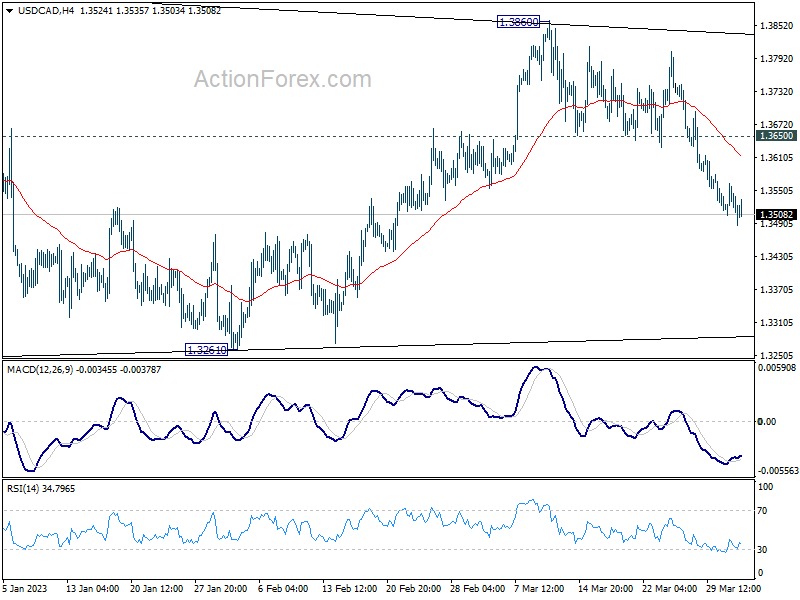
Intraday bias in USD/CAD remains on the downside for the moment. Fall from 1.3860 is seen as the third leg of the corrective pattern from 1.3976. Deeper decline would be seen to 1.3224/61 support zone. But strong support should be seen around there to bring rebound. Still, break of 1.3650 support turned is needed to indicate completion of the decline first. Or further fall will remain in favor in case of recovery.
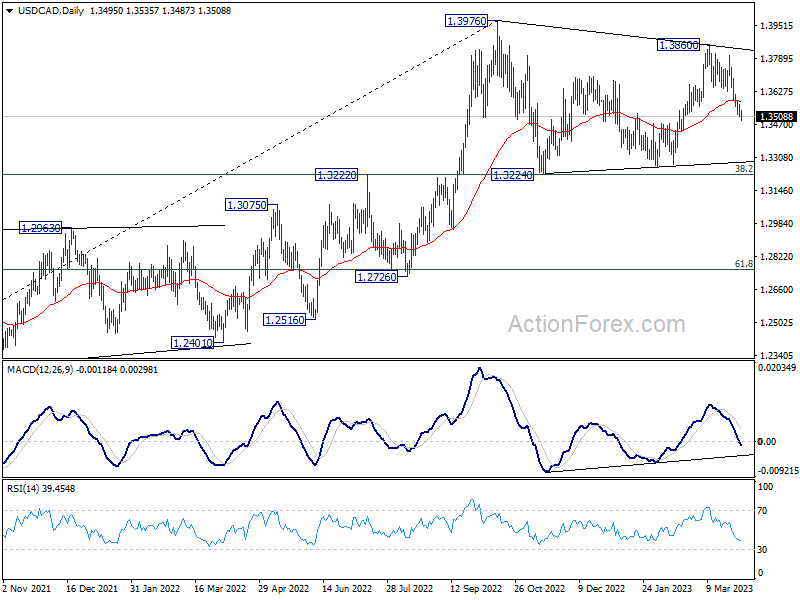
In the bigger picture, the up trend from 1.2005 (2021 low) is still in progress. Break of 1.3976 will confirm resumption and target 61.8% projection of 1.2401 to 1.3976 from 1.3261 at 1.4234. Firm break there will pave the way to long term resistance zone at 1.4667/89 (2016, 2020 highs). On the downside, sustained break of 55 week EMA (now at 1.3282) is needed to confirm medium term topping. Otherwise, outlook will remain bullish even in case of deep pull back.
AUD/USD Daily Report
Daily Pivots: (S1) 0.6657; (P) 0.6698; (R1) 0.6725; More...
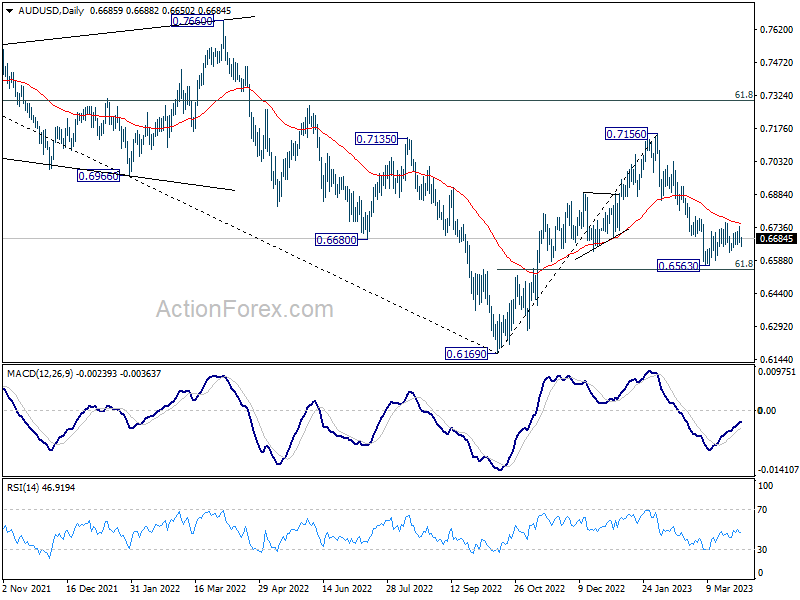
AUD/USD's consolidation from 0.6563 is extending and intraday bias remains neutral. On the downside, decisive break of 0.6546 fibonacci level will carry larger bearish implication. On the upside, however, break of 0.6758 resistance will now be a strong signal of bullish reversal and turn bias back to the upside.
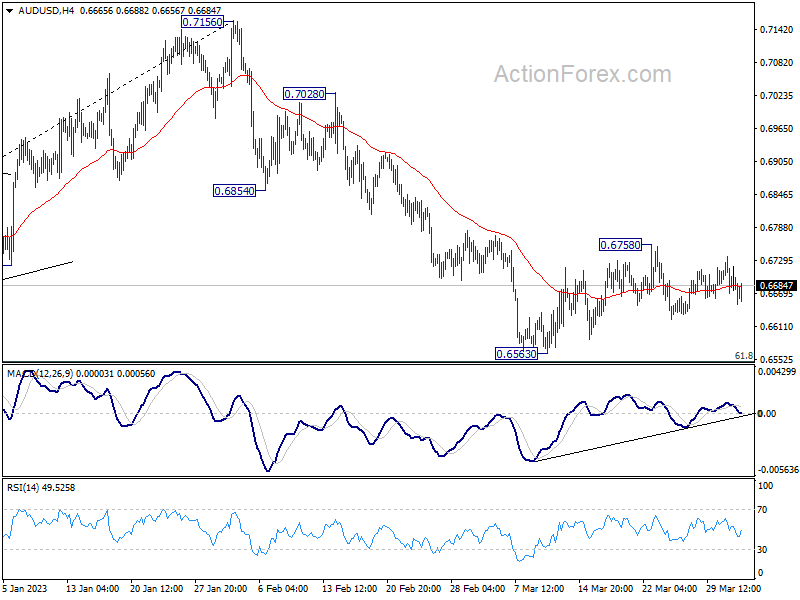
In the bigger picture, as long as 61.8% retracement of 0.6169 to 0.7156 at 0.6546 holds, the decline from 0.7156 is seen as a correction to rally from 0.6169 (2022 low) only. Another rise should still be seen through 0.7156 at a later stage. However, sustained break of 0.6546 will raise the chance of long term down trend resumption through 0.6169 low.
USD/JPY Daily Outlook
Daily Pivots: (S1) 132.40; (P) 132.99; (R1) 133.40; More...
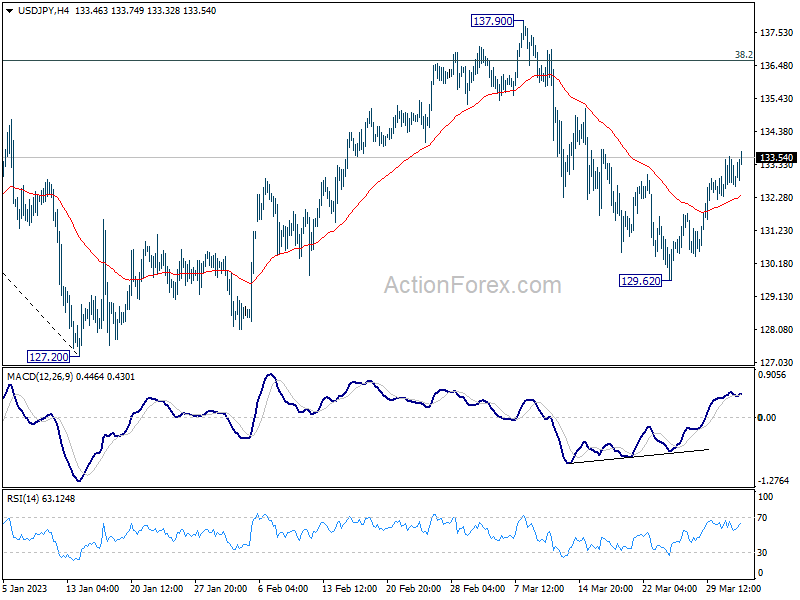
Intraday bias in USD/JPY remains mildly on the upside for the moment. Corrective pattern from 127.20 is extending with another rising leg. Sustained break of 55 day EMA (now at 133.43) will target 137.90 resistance. On the downside, though, break of 129.62 will bring retest of 127.20 low.
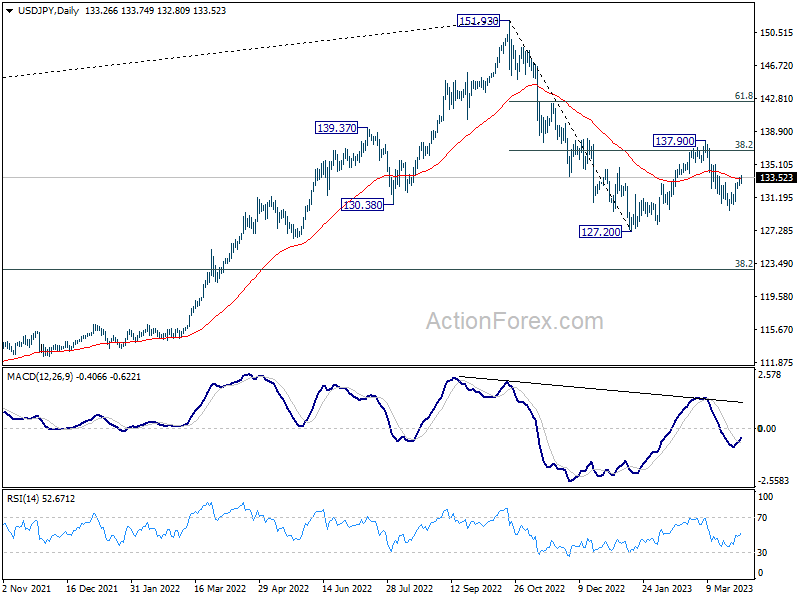
In the bigger picture, corrective pattern from 127.20 might be extending. But after all, down trend from 151.93 is expected to resume at a later stage. Break of 127.20 will resume this down trend and target 61.8% projection of 151.93 to 127.20 from 137.90 at 122.61. This will now be the favored case as long as 137.90 resistance holds.
USD/CHF Daily Outlook
Daily Pivots: (S1) 0.9119; (P) 0.9149; (R1) 0.9181; More...
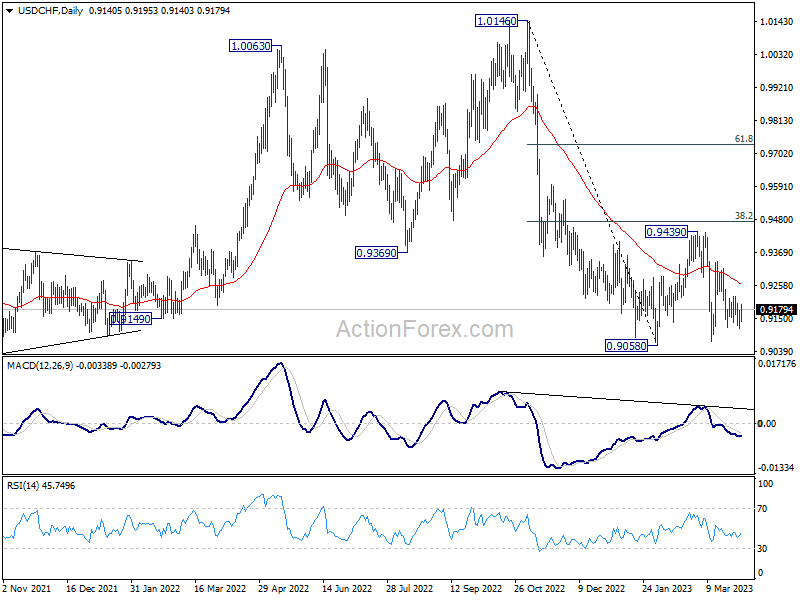
Intraday bias in USD/CHF remains neutral for the moment. Corrective pattern from 0.9058 low is extending and another rise cannot be ruled out. But upside should be limited by 0.9474 fibonacci level. On the downside, firm break of 0.9058 will resume larger down trend from 1.1046.
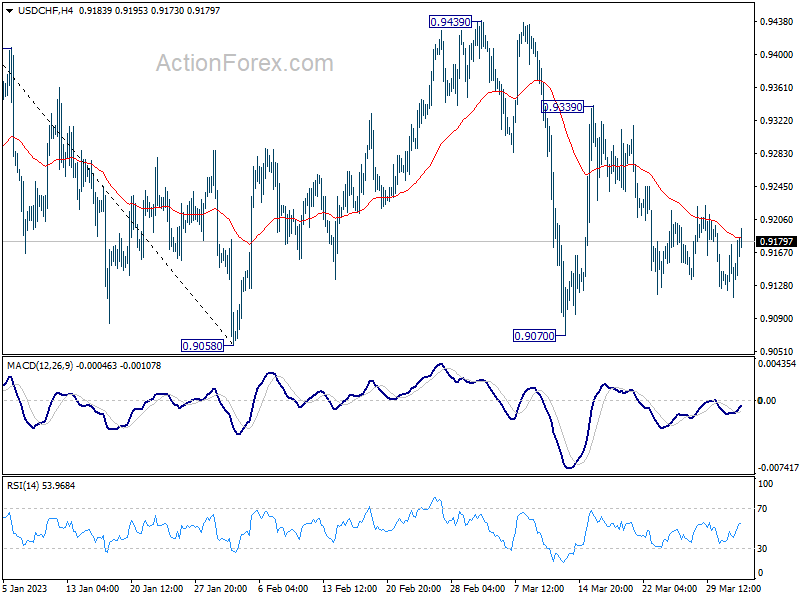
In the bigger picture, fall from 1.1046 (2022 high) should still be in progress with 38.2% retracement of 1.0146 to 0.9058 at 0.9474 intact. Prior rejection by 55 week EMA was a medium term bearish sign. Break of 0.9058 will resume such decline towards 0.8756 support (2021 low). But overall, this fall is still as a leg in the long term range pattern from 1.0342 (2016 high). So, downside should be contained by 0.8756 to bring reversal.
EUR/USD Daily Outlook
Daily Pivots: (S1) 1.0811; (P) 1.0869; (R1) 1.0900; More...
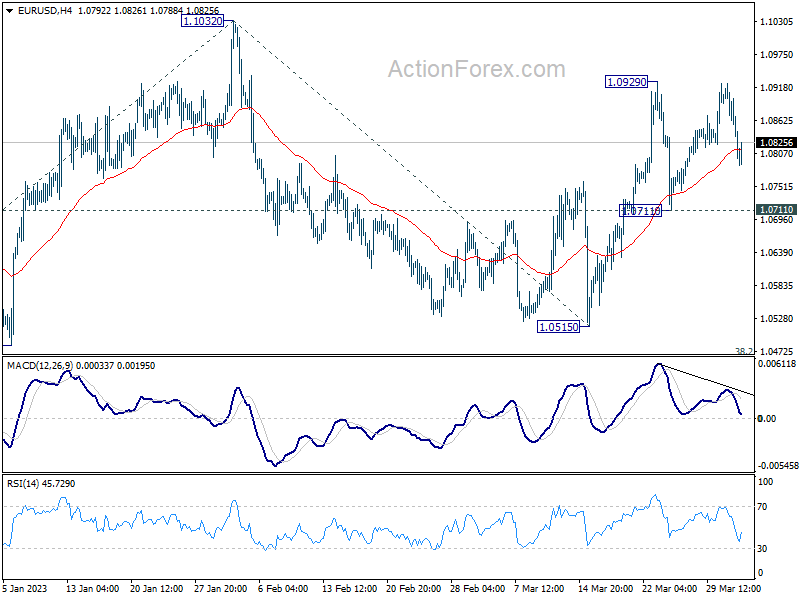
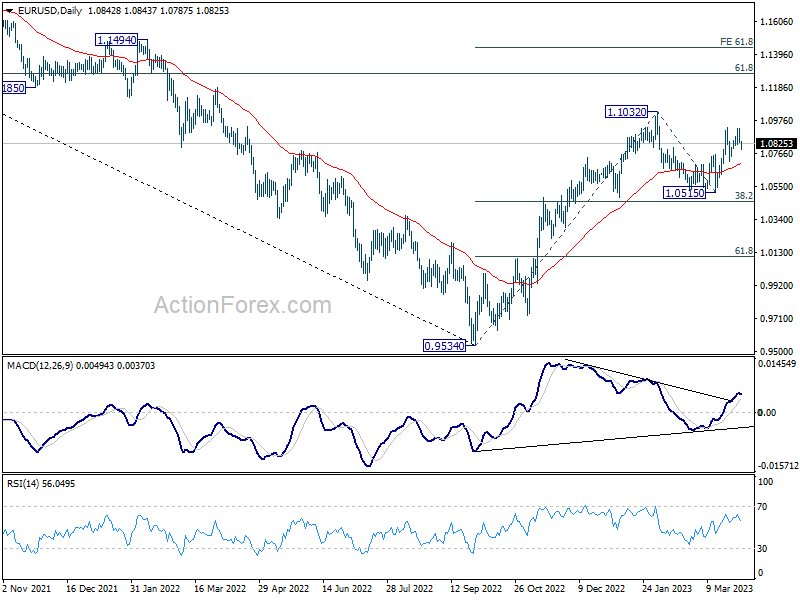
Intraday bias in EUR/USD remains neutral as consolidation from 1.0929 is extending, but further rally is in favor with 1.0711 support intact. On the upside, break of 1.0929 will resume the rally from 1.0515 to retest 1.1032 high. Decisive break there will resume larger up trend from 0.9534 to 1.1273 fibonacci level next. On the downside, though, break of 1.0711 will turn bias to the downside to extend the corrective pattern from 1.1032 with another decline.
In the bigger picture, rise from 0.9534 (2022 low) is in progress with 38.2% retracement of 0.9534 to 1.1032 at 1.0460 intact. The strong support from 55 week EMA (now at 1.0625) was also a medium term bullish sign. Next target is 61.8% retracement of 1.2348 (2021 high) to 0.9534 at 1.1273. Sustained break there will solidify the case of bullish trend reversal and target 1.2348 resistance next (2021 high).
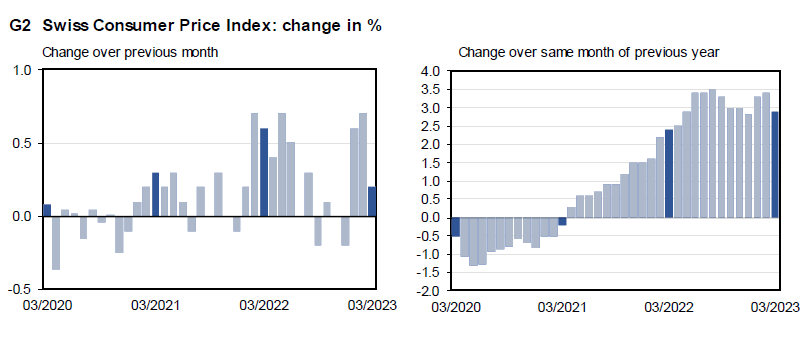
Swiss CPI slowed to 2.9% yoy in Mar, core CPI down to 2.2% yoy
Swiss CPI rose 0.2% mom in March, below expectation of 0.4% mom. Core CPI (excluding fresh and seasonal products, energy and fuel) rose 0.2% mom. Domestic products prices dropped -0.1% mom. Imported products prices rose 0.9% mom.
Compared with the same month of the previous year, CPI slowed from 3.4% yoy to 2.9% yoy, below expectation of 3.2% yoy. Core CPI slowed from 2.4% yoy to 2.2% yoy. Domestic products prices slowed from 2.9% yoy to 2.7% yoy. Imported products prices slowed from 4.9% yoy to 3.8% yoy.
US Takes Center Stage in this Holiday-Shorted Week
Markets
The steep decline in energy prices over the past few months caused March headline inflation in Europe to decline substantially year-over-year (from 8.5% to 6.9%). Rising core inflation and high m/m readings however showed that this is only the easy part in the long journey back towards the 2% target. But with US (core) PCE inflation for February later on Friday also cooling slightly more than expected, the market focus lied elsewhere. The downleg in core bond yields accelerated, leading to losses in the US between 8.1 and 11.4 bps across the curve. German yields slid 6.6 to 9.6 bps. Equities ended the quarter on a positive note. The Euro Stoxx 50 rallied 0.69%. It even set a new YtD high intraday at 4325. US bourses rose between 1.26% (DJI) and 1.74% (Nasdaq). The euro on currency markets hit the March high at 1.0926 before technical resistance (and perhaps some euro fatigue) kicked in. EUR/USD eventually finished at 1.0839, down from 1.0905 at the open. The US dollar in general traded strong, gaining against most peers. The trade-weighted index moved higher from 102.19 to 102.50. Sterling remains an ocean of calm. EUR/GBP for most of the day held position just south of 0.88. Gold lost some territory but held comfortably above $1950/ounce. Brent oil closed in on the $80/b level for the first time since mid-March and soared past that during Asian dealings this morning after OPEC yesterday announced a surprise production cut (cfr. infra). Brent rallied more than 8% paring gains partially. It’s a two-sided story for yields. It could rekindle the inflationary fire (supporting yields through higher inflation expectations) but at the same time weigh on economic activity and in the end require a less aggressive monetary response (keeping a lid on real yields). The former outweighs for the time being though we are not convinced it will last all day. US cash yields jump up to 8 bps at the front end of the curve. Equities in the region trade mostly in the green. News flow apart from oil is thin otherwise. Japanese (see headline) and Chinese (Caixin man. PMI from 51.6 to 50 vs 51.4 expected) sentiment indicators disappointed. The dollar gains at the start of the new quarter. EUR/USD eases back below 1.08 and technical trading could take it back to 1.0735 in a first instance. The kiwi dollar underperforms this morning.
The US takes center stage is this holiday-shorted week (markets in the region closed on Good Friday). The eco calendar kicks off with the US manufacturing ISM today. If anything, we see some risks for a downward surprise given the recent turmoil. But we wouldn’t draw any conclusions from it as calm has returned in the meantime. If what happened to the likes of SVB is a one-off, then today’s potential undershoot might just as well reverse already next month. To that end, the market reaction today won’t tell us much either. More important data are due later this week with the US services ISM and the ADP job report on Wednesday and payrolls on Friday.
News and views
According the closely watched BoJ Tankan survey, sentiment among larger manufacturing companies unexpectedly declined from 7 to 1. This marked the fifth consecutive quarterly decline. The level is the lowest since end 2020. Japanese manufacturing companies apparently still suffer from higher raw material and fuel costs while at the same time export demand dwindles. The outlook by large manufacturers also eased from 6 to 3. However, the report wasn’t unequivocally negative. The assessment of large non-manufacturing companies improved from 19 to 20, the strongest level since end 2019. The outlook for the sector improved too (15 from 11). Small companies showed similar trends. The non-manufacturing recovers further from the sharp decline in activity due to the pandemic. Big firms also remain cautious on further investments. Investment is expected or rise a meagre 3.2% in fiscal year 2023-24. Companies expect inflation to decelerate from 2.8% in the next year, to 2.3% in three years and 2.1 in five years. The report probably will cause the BoJ to take a wait-and-see approach of any start of monetary policy easing.
The OPEC+ cartel over the weekend announced an unexpected cut in oil production which might additionally reduce supply by about 1.15 mln barrels per day. The cartel indicated that the move intends to support market stability. The decision came ahead of virtual Meeting of the OPEC+ ministerial panel scheduled for this week. Last October OPEC had already decided to reduce its output by 2 mln bpd starting from November to last until the end of this year. The additional cuts will start from May and also last until then end of the year. Brent oil in a first rection this morning jumped from close near $80 p/b to $86 p/b but currently again eased to $ 83.75 p/d.
Crude Oil Rallies on Surprise OPEC Cut
Surprise, surprise! OPEC cut its production by 1 mbpd yesterday.
The news fell like a bomb on Sunday. The barrel of American crude rallied past $81pb, jumped above the 50 and 100-DMA levels – which would otherwise acted as a decent resistance, and will likely be looking to challenge the 200-DMA offers, a touch below the $84pb. Why did OPEC+ make such move? Officially, the cartel wants price stability in oil markets. But in reality, they simply want higher prices. As the Nigerian Minister of State for Petroleum Resources said: the group ‘wants prices at around $90pb’.
Fair enough. From July, combined with Russia’s own output cut as a result of a response to Western sanctions, the amount of oil barrels available for the global markets will be around 1.6 mio less.
That’s enough to revive geopolitical tensions with the US – which already called the decision ill-advised, and more than enough to spur the inflation worries across the world.
What’s the upside potential?
Is it possible that OPEC+ pushes the price of a barrel to $90 and keep it stable there?
What about a rise to $100pb?
Well, it’s possible, but it will be hard. If the rising oil prices hit the global demand prospects at quite an uneasy time for the world economy (due to the bank stress) and further spurs recession worries, there is a chance that the rally in oil prices fades quickly.
The oil bulls’ determination will depend on how much the OPEC+ is willing to push prices higher by cutting output. How much OPEC+ is willing to push prices higher will depend on whether the world economy could absorb higher energy prices.
The latest Caixin PMI data released in China this Monday revealed that manufacturing in China unexpectedly fell in March, to the 50 level, which is the limit between expansion and contraction.
If China can’t boost global growth expectations, it will be hard to imagine a strong rally in oil prices to $90/100 range.
At this point, the 200-DMA will likely act as a solid resistance to the post-OPEC rally and oil prices could stabilize within the $75/80 range.
Shaky start to the week
The OPEC+ decision gave a shake to global financial markets, as – obviously, higher oil prices revived the inflation worries and the interest rate hike bets.
The US 2 and 10-year yields ticked higher in Asia – whereas the yields had fallen on Friday on the back of softer-than-expected PCE and core PCE figures from the US.
US futures are in the negative with Nasdaq futures leading losses, as a sign that a part of the Friday rally in US equities – which was triggered by softer inflation figures could easily be wiped out today.
But oil stocks will likely hail the decision.
In the FX
Revived hawkish Federal Reserve (Fed) expectations will likely reverse the selloff in the US dollar, and bring other majors under pressure.
But the Canadian dollar is in a good position to outperform the complex of G7. The USDCAD was already under the pressure of a softer US dollar over the past two weeks. Now, the oil bulls could take over, and push the pair below the 1.35 mark. The move could easily extend toward the 200-DMA, around the 1.3380 level.
Elsewhere, however, the broadly stronger US dollar won’t be a gift for the others. The EURUSD already slipped below the 1.08 level in Asia. Cable is below 1.23 and gold tests $1950 per ounce to the downside.
Oil Price Jumps on OPEC Production Cut
Market movers today
The main data release this week is the US labour market report on Friday, although most of Europe will be on holiday then.
Today, we get ISM in the US and final versions of PMIs elsewhere, including Sweden and Norway which have not published preliminary versions. All other activity data for March so far has shown little or no impact from the banking turmoil, so that will likely also be the case for today's releases.
Construction is perhaps the industry in the US that has been most surprising in maintaining high employment despite higher interest rates and general slowdown, today we get construction spending data for February.
Swiss inflation data should show declining headline inflation as we have seen elsewhere, although on a much smaller scale as energy prices have not lifted Swiss inflation as much as for example in the euro area, and so will not reduce it as much either.
Early Tuesday morning European time we will have a rate decision in Australia, where the RBA is expected to pause its rate hiking.
The 60 second overview
Oil prices jumped this morning after OPEC+ announced yesterday they would cut production by more than 1 million barrels per day starting next month. From July, there will be about 1.6 million barrels less supply also due to the extension of Russia's existing supply reduction. As a response, Brent price briefly visited USD 86/bbl level this morning before retreating to just below USD 84/bbl. Just as markets were rejoicing at the lower headline inflation pressures on Friday, higher oil prices will now drive stronger inflationary pressures in the short term. The surprise move could also trigger renewed tensions between the US and Saudi governments.
US February Core PCE inflation eased slightly more than expected to 0.3% m/m (forecast 0.4%, Jan revised lower to 0.5%), with Fed's closely followed Core Services PCE inflation also moderating (0.4%, Jan 0.5%). While UST yields ended the day lower, we continue to see some upside risks to short USD rates, as markets' focus shifts back towards the upcoming key macro data releases. The Fed's data from last Friday showed that the deposit outflow from small US banks had halted on the week ending March 22, while most leading indicators suggest US macro momentum remained upbeat in March (more details in Research US - Upbeat macro data keeps the Fed on a tightening bias, 31 March). On Friday, Fed's Cook also emphasized that she will weigh 'stronger momentum in economy against potential headwinds from recent developments', while both Williams and Collins reiterated that Fed's focus remains on inflation as US banking sector overall appears resilient.
Equities: Global equities were higher on Friday with the US session ending close to day-high. MSCI world was up more than 3% last week and thereby also ending with gains in March despite all the banking turmoil and confidence crisis. We argue March would have looked very different if macro data had been weak during the month. However, as seen repeatedly, investors and equity markets are much more resilient to shocks in cases where macro data are improving than vice versa. As a sign of the increased investor confidence, VIX took another leg lower Friday to a level just below 19. In US on Friday Dow +1.3%, S&P 500 +1.4%, Nasdaq +1.7%, Russell 2000 +1.9%. Asian markets are mixed this morning and the same goes for futures in Europe and US.
FI: A rather calm end to the week after a very volatile period characterised rates market on Friday in what was generally a rates down environment amid the euro area final inflation print. While headline inflation fell sharply to 6.9%, core inflation recorded yet another record high print at 5.7% challenging the case for central bank tightening coming to the end. However, markets have generally taken its cues from the headline figures as a gauge for the initial market reaction and only repriced later as focus turns to the central bank policy tightening path.
FX: EUR/USD lost some of its traction and declined below 1.0900 in the latter part of Friday. Quarter-end flows were likely the reason for some USD demand, offsetting some of the USD sell-off stemming from the positive risk sentiment for most part of last week. EUR/GBP is still fluctuating around the 0.88 level while the USD/JPY is trading around the 133-mark. The risk rally benefitted the SEK and sent EUR/SEK down to around 11.25, whereas NOK weakened despite improving sentiment and a rising oil price. EUR/NOK is trading around 11.35.
Credit: The credit markets ended last week on a relatively unworried note. During Friday, iTraxx Main tightened 3.5bp to 84.4bp while iTraxx Crossover tightened 16.5bp to 436.4bp. The positive development in the CDS market was also visible in the cash bond market, where secondary bond trading saw improving buying interests. Primary markets remained most of the week very active with a high issuance pace of both investment grade and high yield rated instruments.
Nordic macro
In yesterday's election, Finland took a right-turn and said good bye to its social democrat PM Sanna Marin as the opposition bloc prevailed. The frontrunner in polls, center-right National Coalition party, won and got 48 seats (out of 200) in the new parliament. The national conservative Finns party secured 46 seats, while social democrats came in third with 43 seats. This was clearly a bloc election, resulting in a win for the three largest parties, and a loss for many others. The new PM will most likely be Petteri Orpo from National Coalition and he will now start negotiations to form a government. Different coalitions are still possible but a right-wing coalition with the Finns party and some smaller parties now looks likely, implying fiscal prudence: the National Coalition has said they are committed to balancing public finances by EUR 6bn but they have also promised tax cuts. Read more on Finland outlook - Conservative victory at parliamentary elections, 3 April.
GBP/USD Daily Outlook
Daily Pivots: (S1) 1.2296; (P) 1.2360; (R1) 1.2394; More...
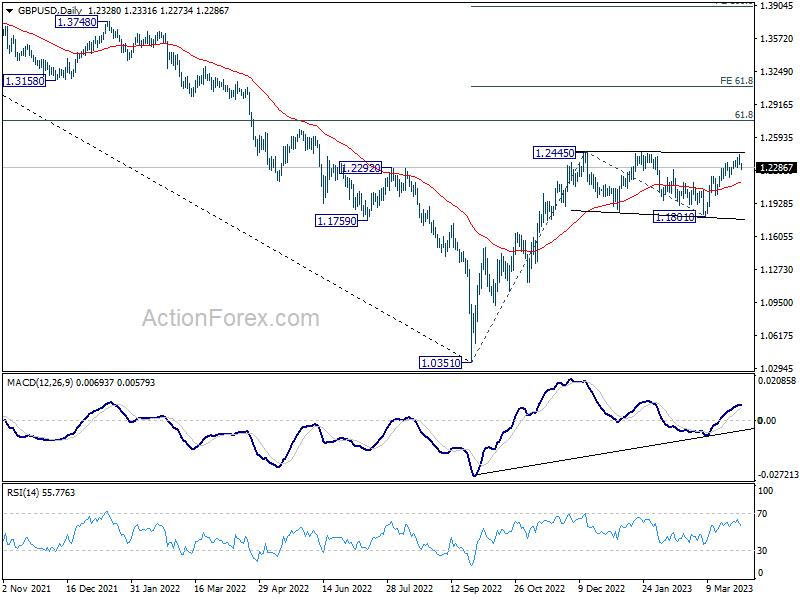
GBP/USD's retreat from 1.2421 continues today but stays above 1.2203 resistance turned support. Intraday bias remains neutral for the moment and further rally is in favor. On the upside, decisive break of 1.2445/6 resistance zone will resume larger rally from 1.0351, and target 1.2759 fibonacci level. However, break of 1.2203 resistance turned support will extend the corrective pattern from 1.2445 with another falling leg, and turn bias back to the downside.
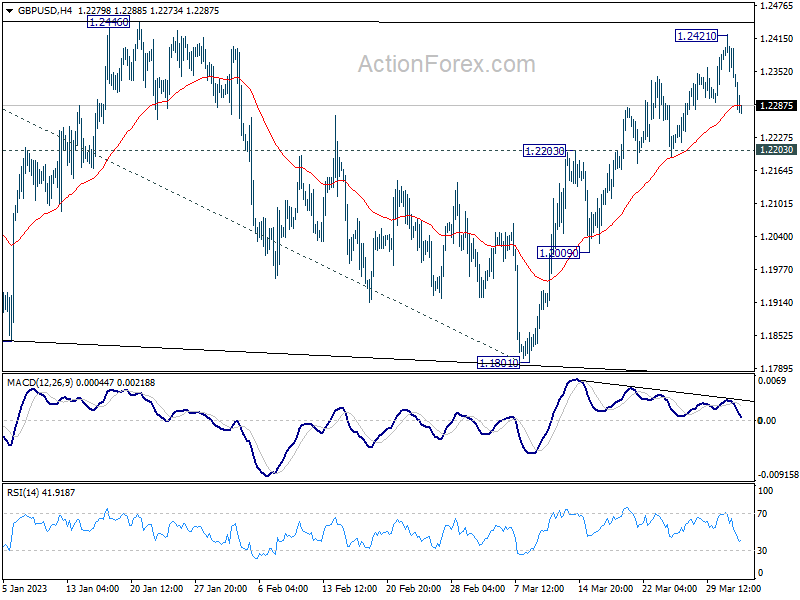
In the bigger picture, the rise from 1.0351 medium term term bottom (2022 low) is in progress for 61.8% retracement of 1.4248 (2021 high) to 1.0351 at 1.2759. Sustained break there will add to the case of long term bullish trend reversal. Further break of 61.8% projection of 1.0351 to 1.2445 from 1.1801 at 1.3095 could prompt upside acceleration to 100% projection at 1.3895. For now, this will remain the favored case as long as 1.1801 support holds, even in case of deep pull back.