Sample Category Title
Market Sentiment Turns Increasingly Negative ahead of NFP Report
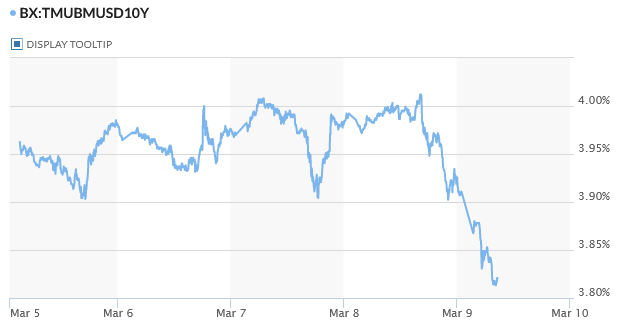
Investor sentiment is growing increasingly negative, as the steep selloff in US stocks carried over to the Asian session. Additionally, US 10-year yield is taking a significant plunge and is threatening 3.8 handle. Traders are bracing for more bearish developments, which could be sparked by today's non-farm payroll report. Swiss Franc has surged broadly on risk-off sentiment, while Euro and Sterling have also recovered. However, Yen is lagging far behind Franc after BoJ maintained its ultra-loose monetary policy. Dollar is trading lower and continuing to digest this week's gains, while commodity currencies remain heavy, led by Australian Dollar.
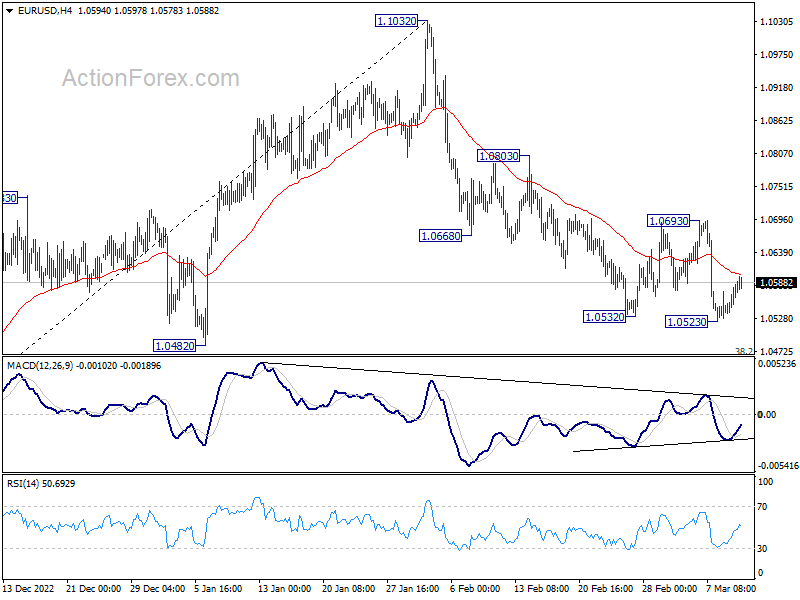
Technically, EUR/USD is holding above 1.0482 support despite this week's decline attempt. Fall from 1.1032 could still turn out to be just a correction in the larger up trend. Break of 1.0693 resistance will confirm short term bottoming and bring stronger rally. If that happens, other European majors could be taken higher against the greenback too. However, another sharp decline through 1.0482 will raise the chance of bearish trend reversal. The next move could be decided after today's NFP, or next week's US CPI by latest.
In Asia, at the time of writing, Nikkei is down -1.57%. Hong Kong HSI is down -2.40%. China Shanghai SSE is down -1.02%. Singapore Strait Time is down -1.01%. Overnight, DOW dropped -1.66%. S&P 500 dropped -1.85%. NASDAQ dropped -2.05%. 10-year yield dropped -0.051 to 3.925.
BoJ stands pat and maintains easing bias
As anticipated, BoJ left its monetary policy unchanged today, maintaining its easing bias. Despite a rise in inflation expectations, CPI is projected to slow down during the current fiscal year before experiencing a moderate increase once again.
Under yield curve control, short-term policy rate was held at -0.10%. Long-term interest rate will remain at around 0% with necessary purchase of JGBs without an upper limit. The band for 10-year JGB yield to fluctuate stayed at plus and minus 0.5%.
BoJ maintained the pledge to continue with QQE with YCC for "as long as it is necessary". It "will not hesitate to take additional easing measures if necessary". It also expects "short- and long-term policy interest rates to remain at their present or lower levels".
BoJ said the economy "has picked up" with exports and industrial production "more or less flat". The economy is projected to "continue growing at a pace above its potential growth rate" as a virtuous cycle form income to spending intensifies gradually.
Inflation expectations "have risen". But, CPI is "likely to decelerate toward the middle of fiscal 2023", then "accelerate moderately" on the back of improvement in output gap, rises in medium- to long-term inflation expectations in wage growth, and waning down of energy prices measures."
The meeting was the last one to be chaired by Governor Haruhiko Kuroda. Kazuo Ueda was approved by both houses of the parliament this week as the next BoJ Governor.
New Zealand BNZ manufacturing rose to 52, gearshift but not strong
New Zealand BusinessNZ Performance of Manufacturing Index rose from 51.2 to 52.0 in February, signalling further increase in expansion. But the reading was still below its long-term average of 53.0.
Looking at some details, production dropped from 52.0 to 49.4. Employment rose from 51.6 to 54.0. New orders rose from 49.2 to 52.0. Finished stocks rose from 52.7 to 55.8. Deliveries was unchanged at 51.8.
BNZ Senior Economist, Craig Ebert stated that "it's been a New Year gearshift, out of reverse. However, these are not what you'd call strong results – in total, and especially when delving into the details. That said, February's PMI, like January's, did denote expansion, overall, and is not all that far shy of its long-term average of 53.0".
BoC Rogers: More evidence needed to decide whether policy is restrictive enough
BoC Senior Deputy Governor Carolyn Rogers reiterated in a speech yesterday that tightening is in a "conditional pause". More evidence is needed to decide whether policy is restrictive enough. Services price inflation will need to cool further.
The decisive to leave policy rate unchanged at 4.50% on Wednesday was a "conditional pause". "If economic developments unfold as we projected and inflation comes down as quickly as we forecast in the January Monetary Policy Report (MPR), then we shouldn't need to raise rates further," she said. "But if evidence accumulates suggesting inflation may not decline in line with our forecast, we're prepared to do more."
Economic data since January showed a "mixed picture". While "things are unfolding broadly in line with our outlook," she added, " We'll need to see more evidence to fully assess whether monetary policy is restrictive enough to return inflation to 2%."
Rogers also noted that inflation is "coming down largely as expected" with a "clear momentum shift in goods prices". However, "services price inflation needs to cool further". Companies need to "return to more normal pricing behavior".
"Year-over-year and three-month rates of core inflation will both need to come down more than they have for inflation to return sustainably to 2%, as will short-term inflation expectations," she said.
DOW broke key support as focus turns to NFP
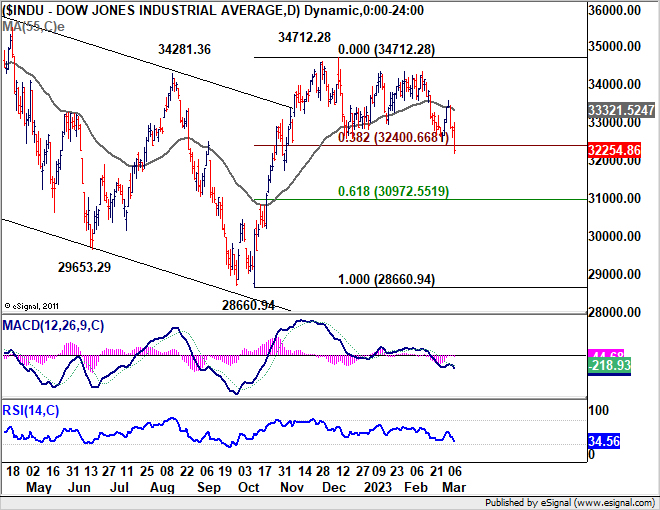
DOW suffered a sharp decline overnight, losing -543.5 points or -1.66%, and broke an important near term support level. The banking sector led the sell-off, with the S&P 500's bank index finishing down -6.6%. Investor caution was also evident ahead of today's job data release. If the data shows strength, it would back up Fed Chair Jerome Powell's indications of a 50bps rate hike, which could lead to higher rates that remain for longer. Good news could become bad news again, as investors remain wary of the potential consequences of higher interest rates on the market.
The non-farm payroll report is expected to show a growth of 200k jobs for February. Investors will also be closely monitoring any revisions made to January's stellar 517k job growth. Unemployment rate is predicted to remain steady at 3.4%, while wage growth is expected to continue its momentum with a 0.3% mom rise.
Related data includes ADP private job report, which demonstrated a 242k increase in jobs for the same month, mostly driven by a 190k rise in the services sector. Meanwhile, ISM manufacturing employment index dropped from 50.6 to 49.1, while the ISM services employment index rose sharply from 50.0 to 54.0. The four-week moving average of initial jobless claims remained relatively stable at 197k. Overall, the data indicated a strong employment market, led by services.
Technically, the close below 38.2% retracement of 28660.94 to 34712.28 at 32400.66 suggests fall from 34712.28 is going to be a deep correction at least, with potential of being bearish reversal. Prior rejection by the 55 day EMA is also not a positive sign. Deeper decline is now in favor back to 61.8% retracement at 30972.55, if DOW couldn't rebound in the coming days. Reactions from 30972 would reveal whether DOW is heading back through 28660.94 low to resume the down trend from last year's high at 36952.65.
Looking ahead
UK GDP will be the main focus in European session with production and trade balance featured too. Later in the day, employment data from the US and Canada will take center stage.
USD/CAD Daily Outlook
Daily Pivots: (S1) 1.3760; (P) 1.3788; (R1) 1.3831; More....
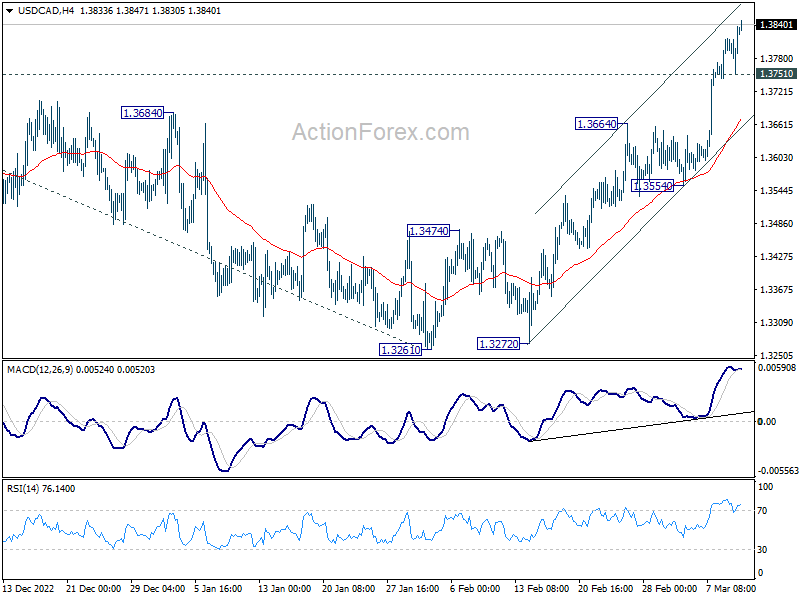
Intraday bias in USD/CAD remains on the upside for the moment. Rise from 1.3261 is in progress for retesting 1.3976 high. Firm break there will resume larger up trend and target 1.4234 projection level. On the downside, break of 1.3751 minor support will turn intraday bias neutral and bring consolidations. But retreat should be contained well above 1.3554 support to bring another rally.
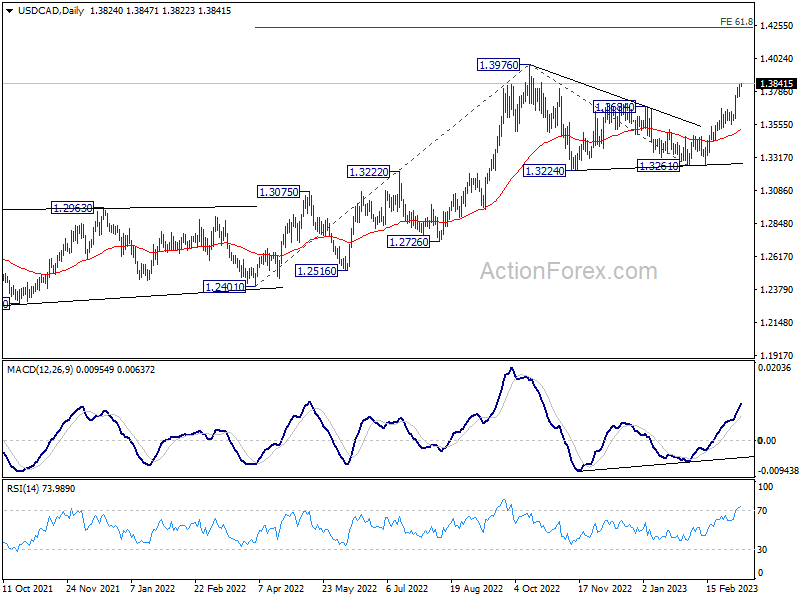
In the bigger picture, the up trend from 1.2005 (2021 low) is still in progress. Next target is 61.8% projection of 1.2401 to 1.3976 from 1.3261 at 1.4234. Firm break there will pave the way to long term resistance zone at 1.4667/89 (2016, 2020 highs). On the downside, break of 1.3261 support is needed to confirm medium term topping. Otherwise, outlook remains bullish even in case of deep pull back.
Economic Indicators Update
| GMT | Ccy | Events | Actual | Forecast | Previous | Revised |
|---|---|---|---|---|---|---|
| 21:30 | NZD | Business NZ PMI Feb | 52 | 50.8 | 51.2 | |
| 21:45 | NZD | Manufacturing Sales Q4 | -0.40% | 5.10% | ||
| 23:30 | JPY | Household Spending Y/Y Jan | -0.30% | -0.20% | -1.30% | |
| 23:50 | JPY | PPI Y/Y Feb | 8.20% | 8.60% | 9.50% | |
| 02:31 | JPY | BoJ Interest Rate Decision | -0.10% | -0.10% | -0.10% | |
| 07:00 | EUR | Germany CPI M/M Feb F | 0.80% | 0.80% | ||
| 07:00 | EUR | Germany CPI Y/Y Feb F | 8.70% | 8.70% | ||
| 07:00 | GBP | GDP M/M Jan | 0.10% | -0.50% | ||
| 07:00 | GBP | Manufacturing Production M/M Jan | -0.10% | 0.00% | ||
| 07:00 | GBP | Manufacturing Production Y/Y Jan | -5.70% | |||
| 07:00 | GBP | Industrial Production M/M Jan | -0.10% | 0.30% | ||
| 07:00 | GBP | Industrial Production Y/Y Jan | -4.00% | |||
| 07:00 | GBP | Goods Trade Balance (GBP) Jan | -17.5B | -19.3B | ||
| 12:00 | GBP | NIESR GDP Estimate (3M) Feb | -0.10% | |||
| 13:30 | USD | Nonfarm Payrolls Feb | 200K | 517K | ||
| 13:30 | USD | Average Hourly Earnings M/M Feb | 0.30% | 0.30% | ||
| 13:30 | USD | Unemployment Rate Feb | 3.40% | 3.40% | ||
| 13:30 | CAD | Net Change in Employment Feb | 2.5K | 150.0K | ||
| 13:30 | CAD | Unemployment Rate Feb | 5.10% | 5.00% | ||
| 13:30 | CAD | Capacity Utilization Q4 | 83.30% | 82.60% |
USD/JPY Dips as Market Awaits Key US NFP Release
Key Highlights
- USD/JPY started a downside correction from the 137.90 zone.
- A key bullish trend line is forming with support near 135.95 on the 4-hours chart.
- Bitcoin price declined sharply and tested the $20,000 support zone.
- The US nonfarm payrolls could increase 205K in Feb 2023, less than the last 517K.
USD/JPY Technical Analysis
The US Dollar remained in a strong uptrend above 135.00 against the Japanese Yen. USD/JPY climbed higher towards the 138.00 before it faced sellers.
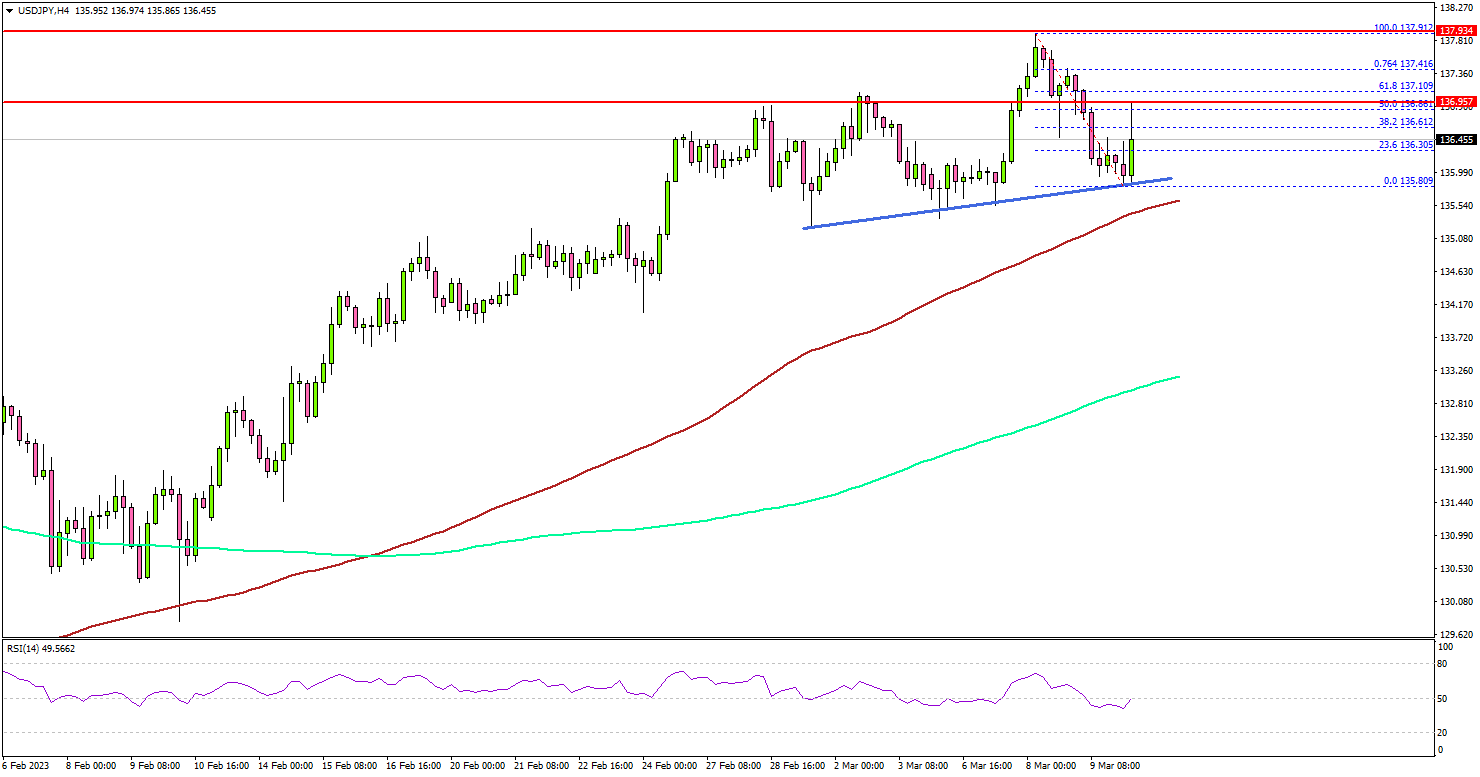
Looking at the 4-hours chart, the pair traded as high as 137.91. The pair settled well above the 100 simple moving average (red, 4-hours) and the 200 simple moving average (green, 4-hours).
Recently, there was a downside correction below the 137.20 support. The pair even traded below the 136.00 level and formed a low at 135.80. It is now moving higher and trading above the 136.20 level.
There is also a key bullish trend line forming with support near 135.95 on the same chart. An immediate resistance is near the 136.85 level. It is near the 50% Fib retracement level of the downward move from the 137.91 swing high to 135.80 low.
The next major resistance is near the 137.40 level or the 76.4% Fib retracement level of the downward move from the 137.91 swing high to 135.80 low.
A clear move above the 137.40 resistance might start a steady increase towards the 138.00 zone. Any more gains might send the pair towards 138.80.
On the downside, an immediate support is near the 136.00 level. The next major support is near the 135.50 level and the 100 simple moving average (red, 4-hours), below which there is a risk of a move towards the 134.20 level.
Looking at Bitcoin price, there was a sharp decline below the $21,200 and $20,500 support levels. The price tested the $20,000 support and started a consolidation phase.
Economic Releases
- UK GDP for Jan 2023 (MoM) - Forecast +0.1%, versus -0.5% previous.
- US nonfarm payrolls for Feb 2023 – Forecast 205K, versus 517K previous.
- US Unemployment Rate for Feb 2023 - Forecast 3.4%, versus 3.4% previous.
- Canada’s employment Change payrolls for Feb 2023 – Forecast 10K, versus 150K previous.
- Canada’s Unemployment Rate for Feb 2023 - Forecast 5.1%, versus 5.0% previous.
DOW broke key support as focus turns to NFP
DOW suffered a sharp decline overnight, losing -543.5 points or -1.66%, and broke an important near term support level. The banking sector led the sell-off, with the S&P 500's bank index finishing down -6.6%. Investor caution was also evident ahead of today's job data release. If the data shows strength, it would back up Fed Chair Jerome Powell's indications of a 50bps rate hike, which could lead to higher rates that remain for longer. Good news could become bad news again, as investors remain wary of the potential consequences of higher interest rates on the market.
The non-farm payroll report is expected to show a growth of 200k jobs for February. Investors will also be closely monitoring any revisions made to January's stellar 517k job growth. Unemployment rate is predicted to remain steady at 3.4%, while wage growth is expected to continue its momentum with a 0.3% mom rise.
Related data includes ADP private job report, which demonstrated a 242k increase in jobs for the same month, mostly driven by a 190k rise in the services sector. Meanwhile, ISM manufacturing employment index dropped from 50.6 to 49.1, while the ISM services employment index rose sharply from 50.0 to 54.0. The four-week moving average of initial jobless claims remained relatively stable at 197k. Overall, the data indicated a strong employment market, led by services.
Technically, the close below 38.2% retracement of 28660.94 to 34712.28 at 32400.66 suggests fall from 34712.28 is going to be a deep correction at least, with potential of being bearish reversal. Prior rejection by the 55 day EMA is also not a positive sign. Deeper decline is now in favor back to 61.8% retracement at 30972.55, if DOW couldn't rebound in the coming days. Reactions from 30972 would reveal whether DOW is heading back through 28660.94 low to resume the down trend from last year's high at 36952.65.
BoJ stands pat and maintains easing bias
As anticipated, BoJ left its monetary policy unchanged today, maintaining its easing bias. Despite a rise in inflation expectations, CPI is projected to slow down during the current fiscal year before experiencing a moderate increase once again.
Under yield curve control, short-term policy rate was held at -0.10%. Long-term interest rate will remain at around 0% with necessary purchase of JGBs without an upper limit. The band for 10-year JGB yield to fluctuate stayed at plus and minus 0.5%.
BoJ maintained the pledge to continue with QQE with YCC for "as long as it is necessary". It "will not hesitate to take additional easing measures if necessary". It also expects "short- and long-term policy interest rates to remain at their present or lower levels".
BoJ said the economy "has picked up" with exports and industrial production "more or less flat". The economy is projected to "continue growing at a pace above its potential growth rate" as a virtuous cycle form income to spending intensifies gradually.
Inflation expectations "have risen". But, CPI is "likely to decelerate toward the middle of fiscal 2023", then "accelerate moderately" on the back of improvement in output gap, rises in medium- to long-term inflation expectations in wage growth, and waning down of energy prices measures."
The meeting was the last one to be chaired by Governor Haruhiko Kuroda. Kazuo Ueda was approved by both houses of the parliament this week as the next BoJ Governor.
New Zealand BNZ manufacturing rose to 52, gearshift but not strong
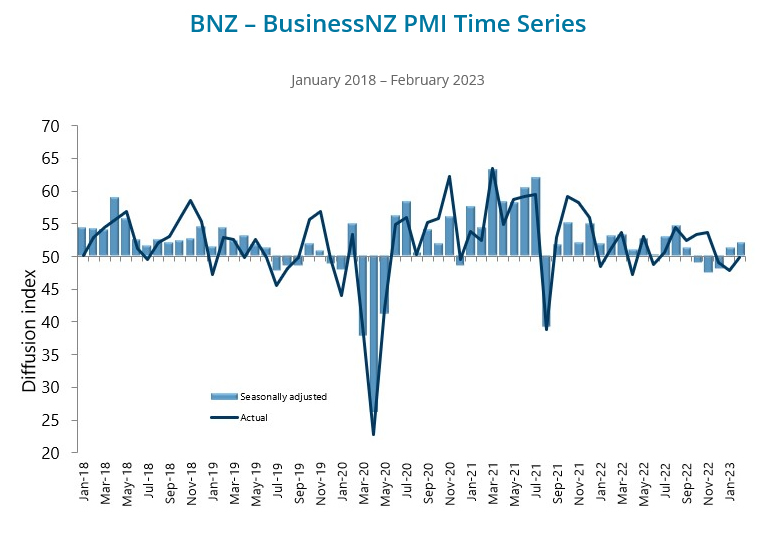
New Zealand BusinessNZ Performance of Manufacturing Index rose from 51.2 to 52.0 in February, signalling further increase in expansion. But the reading was still below its long-term average of 53.0.
Looking at some details, production dropped from 52.0 to 49.4. Employment rose from 51.6 to 54.0. New orders rose from 49.2 to 52.0. Finished stocks rose from 52.7 to 55.8. Deliveries was unchanged at 51.8.
BNZ Senior Economist, Craig Ebert stated that "it's been a New Year gearshift, out of reverse. However, these are not what you'd call strong results – in total, and especially when delving into the details. That said, February's PMI, like January's, did denote expansion, overall, and is not all that far shy of its long-term average of 53.0".
BoC Rogers: More evidence needed to decide whether policy is restrictive enough
BoC Senior Deputy Governor Carolyn Rogers reiterated in a speech yesterday that tightening is in a "conditional pause". More evidence is needed to decide whether policy is restrictive enough. Services price inflation will need to cool further.
The decisive to leave policy rate unchanged at 4.50% on Wednesday was a "conditional pause". "If economic developments unfold as we projected and inflation comes down as quickly as we forecast in the January Monetary Policy Report (MPR), then we shouldn't need to raise rates further," she said. "But if evidence accumulates suggesting inflation may not decline in line with our forecast, we're prepared to do more."
Economic data since January showed a "mixed picture". While "things are unfolding broadly in line with our outlook," she added, " We'll need to see more evidence to fully assess whether monetary policy is restrictive enough to return inflation to 2%."
Rogers also noted that inflation is "coming down largely as expected" with a "clear momentum shift in goods prices". However, "services price inflation needs to cool further". Companies need to "return to more normal pricing behavior".
"Year-over-year and three-month rates of core inflation will both need to come down more than they have for inflation to return sustainably to 2%, as will short-term inflation expectations," she said.
Cliff Notes: A Diverging Economic and Policy Outlook
Key insights from the week that was.
With the domestic and international data calendar light, the actions and rhetoric of policymakers was the key focus for markets this week.
While the RBA’s decision to deliver a 25bp rate hike in March was widely expected, the dovish guidance in the decision statement was a surprise to markets, with the Governor opening the door for a pause potentially as soon as April by noting that the Board would be assessing “when and how much” to increase interest rate hence. This compares to only “how much” in February. Coming updates on household spending, inflation and the labour market will be crucial to the RBA’s decision making in the months ahead. The greater degree of comfort shown by the RBA over the Australian CPI as the FOMC once again asserted their concerns over US inflation hit the Australian dollar hard, AUD/USD falling below USD0.66. Australian yields also fell, the AU/US 10yr spread widening to -25bps.
It is important to recognise, however, that the RBA still has a strong tightening bias given inflation is not expected to return to 3% until mid-2025. This represents three years in which inflation is outside of the RBA’s 2-3% target band, the key reason a pause was dismissed in December. Hence, we continue to expect 25bp rate hikes in both April and May, producing a peak cash rate of 4.10% which will be held through the remainder of 2023 and followed by gradual policy easing over the course of 2024 and 2025.
On the limited data received this week, Australia’s trade surplus printed a little below expectations, down from $13.0bn in December to $11.7bn in January. The main surprise centred on a burst in transport equipment imports thanks to improved supply and ahead of Lunar New Year, up 29% in the month. While total imports rose 4.6%, the downtrend in goods imports excluding transport remains well entrenched, the 6.8% fall pointing to a softening in consumer spending in early 2023. Our Westpac Card Tracker broadly corroborates this, with a clear stalling in nominal spending activity.
In the US, FOMC Chair Powell's appearance before both the Senate Banking Panel and the House Financial Service Committee were this week’s highlights. His comments before the Senate Banking Panel were construed by the market as hawkish, with a clear focus on inflation’s persistence following upward revisions to annual CPI and PCE inflation to December 2022 as well as stronger-than-expected readings for January. Also called out by Chair Powell was the labour market’s persistent strength and evidence of a bounce back in consumer spending as 2023 begins. For policy, the intent was clear: the FOMC will do what it takes to bring inflation back to target within a reasonable timeframe.
In his follow-up appearance before the House Committee, Chair Powell conveyed the same concerns over inflation as well as confidence in the robust health of the US economy; but on policy, he was a little more circumspect, making clear that the FOMC’s decisions are not on a pre-set path and will instead be determined by the strength of the data. While the market continues to hedge its bets between a 25bp and 50bp hike at the March meeting, arguably Chair Powell’s tone means that the payroll and CPI data to come over the next week will have to outperform to warrant the larger move.
Also evident in Chair Powell’s remarks this week was a belief that the Committee has already tightened policy and financial conditions materially, and that the full effect on the economy will come with a lag. So, as long as coming labour market and inflation data point to decelerating momentum, this cycle likely only has a few more hikes left in it before a lengthy pause to March quarter 2024. A similar state of affairs is evident in Euro Area monetary policy; while, in Canada, a pause has already commenced. For each of these markets, it is our expectation that inflation will ebb back towards target in 2023 without need for a recession. The longer-term concern is whether these nations are dynamic enough to rebound to, or above, trend growth once financial conditions ease. If not, faced with high debt burdens, their futures are likely to prove very challenging.
Though China’s 2023 growth target of ‘only’ 5% disappointed the market this week, it should have been seen as a reason for confidence. From the detail of the accompanying remarks, it is clear authorities do not see a need to pump up economic growth with aggressive public infrastructure spending. While this type of investment continues at a robust pace, it is the strength of the private sector (and efficient SOEs) that will dictate the scale of China’s outperformance, both in the near term and further out.
In our view, having shown considerable strength amid tremendous uncertainty in 2020-22, and with burgeoning export opportunities across the developing world, China’s industry has a high probability of delivering national growth outcomes well above authorities’ stated 2023 ambition. Importantly, being driven by productivity and capacity and with benefits flowing through to the Government and households, this momentum should prove sustainable and non-inflationary.
How Can NFP Release Affect the USD?
In February, the NFP (Non-Farm Payrolls) delivered a great shock, surpassing the forecast by over 400%. The forecast for this month's NFP is currently tied at half of the actual figure from last month's release, which means we can expect the US Dollar to get considerably lower. Despite this sentiment, it is imperative to vet the fundamental sentiment from a technical point of view.
DXY - US DOLLAR
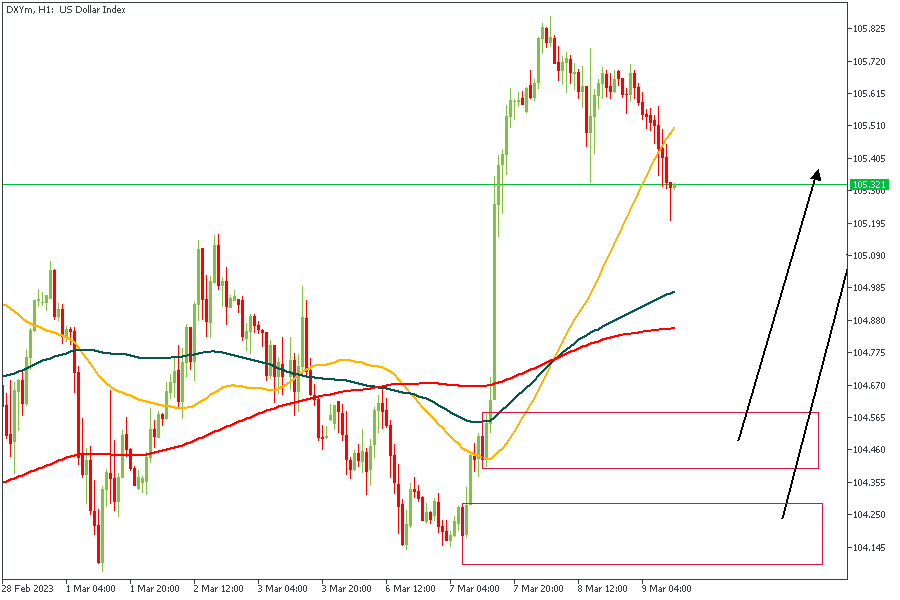
DXY can dip lower after breaking above the previous high, as seen above. The retracement is clearly in line with my previous analysis. I expect the Dollar to drop toward either of the two demand zones highlighted in the chart above.
Analysts’ Expectations:
- Direction: Bearish
- Target: 104.5
- Invalidation: 106.0
EURUSD
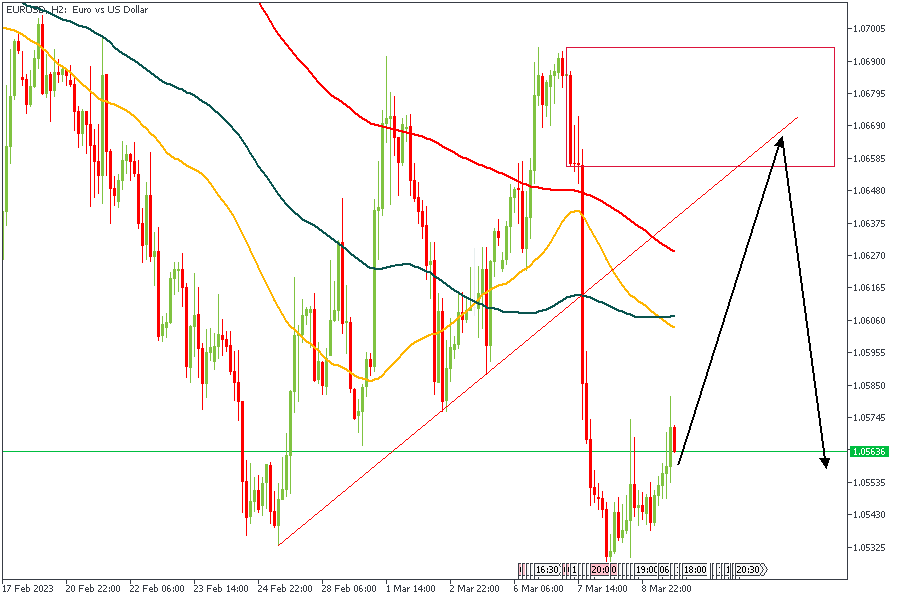
Generally speaking, a weaker dollar usually has a bullish consequence on the EURUSD and most major currency pairs. Based on this, I expect to see EURUSD climb into the highlighted supply zone before any possible drop occurs.
Analysts’ Expectations:
- Direction: Bullish
- Target: 1.0640
- Invalidation: 1.0549
GBPUSD
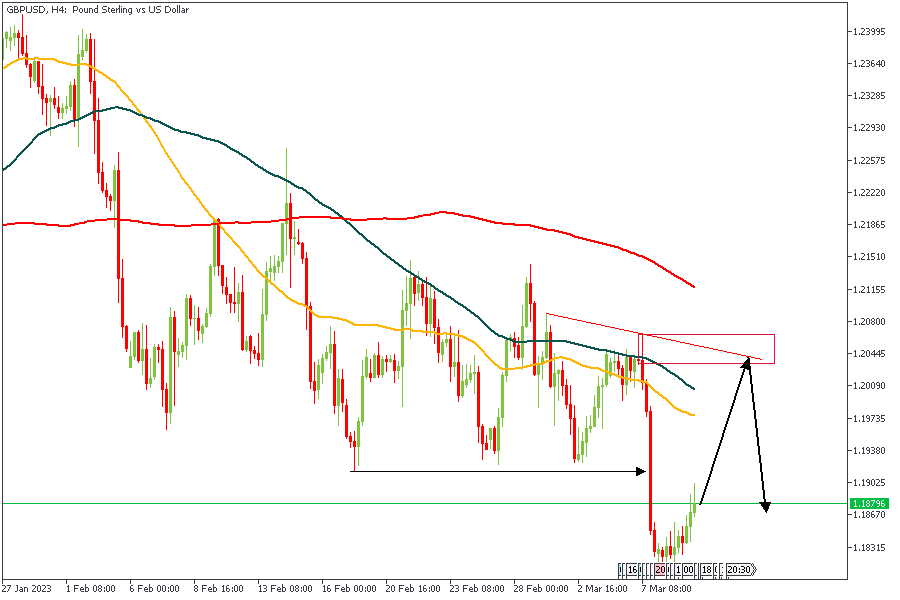
After the bearish break below the previous low, we see that price has created a rally-base-drop supply zone that needs to be mitigated. The supply zone also coincides with 88% of the Fibonacci retracement. Moreover, the arrangement of the moving averages suggests that the price would need to reach the marked zone to find a good enough cause for a bearish continuation.
Analysts’ Expectations:
- Direction: Bullish
- Target: 1.20100
- Invalidation: 1.18310
AUDUSD
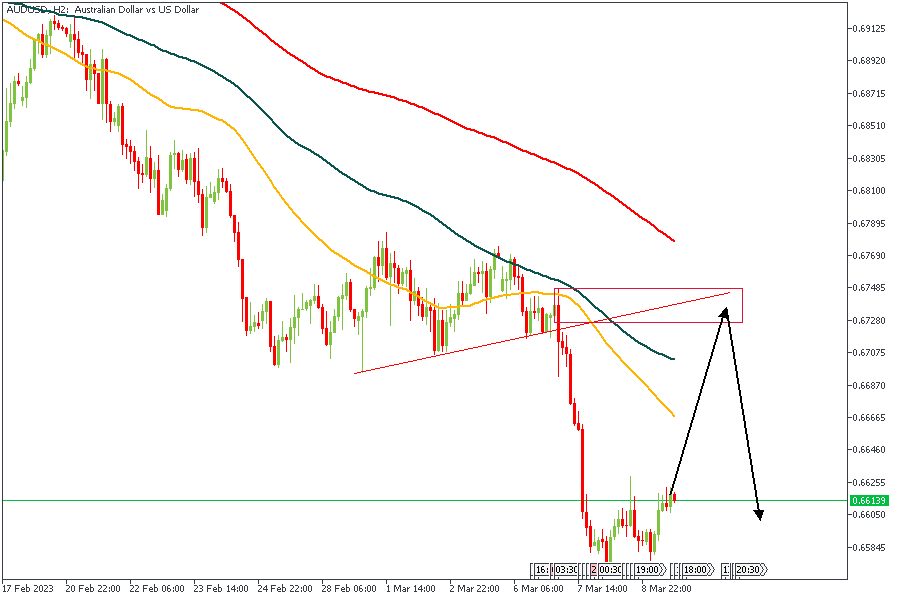
AUDUSD has the clearest picture of the bearish break below the previous low. We have also seen a double-bottom pattern at the most recent low, indicating a high likelihood that the price will retrace to the 0.6700 price region to find a reliable supply zone. After that, we may see a continuation of the bearish trend.
Analysts’ Expectations:
- Direction: Bullish
- Target: 0.67000
- Invalidation: 0.65600
If you would like to trade the NFP with a professional FBS analyst, don't forget to join our live trading broadcast of the NFP release on our YouTube channel.
CONCLUSION
The trading of CFDs comes at a risk. Thus, to succeed, you have to manage risks properly. To avoid costly mistakes while you look to trade these opportunities, be sure to do your due diligence and manage your risk appropriately.
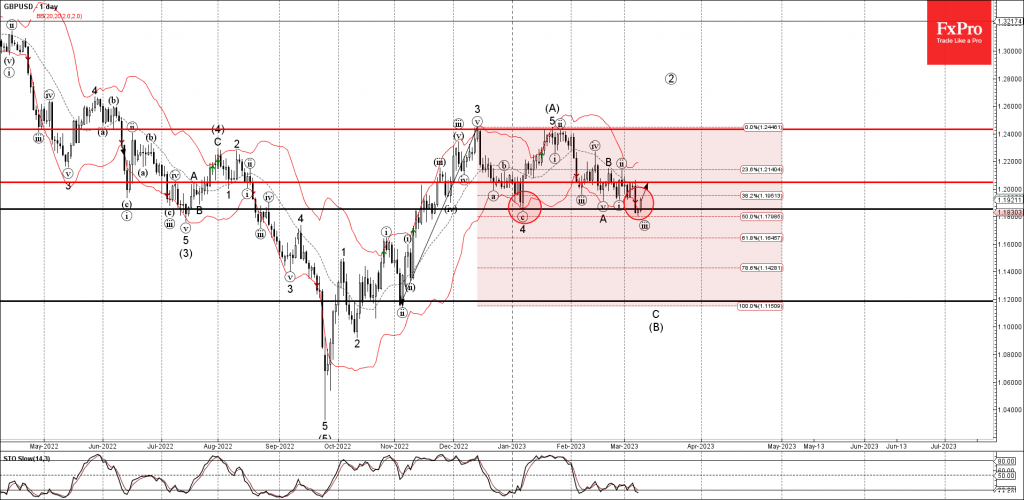
GBPUSD Wave Analysis
- GBPUSD reversed from support level 1.1855
- Likely to rise to resistance level 1.2050
GBPUSD recently reversed up from the powerful support level 1.1855 (previous monthly low from January) – coinciding with the lower daily Bollinger Band and the 50% Fibonacci correction of the upward impulse from November.
The upward reversal from the support level 1.1855 stopped the previous impulse waves (iii) and C.
Given the still oversold daily Stochastic, GBPUSD currency pair can be expected to rise further toward the next resistance level 1.2050.
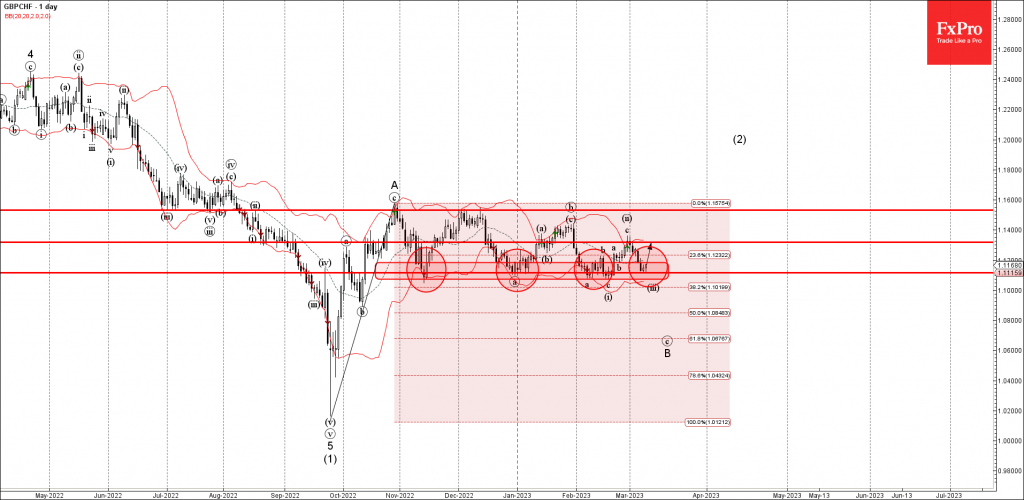
GBPCHF Wave Analysis
- GBPCHF reversed from support level 1.1115
- Likely to rise to resistance level 1.1320
GBPCHF currency pair recently reversed up from the key support level 1.1115 (which has been reversing the price from the start of November) – coinciding with the lower daily Bollinger Band.
The upward reversal from the support level 1.1115 stopped the previous minor impulse waves (iii) and B.
Given the strength of the support level 1.1115, GBPCHF currency pair can be expected to rise further toward the next resistance level 1.1320 (top of the earlier correction (ii)).