Sample Category Title
Sunset Market Commentary
Markets
Where to begin. There’s so much that didn’t happen today. Let’s take a look at equity markets. European stocks opened in red. The likes of the Euro Stoxx 50 (-0.25%) were off intraday lows but never left negative territory. Wall Street loses between 0.1-0.5% in a session devoid of important news or data. We did have weekly jobless claims coming in above the symbolical 200k for the first time in almost two months. It even pulled US yields a bit lower for the day. The move feels exaggerated but note that labour market tightness is the number one key concern to the Fed. Any sign of job market conditions softening is going to be picked up, no matter what. Markets were also put on high alert by Powell after the Fed chair said that “the totality” of the data will decide over the central bank’s next move (25 or 50 bps). We’d be cautious to read a lot in the move though. Tomorrow’s payrolls report combined with next week’s CPI reading are the critical data points. Current yield changes range between -0.3 bps to -5.6 bps with the front-end outperforming. Losses are building as the first US investors are joining. The 2y yield is testing the recently conquered 5% barrier. European yields follow the flattening trend with a remarkable underperformance of the long end of the curve (German and European (swap) yield +5 bps). Currency markets have little going on too. The dollar faces a bit more selling pressure following the jobless claims. EUR/USD advances from 1.0545 to 1.057 currently. The trade-weighted DXY finds support at 105.34 (November 2022 interim low). The Japanese yen is taking the lead on the G10 scoreboard. The decline in core bond yields as well as vulnerable risk sentiment aids the currency. USD/JPY eases to 136.48 after hitting resistance at the 200dMA yesterday and this morning around 137.15. EUR/JPY drifted south to 143.98. The Bank of Japan convenes for a last time under governor Kuroda tomorrow. There are no policy changes expected but markets stick to the idea that it is only a matter of time before the central bank will ditch yield curve control when Ueda takes over. Japan’s 10y yield continues to hit the upper bound of the 0% +/- 50 bps tolerance range. After hitting a 49 bps high mid-January, the spread with the Japanese 10y swap yield, which is out of the BoJ’s scope, remains at an elevated 37 bps today. Sterling is able to eke out some gains against a lackluster dollar and euro. EUR/GBP eases from 0.89 to 0.8878 currently.
tldr; come back tomorrow with the much-anticipated February US jobs report scheduled for release.
News & Views
European energy chief Simson said that the EC will propose to extend the current voluntary consumption cut target (15%) by a year after its expiry end March. Beneficial winter weather helped to reduce demand by nearly 20% over the past months. Simson said that “it’s the best guarantee to achieve another great level storage by November.” The EC aims to fill its storage sites to 90% before next winter. The energy chief also vowed to get rid of Russian LNG completely, as soon as possible. “Committing not to renew existing contracts with Russia is the best way to give a long-term assurance to our reliable partners that meaningful demand will stay.” Benchmark European gas prices (Dutch TTF future) keep setting new cycle lows on a daily basis, approaching €40/MWh for the first time since September 2021.
National Bank of Poland governor Glapinski sounded somewhat more dovish at today’s press conference compared to yesterday’s policy meeting. Glapinski expects Polish inflation to drop very quickly to target and slow more than expected in yesterday’s new projections (2023: 11.9%; 2024: 5.7%; 2025: 3.5%). He’s not calling the formal end to the tightening cycle yet, but is clearly looking in the direction of rate cuts. It’s too early to say whether this will happen this year still or next. Polish money markets were already playing with the notion that a first policy rate cut could happen around the turn of next year. The Polish zloty holds its ground around 4.68.
February NFP and Chance of a Surprise
Following Fed Chair Powell's comments on Capitol Hill last Tuesday, there is a lot of expectation around the upcoming NFP figures. Powell essentially said that if economic data came in well above expectations, then there would be a 50bps hike at the next FOMC meeting. He stressed that the decision hasn't been made yet (otherwise, why have the meeting?) But the potential for increasing the pace of hikes is definitely there, and the market has been pricing it in.
NFP are the first of the two major macroeconomic data points that are scheduled before the next Fed meeting. The other is Feb flash CPI, which will come out next week. Now, all the focus is on the jobs figures, particularly after ADP came in above expectations and JOLTs showed that there were more open jobs at the end of February than in January.
What's expected?
The consensus among analysts was that around 210K jobs were created in February, which would be in line with the last months of 2022. But it's still down from the 517K number reported in January which more than doubled expectations. The unemployment rate, however, is expected to remain steady at the historic low of 3.4%.
There were a couple of factors that led to the surprise jobs number last time, and a couple of them might repeat this month, while others will not. In the latter category is the return of 74K government workers in California as part of a labor dispute resolution, which helped boost the NFP last time.
Why is the jobs market so good?
The surprise last time had more to do with technical adjustments than the total number of jobs created. More specifically, it's not that more people got jobs; fewer than the normal amount of people lost their jobs. Particularly in the more populous areas of New England.
Normally, there is a loss of jobs in January as the holiday shopping comes to an end, and the weather causes a reduction in business activity. That is accounted for in the adjustment made by the BLS in preparing the NFP. But last January was an extraordinarily warm month, which means the ground in the northeast of the country didn't freeze, and activities such as construction and drilling were able to continue.
What about February?
The weather in February was also unseasonably warm, but there was a major winter storm that affected the north and Western areas of the country. The two events could end up canceling out the weather impact on the jobs numbers.
The other thing is that last month already included the adjustment for seasonality, so there is unlikely to be another adjustment boost to the numbers this time around. And, given the large number in January, the prior month could also be revised lower, as typically happens with this way out of the mean results.
Chinese Deflation as Good News
China’s consumer price growth fell to 1.0% y/y, a sharp slowdown from 2.1% y/y and against expectations of 1.9% y/y. Producer prices continued their deflationary slide in February, falling 1.4% y/y, versus -0.8% in the previous month and a slightly stronger than expected 1.3%.
The opening up of the Chinese economy has a deflationary effect on the domestic economy. In contrast, easing restrictions has had a pronounced pro-inflationary impact in Europe and the US. This effect is easily explained by the fact that the Middle Kingdom remains the “world factory”, and the opening of the economy boosts the supply more than the demand, which also helps to restore supply chains.
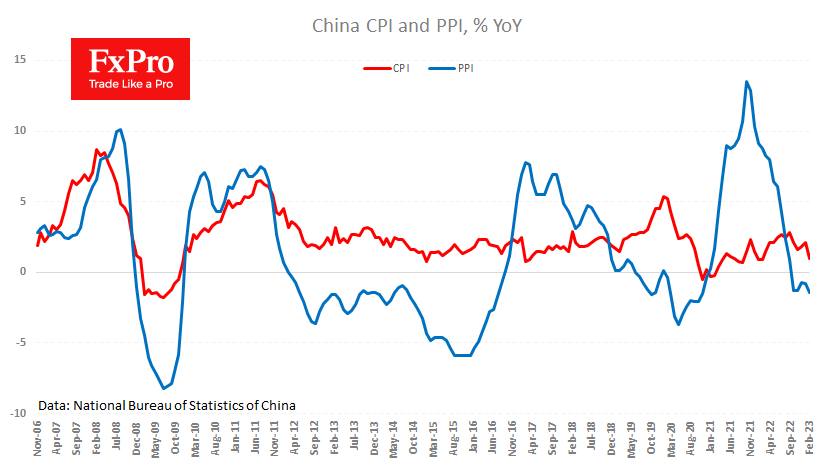
Over the past 20 years, China has been blamed for the spread of global deflation. In the current situation, this is a desirable side effect. Falling producer prices are also likely to help contain the global inflation problem. This is good news for risk demand, even if it does not appear so at first glance. Often, weak price pressures are associated with low demand. We have yet to see the February retail sales figures next week, but it is unlikely that the lifting of closures will suppress demand.
If we are right and the price fall is a sign of a return to the Chinese norm, this should support equity prices and the renminbi exchange rate.
EUR/USD Mid-Day Outlook
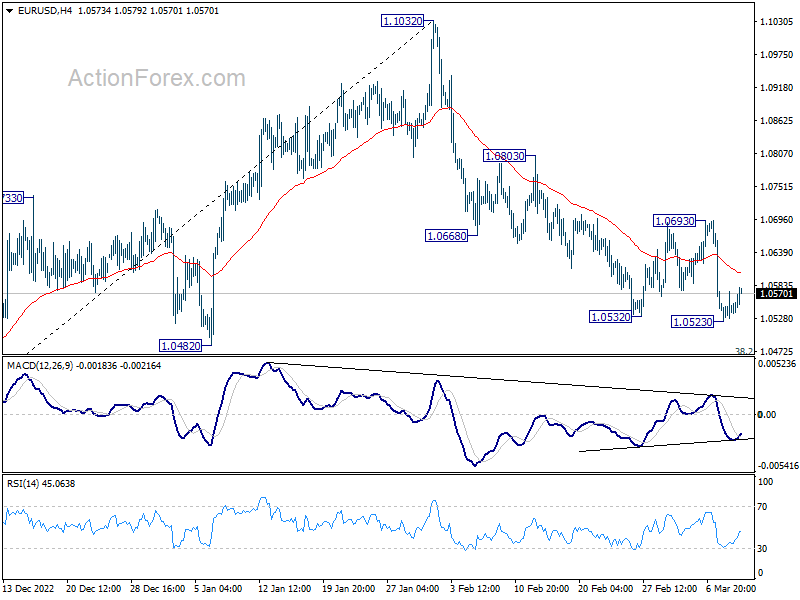
Daily Pivots: (S1) 1.0521; (P) 1.0548; (R1) 1.0570; More...
Intraday bias in EUR/USD is turned neutral with current recovery. Another decline is still in favor as long as 1.0693 resistance fall. Below 1.0523 will target 38.2% retracement of 0.9534 to 1.1032 at 1.0463. Strong support could be seen there to bring reversal. However, sustained break of 1.0463 will carry larger bearish implications.
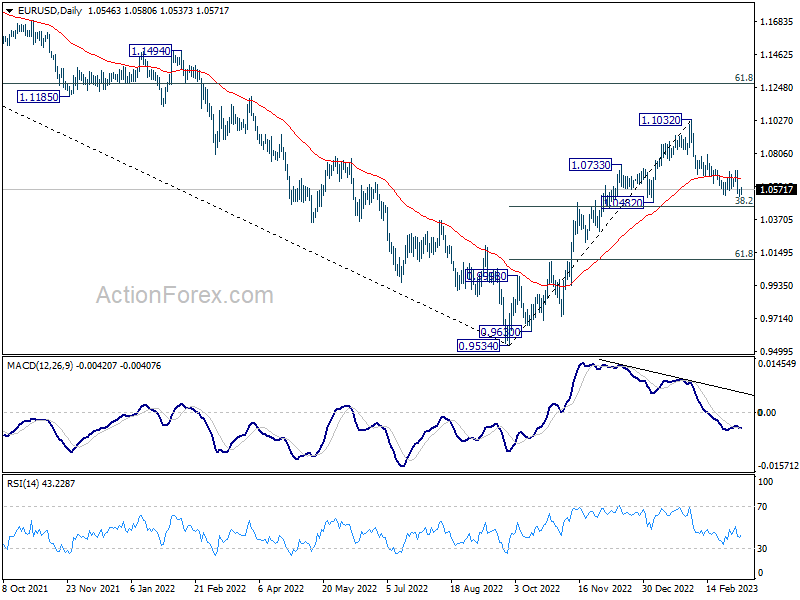
In the bigger picture, as long as 1.0482 support holds, rise from 0.9534 (2022 low) should continue to 61.8% retracement of 1.2348 (2021 high) to 0.9534 at 1.1273. However, sustained break of 1.0482 will bring deeper fall to 61.8% retracement of 0.9534 to 1.1032 at 1.0106, even as a corrective pull back.
GBP/USD Mid-Day Outlook
Daily Pivots: (S1) 1.1813; (P) 1.1836; (R1) 1.1868; More...
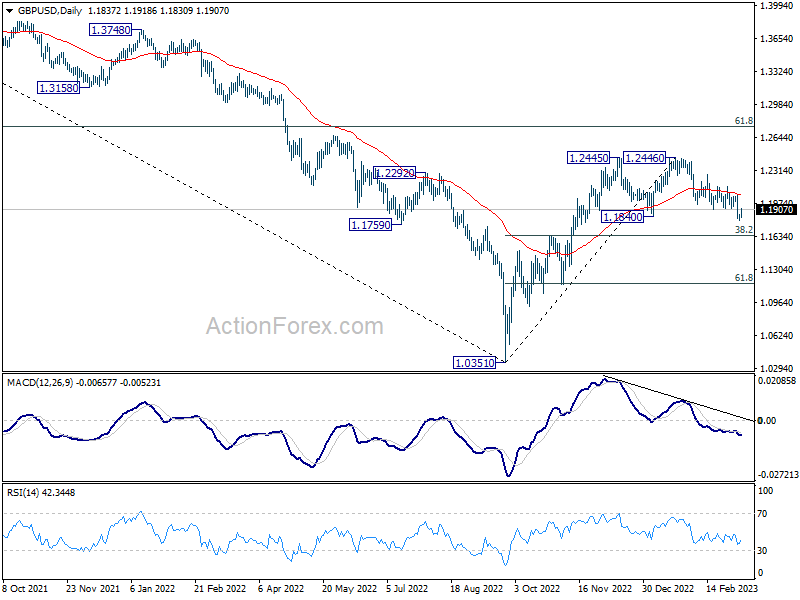
Intraday bias in GBP/USD remains neural first. Firm break of 1.1914 resistance turned support will indicate short term bottoming, and bring stronger rebound to 55 day EMA (now at 1.2055). On the downside, though, break of 1.1801 will resume the fall form 1.2446 to 38.2% retracement of 1.0351 to 1.2446 at 1.1646.
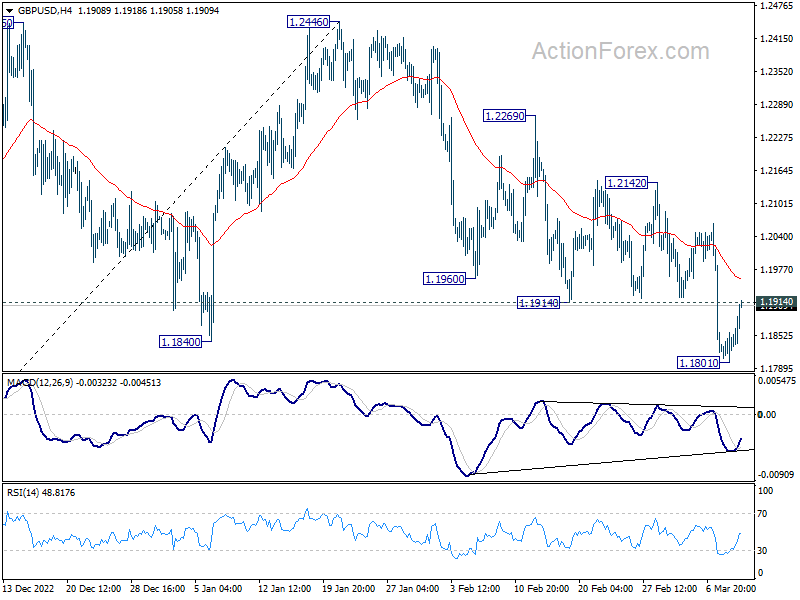
In the bigger picture, break of 1.1840 support argues that a double top pattern (1.2445, 1.2446) was formed after rejection by 55 week EMA (now at 1.2228). Deeper decline should be seen back to 38.2% retracement of 1.0351 to 1.2446 at 1.1646. Sustained break there will raise the chance of trend reversal and target 61.8% retracement at 1.1151. Nevertheless, strong rebound from current level, followed by firm break of 55 day EMA, will invalidate this bearish view and indicate that rise from 1.0351 is still in progress.
USD/CHF Mid-Day Outlook
Daily Pivots: (S1) 0.9390; (P) 0.9414; (R1) 0.9440; More...
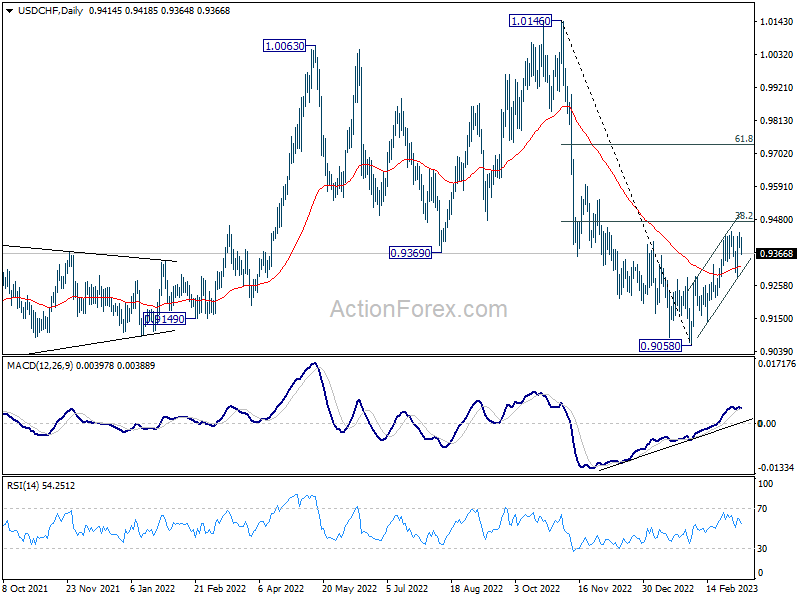
Intraday bias in USD/CHF stays neutral and outlook is unchanged. On the upside, break of 0.9439 will resume the rise from 0.9058 for 38.2% retracement of 1.0146 to 0.9058 at 0.9474. Decisive break there will carry larger bullish implications. On the downside, break of 0.9284 will turn bias back to the downside for retesting 0.9058 low instead.
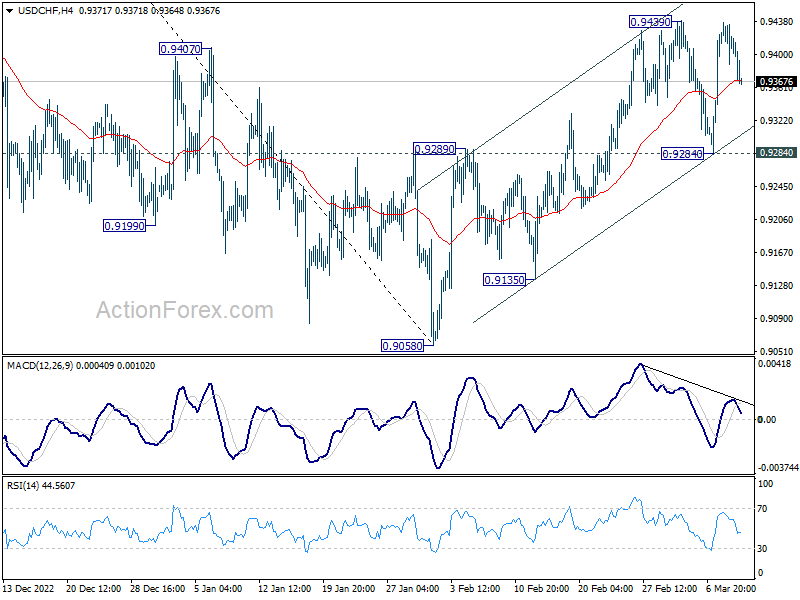
In the bigger picture, decline from 1.0146 is seen as part of a long term sideway pattern. As long as 38.2% retracement of 1.0146 to 0.9058 at 0.9474 holds, another fall is in favor through 0.9058. However, sustained trading above 0.9474 will indicate that the medium term trend has reversed, and open up further rally to 61.8% retracement at 0.9730 and above.
USD/JPY Mid-Day Outlook
Daily Pivots: (S1) 136.59; (P) 137.25; (R1) 138.02; More...
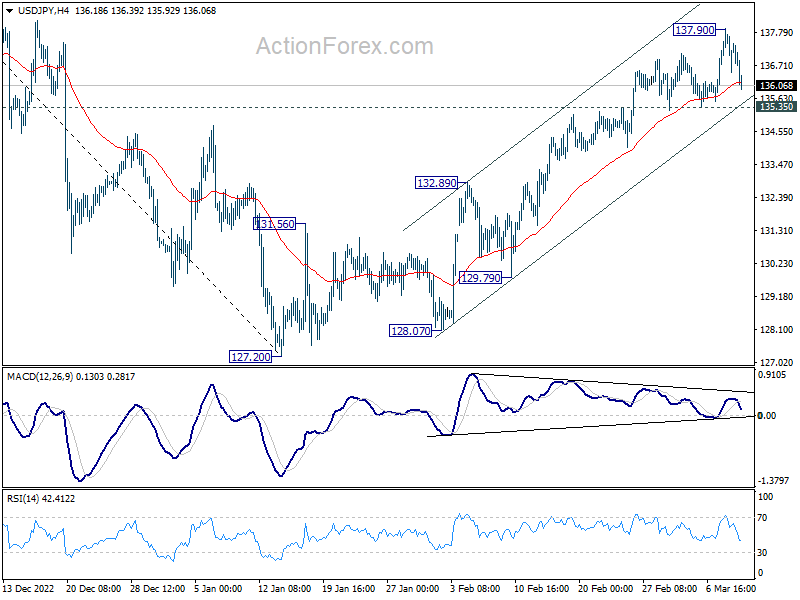
Intraday bias in USD/JPY remains neutral for consolidation below 137.90 temporary top. Further rally is expected as long as 135.35 support holds. Break of 137.90 will resume the rally from 127.20 to next fibonacci level at 142.48. However, break of 135.35 will bring deeper pull back to 55 day EMA (now at 134.30) instead.
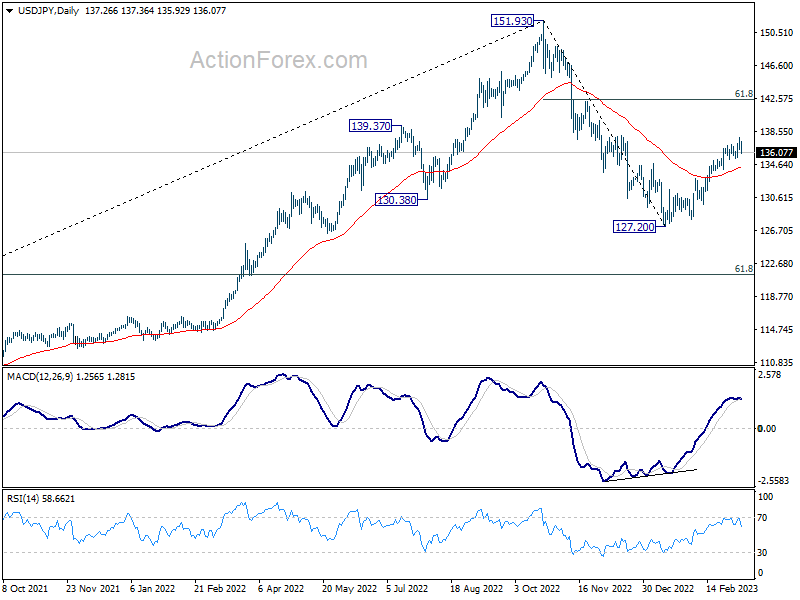
In the bigger picture, the break of 38.2% retracement of 151.93 to 127.20 at 136.64 suggests that whole down trend from 151.93 has completed at 127.20 already. Tentatively, rise from 127.20 is seen as the second leg the medium term pattern from 151.93. Further rally is expected to 61.8% retracement at 142.48. This will now remain the favored case as long as 55 day EMA (now at 134.10) holds.
Yen Gaining Some Ground, Looking Forward to BoJ
Yen is gaining ground against its major counterparts today, as traders are probably lightening up short positions ahead of BoJ policy decision tomorrow. Sterling is also showing signs of strength. However, overall, market sentiment remains cautious, with Dollar retraces some of this week's gains. The most significant upcoming events for the week are scheduled for tomorrow, including the release of UK GDP, US non-farm payroll figures, and Canada's employment report. These data releases are expected to impact market sentiment and drive currency movements in the short-term.
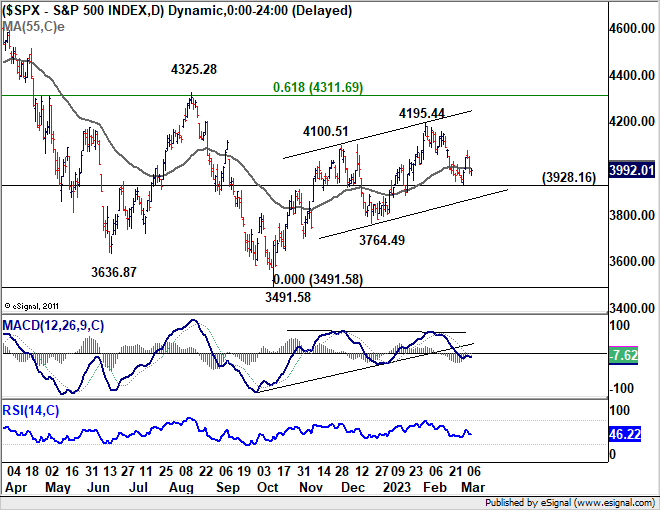
Technically, a major focus for the rest of the week would be on whether selling in US stocks would take off again. S&P 500 is so far holding above last week's low at 3928.16, and the outlook is neutral at worst. But firm break of 3928.16 will raise the chance that whole rebound from 3491.58 has completed and target 3764.49 support for confirmation.
In Europe, at the time of writing, FTSE is down -0.58%. DAX is down -0.24%. CAC is down -0.29%. Germany 10-year yield is up 0.0235 at 2.669. Earlier in Asia, Nikkei rose 0.63%. Hong Kong HSI dropped -0.63%. China Shanghai SSE dropped -0.22%. Singapore Strait Times dropped -0.38%. Japan 10-year JGB yield closed down -0.0026 at 0.504.
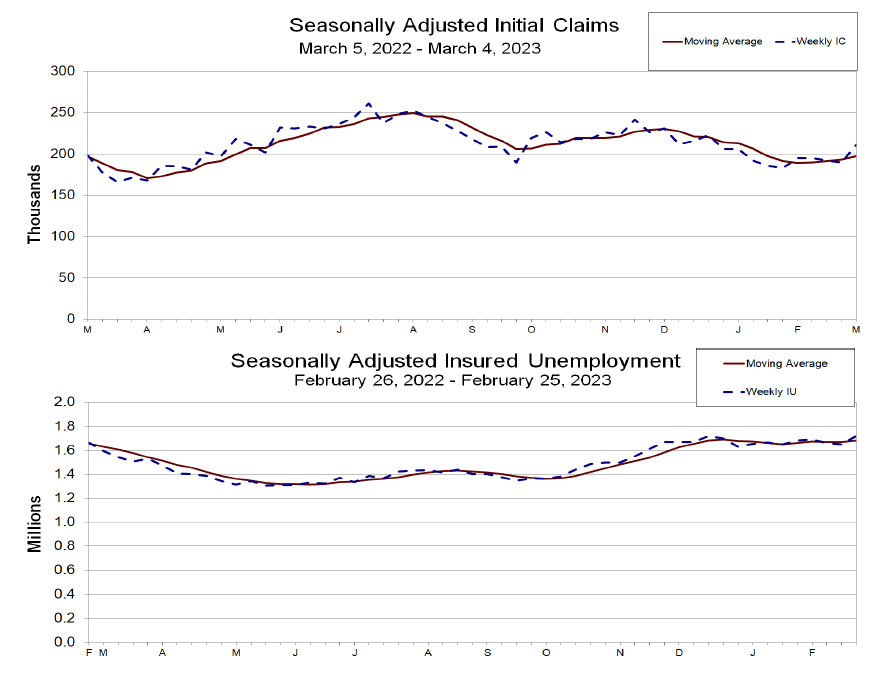
US initial jobless claims rose to 211k, above expectations
US initial jobless claims rose 21k to 211k in the week ending March 4, above expectation of 195k. Four-week moving average of initial claims rose 4k to 197k.
Continuing claims rose 69k to 1718k in the week ending February 25. Four-week moving average of continuing claims rose 10k to 1680k.
ECB Villeroy: Inflation will halve by year end
ECB Governing Council member Francois Villeroy de Galhau said "what is very important is the inflation expectations".
"The peak will come this semester, and then inflation will halve by the end of the year," he added.
The Bank of France head also expect France's inflation to peak in first half of the year.
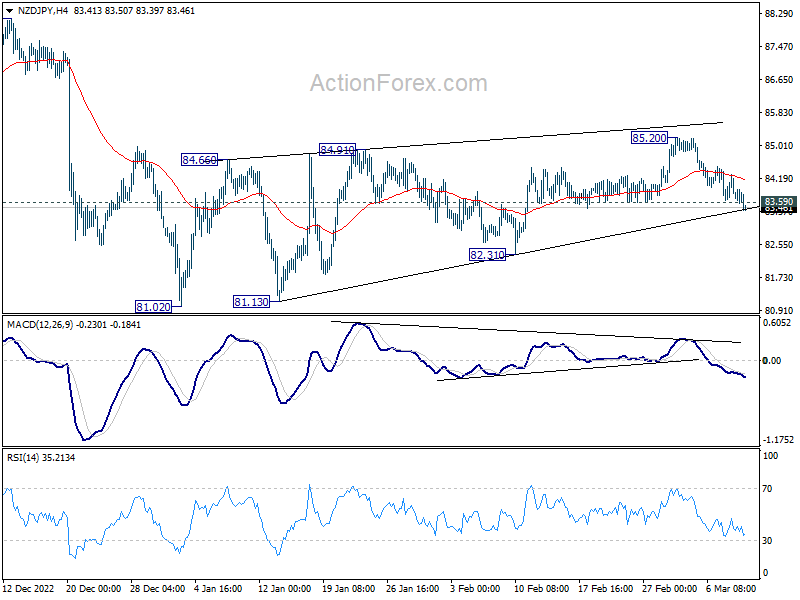
AUD/JPY and NZD/JPY break support ahead of Kuroda's last BoJ meeting
Yen is seeing a broad recovery today as investors anticipate Haruhiko Kuroda's last BoJ monetary policy meeting tomorrow. As with four of his predecessors, Kuroda is unlikely to make any changes to policy during this last meeting, with his comments expected to echo what has been said numerous times before. Specifically, he is likely to reiterate that the current ultra-loose monetary policy is still appropriate until there is sustained inflation above the 2% target led by wage growth.
Meanwhile, the government's nominees for the next BoJ Governor and Deputy Governors have been approved by the lower house of parliament today. The upper house will vote on the nominees tomorrow. Kazuo Ueda will officially replace Kuroda on April 8, and chair his first monetary policy meeting on April 27-28. The two deputy governor nominees, Shinichi Ueda and Ryozo Himino, will take office from March 20.
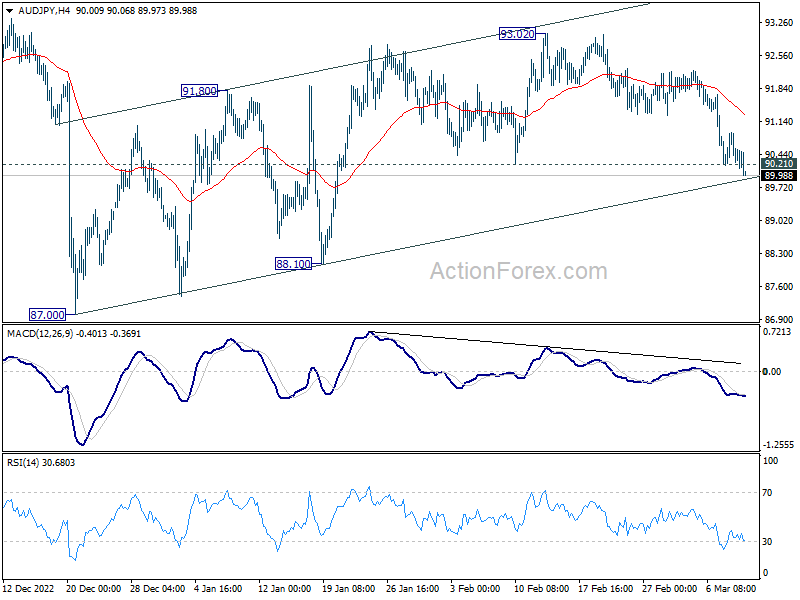
Yen is making progress today by breaking through near term resistance levels against commodity currencies. AUD/JPY's break of 90.21 support argues that corrective rise from 87.00 has completed at 93.02. Sustained trading below channel support (now at 89.91) will affirm this bearish case and target 87.00/88.10 support zone.
NZD/JPY's break of 83.59 support also argue that corrective pattern from 81.02 has completed at 85.20. Sustained trading below trend line support (now at 83.44) will bring deeper fall to 82.31 support first, and then 81.02 low.
USD/JPY Mid-Day Outlook
Daily Pivots: (S1) 136.59; (P) 137.25; (R1) 138.02; More...
Intraday bias in USD/JPY remains neutral for consolidation below 137.90 temporary top. Further rally is expected as long as 135.35 support holds. Break of 137.90 will resume the rally from 127.20 to next fibonacci level at 142.48. However, break of 135.35 will bring deeper pull back to 55 day EMA (now at 134.30) instead.
In the bigger picture, the break of 38.2% retracement of 151.93 to 127.20 at 136.64 suggests that whole down trend from 151.93 has completed at 127.20 already. Tentatively, rise from 127.20 is seen as the second leg the medium term pattern from 151.93. Further rally is expected to 61.8% retracement at 142.48. This will now remain the favored case as long as 55 day EMA (now at 134.10) holds.
Economic Indicators Update
| GMT | Ccy | Events | Actual | Forecast | Previous | Revised |
|---|---|---|---|---|---|---|
| 23:50 | JPY | GDP Q/Q Q4 F | 0.00% | 0.20% | 0.20% | |
| 23:50 | JPY | GDP Deflator Y/Y Q4 F | 1.20% | 1.10% | 1.10% | |
| 23:50 | JPY | Money Supply M2+CD Y/Y Feb | 2.60% | 2.80% | 2.70% | |
| 00:01 | GBP | RICS Housing Price Balance Feb | -48% | -50% | -47% | -46% |
| 01:30 | CNY | CPI Y/Y Feb | 1.00% | 1.90% | 2.10% | |
| 01:30 | CNY | PPI Y/Y Feb | -1.40% | -1.20% | -0.80% | |
| 06:00 | JPY | Machine Tool Orders Y/Y Feb P | -10.70% | -9.70% | ||
| 12:30 | USD | Challenger Job Cuts Y/Y Feb | 410.10% | 440.00% | ||
| 13:30 | USD | Initial Jobless Claims (Mar 3) | 211K | 195K | 190K | |
| 15:30 | USD | Natural Gas Storage | -76B | -81B |
US initial jobless claims rose to 211k, above expectations
US initial jobless claims rose 21k to 211k in the week ending March 4, above expectation of 195k. Four-week moving average of initial claims rose 4k to 197k.
Continuing claims rose 69k to 1718k in the week ending February 25. Four-week moving average of continuing claims rose 10k to 1680k.