

Sample Category Title
Dollar Likely to Have Completed Corrective Bounce
The S&P500 and Nasdaq100 indices staged a solid intraday rebound yesterday, digesting the initial drop and closing the day higher. Along with the rebound in equities, a reversal to the downside is forming in the Dollar Index.
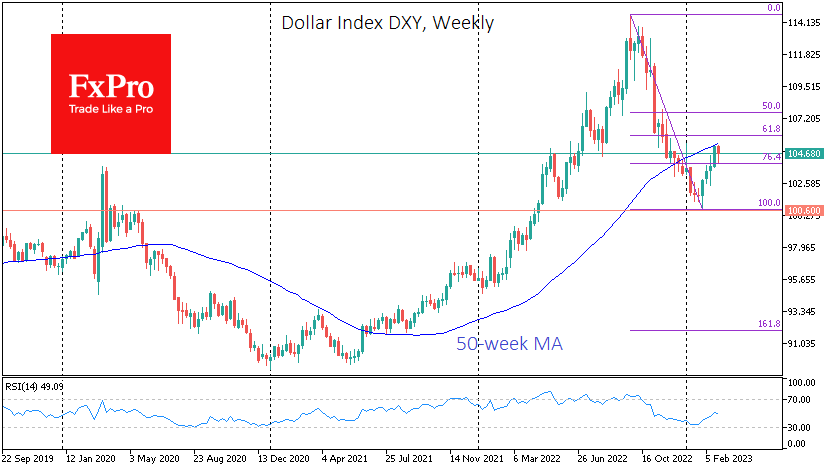
Technically, the dollar’s rebound in February has cleared the oversold conditions accumulated during the decline since late September last year. The RSI on the daily timeframe touched the overbought territory and was turned down precisely a week ago, leaving room for further declines.
Strictly speaking, the pullback is below 61.8% of the initial decline that passes through the 106 level. Below that is the 200 SMA, but the USD bulls didn’t have enough power to push the American currency into the area now, as in January. The 105 territory is interesting, as it has seen several reversals in the past.
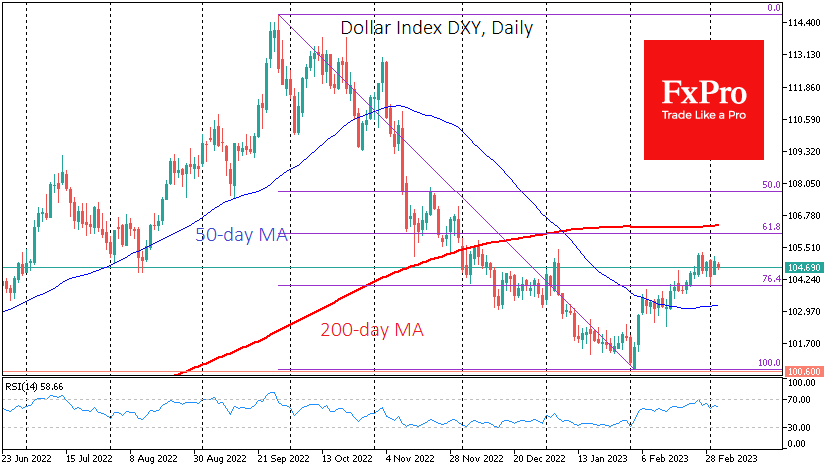
A possible intermediate target for the US currency is 103.2, the 50-day average. Also, here, the DXY stopped rising in March 2020. It is very likely that the dollar will continue its slide at this level and will test the February lows of 100.6 before the end of April.
The view that the dollar is weakening against its major rivals fits well with historical examples. Often the Fed is the first to tighten monetary policy, triggering a wave of dollar strength. But a few months later, other central banks followed suit or moved ahead of the Fed.
Compared with January, the bond markets have priced in the Fed’s expectations quite well. In turn, the ECB and the Bank of England continue to push up expectations in their markets. As in previous similar episodes, this reassessment of expectations by the Fed’s “competitors” promises to be a driving force in the currency markets.
The picture in EURUSD and GBPUSD is also bullish, as the pairs received strong support from buyers on dips to psychological and technical levels near 1.05 and 1.20, respectively.
Week Ahead – Will BoJ Shock Markets Ahead of US Payrolls?
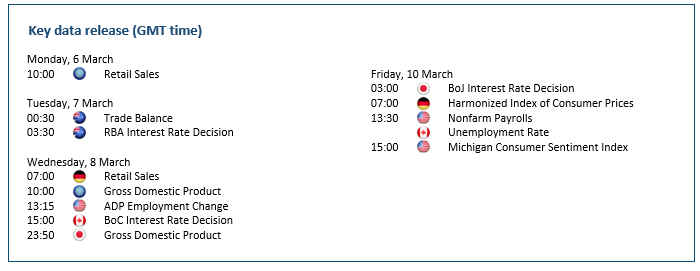
Market participants are in for a wild ride, as the coming week is loaded with promising events. The ball will get rolling with central bank meetings in Australia and Canada. Those will serve as appetizers for the Bank of Japan’s decision, which might be a close call, feeding volatility in the yen. In the US, the latest employment report and testimony by the Fed chief before Congress will decide whether the dollar’s recovery still has miles left in the tank.
Yen braces for turbulence
A difficult decision lies ahead for Bank of Japan officials. They will have to decide on Friday whether to take the next step in their tightening campaign, amid conflicting signals around the Japanese economy and the inflation outlook.
On the bright side, inflation and wage growth have fired up, both running above 4%. In fact, wages rose faster than inflation in January, which means real wage growth finally turned positive. That’s good news for Japanese consumers, and something the central bank has long waited for.
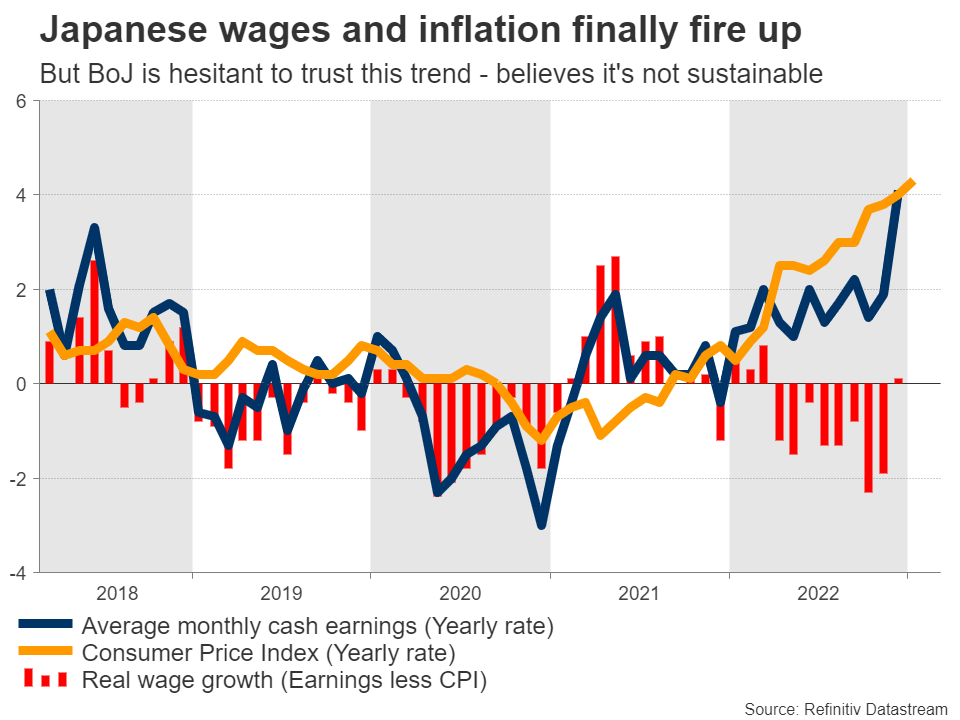
However, several BoJ members - including future Governor Ueda - believe this inflation spell is driven mostly by supply shocks and energy prices, so it won’t last. Energy subsidies from the government finally came into effect last month, driving electricity prices much lower.
Therefore, the logic is that inflation might be high today, but is destined to fall soon. Indeed, incoming data support this notion as the forward-looking Tokyo CPIs fell sharply in February. There are similar questions about wages, since the spring wage negotiations between unions and businesses have just started.
Another issue to consider is that this is the last meeting of outgoing BoJ Governor Kuroda, and he might prefer to leave any major decisions to his successor who will take over next month.
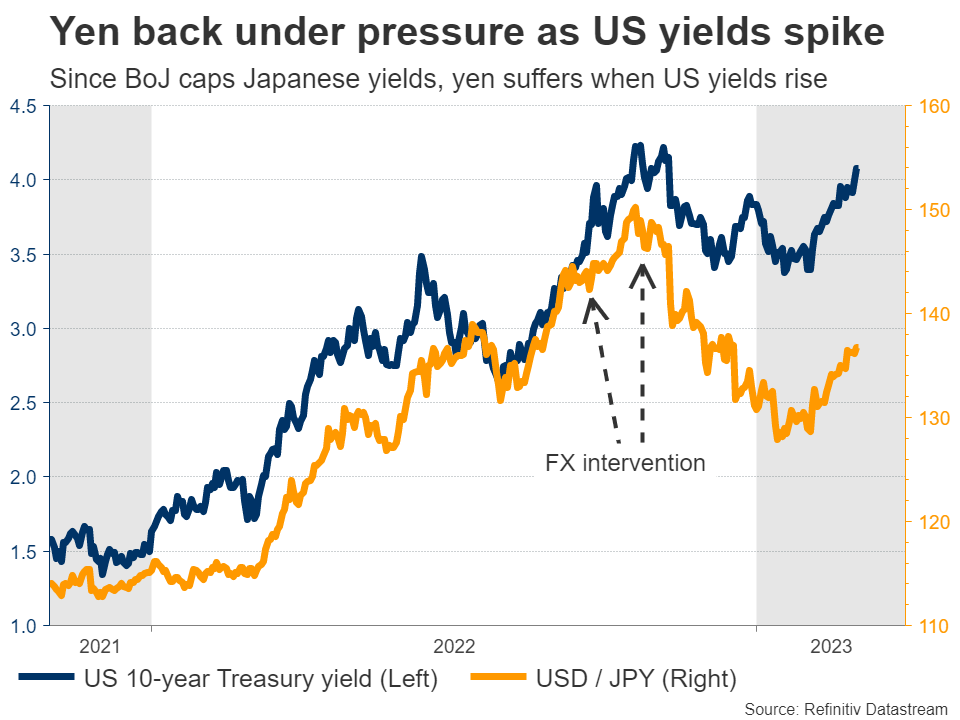
It’s a close call but weighing everything up, it seems more prudent for the BoJ to be patient. While economic data currently warrants further action, there’s heightened uncertainty around inflation and the ongoing wage negotiations. There’s always a chance the BoJ decides to pull the trigger now, but waiting until April would give the officials more clarity.
A decision to do nothing would spell bad news for the yen. That said, it’s probably only a matter of time until the BoJ does raise its yield ceiling again or abandons it completely, so it might not be a game changer for the yen’s trend.
US nonfarm payrolls, another solid print?
In the United States, the underlying theme lately has been how resilient the economy is. Consumer demand, inflationary pressures, and the labor market have not shown any real signs of damage yet despite the Fed’s relentless rate increases, fueling bets that interest rates will need to go higher and stay elevated for a longer period.
This coming week, the show will get started with Fed Chairman Powell, who will testify before Congress on Tuesday and Wednesday. Markets usually react to the Q&A session of his first testimony, and the risk is that he strikes a more hawkish tone following the recent barrage of strong data.
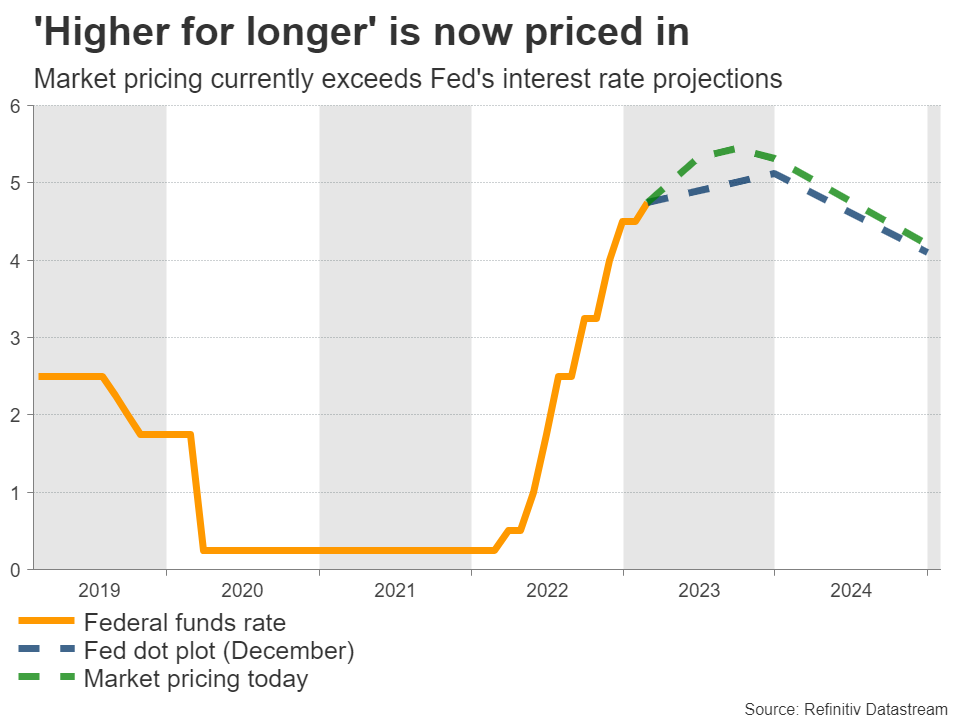
Beyond that, the spotlight will fall on the employment data out on Friday. Forecasts point to another solid report, with nonfarm payrolls seen at 200k in February after printing an astonishing 517k last month. The unemployment rate is expected to tick up to 3.5%, while wage growth is projected to accelerate.
Indeed, most early indicators suggest it was a strong month for the jobs market. Business surveys from S&P Global pointed to an acceleration in hiring, while applications for unemployment benefits remained historically low.
Still, there’s a risk that nonfarm payrolls disappoint. When an NFP report is as strong as it was last month, it is often followed by a weaker number - a correction back to the prevailing trend. Since warm weather played a huge role in boosting the last number, it wouldn’t be surprising to see some ‘payback’ this time.
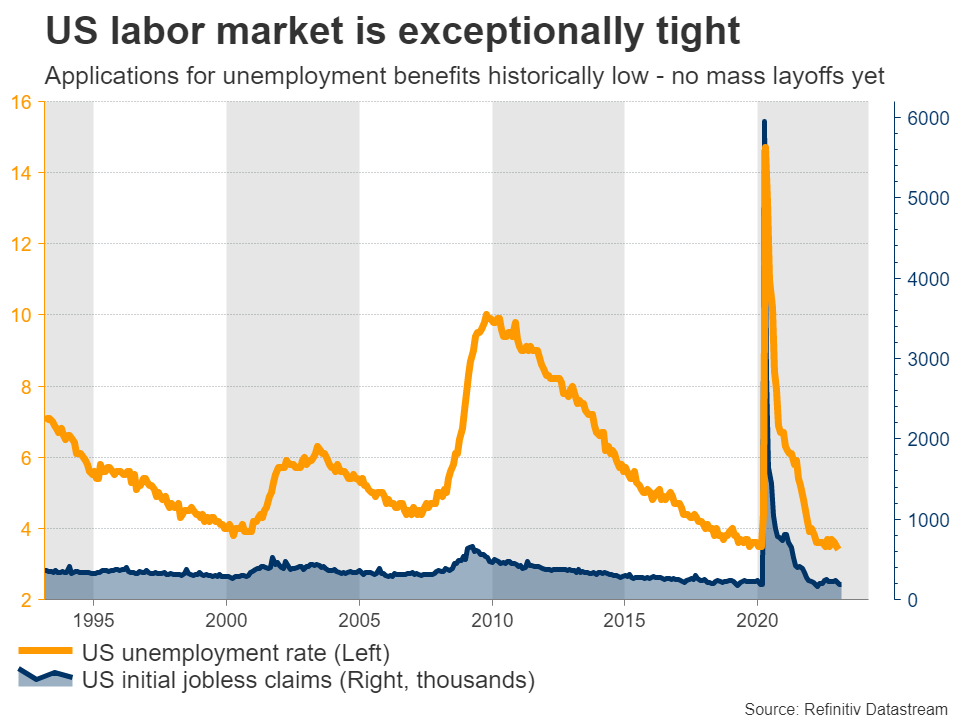
As for the dollar, the outlook seems positive, even if there is a setback next week. With the Fed expected to stay restrictive for longer, US yields have started to race higher, reinforcing the dollar’s rate advantage. This dynamic has also weighed on stock markets, where any further losses could inflict collateral damage on currencies such as the euro or sterling, indirectly benefiting the greenback.
BoC and RBA rate decisions
Crossing into Canada, the central bank is expected to take the sidelines when it meets on Wednesday following a series of disappointing data releases, most notably the latest GDP growth report.
With high interest rates restraining consumers and pressuring the nation’s housing market, the Canadian economy has stalled and inflationary pressures are cooling off. Investors have gotten the message, as market pricing implies almost no chance of a rate increase next week.
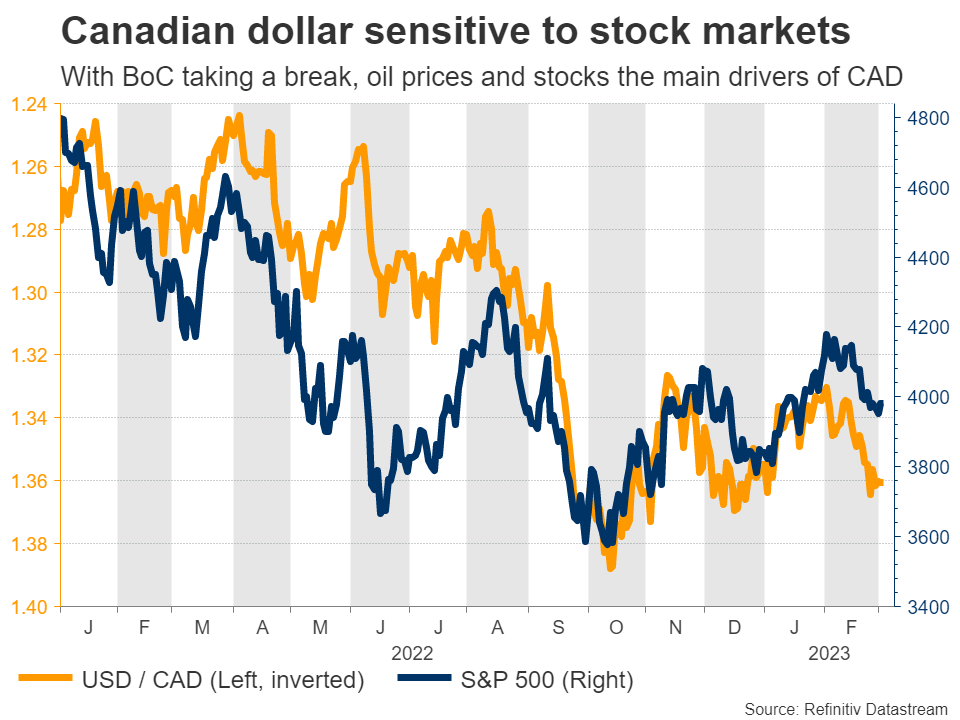
Now that monetary policy has taken a back seat, the primary drivers of the Canadian dollar moving forward might be the performance of oil prices and global risk sentiment, neither of which seems favorable at this stage. Beyond the Bank of Canada decision, the nation’s employment stats will also be in focus on Friday.
Over in Australia, the main event will be the Reserve Bank’s decision on Tuesday. Markets assign a 75% probability for a quarter-point rate increase, after the minutes of the previous meeting showed the Board envisioned “further increases”.
Since it is not fully priced in, a decision to raise rates could briefly boost the Australian dollar, although the currency’s overall trajectory will depend mostly on any signals around the terminal rate.
Developments in China will also be crucial for the Australian dollar, given the close trade links between the two economies. China will release its latest trade data on Tuesday and inflation stats on Thursday, which are likely to reflect the reopening boom seen in other indicators lately.
RBA to Hike Rates Again But Future Path Uncertain after Mixed Data
The Reserve Bank of Australia is widely anticipated to raise the cash rate for the 10th consecutive meeting on Tuesday as it battles to get inflation down. Having flip-flopped between hawkish and dovish inclinations lately, the RBA may struggle again to get its communication right amid some confusing signals on inflation and the economy. This could make it difficult for the Australian dollar to find a floor under its recent slide.
Danger of stagnation
The Australian economy slowed towards the end of 2022 and the slump in the property market deepened further, with even the hot labour market coming under some strain from the series of hikes in the borrowing cost. However, inflation hit a new three-decade peak in the final quarter of 2022, prompting the RBA to row back on language that was bordering on a neutral stance.
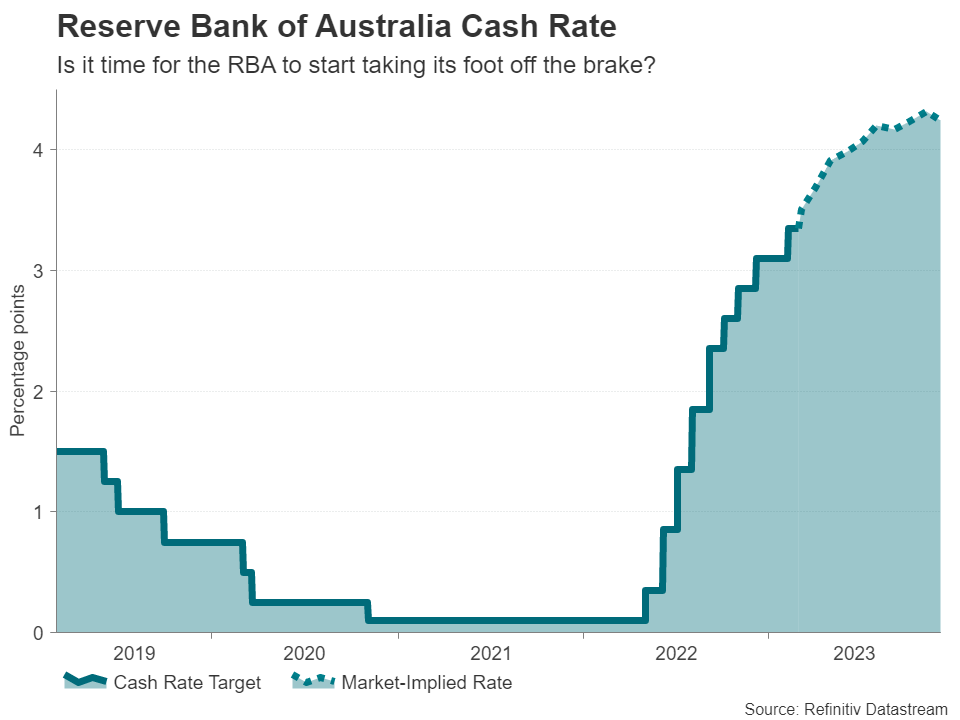
The hawkish tilt from the December meeting to the next one in February was notable and policymakers now expect to raise the cash rate several more times over the coming months. Investors have subsequently fully priced in three 25-basis-point rate increases and another one with equal probability for 2023.
Making sense of the fast-shifting data
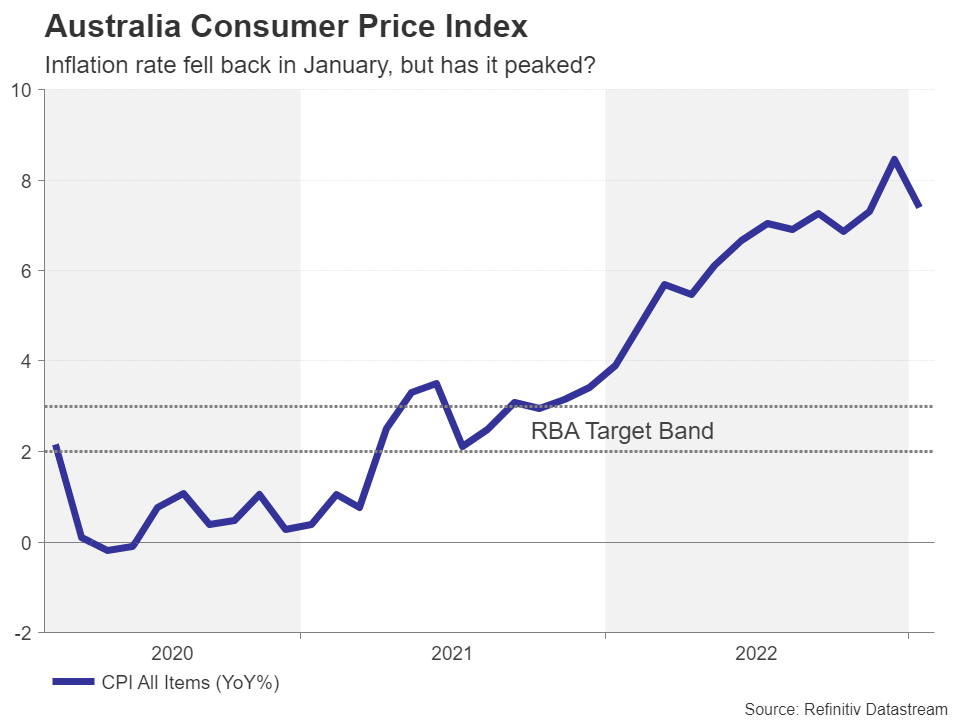
Nevertheless, there was some paring back of the rate hike odds following the release of the fourth quarter GDP data earlier this week, which came in below expectations. Other incoming data in the past couple of weeks have also been pointing down. Employment fell for the second straight month in January, wages rose by less than expected in Q4, and the consumer price index moderated significantly in January, easing from 8.1% to 7.2%, Meanwhile, it seems that the housing downturn isn’t quite over despite some signs of the price declines slowing, as building approvals plunged 13.8% y/y in January.
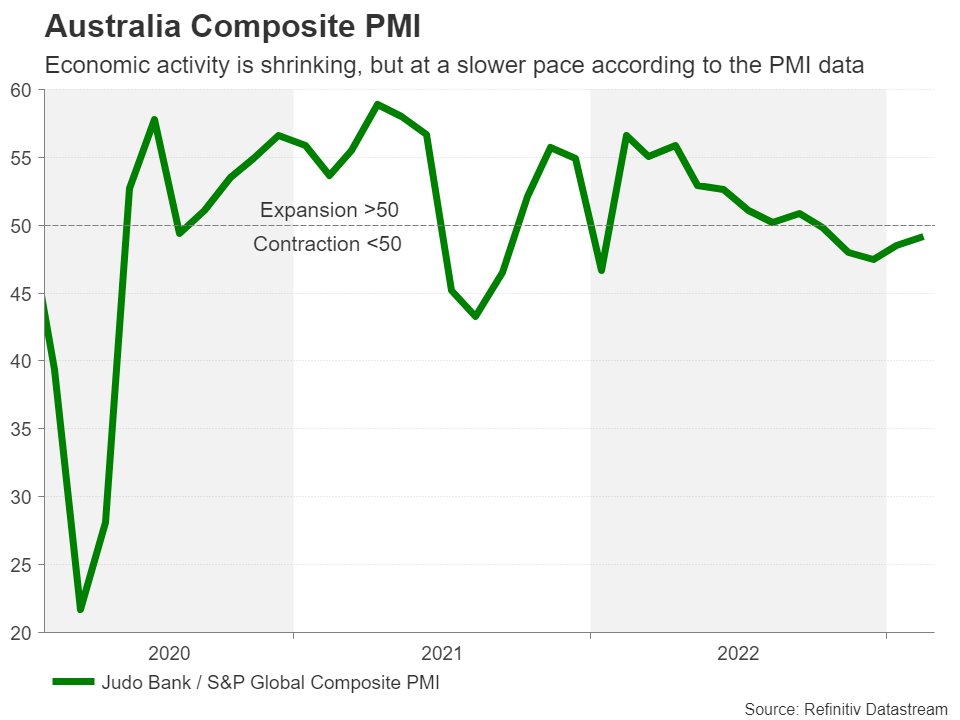
However, more forward-looking indicators such as the Judo Bank/S&P Global PMIs suggest that economic activity may be picking up. In addition, when put into perspective of the bigger economic picture, the slowdown in the jobs market or in broader growth is not that severe.
Inflation not growth likely to be RBA’s main priority
Hence, the RBA will probably not be too worried about recession risks just yet and focus more on the CPI data, and on that, it is too soon to assume that the country is past peak inflation. Moreover, growth in Australia’s biggest export market – China – is bouncing back fast and so the outlook on that front is improving.
With all that in mind, investors may be putting too much weight on the downside risks to the economy and it’s probably premature to be talking about a pause when both headline and underlying measures of inflation remain so elevated. For now, a 25-bps rate hike is almost certain at the March decision, which means the focal point of the meeting will be any changes to the wording of the statement.
There could be some upside for the aussie
If Governor Philip Lowe reinforces his message that there is further tightening to come, this could provide some boost to the aussie as traders reverse their recent unwinding of rate hike bets. A climb back towards the $0.70 level could be possible, although that would require overcoming several major hurdles such as the 200- and 50-day moving averages in the $0.68 and $0.69 regions, respectively.
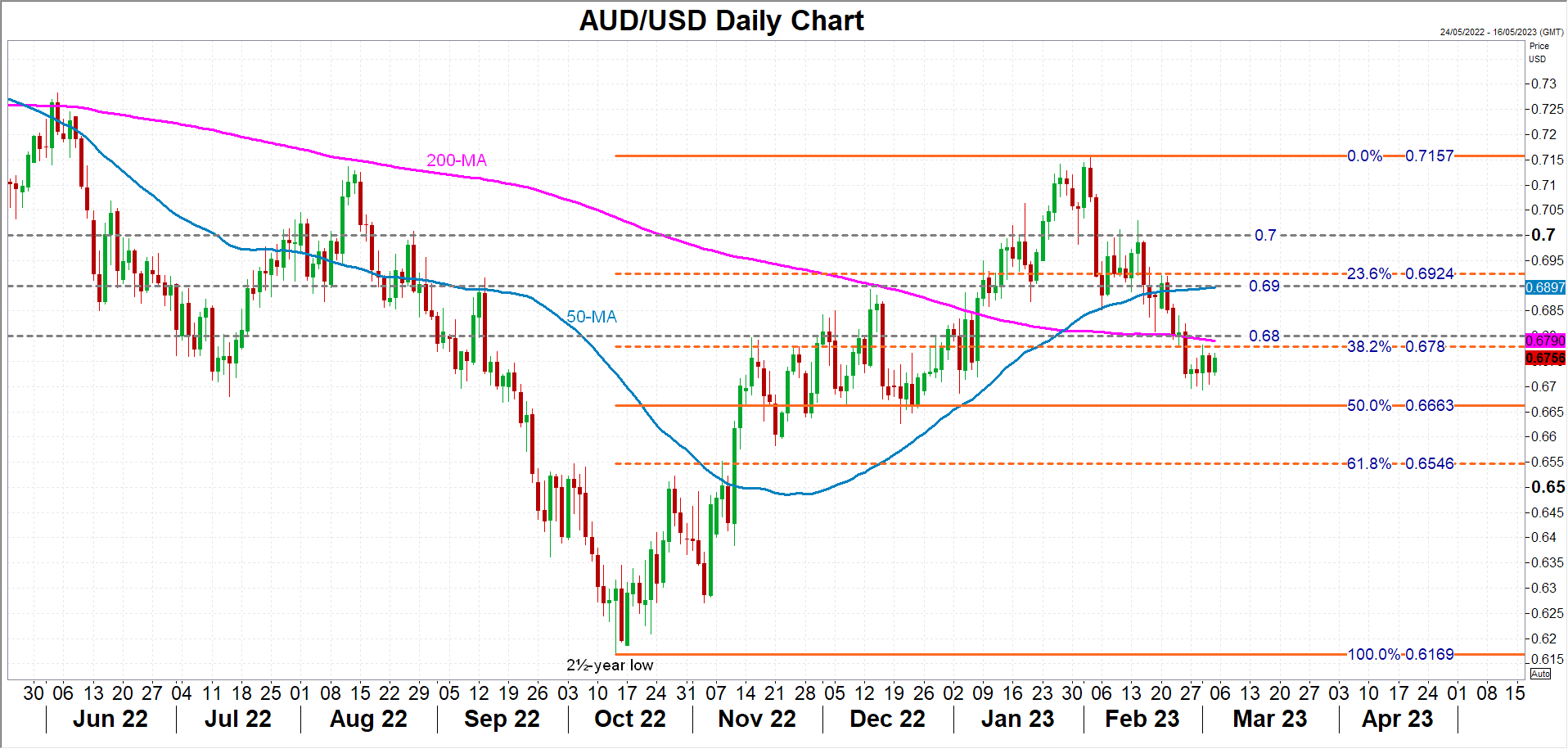
However, should Lowe fail to portray a convincingly hawkish tone by emphasising the risks to growth, the aussie could slide towards the 50% Fibonacci retracement of the October 2022-February 2023 uptrend at $0.6663. Breaching this would open the door to the 61.8% Fibonacci of $0.6546.
Either way, there’s unlikely to be a marked shift in the RBA’s policy stance until policymakers have a clearer view of what’s happening to inflation and in the meantime, the aussie will be driven mainly by general market sentiment as well as of course by speculation about Fed policy.
Weekly Focus – US Jobs Growth in Focus
Markets remain caught between the soft-landing vs overheating narrative. On the one hand, the challenge comes from too high inflation. The US ISM manufacturing prices paid index took a notable jump higher in February, suggesting that producer prices are rising again. In the euro area, February HICP inflation figures came in red hot. While headline inflation eased further to 8.5% (from 8.6% in January), core inflation jumped by 0.3pp to a new record high of 5.6%. Markets reacted by sending yields higher and pricing in more rate hikes from the ECB and the Fed. The ECB peak rate is now priced at close to 4% and we have also changed our ECB call in light of the strong underlying inflation momentum. We now expect a peak policy rate of 4% (deposit rate), with hikes of 50bp in March, 50bp in May, 25bp in June and 25bp in July (see also ECB Preview - Higher for longer, 2 March).
Equities remained on a roller-coaster, caught between higher yields (hurting equity risk premia) and an improving macro outlook (benefitting earnings). Chinese PMIs rose across the board and brought more evidence that the reopening of the economy has boosted activity. New orders in both manufacturing and services rose strongly and stronger employment bodes well for consumers and the housing market. Overall, the figures support our view of a frontloaded Chinese recovery (see also China Macro Monitor - Strong growth burst in early 2023, 1 March). The anticipation of positive spill-over effects to the euro area economy and higher ECB terminal rate expectations boosted EUR/USD, which rose back above 1.06.
The UK and EU struck a deal on the Northern Ireland Protocol (NIP). The NIP tackles the post-Brexit issue of implementing an EU-border between the Republic of Ireland and Northern Ireland, which would violate the peace agreement from 1998, all the while still keeping the British inner market intact. While a date is not yet set for the UK Parliament to vote on the deal, it is at present expected to receive the necessary backing as Conservative MPs are faced with the alternative of another possible collapse of a Conservative government and a continued stalled political process in Northern Ireland. Markets took the deal as a positive sign and EUR/GBP moved lower as the tail risk of a EU-UK trade war has faded.
The macro highlight next week will be the February US jobs report on Friday. We expect nonfarm payrolls growth to moderate to 220k after effects of warm weather and heavy seasonal adjustments in January fade. Overall, leading indicators suggest that labour market conditions have remained tight amid a recovering growth outlook. Fed will also pay close attention to the JOLTs job openings on Wednesday, which have been a good leading indicator for wage growth. The FOMC blackout period will begin on Saturday 11th of March, so Fed still has the option to guide the markets after the Jobs Report. In the euro area, we also look out for comments from ECB members after the high core inflation figures, before the silent period starts on Thursday. On Friday the current Bank of Japan (BoJ) governor, Kuroda, has his last monetary policy meeting. We still think BoJ will tweak its yield curve control in the short-term. It is not likely to happen next week, but we also were surprised last time they did it in December. Either way, we think it is a matter of time and could happen during Q2.
What to Expect from China’s National People’s Congress
Sunday marks the start of the annual, week-long National People's Congress (NPC) in China. That's when all the country's leaders get together to lay out key national policies for the rest of the year and beyond. This will be the first time since the end of the covid restrictions that the NPC is held, and it has gained additional relevance this time around as there will be changes to the leadership in key government roles.
One of the main economic points expected from the Congress is setting the target for GDP growth for 2023. Last year, China's economy grew by 3.0%, affected by zero-covid policy disruptions. That was the second worst economic performance since 1970, and the largest miss of the target ever, after the Congress had targeted 5.5% for 2022.
Recovery or overdrive?
The consensus is that the NPC will set a growth target of 5.0% for 2023, considering global economic weakness and the undershoot in the economy last time. However there have been some press reports that officials are getting ambitious, looking to not only return to growth, but to make up for the "lost year" of 2022. Provincial governments have averaged growth targets of 5.6%.
However, pushing growth would imply increasing prices, considering traditional economic models. China has been in full-on easing mode since the start of Covid and the collapse of the housing industry. Inflation has remained officially under wraps, and the head of the PBOC recently said that interest rates were in line. The NPC is also expected to set inflation targets, which are seen more as a "non binding ceiling". Last year inflation was at around 2%, and it's expected to be targeted at below 3% for the coming year.
Politics in focus
Beyond the top-line economic data, what could get considerable headlines are the expected political changes in the Congress. This could have further economic implications as well as geopolitical effects, which could lead to improved or more cautious risk appetite.
The NPC comes just a few months after the twice-a-decade Communist Party of China (CCP) Congress held last October where President Xi was seen consolidating power. He will be confirmed for a third presidential term. He's also expected to bring the financial system further under his control, potentially reviving the Central Financial Work Commission. The CFWC was abolished back in 2003 as part of liberalizing reforms as China joined the WTC and increased trade relations with other economies.
Business outlook
It's expected that the PBOC's governor will be replaced with Xi confidant and CITIC chairman Zhu Hexin. Meanwhile, worries continue about the increasing crackdown on the private sector, in the wake of the collapse of major housing concerns. There is speculation that the government could take a larger role in directing business activity, with an eye on stimulating the economy and leveraging its trade relations with other countries. Particularly the US, as tensions over Taiwan and the semiconductor industry flare up.
Let It Sink In – Markets Hope Data Will Reflect Tightening
USD/JPY rallies as BoJ may stay dovish
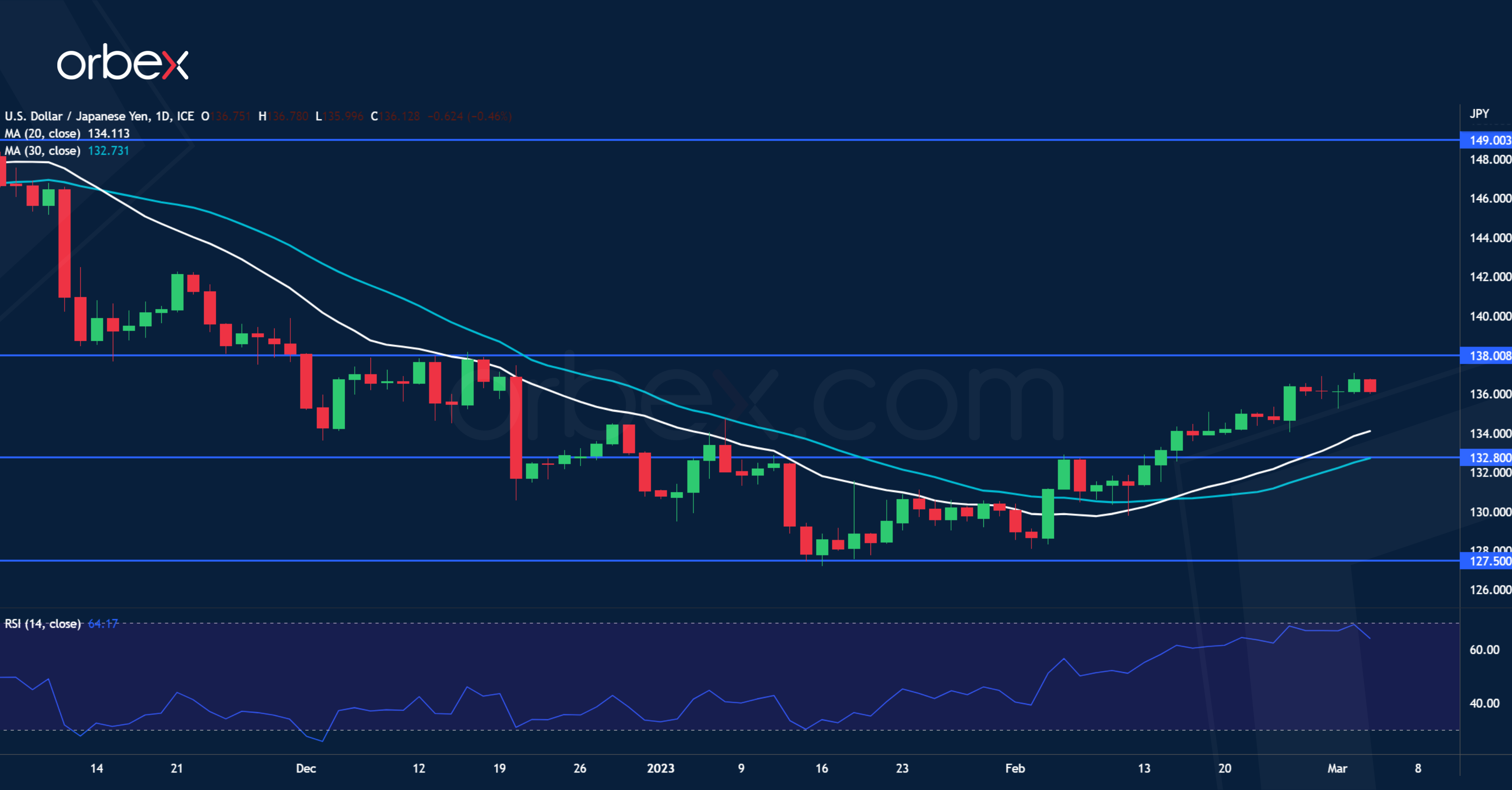
The Japanese yen weakens as the upcoming BoJ team pledges to continue monetary easing. New governor nominee Kazuo Ueda has so far brushed aside any talk of an immediate change to the policy, tempering expectations of a disruptive stance from his predecessor. There could still be an upside surprise at the meeting, in the form of one last tweak of the yield cap by the incumbent Haruhiko Kuroda, which would be supportive to the currency. But if the BOJ event goes uneventful, volatility will likely be directed by the US jobs report later on. The pair is testing December’s high of 138.00 with 132.80 as the closest support.
AUD/USD steadies as RBA to hike again
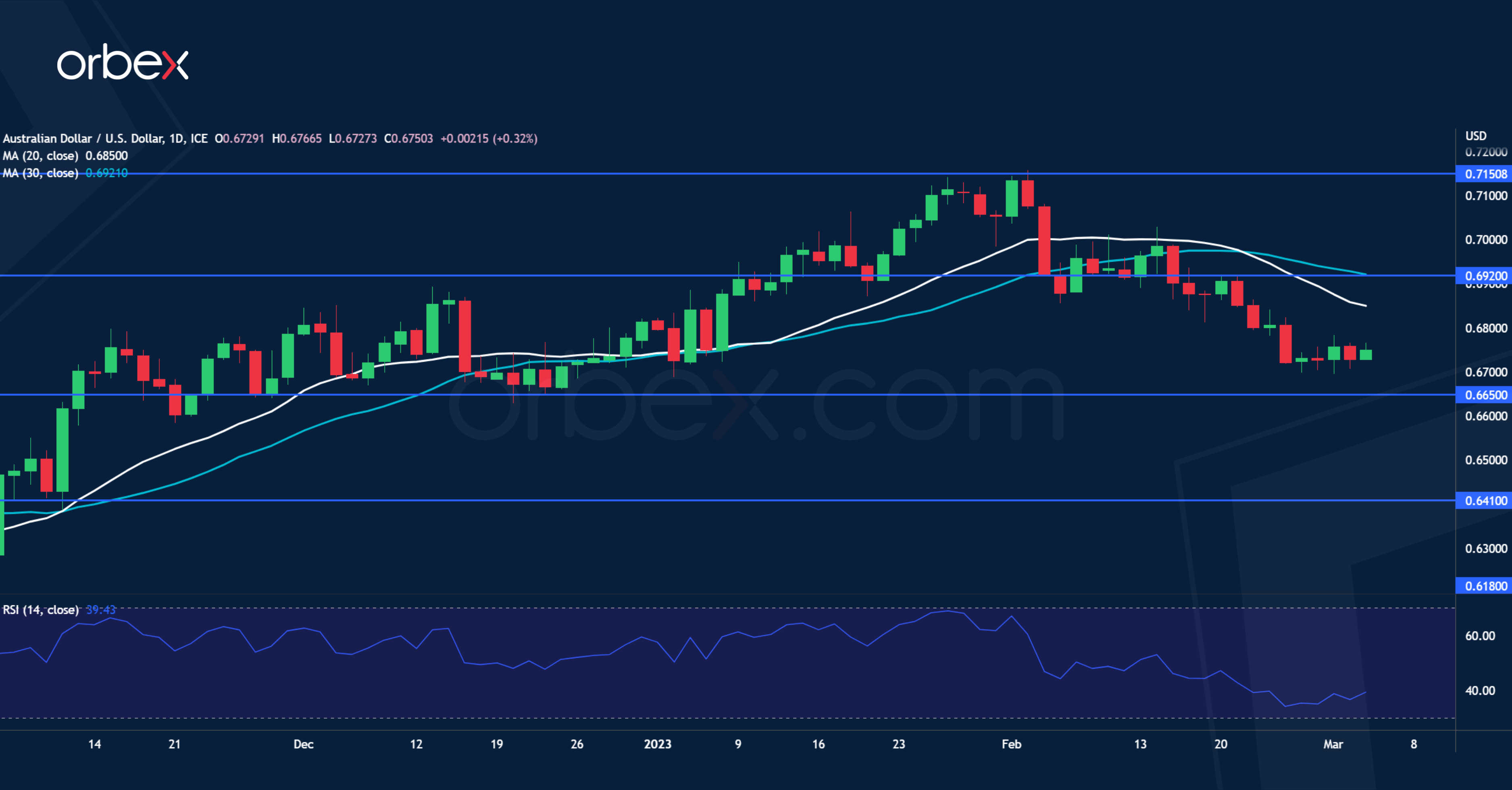
The Australian dollar consolidates ahead of a potential rate increase by the RBA. The tightening is sinking in as Australia's economy grew at its slowest pace in a year in Q4. However, the struggle against inflation is far from over with rising price pressures and labour costs. After the RBA abandoned its pause option and signalled more hikes to deliver, markets are betting that there is room for a whole percentage point to 4.35%, from the current decade-high of 3.35%. An aggressive reassertion out of the upcoming policy meeting could help the aussie regain a foothold against its US peer above 0.6650. 0.6920 is the first hurdle.
USD/CAD rallies as BoC to hold
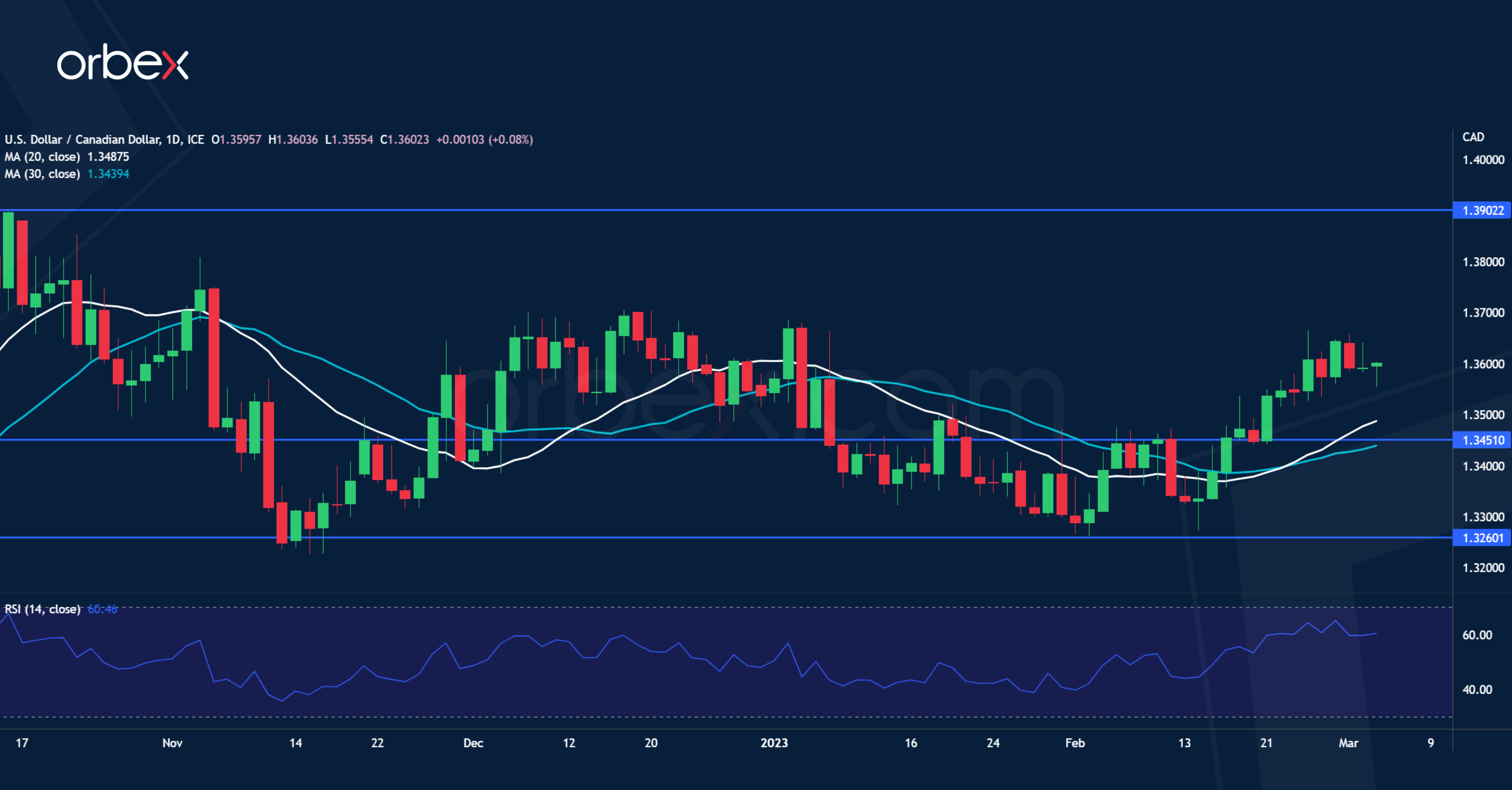
The Canadian dollar slides as the BoC may defend its pause amid weak growth. The central bank previously stated that no further interest rate increases would be needed if data align with expectations. Canada’s lacklustre GDP growth in the final quarter of 2022 might give policymakers a strong enough reason to stay put and hold the benchmark interest rate at 4.5%. In contrast, the Fed is yet to make the pivot a reality and is widely expected to push the tightening further down the road. The greenback’s advance would reflect such policy divergence. October’s high of 1.3900 is a major ceiling and 1.3450 the immediate support.
S&P 500 awaits NFP catalyst
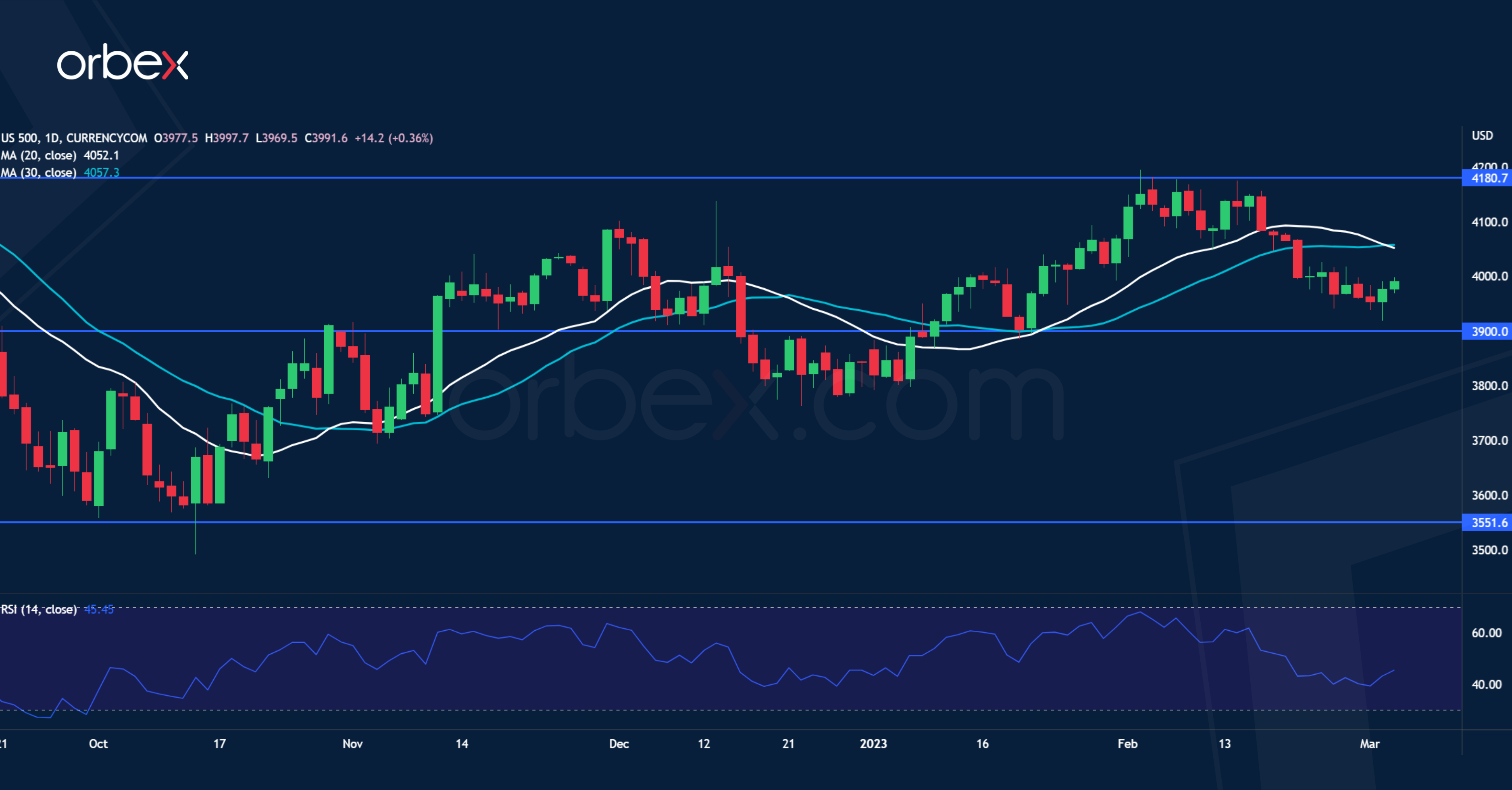
The S&P 500 bounces back on dovish comments from the Atlanta Federal Reserve president. Mr Bostic’s dovish dissent in favour of quarter-point hikes may help market participants digest a series of hawkish comments from policymakers lately. Investors may regain confidence if they believe the Fed would let previous hikes take effect and avoid an overshoot. However, falling unemployment claims point to ongoing strength in the US labour market and may foreshadow another solid nonfarm payrolls report, which represents a major downside risk for equities. The index steadies around 3900 with 4180 as the first hurdle.
Sunset Market Commentary
Markets:
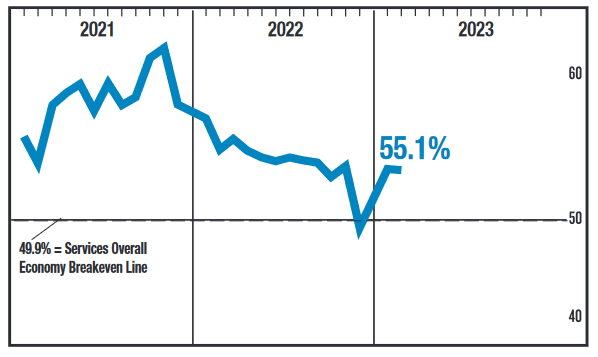
ECB members hit the wire today. ECB Wunsch started off by saying that rates of 4% would not be excluded if the central bank doesn’t get clear signals that core inflation is going down. ECB Vasle followed by talking about additional increases (plural) after the flagged 50 bps March rate hike. Vice-governor de Guindos stuck with formal guidance that the interest rate path after March will be data-dependent. He stressed that the new forecasts on underlying inflation will be very, very important. Recall in this respect yesterday’s unexpected surge in core CPI from 5.3% Y/Y to 5.6% Y/Y, a new EMU record high. ECB Muller is worried about core inflation as well and repeated hesitation now may require more action later on. The overall tone of ECB comments suggests that the ECB at its March 16 policy meeting will signal to stick to its 50 bps rate hike pace in May as well. Such scenario is almost completely discounted in European money markets following fierce February repositioning. We stick to our view that policy rates will peak at at least 4% later this year. Today’s ECB comments didn’t trigger a fresh sell-off though. Ahead of the weekend, investors decided to take some chips off the table during European trading hours, with German/EU yields correction a couple of basis points lower. This context helped stock markets to gains of 1%-1.5% in Europe with US markets opening around 0.5% higher. EUR/USD treaded water just above 1.06. EUR/GBP lost a few technically insignificant ticks, changing hands around 0.8850. From a European data point of view, there’s nothing big anymore ahead of the March 16 policy meeting. • The US services ISM was this week’s final key data release. The ISM stabilized at a strong 55.1 while consensus expected a small setback to 54.5. Details showed very strong new orders (62.6 from 60.4) with employment picking up forcefully from 50 to 54. Prices paid only decelerated marginally from 67.8 to 65.6. Business activity grew, but couldn’t keep up with the stellar pace in January (56.3 to 60.4). Overall, the ISM remains extremely strong, pointing to a tight labour market, resilient economy and continued price pressure. US Treasuries and stocks (to a lesser extent) spike lower on the release. EUR/USD tries to return sub 1.06.
News Headlines:
The FAO food price index in February extended its established downtrend, even as the decline this time was only marginal. The index eased 0.6 M/M from January, the eleventh consecutive monthly decline. The index has fallen 18.7% compared to the peak recorded in March 2022. The small February decline is the result of a significant drop in the subindices vegetable oils and dairy together with fractionally lower prices for meat and cereals, more than offsetting a steep rise in the sugar price index. Looking at the subindices, the cereal price index is now only 1.4% above the level one year ago. The vegetable oil price index dropped to the lowest level since the beginning of 2021 driven by continued weakness in prices across palm, soy, sunflower seed and rapeseed oils. The dairy price index stands 7.2% below the corresponding level of the same month last year. The index for meat eased 1.7% Y/Y. The sugar price index jumped 6.9% on a monthly basis reaching the highest level since February 2017. According the FAO, the rise in the sugar price in February was mostly related to deteriorating sugar production forecasts in India.
Turkish inflation eased further in February to 3.15% M/M and 55.18% Y/Y to be compared with 6.15% M/M and 57.68% Y/Y in January. It was the fourth consecutive decline in the Y/Y reading after reaching a peak north of 85% in October. The decline is for an important part due to base effects resulting from sharp monthly price rises end 2021 and in the first half of last year. In a monthly perspective, Turkey still reported price increases for food and non-alcoholic beverages (7.36% M/M), education (5.69%) and hotels, cafes and restaurants (4.07%). Core inflation also declined from 52.97% to 50,58%. Looking forward, question is whether this downtrend will persist considering a supportive fiscal policy to address the impact of the earthquake but also in the run-up to May elections. In addition monetary policy also stays extremely loose as the CBRT last week further reduced its policy rate from 9% to 8.50%. After touching a historic low against the single currency near EUR/TRY 20.78 last month, the lira regained modest ground currently holding near EUR/TRY 20.08.
US ISM services ticked down to 55.1, corresponds to 1.8% annualized GDP growth
US ISM Services PMI ticked down from 55.2 to 55.1 in February, above expectation of 54.4. Looking at some details, business activity/production dropped from 60.4 to 56.3. New orders rose from 60.4 to 62.6. Employment rose from 50.0 to 54.0. Prices dropped from 67.8 to 65.6.
ISM said: "The past relationship between the Services PMI and the overall economy indicates that the Services PMI for February (55.1 percent) corresponds to a 1.8-percent increase in real gross domestic product (GDP) on an annualized basis."
Ending the Week on a High
Stock markets are poised to end the week on a positive note although broadly speaking, it doesn't seem we've progressed in either direction over recent weeks.
Trading has become very choppy as the economic data has turned more problematic and interest rate expectations have flipped. Investors are now waiting for evidence that the January figures were the blip many expect they were, driven by unseasonably warm weather, and next Friday's jobs report will be the first such tier-one release.
We may see more fluctuations in the markets alongside some interesting releases in the interim, not to mention the two appearances by Fed Chair Jerome Powell in Congress during the week. I can't imagine he will pivot too dramatically in either direction as the data has largely evolved as the Fed feared, but you never know and any shift toward the hawkish end of the spectrum may resonate more than normal given recent developments.
More signs of optimism for China
The services PMI data released today were mostly revised numbers from Europe but the Chinese Caixin release once again surprised in a positive way, which may be part of what's lifting sentiment late in the week. The transition is clearly going well and this is the latest survey that backs up that belief.
There's naturally still a long way to go and the scale of the recovery may depend on how much economic and monetary support is on offer over the coming months, or whether policymakers even deem it less necessary on the back of recent indicators.
Back in the middle of the range
A decent week for oil prices comes to an end slightly in the red, perhaps a sign of some profit-taking kicking in. Prices have fluctuated in a range for months now and the current price sits more-or-less in the middle of that range. While traders are becoming more optimistic about the Chinese recovery, the risks to the global economy may be increasing as interest rate expectations have risen.
The range does appear to be gradually tightening but remains quite large and there appears little appetite for a breakout at this moment in time. Perhaps the US data over the next couple of weeks will change that.
Paring losses ahead of a big week for the US
Gold is bringing an end to a run of four successive weekly declines, rising around 2% over the last five days after running into significant support around $1,800. This followed a near-8% decline from the highs at the start of February so could simply be a case of profit-taking ahead of a big week of US data and Fed speak. The $1,780-$1,800 support below remains crucial and should it break over the next couple of weeks, it may well signal a much more hawkish shift in US monetary policy.
Fragile confidence hit by Silvergate troubles
Bitcoin is falling heavily amid a wider crypto sell-off, driven by the plunge in Silvergate capital and the risk of further negative ripple effects in the industry. Cryptos have performed extremely well this year as the FTX fallout had been much smaller than feared and risk appetite improved. But this story is a reminder that there could still be more to come and it has undermined confidence in the space. While off around 5% today, bitcoin held at $22,000 and still finds itself in a very healthy position. But it could now be a very volatile few days for the industry.
Yen and Franc Recover as Benchmark Yields Retreat
Yen and Swiss Franc recovered today following pullback in benchmark US and European yields. Dollar and Canadian are the softer ones for today while European majors are mixed. Hawkish comments from ECB officials are shrugged off by the common currency. Instead, Euro turned softer after weaker than expected PPI inflation data.
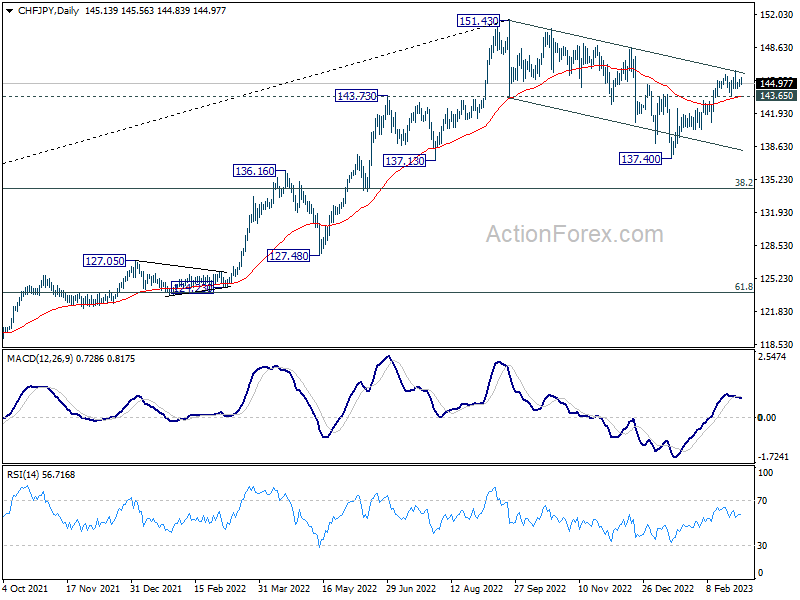
Technically, CHF/JPY's rebound from 137.40 stalled after touching falling trend line resistance. For now, further rise is in favor as long as 143.65 support holds. Sustained break of the trend line will set the stage to retest 151.43 high. However, break of 143.65 will argue that corrective pattern from 151.43 is still in progress and is starting another falling leg.
In Europe, at the time of writing, FTSE is down -0.09%. DAX is up 0.92%. CAC is up 0.60%. Germany 10-year yield is down -0.032 at 2.718. Earlier in Asia, Nikkei rose 1.56%. Hong Kong HSI rose 0.68%. China Shanghai SSE rose 0.54%. Singapore Strait Times dropped -0.09%. Japan 10-year JGB yield rose 0.0086 to 0.506.
ECB de Guindos: Underlying inflation is very, very important
ECB Vice President Luis de Guindos said that headline inflation could fall from 8.5% to 6% by mid-2023. However, core inflation could be more stable.
"In March we'll have some projections, we'll have more data on the evolution of underlying inflation," Guindos said at CUNEF University. "Underlying inflation is very, very important."
De Guindos also emphasized that inflation will have to clearly converge towards 2% target before the central bank could pause the tightening cycle.
ECB Muller: March hike likely not the last rise in this cycle
ECB Governing Council member Madis Muller said, "it's most likely this won't be the last rate rise in this cycle," referring the the intended 50bps hike this month.
"It's quite possible that interest rates will need to stay high for quite some time so that we can be sure that inflation will come back to, and remain at, close to 2%," he added.
"Headline inflation started to come down toward the end of last year, mainly thanks to a decline in energy prices, and it fell to 8.5% in January. More worrying however is that core inflation has remained persistently high at more than 5%, as the underlying price pressures aren't yet receding," Muller said.
"If we hesitate, we may later have to raise interest rates much higher, and keep them high for much longer, in order to get inflation down to the target of 2% and to keep it there" he noted.
ECB Vasle: March rate hike to be followed by additional increases
ECB Governing Council member Bostjan Vasle said,
"my personal expectations is that the increase we intend for our March meeting -- that is 0.5 percentage points -- will not be the last one."
March rate hike "will be followed by additional increases before we reach a level that will be sufficient to bring inflation back to the trajectory towards our goal of 2% inflation," he added.
Eurozone PPI at -2.8% mom, 15.0% yoy in Jan
Eurozone PPI fell -2.8% mom in January, below expectation of -0.3% mom. Compared with January 2022, industrial producer prices increased by 15.0% yoy, below expectation of 17.7% yoy.
For the month, industrial producer prices in Eurozone decreased by -9.4% mom in the energy sector, while prices increased by -0.8% mom for intermediate goods, by -1.2% mom for capital goods, by -1.5% mom for non-durable consumer goods and by -1.6% mom for durable consumer goods. Prices in total industry excluding energy increased by 1.1% mom.
EU PPI was at -2.2% mom, 16.4% yoy. The largest monthly decreases in industrial producer prices were recorded in Ireland (-25.2%), Sweden (-8.0%) and Latvia (-5.8%), while the highest increases were observed in Slovakia (9.0%), Czechia and Hungary (both 5.8%) and Austria (4.9%).
Eurozone PMI composite finalized at 52 in Feb, a resounding expansion of business activity
Eurozone PMI Services was finalized at 52.7 in February, up from January's 50.8. PMI Composite was finalized at 52.0, up from prior month's 50.3. Both were at their 8-month highs.
Looking at some member state, PMI composite improved in Spain (55.7, 9-month high), Ireland (54.5, 9-month high), Italy (52.2, 9-month high), France (51.7, 7-month high) and Germany (50.7, 8-month high).
Chris Williamson, Chief Business Economist at S&P Global Market Intelligence said: "A resounding expansion of business activity in February helps allay worries of a eurozone recession, for now. Doubts linger about the underlying strength of demand... Nevertheless, there are clear signs that business confidence has picked up from the lows seen late last year...
"There is a concern, however, that signs of persistent elevated selling price inflation, combined with the surprising resiliency of the economy, will embolden the ECB into more aggressive monetary policy tightening, which poses a downside risk to demand growth in the months ahead."
UK PMI services finalized at 53.5, fading recession fears and improving business confidence
UK PMI Services was finalized at 53.5 in February, up from January's 48.6. PMI Composite was finalized at 53.1, up from prior month's 48.5. Both were their strongest readings since June 2022.
Tim Moore, Economics Director at S&P Global Market Intelligence, said: "UK service providers moved back into expansion mode in February as fading recession fears and improving business confidence resulted in the strongest rise in new orders since May 2022. However, elevated borrowing costs and stretched household finances remained constraints on growth.
"There was clear evidence that input price inflation has peaked, with the latest increase in average cost burdens the weakest since June 2021... Tight labour market conditions and the need to alleviate squeezed margins continued to limit the degree to which falling cost pressures were passed on to end consumers."
China PMI services rose to 55.0, composite rose to 54.2
China Caixin PMI Services rose from 52.9 to 55.0 in February, above expectation of 54.7. That's also the highest reading since April 2021. PMI Composite rose from 51.1 to 54.2, highest since May 2021.
Wang Zhe, Senior Economist at Caixin Insight Group said: "Both manufacturing and services activity recovered gradually. Production, demand, including external demand, and employment all grew, with services activity showing a stronger recovery than manufacturing output. Input costs and prices charged remained stable, and business owners were highly optimistic."
USD/JPY Mid-Day Outlook
Daily Pivots: (S1) 136.16; (P) 136.63; (R1) 137.23; More...
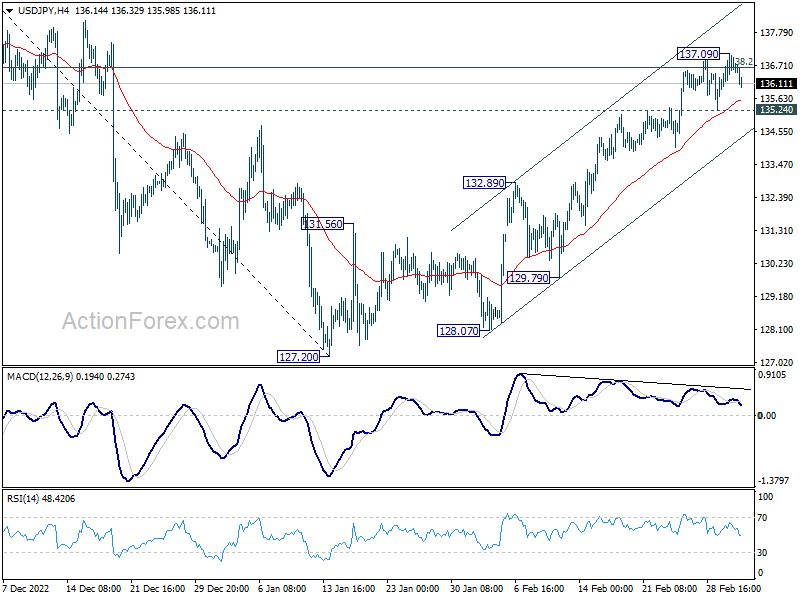
Intraday bias in USD/JPY is turned neutral again with current retreat. On the downside, break of 135.24 support will indicate rejection by 38.2% retracement of 151.93 to 127.20 at 136.64. Intraday bias will be back on the downside for 55 day EMA (now at 133.92) first. On the upside, however, sustained break of 136.64 will indicate that fall from 151.93 has completed, and bring further rally to 61.8% retracement at 142.48.
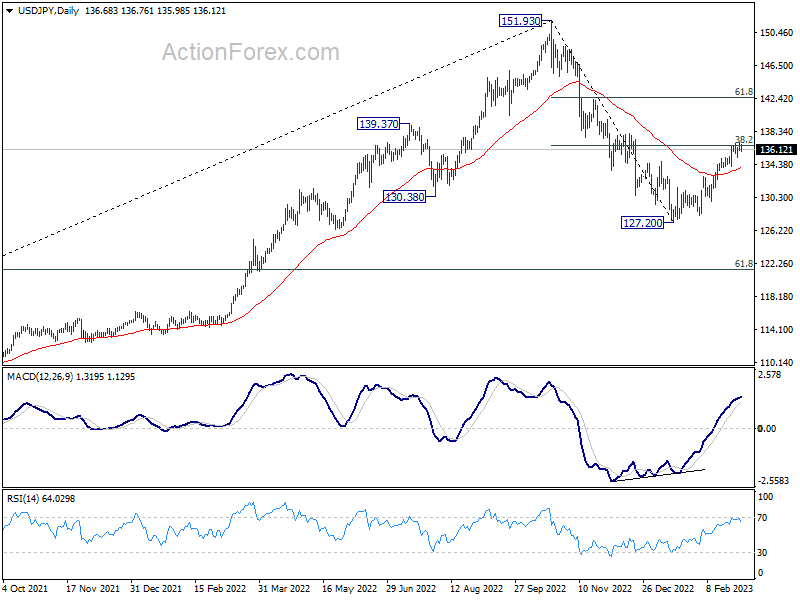
In the bigger picture, focus is now on 38.2% retracement of 151.93 to 127.20 at 136.64. Sustained break there will indicate that price actions from 151.93 medium term are merely a corrective pattern. Such development will maintain long term bullishness. Rejection by 136.64 will, on the other hand, extend the fall from 151.93 to 61.8% retracement of 102.58 to 151.93 at 121.43 at a later stage.
Economic Indicators Update
| GMT | Ccy | Events | Actual | Forecast | Previous | Revised |
|---|---|---|---|---|---|---|
| 23:30 | JPY | Tokyo CPI Core Y/Y Feb | 3.30% | 3.30% | 4.30% | |
| 23:30 | JPY | Unemployment Rate Jan | 2.40% | 2.50% | 2.50% | |
| 01:45 | CNY | Caixin Services PMI Feb | 55 | 54.7 | 52.9 | |
| 07:00 | EUR | Germany Trade Balance (EUR) Jan | 16.7B | 11.2B | 10.0B | |
| 07:45 | EUR | France Industrial Output M/M Jan | -1.90% | -0.2 | 1.10% | 1.50% |
| 08:45 | EUR | Italy Services PMI Feb | 51.6 | 52.4 | 51.2 | |
| 08:50 | EUR | France Services PMI Feb F | 53.1 | 52.8 | 52.8 | |
| 08:55 | EUR | Germany Services PMI Feb F | 50.9 | 51.3 | 51.3 | |
| 09:00 | EUR | Eurozone Services PMI Feb F | 52.7 | 53 | 53 | |
| 09:30 | GBP | Services PMI Feb F | 53.5 | 53.3 | 53.3 | |
| 10:00 | EUR | Eurozone PPI M/M Jan | -2.80% | -0.30% | 1.10% | |
| 10:00 | EUR | Eurozone PPI Y/Y Jan | 15.00% | 17.70% | 24.60% | |
| 13:30 | CAD | Building Permits M/M Jan | -4.00% | 1.70% | -7.30% | |
| 13:30 | CAD | Labor Productivity Q/Q Q4 | -0.50% | 0.20% | 0.60% | |
| 14:45 | USD | Services PMI Feb F | 50.5 | 50.5 | ||
| 15:00 | USD | ISM Services PMI Feb | 54.4 | 55.2 |