

Sample Category Title
EUR/USD Mid-Day Outlook
Daily Pivots: (S1) 1.0558; (P) 1.0616; (R1) 1.0654; More...
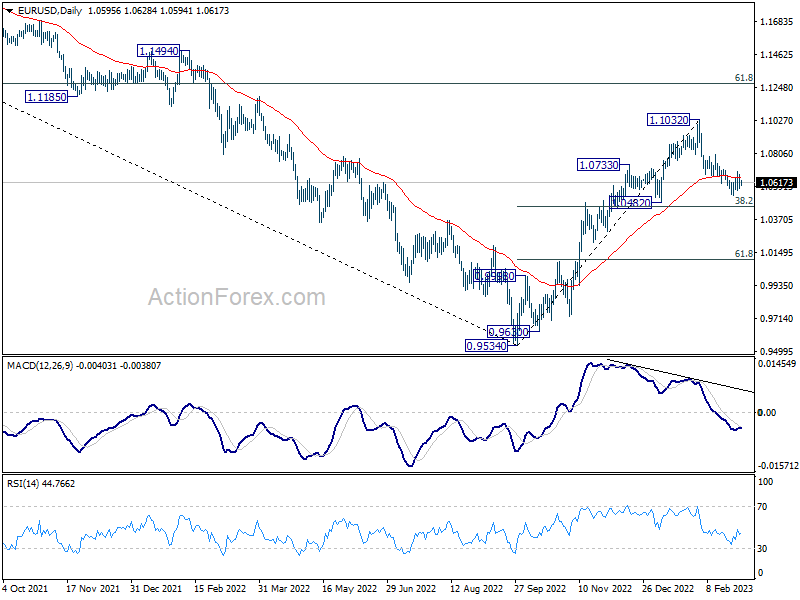
EUR/USD is staying in range of 1.0532/0690 and intraday bias stays neutral. Fall from 1.1032 could still extend lower. But strong support is expected from 38.2% retracement of 0.9534 to 1.1032 at 1.0463 to bring rebound. Break of 1.0690 will turn bias back to the upside for 1.0803 resistance first. However, sustained break of 1.0463 will carry larger bearish implication and bring deeper decline.
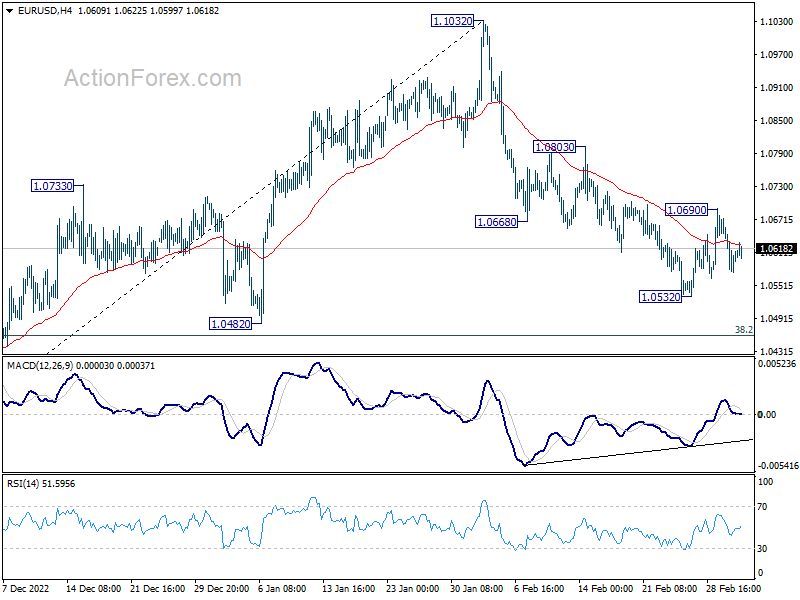
In the bigger picture, as long as 1.0482 support holds, rise from 0.9534 (2022 low) should continue to 61.8% retracement of 1.2348 (2021 high) to 0.9534 at 1.1273. However, sustained break of 1.0482 will bring deeper fall to 61.8% retracement of 0.9534 to 1.1032 at 1.0106, even as a corrective pull back.
GBP/USD Mid-Day Outlook
Daily Pivots: (S1) 1.1904; (P) 1.1970; (R1) 1.2016; More...
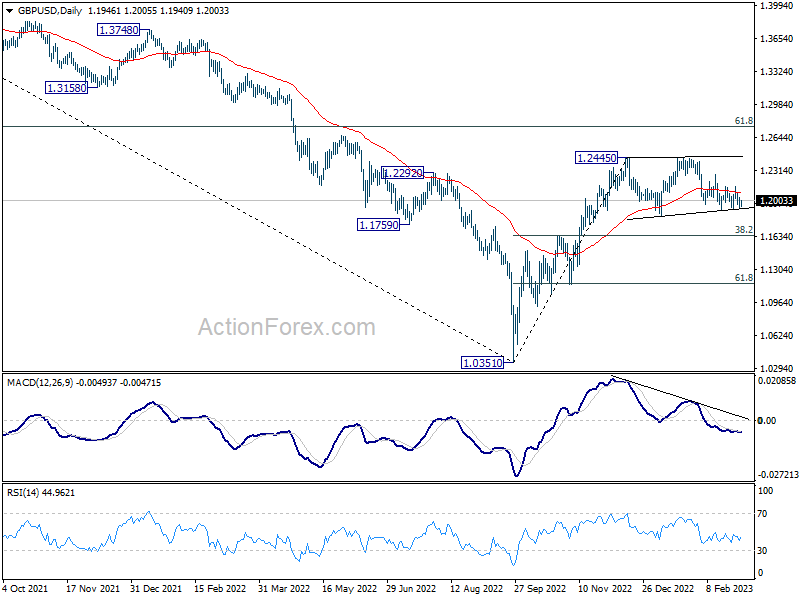
GBP/USD recovered ahead of 1.1914 support as range trading continues. On the downside, break of 1.1914 will resume the decline from 1.2446, as the third leg of the corrective pattern from 1.2445, for 1.1840 support and possibly below. On the upside, break of 1.2142 resistance will turn bias back to the upside for further rebound to 1.2269 and above.
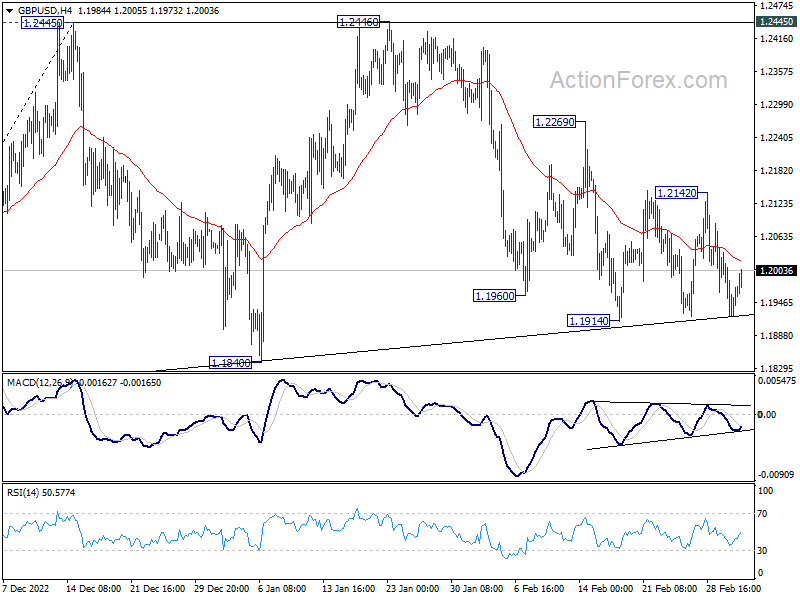
In the bigger picture,as long as 1.1840 support holds, rise from 1.0351 medium term bottom (2022 low) should still continue to 61.8% retracement of 1.4248 (2021 high) to 1.0351 at 1.2759. However, decisive break of 1.1840 will complete a double top pattern (1.2445, 1.2446) after rejection by 55 week EMA (now at 1.2251). Deeper decline should be seen back to 38.2% retracement of 1.0351 to 1.2445 at 1.1645.
USD/CHF Mid-Day Outlook
Daily Pivots: (S1) 0.9397; (P) 0.9418; (R1) 0.9446; More...
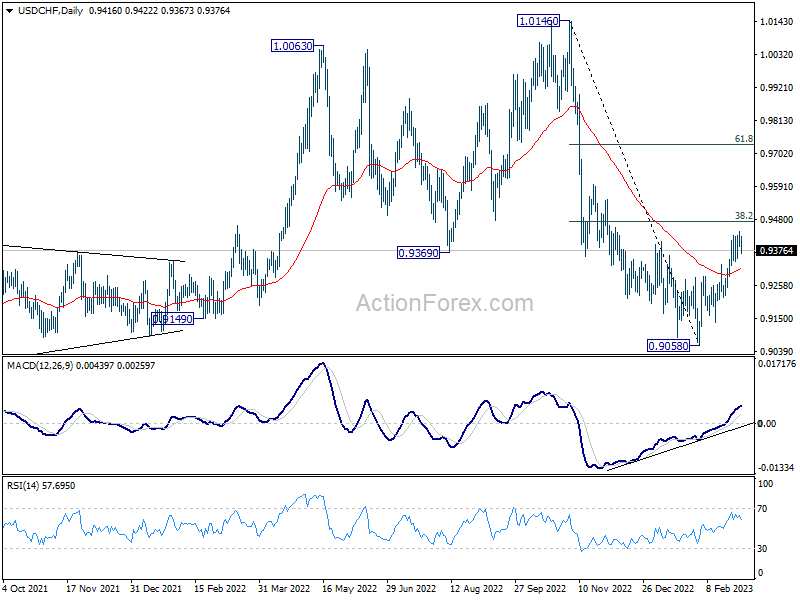
Intraday bias in USD/CHF is turned neutral again first. While further rise cannot be ruled out, strong resistance could be seen from 38.2% retracement of 1.0146 to 0.9058 at 0.9474 to complete the rebound from 0.9058. Break of 0.9340 minor support will turn bias back to the downside. However, decisive break of 0.9474 will carry larger bullish implications and target 61.8% retracement at 0.9730.
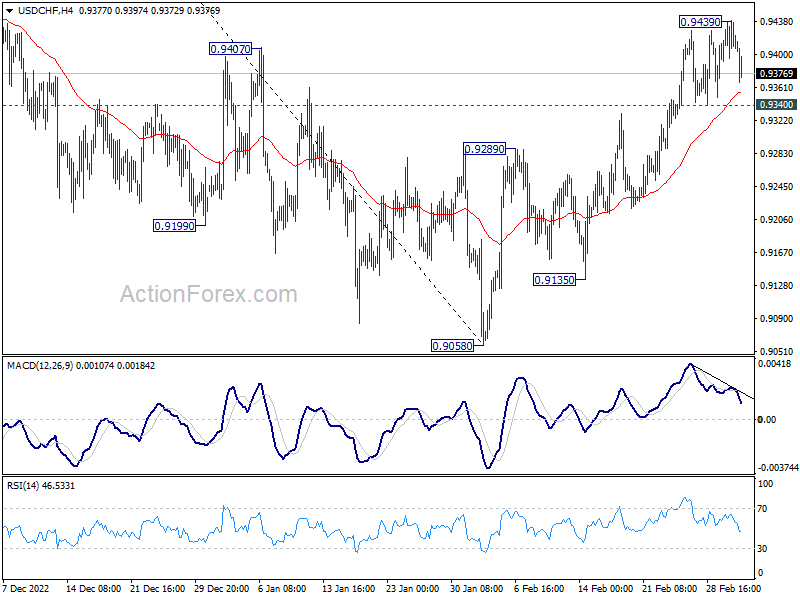
In the bigger picture, decline from 1.0146 is seen as part of a long term sideway pattern. As long as 38.2% retracement of 1.0146 to 0.9058 at 0.9474 holds, another fall is in favor through 0.9058. However, sustained trading above 0.9474 will indicate that the medium term trend has reversed, and open up further rally to 61.8% retracement at 0.9730 and above.
USD/JPY Mid-Day Outlook
Daily Pivots: (S1) 136.16; (P) 136.63; (R1) 137.23; More...
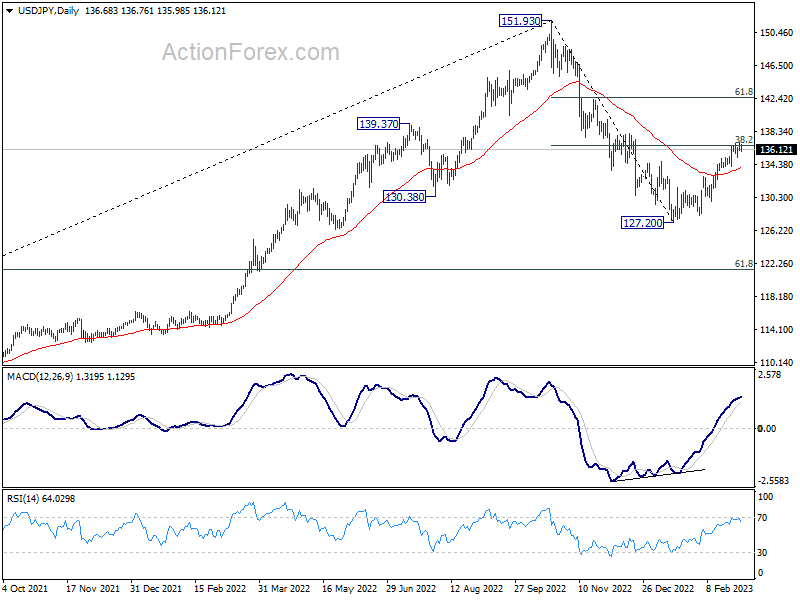
Intraday bias in USD/JPY is turned neutral again with current retreat. On the downside, break of 135.24 support will indicate rejection by 38.2% retracement of 151.93 to 127.20 at 136.64. Intraday bias will be back on the downside for 55 day EMA (now at 133.92) first. On the upside, however, sustained break of 136.64 will indicate that fall from 151.93 has completed, and bring further rally to 61.8% retracement at 142.48.
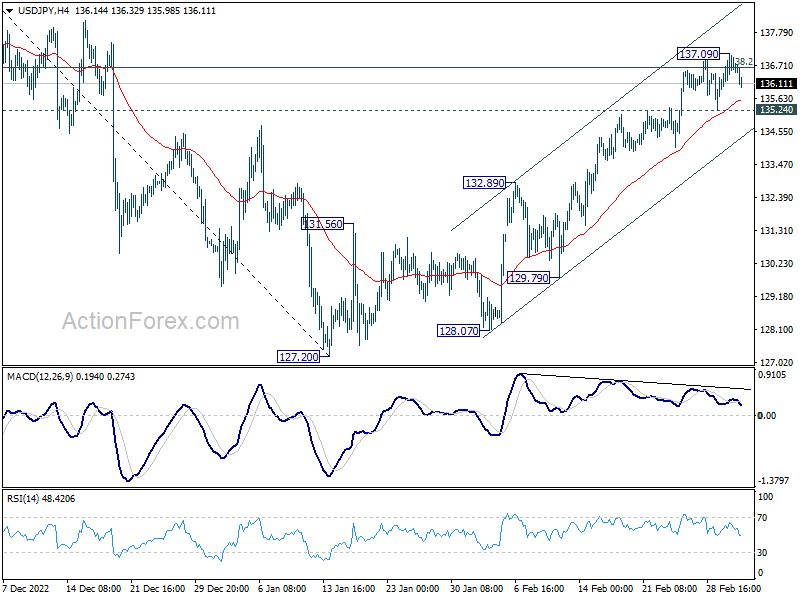
In the bigger picture, focus is now on 38.2% retracement of 151.93 to 127.20 at 136.64. Sustained break there will indicate that price actions from 151.93 medium term are merely a corrective pattern. Such development will maintain long term bullishness. Rejection by 136.64 will, on the other hand, extend the fall from 151.93 to 61.8% retracement of 102.58 to 151.93 at 121.43 at a later stage.
Silvergate Triggered Yet Another Mini Crypto Sell-off
Market picture
Bitcoin plunged more than 6% to $22.0K early this morning. The plunge into this area came as a market reaction to the potential bankruptcy of Silvergate. The news triggered a wave of stop orders on fears that the situation could cause a domino effect in the industry, as with FTX earlier in the day.
Technically, the dip has pushed the price below its 50-day moving average, which does not bode well for the short-term outlook, although this signal will only be reliable at the close of the day. The intraday picture is one of tidy buying after a brief dip. The overall moderately positive sentiment in the global markets supports the buy-the-dip mood.
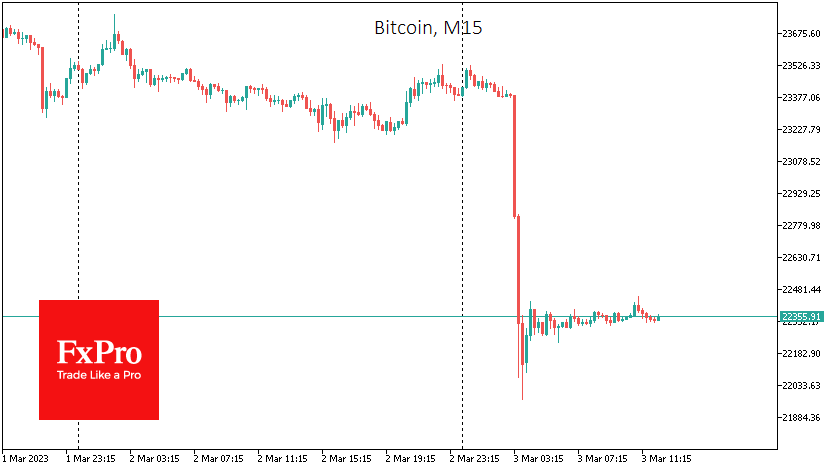
A return above $22.8 an ounce before today’s close could spark further buying. Closing near the lows would be an essential signal to spread fear throughout the crypto market, suggesting a further drawdown to $19.7K in the coming weeks.
News background
Shares in US holding company Silvergate Capital Corporation, which owns crypto bank Silvergate, plunged almost 49% on news of a delay in publishing its annual report to the SEC. The company said it needed “additional time” to complete its audit.
Silvergate Bank has announced that it may file for bankruptcy due to a massive sell-off and an inability to repay its debts. Coinbase, the largest US cryptocurrency exchange, has announced severing its financial relationship with Silvergate Bank.
According to Glassnode, retail bitcoin investors’ purchases have outpaced coin issuance. Investors with balances up to 1 BTC (“shrimps”) and between 1 and 10 BTC (“crabs”) over the past year have bought 105% and 119%, respectively, more Bitcoins that were mined.
Ethereum developers have set March 14 as the date for the Shanghai upgrade on the Goerli test network. If the test network upgrade succeeds, the main network upgrade could occur in the second week of April.
USD/JPY Dips as Tokyo Core CPI Slows
The Japanese yen has gained ground on Friday. In the European session, USD/JPY is trading at 136.17, down 0.44%.
Tokyo Core CPI eases
There was some positive news on the inflation front, as Tokyo Core CPI for February slowed for the first time since January 2022. The indicator was expected to rise from 4.3% to 4.5%, but instead reversed directions and fell to 3.3%. The sharp drop was not a complete surprise, as it was driven by government subsidies, including a 20% reduction in household electricity bills, which took effect in February. Without the subsidies, it’s likely that the Tokyo inflation figure would have come in around 4.5%.
It’s unclear how long the government will continue these subsidies, which means that the inflation picture remains uncertain. The Bank of Japan has insisted that rising inflation is transient and is a result of external factors such as high commodity prices rather than domestic inflationary pressures. The central bank has insisted on maintaining its massive stimulus programme even though inflation has been on the upswing and is more than double the BoJ’s target of 2%.
All eyes are on the Bank of Japan, as the changing of the guard looms ever closer. BoJ Governor-elect Kazuo Ueda will take over the helm from Haruhiko Kuroda in early April. Ueda has been careful not to make any waves at his confirmation hearings, saying that the central bank’s current policy is appropriate. Still, the markets aren’t convinced that Ueda will maintain Kuroda’s ultra-loose policy, especially with rising inflation. The BoJ’s yield curve control (YCC) policy has damaged the bond markets and there is speculation that Kuroda could make a grand exit at his final meeting on March 10 and tweak YCC in order to relieve pressure on Ueda.
USD/JPY Technical
- There is resistance at 137.37 and 138.24
- 135.65 and 134.78 are providing support
XAU/USD: Gold Recovery Accelerates, Underpinned by Rising Daily Cloud Base
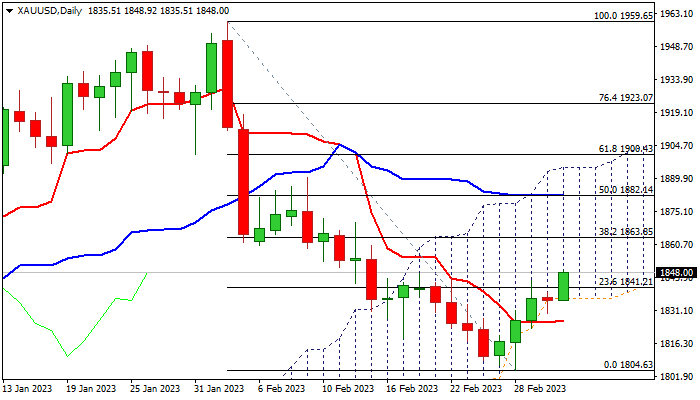
Fresh bullish acceleration in European session on Friday hit two-week high, as gold price benefits from weaker dollar.
Calmer tones from the US policymakers about rate hikes in the coming months, weakened dollar’s bullish stance and offered fresh support to the yellow metal’s price.
Markets focus on today’s top events for the dollar – a number of Fed speakers and US non-manufacturing PMI, which could provide fresh direction signals.
Near-term action continues to trend higher, underpinned by rising daily cloud base, which contained the pullback from $1959 (2023 high, posted on Feb 2) and continued to mark strong support.
Bulls eye pivotal Fibo barrier at $1864 (38.2% retracement of $1959/$1804 descend), break of which would reinforce near-term bullish structure and spark fresh recovery.
The yellow metal is also on track for a weekly gain of around 2% (the biggest weekly advance since the second week of January), which is also forming a bullish engulfing pattern on weekly chart and adding to reversal signals, (still to be verified on close above $1863).
Daily Ichimoku cloud base ($1836) should protect the downside and keep renewed bulls in play.
Res: 1860; 1864; 1872; 1882.
Sup: 1836; 1826; 1804; 1800.
ECB de Guindos: Underlying inflation is very, very important
ECB Vice President Luis de Guindos said that headline inflation could fall from 8.5% to 6% by mid-2023. However, core inflation could be more stable.
"In March we'll have some projections, we'll have more data on the evolution of underlying inflation," Guindos said at CUNEF University. "Underlying inflation is very, very important."
De Guindos also emphasized that inflation will have to clearly converge towards 2% target before the central bank could pause the tightening cycle.
ECB Muller: March hike likely not the last rise in this cycle
ECB Governing Council member Madis Muller said, "it's most likely this won't be the last rate rise in this cycle," referring the the intended 50bps hike this month.
"It's quite possible that interest rates will need to stay high for quite some time so that we can be sure that inflation will come back to, and remain at, close to 2%," he added.
"Headline inflation started to come down toward the end of last year, mainly thanks to a decline in energy prices, and it fell to 8.5% in January. More worrying however is that core inflation has remained persistently high at more than 5%, as the underlying price pressures aren't yet receding," Muller said.
"If we hesitate, we may later have to raise interest rates much higher, and keep them high for much longer, in order to get inflation down to the target of 2% and to keep it there" he noted.
ECB Vasle: March rate hike to be followed by additional increases
ECB Governing Council member Bostjan Vasle said, "my personal expectations is that the increase we intend for our March meeting -- that is 0.5 percentage points -- will not be the last one."
March rate hike "will be followed by additional increases before we reach a level that will be sufficient to bring inflation back to the trajectory towards our goal of 2% inflation," he added.