

Sample Category Title
BoJ Ueda: Current policy a necessary, appropriate means to achieve 2% inflation
At a parliamentary confirmation hearing, incoming BoJ Governor Kazuo Ueda said, "current policy is a necessary, appropriate means to achieve 2% inflation," despite various side effects emerging from the stimulus.
"Japan's trend inflation is likely to rise gradually. But it will take some time for inflation to sustainably and stably achieve the BOJ's 2% target," he said.
"Consumer inflation is likely to fall below 2% in the latter half of the next fiscal year. It takes time for the effect of monetary policy to appear on the economy. "
"It's standard practice to act preemptively to demand-driven inflation, but not respond immediately to supply-driven inflation. Otherwise, the BOJ will be cooling demand, worsening economy and pushing down prices by tightening monetary policy."
"If trend inflation heightens significantly and sustained achievement of the BOJ's 2% target comes into sight, the central bank must consider normalizing policy. But if trend inflation lacks strength, the bank must continue how to maintain its ultra-easy policy, while paying attention to deterioration in market function."
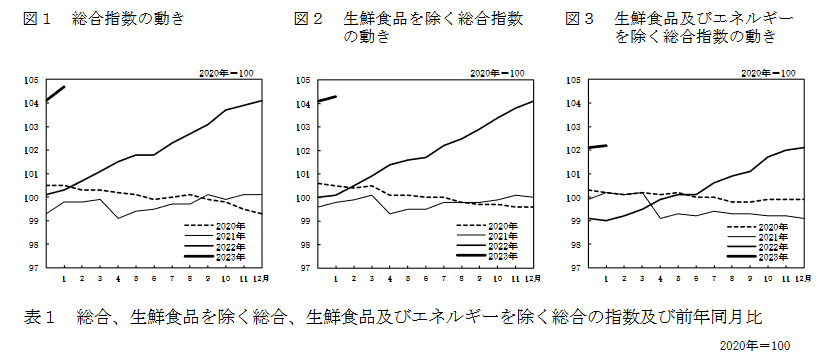
Japan CPI core hit 41-yr high at 4.2% in Jan
Japan all item CPI rose from 4.0% yoy to 4.3% yoy in January, below expectation of 4.5% yoy. CPI core (all-item ex-food) rose from 4.0% yoy to 4.2% yoy, matched expectations. CPI core-core (all-item ex-food and energy) rose from 3.0% yoy to 3.2% yoy, matched expectations.
Core CPI rate of 4.2% was the highest in 41-year since September 1981. The core inflation rate stayed above BoJ's 2% target for nine consecutive months.
RBNZ Silk: A tightening pause is being contemplated now
RBNZ Assistant Governor Karen Silk said in a Bloomberg interview "there's still more work to do here" on interest rate and fighting inflation. While "all levels are on the table" for April meeting, the central bank is not contemplating a pause.
"This is still an economy that has excess demand, a tight labor market, and as a consequence both headline inflation and core inflation at levels that are well outside the (target) band," she said.
Regarding April meeting, "all levels are on the table for discussion at every meeting," she said. "I'm not going to turn round and comment on whether we would be looking at 25, 50 or 75, they will all be on the table for discussion and they will depend on the information at hand."
Nevertheless, a pause in tightening is "certainty not something that we're contemplating at this point in time," she said.
Silk also noted that some upside risk was built into the forecast interest peak of 5.5%. However, "without building that in, any variation to that peak would have been still at the margin," she said. "There's potentially still some upside risk on the fiscal side of it. Let's just see how it plays out over the next six weeks."
Cliff Notes: Mixed Signals to Keep Central Banks on Tightening Path
Key insights from the week that was.
Critical data for Australia’s economy was mixed this week; elsewhere, the mindset of policy makers dominated the headlines.
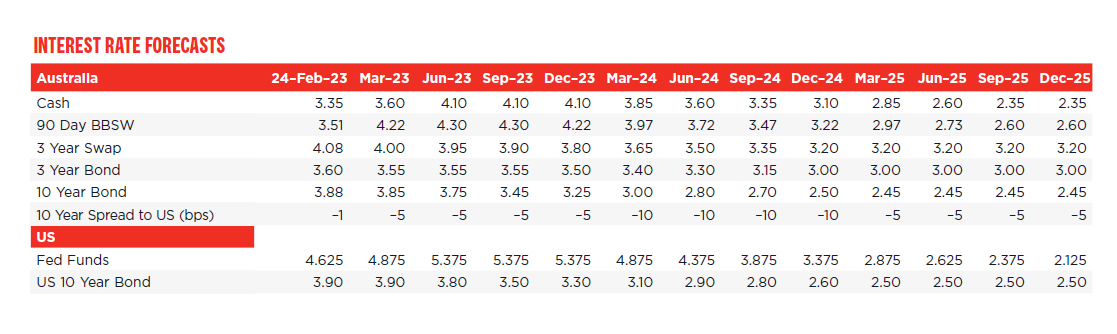
The minutes of the RBA’s February meeting provided more colour around the Board’s decidedly more hawkish view. Most notably, the option of keeping rates ‘on hold’ was not considered in February having previously been an option in December. Further, debate between a 25bp and 50bp rate hike highlighted questions over the necessary scale of tightening to come and some lingering uncertainty around the timing of inflation’s peak “only [to] be confirmed in a few months’ time”.
Given time and pressure from policy are both expected to be required to bring inflation back to target towards the end of the RBA’s forecast horizon, and as the RBA has confidence in the state of the labour market and prospects for growth, as detailed by Chief Economist Bill Evans it now seems most likely that the Board will hike in March, April and May to a peak of 4.10% (previously 3.85%). At that deeply contractionary level, the RBA will be able to go on hold; however, it remains our view that the combined outlook for growth and inflation will not justify rate cuts until early-2024. Over the course of 2024 and 2025, we see 175bps of cuts to a low of 2.35% where the cash rate is expected to settle, with growth at trend and inflation at the top of the 2-3%yr range.
Given how tight Australia’s labour market is, it was surprising to see the WPI print materially to the downside in Q4 at 0.8% (consensus 1.0%). While the average wage increase among those who received a pay rise remained elevated at 4.0%, only 21% of private sector jobs received an increase in Q4, down from 46% in September and more in line with the seasonal norm. Individual arrangements are continuing to drive wages growth – reflecting robust demand for skilled labour – but the roll-over of minimum wage/award increases from September to December was not as strong as anticipated.
In the lead-up to next week’s Q4 GDP report, the ABS also released two partial indicators for investment.
Construction work done disappointed in the three months to December, falling 0.4% owing to a dip in private business construction and another decline in private home renovation. In contrast to Q3’s 3.7% rebound (revised up from 2.2%), the Q4 result clearly indicates a loss of momentum heading into year-end despite a sizeable pipeline of work and as supply constraints eased.
The Q4 CAPEX survey subsequently signalled a mixed outlook for investment. Of note from the detail on current activity, equipment spending posted a mild 0.6% gain as weakness in mining offset support from non-mining sectors. On spending intentions, in our view, the fifth estimate for the 2022/23 financial year implies a 14% gain in CAPEX (in line with the prior estimate). The first estimate for 2023/24 was also robust, up 11% on the first estimate from a year ago; however, the realisation ratio adjustment implies this equates to a much more modest gain of 5.5%. It bears remembering that all of these figures are nominal and price growth has been rapid of late, CAPEX costs up 10.5%yr at December 2022.
Despite the downside surprise in construction work and soft read on equipment spending, we have revised up our forecast for Q4 GDP from 0.6% to 0.7% as net exports look to have been stronger than initially anticipated. Our full GDP preview will be on Westpac IQ later today.
For those interested in medium and long-run trends, this week also saw the release of a deep dive into Australia’s historic surge in net migration which is set to continue through 2023 and 2024. Also worthy of consideration are the implications of the safeguard mechanism for Australia’s heavy emitters and carbon markets, topics taken up in the latest instalment of Commodities in Transition.
Over in New Zealand this week, the RBNZ delivered a 50bp increase as expected while retaining a hawkish outlook – guiding that they expect the cash rate to peak at 5.5% mid-2023 and remain at that level until late next year. Our NZ economics team expect this peak to be achieved through a 50bp increase in April and 25bps in May. We are more cautious on the outlook than the RBNZ however, believing that rate cuts will need to commence in early-2024 rather than near its end. As discussed by Acting NZ Chief Economist Michael Gordon, “it will take some time just to stabilise the average rate that homeowners are paying, let alone provide some relief as the economy cools off”. Note as well that the destruction caused by the recent cyclone is being looked through by the RNBZ, with disruptions to prices and activity expected to prove temporary.
In the US, the minutes of the February FOMC meeting were largely as anticipated. Broadly, they conveyed a sanguine view on economic momentum and the labour market, with the soft but positive pulse in domestic demand at Q4 welcome. The focus for policy makers therefore remained on risks to inflation and the appropriateness of financial conditions. While they believe progress is being made, the FOMC are not yet “confident” inflation is “on a sustained downward path” back to target. This will require a broadening of the disinflationary pulse to date concentrated in goods pricing. While partial data signals this next step is near, its scale and speed is yet to be proven.
While they wait for further data, the FOMC is intent on making sure that “overall financial conditions [are] consistent with the degree of policy restraint that the Committee is putting into place”. In our view, the Committee is aiming to hold up the long end of the Treasury curve, the 10-year yield between 3.50% and 4.00% as an example. In doing so, they will restrict the housing market and durables consumption (such as car purchases) while also holding back equity markets and household wealth. Unlike other major economies, the downside of the FOMC taking this course is limited, with the market able to reprice term interest rates household and businesses borrow at should the policy stance have a larger than anticipated impact on the economy. This ‘release valve’ for policy is a key reason why we believe that the fed funds rate won’t be cut until 2024, having been raised to 5.375% at June through 25bp increases at the March, May and June meetings.
We Have Lifted Both RBA Cash Rate Forecast and FOMC Forecast
We have lifted our forecast terminal RBA cash rate from 3.85% to 4.1%.
We have also lifted our forecast for the federal funds rate with a peak in June of 5.25–5.5%, from 4.75–5% in March.
Since October we have consistently held the view that the cash rate would peak in May at 3.85%.
We still see the date of the peak as May 2023 but now see that peak as slightly higher.
The previous view envisaged a 25 basis point hike in March followed by a pause in April with the final hike of 25 basis points in May.
Over the course of the last few months of 2022 the Board consistently referred to the possibility of pausing and, as recently as December, considered a pause as one of three policy options.
However, the Board has adopted a more hawkish approach since the release of the December quarter inflation report which showed: underlying inflation at 6.9% compared to the official forecast of 6.5%; goods inflation up in the quarter; and services inflation particularly strong.
The February Minutes noted that: "members agreed that further increases in interest rates are likely to be needed over the months ahead". This was stronger guidance than "The Board expects to increase interest rates further over the period ahead, but is not on a pre-set path", which we saw in December. In particular, "not on a pre-set path" had allowed scope for a near term pause.
We also saw the February Board Minutes where the Board did not even consider a pause.
During the Governor's two appearances in Canberra last week, he outlined his support for a steady approach to policy. Abruptly pausing in April, only to resume with a hike in May (as implied by our previous forecast) would not be consistent with this steady approach.
Another way to maintain the 3.85% terminal rate and eliminate the pause in April would have been to bring forward the May hike to April.
But recall that the May meeting will have the advantage of a full update of March quarter inflation including the trimmed mean underlying measure, which is not calculated in the monthly inflation indicator. We expect annual trimmed mean inflation to print 6.6% for the March quarter, down from 6.9% in December. We estimate the Reserve Bank is probably expecting around 6.7%.
This slowdown will not be sufficient for the Bank to significantly change its inflation forecasts, which are refreshed for the May meeting.
The current forecast does not envisage that inflation will be back at the 2–3% target band until June 2025.
In December, the Board Minutes noted a key reason why a pause was not appropriate: "The Bank's most recent forecasts had indicated that, even with further increases in the cash rate as incorporated in the November forecasts, inflation was expected to take several years to return to the target range."
With this condition unlikely to change by May it seems that a pause would again not be considered appropriate.
By the time of the June meeting, we expect that there will be credible evidence that demand is slowing; labour markets are easing; and risks of a wage/price spiral have receded.
We expect that to be confirmed by the March quarter Wage Price Index Report which is forecast to print a soft 0.8%qtr gain indicating that wage pressures are not accelerating (as we have just seen with the December Report which showed growth slowing from 1.1%qtr in September to 0.8%qtr).
At 4.1%, the cash rate will be in deeply contractionary territory and a pause will be appropriate.
The decision to pause will be with a reasonable view that the tightening cycle has peaked. Westpac concurs and expects that the next move in rates beyond mid-2023 will be the beginning of an easing cycle in the March quarter 2024.
But there are risks to this scenario and they appear to land mainly on the upside.
The downside risks – an earlier easing than March next year – seem low.
While we expect the economy to stagnate in the second half of 2023 there will not be sufficient progress in bringing inflation into line with the target before the end of 2023 to accommodate earlier rate cuts.
We expect inflation in Australia to still be around 4% by end 2023, falling to 3.0% by end 2024, allowing a policy response to a stagnating economy by the first quarter of 2024.
The outlook
The risks to our near-term rate outlook are pitched to the upside.
We have recently written about the RBA tightening cycle lagging the Federal Reserve's.
This was because wages growth had peaked in the US and goods inflation had been slowing considerably.
In Australia we are yet to see across-the-board weakness in goods inflation while wage inflation is still lifting on an annual basis, although now appears to be slowing somewhat on a quarterly basis.
The surprise easing in the quarterly pace of wage inflation means we are now predicting a wage inflation peak of 4.0%, down from 4.5%.
The forecast extension of the US tightening cycle is in response to a further late-cycle tightening in the labour market; some evidence of resilience in demand; a slowing in the pace of overall disinflation while services inflation remains stubbornly high.
The Reserve Bank will be aware that these developments in the US may provide potential warning signals for Australia.
Our new forecasts now have Australia's tightening cycle peaking around six weeks before the US cycle.
In Australia we also have a number of 'COVID legacies' that may hold up demand in the first half of 2023: the $300 billion in accumulated household excess savings; the lift in national incomes coming from the boost in the terms of trade (partly due to the reopening of China); solid household wage income growth directly stemming from tight labour markets; and the boost in demand from surging net migration (we estimate net migration reached 400,000 in 2022 and will remain strong at 350,000 in 2023).
Were these factors to offset the drags from high interest rates and collapsing real wages in the first half of 2023 the RBA might have to respond with a further move at its August meeting, since inflation is already forecast to hold up at uncomfortably high levels (the RBA expects trimmed mean inflation of 6.2% by the June quarter).
Finally, we were surprised to see the observation in the February Board Minutes that: "the cash rate was lower than in many other comparable economies"; complemented by: "there was little evidence to suggest that the overall impact of monetary policy on activity and inflation in Australia was materially different than elsewhere." Taken on face value these comments place our two terminal rate forecasts of 4.1% and 5.25%–5.5% as quite anomalous.
Conclusion
The RBA seems locked in to further hikes in the cash rate in both March and April. The revised forecasts and March quarter inflation report are likely to require a further hike in May.
With the concerns about a wage-price spiral easing following the December quarter Wage Price Index report; demand slowing; and the cash rate deeply contractionary, at 4.1%, the case for a pause in June is credible.
Further out the next move is likely to be a rate cut beginning in the March quarter 2024.
But risks to this scenario are to the upside – COVID legacy factors that could boost demand and slow the disinflation process; the extension of the US tightening cycle; and recent recognition that Australia's cash rate is below other countries will keep markets alert to those upside rate risks.
USD/JPY Regains Strength, US GDP Expands 2.7%
Key Highlights
- USD/JPY climbed higher above the 132.50 resistance zone.
- A connecting bullish trend line is forming with support near 134.50 on the 4-hours chart.
- EUR/USD slowly moved below the 1.0620 support zone.
- The US GDP grew 2.7% in Q4 2022 (Prelim), less than the 2.9% forecast.
USD/JPY Technical Analysis
The US Dollar gained strength for a steady increase above the 132.50 resistance against the Japanese Yen. USD/JPY even broke the 133.20 level to move into a positive zone.
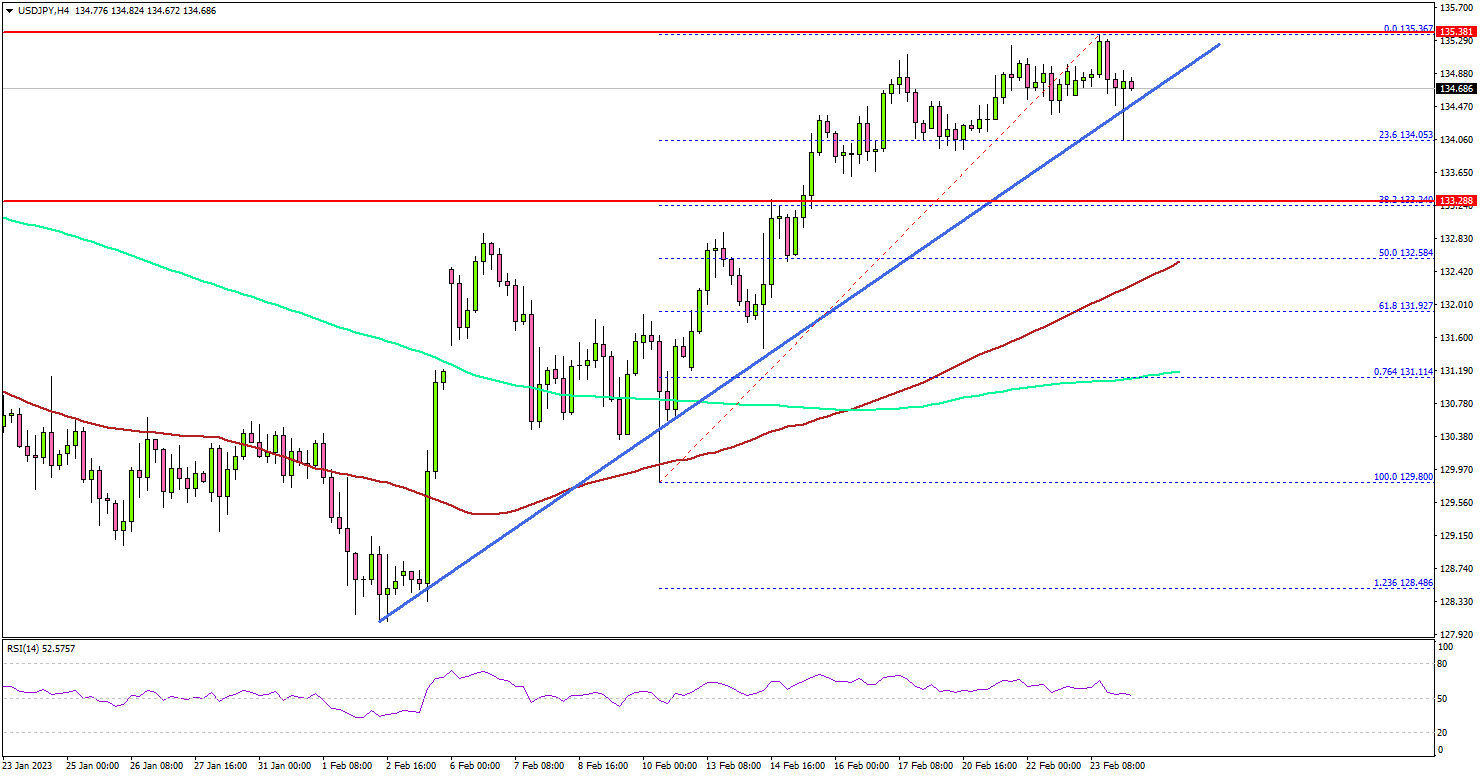
Looking at the 4-hours chart, the pair settled above the 133.50 level, the 100 simple moving average (red, 4-hours), and the 200 simple moving average (green, 4-hours).
The upward move was such that the pair even climbed above the 135.00 level. It is now showing positive signs above 134.50. There is also a connecting bullish trend line forming with support near 134.50 on the same chart.
On the downside, an immediate support is near the 134.50 level. The next major support is near the 134.00 level, below which there is a risk of a move towards the 133.30. Any more losses could open the doors for a drop towards 132.50.
On the upside, an immediate resistance is near the 135.50 level. The next major resistance is near the 136.20 level. A clear move above the 136.20 resistance might start a steady increase towards the 138.00 resistance zone. Any more gains could open the doors for a move towards the 140.00 level.
Looking at EUR/USD, the pair slowly declined below 1.0620 and there is a risk of more losses in the coming days.
Economic Releases
- US New Home Sales for Jan 2023 (MoM) – Forecast 2.5% versus 2.3% previous.
- US Personal Income for Jan 2023 (MoM) - Forecast +0.9%, versus +0.2% previous.
GBPJPY Wave Analysis
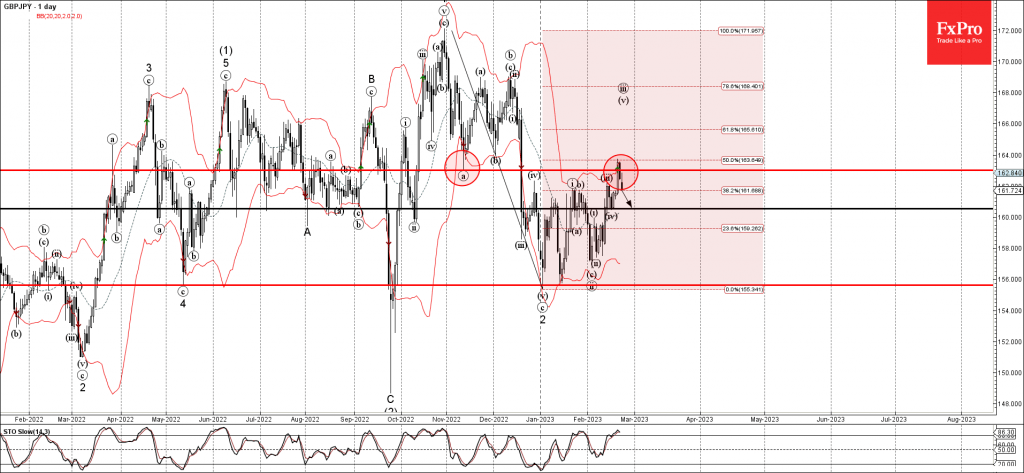
- GBPJPY reversed from key resistance level 163.00
- Likely to fall to support level 160.50
GBPJPY currency pair recently reversed down from the key resistance level 163.00 (former monthly low from November) coinciding with the upper daily Bollinger Band and the 50% Fibonacci correction of the downward impulse from November.
The downward reversal from the resistance level 163.00 stopped the previous impulse waves (iii) and 3, which belong to wave 3 from the start of January.
Given the overbought reading on the daily Stochastic, GBPJPY can be expected to fall further toward the next support level 160.50 (low of the previous minor wave (iv)).
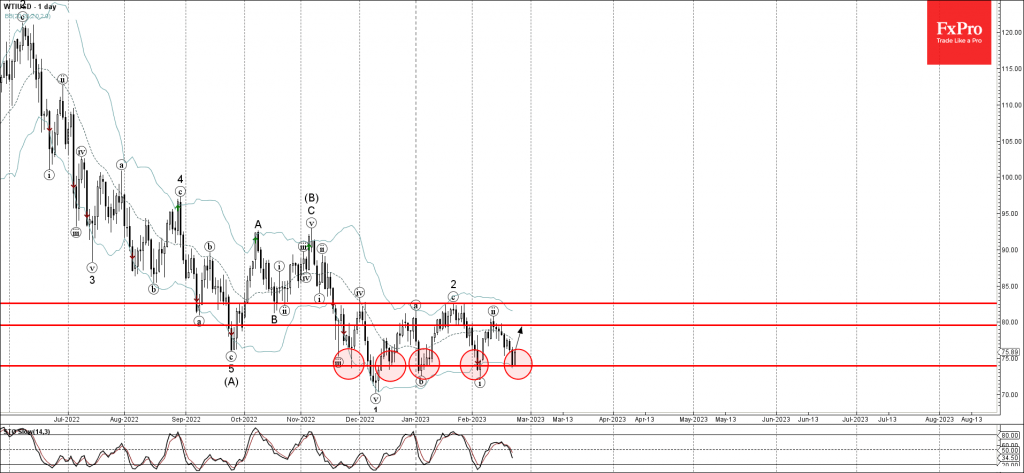
WTI Wave Analysis
- WTI reversed from support level 74.00
- Likely to rise to resistance level 80.00
WTI crude oil recently reversed up from the pivotal support level 74.00 (which has been reversing the price from the end of November).
The support level 74.00 was further strengthened by the lower daily Bollinger Band.
WTI crude oil can be expected to rise further toward the next round resistance level 80.00 (which stopped the previous short-term correction (ii)).
US Labour Market Remains Strong
Weekly jobless claims in the US were once again better than expected. This further confirms that the economy remains in a state where domestic inflationary pressures are building up, requiring the Fed to go further than expected.
Initial jobless claims fell from 194K to 192K, against expectations for an increase to 200K. Continuing claims came in at 1654K versus 1696K the previous week and the expected 1700K. Current levels are extremely low by historical standards.
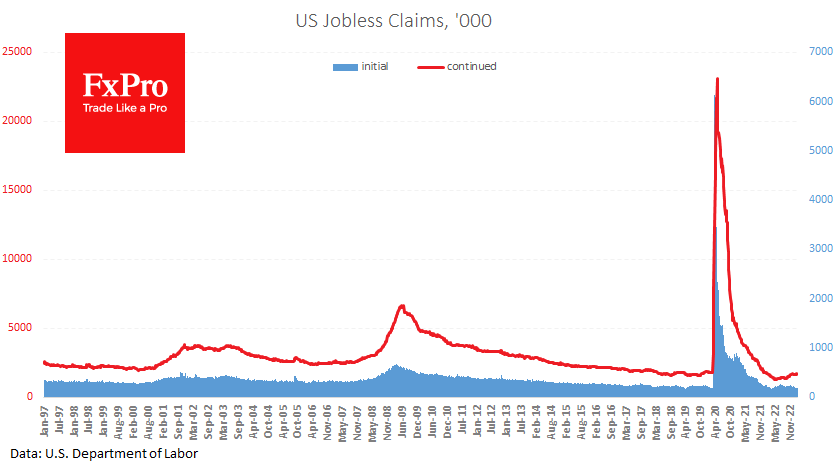
As energy prices have fallen significantly since the middle of last year and logistical problems have largely been resolved, labour costs are becoming the primary driver of price increases. In most cases, a strong labour market is good news for risk demand, but now such data could raise the Fed’s estimate of the endpoint of the current tightening cycle, putting pressure on equities.
This is potentially positive news for the dollar as it suggests higher yields on dollar-denominated debt. However, the impact of today’s particular release is likely insignificant, given the only slight deviation from expectations and the high frequency of these releases.