

Sample Category Title
Sunset Market Commentary
Markets
Trading on almost all markets was conditional to the publication of the US January CPI as this report was supposed provide the ‘ultimate reality check’ on the Fed’s (and by extension other central bankers’) call to continue raising rates and to keep them at a higher level for quite some time. The report was very close to expectations. Headline inflation printed at 0.5% M/M and 6.4% Y/Y (from 6.5%). Core inflation rose at a 0.4% monthly pace (similar to December) to be 5.6% higher compared to the same month last year (was 5.7%). Housing (0.8% M/M) was the most important contributor to the January price rise. Food prices rose 0.5% M/M and transportation costs 0.4%. Price declines were registered for used cars (-1.9%,) and medical care (-0.4%) but the weight of these items is relatively small. Understandably, markets initially didn’t know which card to play. In volatile trading the US yield curve currently continues its bearish inversion with the 2-y gaining 7 bps, the 10-y +3 bps while the 30-y yield trades little changed. German yields are rising 4/6 bps points across the curve. ECB’s Makhlouf indicated that the ECB could raise its policy rate above 3.50% and leave it there for a while. The euro 2-y swap (3.45%) and 2-y Bund yield (2.83) are setting new cycle peak levels. On equity markets, the Euro Stoxx 50 tested recent peak (4275) but higher yields post US CPI blocked further gains (currently unchanged). US indices erased opening losses. Oil trader marginally lower (Brent $85.75 p/b) even as OPEC sees the market in 2023 slightly tighter both on a higher demand and lower supply.• On FX markets, the dollar also show some nervous swings immediately after the CPI release. Finally, the risk-driven decline came to a halt. USD/JPY extends its recent (partially yen-driven) rebound and is currently testing first resistance near 132.90. EUR/USD reversed an initially trip to the high 1.07 area to currently trade unchanged near 1.073. A bit strangely, the US CPI report also aborted further gains of sterling, not only against the dollar, but also against the euro. A strong UK labour market report (+ 102k jobs in January; weekly earnings ex-bonus at 6.7%) made markets question recent rather soft BoE guidance post the February policy meeting. The 2-y UK yield is gaining 17 bps (was 7 bps before the US CPI). Markets are growing ever more confident that the BoE will (have to) raise its policy rate to 4.50% in the summer. EUR/GBP over the previous days was captured in a ST downtrend channel and today filled bids in the 0.881 area, just to reverse this sterling gain after the US data (0.8835). Cable even loses a few ticks in a daily perspective (1.2130, after an intraday top near 1.2250).
News & Views
The Hungarian Q4 flash GDP estimate showed growth contracting by 0.4% Q/Q, somewhat less than feared (-1.1% Q/Q) but still a second consecutive negative number (downward revision to -0.7% Q/Q in Q3) putting the country in a technical recession. In (NSA) Y/Y terms, GDP grew by 0.4%. In 2022, the volume of GDP grew by 4.6%. In a brief comment, the Hungarian Central Statistical Office only elaborates somewhat on the Y/Y-release. There was significant growth especially in the manufacture of motor vehicles, trailers and semi-trailers, as well as that of electrical equipment within industry and mostly in real estate activities as well as transportation and storage among market services. A considerable downturn in agriculture slowed the Y/Y-increase. A detailed GDP-release will be published on March 2. The Hungarian forint holds its remarkable momentum, trading at EUR/HUF 380 for the first time since May last year. Preliminary Polish GDP numbers, showed a 2.4% Q/Q GDP decline in the final three months of 2022 with the Y/Y-number printing at 2%. Details will be available on Feb 28. The Polish zloty joins today’s CE-momentum with EUR/PLN dropping from 4.8 (weakest PLN since October) towards 4.76.
The Turkish government ordered private pension funds to boost their holdings of Turkish stocks to stop the post-earthquake decline (cumulative -15% on Feb 7&8) when trading is expected to resume tomorrow. Pension funds will be required to allocate 30% of the funds the government contributes to individual pension contributions to Turkish stocks instead of 10% previously. The weighting of a single stock in their portfolio will also be increased from 1% to 5%.
January CPI: Still A Long Way from Mission Accomplished
Summary
Inflation is not going away quietly. Consumer prices increased 0.5% in January, the biggest monthly move since October. Firmer food inflation and a rebound in energy prices helped boost the headline number. Excluding food and energy, the core CPI increased 0.4% amid a slight pickup in core goods and a solid 0.5% rise in core services prices. Over the past three months, the core CPI rose at a 4.6% annualized pace, an acceleration from the 4.3% run-rate seen over the three-month period ending in December and notably stronger than the 3.1% pace that was originally reported with the December CPI report.
In our view, inflation is still set to grind lower, but the process is likely to be bumpy and take time. Despite some directional improvement over the past couple of quarters, prices are still growing well-above the Fed's 2% target, and the tight labor market suggests that there are still inflationary pressures that could forestall a full return to 2% inflation. We continue to look for the FOMC to raise the fed funds rate by another 25 bps at both the March and May meetings and to hold the target range at 5.00%-5.25% through the year's end to ensure that high inflation will be quelled for good.
Inflation Continues at a Vexing Pace
January's CPI report underscored that the battle against inflation will not be quickly won. Consumer prices rose 0.5% over the month after tame gains of 0.2% and 0.1% in November and December, respectively. The strong outturn in January led the year-over-year inflation rate to tick down only a tenth of a percentage point to 6.4%. Excluding food and energy, "core" prices increased 0.4% in January and 5.6% over the past year.
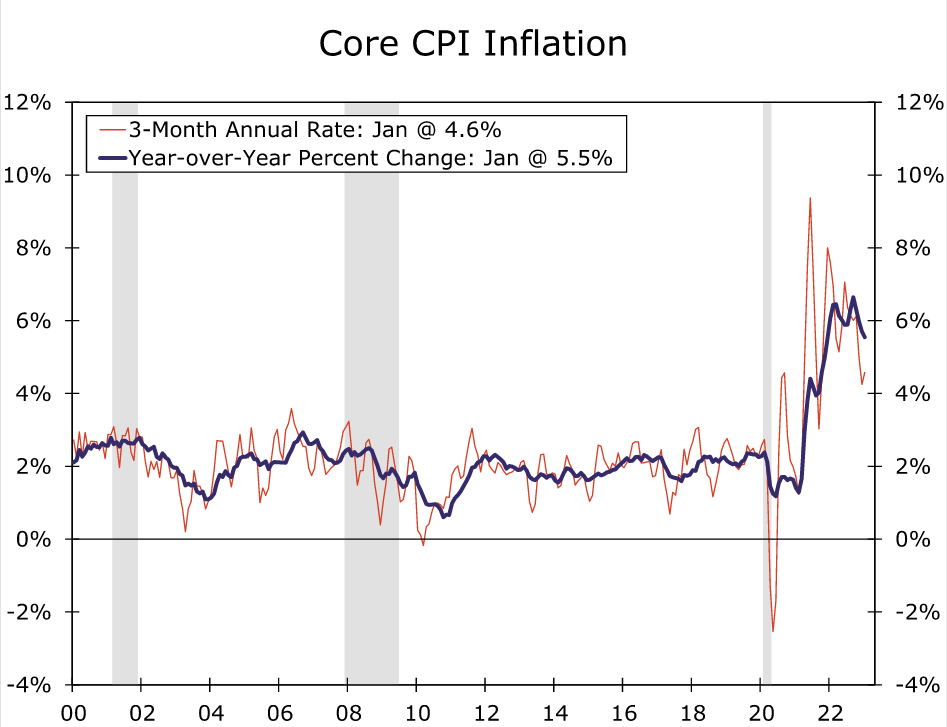
Annual revisions to the seasonal factors that were released on Friday foreshadowed that, while inflation has come off its peak, momentum remains stronger than the prior three monthly reports indicated. The three-month annualized pace of core CPI inflation through December was revised up to 4.3% from 3.1% previously. The January report further dampens enthusiasm that inflation is rapidly slowing. In light of the strong core inflation reading in January, the three-month annualized rate quickened to 4.6% from the 4.3% pace registered in December.
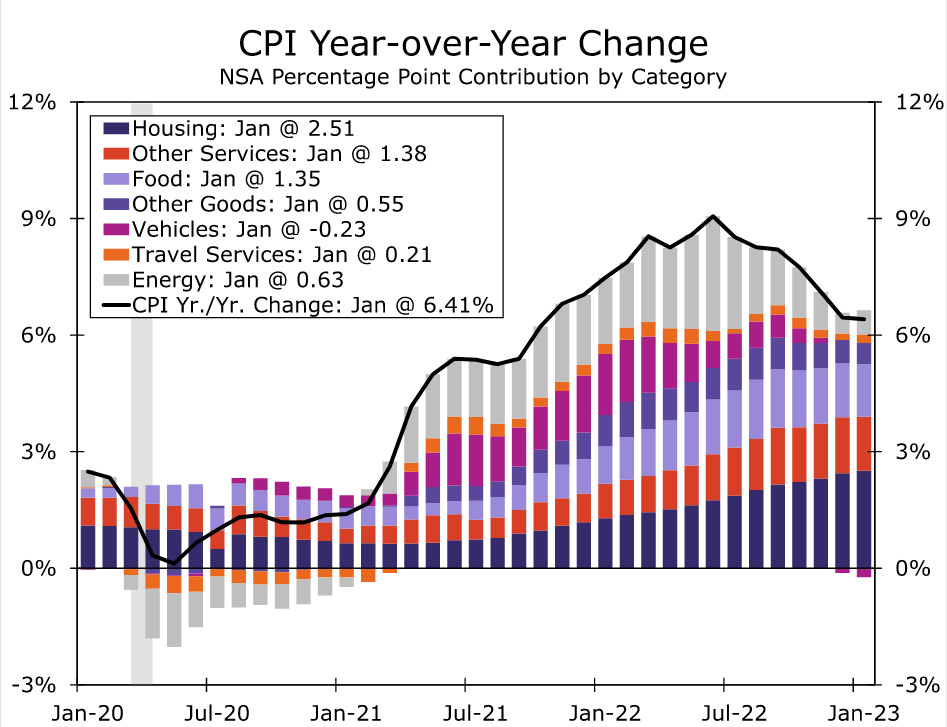
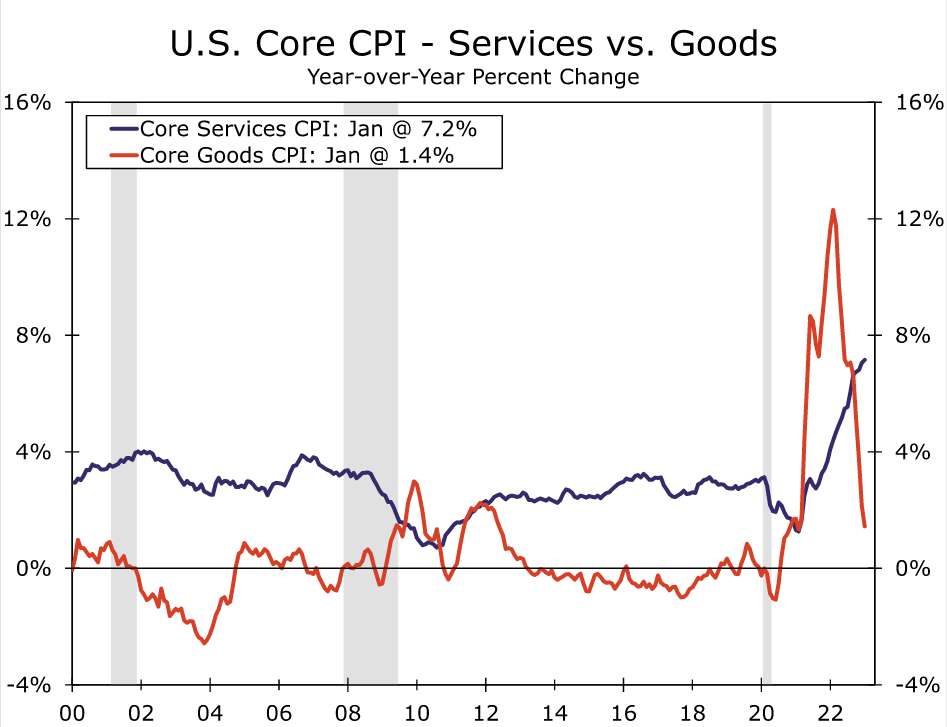
Core goods prices increased a scant 0.1% in January. The normalization in used auto prices continued with prices falling 1.9% in the month, the seventh consecutive month of deflation. New vehicle prices also increased a relatively tame 0.2%. That said, not all goods' categories posted disinflationary prints. Apparel prices rose 0.8% in January, and inflation for medical drugs and supplies jumped 1.1%. Overall, core goods inflation has slowed markedly over the past year, but as broken out in a nearby chart, the improvement has been primarily driven by vehicles.
Core services prices once again advanced faster than goods with a 0.5% rise in January. Rent and owners' equivalent rent growth each eased slightly but remained strong with gains of 0.7%, as the long lag between these measures and market-based rents has yet to reflect the ongoing disinflation in residential housing costs. Travel-related services prices were mixed, with lodging away from home up 1.2%, car rentals up 3.0% but airline fares down 2.1%. The core services ex-primary shelter measure that Chair Powell and other FOMC members have cited as a "super-core" measure of inflation increased 0.4% over the month and at a 3.2% three-month annualized rate.
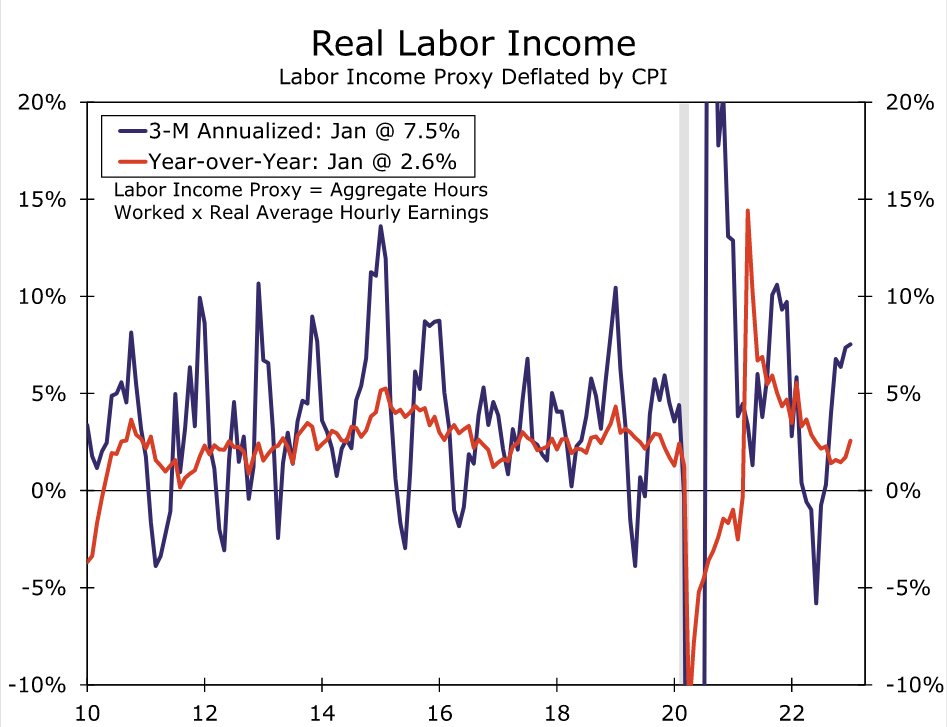
At the same time core prices continue to grow at an elevated pace, prices for necessities continue to bite. Supporting the rebound in inflation in January was a 2.0% rise in energy prices. A 2.4% rise in gasoline prices ends, or at the very least disrupts, a downward run that saw gasoline prices falling 24% over the second half of 2022 and played a meaningful role in the improvement of real income dynamics in recent months. Since peaking in June, headline CPI inflation has fallen 2.7 percentage points on a year-over-year basis, with energy goods alone shaving off 2.3 points. At the same time, consumers have yet to benefit from plummeting natural gas prices, with energy services up 2.1% in January. Price increases at the grocery store slowed only slight in January (up 0.4%) and remain more than 11% higher than a year ago.
Still More Work to Do
Today's report makes clear that there will be some bumps on the road back to 2% inflation. We continue to look for inflation to trend lower, but we believe getting back to an inflation rate the Fed can live with on a sustained basis will neither be quick nor painless. While inventory dynamics and higher interest rates are putting downward pressure on goods and shelter prices, the tight labor market continues to emit upward pressure on prices across all categories. Over the past three months, the core CPI increased at a 4.6% annualized rate. Although this is down from the highs of last year, it remains too high to meet the Fed's mandate of price stability.
As we wrote in our recent monthly U.S. Economic Outlook, the prospects for a "soft landing" have increased relative to a few months ago. Among other factors, slower inflation, most notably for energy and food, have helped propel solid gains in real disposable incomes. However, the upshot of a remarkably resilient U.S. labor market is that it may cause inflation to remain stubbornly above the Fed's 2% target for price growth. Labor demand and cost growth remain inconsistent with 2% inflation, and that keeps the chance of a recession still more likely than not, in our view. We have not seen the end of Fed tightening this cycle, let alone the full effects. We continue to look for the FOMC to raise the fed funds rate by another 25 bps at both the March and May meetings and to hold the target range at 5.00%-5.25% through the year's end to ensure that high inflation will be quelled for good.
S&P 500 Wave Analysis
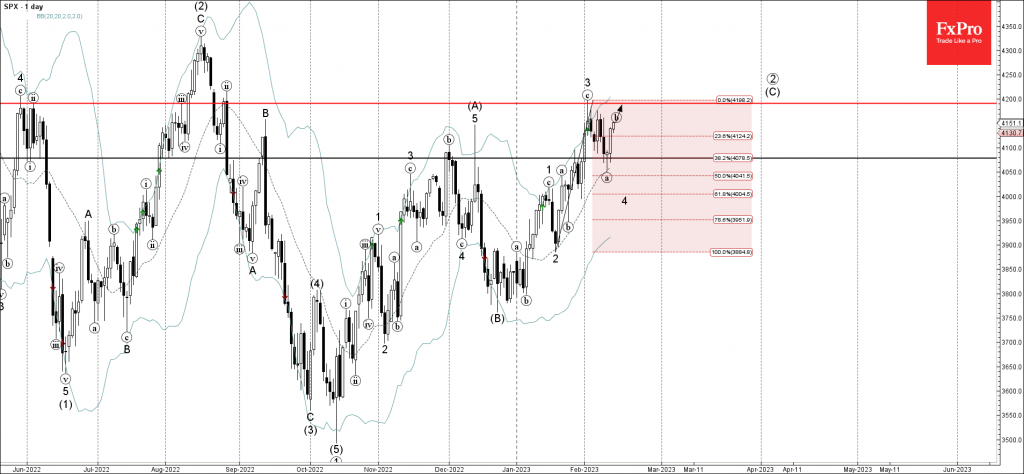
- S&P 500 reversed from support level 4080.00
- Likely to rise to resistance level 4200.00
S&P 500 index recently reversed up from the support level 4080.00 (former resistance from the end of January), standing near the 20-day moving average and the 38.2% Fibonacci correction of the upward impulse from January.
The upward reversal from the support level 4080.00 created the daily Japanese candlesticks reversal pattern Morning Star – which ended earlier wave a.
S&P 500 index can be expected to rise further toward the next resistance level 4200.00 (which stopped the previous impulse wave 3).
EURUSD Wave Analysis
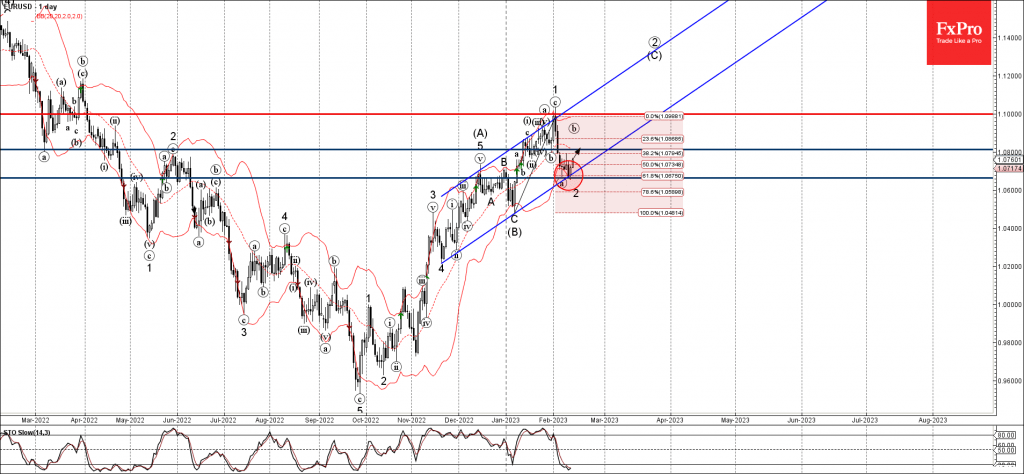
- EURUSD reversed from support level 1.0665
- Likely to rise to resistance level 1.0800
EURUSD recently reversed up from the key support level 1.0665 (former resistance from December), standing near the lower daily Bollinger Band and the 61.8% Fibonacci correction of the upward impulse from January.
The support level 1.0665 was further strengthened by the intersecting lower support trendline of the daily up channel from November.
Given the oversold daily Stochastic, EURUSD can be expected to rise further toward the next resistance level 1.0800 (top of the previous wave B).
USD/JPY Mid-Day Outlook
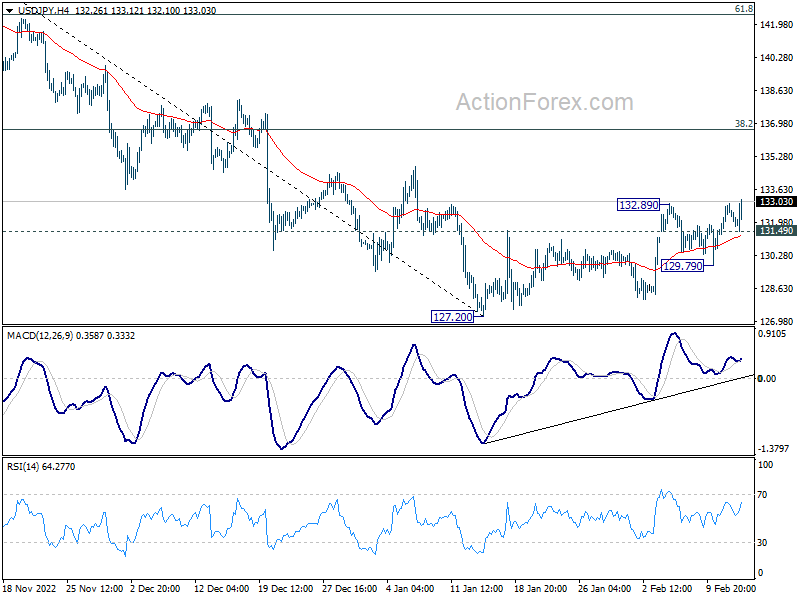
Daily Pivots: (S1) 131.48; (P) 132.19; (R1) 133.14; More...
Breach of 132.89 minor resistance suggests that rebound from 127.20 is resuming. Intraday bias is back on the upside for 38.2% retracement of 151.93 to 127.20 at 136.64, even as a correction to the decline from 151.39. On the downside, break of 131.49 minor support will turn intraday bias neutral again first.
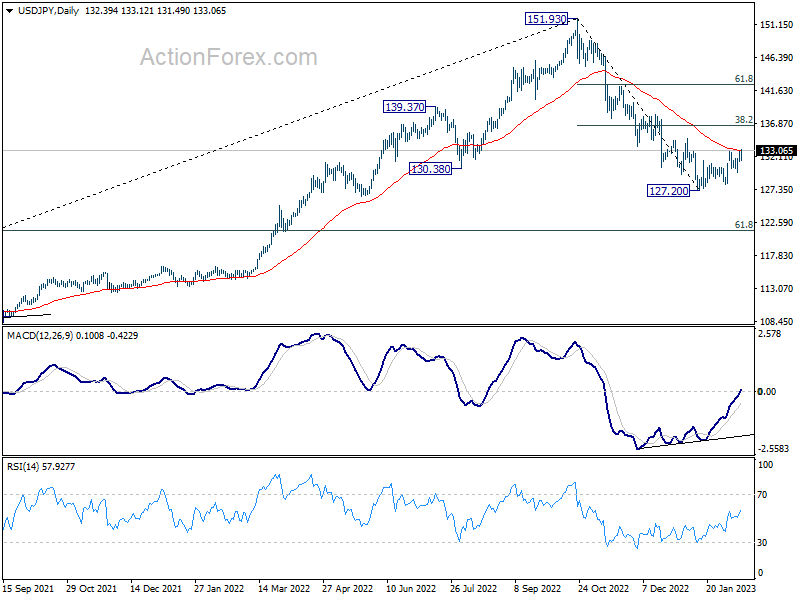
In the bigger picture, prior of 55 week EMA (now at 131.47) raises the chance of medium term bearish reversal, but that's not confirmed yet. Strong rebound from current level, followed by sustained break of 38.2% retracement of 151.93 to 127.20 at 136.64 will argue that price actions from 151.93 is merely a corrective pattern. However, rejection by 136.64 will solidify medium term bearishness for 61.8% retracement of 102.58 to 151.93 at 121.43 and 38.2% retracement of 75.56 to 151.93 at 122.75.
USD/CHF Mid-Day Outlook
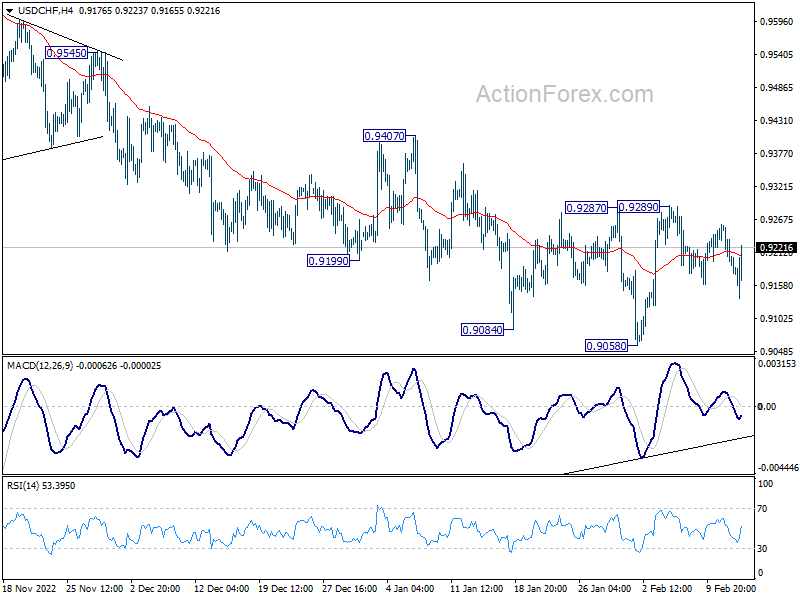
Daily Pivots: (S1) 0.9170; (P) 0.9215; (R1) 0.9239; More...
No change in USD/CHF's outlook and intraday bias stays neutral. On the upside, firm break of 0.9287/9 resistance will confirm short term bottoming at 0.9058, and bring stronger rise to 0.9407 resistance. On the downside, however, sustained break of 0.9058 will resume larger decline from 1.0146 instead.
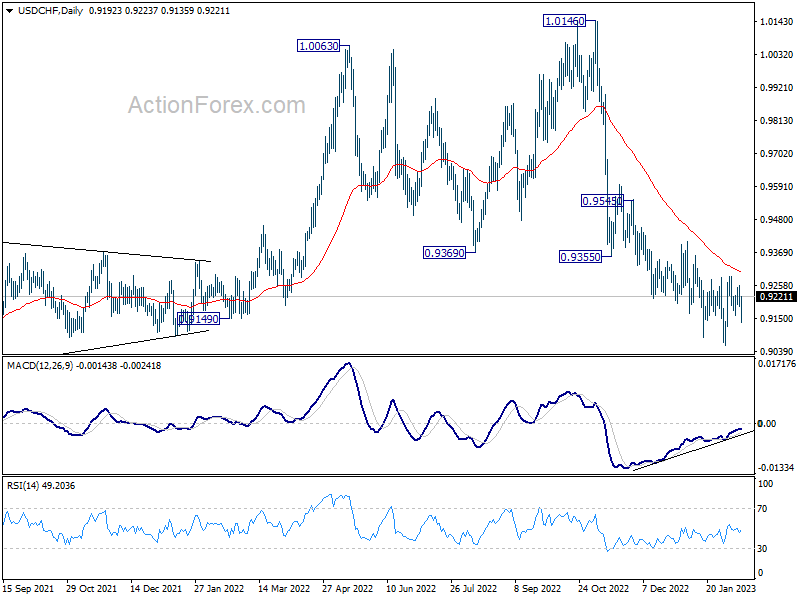
In the bigger picture, rise from 0.8756 (2021 low) has completed at 1.0146, well ahead of 1.0342 long term resistance (2016 high). Based on current downside momentum, fall from 1.0146 should be a medium term down trend itself. Next target is a test on 0.8756 low. Strong support should be seen there to bring rebound. Still, further decline will now be expected as long as 0.9407 resistance holds, in any case.
EUR/USD Mid-Day Outlook
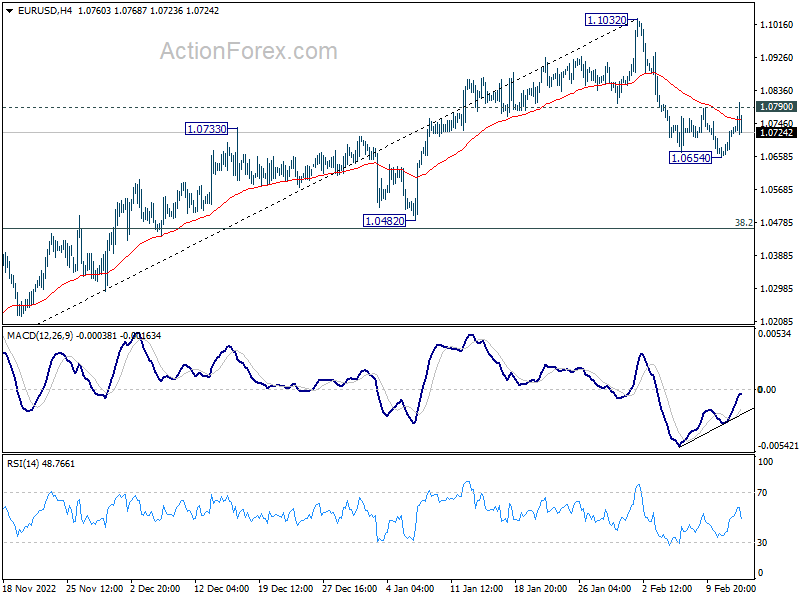
Daily Pivots: (S1) 1.0677; (P) 1.0704; (R1) 1.0751; More...
EUR/USD failed to break through 1.0790 resistance decisively and intraday bias stays neutral. On the downside, break of 1.0654 will resume the corrective fall from 1.1032 to 38.2% retracement of 0.9534 to 1.1032 at 1.0463. Strong support should be seen around there to bring rebound, at least on first attempt. On the upside, firm break of 1.0790 minor resistance will turn bias back to the upside for retesting 1.1032 high instead.
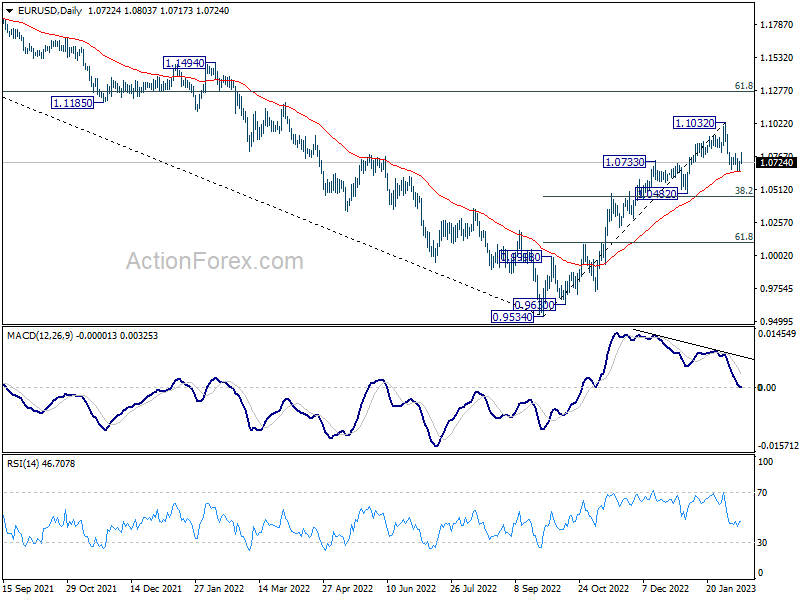
In the bigger picture, the rally from 0.9534 low (2022 low) is a medium term up trend rather than a correction. Further rise is in favor to 61.8% retracement of 1.2348 (2021 high) to 0.9534 at 1.1273 next. This will remain the favored case as long as 1.0482 support holds.
US: Inflation Continues to Moderate in January, Though Details Less Constructive
The Consumer Price Index increased 0.5% month-on-month (m/m) in January, meeting expectations. The 12-month change edged lower to 6.4% (down from 6.5% in December).
Energy prices increased by 2.0% m/m, as rising gasoline prices (+2.4% m/m) and energy services (+2.1% m/m) each notched similar gains on the month. Food prices rose 0.5% m/m and were up 10.1% y/y.
Core inflation (excludes food & energy) rose 0.4% m/m – matching December's gain. Compared to last January, prices were up 5.6% – a tick lower than the 5.7% recorded in December.
Price growth across services (+0.5% m/m) saw a modest deceleration from December. Gains were concentrated in the shelter component (+0.7% m/m) with both rents and owner's equivalent rent each notching similar gains. Lodging away from home (+1.2% m/m) was also higher in January.
- Stripping out shelter, "super" core service inflation rose 0.3% m/m – a modest deceleration from the 0.4% m/m gain in December – and is up 6.4% y/y.
Core goods prices (0.1% m/m%) recorded a modest gain – ending what had been three prior months of declines. Price growth was seen across most categories including household furnishings (+0.5% m/m), apparel (+0.8% m/m), recreation commodities (+0.1% m/m) and other goods (+0.8% m/m). Transportation goods (-0.7% m/m) were lower on the month, as used vehicle prices (-1.9% m/m) recorded another sizeable decline, while new vehicle prices (+0.2% m/m) were higher.
Key Implications
Despite core inflation matching December's month-on-month gain, favorable base effects meant that inflation continued to lose speed on a year-over-year basis. That said, the three-month annualized change rose to 4.6% (previously 4.3%) – ending what had been two consecutive months of declines.
A big reason for the sustained upward pressure on price growth last month was the result of goods prices no longer being a source a deflation as it had been in each of the prior three months. Indeed, used vehicle prices recorded another month of solid declines, however, that was more than offset by stronger price growth across most other consumer goods categories. With more recent wholesale car price data – as measured by the Manheim UVPI – showing used vehicle prices having turned higher, further declines from this component are unlikely. Unless we see price growth across other goods turn lower, goods inflation will again make positive contributions to core inflation.
Today's inflation numbers reinforce Chair Powell's recent messaging that we are only in the very earlier stages of the disinflationary process. The adjustment is unlikely to occur in a linear fashion, and it certainly can't make meaningful progress in an environment where the economy continues to add +500k jobs per-month. We expect that the FOMC will need to raise the Fed funds rate at each of its next two meetings by 25 basis points in order to make the policy stance sufficiently restrictive to cool the economy and return inflation to 2%.
GBP/USD Mid-Day Outlook
Daily Pivots: (S1) 1.2064; (P) 1.2108; (R1) 1.2184; More...
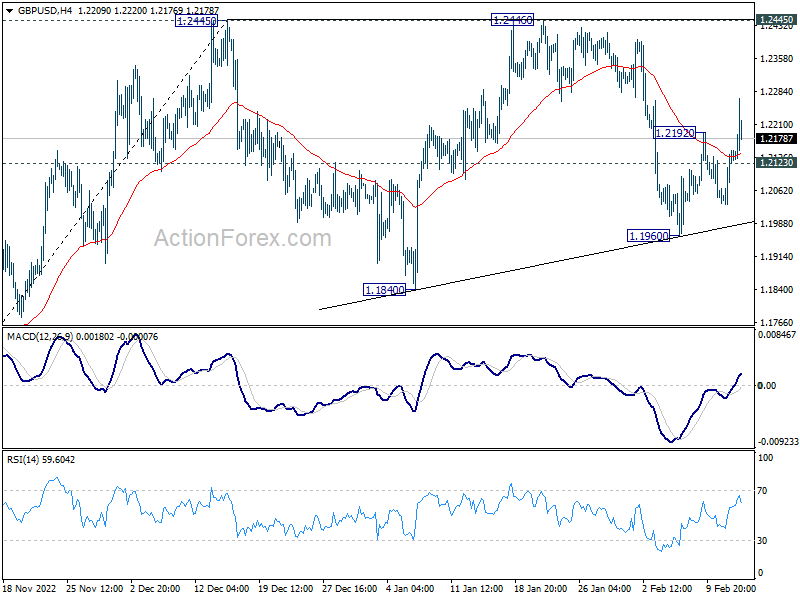
GBP/USD's rebound from 1.1960 resumed by breaking 1.2192 minor resistance and intraday bias is back on the upside. The development revived the case that corrective pattern from 1.2445 has already completed at 1.1960. Further rise should be seen to retest 1.2445/6 next. On the downside, however, below 1.2123 will mix up the outlook again and turn intraday bias neutral.
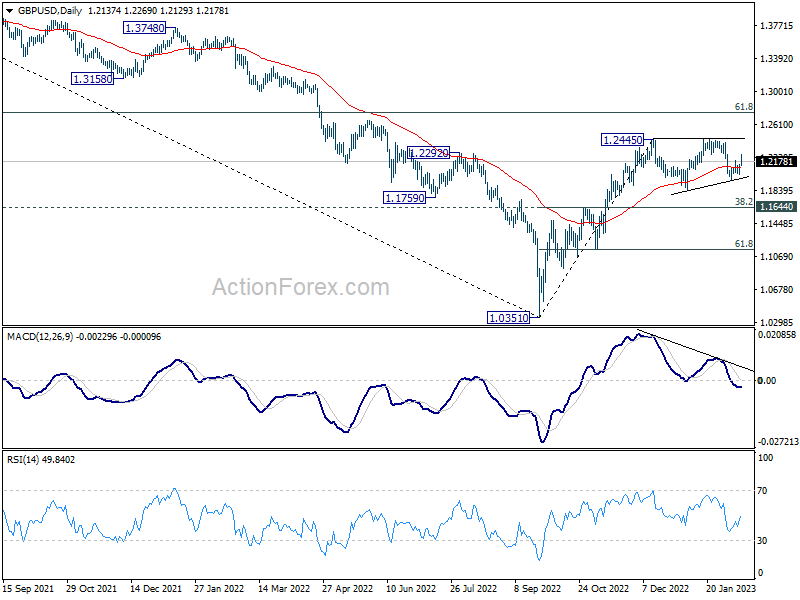
In the bigger picture, rise from 1.0351 medium term bottom is at least correcting whole down trend from 1.4248 (2021 high). Further rise is expected as long as 1.1644 resistance turned support holds. Next target is 61.8% retracement of 1.4248 to 1.0351 at 1.2759. Sustained break there will pave the way back to 1.4248.
Dollar Struggles after CPI, Sterling Supported by Job Data
Dollar is rather indecisive in early US session. US consumer inflation slowed less than expected in January, support Fed to continue tightening, probably for longer. However, positive risk sentiment is offsetting the boost to the greenback. Sterling, on the hand, was lifted by solid job data while FTSE hitting new record high. Elsewhere, Euro Swiss Franc and Aussie are on the firmer side. Yen, Canadian and Kiwi are on the weaker side.
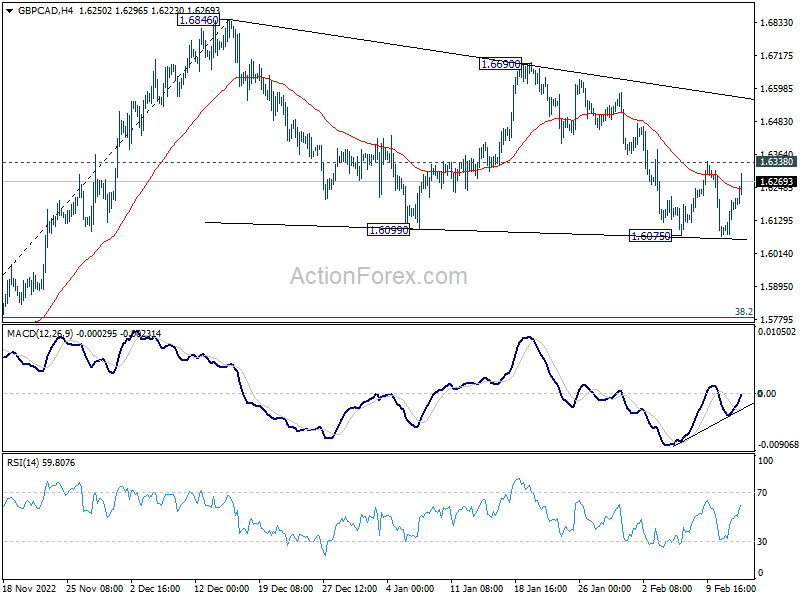
Technically, GBP/CAD's break of 4 hour 55 EMA is a positive sign. Immediate focus is now on 1.6338 resistance. Decisive break there will argue that whole corrective pattern from 1.6846 has completed with three waves to 1.6075. Stronger rally would then be seen back to 1.6690/6846 resistance. Tomorrow's UK CPI data could be the trigger.
In Europe, at the time of writing, FTSE is up 0.24%. DAX is up 0.26%. CAC is up 0.36%. Germany 10-year yield is up 0.017 at 2.388. Earlier in Asia, Nikkei rose 0.64%. Hong Kong HSI dropped -0.24%. China Shanghai SSE rose 0.28%. Singapore Strait Times dropped -0.20%. Japan 10-year JGB yield closed flat at 0.504.
US CPI slowed to 6.4% yoy in Jan, Core CPI down to 5.6% yoy
US CPI rose 0.5% mom in January while CPI core rose 0.4% mom. Both matched expectations. Food index rose 0.5% mom while energy index rose 2.0% mom.
Over the last 12 months, CPI slowed from 6.5% yoy to 6.4% yoy, above expectation of 6.2% yoy. That's nonetheless the lowest reading since October 2021. CPI core slowed from 5.7% yoy to 5.6% yoy, above expectation of 5.5% yoy, but was the lowest since December 2021. Energy index rose 8.7% yoy while food index rose 10.1% yoy.
ECB Makhlouf: I'm open to acting forcefully to bring inflation down
ECB Governing Council member Gabriel Makhlouf told WSJ, "I'm open to acting forcefully to get inflation down to our target." He noted that interest rate could rise to above 3.5% and stay there.
Regarding speculations that ECB would cut interest this year, Makhlouf said, "I think that really is going too far... We'll reach a point where we're going to, then plateau."
"I see the ECB as putting up interest rates after the March meeting...Even though inflation is coming down it's still way above our target," Makhlouf added.
UK payrolled employees rose 102k in Jan, unemployment rate at 3.7% in Dec
In January, UK payrolled employees rose 0.3% mom or 102k. Comparing with the same month a year ago, payrolled employees rose 2.6% yoy or 768k. Median monthly pay rose 6.8% yoy. Claimant count dropped -12.9k, versus expectation of 9k rise.
In the three months to December, unemployment rate came in at 3.7%, 0.1% higher than the three-month period. Employment rate was at 75.6%, 0.2% higher than the previous three-month period. Economic inactivity rate was at 21.4%, 0.3% lower than the previous three-month period. Average earnings excluding bonus was up 6.7% 3moy, above expectation of 6.5%. Average earnings including bonus was up 5.9% 3moy, below expectation of 6.2%.
Japan GDP grew 0.2% in Q4 only, missed expectations
Japan GDP grew 0.2% qoq in Q4, below expectation of 0.5% qoq. In annualized term, GDP rose 0.6%, below expectation of 2.0%. GDP deflator rose 1.1% yoy, matched expectations. For the full year of 2022, GDP expanded 1.1%, slowed from 2021's 2.1%.
Economy Minister Shigeyuki Goto said after the release, "Rising inflation and the global slowdown are risks... But corporate spending appetite hasn't cooled ... we're not too pessimistic about the outlook."
Finance Minister Shunichi Suzuki said, "With global monetary tightening continuing, the slowdown in overseas economies could still drag on Japan's economy as well. We also need to pay attention to the impact from inflation, supply constraints, volatility in financial markets and the spread of Covid cases in China."
Separately, it's confirmed that the government nominated Kazuo Ueda as the next BoJ Governor, when Haruhiko Kuroda's term ends on April 8. Ueda is a 71-year-old former BoJ board member and an academic at Kyoritsu Women's University.
Australia consumer sentiment dropped back to 78.5, pressures bearing down on consumer becoming intense
Australia Westpac-Melbourne Institute Consumer Sentiment Index fell -6.9%mom from 84.3 to 78.5 in February. The reading was already below the trough of 79.0 as seen in the global financial crisis, but above the 75.6 low in April 2020 when the pandemic first hit.
Westpac noted: "Cost of living pressures and interest rate rises continue to weigh heavily. Hopes of some easing in both have been dashed by the strong December quarter CPI and the RBA's resumption of its interest rate tightening cycle."
Regarding RBA policy, Westpac expects another 25bps hike to 3.60% on March 7, a pause in April, and then a final 35bps hike in May to 3.85%.
It added, "The consumer sentiment survey continues to give a very clear warning that the pressures bearing down on the consumer are becoming intense. While spending has held up relatively well to date, we expect an abrupt slowdown to show through in coming months."
Australia NAB business confidence rose to 6, conditions rose to 18
Australia NAB Business Confidence rose further from 0 to 6 in January. Business Conditions also improved from 13 to 18. Looking at some details, trading conditions rose from 20 to 28. Profitability conditions rose from 13 to 17. Employment conditions rose from 9 to 10.
NAB Chief Economist Alan Oster: "Business conditions picked back up in January after three months of softening in late 2022. There were strong increases in conditions for 'upstream' sectors such as wholesale, construction and manufacturing, and importantly, conditions in the more consumer-facing industries remained very strong."
"Confidence dipped into negative territory late in 2022 but is now back around the average after rebounding over the past two months. The improvement in confidence suggest firms have a more optimistic outlook as concerns about global growth prospects ease, while strong conditions are also providing evidence that the economy is more resilient than previously expected."
RBNZ survey: OCR expected to rise to 5% by year end
According to RBNZ Survey of Expectations (Business), one-year inflation expectations rose slightly from 5.08% to 5.11% in February quarter. The reading was similar to value from the 1990 survey when actual CPI was 7.60%.
On the other hand, two-year inflation expected dropped further from 3.62% to 3.30%. The spread also narrowed, with no respondent answering below 2.00% or above 6.00%.
Official Cash Rate (OCR) expectations increased notably by 74 basis points from 4.25% to 4.89% by the end of this quarter. OCR is expected rise further to 5.00% by the end of the year, up from 4.67%.
GBP/USD Mid-Day Outlook
Daily Pivots: (S1) 1.2064; (P) 1.2108; (R1) 1.2184; More...
GBP/USD's rebound from 1.1960 resumed by breaking 1.2192 minor resistance and intraday bias is back on the upside. The development revived the case that corrective pattern from 1.2445 has already completed at 1.1960. Further rise should be seen to retest 1.2445/6 next. On the downside, however, below 1.2123 will mix up the outlook again and turn intraday bias neutral.
In the bigger picture, rise from 1.0351 medium term bottom is at least correcting whole down trend from 1.4248 (2021 high). Further rise is expected as long as 1.1644 resistance turned support holds. Next target is 61.8% retracement of 1.4248 to 1.0351 at 1.2759. Sustained break there will pave the way back to 1.4248.
Economic Indicators Update
| GMT | Ccy | Events | Actual | Forecast | Previous | Revised |
|---|---|---|---|---|---|---|
| 23:30 | AUD | Westpac Consumer Confidence Feb | -6.90% | 5.00% | ||
| 23:50 | JPY | GDP Q/Q Q4 P | 0.20% | 0.50% | -0.20% | |
| 23:50 | JPY | GDP Deflator Y/Y Q4 P | 1.10% | 1.10% | -0.30% | |
| 00:30 | AUD | NAB Business Conditions Jan | 18 | 12 | ||
| 00:30 | AUD | NAB Business Confidence Jan | 6 | -1 | ||
| 02:00 | NZD | RBNZ Inflation Expectations Q/Q Q1 | 3.30% | 3.62% | ||
| 04:30 | JPY | Industrial Production M/M Dec F | 0.30% | -0.10% | -0.10% | |
| 07:00 | GBP | Claimant Count Change Jan | -12.9K | 9K | 19.7K | |
| 07:00 | GBP | ILO Unemployment Rate (3M) Dec | 3.70% | 3.70% | 3.70% | |
| 07:00 | GBP | Average Earnings Excluding Bonus 3M/Y Dec | 6.70% | 6.50% | 6.40% | 6.50% |
| 07:00 | GBP | Average Earnings Including Bonus 3M/Y Dec | 5.90% | 6.20% | 6.40% | 6.50% |
| 07:30 | CHF | Producer and Import Prices M/M Jan | 0.70% | 0.20% | -0.70% | |
| 07:30 | CHF | Producer and Import Prices Y/Y Jan | 3.30% | 2.20% | 3.20% | |
| 10:00 | EUR | Eurozone GDP Q/Q Q4 P | 0.10% | 0.10% | 0.10% | 0.30% |
| 10:00 | EUR | Eurozone Employment Change Q/Q Q4 P | 0.40% | 0.10% | 0.30% | |
| 11:00 | USD | NFIB Business Optimism Index Jan | 90.3 | 90.9 | 89.8 | |
| 13:30 | USD | CPI M/M Jan | 0.50% | 0.50% | 0.10% | |
| 13:30 | USD | CPI Y/Y Jan | 6.40% | 6.20% | 6.50% | |
| 13:30 | USD | CPI Core M/M Jan | 0.40% | 0.40% | 0.40% | |
| 13:30 | USD | CPI Core Y/Y Jan | 5.60% | 5.50% | 5.70% |