Sample Category Title
EUR/USD Daily Outlook
Daily Pivots: (S1) 1.0852; (P) 1.0891; (R1) 1.0931; More...
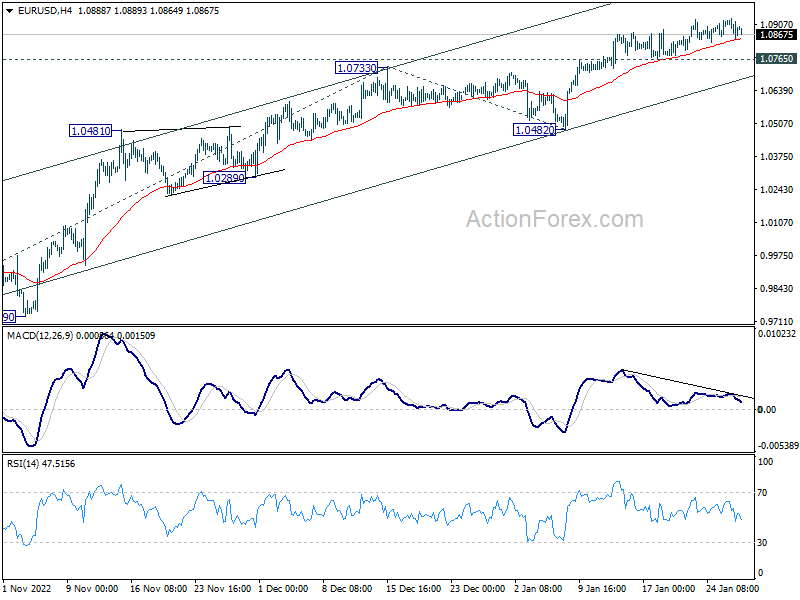
EUR/USD is losing upside momentum as seen in bearish divergence condition in 4 hour MACD. But further rise could still be seen as long as 1.0765 support holds, to 61.8% projection of 0.9630 to 1.0733 from 1.0482 at 1.1164 next. On the downside, though, break of 1.0765 support should now confirm short term topping, and turn bias back to the downside for 55 day EMA (now at 1.0591).
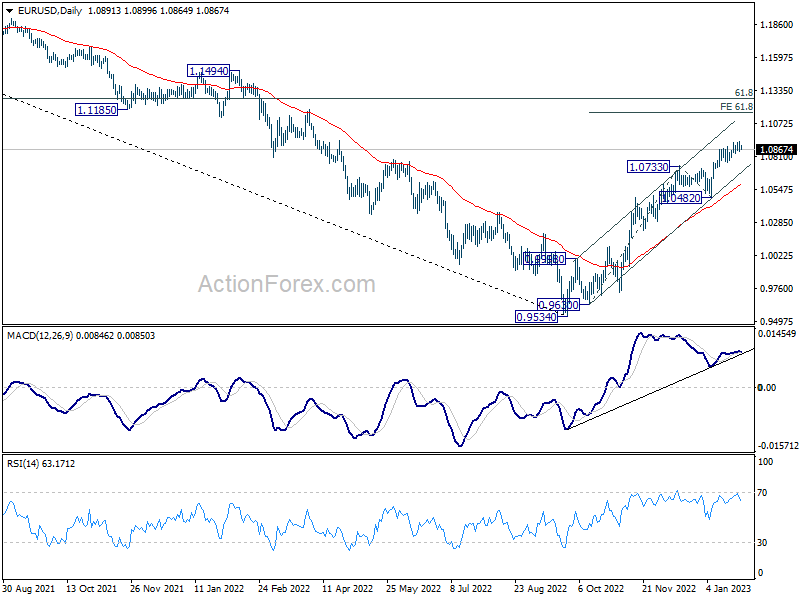
In the bigger picture, current development suggests that the rally from 0.9534 low (2022 low) is a medium term up trend rather than a correction. Further rise is in favor to 61.8% retracement of 1.2348 (2021 high) to 0.9534 at 1.1273 next. This will remain the favored case as long as 1.0482 support holds.
Dollar Eyes PCE Inflation Data, Ready for a Bounce?
Risk-on rallies appear to be taking a breather ahead of the weekend. While US stocks jumped overnight, Asian markets are just mixed. Focuses will turn to US PCE inflation data today. Dollar might try to bounce if there is upside surprise in the report. Yet, the big events are the three central bank meetings next week - Fed, ECB, and BoE, plus ISMs and NFP. So, any moves could be temporary.
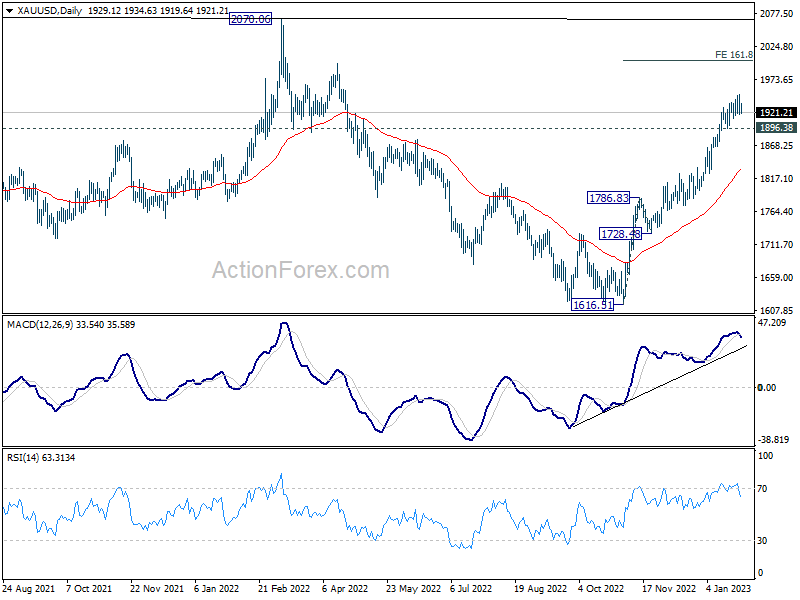
Technically, Gold is clearly losing upside momentum as seen in both 4 hour and daily MACD. While another rise cannot be ruled out, Gold might not have enough momentum to hit target of 161.8% projection of 1616.51 to 1786.83 from 1728.48 at 2004.05, or not even 2000 handle. Break of 1896.38 support will confirm topping and bring correction to 55 day EMA (now at 1829.03). If happens, that would be used as a signal to confirm Dollar's bounce.
In Asia, at the time of writing, Nikkei is up 0.10%. Hong Kong HSI is down -0.05%. Singapore Strait Times is up 0.43%. Japan 10-year JGB yield is up 0.0126 at 0.478. Overnight, DOW rose 0.61%. S&P 500 rose 1.10%. NASDAQ rose 1.76%. 10-year yield rose 0.031 to 3.493.
Japan Tokyo CPI core rose to 3.4% yoy, highest in 42 years
In Japan, Tokyo CPI core (all items ex-fresh food), accelerated from 4.0% yoy to 4.3% yoy in January, above expectation of 4.2% yoy. That's also the fastest annual increase in nearly 42 years since May 1981.
Headline CPI (all items) rose from 4.0% yoy to 4.4% yoy, matched expectations. CPI core-core (all items ex-fresh food, energy) rose from 2.7% yoy to 3.0% yoy.
NZ ANZ business confidence rose to -52, inflation pressures remains intense
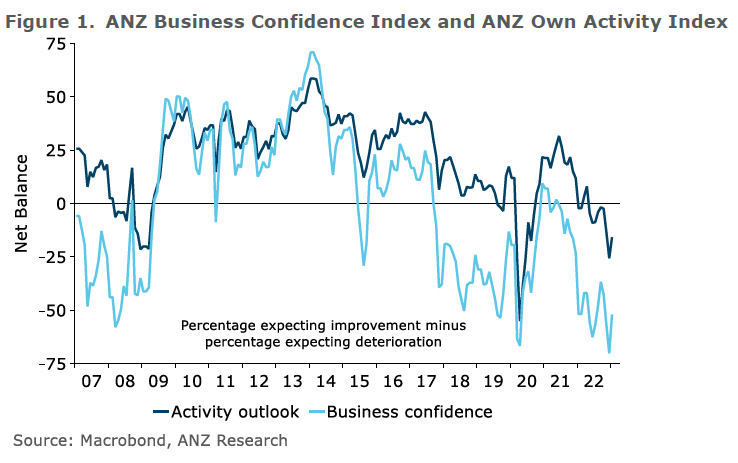
New Zealand ANZ Business Confidence improved from -70.2 to -52.0 in January. Own activity outlook rose form -25.6 to -15.8.
Looking at some details, exports intentions rose from -10.0 to -5.4. Investment investment intentions rose form -20.5 to -13.7. Employment intentions rose from -16.3 to -11.1.Pricing intentions rose from 59.1 to 62.4. Cost expectations rose from 84.4 to 91.3. Profit expectations rose from -52.7 to -42.6. Inflation expectations dropped from 6.23 to 5.99.
ANZ said: "Inflation pressures remain intense. Pricing intentions rose 3 points, and cost expectations rose 7 points. Inflation expectations remain stuck around the 6% mark. There's good reason for the RBNZ to keep hiking a while yet (we are picking +50bp in February)."
Looking ahead
Eurozone will release M3 money supply in European session. But main focus will be on US personal income and spending with PCE inflation later in the day.
EUR/USD Daily Outlook
Daily Pivots: (S1) 1.0852; (P) 1.0891; (R1) 1.0931; More...
EUR/USD is losing upside momentum as seen in bearish divergence condition in 4 hour MACD. But further rise could still be seen as long as 1.0765 support holds, to 61.8% projection of 0.9630 to 1.0733 from 1.0482 at 1.1164 next. On the downside, though, break of 1.0765 support should now confirm short term topping, and turn bias back to the downside for 55 day EMA (now at 1.0591).
In the bigger picture, current development suggests that the rally from 0.9534 low (2022 low) is a medium term up trend rather than a correction. Further rise is in favor to 61.8% retracement of 1.2348 (2021 high) to 0.9534 at 1.1273 next. This will remain the favored case as long as 1.0482 support holds.
Economic Indicators Update
| GMT | Ccy | Events | Actual | Forecast | Previous | Revised |
|---|---|---|---|---|---|---|
| 23:30 | JPY | Tokyo CPI Core Y/Y Jan | 4.30% | 4.20% | 4.00% | |
| 00:00 | NZD | ANZ Business Confidence Jan | -52 | -70.2 | ||
| 00:30 | AUD | Import Price Index Q/Q Q4 | 1.80% | 1.60% | 3.00% | |
| 00:30 | AUD | PPI Q/Q Q4 | 0.70% | 1.90% | 1.90% | |
| 00:30 | AUD | PPI Y/Y Q4 | 5.80% | 6.30% | 6.40% | |
| 09:00 | EUR | Eurozone M3 Money Supply Y/Y Dec | 4.60% | 4.80% | ||
| 13:30 | USD | Personal Spending Dec | -0.10% | 0.10% | ||
| 13:30 | USD | Personal Income M/M Dec | 0.20% | 0.40% | ||
| 13:30 | USD | PCE Price Index M/M Dec | 0.10% | |||
| 13:30 | USD | PCE Price Index Y/Y Dec | 5.50% | |||
| 13:30 | USD | Core PCE Price Index M/M Dec | 0.30% | 0.20% | ||
| 13:30 | USD | Core PCE Price Index Y/Y Dec | 4.70% | |||
| 15:00 | USD | Pending Home Sales M/M Dec | -1.00% | -4.00% | ||
| 15:00 | USD | Michigan Consumer Sentiment Index Jan F | 64.6 | 64.6 |
Japan Tokyo CPI core rose to 3.4% yoy, highest in 42 years
In Japan, Tokyo CPI core (all items ex-fresh food), accelerated from 4.0% yoy to 4.3% yoy in January, above expectation of 4.2% yoy. That's also the fastest annual increase in nearly 42 years since May 1981.
Headline CPI (all items) rose from 4.0% yoy to 4.4% yoy, matched expectations. CPI core-core (all items ex-fresh food, energy) rose from 2.7% yoy to 3.0% yoy.
NZ ANZ business confidence rose to -52, inflation pressures remains intense
New Zealand ANZ Business Confidence improved from -70.2 to -52.0 in January. Own activity outlook rose form -25.6 to -15.8.
Looking at some details, exports intentions rose from -10.0 to -5.4. Investment investment intentions rose form -20.5 to -13.7. Employment intentions rose from -16.3 to -11.1.Pricing intentions rose from 59.1 to 62.4. Cost expectations rose from 84.4 to 91.3. Profit expectations rose from -52.7 to -42.6. Inflation expectations dropped from 6.23 to 5.99.
ANZ said: "Inflation pressures remain intense. Pricing intentions rose 3 points, and cost expectations rose 7 points. Inflation expectations remain stuck around the 6% mark. There's good reason for the RBNZ to keep hiking a while yet (we are picking +50bp in February)."
USD/JPY Aims Fresh Increase If It Clears This Resistance
Key Highlights
- USD/JPY started a recovery wave above the 129.50 resistance.
- A key bullish trend line is forming with support near 128.70 on the 4-hours chart.
- EUR/USD and GBP/USD traded in a range after the US GDP release.
- The US GDP grew 2.9% in for Q4 2022 (Preliminary), more than the market forecast of 2.6%.
USD/JPY Technical Analysis
The US Dollar found support near the 127.30 zone against the Japanese Yen. USD/JPY started a recovery wave above the 128.00 and 128.40 resistance levels.
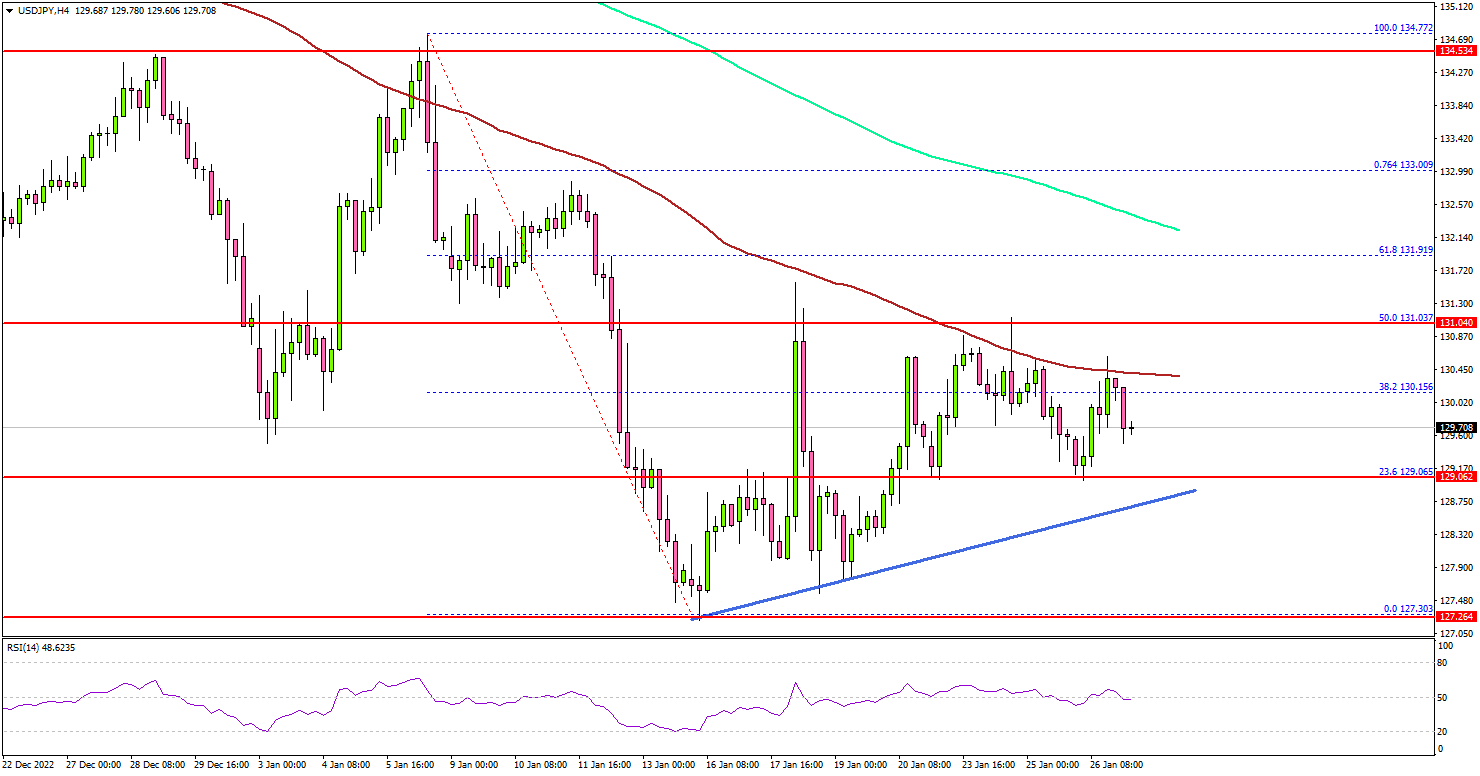
Looking at the 4-hours chart, the pair was able to clear the 129.50 resistance zone. There was also a move above the 38.2% Fib retracement level of the key decline from the 134.77 swing high to 127.30 low.
Recently, it faced resistance near the 100 simple moving average (red, 4-hours). The first major resistance is near the 131.00 level.
The 50% Fib retracement level of the key decline from the 134.77 swing high to 127.30 low is also near the 131.00 zone. A clear move above the 131.00 resistance might start a steady increase towards the 132.50 resistance zone.
Any more gains could open the doors for a move towards the 133.50 level. The next key hurdle is near 134.00, above which the pair could climb towards the 135.00 resistance zone.
On the downside, there is a major support at 129.60. There is also a key bullish trend line forming with support near 128.70 on the same chart. A downside break below the 128.70 zone might push the pair lower.
The next major support sits near the 128.00 level. Any more losses might open the doors for a move towards the 127.30 support zone.
Looking at EUR/USD, the pair is consolidating above the 1.0800 zone and might attempt a fresh increase above the 1.0900 resistance.
Economic Releases
- US Personal Income for Dec 2022 (MoM) - Forecast +0.2%, versus +0.4% previous.
- US Pending Home Sales for Dec 2022 (YoY) - Forecast -0.9%, versus -4.0% previous.
Busy Japanese Calendar Next Week, But Yen’s Performance in the Hands of the Fed
Amidst the most important week yet in 2023, we get a plethora of Japanese data. With its next meeting scheduled in March, the BoJ can sit back and watch developments. In the meantime, the dollar/yen pair appears to have found a short-term balance following three month of nonstop yen outperformance. Could next week’s data releases give a helping hand to yen bulls?
Next BoJ meeting in March, significant developments in the meantime
The BoJ kicked off the central-bank meetings season by hosting its rate-setting gathering on January 18. It now has the luxury of sitting on the sidelines as the remaining key central banks meet next week. The BoJ will have the opportunity to assess the potential impact of the Fed decisions and possible actions, while facing a full agenda domestically. The "Shunto" spring wage negotiations will be held during February/March as there are reports for government pressure in favour of stronger pay rises, particularly for permanent salaries. A strong result from these negotiations would definitely help the new governor taking over in April. In the meantime, on February 10 the Japanese parliament will be informed of the nominated governor. It is worth noting that the two deputy governors will also be replaced as the government prefers to give its new BoJ man-in-charge carte-blanche on monetary policy.
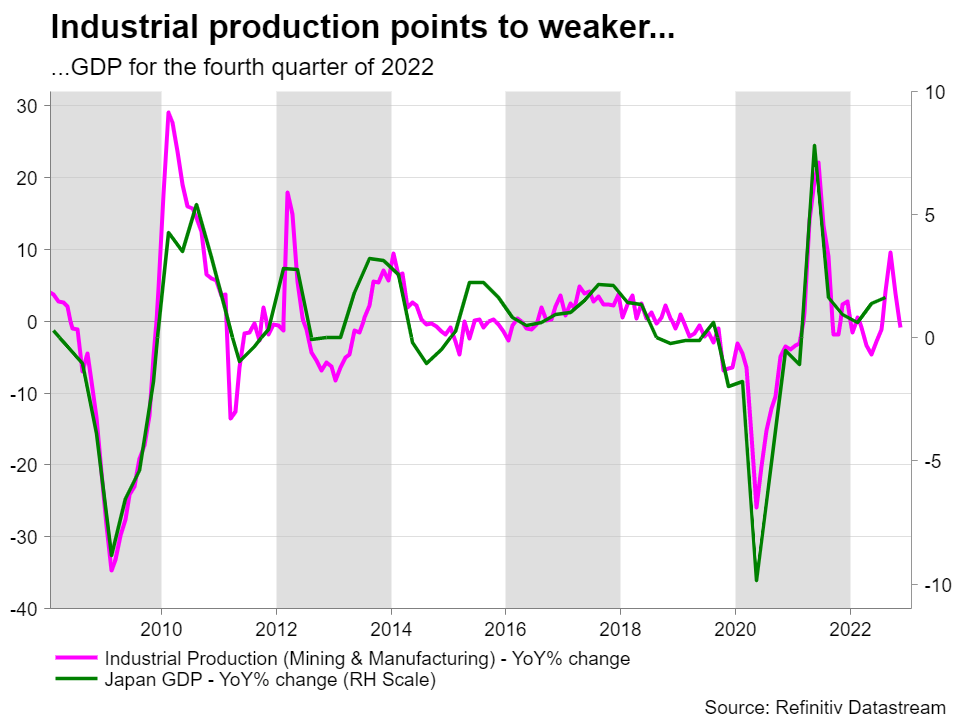
Busy start for the new week, key industrial production print
Amidst this busy agenda, next week enjoys a full data-release calendar. Starting on Monday evening, the December unemployment, which is unlikely to surprise, and the preliminary figure of the December Industrial production will be released. Another negative year-on-year print in the latter should increase the concern about the Japanese economic outlook, particularly as energy costs have dropped recently. The first estimate of the fourth quarter GDP is expected on February 14 as the world tries to gauge the true impact of the Chinese reopening on demand and supply lines globally.
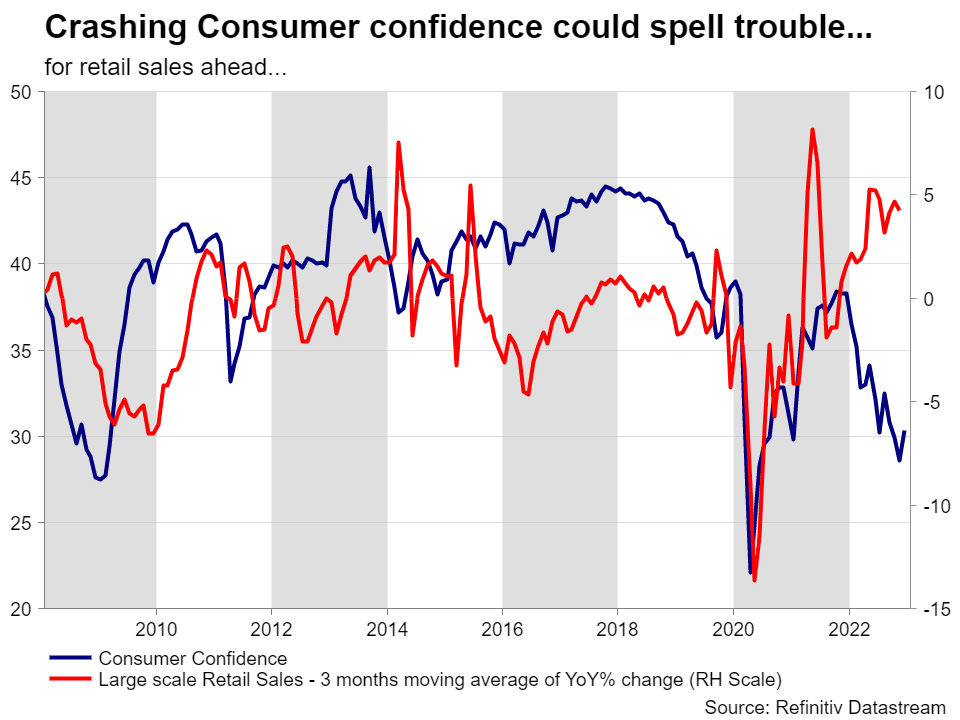
Consumer confidence low, but retail sales growth decent
Next week we will also be enlightened on the important consumer side. And here we are faced with an interesting disparity. While the consumer confidence index has dropped to extremely low levels, retail sales growth appears vigorous. This gap is even more evident when analyzing the large-scale retail shops figures. Despite the apparent volatile nature of the sales dataset, recent history points to a possible correction in retail sales ahead, even if the consumer confidence manages to record a small comeback on Tuesday.
Yen at crossroads
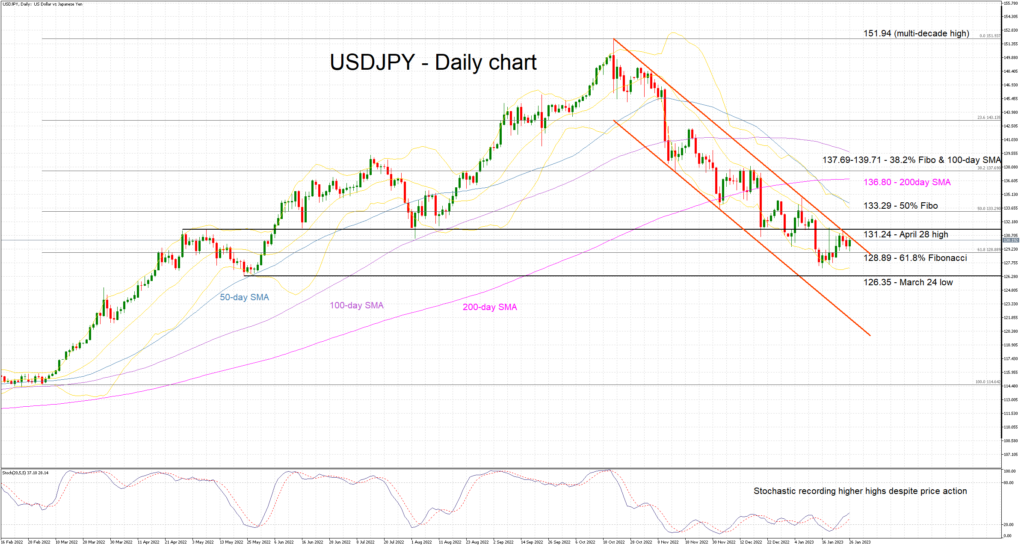
The yen has been in the spotlight lately due to its aggressive appreciation against the dollar since the October 21 multi-decade high of 151.94. Next week, the yen’s performance rests squarely on the hands of the Fed. A more dovish show at the February 1 gathering could open the door for further yen outperformance. From a technical perspective, the yen has been moving inside a textbook-like downward trend channel. It currently appears to have found a short-term balance around the 130 area. While the overall technical picture appears to be yen bullish, the stochastic oscillator is sending an opposing signal that could prove more significant if the April 28 high of 131.24 is broken to the upside.
Cliff Notes: Global Service Sector Inflation Looks to be Peaking
Key insights from the week that was.
With much of Asia taking time to celebrate lunar new year and the US/European data calendar light, inflation data for Australia and New Zealand received a lot of attention.
Before the inflation data though, NAB’s latest business survey revealed conditions for Australian firms are cooling at an appreciable rate, the 8pt decline at the turn of the year broad based by industry and state. However, conditions are still above average. And, in this survey, an easing in labour costs and upstream prices pressures contributed to a modest improvement in business confidence, up 3pts to -1 – only a slightly pessimistic read.
The Q4 Australian CPI report subsequently provided an upside surprise, headline inflation printing at 1.9% (7.8%yr), well above the market’s expectation and our own. Despite stronger-than-expected gains in dwelling prices and utilities, housing made a relatively minor 0.06ppt contribution to headline inflation’s surprise. The key contributor was instead a 5.4% rise in recreation prices, as pent-up demand for holidays jolted travel costs 10.9% higher into year end.
Critically though, trimmed mean inflation was broadly in line with Westpac’s expectation at 1.7% (6.9%yr), indicating that underlying inflation pressures are generally evolving as anticipated. The Q4 report confirms for us both that the RBA has more to do in the first half of 2023, with three more 25bp hikes expected at the February, March and May meetings, but also that domestic inflation pressures will subside through 2023 and return back to target in 2024. At that time, the RBA will be able to begin unwinding their contractionary policy stance, supporting a modest recovery in GDP growth back to trend in 2025.
New Zealand’s Q4 CPI also surprised to the upside, albeit only at the margin (1.4%; 7.2%yr). Like in Australia, travel costs were a key driver of inflation in Q4; so was food. However, pressures were broad based overall. Critically for policy, the annual rate showed that inflation continued to crest in Q4 instead of accelerating further as the RBNZ had anticipated. This has led our NZ team and the market to become less hawkish on the path for policy in H1 2023.
February’s RBNZ meeting is now expected to deliver a 50bp hike instead of 75bps to be followed by another 50bp move in April, resulting in a 5.25% peak for the cycle (previously 5.50%). Note as well that April’s 50bp hike is dependent on the state of the economy at that time. If the downturn in activity is sharper than anticipated, or inflation cools quicker, a 25bp final hike to 5.00% could instead be in order.
Turning to Europe and the US, the S&P Global PMIs gained momentum across the board in December. However, the respective levels in both jurisdictions continue to highlight that the greater risk for growth is in the US not Europe. In December, the US service and manufacturing PMIs remained well below the 50 expansion/ contraction threshold at 46.6 and 46.8. Although European manufacturing contracted further in the month (48.8), the service sector measure rebounded into expansion, 50.7. Seasonally warm weather will have contributed, but arguably so did improving sentiment over the outlook and global tourism’s progressive re-opening.
Other data for the US also highlighted the uncertainty the nation faces heading into 2023. As we anticipated, headline Q4 GDP growth was robust at 2.9% annualised. But, as was the case in Q3, consumption growth was modest, circa 2.1%. The composition of consumption was also notable, with growth in services consumption continuing to slow – the 3.2% annual rate at December less than half the cycle peak of H2 2021. Goods consumption also effectively stalled in H2 2022, and residential construction continued to contract at a rapid rate, -19%yr. Had it not been for intangibles spending (R&D etc), business investment would have also contracted in Q4. The support from trade seen through mid-2022 also looks to be giving way.
Over 2022, annual growth in US domestic demand has slowed from 5.5%yr at December 2021 to 1.3%yr currently. And, in 2023, our baseline expectation is that domestic demand will stall, with risks heavily skewed to the downside. With US inflation already in rapid retreat, the foundation for aggressive rate cuts by the FOMC back to a more neutral level during 2024 is in place. Even though two more 25bp rate hikes are priced by Westpac and the market before mid-2023, increasingly the timing and scale of the subsequent cutting cycle is becoming the market’s focus. Next week’s FOMC decision and press conference are therefore keenly awaited, particularly after the Bank of Canada called an end to its tightening cycle this week, assuming the outturn is in line with their expectations. In closing, note that, for the US, this is without a material disruption from the latest iteration of debt-ceiling uncertainty which looks set to continue through the first half of the year.
EURCAD Wave Analysis
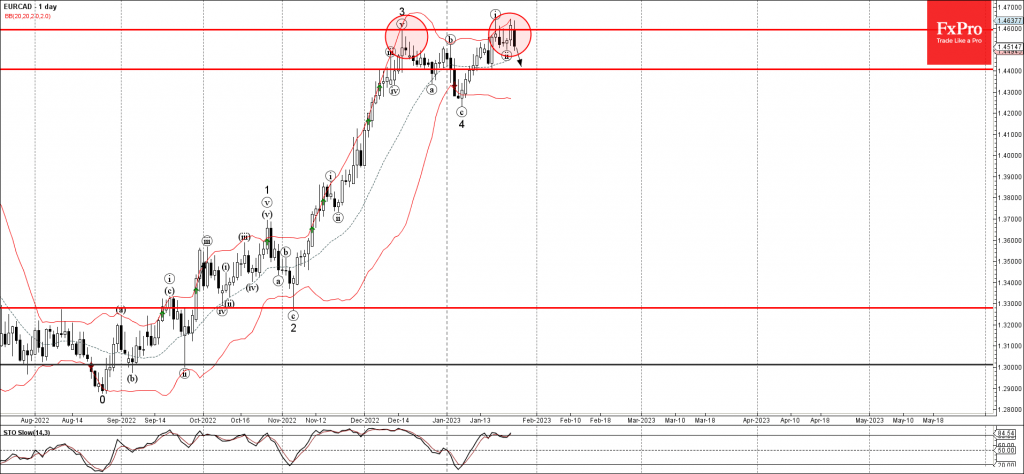
- EURCAD reversed from pivotal resistance level 1.4595
- Likely to fall to support level 1.4400
EURCAD currency pair recently reversed down from the pivotal resistance level 1.4595 (which stopped the sharp uptrend in the middle of December).
The resistance level 1.4595 was further strengthened by the upper daily Bollinger Band.
EURCAD currency pair can be expected to fall further toward the next support level 1.4400 (which reversed the price sharply earlier this month).
Natural Gas Wave Analysis
- Natural gas broke support zone
- Likely to fall to support level 2.5000
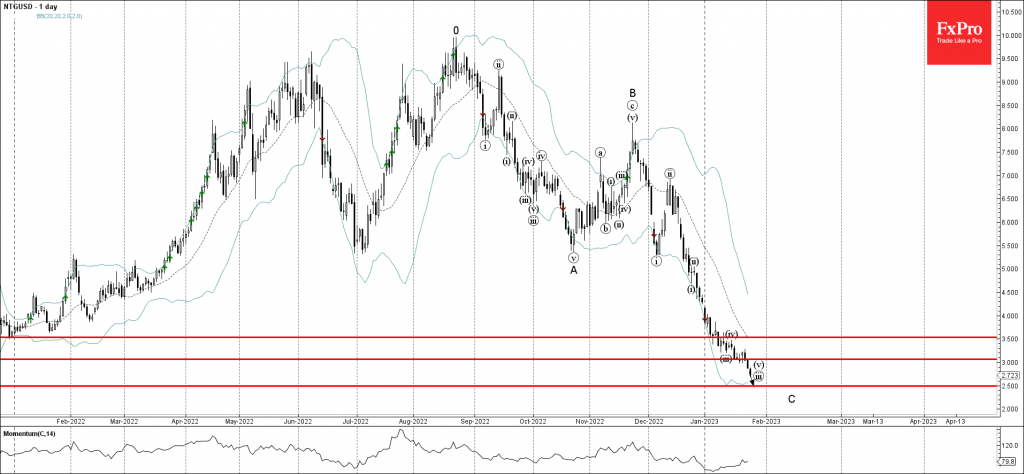
Natural gas recently broke the support zone lying between the round support level 3.000 and the support level 3.500, which started the sharp uptrend at the end of 2021.
The breakout of these support levels accelerated the active impulse waves (iii) and C.
Natural gas can be expected to fall further toward the next support level 2.5000 (target price for the completion of the active impulse wave C).