Sample Category Title
EURJPY Retreats After Hitting Downtrend Line at 142.00
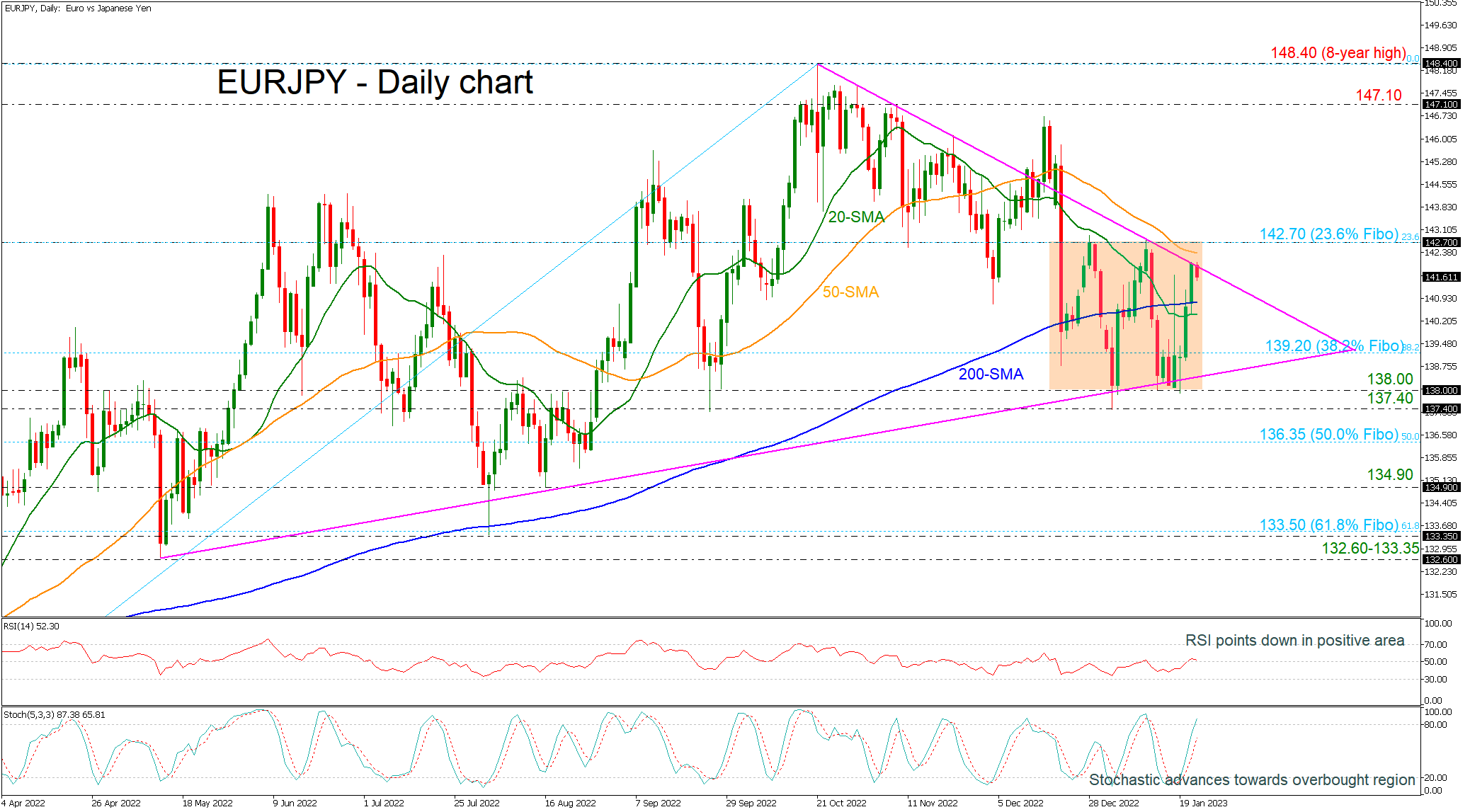
EURJPY has been developing within a symmetrical triangle in the long-term timeframe, taken from the troughs in May 2022 and the peak in October 2022. Moreover, in the short-term view, the price is consolidating within a trading range with upper boundary the 23.6% Fibonacci retracement level of the up leg from 124.40 to 148.40 at 142.70 and lower boundary the 138.00 psychological mark, while it found strong resistance at the downtrend line at the moment.
Technically, the RSI indicator is sloping slightly down in the positive territory, while the stochastic is approaching the overbought area, suggesting more gains in the near term.
If the bulls manage to climb beyond the downtrend line and the 50-day simple moving average (SMA) at 142.35 may hit the 23.6% Fibonacci at 142.70. A successful rally above them could change the recent neutral mode to bullish, testing the 147.10 resistance and the eight-year peak of 148.40.
On the other hand, a continuation of the recent retreat could open the door for a touch of the 200-day SMA at 140.80 and the 20-day SMA at 140.45. Below these lines, the 38.2% Fibonacci at 139.20 and the 138.00 round number may halt bearish actions. However, if the bears break that level too, this could take the market towards 137.40 and 136.35, which is the 50.0% Fibonacci, shifting the bias to bearish again.
All in all, EURJPY is looking neutral in the short-term timeframe and traders need to wait for a jump above 142.70 or a drop below 138.00.
Recent Rise in Yields Created Some Breathing Space
Markets
The week started with a quiet but constructive trading session. No news apparently was considered good news. Eco data, if any, were second tier. The EC consumer confidence improved modestly, from -22.0 to -20.9, nothing to get euphoric about. Even so, it didn’t affect the positive equity sentiment. The EuroStoxx50 closed with a gain of 0.75%. This time it was the US indices’ turn to outperform with gains up to 2.01% (Nasdaq). The positive risk sentiment this time didn’t need the support from lower yields. Both US and European yields continued the bottoming out process that started last week. German yields gained between 2.1 bps (2-y) and 3.1 bps (5-y), with swaps slightly underperforming Bunds (swaps + 4.5/5 bps in the 2-10 sector). ECB speakers Kazimir and Vujic took the last opportunities to join the majority mantra that more 50 bps rate hikes will most likely be necessary (ECB blackout period before the February 2 meeting starts tomorrow). Evidently, there is no ECB consensus view, but pleadings from the likes Stournaras to take a more gradual approach for now are only backed by a small minority. The outperformance of US equities also went hand-in-hand with a slight underperformance of US Treasuries. US yields gained between 5.9 bps (5-y) and 1.7 bp (30-y). At 3.51%, the 10-y yield tries to leave the key 3.42/3.32% support area. Recent rise in yields created some breathing space, but for sure still doesn’t bring the curve in line with recent Fed guidance. To be continued. Oil extended its gradual rebound (Brent $88.2 p/b). The comeback in the European reference TTF gas contract (€ 66 p/MWh) remains limited for now.
This morning, China and other regional markets stay closed for the Lunar New Year holidays. Still, sentiment stays constructive in line with the US yesterday. Treasuries are trading little changed. The dollar stays in the defensive (EUR/USD 1.0885, DXY 101.88). Later today, the January preliminary PMI’s take center stage. The EMU composite PMI is expected to continue the gradual bottoming out process that started in November, probably rising from 49.3 to 49.5. An easing of mainly energy-driven prices pressures might provide some breathing space, both for European consumers and companies, potentially translating into a milder economic setback than was expected a few months ago. Question is what a combination of easing prices pressure and hopes for better activity should mean for European markets. In theory it might be a further supportive for European equities, but they already substantially outperformed the US of late. It might also support the euro as it would make it easier for the ECB to fulfill its anti-inflationary commitment. If so, European yields might continue their recent rebound with the 2.25% area a next ST target for the 10-y German yield. Also keep an eye at the US PMI’s. Weaker PMI’s over the previous months sometimes supported market expectations on a softer Fed approach. However, also the US composite PMI is expected to bottom (rebound from 45 to 46.4). Day-to-day momentum still suggests that a test of the EUR/USD 1.0942 level (50% retracement since early 2021) is on cards. EUR/GBP is still locked in a very tight range near 0.88.
News Headlines
Japan’s composite PMI rose from 49.7 to 50.8, back in expansion territory in January. The advance was exclusively driven by a further recovery in the services sector (52.4 from 51.1) thanks to a nationwide travel subsidy programme and the relaxation of Covid restrictions. New orders, backlogs and output all grew stronger than in December. Employment levels however decreased for the first time in year and expectations for the year ahead were less positive due to faster rising input prices. The manufacturing gauge was unchanged at 48.9, signaling a contraction. There were some positive developments though as both output & new orders printed weaker declines than the month before & employment grew stronger. The outlook in the sector turned more optimistic. The Japanese yen appreciates marginally this morning. USD/JPY edges lower from 130.67 to 130.14.
The European Parliament will vote today on a change in banking regulation that would cut the increase in capital requirements on securitisations in half. Securitisation is a liquidity and risk-reducing tool in which assets are bundled into investment vehicles before being sliced in sellable tranches. The technique was barely used in Europe the last 15 years because of the high capital requirements and flurry of disclosure rules. The banking industry hopes that the regulation overhaul will revive the market, offering a more attractive funding source in times of monetary tightening.
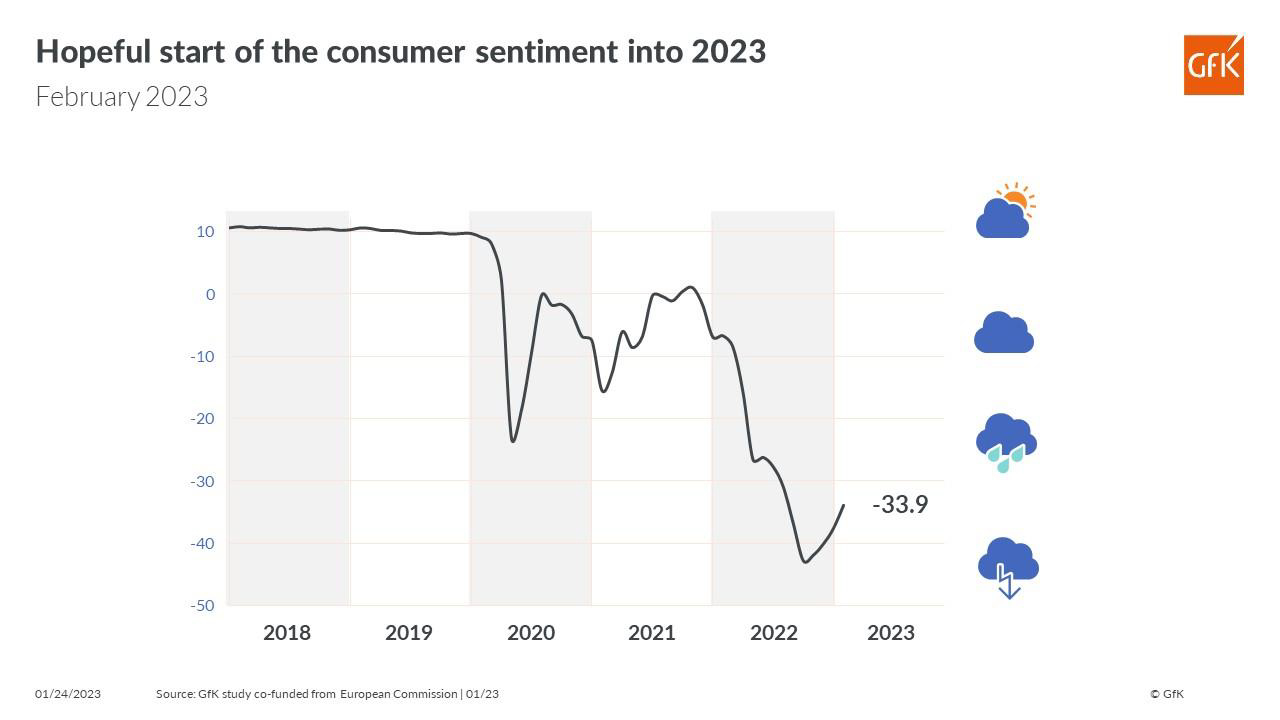
Germany Gfk consumer sentiment rose to -33.9, positive trend consolidating
Germany Gfk consumer sentiment for February rose 3.7 pts to -33.9, below expectation of -33.0. In January, Economic expectations improved from -10.3 to -0.6. Income expectations rose from -43.4 to -32.2. Propensity to buy dropped from -16.3 to -18.7.
"With the fourth increase in a row, the positive trend in consumer sentiment is consolidating. Even though the level is still very low, pessimism has eased recently", explains GfK consumer expert Rolf Bürkl.
"Falling energy prices, such as for gasoline and heating oil, have ensured that consumer sentiment is less gloomy. Nevertheless, 2023 will remain difficult for the domestic economy. Private consumption will not be able to positively contribute to overall economic development this year. This is also signaled by the still very low level of the indicator."
More Job Cuts, PMI Data and Microsoft Earnings
The week started with more news of layoffs, and further gains in the S&P500.
Spotify was the latest tech company to announce it will let go of 6% of its workforce – around 600 jobs. Shares gained 2% Ford announced it will cut 3200 jobs, mostly in Germany. Shares jumped more than 3%.
Easy. Companies slash jobs, investors buy shares.
But job cuts and cost-saving measures may not be all positive; they could also be a sign of a slowing demand. Just saying.
Anyway, the persistent optimism from investors, and the urge to call the end of the bear market pushed the S&P500 above the 200-DMA, yet again. Earnings will decide whether the latest gains will be sustainable.
All eyes are on Microsoft
All eyes are on Microsoft – not only because it will release Q4 earnings after the bell, but also because it’s been making a great buzz since the start of the year thanks to its bet on ChatGPT.
The company confirmed yesterday that is putting $10 billion into the now-very-famous ChatGPT.
And given the traction that ChatGPT has gained since the start of the year, Microsoft could be on a winning path with its AI-bet.
The company’s CEO said last week in Davos that every Microsoft product will have a certain AI-capability. The bots will be able to analyze Excel spreadsheets, to create AI art to illustrate a PowerPoint presentation, or even draft a whole email in Outlook. This is good news for everyone.
As such, it could well secure Microsoft's position as exclusive cloud computing provider to one of the world's leading – or at least the most famous to date - AI start-ups; it is a boost to its Azure cloud business, and perhaps to its search engine Bing, as well, which has remained well under the shadow of Google since ever.
Let’s see if Microsoft will be the one to push the S&P500 above the year-long down trending channel top – despite the looming recession chatter.
PMI
PMI data released this morning showed that the manufacturing activity in Japan didn’t improve in January, and remained in the contraction zone, although the services PMI printed a better-than-expected expansion. The dollar-yen advanced past the 130 level on Monday, but finds sellers above that level, as traders continue betting against the Bank of Japan’s (BoJ) dovish policy, which makes little sense in the actual market environment. Buying the yen against US dollar remains a popular trade.
In Australia, the manufacturing PMI slipped below 50, into the contraction zone for the first time in 32 months, but business confidence improved to a three-month high, on hopes that China’s reopening will make sure that activity doesn’t stay depressed for long. The Aussie-dollar broke above the 70 cents level, as predicted, and consolidated above that level despite the weak PMI read this morning. The pair should continue its journey north on the back of a globally softer US dollar, and prospects of a better Chinese demand that boost commodity prices, including iron ore – which matters for the Aussie.
In other currencies, the EURUSD couldn’t consolidate gains above the 1.09 mark yesterday. But today’s PMI data could help give another boost to the single currency.
And, if not, the message from the European Central Bank (ECB) is crystal clear: the rate hikes will continue and that’s positive for the euro.
Fun fact: The ECB went from one of the most dovish central banks last year – except the Bank of Japan and the Turkish central bank – to one of the most hawkish central banks in just a year.
If the euro weakened to below parity last year because of the dovish ECB divergence, the hawkish rectification in the ECB’s policy stance should help it to recover further.
Focus Turns to the PMIs
Market movers today
The market highlight today will be the January PMI figures for the euro area, UK and US, which will give a first glimpse into the state of the global economy in 2023. The latest euro optimism could get another boost from further signs that the rebound in euro area leading indicators extends into Q1, while in the US we expect PMIs still to paint a weak overall picture, as it seems the economy clearly lost steam.
In Denmark, business confidence is on the agenda and in Sweden we get Prospera inflation expectations, which could show a drop.
Overnight, Australian Q4 CPI could be the deciding factor for RBA's February meeting, as markets remain split between a pause and a 25bp hike.
The 60 second overview
Euro area: While ECB's 50bp hike next week seems like a done deal, yesterday's comments reflected uncertainty over the hiking pace in March. ECB's Kazimir explicitly favoured two more 50bp hikes, while Lagarde reiterated that rates will have to be hiked 'significantly at a steady pace'. That said, both Stournaras and Visco called for more cautious approach. We expect two more 50bp hikes, followed by a final 25bp in May, which is also the base case for the markets with cumulative 119bp priced in by May. On a positive note, euro area flash consumer confidence continued recovering in January, although from a historical perspective the index still remains extremely low at -20.9 (Dec. -22.0).
PMIs today: Consensus expects a modest uptick in the euro area PMIs today, but overnight, both Japanese and Australian PMIs painted a fairly mixed picture. Service sector indices recovered from December, but manufacturing PMI remained low in Japan and even ticked lower in Australia. In Japan, the underlying price indices sent mixed signals, with service sector input price pressures continuing to build (62.6, from 61.5), but output price indices easing. Meanwhile the Australian labour market appears resilient to the overall gloomy economic outlook, with both employment indices rising further above 50.
Commodities: Brent oil prices rose above USD88/bbl yesterday, while LMEX industrial metals index is already 25% above its late October lows. Faster reopening in China is expected to give a boost to commodity demand, as record-high savings suggest that pent-up demand could drive a quick uptick in economic activity. Last week, we also revised our Chinese GDP forecast higher.
FI: European government bond yields and interest rates rose modestly as the market looks towards two hikes of 50bp at the next two meetings in February and March, respectively. Hence, we are gain looking at a terminal rate of 3.25% to 3.5%. We did see a widening of the Bund ASW-spread that continues to struggle breaking through the 60bp-level. The European yield curves continue to be significantly inverse and with ECB remaining hawkish it is difficult to see this trend being broken.
FX: Yesterday's FX session was generally characterised by a modest USD comeback and the rise in oil supporting the traditional oil currencies and not least NOK. JPY suffered from both the rise in oil and global yields leaving USD/JPY not far from the 131 mark. With the strengthening of the dollar EUR/USD has come back below 1.09 again.
Credit: Credit markets were off to a decent start on Monday despite a mixed outlook for rates amidst hawkish comments from the ECB. Itrax main tightened 2.7bp to close at 78.8bp and Itrax Xover tightened 14bp to close at 415.1bp. Primary market activity for corporates was slowing down from recent weeks, with most corporates moving into silent period before results.
Nordic macro
Sweden: Prospera's survey of money market players' inflation expectations, due for release at 08:00, ought to show a significant drop, in particular at the 1-year horizon from the most recent print of 4.6%. This is because we ourselves forecast inflation to be quite close to 2% at the beginning of 2024.
EUR/USD Daily Outlook
Daily Pivots: (S1) 1.0837; (P) 1.0882; (R1) 1.0917; More...
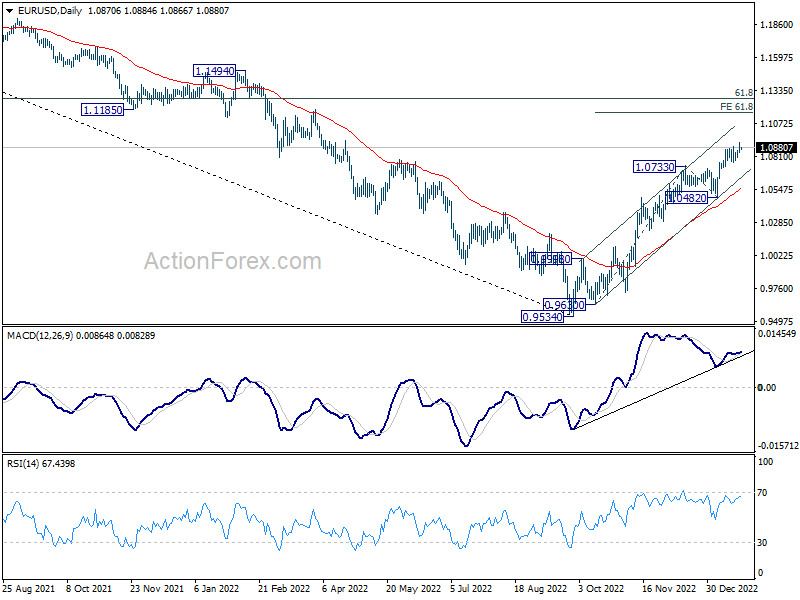
Further rally is expected in EUR/USD with 1.0765 support intact. Current rise from 0.9534 should target 61.8% projection of 0.9630 to 1.0733 from 1.0482 at 1.1164 next. On the downside, though, break of 1.0765 support should now indicate short term topping, and turn bias back to the downside for 55 day EMA (now at 1.0557).
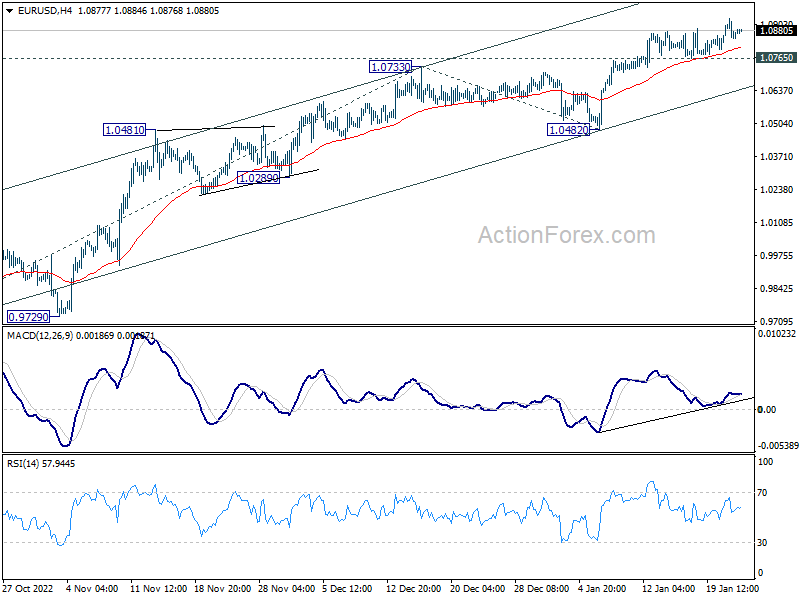
In the bigger picture, current development suggests that the rally from 0.9534 low (2022 low) is a medium term up trend rather than a correction. Further rise is in favor to 61.8% retracement of 1.2348 (2021 high) to 0.9534 at 1.1273 next. This will remain the favored case as long as 1.0482 support holds.
GBP/USD Daily Outlook
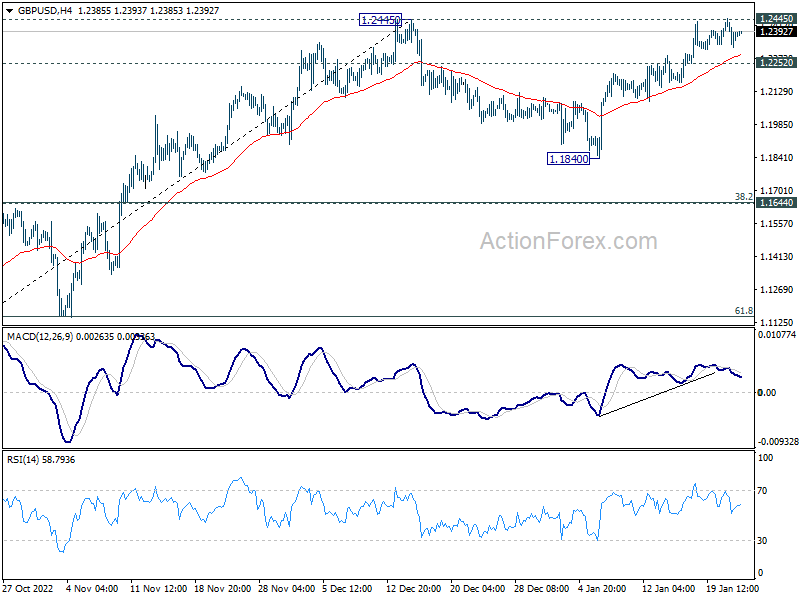
Daily Pivots: (S1) 1.2319; (P) 1.2384; (R1) 1.2443; More...
GBP/USD is staying in consolidation in tight range and intraday bias remains neutral. On the upside, decisive break of 1.2445 will confirm resumption of whole rise from 1.0351. Next target will be 1.2759 fibonacci level. On the downside, break of 1.2252 minor support will turn bias to the downside, and extend the corrective pattern from 1.2445 with another falling leg.
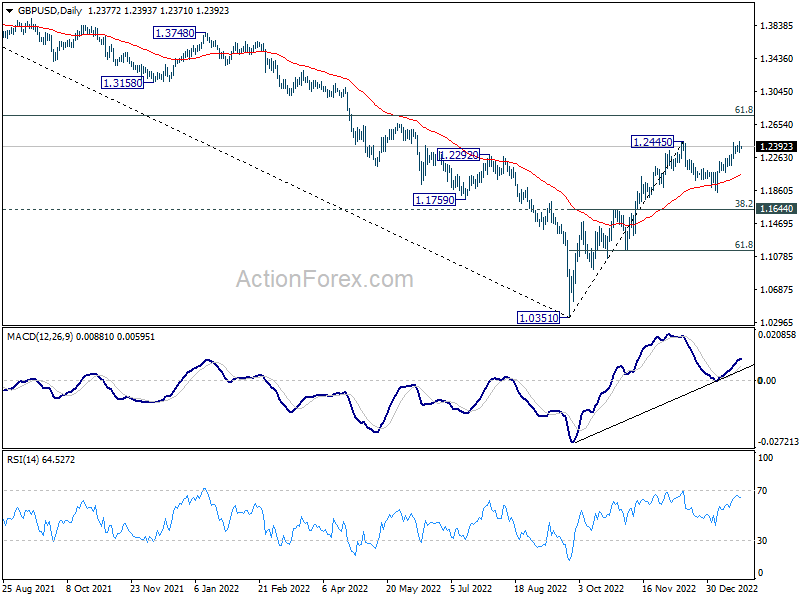
In the bigger picture, rise from 1.0351 medium term bottom is at least correcting whole down trend from 1.4248 (2021 high). Further rise is expected as long as 1.1644 resistance turned support holds. Next target is 61.8% retracement of 1.4248 to 1.0351 at 1.2759. Sustained break there will pave the way back to 1.4248.
USD/CHF Daily Outlook
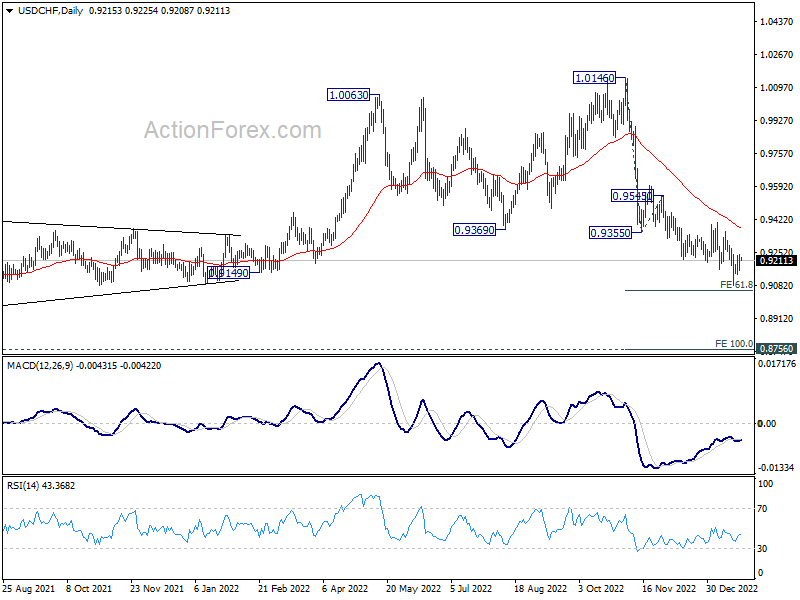
Daily Pivots: (S1) 0.9152; (P) 0.9193; (R1) 0.9245; More...
Intraday bias in USD/CHF remains neutral for the moment. Outlook also stays bearish with 0.9407 resistance intact. On the downside, sustained break of 61.8% projection of 1.0146 to 0.9355 from 0.9545 at 0.9056 will pave the way to 100% projection at 0.8754, which is close to 0.8756 long term support. Nevertheless, on the upside, break of 0.9407 should confirm short term bottoming and turn bias back to the upside.
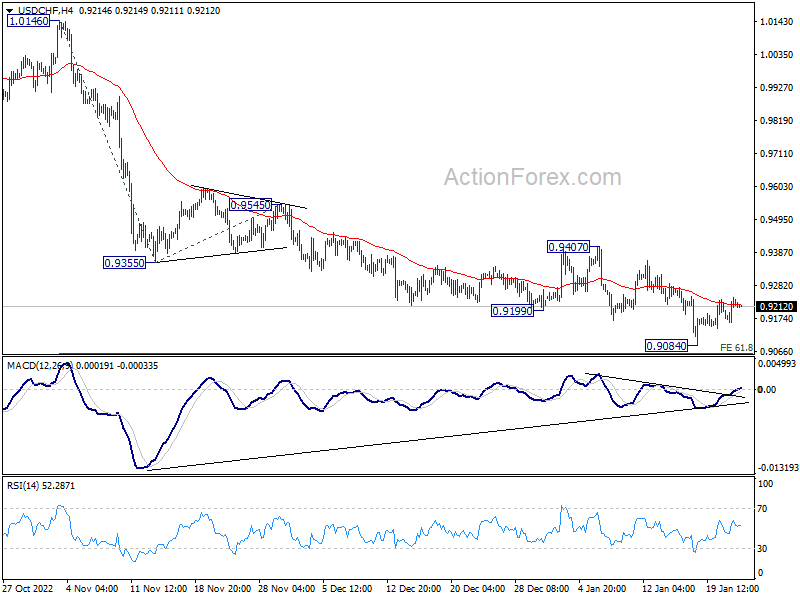
In the bigger picture, rise from 0.8756 (2021 low) has completed at 1.0146, well ahead of 1.0342 long term resistance (2016 high). Based on current downside momentum, fall from 1.0146 should be a medium term down trend itself. Next target is a test on 0.8756 low. Strong support should be seen there to bring rebound. Still, further decline will now be expected as long as 0.9407 resistance holds, in any case.
USD/JPY Daily Outlook
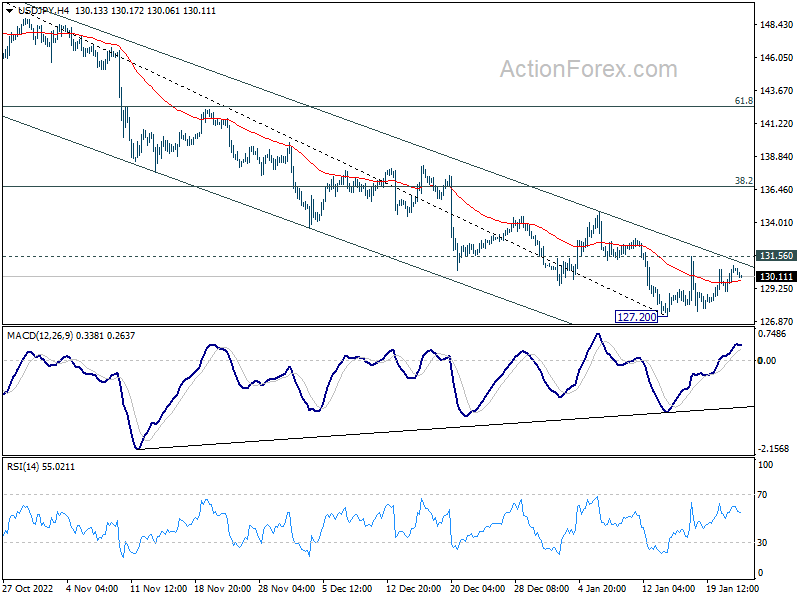
Daily Pivots: (S1) 129.53; (P) 130.21; (R1) 131.37; More...
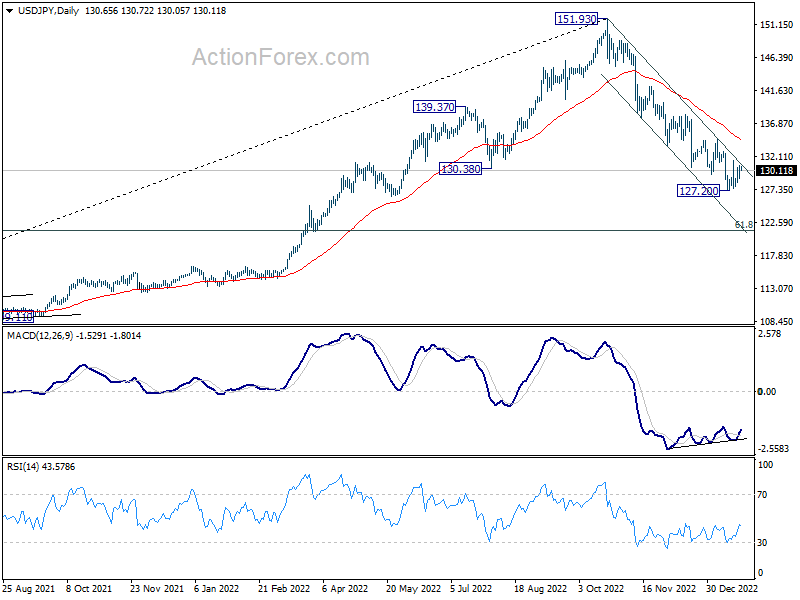
Range trading continues in USD/JPY and intraday bias stays neutral at this point. On the downside, break of 127.20 will resume the whole decline from 151.93 and target 121.43 fibonacci level. Nevertheless, on the upside, break of 131.56 should confirm short term bottoming, and turn bias back to the upside for stronger rebound to 55 day EMA (now at 134.49).
In the bigger picture, the break of 55 week EMA (now at 131.47) raises the chance of medium term bearish reversal, but that's not confirmed yet. Strong support could be seen around 61.8% retracement of 102.58 to 151.93 at 121.43 and 38.2% retracement of 75.56 to 151.93 at 122.75 to bring rebound. But break of 131.56 resistance is needed to indicate bottoming first. Otherwise further fall will remain in favor.
USD/CAD Daily Outlook
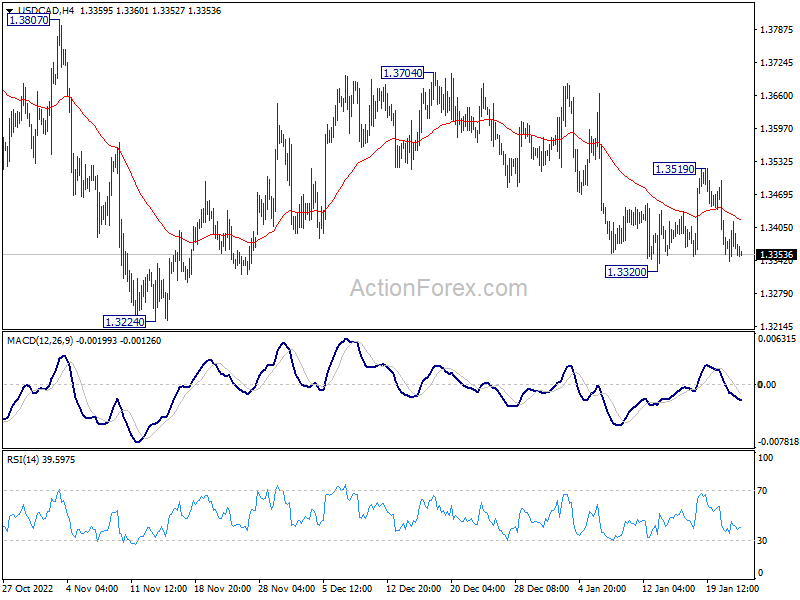
Daily Pivots: (S1) 1.3333; (P) 1.3376; (R1) 1.3409; More....
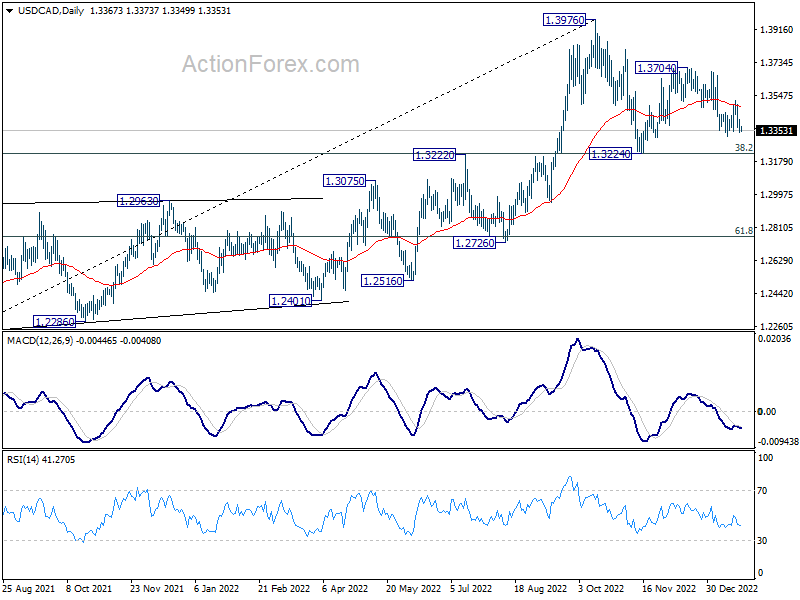
Range trading continues in USD/CAD and intraday bias stays neutral at this point. On the downside, break of 1.3320 will resume the fall from 1.3704 to 1.3224 key support level. On the upside, though, above 1.3519 will turn bias back to the upside for 1.3704 resistance.
In the bigger picture, as long as 1.3222 cluster support (38.2% retracement of 1.2005 to 1.3976 at 1.3223) holds, larger up trend from 1.2005 (2021 low) is still expected to resume through 1.3976 high at a later stage. However, firm break of 1.3222/3 will indicate that the trend might have reversed. Deeper fall would be seen to next cluster support at 1.2726 (61.8% retracement at 1.2758).