Sample Category Title
US GDP and PCE Inflation Eyed Ahead of Fed Decision as Dollar Languishes
Investors will get the first reading on US GDP growth for the fourth quarter on Thursday (13:30 GMT), while on Friday, the last inflation statistics before Fed policymakers gather for their first meeting of 2023 will be watched. The data could be a boon for risk appetite, as the American economy probably grew at a solid clip in Q4, and inflation as measured by the PCE price index moderated further. But the US dollar is looking increasingly in trouble, as the Fed has already strongly hinted that another downshift in the pace of rate hikes is on the cards next week.
Headed for recession?
It's a busy few days for US data and fresh out of the oven are S&P Global’s flash PMI estimates for January. US growth stuttered towards the end of 2022 according to both the S&P and ISM surveys and it doesn’t appear that there was a dramatic improvement at the beginning of 2023 as the PMIs point to ongoing contraction in business activity, albeit at a smaller pace.
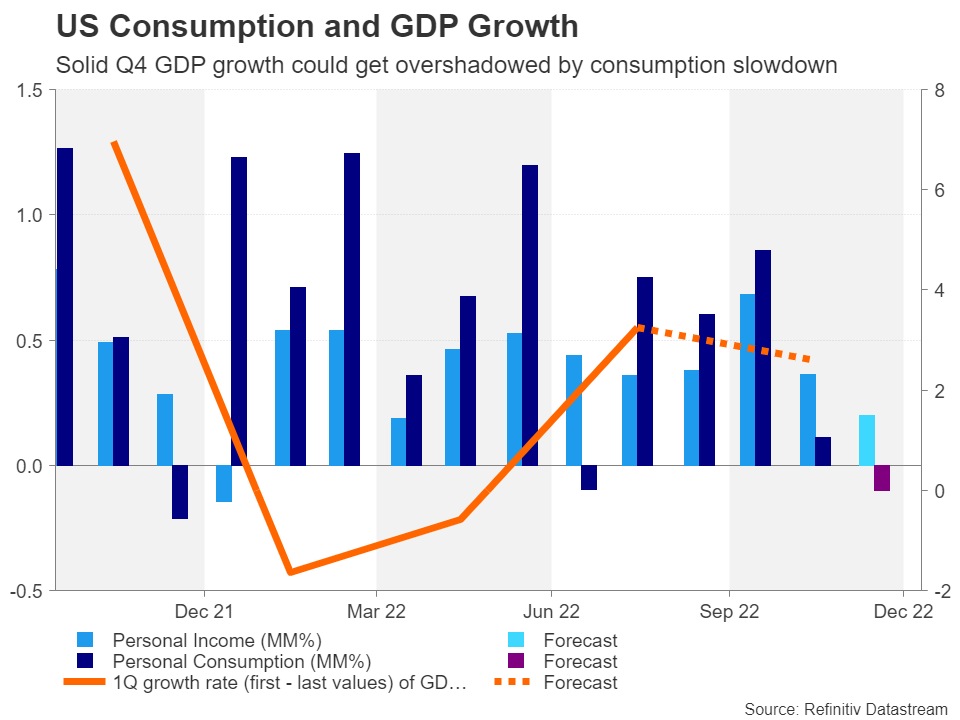
However, despite the general deterioration in the various indicators, the economy isn’t in a broad-based decline yet and therefore not quite in a recession. Durable goods numbers due on Thursday are expected to show that orders bounced back by 2.5% over the month in December after tumbling 2.1% in the prior month. More encouragingly, GDP is projected to have notched up annualized growth of 2.6% in the final three months of 2022.
Weaker consumption poses a danger
However, Friday’s data on personal income and spending will be more crucial in painting a more accurate picture for what to expect for the current quarter amid signs that US consumers have finally started to feel the squeeze from soaring prices. Personal income is forecast to have risen by 0.2% m/m in December, halving from November’s rate of 0.4%, while consumption is expected to have dropped by 0.1% m/m after increasing by 0.1% previously.
If consumer spending does indeed fall in December, it would suggest that the post-pandemic spending spree has run its course and that the Fed’s series of interest rate hikes have finally started to bite. The outlook for consumers remains clouded because although inflation is falling, which should boost real wages in the coming months, job losses are on the rise, especially in the tech sector.
Inflation is falling
Nevertheless, the latest PCE inflation figures should offer some relief on Friday if they support the market view that a Fed pivot is nearer than what policymakers would like to publicly acknowledge. The core PCE price index, which is favoured by the Fed, is forecast to have quickened slightly to 0.3% on a month-on-month basis, but the 12-month rate is expected to have edged further down from 4.7% to 4.4%, which would make it the lowest since October 2021.
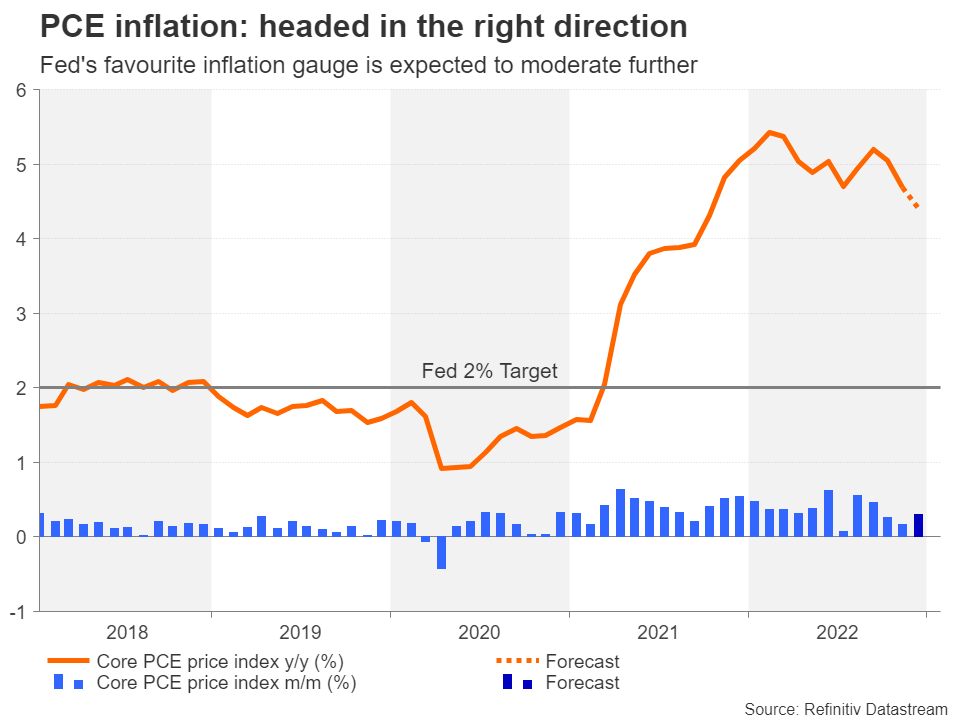
If the downward trend in core PCE is maintained and there aren’t upside surprises in any of the other data points, particularly personal consumption, the dollar is likely to come under pressure. The greenback’s gauge against a basket of currencies is drifting near eight months lows, while the euro has scaled a nine-month peak versus its US counterpart.
Can the dollar regain the front foot?
But the single currency has just reached a key technical level – the 50% Fibonacci retracement of the January 2021-September 2022 downtrend, which may prove to be a more challenging barrier to overcome. Furthermore, with the FOMC and ECB decisions due on February 1 and 2, respectively, some investors might sit on the sidelines until then.
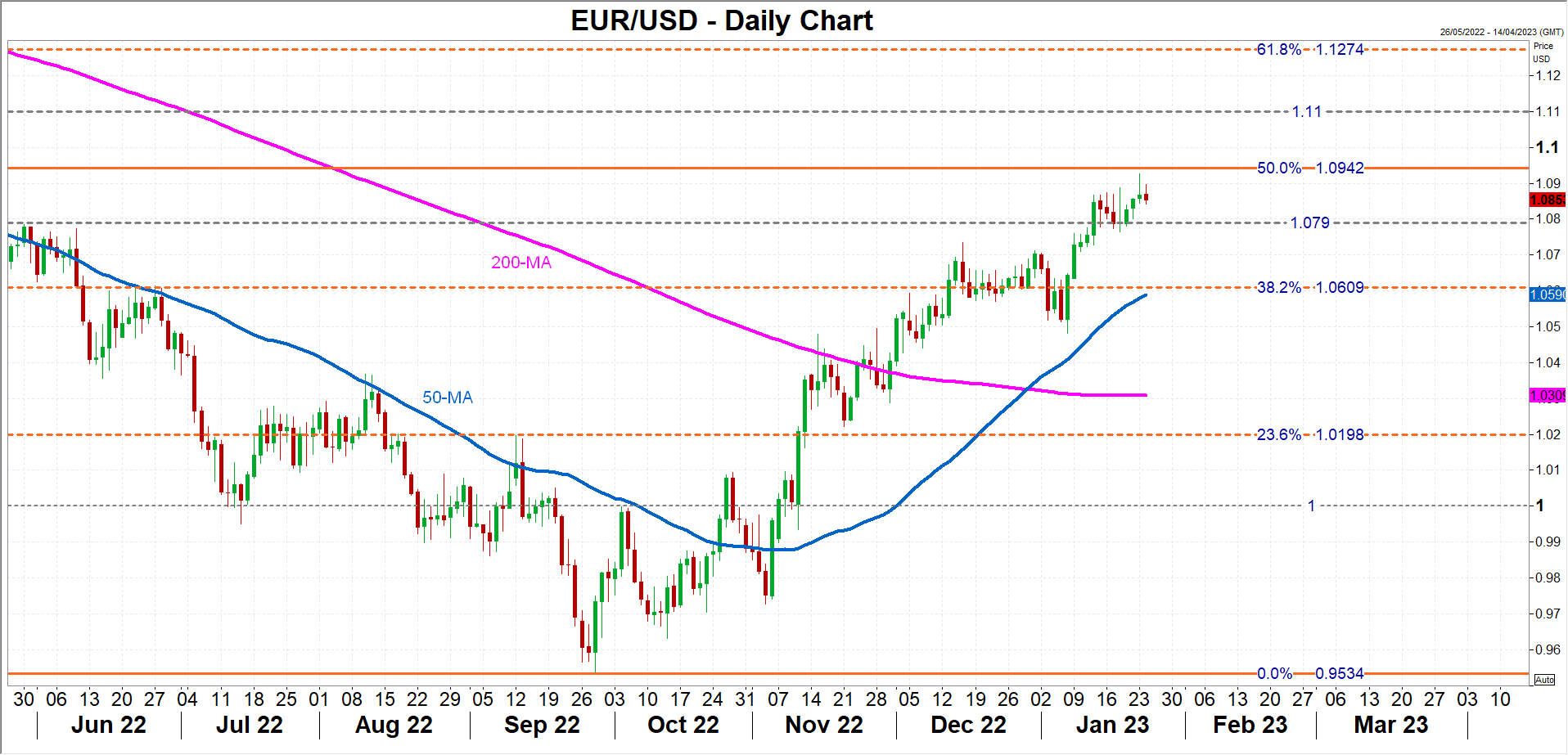
Still, a soft set of data has the potential to lift the euro above the 50% Fibonacci of $1.0942, opening the way for the $1.11 handle. Alternatively, if inflation doesn’t slow as fast as anticipated, the euro could seek immediate support in the $1.0790 region before heading towards its 50-day moving average at $1.0590.
In the bigger picture, the odds might be stacked against the dollar, as the pace of monetary policy tightening between the Fed and other central banks begins to diverge in 2023 and the US economy teeters on the brink of recession. But that doesn’t mean that there is cause to fall too out of love with US assets as this rotation out of the dollar could merely be an adjustment after investors became too optimistic about America’s growth prospects and overly pessimistic about the rest of the world's.
ECB Panetta: Beyond February any unconditional guidance would depart from data-driven approach
ECB Executive Board member Fabio Panetta said in an interview, "It was reasonable to increase rates in December and signal a similar step in February."
"But beyond February any unconditional guidance – that is, guidance unrelated to the economic outlook – would depart from our data-driven approach."
"Our December decisions were based on the projections available at that time. In March we will have new ones and should reassess the situation."
"Inflation is still too high, but recent developments suggest that we can fend off the risks of second-round effects and bring down inflation by continuing to adjust our policy rates in a well-calibrated, non-mechanical way."
Fed Preview: What It Takes for the Fed to Cut Rates
Fed Preview: What It Takes for the Fed to Cut Rates
- The Fed looks keen on raising Fed funds rate to 5%. We expect a 25bp rate hike next week followed by another 25bp hike in March and May, respectively.
- A turn in the business cycle and drop in short-term inflation expectations pave the way for rate cuts next year, but the neutral rate is higher than before the crisis.
- We think the trajectory for Fed funds discounted by markets looks broadly fair, but we see slight upside to the front end of the curve and in particular 6M-2Y.
The Fed appears adamant to raise Fed funds rate to 5%, but it will take a little longer than we previously expected. We now look for the Fed to hike 25bp next week followed by two more 25bp hikes in March and May to conclude the hiking cycle. For markets, focus has already turned to looming cuts - the swap market discounts first two 25bp rate cuts already in the second half of this year. We look at what it takes this time for the Fed to cut rates.
Normally, a turn in the business cycle paves the way for the Fed to cut rates. This time it needs to take into account the risk of prolonging the underlying inflation. The drop in inflation and wage growth are encouraging signs for the Fed, but labour market conditions remain tight. Recent easing in financial conditions and higher metal prices point towards a rebound in the manufacturing cycle, but the Fed cannot risk retightening labour markets too early when no real slack has been created. For now, most leading indicators remain firmly at recessionary levels, and we expect modest GDP contraction in the coming quarters, but the downturn could be shallower than previously thought. Some further easing in labour market conditions will still be needed for the rate cuts to materialise.
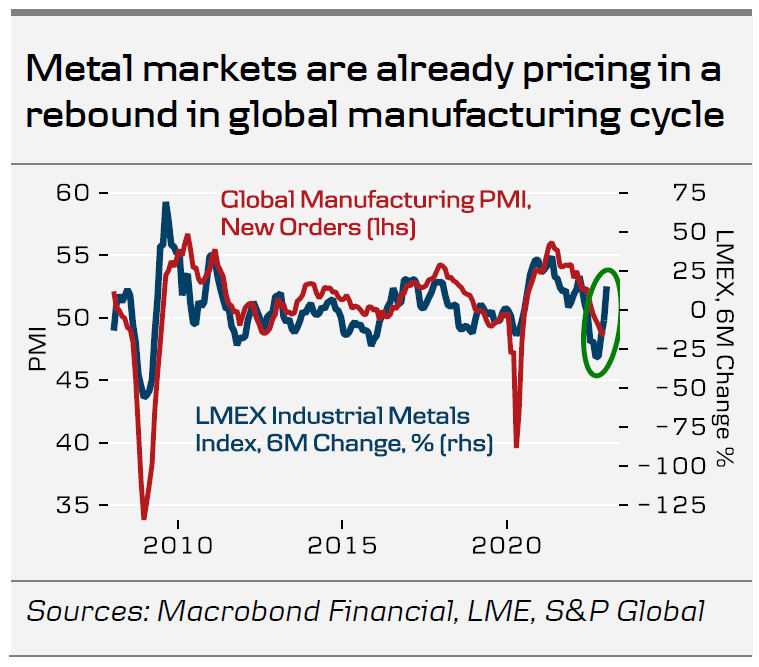
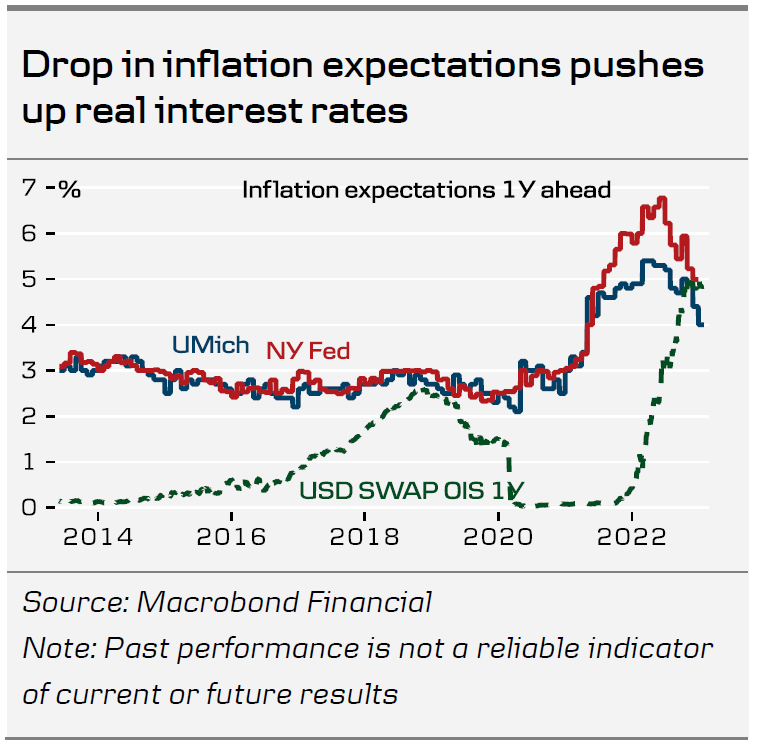
That said, the Fed could succeed in a soft landing, i.e. get inflation down to 2% and avoid a (deep) recession in the economy, which in our view would warrant rate cuts. A 5% policy rate is suitable, when inflation and inflation expectations are high, but not compatible with 2% inflation. Both market and consumer survey based short-term inflation expectations have declined recently, which means the Fed can lower its (nominal) policy rate and keep the real interest rate and thus monetary policy unchanged. The trend in short-term inflation expectations sets the pace and timing for the rate cuts even without a recession.
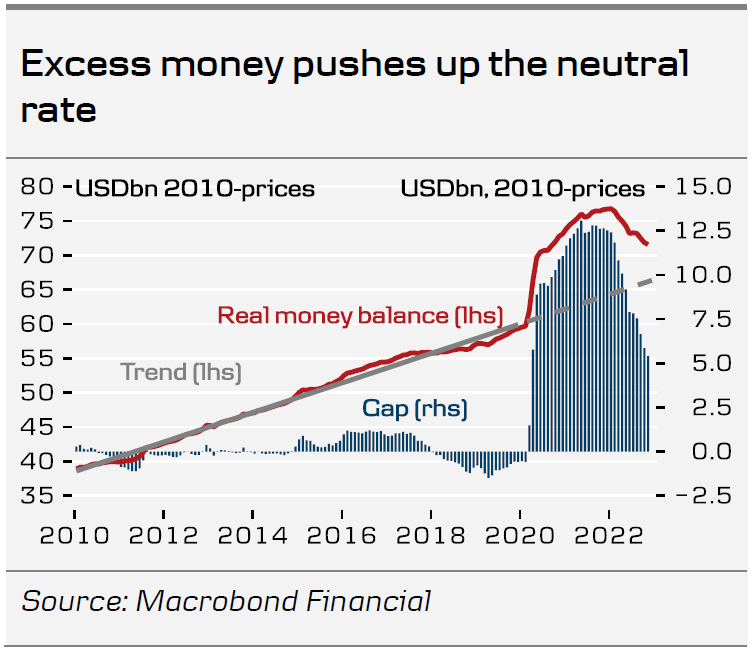
The neutral rate of interest in the US is higher now than before the crisis. There is still a real money balance surplus in the US. It requires the Fed to keep real interest rates higher to avoid a resurgence in inflation. If the neutral Fed funds rate was 2-2.5% before the crisis, it might now be 2.5-3%. It dictates the end-point for future rate cuts.
The market discounts the Fed to hike Fed funds to 4.9% in June and lower it to 2.5% in the coming 2-3 years. We think the trajectory looks broadly fair, but see upside to the front end of the curve and in particular 6M-2Y, i.e. we expect rates to peak at slightly higher level, for the Fed to first cut rates in 2024 and probably not all the way to 2.5%. This is a soft landing scenario for interest rates, where the US gets away with mild recession or avoids it completely. If inflation starts to rebound (e.g. on the back of the recent rally in commodity prices), the Fed may have to keep Fed funds at 5% or higher for longer. If labour market conditions suddenly deteriorate and inflation plunges, rate cuts would come sooner.
Sunset Market Commentary
Markets
Positive risk vibes coming from WS yesterday and Asia this morning, triggered a positive start in Europe as well. The single currency profited, with EUR/USD reaching for the 1.09 handle. Opening moves occurred in the run-up to EMU January PMI releases. Recall that markets since November reacted asymmetric to economic releases. They embraced negative economic surprises and below-consensus inflation prints. Both from the point of view that these would stop central banks from executing their monetary policy normalization plans. It led to the current situation where market positioning is completely misaligned with central bank guidance. Markets are betting on a lower policy rate peak than central banks suggest while simultaneously betting on a soon (<6 months) policy reversal once rates hit those peak levels. Central banks stress the opposite: don’t expect any rate cuts say in the next 12 months after hitting the peak. It’s important to keep this situation sketch in mind when looking at today’s EMU PMI’s and the market reaction. Both EMU manufacturing (48.8 from 47.8) and services PMI (50.7 from 49.8) beat consensus with the composite number (50.2 from 49.3) moving back above the 50 boom/bust handle for the first time since June 2022. S&P Global, responsible for the surveys, dedicated the tentative return to growth to markedly improving prospects for the year ahead with order books meanwhile showing reduced rates of contraction. Employment growth also picked up momentum as firms prepared for a better than previously expected year ahead. The PMI survey adds to evidence that the EMU could escape a recession with the nadir being reached back in October. Falling energy prices, easing supply chain stress and the Chinese reopening restored confidence since though we’re not out of the woods yet. Average selling prices for both goods and services ticked higher, reflecting still-elevated cost growth and upward wage pressure. Those strengthen the case for monetary policy makers to pursue more normalisation/tightening in their inflation crusade. For the first in a long time, that’s how European markets reacted post-PMI’s. Although the move lacked real strength, it was clearly directional. The EuroStoxx50 trades 0.7% off its intraday high. European bonds – who already sold off in recent sessions – grinded a few ticks lower. EUR/USD fell back to 1.0860. EUR/GBP surged from 0.8770 to 0.8840 with sterling weakness stemming from disappointing PMI’s (composite 47.8 from 49). US January PMI’s beat consensus as well, rebounding slightly more than forecast. The composite measure increases from 45 to 46.6 (still way into contraction territory). In a first reaction, US yields and the dollar gain a few ticks, as does – somewhat counterintuitive – US stocks. Moves remain very limited in absolute terms.
News & Views
The German government is due to lift its 2023 GDP projection from a 0.4% contraction to a 0.2% expansion, Bloomberg reported citing people familiar with the new forecasts. Growth for next year is seen at 1.8% from 2.3% earlier. The previous forecasting round dates back from October. At the time, fears for an energy crunch during the winter ran high and installed a mood of doom and gloom. An unusually warm winter helped cut gas/energy consumption and, combined with diversifying supplies, have eased much of those concerns. Economy minister Habeck will present the updated projections tomorrow.
Hungary’s central bank (MNB) kept the base rate steady at 13%. The MNB has said before that this level is adequate to manage fundamental inflation risks. Inflation rose to 24.5% in December due to a pick-up in fuel prices but should start to ease slowly in the first half of 2023. But still-elevated inflation expectations require a tight monetary policy for a prolonged period. To enhance monetary policy transmission, it will further absorb interbank liquidity through, amongst others, its one-day deposit quick tenders for which the rate is set at 18%. The MNB vowed to maintain the current terms of these emergency measures introduced in mid-October “until a trend improvement in risk perceptions occurs”. Some forint investors doubted the MNB’s commitment, thinking the central bank would be lured by the recent easing in global financial conditions to cut the 18% shadow policy rate already. Together with the doubling in the required reserve ratio to 10%, the Hungarian currency rallied. EUR/HUF fell from 398 to the recent lows around 392 currently. Most Hungarian swap yields pared losses of as much as 25 bps to trade 5-10 bps lower.
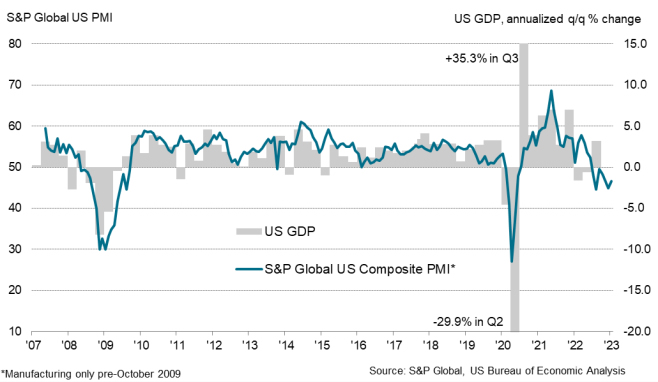
US PMI composite rose to 46.6, started 2023 on a disappointingly soft note
US PMI Manufacturing rose from 46.2 to 46.8 in January. PMI Services rose from 44.7 to 46.6. PMI Composite rose from 45.0 to 46.6.
Chris Williamson, Chief Business Economist at S&P Global Market Intelligence said:
"The US economy has started 2023 on a disappointingly soft note, with business activity contracting sharply again in January. Although moderating compared to December, the rate of decline is among the steepest seen since the global financial crisis, reflecting falling activity across both manufacturing and services.
"Jobs growth has also cooled, with January seeing a far weaker increase in payroll numbers than evident throughout much of last year, reflecting a hesitancy to expand capacity in the face of uncertain trading conditions in the months ahead. Although the survey saw a moderation in the rate of order book losses and an encouraging upturn in business sentiment, the overall level of confidence remains subdued by historical standards. Companies cite concerns over the ongoing impact of high prices and rising interest rates, as well as lingering worries over supply and labor shortages.
"The worry is that, not only has the survey indicated a downturn in economic activity at the start of the year, but the rate of input cost inflation has accelerated into the new year, linked in part to upward wage pressures, which could encourage a further aggressive tightening of Fed policy despite rising recession risks."
Choppy Trading
Equity markets are largely moving lower on Tuesday, reversing part of Monday's gains in what remains quite choppy trade.
Earnings season will continue to dominate and so far, there isn't really anything positive to take away from it. There are still a lot of huge names to report, of course, but so far it basically underlines everything investors already think about the economy at the moment.
The environment is currently very challenging and uncertain, while the labour market is overly tight under the circumstances and highly likely to loosen considerably over the coming months. Investors are looking for any indication that this may be too pessimistic but they aren't really getting what they want.
What's more, the economic data we've seen this morning doesn't exactly inspire either. The European PMIs were a little better than expected and improved in many cases while still being pretty weak. The all-important UK services sector on the other hand was both weak and softer than expected, and even last month's number was revised lower into contraction territory.
So basically the euro area may in fact avoid a recession while not really growing in any significant way, and the UK is almost certainly heading for one even if it manages to have avoided it in the second half of last year. And that's before we talk about interest rates again and whether market expectations are in fact too optimistic which would make the situation worse. It clearly doesn't take much to shift the mood in the markets.
Starting to run on fumes?
Oil prices are marginally higher again, continuing the good run they've been on since early in the year, but momentum is starting the fade. The China reopening trade has boosted oil prices considerably but we perhaps need more data to justify a continuation of that.
Reports suggest that OPEC+ delegates expect the panel to recommend no changes to output when they meet next week which indicates they believe the market is fairly balanced at the moment. Of course, there's considerable uncertainty in the global outlook and the China transition so that remains subject to change.
Rising on declining momentum
Gold is edging higher again on slightly softer yields in the bond market. Of course, it is once again doing so on weaker momentum which suggests that, barring any bullish catalyst that would change that, it may be shaping up for a correction of some kind. It's come well off its early November lows at this point and plenty of there's potentially plenty of resistance ahead. Of course, how much very much depends on the signals central banks and the economic data send over the coming weeks.
Choppiness continues
Bitcoin has been very choppy in recent days, trading largely between $22,300 and $23,300. That's a fairly tight range but importantly, it's not really given back any of the extraordinary gains it enjoyed over the last couple of weeks. That will continue to provide encouragement the longer it remains the case, especially if it can once again break higher from here.
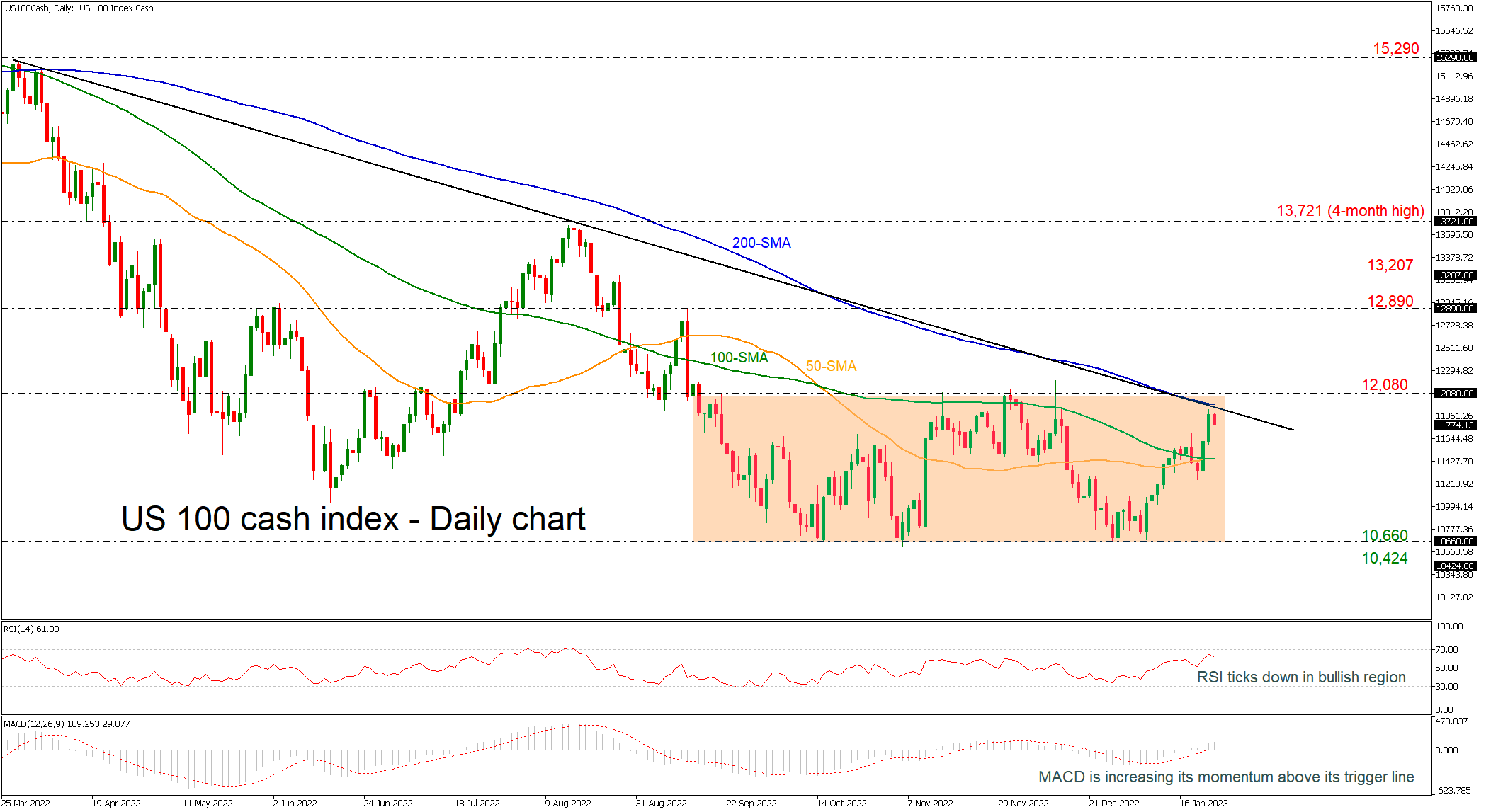
US 100 Index Fails to Conquer Downtrend Line and 200-day SMA
The US 100 cash index is flirting with the long-term downtrend line, taken from the peak in March 2022 and the 200-day SMA around 11,970. The index has been consolidating within a sideways channel with upper boundary the 12,080 resistance and lower boundary the 10,660 support. The RSI is sloping down in the positive region; however, the MACD is still extending its momentum above its trigger and zero lines.
Traders would be more eager to engage in buying activities if the price manages to surpass the nearby barrier of the 200-day SMA at 11,970. If this is successfully breached, the rally may next rest somewhere between 12,890 and 13,207.
On the flip side, the selling pressure could accelerate again if the market deteriorates below the 50- and the 100-day SMAs lines. Such a move could next bring the 10,660 lower boundary under the spotlight, which if violated could trigger sharper losses probably towards 10,424.
In the long-term timeframe, the pair is in a bearish trend, while in the medium-term it is neutral. A push above 12,080 may shift the outlook to slightly bullish.
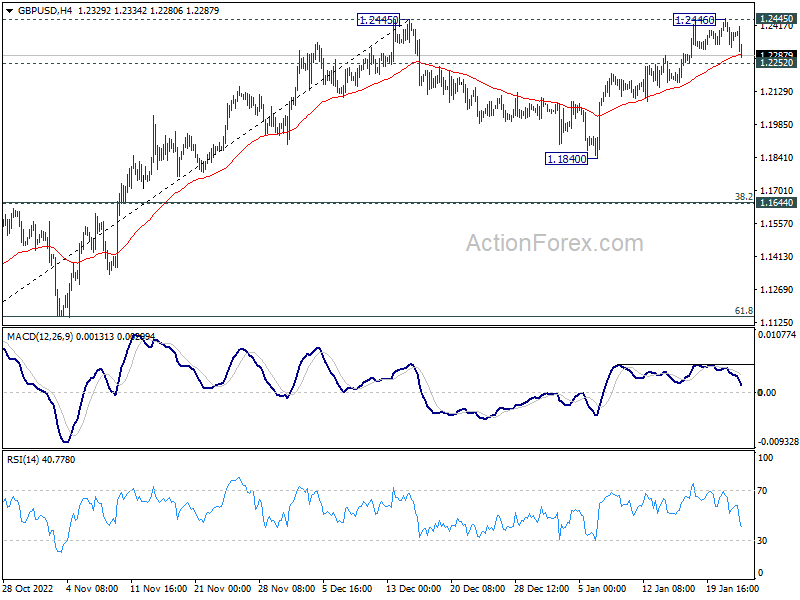
GBP/USD Mid-Day Outlook
Daily Pivots: (S1) 1.2319; (P) 1.2384; (R1) 1.2443; More...
Intraday bias in GBP/USD remains neutral despite today's decline. On the downside, firm break of 1.2252 minor support will turn bias to the downside, and extend the corrective pattern from 1.2445 with another falling leg. On the upside, decisive break of 1.2445 will confirm resumption of whole rise from 1.0351. Next target will be 1.2759 fibonacci level.
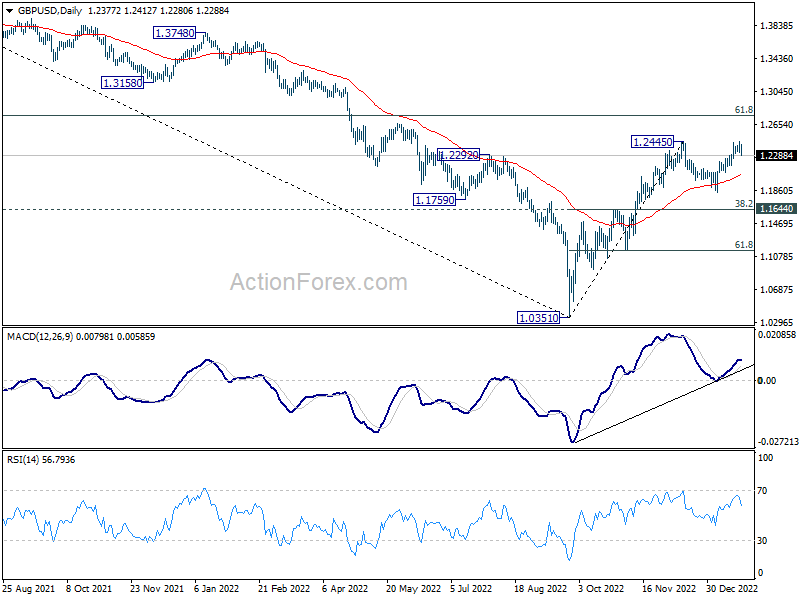
In the bigger picture, rise from 1.0351 medium term bottom is at least correcting whole down trend from 1.4248 (2021 high). Further rise is expected as long as 1.1644 resistance turned support holds. Next target is 61.8% retracement of 1.4248 to 1.0351 at 1.2759. Sustained break there will pave the way back to 1.4248.
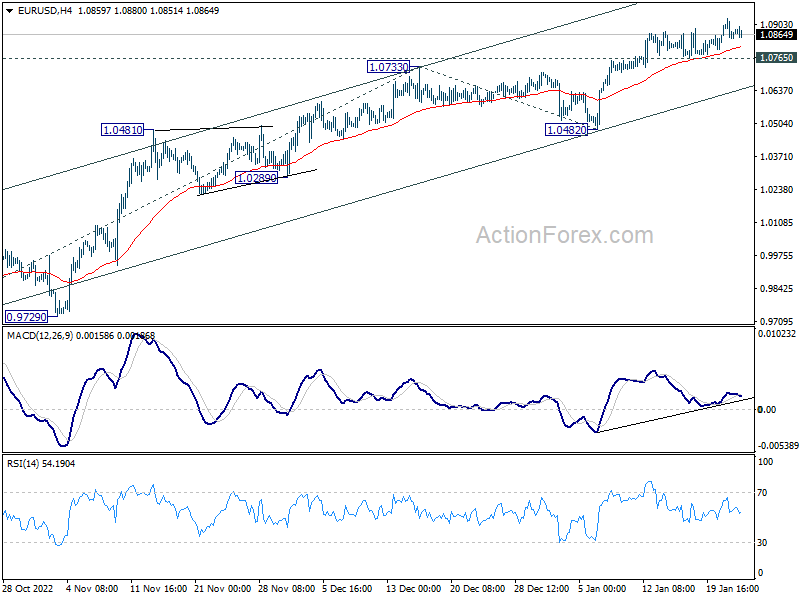
EUR/USD Mid-Day Outlook
Daily Pivots: (S1) 1.0837; (P) 1.0882; (R1) 1.0917; More...
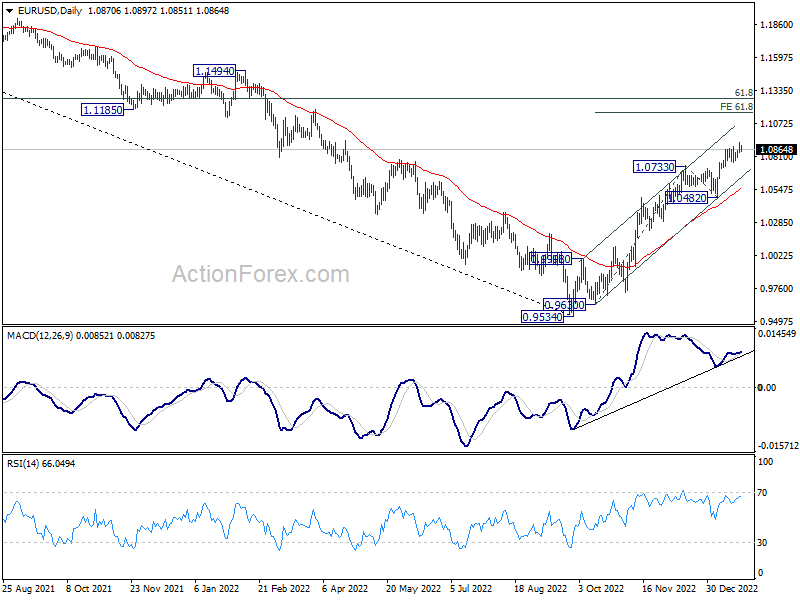
No change in EUR/USD's outlook and further rise is expected with 1.0765 support intact. Current rise from 0.9534 should target 61.8% projection of 0.9630 to 1.0733 from 1.0482 at 1.1164 next. On the downside, though, break of 1.0765 support should now indicate short term topping, and turn bias back to the downside for 55 day EMA (now at 1.0557).
In the bigger picture, current development suggests that the rally from 0.9534 low (2022 low) is a medium term up trend rather than a correction. Further rise is in favor to 61.8% retracement of 1.2348 (2021 high) to 0.9534 at 1.1273 next. This will remain the favored case as long as 1.0482 support holds.