Sample Category Title
Voting Rotation, Hawkishness and the Next ECB Meeting in Sight
The ECB prepares to hold its first rate-setting meeting for 2023 on February 2. The market is almost certain that another 50 bps rate hike will be announced next week. The attention falls on the ECB outlook as an open debate among the ECB members is developing before our eyes. Both sides have sound arguments with the doves regaining strength following the recent easing in both the inflation rates and commodity prices. But who has the upper hand at the February meeting?
Voting rotation in place
Similar to the Fed, the ECB has adopted a voting rotation since January 1, 2015 as the euro area countries exceeded a predefined number of 18. Contrary to the Fed where specific members are voting for the entire calendar year, the ECB is enforcing a monthly voting rotation.
In more detail, the six members of the governing council vote every month, a situation similar to the Fed’s voting system. The 20 eurozone countries are then split in to two groups. The first group consisting of Germany, France, Italy, Spain and the Netherlands share four votes every month. In practice, one representative of the aforementioned countries will not vote each month. The remaining 15 countries share just 11 votes. In total, there are only 21 votes to be cast each month if there is a policy meeting scheduled. Naturally, all ECB members take part in the discussions and deliberations at the meetings.
The usual hawks-doves division
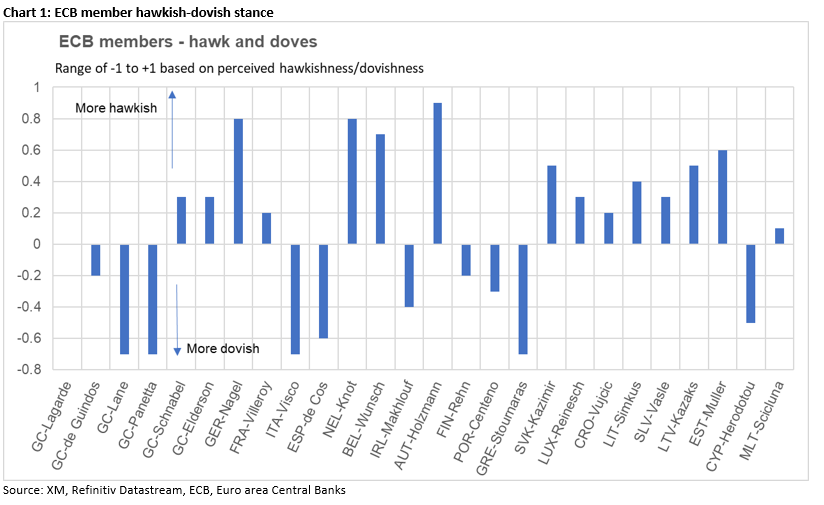
The ECB members have been traditionally separated to hawks and doves based on their opinions on both monetary policy and the overall eurozone economic outlook. The group of hawks advocates for a more aggressive stance, it is historically led by the Bundesbank governor and it encompasses most governors of the northern eurozone countries. On the other hand, doves are the ECB members that tend to support a looser approach, especially at this juncture that the Fed prepares to press the brakes on further rate hikes. Traditionally, the governors coming from the European South belong to this dovish camp. Chart 1 below shows our estimation of the hawkishness and dovishness of the 26 ECB members based on their recent commentary.
Hawkishness per month
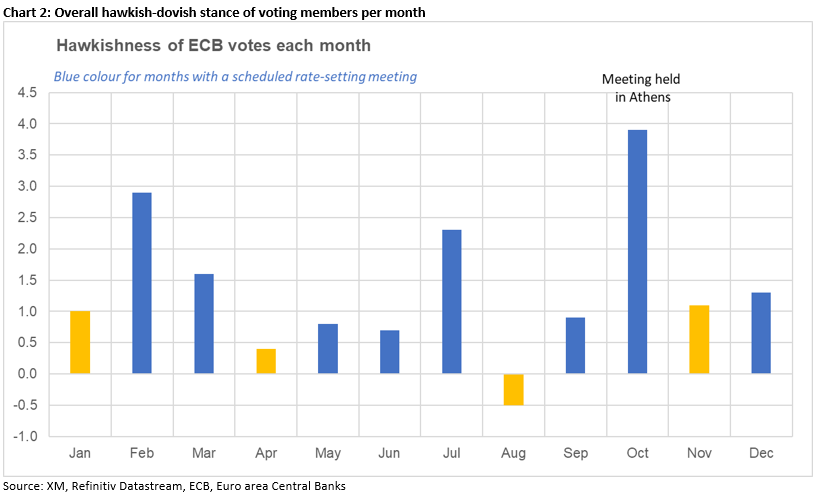
Based on the perceived hawkishness of the ECB members, we have gone a step further and calculated the relative hawkishness/dovishness of the voting members for each month – presented at Chart 2 below. We have colour-coded the eight rate-setting meeting set for 2023. Interestingly, the most hawkish voting stance comes at the October meeting that is scheduled to be held in Athens, Greece. Traditionally, the ECB tends to avoid making significant announcements away from Frankfurt, unless there is a crisis in the market.
What does this mean for the February 2 meeting?
The February meeting records the second highest hawkish voting stance in 2023. This potentially means that an attempt by the ECB doves to gain the upper hand at the meeting and disproportionately influence the decision-making process could be blocked by the hawks. Based on recent comments by notable hawks, they do not appear to have shifted their stance regarding the next rate hikes despite the recent improved economic data releases. This could also mean that any dovish market expectations going into the meeting could potentially face a difficult time. Despite the recent market sentiment favouring the euro, the overall positioning in the market appears to be more dollar positive. On face value, this situation increases the chances for a more sizeable move next week if the ECB manages to present a more hawkish stance than anticipated, and hence disappoint the euro doves. Similarly, the recent dip in yields could be reversed after the meeting, especially if on February 1 chairman Powell fails to meet the dovish Fed expectations. To sum up, the market focus next week will almost entirely fall on the overall language of the ECB statement and the usual press conference by president Lagarde.
EUR/USD Kept Gradual, But Protracted Uptrend
Markets
Yesterday, the (EMU) PMI’s were the main eco story for trading. Both manufacturing (48.8 from 47.8) and services (50.7 from 50.2) beat expectations, raising the composite PMI to 50.2, the first reading north of the boom-or-bust level since June last year. Improvement was supported by rising confidence for activity in the next 12 months. This also caused companies to keep hiring. Rises of input prices are slowing amongst others due to easing pressure from energy prices and reduced distortions of supply chains. Still, output prices continue to rise at an elevated pace. The combination of a better activity with high output prices supports CB guidance (including from ECB) to continue tightening policy. In line with recent market reaction function, an uptick in EMU yields to rise was unconvincing and short-lived. This also applied to a (slightly) better than expect US PMI later (composite 46.6 from 45.0). A brief spike in US yields almost immediately attracted bond buyers to step in. The move more or less coincided with headlines that the US and German agreed to supply tanks to Ukraine. This is seen as a potential important development for the conflict, but the direct link with global markets is not that evident. Whatever the reason, markets returned to pattern of a equities capturing a better bid, easing global bond yields and the dollar declining from the intraday top. German yields lost between 6.2 bps (30-y) and 5.1 bps (10-y). US yields eased 1.7 bps (2-y) to 7.6 bps (10-y). US equities reversed opening losses to close mixed (S&P 500 -0.07%). In a sell-on upticks pattern, DXY closed at 101.92 (top 102.43). EUR/USD kept its gradual, but protracted uptrend to close at 1.0887. Sterling underperformed with EUR/GBP again closing north of 0.88(27). Among the CE currencies, the forint rebounded sharply as the MNB pledged to maintain tight monetary conditions for a prolonged period (EUR/HUF close at 389,35 from 395.4).
Asian equity markets are trading mixed. Treasuries maintain most of yesterday’s gain (US 10-y near 3.45%). The dollar stays in the defensive (DXY 101.85, EUR/USD testing 1.09, with USD/JPY slightly outperforming at 130.35). Later, German IFO business confidence is seen in line with yesterday’s PMI’s (business climate seen rising from 88.6 to 90.3). The Bank of Canada is expected to raise its policy rate by 25 bps to 4.50%. Markets look out for governor Mecklem to lay the groundwork for a pause. On EMU and US interest rate markets, investors stay reluctant to comply with recent hawkish CB guidance. The US 10-y yield still struggles to move a away from the 3.40% support area. The German 10-y yield meets resistance near 2.20%. EUR/USD is nearing ever closer to the 1.0942 resistance.
News Headlines
Australian Q4 CPI topped estimates across the board. Prices surged 1.9% q/q in the final quarter of last year, unexpectedly accelerating from the previous quarter (1.8%). As such, inflation hit a new 32-year high on a yearly basis (7.8%). Core inflation was up 1.7% q/q (6.9% y/y) or 1.6% (5.8%) depending on the gauge. Australia’s central bank (RBA) expected inflation end 2022 in the ballpark of 8%. The RBA at the last meeting lifted policy rates to 3.1% but turned a more balanced by considering economic growth and recognizing the monetary policy time lag. Today’s inflation outcome however suggests it’s not yet time for a tightening pause. Especially high core inflation, rooting from a.o. a strong labour market, is keeping the pressure high. Australian money markets discounted about a 50% chance for another 25 bps in February before the publication. That rose to 75% today. Swap yields shot up 14-20.5 bps, the front end underperforming. The Aussie dollar jumps beyond resistance around 0.705 to AUD/USD 0.71.
Sticking to the subject and continent, inflation in New Zealand also rose faster than expected, though to a lesser extent than in its western neighbour. Price growth in Q4 2022 came in at 1.4% q/q. That’s a little more than the 1.3% but, unlike in Australia, a deceleration from Q3 (2.2%). Non-tradeable CPI, a measure for domestic inflation, was up 1.5% (6.6% y/y) vs 1.7% expected. Inflation is up 7.2% (vs 7.1% expected) y/y, the same as in Q3. The numbers do miss the Reserve Bank of New Zealand’s own forecast. The central bank held a much more hawkish tone at the most recent meeting compared to the RBA. It raised rates by 75 bps to 4.25% and penciled in a 5.5% terminal rate to bring inflation back to target over the medium term. Since the meeting, markets were split between a 50 bps or another jumbo hike at the Feb 22 meeting. Odds have now turned a bit more in favour for the former. The kiwi dollar loses a few ticks this morning, easing from recent highs at NZD/USD 0.6505 to 0.6489.
EUR/AUD Daily Outlook
Daily Pivots: (S1) 1.5408; (P) 1.5455; (R1) 1.5502; More...
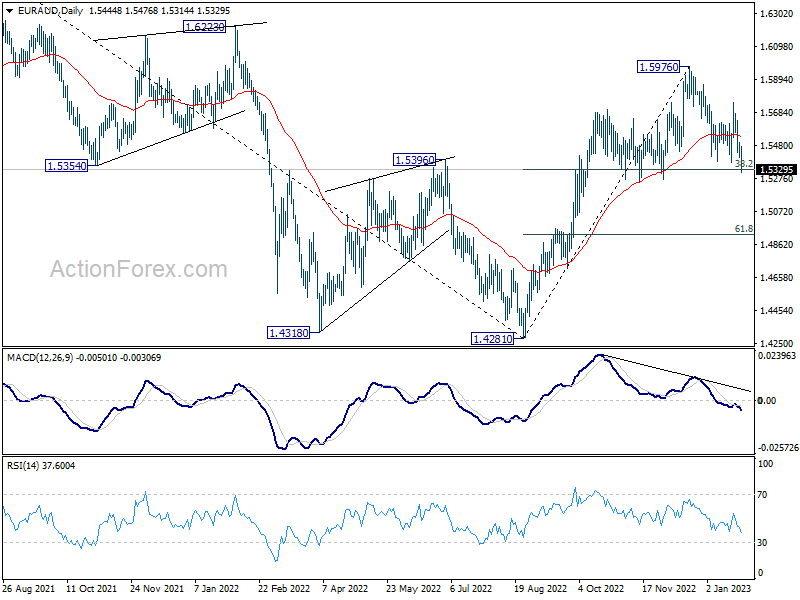
EUR/AUD's decline from 1.5976 resumes by breaking through 1.5376 today, and intraday bias is back on the downside. Sustained break of 1.5271 support will carry larger bearish implications. Deeper fall would then be seen to 61.8% retracement of 1.4281 to 1.5976 at 1.4928. Nevertheless, rebound from current level, followed by break of 1.5749 resistance, will revive near term bullishness for 1.5976 and above.
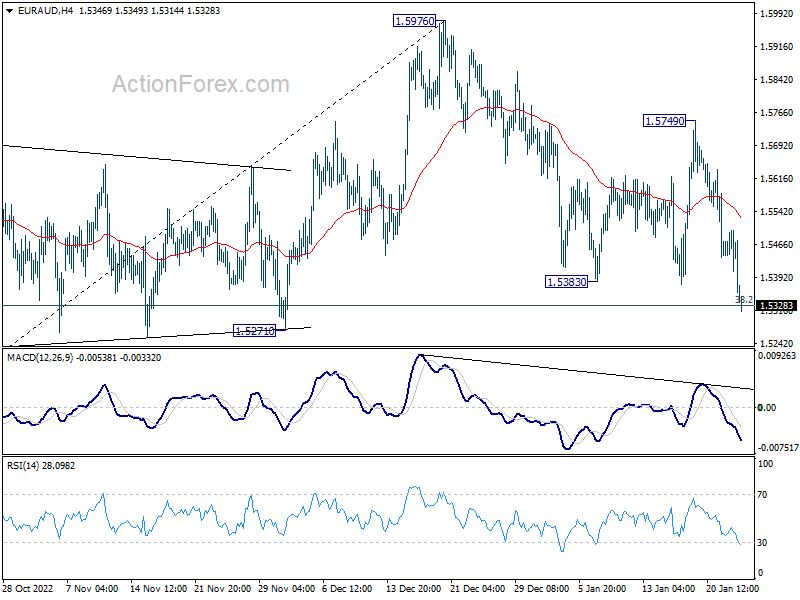
In the bigger picture, it's still early to confirm if rise from 1.4281 represents bullish trend reversal. But as long as 1.5271 support holds, such rally is in favor to continue. Break of 1.5976 will target 1.6434 key resistance next. On the other hand, firm break of 1.5271 will retain medium term bearishness instead.
EUR/GBP Daily Outlook
Daily Pivots: (S1) 0.8778; (P) 0.8813; (R1) 0.8858; More...
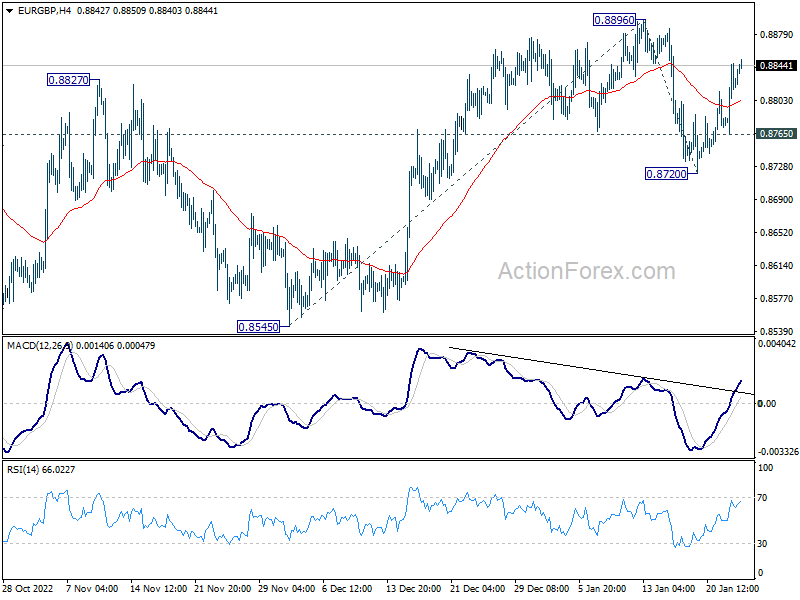
Intraday bias in EUR/GBP remains on the upside for retesting 0.8896 resistance. Firm break there will resume whole rise from 0.8896 to 61.8% projection of 0.8545 to 0.8896 from 0.8720 at 0.8937. On the downside, below 0.8765 minor support will turn intraday bias neutral again.
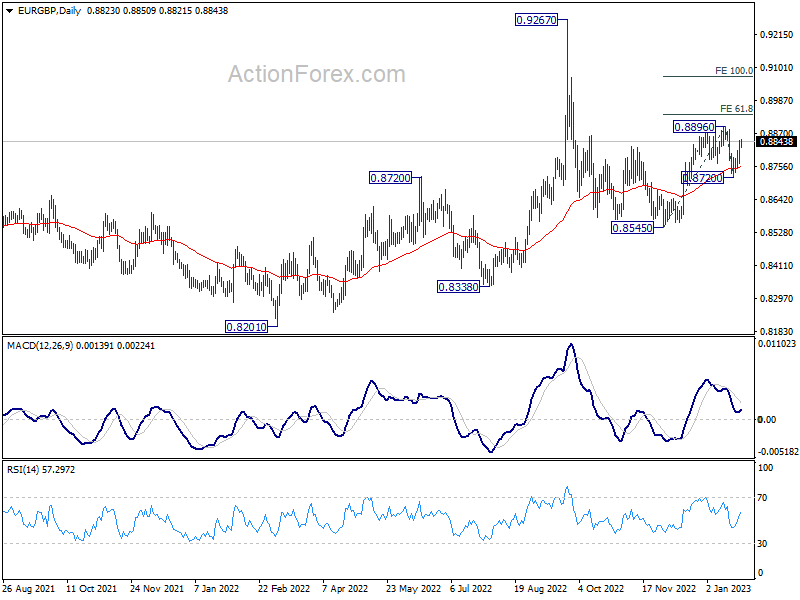
In the bigger picture, the notable support from 55 day EMA (now at 0.8752) retains near term bullishness. Break of 0.8896 should target 0.9267 (2022 high) and possibly above, to resume whole up trend from 0.8201 (2022 low). However, break of 0.8270 support and sustained trading below 55 day EMA will set the stage for 0.8545 and below.
EUR/JPY Daily Outlook
Daily Pivots: (S1) 141.27; (P) 141.74; (R1) 142.21; More....
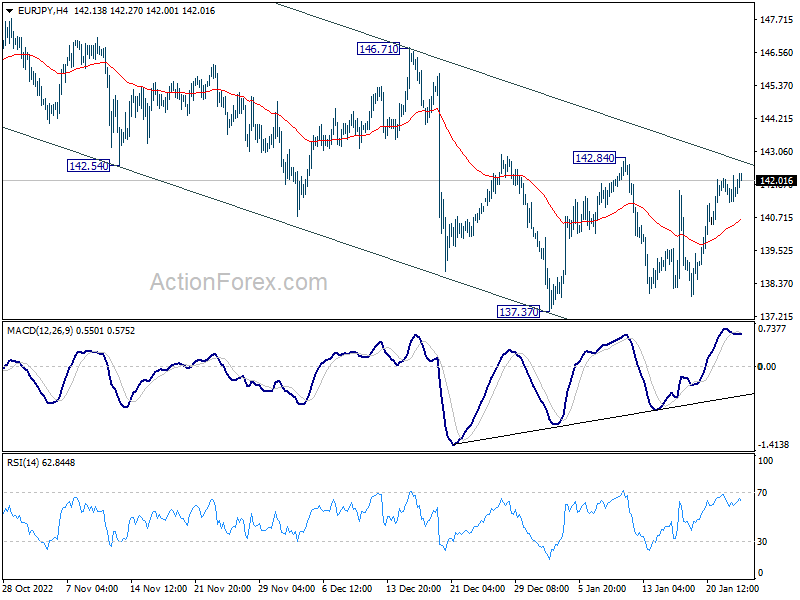
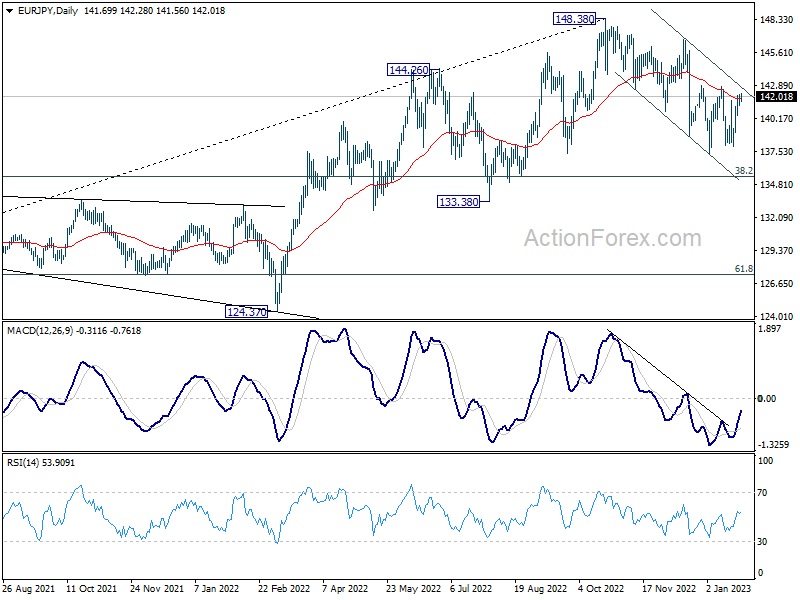
Range trading continues in EUR/JPY and intraday bias remains neutral. On the downside, break of 137.37 will resume the whole decline from 148.38 to 135.40 fibonacci level next. However, firm break of 142.84 will argue that the correction from 148.38 has completed, and bring stronger rise back to 146.71 resistance.
In the bigger picture, as long as 55 week EMA (now at 138.62) holds, larger up trend from 114.42 (2020 low) is still in progress for 149.76 long term resistance. However, firm break of 55 week EMA will bring deeper fall to 38.2% retracement of 114.42 to 148.38 at 135.40. Sustained break there will raise the chance of trend reversal, and target 61.8% retracement at 127.39.
GBP/JPY Daily Outlook
Daily Pivots: (S1) 159.82; (P) 160.82; (R1) 161.65; More...
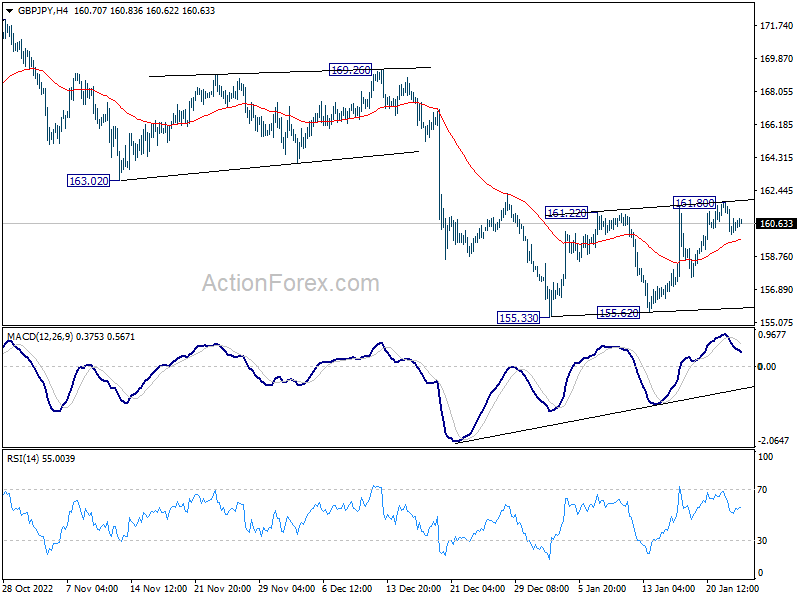
Intraday bias in GBP/JPY stays neutral at this point. On the downside, break of 155.33 low will resume the fall form 172.11 to 153.70 fibonacci level next. Risk will stays on the downside as long as 55 day EMA (now at 162.03) holds, even in case of another rally attempt.
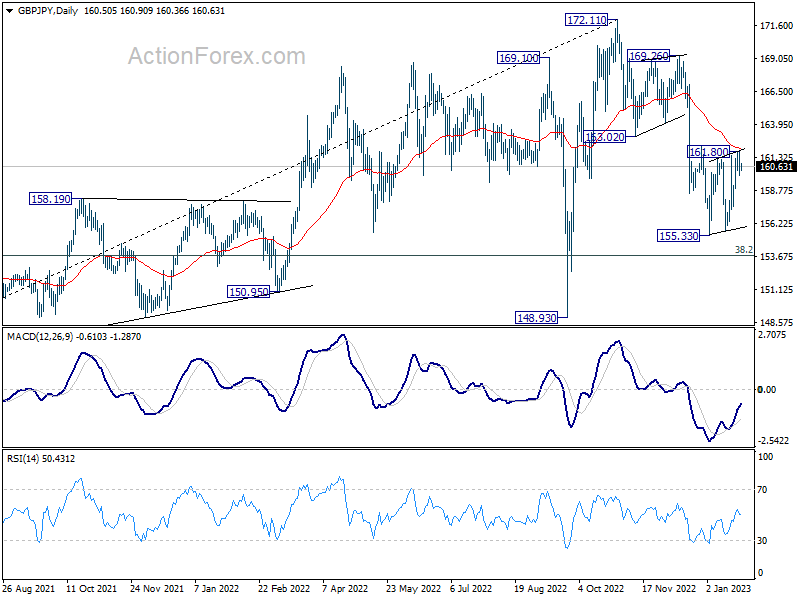
In the bigger picture, as long as 163.02 support turned resistance holds, decline from 172.11 medium term top is expected to continue to 38.2% retracement of 123.94 to 172.11 at 153.70. Sustained break there will raise the change of trend reversal and target 61.8% retracement at 142.34. Nevertheless, break of 163.02 support turned resistance will argue that the decline has completed, and retain medium term bullishness.
EUR/CHF Daily Outlook
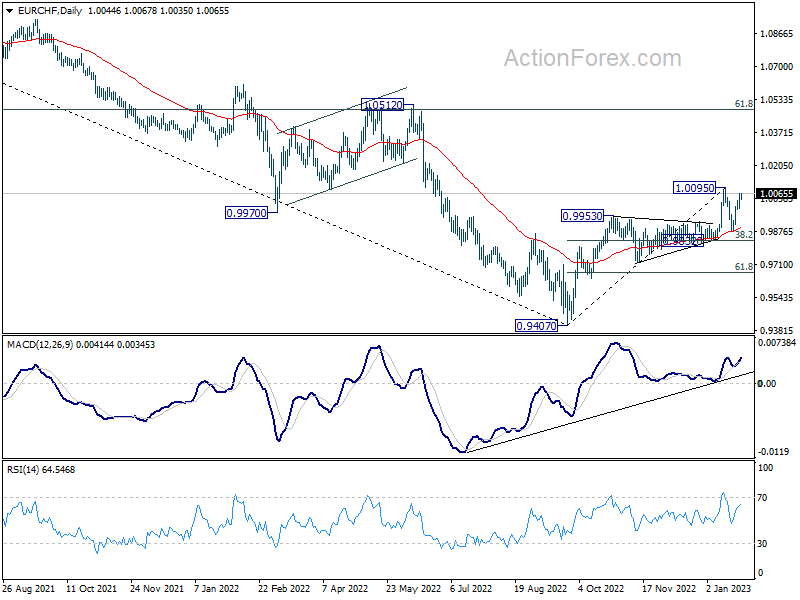
Daily Pivots: (S1) 1.0003; (P) 1.0035; (R1) 1.0076; More....
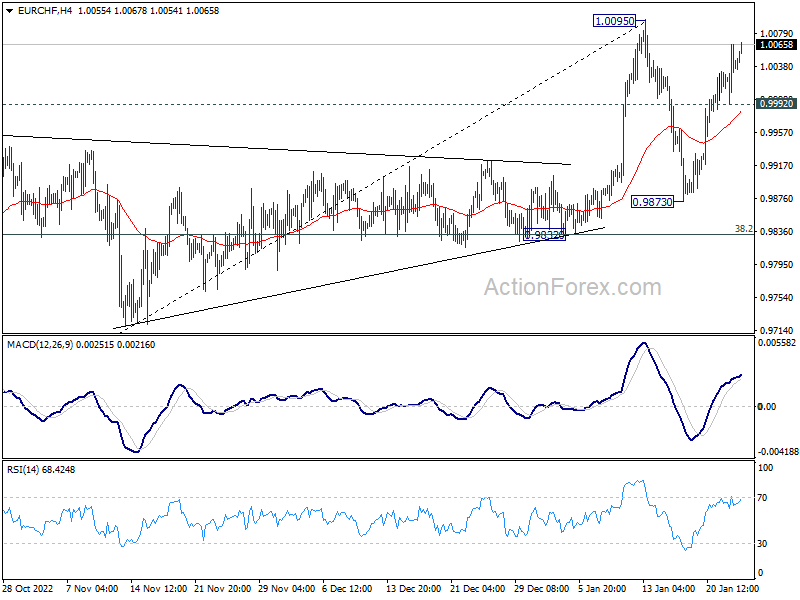
EUR/CHF's rebound from 0.9873 is still in progress and intraday stays on the upside for resting 1.0095. Firm break there will resume whole rally from 0.9407 low. On the downside, though, break of 0.9952 minor support will turn bias back to the downside, to extend the corrective pattern from 1.0095 with another leg, back towards 0.9873 support.
In the bigger picture, the initial rejection by 55 week EMA (now at 1.0039) mixed up the outlook. On the upside, sustained trading above 55 week EMA will raise the chance of bullish trend reversal. Rise from 0.9407 should then target 1.0505 cluster resistance (2020 low at 1.0505, 61.8% retracement of 1.1149 to 0.9407 at 1.1484). However, firm break of 0.9832 support will revive medium term bearishness and bring retest of 0.9407 low instead.
BOC Interest Rate Decision: Another Hike?
After its last meeting, the BOC Governor Macklem said that the likely course would be a pause, unless there was a major change in the data. Of course he said it with a lot more words and technical jargon, but that was the essence of the message. Naturally, the markets adjusted the expectation to the BOC holding rates steady.
The latest inflation data pointed to a strong deceleration. Even though the rate remains well above target, there is always some delay between when rates are raised and when inflation comes down to an acceptable range. So, it's expected that the central bank will stop raising when inflation starts to show signs it's coming under control, and not necessarily has reduced all the way.
What changed?
Inflation figures were in line with expectations, confirming the view for the BOC. But, the unemployment rate showed a surprise build. Over 100K people found jobs in December, well above the 7K expected. It is true that Canada has some wildly fluctuating jobs numbers. But given the context of the BOC saying it was going to be data dependent for the next meeting, the consensus now shifted to expect a 25bps hike at the next meeting.
The context has implications beyond Canada, since the US faces similar economic conditions, and often the two central banks move in tandem. Inflation in the US has been coming down, but the jobs market remains surprisingly resilient. The prior months had seen slow jobs growth in Canada, leaving the impression that Canada could exit the rate hiking cycle sooner than its southern neighbor. But, if the BOC raises rates, it could have a somewhat diminished impact on the USDCAD, as traders weigh whether the strong jobs numbers seen in the US would also imply the Fed will move higher as well.
What about further down the road?
The other aspect is the global economy. Most of the reduction in inflation came from lower fuel prices. Wholesale food prices diminished, but not what shoppers were paying at stores. Meaning that the average Canadian might not notice the improving price situation, and in turn that could continue to impact consumer demand.
What is more directly correlated to the currency market, however, is the price of crude. As Canada's main export the drop in petroleum prices naturally affected the CAD. But, now that China is reopening faster than expected, there is renewed speculation that crude prices could continue to appreciate. Particularly in the context of the latest IEA report, which forecasts demand for crude to reach a historic peak in the next year, while supplies remain constrained.
Potential market reaction
It's expected that after this rate hike, the BOC will once again say that it expects a pause, depending on the data. The other option is that it could surprise the markets by not raising rates. That could be because it discounts the jobs data as a one-off, and heavily imply that it could rates rates at the next meeting. Both courses of action would likely leave the long-term outlook for the CAD in the same place, but could provide some short-term volatility.
EUR/USD Daily Outlook
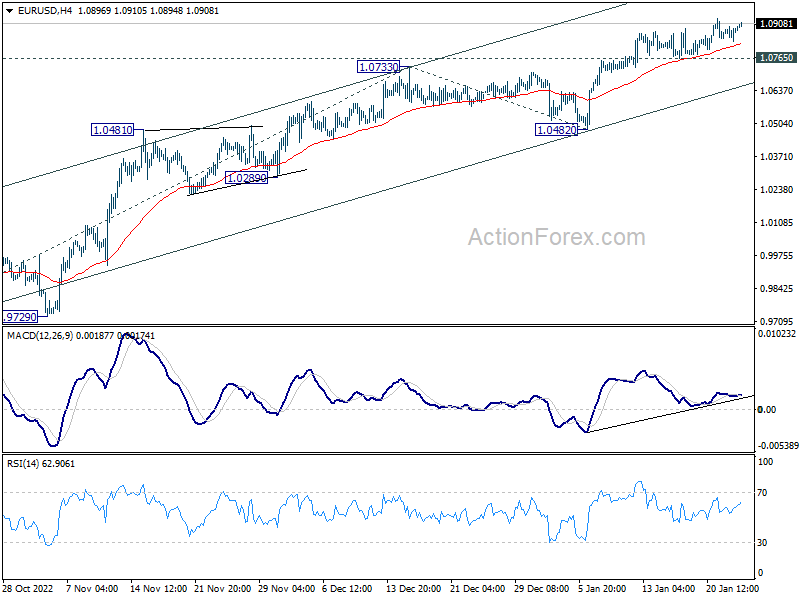
Daily Pivots: (S1) 1.0850; (P) 1.0874; (R1) 1.0913; More...
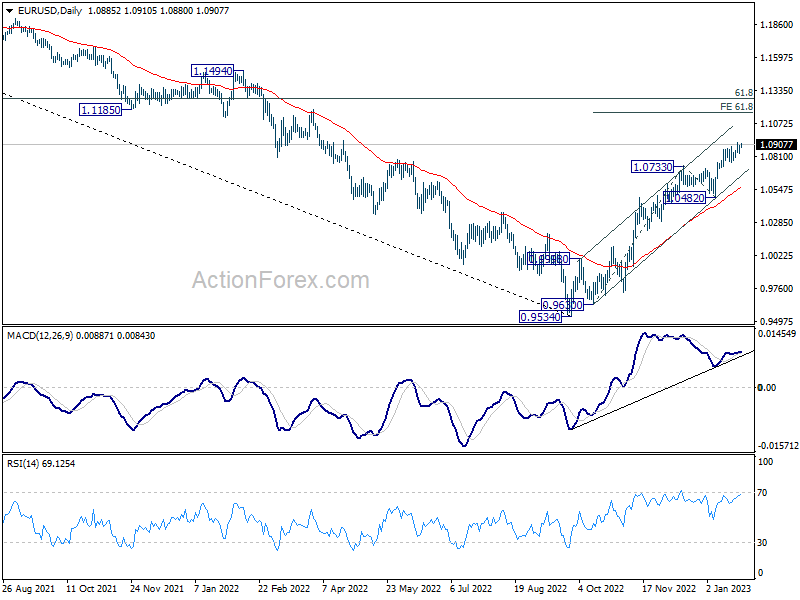
Further rally is expected in EUR/USD with 1.0765 support intact. Current rise from 0.9534 should target 61.8% projection of 0.9630 to 1.0733 from 1.0482 at 1.1164 next. On the downside, though, break of 1.0765 support should now indicate short term topping, and turn bias back to the downside for 55 day EMA (now at 1.0557).
In the bigger picture, current development suggests that the rally from 0.9534 low (2022 low) is a medium term up trend rather than a correction. Further rise is in favor to 61.8% retracement of 1.2348 (2021 high) to 0.9534 at 1.1273 next. This will remain the favored case as long as 1.0482 support holds.
GBP/USD Daily Outlook
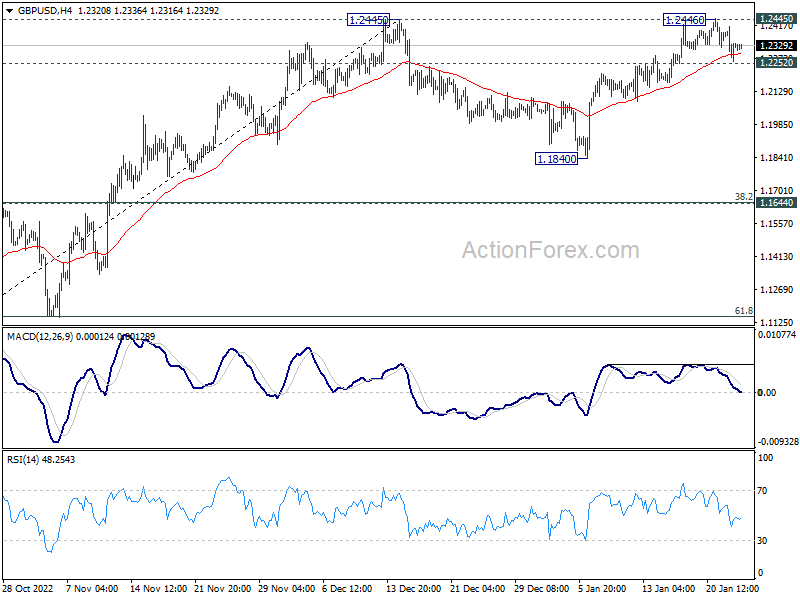
Daily Pivots: (S1) 1.2264; (P) 1.2339; (R1) 1.2415; More...
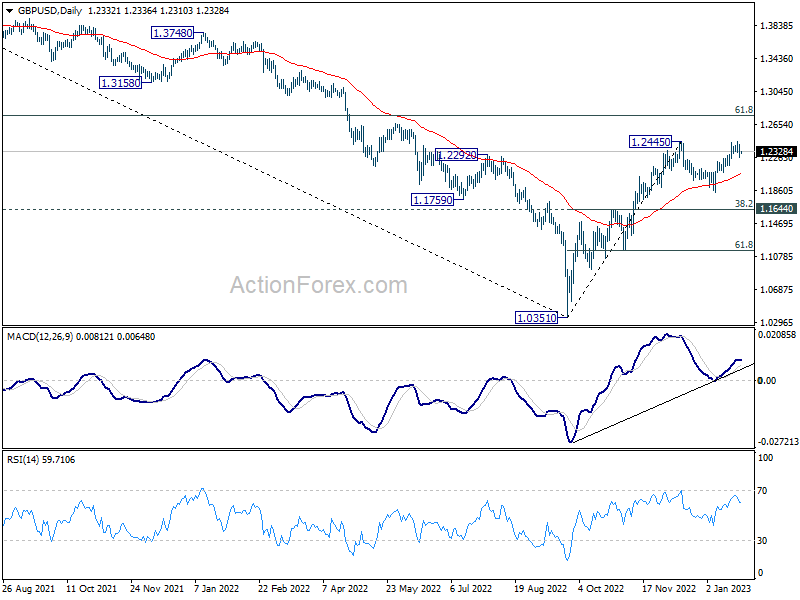
Intraday bias in GBP/USD stays neutral as range trading continues. On the downside, firm break of 1.2252 minor support will turn bias to the downside, and extend the corrective pattern from 1.2445 with another falling leg. On the upside, decisive break of 1.2445 will confirm resumption of whole rise from 1.0351. Next target will be 1.2759 fibonacci level.
In the bigger picture, rise from 1.0351 medium term bottom is at least correcting whole down trend from 1.4248 (2021 high). Further rise is expected as long as 1.1644 resistance turned support holds. Next target is 61.8% retracement of 1.4248 to 1.0351 at 1.2759. Sustained break there will pave the way back to 1.4248.