Sample Category Title
CADJPY Wave Analysis
- CADJPY reversed from support level 96.00
- Likely to rise to resistance level 98.00
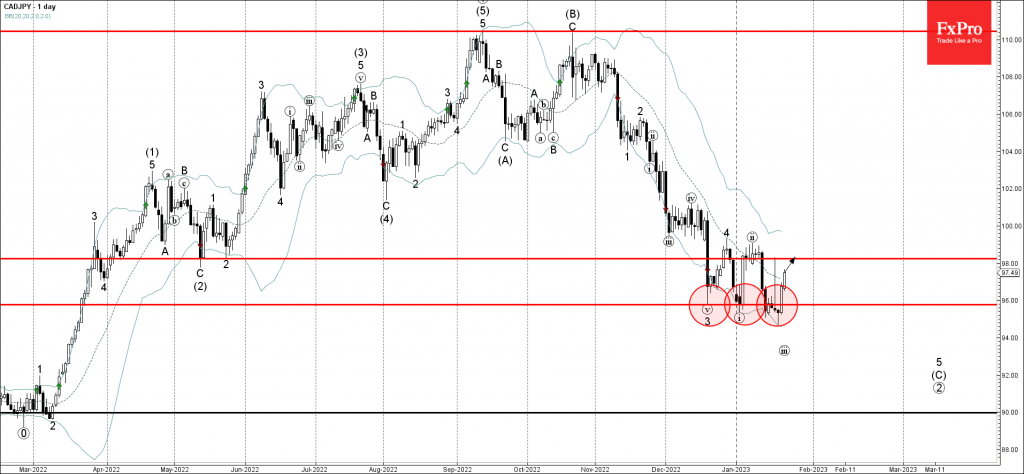
CADJPY currency pair recently reversed up from the pivotal support level 96.00 (which has been reversing the price from the middle of December) intersecting with the daily Bollinger Band.
The upward reversal from the support level 96.00 created the daily Hammer – which stopped the earlier impulse waves 5 and (C).
CADJPY currency pair can be expected to rise further toward the next resistance level 98.00 (top of the earlier sharp reversal pivot from last week).
AUDUSD Wave Analysis
- AUDUSD reversed from support level 0.6885
- Likely to rise to resistance level 0.7060
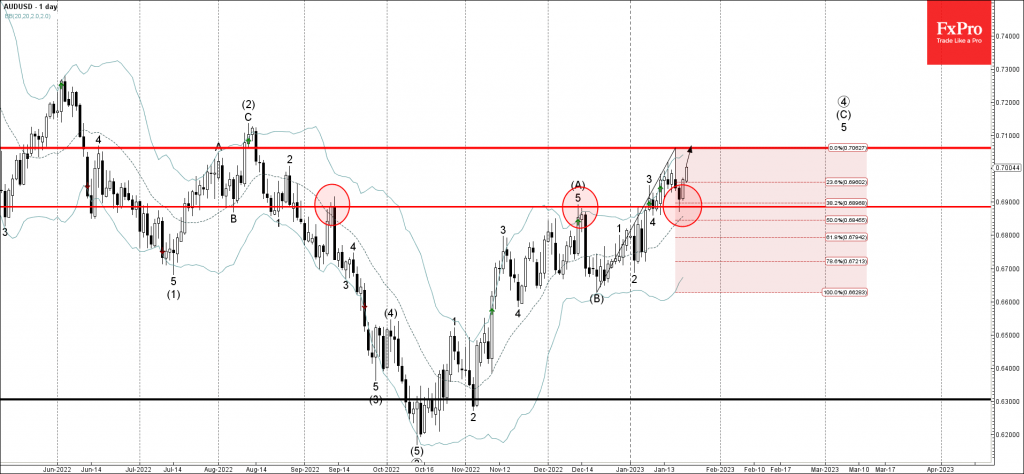
AUDUSD currency pair recently reversed up with the daily Bullish Engulfing from the key support level 0.6885 (previous monthly high from the start of December).
The support level 0.6885 was further strengthened by the 38.2% Fibonacci correction of the previous upward impulse from the middle of December.
AUDUSD currency pair can be expected to rise further toward the next resistance level 0.7060 (top of the previous daily shooting star from last week).
Global Flash PMIs, and the Return of Investor Optimism?
At the conclusion of the latest WEF meeting in Davos, many of the leaders there were optimistic that the world would avoid a recession. Or, at least, if there was a recession, it would be short and shallow. A substantial portion of that optimism relied on an expectation that China would rebound, now that it was putting covid restrictions away.
The meeting happened right after the latest GDP figures from the world's second largest economy, which were well above expectations. That helped offset some of the negativity that would be expected when the US reported slower than expected industrial growth. So, it begs the question: Are major investors looking at this as the bottom? Or is there further downside?
What to look out for
One of the clues could be in PMI data, to see where advance trends in the economy are headed. Over the last several months, most major economies were reporting PMIs below the 50 level, that indicate contraction. But the latest consensus shows that indicator might be starting to rise again, particularly in Europe.
Europe's ability to keep up with energy demand has helped boost optimism in the shared economy, with stocks moving to 9-month highs. If PMIs were to move above 50, it could provide further impetus to the notion that the ECB will keep hiking, and support the Euro. Meanwhile, if PMIs in the US were to show a similar trend as industrial data, it could weaken the greenback.
Key data points:
Australia's Manufacturing PMI is expected to fall to 49.5 from 50.2, entering contraction for the first time since the pandemic. This despite reports of thawing relations between Canberra and Beijing which are expected to increase trade. Services, on the other hand, are expected to tick up though remain in contraction at 47.5 compared to 47.3 prior.
French Manufacturing PMI is forecast to improve to 49.7, up from 49.2 prior. That's only marginally in contraction. France is the first major EU company to report, and could then set the tone for optimism if the result were to come in above expectations. Services PMI is expected to do even better at 49.8, up from 49.5 prior.
German Manufacturing PMI is expected to also improve, but remain in worse condition than France, at 47.8 compared to 47.1 prior. Services, on the other hand, are expected to almost return to expansion at 49.6 compared to 49.2 prior. The latest news on German energy reserves has been positive, but the last few days have seen cold weather in Europe, with expectations it could continue. Coinciding with the PMI survey, that could dampen the optimism among executives in Europe's largest economy.
UK Manufacturing PMI is expected to stage a marginal improvement though remains firmly in contraction at 45.5 compared to 45.3 prior. The persistent strikes and reports that even more are expected in February have contributed to pessimism in the industrial sector. Services, on the other hand, are forecast to remain in contraction by the bare minimum at 49.9.
US Manufacturing PMI is forecast to stay firmly in contraction at 46.2, unchanged from December. Services PMI is expected to show a marginal improvement to 45.0 from 44.7 prior. A beat of expectations would come as a larger surprise to markets, given how much of the other data has been pessimistic.
January Flashlight for the FOMC Blackout Period
Summary
- Pieces have fallen into place since the FOMC's last meeting on December 14 to allow the Committee to dial back its pace of tightening further. Consumer prices have decelerated in recent months, and the labor market has shown signs of cooling, although it generally remains tight.
- The FOMC raised its target range for the federal funds by 75 bps at four consecutive meetings between June and November, but it downshifted to 50 bps in December. We look for the Committee to hike rates by 25 bps on February 1, bringing the target range for the federal funds rate to 4.50%-4.75%. Fed policymakers appear to be entering the fine-tuning phase of this tightening cycle.
- However, inflation remains too high for the Fed's liking, and most FOMC members continue to state publicly that rates need to go higher to bring inflation back to the target of 2%. We look for the Committee to raise its target range for the federal funds rate by 25 bps at each of its meetings on February 1, March 22, and May 3. If realized, the target range would end the tightening cycle at 5.00%-5.25% in early May.
- Given recent signs of slowing economic growth, we readily acknowledge that rates may not rise quite as high as we envision. But we believe that in order to bring inflation back to 2% on a sustained basis, the FOMC will maintain its target range at the terminal rate longer than most market participants currently expect. We do not expect the FOMC to begin cutting rates until early 2024.
- The post-meeting statement already notes that policy will need to be "sufficiently restrictive to return inflation to 2 percent over time." We can envision the Committee adding the phrase "for some time" to "sufficiently restrictive" in the February 1 statement. Chair Powell could also stress this intention in his post-meeting press conference.
- This stronger statement of the FOMC's intentions, should it be added, would hammer home the point that the Committee likely will not be easing policy until there are unambiguous indications that inflation is returning to 2% on a sustained basis.
- We look for the FOMC to once again maintain the current pace of quantitative tightening by allowing up to $60 billion of Treasury securities and up to $35 billion of mortgage-backed securities to roll off its balance sheet every month.
Pieces in Place for the FOMC to Further Downshift Its Pace of Tightening
Heading into its first meeting of the year, the FOMC is likely feeling more content with the stance of monetary policy than it has in some time. Inflation is more convincingly coming down, but without a collapse in hiring and broader demand. That noted, prices are still growing in excess of 2%, and with an exceptionally tight jobs market, the FOMC is not done tightening policy yet, by our estimation. However, the directional improvement in inflation and somewhat softer labor market conditions lead us to believe that the FOMC is past the catch-up phase of this tightening cycle and onto the fine-tuning phase. We look for the FOMC to downshift its pace of tightening further at its Jan. 31-Feb. 1 meeting, hiking the fed funds rate by 25 bps to a target range to 4.50-4.75%.
Slower Inflation, Cooler Hiring Since the Past FOMC Meeting
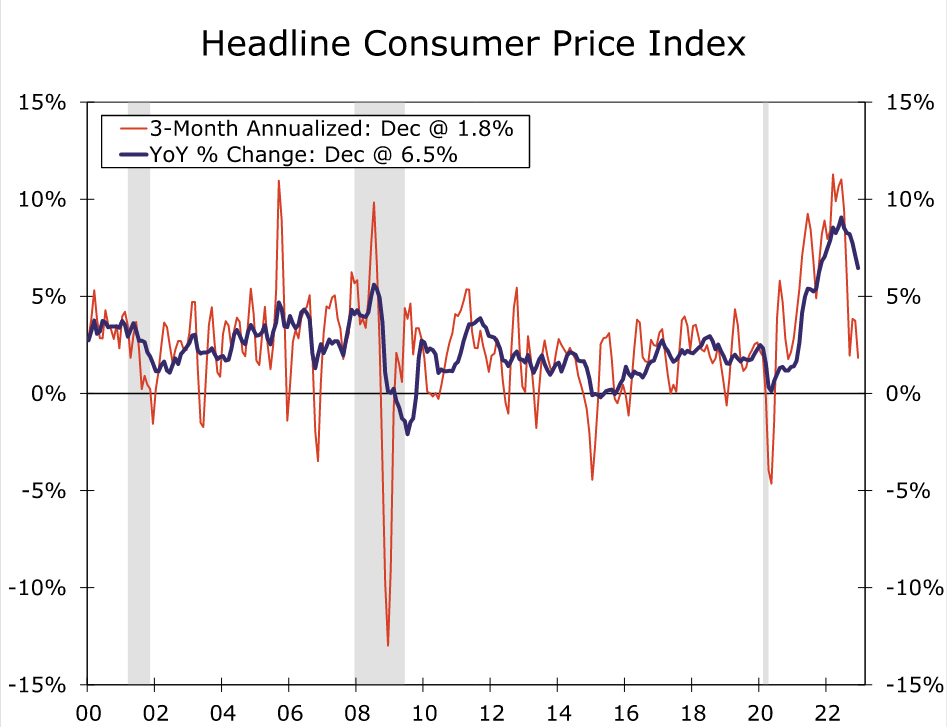
Since the FOMC last met on December 14, there have been encouraging developments on the inflation front. The slowdown in inflation toward the end of last year looks more concrete after the latest readings on consumer and producer prices. The core CPI increased 0.2-0.3% in each of the past three months, lowering the three-month annualized rate to 3.1% in December from 6.0% in September. Tamer energy and food-related prices are also helping to dampen headline inflation and support real income growth (Figure 1). We have lowered our own estimates for inflation over the next 12 months, and we expect the FOMC to also be a bit more sanguine about the outlook for price growth.
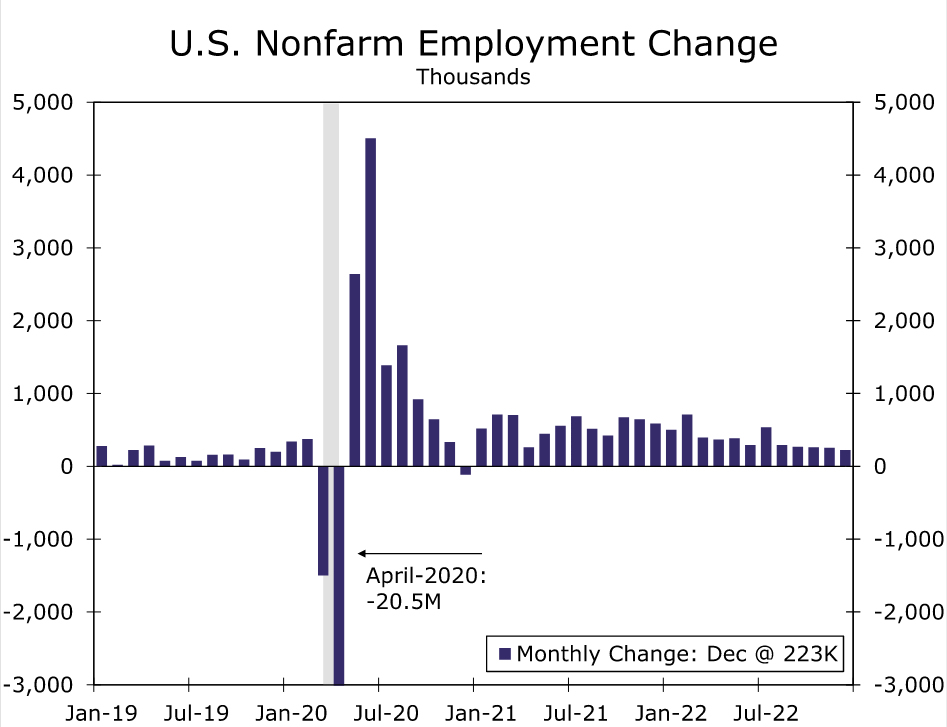
At the same time, the jobs market has continued to gradually cool. December's rise in payrolls was the weakest print in two years but remained impressive in an absolute sense with 223K new jobs added (Figure 2). Demand for new workers has edged lower based on job openings and hiring plans, yet initial jobless claims signal businesses continue to hold onto existing workers and layoffs are not yet widespread. Perhaps most importantly for the FOMC given its nearly singular focus on inflation, the chances of a wage-price spiral look a little dimmer after the most recent slate of data. Average hourly earnings growth slowed in December from a downwardly revised gain in November, and not all hope may be lost on the labor supply front with an increase in the labor force participation over the inter-meeting period.
Still Work to Be Done
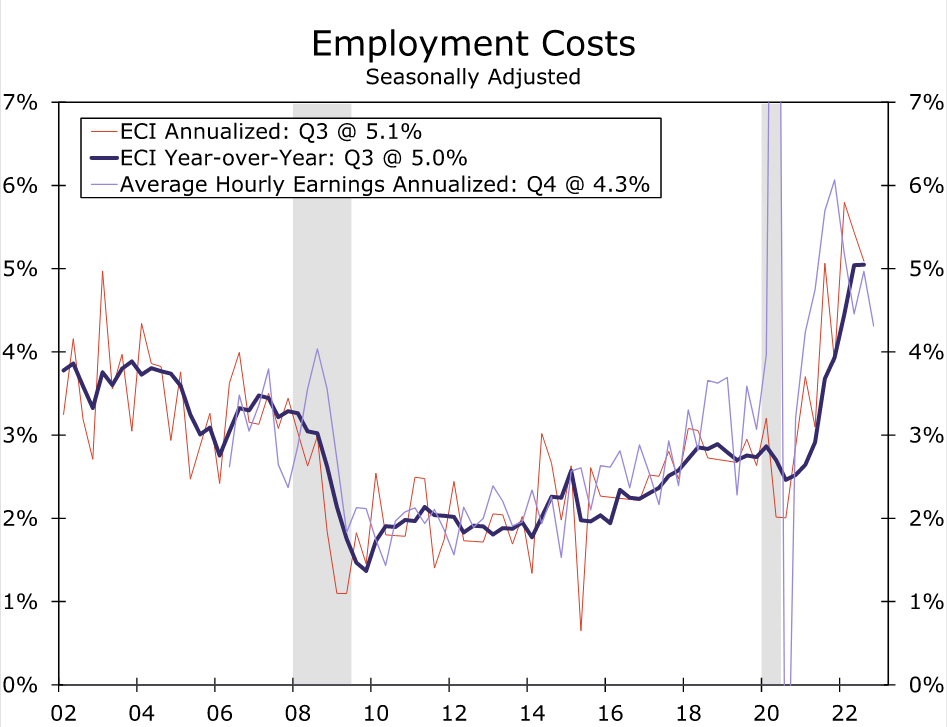
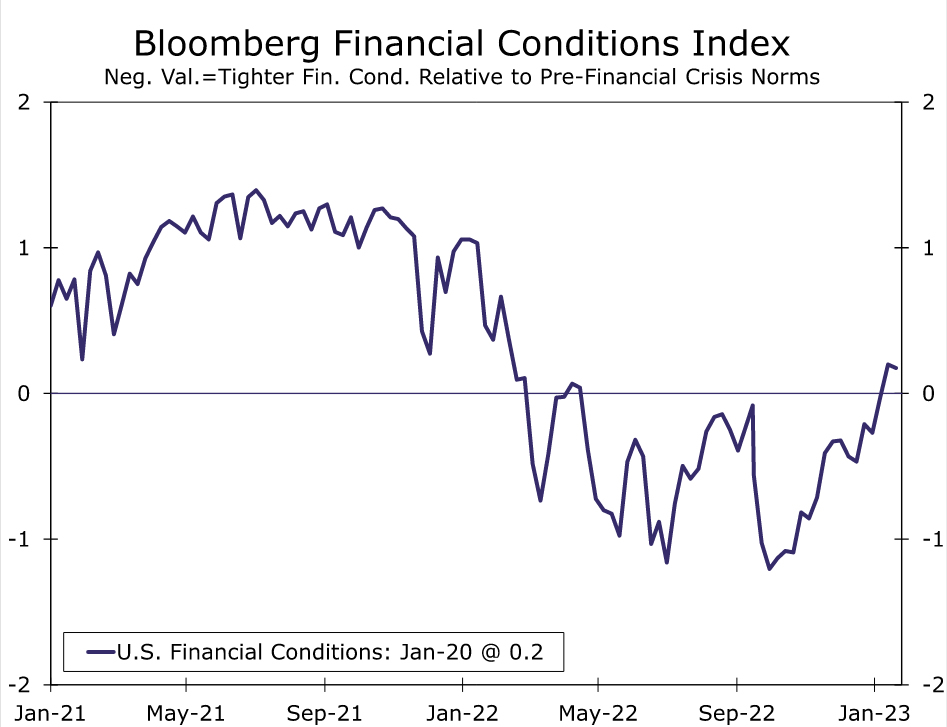
Despite the improvement, however, inflation remains too high for the FOMC's liking. In addition, the recent softening in price growth has been driven by a fairly narrow set of components such as gasoline, vehicles and airfares—a sign conditions are normalizing but not in and of themselves enough to convince the FOMC to call the all-clear on inflation. Chair Powell and others on the Committee have voiced concern about the medium-term inflation pressures emanating from the tight labor market. Even accounting for the weaker December data, average hourly earnings growth is still too hot to be consistent with the Fed's inflation target if the trend rate of productivity growth is 1%-1.5% (Figure 3). At the same time, financial conditions have eased since the December meeting, making it more difficult for the FOMC's policy efforts to quell inflation to filter through to the economy (Figure 4).
We therefore expect the FOMC will continue to tighten policy at the upcoming meeting, but at a more measured pace. Specifically, we look for the FOMC to raise the fed funds rate by 25 bps, which would mark the smallest increase since the FOMC's initial rate hike last March and bring the target range to 4.50%-4.75% from 0%-0.25% a year ago. After the dizzying pace of hikes in 2022, policy is better placed to curtail current inflation pressures, leaving subsequent moves as more likely to be tweaks than the "front-loading" efforts of the past year. A number of neutral-leaning Fed officials, including regional Fed presidents Harker, Collins and Bostic, have publicly stated their support for downshifting to a 25 bps hike at the next FOMC meeting. An upside surprise to the fourth quarter Employment Cost Index, scheduled to be released just hours before the meeting kicks off on Jan. 31, is likely the only data point that could divert the Fed from its currently signaled course. Currently, markets are pricing in less than a 10% chance that the FOMC hikes by more than 25 bps.
FOMC to Markets: Rate Cuts Still A Ways Away
Although the FOMC looks set to slow its pace of tightening further, there has been a remarkable degree of consensus among the Committee that policy has not yet reached its final destination when it comes to rates. December's Summary of Economic Projections (SEP) showed all participants expecting the target range to reach an upper bound of at least 5%, with the median a touch higher at 5.25%. Recent public comments from a slew of officials (Harker, Barkin, Bullard, Daly, and Bostic) have indicated that expectations to raise the fed funds rate beyond 4.50%-4.75% remain intact. We expect the post-meeting statement and Chair Powell in the press conference to reiterate the policy rate has further to go, even if Powell does not provide a pointed update on where participants' projections for year-end rates would land as he did in November when there also was no update to the SEP.
Moreover, we believe the FOMC will maintain its message that even as the end of rate increases may be drawing near, rate cuts remain a long way off. The latest post-meeting statement already notes that policy will need to be “sufficiently restrictive” to return inflation to 2%, but we could see the Committee adding that a restrictive stance of policy will likely be required “for some time” to underscore that rate cuts are unlikely to come as quickly as in prior cycles.
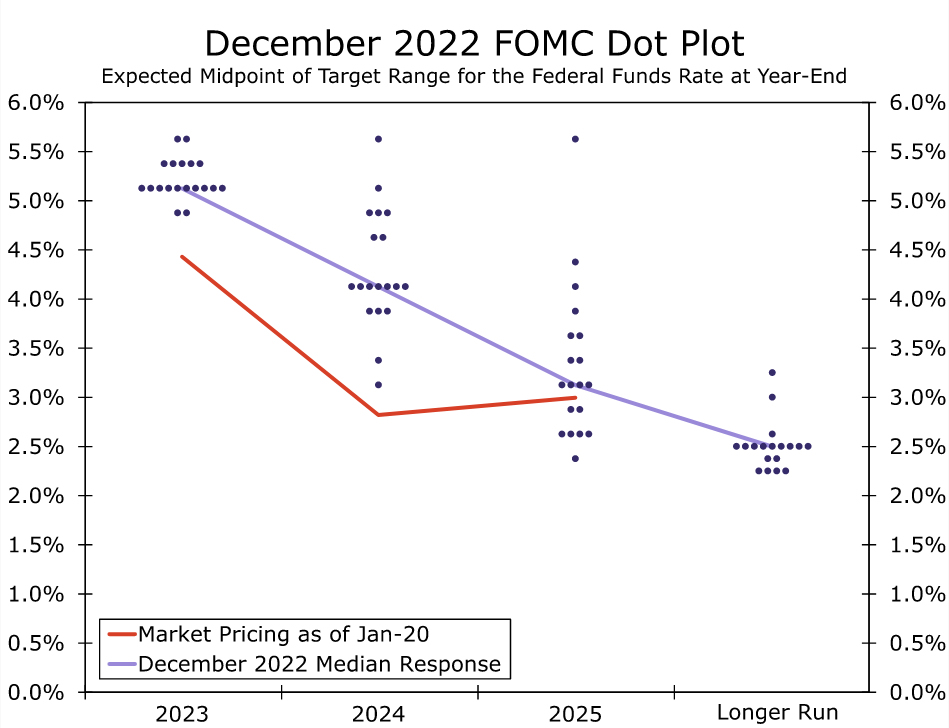
Markets continue to price in a lower path for the fed funds rate than implied by the most recent dot plot. Fed funds futures currently point to a peak rate this spring consistent with the target range reaching 4.75%-5.00%. The slightly lower terminal rate than our own estimate (Figure 5) and what is implied in the most recent dot plot, 5.00%-5.25%, does not seem terribly unreasonable. After all, the data have softened recently and a 25 bps gap seems small in the context of the 425 bps of tightening executed over the past 10 months.
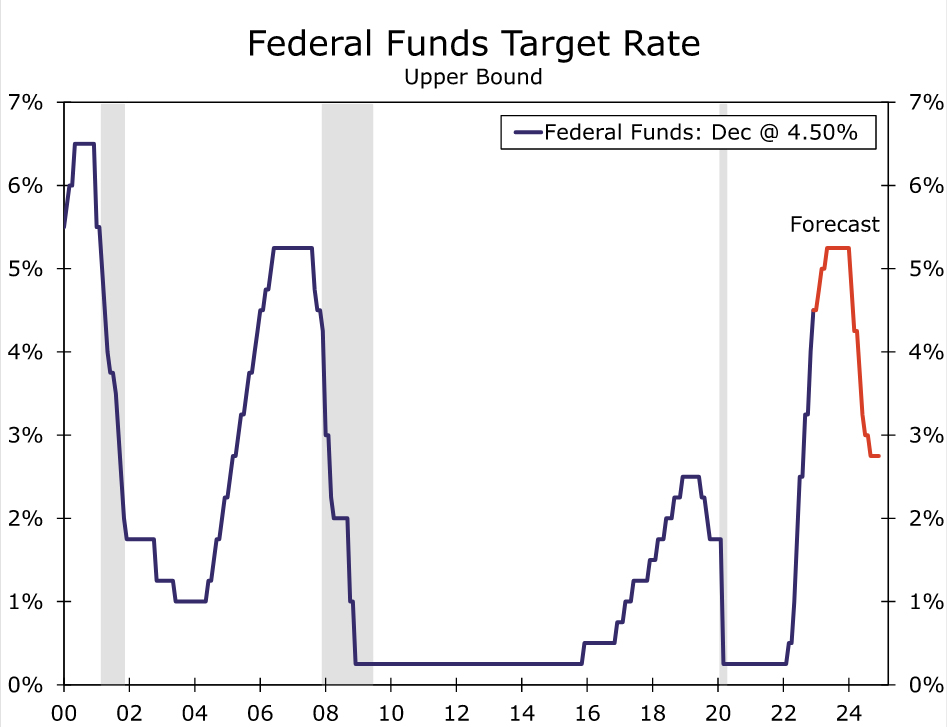
But the roughly 50 bps of cuts priced over the second half of the year is more at odds with Fed guidance (Figure 6). According to the December meeting minutes, "Participants noted that, because monetary policy worked importantly through financial markets, an unwarranted easing in financial conditions, especially if driven by a public misperception of the Committee's reaction function, would complicate the Committee's efforts to restore price stability." While the current gap in market expectations and the Fed guidance appears somewhat bothersome to the FOMC, we believe the Committee will continue its steady drumbeat on the need to hold rates steady long after the final hike this cycle, rather than aggressively push back against current market pricing at this meeting. Instead, like its ultimate goal of bringing down inflation, the FOMC can stay at this message however long it takes, i.e. "until the job is done".
We Do Not Expect the FOMC to Change the Pace of Quantitative Tightening
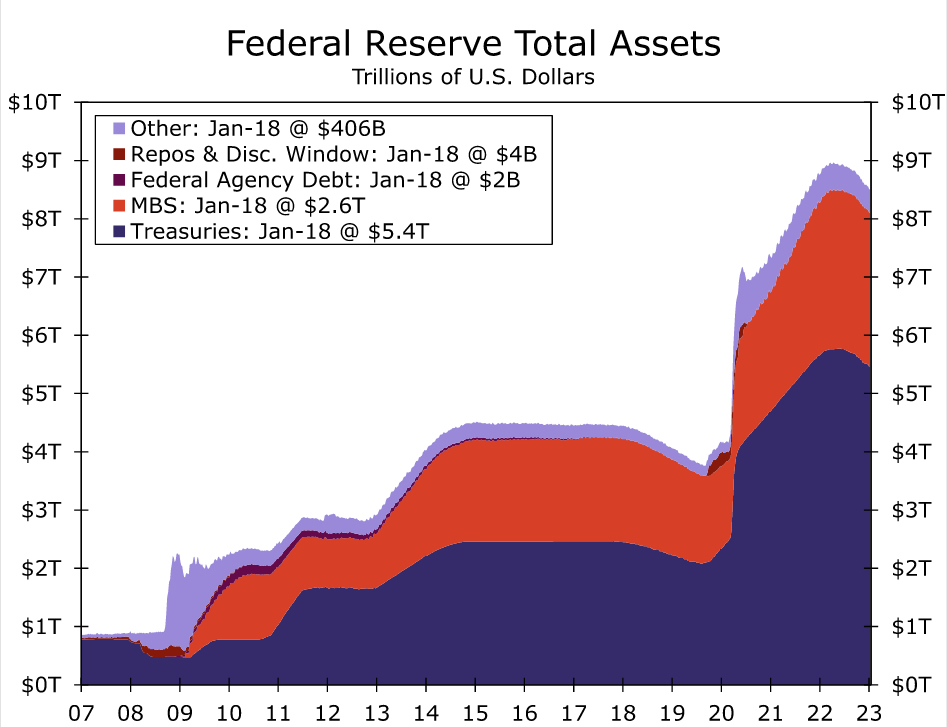
The Fed also has been taking steps to shrink its balance sheet (a.k.a., "quantitative tightening" or "QT") since June. Initially, the central bank allowed up to $30 billion worth of U.S. Treasury securities and up to $17.5 billion worth of mortgage-backed securities (MBS) to roll off its balance sheet every month. These monthly caps were raised to $60 billion and $35 billion, respectively, beginning in September. Since peaking in April 2022, the size of the Fed's balance sheet has declined by $476 billion to currently stand at roughly $8.5 trillion (Figure 7). Over that period, the central bank's holdings of Treasury bills, notes and bonds have dropped by $325 billion while its holdings of MBS is down by about $100 billion.
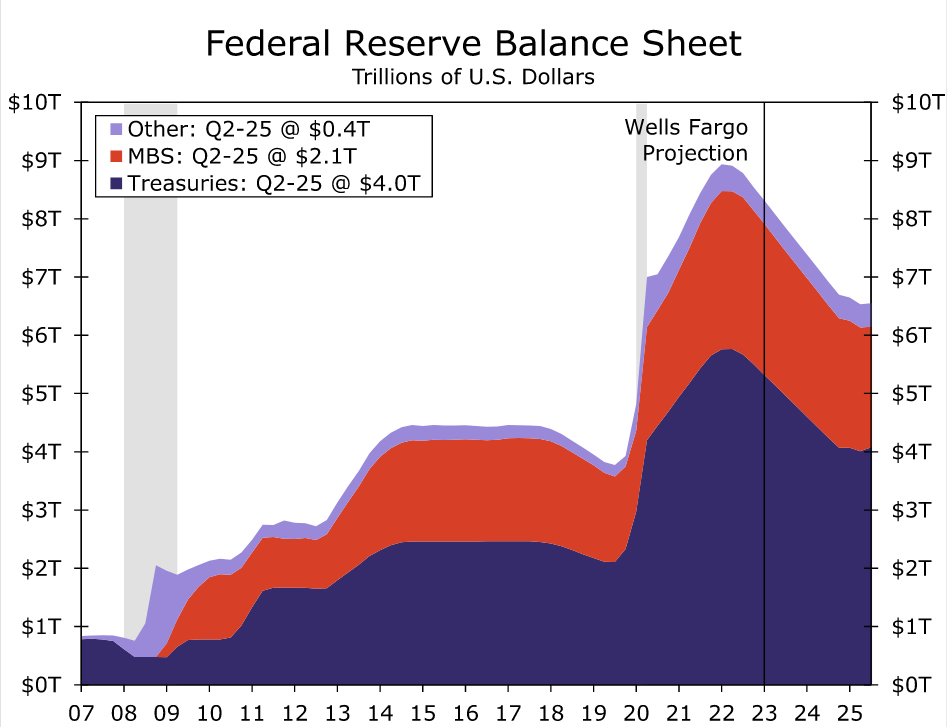
Because recent data indicate the U.S. economy continues to expand, we expect the FOMC will announce on February 1 that it once again will maintain the current monthly pace of QT (i.e., up to $60 billion of Treasury securities and up to $35 billion of MBS). As we wrote in a report that we published in July, we expect that, barring a recession, the Committee will allow the Fed's balance sheet to shrink to about $6.5 trillion in early 2025 (Figure 8). However, if the economy were to slip into a recession ahead of 2025, then we believe the FOMC will bring balance sheet reduction to an early end because it acts as a form of monetary tightening. Continued QT in conjunction with rate cuts, which the Committee likely would employ to support the economy, would work at cross purposes.
Although the overall size of the Fed's balance sheet likely would remain unchanged in the event of recession, its composition very well could change. That is, the FOMC stated in January 2022 that it "intends to hold primarily Treasury securities" on the asset side of its balance sheet in the longer run to minimize "the effect of the Federal Reserve holdings on the allocation of credit across sectors of the economy." Therefore, we could envision a scenario in which the Federal Reserve kept the overall size of its balance sheet constant by purchasing an equivalent amount of Treasury securities to replace the MBS that was rolling off.
Sunset Market Commentary
Markets
It’s been a quiet session. Trading was already muted in Asian dealings with Chinese and several other local markets closed for the Lunar NY holiday season. The economic calendar failed to inspire too, containing nothing more than European consumer confidence, due after wrapping up this report. It looked that core bonds’ 2023 rally finally hit the ceiling by the end of last week.
A slew of central bank speeches, especially those from ECB members, at long last started to filter through. The central message: monetary tightening is not over yet. ECB’s Kazimir (“need to deliver two more half-point hikes) and Vujic (December guidance on 50 bps hikes is “still reasonable”) were the most recent ones to reinforce that narrative today. Others, eg. Stournaras, argued for a more gradual approach though such views are shared by a minority only. German bond yields eke out another 3 bps at the long end of the curve with the 10y yield (2.2%) now 20 bps back above last week’s lows. Swaps underperform vs Bunds, adding 2.7-5.4 bps across the curve. The 10y yield moves further north from 2.72% (June 2022 interim high), turning previous resistance back into a support zone. US Treasury yields advance between 3.2 bps to 5.2 bps with the wings outperforming the belly of the curve. The 10y yield rose above 3.5% (June 2022 interim high) but we need confirmation of a sustained break in the coming days. The all in all orderly yield uptick doesn’t unsettle riskier markets. European stocks advance with marginal gains to the tune of 0.2%. Wall Street opens with similar gains (Nasdaq).
EUR/USD on currency markets caught some attention by launching an early attempt in the battle for 1.09. The breach higher triggered some minor stop losses but it wasn’t enough for an actual test of the 1.0942 resistance level. After camping north of 1.09 for a few hours, the pair eventually returned to familiar ground around 1.085 as the dollar clawed back. The Japanese yen underperforms G10 peers. Bets on a hawkish twist by the BoJ are being unwound further, pressuring the currency. USD/JPY settles above 130. The more than one big-figure-jump helps the trade-weighted dollar (DXY, 102.23) away from 9-month lows and important support at 101.297. Sterling starts the week on softer footing. EUR/GBP advanced from 0.873 to test 0.88. Cable (GBP/USD) sniffed at recent (December) highs around 1.245 before technical return action brought the pair back to 1.233 at the time of writing. News Headlines
The Hungarian forint underperforms regional peers today with EUR/HUF moving away from the 391.50 support zone towards 397. The move comes after rating agency Fitch last Friday (after market close) revised down the outlook on the Hungarian BBB rating from stable to negative. Fitch sees a high probability of delays in the disbursement of EU funds which would further question policy credibility, highlight governance challenges and potentially hurt investor sentiment. More generally, the rating agency pointed out that a tougher international environment, including higher global interest rates, volatile energy prices and weakening demand from key trading partners is exposing vulnerabilities stemming from a policy mix that is influenced by political considerations. Moody’s and S&P have a similar rating for Hungary, with S&P’s outlook on negative as well.
Eurostat data showed that the EMU general government deficit rose to 3.3% of GDP in Q3, up from 2% in Q2. The statistics agency noted that measures to alleviate the impact of high energy prices started to have a stronger impact on the government balance with the majority of member states continuing to record a government deficit. EMU government expenditures rose by 1% to 50.5% with government revenue declining slightly as the economy slowed. The EMU debt ratio rose to 93% of GDP.
Could the Australian CPI Further Boost the Aussie?
Amidst a quiet period on the Asian front due to the week-long Spring Festival in China, we get a handful of Australian data this week. Inflation data continues to attract the market’s attention, despite the recent drop in energy prices, amidst mixed expectations for a recession during 2023 at the biggest country of the Australian continent.
Another stronger CPI print?
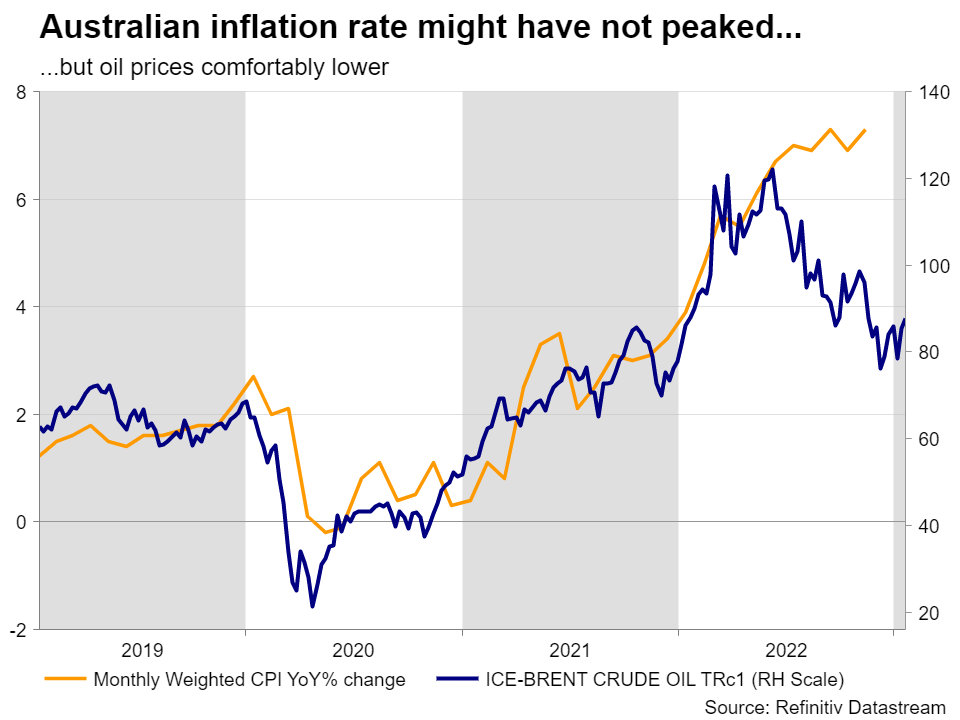
With the first RBA meeting for 2023 held in two weeks, the first batch of inflation data will be released on Wednesday. The monthly Consumer Price Index indicator for December is expected to show a year-on-year increase of 7.6%, up from the November print of 7.3% YoY change. In addition, the fourth quarter inflation figures, which tend to be more representative of the underlying pressures, are forecast to confirm a jump in price pressures across the board. Also, on Friday the fourth quarter print for the Producer Price index is expected to fall in line with the remaining data set.
What about the Leading indicator?
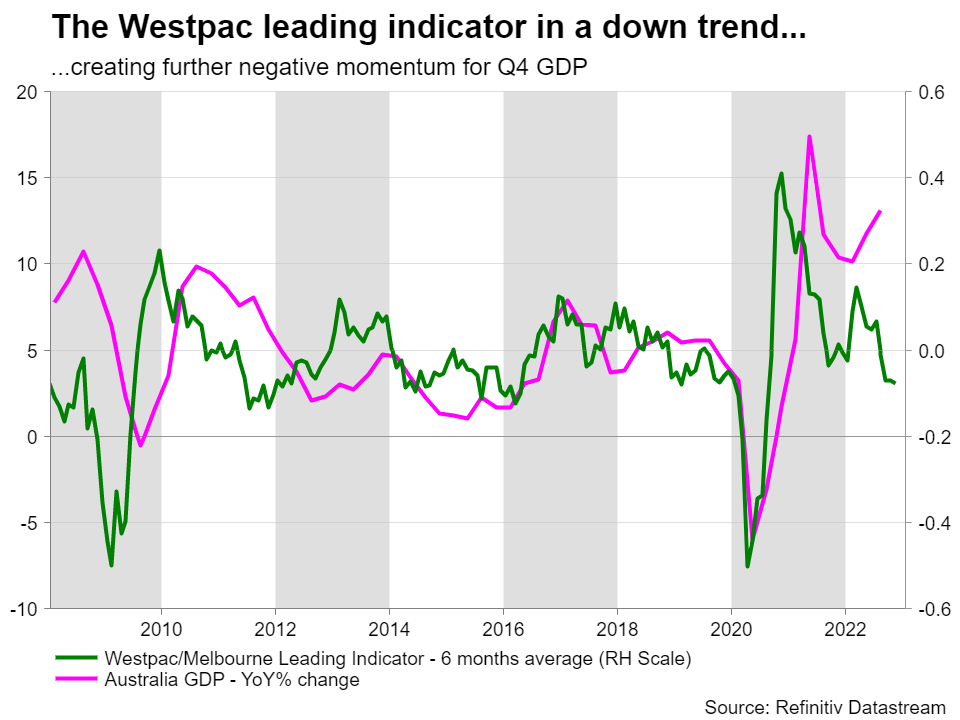
On Wednesday morning we get another piece of the economic puzzle. The Westpac/Melbourne Institute Composite Leading indicator, along with the Manufacturing and Services PMIs and the NAB Business surveys, are thought to accurately reflect the economic undercurrents in Australia. Having said that, the former has been flat lining recently, signaling significant downside risk to the fourth quarter GDP released on March 1.
Possible implications for the RBA?
Since the eve of the new year, the economic data releases have been relatively mixed in Australia. Despite inflation pressures remaining elevated, the labour market continues to enjoy a golden period. However, similarly to other regions, the housing sector is showing increasing signs of cracks. The latter is gradually becoming a hot topic among the central bankers, but it appears incapable of forcing the RBA to stop its current hiking cycle. If one adds the Chinese economic reopening to this mixture, it looks increasingly likely that stronger inflation data this week would potentially force the market to further cement expectations of a 25bps rate move on February 7. The current market probability assigned to this move stands at 61%.
Could the aussie get another boost?
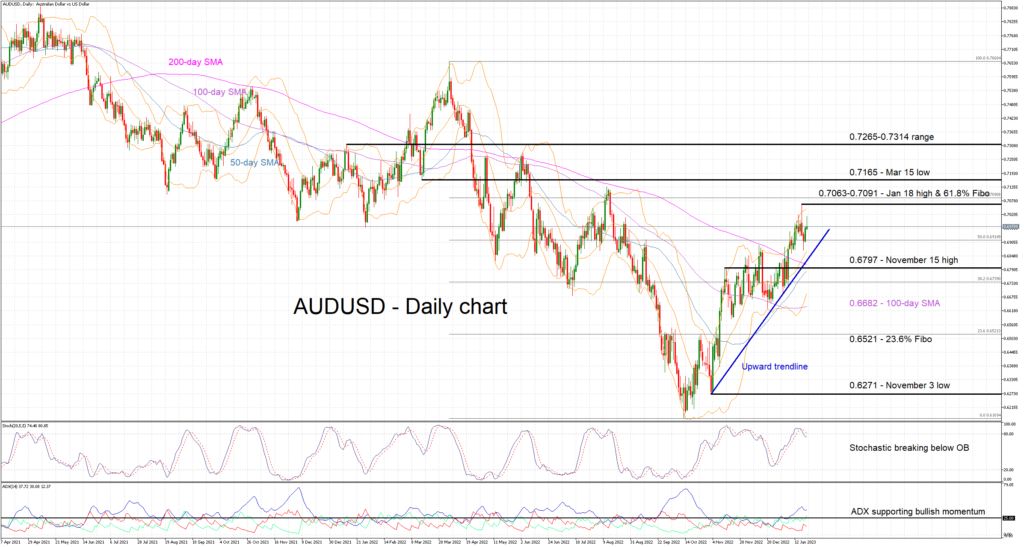
Following almost 18 months of weakness, the aussie/dollar pair is staging an aggressive recovery since October 2022. It currently battles with the psychological level of 0.7 having recorded a sizable 3.5% advance in 2023. The recent move can be characterized as aggressive, but the overall technical picture appears to be mostly positive for aussie bulls. Having said that, short-term corrections could be on the cards, but the onus is on the aussie bears to regain market control.
Euro Hits 9-month High But Pares Gains
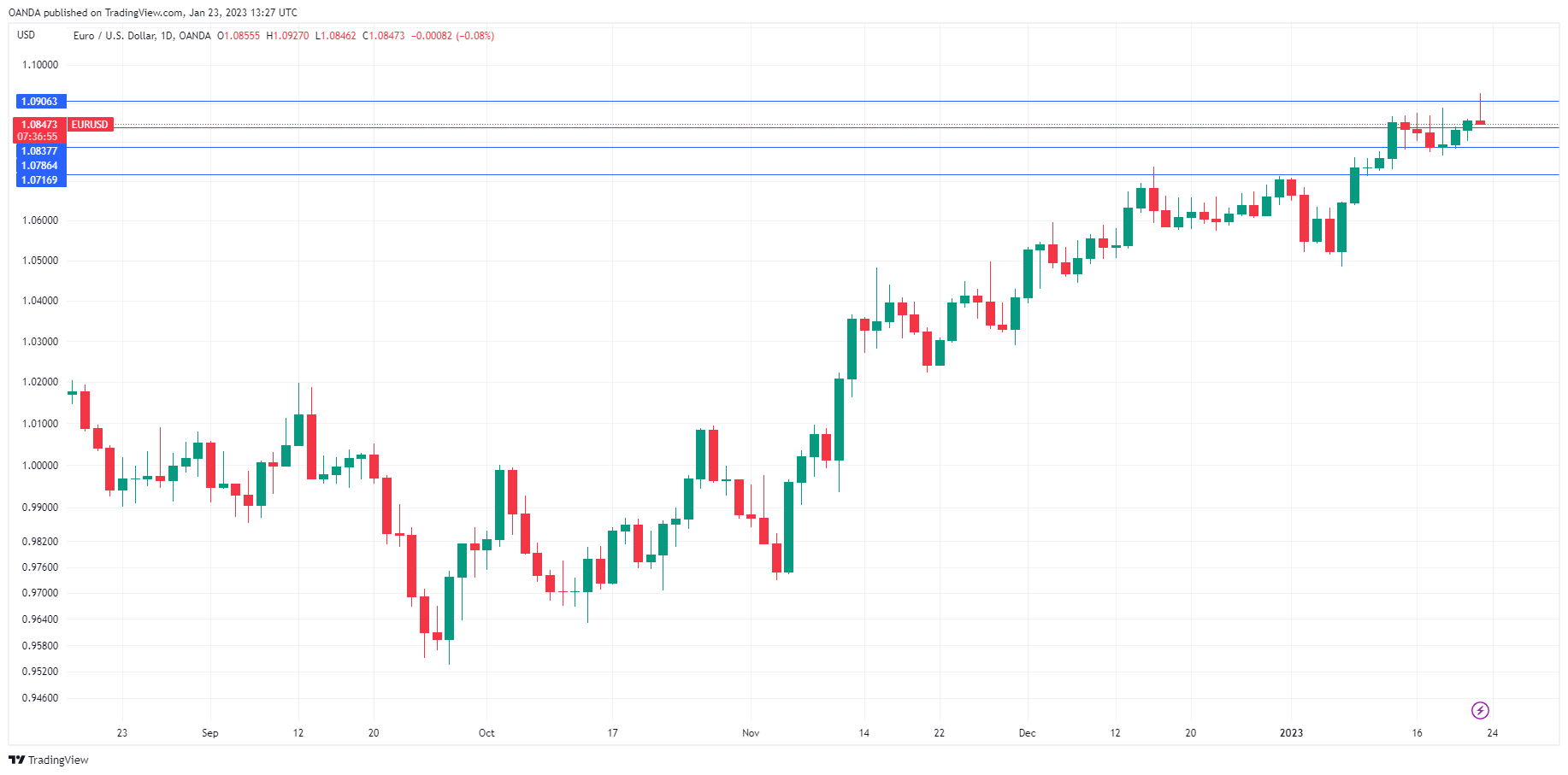
The euro has started the week with gains. EUR/USD briefly punched above the 1.09 line earlier today, for the first time since April but has pared these gains.
Tough ECB talk boosts euro
The ECB meets next on February 2nd and is widely expected to raise rates by 50 basis points. What’s the game plan after that? There has been speculation that the central bank might ease up with a 25-bp increase in March, with a Bloomberg report last week noting that although policy makers haven’t made a decision, the likelihood of a 25-basis point hike in March is gaining support.
The ECB has pushed back against this speculation, and the hawkish stance has reassured investors and boosted the euro. ECB President Christine Lagarde said at the Davos forum that inflation was still “way too high” and that the ECB would stay the course until inflation returns to 2%. ECB member Klaas Knot said on Sunday that the ECB should maintain 50-bp hikes at the February and March meetings and that easing the pace of hikes is “still far away”.
The eurozone economy is holding up fairly well despite the Ukraine war and energy prices have fallen, leaving ECB policy makers in a dilemma regarding rate policy. Should the ECB respond to the positive economic environment with smaller hikes of 25 bp or continue with 50-bp increases in order to ensure that inflation does not become entrenched? Lagarde said in December that the Bank would determine future rate moves based on data, and key releases such as inflation and employment reports could determine rate policy after February.
EUR/USD Technical
- 1.0837 is a weak support line. Below, there is support at 1.0786
- 1.0907 and 1.0958 are the next resistance lines
Dollar Rebounding With Yields, Euro Pares Gain
Dollar rebounds broadly in early US session, following benchmark treasury yields higher. But at the time of writing, Aussie is the strongest as supported by positive risk sentiment. Euro follows as it pares back some gains despite more hawkish ECB comments and an upbeat Bundesbank monthly report. Yen is currently the worst performer for the day, followed by Sterling.
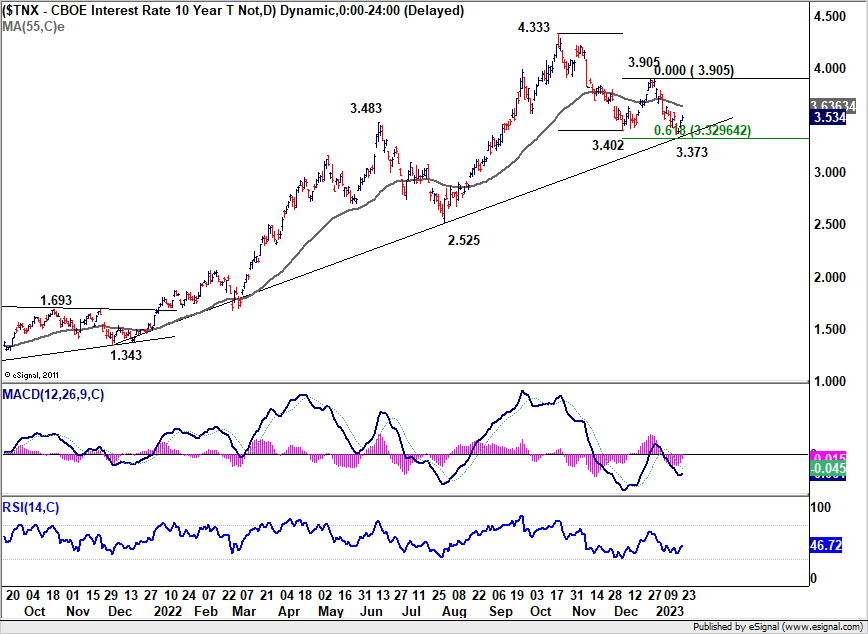
Technically, while it's still early to tell, it won't be a surprise to see 10-year yield bottomed at 3.373 and stage and a sizeable rebound. The level was close to 61.8% projection of 4.333 to 3.402 from 3.905 at 3.373, as well as medium term trend line support. Sustained trading above 55 day EMA (now at 3.636) should indciate the whole correction from 4.333 has completed in a three wave form. Further rally could then be seen back to 3.905 and above. Such development, if happens, with give the greenback some support, and takes USD/JPY higher in particular.
In Europe, at the time of writing, FTSE is up 0.28%. DAX is up 0.11%. CAC is up 0.27%. Germany 10-year yield is up 0.381 at 2.211. Earlier in Asia, Nikkei rose 1.33%. Japan 10-year JGB yield dropped -0.0264 to 0.378. Hong Kong, China, and Singapore were on holiday.
ECB Kazimir: We need to deliver two more hikes by 50bps
ECB Governing Council member Peter Kazimir said, "An inflation drop in two consecutive months is good news. But it is not a reason to slow the tempo of raising interest rates... I am convinced that we need to deliver two more hikes by 50 basis points."
"For me, the most important is core inflation trend," Kazimir said. "We are halfway through. If it were up to me, I would enter summer holidays with the tightening cycle completed. But don't ask me today, how high we will go with the rates, and how long will they need to stay there to tame inflation as needed."
ECB Stournaras: Adjustment of interest rates needs to be more gradual
ECB Governing Council member Yannis Stournaras said "in my opinion, the adjustment of interest rates needs to be more gradual, taking into account the slowdown in growth of the euro area economy,"
"Given the high uncertainty, ongoing geopolitical and macroeconomic turmoil, and volatility in the markets, it is very difficult to accurately predict the level at which interest rates need to be set," he added.
Bundesbank: Germany GDP likely to have roughly stagnated in Q4
Bundesbank said in the monthly report that real GDP was "likely to have roughly stagnated in the final quarter of 2022, exceeding earlier expectations". Real GDP grew 1.9% in 2022 as a whole, comparing to 2021. "It thus slightly exceeded the pre-pandemic level again."
Consumer price momentum "continued to weaken" in December, due to "significantly lower energy prices". However, "non-energy components such as food, industrial goods and services continued to rise sharply".
BoJ Minutes: Meeting suspended at government's request
published minutes of the December 19-20 meeting today, where the 10-year JGB yield cap was raised from 0.25% to 0.50%.
"Many members noted that there was a distortion in the price formation of 10-year bonds, and that the functioning of bond markets had deteriorated, particularly in terms of relative relationships among interest rates of bonds with different maturities and arbitrage relationships between spot and futures markets," the minutes said".
"Members concurred that, with regard to the conduct of yield curve control, the measure to expand the range of 10-year JGB yield fluctuations to between around plus and minus 0.5 percentage points from the target level, while significantly increasing the amount of JGB purchases, was appropriate."
Meanwhile, government representatives requested to adjourn the meeting after the discussions. They're probably surprised by the agreed adjustment to YCC. The meeting was adjourned from 10:51 a.m. to 11:28 a.m. before concluding at 11:54 a.m.
EUR/USD Mid-Day Outlook
Daily Pivots: (S1) 1.0819; (P) 1.0839; (R1) 1.0876; More...
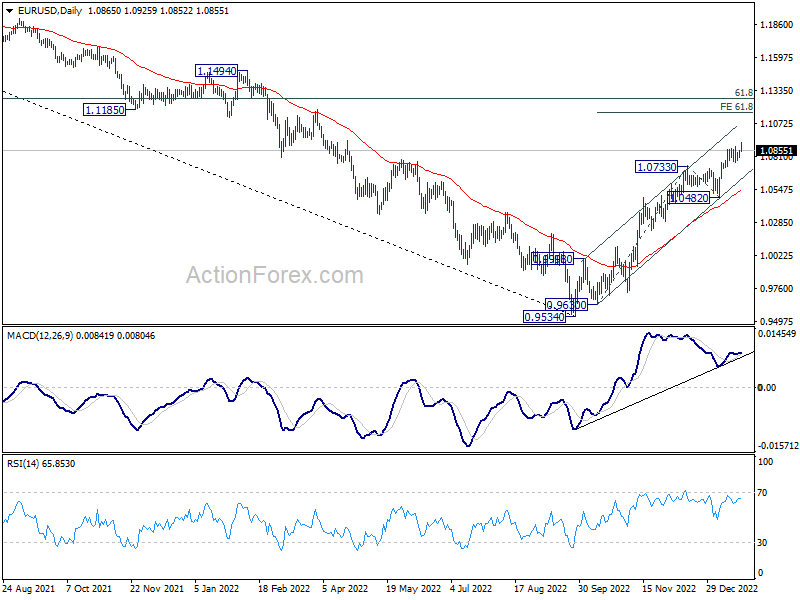
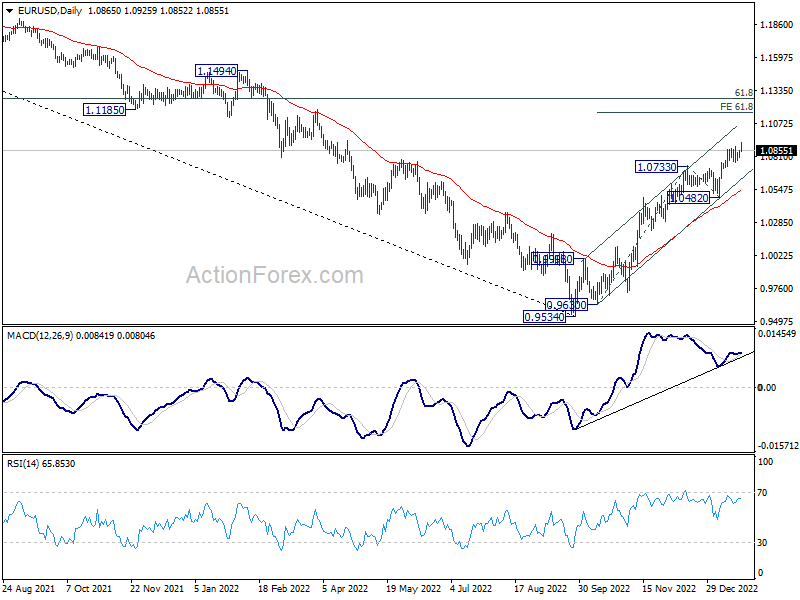
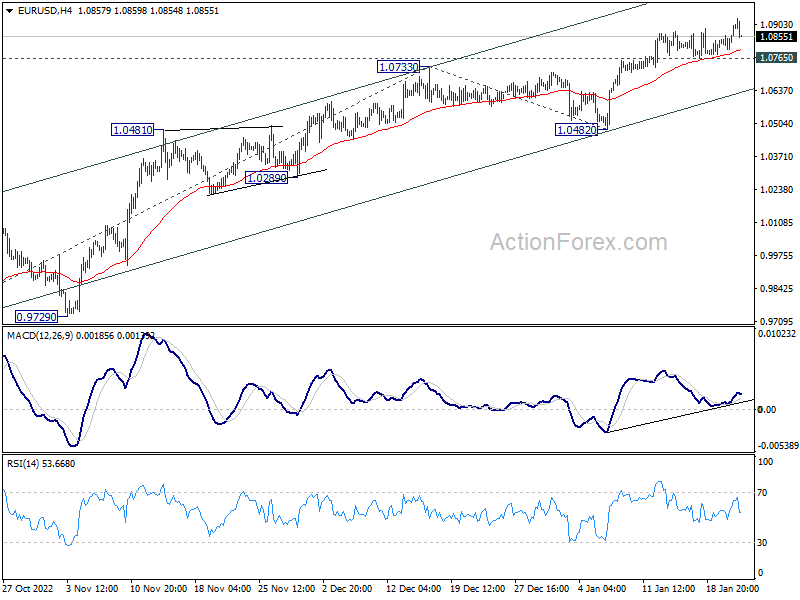
EUR/USD retreats slightly after rising to 1.0925, but stays well above 1.0765 support. Intraday bias stays on the upside first. Current rise from 0.9534 should target 61.8% projection of 0.9630 to 1.0733 from 1.0482 at 1.1164 next. On the downside, though, break of 1.0765 support should now indicate short term topping, and turn bias back to the downside for 55 day EMA (now at 1.0544).
In the bigger picture, current development suggests that the rally from 0.9534 low (2022 low) is a medium term up trend rather than a correction. Further rise is in favor to 61.8% retracement of 1.2348 (2021 high) to 0.9534 at 1.1273 next. This will remain the favored case as long as 1.0482 support holds.
Economic Indicators Update
| GMT | Ccy | Events | Actual | Forecast | Previous | Revised |
|---|---|---|---|---|---|---|
| 23:50 | JPY | BoJ Minutes | ||||
| 13:30 | CAD | New Housing Price Index M/M Dec | 0.0% | -0.2% | -0.20% | |
| 15:00 | EUR | Eurozone Consumer Confidence Jan P | -20 | -22 |
EUR/USD Mid-Day Outlook
Daily Pivots: (S1) 1.0819; (P) 1.0839; (R1) 1.0876; More...
EUR/USD retreats slightly after rising to 1.0925, but stays well above 1.0765 support. Intraday bias stays on the upside first. Current rise from 0.9534 should target 61.8% projection of 0.9630 to 1.0733 from 1.0482 at 1.1164 next. On the downside, though, break of 1.0765 support should now indicate short term topping, and turn bias back to the downside for 55 day EMA (now at 1.0544).
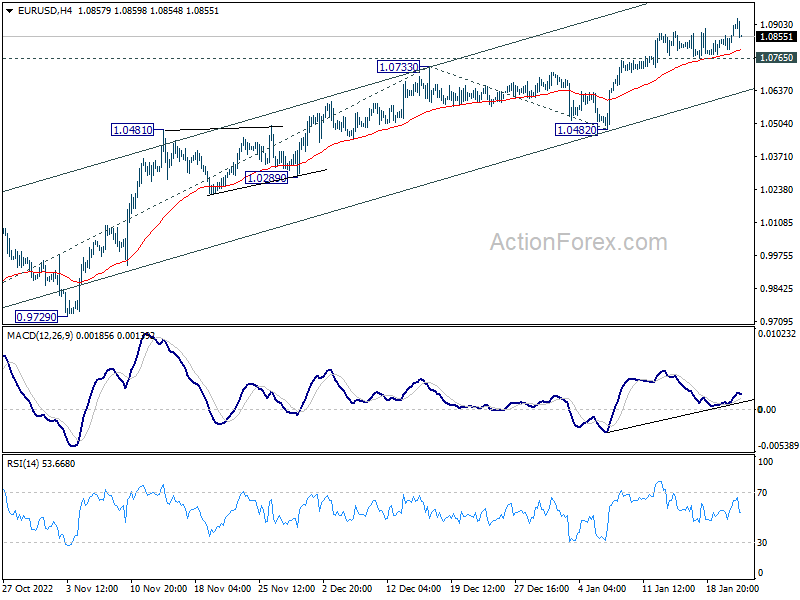
In the bigger picture, current development suggests that the rally from 0.9534 low (2022 low) is a medium term up trend rather than a correction. Further rise is in favor to 61.8% retracement of 1.2348 (2021 high) to 0.9534 at 1.1273 next. This will remain the favored case as long as 1.0482 support holds.