Sample Category Title
China GDP growth slowed to 2.9% yoy in Q4, but beat expectations
China's GDP growth slowed to 2.9% yoy in Q4, down from Q3's 3.9% yoy but beat expectation of 1.8% yoy. For 2022 as a whole, GDP grew 3.0%, sharply lower than 2021's 8.4%, but was better than 2020's 2.2%. That's still the second worst on record nonetheless.
In December, industrial production rose 1.3% yoy, above expectation of 0.3% yoy. Retail sales declined -1.8% yoy, much better than expectation of -9.5% yoy. Fixed asset investment grew 5.1% ytd yoy, above expectation of 5.1%.
"The foundation of domestic economic recovery is not solid as the international situation is still complicated and severe while the domestic triple pressure of demand contraction, supply shock and weakening expectations is still looming," NBS said in a release.
Also released, China's population decreased by -850k in 2022, the first contraction in more than six decades. Birthrate was at 6.77 births per 1000 people, sharply down from 2021's 7.52 births, and marked the lowest level on record. Death rate rose from 7.18 to 7.37 per 1000 people, highest since 1976.
GBP/USD Could Rally Further If It Clears 1.2300
Key Highlights
- GBP/USD started a fresh increase above the 1.2200 resistance.
- It surpassed a major bearish trend line with resistance near 1.2050 on the 4-hours chart.
- EUR/USD might struggle to clear the 1.0920 resistance zone.
- The UK ILO Unemployment rate could remain at 3.7% in Nov 2022 (3M).
GBP/USD Technical Analysis
The British Pound started a fresh increase above the 1.2150 resistance zone against the US Dollar. GBP/USD broke the 1.2200 resistance to move into a positive zone.
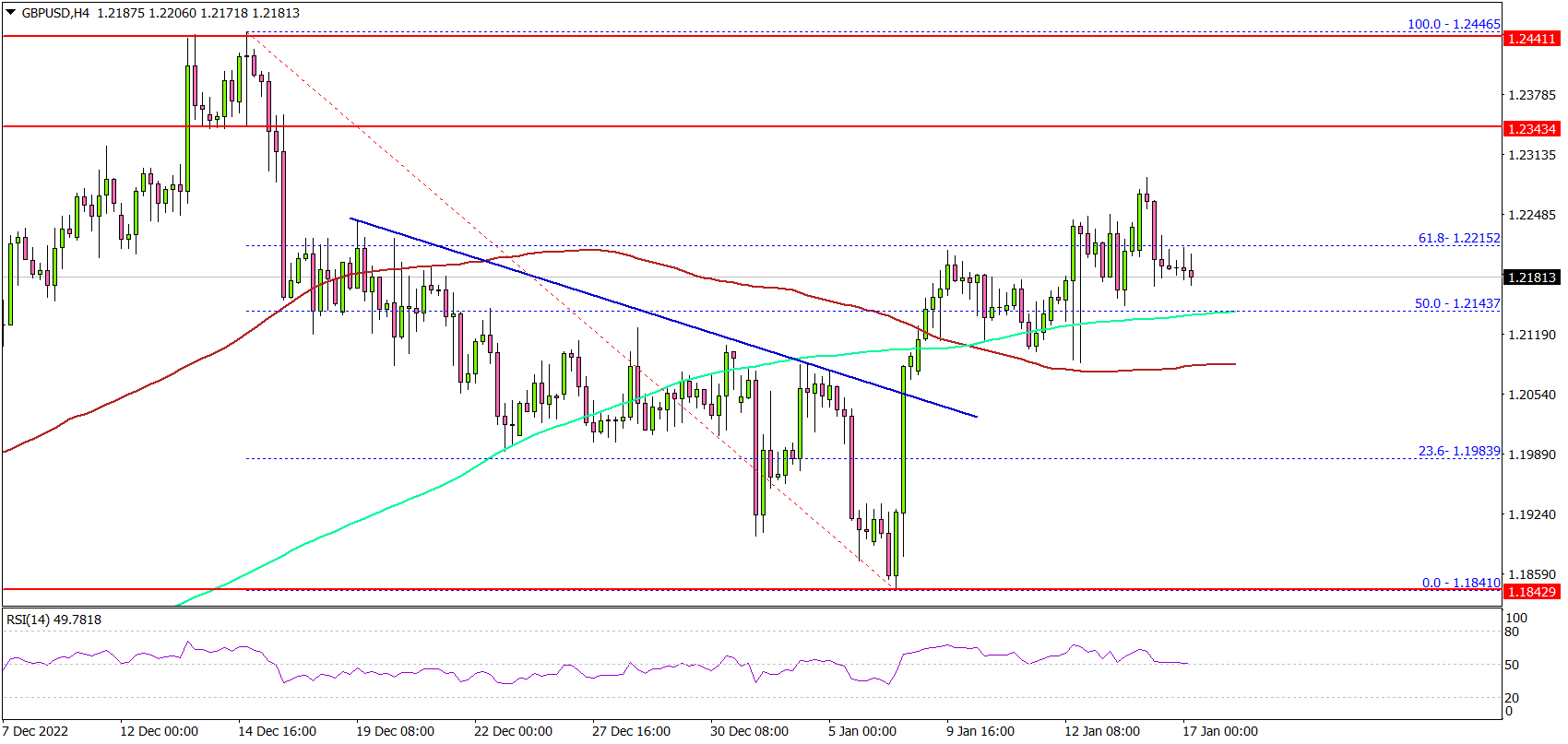
Looking at the 4-hours chart, the pair surpassed a major bearish trend line with resistance near 1.2050. It opened the doors for a move above the 1.2200 resistance, the 100 simple moving average (red, 4-hours) and the 200 simple moving average (green, 4-hours).
There was a clear move above the 50% Fib retracement level of the key decline from the 1.2446 swing high to 1.1841 low. On the upside, an initial resistance is near the 1.2300 level.
The next major resistance may perhaps be near 1.2345. A clear move above the 1.2345 resistance might start a steady increase. In the stated case, GBP/USD could even surpass the 1.2500 zone. The next key hurdle is near 1.2620, above which the pair could climb towards the 1.2800 resistance zone.
On the downside, there is a major support at 1.2120. The next major support is near the 1.2050 level. A downside break below the 1.2050 zone might push the pair lower.
The next major support sits near the 1.2000 level. Any more losses might open the doors for a move towards the 1.1850 support zone.
Looking at EUR/USD, the pair is struggling to gain pace for a clear move above a key barrier near the 1.0920 resistance.
Economic Releases
- UK Claimant Count Change for Dec 2022 – Forecast 11.0K, versus 30.5K previous.
- UK ILO Unemployment Rate for Nov 2022 (3M) – Forecast 3.7%, versus 3.7% previous.
Australia Westpac consumer sentiment rose 5% in Jan
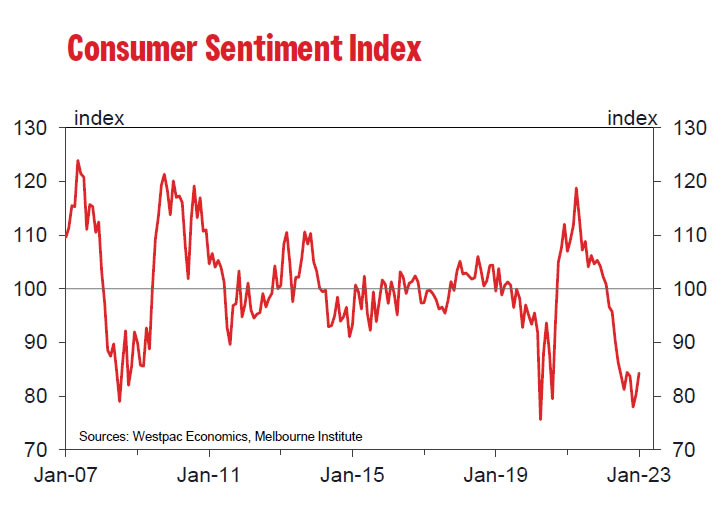
Australia Westpac Consumer Sentiment rose 5.0% mom to 84.3 in January, the largest monthly gain since April 2021. It's also the second straight month of improvement, with combined rise of 8.1%. Current Conditions index rose 2.8% mom while Expectations Index rose 6.3% mom. Unemployment Expectations also improved 8.4% mom.
Westpac said: "One likely explanation for the lift in confidence is that January was the first month since April last year that did not see an increase in the RBA cash rate. While that was because there was no RBA Board meeting in the month rather than an explicit decision by the Bank to leave rates unchanged, the break in the tightening cycle looks to have provided some relief."
Regarding RBA rate decision, Westpac expects another 25bps hike on February. It also expects clear message from RBA that the February increase will not be the last in the tightening cycle, because of a lift in annual inflation, strong retail sales growth and ongoing tight labor market.
NZ NZIER business sentiment hit record low
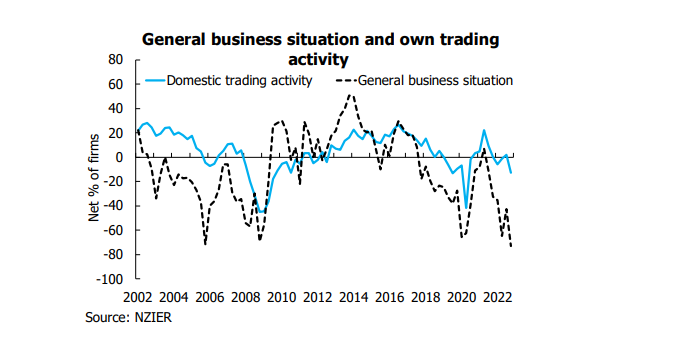
New Zealand NZIER Quarterly Survey of Business Opinion showed, in Q4 on a seasonally adjusted basis, a net 73% of businesses expect general economic conditions to deteriorate over the coming months. That's the worst level in the survey's history.
A net 13% of businesses reported a decline in their own activity over the past quarter, worst since Q2 2020 during the full impact of the first pandemic lockdown. A net 33% expected decline in activity in the coming quarter.
"Firms have also reduced investment plans substantially, particularly when it comes to investment in buildings," NZIER said. Retail businesses were feeling "very downbeat", it found.
BoE Bailey: Labor force shrinkage the major risk to UK inflation
BoE Governor Andrew Bailey told a parliamentary committee yesterday that inflation could fall back substantially this year. Still, there are risks from labor shortage and China.
"The biggest single reason inflation has risen to that level is the war in Ukraine. It is also the most likely reason that we're going to see a rapid fall in inflation in the year ahead, because we are not seeing energy prices rising further. In fact, they're coming down," he said.
"Going forwards, the major risk to inflation coming down in the way that it will is the supply side," Bailey said. "In this country particularly the question of the shrinkage of the labor force," which has pushed up wages.
"First of all in the economic outlook it think it's quite likely we will see a negative impact in the short run in China from what's going on at the moment from the release of the Covid restrictions and the impact that's having," Bailey said. "I'm not sure that would be very long lasting."
Nikkei 225 Index Wave Analysis
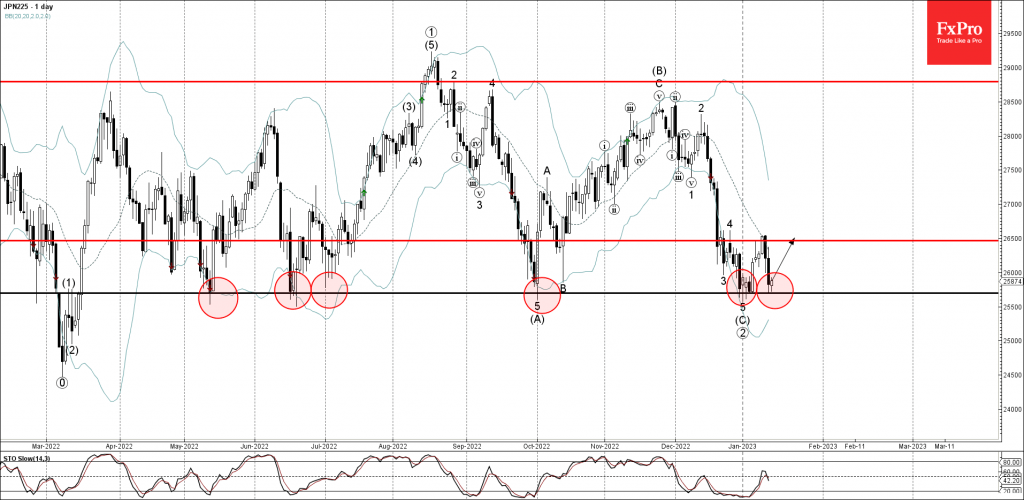
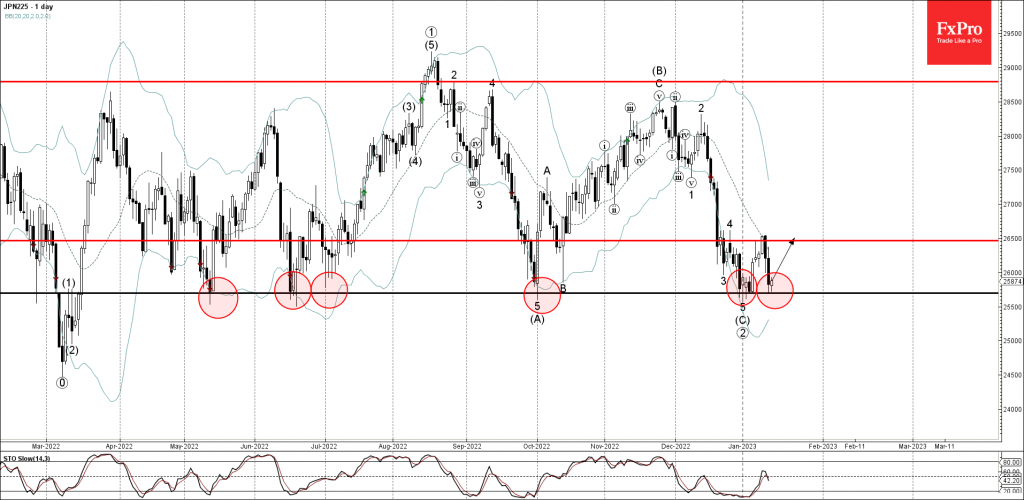
- Nikkei 225 reversed from key support level 25695.00
- Likely to rise to resistance level 26500.00
Nikkei 225 index recently reversed up from the key support level 25695.00 (which has been repeatedly reversing this index from last May).
The upward reversal from the support level 25695.00 continues the active long-term upward impulse wave ③, which also previously started from the same support level.
Nikkei 225 index can be expected to rise further toward the next resistance level 26500.00 (which has been reversing the index from the end of December).
NZDJPY Wave Analysis
- NZDJPY reversed from key support level 81.35
- Likely to rise to resistance level 82.60
NZDJPY currency pair recently reversed up from the key support level 81.35 (which is the lower border of the wide sideways price range inside which the pair has been moving from September).
The support level 81.35 was further strengthened by the lower daily Bollinger Band.
Given the strength of the support level 81.35, NZDJPY can be expected to rise further toward the next resistance level 82.60 (former support level which stopped wave A at the end of last month).
Are US Retail Sales the Dollar’s Next Big Test?
Last week, it was again confirmed that the US inflation data is the dollar’s biggest nightmare. The currency tumbled and hit a new 7-month low on Monday as investors were further convinced that the Fed may eventually need to cut interest rates at some point this year. As they seek extra validation to their view, this week, traders are likely to pay attention to the US retail sales for December and the PPIs for the month, both due to be released on Wednesday at 13:30 GMT.
Inflation data confirms rate-cut bets
Last Thursday, both the headline and core CPI rates for December declined to 6.5% y/y and 5.7% y/y from 7.1% and 6.0% respectively, matching expectations. However, what came as a surprise and perhaps prompted traders to sell more dollars may have been the monthly CPI rate.
Instead of stagnating as the forecast suggested, consumer prices declined 0.1% m/m, adding credence to the view that inflation may be on a sustained downtrend and that the Fed would eventually need to cut rates later this year, even as some officials continued arguing after the data that no cuts are on the table after interest rates hit their terminal level.
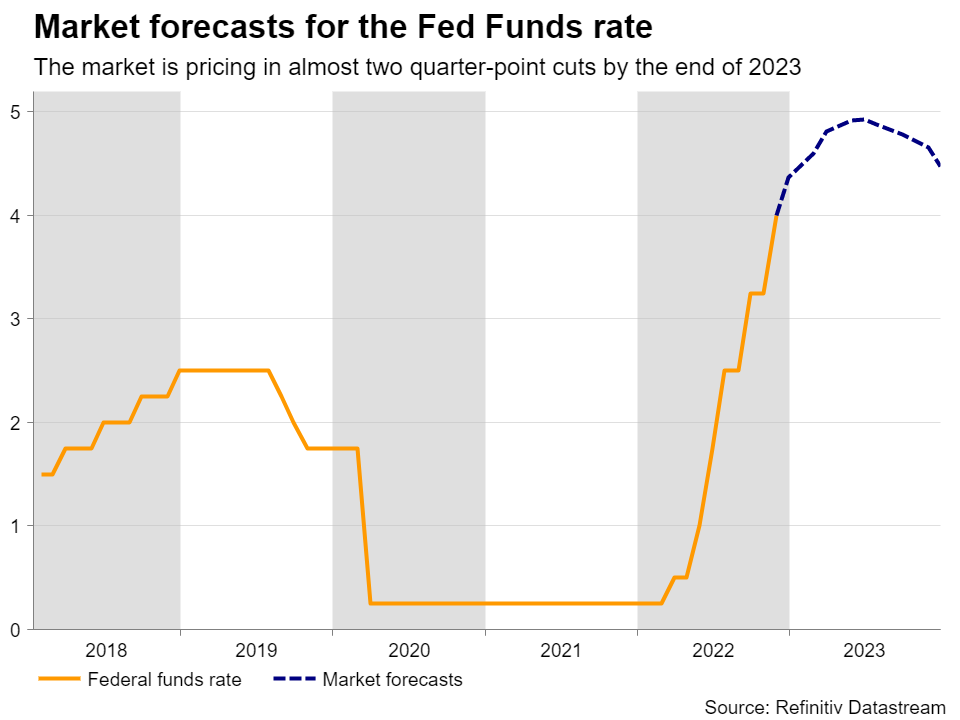
Market participants are now pricing in a 90% chance for the Fed to proceed with a 25bps hike at its upcoming gathering, something also supported by some officials lately, and they are anticipating a terminal rate of around 4.92%. That’s below the Fed’s median dot for 2013, which is at 5.125%. Most importantly, investors are still expecting 50bps worth of rate reductions by the end of the year, while various Fed speakers have suggested that rates will remain steady for many months, once they reach their peak.
US retail sales to continue deteriorating
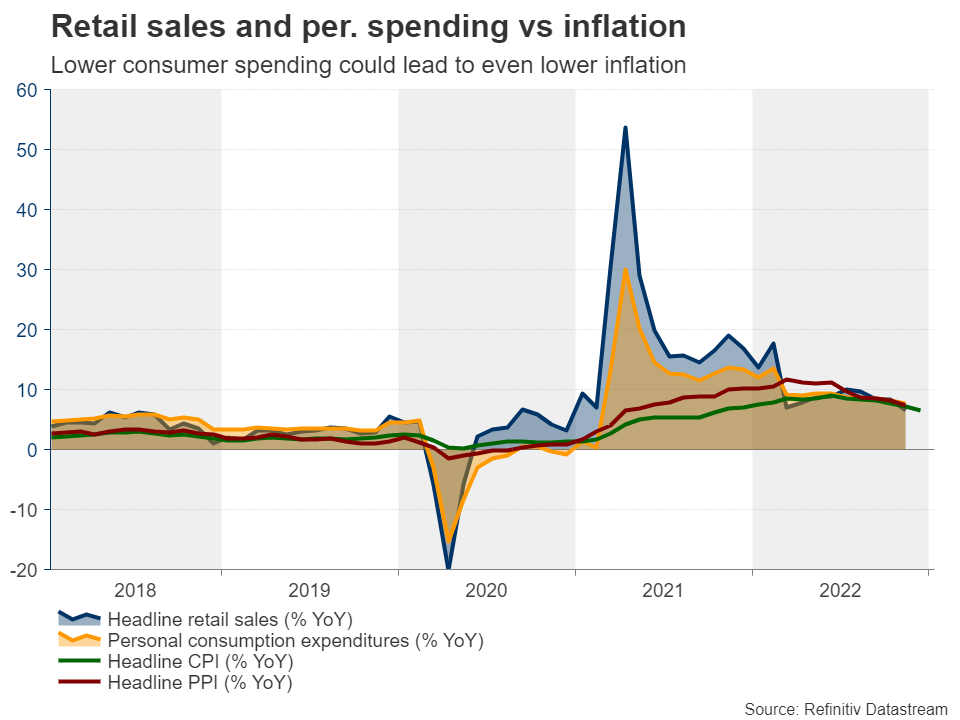
This week, both headline and core retail sales are forecast to have declined further and more than in November. Specifically, expectations are for both rates to slide to -0.8% m/m and -0.4% m/m from -0.6% and -0.2% respectively. This means that consumers are becoming more reluctant to spend, which could bring inflation further down in coming months, something also supported by the PPI forecasts. Both the headline and core PPI rates are expected to have continued declining, with the monthly headline print expected to tick into the negative zone just as the CPI rate did.
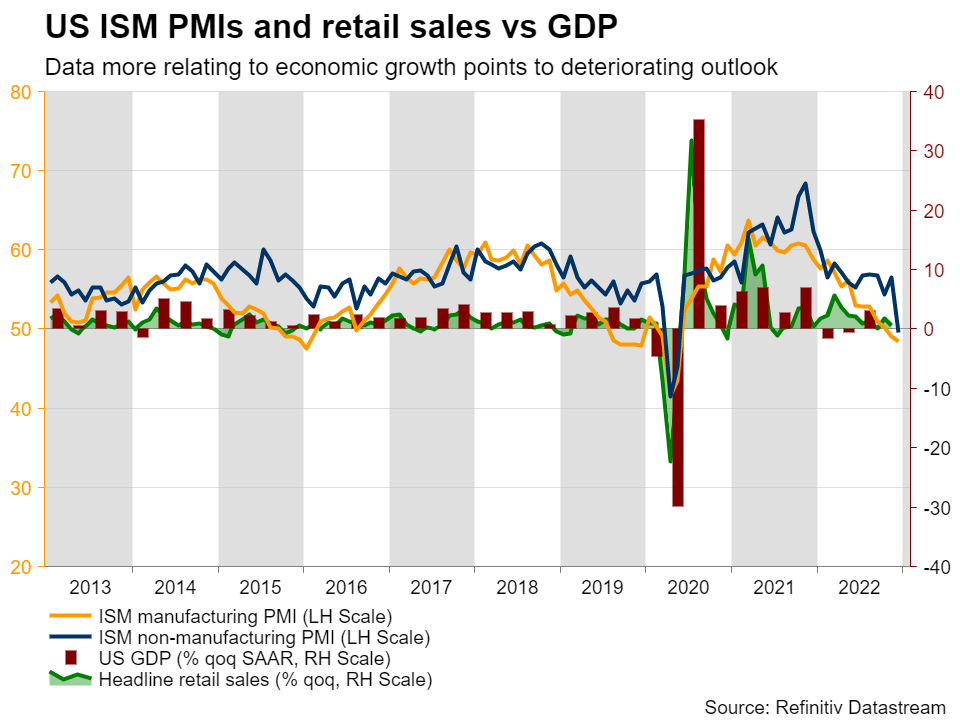
Having said all that though, deteriorating consumer demand also means softer economic growth. Releases relating to economic growth prospects have been worsening, with one of the latest examples being the ISM non-manufacturing PMI for December, which fell into contractionary territory for the first time since May 2020. Coming on top of the further contraction in the manufacturing sector, a shrinking service sector (which accounts for around 77.6% of US GDP) is anything but encouraging. So, another soft retail-sales data set could ring more alarm bells.
Dollar may continue drifting south
Expectations of softer inflation blended with concerns about the performance of the US economy could further solidify investors’ opinion that the effect of the prior interest rate hikes may not be fully reflected in economic data yet, and that consequently interest rates may need to be cut at some point later this year. This could result in much more dollar selling, especially against the euro and the yen.
With underlying inflation in the Eurozone continuing to accelerate, the ECB is expected to keep raising interest rates more aggressively than the Fed henceforth. As for the BoJ, last week’s reports that officials may proceed with additional action at Wednesday’s meeting to correct distortions in the yield curve added to speculation that the BoJ may be starting its own tightening crusade at a time when the Fed is headed for the exit.
Will euro/dollar extend its recovery to 1.1175?
After the US inflation data, euro/dollar emerged and closed the day above 1.0800. Now, it is pulling back, but even if it falls back below 1.0800, the prevailing short-term trend will remain positive as a higher high is already confirmed.
A potential setback below 1.0800 could trigger buying orders near the 1.0715 barrier and another round of soft US economic data could result in a rebound back above 1.0800. Such a move could pave the way towards the 1.1175 territory, which acted as a resistance on March 31 and provided strong support between November 2021 and February. 2022.
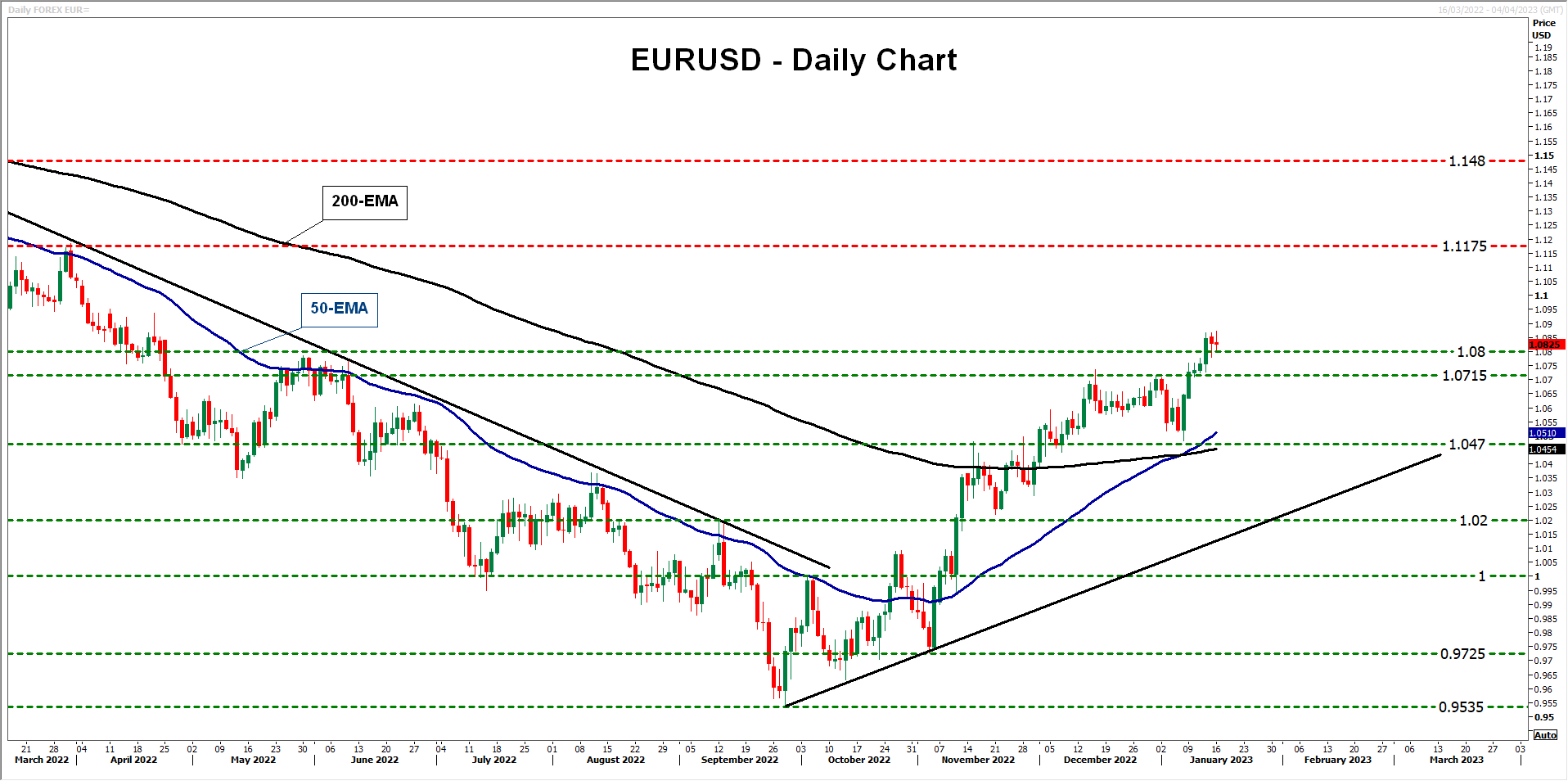
On the other hand, stronger-than-expected US retail sales could encourage some dollar buying and perhaps take euro/dollar below 1.0715. However, the pair would still be above the uptrend line drawn from the low of September 28, and thus, such a retreat may be seen as a corrective move before the next leg north. For the outlook of this pair to shift to bearish, a clear break below parity may be needed.
Japan’s Inflation Acceleration Sets Up a Hawkish BoJ Stance
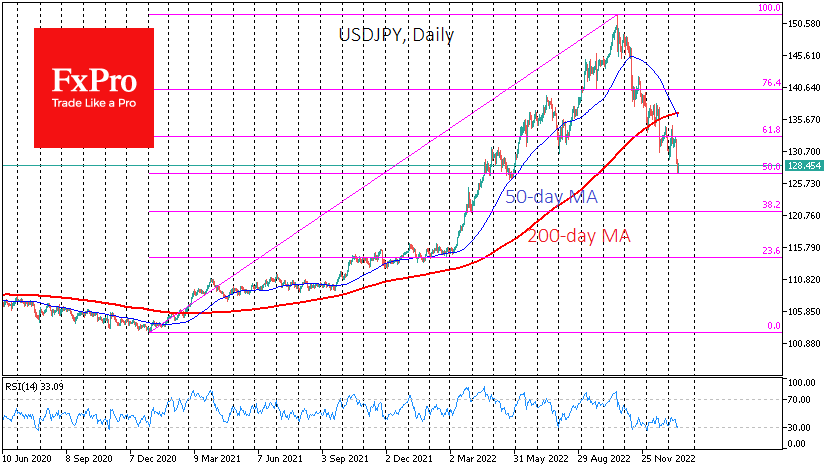
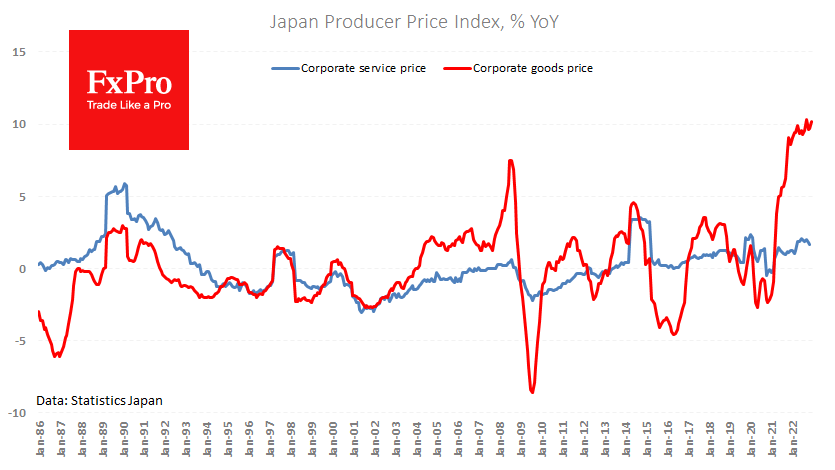
Japan’s Domestic Corporate Goods Price Index rose 0.5% m/m and 10.2% y/y in December after 0.8% m/m and 9.7% y/y. This is near the peak of 10.3% set in September. Despite lower commodity prices, prices are stubbornly reluctant to fall in Japan. And this is discouraging as more than one generation of economists has seen Japan as a prime example of deflation, citing demographics. We may continue to see a secondary effect of the yen weakening.
The Bank of Japan has halted the yen’s weakening spiral by reversing about half of the losses since the start of 2021. Nevertheless, increased exchange rate volatility pushes sellers to impose higher margins on prices, which prolongs inflationary pressures and risks triggering the price-wage spiral that every central bank in the world fears.
With this kind of resilience in inflation, investors expect to see a tougher central bank stance. From that point of view, it is logical that the Bank of Japan has had to go out with record purchases of Japanese government bonds in recent days to keep their yields from rising.
However, rising government bond yields are increasing pressure on the budget. There are doubts about the sustainability of the Japanese finance ministry, given the country’s massive national debt, chronic budget deficit and sluggish economic growth.
The BoJ remains the only central bank to maintain negative interest rates, probably out of fear of triggering unnecessary pressure on the economy. Therefore, with double interest, we should watch for the decisions and comments of the BoJ on Wednesday morning, where no options can be ruled out.
We could see a decisive turnaround from the policy targeting government bond yields and even a key rate hike. If that is the case, the yen could continue to strengthen towards 120 before the end of the first quarter.
The opposite surprise cannot be ruled out when the central bank strengthens its negative rate policy and puts the yen back on a sustained downward path. This turnaround could be particularly dramatic for the currency as market prospects are now skewed towards an expectation of tighter policy, albeit less dramatically than we see in the USA or the Eurozone. In that case, the USDJPY might hit 133 very quickly and then aim for 140 before the end of March.
A dull scenario is also possible if the BoJ balances out its signals and does not cause market turbulence as it did at its last meeting in December. The inflation picture is pointing towards a policy-tightening option despite the risks of losses for the economy.