

Sample Category Title
Sunset Market Commentary
Markets
With US cash markets closed for Martin Luther King Jr. holiday, trading remained very subdued at the start of the new week. It doesn’t help either that there were no important economic data scheduled for release. The World Economic Forum kicked off in Davos today but there too the news flow still had to pick up. Comments from central bankers were limited to ECB’s Rehn repeating the current mantra that policy rates will still have to rise significantly to levels that are restrictive enough to bring inflation timely back to target. By acting swiftly, Rehn said, the ECB should be able to avoid a so-called Volcker shock. But German/European yields weren’t really impressed. An early upleg that brought them several (4 to 5) bps higher was based on air and evaporated soon enough. Yields currently trade close to unchanged. That intraday reversal also capped the euro’s upside momentum. EUR/USD tested recent highs below 1.09 before paring gains back to the low 1.08 area. The Japanese yen (USD/JPY 128.49) underperforms peers today after a stellar run over the previous days. This brings us to one of the most closely watched events for this week; the BoJ.
The Japanese central bank meets this Wednesday. Back in December, it unexpectedly doubled the allowed deviation from the 0% 10-y yield cap from 25 to 50 bps. The news sent shockwaves through markets. The BoJ said this was to improve bond-market functioning with markets consistently pushing yields against the 0.25% upper limit in a context of rising inflation. It triggered near-constant BoJ bond-buying over the past few months. This is still the case today even with the higher cap. Investors saw the move as the beginning of the end of YCC and will probably see their case confirmed if, as currently is speculated here and there, the BoJ raises the yield bar again this week. Eventually, the BoJ twist could even lead to rate hikes when the new governor takes over from Kuroda in April. Upgraded inflation forecasts (nearing 2% at the end of the horizon, as cited by Japanese business newspaper Nikkei) could serve as the decisive argument. The Norges Bank also meets this week (Thursday). There are no new forecasts this time around. Headline inflation eased slightly more than expected in the December projections but the more sticky core inflation unexpectedly rose (5.8%). In this respect, we’re keen to see whether the central bank sticks to its forecasted terminal rate of 3%. The NOK weakening since Norges Bank (in particular vs the euro) was also bigger than expected. Other things to watch this week include Chinese Q1 GDP numbers, earnings season kicking in higher gear and an extensive UK economic update with the labour market report tomorrow, December inflation on Wednesday and retail sales on Friday. Sticking to the UK, the country got some bad news coming from DBRS Morningstar this morning (see below).
News Headlines
DBRS Morningstar, the number 4 global credit rating agency, downgraded the UK credit rating from AA (high) to AA with a stable trend. The downgrade reflects UK policy becoming less predictable and no longer compatible with a higher rating. DBRS specifically refers to the volatile period in September/October of last year where the interim-tandem Truss/Kwarteng was throwing away the UK’s credibility via unfunded spending proposals. Although the high degree of uncertainty has receded, the swift changes in economic policies in recent months have affected the predictability of UK policy. The UK is rated AA at S&P and one notch lower at both Fitch (AA-) and Moody’s (Aa3). All ratings come with a negative outlook attached.
US Treasury Secretary Yellen will hold a surprise meeting with Chinese vice-premier Liu He on Wednesday morning at the sidelines of the World Economic Forum in Davos. It’s their first 1-on-1 live encounter which stems from US President Biden and Chinese PM Xi Jinping’s meeting in November of last year at the G20-Summit. Both countries aim to dethaw their relationship which hit rock-bottom during the Trump presidency although they remain at odds over thorny issues such as trade, Taiwan, human rights and access to technology. The meeting will probably be highly symbolic in nature while nevertheless laying the groundwork for a visit by US Secretary of State Blinken to China early this year.
USD/JPY Mid-Day Outlook
Daily Pivots: (S1) 127.07; (P) 128.25; (R1) 129.04; More...
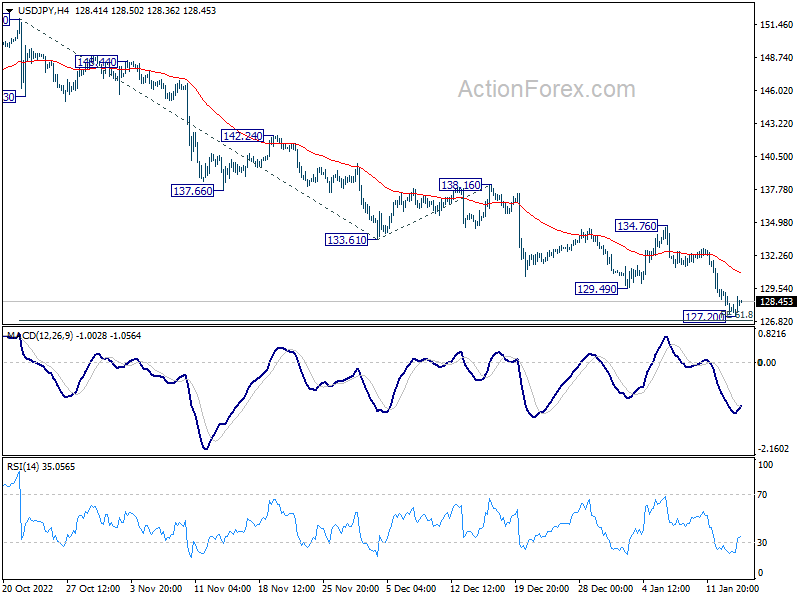
Intraday bias in USD/JPY is turned neutral with current recovery, and some consolidations could be seen. But further decline is expected as long as 134.76 resistance holds. Break of 127.20 will resume the fall from 151.93 to 121.43 fibonacci level next.
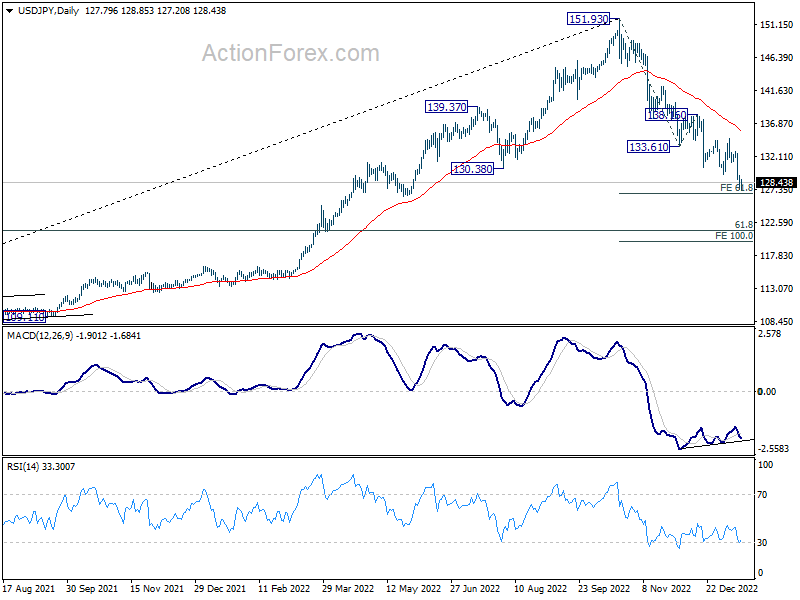
In the bigger picture, the firm break of 55 week EMA (now at 131.59) raises the chance of medium term bearish reversal, but that's not confirmed yet. Strong support could be seen around 61.8% retracement of 102.58 to 151.93 at 121.43 and 38.2% retracement of 38.2% retracement of 75.56 to 151.93 at 122.75 to bring rebound. But break of 134.76 resistance is needed to indicate bottoming first. Otherwise further fall will remain in favor.
USD/CHF Mid-Day Outlook
Daily Pivots: (S1) 0.9242; (P) 0.9279; (R1) 0.9303; More...
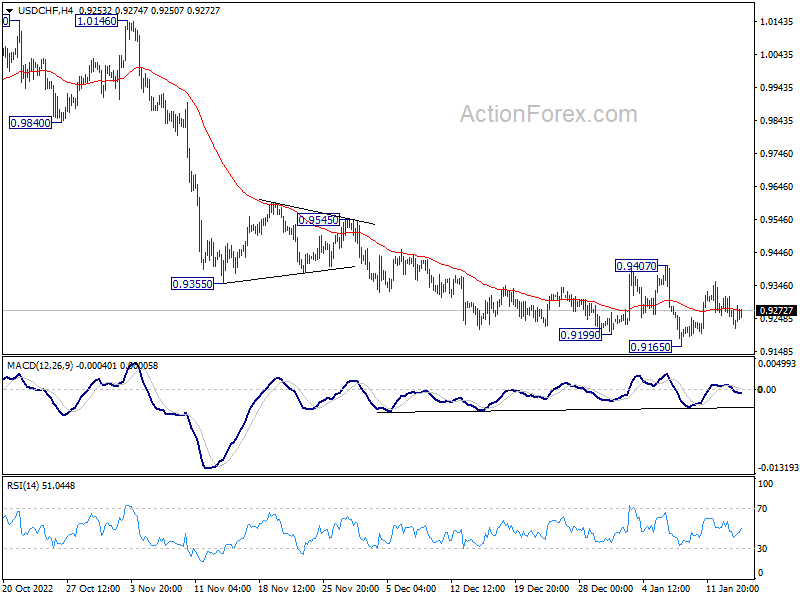
Intraday bias in USD/CHF stays neutral at this point. Outlook stays bearish as long as 0.9407 resistance holds. Break of 0.9165 will resume whole fall from 1.0146. However, firm break of 0.9407 will turn bias back to the upside for stronger rebound.
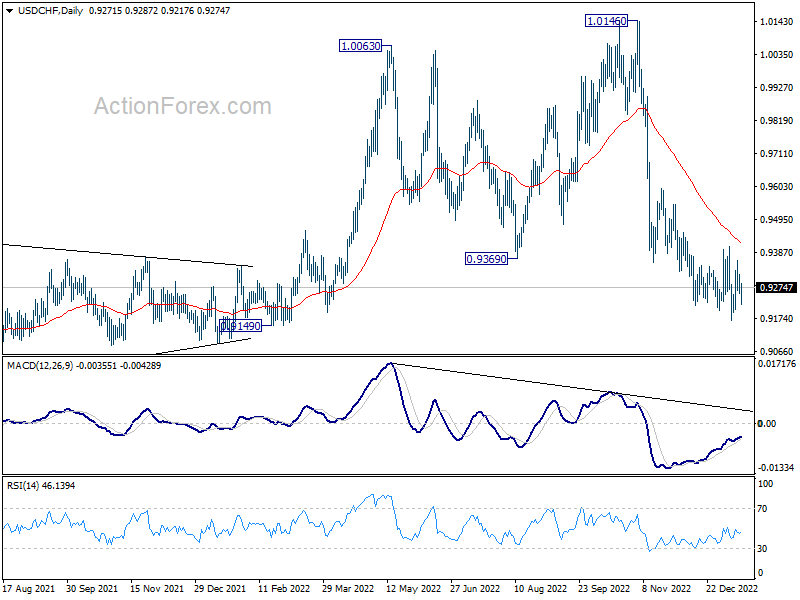
In the bigger picture, rise from 0.8756 (2021 low) has completed at 1.0146, well ahead of 1.0342 long term resistance (2016 high). Based on current downside momentum, fall from 1.0146 should be a medium term down trend itself. Next target is a test on 0.8756 low. Strong support should be seen there to bring rebound. Still, further decline will now be expected as long as 0.9407 resistance holds, in any case.
GBP/USD Mid-Day Outlook
Daily Pivots: (S1) 1.2173; (P) 1.2211; (R1) 1.2270; More...
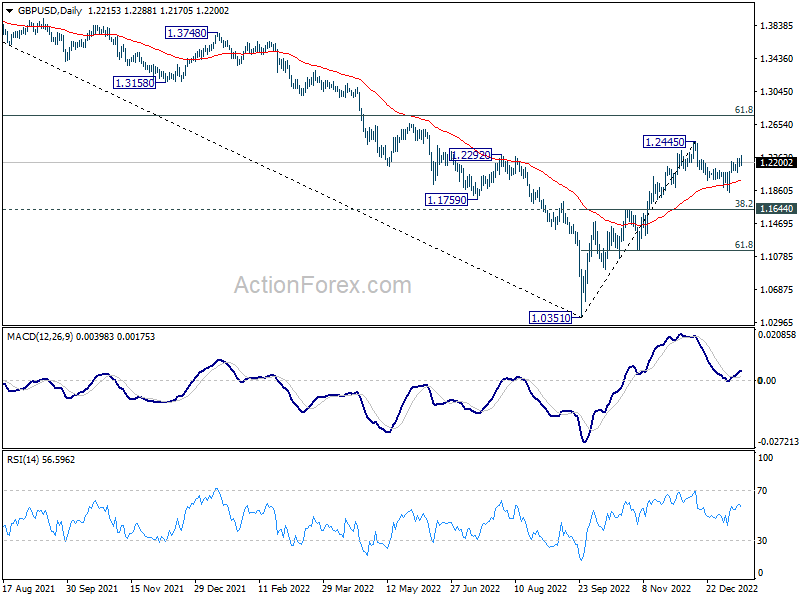
Intraday bias in GBP/USD is turned neutral first with today's retreat. On the upside, above 1.2288 will resume the rebound from 1.1840 to retest 1.2445 high. Decisive break there will resume whole rally from 1.0351 to 1.2759 fibonacci level. On the downside, break of 1.2086 minor support will turn intraday bias back to the downside for 1.1840 support instead.
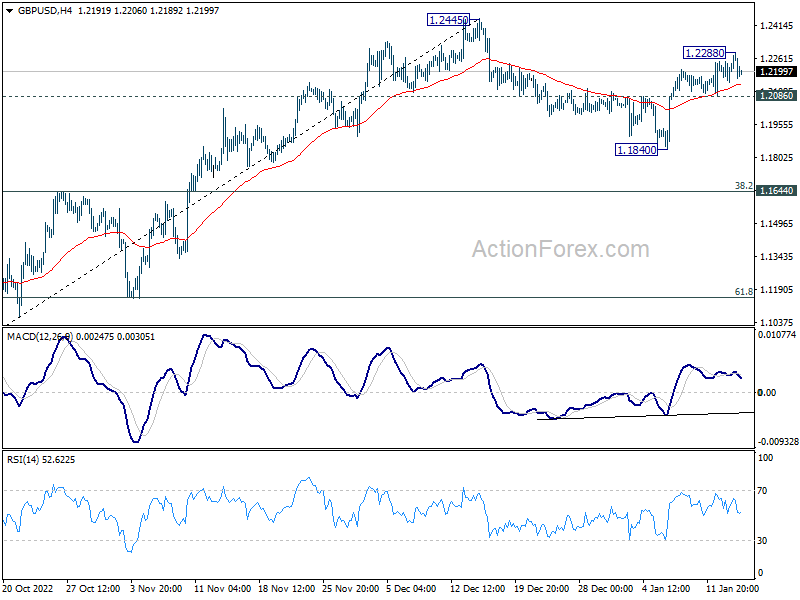
In the bigger picture, rise from 1.0351 medium term bottom is at least correcting whole down trend from 1.4248 (2021 high). Further rise is expected as long as 1.1644 resistance turned support holds. Next target is 61.8% retracement of 1.4248 to 1.0351 at 1.2759. Sustained break there will pave the way back to 1.4248.
USD/JPY Rally Takes a Breather
The Japanese yen has awoken from this week’s slumber and is sharply higher on Thursday. In the European session, USD/JPY is trading at 130.96, down 1.16%.
BOJ may be planning review of policy
The BOJ has been in the headlines since the December meeting when it widened the band around its 10-year bond yield target. The move caught the markets flat-footed and the yen gained a staggering 3.8% the same day. The central bank meets on January 17th and 18th and investors will be keeping a close eye on the meeting.
There have been reports that the BOJ will raise its inflation forecast at the meeting, and the Yomiuri newspaper reported today that the BOJ will review the side effects of its ultra-loose policy and could take measures to address distortions in the yield curve. The yen has soared in response to this latest report, as any steps towards normalization are bullish for the yen. Will the upcoming meeting be as dramatic as what we experienced in December? That would be a high bar to reach, but the meeting should be treated as a market-mover.
There is a feeling of optimism ahead of today’s US inflation report. The forecast is for inflation to continue to fall, which is exactly what investors want to hear. The consensus for headline inflation stands at 6.5%, following the November gain of 7.1%. The core rate is also expected to ease, with a forecast of 5.7% in December, compared to 6.0% in November. If inflation, particularly the core rate, falls as expected, the US dollar will likely lose ground, as the Fed would have good reason to slow the pace of tightening and could afford to be less hawkish in its stance.
USD/JPY Technical
- 132.13 has strengthened in resistance following the yen’s strong gains. 133.28 is the next resistance line.
- 131.68 and 129.49 are the next support lines
EUR/USD Mid-Day Outlook
Daily Pivots: (S1) 1.0787; (P) 1.0827; (R1) 1.0874; More...
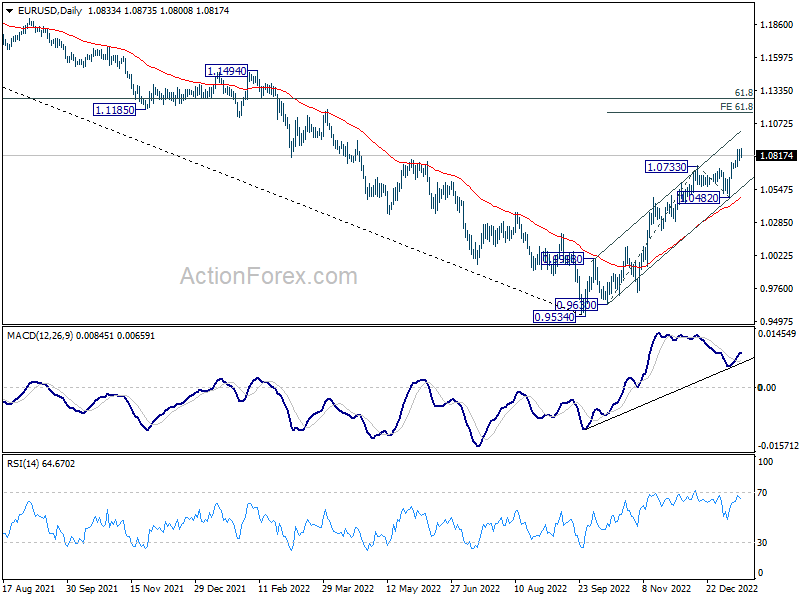
A temporary top is formed at 1.0873 with current retreat. Intraday bias in EUR/USD is turned neutral for consolidations first. But further rally is expected as long as 1.0482 support holds. On the upside, break of 1.0873 will resume larger rally from 0.9534 to 61.8% projection of 0.9630 to 1.0733 from 1.0482 at 1.1164 next.
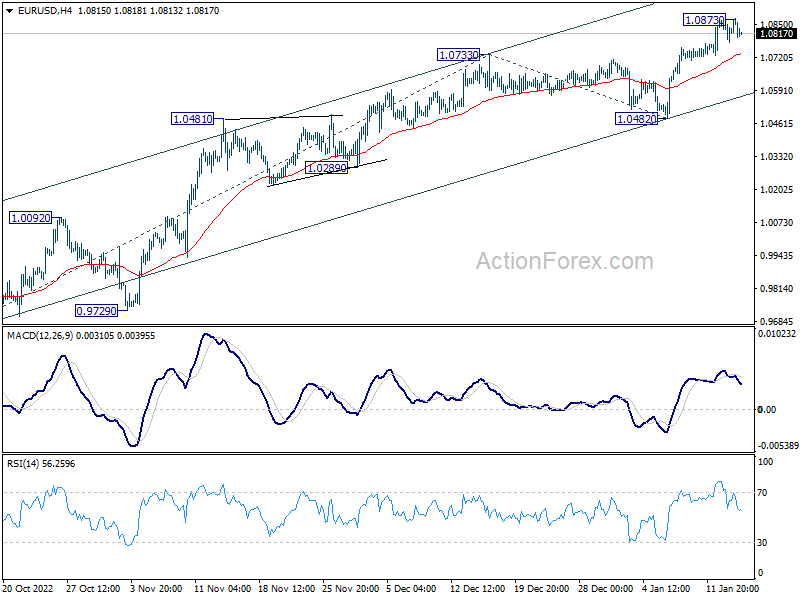
In the bigger picture, current development suggests that the rally from 0.9534 low (2022 low) is a medium term up trend rather than a correction. Further rally is in favor to 61.8% retracement of 1.2348 (2021 high) to 0.9534 at 1.1273 next. This will remain the favored case as long as 1.0482 support holds.
Dollar Recovering Slightly as Markets Turned Mixed, Treading Water
The forex markets turned mixed with an ultra-light economic calendar today, while the US is on holiday. Dollar is recovering slightly but it's outperformed by Swiss Franc and Canadian. Yen is paring some of recent gains, as eyes turn to Wednesday's BoJ policy decision. Sterling and Aussie are turning softer together with Euro. Overall, though, most major pairs and crosses are staying inside Friday's range.
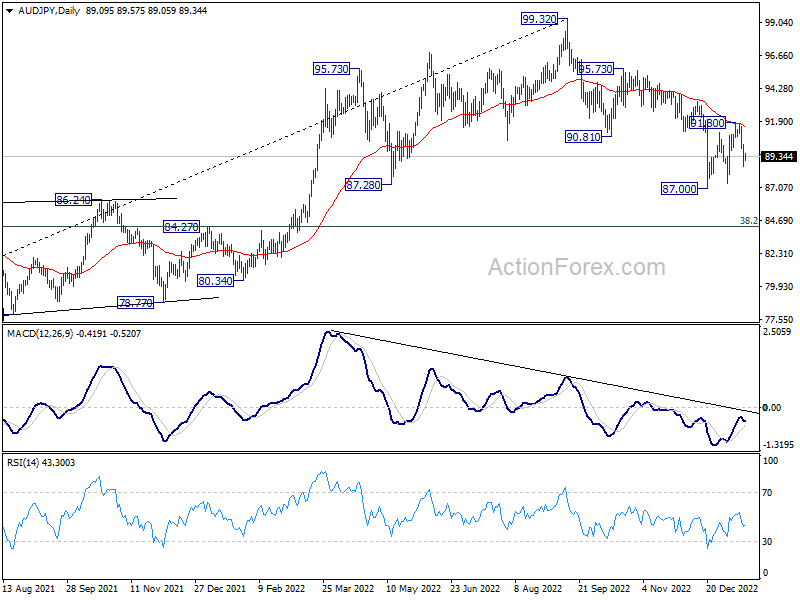
Technically, AUD/JPY could be a pair to watch in the upcoming Asian session with a batch of China data featured. So far, price actions from 87.00 are corrective looking. Rejection by 55 day EMA also keeps outlook bearish. Retest of 87.00 low should be seen on next move. Firm break there will resume whole fall form 99.32 to 38.2% retracement of 59.85 (2020 low) to 99.32 at 84.24.
In Europe, at the time of writing, FTSE is up 0.10%. DAX is up 0.41%. CAC is up 0.37%. Germany 10-year yield is up 0.0250 at 2.165. Earlier in Asia, Nikkei dropped -1.14%. Hong Kong HSI rose 0.04%. China Shanghai SSE rose 1.01%. Singapore Strait Times dropped -0.31%. Japan 10-year JGB yield rose 0.0026 to 0.514.
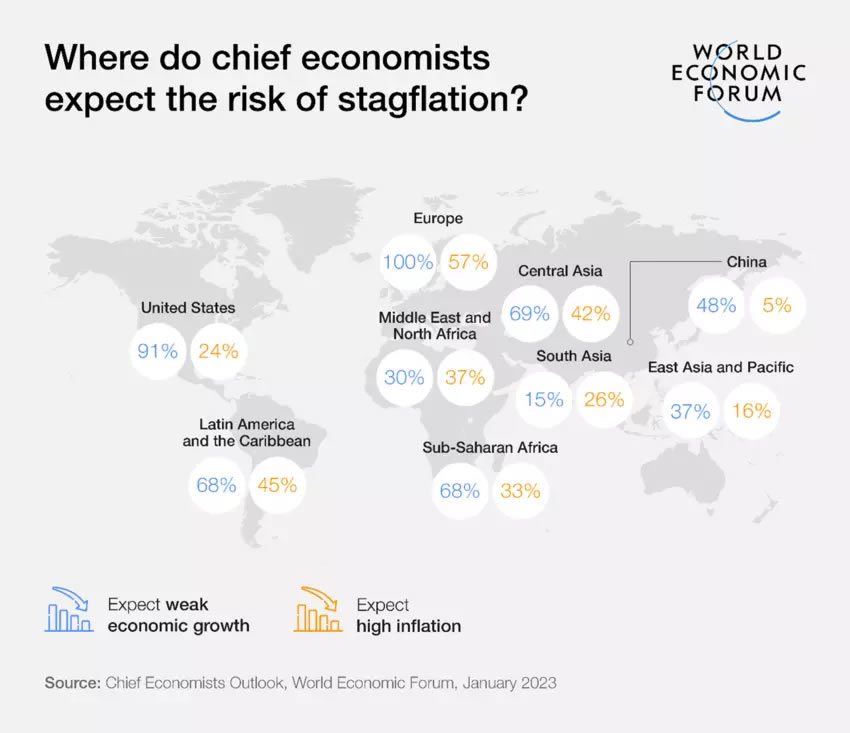
WEF: 63% chief economists expect global recession in 2023
In the Chief Economists Outlook of the World Economic Forum, 63% of survey respondents said a global recession is likely this year, with 18% saying that it's "extremely likely".
Prospect for growth was also bleak, all respondents expecting weak growth in Europe, (68% very weak and 32% weak). 91% expect weak growth in the US (9% very weak, and 82% weak. Even for China, 48% expect weak growth (10% very weak, 38% weak).
Inflation expectations saw significant variation across regions. All respondents expect high inflation in Europe (43% high, 57% very high). Also, all respondents expect high inflation in the US (76% high, 24% very high). But only 53% expect high inflation in China (48% high, 5% very high).
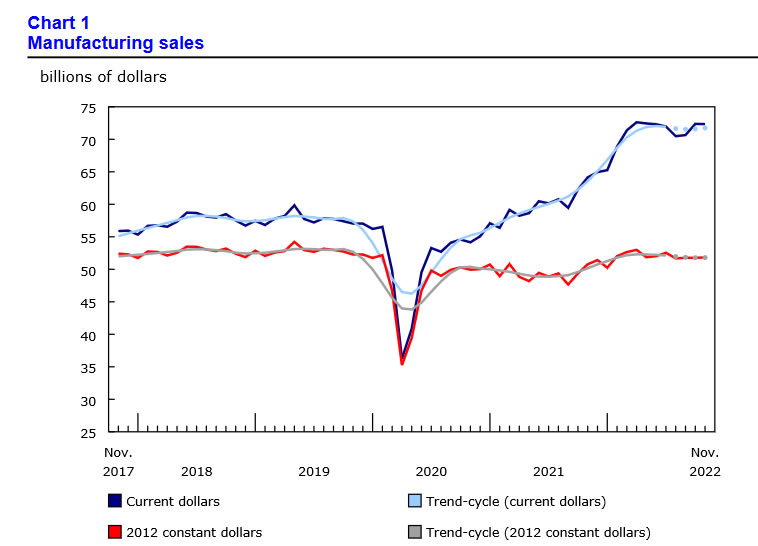
Canada manufacturing sales flat at CAD 72.3B in Nov
Canada manufacturing sales were flat at CAD 72.3B in November, below expectation of 2.3% mom growth. higher sales of durable goods (+1.8%), led by motor vehicles (+12.7%) and fabricated metal products (+2.7%), were offset by lower sales of non-durable goods (-1.7%), led by the chemical (-4.4%) and petroleum and coal product (-2.1%) industries.
Japan PPI up 10.2% yoy in Dec, second highest on record
Japan PPI rose 10.2% yoy in December, accelerated from 9.7% yoy, above expectation of 9.5% yoy. The reading topped 10% handle for the second time in 2022, marking the second-largest gains on record, following the 10.3% yoy jump in September.
For 2022, wholesale prices rose 9.7% on average, hitting a new record high since comparable data became available in 1981. It's also twice as fast as in 2021 when a 4.6% increase was reported.
Japan yield curve distortion worsens, Nikkei down
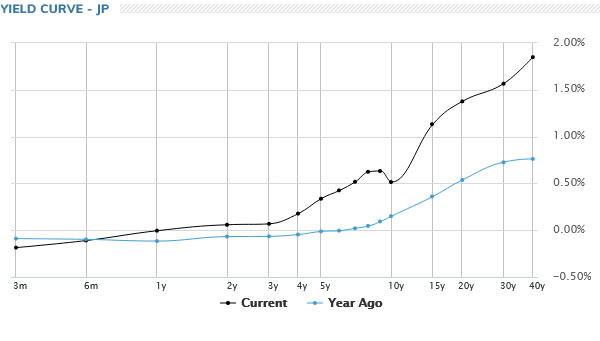
Japanese stocks, bonds and currency market remain rather nervous today, as traders are eyeing BoJ policy decision on Wednesday. The yield curve "distortion", as described by the central bank, was getting more serious after 8- and 9-year yield surged past 0.6% handle last week. At the same time, 10-year JGB yield, closed at 0.514, is still firmly tied to the 0.5% cap. Both 8- and 9-year yield closed down but stayed above 10-year's level at 0.624 and 0.632.
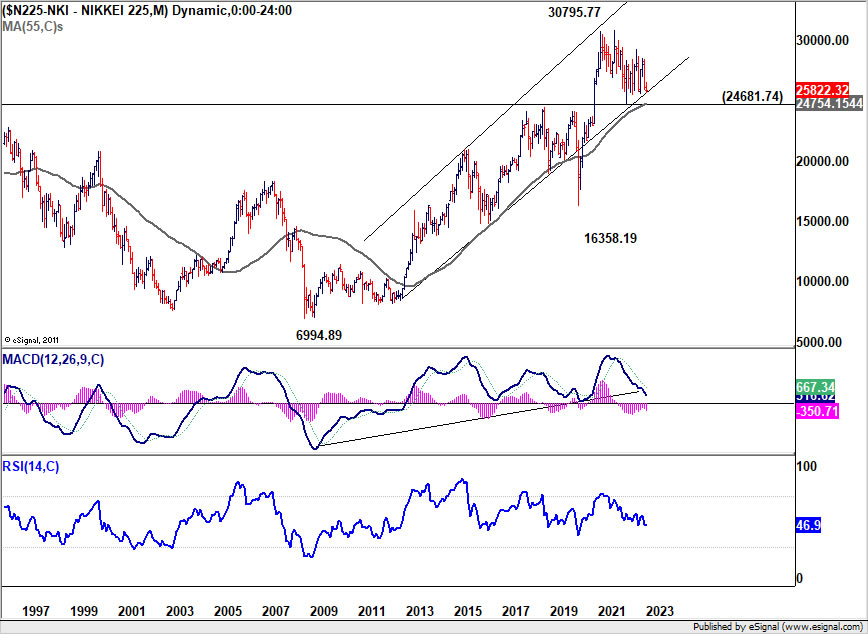
As speculation on a YCC tweak to rectify the distortion intensified , Nikkei declined -1.14% to close at 25822.32. Technically speaking, while deeper decline is possibly for the near term, strong support should be seen around 24681.74 to contain downside. The level is close to 55 month EMA, which stands at 24754.15. Nikkei has been continuously supported by the EMA, as well as the long term channel, for a decade, barring the initial two months of the pandemic. But a firm break of 24681.74 will indicate something rather substantial is happening.
EUR/USD Mid-Day Outlook
Daily Pivots: (S1) 1.0787; (P) 1.0827; (R1) 1.0874; More...
A temporary top is formed at 1.0873 with current retreat. Intraday bias in EUR/USD is turned neutral for consolidations first. But further rally is expected as long as 1.0482 support holds. On the upside, break of 1.0873 will resume larger rally from 0.9534 to 61.8% projection of 0.9630 to 1.0733 from 1.0482 at 1.1164 next.
In the bigger picture, current development suggests that the rally from 0.9534 low (2022 low) is a medium term up trend rather than a correction. Further rally is in favor to 61.8% retracement of 1.2348 (2021 high) to 0.9534 at 1.1273 next. This will remain the favored case as long as 1.0482 support holds.
Economic Indicators Update
| GMT | Ccy | Events | Actual | Forecast | Previous | Revised |
|---|---|---|---|---|---|---|
| 23:50 | JPY | PPI Y/Y Dec | 10.20% | 9.50% | 9.30% | 9.70% |
| 00:00 | AUD | TD Securities Inflation M/M Dec | 0.20% | 1.00% | ||
| 06:00 | JPY | Machine Tool Orders Y/Y Dec P | 1.00% | -7.70% | ||
| 13:30 | CAD | Manufacturing Sales M/M Nov | 0.00% | 2.30% | 2.80% | 2.40% |
| 15:30 | CAD | BoC Business Outlook Survey |
WEF: 63% chief economists expect global recession in 2023
In the Chief Economists Outlook of the World Economic Forum, 63% of survey respondents said a global recession is likely this year, with 18% saying that it's "extremely likely".
Prospect for growth was also bleak, all respondents expecting weak growth in Europe, (68% very weak and 32% weak). 91% expect weak growth in the US (9% very weak, and 82% weak. Even for China, 48% expect weak growth (10% very weak, 38% weak).
Inflation expectations saw significant variation across regions. All respondents expect high inflation in Europe (43% high, 57% very high). Also, all respondents expect high inflation in the US (76% high, 24% very high). But only 53% expect high inflation in China (48% high, 5% very high).
Canada manufacturing sales flat at CAD 72.3B in Nov
Canada manufacturing sales were flat at CAD 72.3B in November, below expectation of 2.3% mom growth. higher sales of durable goods (+1.8%), led by motor vehicles (+12.7%) and fabricated metal products (+2.7%), were offset by lower sales of non-durable goods (-1.7%), led by the chemical (-4.4%) and petroleum and coal product (-2.1%) industries.
Speculation of BoJ Policy Shift Heats Up as Yield Cap Comes Under Pressure
The Bank of Japan will kick off the central bank policy decisions of 2023 when it begins its two-day meeting on Tuesday, with the outcome expected in the early hours of Wednesday. Although it was only at the last meeting in December when policymakers tweaked their yield curve control (YCC) strategy, a further change in policy cannot be ruled out in January. The Bank’s upper yield cap has come under attack again amid speculation that it will further widen the target band or abandon the controversial policy altogether. Expectations that a stimulus exit is around the corner have propelled the yen in recent weeks, and there could be more gains in store in the near term.
It's all about the timing
The December decision to increase the band around the 0% target for 10-year Japanese government bonds (JGB) by 25 basis points to ±0.50% came as a complete shock for the markets. The prior ceiling of 0.25% had been under pressure for some time but policymakers had remained resolute in not altering their stance until there was clear evidence of wage growth picking up. Governor Haruhiko Kuroda had provided some subtle hints of an adjustment, but the timing was still unexpected.
This time round, the noises for an exit from easy policy have become louder, but there is again a very high degree of uncertainty around the timing. One media report suggests policymakers want to take their time to assess the impact of the recent widening of the yield band, while another report indicates a further tweak might be needed to improve the functioning of the JGB market.
It’s arguable if BoJ has begun to tighten policy
Japan’s 10-year yield briefly spiked above the upper band on Friday as investors upped their bets that the Bank of Japan will soon join the global tightening race. After the December meeting, Kuroda has gone out of his way to refute claims that the action amounted to tightening, and he does have a point, just not in the intended way.
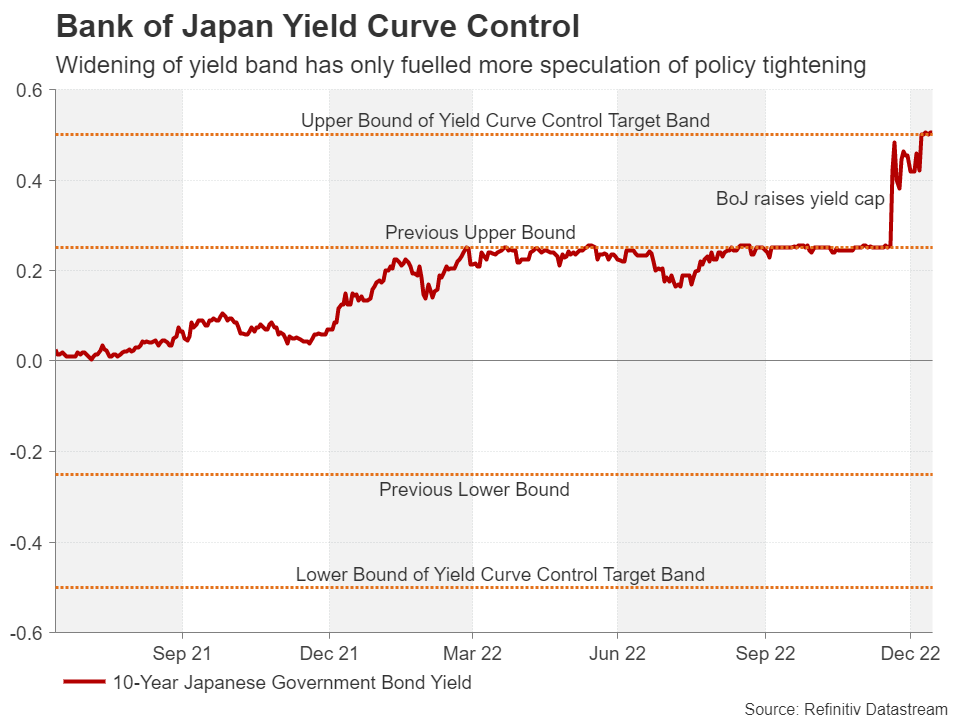
The Bank has in fact had to increase its purchases of 10-year JGBs since the move, which opened the door to a flurry of speculation about an impending exit from YCC. Another tweak, say to widen the band from ±0.50% to ±1.00%, is possible. But what would be the point? The BoJ took its previous decision in the hope of making YCC policy more sustainable. But investors are unlikely to let up in their push to test the BoJ. Even though the Bank holds a large chunk of issued JGBs, the illiquid market also makes it more prone to volatility from selloffs, especially from foreign speculators.
Yield curve control policy’s days might be numbered
This then begs the question, if a further widening would be ineffective, could the BoJ completely ditch YCC? The odds of that happening by the March meeting before Kuroda’s term expires in April, or right after when a new governor takes over, are rising by the day. But January might be too soon. Although inflation in Japan continues to head higher and is fast approaching 4%, energy prices are retreating so it may only be a matter of time before CPI peaks in Japan too.
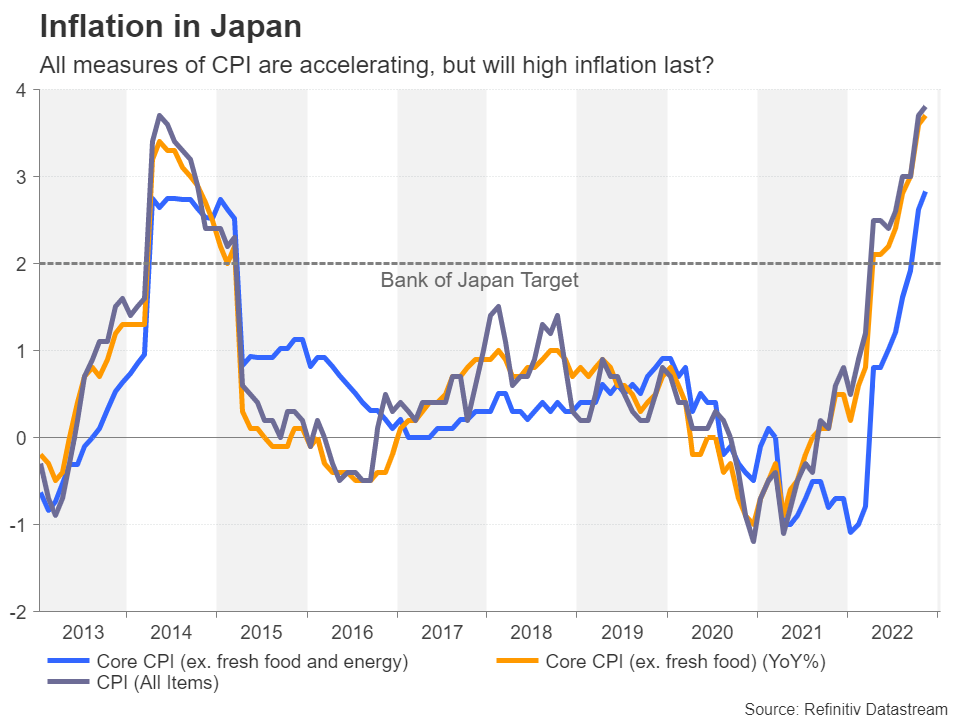
Another advantage for policymakers to wait until at least the March meeting before making up their minds on further policy changes is that Japanese trade unions conduct an annual round of wage negotiations each spring to set pay for the new fiscal year. The BoJ will probably want to wait and see how big the wage increases will be, as this has been a key criteria for policy tightening for some time now.
Wages could hold the key to next policy twist
In spite of real wages declining in recent months as inflation climbs, there are some encouraging signs that pay rises in Japan are finally starting to accelerate. One retailer just announced a 40% pay hike for its employees. Moreover, BoJ officials appear to be toning down their view lately that the current cost-push-driven inflation isn’t sustainable and that only through real wage growth can Japan break free from its deflationary mindset.
If the price increases continue to broaden in the coming months, policymakers are likely to grow more concerned about inflation becoming entrenched, even in the absence of substantial wage gains. There could be some clues on this from the BoJ’s updated outlook report on Wednesday where inflation forecasts are anticipated to be revised higher.
Yen is on a roll
Should the BoJ bide its time and keep its monetary policy settings unchanged in January, but significantly revise up its CPI projections and potentially also drop its easing bias, the Japanese yen could attract more buyers. The US dollar slumped to a seven-and-a-half-week low of 127.21 yen on Monday, brushing the 50% Fibonacci retracement of the January 2021-October 2022. A breach of this support area would become more likely.
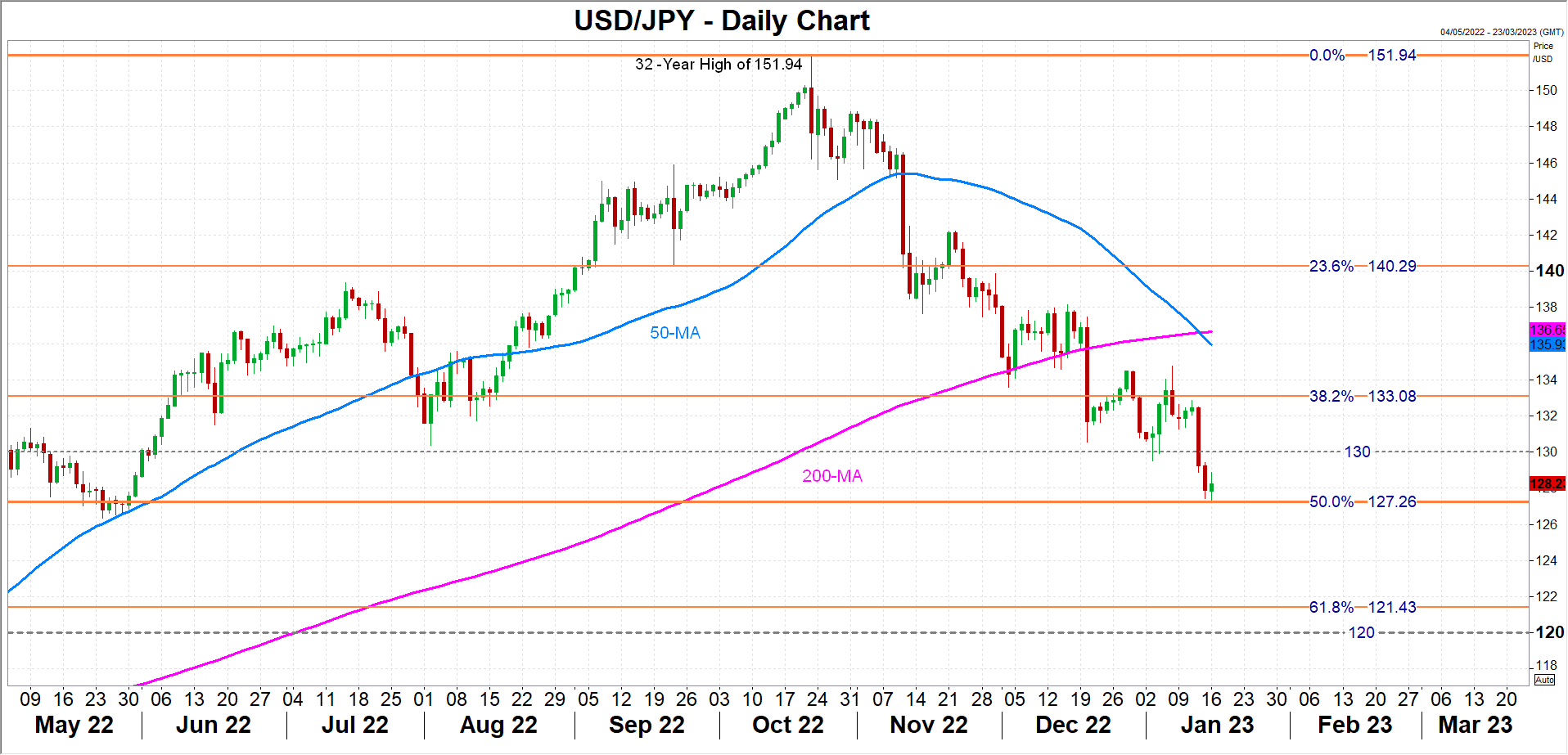
However, if policymakers conclude that defending the yield target is no longer tenable and pull another surprise by abandoning YCC, the yen would be set for a more powerful gains, extending the rally until at least the 61.8% Fibonacci of 121.43 yen before aiming for the crucial 120 level.
In the dovish scenario where there is no indication of a near-term policy shift in either the statement or Kuroda’s press conference, the yen could enter a consolidation mode, allowing the dollar to reclaim the 130 handle in the short term.
Markets think a rate hike is also on the cards
There is a slight danger that even in the event of a less dovish-than-expected meeting, any surprise won’t have as much impact the second time given the extent of the yen’s advances recently. In addition, investors are not just betting on an end to quantitative easing, but also for an end to negative rates.
Interest rate futures have priced in about a 35% probability of a rate hike from -0.1% to 0.0% in January, so there is some scope for disappointment. Nevertheless, any respite in yen buying is likely to be temporary as the Bank of Japan seems poised to start tightening at some point in 2023, just as other central banks reach the end of their rate-hike cycle.