Sample Category Title
BoJ Meeting Remains Talk of the Town
Markets
The core bond yield slide finally halted on Friday, with some help of the technical charts. The US 10y yield (+6.1 bps) for example touched and then rebounded off 3.42% which marks both the December lows and the 50% retracement of the August-October yield rally. Other yields moved 7.5-8.9 bps higher in the 2y-5y bucket and 3.4 bps at the longest maturity. German yields only rose between 0.9 and 3.4 bps but that’s hiding intraday moves of more than 7 bps. Despite the (US) yield advance, Wall Street erased a 1% opening drop to go into the long weekend 0.3-0.71% higher. This was supported by the U. of Michigan consumer confidence. The series improved more than expected, both in terms of the current assessment and future expectations. In addition, inflation expectations for the year ahead fell from 4.4% to 4%. The upbeat sentiment also weighed on the dollar. The greenback was looking for a bottom in European dealings but eventually closed mixed, at best. EUR/USD stabilized near a nine-month high above 1.08. The trade-weighted index lost another support level at 102.34 (62% retracement of the 2022 rally). The Japanese yen continued to outperform all major peers on speculation the BoJ will deliver more policy tweaks at its meeting this Wednesday. USD/JPY tumbled from 129.25 to 127.87. Sterling recovered a tad. Production figures were a mixed bag but perhaps the currency finally took comfort from the EU and UK planning to settle the NI protocol dispute this week once and for all. EUR/GBP ended the week at 0.8857.
Asian stocks this morning trade mostly in the green, with the exception of Japan. The BoJ meeting remains talk of the town. Japan’s 10y yield again climbs beyond the 0.5% cap, renewing pressure on the central bank to intervene. The Japanese yen takes a breather today though. China’s PBOC has injected less cash via policy loans than expected this morning while keeping the rate unchanged. The country celebrates the Lunar New Year holidays next week and funding demand typically rises going into this period. US financial markets (bonds and equities) are closed for Martin Luther King Jr. Day today. This means a slow start of the week, especially with no important economic data scheduled for release in Europe. The US dollar currently trades in the defensive. We have no reasons to assume a sudden comeback of the greenback today. Next resistance in EUR/USD is located at 1.0942. Support for DXY kicks in at 101.297 (May 2022 correction low). Worth mentioning is the start of the World Economic Forum in Davos today. The gathering of world’s political and business elite runs through January 20.
News Headlines
Rating agency Fitch on Friday affirmed the Polish A credit rating with a stable outlook. It reflects the country's diversified economy, its fairly sound macroeconomic framework supported by its EU membership and its slightly lower public debt levels in comparison with rated peers. This is balanced against lower governance indicators and income levels than the 'A' medians. Fitch expects Polish growth to slow from 5.7% last year to 1.1% this year, before rebounding to 2.6% in 2024. Inflation is set to average 15.5% over 2023, up from 14.3% in 2022. It is only forecasted to return to 7.7% in 2024, leaving no scope for the NBP to engage on an easing cycle. The Polish budget deficit is expected to widen to 5% of GDP this year, up from 3% in 2022 and before returning to that level in 2024. Debt metrics should put the debt ratio back on a modest downward trajectory in 2023-2024 after reaching 50.4% in 2022. The Polish zloty for almost three months now, is holding an extremely narrow range between 4.65 and 4.70.
US Treasury Secretary Yellen in a letter to Republican House majority speaker McCarthy informed him that from January 19 onwards, will begin taking special accounting measures to avoid breaching the US debt limit. Currently, US debt subject to the limit sits around $78bn below it ($31.4tn). Yellen said that it is unlikely that cash and extraordinary measures will be exhausted before early June with analysts guesstimating that the Treasury will run out of cash around August without boost to the debt ceiling. This could trigger a lengthy stalemate in split Congress with Republicans demanding spending cuts as a quid pro quo for raising the ceiling with Democrats rejecting such hostile-taking maneuvers and demanding a straight-forward increase to be able to honor previous political commitments.
Buying Euro on Every Ray of Sunlight
Earnings season kicked off last Friday when the big US banks reported their Q4 results. The results were mixed. JP Morgan warned of a "modest deterioration" in the macroeconomic outlook, Bank of America reported a better-than-expected trading revenue, but a worse-than-expected net interest income. Citi turned in a record-setting performance but equity trading fell short of expectations, while Wells Fargo reported higher-than-expected expenses, but also a record net interest income.
But wait
JP Morgan and BoFA still recorded very strong results for their consumer banking divisions last quarter, where you have credit cards, bank accounts and loans. JPM for example reported net income of more than $4.5 billion. That was up 9.5% from a year earlier.
And BofA enjoyed record net income in consumer banking, posting a profit of nearly $3.6 billion. And that’s up 14.5% from a year earlier.
So despite the skyrocketing inflation, and slowing economy, the banks continued raking in the dough…
Further goods news is that, the major US banks said that they all expect ‘mild recession’, and that unemployment in the US would rise to between 4.9 and 5.5% depending on who is talking. Although these predictions are nothing better than an average weather forecast, they have been immediately taken as a sign of an imminent slow down and even pause, and even a reversal in the Federal Reseve’s (Fed) policy tightening.
JP Morgan rallied 2.50%, Citi gained 1.70%, Bank of America rallied 2.20% and Wells Fargo jumped 3.25%. As a result, the S&P500 closed a touch above its 200-DMA and just a point below the 4000 mark.
So much excitement in JPY
One of the most exciting currencies of the moment is the Japanese yen.
Last week, the 10-year JGB yield, which is controlled by the Bank of Japan (BoJ), and which should not go above the 0.50% ceiling, went past that level, hinting that the BoJ – who buys pretty much every 10-year JGB available in the market, does struggle to maintain control of bond yields.
The BoJ’s monetary policy has turned into something so shaky that it's almost like watching a train wreck in slow motion - you know something bad is going to happen, but you can't look away.
In fact, the Bank of Japan's revision of its yield curve control measures back in December was supposed to restore order to the bond market, but instead it's produced more volatility and uncertainty.
And many traders are now questioning how and when this absurd YCC policy will end.
Many even expect the YCC policy to be scraped when the BoJ meets this week.
If that’s the case, we will likely see the 10-year JGB yields go crazy, the yen further rally and the BoJ forced to readjust its rates as soon as possible.
Government default?
Besides earnings and the BoJ meeting, we have a jam-packed calendar of exciting releases this week, starting with the Empire State Manufacturing Index, the US produce price index report and retail sales report.
Many Fed members will also be throwing in comments before the next FOMC meeting, where the expectation now is an almost certain 25bp hike. That’s causing further weakness in the US dollar index, which slid last Friday, and further extended losses this Monday in Asia.
And besides the dovish Fed expectations, warning from Treasury Department that the US will reach the debt limit on January 19th and will need extraordinary measures from Congress to avoid a government default, is also weighing on the US dollar this Monday.
US crude past 50-DMA
In energy, US crude cleared the 50-DMA to the upside last Friday. The market is undecided between the rallies triggered by Chinese reopening, and price pullbacks caused by mild winter, lower nat gas prices, and recession worries.
I still believe that the bulls have stronger arguments to take the upper hand in this battle, with a potential advance in US crude to $88pb mark.
Buying Euro on every ray of sunlight
It’s a sure thing that the falling nat gas prices thanks to a soft – but snowless winter in Europe, make things look brighter for the Europeans from the energy crisis perspective.
While most of us are disappointed with the lack of snow magic on our mountains this year, every sunny day is a reason to accumulate euros because every ray of sunlight pushes the scenario of energy shortage away from the continent.
Actually, we are seeing a solid resistance in EURUSD into the 1.09 level, but we will certainly not wait long before the pair takes over the 1.10 resistance.
Investors Remain Risk On
Market movers today
The week kicks off in a quiet fashion as the US banks are closed for Martin Luther King's Day celebration. The World Economic Forum's annual meeting starts in Davos today, and over the week, we will hear a bunch of interesting speeches.
Overnight, we will get Q4 GDP figures from China alongside December retail sales and industrial production data. GDP is expected to have dropped 1% q/q due to the negative lockdown effects in November and Covid surge in December. December activity data is also likely to look very weak but this negative news should be followed by a faster-than-expected rebound in February-March.
On the central bank front, we have the Bank of Japan meeting on Wednesday and Norges Bank on Thursday.
In Europe, key events will be the ZEW index from Germany on Tuesday and the release of ECB minutes on Thursday.
In the US, focus is on last minute Fed commentary ahead of the quiet period starting on Saturday. The most important data release will be December retail sales on Wednesday.
The 60 second overview
Risk sentiment: The week kicks off with risk on with stock market in Asia in green, European futures higher and USD edging lower. EUR/USD again broke the 1.085 level. Trading should be quieter than normal due to a bank holiday in the US.
Updated FX forecasts: Since our last FX forecast update in mid-December, European equities have strongly benefited from diminishing energy concerns, China reopening as well as a general outperformance of cyclical assets vs defensives. Inflation data has generally surprised to the downside and most central banks have slowed their hiking pace. Meanwhile, Bank of Japan increased its yield curve control target band in December with markets now pricing the first hike this summer. Industrial metals have surged to new near-term highs with China set for an earlier than expected reopening.
In this context, USD weakness has extended into 2023, and our topside risk scenario to EUR/USD has played out. Near-term we acknowledge the risk of this continuing, but further ahead we believe too much positivity is priced into the EUR and that markets underestimate the re-tightening potential of financial conditions. We thus keep our downward trajectory on EUR/USD, forecasting 1.03 in 12M. A key assumption behind our FX forecasts is that of a stronger USD and tightening of global financial conditions. Risks to this assumption primarily lies in Fed delivering an actual policy pivot - possibly due to inflation pressures fading fast, a global capex uptick and/or industrial production increasing strongly.
Japan: Ahead of the BoJ meeting on Wednesday, Japan's 10-year yield has risen above BoJ's cap for the second consecutive day while the yen has strengthened to levels last seen in May. In its previous meeting in December, the central bank expanded its target band for the 10-year bond yield to between plus and minus 50bp. Despite some speculations, consensus expects no changes in monetary policy this week, but even if the BoJ was to surprise the market, we think market reactions this time would be more muted.
Russia-Ukraine: Russia and Belarus will start joint military drills today lasting until 1 February, which has raised alarm in Kyiv that Russia could be planning a new offensive against the capital city. Heavy fighting in the battlefield is currently focused around two cities in the country's east, in Soledar and Bakhmut, but on Saturday, Russia fired two waves of missiles across the country.
FI: We are again looking forward to a very busy week in terms of issuance as we have plenty of regular tap auctions from both European sovereign issuers as well as the Scandinavian countries. Furthermore, there are limited redemptions and coupons so the net cash flow remains very negative.
FX: USD continues to weaken, notably against both EUR and JPY, whereas Scandies are supported. This morning we released our updated FX forecasts. In short, we keep our downward trajectory for EUR/USD now targeting 1.03 in 12M, although acknowledging the risk that the EUR-rally could continue short-term. We remain bearish on the SEK, but see potential for a near-term correction lower in EUR/SEK. As for the NOK, we believe 2023 will prove a fruitful year.
Credit: Following an otherwise strong week, CDS indices were slightly soft on Friday where iTraxx Xover widened 6.4bp and Main 1.6bp. Cash bonds held up better with HY bonds tightening 10bp and IG 2bp after having underperformed CDS indices during the first part of the week.
Aussie Off to a Bright Start in 2023
The Aussie dollar has started 2023 strongly, rising above 70 cents to highs since August. A softer US dollar and improved China sentiment have been key. This week’s highlights include Australia jobs data, the Bank of Japan decision and US retail sales.
The Australian dollar has risen about 1.6 cents or 2.3% so far in January, to just under 0.7000. Price action was quite mixed in the first few days of the year, the Aussie rally only igniting on 6 January when the US dollar slumped in response to soft data.
While the US December payrolls gain of 223k was quite solid and the unemployment rate edged down to 3.5%, there was a deceleration in wages growth (4.6%yr versus 5.0% expected). Moreover, on the same day the US services ISM survey showed a shocking slide in the headline index, to 49.6 in December from 56.5 in November.
Adding to the softer US dollar tone was last week’s US December inflation data. Overall CPI slowed to 6.5%yr from 7.1% in November, while the ex-food and energy CPI eased to 5.7%yr (low since December 2021) from 6.0%. There is clearly a long way to go to the Fed’s 2% target, but economists found signs in the report’s details indicating ongoing softening in inflation pressure.
This of course added to expectations that the Fed would further slow the pace of its monetary tightening. Markets now price only 55-60 basis points in further rate rises over H1 2023 (4 meetings). However, the projected yield peak of around 4.90% is still higher than the equivalent of most other major currencies, certainly including the Aussie (RBA cash rate seen peaking near 3.75% in Q3 2023).
But the Aussie has also found some support from improved China sentiment. Spot iron ore has jumped from $111/tonne on 23 December to $126 on 13 January, a high since June 2022. The LME base metals index is also at highs since June, having risen 7.2% so far this year. China equities are up about 7% so far in January, Hong Kong shares +10% as Covid restrictions continue to be eased.
The improved China mood is helping A$ on crosses, including AUD/NZD rallying above 1.09, from around 1.05-1.06 in mid-December. Any pronounced weakness in China’s Q4 GDP or December activity data (due Tuesday) seems likely to be downplayed as old news, given the pace of change in China’s Covid rules.
The other notable international events are US retail sales data and the Bank of Japan decision. The yen is even stronger than the Aussie YTD, as anticipation grows for another BoJ policy tweak after the December surprise widening of the 10-year bond yield range to -0.5% to +0.5%.
Australia’s key data release this month is Q4 CPI on 25 January, but there is always market interest in the monthly labour force survey (Thursday). Westpac looks for a 30k rise in total employment, keeping the unemployment rate at a very low 3.4%.
Event risk
US holiday (Martin Luther King Jr birthday) (Mon), Aust Jan Westpac consumer sentiment, China Q4 GDP, Dec industrial production and retail sales, Germany Jan ZEW investor sentiment, UK Nov unemployment (Tue), Bank of Japan policy decision, UK Dec CPI, US Dec retail sales (Wed), Aust Dec employment (Thu), Japan Dec CPI, UK Dec retail sales (Fri)
USD/CAD Daily Outlook
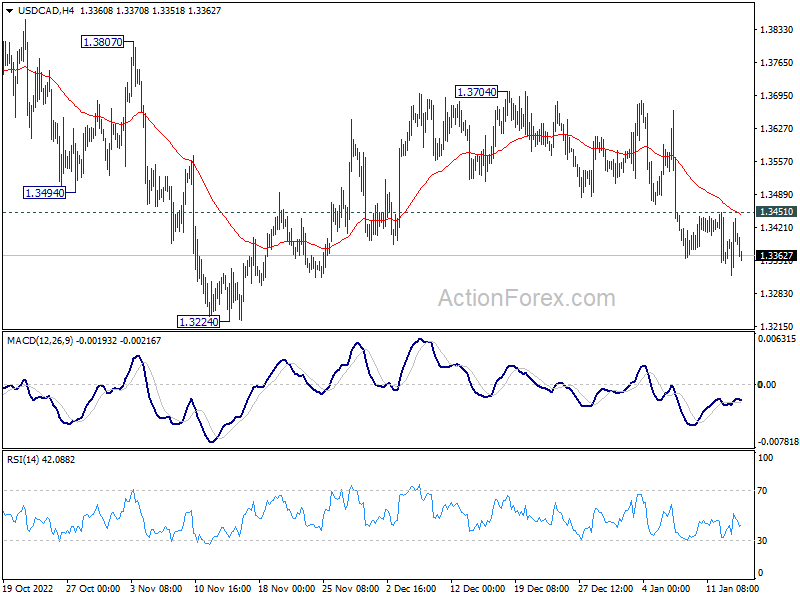
Daily Pivots: (S1) 1.3331; (P) 1.3386; (R1) 1.3449; More....
Further decline could still be seen in USD/CAD. But downside should be contained above 1.3224 key support level. Above 1.3451 minor resistance will turn bias back to the upside for 1.3704 resistance. However, sustained break of 1.3222/4 cluster support will resume the whole fall from 1.3976 and carry larger bearish implications.
In the bigger picture, as long as 1.3222 cluster support (38.2% retracement of 1.2005 to 1.3976 at 1.3223) holds, larger up trend from 1.2005 (2021 low) is still expected to resume through 1.3976 high at a later stage. However, firm break of 1.3222/3 will indicate that the trend might have reversed. Deeper fall would be seen to next cluster support at 1.2726 (61.8% retracement at 1.2758).
AUD/USD Daily Report
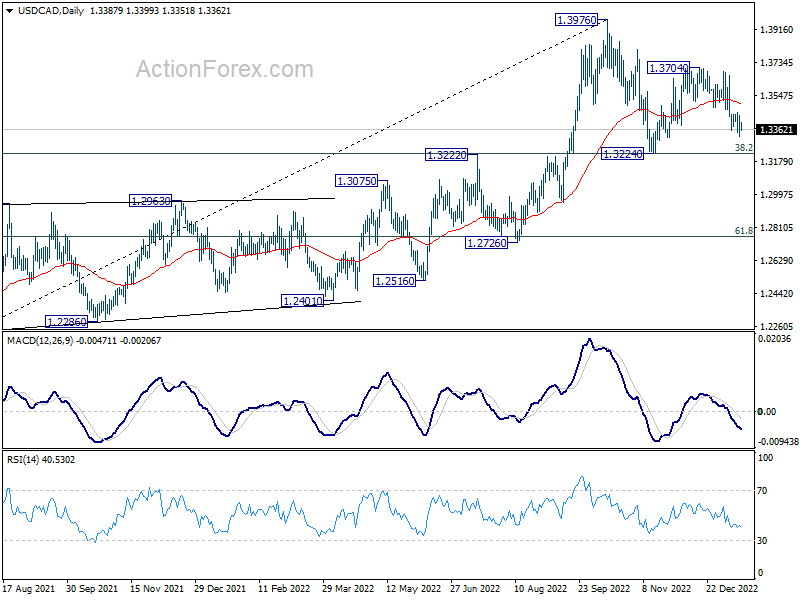
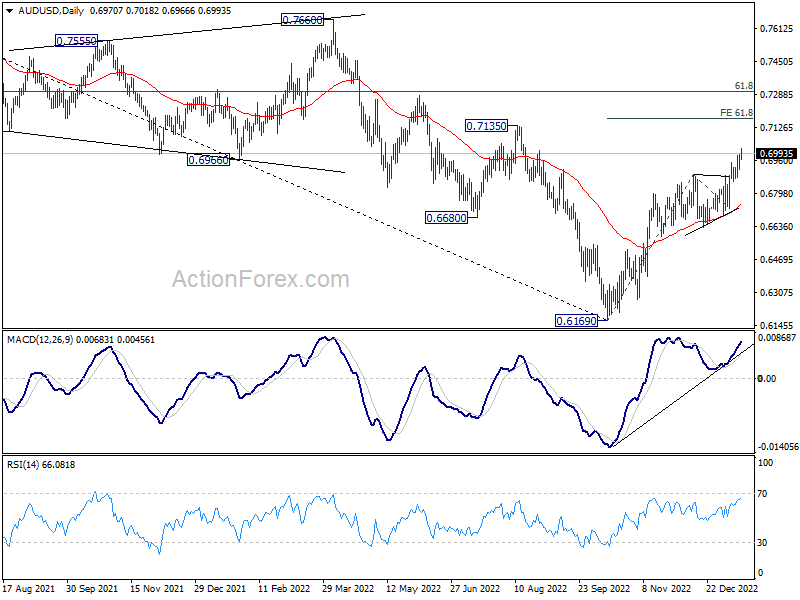
Daily Pivots: (S1) 0.6931; (P) 0.6962; (R1) 0.7009; More...
Intraday bias in AUD/USD stays on the upside at this point. Current rally should target 61.8% projection of 0.6169 to 0.6892 from 0.6721 at 0.7444. On the downside, break of 0.6875 minor support will turn intraday bias neutral and bring consolidations again. But overall outlook will stay bullish as long as 0.6721 support holds, in case of retreat.
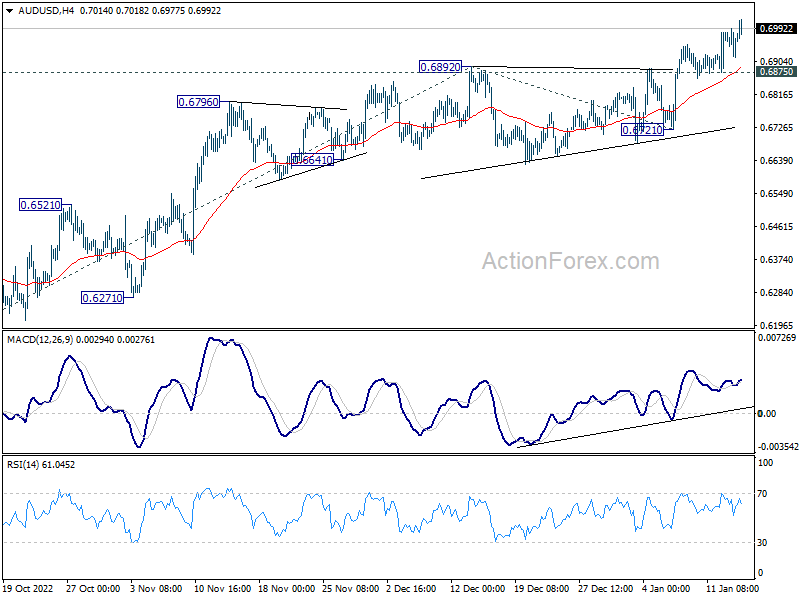
In the bigger picture, corrective decline from 0.8006 (2021 high) should have completed with three waves down to 0.6169 (2022 low). Further rally should be seen to 61.8% retracement of 0.8006 to 0.6169 at 0.7304. Sustained break there will pave the way to retest 0.8006. This will now remain the favored case as long as 0.6721 support holds.
EUR/USD Daily Outlook
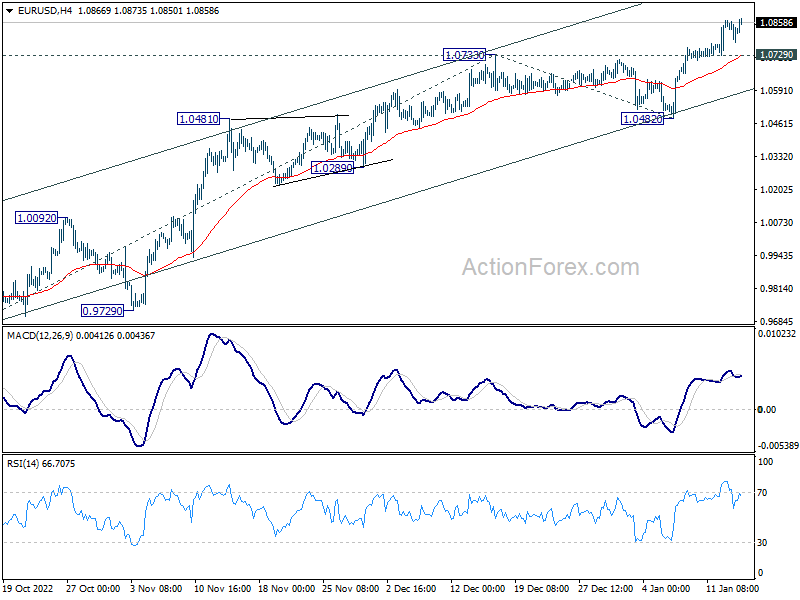
Daily Pivots: (S1) 1.0787; (P) 1.0827; (R1) 1.0874; More...
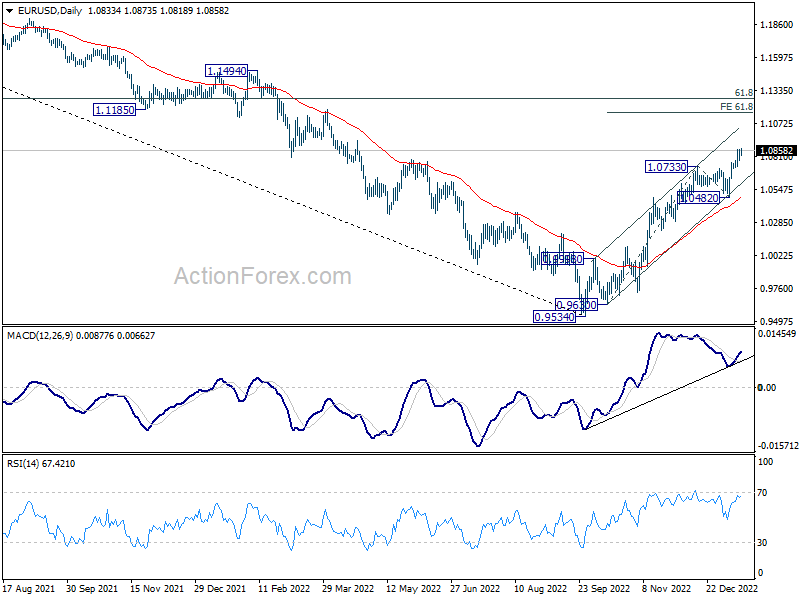
Intraday bias in EUR/USD remains on the upside for the moment. Current rally should target 61.8% projection of 0.9630 to 1.0733 from 1.0482 at 1.1164 next. On the downside, below 1.0729 minor support will turn intraday bias neutral again first. But near term outlook will stay bullish as long as 1.0482 support holds, in case of retreat.
In the bigger picture, current development suggests that the rally from 0.9534 low (2022 low) is a medium term up trend rather than a correction. Further rally is in favor to 61.8% retracement of 1.2348 (2021 high) to 0.9534 at 1.1273 next. This will remain the favored case as long as 1.0482 support holds.
GBP/USD Daily Outlook
Daily Pivots: (S1) 1.2173; (P) 1.2211; (R1) 1.2270; More...
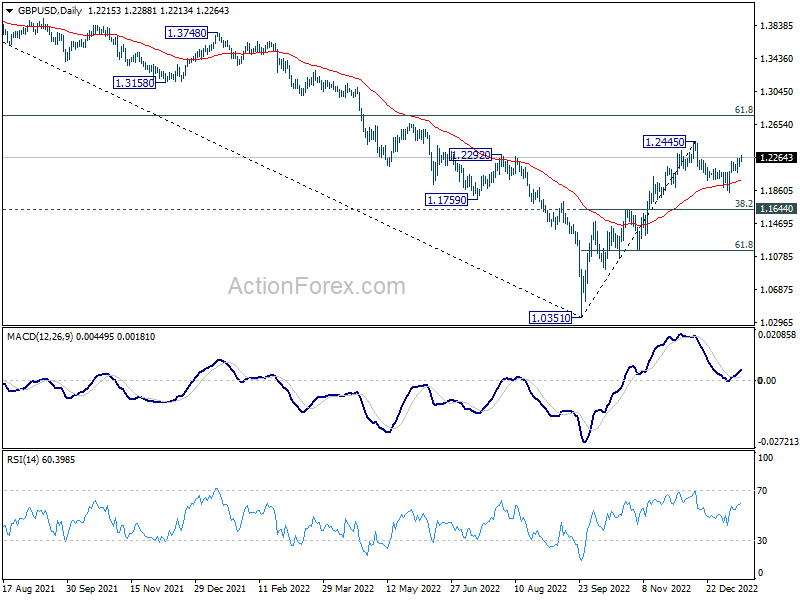
Intraday bias in GBP/USD stays on the upside at this point. Rise from 1.1840 should target a test on 1.2445 high. Decisive break there will resume whole rally from 1.0351 to 1.2759 fibonacci level. On the downside, break of 1.2086 minor support will turn intraday bias neutral first.
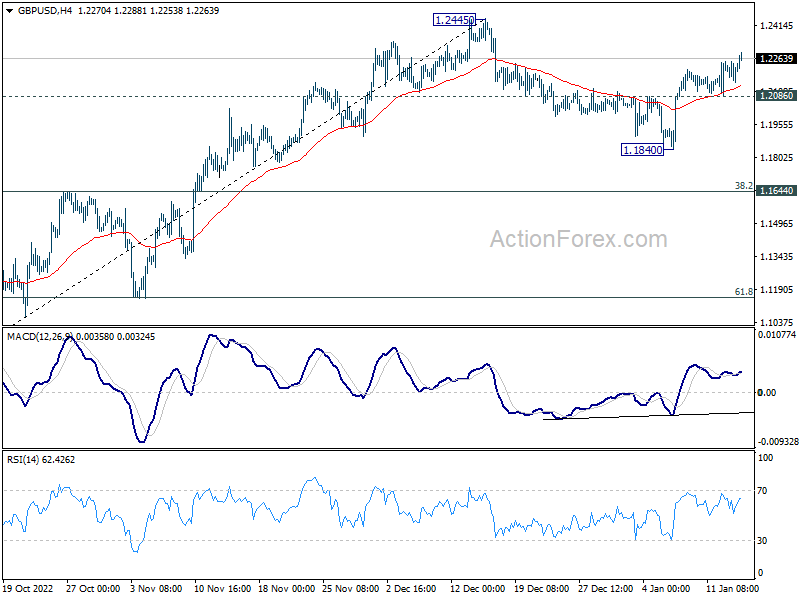
In the bigger picture, rise from 1.0351 medium term bottom is at least correcting whole down trend from 1.4248 (2021 high). Further rise is expected as long as 1.1644 resistance turned support holds. Next target is 61.8% retracement of 1.4248 to 1.0351 at 1.2759. Sustained break there will pave the way back to 1.4248.
USD/CHF Daily Outlook
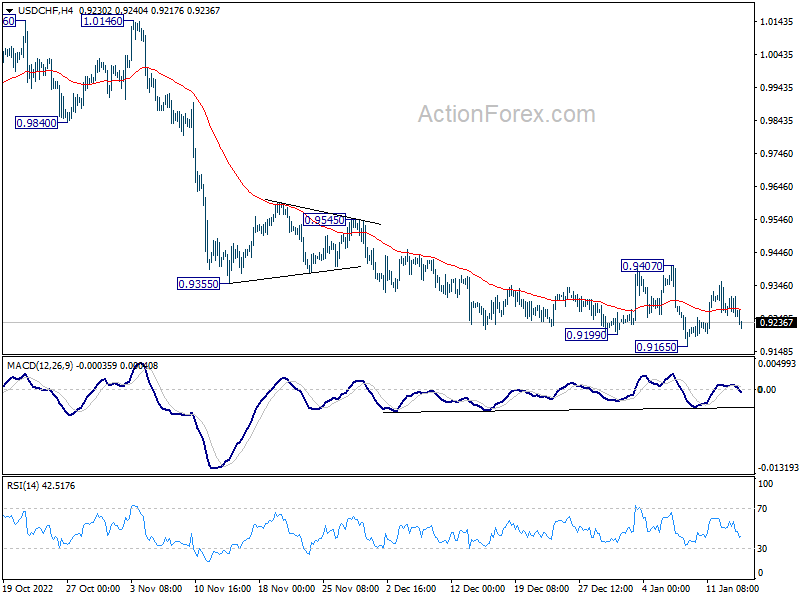
Daily Pivots: (S1) 0.9242; (P) 0.9279; (R1) 0.9303; More...
Range trading continues in USD/CHF and intraday bias remains neutral for the moment. Outlook stays bearish as long as 0.9407 resistance holds. Break of 0.9165 will resume whole fall from 1.0146. However, firm break of 0.9407 will turn bias back to the upside for stronger rebound.
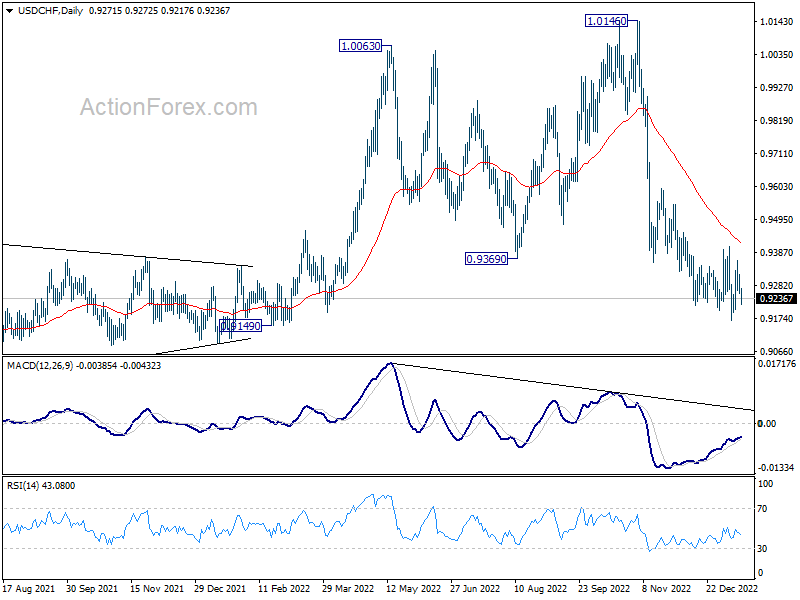
In the bigger picture, rise from 0.8756 (2021 low) has completed at 1.0146, well ahead of 1.0342 long term resistance (2016 high). Based on current downside momentum, fall from 1.0146 should be a medium term down trend itself. Next target is a test on 0.8756 low. Strong support should be seen there to bring rebound. Still, further decline will now be expected as long as 0.9407 resistance holds, in any case.
USD/JPY Daily Outlook
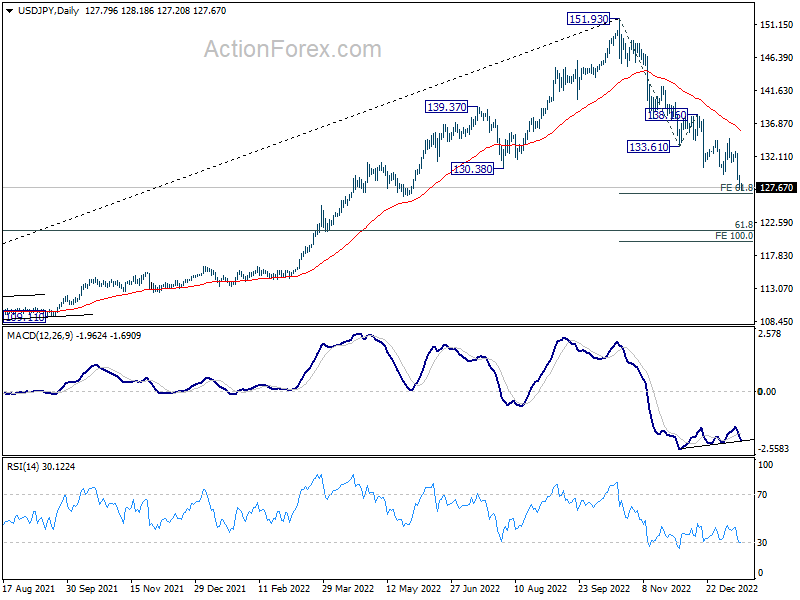
Daily Pivots: (S1) 127.07; (P) 128.25; (R1) 129.04; More...
Intraday bias in USD/JPY remains on the downside at this point. Current fall from 1.151.93 in progress for 61.8% projection of 151.93 to 133.61 from 138.16 at 126.83. Break there will target 121.43 fibonacci level next. On the upside, above 129.3 minor resistance will turn intraday bias neutral first. But outlook will remain bearish as long as 134.76 resistance holds.
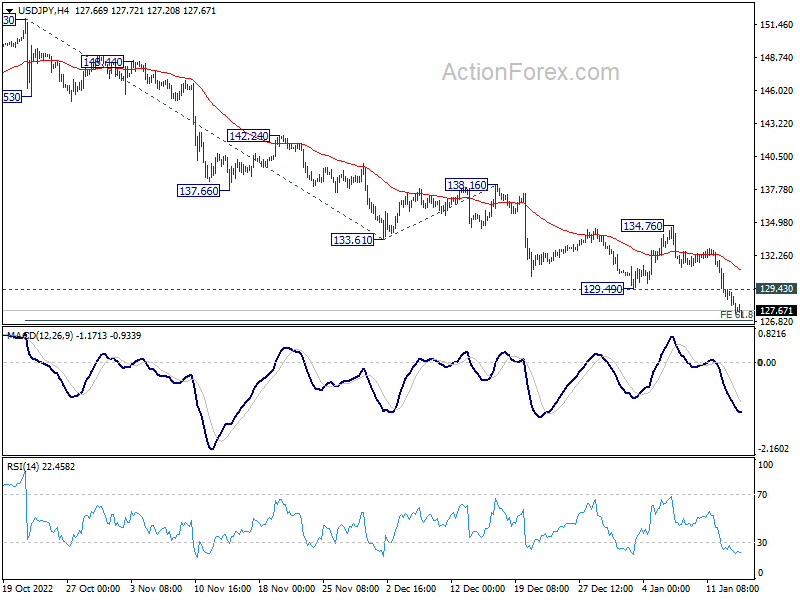
In the bigger picture, the firm break of 55 week EMA (now at 131.59) raises the chance of medium term bearish reversal, but that's not confirmed yet. Strong support could be seen around 61.8% retracement of 102.58 to 151.93 at 121.43 and 38.2% retracement of 38.2% retracement of 75.56 to 151.93 at 122.75 to bring rebound. But break of 134.76 resistance is needed to indicate bottoming first. Otherwise further fall will remain in favor.