Sample Category Title
Summary 1/16 – 1/20
Monday, Jan 16, 2023
| GMT | Ccy | Events | Consensus | Previous |
|---|---|---|---|---|
| 23:50 | JPY | PPI Y/Y Dec | 9.50% | 9.30% |
| 00:00 | AUD | TD Securities Inflation M/M Dec | 1.00% | |
| 00:00 | AUD | TD Securities Inflation Y/Y Dec | 5.90% | |
| 06:00 | JPY | Machine Tool Orders Y/Y Dec P | -7.70% | |
| 13:30 | CAD | Manufacturing Sales M/M Nov | 2.30% | 2.80% |
| 15:30 | CAD | BoC Business Outlook Survey | ||
| 21:00 | NZD | NZIER Business Confidence Q4 | -42 | |
| 23:30 | AUD | Westpac Consumer Confidence Jan | 3.00% |
| GMT | Ccy | Events | |
|---|---|---|---|
| 23:50 | JPY | PPI Y/Y Dec | |
| Forecast: 9.50% | Previous: 9.30% | ||
| 00:00 | AUD | TD Securities Inflation M/M Dec | |
| Forecast: | Previous: 1.00% | ||
| 00:00 | AUD | TD Securities Inflation Y/Y Dec | |
| Forecast: | Previous: 5.90% | ||
| 06:00 | JPY | Machine Tool Orders Y/Y Dec P | |
| Forecast: | Previous: -7.70% | ||
| 13:30 | CAD | Manufacturing Sales M/M Nov | |
| Forecast: 2.30% | Previous: 2.80% | ||
| 15:30 | CAD | BoC Business Outlook Survey | |
| Forecast: | Previous: | ||
| 21:00 | NZD | NZIER Business Confidence Q4 | |
| Forecast: | Previous: -42 | ||
| 23:30 | AUD | Westpac Consumer Confidence Jan | |
| Forecast: | Previous: 3.00% | ||
Tuesday, Jan 17, 2023
| GMT | Ccy | Events | Consensus | Previous |
|---|---|---|---|---|
| 02:00 | CNY | GDP Y/Y Q4 | 1.80% | 3.90% |
| 02:00 | CNY | Industrial Production Y/Y Dec | 0.30% | 2.20% |
| 02:00 | CNY | Retail Sales Y/Y Dec | -9.50% | -5.90% |
| 02:00 | CNY | Fixed Asset Investment YTD Y/Y Dec | 5.00% | 5.30% |
| 04:30 | JPY | Tertiary Industry Index M/M Nov | 0.20% | 0.20% |
| 07:00 | GBP | Claimant Count Change Dec | 30.5K | |
| 07:00 | GBP | ILO Unemployment Rate (3M) Nov | 3.70% | 3.70% |
| 07:00 | GBP | Average Earnings Including Bonus 3M/Y Nov | 6.10% | 6.10% |
| 07:00 | GBP | Average Earnings Excluding Bonus 3M/Y Nov | 6.30% | 6.10% |
| 07:00 | EUR | Germany CPI M/M Dec F | -0.80% | -0.80% |
| 07:00 | EUR | Germany CPI Y/Y Dec F | 8.60% | 8.60% |
| 10:00 | EUR | Germany ZEW Economic Sentiment Jan | -15.5 | -23.3 |
| 10:00 | EUR | Germany ZEW Current Situation Jan | -57 | -61.4 |
| 10:00 | EUR | Eurozone ZEW Economic Sentiment Jan | -14.3 | -23.6 |
| 13:15 | CAD | Housing Starts Y/Y Dec | 265K | 264K |
| 13:30 | CAD | CPI M/M Dec | -0.60% | 0.10% |
| 13:30 | CAD | CPI Y/Y Dec | 6.30% | 6.80% |
| 13:30 | CAD | CPI Median Y/Y Dec | 4.90% | 5.00% |
| 13:30 | CAD | CPI Trimmed Y/Y Dec | 5.20% | 5.30% |
| 13:30 | CAD | CPI Common Y/Y Dec | 6.60% | 6.70% |
| 13:30 | USD | Empire State Manufacturing Index Jan | -8.2 | -11.2 |
| GMT | Ccy | Events | |
|---|---|---|---|
| 02:00 | CNY | GDP Y/Y Q4 | |
| Forecast: 1.80% | Previous: 3.90% | ||
| 02:00 | CNY | Industrial Production Y/Y Dec | |
| Forecast: 0.30% | Previous: 2.20% | ||
| 02:00 | CNY | Retail Sales Y/Y Dec | |
| Forecast: -9.50% | Previous: -5.90% | ||
| 02:00 | CNY | Fixed Asset Investment YTD Y/Y Dec | |
| Forecast: 5.00% | Previous: 5.30% | ||
| 04:30 | JPY | Tertiary Industry Index M/M Nov | |
| Forecast: 0.20% | Previous: 0.20% | ||
| 07:00 | GBP | Claimant Count Change Dec | |
| Forecast: | Previous: 30.5K | ||
| 07:00 | GBP | ILO Unemployment Rate (3M) Nov | |
| Forecast: 3.70% | Previous: 3.70% | ||
| 07:00 | GBP | Average Earnings Including Bonus 3M/Y Nov | |
| Forecast: 6.10% | Previous: 6.10% | ||
| 07:00 | GBP | Average Earnings Excluding Bonus 3M/Y Nov | |
| Forecast: 6.30% | Previous: 6.10% | ||
| 07:00 | EUR | Germany CPI M/M Dec F | |
| Forecast: -0.80% | Previous: -0.80% | ||
| 07:00 | EUR | Germany CPI Y/Y Dec F | |
| Forecast: 8.60% | Previous: 8.60% | ||
| 10:00 | EUR | Germany ZEW Economic Sentiment Jan | |
| Forecast: -15.5 | Previous: -23.3 | ||
| 10:00 | EUR | Germany ZEW Current Situation Jan | |
| Forecast: -57 | Previous: -61.4 | ||
| 10:00 | EUR | Eurozone ZEW Economic Sentiment Jan | |
| Forecast: -14.3 | Previous: -23.6 | ||
| 13:15 | CAD | Housing Starts Y/Y Dec | |
| Forecast: 265K | Previous: 264K | ||
| 13:30 | CAD | CPI M/M Dec | |
| Forecast: -0.60% | Previous: 0.10% | ||
| 13:30 | CAD | CPI Y/Y Dec | |
| Forecast: 6.30% | Previous: 6.80% | ||
| 13:30 | CAD | CPI Median Y/Y Dec | |
| Forecast: 4.90% | Previous: 5.00% | ||
| 13:30 | CAD | CPI Trimmed Y/Y Dec | |
| Forecast: 5.20% | Previous: 5.30% | ||
| 13:30 | CAD | CPI Common Y/Y Dec | |
| Forecast: 6.60% | Previous: 6.70% | ||
| 13:30 | USD | Empire State Manufacturing Index Jan | |
| Forecast: -8.2 | Previous: -11.2 | ||
Wednesday, Jan 18, 2023
| GMT | Ccy | Events | Consensus | Previous |
|---|---|---|---|---|
| 23:50 | JPY | Machinery Orders M/M Nov | -0.90% | 5.40% |
| JPY | BoJ Interest Rate Decision | -0.10% | ||
| 04:30 | JPY | Industrial Production M/M Nov F | -0.10% | -0.10% |
| 07:00 | GBP | CPI M/M Dec | 0.40% | 0.40% |
| 07:00 | GBP | CPI Y/Y Dec | 10.60% | 10.70% |
| 07:00 | GBP | Core CPI Y/Y Dec | 6.60% | 6.30% |
| 07:00 | GBP | RPI M/M Dec | 1.00% | 0.60% |
| 07:00 | GBP | RPI Y/Y Dec | 13.90% | 14.00% |
| 09:00 | EUR | Italy Trade Balance (EUR) Nov | -1.80B | -2.12B |
| 10:00 | EUR | Eurozone CPI Y/Y Dec F | 9.20% | 9.20% |
| 10:00 | EUR | Eurozone CPI Core Y/Y Dec F | 5.20% | 5.20% |
| 13:30 | CAD | Raw Material Price Index Dec | -0.80% | |
| 13:30 | CAD | Industrial Product Price M/M Dec | -0.40% | |
| 13:30 | USD | Retail Sales M/M Dec | -0.80% | -0.60% |
| 13:30 | USD | Retail Sales ex Autos M/M Dec | -0.50% | -0.20% |
| 13:30 | USD | PPI Core M/M Dec | 0.10% | 0.40% |
| 13:30 | USD | PPI Core Y/Y Dec | 5.90% | 6.20% |
| 13:30 | USD | PPI M/M Dec | -0.10% | 0.30% |
| 13:30 | USD | PPI Y/Y Dec | 6.80% | 7.40% |
| 14:15 | USD | Industrial Production M/M Dec | -0.10% | -0.20% |
| 14:15 | USD | Capacity Utilization Dec | 79.60% | 79.70% |
| 15:00 | USD | Business Inventories Nov | 0.40% | 0.30% |
| 15:00 | USD | NAHB Housing Market Index Jan | 31 | 31 |
| 19:00 | USD | Fed's Beige Book | ||
| 23:50 | JPY | Trade Balance (JPY) Dec | -1.63T | -1.73T |
| GMT | Ccy | Events | |
|---|---|---|---|
| 23:50 | JPY | Machinery Orders M/M Nov | |
| Forecast: -0.90% | Previous: 5.40% | ||
| JPY | BoJ Interest Rate Decision | ||
| Forecast: | Previous: -0.10% | ||
| 04:30 | JPY | Industrial Production M/M Nov F | |
| Forecast: -0.10% | Previous: -0.10% | ||
| 07:00 | GBP | CPI M/M Dec | |
| Forecast: 0.40% | Previous: 0.40% | ||
| 07:00 | GBP | CPI Y/Y Dec | |
| Forecast: 10.60% | Previous: 10.70% | ||
| 07:00 | GBP | Core CPI Y/Y Dec | |
| Forecast: 6.60% | Previous: 6.30% | ||
| 07:00 | GBP | RPI M/M Dec | |
| Forecast: 1.00% | Previous: 0.60% | ||
| 07:00 | GBP | RPI Y/Y Dec | |
| Forecast: 13.90% | Previous: 14.00% | ||
| 09:00 | EUR | Italy Trade Balance (EUR) Nov | |
| Forecast: -1.80B | Previous: -2.12B | ||
| 10:00 | EUR | Eurozone CPI Y/Y Dec F | |
| Forecast: 9.20% | Previous: 9.20% | ||
| 10:00 | EUR | Eurozone CPI Core Y/Y Dec F | |
| Forecast: 5.20% | Previous: 5.20% | ||
| 13:30 | CAD | Raw Material Price Index Dec | |
| Forecast: | Previous: -0.80% | ||
| 13:30 | CAD | Industrial Product Price M/M Dec | |
| Forecast: | Previous: -0.40% | ||
| 13:30 | USD | Retail Sales M/M Dec | |
| Forecast: -0.80% | Previous: -0.60% | ||
| 13:30 | USD | Retail Sales ex Autos M/M Dec | |
| Forecast: -0.50% | Previous: -0.20% | ||
| 13:30 | USD | PPI Core M/M Dec | |
| Forecast: 0.10% | Previous: 0.40% | ||
| 13:30 | USD | PPI Core Y/Y Dec | |
| Forecast: 5.90% | Previous: 6.20% | ||
| 13:30 | USD | PPI M/M Dec | |
| Forecast: -0.10% | Previous: 0.30% | ||
| 13:30 | USD | PPI Y/Y Dec | |
| Forecast: 6.80% | Previous: 7.40% | ||
| 14:15 | USD | Industrial Production M/M Dec | |
| Forecast: -0.10% | Previous: -0.20% | ||
| 14:15 | USD | Capacity Utilization Dec | |
| Forecast: 79.60% | Previous: 79.70% | ||
| 15:00 | USD | Business Inventories Nov | |
| Forecast: 0.40% | Previous: 0.30% | ||
| 15:00 | USD | NAHB Housing Market Index Jan | |
| Forecast: 31 | Previous: 31 | ||
| 19:00 | USD | Fed's Beige Book | |
| Forecast: | Previous: | ||
| 23:50 | JPY | Trade Balance (JPY) Dec | |
| Forecast: -1.63T | Previous: -1.73T | ||
Thursday, Jan 19, 2023
| GMT | Ccy | Events | Consensus | Previous |
|---|---|---|---|---|
| 00:01 | GBP | RICS Housing Price Balance Dec | -30% | -25% |
| 00:30 | AUD | Employment Change Dec | 21.2K | 64.0K |
| 00:30 | AUD | Unemployment Rate Dec | 3.40% | 3.40% |
| 07:30 | CHF | Producer and Import Prices M/M Dec | -0.40% | -0.50% |
| 07:30 | CHF | Producer and Import Prices Y/Y Dec | 3.80% | |
| 09:00 | EUR | Eurozone Current Account (EUR) Nov | -0.4B | |
| 12:30 | EUR | ECB Meeting Accounts | ||
| 13:30 | CAD | Wholesale Sales M/M Nov | 2.10% | |
| 13:30 | USD | Initial Jobless Claims (Jan 13) | 212K | 205K |
| 13:30 | USD | Building Permits Dec | 1.37M | 1.34M |
| 13:30 | USD | Housing Starts Dec | 1.36M | 1.43M |
| 13:30 | USD | Philadelphia Fed Manufacturing Survey Jan | -11.2 | -13.8 |
| 15:30 | USD | Natural Gas Storage | 11B | |
| 16:00 | USD | Crude Oil Inventories | 19.0M | |
| 21:30 | NZD | Business NZ PMI Dec | 47.4 | |
| 23:30 | JPY | National CPI Y/Y Dec | 3.80% | |
| 23:30 | JPY | National CPI Core Y/Y Dec | 4.00% | 3.70% |
| 23:30 | JPY | National CPI Core-Core Y/Y Dec | 2.80% |
| GMT | Ccy | Events | |
|---|---|---|---|
| 00:01 | GBP | RICS Housing Price Balance Dec | |
| Forecast: -30% | Previous: -25% | ||
| 00:30 | AUD | Employment Change Dec | |
| Forecast: 21.2K | Previous: 64.0K | ||
| 00:30 | AUD | Unemployment Rate Dec | |
| Forecast: 3.40% | Previous: 3.40% | ||
| 07:30 | CHF | Producer and Import Prices M/M Dec | |
| Forecast: -0.40% | Previous: -0.50% | ||
| 07:30 | CHF | Producer and Import Prices Y/Y Dec | |
| Forecast: | Previous: 3.80% | ||
| 09:00 | EUR | Eurozone Current Account (EUR) Nov | |
| Forecast: | Previous: -0.4B | ||
| 12:30 | EUR | ECB Meeting Accounts | |
| Forecast: | Previous: | ||
| 13:30 | CAD | Wholesale Sales M/M Nov | |
| Forecast: | Previous: 2.10% | ||
| 13:30 | USD | Initial Jobless Claims (Jan 13) | |
| Forecast: 212K | Previous: 205K | ||
| 13:30 | USD | Building Permits Dec | |
| Forecast: 1.37M | Previous: 1.34M | ||
| 13:30 | USD | Housing Starts Dec | |
| Forecast: 1.36M | Previous: 1.43M | ||
| 13:30 | USD | Philadelphia Fed Manufacturing Survey Jan | |
| Forecast: -11.2 | Previous: -13.8 | ||
| 15:30 | USD | Natural Gas Storage | |
| Forecast: | Previous: 11B | ||
| 16:00 | USD | Crude Oil Inventories | |
| Forecast: | Previous: 19.0M | ||
| 21:30 | NZD | Business NZ PMI Dec | |
| Forecast: | Previous: 47.4 | ||
| 23:30 | JPY | National CPI Y/Y Dec | |
| Forecast: | Previous: 3.80% | ||
| 23:30 | JPY | National CPI Core Y/Y Dec | |
| Forecast: 4.00% | Previous: 3.70% | ||
| 23:30 | JPY | National CPI Core-Core Y/Y Dec | |
| Forecast: | Previous: 2.80% | ||
Friday, Jan 20, 2023
| GMT | Ccy | Events | Consensus | Previous |
|---|---|---|---|---|
| 00:01 | GBP | GfK Consumer Confidence Jan | -41 | -42 |
| 07:00 | GBP | Retail Sales M/M Dec | 0.40% | -0.40% |
| 07:00 | GBP | Retail Sales Y/Y Dec | -4.20% | -5.90% |
| 07:00 | GBP | Retail Sales ex-Fuel M/M Dec | 0.40% | -0.30% |
| 07:00 | GBP | Retail Sales ex-Fuel Y/Y Dec | -4.40% | -5.90% |
| 07:00 | EUR | Germany PPI M/M Dec | -1.20% | -3.90% |
| 07:00 | EUR | Germany PPI Y/Y Dec | 20.80% | 28.20% |
| 13:30 | CAD | Retail Sales M/M Nov | -0.50% | 1.40% |
| 13:30 | CAD | Retail Sales ex Autos M/M Nov | -0.90% | 1.70% |
| 15:00 | USD | Existing Home Sales M/M Dec | 3.95M | 4.09M |
| GMT | Ccy | Events | |
|---|---|---|---|
| 00:01 | GBP | GfK Consumer Confidence Jan | |
| Forecast: -41 | Previous: -42 | ||
| 07:00 | GBP | Retail Sales M/M Dec | |
| Forecast: 0.40% | Previous: -0.40% | ||
| 07:00 | GBP | Retail Sales Y/Y Dec | |
| Forecast: -4.20% | Previous: -5.90% | ||
| 07:00 | GBP | Retail Sales ex-Fuel M/M Dec | |
| Forecast: 0.40% | Previous: -0.30% | ||
| 07:00 | GBP | Retail Sales ex-Fuel Y/Y Dec | |
| Forecast: -4.40% | Previous: -5.90% | ||
| 07:00 | EUR | Germany PPI M/M Dec | |
| Forecast: -1.20% | Previous: -3.90% | ||
| 07:00 | EUR | Germany PPI Y/Y Dec | |
| Forecast: 20.80% | Previous: 28.20% | ||
| 13:30 | CAD | Retail Sales M/M Nov | |
| Forecast: -0.50% | Previous: 1.40% | ||
| 13:30 | CAD | Retail Sales ex Autos M/M Nov | |
| Forecast: -0.90% | Previous: 1.70% | ||
| 15:00 | USD | Existing Home Sales M/M Dec | |
| Forecast: 3.95M | Previous: 4.09M | ||
The Weekly Bottom Line: Inflation Turning, But Victory Still Nowhere Insight
U.S. Highlights
- After fifteen rounds of votes, Kevin McCarthy was elected the new House Speaker. However, it didn’t come without making major concessions, setting the stage for more political brinksmanship over the coming months.
- Headline inflation came in below expectations – falling 0.1% m/m. The core measure rose by 0.3% m/m, bring the 12-month change to 5.7% - the slowest pace of price growth in a year.
- Data out this week showed that labor market remains incredibly tight. The number of small businesses with unfilled job openings remains historically elevated while jobless claims have steadily trended lower over the last month.
Canadian Highlights
- Equity markets started this year on a sturdier footing. Crude prices also increased, while yields on bonds with longer maturities declined on signs of cooling inflation stateside.
- It was a quiet week for economic data in Canada. However, next week will bring a cornucopia of releases, including the BoC Business Outlook and Consumer Expectations surveys , existing home sales, inflationt and retail sales.
- This will be the last data before the Bank of Canada’s next interest rate announcement on January 25th, where we expect a quarter point hike.
U.S. - Inflation Turning, But Victory Still Nowhere Insight
This week ushered in a new House Speaker and a fresh reading on CPI. The former came after fifteen rounds of votes and several concessions made by Speaker McCarthy. Of those, arguably the biggest was a commitment to pairing an increase in the debt ceiling with cuts in government spending. U.S Treasury Security Janet Yellen informed Congress that the debt limit could be reached as early as next week, and Treasury will start to employ extraordinary measures which are expected to last until June. With Democrats unwilling to tie debt ceiling negotiations to cuts in spending, we are headed for more fiscal brinkmanship over the coming months.
After last week’s payrolls report, investors were eager to see the December reading on U.S. CPI to better gauge the future path of the policy rate. Going into the week, most market participants expected a further downshift in the pace of rate hikes when the FOMC next meets in early-February. Inflation is (finally) moving in the right direction, solidifying market pricing for a 25-bps hike. Equities were up 2% on the week, while the U.S. 10Y fell by roughly 10-bps and currently sits at 3.45%
Headline inflation fell 0.1% m/m – a tick below expectations – with the pullback largely attributed to weaker gasoline prices (-9.4%). The core measure rose by 0.3% which brought the twelve-month change to “just” 5.7% – the slowest pace of growth in over a year. Even more encouraging was the steady downward trend in the three-month annualized change, which now sits at 3.1% (Chart 1).
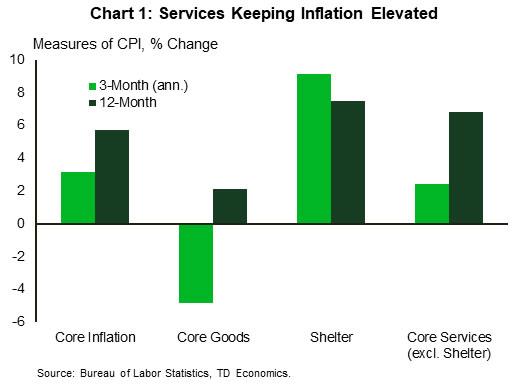
Distortions from the pandemic continued to show further evidence of easing, with core goods prices (-0.3%) falling for the third consecutive month. Declines were primarily concentrated in transportation, while most other categories were higher on the month. That said, retail inventories have been piling up more recently, suggesting we are likely to see further price declines in things like apparel, furniture, and electronics in the months ahead. While encouraging, a softening in goods prices alone can only go so far in bringing down inflation. Core services will also need to slow, and herein lies the problem. Shelter continues to make outsized gains and is not expected to rollover until mid-year. Meanwhile, services (excluding shelter), whose price growth is more closely tied to wages, is unlikely to slow until we see some softening in underlying labor market conditions. And that doesn’t appear to be on the immediate horizon.
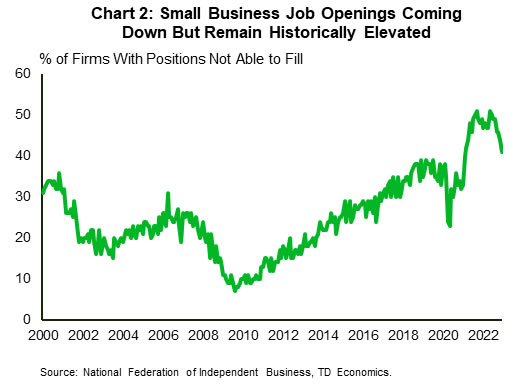
Data out this week showed that while the number of small businesses reporting job openings are declining, they remain historically elevated (Chart 2). As a result, nearly half of small businesses surveyed reported having increased compensation in recent months, while more than a quarter are planning to boost wages over the next three months. Elsewhere, jobless claims continued to edge lower through the first week of January – falling to 205k – with the four-week moving average having steadily declined since late-November. Putting all this together suggests the labor market remains incredibly tight and has not yet reached an inflection point. So while inflation may be easing, the Fed is nowhere near declaring victory. We expect more tightening to come over the coming months – likely in the form of two 25-bps hikes – before pausing to assess the cumulative impact of all 475-bps of tightening.
 Canada – Data Cornucopia Expected Next Week
Equity markets started this year on a sturdier footing. Coming on the heels of last week's gain, equity indexes on both sides of the border continued to rise this week. Investors spirits were lifted by continued improvements on inflation front, with the latest U.S. data showing that price growth continued to decelerate for the sixth consecutive month in December.
This optimism also lifted the TSX, with an additional boost coming from an increase in oil prices. WTI reversed last week's slump, trading at close to $79/barrel on Friday morning amid expectations that the end of strict Covid-19 rules in China will boost demand for oil in the months ahead. Expectations that inflation have peaked, and that the interest rate increases by the Fed will soon come to an end, also pushed yields on bonds with longer maturities lower. Yields on 5-year Government of Canada bonds followed suit, and were down by about 24 basis points on the week.
Outside of financial markets, it was a quiet week in Canada, however, the next one will be anything but. The highly anticipated Bank of Canada Business Outlook and Consumer Expectations surveys as well as data on existing home sales will kick off the busy week, followed by the inflation report on Tuesday and retail sales on Friday. This will be the final batch of data ahead of the next Bank of Canada interest rate announcement on January 25th.
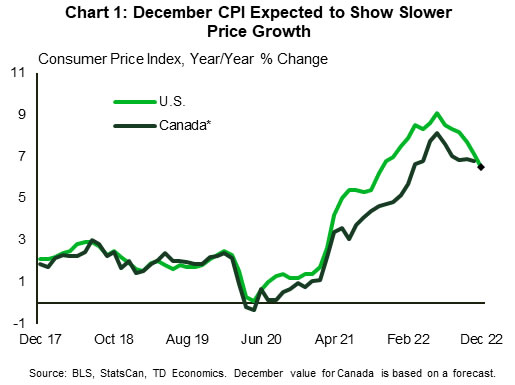
The two Bank of Canada surveys and the inflation report will be of particular interest, providing guidance on the direction of actual inflation and inflation expectations among businesses and consumers. We expect to see a meaningful deceleration in the pace of inflation in December, thanks to a drop in energy prices as well as smaller gains in food prices (Chart 1) after three months of little progress. While encouraging, headline inflation remains too high for the BoC's comfort, and improvements in core inflation may be slower, with prices for services likely to prove stickier.
Existing home sales data is unlikely to deliver any surprises. We expect resale activity and prices remained depressed in December, however, based on preliminary regional data, both have likely fared better than expected. Overall, as we note in our latest housing forecast, the bulk of the adjustment in home prices and sales to higher interest rates appears to be in the rear view mirror. We expect that the market will bottom sometime in early 2023, with around a 20% peak-to-trough decline in home prices.
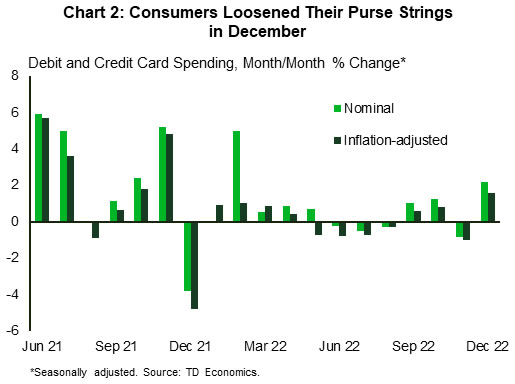
Retail sales will shed light on consumer spending during the busy holiday months. November's numbers are likely to show a drop in spending, however, the preliminary results for December could show a rebound. This will be consistent with our spending data based on TD debit and credit card transactions (Chart 2). Overall, monthly consumer spending has been more robust in Q4, rebounding from the weak reading in Q3. Taking this together with last week's strong job numbers, we don't see much standing in the way of another Bank of Canada rate hike.
Weekly Economic & Financial Commentary: Pace of Fed Tightening to Downshift Further
Summary
United States: War Not Yet Won on Inflation
- The December Consumer Price Index data was the most significant macroeconomic development of the week and showed modest deflation to finish 2022. We now expect the Fed to hike the federal funds rate by just 25 bps at its next policy meeting on February 1, but a slower pace of tightening does not necessarily mean less.
- Next week: Retail Sales (Wed), Industrial Production (Wed), Existing Home Sales (Fri)
International: What's Happening in the Rest of the World?
- Brazil's December CPI data showed inflation receding less than expected. Over the past several months, inflation has sharply fallen from its peak, but with Lula now in office, fiscal policy may begin to move in a more inflationary direction. Down under, inflation pressures in Australia remain persistent. After receding from its 7.3% peak in October, headline CPI re-accelerated to 7.3% year-over-year in November. Housing, food and transport prices saw the most significant price rises. Last but not least, U.K. November GDP registered a surprise 0.1% month-over-month gain, lowering the likelihood that a U.K. recession occurred at the end of last year.
- Next week: China GDP (Tue), Canada CPI (Tue), Bank of Japan/Japan CPI (Wed/Thu)
Interest Rate Watch: Pace of Fed Tightening to Downshift Further
- We have changed our expectation for the outcome of the February 1 FOMC meeting from a rate hike of 50 bps to 25 bps. But we maintain our view that the FOMC will ultimately raise its target range for the federal funds rate by a cumulative amount of 75 bps from its current setting of 4.25%-4.50%.
Credit Market Insights: Consumers Continue to Tap Credit...for Now
- The swing in revolving credit over the past year or so reflects, at least in part, consumers reaching for their credit cards to help sustain spending as decades-high inflation outpaced income growth.
Topic of the Week: Brazil's "January 6 Moment"
- While political risk is typically elevated in Brazil and could weigh on local asset prices, we believe Brazil's “January 6 moment” will not have a long-lasting impact on local financial markets nor the economy.
Canadian Inflation Data to Land as BoC Weighs Another Rate Hike
The final Canadian inflation reading of 2022 will arrive next week. With the Bank of Canada’s highly-anticipated interest rate decision looming on Jan. 25, all eyes will be on this report and the BoC’s Q1 Business Outlook Survey (BOS). A very strong December labour market report has tilted odds towards the BoC hiking the overnight rate by another 25 basis points on January 25th (adding to the 400 basis points of hikes in 2022). But any downside surprise in the CPI data or a dovish tone in the BOS could make that decision a closer call. Either way, it is increasingly likely that the Bank of Canada is close to the end of the current interest rate hiking cycle.
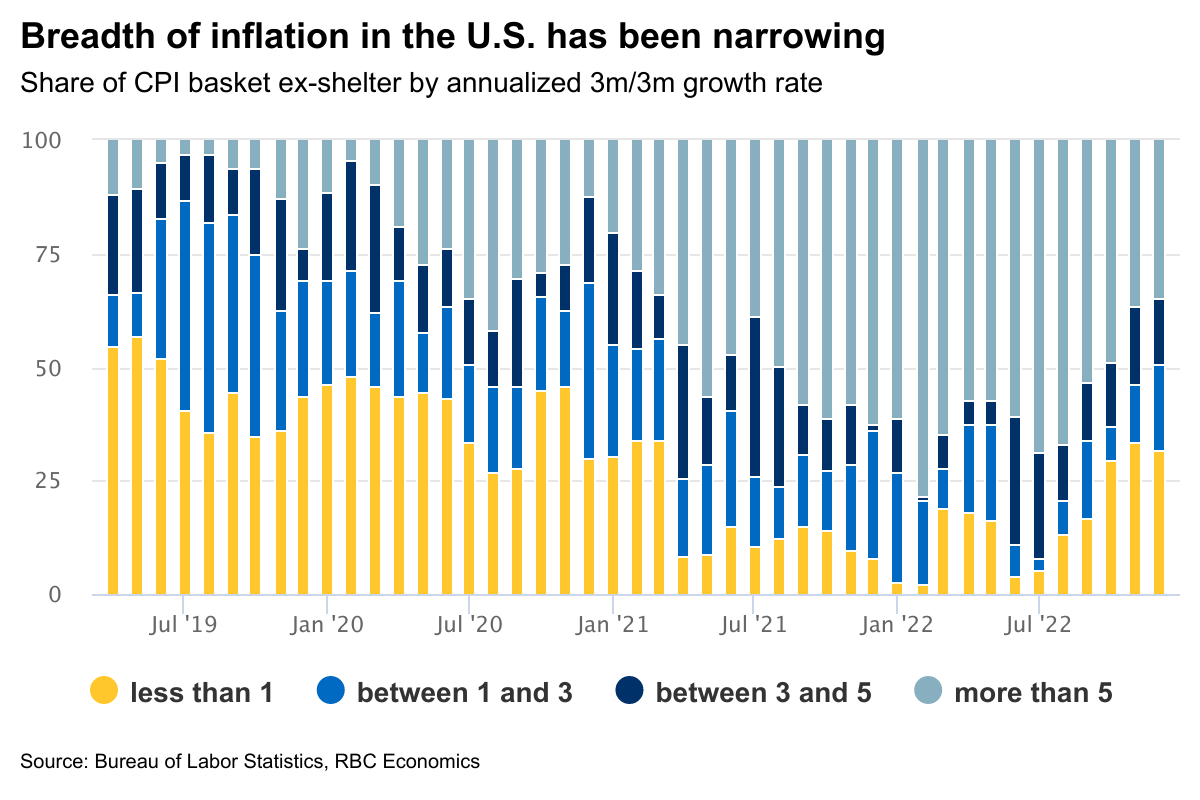
We expect headline CPI growth slowed to 6.4% in December from 6.8% in November (sinking even further below the 8.1% peak in June of last year). Grocery prices continued to surge higher, rising 11.4% year-over-year in November. But food price growth should start slowing in 2023 as the delayed impact of lower global agricultural commodity prices feeds through and supply chain disruptions continue to ease. What’s more, prices at the pump slumped by 13% month-over-month in December. Shelter costs are likely among those where price growth accelerated, driven by surging rents and mortgage interest costs and only partial offsets from lower home-buying related expenses. Still, broader measures of inflation have shown signs of cooling off. Month-over-month increases in the BoC’s preferred CPI-Median and CPI-Trim ‘core’ CPI measures have slowed. And the share of the price basket seeing inflation above the central bank’s 1% to 3% target range has edged down to 60% over the last three months from over 75% in the summer.
We expect the BOS to show an ongoing deterioration in the outlook for future sales as of late last year. This would be consistent with softer business sentiment in manufacturing PMI data. While broader global supply chain disruptions have continued to ease, labour shortages remained acute with job openings still high and the number of available unemployed workers low. The BoC will be watching longer-run business inflation expectations and wage plans—particularly after both measures showed signs of easing in the prior BOS. Comments on businesses’ price-setting behaviour will also be closely scrutinized after the Q3 release flagged that more businesses were resorting to pre-pandemic practices of raising prices less frequently. Firms were also responding more directly to signs of rising costs and competition.
Week ahead data watch
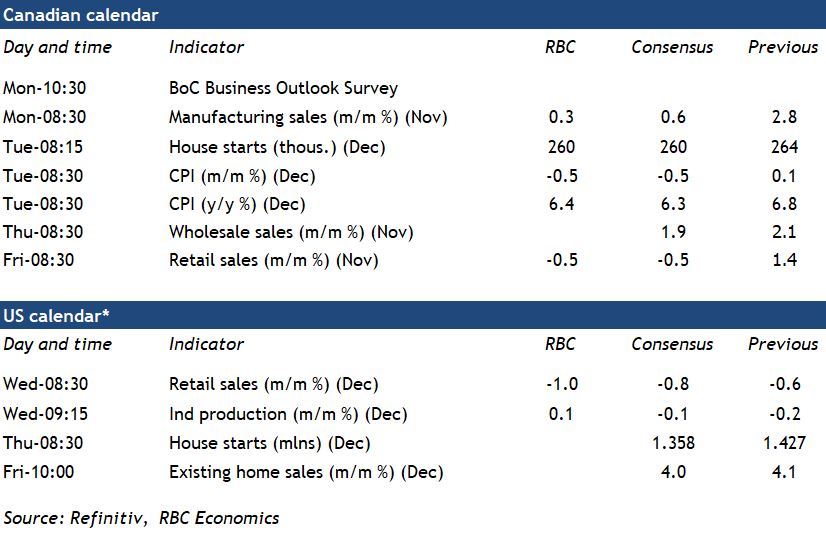
We expect manufacturing sales to tick up 0.3% in November, slightly below the flash estimate of 0.6% from StatCan. Motor vehicle, petroleum, and coal products accounted for the largest share of growth. Prices rose in the month and sale volumes likely edged lower.
StatCan’s preliminary estimate on November retail sales showed a 0.5% decline. We expect the same for sales volume with prices little changed. Auto sales ticked higher but other sales likely declined. Our own spending data was flagging strong holiday spending in that month and into December, but with sales plateauing after that.
Housing starts likely remained steady at 260,000 units in December from an annual pace of 264,159 units in November. Residential building permit issuance was still strong in November, with a 3-month rolling average of 249,000 units.
The slowdown in U.S. unit auto sales, combined with a drop in gas station sales in December, was likely to result in a 1% drop in U.S. retail sales. We expect a 0.1% increase in industrial production in December, with lower manufacturing output (-0.2%) offset by a second consecutive large increase in utilities output (1.8%).
Week Ahead – Earnings Season Underway
It will be a busy week filled with a wide range of economic indicators, lots of Fed speak, and earnings season heats up. Wall Street will now not just fixate on inflation data, but also on how quickly the economy softens. Traders will pay close attention to the Empire manufacturing index, retail sales, PPI, industrial production, NAHB housing market index, weekly jobless claims, and existing home sales data.
Fed speak will happen all week long and expectations are high for more members to signal they are comfortable with downshifting their tightening pace again.
Earnings season continues with more bank earnings, the airline’s report, Procter & Gamble earnings will include insights on pricing trends, and Fastenal reports.
EU
The run-up to the February ECB meeting is going to bring immense focus on incoming data and central bank speak, with investors becoming increasingly hopeful that global interest rates may nearly be peaking and perhaps not as high as feared even a couple of weeks ago. On the former, the standout release will be the final inflation number for December while the ZEW surveys will also be of interest.
On the latter, the ECB minutes will be poured over, as will comments from President Christine Lagarde and colleagues towards the end of the week. Markets are still pricing in three 50 basis point hikes at the upcoming meetings but that could be pared back.
UK
So it turns out the UK may have just about avoided a technical recession in 2022 thanks to the World Cup. The GDP data for November showed unexpected growth which, when combined with the 0.5% gain in October makes it unlikely that the economy will have fallen into a recession after all, barring surprise downward revisions or a shocking number in December. Perhaps Gareth Southgate will get that knighthood after all.
Ultimately, it makes no difference. The spending that boosted November’s number will probably simply be shifted from elsewhere. The cost-of-living crisis is squeezing the economy and will likely further intensify this year, potentially tipping the economy into recession, anyway. We’ll get a lot more data this week including unemployment, inflation, and retail sales.
Russia
No data or events are scheduled for next week so the focus will remain on developments in Ukraine.
South Africa
The currency has stabilized after tumbling last week amid speculation around the changing of the SARB mandate. While the ANC hasn’t given up hope, any changes are unlikely, for the foreseeable future, anyway. That leaves investors to focus on the inflation and retail sales data next Wednesday, the first of which still sits above the SARB 3-6% target range.
The CBRT meets next week and frankly, I have no idea what they will do. Official inflation fell from 84.39% to 64.27% in December which the central bank could look to capitalise on, despite previously indicating it was done with its latest easing cycle.
Switzerland
The World Economic Forum takes place in Switzerland next week and on Friday, SNB Chair Thomas Jordan will be among many central bankers throughout the week making an appearance.
All eyes will be on China this week. To kick off the week, the PBOC is expected to cut its one-year MLF rate by 10 basis points to 2.65%. On Tuesday, we see the impact Covid had on GDP, industrial production, retail sales, and fixed asset investment. Fourth quarter GDP is expected to drop from 3.9% to 1.5%, while December’s retail sales plunge from -5.9% to -12.0%. At the end of the week, China is expected to cut its loan prime rates.
Much attention will remain on China’s Covid situation and whether the economic outlook continues to brighten with improving reopening trends.
India
Inflation has been falling and that is starting to make some traders doubt that the RBI will need to continue to raise rates. The upcoming week contains wholesale price data that is expected to show disinflation trends remain. Trade data is also due.
Australia & New Zealand
China’s reopening momentum has been good news for both Australia and New Zealand. China-Australia relations are expected to return to a healthy and stable development, with China’s ambassador Xiao Qian recently commenting positively on China-Australia relations. The relationship has been constructive so far. The main economic release for Australia will be the December employment report. Hiring is expected to slow down from 64,000 to 15,000.
For New Zealand, traders will pay close attention to the REINZ House Sales data, Food prices, and manufacturing PMI.
The Bank of Japan’s monetary policy decision is expected to keep rates on hold. Traders are still digesting the surprising decision to adjust its government bond yield curve control. BOJ watchers are looking for hints that they could soon move toward normalization by the end of July.
Next week also focuses on the Japan PPI, machine tool orders, Tertiary industry index, core machine orders, industrial production, and trade data.
Singapore
Second-tier data includes the release of non-oil domestic exports for December.
Economic Calendar
Saturday, Jan. 14
Economic Events
- Second and final day of voting for Czech president
- Assistant Trade Representative McCartin leads a US delegation in trade talks with Taiwan counterparts in Taipei.
Sunday, Jan. 15
Economic Data/Events
- No major events expected
Monday, Jan. 16
Economic Data/Events
- US markets closed for Martin Luther King Day
- Australia inflation gauge
- Canada existing home sales
- China property prices, medium-term lending
- India wholesale prices
- Japan PPI, machine-tool orders
- UK Rightmove house price index
- The World Economic Forum’s annual meeting kicks off in Davos, Switzerland
- EU finance ministers meet in Brussels
Tuesday, Jan. 17
Economic Data/Events
- US Empire State manufacturing survey
- Australia consumer confidence
- Canada CPI, housing starts
- China retail sales, industrial production, GDP, surveyed jobless rate
- Germany CPI, ZEW survey expectations
- Italy CPI
- Japan tertiary industry index
- Mexico international reserves
- New Zealand house sales
- Singapore trade
- South Korea money supply
- UK jobless claims, unemployment
- Fed’s Williams gives speaks at an event about equitable growth hosted by the bank
- ECB’s Centeno participates in a panel at the World Economic Forum in Davos
- Big earnings from Goldman Sachs, Morgan Stanley, and United Airlines
Wednesday, Jan. 18
Economic Data/Events
- US retail sales, PPI, industrial production, business inventories, MBA mortgage applications, cross-border investment
- Fed release Beige Book
- BOJ rate decision: Expected to keep rates on hold
- Eurozone CPI
- South Africa CPI
- UK CPI
- Canada industrial product prices
- Italy trade
- Japan machinery orders, industrial production
- New Zealand card spending
- South Africa retail sales
- Taiwan jobless rate, GDP
- Thailand car sales
- NATO Military Committee in Chiefs of Defence session opens
- Fed’s Bostic gives welcoming remarks at a conference on model risk management hosted by the bank
- Fed’s Logan speaks at the University of Texas Austin McCombs School of Business
- Fed’s Harker speaks at the Lyons CEEE Economic Forecast event
- Alcoa report earnings
Thursday, Jan. 19
Economic Data/Events
- US housing starts, initial jobless claims, Philadelphia Fed index
- Norway Rate Decision: May hold rates or deliver a 25bp rate increase
- Turkey Rate Decision: Expected to keep the one-week repo rate unchanged at 9.00%
- Argentina trade
- Australia unemployment
- China Swift global payments
- Japan trade
- New Zealand food prices
- Spain trade
- ECB publishes the account of its December 2022 policy meeting
- ECB President Christine Lagarde speaks in a panel at World Economic Forum in Davos
- ECB’s Schnabel speaks in a webinar on monetary policy
- Fed’s Collins speaks at a conference on housing hosted by the bank
- Fed’s Williams speaks at an event hosted by the Fixed Income Analyst Society in NY
- France’s main labor unions’ first day of strikes over the government’s plan to raise the retirement age
- Procter & Gamble and Netflix report earnings
Friday, Jan. 20
Economic Data/Events
- US existing home sales
- BOJ announce outright purchase total of government securities
- Japan CPI
- Canada retail sales
- China loan prime rates
- Germany PPI
- Mexico retail sales
- New Zealand PMI, net migration
- Thailand foreign reserves, forward contracts
- UK retail sales
- ECB President Christine Lagarde and French Finance Minister Bruno Le Maire speak on a panel in Davos
- Schlumberger and American Airlines report earnings
Sovereign Rating Updates
- Hungary (Fitch)
- Ireland (Fitch) – Norway (Fitch)
- Austria (DBRS)
- EFSF (DBRS)
- ESM (DBRS)
Fed Nears a Hiking Pause – History Points to Recession and Possible October 2023 Rate Cut
The Federal Reserve Bank has been on an aggressive tightening path since March 2022. A total of 425 bps of rate hikes have pushed the Fed Funds Rate to 4.25%, the highest level since December 2007. The market is pricing in an extra 58 bps of rate hikes by June 2023, but numerous forecasters have been quite vocal that the Fed could be making its last tightening move in the first quarter and then opting to pause. It appears quite plausible for the Fed to eventually pause and allow the economy to absorb the higher interest rates. Sectors that are dependent on interest rates, like the housing sector, had fared negatively in 2022, elevating concerns about their 2023 performance.
Three rate hiking cycles since 2000
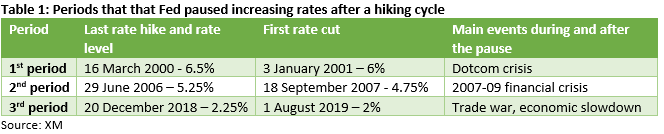
Since 2000 there have been three periods that the Fed completed its rate hiking cycle and then paused. Table 1 below presents these three instances and the main events during and after its pause. Interestingly, during the last 22 years the Fed has delivered 36 rate hikes with an average move size of 33bps. On the other hand, 26 rate cuts have been announced but the average move size was much higher at 46 bps.
Key similarity in these periods is the ensuing recession
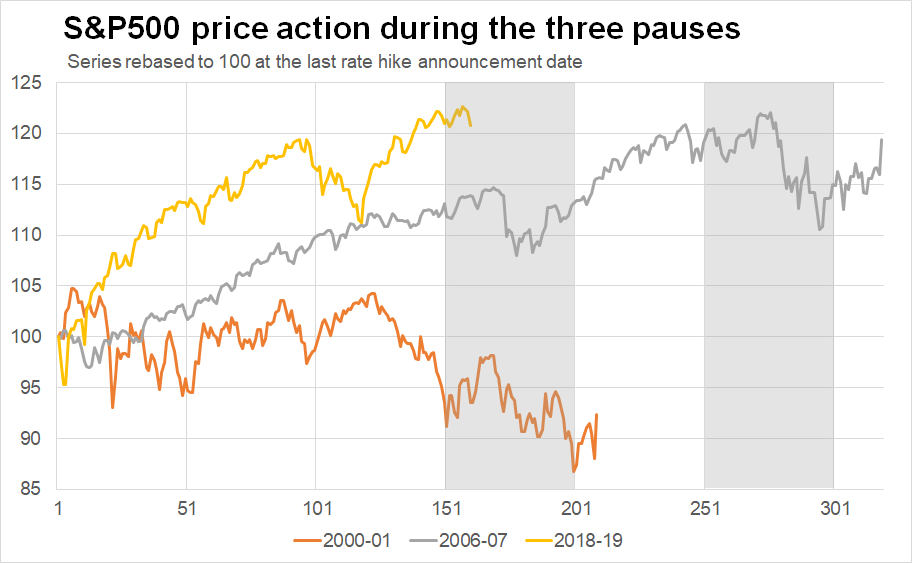
The famous dotcom crash occurred just before and continued during the 2000-2001 Fed pause, eventually wiping out $5trillion from stock markets’ capitalization. By October 2002 the Nasdaq index had dropped 78% from its peak. Unsurprisingly, a short-lived recession ensued lasting from March 2010 to November 2001.
Similarly, the 2007-09 financial crisis began during the 2006-07 Fed pause. The defaults by subprime lenders in the first quarter of 2007 were an early indication of the “financial typhoon” that hit the financial markets in August 2007 when two hedge funds were frozen. The end-product of this financial crisis was the Euro area sovereign debt crisis and the accompanied euro periphery bailouts. The National Bureau of Economic Research (NBER) in the US has identified the December 2007 - June 2009 period as the longest-running recession since the 1929-1933 economic crash.
Thirdly, another recession followed the 2018-19 Fed pause. The pause in monetary policy tightening occurred amidst the trade war between the US and China, the aftermath of the NAFTA renegotiation (September 2018) and, more importantly, the first effort from the Fed to reduce its ballooning balance sheet. The first Quantitative Tightening (QT) operation started in October 2017 and was stopped abruptly in September 2019.
Duration of the pauses and projection to current timeframe
The duration of the Fed pauses has varied in the three periods examined. The 2000-01 pause lasted 10 months, the 2006-07 stop endured 15 months while the third pause had an eight-month life. Assuming that the Fed delivers its final rate move at the March 22 meeting then, based on its recent history, the projected pause would potentially end at some point between October 31, 2023 and June 9, 2024. Current market pricing points to a total of 52 bps of rate cuts in the second half of 2023, while there are increasing voices in the market that the anticipated recession would most likely force the Fed to cut rates even earlier and at a faster pace.
Price action in the three Fed pauses
We examined the performance in the three periods of stable monetary policy for various securities. Table 2 below presents the results. The immediate observation is that the 10-year US treasury yield sold off by 73-133 bps in these three periods, reversing part of the earlier move higher. The 10-year yield currently stands at 3.45% and could potentially drop to as low as 2.10% if history repeats itself.

Stock markets reacted positively in the 2006-07 and 2018-19 pauses with an average advance of 18% and 24% for the S&P 500 and the DAX 40 respectively. But the same cannot be said for the 2000-01 figures that are negative due to the dotcom crisis. Similarly, both Gold and WTI oil prices recorded gains in the second and third periods, averaging gains of 16% and 19% respectively, but recorded losses in the 2000-01 pause.
Summary of our findings
With the market anxiously trying to forecast the Fed’s reaction function, we have examined the three instances that the Fed paused its rate hiking cycle. These pauses lasted from eight to 15 months, going against both the forecasters’ current expectations and market pricing of a rate cut during the second quarter of 2023. However, it is worth noting that the Fed stops occurred during or were followed by a recession in the US economy. These historical events lend some credibility to the advocates of an imminent recession. Finally, performance has been relatively mixed apart from the 10-year yield recording a drop of 73-133 bps in the examined periods. Interestingly, both the equity and commodity markets enjoyed strong returns in the 2006-07 and 2018-19 pauses.
Week Ahead – Will the Bank of Japan Roll Out Another Surprise?
A volatile week awaits FX traders, featuring the first Bank of Japan decision of the year. It’s a close call whether policymakers will adjust their yield strategy once again, although even if they don’t, it’s probably only a matter of time. There’s also a deluge of data releases from the major economies.
Tough decision for BoJ
The Bank of Japan shocked financial markets last month when it raised the ceiling on long-term Japanese yields, a decision that turbocharged the yen. Heading into the next policy decision on Wednesday, the question is whether a similar move is on the cards.
It’s a close call, something also reflected in market pricing. Investors currently assign a 45% probability for an immediate rate increase of 10 basis points, which would mark an exit from negative rates. Similarly, speculators are betting the yield ceiling will be adjusted again soon, something evident by the widening spread between overnight index swaps and the 10-year yield.
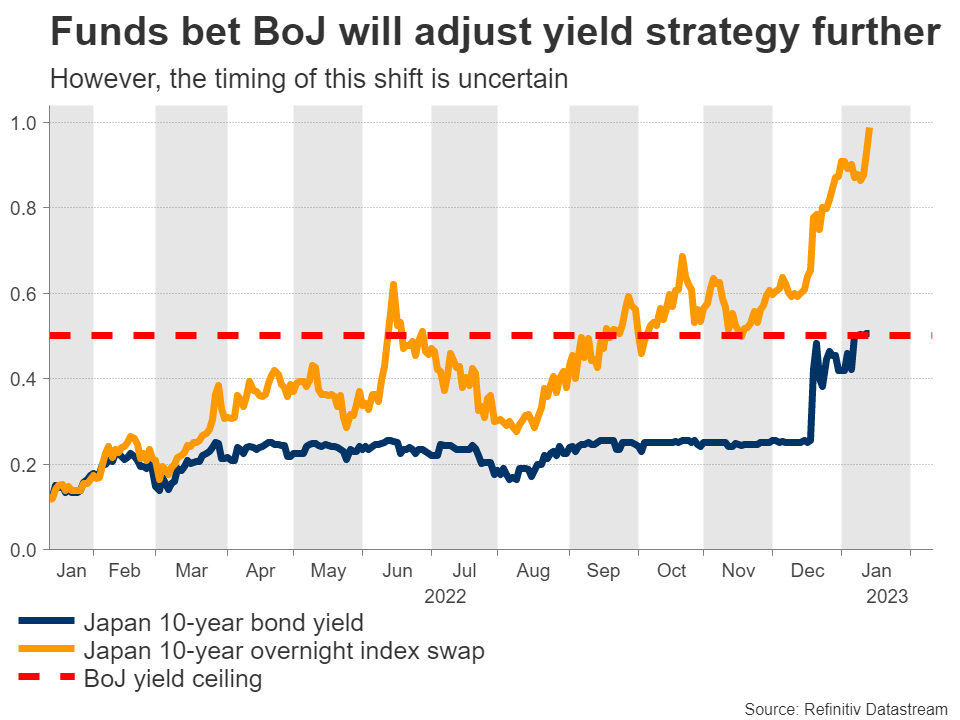
Arguing for another shock-and-awe move is the latest acceleration in the inflation metrics for Tokyo, which hit their highest levels in four decades in December. These are considered forward-looking inflation measures for the entire economy, so they carry some weight in the BoJ’s thinking.
However, media sources “familiar with the Bank’s thinking” suggest many officials prefer to spend some time monitoring the effects of their last decision, before making any further moves. Enhancing this view is the latest slowdown in wage growth and household spending, which are worrisome signs about the durability of inflationary pressures.
Weighing everything up, from a risk management perspective, it makes more sense for the BoJ to be patient at this meeting and perhaps wait until March before taking the next step in its normalization campaign. That would allow policymakers a look at another couple of months’ worth of data, before deciding on the best course of action.
As for the yen, a decision to remain on hold might come as a disappointment initially. Nonetheless, it’s probably a matter of time until the BoJ raises the yield ceiling again and ultimately raises rates, so the overall outlook for the currency remains quite bright.
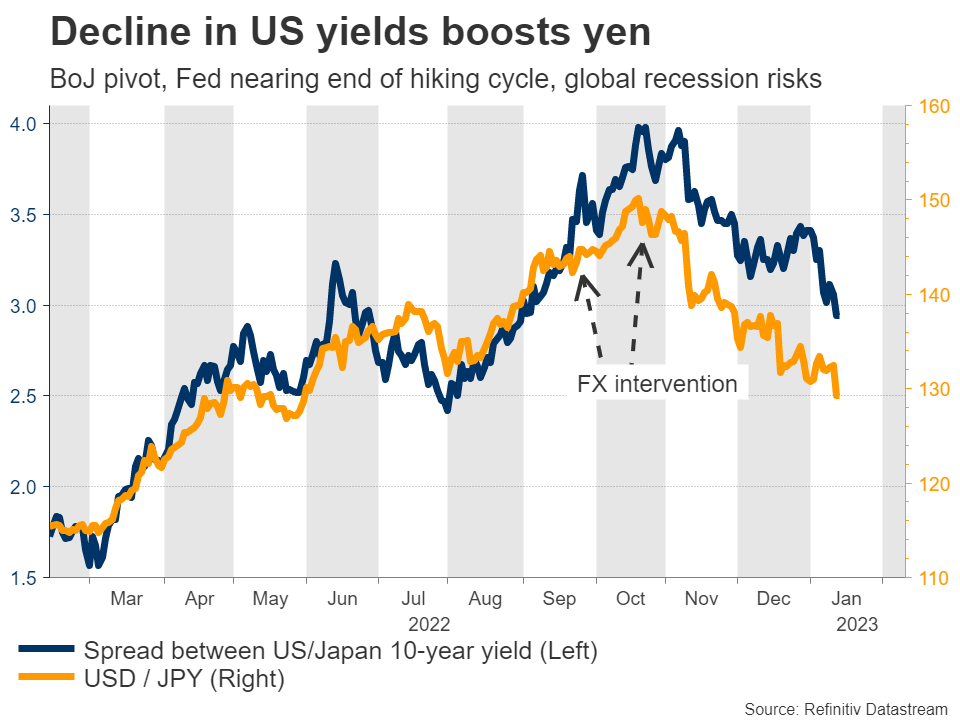
With the BoJ tightening policy just as most central banks are about to end their own tightening cycles, rate differentials could compress further in the yen’s favor this year. Heightened recession risks globally support this notion, as does the persistent decline in energy prices, which is encouraging for an oil-importing economy like Japan.
Speculation around who will replace Kuroda as BoJ Governor when his term ends in April could be another driver of the yen.
US retail sales on tap
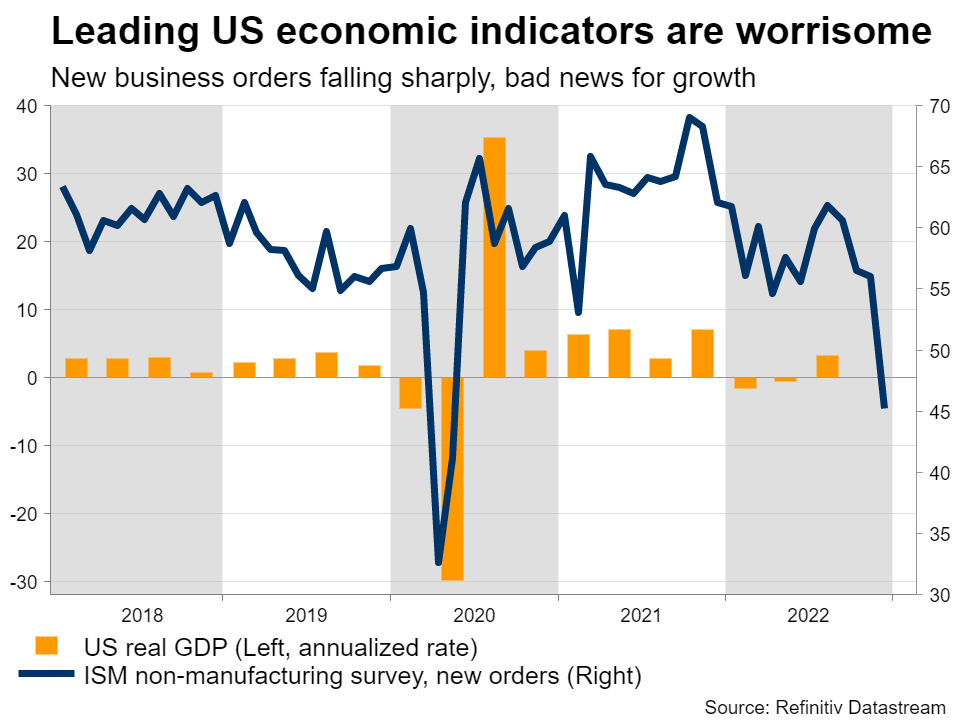
Over in the United States, the latest batch of producer prices and retail sales will be the highlights, both released on Wednesday. It’s becoming clear that inflationary pressures in America are finally cooling, although that’s not necessarily good news, since it’s happening mostly because demand is cratering. New business orders have fallen sharply, which is usually a harbinger of softer economic growth - or even recession - a few quarters later.
As such, retail sales might attract some extra attention next week, for an update on consumer demand. Investors have settled on a 25 basis point rate increase from the Fed next month, and it would take a huge surprise in this data to change this consensus.
Turning to the dollar, it had a rough start to the year as hawkish expectations about the Fed moderated. A policy turn by the BoJ alongside the unusually warm weather in Europe that helped calm nerves around the energy crisis also played a role, by boosting both the yen and euro.
Still, it’s difficult to call for a total breakdown in the dollar while most major economies are in worse shape than the US. Historically speaking, the dollar tends to depreciate when the global economy is doing well and there aren’t many risks around, which is not the case today. Hence, despite the sharp pullback, calls for the dollar’s demise seem premature.
Across the border in Canada, the latest inflation stats are out on Tuesday, ahead of retail sales on Friday.
Barrage of UK releases
In the United Kingdom, the ball will get rolling with the latest jobs report on Monday. Inflation numbers will be released Wednesday, before the week culminates with retail sales on Friday.
Markets are currently leaning towards a 50 basis point rate increase from the Bank of England in February, but there’s still some uncertainty around that. Hence, this data could be important in shaping expectations, and by extension driving the pound.
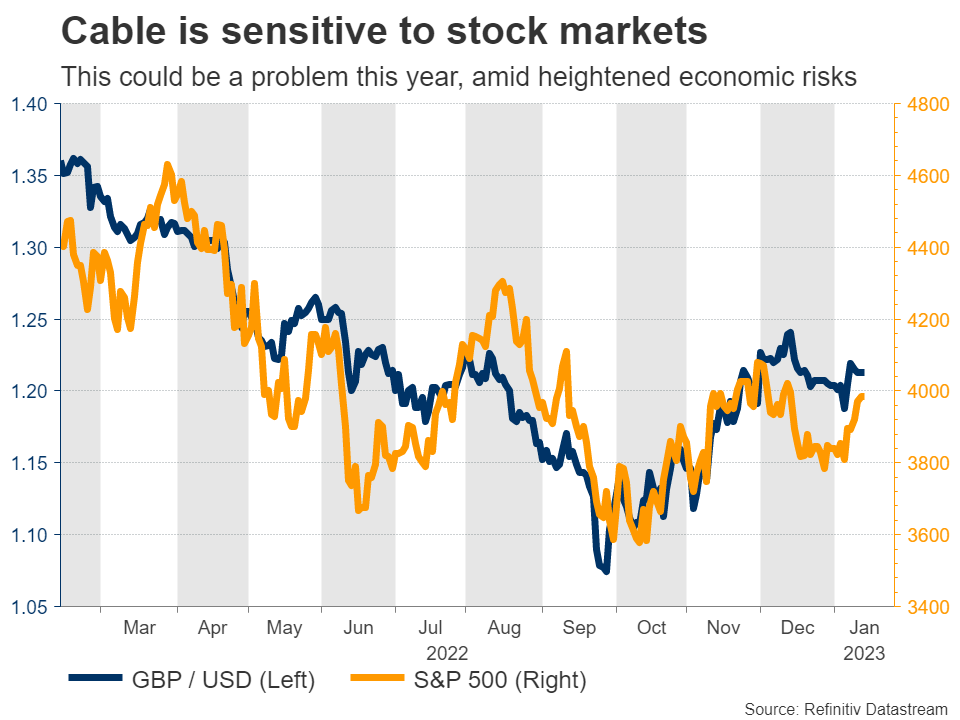
Overall, it’s difficult to be optimistic about sterling. The Bank of England might be raising rates, but it is doing so reluctantly, paying greater attention to the recession risks that have surrounded the economy. Those have intensified lately amid widespread worker strikes over insufficient pay.
Beyond domestic factors, sterling also has a strong correlation with stock markets. That seems like a vulnerability at this point, since valuations on Wall Street remain ‘expensive’ and out-of-sync with what leading economic indicators suggest about what happens next.
Australian and Chinese indicators
The China-sensitive Australian dollar is the best performing major currency so far this year, but it’s doubtful whether this will last. News that China will lift its ban on some Australian exports propelled the currency higher lately, alongside optimism about China’s reopening and the cheerful mood in risk assets.
Alas, this rally might be more ‘hype’ than substance. Applying the Western model of economic reopening to China may be an error, as the nation hasn’t rolled out a full vaccination campaign. In addition, the problems in its property sector haven’t been resolved, and any Western recession will inevitably hit both China and Australia through the trade channel.
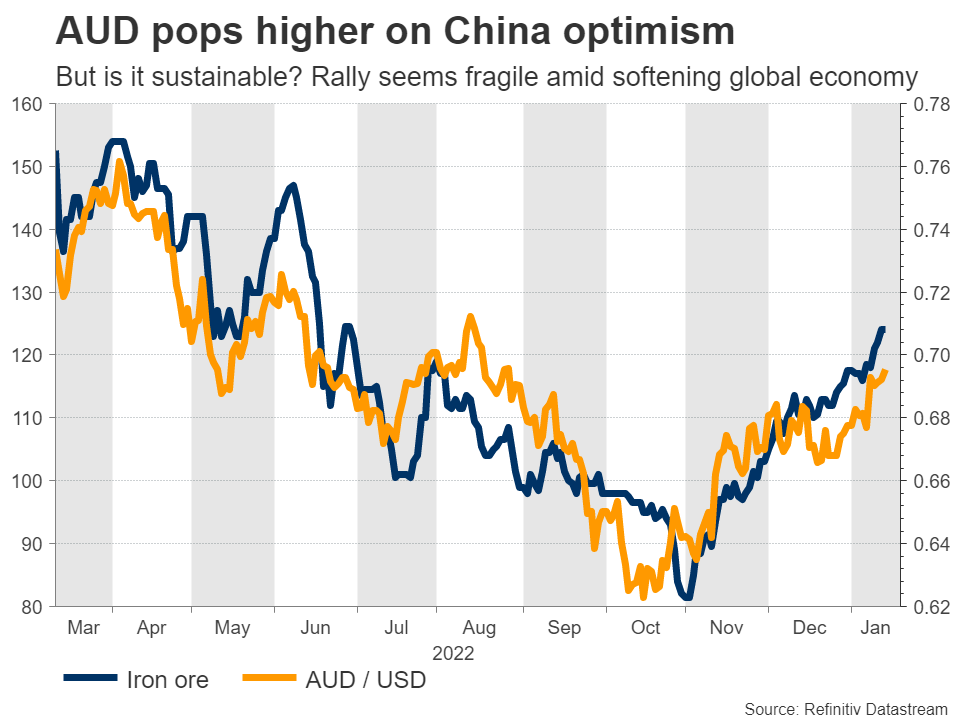
China’s GDP numbers are out on Tuesday and forecasts suggest the economy contracted in Q4, amid strict lockdown measures. Then on Thursday, Australia’s employment report for December will be released.
Finally, note that the earnings season will also fire up with names such as Netflix and Procter & Gamble releasing their quarterly results next week.
Weekly Focus – Markets Are Rallying But Is It Premature?
Year 2023 has delivered for risk lovers thus far. Early signs of moderating core price pressures in the US, Chinese reopening and a mild winter in Europe are altogether positive signals for risky assets in short term. The problem is that a premature easing in financial conditions risks upholding underlying price pressures, and central banks are by no means out of the woods as they aim to make sure that the current price pressures are tamed for good. The ECB particularly finds itself in a tricky position as core inflation has kept rising, and soon, pent-up demand from China could create new inflationary concerns. See our Euro Macro Notes - The China connection: short-term boost, long-term worry, 12 January.
The sudden change of fortunes has driven a substantial outperformance in European equities vs the US over the last 2-3 months. European equities have gained 13% since the start of November compared to only 3% in the US. Meanwhile, EUR/USD has continued to tick higher, breaching 1.085 this week. We are in the process of updating our EUR/USD forecast, and while we still see fundamentals favouring USD in 6-12 months horizon, it is difficult to pinpoint a trigger for a near term reversal.
This week, US December CPI came out close to our and consensus expectations, but the details suggest underlying price pressures could be starting to moderate. Core services inflation picked up to 0.5% m/m (from 0.4%), but the uptick was driven by higher shelter and health care components, while the most wage-sensitive components showed easing price pressures. We have updated our call and we now expect Fed to hike by 25bp (was 50bp) in February. We continue to think that easing financial conditions, less negative growth outlook and economic recovery in China create persistent inflation risks, and still think the Fed will eventually hike the policy rate to 5.00-5.25% in May (prev. March). See US Labour Market Monitor, 11 January and Global Inflation Watch - Central banks welcome easing inflation, 13 January, for our latest thoughts on inflation developments.
Next week, we get Q4 GDP data from China on Tuesday morning, which is expected to drop 1% q/q due to the negative lockdown effects in November and covid surge in December. We also get industrial production, retail sales, investments and unemployment for December, which will most likely look very weak. The negative numbers should be followed by a faster-than-expected rebound during H1, though, as the positive reopening effects come through.
In the US, December PPI, retail sales and industrial production data are all released on Wednesday. Retail sales is the most important of the bunch, as it will be the first piece of hard data for December, and will give us a sense of if the sharp slowdown illustrated by the ISM services actually took place. The FOMC blackout will begin on the 21st, and investors will keep an eye on any last minute commentary.
In the euro area, we have ZEW expectations for January due on Tuesday and ECB minutes on Thursday. In the former, it will be interesting to see whether the recent rebound in leading indicators persists into Q1. In the latter, we look out for more details surrounding the upcoming balance sheet normalisation (QT) and how much more 'significant' interest rate increases the Governing Council has in mind in light of the inflation outlook.
Sunset Market Commentary
Markets
The recent downleg in core yields finally came to a standstill. Markets yesterday further reduced expectations both on the pace of Fed hiking and on the end-point of the rate cycle after US inflation eased further in December (albeit in line with expectations). There we no really high profile eco data today. A first estimate of German 2022 growth was reported at 1.9% Y/Y. Only 1.8% was expected, indicating that the slowdown in Q4 was likely less than feared. The ECB announced that banks repaid another € 62.8 bln of TLTRO loans. The amount was materially smaller than expectations for € 200+ bln of repayments. The repayment brings the outstanding amount of TLTRO loans below € 1.3 trillion. Alongside ECB rate hikes, the reduction of liquidity due to TLTRO repayments is a second channel to tighten financing conditions in the euro area. German 2 & 30 yields are little changed. The 10-y cedes 3.0 bps. US yields are ‘rebounding’ 1/2 bps across the curve. The US 2-y yield (4.17%) and 10-y yield (3.47%) are holding north of support levels at 4.13% and 3.4% respectively. Still it’s much too early to call the start of a genuine counter-move yet. Equities also shifted into a lower gear after recent, yield-driven rally. European indices gain marginally (Eurostoxx 50 + 0.2%). First Q4 earnings from major US banks failed to convince. US indices are ceding up to 0.75% immediately after the open. Oil extends this week’s gradual, but protracted rebound with Brent trading near $84 p/b compared to sub $80 levels recorded at the end of last week.
In FX, the dollar is looking for a bottom after the recent sell-off. The TW DXY trades near 102.55 after testing the 102 big figure early in Europe. EUR/USD (1.0795) also returns most of yesterday’s break beyond 1.0787. The yen still outperforms the dollar. At 128.2, the USD/JPY cross rate recently dropped below several support levels. This morning, the BOJ again had to step in to buy bonds after the 10-y broke beyond the 0.50% barrier. Even so, both the price action in the bond market and the FX market suggests that markets pondering further changes in the BOJ policy framework maybe already at next week’s policy meeting. EUR/GBP (0.887) failed to surpass the 0.89 big figure. UK production data were unconvincing, but services activity apparently held up better with the monthly GDP indicator for November printing in positive territory (+0.1%).
News Headlines
Hungarian December inflation jumped 1.9% m/m to be up 24.5% Y/Y. That was less than expected (3% and 25.8% resp.). Slowing food price increases (2% m/m, lowest in 2022) and tanking gas prices (11.8% m/m) partially offset a meteoric rise in fuel prices (+24.4% m/m) following the price cap removal early December. Tradeable goods inflation also eased but market services inflation remains elevated. KBC Economics expects inflation to peak early 2023 to 25-25.5%. The forint appreciates marginally against the euro (EUR/HUF near 396). The forint is key in assessing NBH monetary policy. In the current, relatively optimistic market mood vis-à-vis the forint, KBC Economics expects the MNB to start cutting the 18% O/N deposit rate end of February at the earliest before closing the gap with the regular base rate (13%) in June. This timing may shift to the future should sentiment deteriorate again.
December inflation in Sweden rose from 11.5% to 12.3% on a 2.1% m/m increase. Using a fixed interest rate, headline inflation also entered double digit territory (10.2% from 9.5%) while the Riksbank’s preferred core gauge (ex. energy) accelerated from 8% to 8.4%. All of the readings, both m/m and y/y, topped estimates, including those from the central bank. It all but cements expectations for a 50 bps rate hike at the February 9 meeting – the first one under governor Erik Thedeen – with a 50% chance discounted for 75 bps. The Riksbank lifted policy rates last year by a cumulative 250 bps. At the last meeting in November, it projected a terminal rate of 3%. But today’s data may have rendered this forecast outdated. The Swedish swap yield curve inversion deepens with yields rising 5.7-6.4 bps at the front end. The Swedish krone is unable to profit against a euro that also has some interest rate support due in coming months. EUR/SEK stabilizes near recent highs around 11.28.
GBPUSD Pullbacks Despite Surprise in GDP Data
Britain, as previously with mainland Europe, is showing better than expected GDP performance, tempering expectations on the depth and duration of the looming recession. Monthly GDP estimates showed an unexpected growth of 0.1% in November after 0.5% in October, markedly better than the 0.2% contraction that had been expected.
This was driven by a better-than-expected service sector performance, representing the lion’s share of the UK economy. Construction also held off a decline in November, but the annual growth rate slowed to 4.0% compared to 5.9% a month earlier.
However, things are deteriorating in the industry. Industrial production has fallen for 8 of the last ten months. Although the rate fell markedly in the previous quarter, activity in November was 5.1% lower than a year earlier. The manufacturing sector is losing 5.9% YoY, holding around this rate since July.
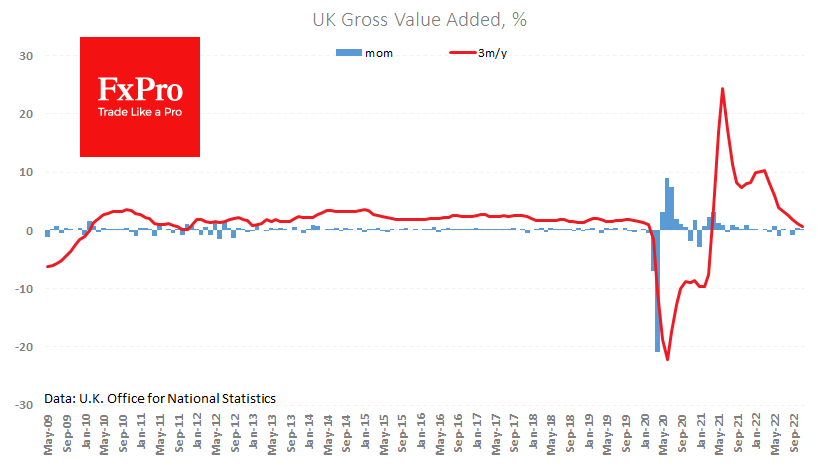
Although industry contributes less than 10% to the country’s GDP, the dynamics of this sector are often ahead of the business cycle, being the first to take the hit when economic conditions deteriorate.
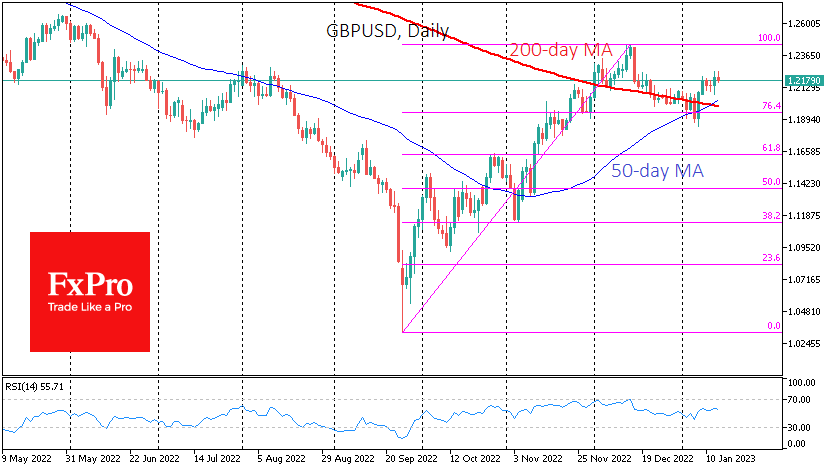
Initially, the market reacted to the monthly data release by buying the pound, pushing the FTSE100 to its highs for the year and only 0.7% from its historic peak in mid-2018. However, markets soon retraced the gains, which fits well with the desire to lock in some profits after the impressive progress of the past two weeks. GBPUSD pulled back to 1.2175, despite the ‘golden cross’ formed two days ago (the 50-day MA overcame the 200-day MA).
Despite the bullish signal, the pound exchange rate and British asset prices remain vulnerable to short-term pullbacks without breaking the upward trend. We cannot discuss breaking the trend until GBPUSD falls below 1.1900. However, it is more likely that a short-term correction into the 1.2000-1.2050 area will be followed by renewed buying after a short-term shakeout.