

Sample Category Title
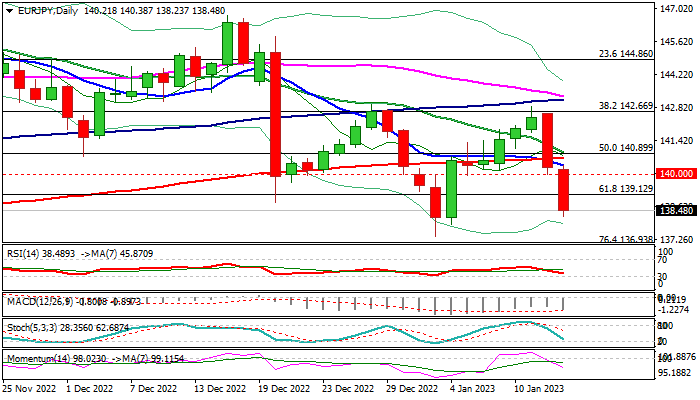
EUR/JPY Falls Sharply for the Second Day
The cross extends steep fall into second straight day, losing 1.3% until early US session on Friday, following 1.6% drop on Thursday, as yen rose sharply on weaker dollar and speculations that BoJ is about to start revisions of its ultra-loose monetary policy.
Strong bearish acceleration broke through pivotal support at 140.00 (psychological) and 139.12 (Fibo 61.8% of 133.39/148.40 rally), retracing the most of 137.38/142.85 corrective leg and signaling that larger bears are tightening grip for possible continuation after limited corrective phase.
Formation of 10/200DMA death-cross contributes to negative outlook, as bearish momentum is strengthening on daily chart and RSI and Stochastic indicators are heading south.
Firm break of 137.33/38 pivots (Sep 26/Jan 3 lows) would signal continuation of the downtrend from 148.40 (2022 high).
Upticks under broken 140 support, reverted to solid resistance, should offer better selling opportunities.
Res: 139.12; 140.00; 140.37; 140.68.
Sup: 137.91; 137.38; 136.93; 135.51.
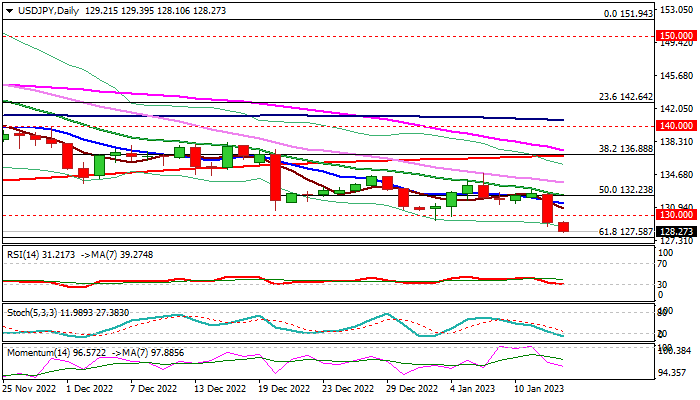
USD/JPY: Larger Downtrend to Resume after Taking Out Key Supports
The USDJPY keeps firm negative tone and dips to new lowest levels in over seven months on Friday, in extension of strong acceleration on Thursday, when the pair lost 2.3% of its value, in the biggest daily drop since Dec 20.
The dollar was deflated by growing expectations that the Fed would continue slow the pace of its rate hikes, following further easing of US inflation.
Also, Japanese yen received fresh support from talks that the Bank of Japan would soon start modifying its monetary policy, which is still unchanged, despite the other central banks already strongly tightened its monetary policies.
The pair is on track for the biggest weekly loss since late November and weekly close below psychological 130 support for the first time since June 2.
Bearish daily studies add to negative near-term outlook, as bears eye initial target at 127.58 (Fibo 61.8% of 112.53/151.94, break of which would generate fresh bearish signal for extension of steep downtrend from 151.94 (2022 peak, the highest in nearly 33 years) towards target at 124.66 (20MMA).
Broken 130 support reverted to solid barrier, along with 55WMA (131.12), marking significant resistance zone which should limit corrective upticks (as daily studies are oversold) and keep bears in play.
Res: 129.39; 130.00; 130.56; 131.12.
Sup: 127.58; 127.00; 126.25; 125.48.
Dollar Trying to Recover, Except Versus Yen
Yen's rally continues today on talks that BoJ could tweak the yield curve control again next week. It's also supported by extended decline in US and European benchmark treasury yields. Meanwhile, Dollar is trying to fight back as US futures are taking dive, reversing some of yesterday's post-CPI gains. But overall, the greenback remains the second worst performer for the week, following Swiss Franc, and followed by Kiwi. Yen is the best, followed by Euro and then Aussie.
In Europe, at the time of writing, FTSE is up 0.41%. DAX is flat. CAC is up 0.21%. Germany 10-year yield is down -0.017 at 2.107. Earlier in Asia, Nikkei dropped -1.25%. Hong Kong HSI rose 1.04%. China Shanghai SSE rose 1.01%. Singapore Strait Times rose 0.79%. Japan 10-year JGB yield rose 0.0067 to 0.512.
UK GDP grew 0.1% mom in Nov, avoided contraction
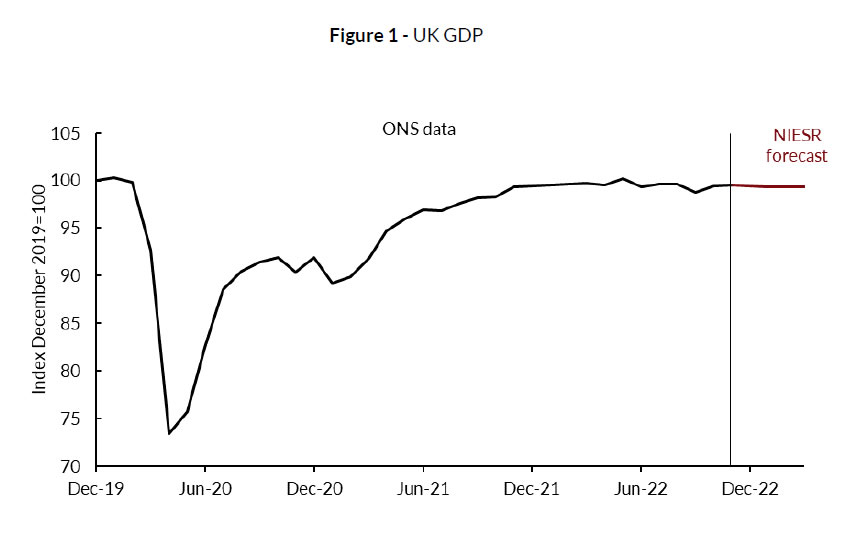
UK real GDP grew 0.1% mom in November, much better than expectation of -0.3% mom contraction. Services grew 0.2% mom. Production declined -0.2% mom. Construction was flat. Overall monthly GDP is -0.3% below its pre-pandemic levels.
In the three months to November, GDP fell -0.3% 3mo3mo. there was a -0.1% decline in Services, -1.4% decline in production, with the only growth coming from 0.3% in construction.
Also published, manufacturing production was down -0.5% mom, -5.9% yoy in November, versus expectation of -0.2% mom, -5.2% yoy. Industrial production was down -0.2% mom, -5.1% yoy, versus expectation of -0.1% mom, -2.8% yoy. Goods trade deficit widened to GBP -15.6B, versus expectation of GBP -14.9B.
NIESR expects 0.1% UK GDP growth in Q4, Q1 risk on the downside
After today's UK GDP release, NIESR forecasts that GDP in December will fall relative to November. But overall, service-driven GDP growth of 0.1% in Q4 is estimated.
Paula Bejarano Carbo, Associate Economist, NIESR, said: "Given that PMIs for services, manufacturing and construction all posted below the neutral 50 for December, we expect to see a slight fall in GDP in December relative to November; but this means a rise in quarterly GDP, possibly a sign that households are enjoying a last hurrah before they tighten their belts in 2023.
" Looking towards the first quarter of 2023, the risks to GDP seem to remain on the downside, driven by anaemic growth in the major sectors, fragile consumer and business confidence and a widespread fall in real incomes."
Eurozone industrial production rose 1.0% mom in Nov, EU up 0.9% mom
Eurozone industrial production rose 1.0% mom in November, above expectation of 0.6% mom. Production of capital goods grew by 1.0%, intermediate goods by 0.8% and durable consumer goods by 0.4%, while production of energy fell by -0.9% and non-durable consumer goods by -1.3%.
EU industrial production rose 0.9% mom. Among Member States for which data are available, the highest monthly increases were registered in Ireland (+6.4%), Luxembourg (+5.0%) and Malta (+4.6%). The largest decreases were observed in Estonia (-3.7%), Sweden (-3.3%) and Croatia (-1.9%).
Eurozone exports rose 17.2% yoy, imports up 20.2% yoy in Nov
Eurozone export of goods to the world rose 17.2% yoy to EUR 264.7B in November. Imports rose 20.2% yoy to EUR 276.3B. Trade deficit came in at EUR -11.7B. Intra-Eurozone trade rose 16.8% yoy to EUR 241.5B.
In seasonally adjusted term, exports rose 1.0% mom to EUR 251.5B. Imports dropped -3.8% mom to EUR 266.7B. Trade deficit narrowed from October's EUR -28.1B to EUR -15.2B, versus expectation of EUR -20.0B. Intraday Eurozone trade dropped from October's EUR 233.4B to EUR 232.2B.
ECB Kazaks: Core inflation currently a key gauge for inflation persistence
ECB Governing Council member Martins Kazaks pushed back on talks that the central bank would cut interest rates by the end of this year. He said he failed to see a "rationale" for that.
"It would take a deep recession with a sizeable jump in unemployment for inflation to sink and thus push for rate cuts," the Latvian central bank governor said. "But that is not likely, given the current macro outlook."
"It is possible for core inflation to continue trending up even as headline inflation is coming down, for instance, due to swings in energy prices," he said. "In my view, core inflation currently is a key gauge for inflation persistence and policy decisions."
He expects interest rate to rise "well into restrictive territory" but declined to estimate the terminal rate. "Uncertainty is too high, and we shall find it step-by-step," he said.
China export plunged -9.9% yoy in Dec, imports dropped -7.5% yoy
China exports plunged -9.9% yoy in December in USD terms, worst drop since February 2020, but slightly better than expectation of -10.0% yoy. Imports fell -7.5% yoy, better than expectation of -9.8% yoy. Trade surplus widened from USD 69.8B to USD 78.0B, slightly above expectation of USD 77.9B.
In CNY term, exports declined -0.5% yoy while imports rose 2.2% yoy. Trade surplus widened from CNY 494B to CNY 550B, above expectation of USD 533B.
For 2022 as a whole, in US term, exports rose 7.2%, much worse than 2021's 29.6%. Imports rose 1.1%, down sharply from 2021'xs 30.0%.
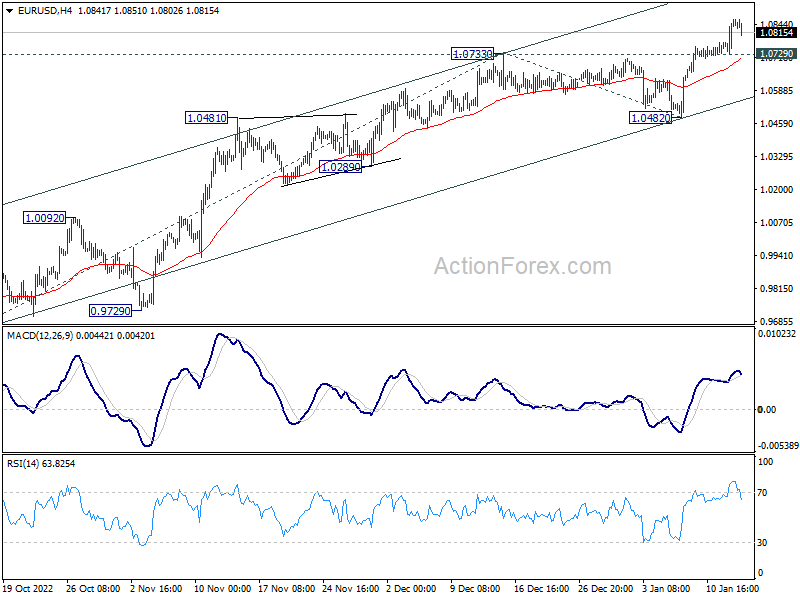
EUR/USD Mid-Day Outlook
Daily Pivots: (S1) 1.0766; (P) 1.0816; (R1) 1.0902; More...
With 1.0729 minor support intact, intraday bias in EUR/USD stays mildly on the upside. Current rise from 0.9534 should target 61.8% projection of 0.9630 to 1.0733 from 1.0482 at 1.1164 next. On the downside, below 1.0729 minor support will turn intraday bias neutral again first. But near term outlook will stay bullish as long as 1.0482 support holds, in case of retreat.
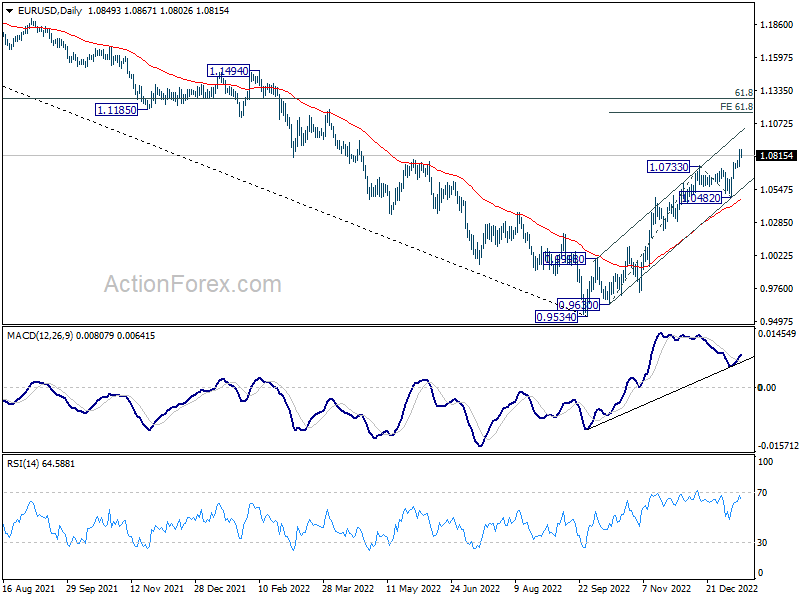
In the bigger picture, current development suggests that the rally from 0.9534 low is a medium term up trend rather than a correction. Further rally is in favor to 61.8% retracement of 1.2348 (2021 high) to 0.9534 at 1.1273 next. This will remain the favored case as long as 1.0482 support holds
Economic Indicators Update
| GMT | Ccy | Events | Actual | Forecast | Previous | Revised |
|---|---|---|---|---|---|---|
| 23:50 | JPY | Money Supply M2+CD Y/Y Dec | 2.90% | 3.30% | 3.10% | |
| 03:20 | CNY | Trade Balance (USD) Dec | 78.0B | 77.9B | 69.8B | |
| 03:20 | CNY | Exports (USD) Y/Y Dec | -9.90% | -10% | -8.70% | |
| 03:20 | CNY | Imports (USD) Y/Y Dec | -7.50% | -9.80% | -10.60% | |
| 03:20 | CNY | Trade Balance (CNY) Dec | 550B | 533B | 494B | |
| 03:20 | CNY | Exports (CNY) Y/Y Dec | -0.50% | 0.90% | ||
| 03:20 | CNY | Imports (CNY) Y/Y Dec | 2.20% | -1.10% | ||
| 07:00 | GBP | GDP M/M Nov | 0.10% | -0.30% | 0.50% | |
| 07:00 | GBP | Index of Services 3M/3M Nov | -0.10% | -0.40% | -0.10% | |
| 07:00 | GBP | Manufacturing Production M/M Nov | -0.50% | -0.20% | 0.70% | |
| 07:00 | GBP | Manufacturing Production Y/Y Nov | -5.90% | -5.20% | -4.60% | -5.70% |
| 07:00 | GBP | Industrial Production M/M Nov | -0.20% | -0.10% | 0.00% | -0.10% |
| 07:00 | GBP | Industrial Production Y/Y Nov | -5.10% | -2.80% | -2.40% | -4.70% |
| 07:00 | GBP | Goods Trade Balance (GBP) Nov | -15.6B | -14.9B | -14.5B | -12.3B |
| 09:00 | EUR | Italy Industrial Output M/M Nov | -0.30% | 0.40% | -1.00% | |
| 10:00 | EUR | Eurozone Trade Balance (EUR) Nov | -15.2B | -20.0B | -28.3B | -28.1B |
| 10:00 | EUR | Eurozone Industrial Production M/M Nov | 1.00% | 0.60% | -2.00% | -1.90% |
| 12:00 | GBP | NIESR GDP Estimate (3M) Dec | 0.10% | -0.30% | ||
| 13:30 | USD | Import Price Index M/M Dec | 0.40% | -0.90% | -0.60% | |
| 15:00 | USD | Michigan Consumer Sentiment Index Jan P | 61.6 | 59.7 |
EUR/USD Mid-Day Outlook
Daily Pivots: (S1) 1.0766; (P) 1.0816; (R1) 1.0902; More...
With 1.0729 minor support intact, intraday bias in EUR/USD stays mildly on the upside. Current rise from 0.9534 should target 61.8% projection of 0.9630 to 1.0733 from 1.0482 at 1.1164 next. On the downside, below 1.0729 minor support will turn intraday bias neutral again first. But near term outlook will stay bullish as long as 1.0482 support holds, in case of retreat.
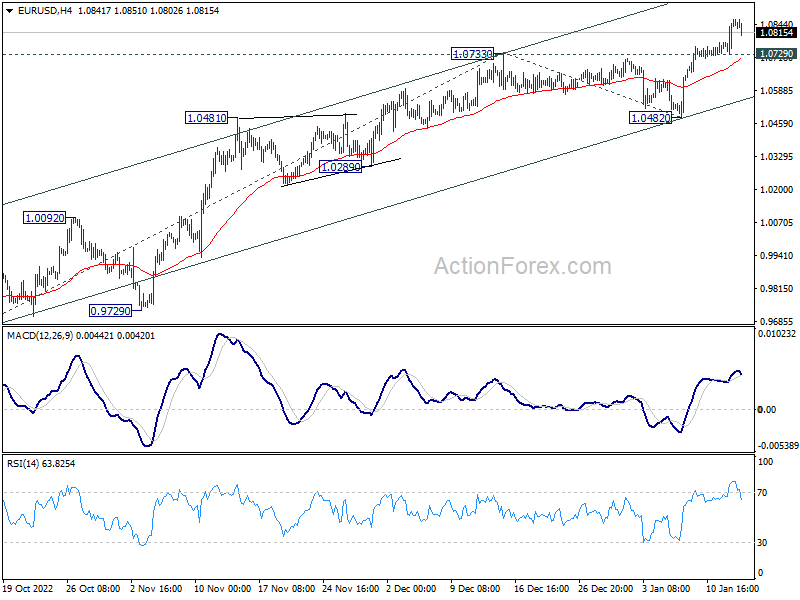
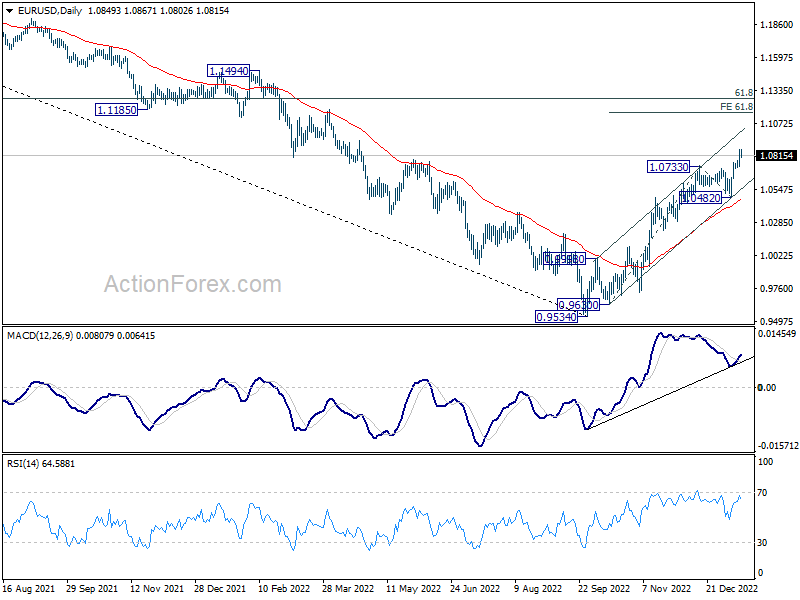
In the bigger picture, current development suggests that the rally from 0.9534 low is a medium term up trend rather than a correction. Further rally is in favor to 61.8% retracement of 1.2348 (2021 high) to 0.9534 at 1.1273 next. This will remain the favored case as long as 1.0482 support holds.
GBP/USD Mid-Day Outlook
Daily Pivots: (S1) 1.2119; (P) 1.2183; (R1) 1.2277; More...
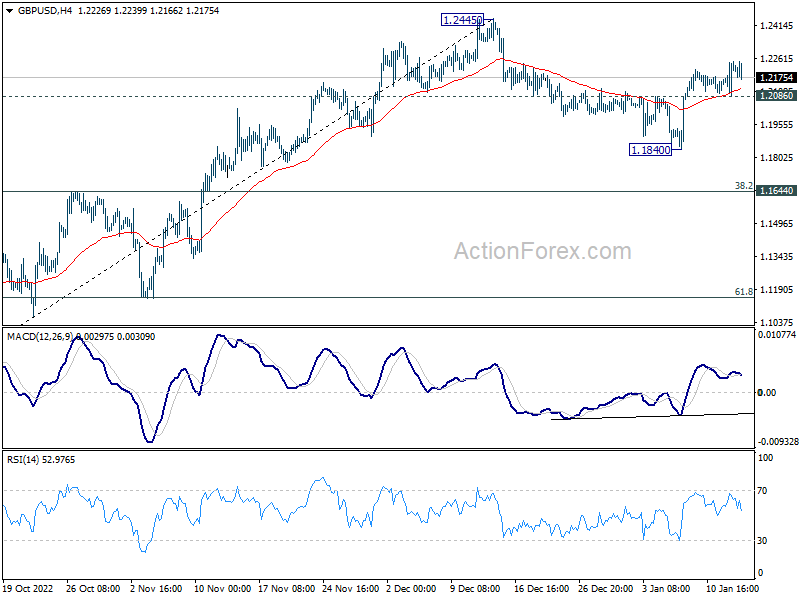
Intraday bias in GBP/USD stays mildly on the upside with 1.2086 minor support intact. Current rise from 1.1840 would target a test on 1.2445 high. Decisive break there will resume whole rally from 1.0351 to 1.2759 fibonacci level. On the downside, break of 1.2086 minor support will turn intraday bias neutral first. Further break of 1.1840 will resume the correction from 1.2445 to 38.2% retracement of 1.0351 to 1.2445 at 1.1645.
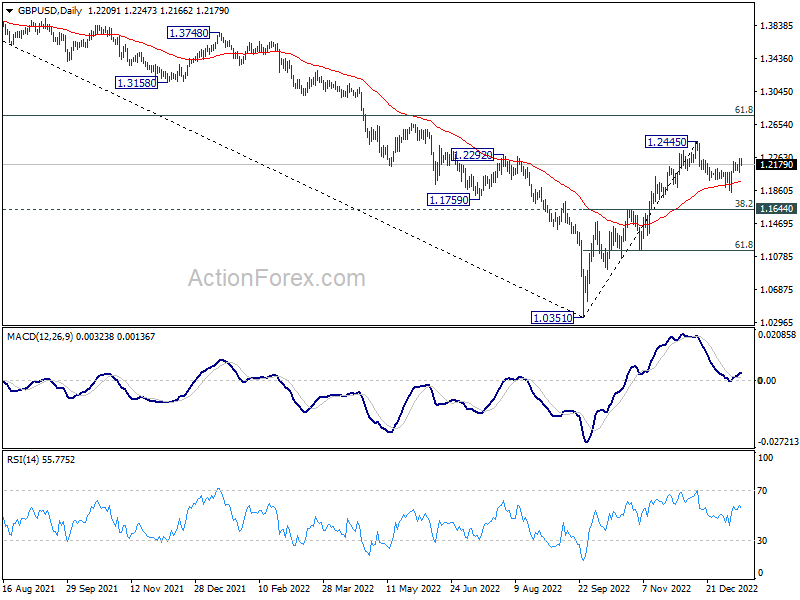
In the bigger picture, rise from 1.0351 medium term bottom is at least correcting whole down trend from 1.4248 (2021 high). Further rise is expected as long as 1.1644 resistance turned support holds. Next target is 61.8% retracement of 1.4248 to 1.0351 at 1.2759. Sustained break there will pave the way back to 1.4248.
USD/CHF Mid-Day Outlook
Daily Pivots: (S1) 0.9239; (P) 0.9300; (R1) 0.9333; More...
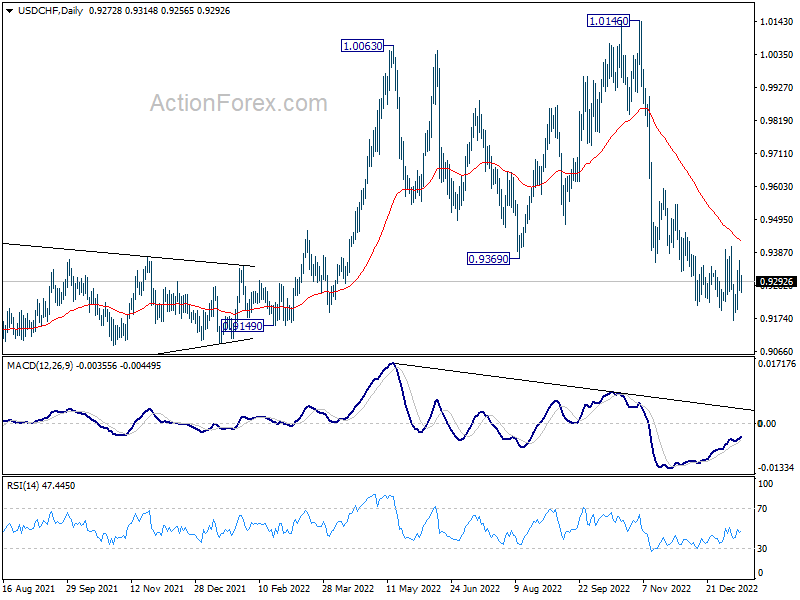
USD/CHF continues to trade sideway in established range and intraday bias remains neutral. Further decline is still in favor as long as 0.9407 resistance holds. Break of 0.9165 will resume whole fall from 1.0146. However, firm break of 0.9407 will turn bias back to the upside for strong rebound.
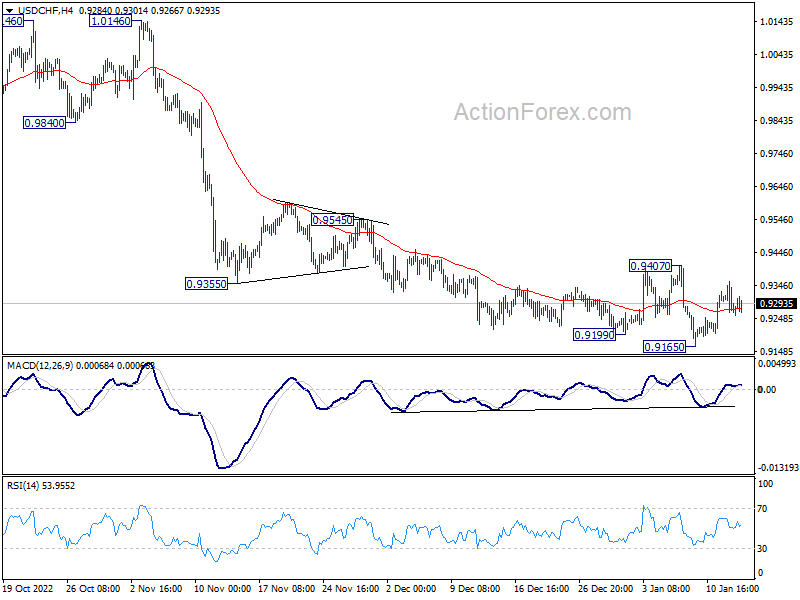
In the bigger picture, rise from 0.8756 (2021 low) has completed at 1.0146, well ahead of 1.0342 long term resistance (2016 high). Based on current downside momentum, fall from 1.0146 should be a medium term down trend itself. Next target is a test on 0.8756 low. Strong support should be seen there to bring rebound. Still, further decline will now be expected as long as 0.9407 resistance holds, in any case.
USD/JPY Mid-Day Outlook
Daily Pivots: (S1) 127.96; (P) 130.24; (R1) 131.60; More...
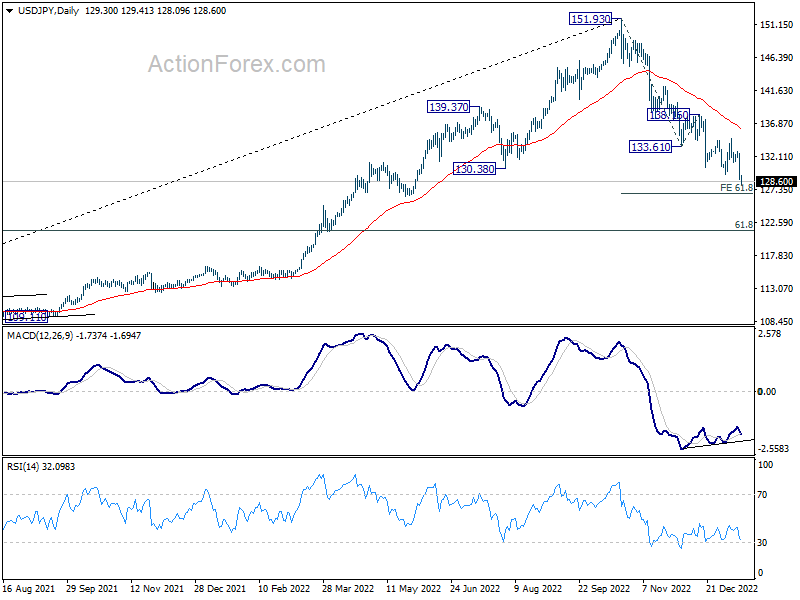
Intraday bias in USD/JPY remains on the downside for the moment. Current decline from 151.93 should target 61.8% projection of 151.93 to 133.61 from 138.16 at 126.83 next. On the upside, above 131.29 minor resistance will turn intraday bias neutral first. But outlook will remain bearish as long as 134.76 resistance holds, in case of recovery.
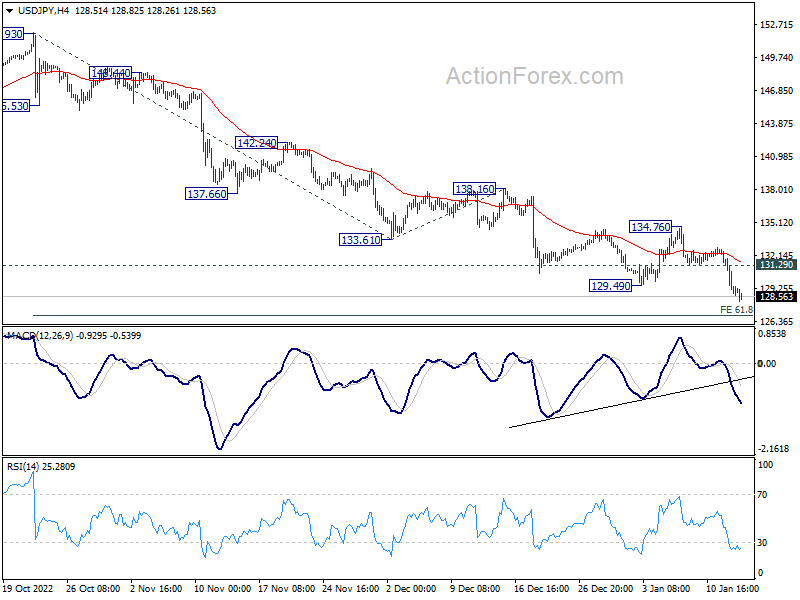
In the bigger picture, a medium term top was in place at 151.93. Sustained trading below 55 week EMA (now at 131.73) would raise the chance of bearish trend reversal. Deeper fall would be seen to 61.8% retracement of 102.58 to 151.93 at 121.43. This will now remain the favored case as long as 55 day EMA (now at 136.06) holds.
WTI Oil Futures Retest 50-day SMA
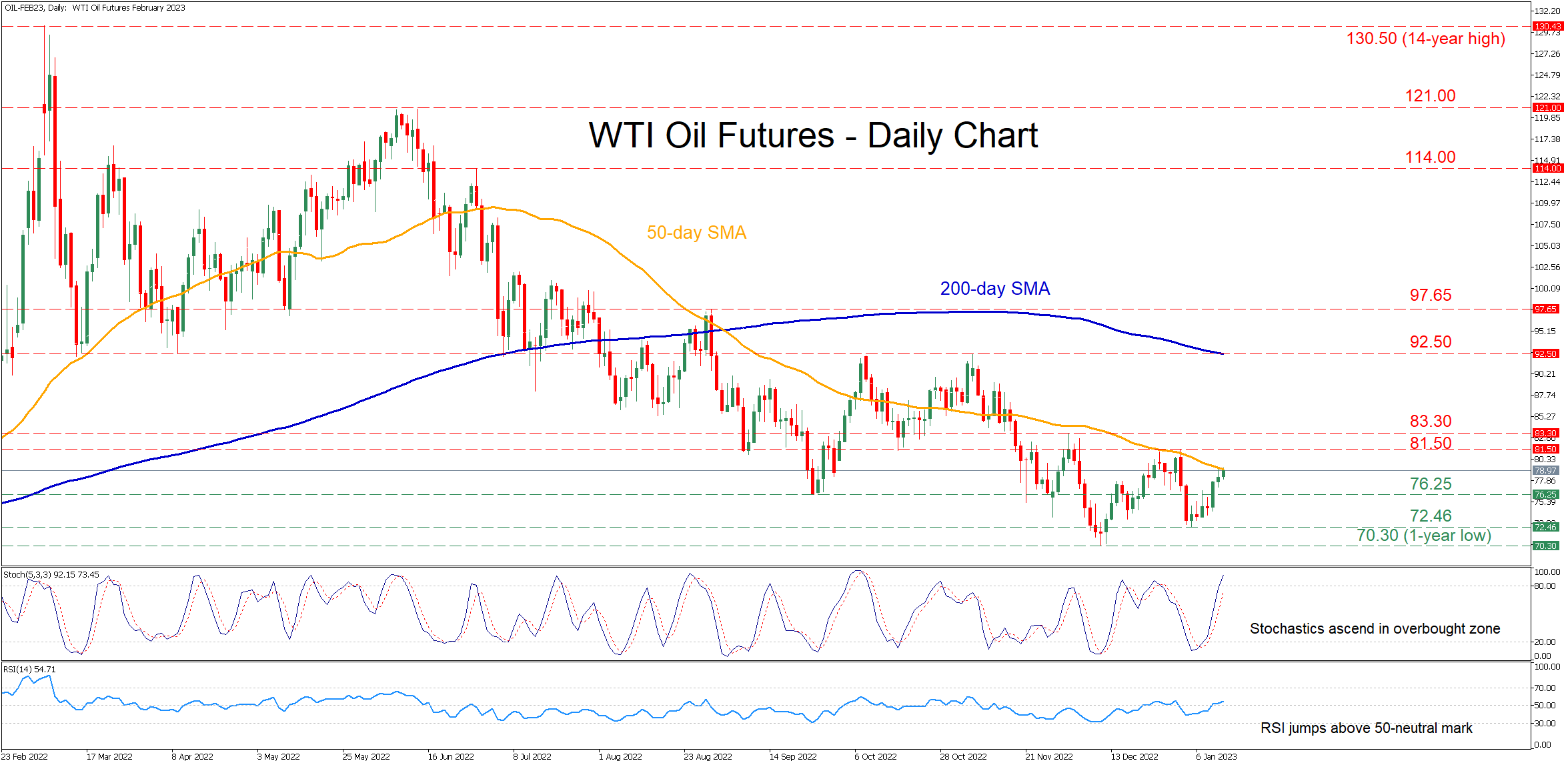
WTI oil futures (February delivery) have been trending downwards since June but managed to regain some ground after finding their feet at the one-year low of 70.30. In the near term, the price is challenging the 50-day simple moving average (SMA), which has repeatedly rejected the commodity’s rebound.
The momentum indicators currently suggest that bullish forces are strengthening. Specifically, the stochastic oscillator is ascending in the overbought zone, while the RSI has crossed above its 50-neutral mark.
If buyers manage to push the price above the 50-day SMA, the recent resistance region of 81.50 could reject further advances. Breaking above that zone, the price may challenge the 83.30 hurdle. Conquering this barricade, the bulls might aim for the November high of 92.50, which overlaps with the 200-day SMA.
On the flipside, if the positive momentum wanes and the price reverses lower, the September bottom of 76.25 could act as the first line of defense. Diving beneath that region, the recent support of 72.46 may come under examination. A break below that zone could set the stage for the one-year low of 70.30.
In brief, WTI oil futures seem to be attempting a recovery but the 50-day SMA continues to act as a solid ceiling. Hence, a break above the latter could spark a rally to the upside.
NIESR expects 0.1% UK GDP growth in Q4, Q1 risk on the downside
After today's UK GDP release, NIESR forecasts that GDP in December will fall relative to November. But overall, service-driven GDP growth of 0.1% in Q4 is estimated.
Paula Bejarano Carbo, Associate Economist, NIESR, said: "Given that PMIs for services, manufacturing and construction all posted below the neutral 50 for December, we expect to see a slight fall in GDP in December relative to November; but this means a rise in quarterly GDP, possibly a sign that households are enjoying a last hurrah before they tighten their belts in 2023.
" Looking towards the first quarter of 2023, the risks to GDP seem to remain on the downside, driven by anaemic growth in the major sectors, fragile consumer and business confidence and a widespread fall in real incomes."
Earnings to Spoil the Party?
It's been another lively week in financial markets and one in which investors have become increasingly hopeful that 2023 won't be as bad as feared.
In a way, the week started with the jobs report the Friday before as it was this that enabled the enthusiasm to build. The labour market has been a major barrier to optimism as the Fed was never going to pivot quickly unless there were signs in the labour market that slack was building and wages cooling. We're now starting to see that.
That optimism has been compounded by the first monthly inflation decline in two and a half years and further sharp annual declines in both the headline and core readings. While the final hurdle to 2% may be the most challenging, there's no doubt we're heading in the right direction and the threat of entrenched inflation has greatly receded.
Now it's over to corporate America to potentially spoil the party as the enthusiasm on inflation is not yet matched to the economic outlook. We haven't seen mass layoffs yet but a number of firms, starting in the tech space but spreading further, have warned of large redundancies in the coming months. The fourth quarter earnings season may bring investors back down to earth with a bang. The start of the year has been fantastic but the rest of it will stilll be very challenging.
More bleak Chinese trade data
That's very evident in the Chinese trade data, as it has in the data of other major trading nations in recent months. Imports and exports both slumped again, albeit to a slightly lesser degree than expected. The drop in imports reflects the Covid adjustment which is likely weighing on demand and the local economy. Exports is a global issue, with those to the US and EU sliding the most, reflecting the challenging economic environment. That may not improve in the near term but there will be a hope that it could in the second half of the year.
Can UK avoid recession?
The optimists may put to some of the recent data as an indication of some resilience in the economy but I'm not convinced. Take the UK, for example. It may not be in a technical recession afterall, with spending around the World Cup enabling a better performance in November, delivering growth of 0.1% after a 0.5% gain in October. Aside from the fact that December could be worse as a result, or some of those gains could be revised out, those numbers don't change the reality of the cost-of-living crisis and if accurate, it more likely reflects shifted spending patterns as opposed to a more willing consumer. A recession may be delayed but the economy is still under immense strain.
The end of the tightening cycle
The Bank of Korea may be among the first central banks to bring its tightening cycle to an end, after raising the Base Rate by 25 basis points before removing reference to the need to hike further. This was replaced with a commitment to judge whether rates will need to raise rates depending on multiple factors including incoming data. I think most others won't be far behind, with in most cases the end coming at some point in the first quarter. All we have to contend with then is the economic consequences of the tightening.
BoJ under pressure to abandon YCC
And then there's the anomoly out there. I'm not talking about the CBRT which I just can't take seriously and that's saying something at the moment. The Bank of Japan shocked the markets in December by widening its yield curve control buffer around 0% and it's been paying the price ever since. Another unscheduled bond buying overnight occurred on the back of the 10-year JGB breaching 0.5%, as investors bail on Japanese debt on the belief that the YCC tool is being phased out and will be abandoned altogether before long. This makes the meeting next week all the more interesting.
Will economic optimism be spoiled?
Oil prices are on the rise again on Friday, buoyed by renewed optimism on interest rates. The fact remains that the first half of the year, at least, will be enormously challenging for the global economy but lower terminal rates and even cuts later in the year will cushion the blow and could see it outpeform current expectations. That, along with the resurgence in China, will be a big plus for crude demand and could keep the price well supported.
Of course, it now has to contend with what Wall Street has to throw its way in the coming weeks. That will likely include weak earnings, bleak forecasts and potentially job loss announcements. Maybe we'll all feel a little less hopeful if that materialises as feared which could weigh a little on oil after the recent surge.
Record highs in sight?
Gold is continuing its powerful start to the year with another small gain on Friday, breaching $1,900 in the process. It's now right in the middle of the $1,880-$1,920 range that has been so pivotal in recent years. That could see it run into strong resistance in the coming sessions, although as yet momentum is only improving. That will give gold bulls comfort and should it hold long enough to breach the upper end of that range, it could be a very positive signal. Suddenly $2,000, even record highs, could be in sight.
Revival underway?
The risk rally over the last week has even lifted bitcoin out of its pit of despair. It goes without saying that it's been a tough few months for cryptos but the lack of recent contagion in the space, or new revelations, and the risk rebound in broader markets has lifted it off its lows to trade at its highest level since the FTX scandle erupted. It's trading at $19,000 and traders may harbour some hope of a move back above $20,000, a level once deemed a disturbing low but now potentially representing a sign of a revival.