

Sample Category Title
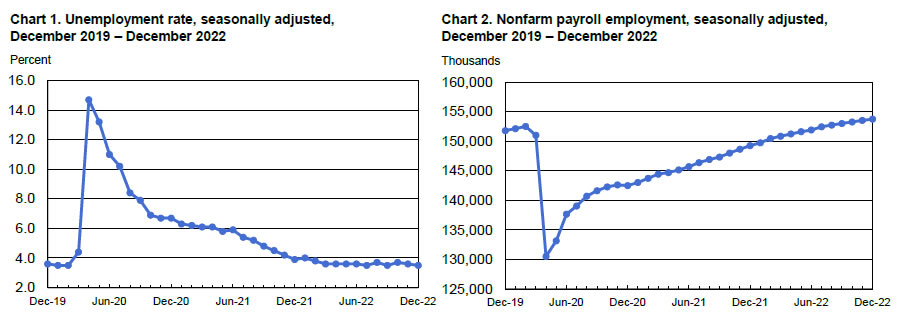
US NFP jobs grew 223k in Dec, unemployment rate down to 3.5%
US non-farm payroll employment increased 223k in December, above expectation of 200k. Payroll employment rose by 4.5m in 2022 (an average monthly gain of 375kj, less than the increase of 6.7m in 2021 (an average monthly gain of 562k).
Unemployment rate dropped to 3.5%, better than expectation of 3.7%. Participation rate ticked up from 62.2% to 62.3%.
Average hourly earnings rose 0.3% mom, below expectation of 0.4% mom. Over the past 12 months, average hourly earnings rose 4.6% yoy.
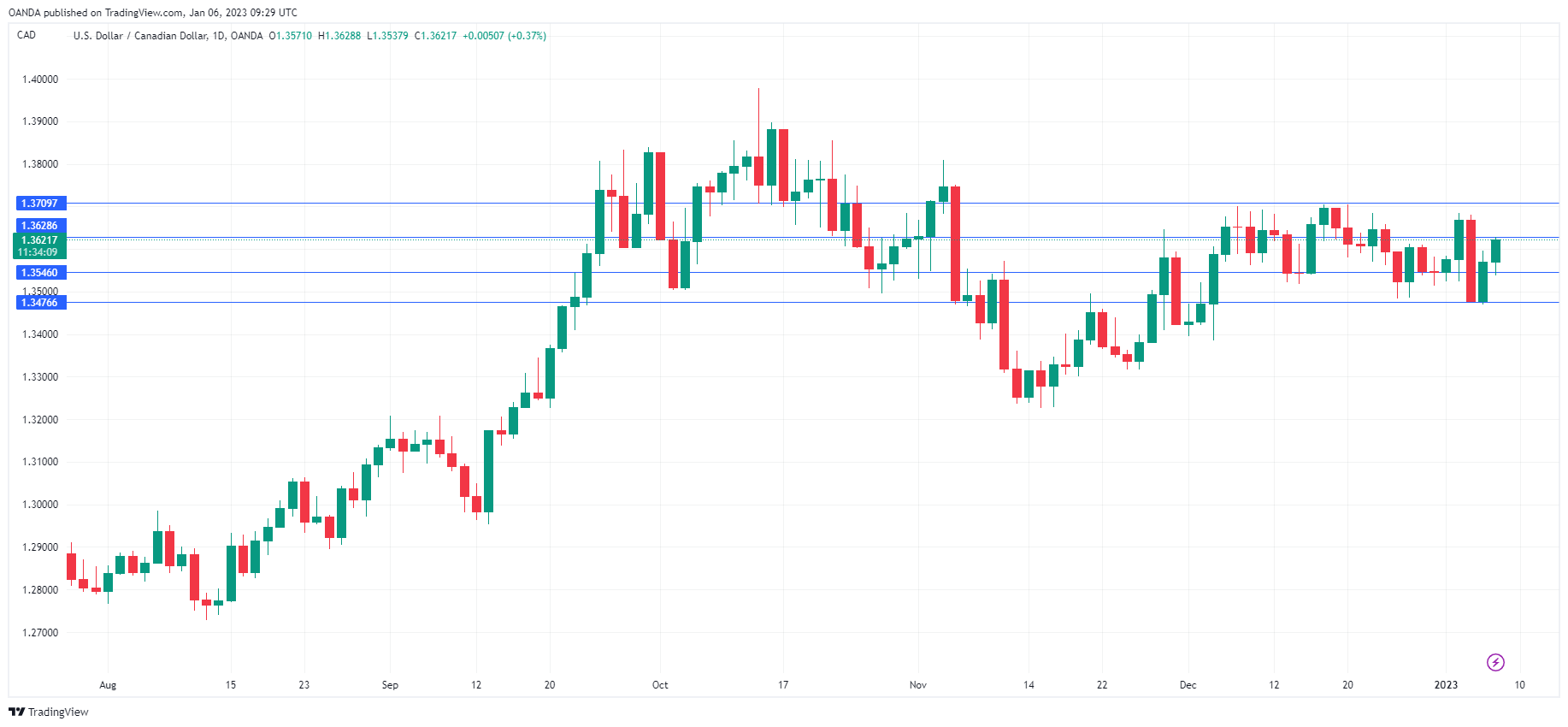
USD/CAD Eyes Canada, US Job Reports
The Canadian dollar has edged lower on Friday. In the European session, USD/CAD is trading at 1.3620, up 0.36%. The first week of the new year has been busy. The Canadian dollar sparkled on Wednesday and climbed 1.4%, but has since pared most of those gains.
Canada and the US will wrap up the week with the December employment reports, which could mean some volatility in the North American session. Canada’s job creation in recent months has not impressed, with the exception of a massive gain of 108,300 in October. This was followed by a marginal gain of 10,100 in November, and December is expected to be even smaller, with an estimate of 8,000. The unemployment rate is forecast to inch higher to 5.2%, up from 5.1%. Canada also releases Ivey PMI, which has been stagnant over the past two months, just above the 50.0 threshold which separates contraction from expansion. The PMI is projected to drop to 51.0 for December, down from 51.4 in November.
In the US, the focus will be on nonfarm payrolls and wage growth. Unemployment claims and other employment indicators show that the labour market remains resilient and there is a strong demand for workers despite a slowing economy. The ADP employment report, although not considered a reliable precursor to NFP, jumped to 235,000 in December, crushing the previous reading of 127,000 and the estimate of 150,000. The markets expect NFP to move in the opposite direction, with an estimate of 200,000, down from 263,000 in November.
A soft NFP release would be an indication that the labour market may finally be weakening. For the Fed, this would be good news, as it believes that the labor market must soften in order for inflation to fall. For the markets, always hoping for a dovish pivot, a weak NFP would likely raise speculation that the Fed may be close to winding up its current tightening cycle, and this could translate into the US dollar losing ground.
USD/CAD Technical
- USD/CAD is putting pressure on resistance at 1.3628. Above, there is resistance at 1.3709
- There is support at 1.3546 and 1.3476
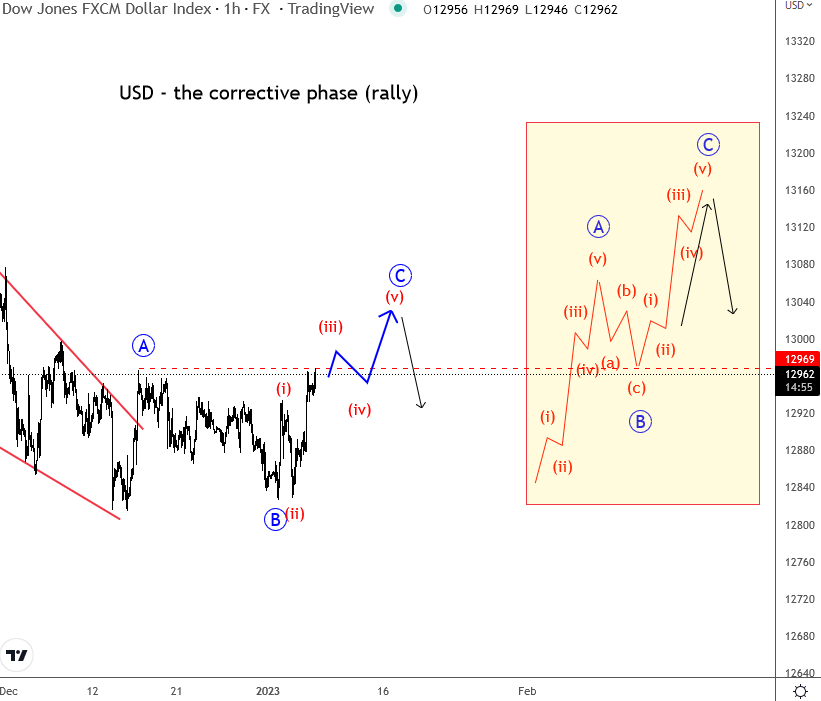
USD in the Corrective Phase
Markets are slow as we are waiting for important jobs data from the US. The expectations are fewer jobs than reported last month, so it should be interesting to see if jobs are coming down, which has been expected for a while now due to higher rates. Expectations are 200k, well below that number will likely suggest that there will be fewer rate hikes going forward due to recession risk, and this can bring the USD lower. An outcome above 200k, especially around 250k or 300k would likely suggest that rates will stay stable or that FED have some room for more hikes which can give some support to the buck. Technically speaking we see USD (equal w.) now finally breaking higher into wave C about what we talked for the last few weeks. However, this C wave is a final leg of a higher-degree rally, so the upside can be limited sometime this month. We see plenty of xxx/USD pairs in an Elliott Wave corrective set-back, so we think that majors will recover at some point, but lower supports can be retested first.
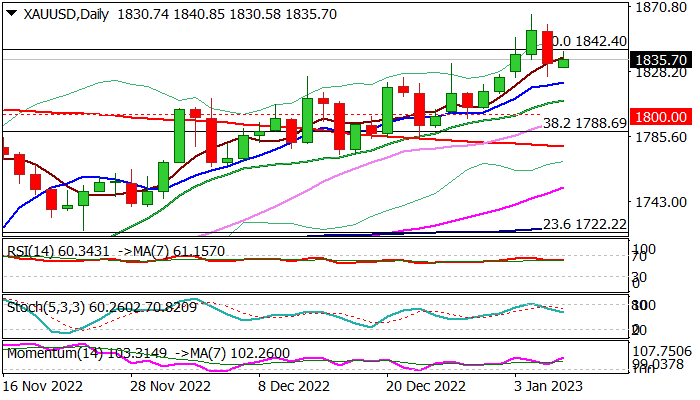
XAU/USD: Gold May Come Under Increased Pressure on Better than Expected US NFP Data
Gold price is slightly higher in early Friday after 1.2% drop previous day, with limited range as traders await release of US labor data.
Gold price pulled back from $1865 (Jan 4 peak, the highest in nearly seven months) after surprise US data (private sector hiring rose well above expectations and weekly jobless claims fell to a multi-month low) signaled that Fed would stay on tightening path longer than expected that lifted dollar.
Investors look for further signals from US Dec labor data, which could further lift the greenback and increase pressure on metal, on release above expectations.
An array of daily moving averages and psychological $1800 level offer supports at $1821/$1796 zone, with break lower to weaken near-term structure and risk deeper drop.
Bullish scenario, on the other hand, sees minimum requirement on weekly close above cracked Fibo barrier at $1842 (50% retracement of $2070/$1614) that would improve the tone and shift focus towards targets at $1896/$1900 (Fibo 61.8% / psychological).
Res: 1842; 1865; 1879; 1896.
Sup: 1821; 1809; 1800; 1779.
WTI Oil: Renewed China Optimism Keeps Oil Price Afloat, But Downside Remains at Risk
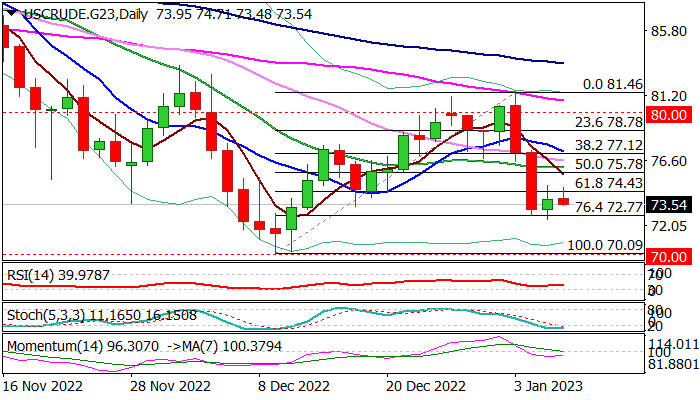
The WTI oil remains slightly bullishly aligned on Friday morning, following bounce on Thursday.
Oil price regained traction after a sharp fall this week, as fresh signals on renewed hopes that China’s demand may rise and lower US inventories improved sentiment, though more evidence is still needed to signal reversal. Fresh support may also emerge from profit-taking, after sharp fall on Tue/Wed, with oversold daily studies supporting the notion.
Fresh recovery is still facing headwinds at initial Fibo resistance at $74.57 (23.6% of $81.49/$72.44) and keeping away pivotal barrier at $75.89 (Fibo 38.2%), break of which is needed to firm the structure and signal further retracement of $81.46/$/$72.44. bear-leg.
On the other hand, dollar has received fresh support from surprise US data on Thursday, with better than expected US NFP numbers today, to add to support and increase pressure on oil price.
The WTI contract is on track for a weekly fall of over 8% that signals increased downside risk, as weekly studies are overall bearish.
Res: 74.57; 75.89; 76.17; 77.12.
Sup: 72.77; 72.44; 70.23; 70.00.
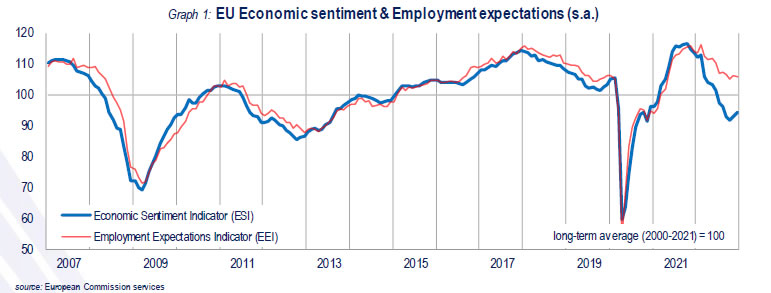
Eurozone economic sentiment indicator rose to 95.8 in Dec
Eurozone Economic Sentiment Indicator rose from 94.0 to 95.8 in December. Industry confidence rose from -1.9 to -1.5. Services confidence rose from 3.1 to 6.3. Consumer confidence rose from -23.9 to -22.2. Retail trade confidence rose from -6.6 to -3.6. Employment Expectations Indicator was unchanged at 107.3. E Economic Uncertainty Indicator dropped from 28.5 to 27.5.
EU Economic Sentiment Indicator rose from 92.7 to 94.2. Employment Expectations Indicator dropped from 106.3 to 105.9. Economic Uncertainty Indicator dropped from 27.9 to 26.9. Amongst the largest EU economies, the ESI increased in Germany (+2.0), Spain (+1.9), the Netherlands (+1.5), Italy and Poland (both +0.9), while it eased again in France (-1.3).
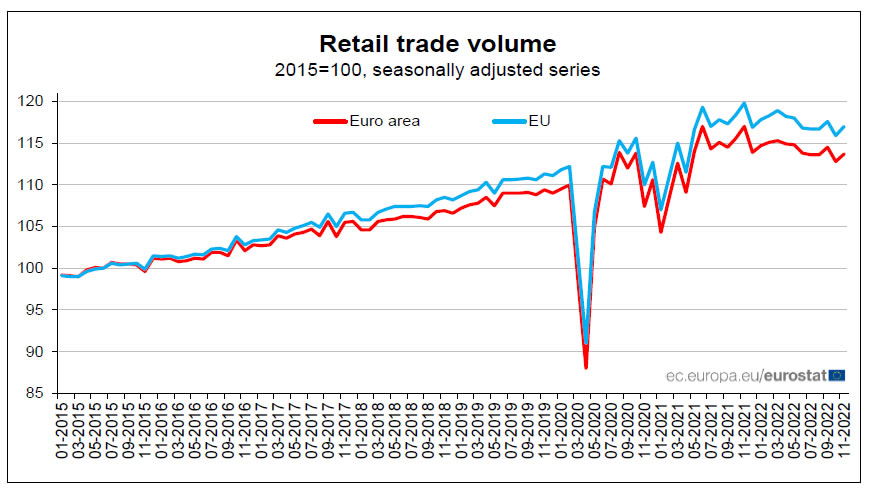
Eurozone retail sales volume rose 0.8% mom in Nov, EU up 0.9% mom
Eurozone retail sales volume rose 0.8% mom in November, above expectation of 0.1% mom. For the month, the volume of retail trade increased by 1.6% for non-food products and by 1.0% for automotive fuels, while it decreased by -0.9% for food, drinks and tobacco.
EU retail sales volume rose 0.9% mom. Among Member States for which data are available, the highest monthly increases in the total retail trade volume were registered in Spain (+3.6%), Poland (+2.6%) and Sweden (+2.3%). The largest decreases were observed in Luxembourg (-2.0%), France and Croatia (both -1.0%) and Slovenia (-0.5%).
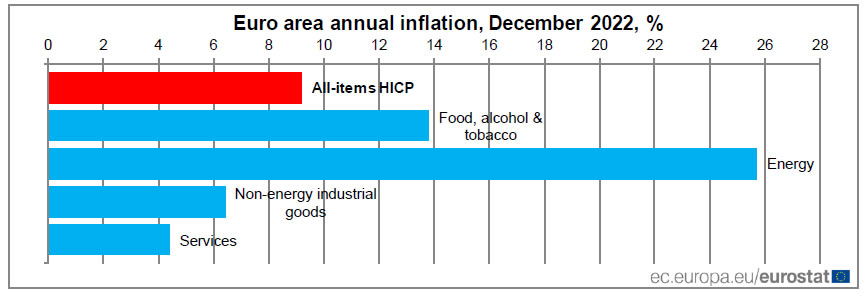
Eurozone CPI slowed to 9.2% yoy in Dec, CPI core rose to 5.2% yoy
Eurozone CPI slowed from 10.1% yoy to 9.2% yoy in December, below expectation of 10.0% yoy. CPI core (excluding energy, food, alcohol & tobacco) rose from 5.0% yoy to 5.2% yoy, above expectation of 5.2% yoy.
Looking at the main components energy is expected to have the highest annual rate in December (25.7%, compared with 34.9% in November), followed by food, alcohol & tobacco (13.8%, compared with 13.6% in November), non-energy industrial goods (6.4%, compared with 6.1% in November) and services (4.4%, compared with 4.2% in November).
EUR/USD: The Downside Remains at Risk Ahead of Key US Labor Data
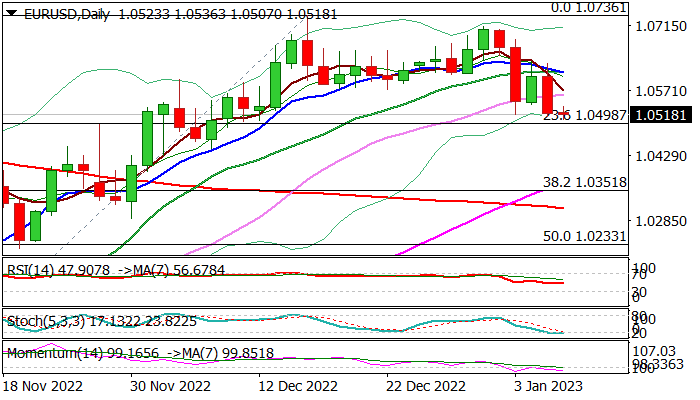
The Euro is holding just above one -month low and trading within a narrow range in early Friday, following Thursday’s 0.8% drop, which further weakened near-term structure.
The single currency was hit by fresh strength of the US dollar, sparked by US data well away from expectations, which signaled that the Fed is likely to stay on tightening path longer than anticipated.
Traders are awaiting release of EU Dec inflation (9.7% f/c vs 10.1% in Nov) and US NFP data (Dec 200K f/c vs Nov 263K).
Stronger than expected CPI numbers would offer support for Euro on renewed expectations that the ECB would keep aggressive stance in policy tightening, while above expectations US labor data would add to improved dollar’s sentiment and increase pressure on Euro.
Daily chart studies show strengthening negative momentum and MA’s (10/20/30) in bearish mode that weighs on near-term structure.
Fresh bears pressure initial Fibo support at 1.0498 (23.6% of 0.9730/1.0736), loss of which would accelerate descend and expose key supports at 1.0351/12/02 (Fibo 38.2% / 200DMA top of rising daily cloud).
Converged 10/20DMA’s (1.0610) are on track to create a bear-cross and mark solid resistance, which should cap and keep bears in play.
Res: 1.0536; 1.0563; 1.0610; 1.0660.
Sup: 1.0498; 1.0443; 1.0351; 1.0312.
A Solid Labour Market Report Should Help Put a Floor for Core (US and European) Bond Yields
Markets
The market focus shifted yesterday from softer than expected EMU inflation (and a broader cooling of inflation expectations) to US (labour market/activity) data. After solid JOLTS job opening published on Wednesday, ADP private job growth (235k from an upwardly revised 182k, vs 150k expected) and US jobless claims (better than expected both for the weekly & continuing series) reinforced the view that a persistently tight labour market is at risk of causing sustained upward wage drift, annex underlying inflation. Fed speakers returned from their New Year holiday break. Ester George again challenged market positioning as she guided Fed rates to stay above 5% well into 2024. Atlanta Fed Chair Bostic repeated there is still much work to do. Yields jumped after the strong labour data but gains partially faded later. US rates finished between 10.4 (2-y) and 0.4 bps (30-y) higher, resuming the inversion dynamics. German yields gained between 7.2 bps (2-y) and 4.1 bps (30-y). ECB’s Villeroy indicated the ECB should complete its hiking cycle by summer and to then hold rates at that level for a longer period of time. Even as the French ECB member repeated that it’s too early to anticipate at what level rates will peak, such an approach might fit with a scenario of the ECB raising rates 50 bps at the two upcoming meetings, to finish the cycle near 3.50%. The ‘end’ of the first 2023 bond market upleg also hurt equities. US indices ceded up to 1.47% (Nasdaq). The EuroStoxx 50 lost 0.36%. Oil (brent $ 78.8/b) and the Dutch gas future (two pointers of receding energy inflation of late) show tentative signs of bottoming. Strong US labour data, higher yields and a receding risk optimism again put the dollar in pole position. The US DXY index jumped from the 104 area to close at 105.04. EUR/USD dropped from 1.06+ levels to close at a 2023 low (1.0522). USD/JPY also extended its rebound (close 133.41 vs sub 130 levels early this week).
Today’s calendar is well filled with the EMU December CPI, EC confidence data, US payrolls and the services ISM. EMU inflation will substantially ease from last month’s 10.1% level, but this shouldn’t come as a surprise after the softer data from EMU members states. We continue to keep a close eye at the core reading which is expected to hold near (or above) 5.0%. For the payrolls, markets expect another 200k+ net job gain. From a monetary policy point of view, wage growth (AHE expected at 0.4% M/M and 5.0% Y/Y) will continue to print at a level that is much too high for the Fed to conclude that inflation will move to target in the foreseeable future. A solid labour market report should help to put a floor for core (US and European) bond yields. It also should facilitate a further comeback of the USD. EUR/USD 1.0452 (23% Retracement from Sept/Dec rise) is first reference on the charts.
New Headlines
Rumours that China was preparing additional support for the vast property sector gained more substance after people familiar with the matter told Bloomberg that the country is planning to relax the so-called “three red lines”. Under that regime, introduced in 2020, developers wanting to refinance needed to meet three key thresholds as the Chinese government sought to deleverage the sector, lower risks in the financial sector and make homes more affordable. Beijing now mulling relaxations to the rules, including easing borrowing caps and push back the grace period for meeting the targets, is seen as a major policy shift. The Chinese yuan rallies this morning from USD/CNY 6.88 to 6.855 currently. The offshore yuan (USD/CNH 6.859) broke below the 200dMA with next resistance kicking in at 6.838 (May USD/CNH interim high).
Nominal Japanese wages grew 0.5% in November, down from 1.4% the previous month, the labor ministry reported. Real wages fell a more-than-expected 3.8% y/y, the most since 2014. The decline was driven by a sharp drop in bonusses though. Basic salaries remained broadly stable. It nevertheless suggests that wage growth has still some ground to cover before the Bank of Japan considers it enough for sustainable (2%) inflation. Its governor, Kuroda, previously indicated that they needed to grew around 3%. This year’s spring wage negotiations are seen as critical for any BoJ policy rate hikes, meaning that changes are likely to happen after Kuroda’s term ends in April. The Japanese yen is under pressure this morning, underperforming G10 peers. USD/JPY advances from 133.41 to 134.12.