

Sample Category Title
US NFP to guide stocks and Dollar
Focuses will once again turn to US non-farm payrolls data today. Markets are expecting 200k job growth in December. Unemployment rate is expected to be unchanged at 3.7%. Average hourly earnings are expected to continue to grow solidly by 0.4% mom.
Looking at some related data, ADP private employment posted strong upside surprise of 235k growth. ISM manufacturing employment rose from 48.4 to 51.4, back in expansion. Four-week moving average of initial jobless claims was down slightly to 214k. Consumer confidence improved notably from 101.4 to 108.3.
Overall, the US job markets should continue to show much resilience despite high inflation and continuous tightening. The point of attention is more likely on wages growth and the implications on inflation ahead, and thus Fed's policy path.
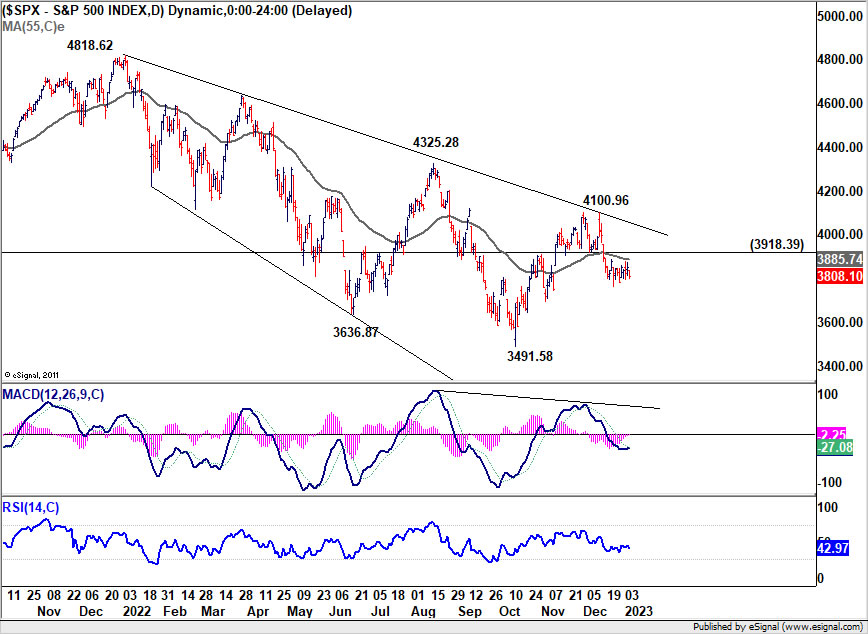
US stocks have been trading in tight range in the past two weeks, rightly so. S&P 500 is capped below flat 55 day EMA, which keeps near term bearish bias. Break of near term support at 3764.49 will resume the decline from 4100.96. More importantly, such development will affirm the case that whole correction from 4818.62 is still in progress for at least another low below 3491.58. Nevertheless, a strong close above 55 day EMA and 3918.39 resistance will instead indicate that rebound from 3491.58 is ready to resume through 4100.96. SPX's reaction to today's NFP data will be a clear indication of underlying risk sentiment, which should then guide the path of Dollar.
Fed Bullard: Policy rate getting closer to sufficiently restrictive zone
St. Louis Fed President James Bullard said yesterday that FOMC aggressive actions in 2022 and planned rate hike in 2023 has "returned inflation expectations to a level consistent with the Fed's 2% inflation target."
"During 2023, actual inflation will likely follow inflation expectations to a lower level as the real economy normalizes," he said.
"The policy rate is not yet in a zone that may be considered sufficiently restrictive, but it is getting closer," he added.
Regarding the economy, Bullard noted, "The probability of a soft landing has increased compared to where it was in the fall of 2022, where it was looking more questionable... And the reason I think that the prospects for a soft landing have increased is that the labor market has not weakened the way many had predicted" and growth levels rebounded from weakness".
ECB Villeroy: Desirable to reach terminal rate by summer, and stay there
ECB Governing Council member Francois Villeroy de Galhau said yesterday, "it would be desirable to reach the right 'terminal rate' by next summer, but it is too early to say at what level."
"We'll then be ready to remain at this terminal rate as long as necessary," Villeroy said. "The sprint of rate increases in 2022 becomes more of a long-distance race, and the duration will count at least as much as the level."
"We need to be pragmatic and guided by observed data, including underlying inflation, without fetishism for increases that are too mechanical," he added.
"Our forecast, and our commitment, is to bring inflation toward 2% between now and the end of 2024 to the end of 2025," Villeroy said.
USD/JPY Faces Uphill Task Near 134.00
Key Highlights
- USD/JPY is attempting a recovery wave above the 131.50 resistance zone.
- A major bearish trend line is forming with resistance near 133.60 on the 4-hours chart.
- Gold remains well supported above the $1,820 pivot zone.
- The US nonfarm payrolls could decline from 263K to 200K in Dec 2022.
USD/JPY Technical Analysis
The US Dollar extended its decline below the 132.00 level against the Japanese Yen. USD/JPY found support near 129.50 and recently started a recovery wave.
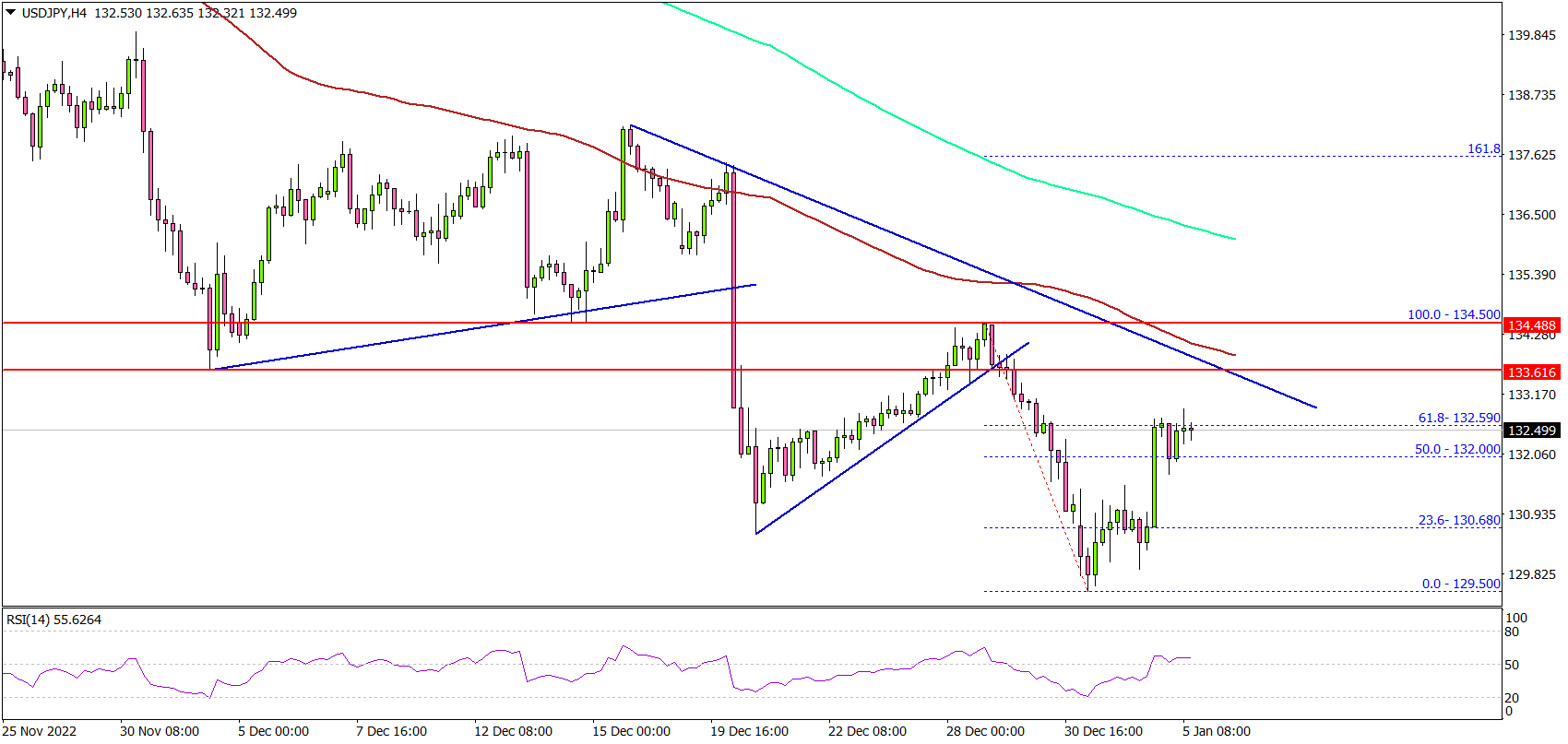
Looking at the 4-hours chart, the pair traded as low as 129.50 and climbed higher. There was a move above the 130.00 and 130.50 resistance levels. The bulls were able to push the pair above the 50% Fib retracement level from the 134.50 swing high to 129.50 low.
However, the pair is trading below the 100 simple moving average (red, 4-hours) and the 200 simple moving average (green, 4-hours).
On the upside, an initial resistance is near the 133.20 level. There is also a key bearish trend line forming with resistance near 133.50 on the same chart. The next major resistance may perhaps be near 134.00.
A clear move above the 134.00 resistance might start a steady increase. In the stated case, USD/JPY might start a steady increase. In the stated case, the pair could rise towards the 135.00 level.
On the downside, there is a key support at 131.00. The main support is now forming near the 130.00 level. A downside break below the 130.00 zone might push the pair lower. The next major support sits near the 129.50 level. Any more losses might open the doors for a move towards the 128.00 support zone.
Looking at gold price, the bulls are active above the $1,820 and $1,810. Moving ahead, the price might start another increase towards $1,880.
Economic Releases
- Euro Zone CPI for Dec 2022 (YoY) (Prelim) - Forecast +9.7%, versus +10.1% previous.
- Euro Zone CPI for Dec 2022 (MoM) - Forecast +0.8%, versus -0.1% previous.
- US nonfarm payrolls for Dec 2022 – Forecast 200K, versus 263K previous.
- US Unemployment Rate for Dec 2022 - Forecast 6.7%, versus 6.7% previous.
- Canada’s employment Change payrolls for Dec 2022 – Forecast 8K, versus 10.1K previous.
- Canada’s Unemployment Rate for Dec 2022 - Forecast 5.2%, versus 5.1% previous.
AUDCAD Wave Analysis
- AUDCAD reversed from resistance area
- Likely to fall to support level 0.9071
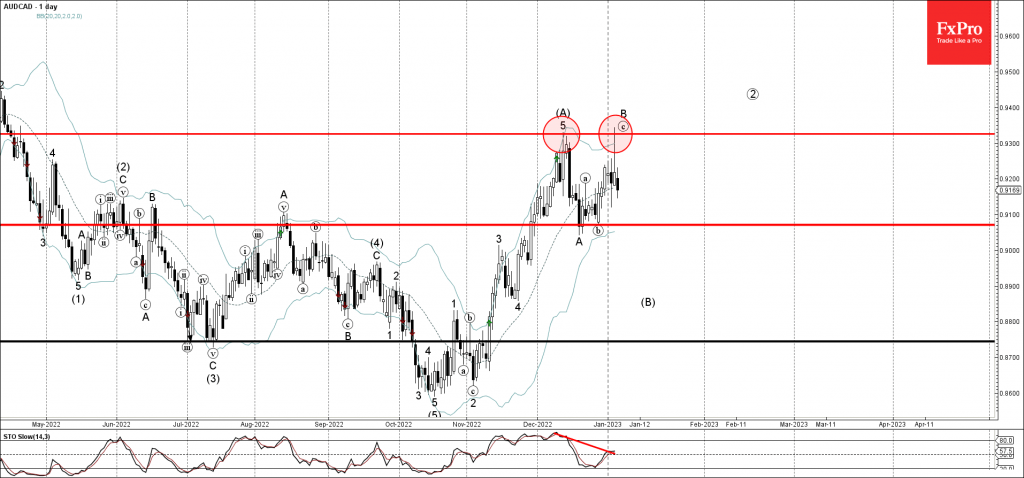
AUDCAD currency pair recently reversed down sharply from the resistance area located between the pivotal resistance level 0.9325 (top of the previous correction (A)) and the upper daily Bollinger Band.
The downward reversal from the resistance level 0.9325 created the daily Japanese candlesticks reversal pattern Shooting Star.
Given the clear bearish divergence on the daily Stochastic indicator, AUDCAD can be expected to fall further toward the next support level 0.9071 (low of the previous corrections A and (b)).
Preliminary Data Sets Up for Another Strong NFP Report
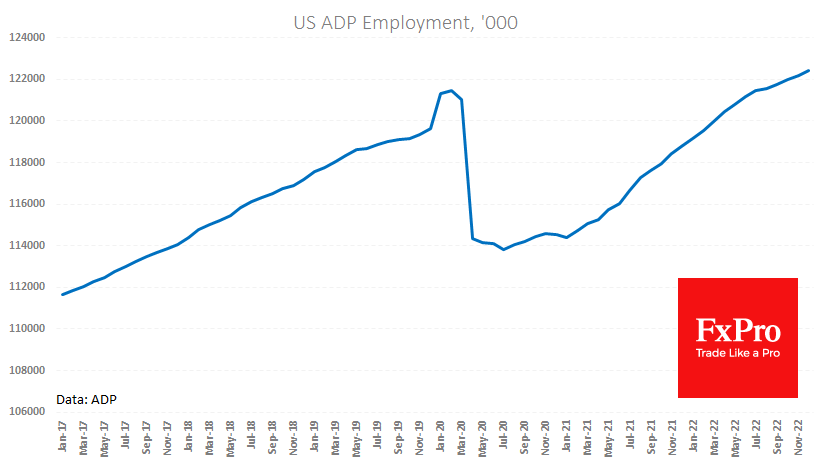
The ADP said the US private sector added 235K jobs in December in a report ahead of tomorrow’s official data release. The market expected an increase of 150k after a rise of 182K a month earlier. The ADP commented on the last report as a turning point, noting a decline of 100k in the manufacturing sector.
This time, observers pointed to a jump in employment in small and medium-sized companies while large companies were downsizing. This is a typical story of small businesses being the first to adapt to changing conditions.
Weekly jobless claims also came as a positive surprise. Initial claims fell to 204k against 223k a week earlier and an expected increase to 230k. The number of repeat claims fell from 1718k to 1694k, stabilising over the past five weeks.
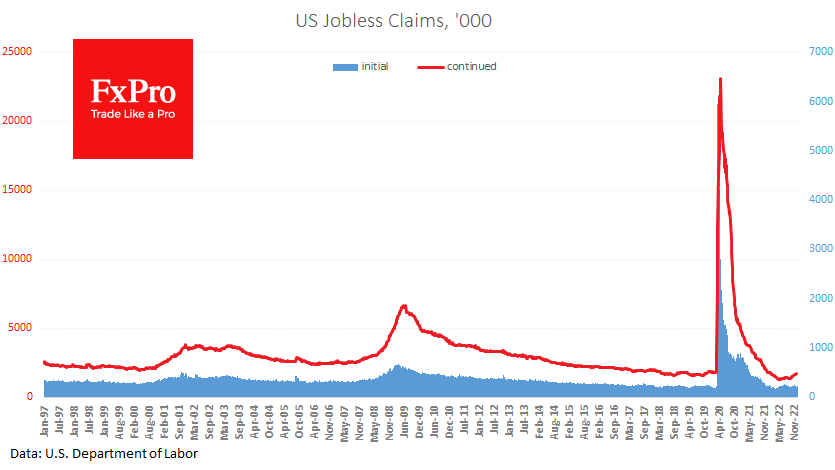
Wednesday’s published job openings data also came in better than expected, showing 10.46 million openings – much better than the 10.0 million expected.
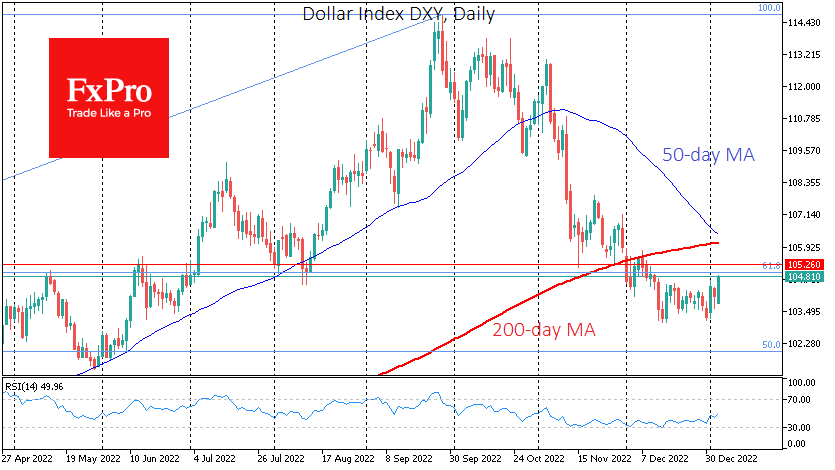
The publication of robust data was further boosted by comments from Esther George, who said she had raised her benchmark rate forecast for this year above 5% and kept it at its peak until at least 2024. The bullish news set the dollar index up 0.75% in a couple of hours and is now trading near 104.80, its highest level since December 12.
The technical picture is beginning to look more and more like the start of a new dollar momentum after the corrective pullback from late September to mid-December.
Dollar Index: Surprise Numbers from US Labor Sector Point to Further Tightening
The dollar index accelerated higher at the start of the US session on Thursday, driven by surprise figures from the US labor sector, after Wednesday’s release of Fed’s minutes had a minor impact on the currency, as US policymakers reacted in line with expectations.
US private payrolls (ADP) rose to 235K in December, well above 150K consensus and November’s 127K, while weekly jobless claims fell to 204K from 223K previous week and 225K forecast, hitting the lowest since the last week of September.
The data signal that US labor market remains strong, boosting worries that the US central bank could continue raising interest rates for a longer than initially estimated that prompts investors back into US dollar.
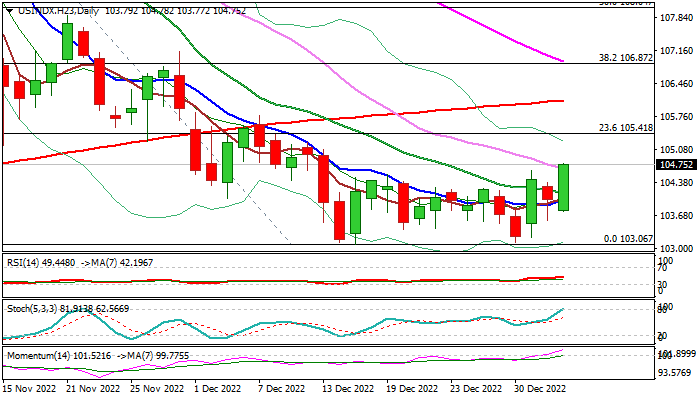
Fresh strength further improves near-term picture, as bullish momentum is rising and 10/20DMA’s turned to bullish setup, though more work at the upside is still needed to signal reversal and confirm a double-bottom at 103.06/12 (Dec 15 and Dec 30 lows respectively).
Lift through 105.41/106.10 (Fibo 23.6% of 113.02/103.06/200DMA) is seen as a minimum requirement for stronger bullish signal that would accelerate recovery towards next trigger at 106.87 (Fibo 38.2% / 30DMA). Markets turn focus towards key event this week – US Dec non-farm payrolls – which are due to be released on Friday.
Economists expect hiring to rise by 200K in December, after 263K increase previous month and any stronger surprise at the upside to provide further boost to the greenback.
Res: 105.21; 105.41; 105.78; 106.10.
Sup: 104.17; 103.77; 103.38; 106.06.
Sunset Market Commentary
Markets
The (mainly) European bond and equity rally from the first three trading sessions of the year today met a roadblock. Italy was the last of the major EMU member states to publish preliminary December inflation data. With HICP inflation at 0.2% M/M and 12.3 Y/Y (from 12.6%) the country parted ways from the unexpected, substantial easing of headline inflation in almost all other EMU members states. Admittedly, this for sure wasn’t the main reason for the bond rally to halt. While European markets were some kind of a trendsetter earlier this week, the focus is gradually returning back to the US. The ADP report on private job growth still surprised on the upside (235k additional employment vs 182k last month and about 150k expected), confirming the Fed’s assessment that a tight labour market and upside wage drift might prevent underlying inflation to continue a sustained trajectory to the 2% target anytime soon. In the same vein, jobless claims (weekly and continuing) also printed lower than expected. US yields already were already a few basis points higher pre-ADP and this trend accelerated after the data. The US curve inversion deepened with yields rising 13 bps for the 2-y to 6 bps for the 30-y. Global sentiment also blocked this week’s strong EMU/German bond rally, with Bund yields adding 8 (2-y) to 5.5 bps (30-y). Intra-EMU spreads widened marginally later in the session, but the move remains modest (10-y Italian spread versus Germany +2 bps). In the meantime, European sovereigns continue their first major tranche of 2023 funding. After Austria (€ 5bln, 10-y) and Slovenia (€ 1.25 bln 10-y) yesterday, Ireland today priced a € 3.5 bln 20-y green bond. Portugal sells € 3 bln of 15-y bonds, both with strong order books. On other markets, the rise in yields also blocked the equity rally from earlier this week. Losses in Europe stay modest (EuroStoxx50 -0.4%). The US again underperforms (S&P 500 -1.2%). In the energy complex the decline in the Dutch reference gas contract halted (TTF Feb future € 67 p/MWh). Oil on the other hand stays in the defensive with Brent ($ 78.25 p/b) holding near recent correction low.
The post-ADP jump in US yields this time almost immediately translated into a stronger dollar. The trade-weighted DXY jumped from the 104.20 area before the data to touch an intra-day top just below 105. EUR/USD leaves the 1.06+ area. At 1.055, first ST support at 1.052 is again withing reach. Similar story for USD/JPY. The era of post-BOJ yen strength is over, with USD/JPY trading at 133.60 compared to a correction low at 129.52 earlier this week. Sterling underperforms both the dollar and the euro with EUR/GBP (0.885) again nearing the key 0.8870 resistance area. According to the BoE’ monthly survey, UK business leaders raised year-ahead expectations for CPI inflation further to 7.4 from 7.2%. Wage expectations rose 0.5% to 6.3%. News Headlines
Saudi Arabia cut oil prices for Asia for all types of crude to be shipped in February. It’s a sign that demand in the country’s main market remains sluggish amid slowing economies and a surge in corona cases in China. State-controlled oil producer Saudi Aramco lowered the price to $1.80 a barrel above the regional benchmark (Dubai crude). That’s $1.45 lower than the price for deliveries this month. Oil prices on broader international markets have been declining dramatically over the past few months. The European Brent reference slid by a third from above $120/b in June to below $80 today despite OPEC’s decision to cut production by 2 million barrels a day in October. Its next regular meeting is scheduled for June.
Polish inflation eased more than expected. Prices rose 0.2% m/m instead of the 0.7% anticipated, bringing the yearly figure down from 17.5% to a still-elevated 16.6% (17.4% expected). It’s the second decline straight, feeding hopes that headline inflation may have peaked in October at 17.9%. The National Bank of Poland, which kept policy rates steady at 6.75% yesterday and is giving a press conference later today, had penciled in an average 17.9% for 2022 Q4 with the peak seen in 2023Q1 at 19.6%. The decline was driven by falling electricity, gas and fuel prices (-3.3% m/m). Food prices still rose by 1.4% m/m. Despite the drop in headline inflation, caution is warranted since core inflation (ex. energy and food) so far hasn’t shown any signs of topping out. The December reading is due January 16. Poland’s currency shrugged. EUR/PLN ekes out a slight gain from 4.667 to 4.675.
Fed Bostic: There is still much work to do
Atlanta Fed President Raphael Bostic inflation is "way too high" in the US and the FOMC remains "determined to use our policy tools to bring inflation back toward our objective."
"I appreciate recent reports that include signs of moderating price pressures, but there is still much work to do," Bostic added. "The most recent report showed the Fed's preferred measure of inflation running at a 5.5% annual rate."