Sample Category Title
Fed George: Interest rate to stay above 5% well into 2024
Kansas City Fed President Esther George said in a CNBC interview that she has raised her forecast on interest rate to over 5%. Also, "I see staying there for some time, again, until we get the signals that inflation is really convincingly starting to fall back toward our 2% goal". Interest rate will stay above 5% well into 2024.
"Where we really see the persistence in that inflation seems to be in the non-housing part of the services side of the economy," George said. "So, I think that's going to be where I'll be watching for the real clues to see whether we are getting traction with our policy in that area."
"I'm not forecasting a recession, but I'm quite realistic that when you see below-trend growth — and the idea that our instrument is going to work on demand, bringing that down — it doesn't leave a lot of margin there," George said. "Not my forecast, but I do understand that bringing demand down creates that sort of possibility."
Oil Started the Year with a Decline
The first two trading sessions of the year have clearly shown that traders are sticking to the bearish patterns formed in the previous six months. Interestingly, oil is not even helped by apparent producer lethargy, which translates into stagnant production and shrinking inventories.
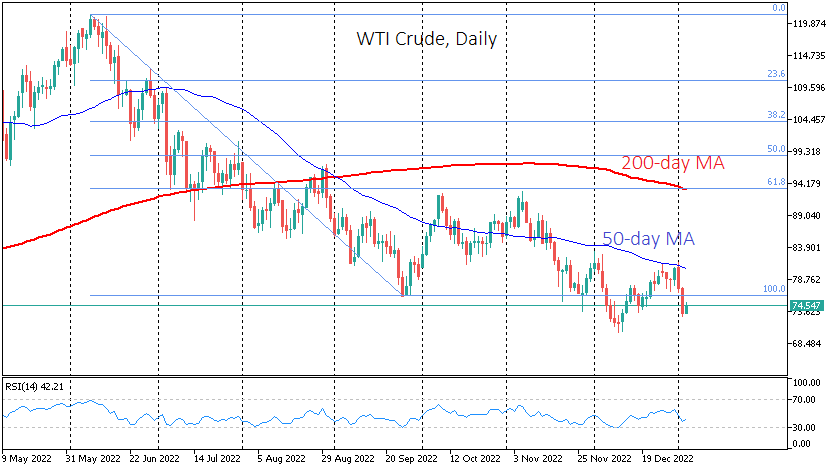
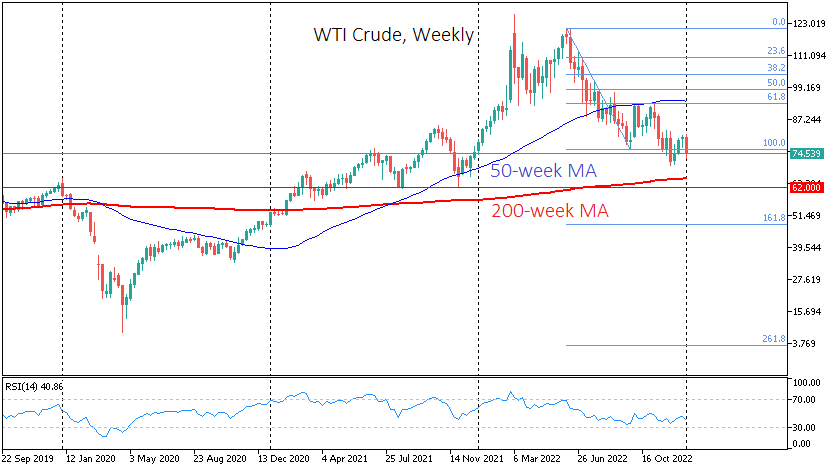
Oil, which had been gaining for the last three weeks of the year, faced intense selling pressure below $80 for a barrel of WTI Crude, near which the 50-day moving average also passed. The sharp, almost 10% decline from that line in two days, as in previous similar episodes last year, sets the stage for a further drop.
A bearish pattern in oil since June persists with a sequence of lower highs and lower lows. This trend will be further confirmed, with WTI falling below $70 as part of the downward momentum that has begun.
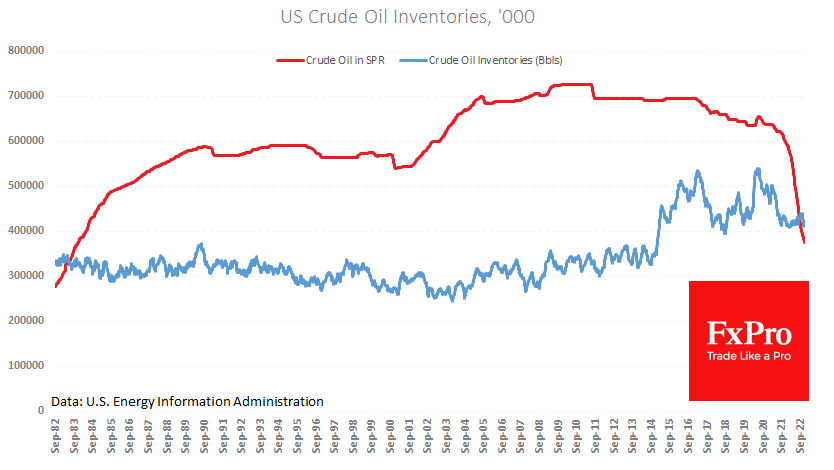
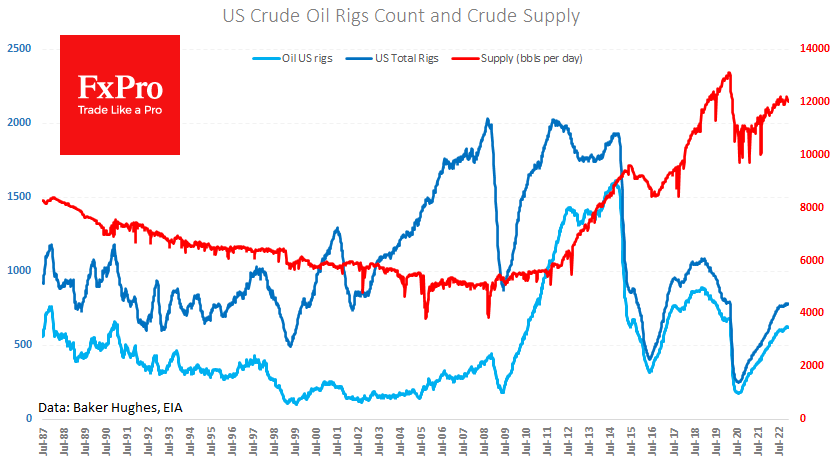
Another batch of weekly inventory data is released today, from which a slight increase in commercial inventories is expected. If we ignore the high-frequency noise of the data, however, what catches the eye is stagnant production, which has been hovering around the 12m BPD level since last May. This is markedly lower than the peak of 13m in March 2020, with employment and GDP levels above pre-pandemic levels.
Producers thus refrain from competing with the state, which continues to sell off reserves at a lower rate.
In the short term, a fall in demand in China, where economic pain from the coronavirus pandemic is intensifying, is in favour of further price reductions. In addition, traders are under pressure from increasing recession risks in a third of the world economy, as predicted by the IMF. Signals that developed countries remain committed to fighting inflation and are willing to sacrifice growth are not helping oil now. Neither are all the new signs that financial institutions continue to tighten the terms of their hydrocarbon loans.
The more than 40% collapse in US gas prices over the past three weeks does not add to the optimism of oil buyers either. The price is now back where it was in January 2022, having put back a market premium due to fears of a supply disruption from Russia to Europe.
Potentially, oil could retreat to the $62-65 area, where it has repeatedly fumbled for support since April 2021. If economic indicators deteriorate further, the price may stop its decline at as low as $50.
Euro Calm as Data Calendar Remains Light
EUR/USD is almost unchanged on Thursday. The economic calendar is light, with no tier-1 events out of the eurozone. The US releases the ADP employment report and unemployment claims, ahead of the jobs report on Friday.
Will eurozone inflation dip?
German inflation fell sharply in December, falling to 9.6% from 11.3% in November. This was a positive way to end what was a rough 2022 – annual inflation hit 7.9%, its highest level since 1951. France and Italy’s inflation levels also fell and investors are hoping for a repeat performance on Friday, when the eurozone releases the December inflation report.
Eurozone CPI is expected to drop to 9.7%, compared to 10.1% in November. A drop into single digits will be welcome, but much of the decline could be a result of energy subsidies in Germany and elsewhere. ECB President Lagarde has noted that headline inflation could rise once the government subsidies come to an end. Core CPI provides a more accurate indication of whether inflation is really falling, and the forecast is for the core rate to remain unchanged at 5.0%. A decline in the CPI reading will create headlines but is unlikely to sway the central bank from raising rates at the February 2nd meeting, likely by 50 basis points. The ECB is committed to curbing inflation and is unlikely to ease up on rate hikes until it is convinced that inflation is on a sustained downturn.
The Federal Reserve minutes reiterated the hawkish message that Jerome Powell had for the markets at the December meeting. FOMC members committed to maintaining a restrictive policy while inflation remained unacceptably high, saying that more evidence was needed to show that inflation was on a “sustained downward path to 2 per cent”. The minutes noted that several members warned against “prematurely loosening monetary policy”.
The Fed has been consistent with its hawkish stance for some time, yet there is still a dissonance between the Fed’s message and market pricing. The minutes noted that no FOMC members expect any rate cuts this year, while the markets have priced in a possible small reduction by the end of 2023 and have forecast a funds rate peak at 4.5%-4.75%. The Fed, on the other hand, expects rates to hit 5% or higher. The Fed is not pleased with this disconnect and the minutes contained a warning to the markets not to underestimate the Fed’s resolve to maintain high rates in order to curb inflation.
EUR/USD Technical
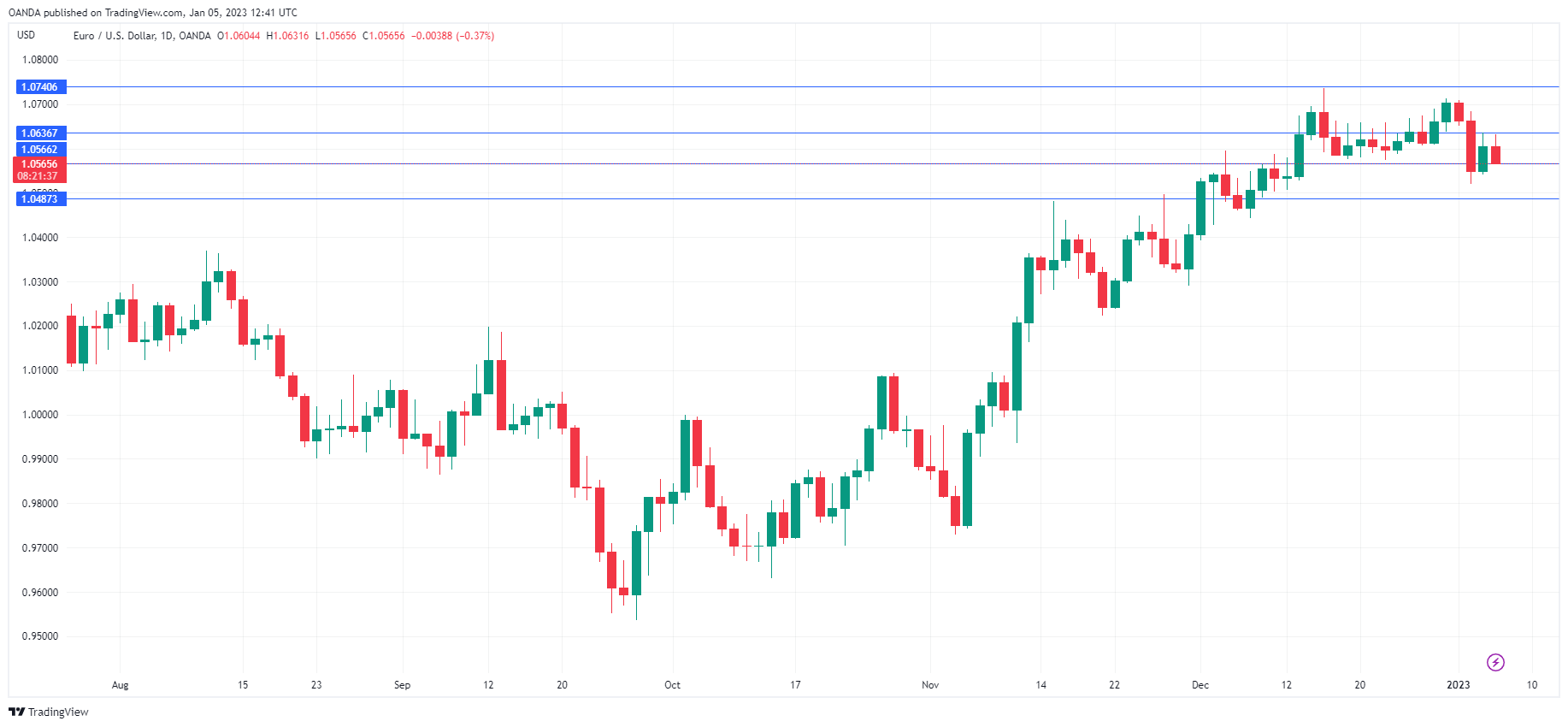
- EUR/USD is putting pressure on support at 1.0566, followed by support at 1.0487
- There is resistance at 1.0636 and 1.0740
EUR/USD Mid-Day Outlook
Daily Pivots: (S1) 1.0552; (P) 1.0593; (R1) 1.0646; More...
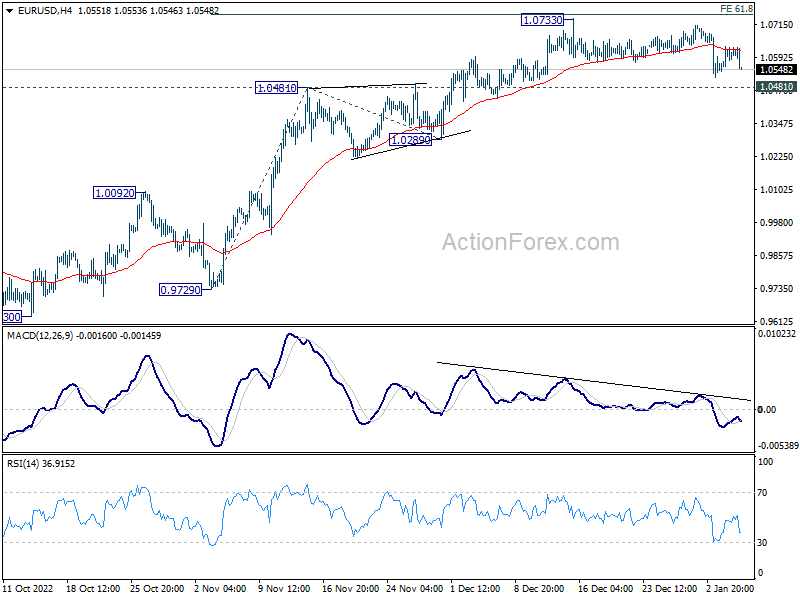
Outlook in EUR/USD remains unchanged and intraday bias stays neutral. On the downside, break of 1.0481 will confirm short term topping, on bearish divergence condition in 4 hour MACD. Deeper fall would be seen back to 1.0289 support and below. On the upside, however, firm break of 61.8% projection of 0.9729 to 1.0481 from 1.0289 at 1.0754 will pave the way to 100% projection at 1.1041.
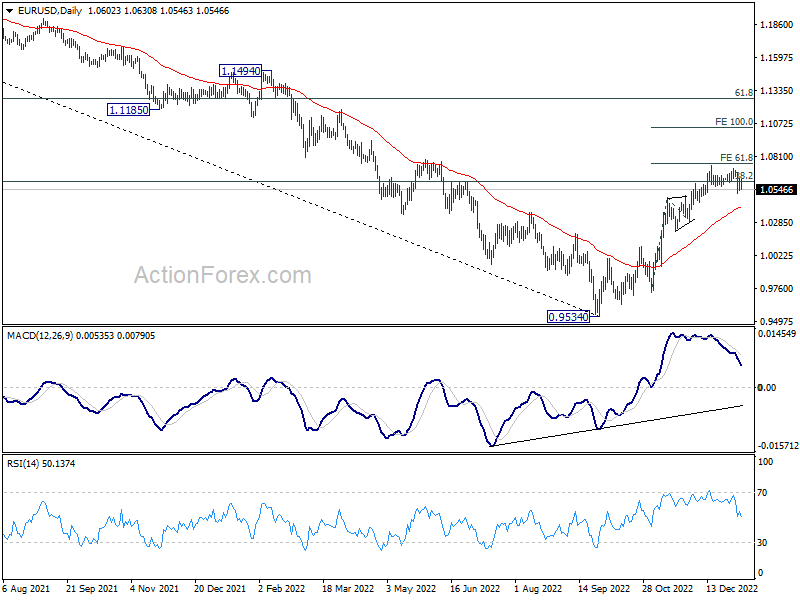
In the bigger picture, focus stays on 38.2% retracement of 1.2348 (2021 high) to 0.9534 at 1.0609. Rejection by 1.0609 will suggest that price actions from 0.9534 medium term bottom are developing into a corrective pattern. Thus, medium bearishness is retained for another fall through 0.9534 at a later stage. However, sustained break of 1.0609 will raise the chance of trend reversal and target 61.8% retracement at 1.1273.
GBP/USD Mid-Day Outlook
Daily Pivots: (S1) 1.1981; (P) 1.2034; (R1) 1.2111; More...
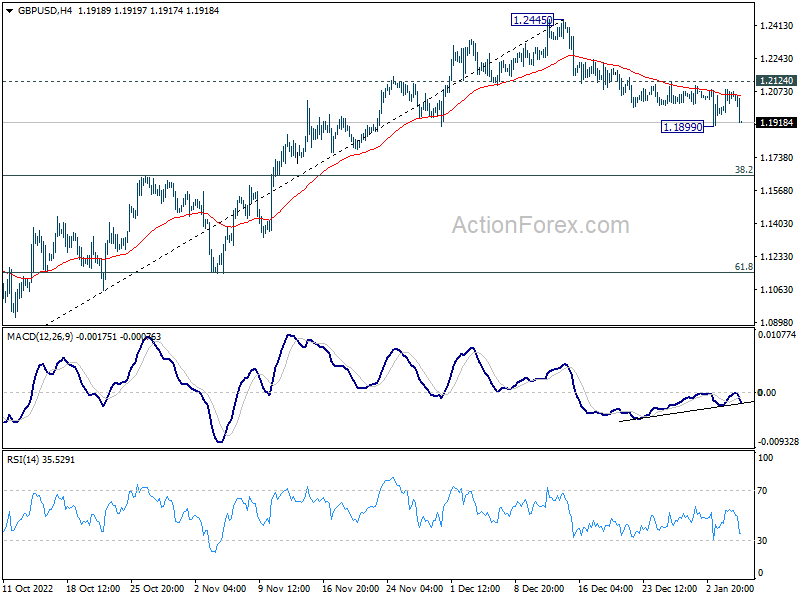
GBP/USD is staying in range above 1.1899 and intraday bias remains neutral first. On the downside, break of 1.1899 and sustained trading below 55 day EMA (now at 1.1938) will target 38.2% retracement of 1.0351 to 1.2445 at 1.1645 next. However, strong rebound from 55 day EMA, followed by break of 1.2124 resistance, will argue that the pull back from 1.2445 has completed, and turn bias back to the upside for retesting this high.
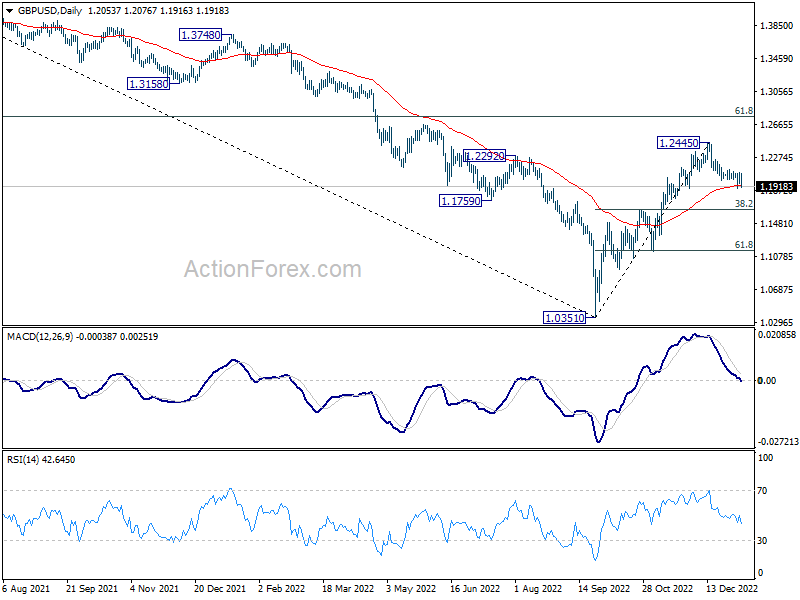
In the bigger picture, rise from 1.0351 medium term bottom is at least correcting whole down trend from 1.4248 (2021 high). Further rise is expected as long as 1.1644 resistance turned support holds. Next target is 61.8% retracement of 1.4248 to 1.0351 at 1.2759. Sustained break there will pave the way back to 1.4248. This will remain the favored case as long as 55 day EMA (now at 1.1916) holds.
USD/CHF Mid-Day Outlook
Daily Pivots: (S1) 0.9241; (P) 0.9310; (R1) 0.9367; More...
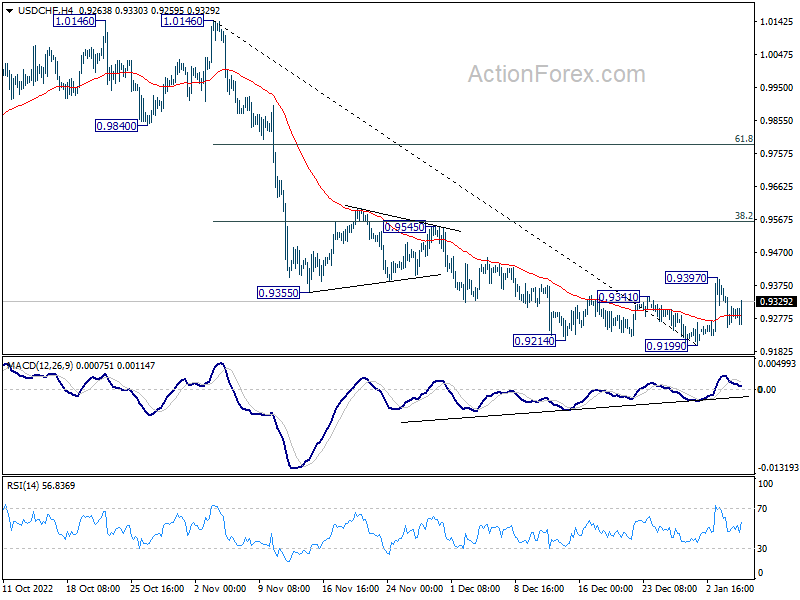
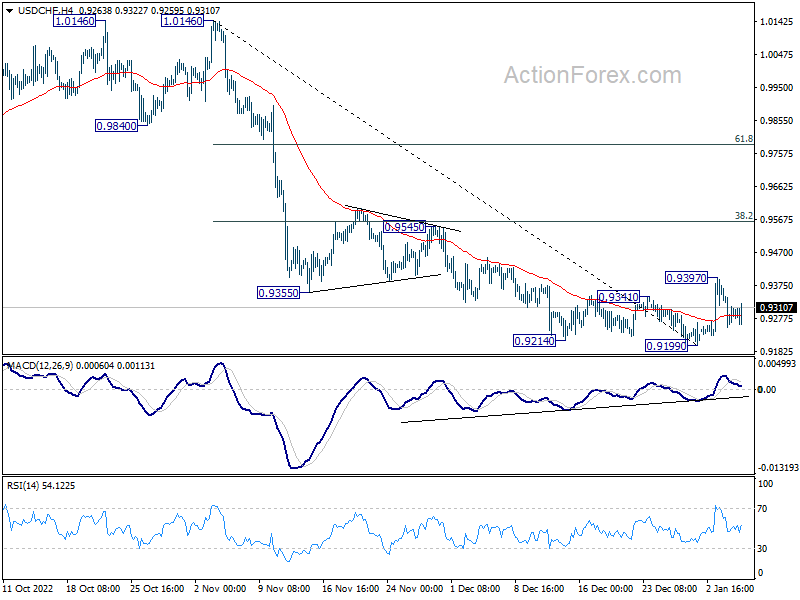
Intraday bias in USD/CHF remains neutral and outlook is unchanged. Risk stays mildly on the upside with 0.9199 short term bottom intact. Break of 0.9397 will resume the rebound from 0.9199 to 55 day EMA (now at 0.9460) and above. On the downside, however, firm break of 0.9199 will resume whole decline from 1.0146 instead.
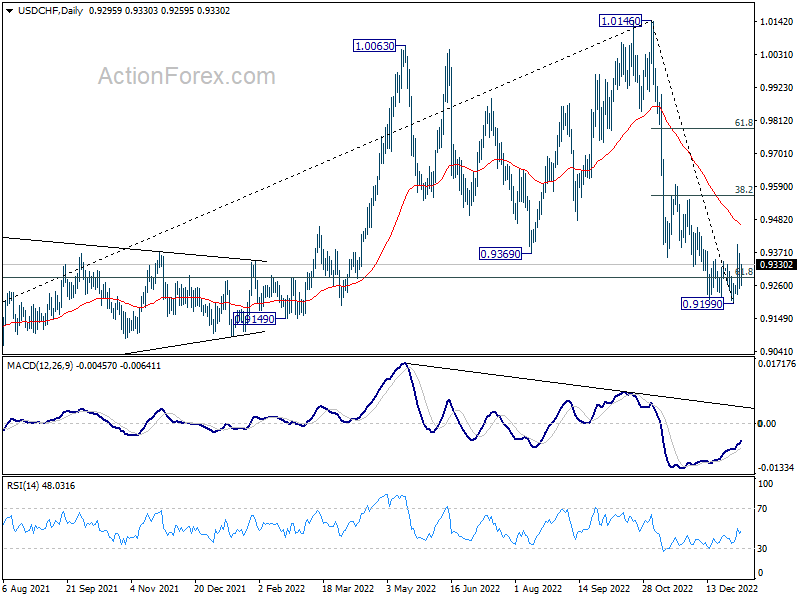
In the bigger picture, rise from 0.8756 (2021 low) has completed at 1.0146, well ahead of 1.0342 long term resistance (2016 high). Based on current downside momentum, fall from 1.0146 might be a medium term down trend itself. Sustained break of 61.8% retracement of 0.8756 to 1.0146 at 0.9287 will pave the way to 0.8756. In any case, risk will stay on the downside as long as 0.9545 resistance holds.
USD/JPY Mid-Day Outlook
Daily Pivots: (S1) 130.82; (P) 131.77; (R1) 133.61; More...
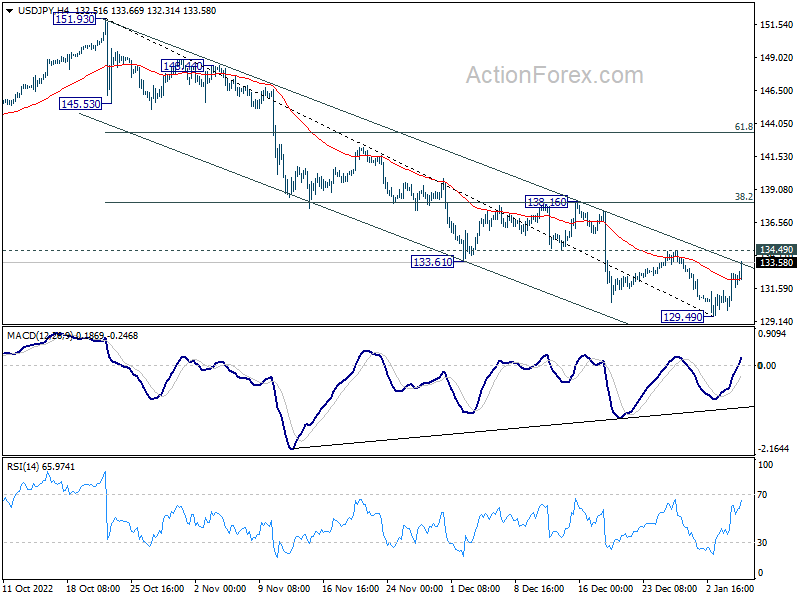
USD/JPY's rebound from 129.49 extends higher today but stays below 134.49 resistance. Intraday bias remains neutral first. Considering bullish convergence condition in 4 hour MACD, firm break of 134.49 should confirm short term bottoming. Bias will be turned back to the upside for 138.16 cluster resistance (38.2% retracement of 151.93 to 129.49 at 138.06. On the downside, break of 129.49 will resume the whole decline from 151.93 instead.
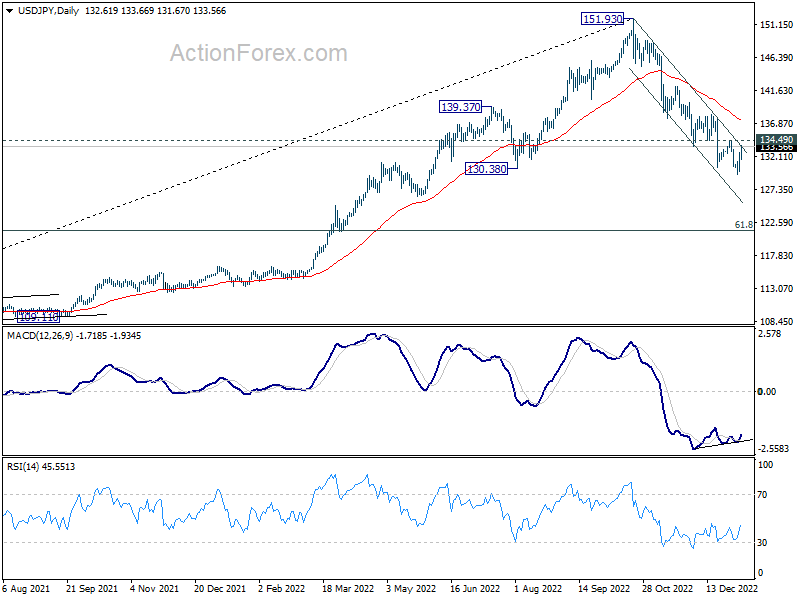
In the bigger picture, a medium term top was in place at 151.93. Sustained trading below 55 week EMA (now at 131.65) would raise the chance of bearish trend reversal. Deeper fall would be seen to 61.8% retracement of 102.58 to 151.93 at 121.43. This will now remain the favored case as long as 55 day EMA (now at 137.26) holds.
Dollar Lifted by Solid ADP Job, But Still Stuck in Range
Dollar rises broadly in early US session as lifted by stronger than expected ADP private job data. Meanwhile, stock futures turn south, apparently triggered by affirmation of continuous tightening by Fed. Yet, traders would still hold the larger bets until tomorrow's non-farm payrolls data. For now, Swiss Franc is following the greenback as the second strongest for the day, then Euro. Sterling, Yen and Aussie are the weakest ones.
Technically, it should be emphasized again that many Dollar pairs are still range bound. EUR/USD is staying inside 1.0481/0733. AUD/USD is inside 0.6628/0.6892. USD/CHF is inside 0.9199/9397. Even USD/JPY is also inside 129.49/134.49. One-sided breakouts in these pairs are needed to confirm Dollar's next move, which might happen tomorrow.
In Europe, at the time of writing, FTSE is up 0.59%. DAX is down -0.30%. CAC is down -0.11%. Germany 10-year yield is up 0.0544 at 2.325. Earlier in Asia, Nikkei rose 0.40%. Hong Kong HSI rose 1.25%. China Shanghai SSE rose 1.01%. Singapore Strait Times rose 1.55%. Japan 10-year JGB yield dropped -0.0431 to 0.421.
US ADP jobs rose 245k, strong labor market but fragmented
US ADP private employment grew 245k in December, well above expectation of 145k. By sector, goods-producing jobs rose 22k while service-providing jobs rose 213k. By establishment size, small companies added 195k jobs and medium companies added 191k. But large companies cut -151k jobs. Annual pay for job-stays were up 7.3% yoy,
Nela Richardson Chief Economist, ADP, said: "The labor market is strong but fragmented, with hiring varying sharply by industry and establishment size. Business segments that hired aggressively in the first half of 2022 have slowed hiring and in some cases cut jobs in the last month of the year."
US initial jobless claims fell to 204k, better than expectations
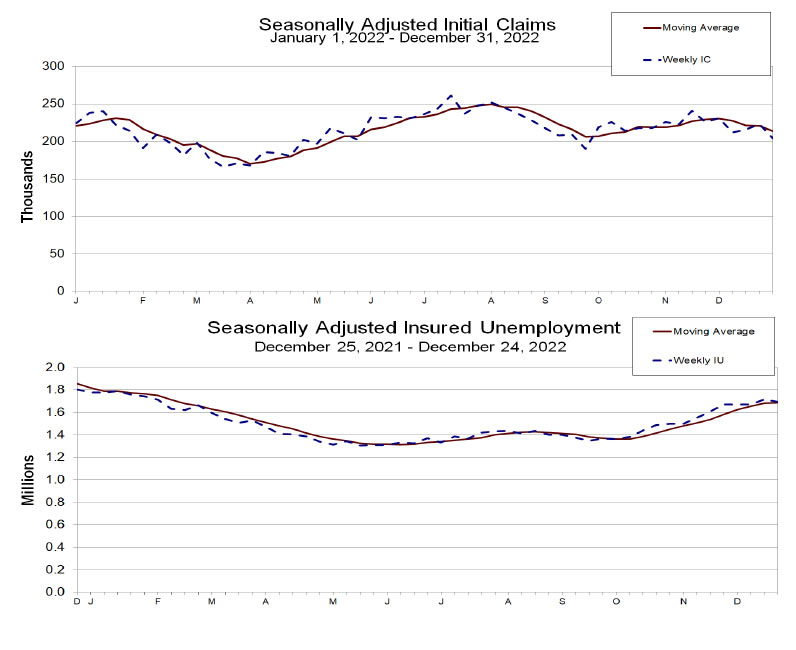
US initial jobless claims fell -19k to 204k in the week ending December 31, better than expectation of 230k. Four-week moving average of initial claims dropped -7k to 214k. Continuing claims dropped -24k to 1694k in the week ending December 24. Four-week moving average of continuing claims rose 6k to 1688k.
Also released, US trade deficit narrowed to USD -61.5B in November, versus expectation of USD -74.6B. Canada trade surplus narrowed to CAD 0.0B, below expectation of CAD 1.2B.
Eurozone PPI at -0.9% mom, 27.1% yoy in Nov
Eurozone PPI came in at -0.9% mom, 27.1% yoy in November, versus expectation of -0.8% mom, 28.2% yoy. For the month, industrial producer prices decreased by -2.2% mom in the energy sector and by -0.4% mom for intermediate goods, while prices increased by 0.2% mom for durable consumer goods, by 0.3% mom for capital goods and by 0.6% mom for non-durable consumer goods. Prices in total industry excluding energy increased by 0.1% mom.
EU PPI was at -0.9% mom, 27.4% yoy. The largest monthly decreases in industrial producer prices were recorded in Bulgaria (-12.6%), Slovakia (-11.6%) and Greece (-6.0%), while the highest increases were observed in Italy (+3.3%), Sweden (+2.7%) and Ireland (+2.4%).
UK PMI services finalized at 49.9 in Dec, fractional fall in activity
UK PMI Services was finalized at 49.9 in December, up from November's 48.8. S&P Global said fractional fall in activity was recorded at the end of 2022. Inflation rates were down but still high. Employment was unchanged, ending long period of jobs growth. PMI Composite was finalized at 49.0, up from prior month's 48.2.
Tim Moore, Economics Director at S&P Global Market Intelligence:
"Around 40% of the survey panel expect a rise in business activity over the next 12 months, while 16% forecast a decline. Survey respondents commented on squeezed disposable incomes, elevated recession risks and a housing market downturn as key factors likely to constrain demand in the year ahead.
"Although service providers widely noted concerns about global economic headwinds and stubbornly high inflation, there were also many reports citing positivity about factors within their control, including forthcoming product launches, expansion into new markets and planned business investment."
China Caixin PMI composite improved to 48.3, continuing contraction
China Caixin PMI Services rose from 46.7 to 48.0 in December, above expectation of 47.5. PMI Composite rose from 47.0 to 48.3, pointing to contraction in business activity for the fourth straight month.
Wang Zhe, Senior Economist at Caixin Insight Group said: "Both manufacturing and services sectors' supply and demand contracted due to the pandemic, with manufacturing demand taking a harder hit than in November. Overseas demand was weak, employment remained sluggish, but inflationary pressure was modest, and optimism among businesses significantly improved.
"Covid outbreaks rapidly spread across China in November, causing a number of macroeconomic indicators to fall sharply. On Dec. 7, China announced 10 new measures to further optimize Covid containment. In the short term, infections are expected to explode, which will disrupt production and everyday life. How to effectively coordinate Covid controls with economic and social development has once again become a crucial question."
USD/JPY Mid-Day Outlook
Daily Pivots: (S1) 130.82; (P) 131.77; (R1) 133.61; More...
USD/JPY's rebound from 129.49 extends higher today but stays below 134.49 resistance. Intraday bias remains neutral first. Considering bullish convergence condition in 4 hour MACD, firm break of 134.49 should confirm short term bottoming. Bias will be turned back to the upside for 138.16 cluster resistance (38.2% retracement of 151.93 to 129.49 at 138.06. On the downside, break of 129.49 will resume the whole decline from 151.93 instead.
In the bigger picture, a medium term top was in place at 151.93. Sustained trading below 55 week EMA (now at 131.65) would raise the chance of bearish trend reversal. Deeper fall would be seen to 61.8% retracement of 102.58 to 151.93 at 121.43. This will now remain the favored case as long as 55 day EMA (now at 137.26) holds.
Economic Indicators Update
| GMT | Ccy | Events | Actual | Forecast | Previous | Revised |
|---|---|---|---|---|---|---|
| 23:50 | JPY | Monetary Base Y/Y Dec | -6.10% | -3.20% | -6.40% | |
| 01:45 | CNY | Caixin Services PMI Dec | 48 | 47.5 | 46.7 | |
| 05:00 | JPY | Consumer Confidence Index Dec | 30.3 | 29.1 | 28.6 | |
| 07:00 | EUR | Germany Trade Balance (EUR) Nov | 10.8B | 7.5B | 6.9B | |
| 09:30 | GBP | Services PMI Dec F | 49.9 | 50 | 50 | |
| 10:00 | EUR | Eurozone PPI M/M Nov | -0.90% | -0.80% | -2.90% | |
| 10:00 | EUR | Eurozone PPI Y/Y Nov | 27.10% | 28.20% | 30.80% | |
| 12:30 | USD | Challenger Job Cuts Y/Y Dec | 129.10% | 416.50% | ||
| 13:15 | USD | ADP Employment Change Dec | 235K | 145K | 127K | |
| 13:30 | USD | Initial Jobless Claims (Dec 30) | 204K | 230K | 225K | 223K |
| 13:30 | USD | Trade Balance (USD) Nov | -61.5B | -74.6B | -78.2B | -77.9B |
| 13:30 | CAD | Trade Balance (CAD) Nov | 0.0B | 1.2B | 1.2B | |
| 14:45 | USD | Services PMI Dec F | 44.4 | 44.4 | ||
| 15:30 | USD | Natural Gas Storage | -230B | -213B | 0.13B | |
| 16:00 | USD | Crude Oil Inventories | 1.5M | 0.7M |
US initial jobless claims fell to 204k, better than expectations
US initial jobless claims fell -19k to 204k in the week ending December 31, better than expectation of 230k. Four-week moving average of initial claims dropped -7k to 214k.
Continuing claims dropped -24k to 1694k in the week ending December 24. Four-week moving average of continuing claims rose 6k to 1688k.
BTCUSD Fails to Break Above 200-SMA
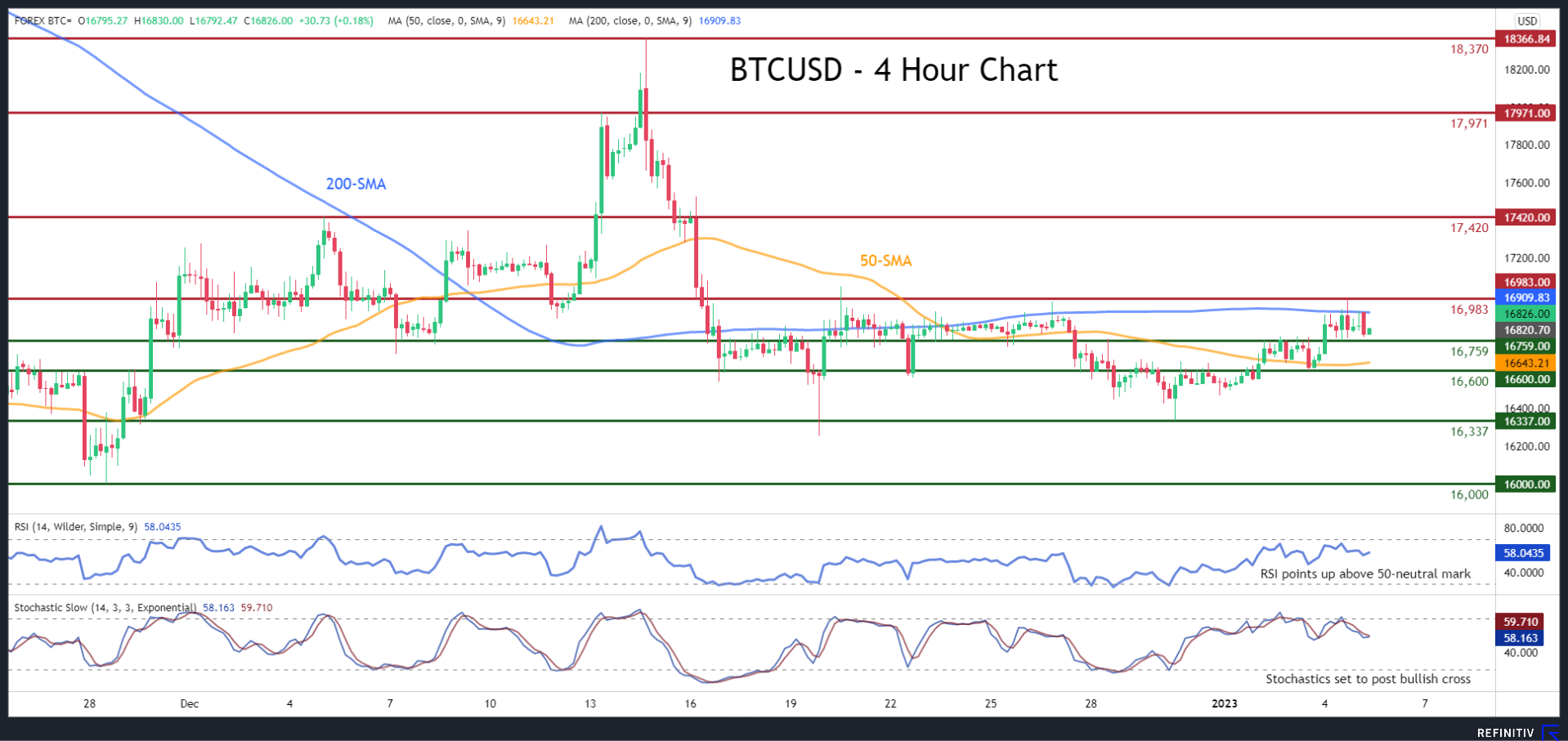
BTCUSD has been experiencing a prolonged period of consolidation in the four-hour chart, with the price failing to escape its narrow range. Since the beginning of 2023, the cryptocurrency has been attempting a rebound, but its advance has been repeatedly held down by the 200-period simple moving average (SMA).
The momentum indicators currently suggest that near term risks are tilted to the upside. Specifically, the RSI is pointing upwards above its 50-neutral mark, while the stochastic oscillator is set to post a bullish cross.
Should bullish forces prevail and push the price above its 200-period SMA, the recent resistance of 16,983 could prove to be the first obstacle. Conquering this barricade, the price could challenge the December resistance of 17,420 before the 17,971 zone comes under examination. Failing to halt there, further advances could turn the spotlight to the December high of 18,370.
On the flipside, bearish actions could encounter initial support at the 16,759 barrier. Violating that zone, the price could descend to challenge the 16,600 support region. A break below that region may then open the door for the December 2022 low of 16,252.
Overall, BTCUSD appears unable to exit its sideways pattern as the 200-period SMA continues to act as a strong ceiling. Hence, a break above that hurdle could lead to some upside for the king of cryptocurrencies.