Sample Category Title
Week Ahead – US Inflation Back in Focus, UK Data to Underline Recession Risks
After a choppy start to the new year, markets will be bracing for the next set of CPI data out of the United States next week amid ongoing unease about Fed policy. Inflation stats are also due out of Australia, while in the United Kingdom, monthly GDP numbers could stoke recession fears yet again. China’s economy will be at the forefront of investors’ minds too as the December economic indicators start rolling in. But a potentially bigger market-moving event is a gathering of central bankers in Sweden where Fed chief Jerome Powell will be participating.
Will US CPI maintain its descent?
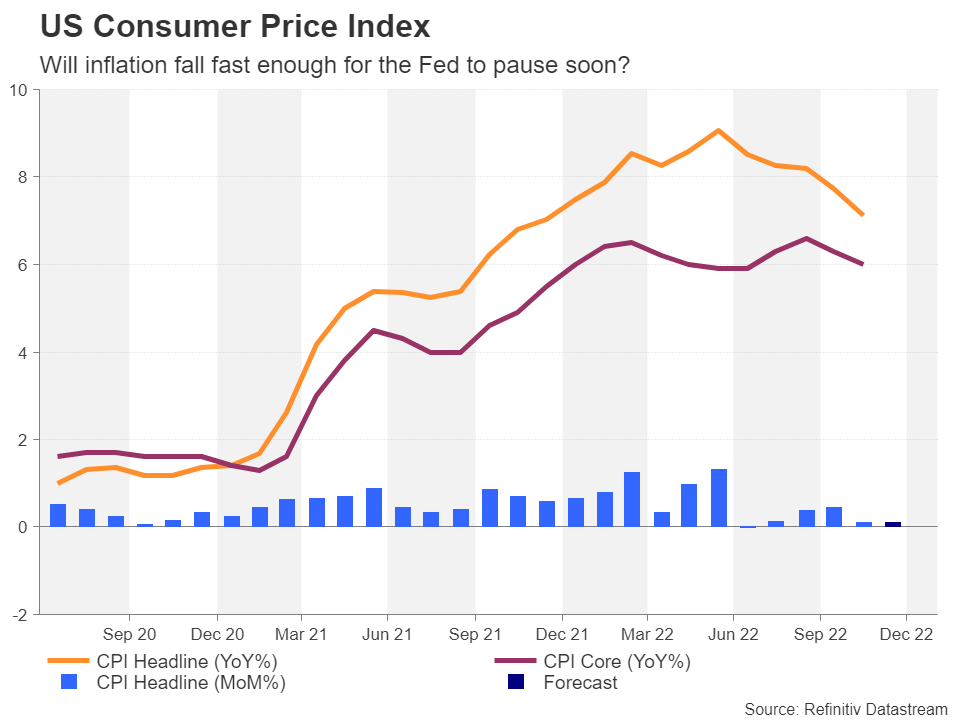
Markets may have given up hope of an early Fed pivot but they are still not convinced that rates will have to be raised too high into restrictive territory. The consumer price index for December due Thursday will be the next vital release that will either bolster bets of a more aggressive Fed or undermine policymakers’ warnings of additional rate increases to come.
Inflation is clearly on the way down in the US. The question now is: how long will it take for it to fall back to within the Fed’s 2% goal and is there a risk it could begin to creep back up again before reaching the target? The December CPI readings will further paint the picture on this. After falling to 7.1% in October, America’s inflation rate could drop below 7% in December for the first time in 13 months. The month-on-month rate is predicted to maintain the lowly pace of 0.1%, but the core measure could quicken slightly from 0.2% to 0.3% m/m.
There will be further views on inflationary pressures on Friday from the University of Michigan’s closely watched consumer sentiment survey. Although consumer sentiment has barely recovered from all-time lows and only a slight pickup is anticipated in the index in January, the survey’s gauges of consumer inflation expectations have been more encouraging. Both one- and five-year inflation expectations confirm the recent peak highlighted by the other price metrics and if there is a further decline in January, this could lift sentiment at the end of the trading week.
The US dollar has been directionless lately as the rising threat of the US economy tipping into recession has offset the boost from the Fed’s ultra-hawkish stance. It’s been somewhat of a similar story on Wall Street and stocks continue to struggle. But with concerns about weakening demand growing by the day, it will be difficult to get anything more than a short-term bounce in risk assets should the inflation figures undershoot expectations.
Riksbank symposium eyed as Powell attends
However, the dollar may find some love on Tuesday when Chair Powell is set to speak at an international symposium on central bank independence, organized by Sweden’s Riksbank. Other prominent speakers will include the Bank of England’s Bailey, the Bank of Canada’s Macklem and the Bank of Japan’s Kuroda, who will soon be departing from the central bank world like his host Stefan Ingves of the Riksbank.
But all eyes will probably be on Powell, who has not made any public remarks since the December FOMC press conference. Given the theme of the symposium, it’s likely that Powell will refrain from commenting on domestic policy, but any fresh views on the interest rate outlook could lift the dollar.
Are China’s woes over?
Aside from Fed policy, another uncertainty weighing heavily on the markets lately has been China’s Covid response. After a year of endless shutdowns that have ravaged the Chinese economy, Beijing’s abrupt change of heart about zero-Covid policy has been bittersweet for the markets. Although military-style lockdowns are now a thing of the past, surging infections have meant that consumers are still not spending as much and businesses are being disrupted from workers calling in sick. Hopes of a quick economic turnaround have subsequently been dashed, with commodities such as oil taking a substantial hit from this reality check.
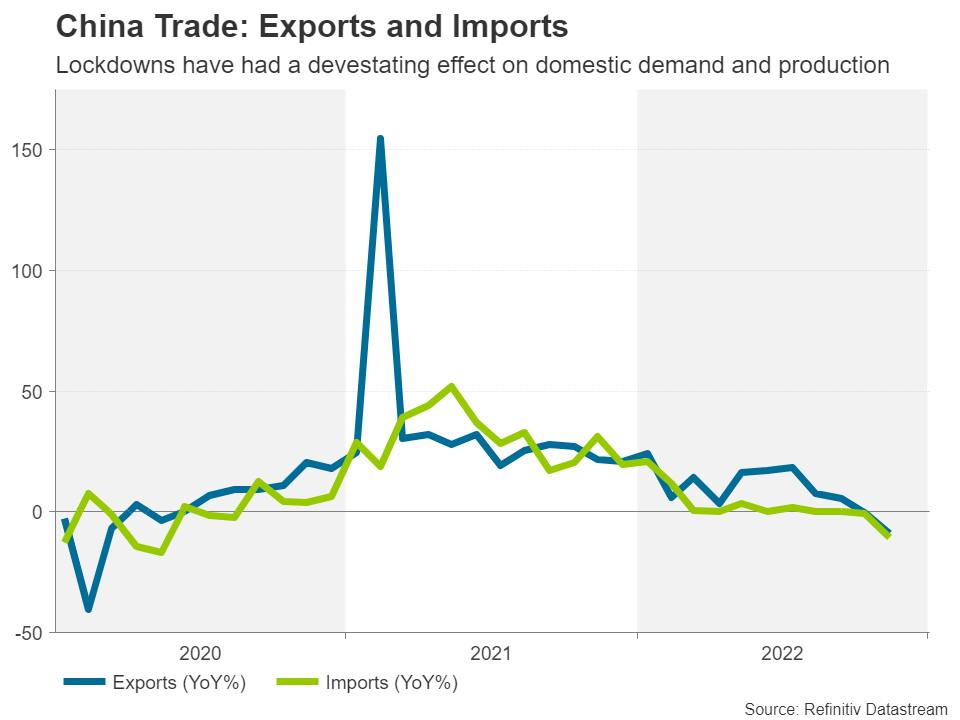
However, if investors spot some signs of stabilization in the data towards the year end, this may be taken as a positive development. The first opportunity for this will come on Thursday with the December CPI and PPI publications where any uptick in price pressures would indicate a demand recovery is underway. On Friday, the latest trade numbers are due. In October and November, China was in the unusual position of reporting back-to-back yearly declines in both exports and imports, underscoring the unsustainability of zero Covid.
Inflation data may pose upside risk for the aussie
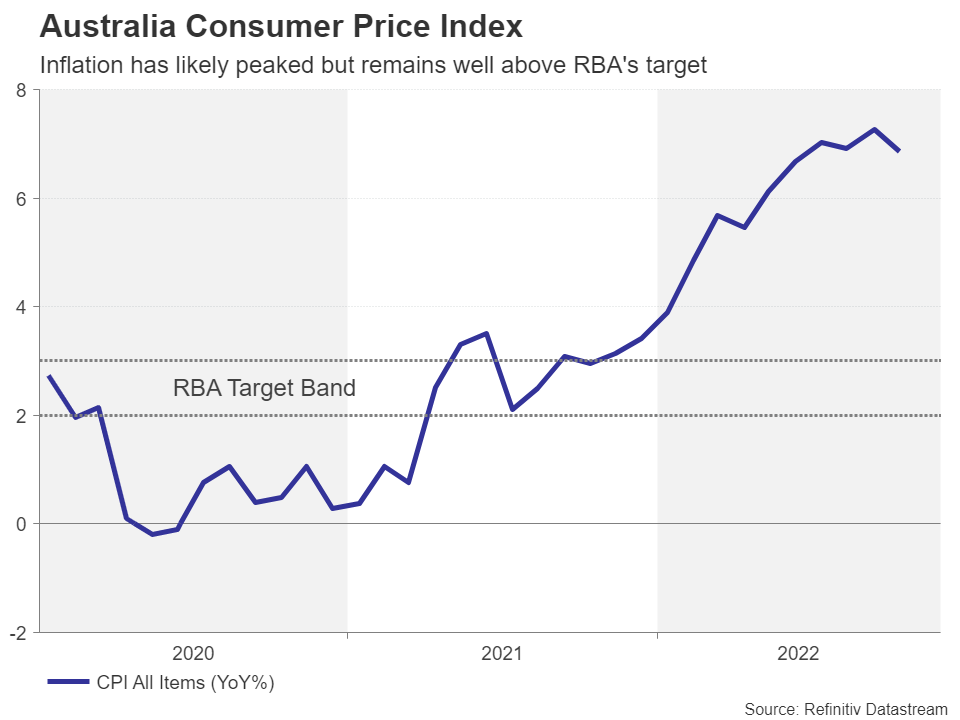
Any improvement in the December readings could buoy equities as well as the Australian dollar, as China is Australia’s biggest export customer. Domestically, CPI figures out on Wednesday will also be crucial for the aussie. Like in most countries, inflation appears to be peaking down under, but the Reserve Bank of Australia might have nevertheless jumped the gun by downshifting to 25-bps hikes or even considering pausing soon.
At 6.9%, inflation is far too high and the RBA may be underestimating how difficult it will be to get it all the way down to its 2-3% target band. Hence, an upside surprise could further bolster the aussie, which is up a whopping 10% from its October lows.
Pound might not have much to cheer about in 2023
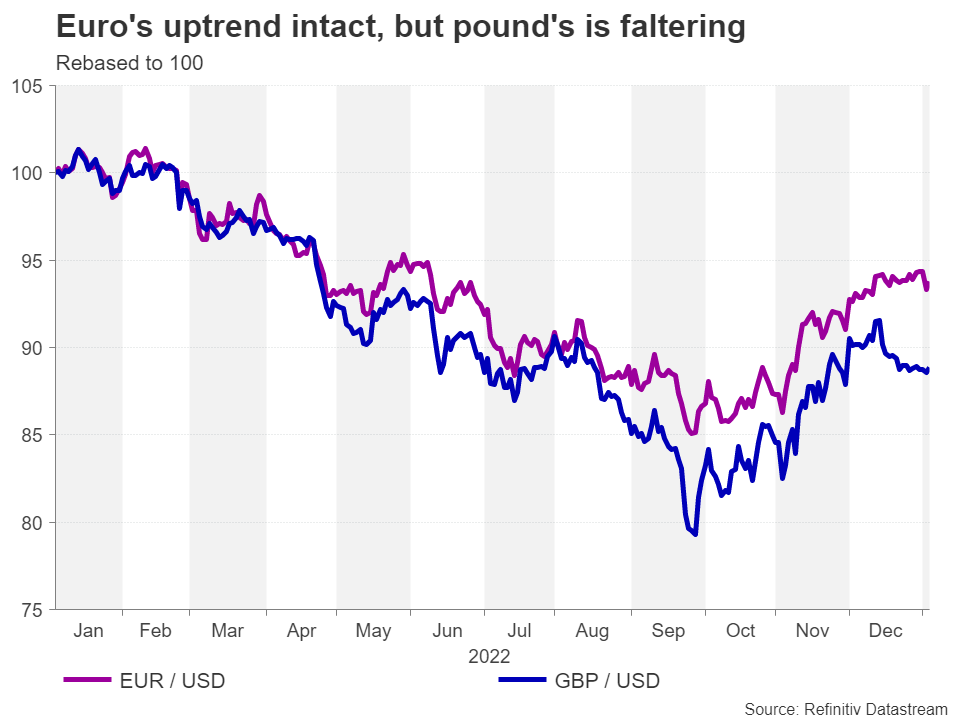
Despite an impressive rebound in the autumn, the pound could not dodge being one of the worst performing major currencies of 2022. Moreover, the uptrend began to falter in December and there could be more pain to come in 2023. It’s highly likely that the UK economy is already in recession and even if the energy crunch continues to subside, there are other problems facing Britain. A cost-of-living crisis made worse by Brexit, the largest wave of strike action since the 1970s, a health service under crippling pressure and a dysfunctional government unable to deal with all the problems doesn’t exactly invoke confidence in the economy or in sterling.
Next week’s batch of data will likely serve as a reminder to investors about the challenges the British economy faces in returning to its pre-pandemic glory. After bouncing back in October, GDP is expected to have contracted again in November. Breakdown figures including industrial production will also be released, along with trade numbers for the same month.
Positive surprises cannot be ruled out, but the risk to the pound is generally skewed to the downside. Unless the dollar suffers a major selloff, it’s hard to see cable matching its December peak of $1.2445 in the near term.
Euro remains resilient against dollar
Across the channel, it’s mostly second-tier releases for the euro area, with the main one being German industrial output for November on Monday and the Eurozone-wide print on Friday. Like the pound, the euro has given up some gains and is off its December highs, but has overall been more resilient, retaining some upward drive. If the US inflation data misses expectations, the euro might just be able to crack the $1.07 barrier.
In Japan, the December CPI estimates for the Tokyo region are due on Tuesday. These will be watched for signs of a further acceleration in Japanese inflation amid intensifying speculation that the Bank of Japan will soon take another step towards exiting its ultra-accommodative stance.
Sunset Market Commentary
Markets
It was a big day datawise, but less so marketwise. Let’s start with the numbers. EMU headline inflation fell as expected more than forecast following earlier national releases: down 0.3% M/M with the Y/Y-reading sliding from 10.1% to 9.2%. It’s the first single digit reading since August. The monthly drop was almost solely due to the fall in German energy prices (fiscal support to pay for customer’s natural gas bills). When stripping out the volatile energy and food components, core inflation extended its upward trend: from 5% Y/Y in November to a new EMU record high of 5.2% in December. It strengthens the case for ECB policy normalization as core/services inflation is the needle in the ECB (and Fed) compass. On other side of the Atlantic, US payrolls beat consensus (223k vs 203k). However, taking into account a 28k downward revision to the previous two months’ numbers, brings the report close to expectations. Average hourly earnings rose less than expected (0.3% M/M and 4.6% Y/Y) and were the item that triggered a market response (see below). The separate household survey was extremely strong with employment rising by 717k and unemployment falling by 278k. It results in a decline of the unemployment rate from 3.7% to 3.5%, matching the cycle and multidecade low. The labour force participation rate increased from 62.1% to 62.3%. Apart from March 2022 (62.4%), it’s the highest level since the start of the Covid pandemic early 2020.
Turning to markets: they first ignored the EMU CPI numbers and next zoomed in on lower-than-expected US wage growth instead of labour market strength. The reasoning is simple, but shortsighted. Fed Chair Powell more than once stressed the risk of wage inflation feeding into core services inflation if the labour market stays strong. This would warrant an even more hawkish course by the Fed. Currently, the market is split between a 25 bps and a 50 bps rate hike early February. We look for more clues in upcoming speeches by Fed governors. Up until now, most of them struck a hawkish (but ignored) tone. We side with another 50 bps hike. EUR/USD drifted below 1.05 for the first time since early December ahead of the payrolls report, but rebounded to 1.0530 afterwards. The US yield curve turns less inverse with yields losing up to 4.9 bps at the front end of the curve (2-yr). In Germany, it’s the very long end of the curve which outperforms with the 30-yr yield down 5.8 bps on the day. US stock markets open with small gains to the tune of 0.5-1%.
News Headlines
Canadian payrolls crushed forecasts. Job growth amounted to 104k in December, far more than the 5k projected. Full-time employment carried the bulk (84.5k). The strong increase unexpectedly lowered the unemployment rate from 5.1% to 5%, only one tenth of a percent above the record low seen mid last year. This was the case even as the participation rate nudged higher from 64.8% to 65%. A tight Canadian labour market results in lofty wage increases. Though slower than in November, wages grew at another 5%+ pace. The Bank of Canada in December lifted policy rates by 50 bps. At 4.25% and considering the already delivered monetary tightening (400 bps), the BoC’s stance turned more neutral and data-dependent. Markets before the publication discounted a 65% chance for a 25 bps hike later this month. That is now 85%. Canadian swap yields extend an earlier rise, adding up to 5 bps at the front. USD/CAD reversed course and went from 1.366 to 1.354 with a touch of USD weakness helping the move as well.
South Africa’s ruling party, the ANC, wants to broaden the central bank’s (SARB) mandate so that it can play a bigger role in supporting the economy. The SARB pursues an inflation-targeting strategy aiming for balanced and sustainable growth. It has repeatedly said that current obstacles to higher growth are outside the scope of monetary policy. The proposal is still under discussion within the ANC, after which it will be sent to Parliament, the ANC chairman said. As it may require a constitutional amendment to the mandate, the vote would need approval from two thirds of lawmakers. The ANC only controls 58%. South Africa’s rand dipped after the story. EUR/ZAR is trading around 18.2, up from the low 18 area this morning. USD/ZAR rose from 17.17 to 17.30.
US: Employment Slows Modestly in December, While the Unemployment Rate Returns to 50-year Low
The U.S. economy added 223k jobs in December, slightly above the consensus forecast for 200k. Revisions to the two prior months were negative, subtracting 28k from the previously reported figures. For the year, non-farm payrolls showed the U.S. economy added 4.5 million jobs and ended the year with employment 0.8% above pre-pandemic levels.
Employment gains on the service-side (+180k) were largely concentrated in education & health care (+78k), leisure & hospitality (+67k), and other services (+14k). Professional & business services (-6k) and information services (-5k) both shed jobs on the month, though the former was largely due to another sharp decline in temporary help services (-35k). Goods producing industries (+40k) had another solid month, with gains concentrated in construction (+28k). The manufacturing sector added 8k jobs.
In the household survey, civilian employment recorded a sizeable gain of 717k, while the labor force grew by a smaller (but still robust) 439k. As a result, the unemployment rate ticked lower by 0.1 percentage points (pp) to 3.5% –returning to its 50-year low. The participation rate edged higher by 0.1pp, rising to 62.3%, and ending the year 0.1pp above where it started.
Average hourly earnings rose 0.3% month-on-month (m/m) – a deceleration from the 0.4% m/m gain recorded in November. Compared to December 2021, wage growth was up 4.6% (down from 4.8% y/y in November). Aggregate hours worked rose by 0.2% m/m.
Key Implications
After oscillating in a very narrow range of 256k-269k in recent months, the pace of hiring took a modest step lower in December. Based on a three-month moving average, employment growth has slowed by over 125k jobs per-month since the Fed began rapidly tightening monetary policy last May but continues to run at a pace well above population growth.
Average hourly earnings cooled in December, but at 4.6% y/y, remains far too hot. Wage growth has been identified by the Federal Reserve as the primary source fueling higher inflation across many of the labor-intensive service sectors. Labor demand has started to ease from last year's highs, but there are still 1.7 job openings for every person actively looking for work. With labor force growth showing little improvement this past year, labor demand will need to slow considerably more to restore balance in the labor market cool wage pressures.
While a New Year tends to usher in change, the Fed's commitment to restoring price stability remains steadfast. With at least another 50 basis points of tightening to come over the first half of this year and the FOMC expected to keep rates elevated through much of 2023, a broader slowdown in economic activity appears likely over the coming months.
USD/JPY Mid-Day Outlook
Daily Pivots: (S1) 132.06; (P) 133.06; (R1) 134.42; More...
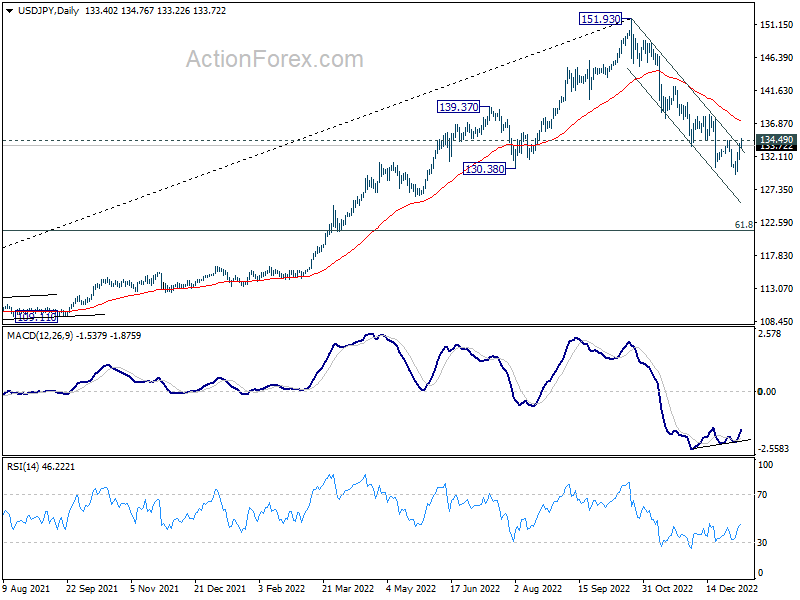
Immediate focus remains on 134.49 resistance in USD/JPY. Considering bullish convergence condition in 4 hour MACD, firm break of 134.49 should confirm short term bottoming. Bias will be turned back to the upside for 138.16 cluster resistance (38.2% retracement of 151.93 to 129.49 at 138.06. On the downside, break of 129.49 will resume the whole decline from 151.93 instead.
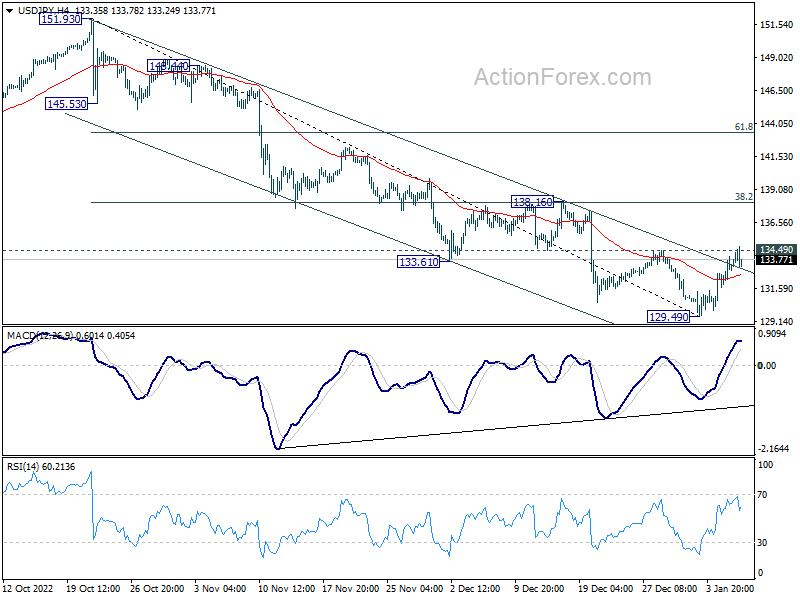
In the bigger picture, a medium term top was in place at 151.93. Sustained trading below 55 week EMA (now at 131.65) would raise the chance of bearish trend reversal. Deeper fall would be seen to 61.8% retracement of 102.58 to 151.93 at 121.43. This will now remain the favored case as long as 55 day EMA (now at 137.26) holds.
USD/CHF Mid-Day Outlook
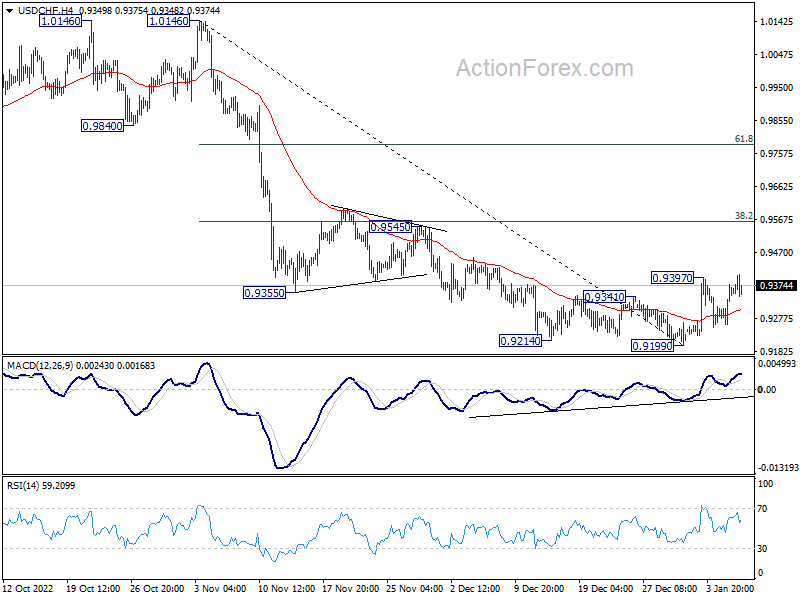
Daily Pivots: (S1) 0.9289; (P) 0.9334; (R1) 0.9406; More...
USD/CHF's rebound from 0.9199 is resuming by breaching 0.9397. Intraday bias is back on the upside for 55 day EMA (now at 0.9460) and above. On the downside, however, break of 4 hour 55 EMA (now at 0.9303) will bring retest of 0.9199 low instead.
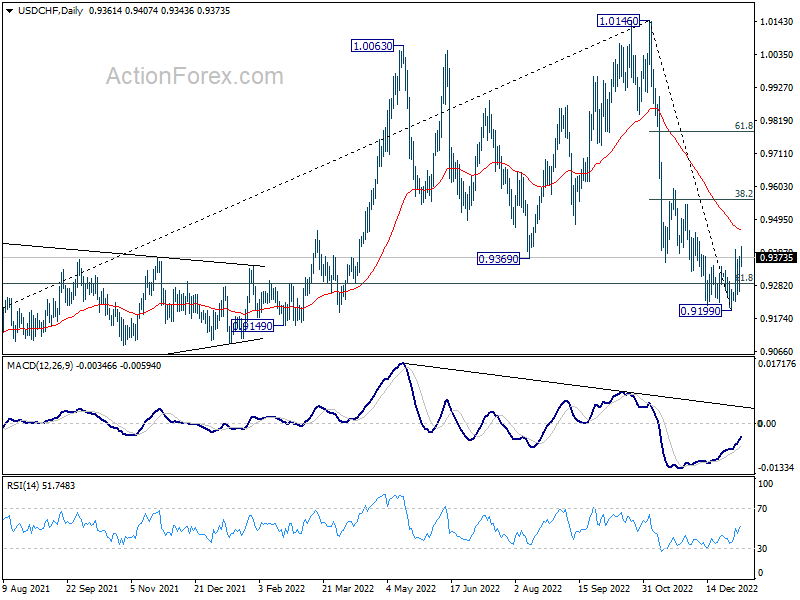
In the bigger picture, rise from 0.8756 (2021 low) has completed at 1.0146, well ahead of 1.0342 long term resistance (2016 high). Based on current downside momentum, fall from 1.0146 might be a medium term down trend itself. Sustained break of 61.8% retracement of 0.8756 to 1.0146 at 0.9287 will pave the way to 0.8756. In any case, risk will stay on the downside as long as 0.9545 resistance holds.
GBP/USD Mid-Day Outlook
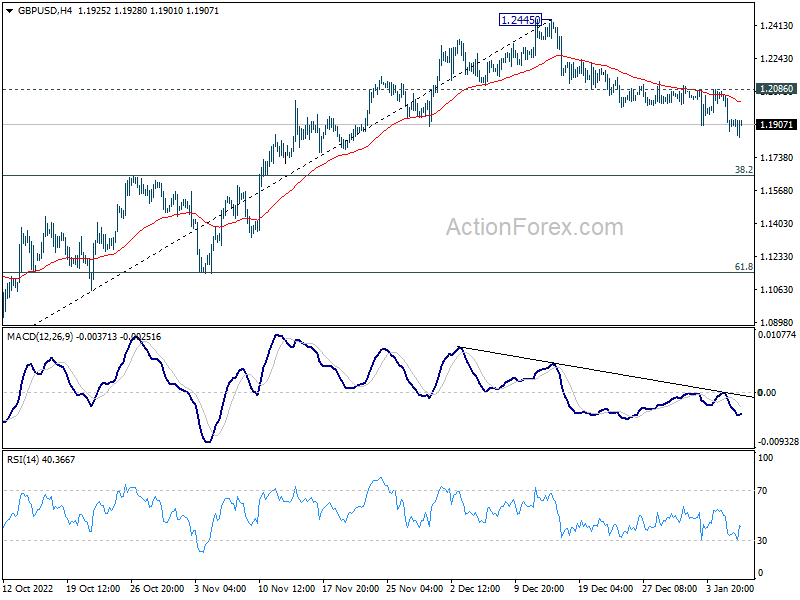
Daily Pivots: (S1) 1.1832; (P) 1.1955; (R1) 1.2036; More...
Intraday bias in GBP/USD remains on the downside at this point. Sustained trading below 55 day EMA (now at 1.19383) will extend the fall from 1.2445 to 38.2% retracement of 1.0351 to 1.2445 at 1.1645 next. However, strong rebound from 55 day EMA, followed by break of 1.2086 resistance, will argue that the pull back from 1.2445 has completed, and turn bias back to the upside for retesting this high.
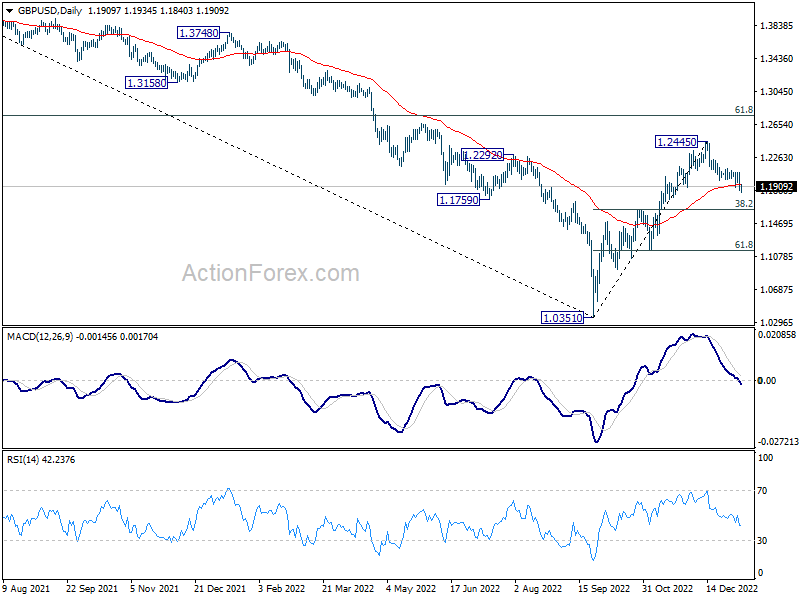
In the bigger picture, rise from 1.0351 medium term bottom is at least correcting whole down trend from 1.4248 (2021 high). Further rise is expected as long as 1.1644 resistance turned support holds. Next target is 61.8% retracement of 1.4248 to 1.0351 at 1.2759. Sustained break there will pave the way back to 1.4248. This will remain the favored case as long as 55 day EMA (now at 1.1916) holds.
Canada’s Labour Market Caps Off a Strong Year with Another Big Gain
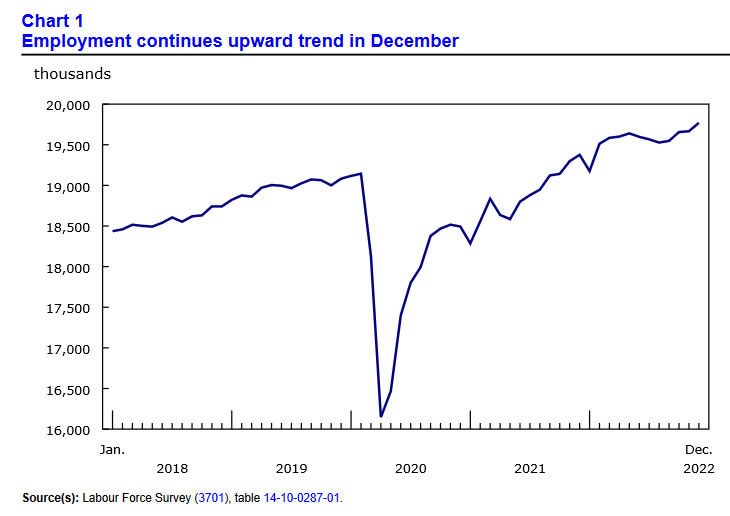
The Canadian labour market added 104k positions in December, with full-time employment up 84.5k and part-time employment up 19.5k.
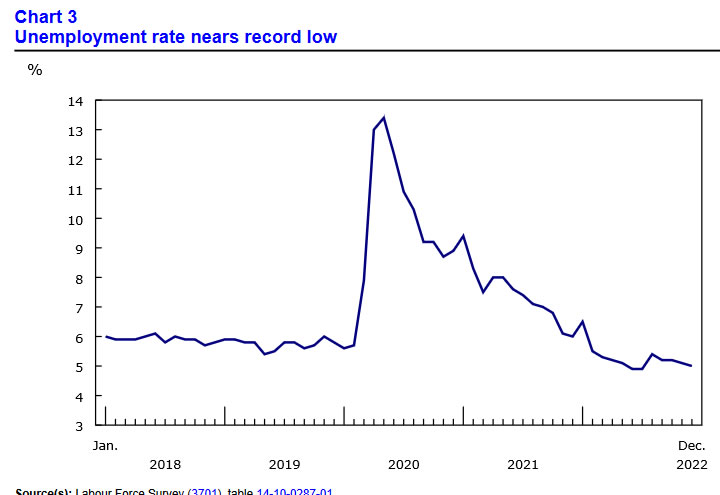
The unemployment rate fell by 0.1 percentage points, to 5.0%. The participation rate rose to 65% (up 0.2 percentage points).
By industry, employment was up in construction (+35k), transportation and warehousing (+29k), and information, culture and recreation (+25k). Losses were seen in health care and social assistance (-17k).
Lastly, total hours worked were up 0.1% month-on-month and wages were up 5.1% year-on-year (y/y).
Key Implications
2022 was a banner year for the Canadian labour market. The economy gained 381 thousand jobs, while the unemployment rate has remained right around the historical low of 4.9% established in the spring. This helped wages rise by over 5% y/y during the back half of the year, incentivizing more people to enter the workforce. Today's impressive report speaks to this strength. The surge in employment and rise in the labour force make this an incredibly positive print. The fact that most of the gains were full-time positions in the private sector and spanned many industries further supports the robustness of today's numbers.
Today's report reinforced expectations that the Bank of Canada will continue hiking its policy rate at its meeting in late January. Though the BoC has signaled it could go either way with its next policy decision, the continued strength in employment means that the Bank isn't done yet.
EUR/USD Mid-Day Outlook
Daily Pivots: (S1) 1.0482; (P) 1.0557; (R1) 1.0599; More...
EUR/USD is still holding inside range of 1.0481/0733. Intraday bias stays neutral for the moment. On the downside, break of 1.0481 will confirm short term topping, on bearish divergence condition in 4 hour MACD. Deeper fall would be seen back to 1.0289 support and below. On the upside, however, firm break of 1.0733 will resume whole rally from 0.9534.
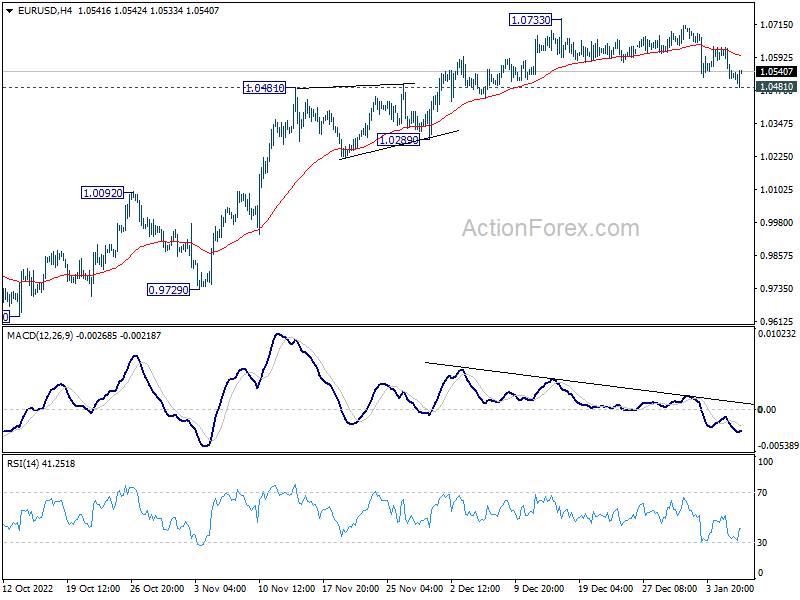
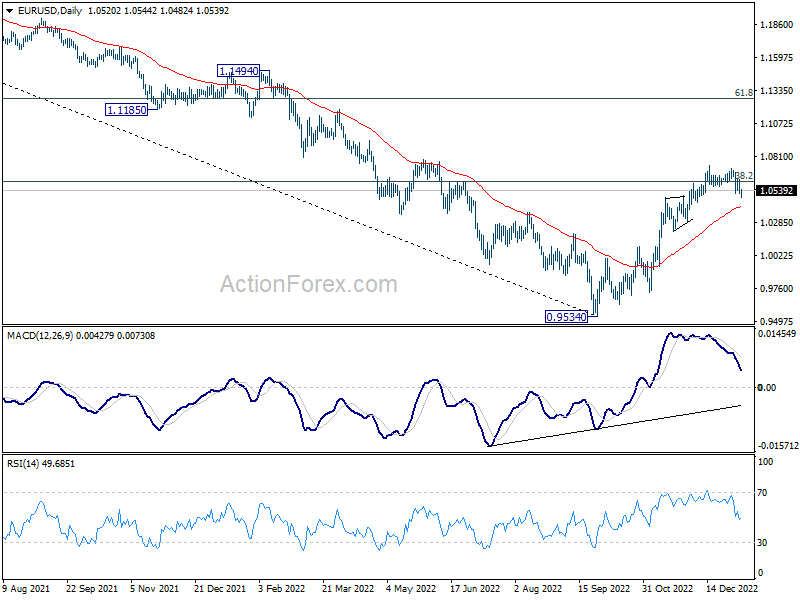
In the bigger picture, focus stays on 38.2% retracement of 1.2348 (2021 high) to 0.9534 at 1.0609. Rejection by 1.0609 will suggest that price actions from 0.9534 medium term bottom are developing into a corrective pattern. Thus, medium bearishness is retained for another fall through 0.9534 at a later stage. However, sustained break of 1.0609 will raise the chance of trend reversal and target 61.8% retracement at 1.1273.
Dollar Struggles to Rise on Solid Job Data
While the US delivers a set of solid non-farm payroll data, Dollar struggles to ride on it to extend the near term rebound. On the other hand, the report is being cheered by stocks investors, with futures shooting higher. Thus, risk-on sentiment is capping the greenback's rally attempt. Softer than expected wage growth might be a factor behind all these developments. Meanwhile, Canadian Dollar is also sluggish despite the stellar employment data. It looks like forex traders will now look forward to next week's US CPI for the big move.
In Europe, at the time of writing, FTSE is up 0.53%. DAX is up 0.24%. CAC is up 0.70%. Germany 10-year yield is down -0.067 at 2.251. Earlier in Asia, Nikkei rose 0.59%. Hong Kong HSI dropped -0.29%. China Shanghai SSE rose 0.08%. Singapore Strait Times dropped -0.48%. Japan 10-year JGB yield rose 0.0846 to 0.506, closed above BoJ's 0.5% cap.
US NFP jobs grew 223k in Dec, unemployment rate down to 3.5%
US non-farm payroll employment increased 223k in December, above expectation of 200k. Payroll employment rose by 4.5m in 2022 (an average monthly gain of 375kj, less than the increase of 6.7m in 2021 (an average monthly gain of 562k).
Unemployment rate dropped to 3.5%, better than expectation of 3.7%. Participation rate ticked up from 62.2% to 62.3%.
Average hourly earnings rose 0.3% mom, below expectation of 0.4% mom. Over the past 12 months, average hourly earnings rose 4.6% yoy.
Canada employment grew 104k in Dec, unemployment rate down to 5%
Canada employment grew strongly by 104k in December, well above expectation of 5.5k. Total employment also surpassed prior peak in May.
Unemployment rate dropped from 5.1% to 5.0%, below expectation of 5.2%, just above record low of 4.9% reached in June and July. Participation rate rose 0.2% to 65.0%.
Eurozone CPI slowed to 9.2% yoy in Dec, CPI core rose to 5.2% yoy
Eurozone CPI slowed from 10.1% yoy to 9.2% yoy in December, below expectation of 10.0% yoy. CPI core (excluding energy, food, alcohol & tobacco) rose from 5.0% yoy to 5.2% yoy, above expectation of 5.2% yoy.
Looking at the main components energy is expected to have the highest annual rate in December (25.7%, compared with 34.9% in November), followed by food, alcohol & tobacco (13.8%, compared with 13.6% in November), non-energy industrial goods (6.4%, compared with 6.1% in November) and services (4.4%, compared with 4.2% in November).
Eurozone economic sentiment indicator rose to 95.8 in Dec
Eurozone Economic Sentiment Indicator rose from 94.0 to 95.8 in December. Industry confidence rose from -1.9 to -1.5. Services confidence rose from 3.1 to 6.3. Consumer confidence rose from -23.9 to -22.2. Retail trade confidence rose from -6.6 to -3.6. Employment Expectations Indicator was unchanged at 107.3. Economic Uncertainty Indicator dropped from 28.5 to 27.5.
EU Economic Sentiment Indicator rose from 92.7 to 94.2. Employment Expectations Indicator dropped from 106.3 to 105.9. Economic Uncertainty Indicator dropped from 27.9 to 26.9. Amongst the largest EU economies, the ESI increased in Germany (+2.0), Spain (+1.9), the Netherlands (+1.5), Italy and Poland (both +0.9), while it eased again in France (-1.3).
Eurozone retail sales volume rose 0.8% mom in Nov, EU up 0.9% mom
Eurozone retail sales volume rose 0.8% mom in November, above expectation of 0.1% mom. For the month, the volume of retail trade increased by 1.6% for non-food products and by 1.0% for automotive fuels, while it decreased by -0.9% for food, drinks and tobacco.
EU retail sales volume rose 0.9% mom. Among Member States for which data are available, the highest monthly increases in the total retail trade volume were registered in Spain (+3.6%), Poland (+2.6%) and Sweden (+2.3%). The largest decreases were observed in Luxembourg (-2.0%), France and Croatia (both -1.0%) and Slovenia (-0.5%).
Elsewhere
UK PMI Construction dropped from 50.4 to 48.8 in December. France consumer spending rose 0.5% mom in November. Swiss retail sales dropped -1.3% yoy in November. Germany retail sales rose 1.1% mom in November while factory orders dropped -5.3% mom.
EUR/USD Mid-Day Outlook
Daily Pivots: (S1) 1.0482; (P) 1.0557; (R1) 1.0599; More...
EUR/USD is still holding inside range of 1.0481/0733. Intraday bias stays neutral for the moment. On the downside, break of 1.0481 will confirm short term topping, on bearish divergence condition in 4 hour MACD. Deeper fall would be seen back to 1.0289 support and below. On the upside, however, firm break of 1.0733 will resume whole rally from 0.9534.
In the bigger picture, focus stays on 38.2% retracement of 1.2348 (2021 high) to 0.9534 at 1.0609. Rejection by 1.0609 will suggest that price actions from 0.9534 medium term bottom are developing into a corrective pattern. Thus, medium bearishness is retained for another fall through 0.9534 at a later stage. However, sustained break of 1.0609 will raise the chance of trend reversal and target 61.8% retracement at 1.1273.
Economic Indicators Update
| GMT | Ccy | Events | Actual | Forecast | Previous | Revised |
|---|---|---|---|---|---|---|
| 23:30 | JPY | Labor Cash Earnings Y/Y Nov | 0.50% | 1.50% | 1.80% | 1.40% |
| 07:00 | EUR | Germany Retail Sales M/M Nov | 1.10% | 1.50% | -2.80% | |
| 07:00 | EUR | Germany Factory Orders M/M Nov | -5.30% | -0.50% | 0.80% | 0.60% |
| 07:30 | CHF | Real Retail Sales Y/Y Nov | -1.30% | 3.00% | -2.50% | -2.60% |
| 07:45 | EUR | France Consumer Spending M/M Nov | 0.50% | -1.00% | -2.80% | -2.70% |
| 09:30 | GBP | Construction PMI Dec | 48.8 | 50.6 | 50.4 | |
| 10:00 | EUR | Eurozone CPI Y/Y Dec P | 9.20% | 10.00% | 10.10% | |
| 10:00 | EUR | Eurozone CPI Core Y/Y Dec P | 5.20% | 5.00% | 5.00% | |
| 10:00 | EUR | Eurozone Economic Sentiment Indicator Dec | 95.8 | 93 | 93.7 | 94 |
| 10:00 | EUR | Eurozone Industrial Confidence Dec | -1.5 | -1.6 | -2 | -1.9 |
| 10:00 | EUR | Eurozone Services Sentiment Dec | 6.3 | 2.1 | 2.3 | 3.1 |
| 10:00 | EUR | Eurozone Consumer Confidence Dec F | -22.2 | -22.2 | -22.2 | |
| 10:00 | EUR | Eurozone Retail Sales M/M Nov | 0.80% | 0.10% | -1.80% | -1.50% |
| 13:30 | USD | Nonfarm Payrolls Dec | 223K | 200K | 263K | 256K |
| 13:30 | USD | Unemployment Rate Dec | 3.50% | 3.70% | 3.70% | 3.60% |
| 13:30 | USD | Average Hourly Earnings M/M Dec | 0.30% | 0.40% | 0.60% | |
| 13:30 | CAD | Net Change in Employment Dec | 104K | 5.5K | 10.1K | |
| 13:30 | CAD | Unemployment Rate Dec | 5.00% | 5.20% | 5.10% | |
| 15:00 | USD | ISM Services PMI Dec | 55.5 | 56.5 | ||
| 15:00 | USD | Factory Orders M/M Nov | -0.90% | 1.00% |
Canada employment grew 104k in Dec, unemployment rate down to 5%
Canada employment grew strongly by 104k in December, well above expectation of 5.5k. Total employment also surpassed prior peak in May.
Unemployment rate dropped from 5.1% to 5.0%, below expectation of 5.2%, just above record low of 4.9% reached in June and July. Participation rate rose 0.2% to 65.0%.