

Sample Category Title
GBP/USD Mid-Day Outlook
Daily Pivots: (S1) 1.2097; (P) 1.2170; (R1) 1.2218; More...
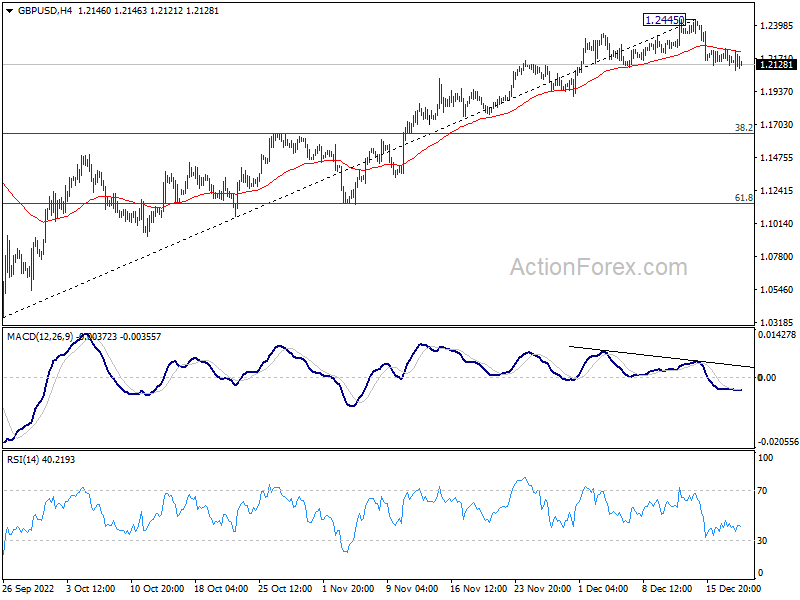
No change in GBP/USD's outlook as intraday bias stays mildly on the downside. Fall from 1.2445 short term top is in progress for 55 day EMA (now at 1.1874). Firm break there will target 38.2% retracement of 1.0351 to 1.2445 at 1.1645. For now, risk will stay on the downside as long as 1.2445 resistance holds, in case of recovery.
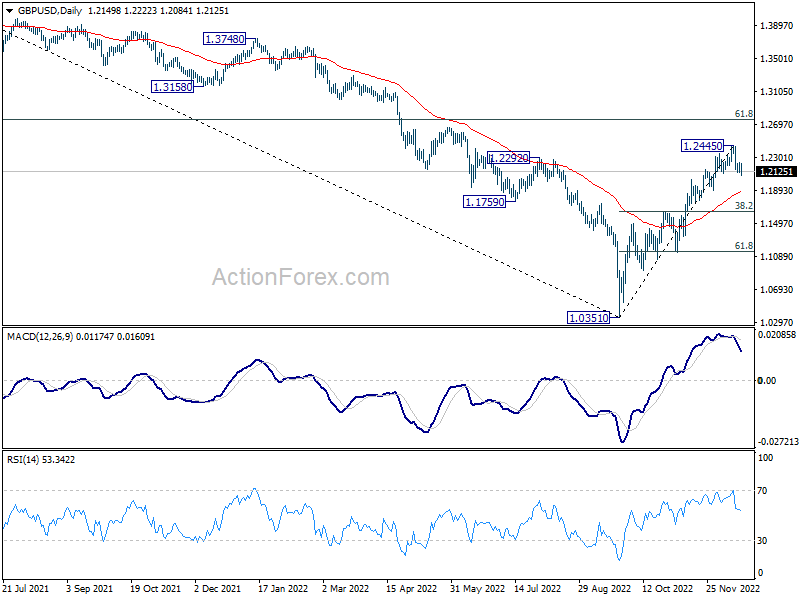
In the bigger picture, rise from 1.0351 medium term bottom is at least correcting whole down trend from 1.4248 (2021 high). Further rise is expected as long as 1.1644 resistance turned support holds. Next target is 61.8% retracement of 1.4248 to 1.0351 at 1.2759. Sustained break there will pave the way back to 1.4248. This will remain the favored case as long as 55 day EMA (now at 1.1874) holds.
USD/JPY Mid-Day Outlook
Daily Pivots: (S1) 136.05; (P) 136.61; (R1) 137.46; More...
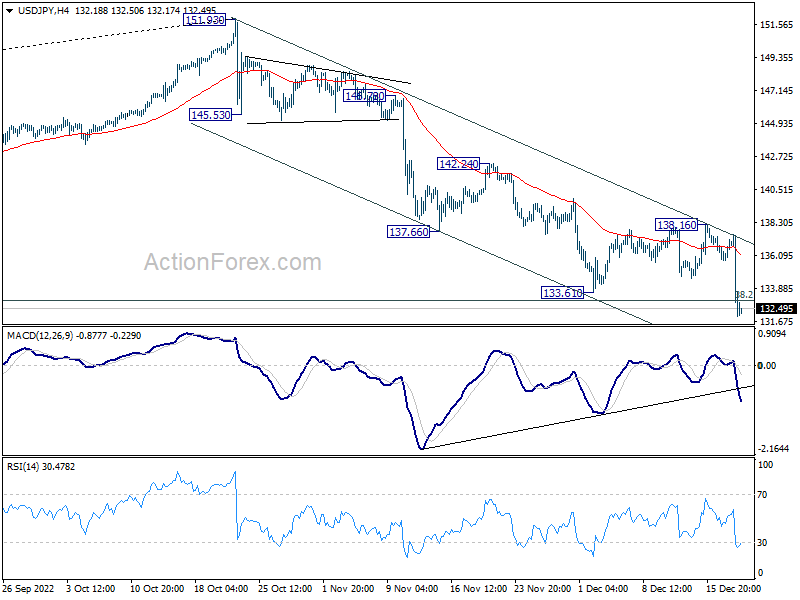
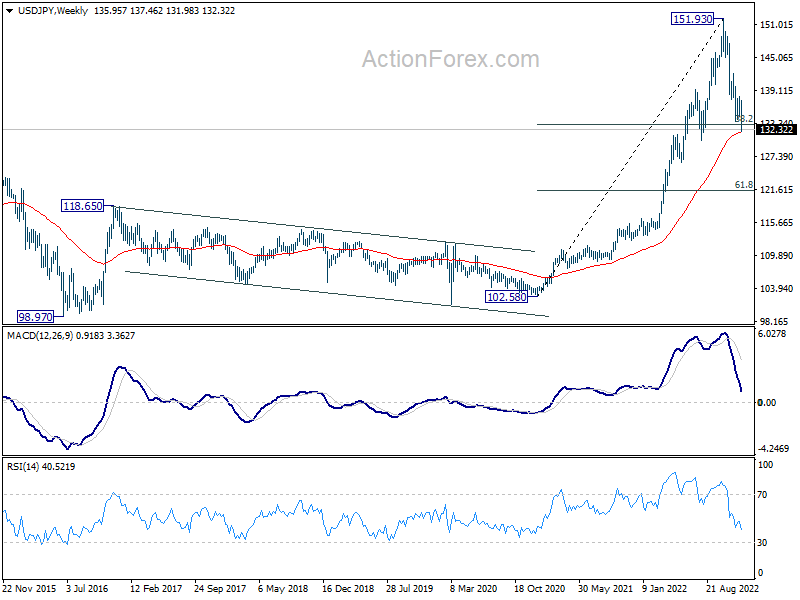
Intraday bias in USD/JPY remains on the downside at this point. Immediate focus is now on 55 week EMA (now at 131.76). Decisive break there will pave the way to next fibonacci level at 121.43. For now, risk will stay on the downside as long as 138.16 resistance holds, in case of recovery.
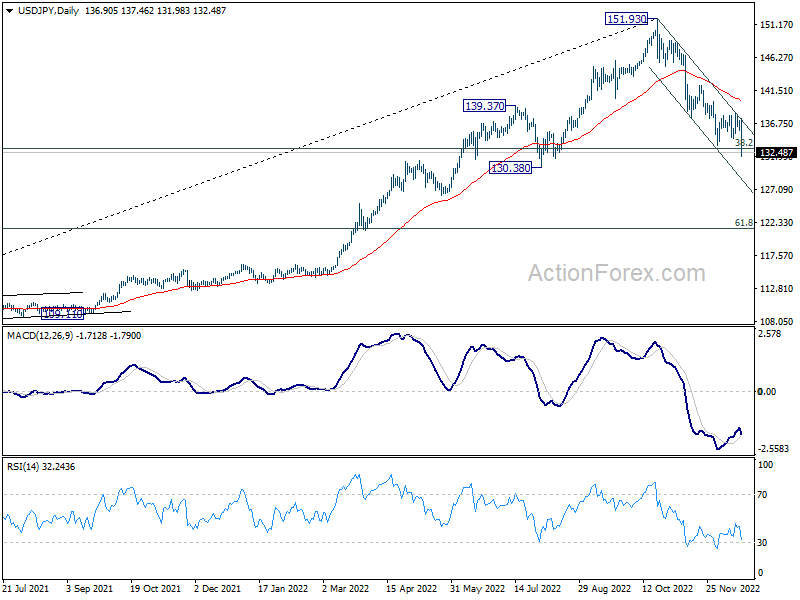
In the bigger picture, price actions from 151.93 medium term could be just a corrective pattern to up trend from 102.58 (2021 low). Strong support from 38.2% retracement of 102.58 to 151.93 at 133.07 and 55 week EMA (now at 131.76) will set the range for such corrective pattern. However, sustained break of 55 week EMA will pave the way to 61.8% retracement at 121.43.
Yen Maintains Post-BoJ Gains, Dollar Ready for a Bounce?
Yen remains the biggest winner of the day, and maintains most gains in early US session. It remains to be seen how long the impact of BoJ's tweak of the yield curve control would last. But any, Yen is enjoying the ride for now. Australian and New Zealand Dollar are the weaker ones so far, but others are mixed against each other. US and Canadian Dollars are having slight upper hands over Europeans. But respects pairs are generally range bound.
Technically, it should be noted that USD/JPY is now in proximity to 55 week EMA (now at 131.72) after today's steep decline. The EMA could provide enough support for at least an interim rebound. If that happens, it would likely be accompanied by a strong bounce in Dollar elsewhere, including break of 1.0481 support in EUR/USD and 0.9378 resistance in USD/CHF. Let's see.
In Europe, at the time of writing, FTSE is up 0.04%. DAX is down -0.33%. CAC is down -0.27%. Germany 10-year yield is up 0.075 at 2.279. Earlier in Asia, Nikkei dropped -2.46%. Hong Kong HSI dropped -1.33%. China Shanghai SSE dropped -1.07%. Singapore Strait Times dropped -0.08%. Japan 10-year JGB yield rose 0.1619 to 0.418.
Canada retail sales rose 1.4% mom in Oct, but volume was unchanged
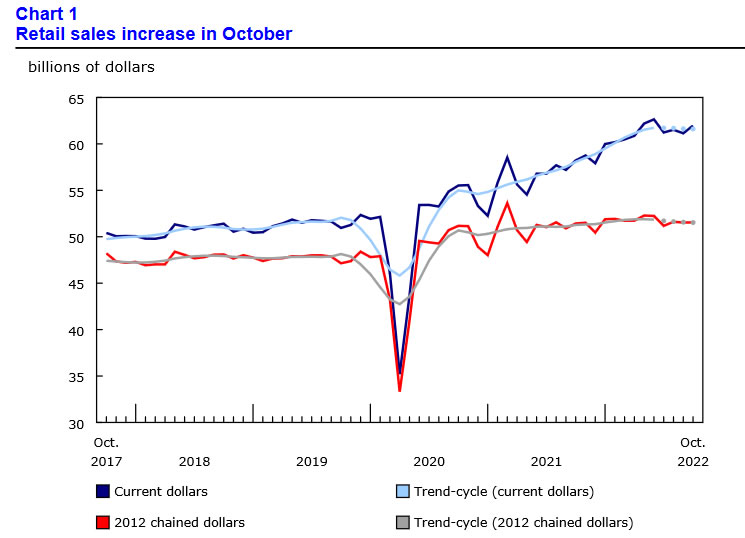
Canada retail sales rose 1.4% mom to CAD 62.0B in October, below expectation of 1.5% mom, and the largest in crease in five month. Sales were up in 6 out of 11 subsectors, representing 84.4% of retail trade. Growth was led by higher sales at gasoline stations (+6.8%) and food and beverage stores (+2.2%). Excluding gasoline stations and motor vehicle and parts, sales rose 0.9%.
In volume terms, retail sales were unchanged for the month.
Based on advance estimate, sales decreased -0.5% mom in November.
BoJ tweaks YCC to allow 10-yr yield to rise to 0.50%
BoJ surprises the markets today by widening the band of 10-year JGB yield from 0.25% to 0.50% today. At the same time, short term policy rate is kept unchanged at -0.10% as expected.
Under the yield curve control framework, the central bank will still continue to purchases JGBs without an upper limit to keep 10-year yield at around 0%. But now, the bank will offer to purchase 10-year JGB yields at 0.50% every business day through fixed-rate operations, effectively allowing 10-year yield to rise towards 0.50% level.
BoJ Kuroda: Yield cap raised to correction distortions in yield curve
BoJ Governor Haruhiko Kuroda said in the post meeting press conference, "Overseas market volatility has heightened from around spring ... While we have kept the 10-year bond yield from exceeding the 0.25% cap, this has caused some distortions in the shape of the yield curve. We, therefore, decided that now was the appropriate timing to correct such distortions and enhance market functions." That's led to the decision today to raise the cap from 0.25% to 0.50%.
"Consumer inflation has hit 3.6% mainly through rising import costs from a weak yen. Furthermore, inflation expectations are heightening. This is pushing down real interest rates and enhancing the stimulus effect on the economy. As such, while we've (widened the band) to correct distortions in the yield curve, the move won't diminish the effect of YCC," he added.
But Kuroda also indicated, "I don't think we need to review YCC or quantitative easing for the time being." "It's premature to debate specifics on changing the monetary policy framework or an exit from easy policy. When achievement of our target comes into sight, the BOJ's policy board will hold discussions on an exit strategy and offer communication to markets," he said.
RBA considered 50bps, 25bps, and no change at Dec meeting
Minutes of RBA's December 6 meeting indicates that the board has considered three interest rate options of a 50bps hike, a 25bps hike, and no change.
The argument for a 50bps increase stemmed from inflation remains "too high", and there were factors support a "more pre-emptive action". For a 25bps increase, the board acknowledged there had bee already a "significant cumulative increase" in interest rates and they would "begin to have more of an effect through the course of 2023". The arguments for now chance placed"further emphasis of the lagged effect" of prior rate increases.
Board members eventually decided that the case for 25bps increase was the"strongest one", as further hike was "likely to be necessary". Members also noted the "importance of acting consistently".
The minutes also reiterated that "the Board expects to increase interest rates further over the period ahead, but it is not on a pre-set path. Members noted that the size and timing of future interest rate increases would continue to be determined by the incoming data and the Board's assessment of the outlook for inflation and the labour market."
NZ ANZ business confidence fell to fresh record low
New Zealand ANZ business confidence declined from -57.1 to -70.2 in December, a new record low. Looking at some details, own activity outlook fell from -13.7 to -25.6. Export intentions dropped form -5.4 to -10.0. Investment intentions dropped form -8.1 to -20.5. Employment intentions dropped from -4.0 to -16.3. Pricing intentions rose from 58.5 to 59.1. Cost expectations declined form 88.7 to 84.4. Inflation expectations dropped from 6.39 to 6.23.
ANZ said: "The fall in business confidence is certainly dramatic, but while it's at a fresh record low, it would be incorrect to read this as an indication that any recession is likely to be unusually severe. Rather, it's unusually widely anticipated. It's a situation unprecedented in recent decades for a central bank to admit it is deliberately engineering a recession."
USD/CHF Mid-Day Outlook
Daily Pivots: (S1) 0.9265; (P) 0.9307; (R1) 0.9328; More...
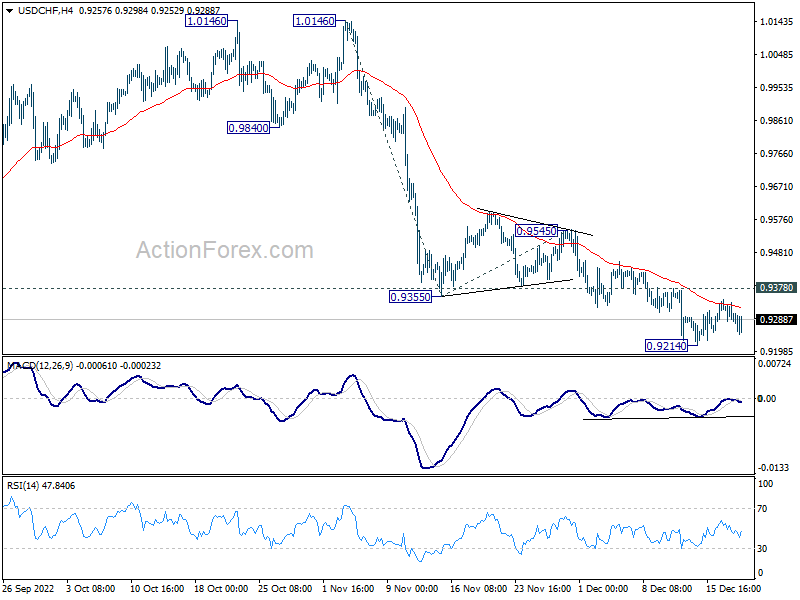
Intraday bias in USD/CHF remains neutral for the moment, but further decline is in favor with 0.9378 resistance intact. On the downside, break of 0.9214 will resume the fall and target 61.8% projection of 1.0146 to 0.9355 from 0.9545 at 0.9056. However, break of 0.9378 resistance will indicate short term bottoming and turn bias back to the upside for 0.9545 resistance instead.
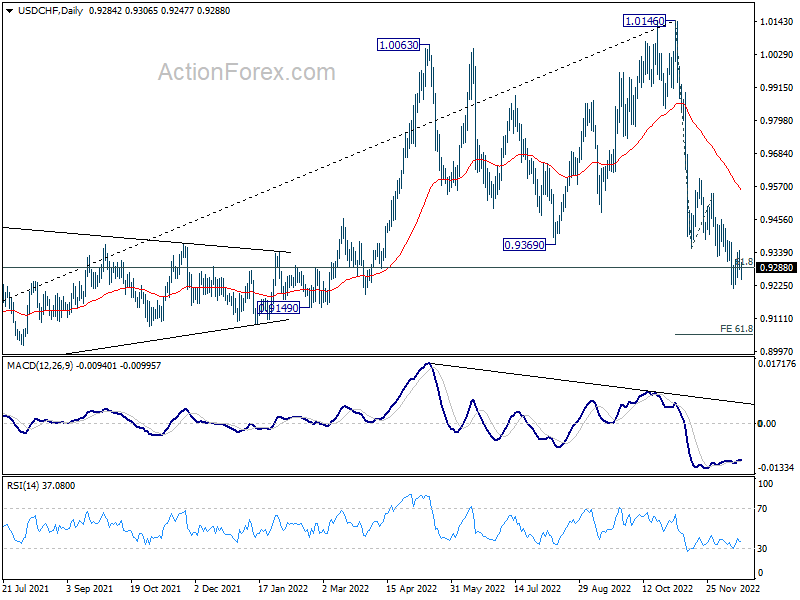
In the bigger picture, rise from 0.8756 (2021 low) has completed at 1.0146, well ahead of 1.0342 long term resistance (2016 high). Based on current downside momentum, fall from 1.0146 might be a medium term down trend itself. Sustained break of 61.8% retracement of 0.8756 to 1.0146 at 0.9287 will pave the way to 0.8756. In any case, risk will stay on the downside as long as 0.9545 resistance holds.
Economic Indicators Update
| GMT | Ccy | Events | Actual | Forecast | Previous | Revised |
|---|---|---|---|---|---|---|
| 00:00 | NZD | ANZ Business Confidence Dec | -70.2 | -57.1 | ||
| 00:30 | AUD | RBA Minutes | ||||
| 03:00 | JPY | BoJ Interest Rate Decision | -0.10% | -0.10% | -0.10% | |
| 07:00 | CHF | Trade Balance (CHF) Nov | 2.31B | 3.27B | 4.14B | 4.27B |
| 07:00 | EUR | Germany PPI M/M Nov | -3.90% | -2.60% | -4.20% | |
| 07:00 | EUR | Germany PPI Y/Y Nov | 28.20% | 30.00% | 34.50% | |
| 09:00 | EUR | Eurozone Current Account (EUR) Oct | -0.4B | -10.3B | -8.1B | |
| 13:30 | CAD | Retail Sales M/M Oct | 1.40% | 1.50% | -0.50% | |
| 13:30 | CAD | Retail Sales ex Autos M/M Oct | 1.70% | 1.30% | -0.70% | |
| 13:30 | USD | Building Permits Nov | 1.34M | 1.50M | 1.51M | |
| 13:30 | USD | Housing Starts Nov | 1.43M | 1.40M | 1.43M | |
| 15:00 | EUR | Eurozone Consumer Confidence Dec P | -23 | -24 |
USD/CHF Mid-Day Outlook
Daily Pivots: (S1) 0.9265; (P) 0.9307; (R1) 0.9328; More...
Intraday bias in USD/CHF remains neutral for the moment, but further decline is in favor with 0.9378 resistance intact. On the downside, break of 0.9214 will resume the fall and target 61.8% projection of 1.0146 to 0.9355 from 0.9545 at 0.9056. However, break of 0.9378 resistance will indicate short term bottoming and turn bias back to the upside for 0.9545 resistance instead.
In the bigger picture, rise from 0.8756 (2021 low) has completed at 1.0146, well ahead of 1.0342 long term resistance (2016 high). Based on current downside momentum, fall from 1.0146 might be a medium term down trend itself. Sustained break of 61.8% retracement of 0.8756 to 1.0146 at 0.9287 will pave the way to 0.8756. In any case, risk will stay on the downside as long as 0.9545 resistance holds.
Canada retail sales rose 1.4% mom in Oct, but volume was unchanged
Canada retail sales rose 1.4% mom to CAD 62.0B in October, below expectation of 1.5% mom, and the largest in crease in five month. Sales were up in 6 out of 11 subsectors, representing 84.4% of retail trade. Growth was led by higher sales at gasoline stations (+6.8%) and food and beverage stores (+2.2%). Excluding gasoline stations and motor vehicle and parts, sales rose 0.9%.
In volume terms, retail sales were unchanged for the month.
Based on advance estimate, sales decreased -0.5% mom in November.
Canadian Dollar Eyes Retail Sales
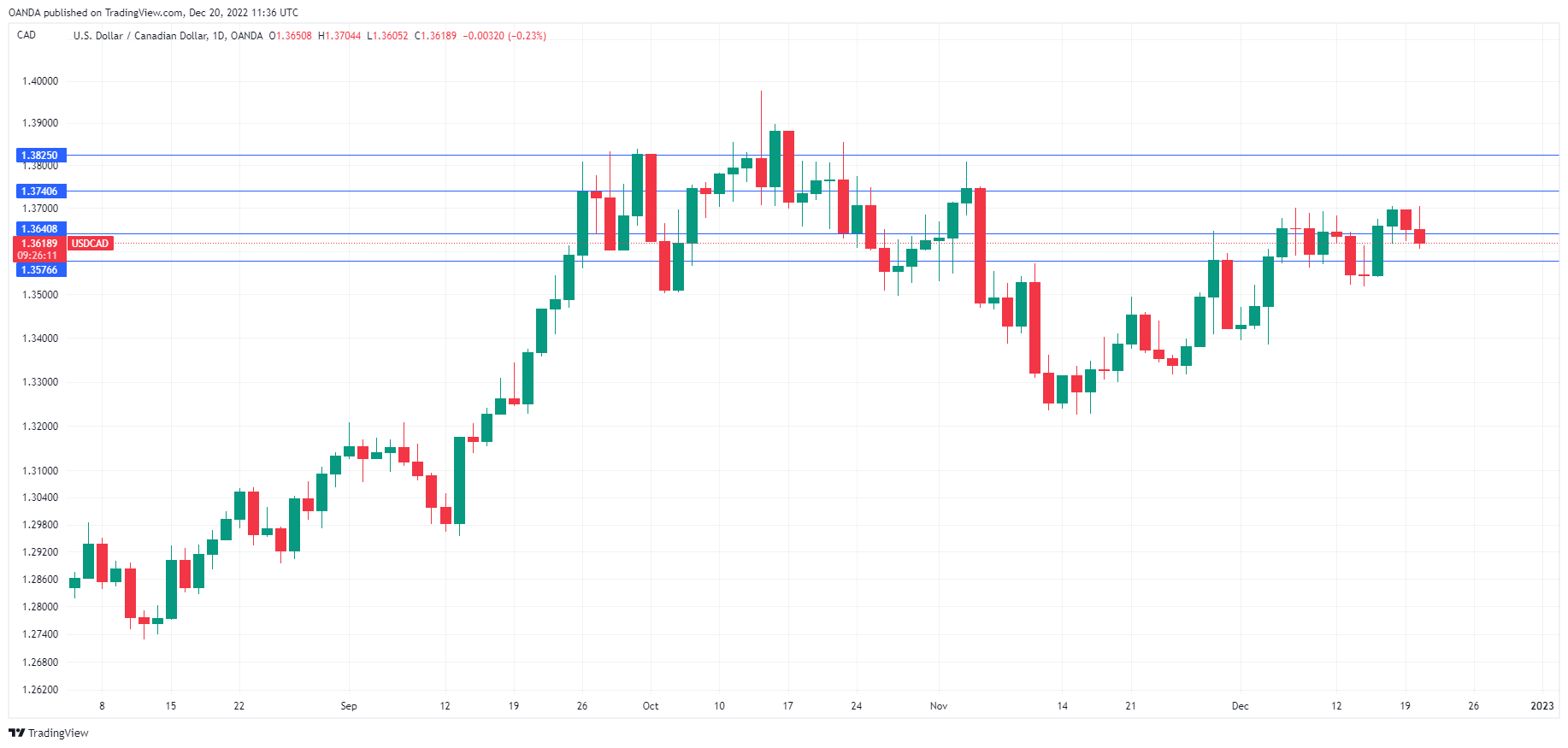
USD/CAD has edged lower on Tuesday. In the European session, USD/CAD is at 1.3626, down 0.19%. We could see stronger movement in the North American session when Canada releases the November retail sales report.
Will retail sales bounce back?
Canada’s retail sales were soft in October, as the headline reading came in at -0.5% and core retail sales at -0.7%. The markets are expecting a mixed report for November, with a consensus of -0.3% for the headline and 0.8% for core retail sales. This will be followed on Wednesday with the CPI data for November, with headline inflation expected to rise to 7.4%, up from 6.9% a month earlier.
The Bank of Canada will be following the retail sales and inflation data carefully. The BoC raised rates by 50 basis points earlier in December, bringing the cash rate to 4.25%. The Bank’s current rate cycle has been steep, with 425 points of tightening in just nine months. BoC Governor Macklem expressed a mea culpa on Monday, admitting that the BoC had missed the boat on rising inflation, which was a “very big forecast error.” Still, Macklem said that a turnaround in inflation was near.
Over in the US, the Federal Reserve continues to battle with investors, who are not listening to the Fed’s hawkish message and received a cold shower from a hawkish Fed meeting last week. Former New York Fed President Dudley emphasised this point on Monday, warning that investors were ignoring the Fed at their peril, as the Fed would simply continue to tighten if it saw that conditions were becoming too loose. The Fed has projected a terminal rate of 5.00% to 5.25%, a view seconded by Goldman Sachs. However, the money markets have priced in a terminal rate of 4.88%, somewhat more dovish than the Fed.
USD/CAD Technical
- There is weak resistance at 1.3681. The next resistance line is 1.3766
- USD/CAD has support at 1.3596 and 1.3484
Bank of Japan surprise – another sign of a global dollar reversal
The Bank of Japan made a surprise move on Tuesday morning, extending the permissible yield range of 10-year government bonds. The decision caused the yen to strengthen by more than 3%, and the Nikkei225 index lost as much as 4% before recovering almost half of its initial decline.
The central bank of Japan said at the end of its regular meeting that it would switch from a 0.25% yield target to a 0.0-0.50% target range instead. As yields had been held at 0.25% solely due to BoJ purchases, the range extension immediately sent yields to the upper end of the range. This decision meant that the BoJ would print fewer yen to buy government bonds for the FX market, strengthening the currency.
Strictly speaking, the Bank of Japan has made monetary policy less accommodating. However, the difference with key rates of other countries remains disastrous, as it is the only one keeping rates negative with an active QE phase.
On the other hand, the signal from the softer central bank itself is definite and could be a trial balloon for a fundamental policy reversal. Bank of Japan meetings are no longer boring.
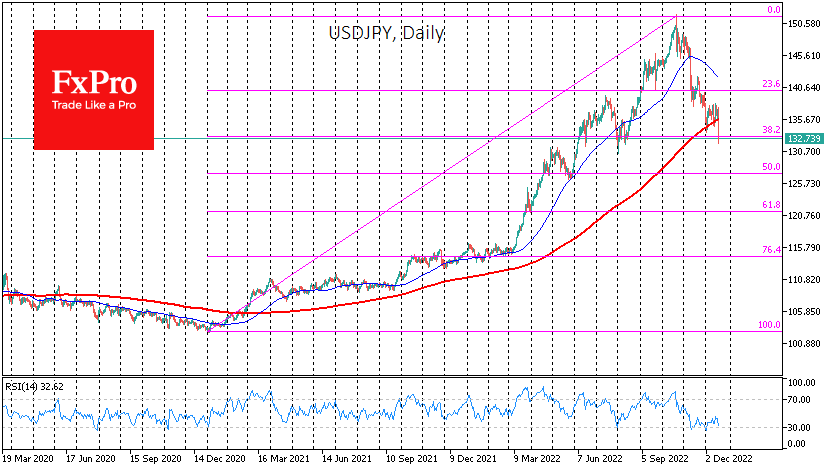
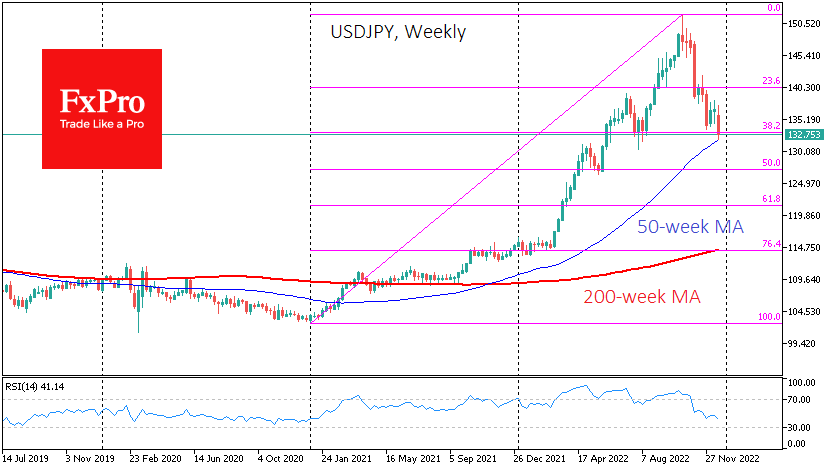
We also pay attention to the timing of the changes. The powerful interventions of the Japanese Ministry of Finance in November stopped the USDJPY rising and confirmed the reversal in the pair thanks to a decisive move down on a break-down of the 50-day moving average.
Throughout December, we saw a three-week consolidation of the pair just above the 200 SMA. The decisive move down after the extended consolidation has been reinforced by the fact that during the lull in the pair, the stop orders pulled closer to the market and are now triggered in droves.
A sharp pullback of the pair under its 200 SMA often signals the reversal of the long-term trend. We had similar signals earlier in the EURUSD and the GBPUSD.
In addition, the fall of the USDJPY below 133 was below the 61.8% retracement of the entire momentum of the pair from the beginning of 2021 to the peak in October 2022. Market participants’ conviction of a hawkish reversal of Bank of Japan policy could trigger a new round of decline in the pair with a technical target near 127. This is where the 50% level of the mentioned last rally and the support area in May of the year gone by are concentrated.
BoJ Tweaks YCC – Global Bond Market Takes a Hit
- Bank of Japan (BoJ) surprised the market this morning by raising the upper band on its yield curve control (YCC) policy from 0.25% to 0.50%.
- Bond yields in Japan rose on the news with spillover to global bond markets and the Danish callable bond market. USD/JPY dropped to 132 on the move.
- We expect a policy rate hike to 0% in Q2 followed by a 25bp increase in the yield target to 0.25% and an increase in the fluctuation band from -0.25% to 0.75%.
In a surprise move, BoJ adjusted its yield curve control this morning. BoJ widened the band around its 10-year 0% yield target to +/-50bp from +/-25. The official explanation is that it will allow for a smoother formation of the yield curve. The move comes with a pledge to sharply increase bond buying, in order to stress that this is a fine-tuning move and not tightening. At the press conference, governor Kuroda also did his best to communicate that it is not a tightening move.
Inflation has picked up in Japan, but it remains an imported phenomenon. Service inflation, for instance, is on the rise, but still stands at just 0.8%. An increase in wage pressure is key for BoJ to achieve its goal of reflating the economy permanently. It remains our base case that a global recession will obstruct a significant increase in wage pressure. However, we see a risk that a new governor will differentiate less between domestically created inflation and imported inflation and will use this opportunity to modify BoJ's extreme position among global central banks – it is the only major central bank left with an easing stance.
Spring will be crunch time in Japan with the annual wage negotiations and a scheduled replacement of all three governors in BoJ. Based on today's move, we think the probability of further moves next year has increased and we expect a move away from negative interest rates after a new governor has been appointed, followed by a further loosening of the yield curve control. Specifically, we expect a policy rate hike to 0% in Q2 followed by a 25bp increase in the yield target to 0.25% and an increase in the fluctuation band from -0.25% to 0.75%.
After the announcement today the market has started to position for a possible rate hike from BoJ. The market now discounts a full 10bp interest rate increase by April, which would take short-term Japanese interest rates back to zero and a full 25bp interest rate increase by August. Yesterday, the market did not expect a full 25bp increase until November, i.e. the market expects a possible rate hike in Japan to be a theme for H1 next year.
Fixed income markets
The unexpected change to the YCC target will have a negative impact on the long end of the French government bond yield curve, as the market speculates about a further repatriation from French government bonds to Japanese government bonds, as we saw in e.g. US treasury bonds and Australian government bond markets in Asian trade this morning. 10Y US treasuries have risen some 8bp, while 10Y Aussie government bonds have risen 19bp. However, Japanese investors already sold significant amounts of foreign bonds in 2022. They reduced their holdings of US treasuries by around USD150bn in 2022 according to the numbers from the Japanese Ministry of Finance. See our monthly overview of the Japanese holdings in various foreign bond markets.
There is also likely to be some negative spillover effect on the Danish callable mortgage bond market, as the market expects Japanese investors to sell in the 30Y callable bonds. Here they also reduced their holdings in 2022 according to the monthly statistics, but much less compared to other foreign markets. Furthermore, when we look at foreign holdings of Danish callable bonds, there has only been a modest reduction in 2022. Foreigners have reduced their holdings of callable bonds from 35% to 33% according to the ownership statistics from the Danish central bank; see Danish Mortgage Bonds, 28 November 2022. 30Y callable mortgage bonds provide a solid yield pick-up relative to 10Y and 20Y JGBs when hedged back into JPY, while e.g. US treasuries give a negative yield.
The higher 10Y yield in Japan could increase the appetite for returning to Japanese government bonds as mentioned, but on the other hand, a stronger JPY is a positive factor when extending FX hedges. However, we would expect Japanese investors to continue to reduce Danish callable bonds to the same or partly higher extent as seen this year. Buybacks in lower coupon callable mortgage bonds should dampen the effects of the continued selloff due to Japanese investors holding up to 75% of their exposure in 30Y lower coupon callable bonds. We see this as a negative event for callable mortgage bonds overall - and especially the lower coupons.
FX market
USD/JPY dropped five big figures to around 132. A stronger JPY is in line with our expectations, but it comes earlier than expected. We continue to see headwind for JPY in the short run from the global inflation pressure and the pressure on the Fed to hike rates further, but we see a substantially stronger JPY on a 6-month horizon. We will adjust our JPY forecast in January.
As the decision marks the end of YCC in Japan, it poses a duration shock to global markets including FX. While JPY is the big winner, the underperformers should be found in the cluster of cyclically sensitive currencies that suffer from higher global real rates like SEK and NOK. In addition, AUD and NZD look vulnerable in a global duration shock in which Asian growth prospects take a hit. On balance, the shock is positive for USD and negative for EUR/USD, although we do not want to overstate the impact at this stage. We are short USD/JPY; see our FX Top Trades 2023, 2 December 2022.
USD/JPY Outlook: Yen Surges after BOJ’s Surprise Decision
The USDJPY was sharply lower in Asian / early European session on Tuesday (down around 3.3%) after the Bank of Japan left its interest rates unchanged but shocked markets by decision to widen the 10-yr bond yield movement from 25 basis points move either side, to 50 basis points.
The central bank expects its decision to allow more rise in long-term interest rates and to partially ease the costs of extended monetary stimulus.
The BoJ expect the latest measures to boost monetary policy framework and highlighted that it is not the beginning of exiting easy policy.
Investors bought yen after BoJ’s decision, sending the currency to the highest levels in 4 ½ months against US dollar.
Fresh acceleration lower weakened technical structure on a daily chart, as the pair eventually broke below 200DMA (135.72) which stayed below the price since late Feb 2021 and contained the recent attacks on Dec 2, 3 and 13,14.
Fresh bears also broke below former low at 133.62 (Dec 2), signaling continuation of a larger downtrend from 151.94 (Oct 21 peak, the highest since July 1990).
Negative momentum is gaining strength and moving averages turned to full bearish setup on daily chart, supporting the action, but RSI is near the border of oversold territory, suggesting that bears may face headwinds on approach to key supports at 130.39/00 (Aug 2 trough / psychological).
Close below 133.62 is needed to confirm bearish stance and keep focus at the downside, with selling upticks strategy favored while the action stays below 200DMA.
Res: 133.62; 134.51; 135.72; 136.22.
Sup: 132.09; 131.88; 130.80; 130.39.
USD/JPY Rockets after BoJ Shocker
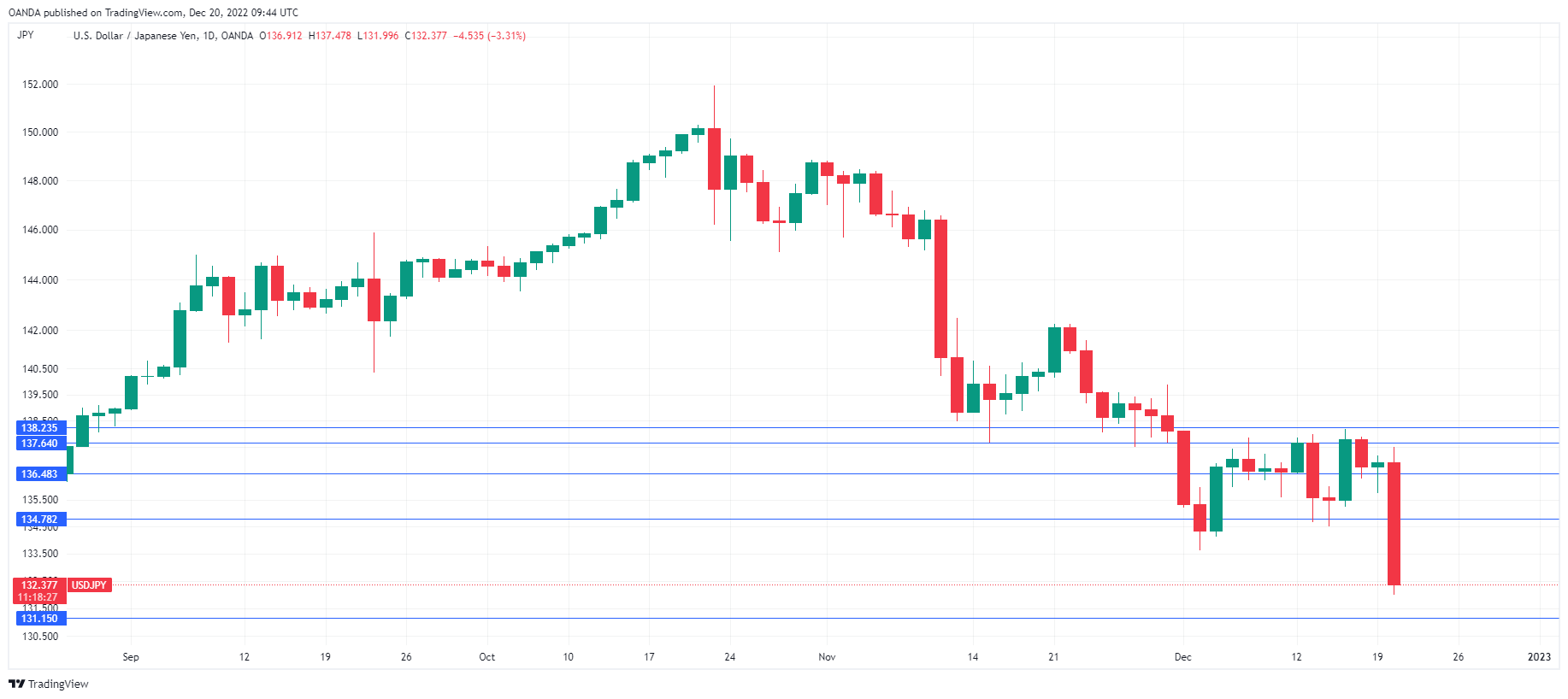
The Japanese yen has sent the dollar tumbling on Tuesday. USD/JPY has fallen 3.26% and is trading at 132.44 in Europe. In the Asian session, USD/JPY fell as low as 131.99 but has recovered slightly.
BoJ tweaks yield curve control
At the end of its policy meeting, the Bank of Japan stunned the markets with a change to its yield curve control (YCC). The BoJ announced it would widen the band around the 10-year bond yield to 50 basis points, up from 25 bp. The move allows long-term interest rates to rise higher and the reaction was deafening, as the yen soared and climbed to its highest level since August 11th. The move was completely unexpected, as the BoJ meeting was expected to be a sleeper with no policy changes. It was just yesterday that I wrote in these pages that the BoJ was not expected to change policy until the changing of the guard in April 2023, when Governor Kuroda steps down.
The BoJ move is certainly dramatic but needs to be kept in proportion. The BoJ is maintaining its YCC targets and said it would sharply increase bond purchases. This could be a signal that the Bank is tweaking its current ultra-loose policy and is not planning to withdraw stimulus.
The BOJ has staunchly defended its yield cap with massive bond purchases, and this has distorted the yield curve and fueled a sharp drop in the yen, which has contributed to higher costs for imports of raw materials. BoJ policy makers may have become uncomfortable with these side effects and felt that the time was right to take a small step towards normalisation. This ‘baby step’ packed a massive punch as seen in the yen’s reaction, and the markets will be looking for hints at further moves from Governor Kuroda as his term winds down.
USD/JPY Technical
- USD/JPY has broken below several support levels. The next support level is 131.13