

Sample Category Title
Yen and JGB Yield Surge on BoJ Pivot Surprise
Yen rises strongly in Asian session after BoJ's surprise announcement of raising 10-year yield cap to 0.50%. Dollar is following closely as second, and then Swiss Franc, on risk aversion. For the same reason, Australian, and New Zealand Dollar are sold off as weakens, followed by Sterling. Canadian and Euro are mixed for now.
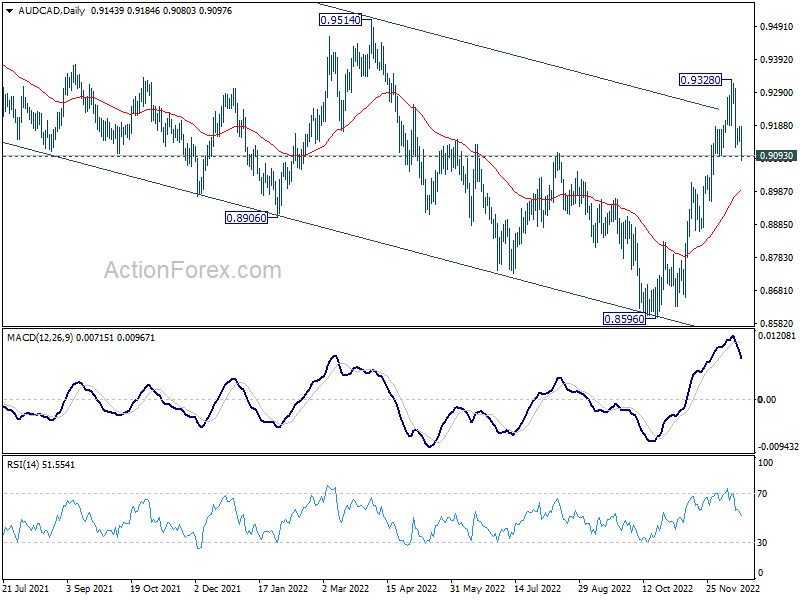
Technically, despite breaking near term falling channel resistance to 0.9328, AUD/CAD quickly retreated back inside the channel. As short term top was probably formed and deeper fall should be seen back to 4 hour 55 EMA (now at 0.8984), and possibly below. The development suggests that Aussie is going to underperform Canadian if rallies in Yen and, to a lesser extent, Dollar intensify.
In Asia, at the time of writing, Nikkei is down -2.51%. Hong Kong HSI is down -1.92%. China Shanghai SSE is down -1.35%. Singapore Strait Times is down -0.21%. Japan 10-year JGB yield up sharply by -0.1635 to 0.419. Overnight, DOW dropped -0.49%. S&P 500 dropped -0.90%. NASDAQ dropped -1.49%. 10-year yield rose 0.099 to 3.581.
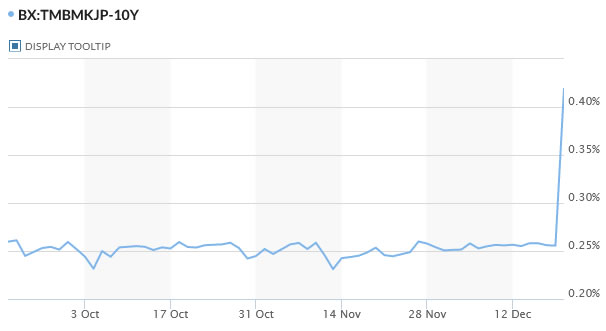
BoJ tweaks YCC to allow 10-yr yield to rise to 0.50%
BoJ surprises the markets today by widening the band of 10-year JGB yield from 0.25% to 0.50% today. At the same time, short term policy rate is kept unchanged at -0.10% as expected.
Under the yield curve control framework, the central bank will still continue to purchases JGBs without an upper limit to keep 10-year yield at around 0%. But now, the bank will offer to purchase 10-year JGB yields at 0.50% every business day through fixed-rate operations, effectively allowing 10-year yield to rise towards 0.50% level.
AUD/JPY and CAD/JPY downside breakout after BoJ surprise
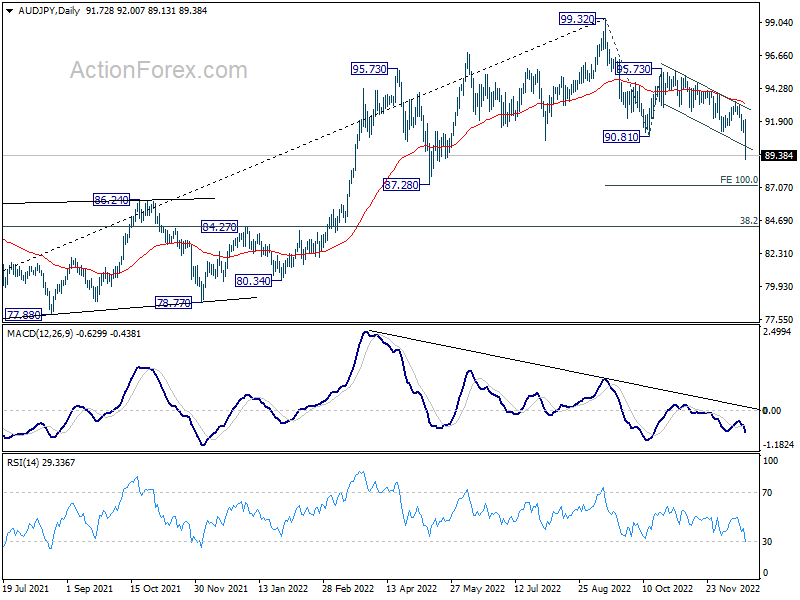
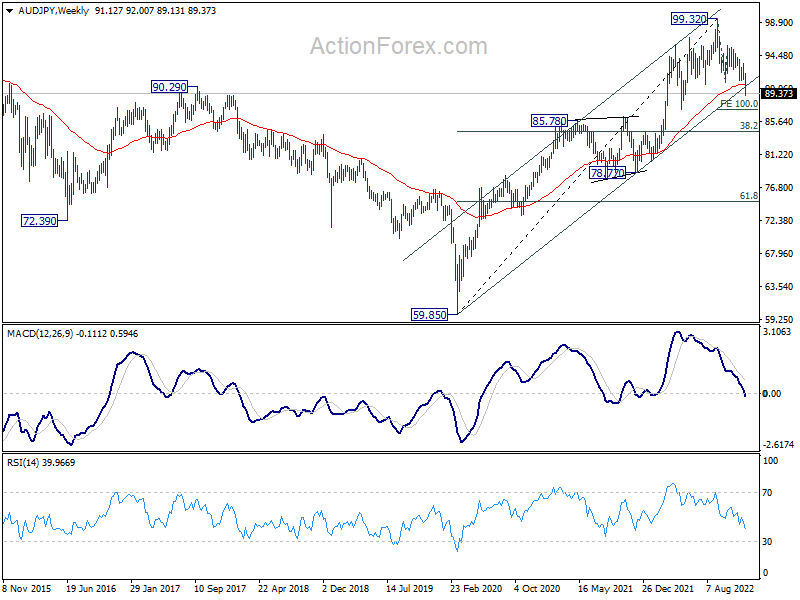
Yen surges broadly today after BoJ surprisingly raise 10-year yield cap from 0.25% to 0.50%. AUD/JPY finally breaks through 90.81 support decisively to resume the decline from 99.32. The strong break of a near term channel also indicates downside acceleration. Next near term target is 100% projection of 99.32 to 90.81 from 95.73 at 87.22
From a longer term point of view, the break of 55 week EMA and the channel support also affirms the case that AUD/JPY is corrective whole up trend from 2020 low at 59.85. Such decline from 99.32 would target 38.2% retracement of 59.85 to 99.32 at 84.24 before forming a bottom.
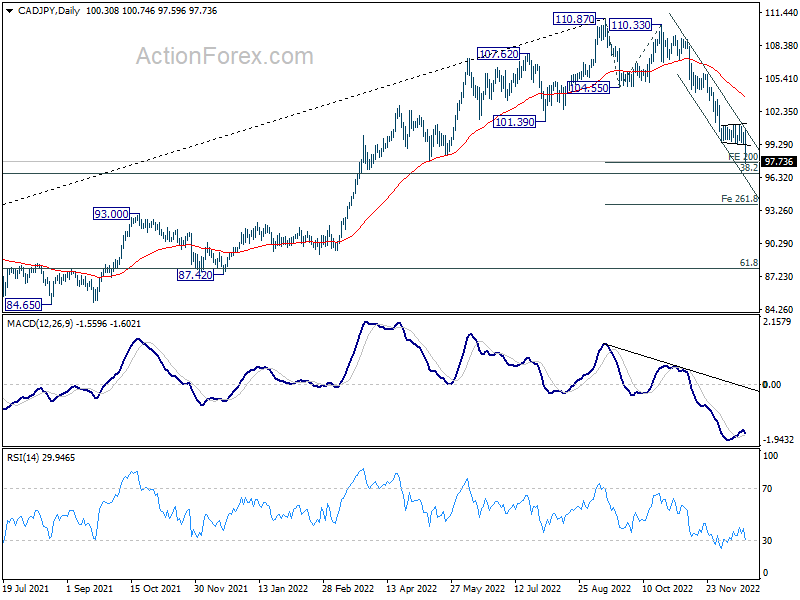
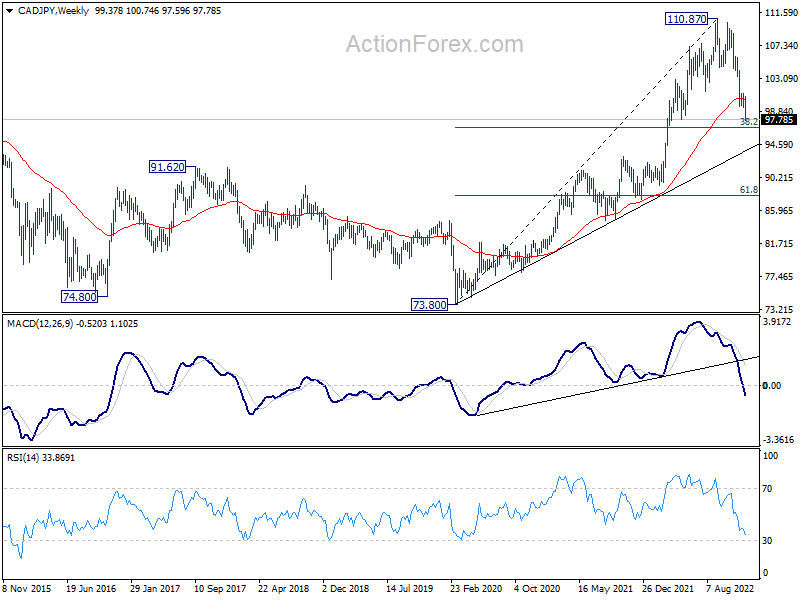
CAD/JPY also broke out of a near term expanding triangle to resume the whole fall from 110.87. Near term target of 200% projection of 110.87 to 104.55 from 110.33 at 97.69 is already met. Such decline is seen the correcting the up trend from 2020 low at 73.80. The question now is whether support from 38.2% retracement of 73.80 to 110.87 at 96.70 is strong enough to contain downside. If now, CAD/JPY accelerate further to 261.8% projection at 93.78.
RBA considered 50bps, 25bps, and no change at Dec meeting
Minutes of RBA's December 6 meeting indicates that the board has considered three interest rate options of a 50bps hike, a 25bps hike, and no change.
The argument for a 50bps increase stemmed from inflation remains "too high", and there were factors support a "more pre-emptive action". For a 25bps increase, the board acknowledged there had bee already a "significant cumulative increase" in interest rates and they would "begin to have more of an effect through the course of 2023". The arguments for now chance placed"further emphasis of the lagged effect" of prior rate increases.
Board members eventually decided that the case for 25bps increase was the"strongest one", as further hike was "likely to be necessary". Members also noted the "importance of acting consistently".
The minutes also reiterated that "the Board expects to increase interest rates further over the period ahead, but it is not on a pre-set path. Members noted that the size and timing of future interest rate increases would continue to be determined by the incoming data and the Board's assessment of the outlook for inflation and the labour market."
NZ ANZ business confidence fell to fresh record low
New Zealand ANZ business confidence declined from -57.1 to -70.2 in December, a new record low. Looking at some details, own activity outlook fell from -13.7 to -25.6. Export intentions dropped form -5.4 to -10.0. Investment intentions dropped form -8.1 to -20.5. Employment intentions dropped from -4.0 to -16.3. Pricing intentions rose from 58.5 to 59.1. Cost expectations declined form 88.7 to 84.4. Inflation expectations dropped from 6.39 to 6.23.
ANZ said: "The fall in business confidence is certainly dramatic, but while it's at a fresh record low, it would be incorrect to read this as an indication that any recession is likely to be unusually severe. Rather, it's unusually widely anticipated. It's a situation unprecedented in recent decades for a central bank to admit it is deliberately engineering a recession."
Looking ahead
Swiss trade balance, Germany PPI and Eurozone current account will be released in European session. later in the day, Canada will publish retail sales while US building permits and housing starts will be featured.
GBP/JPY Daily Outlook
Daily Pivots: (S1) 165.40; (P) 166.15; (R1) 167.09; More...
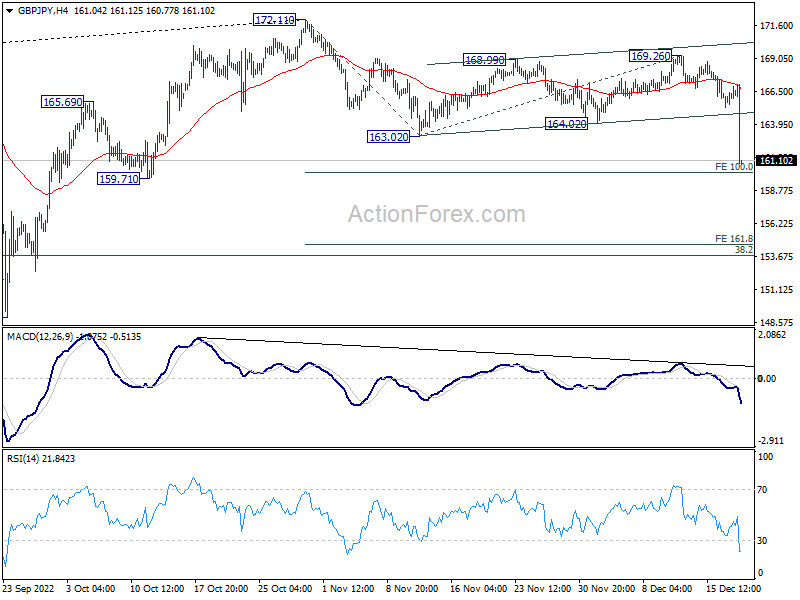
GBP/JPY's decline from 172.11 resumed by breaking through 163.02 support decisively. Intraday bias stays on the downside for 100% projection of 172.11 to 163.02 from 169.26 at 160.17. Firm break there will target 161.8% projection at 154.55 next. For now, outlook will stay bearish as long as 164.02 support turned resistance holds, in case of recovery.
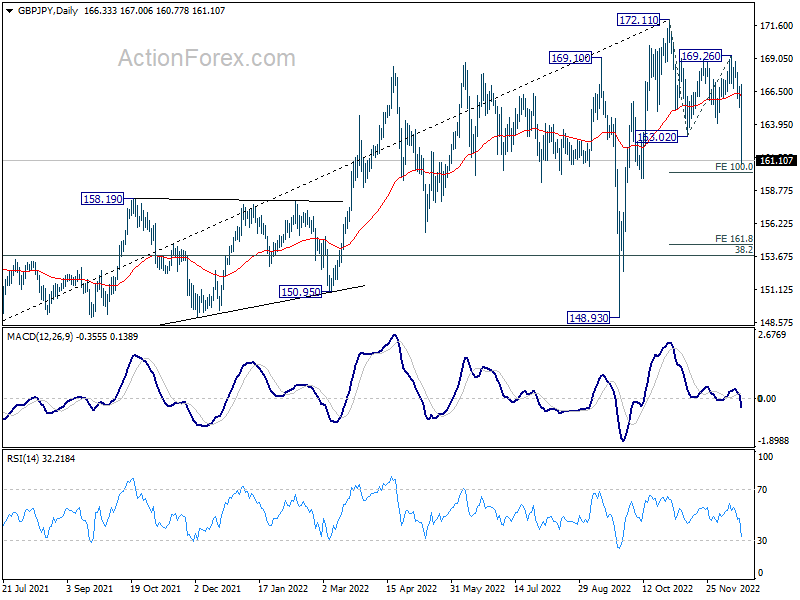
In the bigger picture, sustained break of 55 week EMA (now at 161.26) will confirm medium term topping at 172.11, on bearish divergence condition in weekly MACD. Fall from 172.11 should be correcting whole up trend from 123.94 (2020 low). Deeper decline should be seen to 38.2% retracement of 123.94 to 172.11 at 153.70 and possibly below. This will now remain the favored case as long as 55 day EMA (now at 166.11) holds.
Economic Indicators Update
| GMT | Ccy | Events | Actual | Forecast | Previous | Revised |
|---|---|---|---|---|---|---|
| 00:00 | NZD | ANZ Business Confidence Dec | -70.2 | -57.1 | ||
| 00:30 | AUD | RBA Minutes | ||||
| 03:00 | JPY | BoJ Interest Rate Decision | -0.10% | -0.10% | -0.10% | |
| 07:00 | CHF | Trade Balance (CHF) Nov | 3.27B | 4.14B | ||
| 07:00 | EUR | Germany PPI M/M Nov | -2.60% | -4.20% | ||
| 07:00 | EUR | Germany PPI Y/Y Nov | 30.00% | 34.50% | ||
| 09:00 | EUR | Eurozone Current Account (EUR) Oct | -10.3B | -8.1B | ||
| 13:30 | CAD | Retail Sales M/M Oct | 1.50% | -0.50% | ||
| 13:30 | CAD | Retail Sales ex Autos M/M Oct | 1.30% | -0.70% | ||
| 13:30 | USD | Building Permits Nov | 1.50M | 1.51M | ||
| 13:30 | USD | Housing Starts Nov | 1.40M | 1.43M | ||
| 15:00 | EUR | Eurozone Consumer Confidence Dec P | -23 | -24 |
Technical Outlook and Review
USD/JPY:
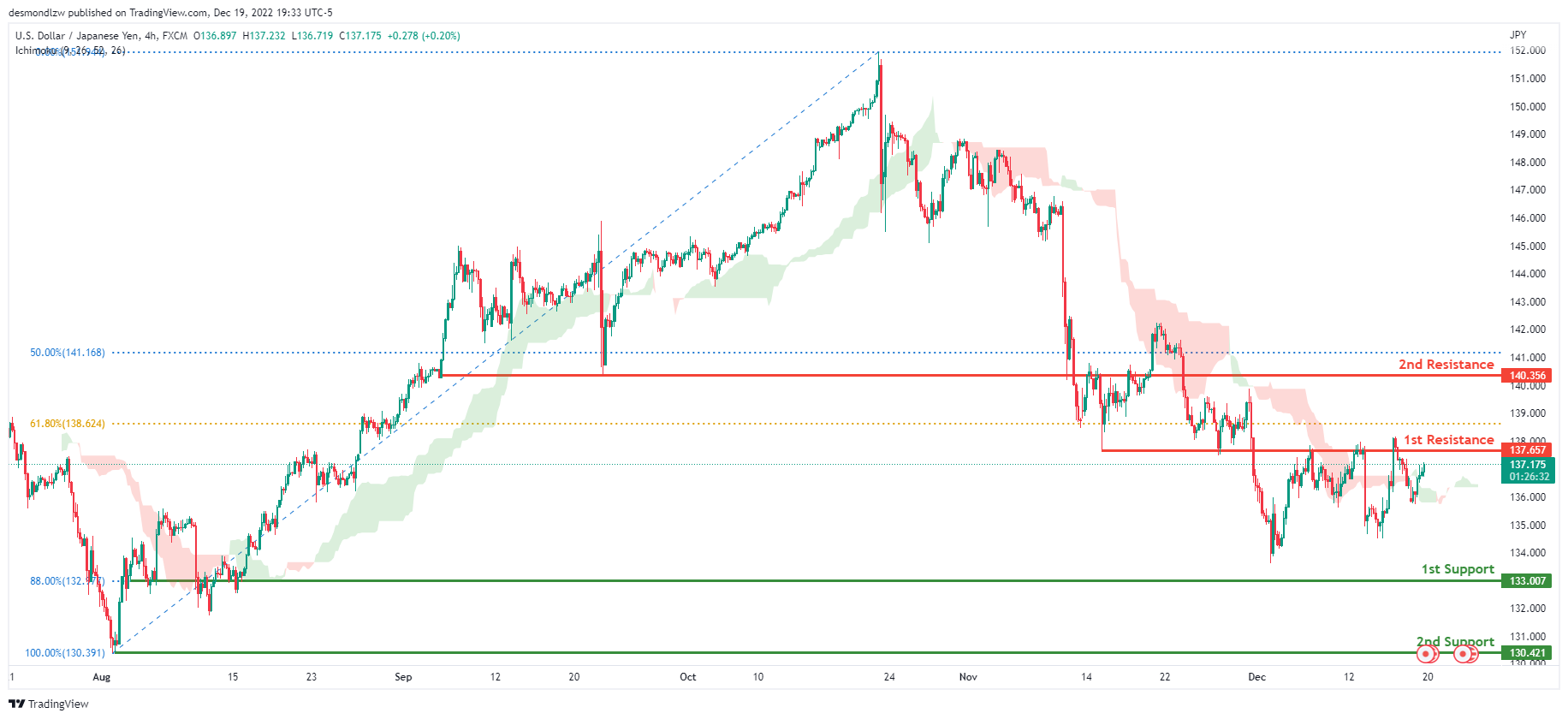
The current general bias for USDJPY on the H4 chart is bullish. To add confluence to this, the price is above the Ichimoku cloud which indicates a bullish market. If the bullish momentum continues, expect USDJPY to break the 1st resistance line at 137.657, where the 61.8% Fibonacci line and previous low are located before heading towards the 2nd resistance at 140.356, where the 50% Fibonacci line and previous swing low are. In an alternative scenario, price could head back down towards the 1st support at 133.007 where the 88% Fibonacci line is.
Areas of consideration:
- H4 time frame, 1st resistance at 137.657
- H4 time frame, 2nd resistance at 140.356
- H4 time frame, 1st support at 133.007
DXY:
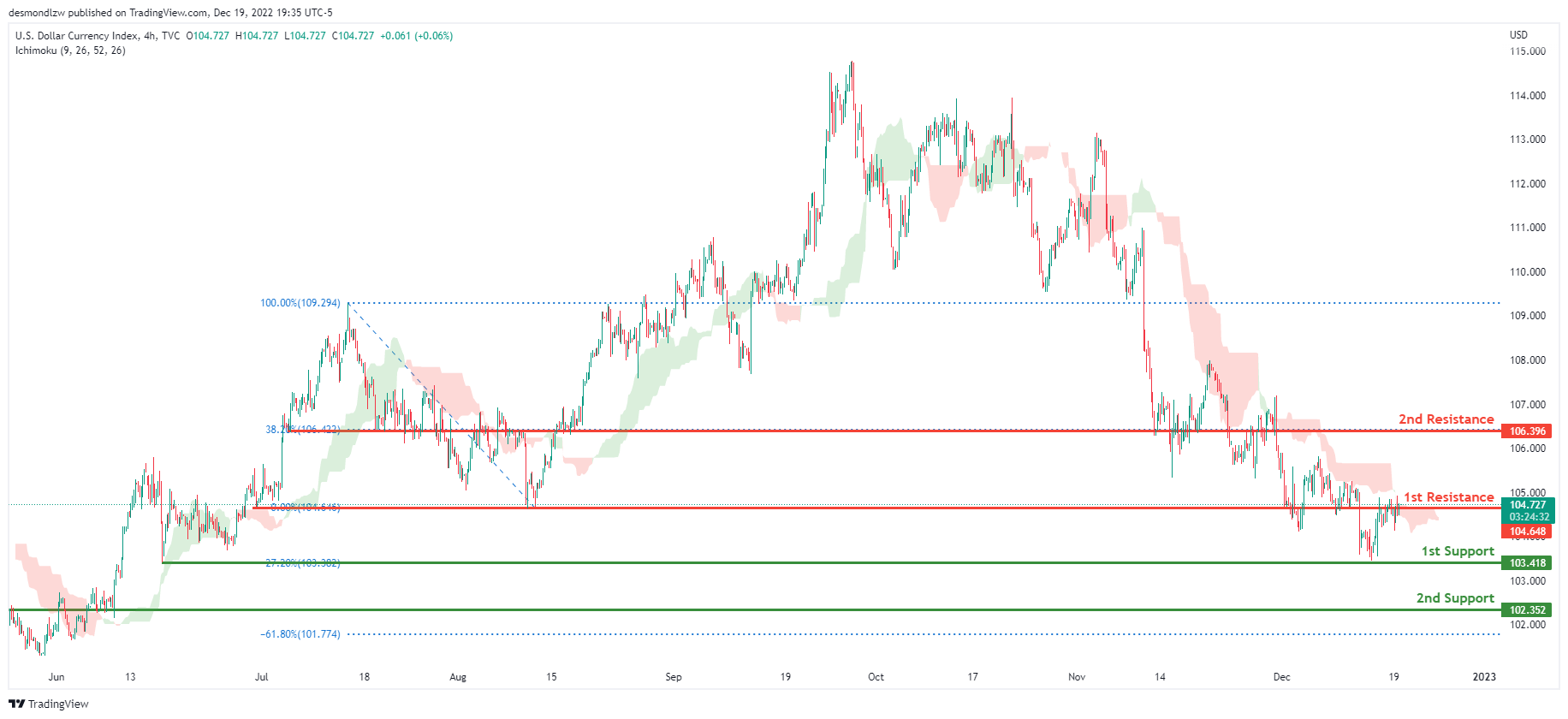
On the H4 chart, the overall bias for DXY is bearish. To add confluence to this, the price is below the Ichimoku cloud which indicates a bearish market. If this bearish momentum continues, expect the price to possibly break the 1st support line at 103.418, where the -27.2% Fibonacci expansion line is before heading towards the 2nd support at 102.352, where the -61.8% Fibonacci expansion line is. In an alternative scenario, price could head back up and break test the 1st resistance line resistance at 104.648, where the previous swing low is before heading towards the 2nd resistance at 106.396, where the 38.2% Fibonacci line is.
Areas of consideration:
- H4 time frame, 1st resistance at 104.648
- H4 time frame, 1st support at 103.418
- H4 time frame, 2nd support at 102.352
EUR/USD:
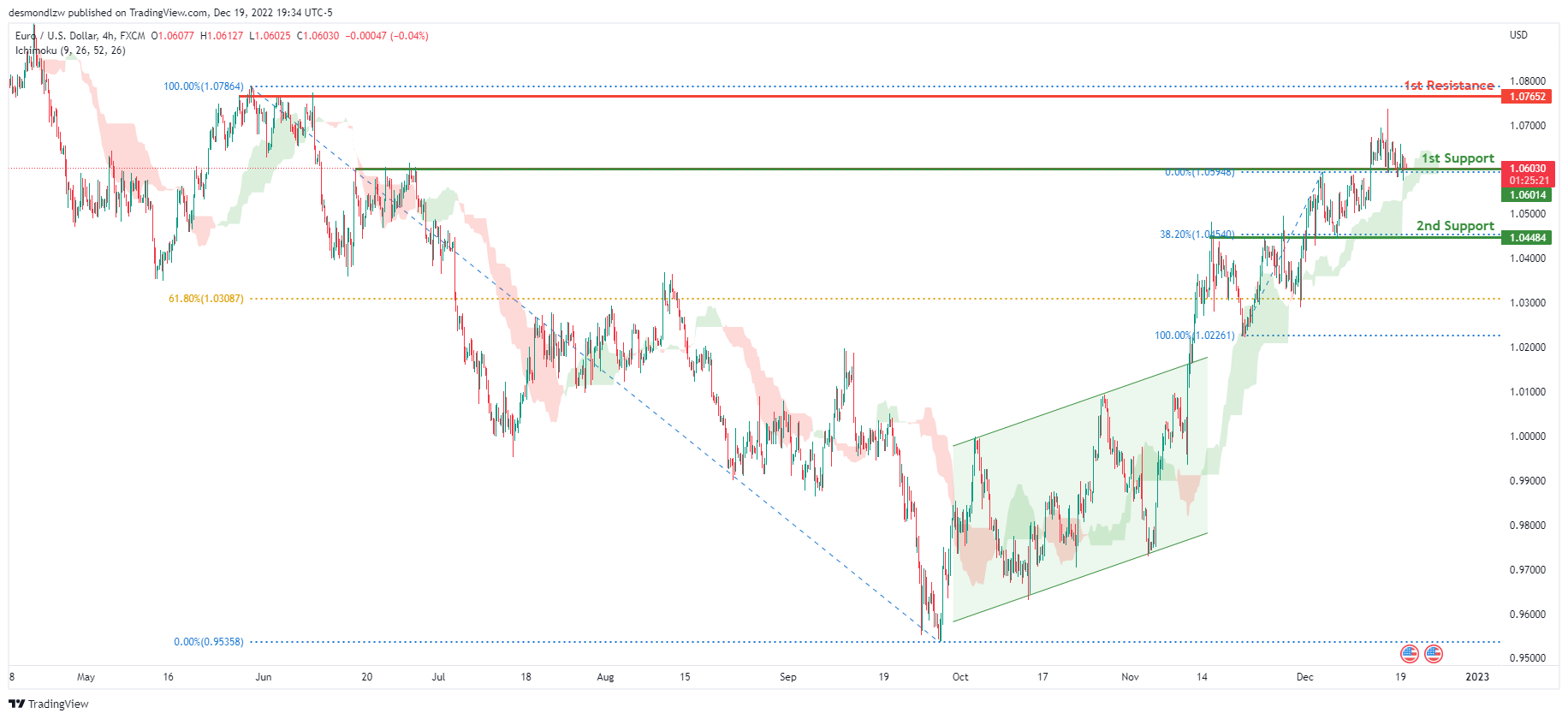
Looking at the H4 chart, my overall bias for EURUSD is bullish due to the current price being above the Ichimoku cloud, indicating a bullish market. To add confluence to this bias, price has also broken above the ascending bullish channel. If this bullish momentum continues, expect the price to possibly head towards the 1st resistance at 1.07652, where the previous swing high is. In an alternate scenario, price could possibly head back down to break the 1st support level at 1.06014, where the previous swing high and 78.6% Fibonacci line are located before heading towards the 2nd support at 1.04484, where the 38.2% Fibonacci line is.
Areas of consideration :
- H4 1st resistance at 1.07652
- H4 1st support at 1.06014
- H4 2nd support at 1.04484
GBP/USD:
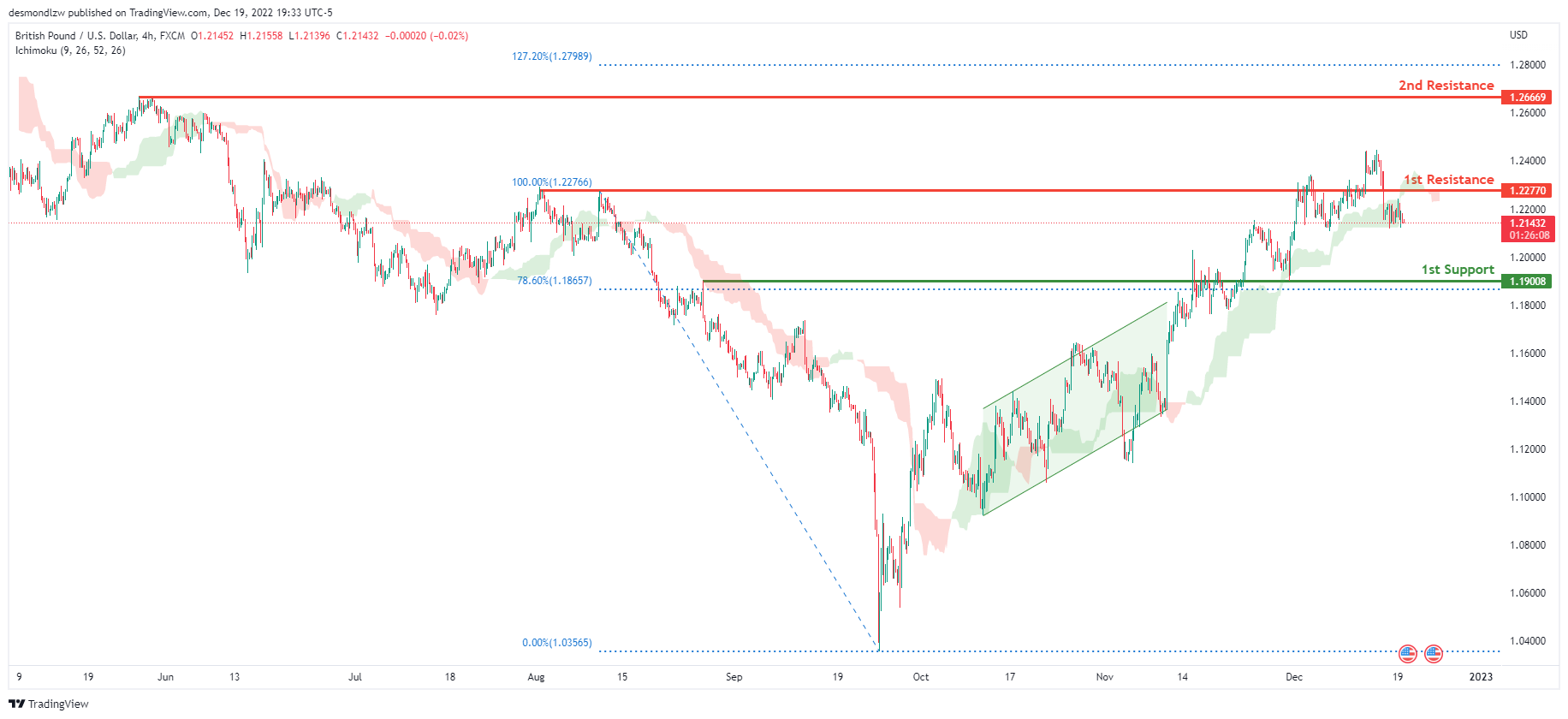
Looking at the H4 chart, my overall bias for GBPUSD is bullish due to the current price crossing above the Ichimoku cloud, indicating a bullish market. Expecting price to head back up to possibly continue heading towards the 1st resistance at 1.22770, where the previous swing high is. In an alternative scenario, price could possibly head back down to retest the 1st support at 1.19008, where the 78.6% Fibonacci line is.
Areas of consideration:
- H4 1st resistance at 1.22770
- H4 1st support at 1.19008
USD/CHF:
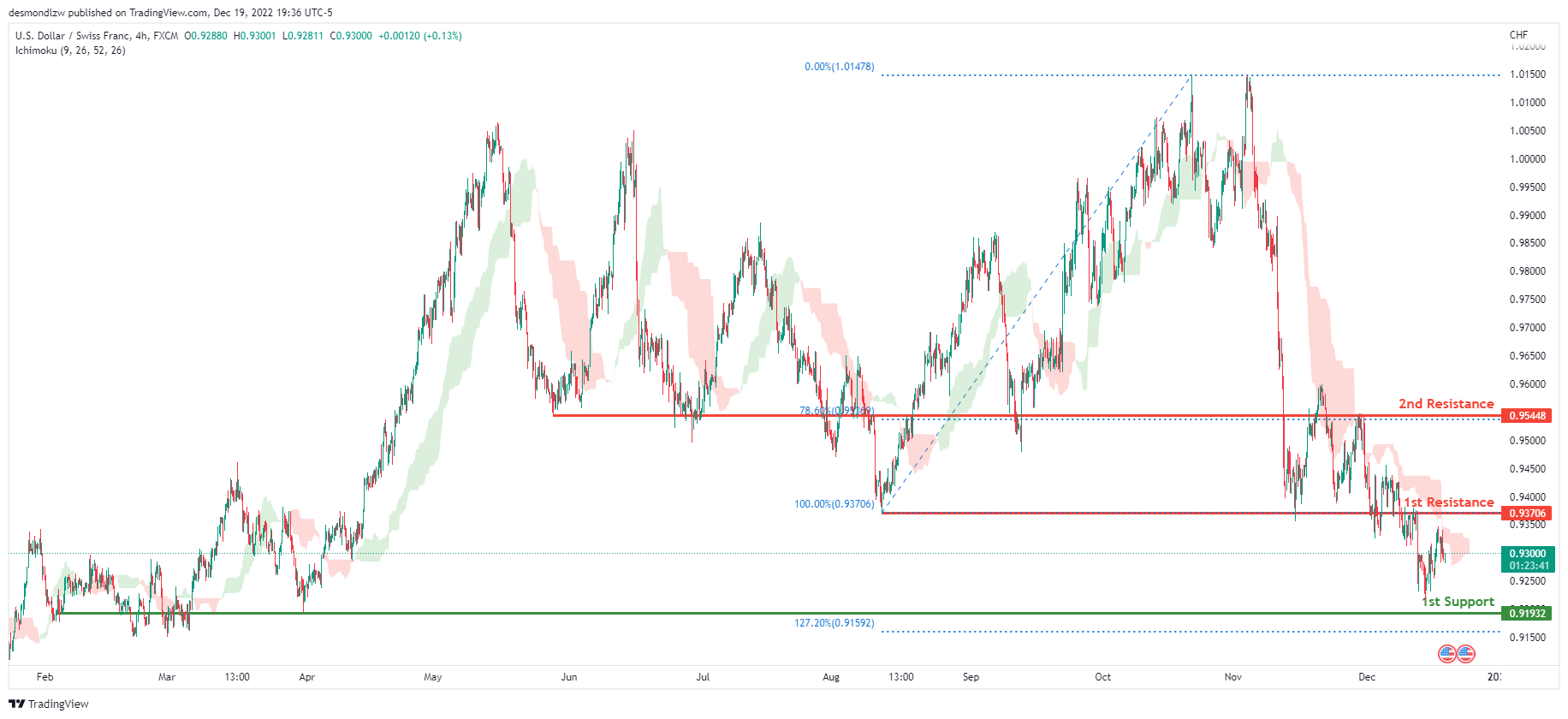
The overall bias for USDCHF on the H4 chart is bearish. In addition, the price is below the Ichimoku cloud, indicating a bearish market. If the current bearish trend continues, expect the price to head back down towards the 1st support line at 0.91932, where the previous swing low and 12.72% Fibonacci extension line is . In an alternative scenario, price could possibly head up towards the 1st resistance at 0.93706, where the previous swing low is .
Areas of consideration
- H4 1st support at 0.91932
- H4 1st resistance at 0.93706
XAU/USD (GOLD):
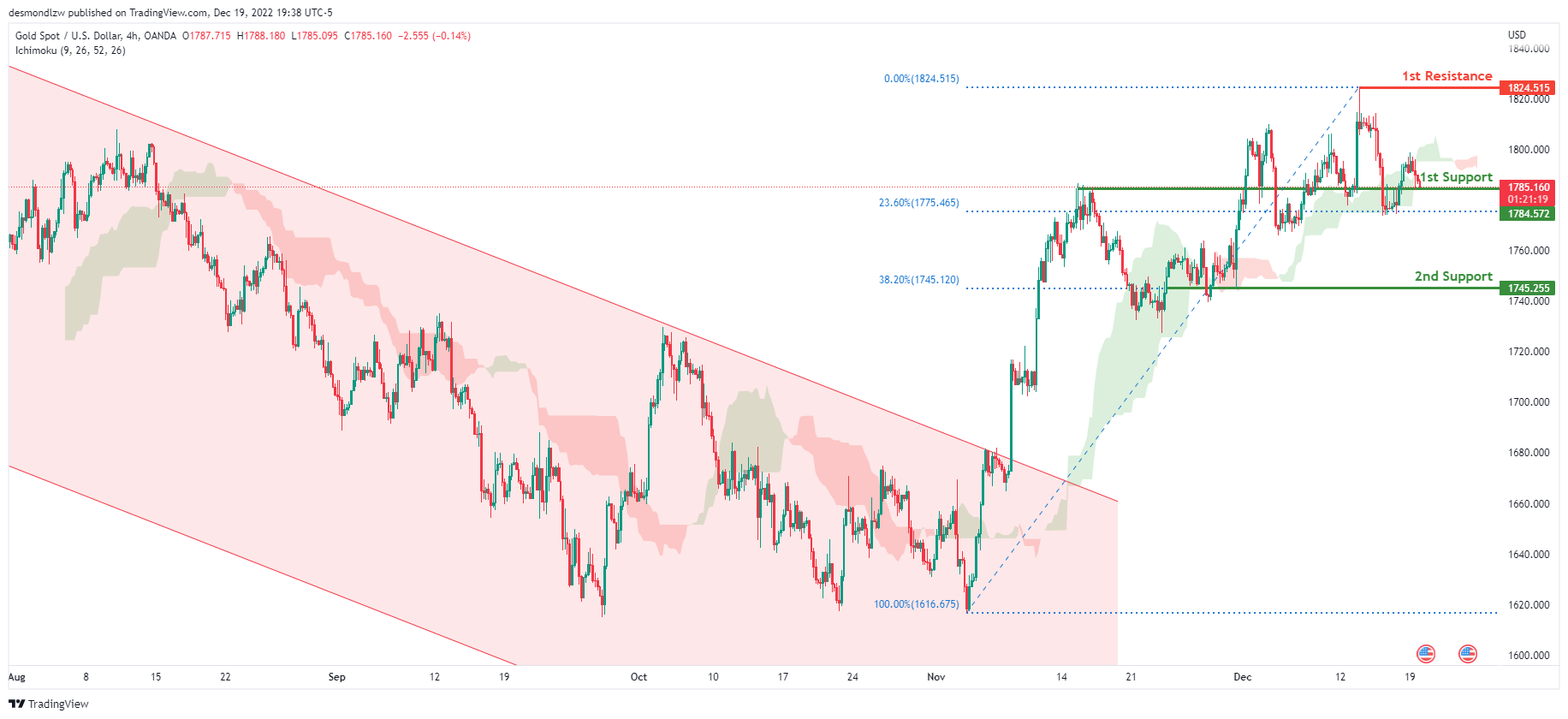
Looking at the H4 chart, my overall bias for XAUUSD is bullish due to the current price being above the Ichimoku cloud, indicating a bullish market. If this bullish momentum continues, expect the price to continue heading towards the 1st resistance at 1824.515 where the recent high is. In an alternative scenario, price could possibly head back down to break the 1st support at 1784.572, where the previous high is before heading towards the 2nd support at 1745.255, where the 38.2% Fibonacci line is.
Areas of consideration:
- H4 time frame, 1st resistance at 1824.515
- H4 time frame, 1st support at 1784.572
- H4 time frame, 2nd support at 1745.255
AUD/USD:
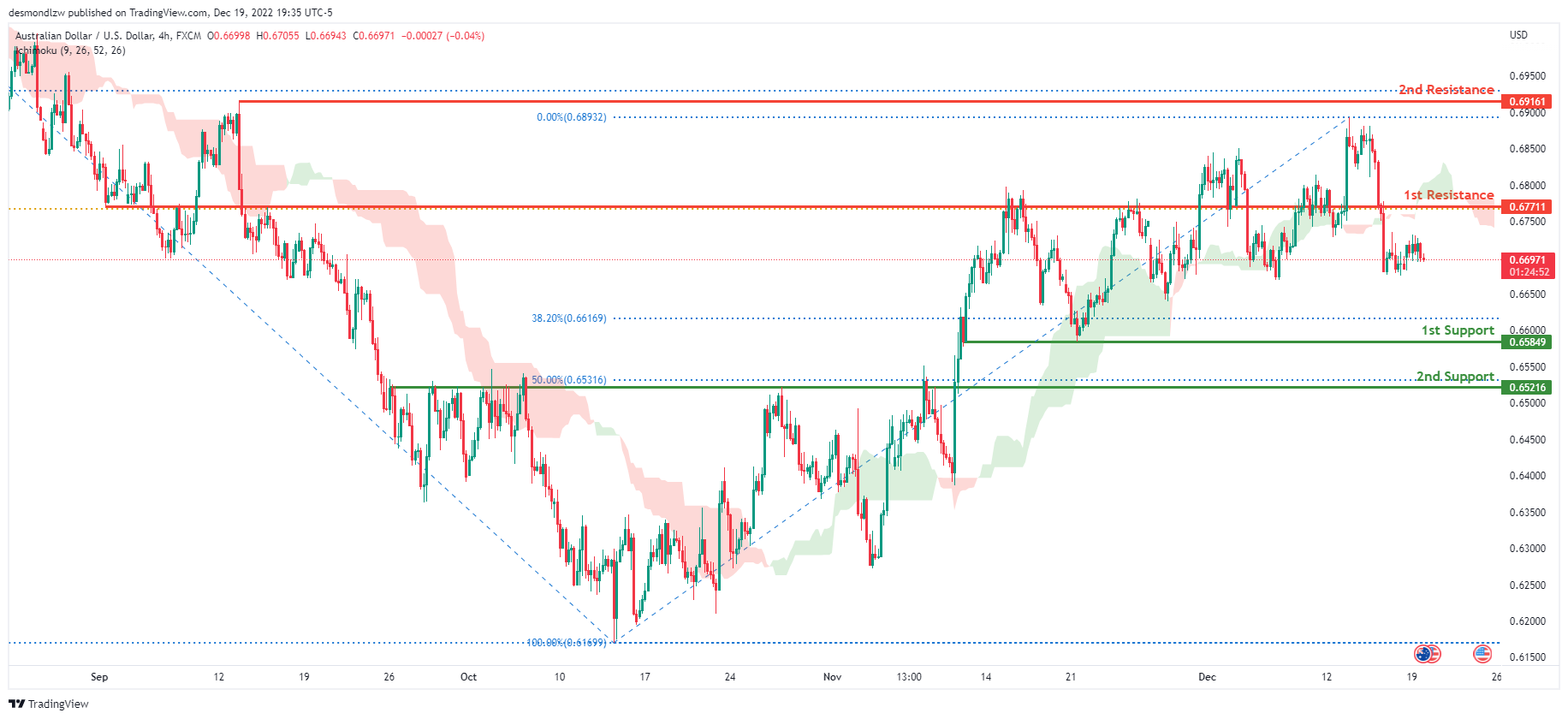
Looking at the H4 chart, my overall bias for AUDUSD is bearish due to the current price being below the Ichimoku cloud, indicating a bearish market. If this bearish momentum continues, expect the price to continue heading towards the 1st support at 0.65849, where the 78.6% Fibonacci line is. In an alternative scenario, price could possibly head back up towards the 1st resistance at 0.67711, where the 61.8% Fibonacci line is
Areas of consideration
- H4, 1st resistance at 0.67711
- H4, 1st support at 0.65849
NZD/USD:
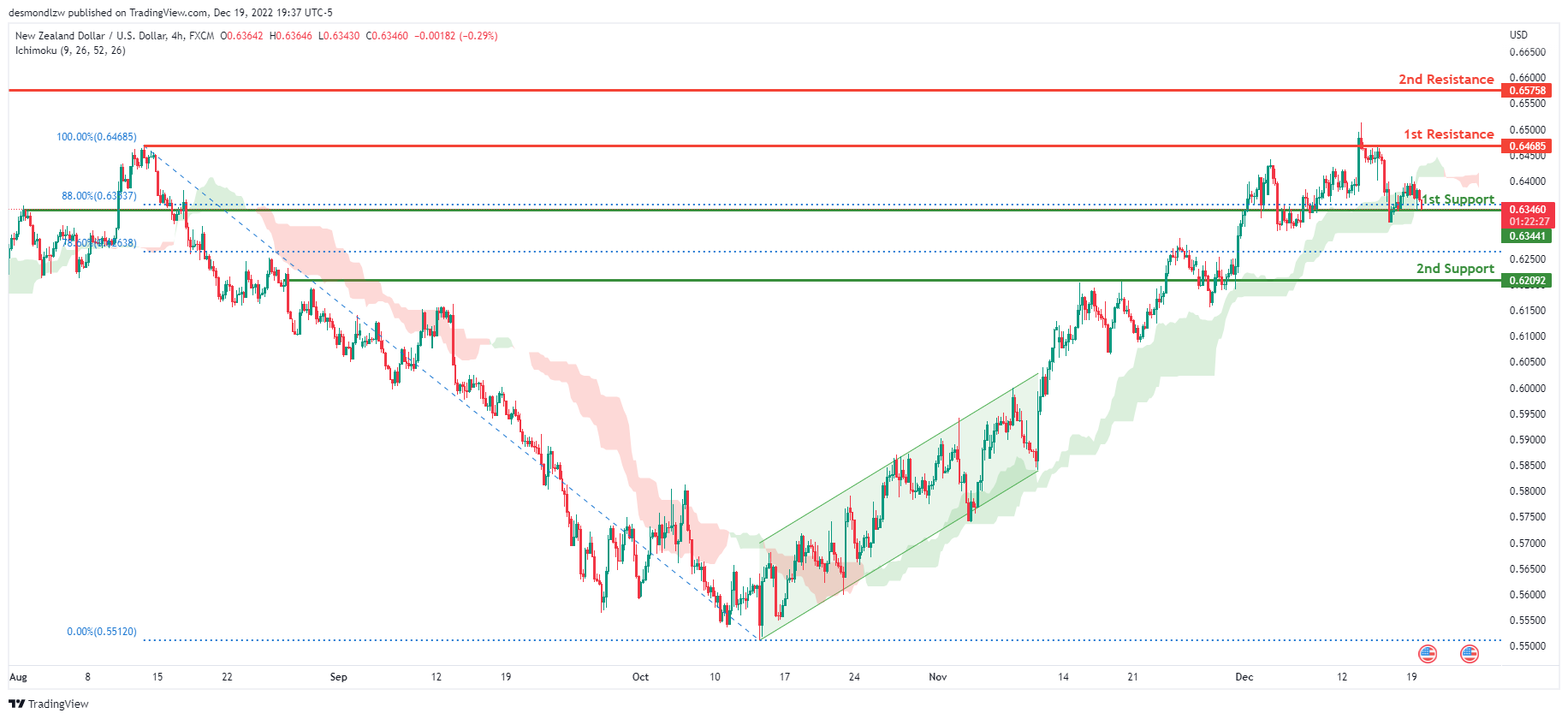
Looking at the H4 chart, my overall bias for NZDUSD is bullish due to the current price being above the Ichimoku cloud, indicating a bullish market.
To add confluence to this bias, price has broken out of the ascending channel. If this bullish momentum continues, expect the price to possibly break the 1st resistance line at 0.64685, where the previous swing high is before heading towards the 2nd resistance at 0.65758, where the previous swing high is. Alternatively, the price may head back down breaking the 1st support at 0.63441, where the 88% Fibonacci line is before heading towards the 2nd support line at 0.62092, where the 78.6% Fibonacci line is.
Areas of consideration:
- H4 time frame, 1st resistance at 0.64685
- H4 time frame, 2nd resistance at 0.65758
- H4 time frame, 1st support at 0.63441
- H4 time frame, 2nd support at 0.62092
USD/CAD:
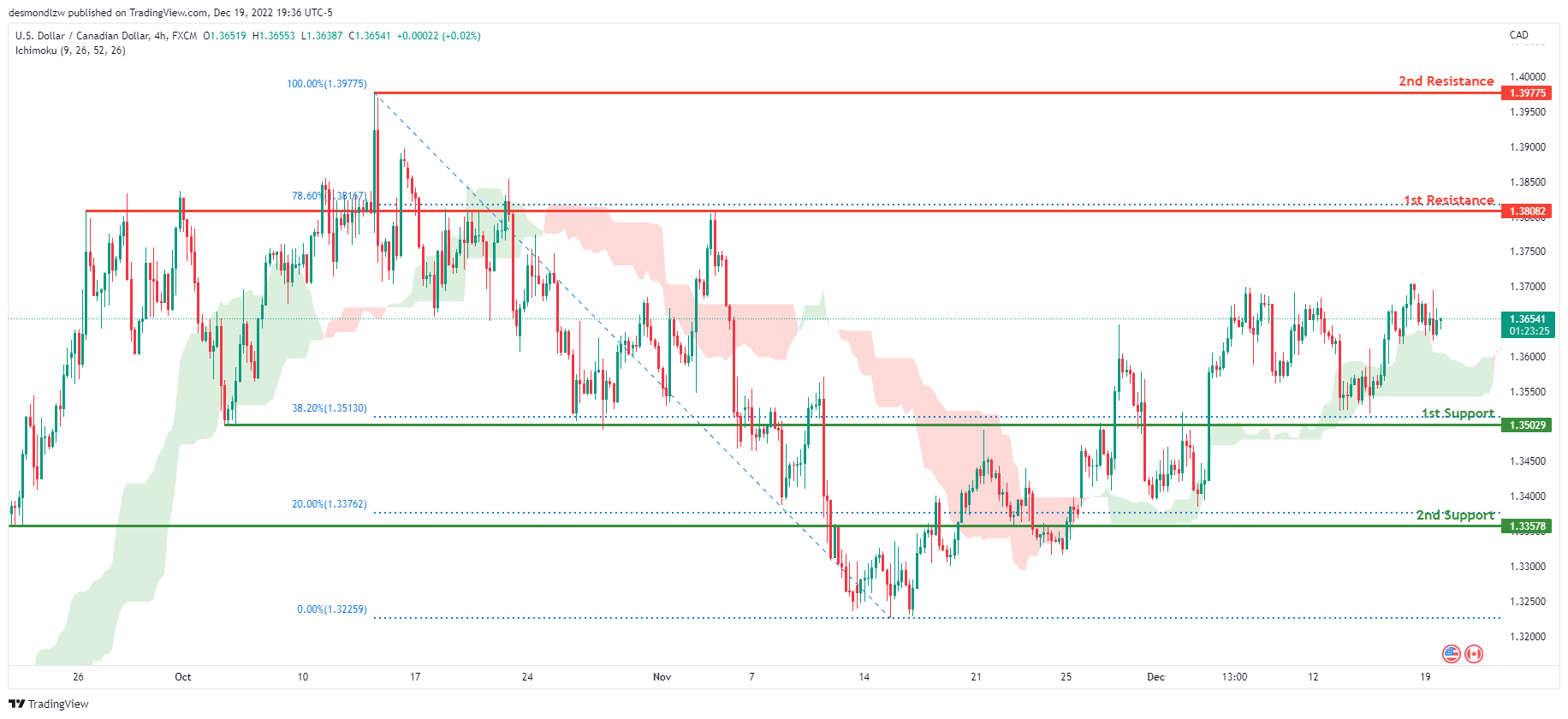
On the H4 chart, the overall bias for USDCAD is bullish. To add confluence to this, the price is crossing above the Ichimoku cloud which indicates a bullish market. If this bullish momentum continues, expect the price to head towards 1st resistance line at 1.38082, where the 78.6% Fibonacci line is. In an alternative scenario, price could head back down to retest the 1st support at 1.35029, where the 38.2% Fibonacci line is.
Areas of consideration:
- H4 time frame, 1st resistance at 1.38082
- H4 time frame, 2nd resistance at 1.39775
- H4 time frame, 1st support at 1.35029
OIL:
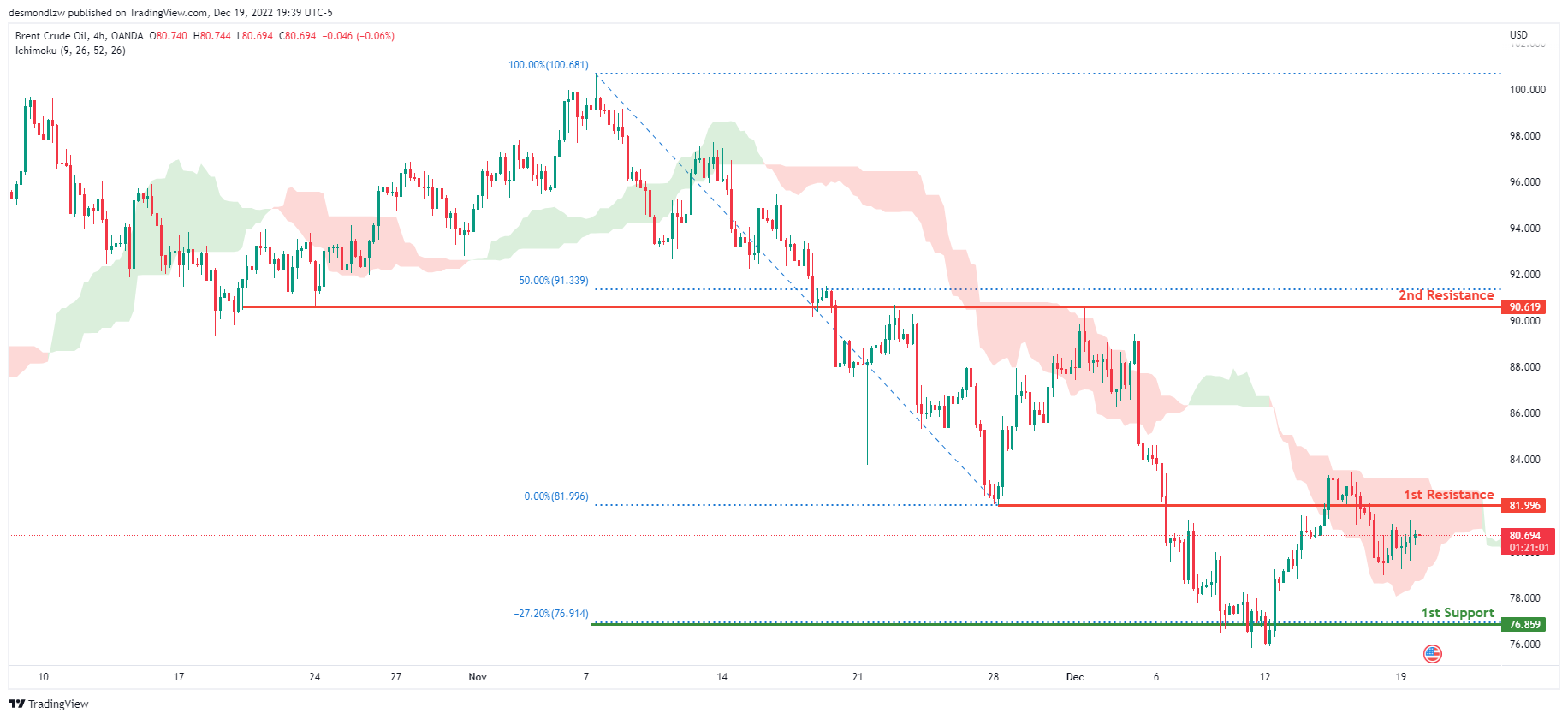
Looking at the H4 chart, my overall bias for BCOUSD is bearish due to the current price crossing below the Ichimoku cloud, indicating a bearish market. If this bearish momentum continues, expect the price to possibly head towards the 1st support line at 76.859, where the -27.2% Fibonacci expansion line is located. In an alternate scenario, price could possibly break the 1st resistance at 81.996, where the previous low is located., before heading towards the 2nd resistance at 90.619, where the 50% Fibonacci line is.
Areas of consideration:
- H4 time frame, 1st resistance at 81.996
- H4 time frame, 2nd resistance at 90.619
- H4 time frame, 1st support at 76.859
Dow Jones Industrial Average:
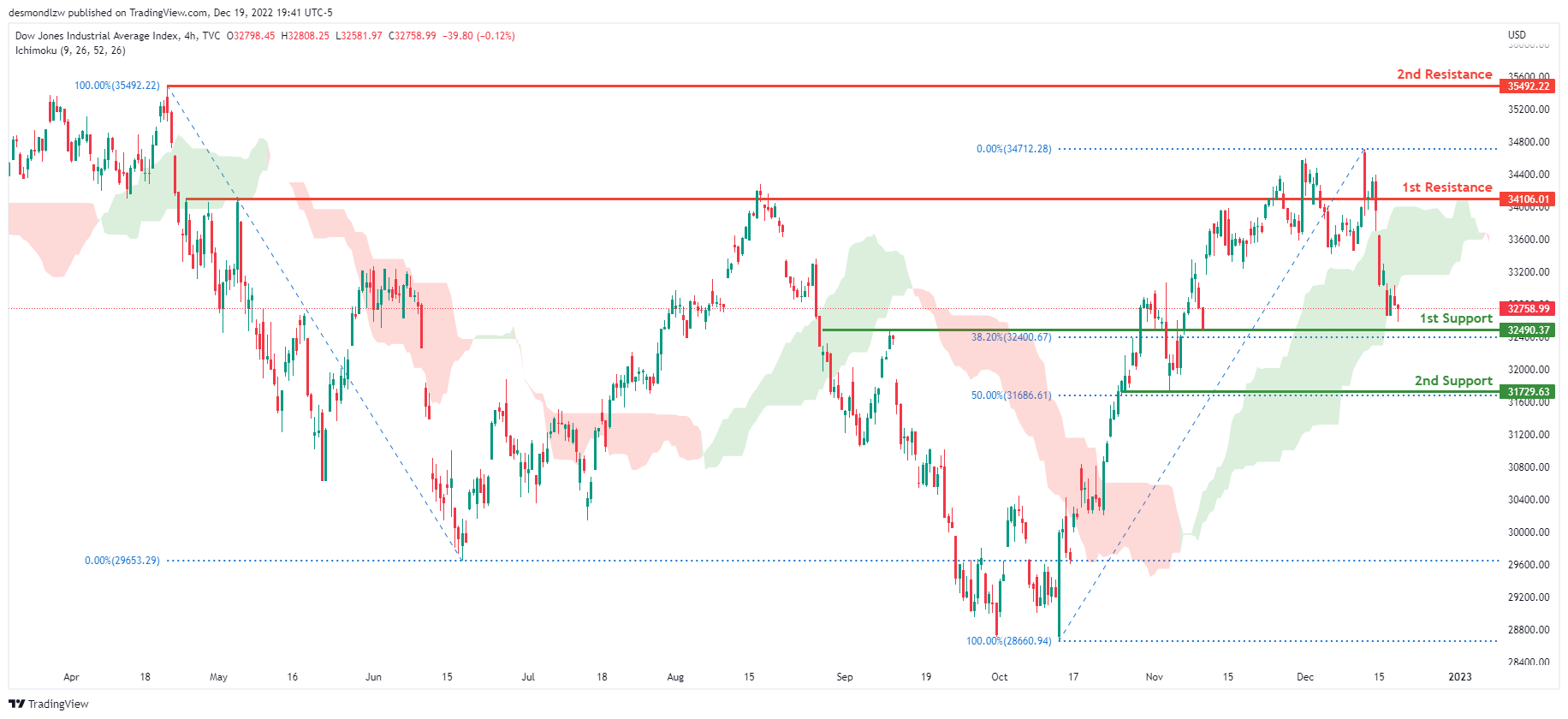
On the H4 chart, the overall bias for DJI is bearish . To add confluence to this, the price is crossing below the Ichimoku cloud which indicates a bearish market. If this bearish momentum continues, expect the price to head back down towards the 1st support at 32490.37, where the 61.8% Fibonacci line is. In an alternative scenario, price could possibly break the 1st resistance line at 34106.01, where the previous swing high is before heading towards the 2nd resistance line at 35492.22, where the previous swing high is.
Areas of consideration:
- H4 time frame, 1st support at 32490.37
- H4 time frame, 1st Resistance at 34106.01
- H4 time frame, 2nd Resistance at 35492.22
DAX:
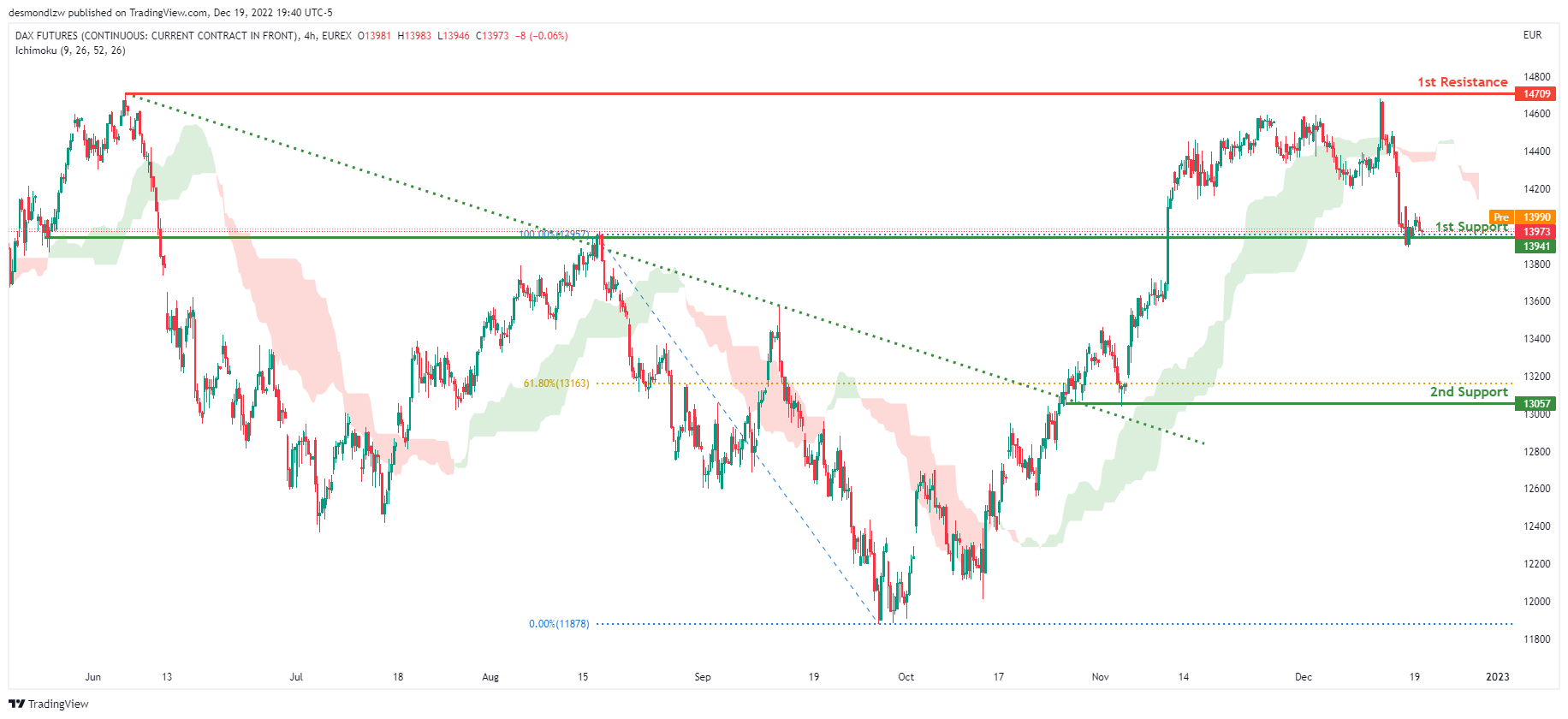
Looking at the H4 chart, my overall bias for DAX is bearish due to the current price being below the Ichimoku cloud, indicating a bearish market. If this bearish momentum continues, expect price to break the 1st support at 13941 where the previous swing high is before heading towards the 2nd support at 13057, where the 61.8% Fibonacci line is. In an alternative scenario, price could possibly head back up to retest the 1st resistance at 14709, where the previous swing high is.
Areas of consideration:
- H4 time frame, 1st resistance is at 14709
- H4 time frame, 1st support is at 13941
- H4 time frame, 2nd support is at 13057
ETHUSD:
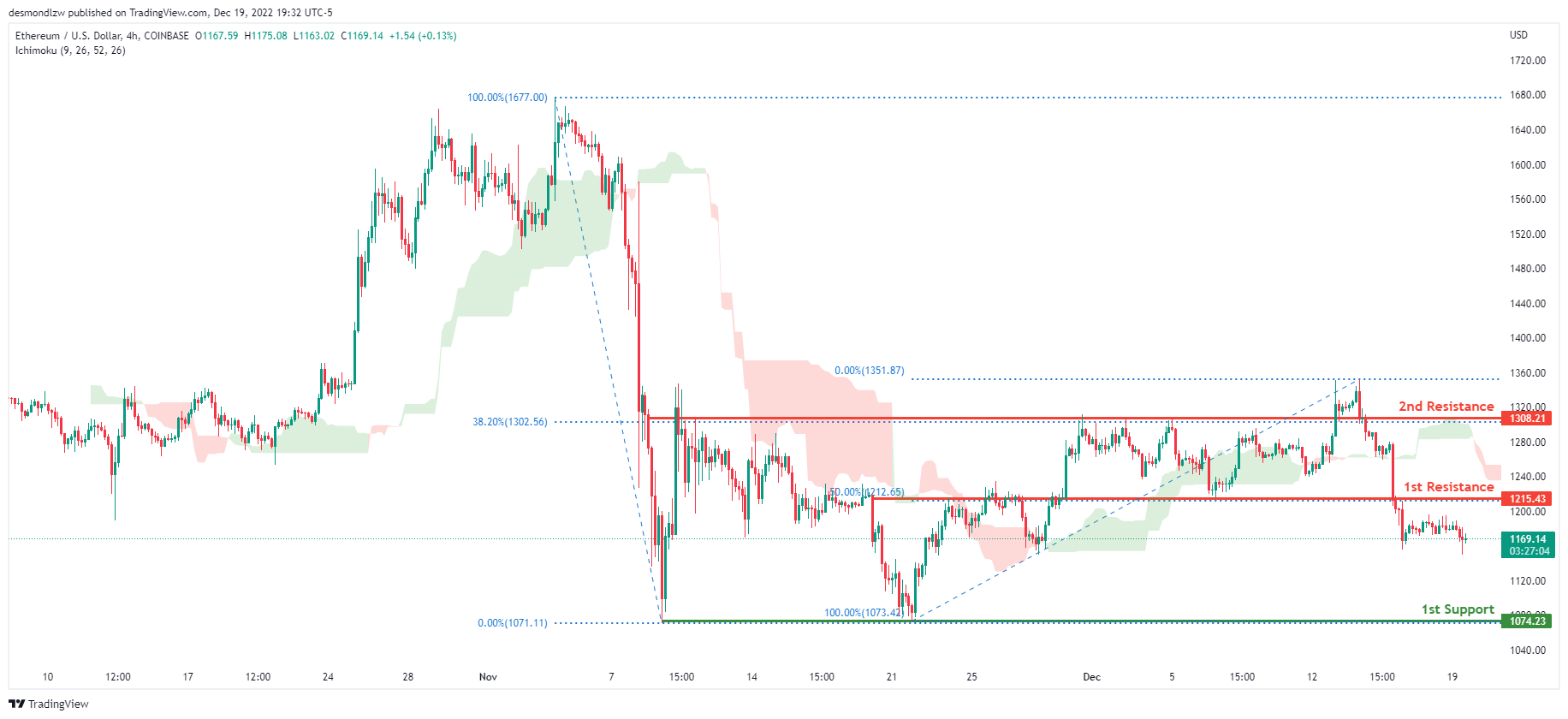
Looking at the H4 chart, my overall bias for ETHUSD is bearish due to the current price crossing below the Ichimoku cloud, indicating a bearish market. If this bearish momentum continues, expect price to head towards the 1st support at 1074.23, where the previous swing low is. In an alternative scenario, price could head back up to retest the 1st resistance at 1215.43, where the 50% Fibonacci line is.
Areas of consideration:
- H4 time frame, 1st resistance of 1215.43
- H4 time frame, 1st support at 1074.23
BTCUSD:
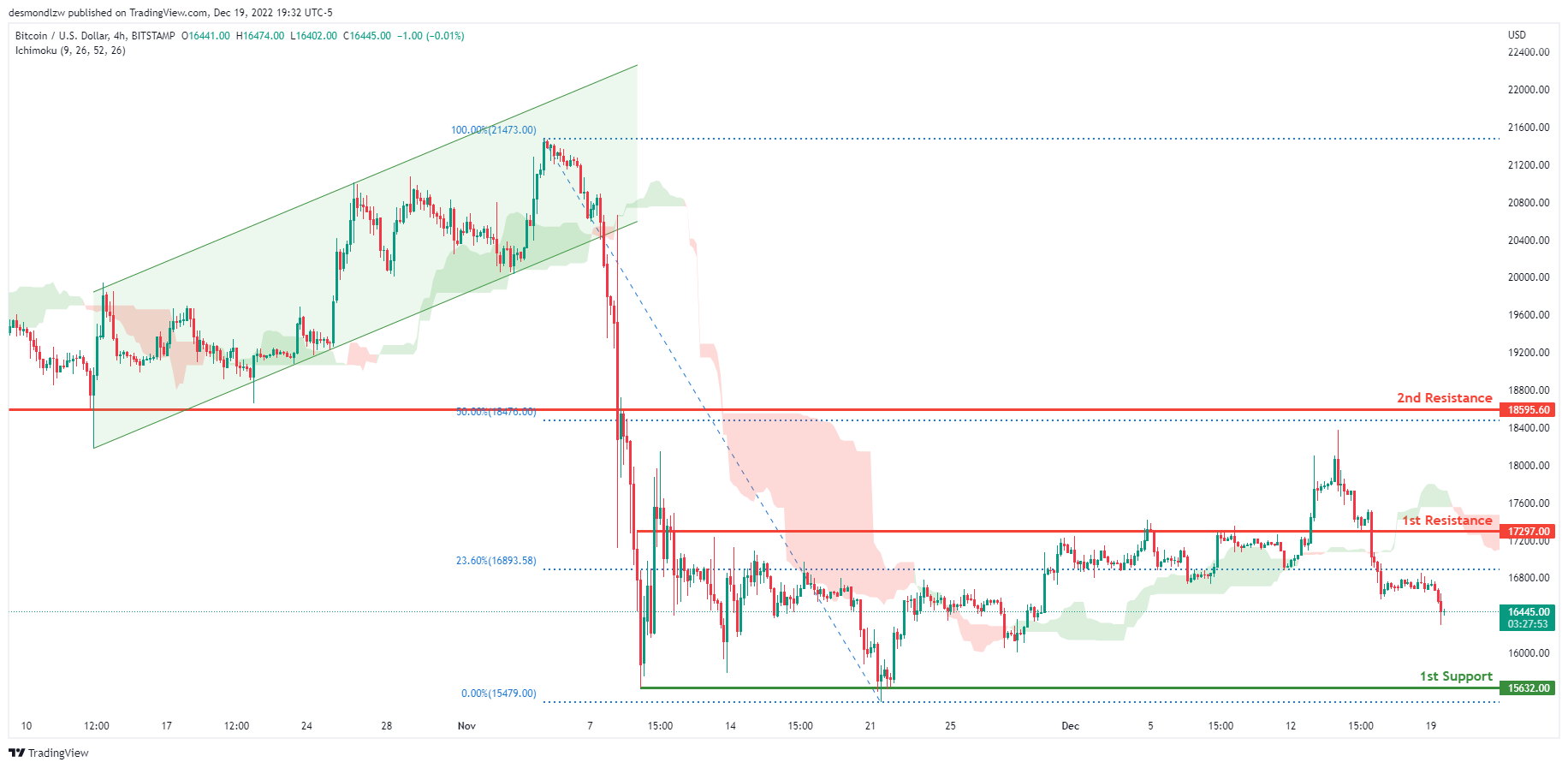
Looking at the H4 chart, my overall bias for BTCUSD is bearish due to the current price being below the Ichimoku cloud, indicating a bearish market. Expecting price to possibly continue heading towards the 1st support at 15632.00, where the previous swing low is. In an alternative scenario, price could possibly head up towards the 1st resistance at 17297.00, where the 23.6% Fibonacci line is.
Areas of consideration:
- H4 time frame, 1st resistance 17297.00
- H4 time frame, 1st support at 15632.00
S&P 500:
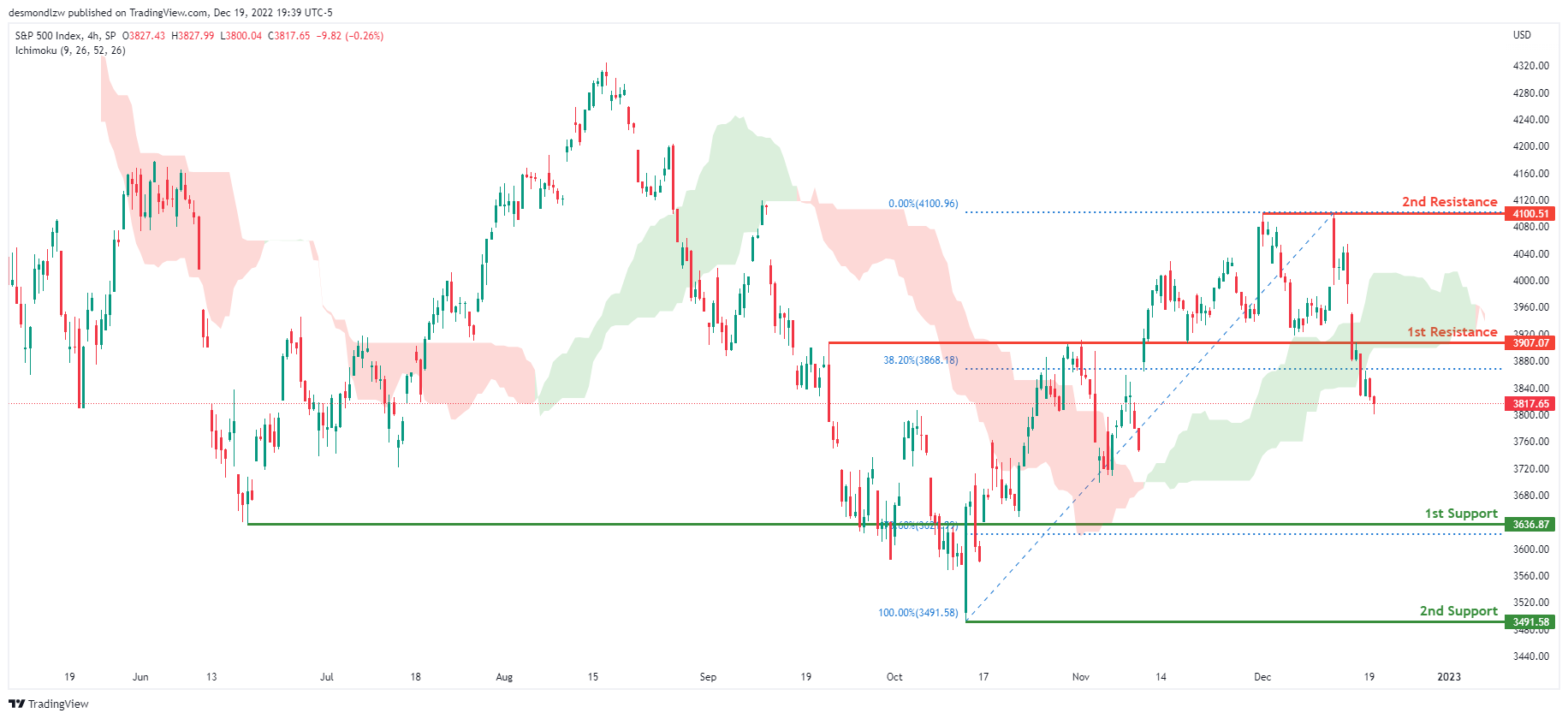
Looking at the H4 chart, my overall bias for S&P500 is bearish due to the current price being below the Ichimoku cloud, indicating a bearish market. If this bearish momentum continues, expect price to continue heading towards the 1st support at 3636.87, where the 78.6% Fibonacci line is. In an alternative scenario, price could possibly head back up to retest the 1st resistance at 3907.07, where the 38.2% Fibonacci line is.
Areas of consideration:
- H4 time frame, 1st support at 3636.87
- H4 time frame, 1st resistance at 3907.07
NZ ANZ business confidence fell to fresh record low
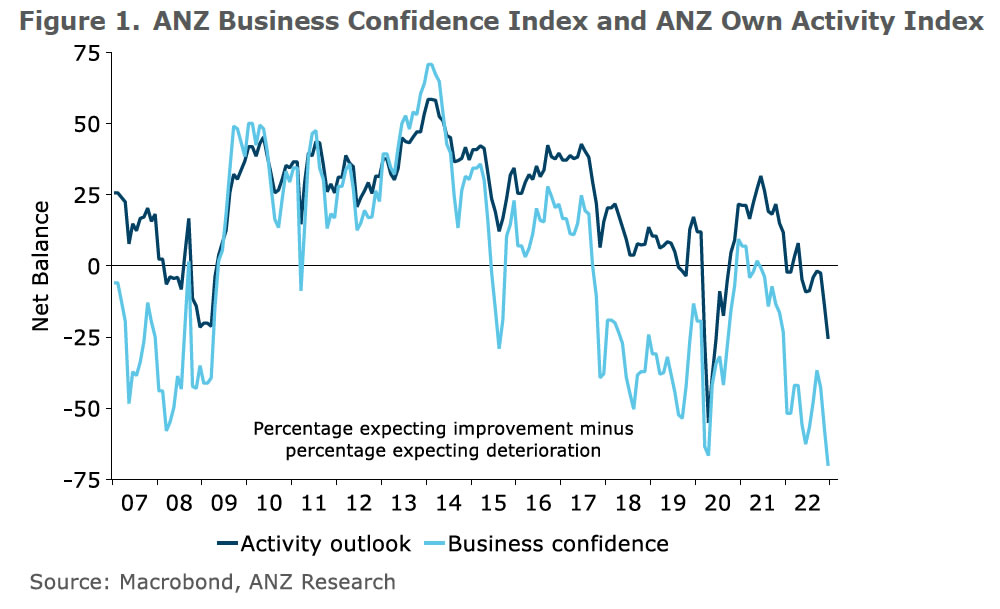
New Zealand ANZ business confidence declined from -57.1 to -70.2 in December, a new record low. Looking at some details, own activity outlook fell from -13.7 to -25.6. Export intentions dropped form -5.4 to -10.0. Investment intentions dropped form -8.1 to -20.5. Employment intentions dropped from -4.0 to -16.3. Pricing intentions rose from 58.5 to 59.1. Cost expectations declined form 88.7 to 84.4. Inflation expectations dropped from 6.39 to 6.23.
ANZ said: "The fall in business confidence is certainly dramatic, but while it's at a fresh record low, it would be incorrect to read this as an indication that any recession is likely to be unusually severe. Rather, it's unusually widely anticipated. It's a situation unprecedented in recent decades for a central bank to admit it is deliberately engineering a recession."
RBA considered 50bps, 25bps, and no change at Dec meeting
Minutes of RBA's December 6 meeting indicates that the board has considered three interest rate options of a 50bps hike, a 25bps hike, and no change.
The argument for a 50bps increase stemmed from inflation remains "too high", and there were factors support a "more pre-emptive action". For a 25bps increase, the board acknowledged there had bee already a "significant cumulative increase" in interest rates and they would "begin to have more of an effect through the course of 2023". The arguments for now chance placed"further emphasis of the lagged effect" of prior rate increases.
Board members eventually decided that the case for 25bps increase was the"strongest one", as further hike was "likely to be necessary". Members also noted the "importance of acting consistently".
The minutes also reiterated that "the Board expects to increase interest rates further over the period ahead, but it is not on a pre-set path. Members noted that the size and timing of future interest rate increases would continue to be determined by the incoming data and the Board's assessment of the outlook for inflation and the labour market."
(RBA) Minutes of the Monetary Policy Meeting of the Reserve Bank Board
Hybrid – 6 December 2022
Members participating
Philip Lowe (Governor and Chair), Michele Bullock (Deputy Governor), Mark Barnaba AM, Wendy Craik AM, Ian Harper AO, Carolyn Hewson AO, Steven Kennedy PSM, Carol Schwartz AO
Members had granted leave of absence to Alison Watkins AM, in accordance with section 18A of the Reserve Bank Act 1959.
Others participating
Luci Ellis (Assistant Governor, Economic), Christopher Kent (Assistant Governor, Financial Markets)
Anthony Dickman (Secretary), David Jacobs (Deputy Secretary)
Jonathan Kearns (Head, Domestic Markets Department), Marion Kohler (Head, Economic Analysis Department), Penelope Smith (Head, International Department)
International economic developments
Members commenced their discussion by observing that global inflation remained high. However, inflation appeared to have peaked in a number of countries as oil prices declined, supply-chain pressures eased and economic growth slowed. Activity in most advanced economies was growing only modestly, and had begun to contract in the United Kingdom. The Chinese economy also continued to face challenges, particularly due to ongoing COVID-19 containment measures there.
The monthly inflation data for October showed an easing in the pace of core inflation in the United States and Canada. Headline inflation had also eased as energy prices had fallen, although food price inflation remained strong. Forward indicators pointed to a further moderation in goods price inflation as supply chains continued to normalise. The data suggested that inventories were returning to more typical levels, supplier delivery times were becoming shorter and shipping costs were continuing to fall.
By contrast, inflation in the services sector remained high, underpinned by strong demand and rapid wages growth, and, while services inflation appeared to have levelled out recently, it was unlikely to abate quickly. Members also noted that the situation in Europe was less encouraging, with little sign of inflation easing amid very strong energy price rises.
Most advanced economies grew modestly in the September quarter, supported by the ongoing recovery in services consumption and business investment. The clearest signs of the effect of rising interest rates were in the housing sector; residential investment had contracted and housing prices had been steady or were declining across a range of economies. That said, surveyed business conditions had also softened over preceding months and investment intentions had fallen below longer run average levels. Slower growth in advanced economies had seen labour demand ease modestly and wages growth start to level out at a high rate, although labour markets remained very tight in most countries. Demand for exports from east Asian economies had also fallen in preceding months.
Members discussed the significant challenges facing the Chinese economy from the management of COVID-19. A number of large cities – including Beijing, Guangzhou and Chongqing – had imposed containment measures, which had slowed mobility and economic activity. While Chinese authorities had announced some adjustments to their COVID-19 containment strategy, the measures being implemented remained stringent by international standards.
Demand for housing in China remained weak, which was affecting residential construction and the financial viability of numerous developers. Private fixed-asset investment had been little changed in preceding months, with the weakness in property investment offsetting growth in the other components of investment. Members noted that the Chinese authorities had recently announced a package of measures to support financing of the property sector. While the package was unlikely to lift demand for property significantly, it had nevertheless helped boost market sentiment regarding the property sector in China; this, in turn, had supported a rise in iron ore prices over the prior month, although prices remained well below the levels seen earlier in the year.
Base metals prices had also risen over November. Energy prices had generally declined owing to a mild European winter and in response to the weak outlook for global growth. The main exception had been the price of gas in Europe, where a decline in October had been reversed in November with the onset of colder weather. Gas prices, however, were still well below their August peaks.
Domestic economic developments
Turning to the domestic economy, members observed that the recent data were largely in line with the assessment of the economy at the November meeting. Labour demand remained strong but employment growth had slowed in recent months. The tightness in the labour market and high inflation had led to a further increase in wages growth. This was particularly the case in the private sector, where the latest indicators of wages growth suggested that the balance of risks had shifted to the upside. The monthly Consumer Price Index (CPI) indicator for October showed that inflation had remained high and broadly based, although the annual rate of inflation had declined a little. The various indicators of activity suggested the economy had grown solidly in the September quarter, supported by household consumption, and demand appeared to have held up into the December quarter.
Members noted that average monthly employment growth over the three months to October had been half that in the first half of the year. With vacancies still very high, some of this slowing was likely to reflect the limited amount of spare capacity remaining in the labour market. Full-time employment had continued to outpace part-time employment, and average hours worked had risen strongly. The unemployment rate had edged back down to 3.4 per cent in October – the equal lowest rate since September 1974. Broader measures of spare capacity had also declined slightly over October, to remain around multi-decade lows, and the rate of participation in the labour force was close to its recent record high. Firms in the Bank's liaison program continued to report that labour availability remained a key challenge, although there were tentative signs this had started to ease a little.
Tight labour market conditions and high inflation were leading to a further pick-up in wages growth. The Wage Price Index had increased by 1 per cent in the September quarter, to be 3.1 per cent higher over the year, slightly above the Bank's forecast in November. Members observed that the pick-up in wages growth had been driven by the private sector, while wages growth in the public sector had remained relatively subdued. The weighted-average increase for those private sector jobs that had received a pay rise in the September quarter was 4.2 per cent; the flow-through of the Fair Work Commission's Annual Wage Review decision to minimum and most award rates of pay had contributed to this strong outcome. A range of more timely measures – such as recently lodged enterprise agreements and information from the Bank's liaison – indicated that wages growth had continued to pick up in the December quarter. Around 35 per cent of firms in liaison had reported wage increases of greater than 5 per cent in October and November.
The monthly CPI indicator for October confirmed that inflation had remained high into the December quarter but, at 6.9 per cent over the year, the outcome was a little below market expectations. Members acknowledged that the monthly series was still new and needed to be interpreted with caution. Some of the strength in services inflation expected in the December quarter – including in electricity prices, which are measured only once per quarter – would be picked up in the monthly series only in the final month of the quarter, which is released at the same time as the quarterly series. Fruit and vegetables prices had declined in October for the second successive month as production had recovered from the effects of the earlier floods; however, these prices were likely to increase again in the months ahead, following the most recent flooding in south-eastern Australia. Petrol prices had increased by 7 per cent, reflecting the unwinding of the temporary reduction in fuel excise. Rent inflation continued to rise sharply, but the pace of increase in home-building costs had slowed.
Some signs were emerging of easing supply-chain pressures flowing through into reduced actual and expected retail price inflation. In liaison, firms reported that some retailers had become less willing to accept price increase requests from suppliers and were not passing through cost increases in full, given concerns about remaining competitive. More generally, most measures of medium- and long-term inflation expectations remained consistent with the inflation target.
Members noted that, while household consumption had been supported by the strong labour market conditions, growth in consumption appeared to be easing. Retail sales had declined in October, but some other components of household consumption appeared to have held up. In liaison, retailers had reported mixed results for 'Black Friday' sales in November. More broadly, there was some evidence of shoppers trading down to less expensive stores and brands. Some retailers had expressed concern about the outlook for 2023, reflecting the effect of rising interest rates and cost-of-living pressures, together with weak consumer sentiment and the wealth effect of declining housing prices. These factors were also weighing on demand for new housing.
Housing prices had fallen further across most capital cities in November, to around 6 per cent below their recent peak, although they were still above pre-pandemic levels. Members noted that rental markets remained very tight and that this was flowing through to growth in CPI rents. A number of demand- and supply-side factors were contributing to the current tightness in the domestic rental market, with further large increases in rents expected over coming years as population growth picks up.
The National Accounts for the September quarter were scheduled to be released the day after the meeting. GDP was expected to have grown solidly in the quarter, with growth in domestic demand led by household consumption. Strong demand for overseas travel by Australians and the filling of order backlogs was expected to have resulted in strong growth in imports.
The outlook for business investment had softened a little but remained positive. The September quarter ABS Capital Expenditure Survey, conducted in October and November, indicated that non-mining firms were expected to increase investment in the 2022/23 financial year, driven by investment in both machinery and equipment and non-residential construction. Capacity utilisation remained very high across most industries. Members noted that business confidence had declined slightly in October, though reported business conditions remained above average.
International financial markets
Members observed that central banks had continued to raise policy rates and signal that further increases are likely to be needed to return inflation to target. However, some central banks, including the US Federal Reserve, were signalling reductions in the size of future increases, noting early signs of a moderation in economic activity and inflation; some had also cited the risk of over-tightening given lags in the transmission of monetary policy.
Market participants' expectations were still for policy rates to peak in mid-2023 and then gradually decline. Expectations for peaks were generally little changed over the prior month, but policy rates were expected to decline more quickly from the peak in response to lower-than-expected inflation in some economies, most notably the United States. Members observed that market expectations for peak policy rates were highest for countries where wages pressures had been strongest – including Canada, New Zealand, the United Kingdom and the United States. The Reserve Bank of New Zealand had communicated that a significant reduction in demand would be necessary to return inflation to target over the forecast period.
Members noted that the speed and strength of the various channels of the transmission of monetary policy differed across advanced economies. A key variation was the speed of pass-through of policy rates to the interest rates paid by households on their mortgages. In particular, average outstanding mortgage interest rates had increased at a faster rate, and by more, in Australia than in comparable countries, owing to the much higher share of variable-rate mortgages in Australia.
Longer term government bond yields had declined in most economies over the prior month, driven by the decline in longer term policy rate expectations amid signs that inflation may have peaked and the weakening economic outlook. Market-based measures of longer term inflation expectations were little changed at between 2 to 3 per cent in most advanced economies, including Australia. Bond yields had remained volatile, although less so than during the prior month.
Private sector financial conditions had also eased a little. Equity prices in most advanced economies had been rising since mid-October. In China, equity prices had risen with the announcement of further support for the property sector and signs of an easing of COVID-19 restrictions supporting sentiment.
Members noted that the US dollar had depreciated over the preceding month or so, most notably following lower-than-expected inflation in the United States. The Australian dollar had appreciated on a trade-weighted basis since mid-October alongside the lower US dollar, higher commodity prices and some improvement in risk sentiment, to be little changed since the start of 2022.
Domestic financial markets
Members noted that financial market pricing implied around a 75 per cent likelihood of a 25 basis point increase in the cash rate at the December meeting. The market-implied path for the cash rate was slightly lower over 2023 than it had been at the previous meeting. This decline had mostly occurred alongside movements in expectations for tightening by other central banks. Market pricing implied that the cash rate in Australia was expected to peak just above 3½ per cent in the second half of 2023. Market economists expected a similar peak in the cash rate, but that it would be reached by March next year.
Households with mortgages had continued to add to their offset and redraw accounts. Members were informed that these excess payments were accumulating at a slower rate than in the preceding two years when consumption opportunities had been constrained. In aggregate, between April and September 2022, households in all income quintiles had been adding to their excess payment buffers.
Taking into account the increase in mortgage rates implied by financial market pricing for the cash rate and the roll off of fixed-rate loans, required mortgage payments relative to income were expected to increase in 2023 to be equal to their previous peak in 2008. As a share of income, expected required payments in 2023 would also be close to the average level of actual mortgage payments – both required and excess mortgage payments – in 2022.
Equity prices had increased from early October. The total return on Australian equities had been positive since the start of 2022, in contrast to many other countries. In part, this reflected the larger share of resource companies and a smaller technology sector in the Australian equity market. Financial market inflation expectations in Australia were still high in the near term, but remained consistent with the inflation target in the medium and longer term.
Considerations for monetary policy
In considering the policy decision, members began by noting that inflation in Australia remained too high. That was largely attributable to global factors, but strong domestic demand relative to the ability of the economy to meet that demand was also playing a role. While the easing in the monthly pace of inflation had been welcome, the monthly indicator was still new and needed to be interpreted with caution, and some further strengthening in inflation was expected in coming months. However, a sustained decline in inflation was expected in 2023, as global supply-side issues continue to be resolved, the recent declines in commodity prices work their way through to consumer prices and growth in demand slows. Medium-term inflation expectations remained well anchored, both in Australia and abroad, reflecting expectations that central banks would do what was needed to reduce inflation. Members noted that it was important that this remained the case.
The Australian economy was continuing to grow solidly. Economic growth was, however, expected to moderate over the following year as the global economy slowed, the bounce-back in spending on services ran its course and growth in household consumption slowed in response to tighter financial conditions.
Members observed that the labour market remained very tight. The unemployment rate remained at its lowest level in nearly 50 years, and job vacancies and ads remained high. Wages growth had continued to pick up from the low rates of recent years and information from the Bank's liaison indicated that it was expected to pick up further. Members discussed the upside risk to wages growth, which stemmed largely from the tight labour market and high inflation.
The Board considered several options for the cash rate decision at the December meeting: a 50 basis point increase; a 25 basis point increase; or no change in the cash rate.
The arguments for a 50 basis point increase stemmed from the fact that inflation remained too high and the economy continued to operate with excess demand. Some other economies had earlier been in a similar situation to Australia and had subsequently seen wages growth pick up strongly, which risked high inflation becoming entrenched. In these cases, returning inflation to target was likely to involve a period of very weak demand, and possibly a recession. Australia was not yet in such a situation, but the inflation mindset was shifting, with firms more willing to put up prices than a year earlier and upside risks to wages growth potentially building. Moreover, the cash rate was not yet at a high level historically and, if the Board ultimately needed to move to a more restrictive policy stance, it would take some time for this to dampen demand. These factors supported an argument for taking more pre-emptive action.
The arguments for a 25 basis point increase also recognised the need to bring demand and supply in the economy more into balance, but acknowledged that there had already been a significant cumulative increase in interest rates and that the full effects of this adjustment would take time to occur. Moreover, it was possible that the policy changes might be transmitted to the economy more slowly than usual, given the higher share of mortgages taken out with fixed interest rates, households' large savings buffers and a summer holiday season without social restrictions for the first time in several years. Nevertheless, the policy changes would begin to have more of an effect through the course of 2023.
In addition, members noted that the share of household income being spent on required mortgage payments would reach around its previous highest level in late 2023, based on the market path for the cash rate and the effect of existing fixed-rate mortgages rolling off onto higher rates over the course of the following year. Furthermore, real incomes had been declining and housing prices and sales volumes had also fallen. Together, these factors were expected to weigh on consumption in the year ahead, while global demand was also likely to weaken. An easing of demand pressures in the economy and the ongoing resolution of supply-side problems could be expected to alleviate the risks of a price-wage spiral, particularly given that medium-term inflation expectations remained well anchored.
Finally, the arguments for no change in the cash rate placed further emphasis on the lagged effects of the large policy adjustment to date, and the value in proceeding cautiously in an uncertain environment. However, members noted that the Bank's most recent forecasts had indicated that, even with further increases in the cash rate as incorporated into the November forecasts, inflation was expected to take several years to return to the target range. Incoming information had not warranted a reassessment of that broad outlook. Moreover, members noted that no other central bank had yet paused.
Members acknowledged that there were arguments in favour of each of these courses of action. They concluded that the case to increase the cash rate by 25 basis points at the present meeting was the strongest one. A further increase in the cash rate was likely to be necessary to achieve a more sustainable balance of demand and supply, but there had already been a material increase in the cash rate in a short period of time and there were lags in the operation of policy. Members also noted the importance of acting consistently, and that shifting to either larger increases or pausing at this point with no clear impetus from the incoming data would create uncertainty about the Board's reaction function.
The Board expects to increase interest rates further over the period ahead, but it is not on a pre-set path. Members noted that the size and timing of future interest rate increases would continue to be determined by the incoming data and the Board's assessment of the outlook for inflation and the labour market.
Members noted that there was considerable uncertainty about the outlook. While household spending was expected to slow over the period ahead, the timing and extent of this slowdown was uncertain. Another source of uncertainty was the outlook for the global economy, which had deteriorated. The Board would also continue to play close attention to the price-setting behaviour of firms and the evolution of labour costs, given the importance of avoiding a price-wage spiral. The Board is seeking to keep the economy on an even keel as it returns inflation to target, but these uncertainties mean that there are a range of potential scenarios. Members agreed that the path to achieving the needed decline in inflation and achieving a soft landing for the economy remained a narrow one.
Recognising this uncertainty, members noted that a range of options for the cash rate could be considered again at upcoming meetings in 2023. The Board did not rule out returning to larger increases if the situation warranted. Conversely, the Board is prepared to keep the cash rate unchanged for a period while it assesses the state of the economy and the inflation outlook.
Members emphasised that the Board's priority is to re-establish low inflation and return inflation to the 2 to 3 per cent target range over time. High inflation damages the economy and makes life more difficult for people. The substantial cumulative increase in interest rates since May has been necessary to ensure that the current period of high inflation is only temporary. The Board remains resolute in its determination to return inflation to target and will do what is necessary to achieve that outcome.
The decision
The Board decided to increase the cash rate target by 25 basis points to 3.1 per cent. It also increased the interest rate on Exchange Settlement balances by 25 basis points to 3 per cent.
AUD/JPY and CAD/JPY downside breakout after BoJ surprise
Yen surges broadly today after BoJ surprisingly raise 10-year yield cap from 0.25% to 0.50%. AUD/JPY finally breaks through 90.81 support decisively to resume the decline from 99.32. The strong break of a near term channel also indicates downside acceleration. Next near term target is 100% projection of 99.32 to 90.81 from 95.73 at 87.22
From a longer term point of view, the break of 55 week EMA and the channel support also affirms the case that AUD/JPY is corrective whole up trend from 2020 low at 59.85. Such decline from 99.32 would target 38.2% retracement of 59.85 to 99.32 at 84.24 before forming a bottom.
CAD/JPY also broke out of a near term expanding triangle to resume the whole fall from 110.87. Near term target of 200% projection of 110.87 to 104.55 from 110.33 at 97.69 is already met. Such decline is seen the correcting the up trend from 2020 low at 73.80. The question now is whether support from 38.2% retracement of 73.80 to 110.87 at 96.70 is strong enough to contain downside. If now, CAD/JPY accelerate further to 261.8% projection at 93.78.
BoJ tweaks YCC to allow 10-yr yield to rise to 0.50%
BoJ surprises the markets today by widening the band of 10-year JGB yield from 0.25% to 0.50% today. At the same time, short term policy rate is kept unchanged at -0.10% as expected.
Under the yield curve control framework, the central bank will still continue to purchases JGBs without an upper limit to keep 10-year yield at around 0%. But now, the bank will offer to purchase 10-year JGB yields at 0.50% every business day through fixed-rate operations, effectively allowing 10-year yield to rise towards 0.50% level.
RBA Board Considered Pause in December
Despite the pause consideration the case was weak – expect another hike of 25 in February.
The Reserve Bank Board considered three options in its deliberations at the December Board meeting. The options were: 50 basis point increase in the cash rate; 25 basis point increase; or no increase .
This contrasts with recent meetings when only the 50 basis point and 25 basis point options were considered.
Given consistent rhetoric from the Bank about pausing it would come as no surprise that the Board did consider the pause. Indeed, it came as a bigger surprise that 50 basis points was still on the table.
The case for pausing rested on the theme of placing “further emphasis on the lagged effects of a large policy adjustment to date, and the value in proceeding cautiously in an uncertain environment.”
But this argument seemed to be quickly dismissed, noting that the Bank’s forecasts in the November SOMP were that, despite further increases in interest rates (forecasts are based on market pricing and analysts forecasts), “inflation was expected to take several years to return to the target range.” Most importantly, since the forecasts were released in early November “incoming information had not warranted a reassessment of that broad outlook.”
It is also interesting that the Board noted that “members noted that no other central bank had yet paused.”
As with the October and November meetings, the case for 25 basis points over 50 basis points relied on the lags associated with policy: “There had already been a significant cumulative increase in interest rates and the full effects of this adjustment would take time to occur.”
The impact of the policy changes was also likely to be delayed more than normal due to the predominance of fixed rate mortgages savings buffers; and the strong reopening effect that may extend into the summer holidays.
It was also once again noted that there were benefits in acting consistently.
The argument for 50 basis points was quite robust – inflation is too high in an economy operating with excess demand; some other economies had seen wages pick up strongly, risking entrenched inflation; the inflation mind-set was shifting; wages growth potentially building; and the cash rate is not at a high level historically.
Members concluded that the range of options considered would continue to be discussed at future meetings.
In the final paragraph the Board chose, for the first time in any recent final paragraph, to strongly emphasise the dangers of inflation further than we have seen in the Minutes of earlier meetings, “High inflation damages the economy and makes life more difficult for people” and of course the Board repeats the wording in an earlier paragraph that “The Board expects to increase interest rates further over the period ahead, but it is not on a pre set path.” That final qualification is consistent with the signal that the Board will continue to consider the three options going forward.
Despite the fact that the Board considered the “pause” option, these Minutes do not paint a dovish picture of the Board.
Having discussed a pause on multiple occasions in recent RBA communications it would be surprising that the pause option was not raised at the meeting.
But the key is that the current forecasts which have rates rising further are still pointing to a number of years where the inflation rate is outside the range. So unless there has been a change in the data since those November forecasts were released, the Board needs to press on.
The monthly inflation print that came after the November meeting was lower than expected but mainly due to supply side effects and the Board noted that they “needed to be interpreted with caution” while key services inflation was only going to be reported later in the quarter.
The key issue for the RBA is around demand and wages growth. The fear is noted in the “50” discussion, “inflation mind set was shifting… wages growth potentially building.”
The Minutes point out a number of very recent developments on wages – “around 35% of firms in liaison had reported wage increases of greater than 5% in October and November”; “liaison reported that labour availability remained a key challenge, although there were tentative signs this had started to ease a little.”
Since the Board meeting the November employment report highlighted those prospects: 3.4% unemployment; 107,100 jobs being added in October and November; 0.2% fall in the underemployment rate; record high participation and employment-to-population ratio indicating very tight labour markets.
Tighter labour markets than expected even at the November Board and the November forecasts in the SOMP raise the risk to the Board that the scenario we have seen in other countries could repeat in Australia (see the case for “50”).
This risk will be even more of a concern if, as the Board notes, resilience to the slowdown through household savings buffers; high fixed rate exposure from mortgages; and an ongoing reopening effect reflect solid spending momentum in the early months of 2023.
Conclusion
Westpac expects the economy to slow through 2023 with “stagnation” in the second half but does see some momentum extending into 2023.
When the Board comes to consider its options at the next meeting in February it will have the December quarter Inflation Report but will also be observing data for the holiday period that may be holding up better than expected.
Based on the analysis in the Minutes, that will set the scene for hikes in both February and March (December quarter Wages Report available for the March meeting) while the May meeting will also be confronted with uncomfortably high inflation for the March quarter and a central bank that is observing tight labour markets and rising wages pressures.
A hike in May will be appropriate following other central banks, who will already be on hold, and the clear evidence of the economic damage builds – time to pause at the June meeting for the rest of the year.
GBP/USD Trims Gains, Why Dips Could Be Limited
Key Highlights
- GBP/USD corrected lower sharply from the 1.2450 resistance zone.
- A key bullish trend line is forming with support near 1.2140 on the 4-hours chart.
- EUR/USD is struggling to stay above the 1.0550 support zone.
- Gold price might attempt a fresh increase above the $1,800 resistance zone.
GBP/USD Technical Analysis
The British Pound climbed above the 1.2300 zone against the US Dollar. GBP/USD even traded close to the 1.2450 level before the bears emerged.
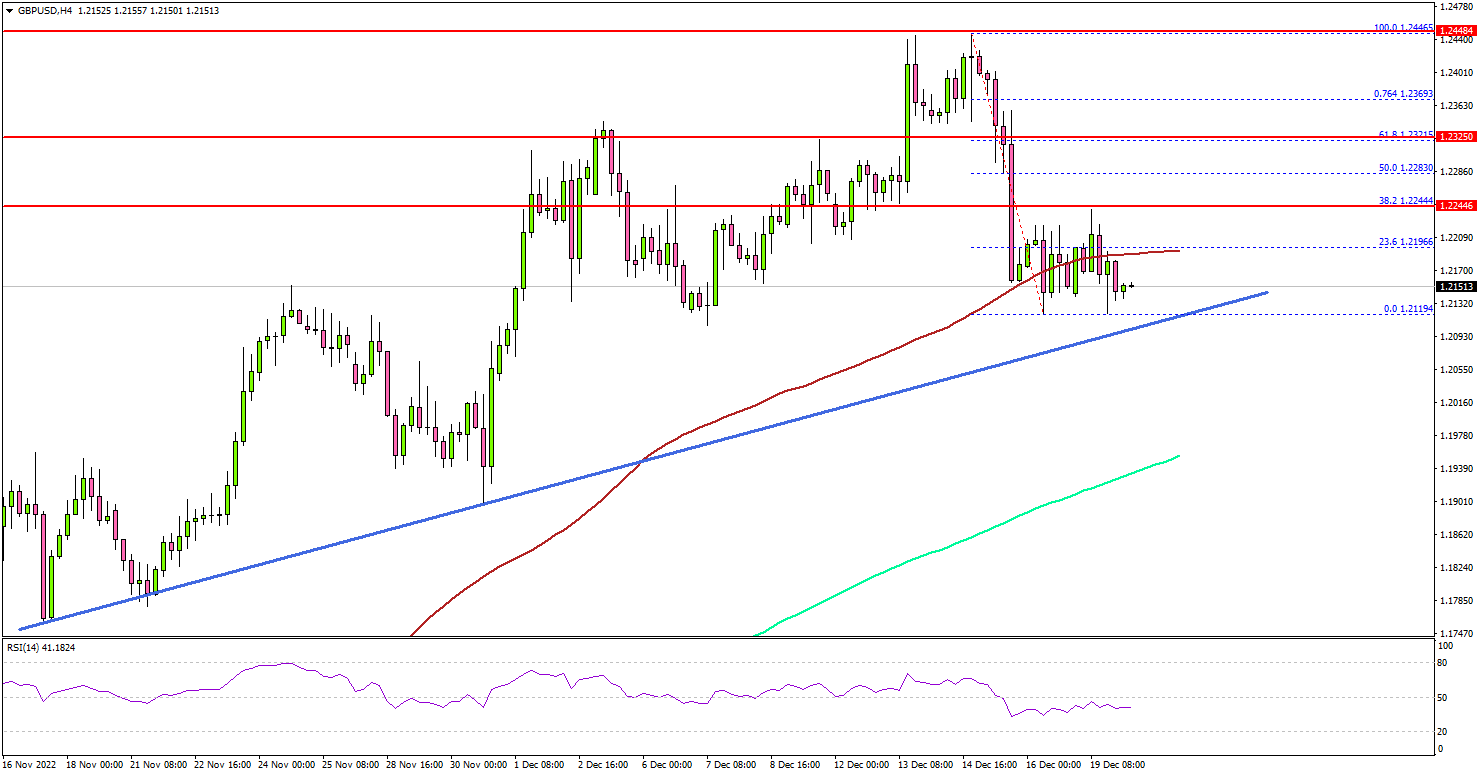
Looking at the 4-hours chart, the pair traded as high as 1.2446 before there was a downside correction. There was a move below the 1.2350 and 1.2320 support levels. The pair even spiked below the 1.2200 support zone and the 100 simple moving average (red, 4-hours).
On the downside, there is a decent support forming near the 1.2120 zone. There is also a key bullish trend line forming with support near 1.2140 on the same chart.
The next major support is near the 1.2080 zone, below which the pair might dive towards the 200 simple moving average (green, 4-hours). Any more losses might open the doors for a move towards the 1.1800 support zone.
On the upside, an initial resistance is near the 1.2250 level. The next major resistance may perhaps be near 1.2320. A clear move above the 1.2320 resistance might start a steady increase. In the stated case, GBP/USD may perhaps rise towards the 1.2380 level. Any more gains could lead the pair towards the 1.2240 resistance zone.
Looking at EUR/USD, the pair is showing a few bearish signs and there is now a risk of a downside break below the 1.0550 support zone.
Economic Releases
- US Housing Starts for Nov 2022 (MoM) – Forecast 1.415M, versus 1.425M previous.
- US Building Permits March 2022 (MoM) – Forecast 1.470M, versus 1.512M previous.