

Sample Category Title
US: More Green Shoots in U.S. November Inflation Report
- Headline U.S. inflation further slowed to 7.1% year-over-year
- Food, energy, and ‘core’ CPI growth (+6%) all decelerated
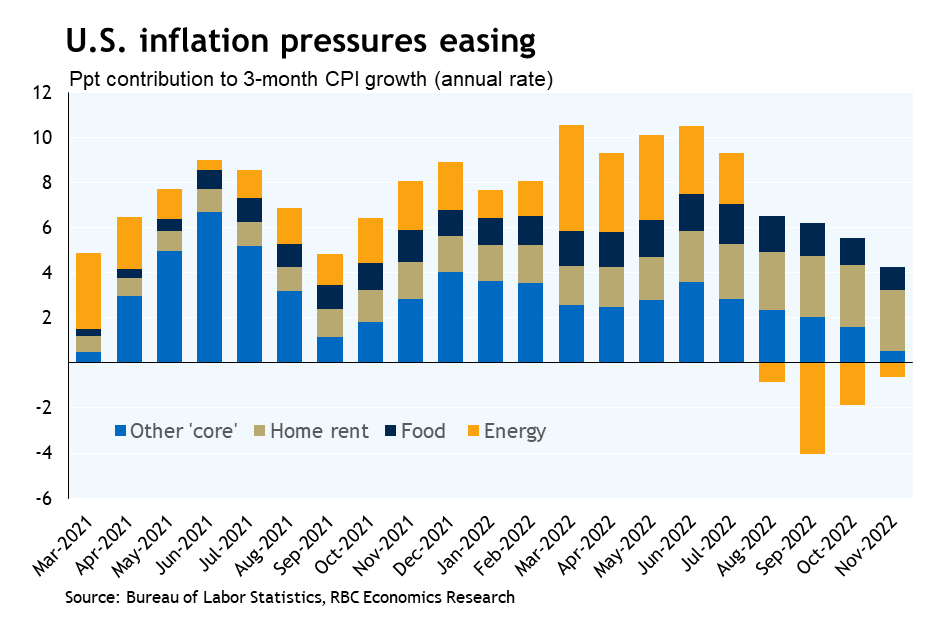
- Home rents increasingly driving headline inflation rates, offsetting easing / narrowing price pressures among other products and services
- Fed to hike by 50 bp tomorrow; more encouraging inflation signs make a pause in early 2023 more likely
November’s U.S. inflation report brought more green shoots that broader inflation pressures are easing. The headline CPI rate slowed to 7.1% from 7.7% year-over-year in October as price pressure for all major categories slowed. Unsurprisingly, a 2% monthly decline in gasoline prices pushed energy inflation down further to 13.1% year over year. CPI for food also slowed to 10.1% from a year ago in November. That rate itself is still very elevated compared to an average rate of just 1.6% over the five years before the pandemic. But improvement in global supply chain conditions as well as lower food commodity prices should see the positive trend persist into 2023. Easing food and energy inflation means an increasingly larger share of inflation in the U,S, - we counted just under a third of the headline year-over-year growth rate in November - was driven by surging rent costs. Most of that however, reflects increases in market rents over the last year feeding through to leases with a lag. Those pressures will start to moderate soon given a slowdown in current market rents since this past summer.
Even accounting for the outsized monthly gain in rents (+0.8%), broadening moderation in price pressure across other non-food and energy items meant ‘core’ inflation slowed again in November. The 0.2% monthly increase in CPI ex-food and energy was markedly slower than the 0.5% average pace year-to-date, and the smallest since August 2021. Notable moderation was again seen in new and used cars as well as other durable goods. Growth in services CPI ex-rent (a measure Fed Chair Powell has identified as an important indicator for underlying inflation trends) slowed to an annualized 3.2% over the last three months by our count after peaking as high as 12.8% in June. Needless to say, despite green shoots in the near-term, price growth has further to fall before reaching the Fed’s 2% target. And consumer demand has been more resilient, adding some tailwinds to inflation trends. Still, higher interest rates will cut into household purchasing power in the year ahead and we look for inflation to continue to creep broadly lower. Overall, a smaller 50 bp hike is expected for the Fed’s meeting tomorrow, to be followed by another 50 bp over the first quarter next year before the Fed feels comfortable to pause the current cycle and reassess.
US: Inflation Shows Further Signs of Easing and Supports the Case for Fed Dialing Back on Rate Hikes Tomorrow
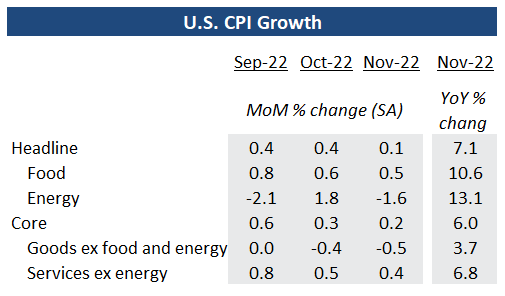
Consumer price inflation increased by 0.1% month-on-month (m/m) in November, coming in well below the 0.4% m/m increase in October. On a year-over-year (y/y) basis, headline inflation edged lower by 0.6 percentage points (pp) from the month prior, slowing to 7.1%.
Energy prices fell by 1.6% m/m, as both gasoline prices (-2.0% m/m) and energy services (-1.1% m/m) were lower on the month. Food prices rose 0.5% m/m (following a slightly larger 0.6% gain in October), and are up 10.6% y/y.
Core inflation (excludes food & energy) rose 0.2% m/m – slightly below the consensus forecast which called for a gain of 0.3% m/m. Relative to last October, the core measure is up 6.0% – down 0.3pp from October's reading of 6.3% y/y and 0.7pp below the peak y/y reading seen back in September.
Price growth across core services (+0.4% m/m) was a tenth of a percentage point lower than in October. Shelter costs (0.6% m/m) were again a meaningful contributor – accounting for nearly half of the annual increase in headline inflation – with rent of primary residence (+0.8% m/m) and owner's equivalent rent (+0.7% m/m) each notching sizeable gains. Lodging away from home fell 0.7% m/m.
- Other service categories including recreational (+1.0% m/m), education & communication (+1.0% m/m) and other personal services (+0.8% m/m) also rose on the month. Meanwhile, price growth across medical (-0.7%% m/m) and transportation (-0.1% m/m) services were lower in November.
Core goods prices declined for the second consecutive month, falling by 0.5% m/m. Declines were concentrated in used vehicle prices (-2.9% m/m), recreational commodities (-0.4% m/m) and apparel (-0.5% m/m). New vehicle prices were flat on the month.
Key Implications
Inflationary pressures continue to ease from their summer highs, with the three-month (annualized) reading on the core measure having steadily declined in each of the last five months and currently sits at 4.3%. While goods prices appear to have peaked, some of the more labor-intensive service sectors continue to emanate relatively strong price growth. Until we see a cooling in labor market conditions, these sectors alongside persistent strength in the shelter component, will continue to exert upward pressure on inflation.
Medical care services have recorded sizeable declines in each of the last two months. On the surface, this is seeming like an encouraging development. However, the recent pullback can largely be traced back to a methodological quirk. The Bureau of Labor Statistics uses changes in the industry's retained earnings from the year prior to project expected costs in the subsequent year. As a result, any decline in medical care costs over the coming months is more to do with weaker 2021 earnings rather than contemporaneous disinflationary pressure, which means policymakers will need to look through any easing in inflation attributed to falling medical care costs.
Despite inflationary pressures showing some promising signs of cooling, the year-ago measure of core inflation continues to run at a clip that's roughly three-times the Fed's 2% inflation target. While we suspect the time has come for the FOMC to begin dialing back on the pace rate hikes – with a 50-bp hike expected tomorrow – policymakers will need to see more conviction in the inflation data before calling it quits on this tightening cycle. For a complete overview of the U.S. economic outlook, please see our updated Quarterly Economic Forecast.
WTI Oil: Recovery Gains Pace on Fresh Supply Concerns
The WTI oil price rises for the second straight day as fresh supply concerns following the closure the US Keystone Pipeline which ships oil from Canada to the US, offset fears of weaker demand.
The supply shortage in the world’s biggest oil consumer suggest that US crude inventories would drop, adding to positive signals from China’s easing of Covid restrictions, which contributes to overall improving near-term sentiment.
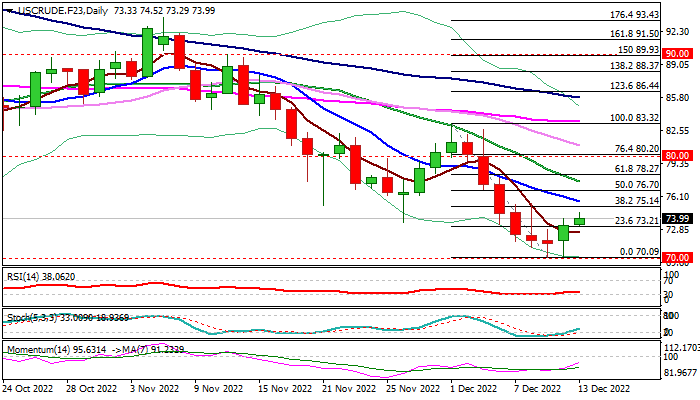
Fresh bounce left a double bottom just above psychological $70 support and managed to close above initial Fibo barrier at $73.21 (23.6% of $83.32/$70.09 bear-leg), generating initial bullish signal, which still requires verification on extension through pivots at $75.14/$75.68 (Fibo 38.2% / falling 10DMA).
On the other hand, daily studies remain overall negative, as MA’s are in bearish setup and north-heading 14-d momentum is still below the centreline which divides positive and negative territory.
Large last week’s bearish candle also weighs on recovery, which needs stronger momentum to pick up.
Res: 74.52; 75.14; 75.68; 76.70
Sup: 73.21; 72.57; 71.11; 70.00
UK Labour Market Reversal
UK data released today marked a sharp rise in jobless claims, marking a turnaround in employment recovery after covid restrictions. The ONS reported a 30.5K increase in claimant count for November after a 6.5K decline a month earlier and a sharply stronger-than-expected 3.5K. Previously there had been a trend of slowing job growth over the months, but new jobs were still being created.
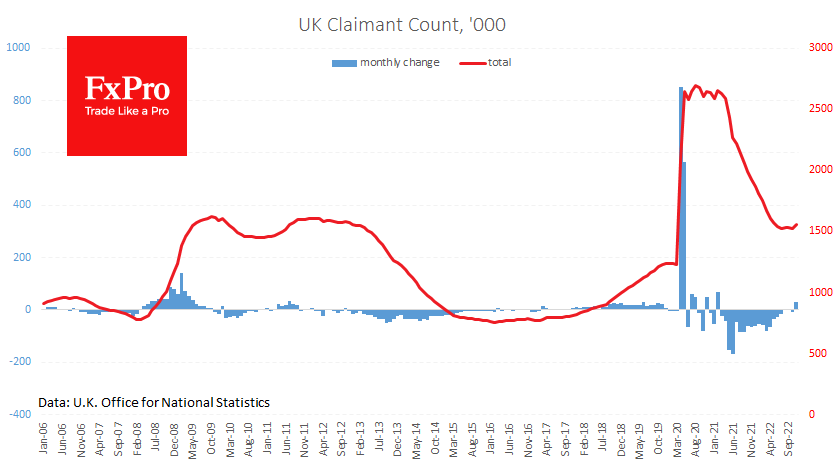
The labour market often acts as a leading indicator for the economy, overshadowing the positive surprise from the GDP data released the previous day. Interestingly, steady buying in the currency market has continued, with the pound rising against the dollar for the fifth consecutive trading session, testing the 1.23 level.
The rise in the pound is now mainly due to a reassessment of key rate expectations, where the market is raising the forecast terminal level of the key Bank Rate. This reassessment is linked to still building up inflationary pressures and the fact that the Bank of England focuses on this rather than labour market indicators.
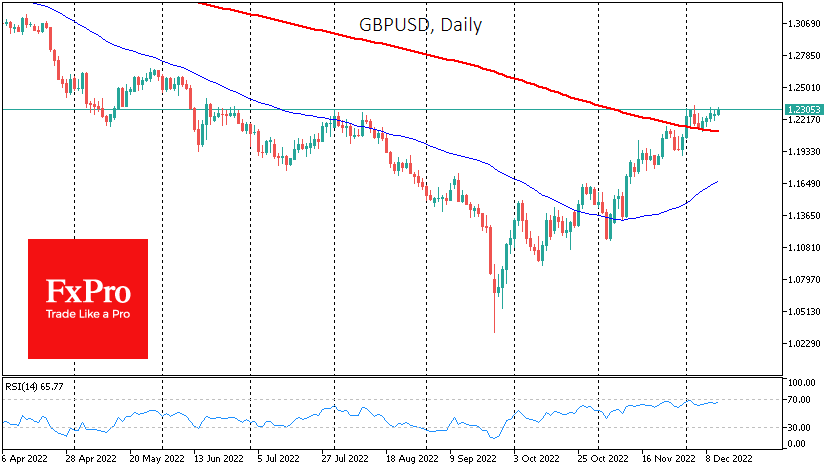
However, in the medium term, investors should still consider the labour market’s weakness, as in Britain, this often quickly becomes a pressure in the real estate and services sector. If that is the case this time, too, the Bank of England will be quicker than currently expected to complete its policy tightening cycle and turn back to stimulative policy. We also note that the rise in unemployment caused by the economic problems of 2022 is well in line with the trend that started in 2016 and is likely to be linked to Brexit.
AUD/USD Mid-Day Report
Daily Pivots: (S1) 0.6718; (P) 0.6758; (R1) 0.6788; More...
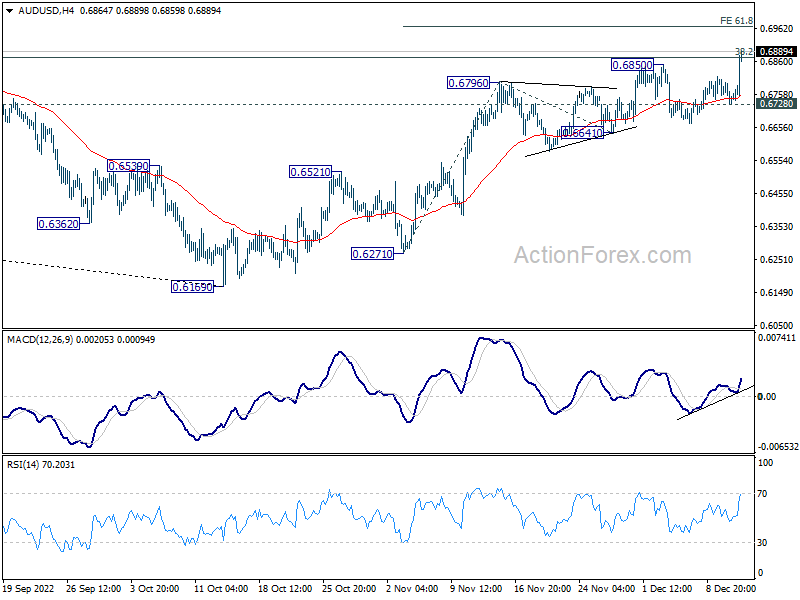
AUD/USD's rally from 0.6169 resumed by break through 0.6850 as well as 0.6871 fibonacci level. Intraday bias is back on the upside for 61.8% projection of 0.6271 to 0.6796 from 0.6641 at 0.6965. Firm break there will target 100% projection at 0.7166 next. For now, outlook will stay bullish as long as 0.6728 support holds, in case of retreat.
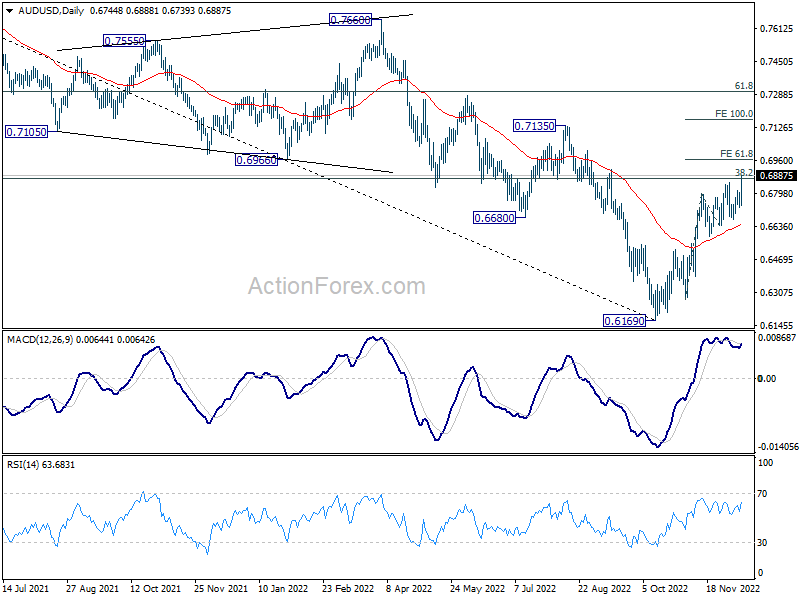
In the bigger picture, it's still unsure if price actions from 0.6169 medium term bottom are developing into a corrective pattern or trend rejection. Rejection by 38.2% retracement of 0.8006 to 0.6169 at 0.6871 will maintain medium term bearishness for another fall through 0.6169 at a later stage. However, firm break of 0.6871, and sustained trading above 55 week EMA (now at 0.6912) will raise the chance of the start of a bullish up trend.
USD/JPY Mid-Day Outlook
Daily Pivots: (S1) 136.84; (P) 137.34; (R1) 138.16; More...
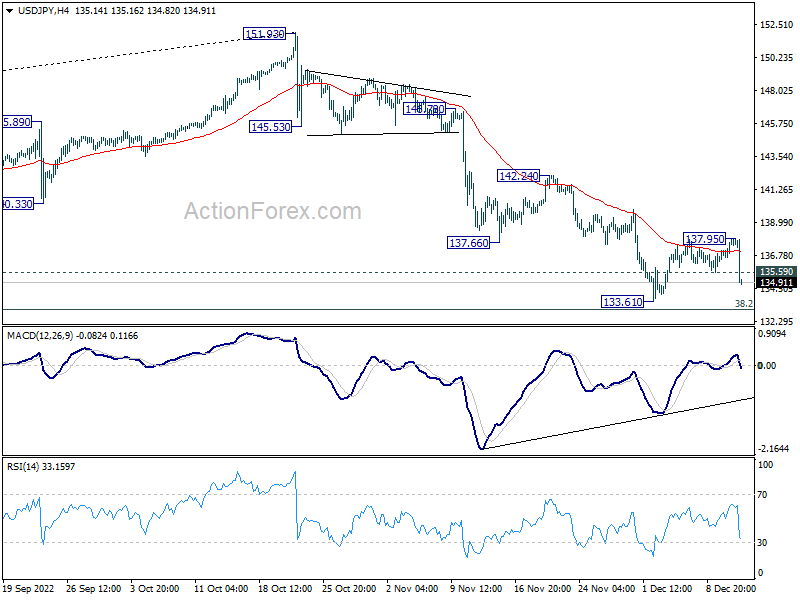
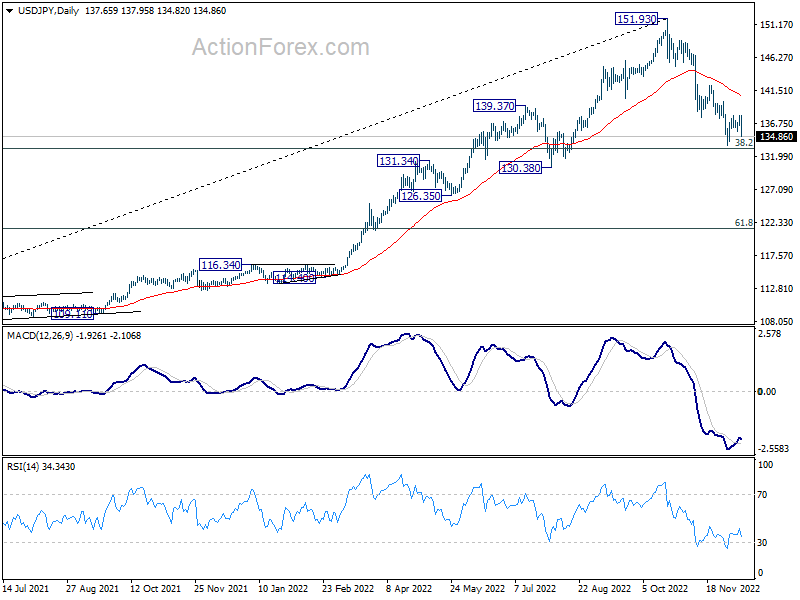
USD/JPY's break of 135.59 minor support indicates that recovery from 133.61 has completed much earlier than expected at 137.95. Intraday bias is back on the downside for 133.61, and then 133.07 medium term fibonacci level. For now, risk will stay on the downside as long as 137.95 resistance holds, in case of recovery.
In the bigger picture, price actions from 151.93 medium term could be just a corrective pattern to up trend from 102.58 (2021 low). Strong support from 38.2% retracement of 102.58 to 151.93 at 133.07 and 55 week EMA (now at 131.71) will set the range for such corrective pattern. However, sustained break of 55 week EMA will pave the way to 61.8% retracement at 121.43.
USD/CHF Mid-Day Outlook
Daily Pivots: (S1) 0.9323; (P) 0.9352; (R1) 0.9389; More...
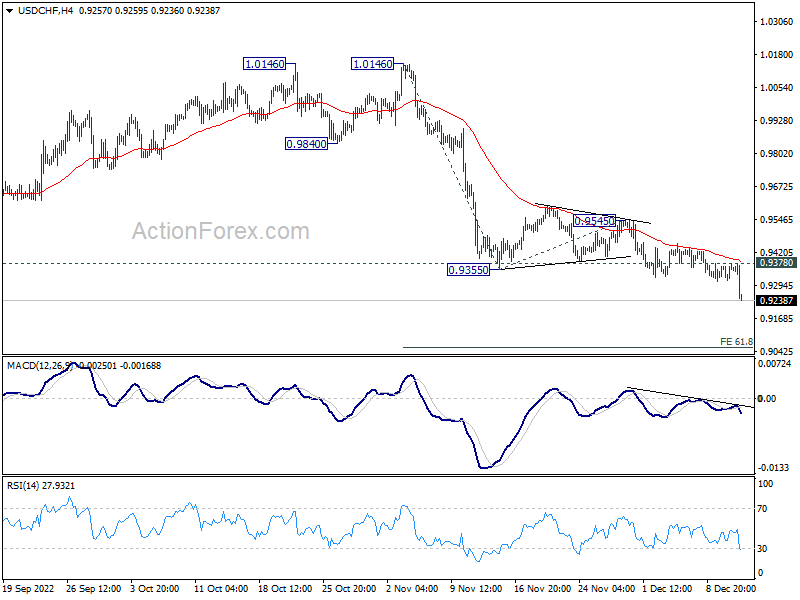
USD/CHF's decline from 1.0146 resumed today and intraday bias is back on the downside. Current fall should now target 61.8% projection of 1.0146 to 0.9355 from 0.9545 at 0.9056. On the upside, break of 0.9378 resistance is needed to indicate short term bottoming. Otherwise, outlook will stay bearish in case of recovery.
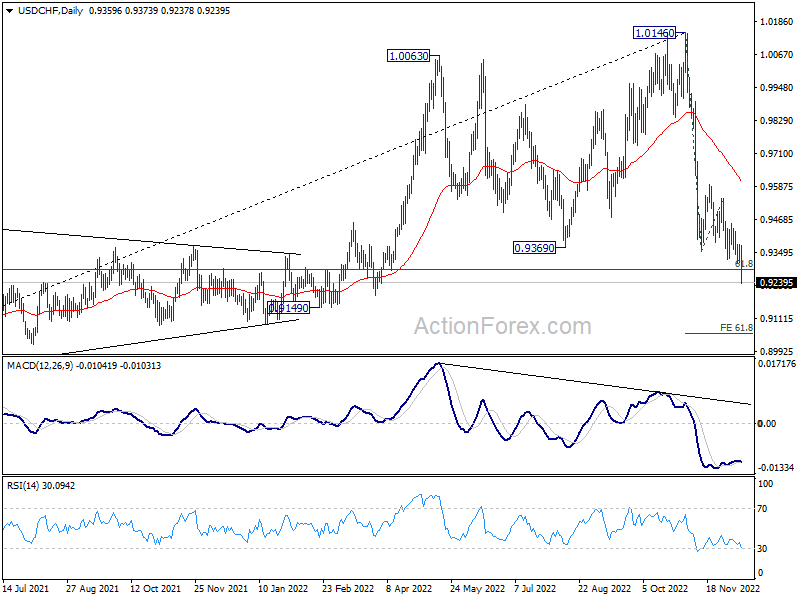
In the bigger picture, rise from 0.8756 (2021 low) has completed at 1.0146, well ahead of 1.0342 long term resistance (2016 high). Based on current downside momentum, fall from 1.0146 might be a medium term down trend itself. Sustained break of 61.8% retracement of 0.8756 to 1.0146 at 0.9287 will pave the way to 0.8756. In any case, risk will stay on the downside as long as 0.9545 resistance holds.
GBP/USD Mid-Day Outlook
Daily Pivots: (S1) 1.2216; (P) 1.2257; (R1) 1.2307; More...
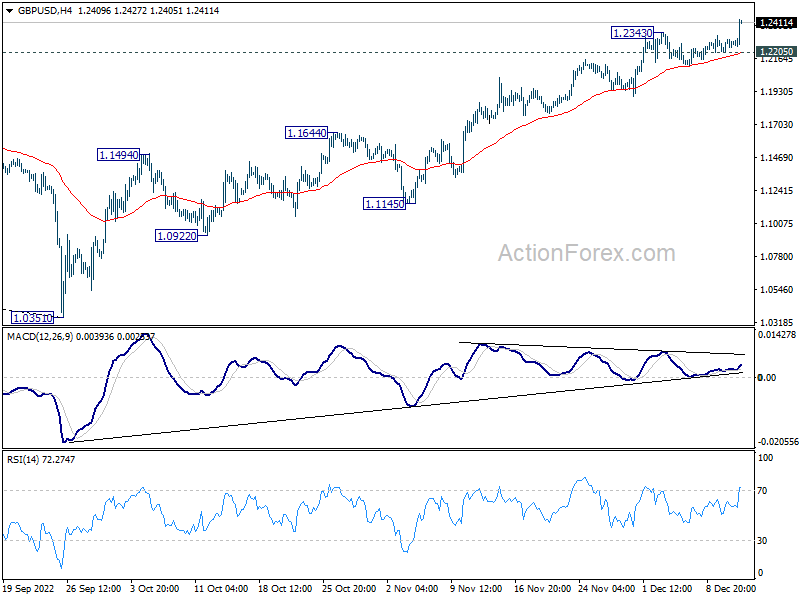
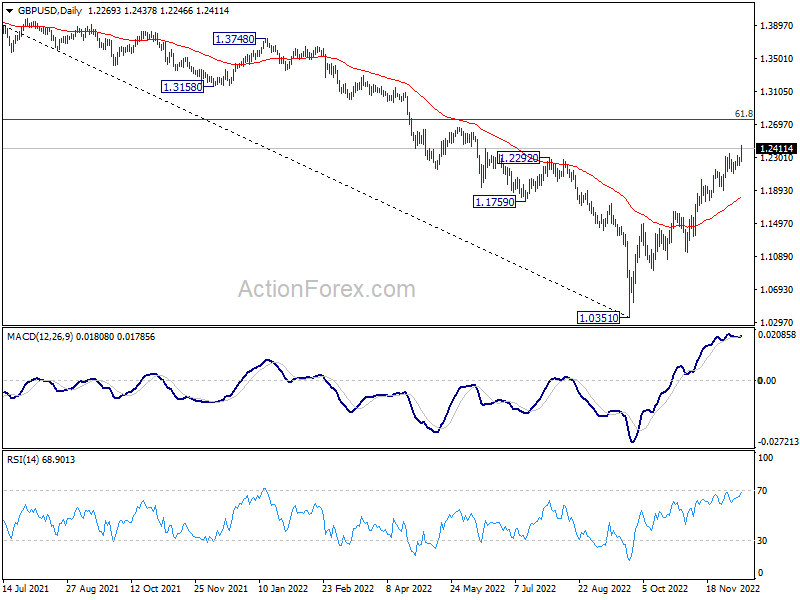
GBP/USD's rise from 1.0351 resumed by breaking through 1.2343. Intraday bias is back on the upside. Further rally should be seen to 1.2759 medium term fibonacci level next. For now, outlook will stay bullish as long as 1.2205 support holds, in case of retreat.
In the bigger picture, rise from 1.0351 medium term bottom is at least correcting whole down trend from 1.4248 (2021 high). Further rise is expected as long as 1.1644 resistance turned support holds. Next target is 61.8% retracement of 1.4248 to 1.0351 at 1.2759. Sustained break there will pave the way back to 1.4248.
EUR/USD Mid-Day Outlook
Daily Pivots: (S1) 1.0503; (P) 1.0542; (R1) 1.0577; More...
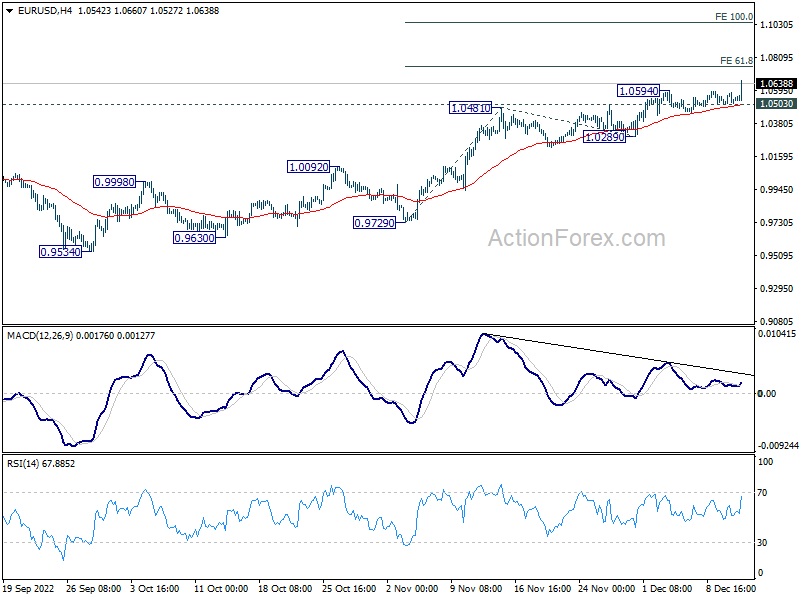
EUR/USD's rally resumed by breaking through 1.0594/0609 resistance zone decisively. Intraday bias is back on the upside for 61.8% projection of 0.9729 to 1.0481 from 1.0289 at 1.0754. Firm break there could prompt upside acceleration to 100% projection at 1.1041. On the downside, break of 1.0503 support is needed to indicate short term topping. Or, outlook will stay bullish in case of retreat.
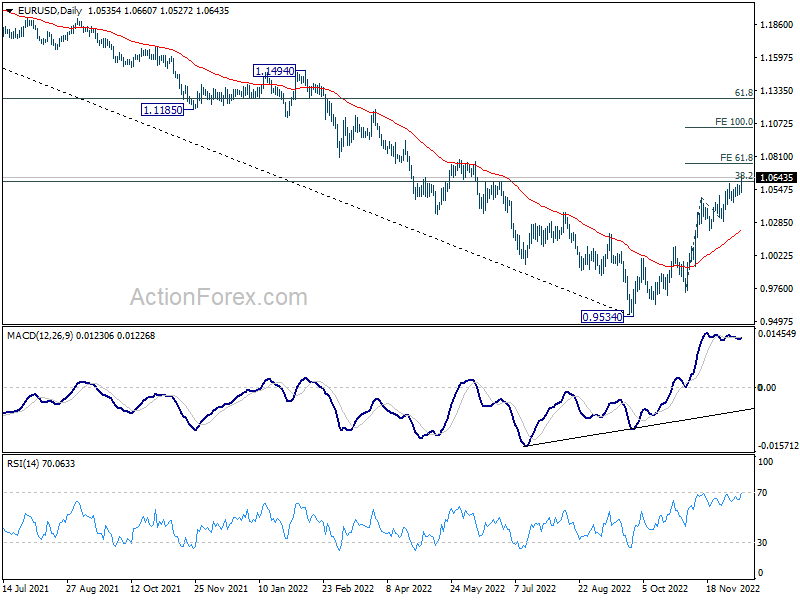
In the bigger picture, focus stays on 38.2% retracement of 1.2348 (2021 high) to 0.9534 at 1.0609. Rejection by 1.0609 will suggest that price actions from 0.9534 medium term bottom are developing into a corrective pattern. Thus, medium bearishness is retained for another fall through 0.9534 at a later stage. However, sustained break of 1.0609 will raise the chance of trend reversal and target 61.8% retracement at 1.1273.
Dollar Hammered as CPI Cooled More Than Expected
Dollar falls sharply together with treasury yield after US data showed consumer inflation cooled more than expected. Stock futures also jump as reaction. Australian and New Zealand Dollar appear to be leading the way up, followed by Yen and then European majors. The question now is on whether current wave of selloff would sustain pass tomorrow's FOMC rate decision and economic projections.
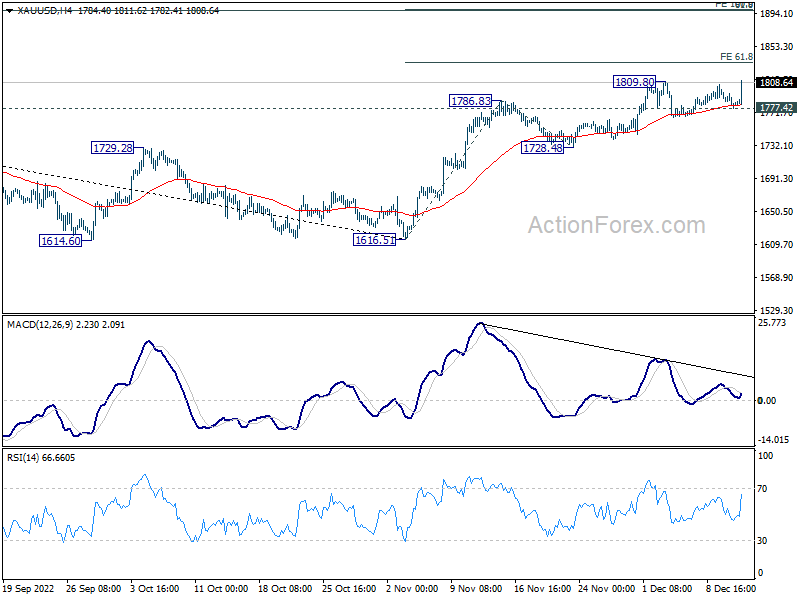
Technically, Gold is also regaining 1800 handle, and trying to resume the rally from 1616.51, on Dollar's weakness. For now, near term outlook will stay bullish as long as 1777.42 support holds. Next target is 61.8% projection of 1616.51 to 1786.83 from 1728.48 at 1833.73. Firm break there could prompt more upside acceleration to 100% projection at 1898.80, which is close to 1900 handle.
In Europe, at the time of writing, FTSE is up 0.84%. DAX is up 1.90%. CAC is up 1.66%. Germany 10-year yield is down -0.0725 at 1.868. Earlier in Asia, Nikkei rose 0.40%. Hong Kong HSI rose 0.68%. China Shanghai SSE dropped -0.09%. Singapore Strait Times rose 0.98%. Japan 10-year JGB yield dropped -0.0014 to 0.255.
US CPI slowed to 7.1% yoy in Nov, core CPI down to 6.0% yoy
US CPI rose 0.1% mom in November, lower than expectation of 0.3% mom. Food index rose 0.5% mom while energy index decreased -1.6% mom. CPI core (all items less food and energy) rose 0.2% mom, below expectation of 0.3% mom.
Over the last 12 months, CPI slowed from 7.7% yoy to 7.1% yoy, below expectation of 7.3% yoy. CPI core slowed from 6.3% yoy to 6.0% yoy, below expectation of 6.1% yoy. Energy index rose 13.1% while food index rose 10.6% yoy.
Germany ZEW rose to -23.3, significant improvement in economic outlook
Germany ZEW Economic Sentiment rose from -36.7 to -23.3 in December, above expectation of -26.3. Current Situation Index rose from -64.5 to -61.4, below expectation of -57.0.
Eurozone ZEW Economic Sentiment rose from-38.7 to -23.6, above expectation of -25.3. Current Situation Index rose 7.7 pts to -57.4. Inflation expectation s for Eurozone fell very sharply by -27.1 pts to -79.3.
"The ZEW Indicator of Economic Sentiment rises again significantly in December. The vast majority of financial market experts expect the inflation rate to decline in the coming months. Together with the temporary stabilisation on the energy markets, this leads to a significant improvement in the economic outlook," comments ZEW President Professor Achim Wambach on current expectations.
Swiss SECO downgrades 2022 and 2023 inflation forecasts
Swiss State Secretariat for Economic Affairs SECO revised down inflation forecasts for 2022 and 2023. For 2022, CPI is projected to be at 2.9% (comparing with September forecast of 3.0%). 2023 CPI is estimated to be 2.2%, (down from 2.3%.
2022 GDP growth forecast was left unchanged at 2.0%. 2023 GDP growth forecast was downgraded slightly from 1.1% to 1.0%. SECO said, "this would point to sluggish growth for the Swiss economy, but not a severe recession".
SECO added, "Europe's energy situation is projected to gradually normalize after a tense 2023/24 winter. At the same time, inflation rates will likely ease worldwide and the global economy should gradually gain momentum". That would trigger a recovery in Switzerland, with 1.6% GDP growth in 2024, and inflation back below average at 1.5%.
UK payrolled employees rose 107k in Nov, unemployment rate rose to 3.7% in Oct
In November, UK payrolled employees rose 107k or 0.4% mom to 29.9m. That also means a rise of 777k or 2.7% yoy over the 12-month period. Early estimates indicate that median monthly pay rose 8.0% yoy. Claimant count rose 30.5k comparing to expectation of 3.5k.
In the three months to October, unemployment rate rose 0.1% to 3.7%, matched expectations. Employment rate rose 0.2% to 75.6%. Economic inactivity rate dropped -0.2% to 21.5%. Average earnings excluding bonus rose 6.1% 3moy, versus expectation of 5.9%. Average earnings including bonus rose 6.1% 3moy, below expectation of 6.2%.
Australia Westpac consumer sentiment bounced from near record low
Australia Westpac Consumer Sentiment Index bounced from near record low and rose 3% from 78.0 to 80.3 in December. But the level remains comparable to the lows see during the pandemic and the Global Financial Crisis.
Concerns over inflation remained dominant among respondents, followed by budget and taxation, economic conditions and interest rates.
Westpac expects RBA to continue to deliver on its "strong tightening bias" in February and hike by 25bps, and signal that there is still more work to be done.
Australia NAB business conditions hold up, but confidence turned negative
Australia NAB Business Confidence dropped from 0 to -4 in November, below zero for the first time since December 2021. Business Conditions dropped from 22 to 20, but remained elevated. Looking at some details, trading conditions dropped from 30 to 28. Profitability conditions dropped from 21 to 20. Employment conditions dropped from 14 to 13.
NAB Chief Economist Alan Oster. "There was a slight softening across a number of industries but the level of business conditions really still remains elevated across the board including in key consumer-facing sectors such as retail and recreation & personal services, and across the states."
"Confidence is now negative, for the first time this year, despite the strength in conditions," said Oster. "The gap between current business conditions and business confidence is now at a record level in the history of the survey – with the exception of March 2020 – pointing to heightened concerns about the resilience of the economy in the period ahead as inflation and higher rates begin to weigh on consumers."
EUR/USD Mid-Day Outlook
Daily Pivots: (S1) 1.0503; (P) 1.0542; (R1) 1.0577; More...
EUR/USD's rally resumed by breaking through 1.0594/0609 resistance zone decisively. Intraday bias is back on the upside for 61.8% projection of 0.9729 to 1.0481 from 1.0289 at 1.0754. Firm break there could prompt upside acceleration to 100% projection at 1.1041. On the downside, break of 1.0503 support is needed to indicate short term topping. Or, outlook will stay bullish in case of retreat.
In the bigger picture, focus stays on 38.2% retracement of 1.2348 (2021 high) to 0.9534 at 1.0609. Rejection by 1.0609 will suggest that price actions from 0.9534 medium term bottom are developing into a corrective pattern. Thus, medium bearishness is retained for another fall through 0.9534 at a later stage. However, sustained break of 1.0609 will raise the chance of trend reversal and target 61.8% retracement at 1.1273.
Economic Indicators Update
| GMT | Ccy | Events | Actual | Forecast | Previous | Revised |
|---|---|---|---|---|---|---|
| 23:30 | AUD | Westpac Consumer Confidence Dec | 3.00% | -6.90% | ||
| 00:30 | AUD | NAB Business Confidence Nov | -4 | 0 | ||
| 00:30 | AUD | NAB Business Conditions Nov | 20 | 22 | ||
| 07:00 | GBP | Claimant Count Change Nov | 30.5K | 3.5K | 3.3K | -6.4K |
| 07:00 | GBP | ILO Unemployment Rate (3M) Oct | 3.70% | 3.70% | 3.60% | |
| 07:00 | GBP | Average Earnings Excluding Bonus 3M/Y Oct | 6.10% | 5.90% | 5.70% | 5.80% |
| 07:00 | GBP | Average Earnings Including Bonus 3M/Y Oct | 6.10% | 6.20% | 6.00% | |
| 07:00 | EUR | Germany CPI M/M Nov F | -0.50% | -0.50% | -0.50% | |
| 07:00 | EUR | Germany CPI Y/Y Nov F | 10.00% | 10.00% | 10.00% | |
| 08:00 | CHF | SECO Economic Forecasts | ||||
| 09:00 | EUR | Italy Industrial Output M/M Oct | -1.00% | -0.30% | -1.80% | -1.70% |
| 10:00 | EUR | Germany ZEW Economic Sentiment Dec | -23.3 | -26.3 | -36.7 | |
| 10:00 | EUR | Germany ZEW Current Situation Dec | -61.4 | -57 | -64.5 | |
| 10:00 | EUR | Eurozone ZEW Economic Sentiment Dec | -23.6 | -25.3 | -38.7 | |
| 11:00 | USD | NFIB Business Optimism Index Nov | 91.9 | 90.8 | 91.3 | |
| 13:30 | USD | CPI M/M Nov | 0.10% | 0.30% | 0.40% | |
| 13:30 | USD | CPI Y/Y Nov | 7.10% | 7.30% | 7.70% | |
| 13:30 | USD | CPI Core M/M Nov | 0.20% | 0.30% | 0.30% | |
| 13:30 | USD | CPI Core Y/Y Nov | 6.00% | 6.10% | 6.30% |