Sample Category Title
U.S. Inflation Data to Foreshadow Further Interest Rate Hikes
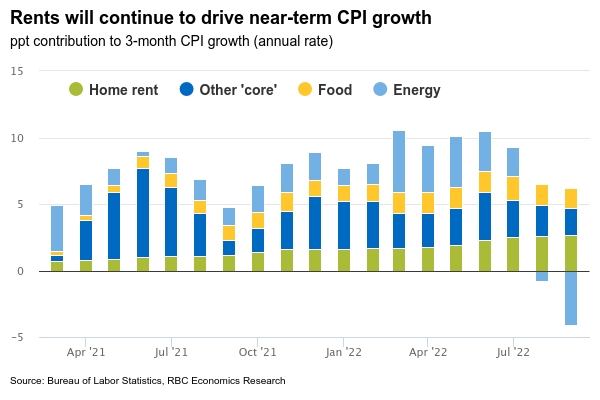
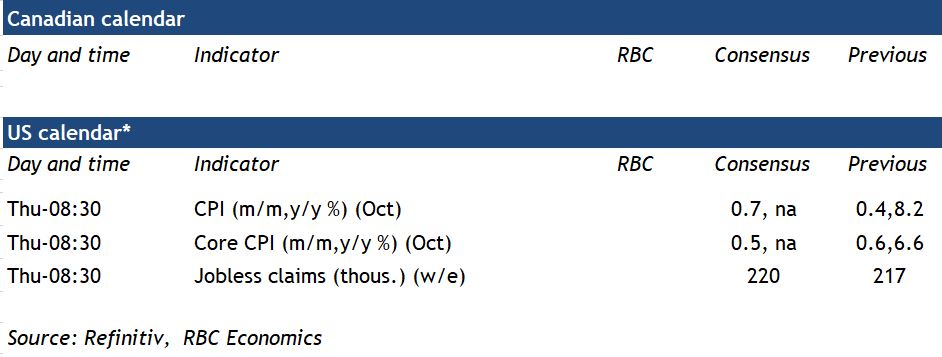
The next inflation reading from the U.S. will still be way too high to prevent another round of interest rate hikes. Year-over-year consumer price growth is expected to edge lower, to 8.0% in October from 8.2% in September. But that is despite an expected large 0.7% month-over-month increase. The price of gasoline rose 4% from October, reversing a 5% drop in September. And grocery prices likely continued to surge.
A 75 basis point interest rate hike from the Federal Reserve this past week took the fed funds target range to 3.75% to 4%. We expect at least another 50 basis point increase when the Fed meets again in December. But the inflation data will continue to be scrutinized for any signs of easing in broader price pressures that could allow the U.S. central bank to slow its pace of interest rate hikes going forward.
Core growth in the Consumer Price Index (a closely watched metric that excludes food & energy products) will continue to be fueled by surging home rents. Those gains are the result of earlier increases in market rental prices (there’s a lag as leases are renewed) that are still feeding through to higher household costs. But a pullback in more recent indicators of current rents mean those pressures will start to ease off in the year ahead.
There are early signs that higher interest rates are starting to cut into household demand, particularly for discretionary goods purchases. And wholesale used vehicle prices have been ticking lower after driving a disproportionate share of the initial surge in inflation. Still, by our count, almost 90% of goods and services in the CPI basket (excluding the shelter component) were still recording price growth above the Fed’s 2% inflation objective in September.
U.S. CPI growth probably peaked in June. But the Fed has further to go with risks increasingly tilted to the upside to our forecast that the Fed Funds rate will rise to 4.50-4.75%.
Week Ahead – Control of Congress
This week will be massive for markets as investors closely watch to see how inflation moderates. In addition to watching to see if inflation comes down from a 40-year high, Wall Street will pay close attention to the midterm elections. Right now polls are suggesting Republicans have a good chance to take over both the House and Senate.
In addition to the inflation report and the midterm election, traders will also closely monitor the preliminary University of Michigan Survey. Sentiment is expected to soften, but traders will pay close attention to inflation expectations, which have been pushing higher.
EU
A quiet week as far as upper-tier economic data is concerned which means the focus next week will be on commentary from ECB policymakers including President Lagarde on Monday, among others.
The dust continues to settle in the UK but as BoE Governor Bailey indicated last week, it’s going to take time to regain confidence and credibility in the markets. The events of the last couple of months have severely damaged the UK’s reputation which was already tarnished by those of recent years. All eyes are now on the Autumn Statement on 17 November.
We’ll get a steady stream of BoE commentary throughout the week which comes on the back of a very dovish rate hike, in which Bailey and colleagues pushed back strongly against market expectations. GDP data on Friday will be of interest but most have already accepted that the country is in recession.
Russia
Inflation data is the most notable release next week after the central bank left its key rate unchanged at 7.5% in October.
South Africa
A relatively quiet week containing a few tier two or three economic releases, the highlight of which is probably manufacturing production figures on Thursday, both of which are expected to have declined in September.
Turkey
Official inflation reached more than 85% in October as the central bank continues to slash interest rates. The inflation data is clearly no deterrent and if anything, President Erdogan sounds more determined than ever to see rates fall further.
Industrial production and unemployment data among the economic releases next week.
Switzerland
Inflationary pressures eased a little last month which may come as a relief to SNB policymakers, some of whom we’ll hear from next week including Chairman Jordan. Further hikes still look likely but to what extent? Policymakers may shed some light.
China
As China’s zero-Covid policy continues, the recently released manufacturing and non-manufacturing PMIs for October fell to 48.7 and 49.2, respectively, below the 50 threshold separating contraction from expansion.
Investors should pay close attention to China’s foreign trade data for October on Monday to see if China’s trade surplus is tending to deteriorate. The CPI on Wednesday is also key as an increase will reduce the ability of the PBOC to support the economy.
The market is currently discussing the possibility of the PBOC lowering the reserve requirement ratio again in order to release more liquidity. These policies may support a more accommodative monetary policy environment in China, which will support growth.
India
Very few economic releases are due next week with the only one of note being industrial output on Friday.
Australia & New Zealand
The AUDUSD and NZDUSD have rallied slightly as market risk sentiment has warmed over the past two weeks. They’ve been broadly weak overall against the US dollar as China’s zero-Covid policy continued, and the market was still digesting the Fed rate moves.
The RBA raised interest rates by 25 bps at its monetary policy meeting on 1 November, raising the cash rate from 2.60% to 2.85%. The RBA updated its forecasts, raising its expectation for peak inflation to 8.0% from 7.75%. Third quarter CPI released last week rose by 7.3% in October, above market expectations of 7.0% and the previous value of 6.1%. The RBA is likely to continue its policy of raising interest rates at the next meeting on 6 December.
As the overall level of inflation in New Zealand remains high, the market expects a 50-75 bps rate hike at the RBNZ’s next central bank rate meeting on 23 November.
The Bank of Japan remained committed to its super-loose monetary policy at its last meeting while raising inflation expectations across the board (the CPI ex-fresh food forecast for FY2023 was raised from 1.4% to 1.6% per annum). It will release its summary of opinions from board members on Monday.
Japan may intervene again in the FX market in the coming weeks if USDJPY continues to aggressively rally. There has been discussion in the market about whether the Bank of Japan will undertake a step-by-step exit from its yield curve control (YCC) in the future, although policymakers have pushed back against this.
Singapore
According to the Monetary Authority of Singapore, core inflation risks remain tilted to the upside, and the economy is expected to grow at a below-trend rate in 2023. Singapore’s CPI recently hit 7.5% in September, with the core CPI at 5.3%. Business confidence also fell sharply to -20 in the third quarter, compared to -8 previously.
No major economic releases are due next week.
Economic Calendar
Saturday, Nov. 5
Economic Events
- Berkshire Hathaway Inc reports Q3 earnings
Sunday, Nov. 6
Economic Events
- Daylight Saving Time ends in the US
- The annual UN climate summit, COP27 begins in Egypt
Monday, Nov. 7
Economic Data/Events
- Australian Foreign reserves
- China foreign reserves and trade
- Singapore foreign reserves
- Germany industrial production
- Thailand CPI
- ECB President Lagarde speaks to the European Commission/ECB high-level conference on the framework for a digital euro
- ECB board member Panetta participates in a panel discussion at the same event
- Fed’s Collins and Mester speak at a symposium on women in economics hosted by the Cleveland Fed
- Fed’s Barkin participates in a discussion about inflation
- Eurozone finance ministers meet in Brussels
Tuesday, Nov. 8
Economic Data/Events
- US midterm elections
- Australia consumer confidence, household spending
- Eurozone retail sales
- France trade
- Japan household spending, leading index
- Mexico international reserves
- New Zealand truckometer traffic index, inflation expectation
- Bundesbank symposium; speeches by Nagel and Enria
- Riksbank’s Breman speaks about the global economy
- ECB’s Wunsch gives a public lecture in Geneva entitled “Germs, War and Central Banks”
- BOE’s Mann participates in a panel at a conference on global risk, uncertainty and volatility hosted by the Swiss National Bank, Fed and BIS in Zurich
- BOE Chief Economist Pill participates in a panel at the UBS European Conference in London
- BOJ announces the outright purchase amount of government securities
Wednesday, Nov. 9
Economic Data/Events
- US wholesale inventories, MBA mortgage applications
- Mexico CPI
- Hungary CPI
- Russia CPI
- China aggregate financing, PPI, CPI, money supply, new yuan loans
- Japan BoP, bank lending
- New Zealand card spending
- Poland rate decision: Expected to keep base rate unchanged at 6.75%
- South Korea jobless rate, bank lending to households
- UK RICS home prices
- EIA crude oil inventory
- New York Fed President John Williams speaks at a conference on global risk, uncertainty and volatility jointly hosted by the Swiss National Bank, Fed and BIS in Zurich
- Fed’s Barkin speaks about the economic outlook at the Shenandoah University School of Business in Winchester, Virginia
- RBA Deputy Governor Michele Bullock speaks at the 2022 ABE Annual Dinner in Sydney
- ECB’s Elderson participates in a panel at an event organized by Euro-Mediterranean Economists Association
- Norges Bank and Riksbank release their respective financial stability reports
- BOE’s Haskel speaks at a Digital Futures at Work Research Centre event titled “Restarting the Future: How to Fix the Intangible Economy”
- Hong Kong Chief Executive Lee is scheduled to address a British Chamber of Commerce-organized webinar
Thursday, Nov. 10
Economic Data/Events
- US CPI and jobless claims
- Norway CPI
- Australia consumer inflation expectations
- Italy industrial production
- Japan money stock, machine tool orders
- Mexico rate decision: Expected to raise the overnight rate by 75bps to 10.00%
- New Zealand home sales
- South Africa manufacturing production
- Thailand consumer confidence
- Dallas Fed President Logan and Kansas City Fed President George speak at an energy and economy conference jointly hosted by their banks
- Cleveland Fed President Mester speaks about the outlook for the economy and monetary policy at a virtual event hosted by Princeton University
- BOE Deputy Governor Ramsden participates in a panel at the Next STEP Global Conference 2022 hosted by PIIE and National University of Singapore’s Lee Kuan Yew School of Public Policy in Singapore
- BOE’s Tenreyro delivers a keynote speech at the Society of Professional Economists Annual Conference in London
- SNB’s Maechler delivers keynote speech at the 17th Annual Meeting of SFI in Zurich
- ECB’s Schnabel, Kažimír and Vasle speak at an event in Ljubljana, Slovenia. Schnabel also participates in a roundtable discussion at the Bank of Slovenia
- ECB publishes its Economic Bulletin
- RBNZ releases a review of monetary policy implementation
- United Nations publishes its “Food Outlook” report
Friday, Nov. 11
Economic Data/Events
- US Veterans Day holiday. The stock market will be open
- US University of Michigan consumer sentiment
- China FDI
- Singles’ Day (Shopping event) in China
- ECB’s Panetta delivers a talk at the Italian Institute for International Political Studies in Milan
- ECB’s de Guindos, Pablo Hernández de Cos and Centeno speak at XXVII Encuentro de Economía en S’Agaró
- ECB’s Holzmann speaks to journalists at the Club of Economic Writers in Vienna
- ECB Chief Economist Lane participates in a policy panel at the 23rd Jacques Polak Annual Research Conference in Washington
- EU releases its autumn economic forecast
- Germany CPI
- Hong Kong GDP
- India industrial production
- Japan PPI
- Mexico industrial production
- New Zealand food prices, PMI
- Turkey industrial production, current account
- UK industrial production, GDP
Sovereign Rating Updates
- Switzerland (Fitch)
- Iceland (S&P)
Week Ahead – Brace for US Midterm Elections and Inflation Data
There are only a handful of events next week but they will be crucial for markets. A divided Congress is the most likely outcome when Americans go to the ballots, setting the stage for two years of political deadlock. Meanwhile, the latest US inflation data will decide the pace of future Fed rate increases and by extension, the dollar’s fortunes.
US midterms
A mid-cycle election in the United States on Tuesday will serve as an appetizer ahead of Thursday’s critical inflation report. This election won’t be a game-changer for financial markets grappling with inflation and recession threats, but it could spark some relief moves in the dollar and stocks.
In a nutshell, the Democrats are likely to lose control of Congress. The party currently holds a slim majority in the House of Representatives, while the Senate is split 50-50, with Vice President Harris’s tiebreaker vote giving the Democrats control of this chamber too.
Opinion polls and betting markets suggest the Republicans will take back the House, with prediction websites putting the probability of this outcome around 85%. The Senate race is too close to call, with both opinion surveys and bookmakers viewing it essentially as a coin toss.
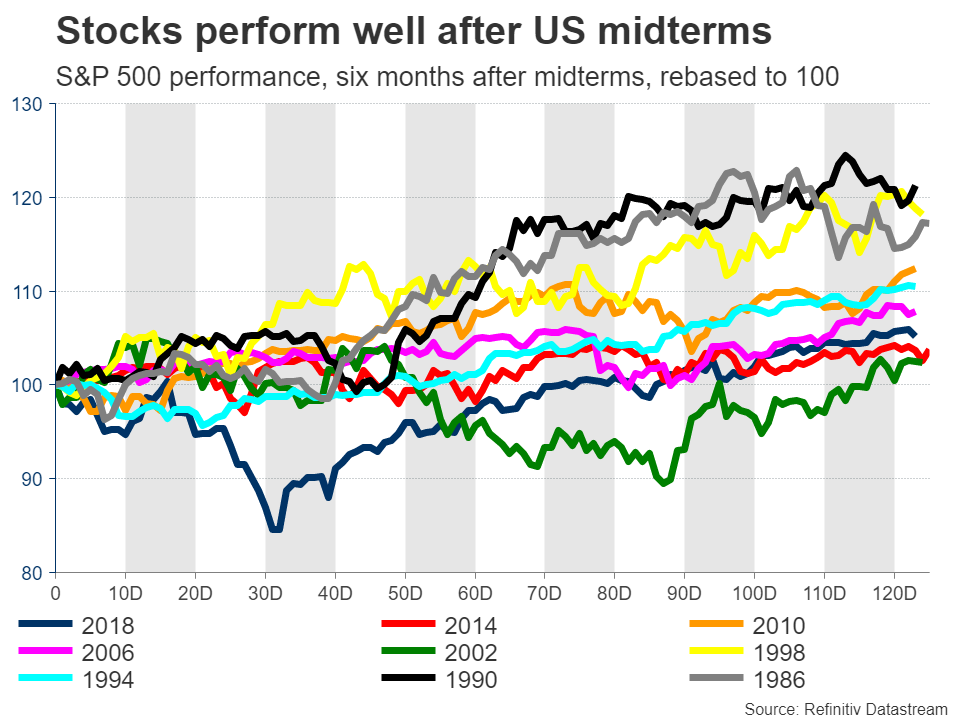
Historically speaking, a divided Congress tends to benefit stock markets since it limits the scope for passing anti-business legislation, such as tighter regulations or higher corporate taxes. Over the last seven decades, stocks have always been higher six months after a midterm election.
In the FX arena, there’s no clear historic pattern, so the market reaction might boil down to how the election affects the trajectory of Fed policy. In this sense, a split Congress would limit the government’s ability to roll out new spending, which argues for slower growth and softer inflation.
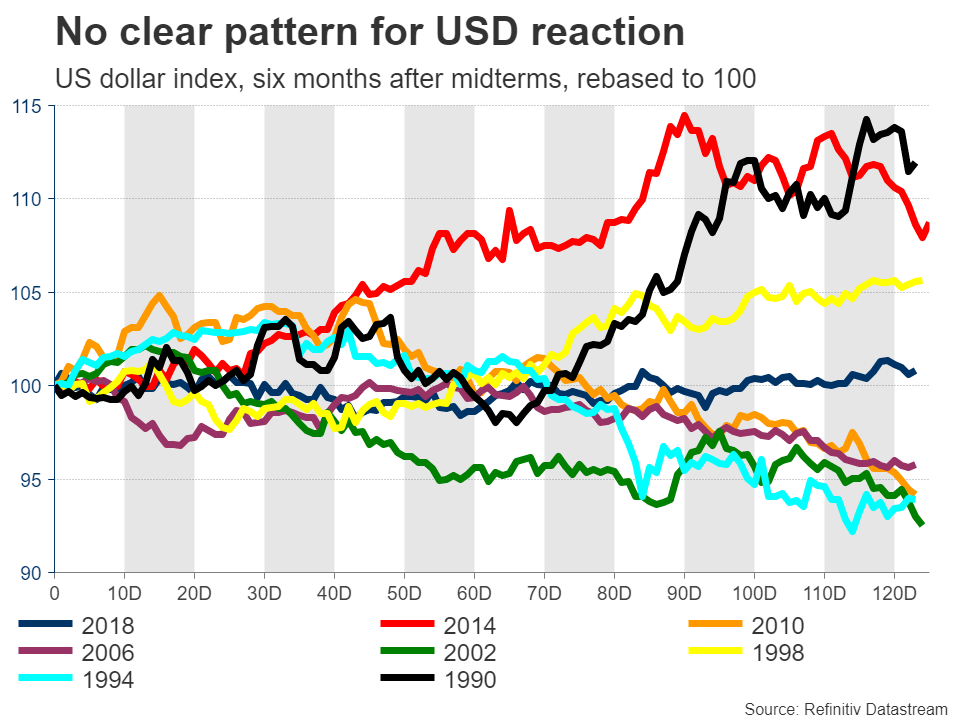
This could spark a pullback in the dollar as traders second-guess whether rates will truly reach the 5.2% peak that’s currently baked into the cake. To be clear though, these reactions are likely to be minor. A divided Congress is already the market’s baseline scenario - it wouldn’t be any surprise.
Similar to 2020, investors might need to wait a few days before the election results are finalized, as ballots that were sent by mail are counted.
US inflation winding down?
In the battle against inflation, the Fed might finally receive some good news. Forecasts suggest that both the headline and core CPI rates retreated in October, albeit only slightly.
Most of the expected cooldown in price pressures is linked to the decline in transportation and fuel costs. The uncertainty revolves around the bigger and ‘stickier’ categories, such as rents and medical care, which combined account for roughly 40% of the entire CPI basket.
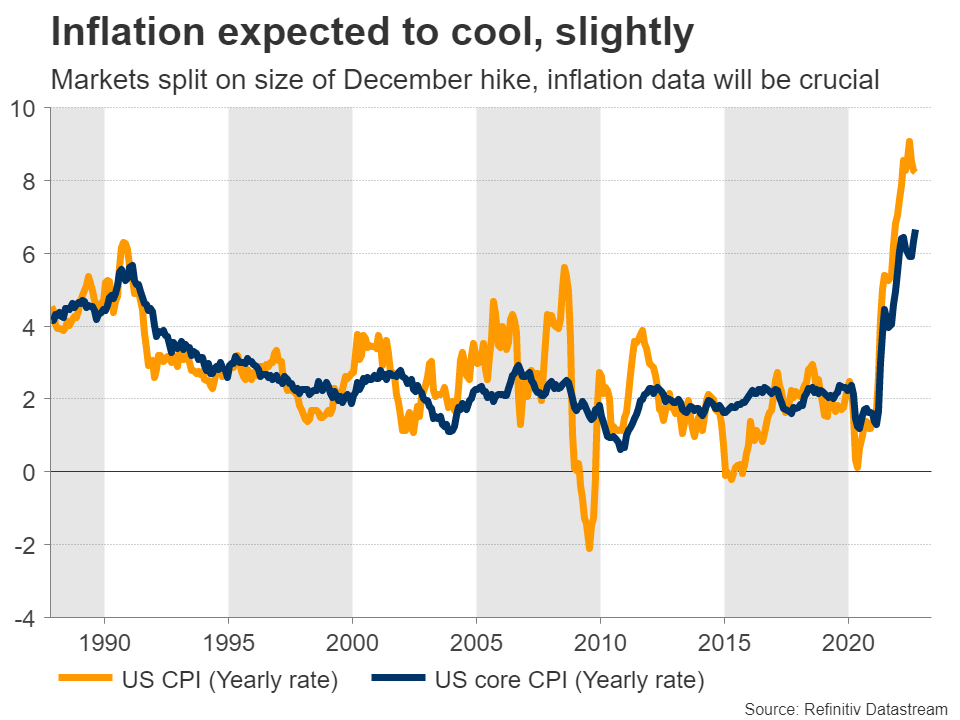
Traders are currently split on how much the Fed will raise rates next month. Market pricing is currently leaning towards another 75 basis point hike, but it’s a close call with investors also assigning decent chances to a smaller 50bps move. This inflation report will inevitably tip the scales in one direction, driving the US dollar accordingly.
Overall, the outlook for the dollar remains positive, but we might be entering the ‘final act’ of this stunning rally. The Fed has opened the door for smaller rate increases moving forward, the market is already flush with long-dollar bets, and the fundamentals of other major currencies have finally started to improve.
In Europe, the recent decline in energy prices suggests that any winter recession might not be brutal after all. In the UK, the budget crisis is now in the rear-view mirror, while the Bank of Japan chief just signaled he is willing to adjust the yield ceiling that has devastated the yen.
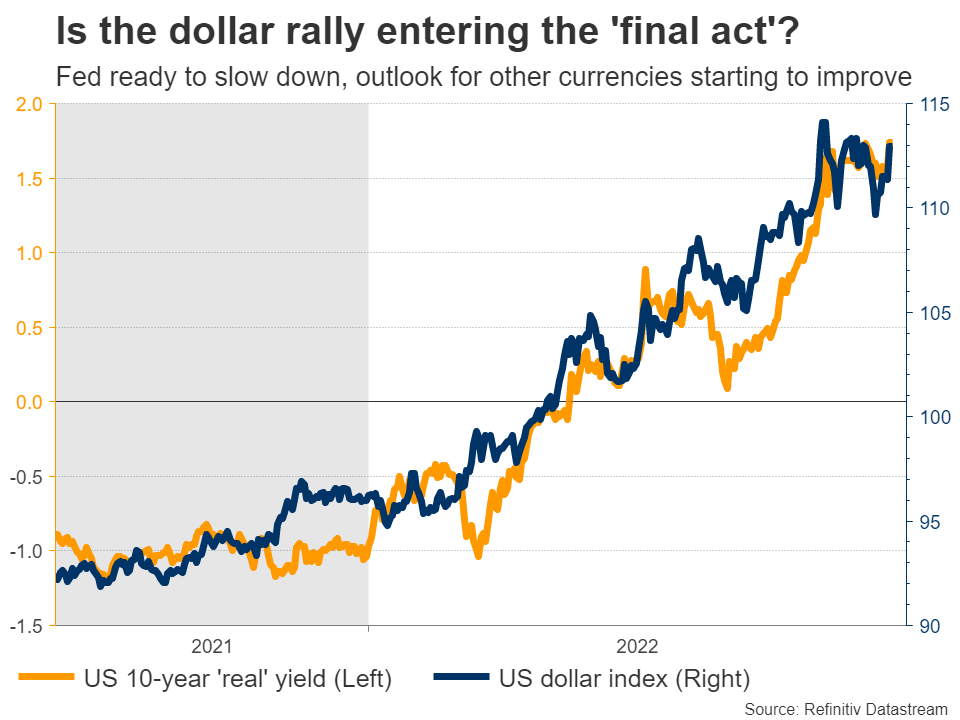
It’s still too early to call for a proper trend reversal, and the dollar could hit new highs in case the global outlook continues to deteriorate, but the scope for further gains seems limited from here. The risk-to-reward profile of chasing further dollar strength just doesn’t seem attractive at this stage.
Japanese and British releases
The biggest piece of news that flew under the radar this week was a shift in tone by the Bank of Japan. Governor Kuroda said his central bank could make its yield curve control strategy “more flexible” in the future, setting the stage for an eventual normalization of policy.
Yield curve control is a policy that essentially caps longer-dated Japanese rates. Since Japanese yields cannot rise beyond a certain level, interest rate differentials automatically widen against the yen as foreign central banks raise rates.
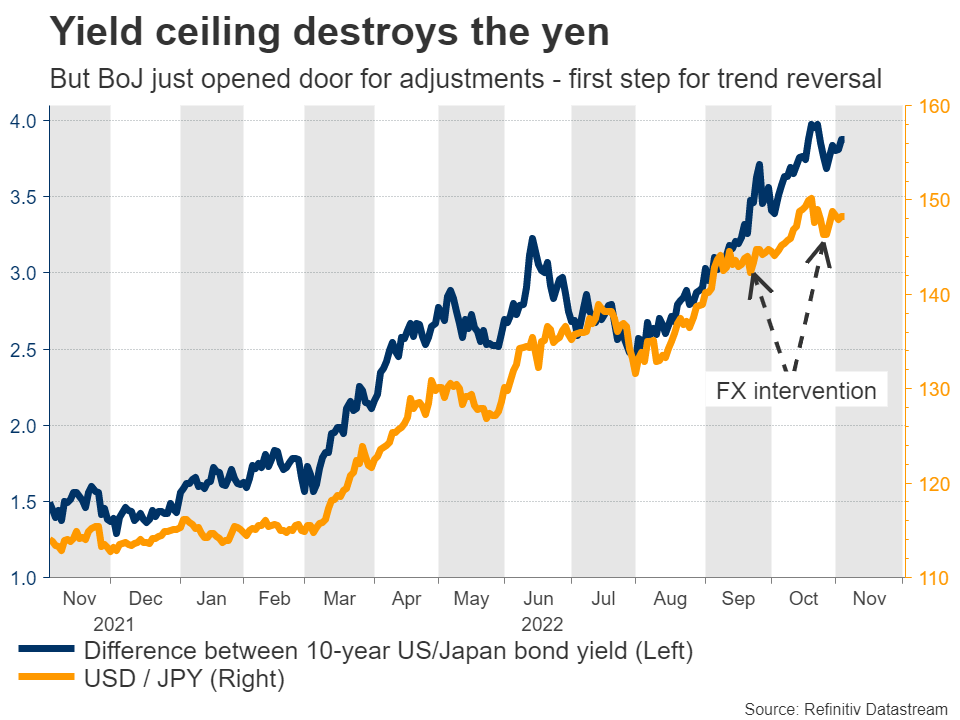
Adjusting this strategy would be the first step towards a trend reversal in the yen. Such a shift would likely require an acceleration in wage growth, which isn’t evident yet. Nevertheless, the wind of change is blowing, and investors will keep an eye on the BoJ’s summary of opinions on Tuesday for more clues on this subject.
Finally, UK economic growth data for the third quarter will be released Friday. Sterling took a serious beating this week, after the Bank of England pushed back against market pricing for aggressive rate increases and reaffirmed its forecasts for a prolonged recession next year.
With interest rate expectations having adjusted to reality and the political scene stabilizing, global risk sentiment could reestablish itself as the main driver for the pound moving forward.
Weekly Focus – Easing of Financial Conditions Comes to a Halt as Fed Maintains a Hawkish Tilt
Whereas last week ended on the note that we may be approaching the point of peak hiking pace, this week brought a reality check. The Federal Reserve hiked rates by 75bp on Wednesday and the widely expected hike was accompanied by Powell's hawkish message that financial conditions need to be tightened further. In contrast to any speculation around a possible Fed pivot, Powell stated clearly that 'it is very premature to be thinking about pausing' even if downside risks to growth are building. As a result, we adjusted our call to include a 50bp hike in February in addition to our earlier forecast of one more 75bp hike in December (see Research US - Fed review: Another hawkish 75bp hike - We now expect 50bp also in February, 2 November). The futures market is now pricing terminal rate at around 5.20%, 15bp higher compared to pre-meeting levels at 5.05%.
The Bank of England also hiked the bank rate by 75bp to 3.0% as expected on Thursday but with a dovish tilt compared to the Fed. Hence, we expect smaller hikes going forward and foresee the peak rate in February at 3.75%. Our view is for less hikes than the market is currently pricing in as we expect GDP data next week to confirm that the economy is already in recession. That being said, risks remain skewed towards additional hikes.
Norges Bank (NB) also delivered a dovish 25bp hike on Thursday, sending the sight deposit rate to 2.50%. While our call was for a 25bp hike, analysts and markets (37bp priced) were evenly split between 25bp and 50bp. This led to considerable market moves in rates and FX markets post announcement.
This week saw a sharp reversal in risk sentiment as premature optimism regarding the big central bank pivot faded. Broad USD as measured by the DXY index gained 1.9% while EUR/USD broke below the 0.98 level. At the time of writing on Thursday, both the US and German 10y yields were 15bp higher on the week. The easing in global financial conditions that we witnessed in October and that works against central banks' efforts and interests now seems to have halted, which means hawkish communication still does the trick.
Next week, the focus will be on US midterm election on Tuesday. Republicans are favoured to win control of both house and senate, although the senate race remains a close call. If republicans win the senate with a slim margin or if democrats are able to retain the senate, market reaction should be quite muted, as major changes in fiscal policy would be difficult to pass. The (modest) risk-scenario for markets would be a clear victory for republicans also in the senate, as this could increase the risk of more expansionary fiscal policies amid the looming recession. We see the risk as fairly unlikely for now, however, as politicians are likely well aware of the inflation risks.
US October CPI will also be in focus next week. We are looking for another high print at +0.7% m/m / +8.0% y/y. There are also several Fed speeches scheduled throughout the week, which will of course be interesting after this week's meeting. Several ECB speakers on the wires as well starting with Lagarde on Monday. Friday brings UK GDP growth for Q3 which we expect will be in negative territory (-0.3% q/q), marking an official start of the recession. In China, we get exports on Monday and CPI data on Wednesday but these are unlikely to move the markets.
Is China “Reopening”? The Forex Impact
China's covid policy hasn't led to a nationwide lockdown, so it's more of a metaphor to talk about "reopening". However, the economic impact from a shift in the current zero-covid policy could be seen as a parallel to when other countries "reopened" in 2021 (and then were subject to renewed restrictions with the omicron variant). More importantly, the change in policy in China is expected to have global implications. So far, changes haven't been officially confirmed, so here are some things to keep in mind ahead of any possible changes.
The latest
Overnight, there were unverified twitter reports that the Chief Scientist at China's CDC Zeng Guang had said that economic development would be prioritized over covid prevention. This followed prior speculation about when China would pivot away from zero-Covid policy. Reports circulated earlier in the week that China had formed a commission to revise policy related to coronavirus, but that policy wouldn't change until March. Note that in March is when the new leaders appointed following the last CCP Congress take office.
It was also reported yesterday that Chinese officials were modifying how covid restrictions were communicated in order to reduce the impact. Reportedly, officials were privately talking to certain businesses and locations to curb covid spread, instead of making broad public announcements.
But they are still rumors
Chinese health authorities are scheduled to hold a press conference on "targeted covid prevention" tomorrow. Many speculate this could be an opportunity to announce either a new policy, or to tweak existing policy in a way that would substantially reduce the economic impact.
There had been rumors for a while that China could start relaxing covid measures after the CCP Congress, but that didn't materialize. As of yet, there hasn't been any confirmation that a change in policy is imminent, though that might come as soon as over the weekend.
The implications
China's economy has been significantly impacted by a combination of the zero covid policies and the near collapse of the housing market (which is also attributed to issues around covid). The mere rumor that restrictions could be lifted in a few months' time sent markets in China shooting higher.
The rolling lockdowns created uncertainty around which industries and areas might suddenly be affected, slowing investment. A formal acknowledgement that zero-covid would be replaced with a policy that did not include lockdowns would likely substantially support the Chinese economy - and increase demand for imported goods, particularly from Japan, New Zealand and Australia.
The outlook
Slowing growth in China is one of the factors contributing to an expected global recession in the coming months. That contributed to lower oil prices, as well as other commodities. But a return of consumer demand could give China similar headaches as other countries: rising inflation and the need for the PBOC to start tightening policy.
With the housing market already in trouble, higher interest rates could make the internal economy a little shakier. But increases in productivity could help global supplies. And the stronger yuan could support increased imports of raw materials.
US: Job Growth Surprises to the Upside in October, Unemployment Rate Ticks Up to 3.7%
The U.S. economy added 261k jobs in October, coming in above the consensus forecast of 200k. Overall, revisions to the two prior months were positive, adding an additional 29k to the previously reported figures.
Employment gains on the service-side (+200k) were largely concentrated in health care & social assistance (+71k), professional & business services (+39k), and leisure & hospitality (+35k). Goods producing industries (+33k) had another solid month, though gains were almost entirely concentrated in manufacturing (+32k). Government added 28k jobs in October.
In the household survey, civilian employment fell by 328k, while the labor force declined by 22k. As a result, the unemployment rate ticked up 0.2 percentage points (pp), rising to 3.7%. The participation rate edged lower by 0.1pp, falling to 62.2.
Average hourly earnings rose 0.4% month-over-month (m/m) – accelerating from the 0.3% m/m gain recorded in September. Compared to October 2021, wage growth was up 4.7%. While this was a deceleration from the 5% y/y seen in September, it was entirely due to base effects.
Key Implications
You can't pull the rug out from underneath this labor market! The strong reading on employment alongside the positive revisions provides yet another example of the resilience still present in the U.S. economy.
Job growth continues to run well in excess of a pace consistent with trend growth in labor supply. This cannot be sustained indefinitely. Even with some reversal in last month's labor force numbers, the participation rate among the core working age (25-54 years old) still sits at its 2019 average. This suggest further gains in labor supply are likely to be more tepid, which should exert a more meaningful drag on employment.
A slowing in employment as a result of insufficient labor supply is a recipe for further wage gains and is the reason we saw an acceleration in month-over-month wage growth in October. Until we see a normalization in labor demand, imbalances in the labor market will remain, keeping sustained upward pressure on wages and further complicating the Fed's fight against inflation.
The Federal Reserve delivered on a fourth consecutive 75-basis point rate hike earlier this week. While we suspect the FOMC will dial back on the pace of rate hikes in December, comments made by Chair Powell in yesterday's press conference suggest that the FOMC's expectations on the terminal rate have drifted higher in recent months, as inflation has shown little evidence of turning and the labor market remains incredibly tight. It's entirely possible the Fed will need to "keep at it" through early-2023 – potentially taking the policy rate as high as 5% – in order to return price stability.
Canadian Employment Surges in October
Employment blew away expectations in October, as the Canadian labour market added a meaty 108k positions in October. As such, job losses recorded over the past few months were more than recouped.
All of October's gain was in full-time work, which jumped by 119k positions. There was little change in the number of part-time positions. Meanwhile, the private sector did the bulk of the hiring (+74k positions).
Even with the robust jobs gain, the unemployment rate held steady at 5.2%, as the labour force climbed by 110k and the participation rate edged up 0.2 ppts to 64.9%.
By industry, strong gains were recorded in construction (+24.6k positions), manufacturing (+23.8k), professional, scientific and technical services (+17.9k), accommodation and food services (+18.3k) and other services (+17.5k). In contrast, a steep decline was recorded in trade (-20.2k).
On a geographic basis, six provinces recorded gains, with the bulk of the hiring concentrated in Ontario (43k) and Quebec (28k).
Lastly, total hours worked jumped 0.7% m/m, while average hourly earnings were up 5.6% year-on-year, marking an acceleration from September's 5.2% pace.
Key Implications
Wow. This jobs report checked all the boxes in terms of being a blowout report. Headline job growth surged, and gains were powered by full-time, private sector positions. In addition, hours worked surged, and wage growth accelerated. The unemployment rate was unchanged, but this was due to many more Canadians looking for work – a healthy sign for growth. Notably, bond yields and the dollar are up in the wake of the report.
The Canadian labour market clearly still has some steam left to it. And, the gain in hours worked suggests that economic growth got off to a good start to begin the fourth quarter, after decelerating in Q3. This report also justifies the Bank's stance that more needs to be done on the rates front, and our current forecast anticipates an additional 50 bps of tightening by the end of the year.
EUR/USD Mid-Day Outlook
Daily Pivots: (S1) 0.9707; (P) 0.9773; (R1) 0.9817; More...
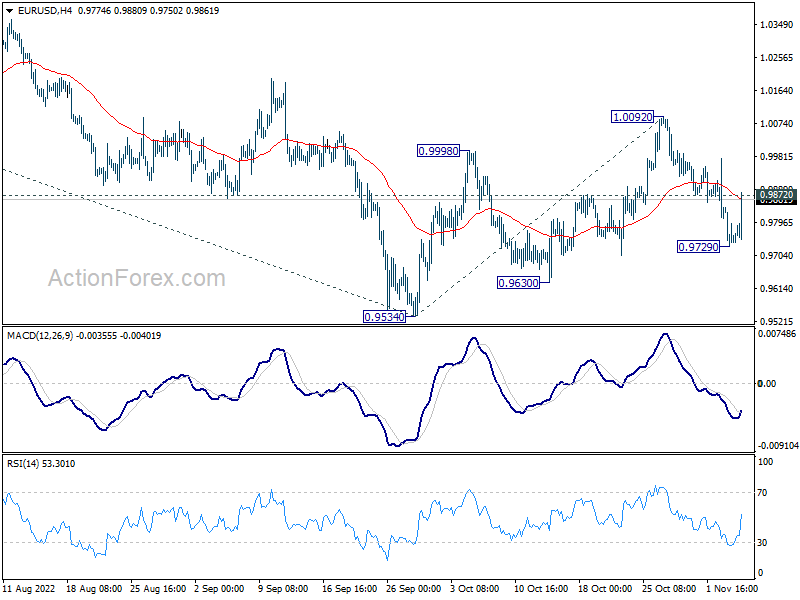
Intraday bias in EUR/USD is turned neutral first with break of 0.9872 minor resistance. At this point, the favored case is still that corrective pattern form 0.9534 has completed with three waves up to 1.0092. Risk will stay on the downside as long as 1.0092 resistance holds. Break of 0.9729 will target a test of 0.9534/9630 support zone.
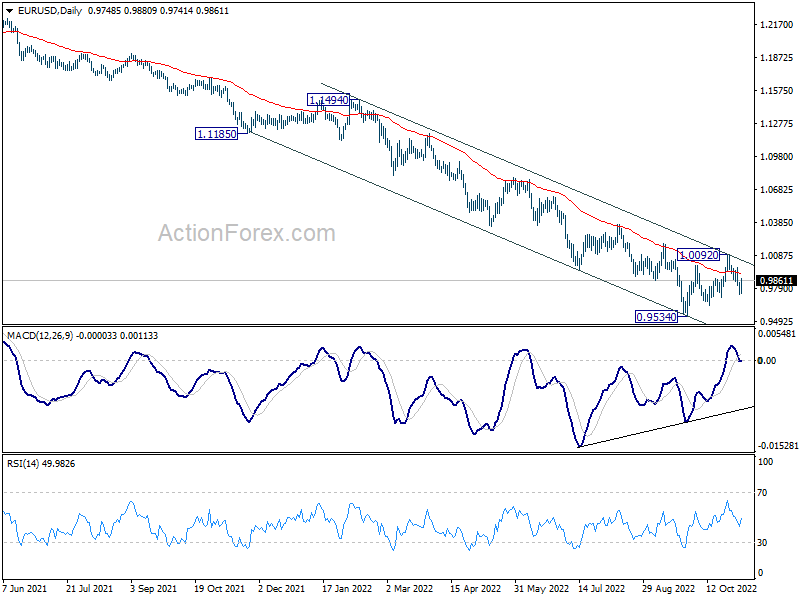
In the bigger picture, medium term term bearishness is retained with failure to sustain above 55 day EMA (now at 0.9930). That is, larger down trend from 1.2348 (2021 high) is still in progress. Firm break of 0.9534 low will confirm this bearish case. For now, risk will stay on the downside as long as 1.0092 resistance holds, in case of recovery.
GBP/USD Mid-Day Outlook
Daily Pivots: (S1) 1.1065; (P) 1.1243; (R1) 1.1335; More...
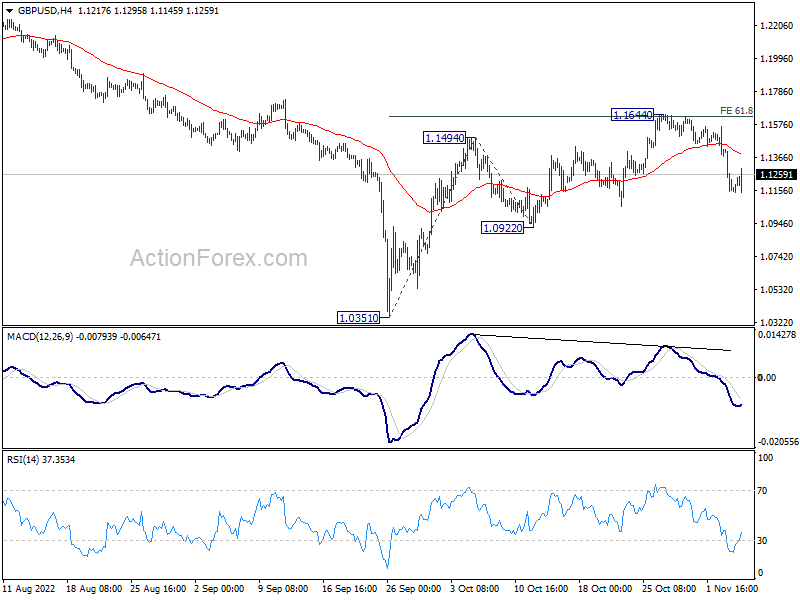
Intraday bias in GBP/USD stays on the downside at this point. As noted before, corrective rebound from 1.0351 should have completed with three waves up to 1.1644. Deeper fall would be seen to 1.0922 support first. Break there will target a retest on 1.0351 low. For now, risk will stay on the downside as long as 1.1644 resistance holds, in case of recovery.
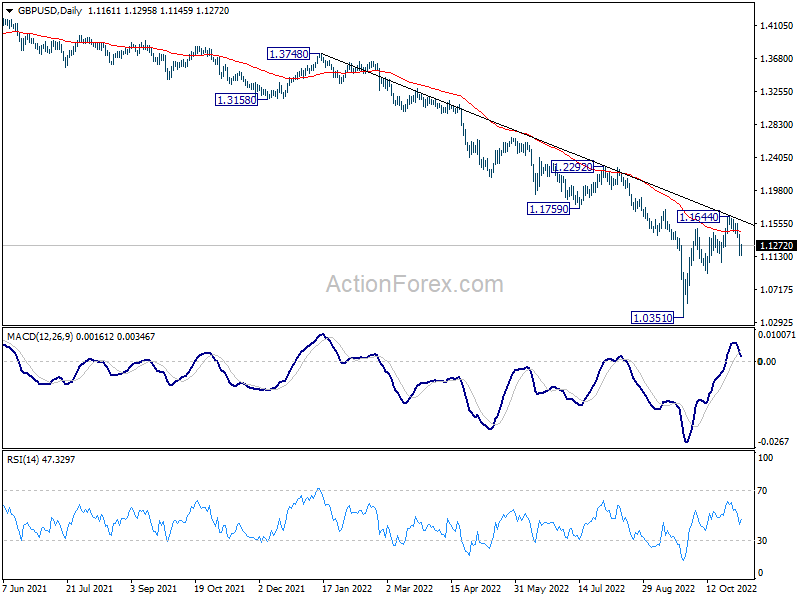
In the bigger picture, fall from 1.4248 (2018 high) is part of the long term down trend from 2.1161 (2007 high). Outlook will stay bearish as long as 1.1759 support turned resistance holds. Parity would be the next target on resumption. Nevertheless, firm break of 1.1759 will confirm medium term bottoming, and open up stronger rise back to 55 week EMA (now at 1.2392).
USD/CHF Mid-Day Outlook
Daily Pivots: (S1) 1.0044; (P) 1.0095; (R1) 1.0187; More...
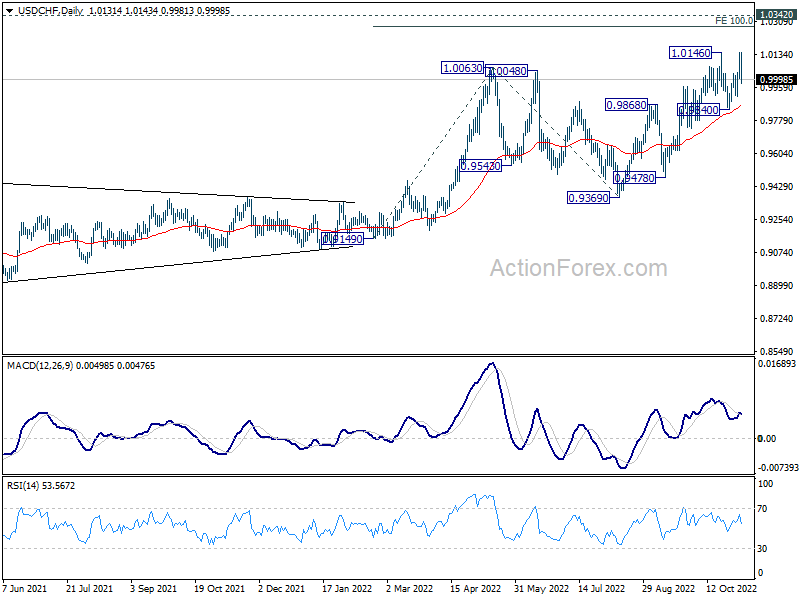
USD/CHF's break of 1.0031 minor support indicates rejection by 1.0146 resistance. Consolidation pattern from there is expected and deeper fall might be seen. But still, outlook will will stay bullish as long as 0.9840 support holds. On the upside, firm break of 1.0146 will resume larger up trend. Next target is 1.0283 projection level.
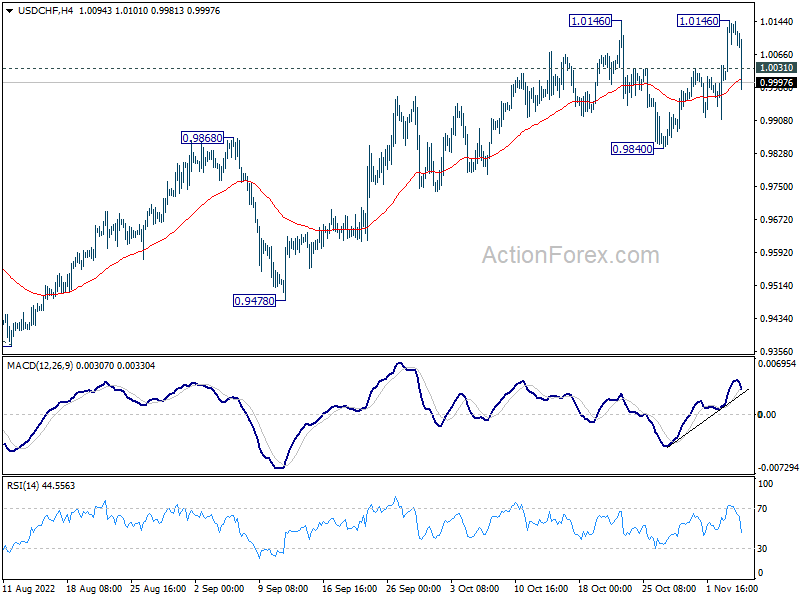
In the bigger picture, current development suggests that up trend from 0.8756 (2021 low) is still in progress. Next target is 100% projection of 0.9149 to 1.0063 from 0.9369 at 1.0283, and then 1.0342 (2016 high). For now, this will remain the favored case as long as 0.9779 support holds, even in case of deep pull back.