Sample Category Title
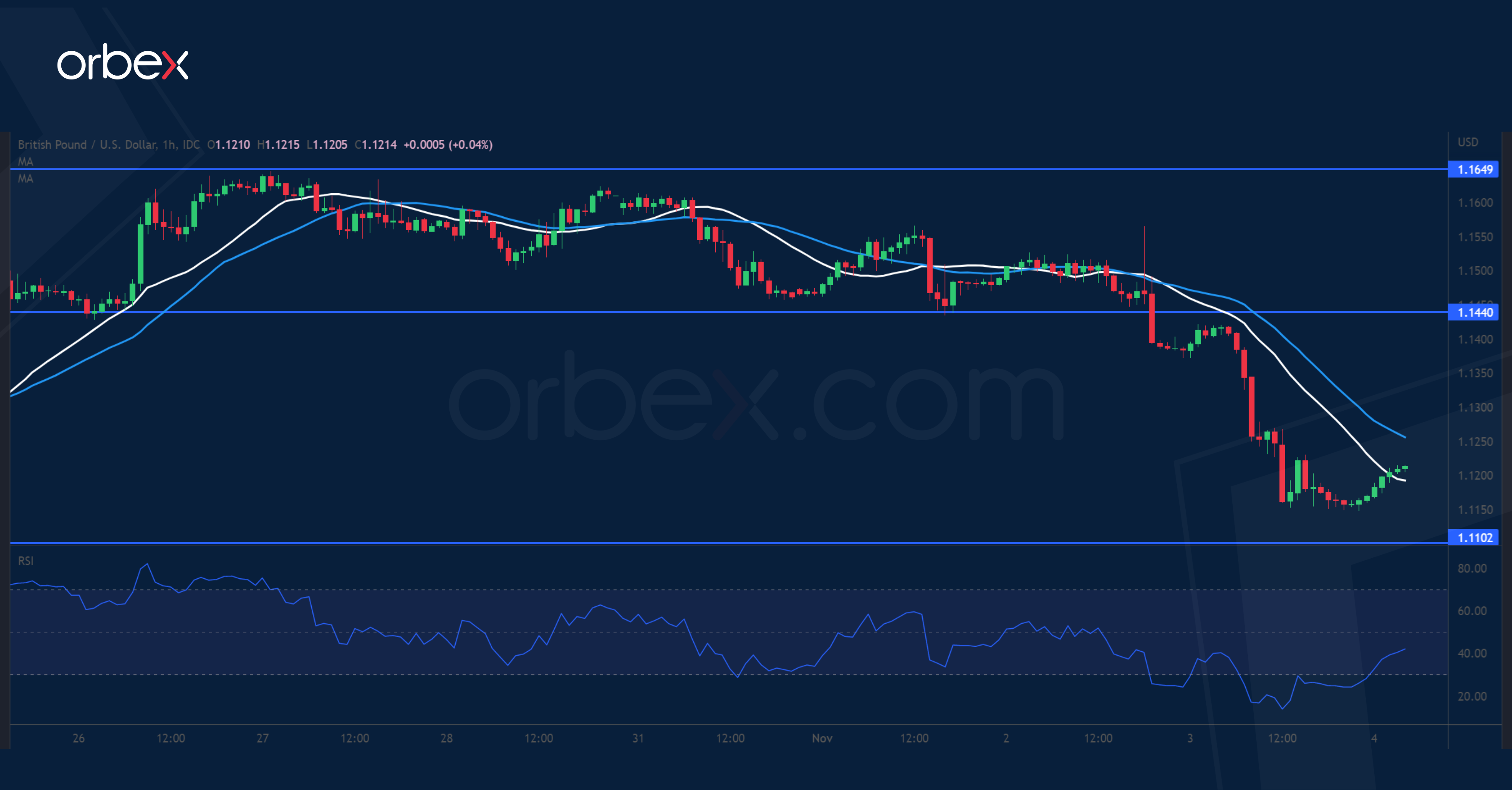
GBP/USD Turns Lower
The pound tumbled after the BoE warned of a protracted downturn. The price lost steam near September’s high (1.1700) and a break below 1.1440 sent buyers packing, turning it into a resistance. A lack of bids at the base (1.1300) of a recent bullish breakout is a warning sign that sentiment has gone cautious. 1.1100 is an important support and after the RSI sank to the oversold area, a ‘buying-the-dips’ behaviour could be expected. However, its breach could make Sterling vulnerable to renewed selling pressure.
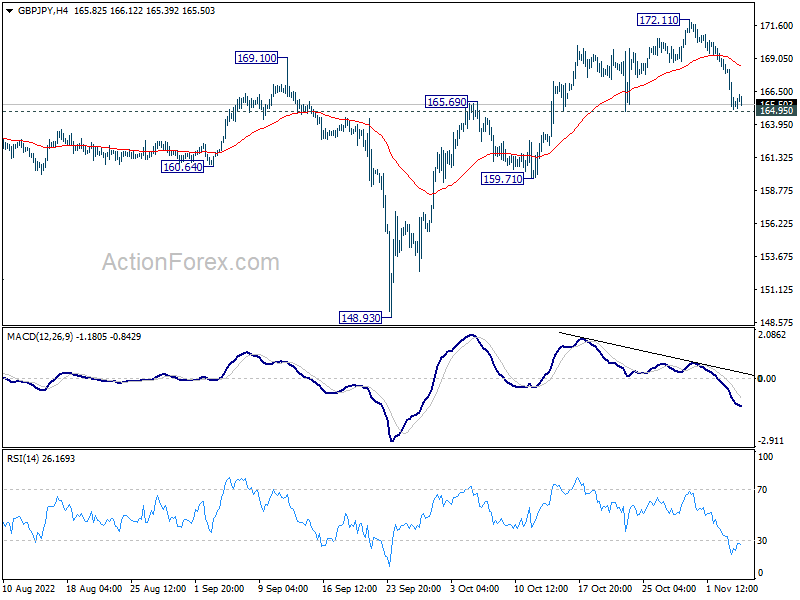
GBP/JPY Daily Outlook
Daily Pivots: (S1) 164.19; (P) 166.39; (R1) 167.67; More...
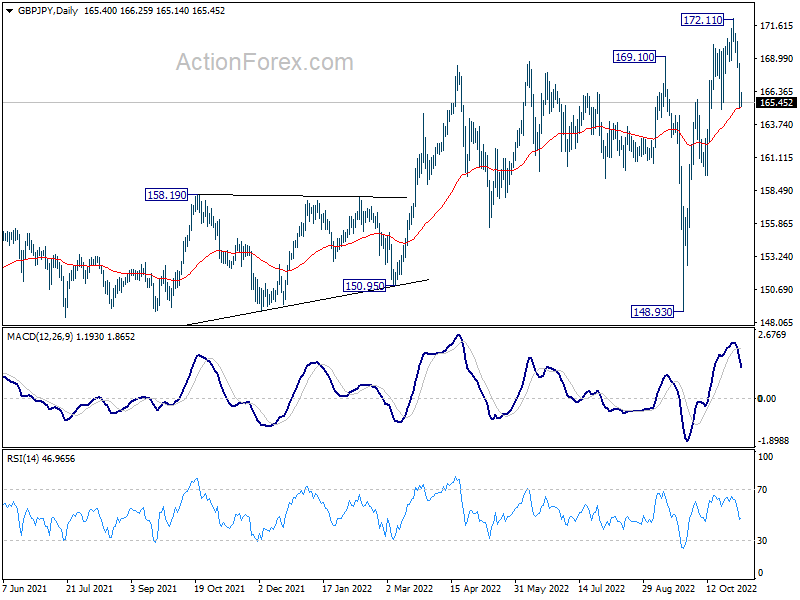
Intraday bias in GBP/.JPY stays neutral at this point. Further rise is in favor as long as 164.95 support holds. Break of 172.11 will resume larger up trend. However, break of 164.95 will bring deeper pull back to 159.71 support and below.
In the bigger picture, up trend from 123.94 (2020 low), as part of the trend from 122.75 (2016 low) is still in progress. Further rise would be seen to 161.8% projection of 122.75 to 156.59 (2018 high) from 123.94 at 178.69. This will now remain the favored case as long as 148.93 support holds.
EUR/JPY Daily Outlook
Daily Pivots: (S1) 143.94; (P) 144.65; (R1) 145.26; More....
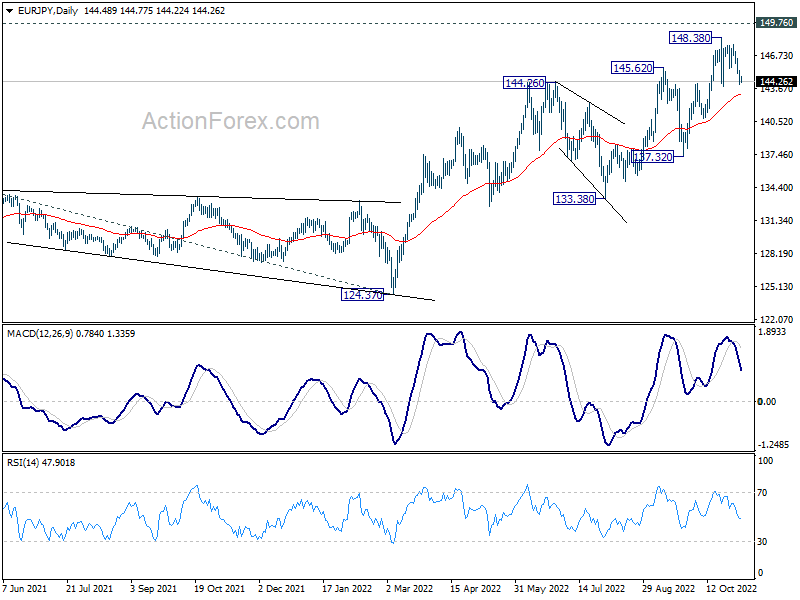
Intraday bias in EUR/JPY stays neutral as consolidation from 148.38 is extending. In case of deeper fall, downside should be contained by 55 day EMA (now at 143.09) to bring rise resumption. On the upside, break of 148.38 will resume larger up trend to 149.76 long term resistance next.
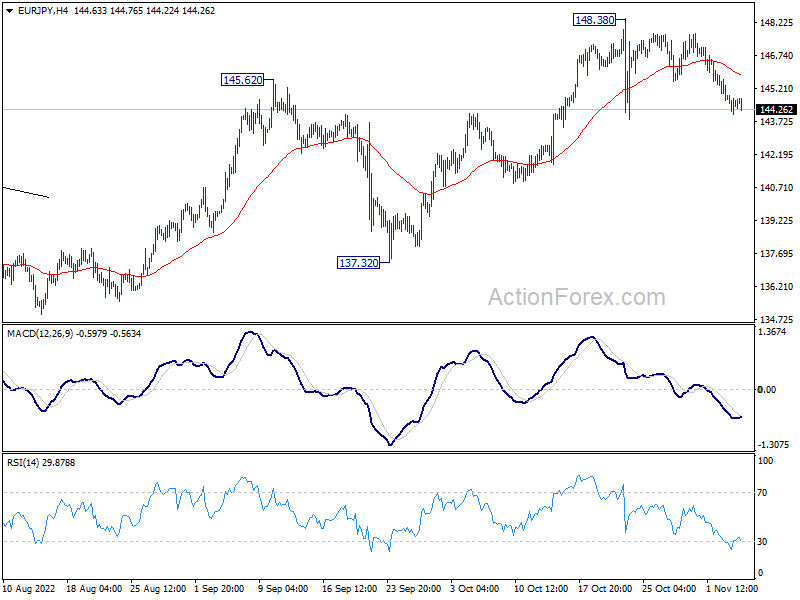
In the bigger picture, the up trend from 114.42 (2020 low) is still in progress for 149.76 (2014 high). Decisive break there will pave the way to 161.8% projection of 114.42 to 134.11 from 124.37 at 156.22. This will now remain the favored case as long as 137.32 support holds.
EUR/GBP Daily Outlook
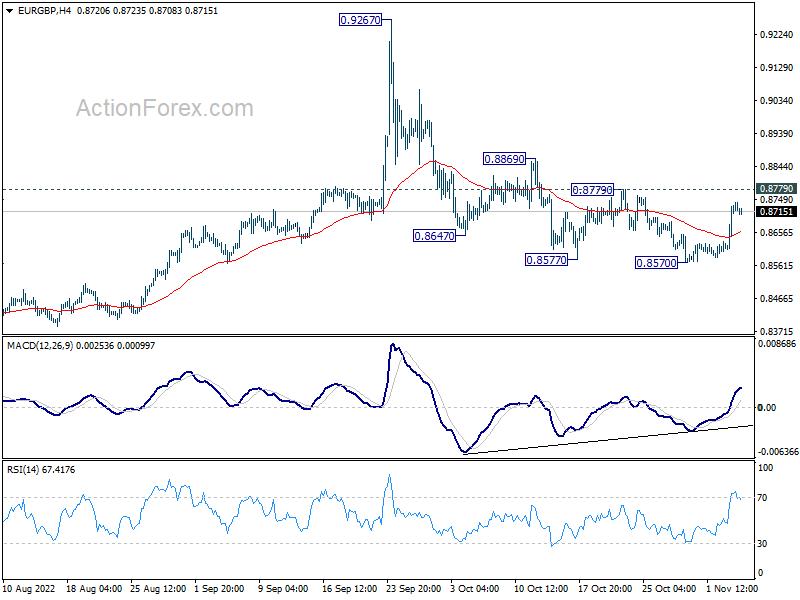
Daily Pivots: (S1) 0.8648; (P) 0.8695; (R1) 0.8783; More...
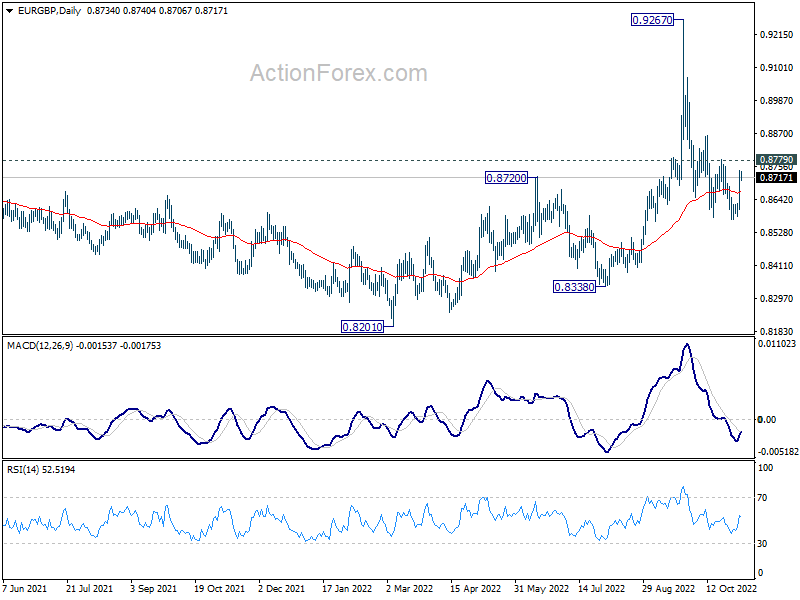
Intraday bias in EUR/GBP remains neutral for the moment. Further decline is in favor with 0.8779 resistance intact. Break of 0.8570 will resume the fall from 0.9267 and target 0.8201/8388 support zone. However, break of 0.8770 will turn bias back to the upside for 0.8869 resistance and above.
In the bigger picture, current development suggests that fall from 0.9267 is a down leg inside long term range pattern. Deeper fall could be seen towards 0.8201/8338 support zone. But strong support should be seen there to bring reversal.
EUR/AUD Daily Outlook
Daily Pivots: (S1) 1.5440; (P) 1.5486; (R1) 1.5541; More...
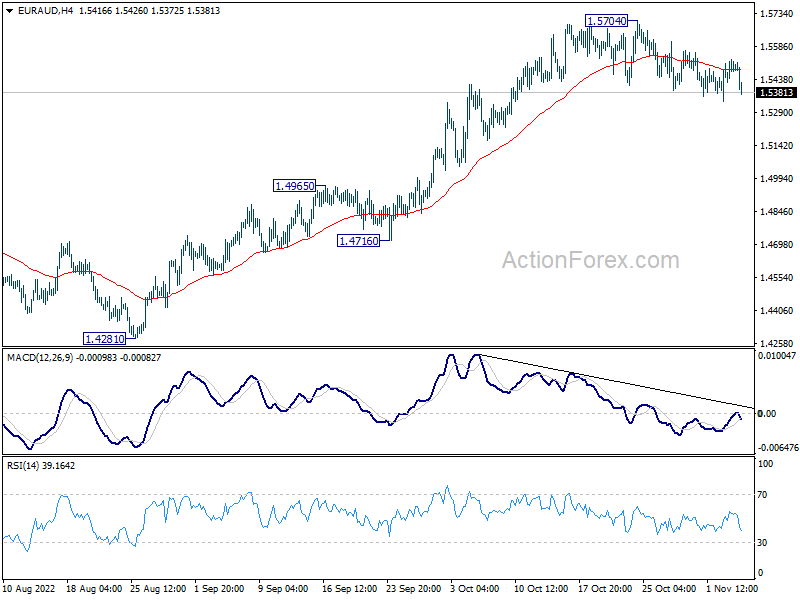
Intraday bias in EUR/AUD remains neutral as consolidation from 1.5704 is extending. Deeper decline cannot be ruled out. But downside should be contained by 55 day EMA (now at 1.5199) to bring rebound. On the upside, break of 1.5704 will resume the rally from 1.4281.
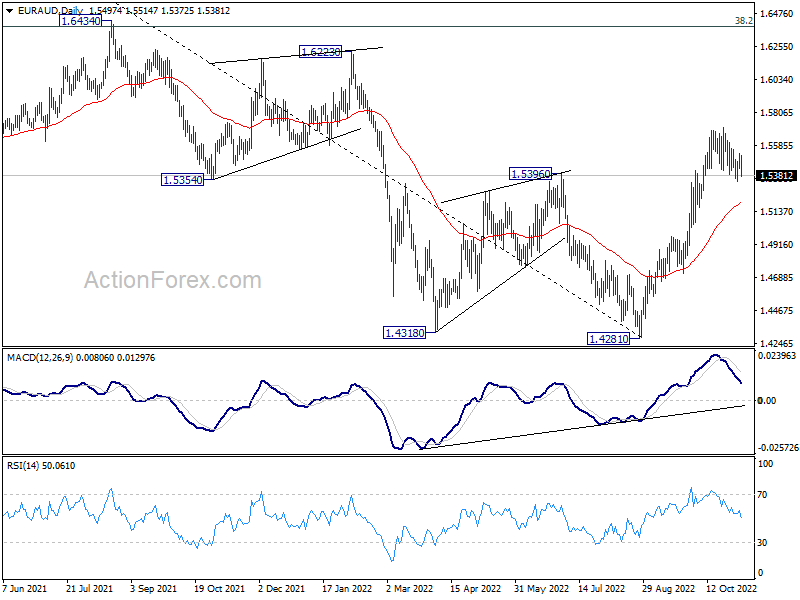
In the bigger picture, a medium term bottom should be in place at 1.4281, on bullish convergence condition in daily MACD. Further rise would be seen back to 1.6434 key resistance next. Break of 1.4965 resistance turned support is needed to indicate reversal. Otherwise, further rally will remain in favor.
EUR/CHF Daily Outlook
Daily Pivots: (S1) 0.9843; (P) 0.9868; (R1) 0.9907; More....
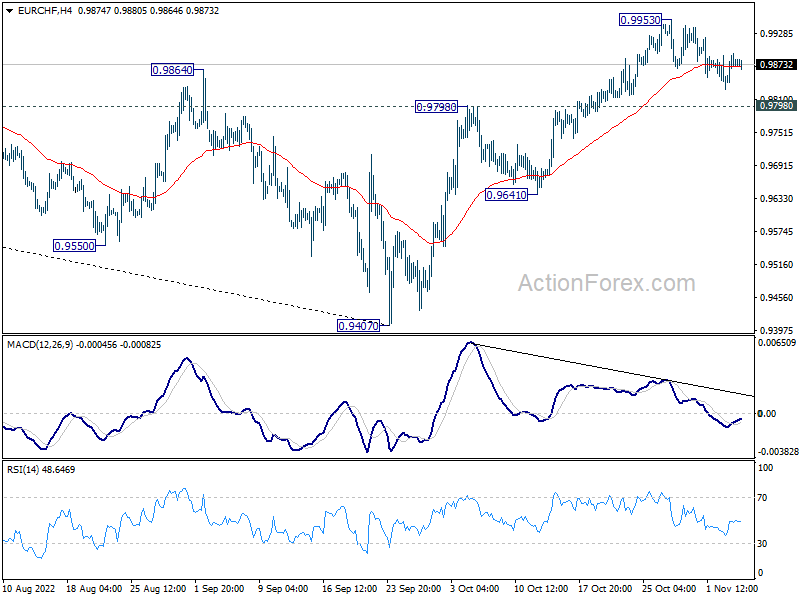
EUR/CHF is still extending the consolidation pattern from 0.9953 and intraday bias stays neutral. In case of deeper retreat, downside should be contained by 0.9798 support to bring rebound. On the upside, break of 0.9953 will resume the rise from 0.9407 to 1.0072 fibonacci level.
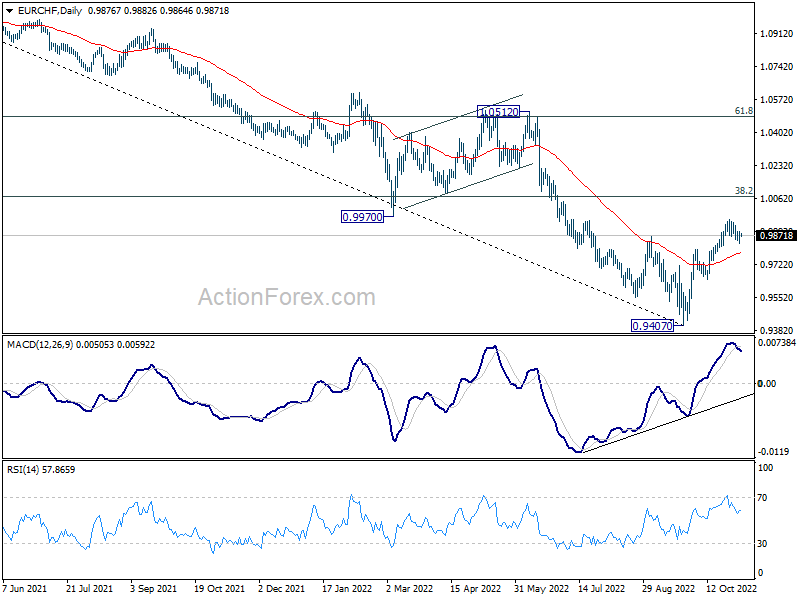
In the bigger picture, a medium term bottom should be in place at 0.9407. Further rally is expected as long as 0.9641 support holds, even as a corrective rebound. Next target 38.2% retracement of 1.1149 to 0.9407 at 1.0072. Reaction from there, as well as 55 week EMA (now at 1.0128) will reveal whether the trend is reversing.
A Reading Close Enough to Expectations (195k) Will Only Reinforce Powell’s Message
Markets
The pound sterling underperformed peers yesterday. The Bank of England hiked by an expected 75 bps to 3%. More is coming but not as much as markets are discounting (4.5-4.75%), it said in unusually explicit wording. Combined with bleak economic forecasts, EUR/GBP rallied from 0.862 to 0.874. GBP/USD gave up support from the 50dMA (1.134) to finish at 1.116. Dollar strength was at least as much responsible for the move, enjoying a healthy bid still in the wake of Powell’s hawkish press conference. The trade-weighted index closed just south of 113. EUR/USD (0.975) lost the lower bound of the short-term upward sloping trend channel. Core bonds stayed under pressure with Bunds marginally underperforming USTs. ECB president Lagarde said that – while not the base scenario – a (mild) recession along would not be enough to tame inflation. These comments come after the ECB last week put more emphasis on growing recession risks, raising speculation for a dovish pivot soon. German yields rose more than 10 bps in the 2-10y segment. The European 2y (+8.6 bps) yield narrowly closed above 3% again. US yields rose between 4.1 bps (30y) and 9.4 bps (2y, new cycle high). A slightly below-consensus but solid October US services ISM doesn’t change the Fed narrative. A knee-jerk countermove on the daily market trends shortly after the release faded quickly. The post-BoE UK yield curve steepened with changes varying from +3.7 bps (2y) to +14.8 bps (30y). UK (money) markets are just not buying the BoE’s/Bailey’s story.
While European and US stocks closed lower yesterday, equities in Asia are closing the week more upbeat. Hong Kong/Chinese stocks go berserk (6-7%+) amid ongoing speculation of an exit from zero-Covid. News of US audit inspections in the region (necessary for keeping Chinese firms listed on US stock exchanges) having wrapped up early also boosted sentiment. China’s yuan rebounds from multiyear lows to USD/CNY 7.248. Some overall dollar weakness is at play too. EUR/USD advances to 0.978. US yields ease a few bps across the curve. Both current dollar and yield declines could soon reverse though. US October payrolls are due later today. An unexpected uptick in JOLT vacancies and the stronger-than-expected ADP job report earlier this week suggest that real labour market softness hasn’t arrived yet. Even if hiring were to slow compared to September, we think that a reading close enough to expectations (195k) will only reinforce Powell’s message on Wednesday. US yields at the shortest tenors already hit new cycle highs. Longer tenors could come closer today. EUR/USD support is located at 0.9633 (October low).
News Headlines
Following up on Tuesday’s 25 bps rate, the Reserve Bank of Australia published its quarterly “Statement on monetary policy” which sets out the RBA’s assessment of current economic conditions along with an outlook for inflation and growth. The central bank upgraded its forecast for trimmed mean inflation (favorite core gauge) for December 2022 from 6% in August to 6.5%. Core inflation will then fall to 3.75% in Dec2023 and remain above the 2%-3% inflation tolerance band by Dec2024 (3.25% from 3% in August). The forecasts assume a further increase in the policy rate to 3.5% by June next year (currently 2.85%) before settling back at 3% by end 2024. Australian growth is forecast at 3% for this year and 1.5% in both 2023 and 2024. The Aussie dollar is relatively stronger this morning, with AUD/USD rising from 0.63 to 0.6350, but remains weak in absolute terms. A positive Asian risk sentiment helps. AUD swap yields lose around 8 bps across the curve.
The US services ISM fell more than expected in October, from 56.7 to 54.4. It’s the weakest level since May 2020, even as the indicator remains far above the 50 boom/bust mark for the moment. Details paint a bleak demand side picture with a drop in business activity (55.7 from 59.1), new orders (56.6 from 60.6) and especially new export orders (47.1 from 65.1). Backlog of orders stabilized (52.5) with inventory levels shrinking at a slower pace (47.2 from 44.1). The employment component fell back below 50 (49.1 from 53). The prices paid component ticked up again to 70.7 from 68.7 pointing at still alleviated price pressure.
The World Needs Soft Jobs Data from the US
Investors got the policy pivot they were looking for this week; unfortunately, not from the Federal Reserve (Fed), but from the Bank of England (BoE) instead.
In an extended market reaction to Wednesday’s Fed decision, the US dollar gained across the board, as investors repositioned for a more aggressive Fed tightening.
The Fed will not stop until it pushes rates above 5%, at least. I say at least, because it will depend on how fast the rate hikes translate into lower inflation, and lower jobs.
Released Wednesday, the ADP report exceeded analysts’ expectations with 239’000 new private job additions last month.
Due today, the NFP is expected to reveal 200’000 new nonfarm jobs in October, for an average hourly pay rise steady around 0.3%.
A stronger than expected jobs, or wages data could only further boost the Fed hawks, whereas today’s jobs figures should be particularly soft to throw cold water on very hot hawkish Fed expectations before the weekly closing bell.
The S&P500 lost another 1% yesterday, and more than 5% since the peak of this week. The latest bear market rally is now leaving its place to another dive, and we could see the index sink toward 3400 in the continuation of an ABCD pattern building since March this year.
Nasdaq dived another 2% and is poised to extend gains toward the 10200 level in the continuation of the latest selloff wave.
Only ugly US data could relieve others’ pain
Unfortunately, the only thing that could reverse the morose investor sentiment would be dramatically ugly jobs, and economic data from the US.
That’s also the only thing that could save the rest of the world from the worsening Fed aggression: rapidly deteriorating economic conditions in the US.
As long as the US economy remains resilient, the Fed will continue exporting its pain, and inflation to the rest of the world through a too-strong US dollar.
So, Americans would excuse the rest of the world for praying to see ugly jobs figures from the US, today.
What is BoE trying to do?
The Bank of England (BoE) raised its interest rate by 75bp yesterday, but announced that the city analysts have got the BoE’s terminal rate wrong, and that the future rate hikes from the BoE will be softer, given that the economic situation is alarming.
So why to hike by 75bp in the first place?
To avoid sterling from crumbling?
But sterling dived anyway, and will dive deeper. Cable, which began the week above the 1.16 mark dived all the way down to 1.1150 after the BoE statement, and the divergence between the Fed – looking for smaller rate hikes but toward a higher end rate, and the BoE, which threw a useless 75bp hike, and doesn’t want to get more aggressive than this, will likely weigh on the pound-dollar in the medium run. We could again see the pair testing parity in the coming weeks.
Good news, however, is, the short end of the British gilt curve eased on expectation of a lower end rate from the BoE. The 2-year yield tipped a toe below 3% yesterday, the 10-year yield remained below the 3.5% level. What BoE is trying to do is to get some pressure off the mortgage rates, and the housing market, even if it means higher inflation than otherwise, for longer.
It looks like the BoE also relies on a reasonably restrictive fiscal budget from the new Sunak government.
US Jobs Market in Focus
Market movers today
Today, markets will zoom in on the US jobs report. We expect another strong reading of 220k.
In Germany, we will get industrial orders for September, which will likely continue to indicate a slowing manufacturing sector.
The 60 second overview
Bank of England: The Bank of England hiked the bank rate by 75bp to 3.0% as expected on Thursday. We expect smaller hikes going forward and keep the peak rate at 3.75%, which we believe will be reached in February. Our view is for less hikes than the market is currently pricing in as we expect GDP data next week to confirm that the economy has already entered recession. That being said, risks remain skewed towards additional hikes.
Norges Bank: Norges Bank also announced a 25bp hike yesterday, sending the sight deposit rate to 2.50%. While our call was for a 25bp hike, analysts and markets (37bp priced) were evenly split between 25bp and 50bp. This led to considerable market moves in rates and FX markets post announcement.
EU-China: German Chancellor Olaf Scholz is the first G7 leader in three years to pay a visit to meet Chinese leader Xi Jinping in China. The visit comes as geopolitical tensions mount, as the US continues to distance itself from China and as the EU seeks to adjust their ties. After the meeting, Xi said that large nations of influence such as China and Germany should all the more work together in 'times of change and turmoil'. China is seeking to reassure the business delegation that travels with Scholz that despite the country's tight Covid policy, they remain open for trade and investments. Scholz, on the other hand, will have to balance between weakening reliance, diversifying supply chains and enhancing security while still fostering business relations. Scholz' visit has also received criticism in the homeland, particularly after shipping giant Cosco received green light from Berlin last week to obtain a stake in a Hamburg port terminal despite opposition from coalition partners.
Equities: Equities came under pressure yesterday, again driven by higher yields, fear of central bank tightness. Hence, no surprise to see cyclical growth underperforming led by tech and communication services. These sectors normally lead the positive earnings surprises but not this time around as they are coming out among the weakest sectors. The combination of weaker growth outlook, tighter monetary policy and weak earnings reports is really challenging for this group of equities. In US yesterday, Dow -0.5%, S&P 500 -1.1%, Nasdaq -1.7% and Russell 2000 -0.5%. In Asia, China stocks going ballistic this morning with Hang Seng up 7%. The rally purely based on speculation that authorities forming a committee to explore an exit from zero-Covid policy. Rest of the Asian markets are more mixed with Japan almost 2% lower. US and European futures are higher this morning.
FI: The rise in yields continued yesterday after the hawkish comments from Federal Reserve Chairman Powell late Wednesday. The rise comes on the back of expectations of more rate hikes although at a slower pace given the high inflation data as well as the solid labour market. Hence, today's US nonfarm payrolls will be very important for this view.
FX: BoE and NB hiked interest rates yesterday, but GBP and NOK weakened as both central banks came across as less hawkish than expected by the market. EUR/USD dropped below 0.98 yesterday as US interest rates rose in the aftermath of Wednesday's FOMC meeting.
Credit: Wednesday night's hawkish Fed meeting sent EUR CDS indices wider yesterday and iTraxx Main closed at 113bp (+2bp) while Crossover was 8bp wider at 551bp. Meanwhile, euro FIG and corporate issuance came almost to a halt with the only deal coming to the market being a covered bond.
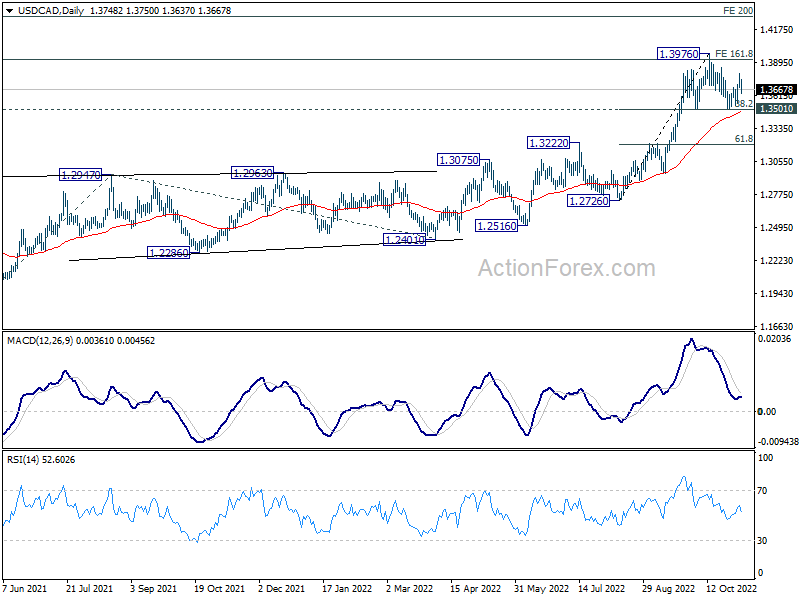
USD/CAD Daily Outlook
Daily Pivots: (S1) 1.3683; (P) 1.3746; (R1) 1.3808; More....
Intraday bias in USD/CAD remains neutral for the moment. Further rise in favor as long as 1.3501 support holds. On the upside, decisive break of 1.3976 will resume larger up trend and target 200% projection of 1.2005 to 1.2947 from 1.2401 at 1.4285. However, sustained trading below 1.3494 support will complete a head and shoulder top pattern (ls: 1.3832; h: 1.3976; rs: 1.3807). Outlook will be turned bearish for deeper fall to 1.3207 resistance turned support.
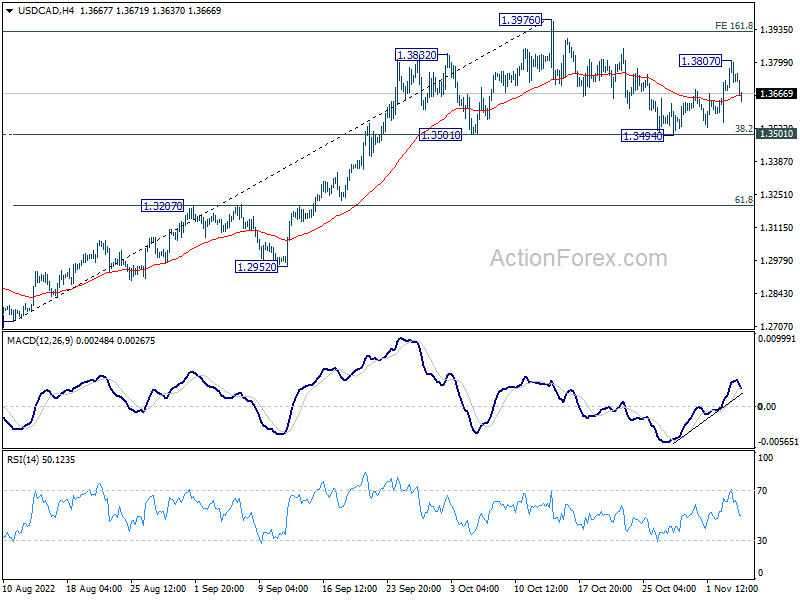
In the bigger picture, up trend from 1.2005 (2021 low) is still in progress. Based on current impulsive momentum, it could be resuming long term up trend from 0.9056 (2007 low). Whether it is or it isn't, retest of 1.4689 (2016 high) should be seen next. This will now remain the favored case as long as 1.3222 resistance turned support holds.