Sample Category Title
BoE Pill: Interest rates don’t need to rise as high as markets are pricing
BoE Chief Economist Huw Pill told CNBC, "Our current assessment is that we don't think interest rates would need to rise as high as markets are pricing precisely because it would produce a slowdown in the economy that is bigger than we need to get these prices under control."
"That is why the message has been, yes, maybe the market was pricing in too aggressively over this period of turmoil where bank rate is headed. What we are seeking, are always seeking is to find that balance that gets us back to the 2% inflation target without generating unnecessary and costly problems in the real economy," he said.
He added that the challenge is to "ensure that inflation, particularly this domestically generated inflation, is evolving consistent with our target in a sustainable way". At the same time, "also to avoid that we overshoot in the opposite direction and generate a slowdown that is not required."
The question for us is, even as headline inflation begins to fall, have we done enough with monetary policy to contain those underlying or persistent dynamics on inflation to ensure that they end up consistent with our target over time? And I think the answer to that is, we still think there's more to do to control that domestically driven wage-price cost dynamic."
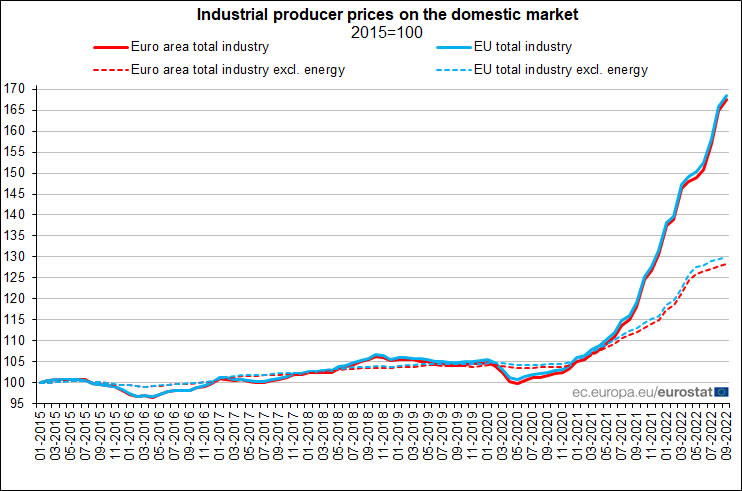
Eurozone PPI up 1.6% mom, 41.9% yoy in Sep
Eurozone PPI rose 1.6% mom, 41.9% yoy in September, below expectation of 1.7% mom, 42.0% yoy. For the month, industrial producer prices in Eurozone increased by 3.3% in the energy sector, by 0.9% for non-durable consumer goods, by 0.4% for capital goods and for durable consumer goods and by 0.1% for intermediate goods. Prices in total industry excluding energy increased by 0.4%.
EU PPI rose 1.5% mom, 41.4% yoy. The highest monthly increases in industrial producer prices were recorded in Bulgaria (+9.2%), Slovakia (+8.9%) and Italy (+3.5%), while the largest decreases were observed in Ireland (-18.9%), Estonia (-3.9%) and Greece (-2.4%).
Eurozone PMI Composite finalized at 47.3, headed for a winter recession
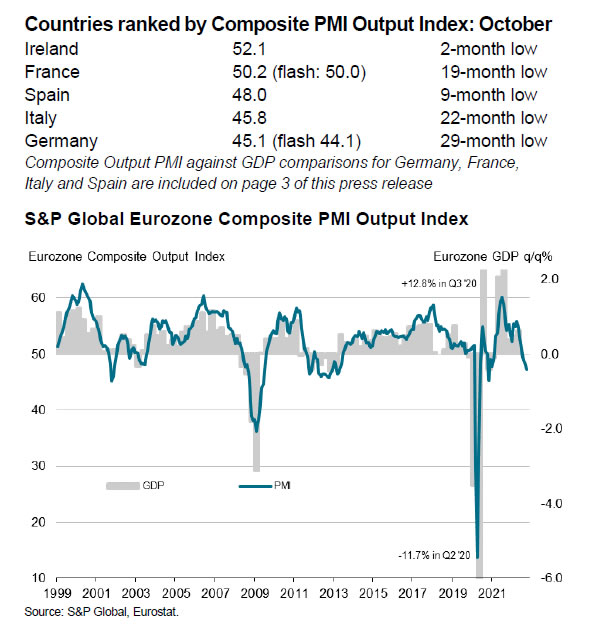
Eurozone PMI Services was finalized at 48.5 in October, down from September's 48.8, a 20-month low. PMI Composite was finalized at 47.3, down from prior month's 48.1, a 23-month low. Looking at some member states, Germany PMI Composite dropped to 45.1 (29-month low), Italy to 45.8 (22-month low), Spain to 48.0 (9-month low), France to 50.2 (19-month low), and Ireland to 52.1, (2-month low).
Joe Hayes, Senior Economist at S&P Global Market Intelligence said:
"After a weak third quarter of PMI and official GDP data, the latest survey results for the start of the fourth quarter suggest the eurozone economy is now headed for a winter recession. High inflation is dampening demand and hurting business confidence. Fears that the energy crisis could intensify over the winter period are also feeding uncertainty and weighing on decision-making.
"Nonetheless, the ECB will want to continue with monetary tightening to contain inflation. October PMI data suggest inflationary pressures remained extremely elevated across the eurozone. We did, however, see some dovish tones in the rhetoric surrounding the ECB's October policy decision, clearly showing that the Governing Council are concerned by the rapidly deteriorating economic outlook. A substantial worsening of economic conditions in the coming months may give policymakers a difficult decision to make with regards to the path of monetary tightening, for fear of being too aggressive and prolonging the downturn."
WTI Oil Futures Sustain Bullish Bias But With Some Caution
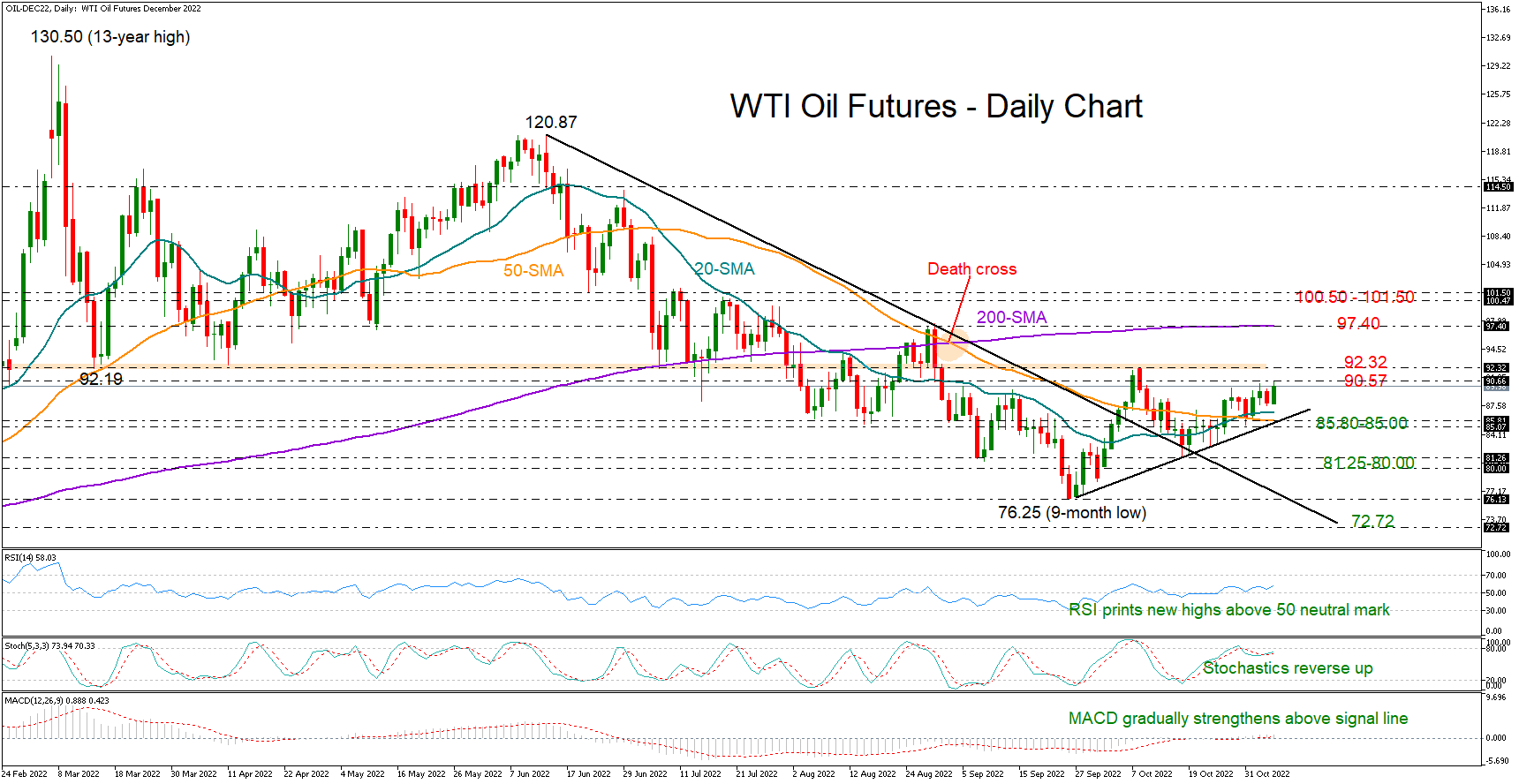
WTI oil futures (December delivery) are set to close with mild gains for the third consecutive week after struggling to successfully enter the 90 territory.
While the positive trajectory in the momentum indicators promotes a bullish continuation, the 90.57-92.32, which includes the 20- and 50-period simple moving averages (SMAs) on the weekly chart, could ruin further progress. A decisive close above that region would mark a new higher high in the chart, boosting hopes for a positive trend reversal. If that were the case, the spotlight would turn to the flattening 200-day SMA at 97.40, a break of which could lift the price up to the 100.50-101.50 resistance area.
If sellers return, the price could pull into the 85.80-85.00 support region, where the short-term descending trendline drawn from the nine-month low of 76.25 is placed. Another move lower could test the 81.25-80.00 constraining zone before meeting the broken descending trendline near the 76.25 low.
In brief, WTI oil futures are indicating persistent buying appetite, though some caution is required as the price seems to be testing a key resistance area.
USD/CAD Jumps ahead of US, Canada Job Data
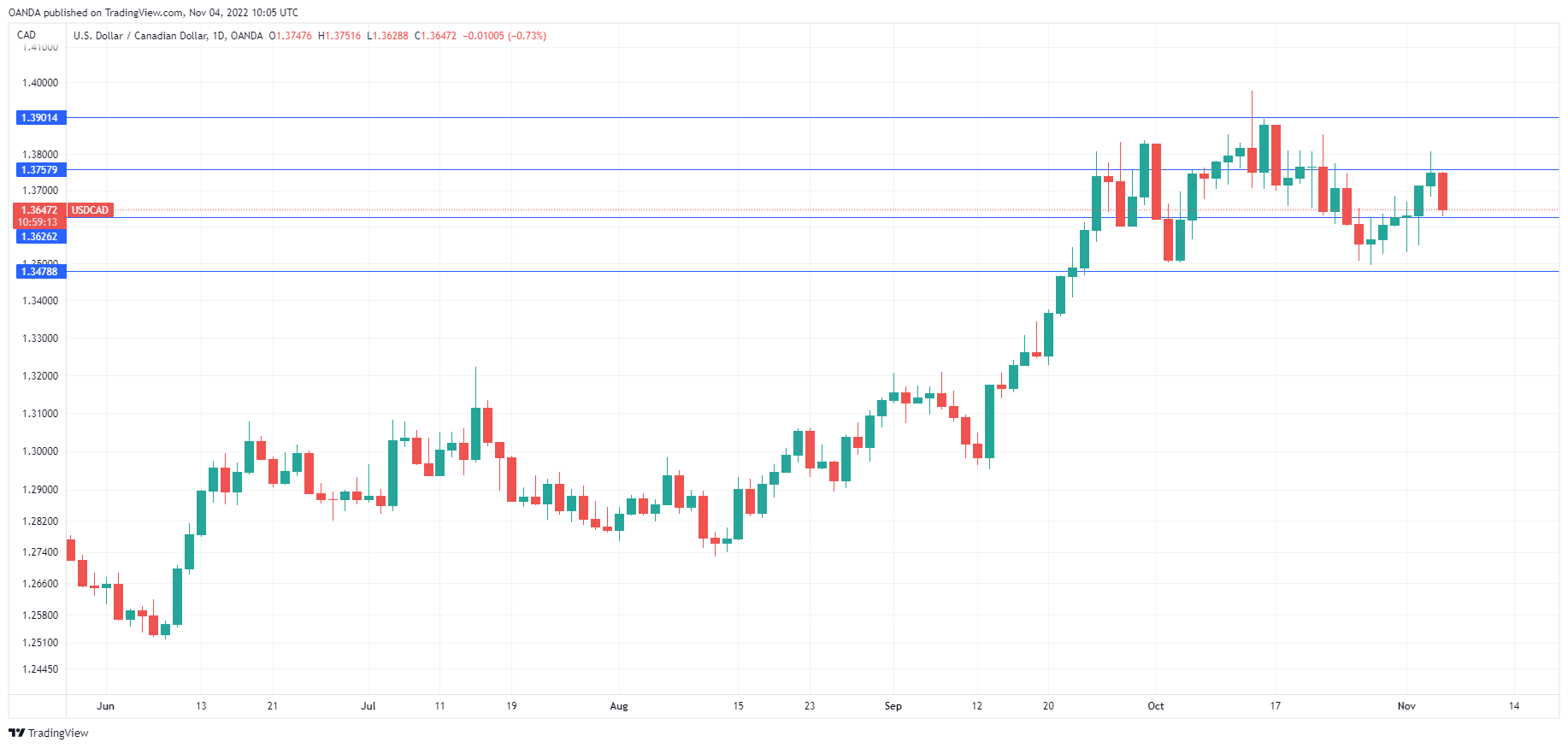
The Canadian dollar is usually quiet before North American markets open, but it is sharply higher today. USD/CAD is trading at 1.3644 in Europe, down 0.73%.
US nonfarm payrolls expected to slow
The week wraps up with the October employment reports from the US and Canada. The highlight will be the US nonfarm payrolls report, which, although still a key event, has been somewhat overshadowed by Fed rate meetings and inflation releases. Still, the release will be carefully watched by Fed policymakers and it will be a factor in the December rate decision. The October consensus stands at 200,000, lower than the September reading of 263,000. With the markets split 50/50 on whether the Fed will raise rates by 0.50% or 0.75%, the NFP release could provide some volatility in the currency markets in the North American session. A stronger-than-expected reading would raise the likelihood of a 0.75% hike and would likely boost the dollar. Conversely, a soft reading would reinforce expectations of the Fed easing to 0.50%, which would be bearish for the dollar.
Canada is expected to post lukewarm job data for October. The unemployment rate is forecast to tick up to 5.3% from 5.2%, with a consensus of 10,000 new jobs, down from 21,100 new jobs in September. Any misses in the forecasts for the Canadian and US job reports could trigger volatility from USD/CAD in the North American session.
The Fed raised rates by 0.75% at this week’s meeting, as expected, but there was a double message for the markets. The rate statement was dovish, stating that the Fed might take a pause in order to see how the rate hikes were working. However, Fed Chair Powell was hawkish in his post-meeting comments, saying that there was no sign that inflation had peaked and that it was “very premature to talk about pausing rate hikes”. The unexpected hawkish tone sent equities lower and boosted the US dollar.
USD/CAD Technical
- USD/CAD is putting strong pressure on support at 1.3656. Below, there is support at 1.3478
- 1.3757 and 1.3901 are the next lines of resistance
GBPUSD: Bears Take a Breather ahead of US Job Report
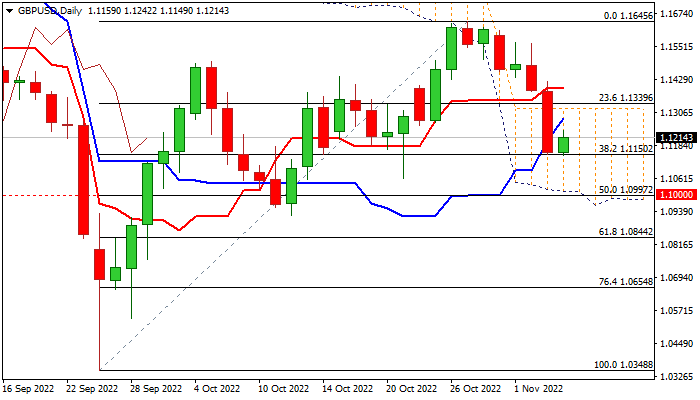
Cable edges higher in early Friday as traders collect profits after bearish acceleration below 1.15 handle in past two days found footstep at solid Fibo support at 1.1150 (38.2% of 1.0348/1.1645).
The pound is weighed by BoE’s gloomy outlook for the economy, while the most recent hawkish tones from Fed suggest that the US central bank will remain in aggressive mode in policy tightening.
A brief optimism that the Fed may slow the pace in hiking rates was dampened by the remarks from Chair Powell, who said that it was still premature to discuss the possible pause in rate increases.
Markets focus on the US October job report, which is expected to show the lowest hiring in nearly two years and a moderate increase in wages, suggesting some loosening in labor market that may add to hopes of Fed’s smaller rate hike in December and cause increased volatility.
Weakened daily studies (MA’s in bearish setup and rising negative momentum), add to bearish near-term bias, though bears still look for confirmation on clear break of 1.1150 pivot that would risk drop towards key supports at 1.10 zone (daily cloud base / psychological) and 1.0922 (Oct 12 trough) in extension.
Upticks should stay capped under 20DMA / daily cloud top (1.1314/21) to keep near-term bears in play.
Res: 1.1242; 1.1321; 1.1376; 1.1412.
Sup: 1.1150; 1.1060; 1.1000; 1.0922.
USDCAD Pauses Rebound as Positive Momentum Weakens
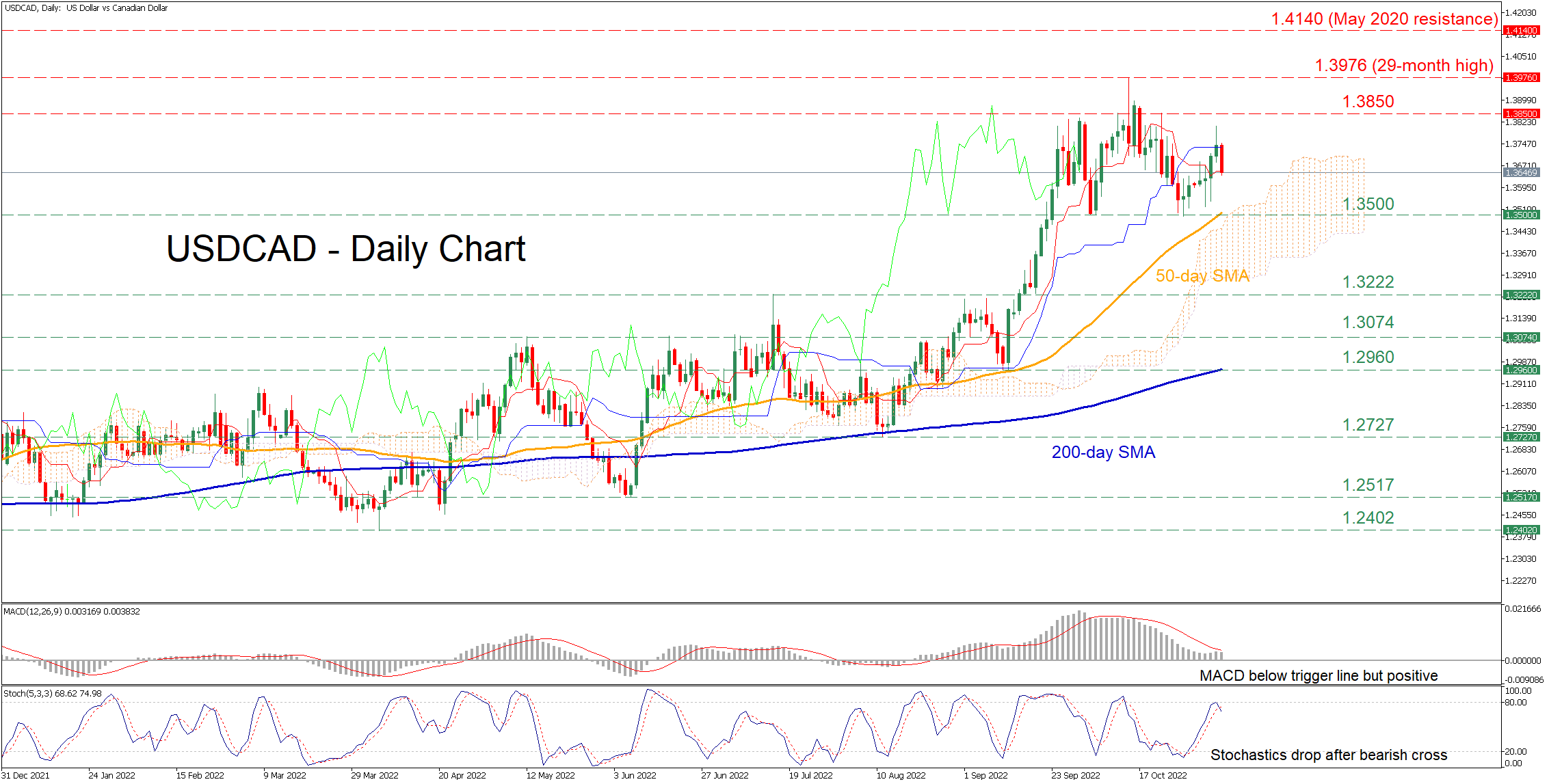
USDCAD has been in a steep uptrend since mid-September, storming to a fresh 29-month high of 1.3976 before experiencing a moderate pullback. Although the pair managed to recoup some losses after finding its feet at the 1.3500 region, the recent recovery appears to be running out of juice.
The momentum indicators currently suggest that bullish forces are waning. Specifically, the MACD histogram remains beneath its red signal line but in the positive territory, while the stochastic oscillator is pointing downwards after posting a bearish cross.
Should the negative momentum strengthen, the pair could encounter initial support at the double-bottom region of 1.3500, which overlaps with the 50-day simple moving average (SMA). Sliding beneath that floor, the bears might aim for the crucial July peak of 1.3222 before the attention shifts to 1.3074. Even lower, the September low of 1.2960 could appear on the radar.
Alternatively, if buyers re-emerge and push the price higher, the 1.3850 hurdle may act as the first line of defence. Crossing above the latter, the 29-month high of 1.3976 could provide further upside protection. Should that barricade fail, the price could ascend to form fresh multi-year peaks, where the May 2020 resistance of 1.4140 may curb any advances.
Overall, even though bullish pressures appear to be subsiding, USDCAD’s uptrend remains intact. Nevertheless, a dive beneath the 1.3500 floor is needed to trigger a moderate downside correction.
Aussie Jumps, Ignores RBA’s Tough Message
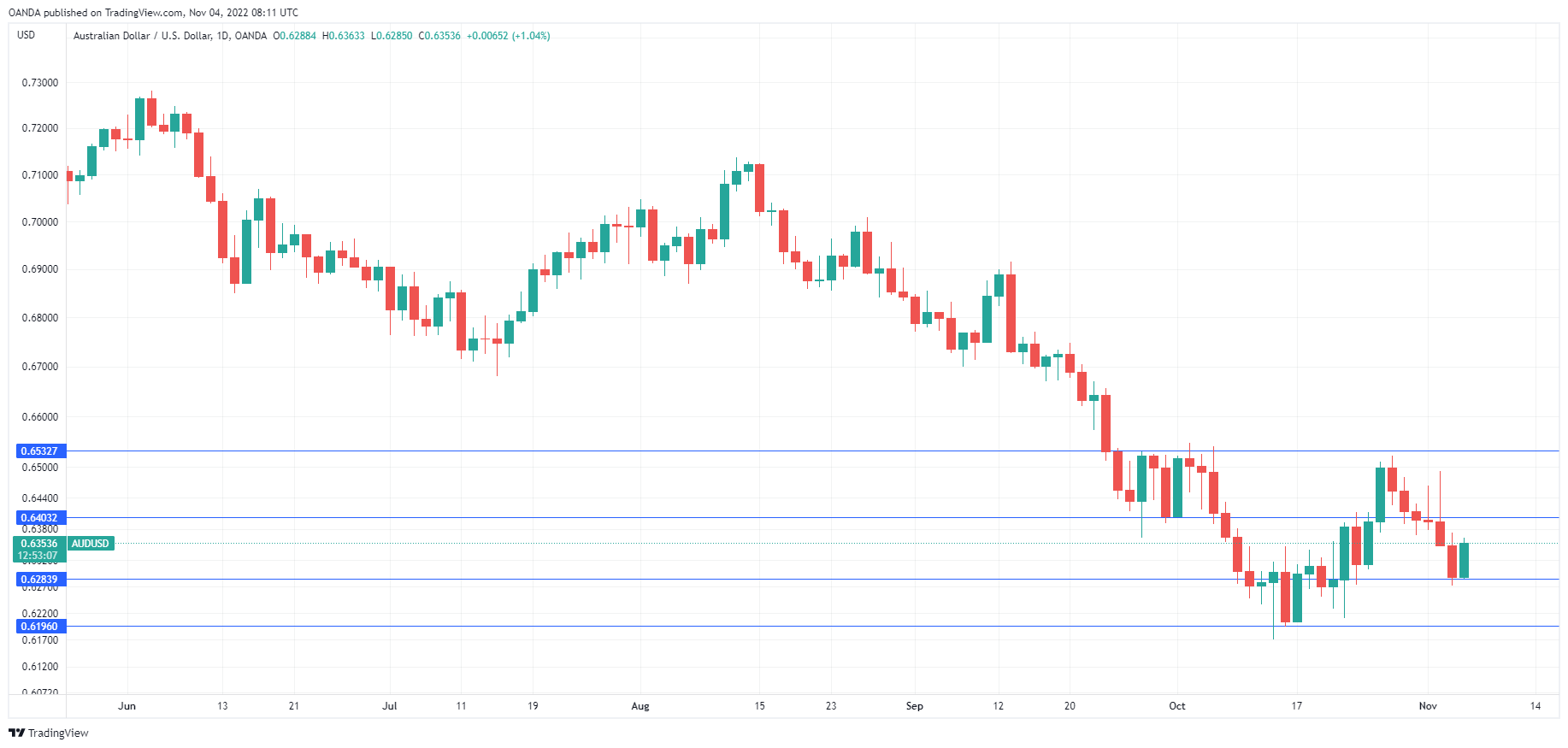
AUD/USD continues to show strong volatility and is sharply higher today. In the European session, the Australian dollar is trading at 0.6338, up 0.81%. This follows losses of almost 1% on Thursday.
RBA sees lower growth, higher inflation
The RBA monetary policy statement was gloomy, with a warning that tough times lie ahead for the Lucky Country. The central bank is projecting a GDP of 3% over 2022, slowing to 1.5% in 2023. Inflation is expected at 4.75% over 2023, higher than the 4.25% pace in its previous policy statement. The forecasts are based on the cash rate peaking at 3.5% in mid-2023.
The RBA raised the cash rate to 2.85% earlier this week, with a 0.25% hike, and Governor Lowe said that the central bank was on a “narrow path” that required “striking the right balance between doing too much and too little.” The RBA finds itself in a pickle, as its steep tightening cycle is slowing growth and hurting businesses and households. At the same time, inflation remains red-hot at 7.3%, fuelled by high food prices. Inflation remains the RBA’s number one priority, but it has eased up on the size of the hikes, hoping that inflation will peak shortly and a recession can be avoided.
The week wraps up with the US nonfarm payrolls report, which has been overshadowed by Fed meetings and inflation releases. Still, the release is carefully watched by Fed policymakers and today’s data will be a factor in the December rate decision. The October consensus stands at 200,000, lower than the September reading of 263,000. With the markets split 50/50 on whether the Fed will raise rates by 0.50% or 0.75%, the NFP could provide some volatility in the currency markets in the North American session.
AUD/USD Technical
- There is resistance at 0.6403 and 0.6532
- There is support at 0.6283 and 0.6196
All Eyes on the Jobs Report
It's been another fascinating week in financial markets and it's not over yet, with the US jobs report still to come amid some interest rate uncertainty.
The Fed meeting on Wednesday left investors scratching their heads a little. What was meant to be the pivot moment quickly became something very different; an admission that markets need to price in more. The central bank had given with one hand and taken with the other and investors were left to sulk once more.
But perhaps the takeaway is more positive than the markets would have us believe. In scaling back its tightening (probably) in December, the central bank is buying itself time for the data to improve and justify a lower terminal rate. It's possible that the fear at the Fed was that a slower pace - or "dovish pivot" would send the wrong message and markets would overreact, undermining its tightening efforts. By adding the terminal rate caveat, it's kept markets on their toes and bought the Fed more time.
Or maybe I'm simply reading too much into it but frankly, who isn't at this point? The fact remains that the pace of tightening will be slower and the Fed will be able to continue making monetary policy restrictive but in a potentially less damaging way while enabling more visibility on the economy. This puts additional emphasis now on the data which could lower the terminal rate and further slow the pace of tightening.
While all of the data will be closely monitored and factor into the Fed's decision-making in December, the two releases at the top of the list are undoubtedly the inflation and jobs reports. And we'll get two of each of those, the first of which being the October jobs report, later today.
Needless to say, investors are a little on edge ahead of the release. Not only was Powell's caveat unexpected and unwelcome by investors, the labour market remains extremely healthy which means today's report is likely to be red hot once more. If that doesn't turn out to be the case, investors may start to see the upside to the Fed's statements on Wednesday.
China rumours boost oil prices
Oil prices are rallying once more at the end of the week as rumours continue to circulate around China's plans to relax certain Covid restrictions in the first major move away from its zero-Covid policy. Of course, this is pure speculation at the moment and yesterday's denial from the National Health Commission appears to have fallen on deaf ears but that doesn't appear to have stopped oil rallying. Stocks in China and Hong Kong aren't doing too badly either.
Of course, there remain two dominant forces in the oil market right now, the economic outlook and OPEC+. We've seen more gloomy forecasts this week, with the BoE suggesting the UK could face a two-year recession. While others may not be as bad, global growth prospects remain weak. Oil has been climbing over the last few weeks but ultimately remains roughly in the middle of the $90-$100 range.
Tentatively higher
Gold is trading tentatively higher on the final day of the week after testing the September and October lows on Thursday. The yellow metal was dealt another blow by the Fed's admission on the terminal rate but appears to be clinging on for now. A hot jobs report today could be the final nail in the coffin, with support around $1,620 coming under serious pressure. Below there $1,600 could be key.
But the gains we're seeing so far today are impressive, if not a little surprising. Following Wednesday's setback, a rally of more than 1% in the run-up to what could be another red-hot jobs report is certainly bold. Should it break $1,680 in the aftermath, it could signal that a relief rally is underway.
Optimism ahead of the jobs report
Bitcoin is bouncing back ahead of the jobs report alongside other risk assets. Whether it will be able to hold onto those gains will obviously depend on the strength of the report itself, especially in light of the recent Fed comments. Clearly, there's some sense of optimism out there and bitcoin could be eyeing up $21,000 once more where it ran into resistance in late October. Of course, a failure to hold onto these gains could see $20,000 come under pressure once more.
NAS 100 Tests Critical Floor
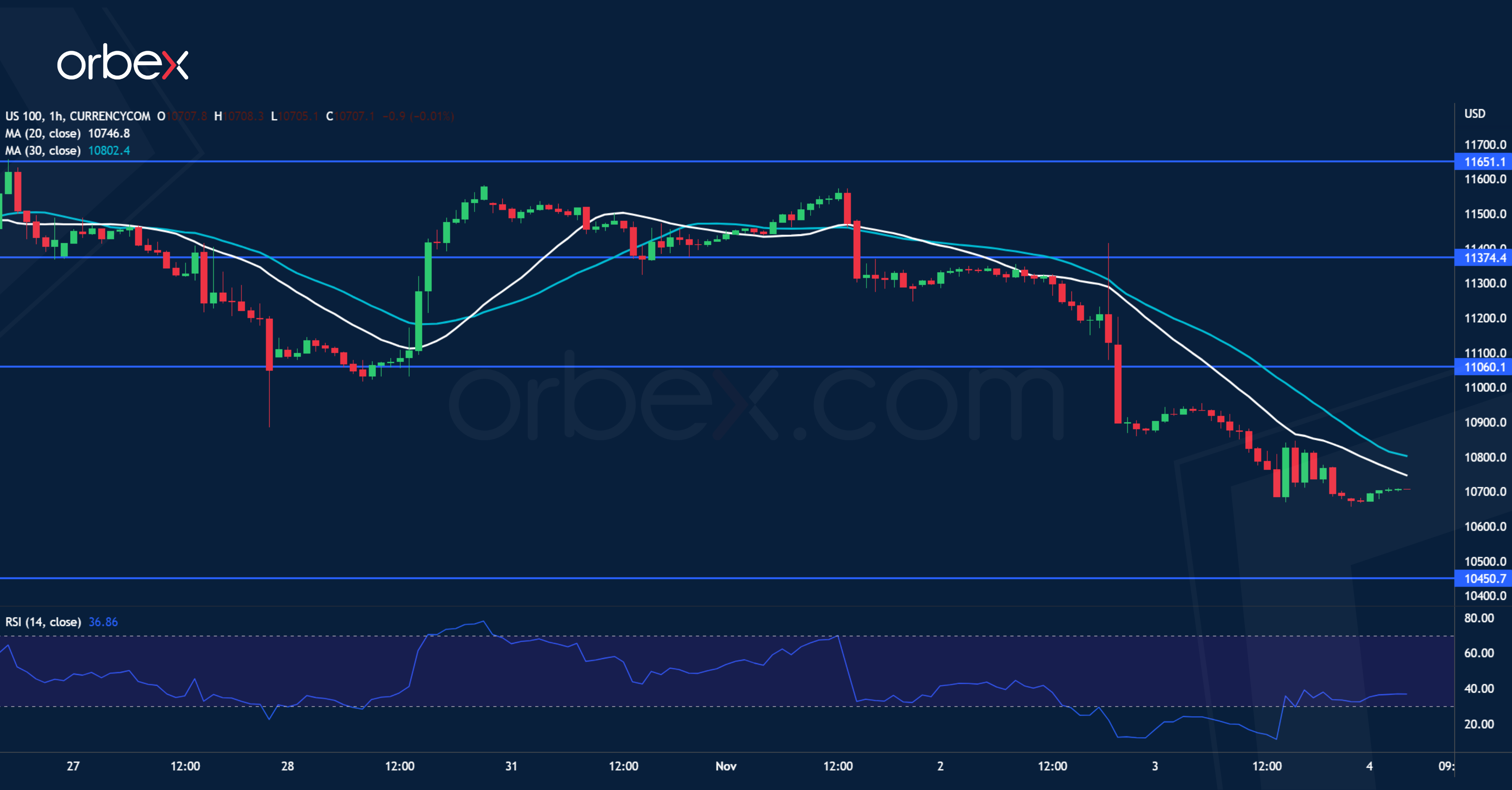
The Nasdaq 100 slumps as fewer US jobless claims reinforces the tightening agenda. Previously, a tentative break below 10900 weakened the bulls’ position. A failure to achieve a new high above 11650 shows that the path of least resistance would be down. A sharp drop below the said support has definitely knocked out the buy side. A rebound is likely to be capped by 11060. 10450 would be the last level to salvage the situation. A bearish breakout could trigger a new round of sell-off and effectively resume the bear market.