

Sample Category Title
USD/CAD Weekly Outlook
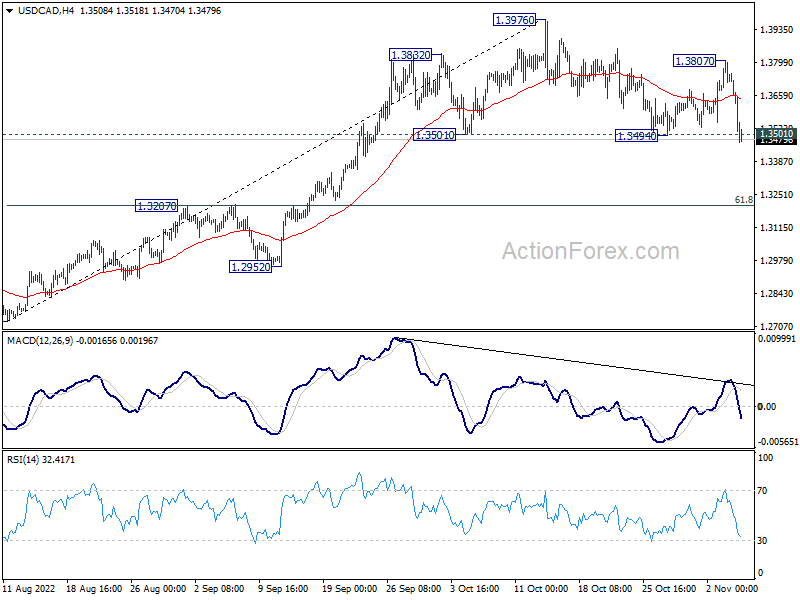
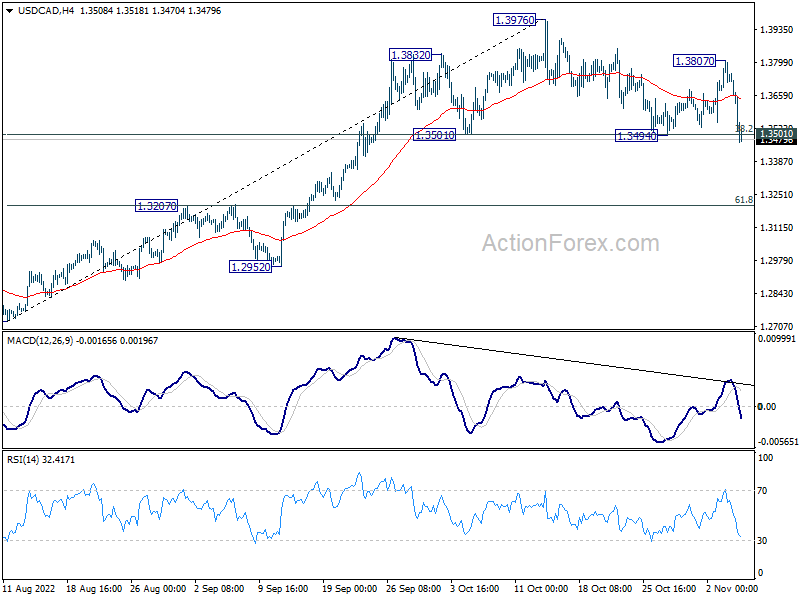
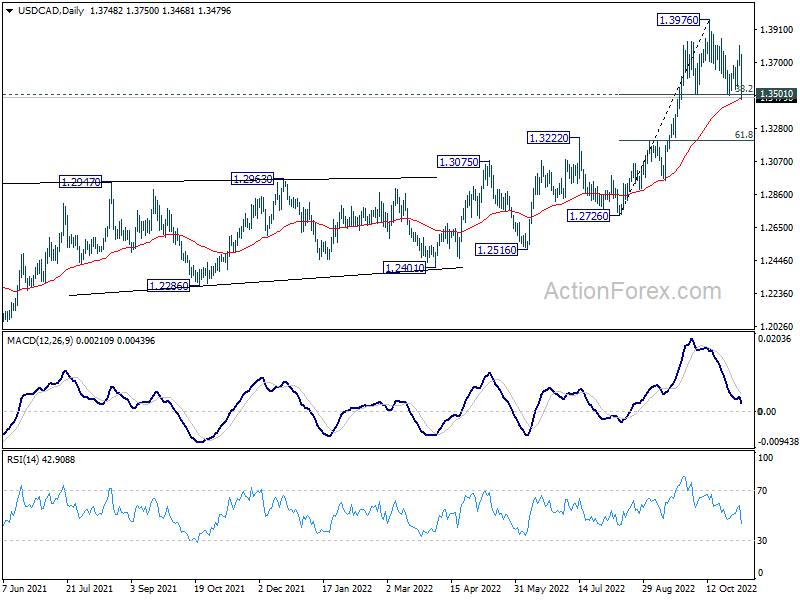
USD/CAD's break of 1.3494 support last week completes a head and should top pattern (1.3832; h: 1.3976; rs: 1.3807). Initial bias is now on the downside this week for deeper correction, to 1.3207 cluster support (61.8% retracement of 1.2726 to 1.3976 at 1.3204. Strong support should be seen there to bring rebound. But for now, risk will stay on the downside as long as 1.3807 resistance holds, in case of recovery.
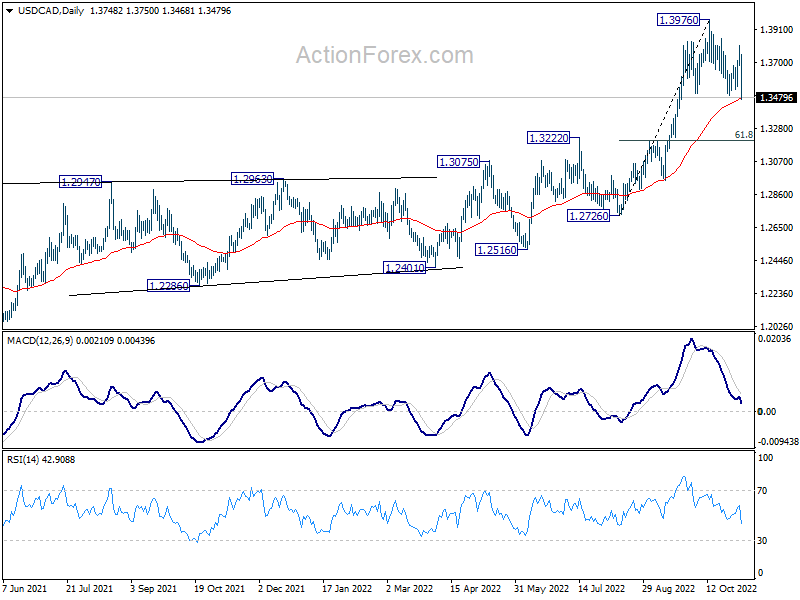
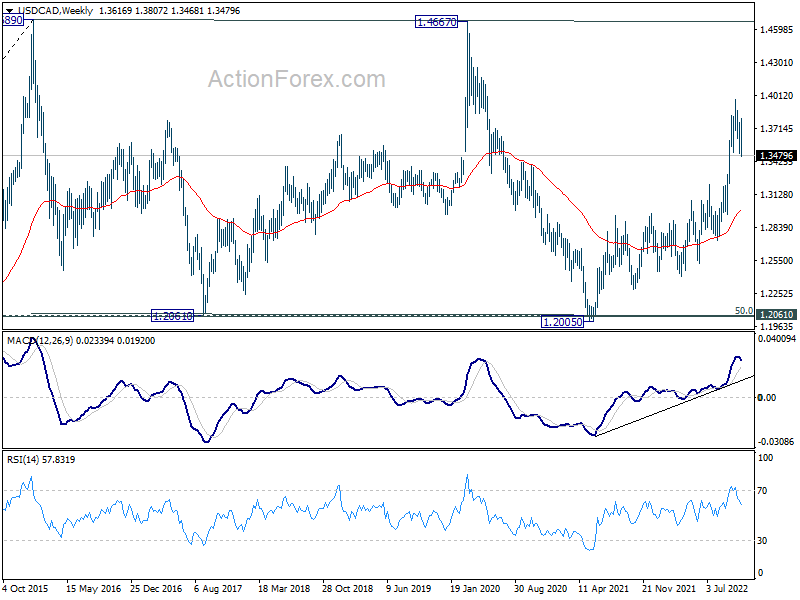
In the bigger picture, up trend from 1.2005 (2021 low) is still in progress. Based on current impulsive momentum, it could be resuming long term up trend from 0.9056 (2007 low). Whether it is or it isn't, retest of 1.4689 (2016 high) should be seen next. This will now remain the favored case as long as 1.3222 resistance turned support holds.
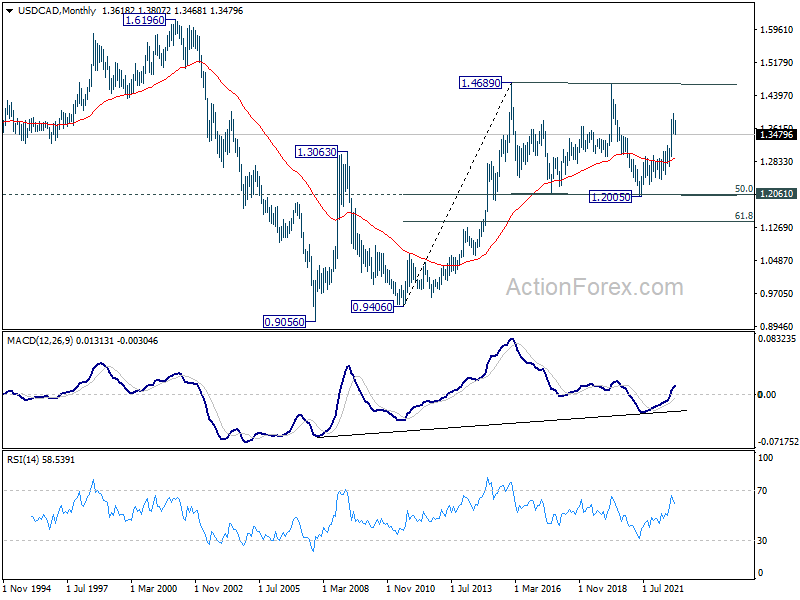
In the longer term picture, price actions from 1.4689 (2016 high) are seen as a consolidation pattern only, which might have completed at 1.2005. That is, up trend from 0.9506 (2007 low) is expected to resume at a later stage. This will remain the favored case as long as 1.2061 support holds, which is close to 50% retracement of 0.9406 to 1.4689 at 1.2048.
GBP/JPY Weekly Outlook
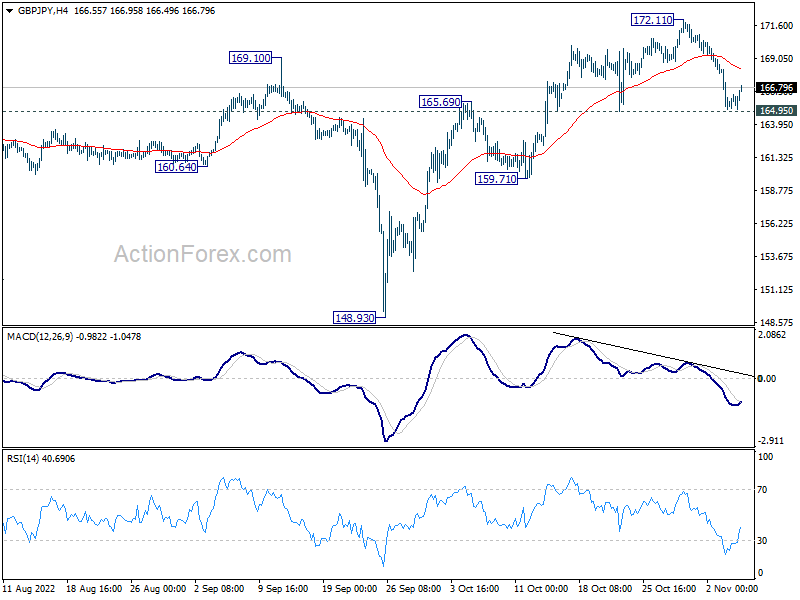
GBP/JPY edged higher to 172.11 last week but retreated sharply since then. But downside is so far supported by 164.95 support. Initial bias remains neutral first. On the upside, break of 172.11 will resume larger up trend. However, break of 164.95 will bring deeper pull back to 159.71 support and below.
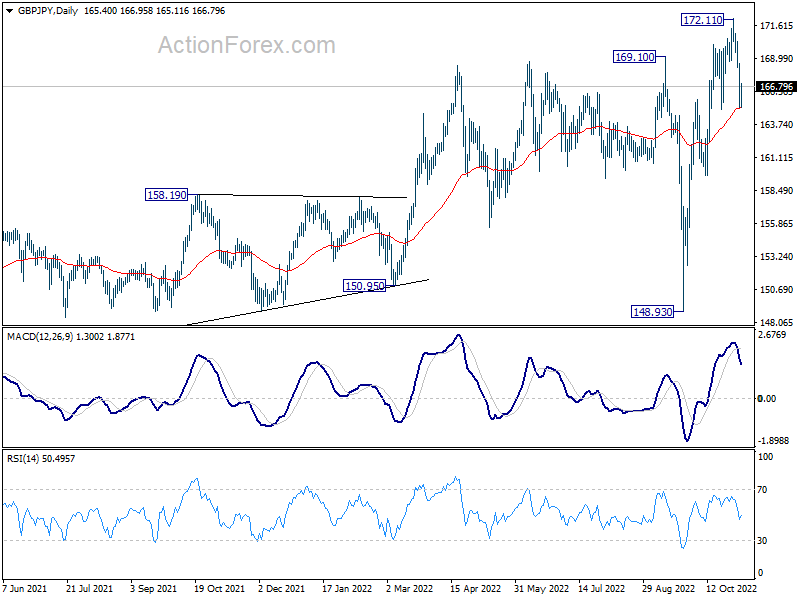
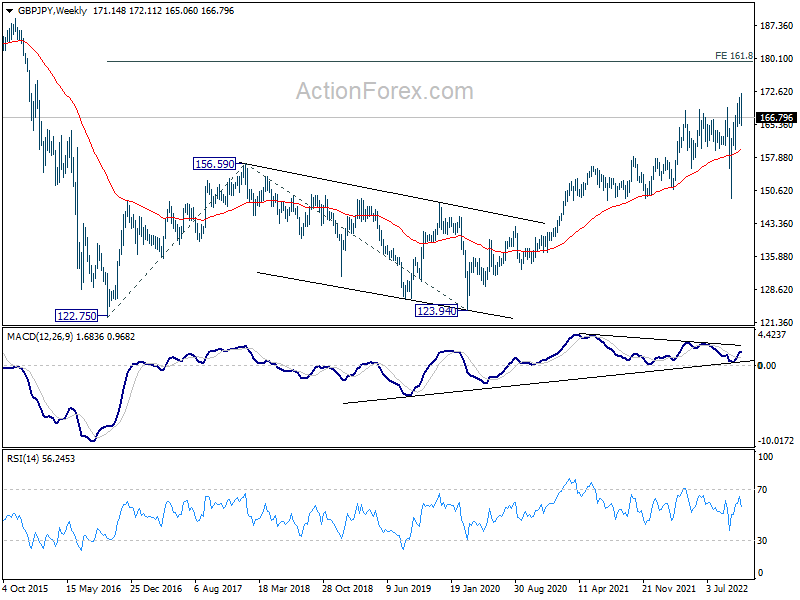
In the bigger picture, up trend from 123.94 (2020 low), as part of the trend from 122.75 (2016 low) is still in progress. Further rise would be seen to 161.8% projection of 122.75 to 156.59 (2018 high) from 123.94 at 178.69. This will now remain the favored case as long as 148.93 support holds.
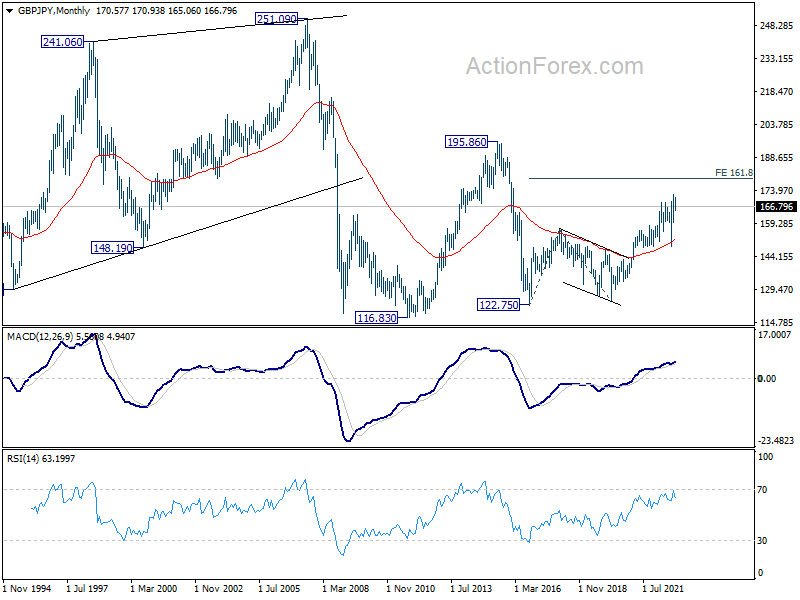
In the longer term picture, as long as 55 month EMA (now at 151.88) holds, rise from 122.75 could still extend higher at a later stage. Next target is 195.86 (2015 high).
EUR/JPY Weekly Outlook
EUR/JPY extended the consolidation from 148.38 last week and outlook remains neutral. Initial bias stays neutral this week first. In case of deeper fall, downside should be contained by 55 day EMA (now at 143.15) to bring rise resumption. On the upside, break of 148.38 will resume larger up trend to 149.76 long term resistance next.
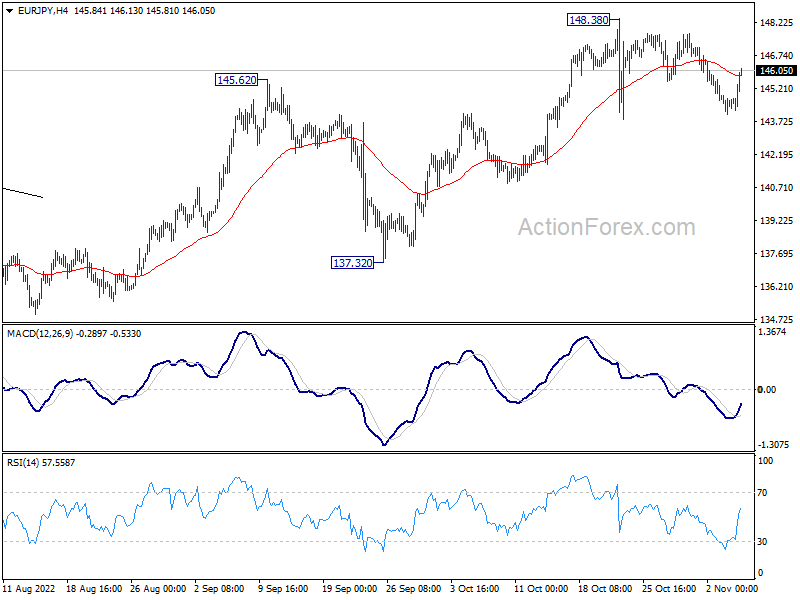
In the bigger picture, the up trend from 114.42 (2020 low) is still in progress for 149.76 (2014 high). Decisive break there will pave the way to 161.8% projection of 114.42 to 134.11 from 124.37 at 156.22. This will now remain the favored case as long as 137.32 support holds.
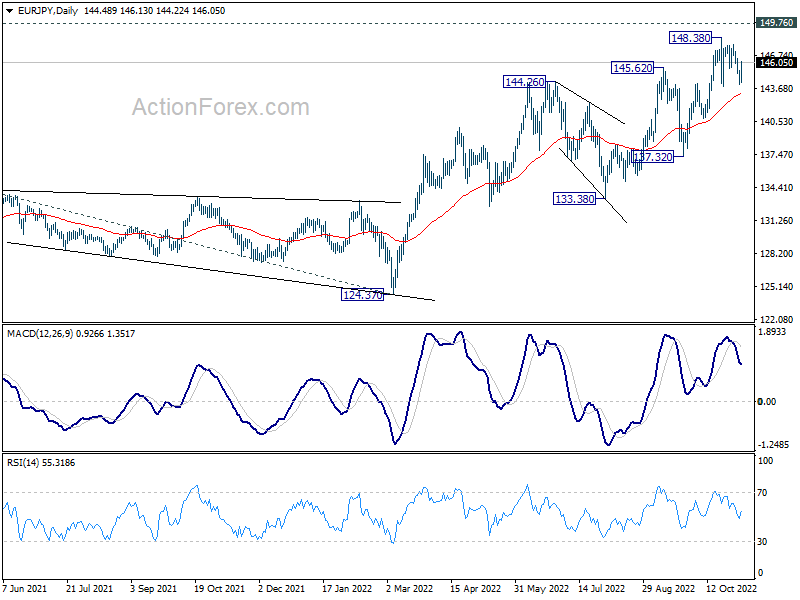
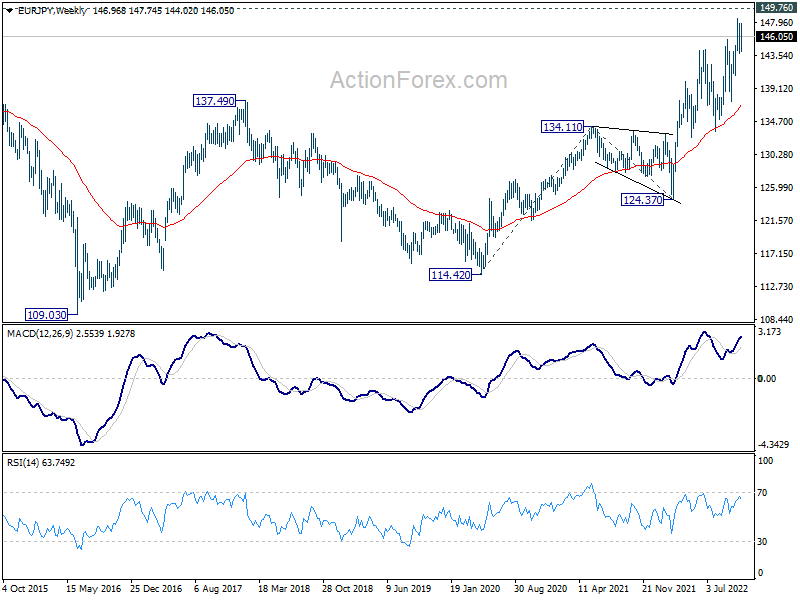
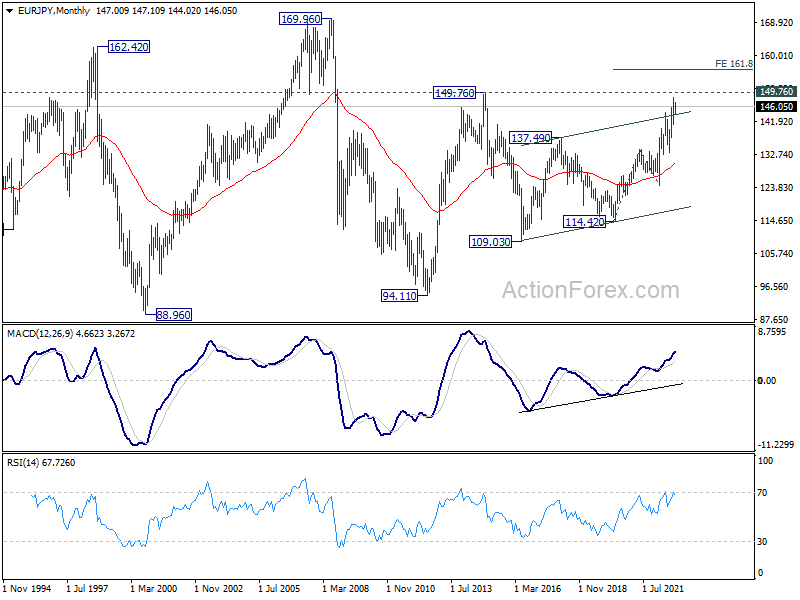
In the long term picture, there is sign of upside acceleration with strong break of long term channel resistance. Outlook will stay bullish as long as 134.11 resistance turned support holds. Sustained break of 149.76 (2014 high) will open up further rally, as resumption of the rise from 94.11 (2012 low), towards 169.96 (2008 high).
EUR/GBP Weekly Outlook
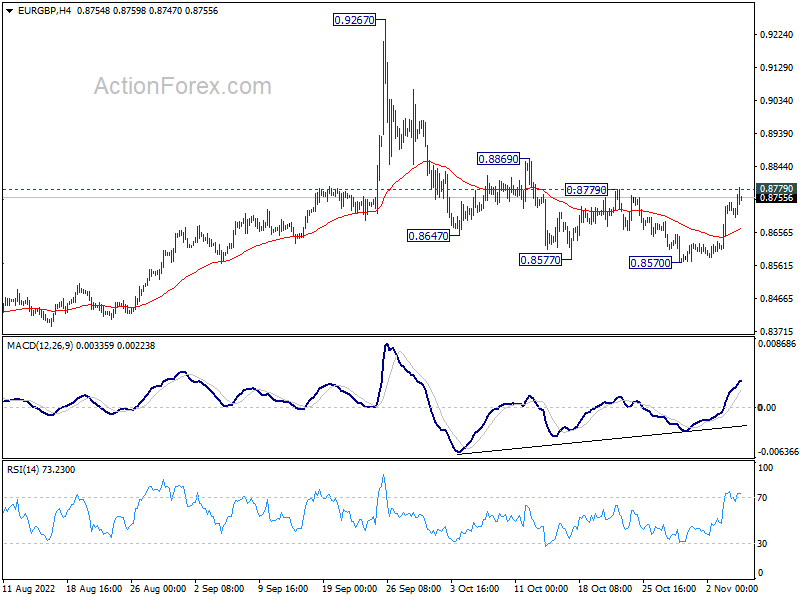
EUR/GBP rebounded strongly last week but upside is still capped by 0.8779 resistance. Initial bias remains neutral first. On the upside, firm break of 0.8779 will argue that fall from 0.9267 has completed, and bring stronger rally to 0.8869 resistance and above. On the downside, break of 0.8570 will resume the fall from 0.9267 and target 0.8201/8388 support zone.
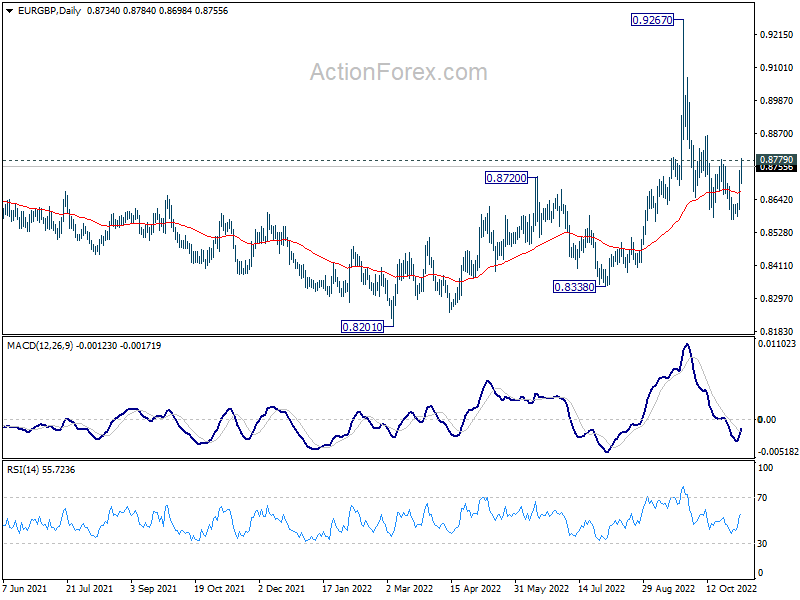
In the bigger picture, current development suggests that fall from 0.9267 is a down leg inside long term range pattern. Deeper fall could be seen towards 0.8201/8338 support zone. But strong support should be seen there to bring reversal.
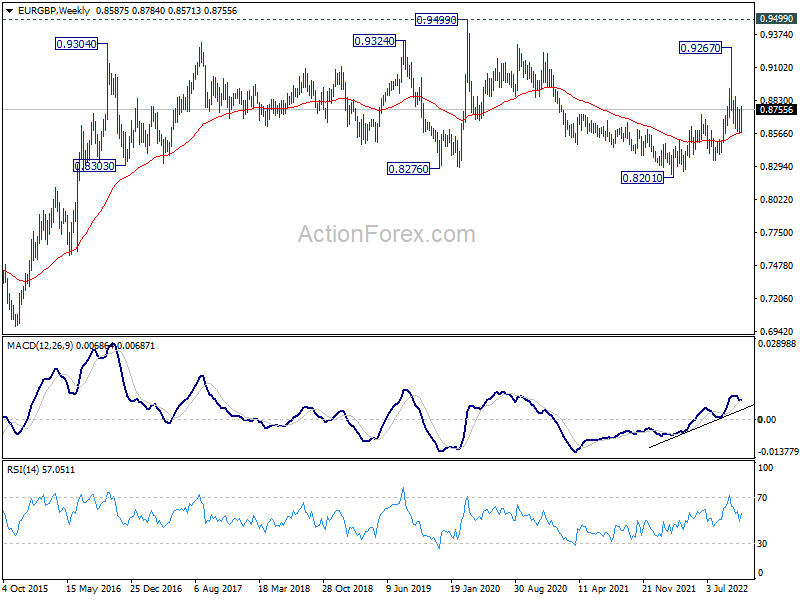
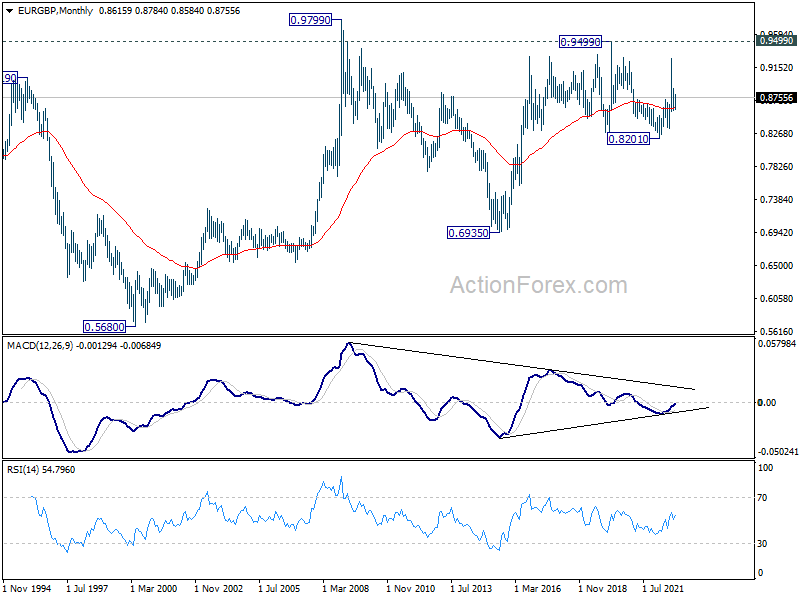
In the long term picture, long term range pattern is extending. But rise from 0.6935 (2015 low) is expected to extend at a later stage, to 0.9799 (2009 high).
EUR/AUD Weekly Outlook
EUR/AUD gyrated lower as correction from 1.5704 extended last week. Initial bias stays neutral this week first and deeper fall cannot be ruled out. But downside should contained by 55 day EMA (now at 1.5199) to bring rebound. On the upside, break of 1.5704 will resume the rally from 1.4281.
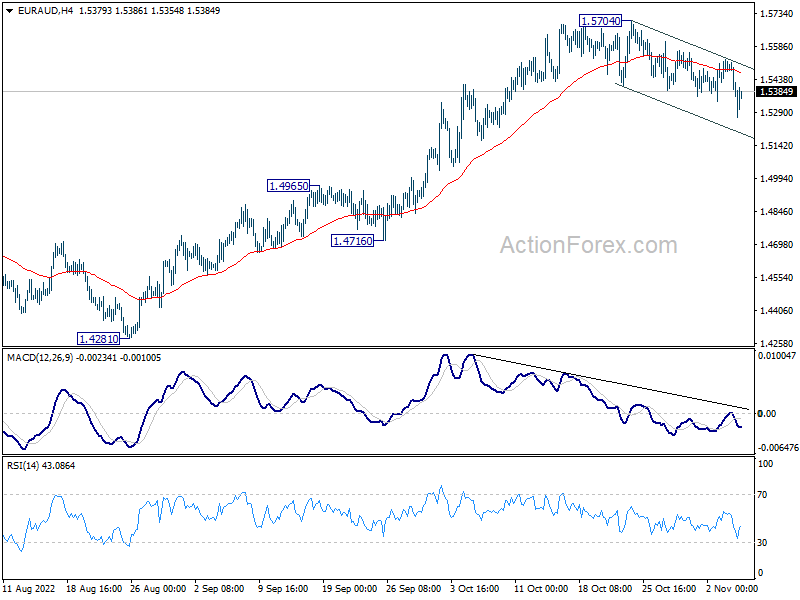
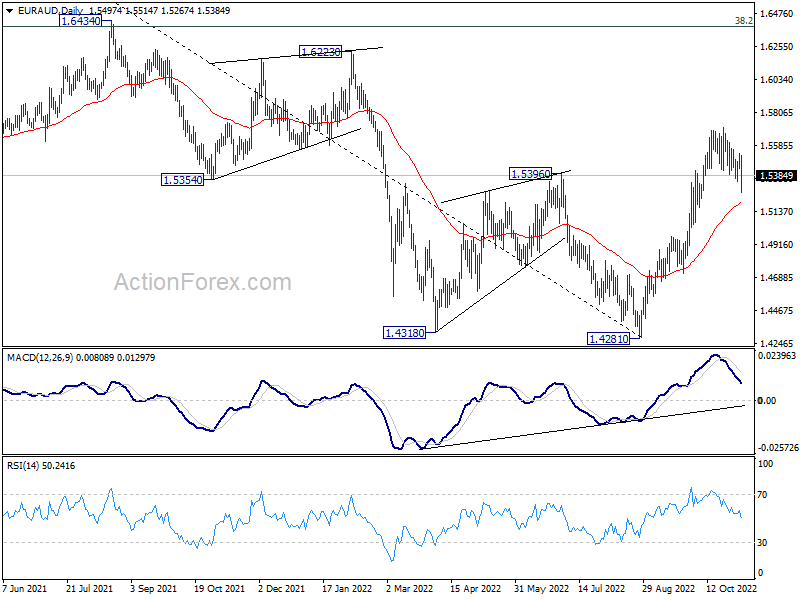
In the bigger picture, a medium term bottom should be in place at 1.4281, on bullish convergence condition in daily MACD. Further rise would be seen back to 1.6434 key resistance next. Break of 1.4965 resistance turned support is needed to indicate reversal. Otherwise, further rally will remain in favor.
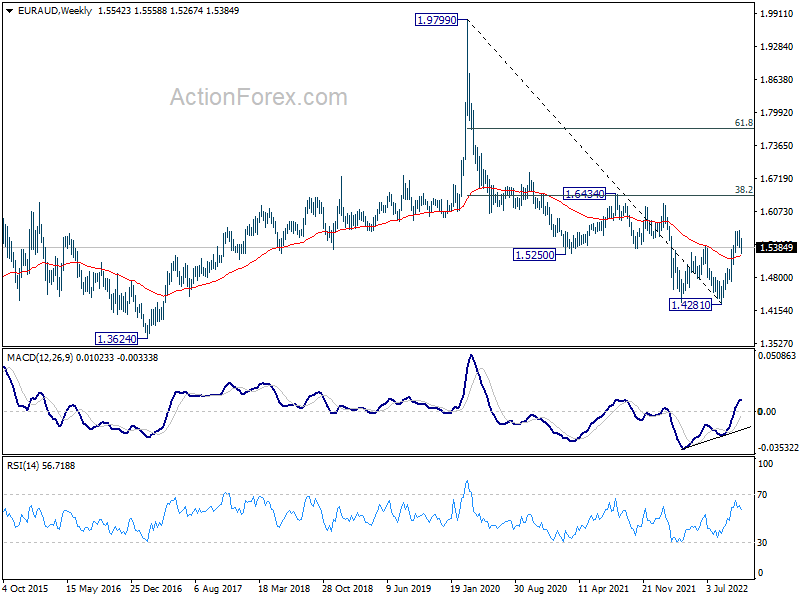
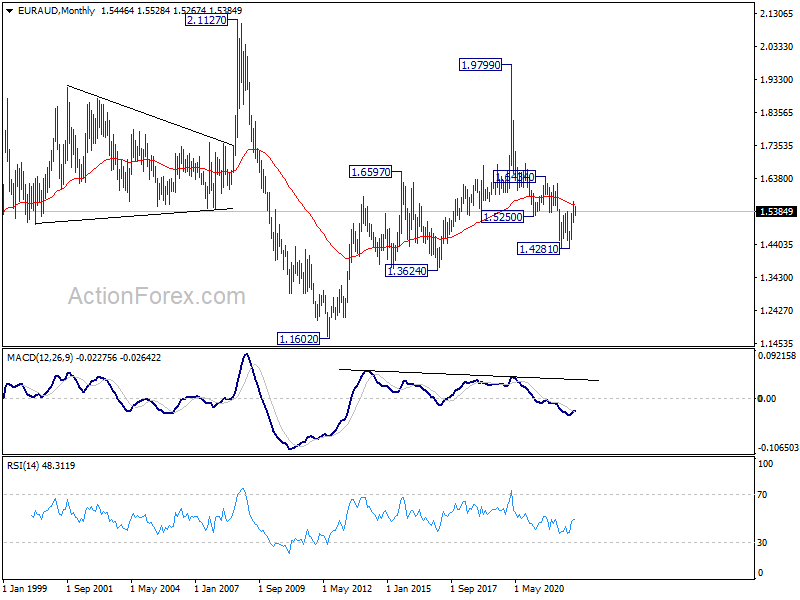
In the longer term picture, breach of 55 month EMA (now at 1.5613) raises the chance of medium term bullish reversal. Focus is back on 1.6434 cluster resistance, 38.2% retracement of 1.9799 (2020 high) to 1.4281 at 1.6389). Sustained break there will confirm and target 61.8% retracement at 1.7691.
EUR/CHF Weekly Outlook
EUR/CHF turned into consolidation below 0.9953 last week and outlook is unchanged. Initial bias stays neutral this week first. Downside of retreat should be contained by 0.9798 resistance turned support to bring rebound. On the upside, break of 0.9953 will resume the rise from 0.9407 to 1.0072 fibonacci level.
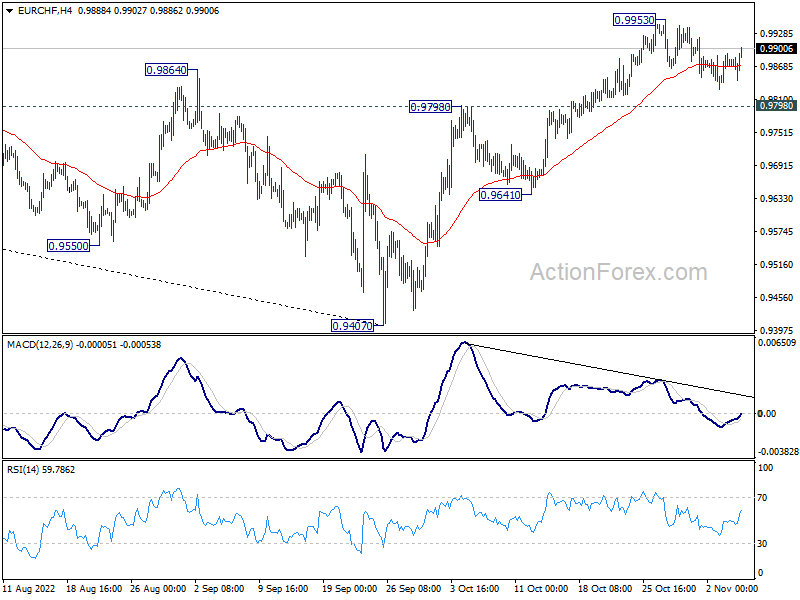
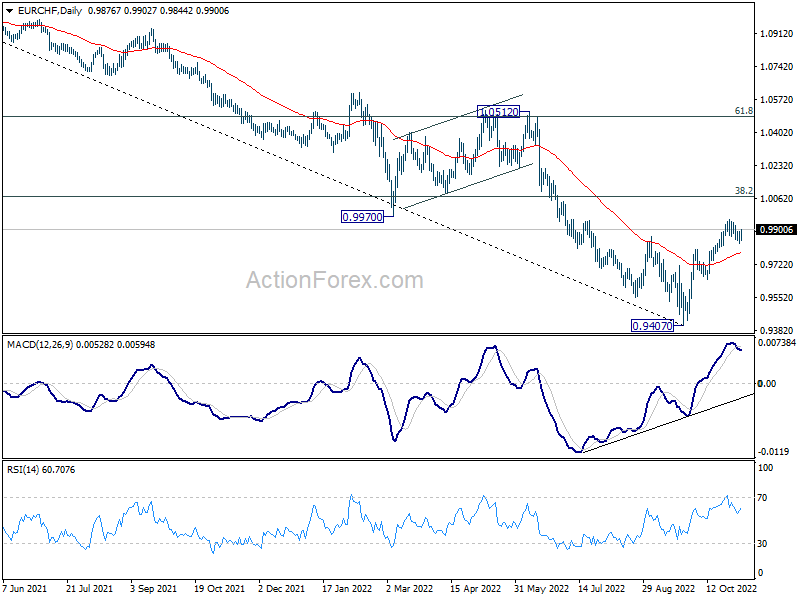
In the bigger picture, a medium term bottom should be in place at 0.9407. Further rally is expected as long as 0.9641 support holds, even as a corrective rebound. Next target 38.2% retracement of 1.1149 to 0.9407 at 1.0072. Reaction from there, as well as 55 week EMA (now at 1.0121) will reveal whether the trend is reversing.
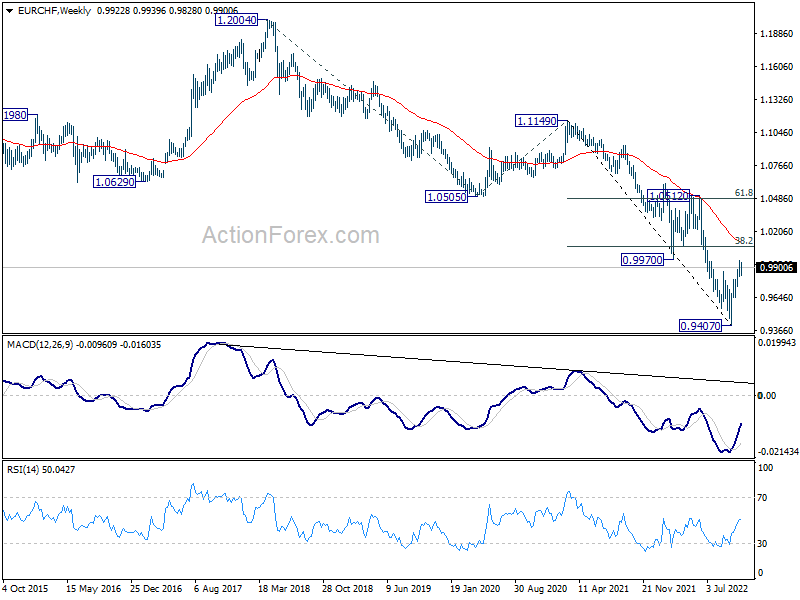
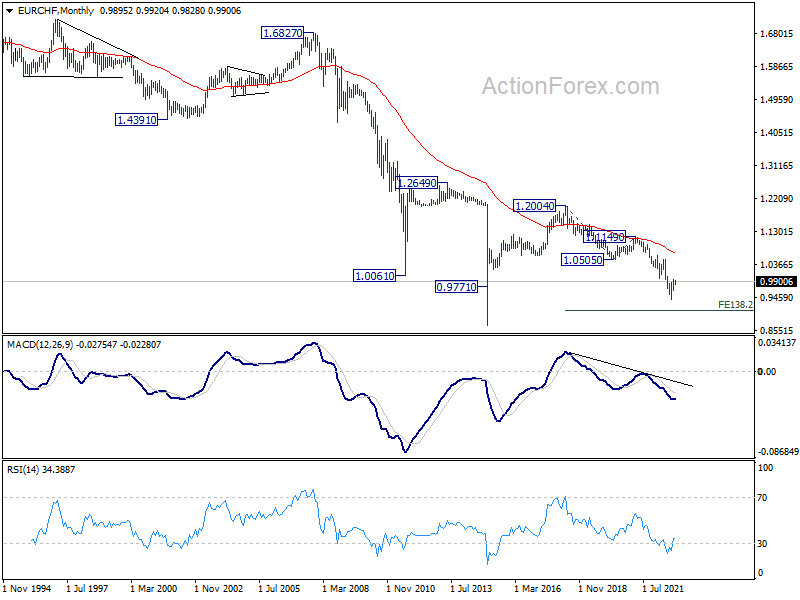
In the long term picture, capped well below 55 month EMA, EUR/CHF is seen as extending the multi-decade down trend. There is no prospect of a bullish reversal until firm break of 1.0505 support turned resistance (2020 low). In case of resumption, next target is 138.2% projection of 1.2004 to 1.0505 to 1.1149 at 0.9033.
Rumor of China Reopening Overwhelmed Other Heavy Weight Events
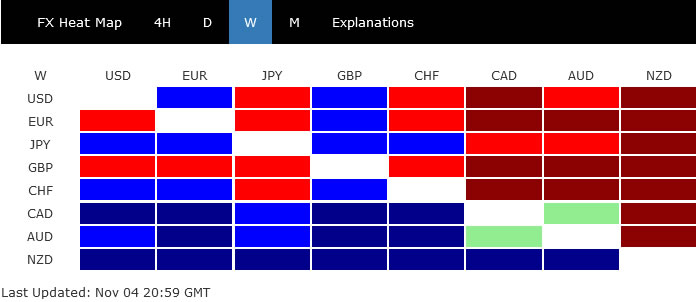
The rumor of earlier reopening in China seemed to have overwhelmed other heavy weight events in the markets last week, including Fed's hawkish rate hike and non-farm payroll report. Late rally in stock markets helped commodity currencies secured the winning places, with New Zealand Dollar having an edge over Australian and Canadian.
On the other hand, Sterling ended as the worst performer, paring some of the Sunak-era gains, and weighed down by BoE dovish hike. Euro and Swiss Franc didn't perform much better, even though they did rebounded against the greenback. Dollar was mixed together with Yen, awaiting more guidance from risk sentiment ahead.
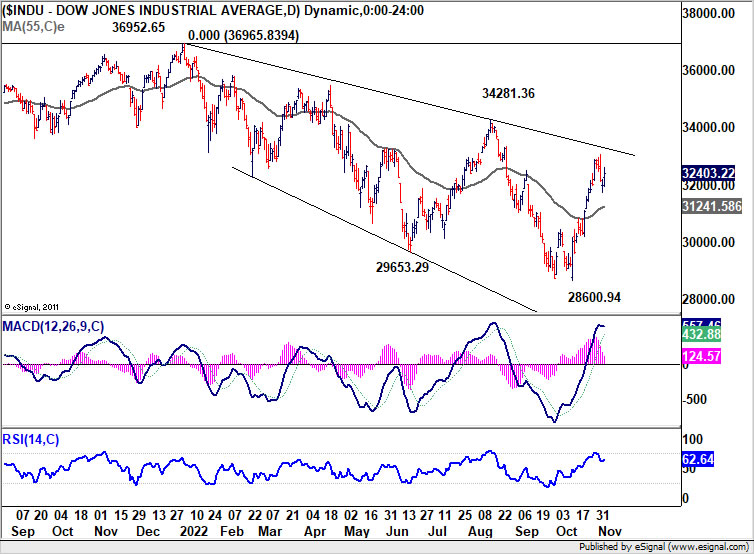
DOW and NASDAQ display contrasting picture
Market sentiment sank after Fed chair Jerome Powell indicated that the terminal interest rate of current cycle could be higher than originally thought, even though the pace of tightening could start to slow as soon as at next meeting. However, the set of non-farm payroll data left investors divided. The strong headline job growth number affirmed Fed's stance to continue with rate hikes. But the rise in unemployment rate was taken by some as a sign of cooling.
DOW pared back much of the earlier losses on Friday, even though it still lost the weekly winning streak. For now, DOW remains very resilient and rise from 28600.94 should still be in progress towards 34281.36 resistance. Decisive break there will confirm completion of the whole medium term correction from 36952.65 and pave the way to retest this high, probably in the early part of next year. This week remain the favored case as long as 55 day EMA (now at 31241.58) holds.
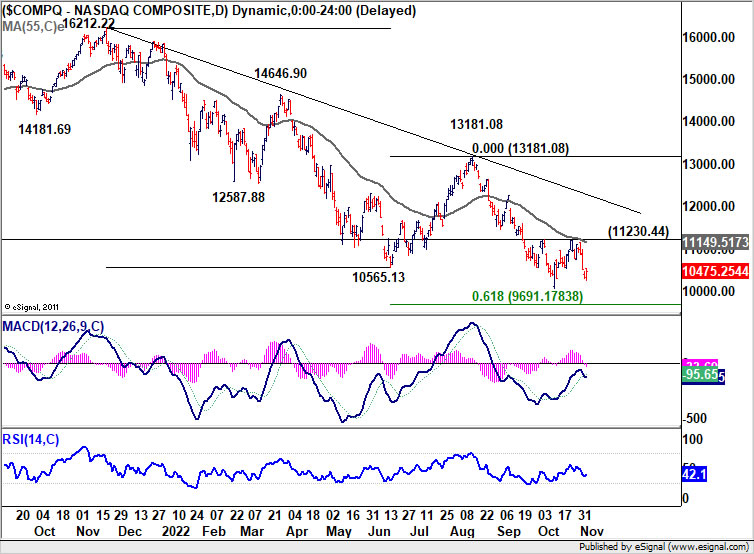
However, NASDAQ is displaying a completely different picture. The recovery on Friday was relatively weak. Prior rejection by 55 day EMA affirmed near term bearishness. It's still expected to extend the down trend from 16212.22 to 61.8% projection from 16212.22 to 10565.13 from 13181.08 at 9691.17, at least, before forming a bottom.
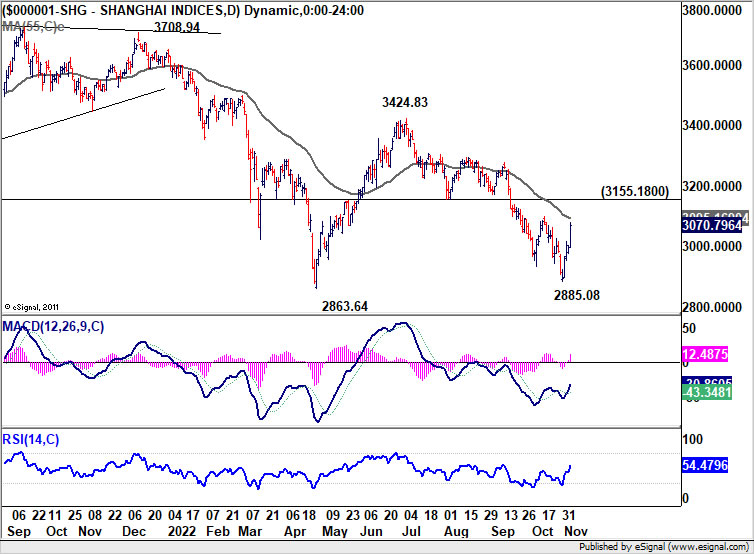
Turnaround in China markets on reopening hope
The turnaround in China markets could be an even stronger factor supporting sentiment elsewhere, including the US and the rebound in DOW. The 5% gain in the Shanghai SSE is seen as triggered by hope for reopening to happen earlier than expected. No official announcement was made by the Chinese government on changing its zero-COVID policy yet. But rumors are alreadying circulating around.
Technically, Shanghai SSE's rebound from 2885.08 will face the first hurdle at 55 day EMA (now at 3095.16). Sustained trading above the EMA, and better followed by firm break of 3155.18 support turned resistance, should confirmed that whole decline from 3424.83 was over. That would set the stage for further rally to towards 3424.83 resistance. Before that happens, the case of earlier reopening would remain doubtful.
Dollar extending correction, breakout delayed
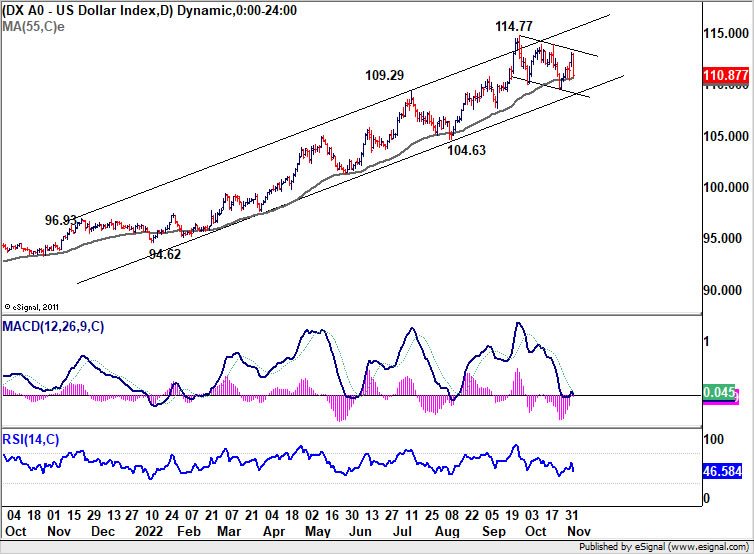
Improving market sentiment, both in the US and China, knocked Dollar index down towards the end of the week. Yet, there is no change in the technical outlook that DXY is in consolidation from 114.77. It's staying well inside the medium term rising channel, and thus, a breakout through 114.77 high is just delayed, not derailed. Nevertheless, sustained break of the channel support (now at around 109) will argue that it's already in a medium term correction and would target 104.63 support instead.
GBP/AUD in correction after dovish BoE hike
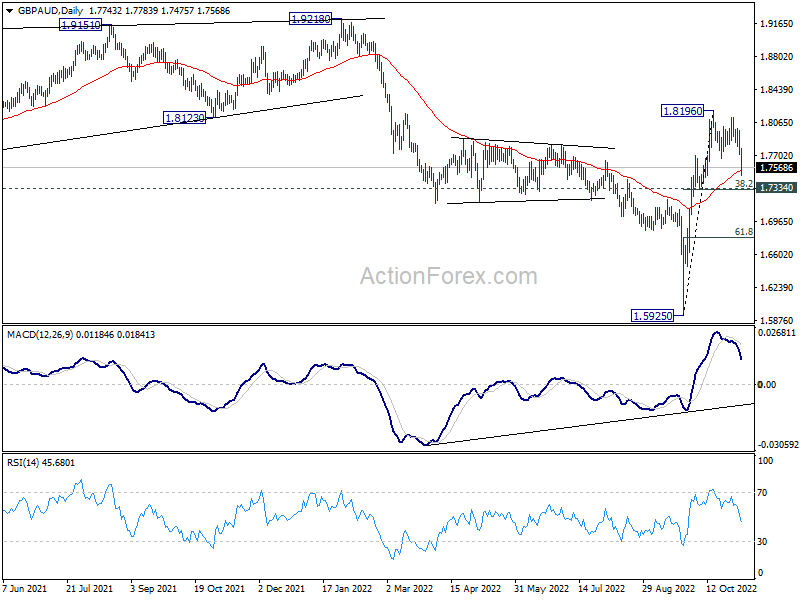
Sterling ended as the worst perform last week, partly because it just pared back some recent rebound. BoE's dovish 75bps hike was another factor. The decision on rate was no unanimous, with 7 members voting for a 75bps hike, one member voting for 50bps and one member voting for 25bps. Inflation forecast was revised down due to the Government's Energy Price Guarantee. At the same time, BoE is projecting recession for a prolonged period. The 75bps hike was seen as a one-off and next would be 50bps in December, followed by a final 25bps hike in February, before pausing.
GBP/AUD's decline from 1.8196 accelerated lower last week. still, it's seen as a corrective move to the rebound from 1.5925 only. Strong support should be seen at 1.7334 cluster support (38.2% retracement of 1.5925 to 1.8196 at 1.7328) to contain downside. Rise from 1.5925 is expected to resume at a later stage.
Nevertheless, the development in GBP/AUD will heavily depend on sentiment on Aussie, and thus on whether China is really exiting its zero-COVID policy soon. If so, even still as a correction, GBP/AUD could fall further to 61.8% retracement at 1.6793 before bottoming.
USD/CAD completed head and shoulder top
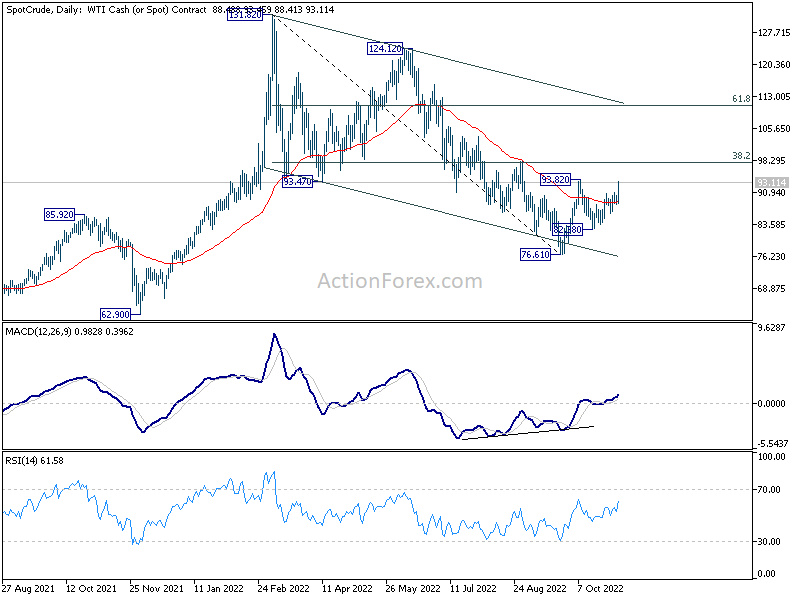
Canadian Dollar was among the best performers, as supported by stellar job market data and rise in oil price. WTI oil's rise from 76.61 looks set to resume through 93.82 resistance soon. The key hurdle is in 38.2% retracement of 131.82 to 76.61 at 97.70. Sustained break there will argue that whole down trend from 131.82 has completed with three waves down to 76.61, and bring further rally to 61.8% retracement at 110.72. However, rejection by 97.70 will keep medium term bearish for another fall through 76.61.
USD/CAD's close below 1.3494 support suggests that it has completed a head and shoulder top pattern (ls: 1.3832; h: 1.3976; rs: 1.3807). Sustained trading below 1.3494 will confirm and bring deeper decline to 1.3207 cluster support (61.8% retracement of 1.2726 to 1.3976 at 1.3204), which is also close to 1.3222 resistance turned support. Downside should be contained there to bring rebound. But for near term, deeper fall is in favor as long as 1.3807 resistance holds.
AUD/USD Weekly Outlook
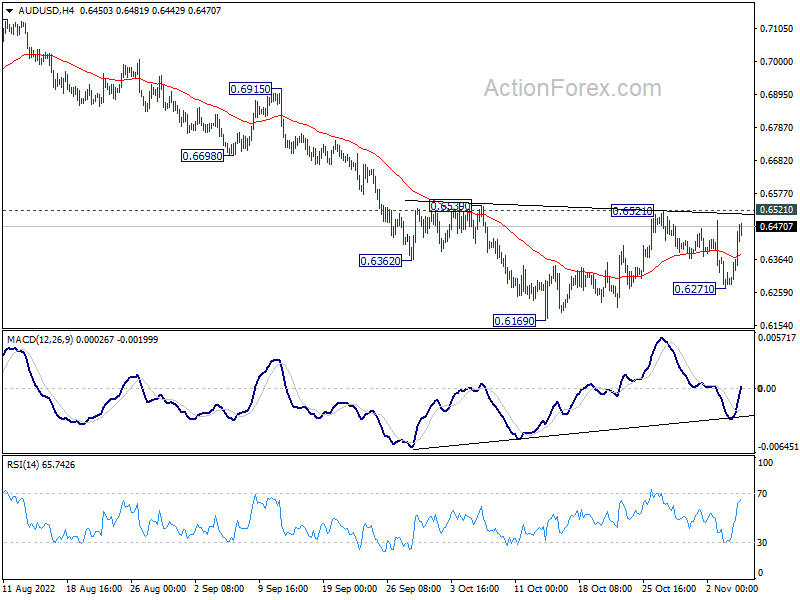
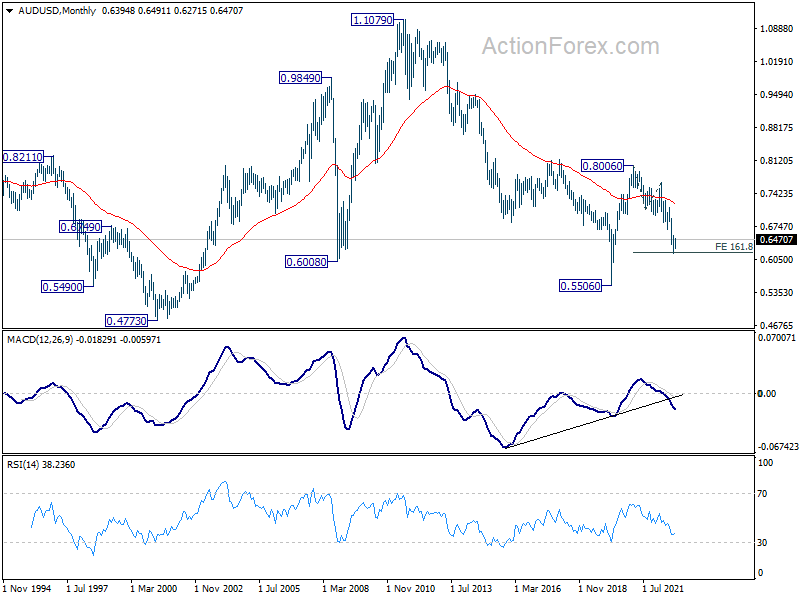
AUD/USD was initially rejected by 0.6539 resistance and dipped to 0.6271 last week, but recovered notably since then. Initial bias is turned neutral this week first. On the upside, decisive break of 0.6521 resistance will now complete a head and shoulder bottom pattern (ls: 0.6362; h: 0.6169; rs: 0.6271). That would also come with sustained trading above 55 day EMA (now at 0.6533). Near term outlook will then be turned bullish for 0.6680/7315 resistance zone next. On the downside, however, break of 0.6271 will bring retest of 0.6169 low instead.
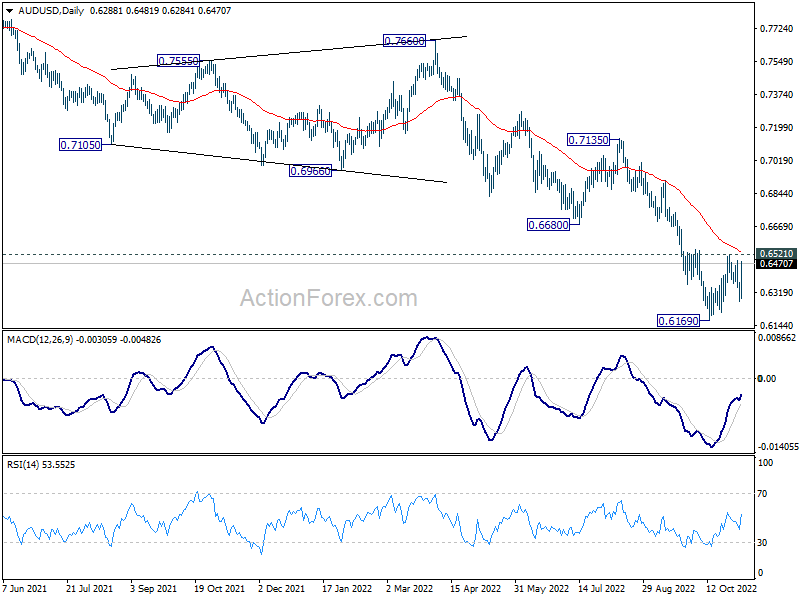
In the bigger picture, down trend from 0.8006 (2021 high) is expected to continue as long as 0.6680 support turned resistance holds. Medium term momentum remains strong and retest of 0.5506 (2020 low) cannot be ruled out. But firm break of 0.6680 will be the first sign of reversal, and bring stronger rebound back to 0.7135 resistance.
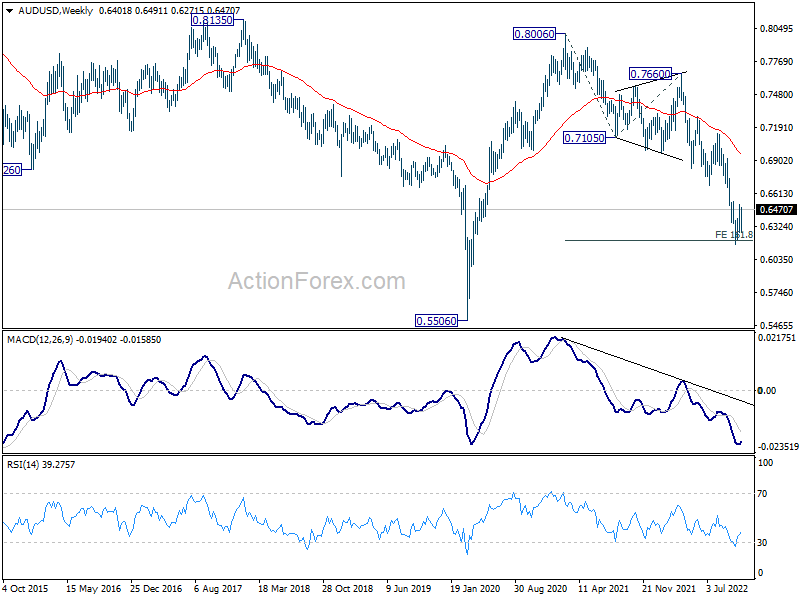
In the long term picture, the down trend from 0.8006 could still be seen as a corrective move, considering that it failed to break through 161.8% projection of 0.8006 to 0.7105 from 0.7660 at 0.6202 decisively. Strong rebound from current level will keep long term outlook neutral first. However, sustained break of 0.6202 will open up deep fall to retest 0.5506.
Summary 11/7 – 11/11
Monday, Nov 7, 2022
| GMT | Ccy | Events | Consensus | Previous |
|---|---|---|---|---|
| 02:00 | CNY | Trade Balance (USD) Oct | 96.0B | 84.7B |
| 02:00 | CNY | Trade Balance (CNY) Oct | 702B | 574B |
| 06:00 | JPY | Machine Tool Orders Y/Y Oct | 4.30% | |
| 07:00 | EUR | Germany Industrial Production M/M Sep | -0.20% | -0.80% |
| 08:00 | CHF | Foreign Currency Reserves (CHF) Oct | 807B | |
| 09:30 | EUR | Eurozone Sentix Investor Confidence Nov | -35 | -38.3 |
| 22:30 | AUD | AiG Performance of Services Index Oct | 48 | |
| 23:30 | AUD | Westpac Consumer Confidence Nov | -0.90% | |
| 23:30 | JPY | Labor Cash Earnings Y/Y Sep | 1.60% | 1.70% |
| 23:30 | JPY | Overall Household Spending Y/Y Sep | 2.70% | 5.10% |
| 23:50 | JPY | BoJ Summary of Opinions |
| GMT | Ccy | Events | |
|---|---|---|---|
| 02:00 | CNY | Trade Balance (USD) Oct | |
| Forecast: 96.0B | Previous: 84.7B | ||
| 02:00 | CNY | Trade Balance (CNY) Oct | |
| Forecast: 702B | Previous: 574B | ||
| 06:00 | JPY | Machine Tool Orders Y/Y Oct | |
| Forecast: | Previous: 4.30% | ||
| 07:00 | EUR | Germany Industrial Production M/M Sep | |
| Forecast: -0.20% | Previous: -0.80% | ||
| 08:00 | CHF | Foreign Currency Reserves (CHF) Oct | |
| Forecast: | Previous: 807B | ||
| 09:30 | EUR | Eurozone Sentix Investor Confidence Nov | |
| Forecast: -35 | Previous: -38.3 | ||
| 22:30 | AUD | AiG Performance of Services Index Oct | |
| Forecast: | Previous: 48 | ||
| 23:30 | AUD | Westpac Consumer Confidence Nov | |
| Forecast: | Previous: -0.90% | ||
| 23:30 | JPY | Labor Cash Earnings Y/Y Sep | |
| Forecast: 1.60% | Previous: 1.70% | ||
| 23:30 | JPY | Overall Household Spending Y/Y Sep | |
| Forecast: 2.70% | Previous: 5.10% | ||
| 23:50 | JPY | BoJ Summary of Opinions | |
| Forecast: | Previous: | ||
Tuesday, Nov 8, 2022
| GMT | Ccy | Events | Consensus | Previous |
|---|---|---|---|---|
| 00:01 | GBP | BRC Like-For-Like Retail Sales Y/Y Oct | 1.50% | 1.80% |
| 00:30 | AUD | NAB Business Confidence Oct | 5 | |
| 00:30 | AUD | NAB Business Conditions Oct | 25 | |
| 02:00 | NZD | RBNZ Inflation Expectations Q/Q Q4 | 3.07% | |
| 05:00 | JPY | Leading Economic Index Sep P | 101.6 | 101.3 |
| 07:45 | EUR | France Trade Balance (EUR) Sep | -14.0B | -15.3B |
| 09:00 | EUR | Italy Retail Sales M/M Sep | -0.10% | -0.40% |
| 10:00 | EUR | Eurozone Retail Sales M/M Sep | 0.00% | -0.30% |
| 11:00 | USD | NFIB Business Optimism Index Oct | 91.7 | 92.1 |
| 23:50 | JPY | Bank Lending Y/Y Oct | 2.50% | 2.30% |
| 23:50 | JPY | Current Account (JPY) Sep | 0.41T | -0.53T |
| GMT | Ccy | Events | |
|---|---|---|---|
| 00:01 | GBP | BRC Like-For-Like Retail Sales Y/Y Oct | |
| Forecast: 1.50% | Previous: 1.80% | ||
| 00:30 | AUD | NAB Business Confidence Oct | |
| Forecast: | Previous: 5 | ||
| 00:30 | AUD | NAB Business Conditions Oct | |
| Forecast: | Previous: 25 | ||
| 02:00 | NZD | RBNZ Inflation Expectations Q/Q Q4 | |
| Forecast: | Previous: 3.07% | ||
| 05:00 | JPY | Leading Economic Index Sep P | |
| Forecast: 101.6 | Previous: 101.3 | ||
| 07:45 | EUR | France Trade Balance (EUR) Sep | |
| Forecast: -14.0B | Previous: -15.3B | ||
| 09:00 | EUR | Italy Retail Sales M/M Sep | |
| Forecast: -0.10% | Previous: -0.40% | ||
| 10:00 | EUR | Eurozone Retail Sales M/M Sep | |
| Forecast: 0.00% | Previous: -0.30% | ||
| 11:00 | USD | NFIB Business Optimism Index Oct | |
| Forecast: 91.7 | Previous: 92.1 | ||
| 23:50 | JPY | Bank Lending Y/Y Oct | |
| Forecast: 2.50% | Previous: 2.30% | ||
| 23:50 | JPY | Current Account (JPY) Sep | |
| Forecast: 0.41T | Previous: -0.53T | ||
Wednesday, Nov 9, 2022
| GMT | Ccy | Events | Consensus | Previous |
|---|---|---|---|---|
| 01:30 | CNY | CPI Y/Y Oct | 2.50% | 2.80% |
| 01:30 | CNY | PPI Y/Y Oct | -1.40% | 0.90% |
| 05:00 | JPY | Eco Watchers Survey: Current Oct | 50.5 | 48.4 |
| 15:00 | USD | Wholesale Inventories Sep F | 0.80% | 0.80% |
| 15:30 | USD | Crude Oil Inventories | -3.1M | |
| 23:50 | JPY | Money Supply M2+CD Y/Y Oct | 3.40% | 3.30% |
| GMT | Ccy | Events | |
|---|---|---|---|
| 01:30 | CNY | CPI Y/Y Oct | |
| Forecast: 2.50% | Previous: 2.80% | ||
| 01:30 | CNY | PPI Y/Y Oct | |
| Forecast: -1.40% | Previous: 0.90% | ||
| 05:00 | JPY | Eco Watchers Survey: Current Oct | |
| Forecast: 50.5 | Previous: 48.4 | ||
| 15:00 | USD | Wholesale Inventories Sep F | |
| Forecast: 0.80% | Previous: 0.80% | ||
| 15:30 | USD | Crude Oil Inventories | |
| Forecast: | Previous: -3.1M | ||
| 23:50 | JPY | Money Supply M2+CD Y/Y Oct | |
| Forecast: 3.40% | Previous: 3.30% | ||
Thursday, Nov 10, 2022
| GMT | Ccy | Events | Consensus | Previous |
|---|---|---|---|---|
| 00:00 | AUD | Consumer Inflation Expectations Nov | 5.40% | |
| 00:01 | GBP | RICS Housing Price Balance Oct | 28% | 32% |
| 09:00 | EUR | Italy Industrial Output M/M Sep | 1.70% | 2.30% |
| 09:00 | EUR | ECB Economic Bulletin | ||
| 12:30 | USD | Initial Jobless Claims (Nov 4) | 221K | 217K |
| 12:30 | USD | Continuing Jobless Claims (Oct 28) | 1.513M | 1.485M |
| 12:30 | USD | CPI M/M Oct | 0.70% | 0.40% |
| 12:30 | USD | CPI Y/Y Oct | 8.00% | 8.20% |
| 12:30 | USD | CPI Core M/M Oct | 0.50% | 0.60% |
| 12:30 | USD | CPI Core Y/Y Oct | 6.50% | 6.60% |
| 15:30 | USD | Natural Gas Storage | 107B | |
| 23:50 | JPY | PPI Y/Y Oct | 8.80% | 9.70% |
| GMT | Ccy | Events | |
|---|---|---|---|
| 00:00 | AUD | Consumer Inflation Expectations Nov | |
| Forecast: | Previous: 5.40% | ||
| 00:01 | GBP | RICS Housing Price Balance Oct | |
| Forecast: 28% | Previous: 32% | ||
| 09:00 | EUR | Italy Industrial Output M/M Sep | |
| Forecast: 1.70% | Previous: 2.30% | ||
| 09:00 | EUR | ECB Economic Bulletin | |
| Forecast: | Previous: | ||
| 12:30 | USD | Initial Jobless Claims (Nov 4) | |
| Forecast: 221K | Previous: 217K | ||
| 12:30 | USD | Continuing Jobless Claims (Oct 28) | |
| Forecast: 1.513M | Previous: 1.485M | ||
| 12:30 | USD | CPI M/M Oct | |
| Forecast: 0.70% | Previous: 0.40% | ||
| 12:30 | USD | CPI Y/Y Oct | |
| Forecast: 8.00% | Previous: 8.20% | ||
| 12:30 | USD | CPI Core M/M Oct | |
| Forecast: 0.50% | Previous: 0.60% | ||
| 12:30 | USD | CPI Core Y/Y Oct | |
| Forecast: 6.50% | Previous: 6.60% | ||
| 15:30 | USD | Natural Gas Storage | |
| Forecast: | Previous: 107B | ||
| 23:50 | JPY | PPI Y/Y Oct | |
| Forecast: 8.80% | Previous: 9.70% | ||
Friday, Nov 11, 2022
| GMT | Ccy | Events | Consensus | Previous |
|---|---|---|---|---|
| 07:00 | EUR | Germany CPI M/M Oct F | 0.90% | |
| 07:00 | EUR | Germany CPI Y/Y Oct F | 10.40% | |
| 07:00 | GBP | GDP M/M Sep | -0.30% | |
| 07:00 | GBP | GDP Q/Q Q3 P | 0.20% | |
| 07:00 | GBP | Industrial Production M/M Sep | -1.80% | |
| 07:00 | GBP | Industrial Production Y/Y Sep | -5.20% | |
| 07:00 | GBP | Manufacturing Production M/M Sep | -1.60% | |
| 07:00 | GBP | Manufacturing Production Y/Y Sep | -6.70% | |
| 07:00 | GBP | Index of Services 3M/3M Sep | -0.10% | |
| 07:00 | GBP | Goods Trade Balance (EUR) Sep | -19.3B | |
| 13:00 | GBP | NIESR GDP Estimate Oct | -0.30% | |
| 15:00 | USD | Michigan Consumer Sentiment Index Nov P | 59.7 | 59.9 |
| GMT | Ccy | Events | |
|---|---|---|---|
| 07:00 | EUR | Germany CPI M/M Oct F | |
| Forecast: | Previous: 0.90% | ||
| 07:00 | EUR | Germany CPI Y/Y Oct F | |
| Forecast: | Previous: 10.40% | ||
| 07:00 | GBP | GDP M/M Sep | |
| Forecast: | Previous: -0.30% | ||
| 07:00 | GBP | GDP Q/Q Q3 P | |
| Forecast: | Previous: 0.20% | ||
| 07:00 | GBP | Industrial Production M/M Sep | |
| Forecast: | Previous: -1.80% | ||
| 07:00 | GBP | Industrial Production Y/Y Sep | |
| Forecast: | Previous: -5.20% | ||
| 07:00 | GBP | Manufacturing Production M/M Sep | |
| Forecast: | Previous: -1.60% | ||
| 07:00 | GBP | Manufacturing Production Y/Y Sep | |
| Forecast: | Previous: -6.70% | ||
| 07:00 | GBP | Index of Services 3M/3M Sep | |
| Forecast: | Previous: -0.10% | ||
| 07:00 | GBP | Goods Trade Balance (EUR) Sep | |
| Forecast: | Previous: -19.3B | ||
| 13:00 | GBP | NIESR GDP Estimate Oct | |
| Forecast: | Previous: -0.30% | ||
| 15:00 | USD | Michigan Consumer Sentiment Index Nov P | |
| Forecast: 59.7 | Previous: 59.9 | ||
Weekly Economic & Financial Commentary: Will the FOMC Slow the Pace of Tightening in Coming Months?
Summary
United States: FOMC Still Has Cover to Focus on Inflation
- Employers continued to add jobs at a steady clip in October, demonstrating the labor market remains tight and the FOMC will continue to tighten policy. The size of the December rate hike depends on the incoming data. October payrolls do not move the needle much toward a 75 bps hike, and they give the Fed cover to continue to focus on inflation.
- Next week: Small Business Optimism (Tue), CPI (Thu), Consumer Sentiment (Fri)
International: Bank of England Hints at a Slowdown
- The Bank of England (BoE) raised its policy rate aggressively at this week's monetary policy announcement, raising its Bank Rate by 75 bps to 3.00%. The increase matched the consensus forecast; however, there were also signals from the BoE that the pace of tightening will likely slow going forward.
- Next week: Brazil CPI (Thu), Mexico Rate Decision (Thu), UK GDP (Fri)
Interest Rate Watch: Will the FOMC Slow the Pace of Tightening in Coming Months?
- For the first time in this rate hiking cycle, the FOMC said that it would take into account the cumulative amount of tightening when deciding future monetary policy moves. Does a slower pace of tightening lie ahead?
Credit Market Insights: Raising the Bar: EU Lending Standards Tighten in Q3
- Last week, the European Central Bank (ECB) released its Bank Lending Survey for Q3-2022. Bank participants in the survey indicated that there was a net tightening of credit lending standards in the face of decades-high inflation and recession fears, with standards tightening for enterprises, home purchases and consumer credit.
Topic of the Week: Homeownership Rises Over the Year, but Affordability Challenges Persist
- The latest Quarterly Residential Vacancies and Homeownership report was released on Wednesday. The report shows that the U.S. homeownership rate was 66.0% in the third quarter, up 0.6 percentage points over the year.
The Weekly Bottom Line: A Hawkish Pivot
U.S. Highlights
- The Fed increased the monetary policy rate by 75 basis points to a range of 3.75-4%, opened the door to a slower pace of tightening, while also setting expectations for a higher terminal rate.
- The ISM purchasing mangers’ indexes weakened in October, suggesting that demand is softening.
- The economy added 261k new jobs, while unemployment rate rose marginally to 3.7%. It will take much more of a slowdown for the Fed to be convinced that pressures from the labor market are moderating.
Canadian Highlights
- The labour market surprised to the upside in October, erasing all of the prior five months’ job losses.
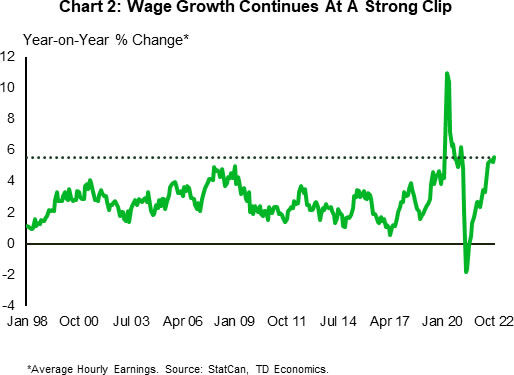
- Wage growth remained hot at 5.6% y/y in October, but Statistics Canada found that those at the top end of the income distribution were most likely to receive raises in the past year.
- Wary of adding further inflationary pressures to the economy, the Federal Fall Economic Statement focused on clarifying funding for previously announced initiatives.
U.S. - A Hawkish Pivot
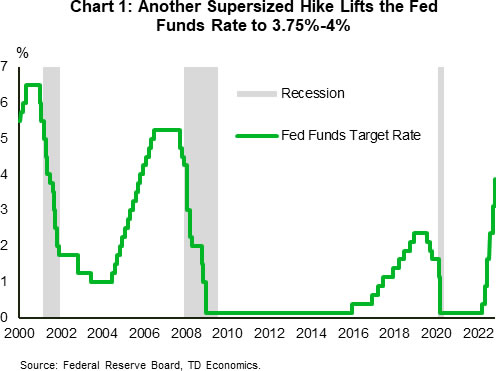
On Wednesday, the Fed increased the monetary policy rate by 75 basis points to a range of 3.75-4% (Chart 1). The hike itself was expected, what captured headlines was the Fed’s pledge to “take into account the cumulative tightening of monetary policy, the lags with which monetary policy affects economic activity and inflation, and economic and financial developments.” In translation, the Fed plans to take a more measured approach to rate hikes going forward and opens the door to a slower pace of tightening. This sent bond and stock markets higher.
Thirty minutes later, Chair Powell poured cold water on those animal spirits by clarifying that despite a potentially slower pace of hiking, the terminal policy rate is likely higher than what FOMC members expected in September. He pointed out that the labor market is very tight, and that consumers still have a mountain of excess savings to keep demand healthy. Therefore, further tightening is likely going to be required to rein in inflation. He further emphasized that it is “very premature” to consider pausing rate hikes, which soured market sentiment, pushing equity prices 3.5% lower relative to last week.
Despite Powell emphasizing strength in demand, leading business indicators – the ISM purchasing managers indexes – weakened in October. While the headline manufacturing index just managed to stay expansionary, the new orders and new export orders indexes continued contracting for the second and third straight month, respectively. Services activity also slowed, with demand factors expansion now clearly on the downward trend. This means that the cumulative impact of rate hikes might be catching up to consumers. However, more concerning to the Fed is that following five straight months of decline, the prices paid component of the services index suddenly accelerated. This suggests that the largest sector of the economy is still facing faster and more widespread price increases.
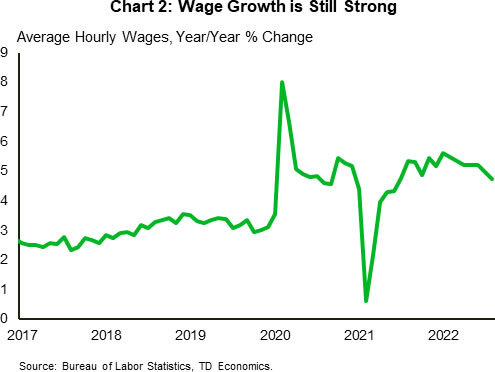
October’s jobs report provided little progress on the Fed’s mission to bring the labor market back into balance. The economy added 261k new jobs, above market expectations for a larger slow down. Meanwhile, the unemployment rate rose by two tenths of a percentage point to 3.7% in the household survey, which showed job losses of 328k. While that is an increase, 3.7% is still a very low level historically. The tight labor market showed up in average hourly earnings growth, which eased only slightly to a still very healthy 4.7% year-on-year (Chart 2).
With the Fed laser focused on the bringing down inflation, it will take much more of a slowdown to be convinced that pressures from the labor market are moderating. For now, erring on the hawkish side remains the Fed’s best option. Looking ahead to next week, the CPI report on Thursday may provide some good news with consensus hoping for a slight moderation in price gains. Markets will also be watching the mid-term elections with recent polls pointing to a Republican majority in Congress, resulting in a divided government. While a divided government is historically positive for risk assets, it could result in more fiscal restraint, which would help the Fed at the margin in reigning in inflation.
Canada – Labour Market Surprises After Summer Chill
The job market surprised to the upside in October. Impressive job growth on the month recouped all of the losses between May and September. With a tight labour market and persistently strong wage growth it's no surprise the federal government is wary of providing additional inflationary pressure to the economy. Indeed, the reticence to provide more fiscal stimulus was evident when it chose to focus its Fall Economic Statement (FES) on supports for low-income Canadians and clarifying the financing of existing commitment rather than net-new initiatives.
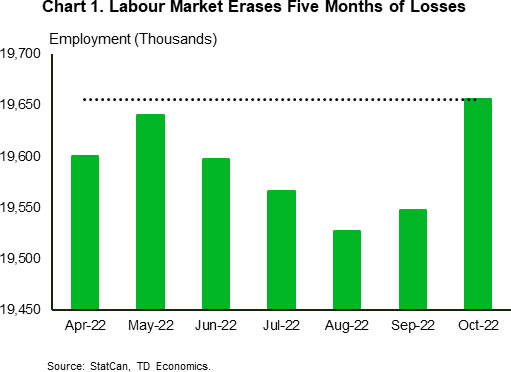
Canada's tight labour market continued in October. Employment gains of 108k erased the losses from the previous five months (Chart 1). The details of the report were solid too. Private sector hiring ticked up (+78k) for the first time since March and all of this month's employment gains were concentrated in full-time work (+119k). The labour force participation rate also moved higher (+0.2 percentage points to 64.9%) and has reached its highest level since June. The supply of new workers came almost entirely from labour force growth (+110k), as the number of unemployed people stayed roughly constant. Roughly equal growth in the labour force and employment meant that the unemployment rate (5.2%) remained unchanged.
The labour market remains drum-tight despite the 5.2% unemployment rate being marginally higher than the record lows reached last summer. With new workers relatively scarce, average hourly earnings grew 5.6% year-on-year (y/y, Chart 2). Interestingly, today's report addressed where exactly some of the wage gains are happening. Of workers who had been with their employer at least one year, nearly two-thirds (64.3%) in the top 25% of wage earners received a raise, while only half of those (50.1%) in the bottom 25% got a pay boost. As inflation is running at 6.9% y/y, this means those at the bottom end of the income spectrum are seeing some of the steepest erosion in real wages (and thus living standards).
It should be no surprise then that the new spending announced Thursday's FES focused on income supports for lowest earners. Of the announced $22.1 billion, the main initiatives were $4 billion in advances for the Canada Workers Benefit and $2.8 billion in student debt relief.
The emphasis of the FES was on clarifying funding for previously announced initiatives. On that note, the Canada Growth Fund will look to make its first investments in early 2023, while the investment tax credit for clean technologies is now being estimated to cost $6.7 billion over five years. On the revenues side, a 2% tax on corporate share buybacks and a global minimum corporate tax that were also announced.
The key takeaway from this week is that the Federal government is wary of additional fiscal stimulus, and for good reason as the labour market remains tight. So, the FES included minimal new spending (to not offset the BoC's efforts to tame inflation) and revenues are going to be used to reduce the nation's debt burden.