

Sample Category Title
USD/JPY Mid-Day Outlook
Daily Pivots: (S1) 147.44; (P) 147.94; (R1) 148.78; More...
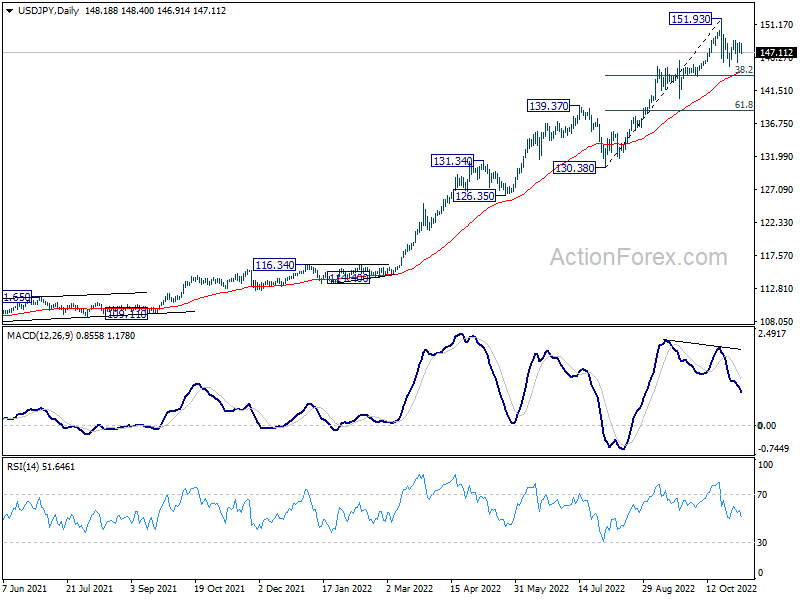
Outlook in USD/JPY remains unchanged as consolidation from 151.93 is in progress. Intraday bias stays neutral. Deeper decline cannot be ruled out, but downside should be contained by 38.2% retracement of 130.38 to 151.93 at 143.69 to bring rebound. On the upside, above 149.69 minor resistance will bring stronger rebound back towards 151.93 high. But upside should be limited there to continue the corrective pattern.
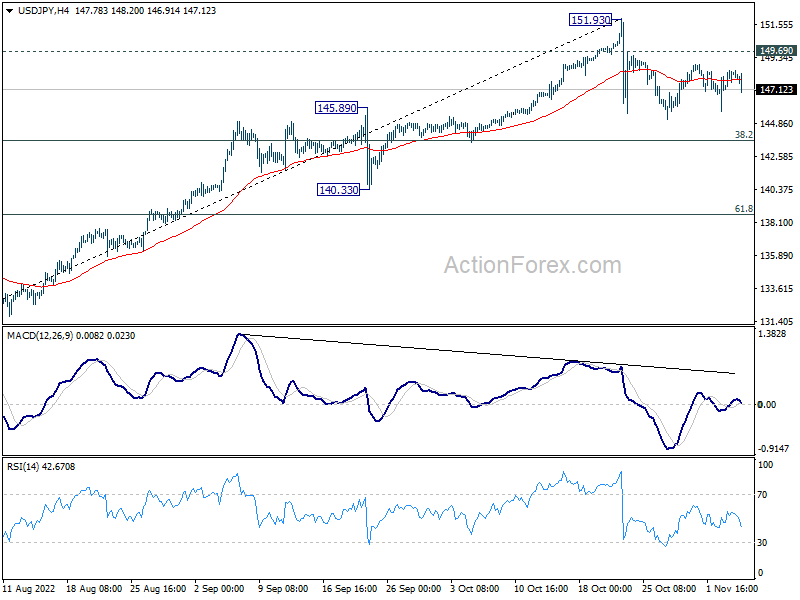
In the bigger picture, up trend from 101.18 is still in progress, as part of the whole up trend from 75.56 (2011 low). 147.68 (1998 high) was already met and there is no clearly sign of topping yet. In any case, break of 140.33 support is needed to be the first sign of medium term topping. Otherwise, further rise is in favor to next target at 160.16 (1990 high).
USD/CAD Mid-Day Outlook
Daily Pivots: (S1) 1.3683; (P) 1.3746; (R1) 1.3808; More....
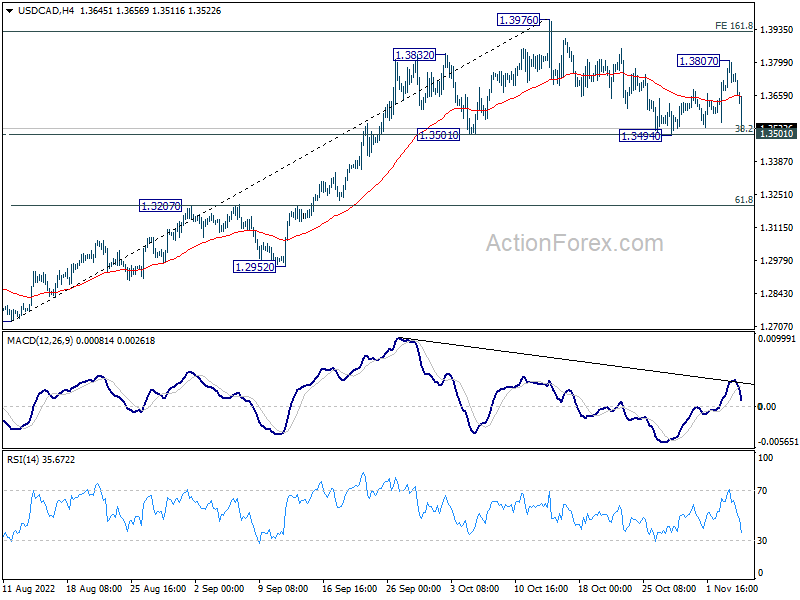
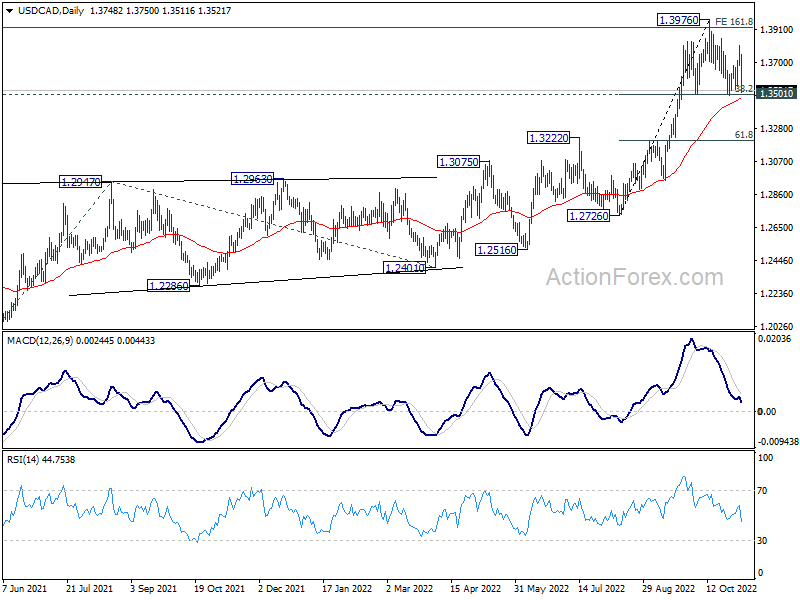
Immediate focus is now on 1.3494/3501 support in USD/CAD. Sustained break there will complete a head and shoulder top pattern (ls: 1.3832; h: 1.3976; rs: 1.3807). Outlook will be turned bearish for deeper fall to 1.3207 cluster support (61.8% retracement of 1.2726 to 1.3976 at 1.3204. On the upside, above 1.3807 minor resistance will bring retest of 1.3976 high.
In the bigger picture, up trend from 1.2005 (2021 low) is still in progress. Based on current impulsive momentum, it could be resuming long term up trend from 0.9056 (2007 low). Whether it is or it isn't, retest of 1.4689 (2016 high) should be seen next. This will now remain the favored case as long as 1.3222 resistance turned support holds.
Canadian Dollar Skyrockets after Stellar Job Data, Dollar Gets No Support From Solid NFP
Canadian Dollar surges broadly after employment blows past expectations. While US non-farm payroll growth was solid, Dollar reacted more to improving risk sentiment and fall sharply. Yen is the second weakest for the day following the greenback. European majors are gaining against the greenback but are all under heavy selling pressure against commodity currencies.
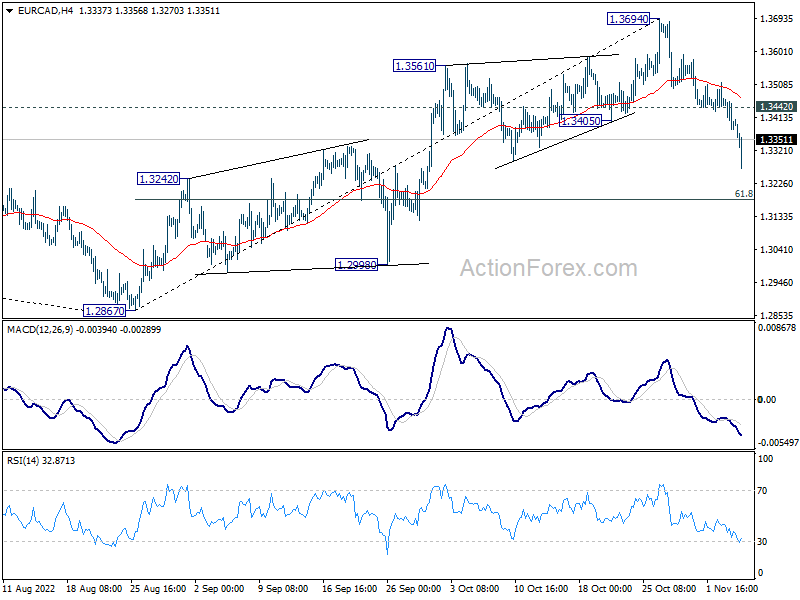
Technically, EUR/CAD's steep decline suggests that it's at least on correction to whole rise from 1.2867. Further decline is expected as long as 1.3442 minor resistance holds. The next line of defense is 61.8% retracement of 1.2867 to 1.3694 at 1.3183. Reaction to this fibonacci level would very much depends on whether USD/CAD would break through 1.3494/3501 support to complete a head and shoulder top reversal pattern.
In Europe, at the time of writing, FTSE is up 1.58%. DAX is up 1.81%. CAC is up 2.34%. Germany 10-year yield is up 0.030 at 2.275. Earlier in Asia, Nikkei dropped -1.68%. Hong Kong HSI rose 5.36%. China Shanghai SSE rose 2.43%. Singapore Strait Times rose 0.89%. Japan 10-year JGB yield rose 0.010 to 0.257.
US NFP rose 261k in Oct, unemployment rate rose to 3.7%
US non-farm payroll employment grew 261k in October, well above expectation of 200k. Prior month's figure was also revised sharply higher from 263k to 315k. Monthly job growth has averaged 407k thus far in 2022.
Unemployment rate rose from 3.5% to 3.7%, above expectation of 3.6%. Number of unemployed persons rose 306k to 6.1m. Labor force participation rate, dropped -0.1% to 62.2%. Average hourly earnings rose 0.4% mom, above expectation of 0.3% mom.
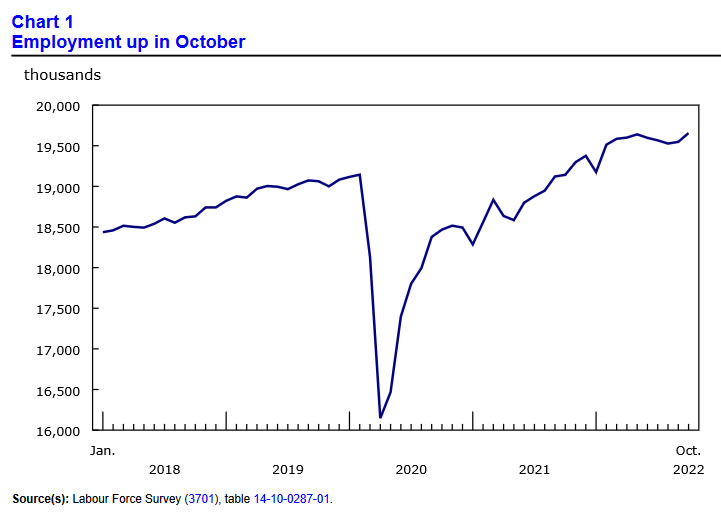
Canada employment grew 108k in Oct, unemployment rate steady at 5.2%
Canada employment grew strongly by 108k in October, well above expectation of 11k.
Unemployment rate held steady at 5.2%. Labor forecast participation rate rose 0.2% to 64.9%.
Year-over-year growth in the average hourly wages of employees remained above 5% for a fifth consecutive month in October, rising 5.6% yoy. Total hours worked increased 0.7% mom.
BoE Pill: Interest rates don't need to rise as high as markets are pricing
BoE Chief Economist Huw Pill told CNBC, "Our current assessment is that we don't think interest rates would need to rise as high as markets are pricing precisely because it would produce a slowdown in the economy that is bigger than we need to get these prices under control."
"That is why the message has been, yes, maybe the market was pricing in too aggressively over this period of turmoil where bank rate is headed. What we are seeking, are always seeking is to find that balance that gets us back to the 2% inflation target without generating unnecessary and costly problems in the real economy," he said.
He added that the challenge is to "ensure that inflation, particularly this domestically generated inflation, is evolving consistent with our target in a sustainable way". At the same time, "also to avoid that we overshoot in the opposite direction and generate a slowdown that is not required."
The question for us is, even as headline inflation begins to fall, have we done enough with monetary policy to contain those underlying or persistent dynamics on inflation to ensure that they end up consistent with our target over time? And I think the answer to that is, we still think there's more to do to control that domestically driven wage-price cost dynamic."
ECB Lagarde: Withdrawing accommodation may not be enough to bring inflation back to target
ECB President Christine Lagarde said in a speech that after increasing interest rates by 200bps, "we expect to raise rates further". He added that, "withdrawing accommodation may not be enough to bring inflation back to our target". But how much further to go, and how fast, will be determined by a few factors.
The first and most important factor is "inflation outlook". The second factor is "corresponding policy stance and its transmission lags into demand and inflation".With the lag in transmission and prevailing uncertainty, "the rate path ahead will look different depending on the contingencies we face."
Eurozone PPI up 1.6% mom, 41.9% yoy in Sep
Eurozone PPI rose 1.6% mom, 41.9% yoy in September, below expectation of 1.7% mom, 42.0% yoy. For the month, industrial producer prices in Eurozone increased by 3.3% in the energy sector, by 0.9% for non-durable consumer goods, by 0.4% for capital goods and for durable consumer goods and by 0.1% for intermediate goods. Prices in total industry excluding energy increased by 0.4%.
EU PPI rose 1.5% mom, 41.4% yoy. The highest monthly increases in industrial producer prices were recorded in Bulgaria (+9.2%), Slovakia (+8.9%) and Italy (+3.5%), while the largest decreases were observed in Ireland (-18.9%), Estonia (-3.9%) and Greece (-2.4%).
Eurozone PMI Composite finalized at 47.3, headed for a winter recession
Eurozone PMI Services was finalized at 48.5 in October, down from September's 48.8, a 20-month low. PMI Composite was finalized at 47.3, down from prior month's 48.1, a 23-month low. Looking at some member states, Germany PMI Composite dropped to 45.1 (29-month low), Italy to 45.8 (22-month low), Spain to 48.0 (9-month low), France to 50.2 (19-month low), and Ireland to 52.1, (2-month low).
Joe Hayes, Senior Economist at S&P Global Market Intelligence said:
"After a weak third quarter of PMI and official GDP data, the latest survey results for the start of the fourth quarter suggest the eurozone economy is now headed for a winter recession. High inflation is dampening demand and hurting business confidence. Fears that the energy crisis could intensify over the winter period are also feeding uncertainty and weighing on decision-making.
"Nonetheless, the ECB will want to continue with monetary tightening to contain inflation. October PMI data suggest inflationary pressures remained extremely elevated across the eurozone. We did, however, see some dovish tones in the rhetoric surrounding the ECB's October policy decision, clearly showing that the Governing Council are concerned by the rapidly deteriorating economic outlook. A substantial worsening of economic conditions in the coming months may give policymakers a difficult decision to make with regards to the path of monetary tightening, for fear of being too aggressive and prolonging the downturn."
RBA downgrades 2023, 2024 growth forecast, raised inflation
In the Statement on Monetary Policy, RBA noted that after a sequence of 50bps and 24bps rate hikes, "the Board recognised that interest rates had already been increased significantly in a short period of time".
"In an uncertain environment, slowing the adjustment of policy allows time to assess the effects of the increases to date and the evolving economic outlook," it added.
The Board expects that "interest rates will need to increase further", but "monetary policy is not on a pre-set path". The size and timing of future interest rate hikes will be determined by incoming data and assessment of the outlook of inflation and labor market.
In the new economic projections, year-average GDP growth forecast for:
- 2022 was left unchanged at 4%.
- 2023 was downgraded from 2.25% to 2.00%.
- 2024 was downgraded from 1.75% to 1.50%.
Year-end forecasts for headline CPI for:
- 2022 was revised up from 7.75% to 8.00%.
- 2023 was revised up from 4.25% to 4.75%.
- 2024 was revised up from 3.00% to 3.25%.
Year-end forecasts for trimmed mean CPI for:
- 2022 was revised up from 6.00% to 6.25%.
- 2023 was left unchanged at 3.75%.
- 2024 was revised up from 3.00% to 3.25%.
Year-end forecasts for unemployment rate for:
- 2022 was revised up from 3.25% to 3.50%.
- 2023 was revised up from 3.50% to 3.75%.
- 2024 was revised up from 4.00% to 4.25%.
USD/CAD Mid-Day Outlook
Daily Pivots: (S1) 1.3683; (P) 1.3746; (R1) 1.3808; More....
Immediate focus is now on 1.3494/3501 support in USD/CAD. Sustained break there will complete a head and shoulder top pattern (ls: 1.3832; h: 1.3976; rs: 1.3807). Outlook will be turned bearish for deeper fall to 1.3207 cluster support (61.8% retracement of 1.2726 to 1.3976 at 1.3204. On the upside, above 1.3807 minor resistance will bring retest of 1.3976 high.
In the bigger picture, up trend from 1.2005 (2021 low) is still in progress. Based on current impulsive momentum, it could be resuming long term up trend from 0.9056 (2007 low). Whether it is or it isn't, retest of 1.4689 (2016 high) should be seen next. This will now remain the favored case as long as 1.3222 resistance turned support holds.
Economic Indicators Update
| GMT | Ccy | Events | Actual | Forecast | Previous | Revised |
|---|---|---|---|---|---|---|
| 21:30 | AUD | AiG Performance of Construction Index Oct | 43.3 | 46.5 | ||
| 07:00 | EUR | Germany Factory Orders M/M Sep | -4.00% | -0.60% | -2.40% | -2.00% |
| 07:45 | EUR | France Industrial Output M/M Sep | -0.80% | -1.00% | 2.40% | |
| 08:45 | EUR | Italy Services PMI Oct | 46.4 | 48.5 | 48.8 | |
| 08:50 | EUR | France Services PMI Oct F | 51.7 | 51.3 | 51.3 | |
| 08:55 | EUR | Germany Services PMI Oct F | 46.5 | 44.9 | 44.9 | |
| 09:00 | EUR | Eurozone Services PMI Oct F | 48.6 | 48.2 | 48.2 | |
| 09:30 | GBP | Construction PMI Oct | 53.2 | 52.1 | 52.3 | |
| 10:00 | EUR | Eurozone PPI M/M Sep | 1.60% | 1.70% | 5.00% | |
| 10:00 | EUR | Eurozone PPI Y/Y Sep | 41.90% | 42.00% | 43.30% | 43.40% |
| 12:30 | USD | Nonfarm Payrolls Oct | 261K | 200K | 263K | 315K |
| 12:30 | USD | Unemployment Rate Oct | 3.70% | 3.60% | 3.50% | |
| 12:30 | USD | Average Hourly Earnings M/M Oct | 0.40% | 0.30% | 0.30% | |
| 12:30 | CAD | Net Change in Employment Oct | 108.3K | 11.0K | 21.1K | |
| 12:30 | CAD | Unemployment Rate Oct | 5.20% | 5.30% | 5.20% | |
| 14:00 | CAD | Ivey PMI Oct | 60.2 | 59.5 |
Canada employment grew 108k in Oct, unemployment rate steady at 5.2%
Canada employment grew strongly by 108k in October, well above expectation of 11k.
Unemployment rate held steady at 5.2%. Labor forecast participation rate rose 0.2% to 64.9%.
Year-over-year growth in the average hourly wages of employees remained above 5% for a fifth consecutive month in October, rising 5.6% yoy. Total hours worked increased 0.7% mom.
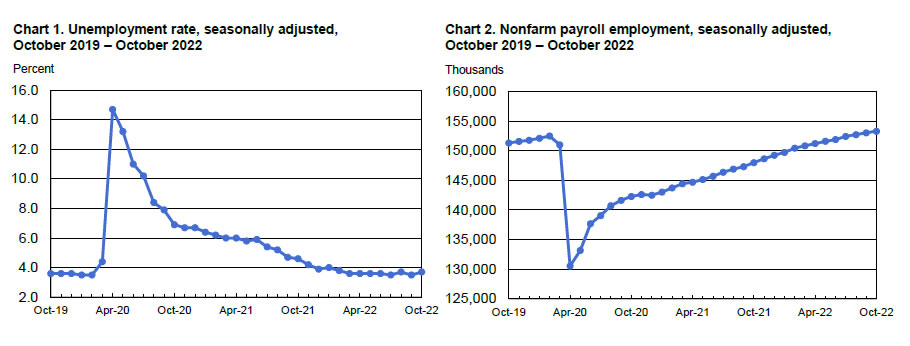
US NFP rose 261k in Oct, unemployment rate rose to 3.7%
US non-farm payroll employment grew 261k in October, well above expectation of 200k. Prior month's figure was also revised sharply higher from 263k to 315k. Monthly job growth has averaged 407k thus far in 2022.
Unemployment rate rose from 3.5% to 3.7%, above expectation of 3.6%. Number of unemployed persons rose 306k to 6.1m. Labor force participation rate, dropped -0.1% to 62.2%. Average hourly earnings rose 0.4% mom, above expectation of 0.3% mom.
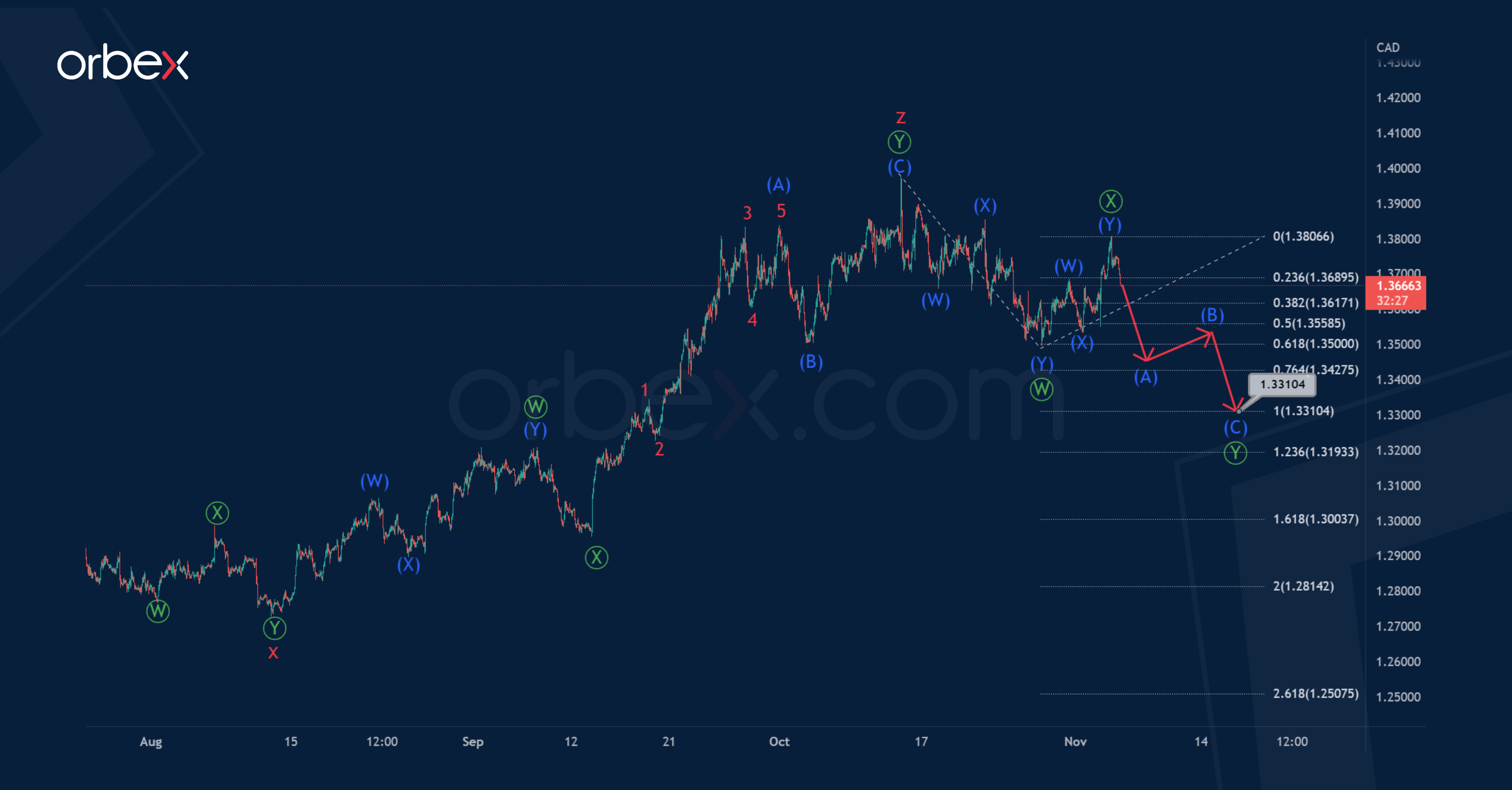
USDCAD: Cycle Triple Zigzag Likely to Complete at 1.403
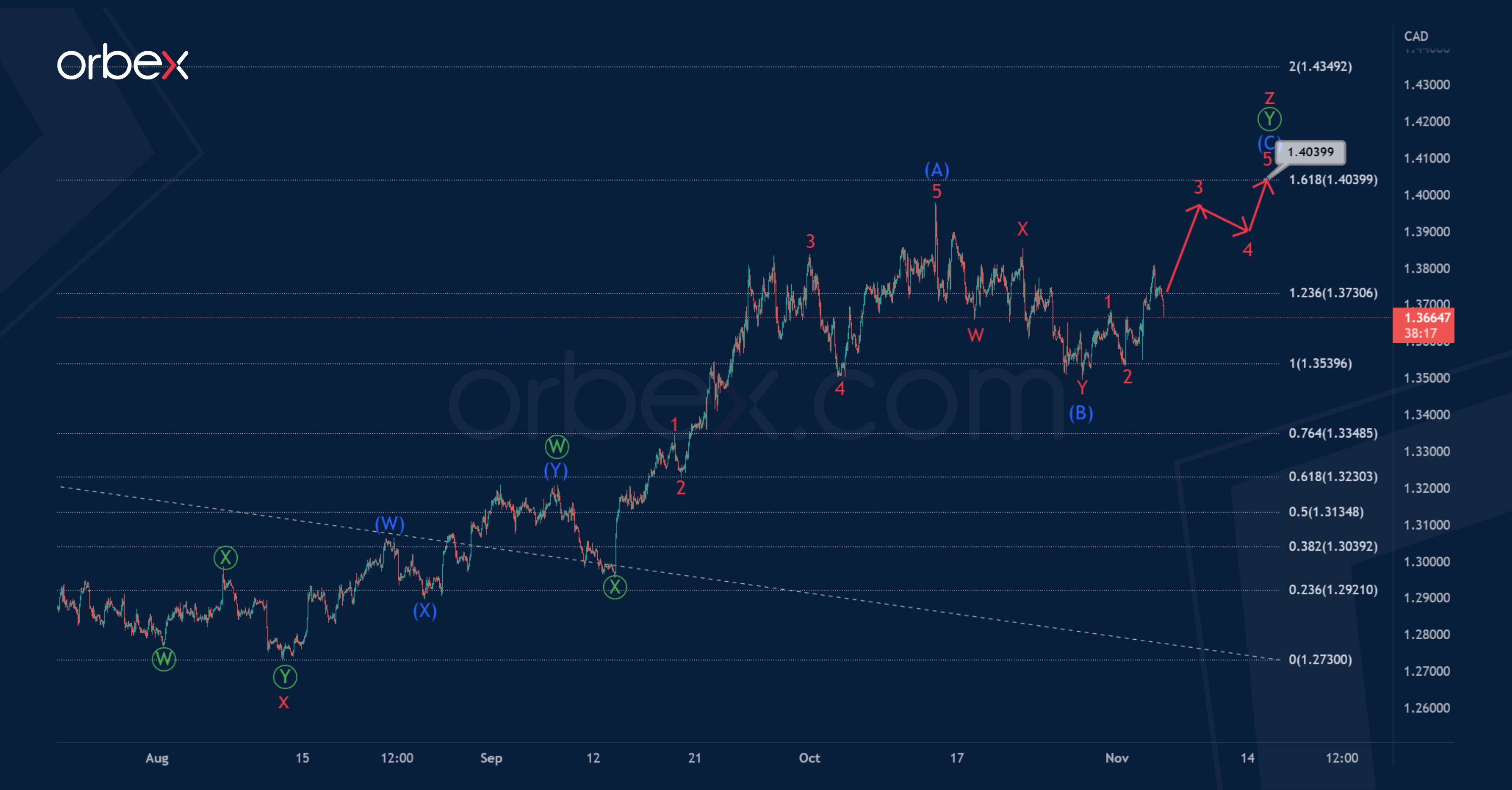
The current USDCAD chart shows the internal structure of a large correction pattern, which most likely takes the form of a cycle triple zigzag w-x-y-x-z.
Perhaps the first four parts of this construction are fully completed, and now the final actionary leg is being built the sub-wave z. Apparently, the wave z takes the form of a primary double zigzag, where the sub-waves are formed.
Thus, the last actionary wave can be formed at the moment.
It may end in the form of a standard zigzag (A)-(B)-(C) near 1.403. At that level, cycle wave z will be at 161.8% of cycle wave y.
Let’s consider an alternative scenario, as seen above. According to this, the formation of a cycle triple zigzag could be fully completed. Therefore, let's assume that the initial part of a new bearish trend is forming.
We assume the construction of a primary double zigzag, which is the beginning in a larger correction pattern.
It is likely that the primary waves have already been completed, each of which is a double zigzag of the intermediate degree.
In the near future, we can expect the formation of a bearish primary wave, which may take the standard zigzag shape (A)-(B)-(C) and end near 1.331. At that level, the primary waves and will be equal.
USDCAD Elliott Wave: Buying The Dips At The Blue Box Area
Hello fellow traders. In this article we’re going to take a quick look at the Elliott Wave charts of USDCAD, published in members area of the website.As our members know, we have favoring the long side in the pair . Recently the pair made a pull back that has given us buying opportunities. We recommended members to avoid selling the pair, while keep favoring the long side. In the further text we are going to explain the Elliott Wave Forecast and trading strategy.
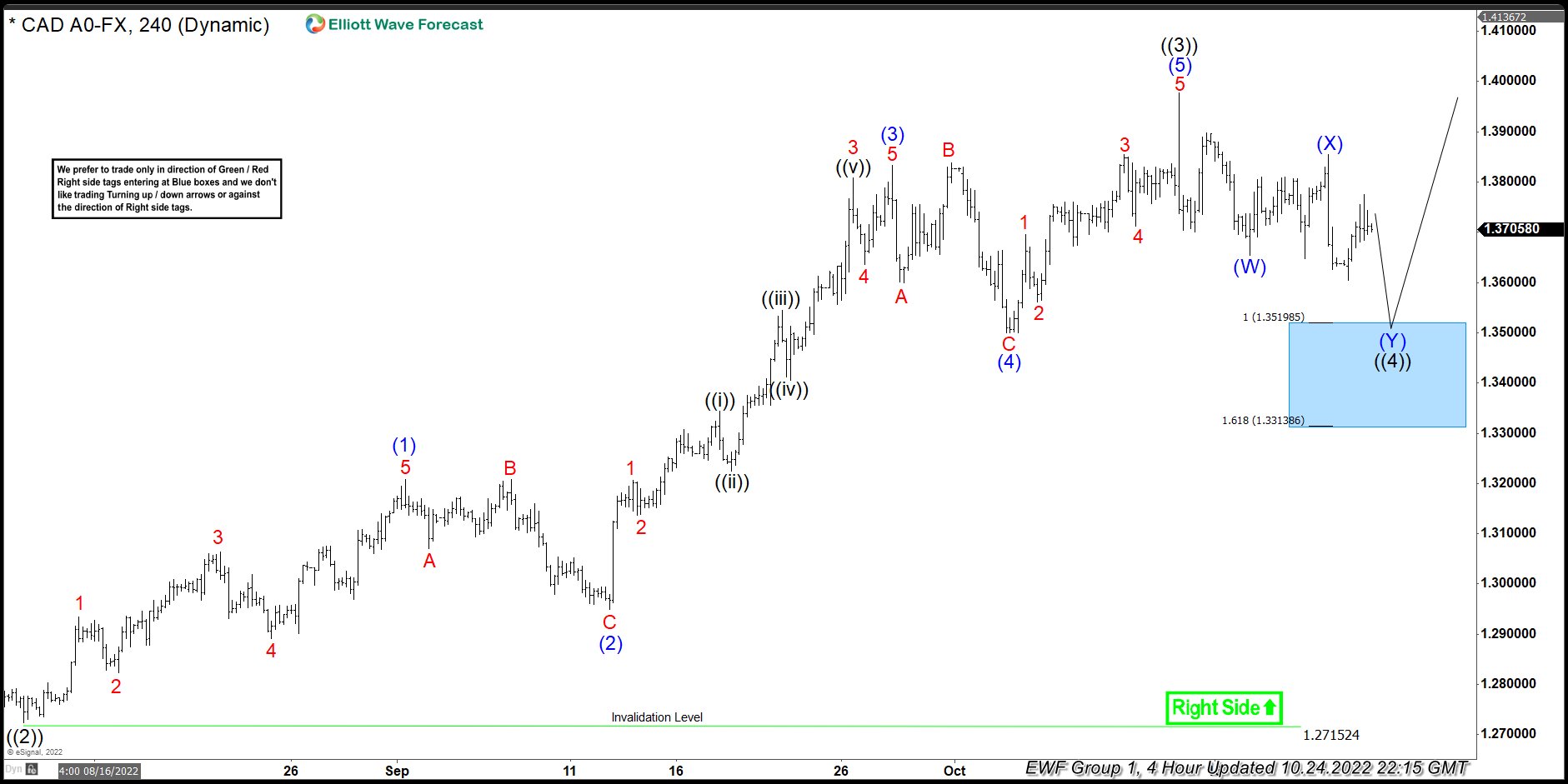
USDCAD Elliott Wave 4 Hour Chart 10.24.2022
The pair is giving us wave ((4)) pull back against the the 1.2715 low. Correction looks incomplete at the moment, showing lower low sequences from the peak that suggests we should ideally see more downside toward 1.3519-1.3313 ( buying zone) . We don’t recommend selling the pair against the main bullish trend. Strategy is waiting for the price to reach blue box zone, before entering the long trades. Buyers should appear at the blue box for the further rally toward new high ideally or for a 3 waves bounce at least . Invalidation for the long trades is break of 1.618 fib ext : 1.3313
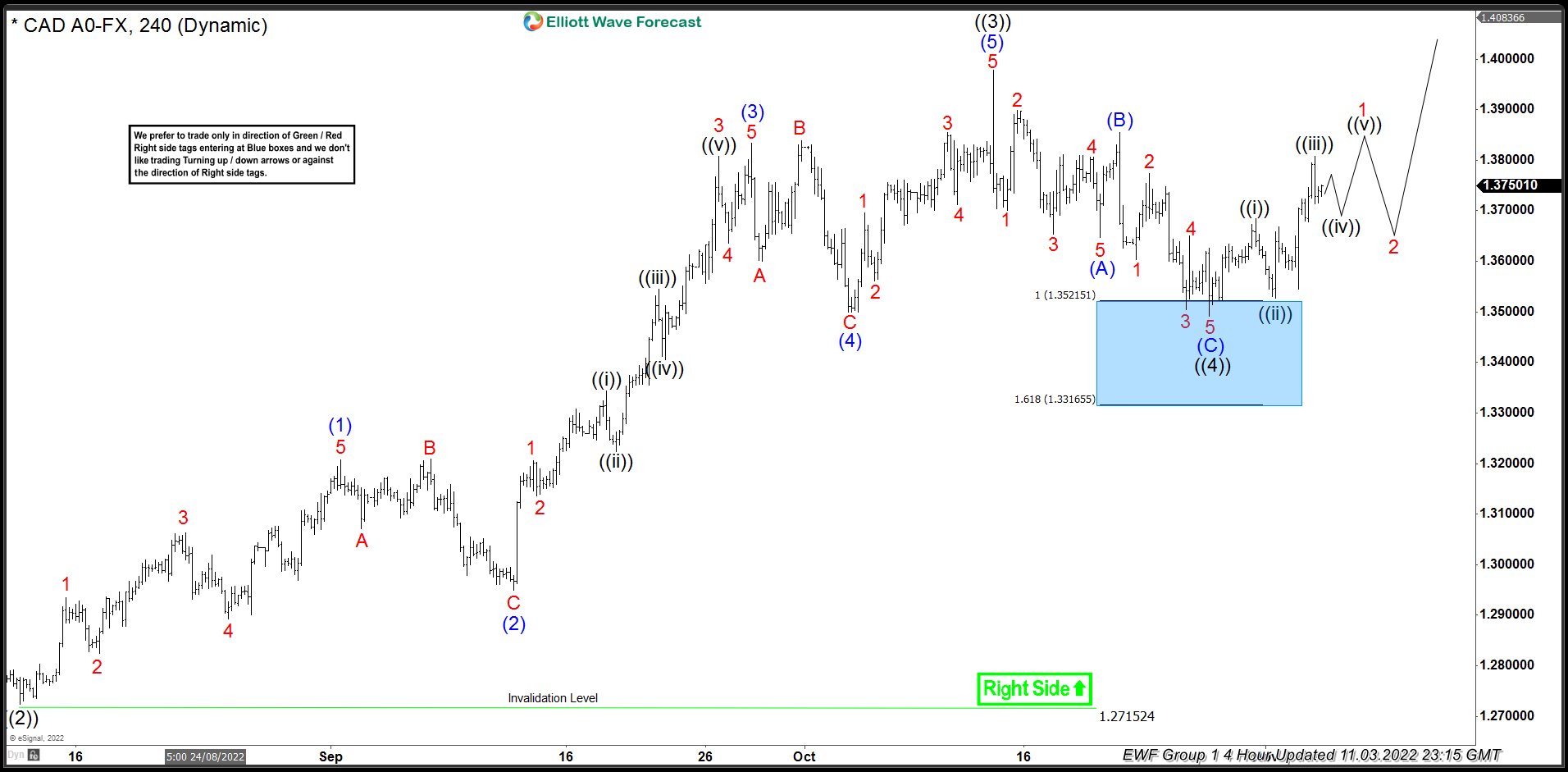
USDCAD Elliott Wave 4 Hour Chart 11.03.2022
USDCAD has given us more downside toward marked area expected. The pair found buyers at the 1.3519-1.3313 ( Blue Box – buying zone) and we are getting good reaction from there. As a result , all long trades are risk free (put SL at BE) + partial profits have been taken. Wave ((4)) black pull back has ended at 1.3492 low. That is the key level to hold for proposed view. As far as the price above that level, next leg up could be in progress toward new highs. In near term we expect to see pull back which will be either ((iv)) or correction against the 1.3492 low.
Keep in mind that market is dynamic and presented view could have changed in the mean time. You can check most recent charts in the membership area of the site. Best instruments to trade are those having incomplete bullish or bearish swings sequences. We put them in Sequence Report and best among them are shown in the Live Trading Room
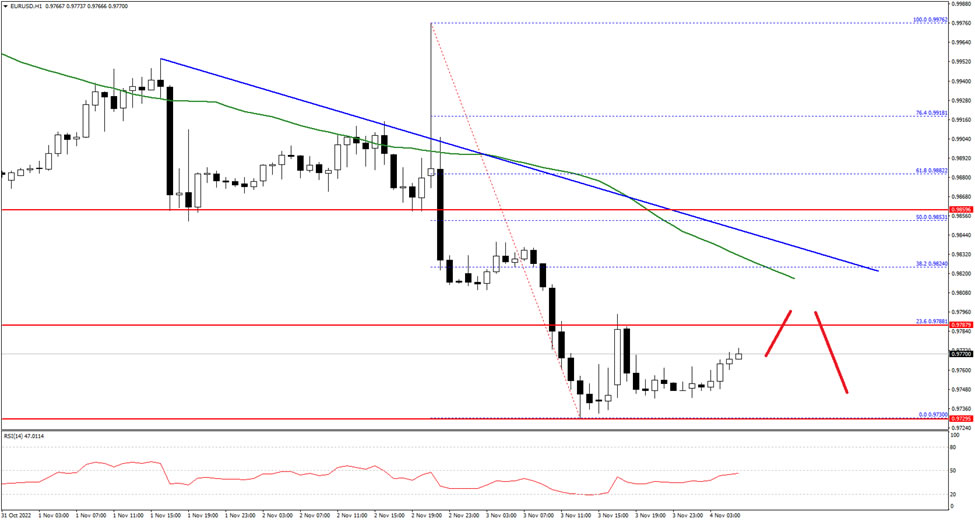
EUR/USD Pair is Now Consolidating Losses Near 0.9770
The Euro struggled to clear the 0.9950 and 0.9960 resistance levels against the US Dollar. The EUR/USD pair reacted to the downside and declined below the 0.9850 support.
There was close below the 0.9800 level and the 50 hourly simple moving average. The pair is now consolidating losses near the 0.9770 zone. An immediate resistance on the upside is near 0.9790 and the 50 hourly simple moving average. The first major resistance is near the 0.9820 level.
A break above the 0.9820 resistance level could start a decent upward move. In the stated case, it could even surpass 0.9850.
Conversely, the pair might start another decline below 0.9750. The next key support is near 0.9720, below the pair could decline towards the 0.9680 level. Any more losses might send the pair towards the 0.9640 level.
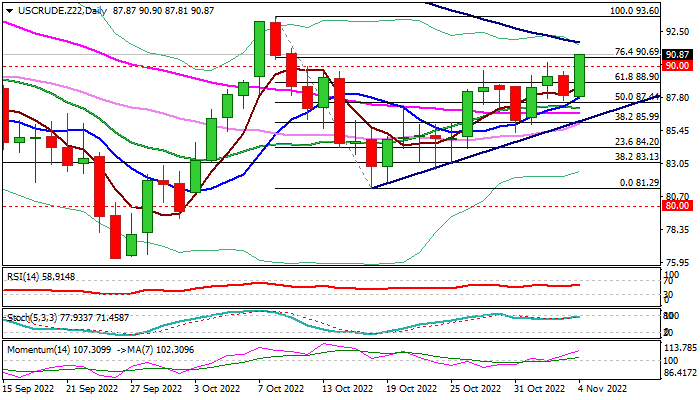
WTI Oil: Oil Price Surges on Weaker Dollar and Persisting Supply Risks
WTI oil price rose strongly on Friday, advancing 3.3% in the mid-European session, lifted by stronger dollar and persisting supply risks, though China’s Covid restrictions and recession fears continue to weigh and may limit gains.
Friday’s strong bullish acceleration broke through some important barriers, the top of thick daily cloud ($89.06) and psychological $90 level, as well as pivotal Fibo resistances at $88.90 and $90.69 (Fibo 61.8% and 76.4% of $93.60/$81.29 respectively), with close above these levels to confirm strong bullish signal and open way for further gains, exposing targets at $91.77 (falling 100DMA) and key near-term barrier at $93.60 (Oct 10 lower top).
Daily studies are in full bullish setup and support the action, which sees a weekly close above broken $90 barrier as a minimum requirement to keep fresh bulls in play.
Res: 91.77; 92.87; 93.60; 94.36.
Sup: 90.00; 89.60; 88.90; 87.77.
ECB Lagarde: Withdrawing accommodation may not be enough to bring inflation back to target
ECB President Christine Lagarde said in a speech that after increasing interest rates by 200bps, "we expect to raise rates further". He added that, "withdrawing accommodation may not be enough to bring inflation back to our target". But how much further to go, and how fast, will be determined by a few factors.
The first and most important factor is "inflation outlook". The second factor is "corresponding policy stance and its transmission lags into demand and inflation".With the lag in transmission and prevailing uncertainty, "the rate path ahead will look different depending on the contingencies we face."