Sample Category Title
US 500 Index Remains Above the 200-Weekly SMA after New 2-year Low
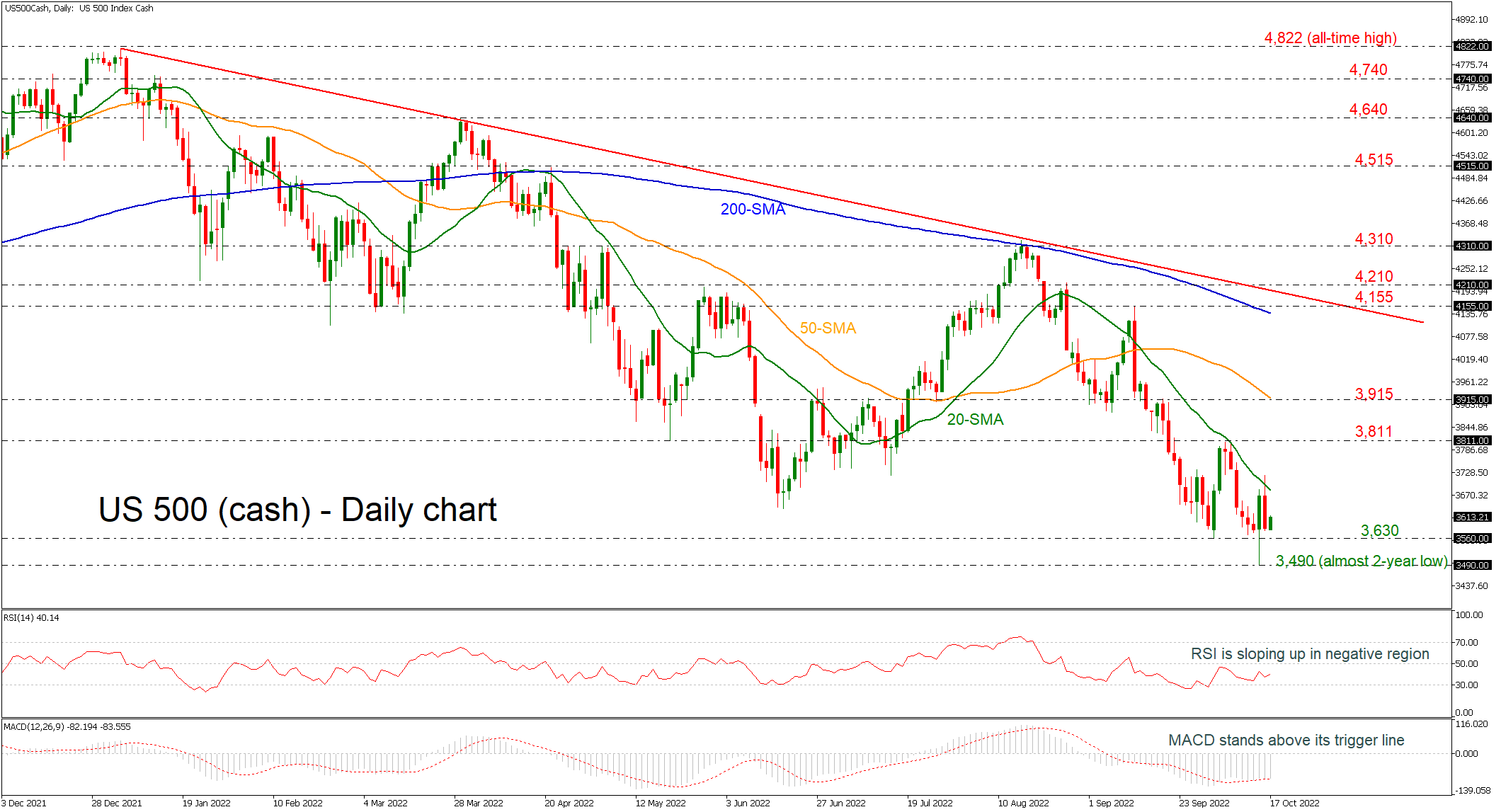
The US 500 cash index posted a negative spike towards a fresh almost two-year low of 3,490 on Thursday but failed to finish the week beneath the 200-weekly simple moving average (SMA) around 3,600.
According to the RSI, the market could maintain itself above the 3,630 support in the short-term as the RSI is positively sloped beneath its neutral threshold of 50. The MACD oscillator is hovering near its trigger line below the zero level.
On the upside, the price could attempt to overcome the 20-day SMA and retest the 3,811 level, which if successfully broken, could open the door for the 50-day SMA, which overlaps with the 3,915 resistance. Should traders continue to move the price up, bringing the short-term uptrend into play, resistance could then run towards the 200-day SMA at 4.135.
A reversal to the downside, however, could find immediate support at the 3,630 barrier, while slightly lower the two-year low of 3,490 could also come into view. If the latter fails to halt bearish movements, the next target could be the 3,225 support, registered back in September 2020.
Turning to the long-term, the outlook is bearish over the past nine months and only a decisive close above 200-day SMA and the descending trend line could change the view to positive.
USD/JPY: Japanese Authorities May Intervene as USD/JPY Rose to 32-year High
The USDJPY is consolidating under new 32-year high (148.85), following strong bullish acceleration last Friday, which broke and closed above key barrier at 147.68 (1998 peak).
The pair advanced 2.3% last week (the biggest weekly rally since the last week of May) extending steep ascend into ninth straight week.
The dollar remains well supported on signs that the Fed is expected to keep its strong hawkish stance and possibly increase the pace of policy tightening in coming months, as well as safe-haven flows on growing economic and geopolitical uncertainty.
Bulls eye targets at 149.32/150.00 (Fibo 161.8% projection of the upleg from Sep 22 trough (140.36 / psychological), where strong headwinds are expected, as daily and weekly studies are strongly overbought and
Japanese authorities may intervene again to support sharply falling yen.
According to the limited reaction on the last intervention (Sep 22) and no substantial changes in fundamentals expected, potential intervention would likely provide better levels to re-enter strongly bullish market.
Res: 148.85; 149.32; 150.00; 151.43.
Sup: 148.42; 147.68; 147.07; 146.22.

AUD/USD Pair Moved into a Bearish Zone Below 0.6280
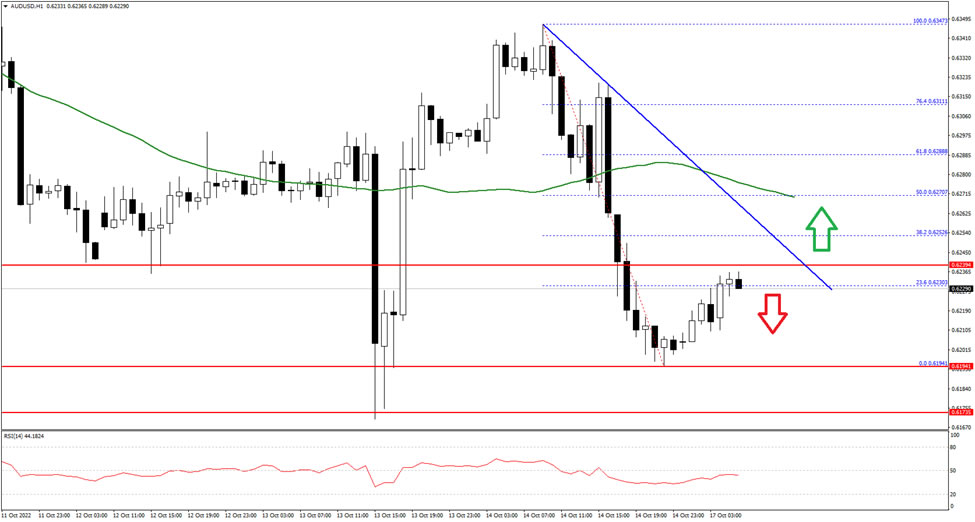
The Aussie Dollar started a fresh decline from the 0.6350 resistance zone against the US Dollar. The AUD/USD pair declined below the 0.6280 level to move into a bearish zone.
There was a clear move below the 0.6250 zone and the 50 hourly simple moving average. The pair traded as low as 0.6194 and is currently correcting losses. An immediate resistance on the upside is near the 0.6245 level and a connecting bearish trend line on the hourly chart.
If there is an upside break above the 0.6250 zone, the pair could rise steadily towards the 0.6300 level in the near term. The main resistance now sits near the 0.6350 level.
An immediate support is near 0.6215 on FXOpen. The next key support is near the 0.6200 level. A downside break below the 0.6200 support could lead the pair towards the 0.6165 support.
GER 40 Struggles to Bounce
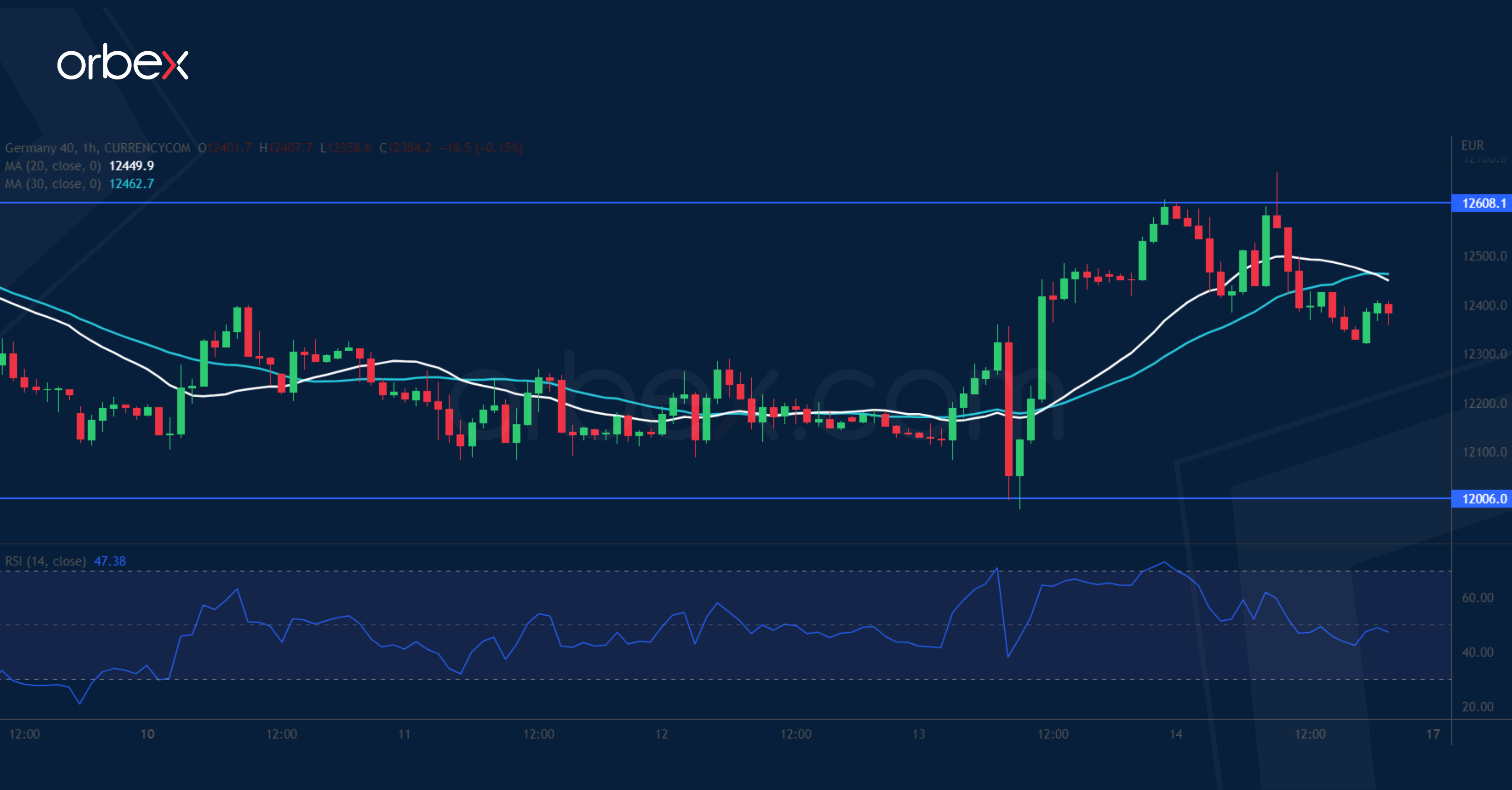
Equities slide as global uncertainties keep investors on their toes. The Dax 40 found support at the base of the bullish breakout (12000) from earlier this month. 12600 near the top of a previous rebound is a key resistance. Its breach would signal strong buying interest and trigger a bounce in the short-term. Otherwise, the market would remain cautious and the bears may double down for lack of opposition. A revisit of 12000 could put the current rebound at risk and extend losses to a two-year low at 11400.
GBP/JPY Tests Major Resistance
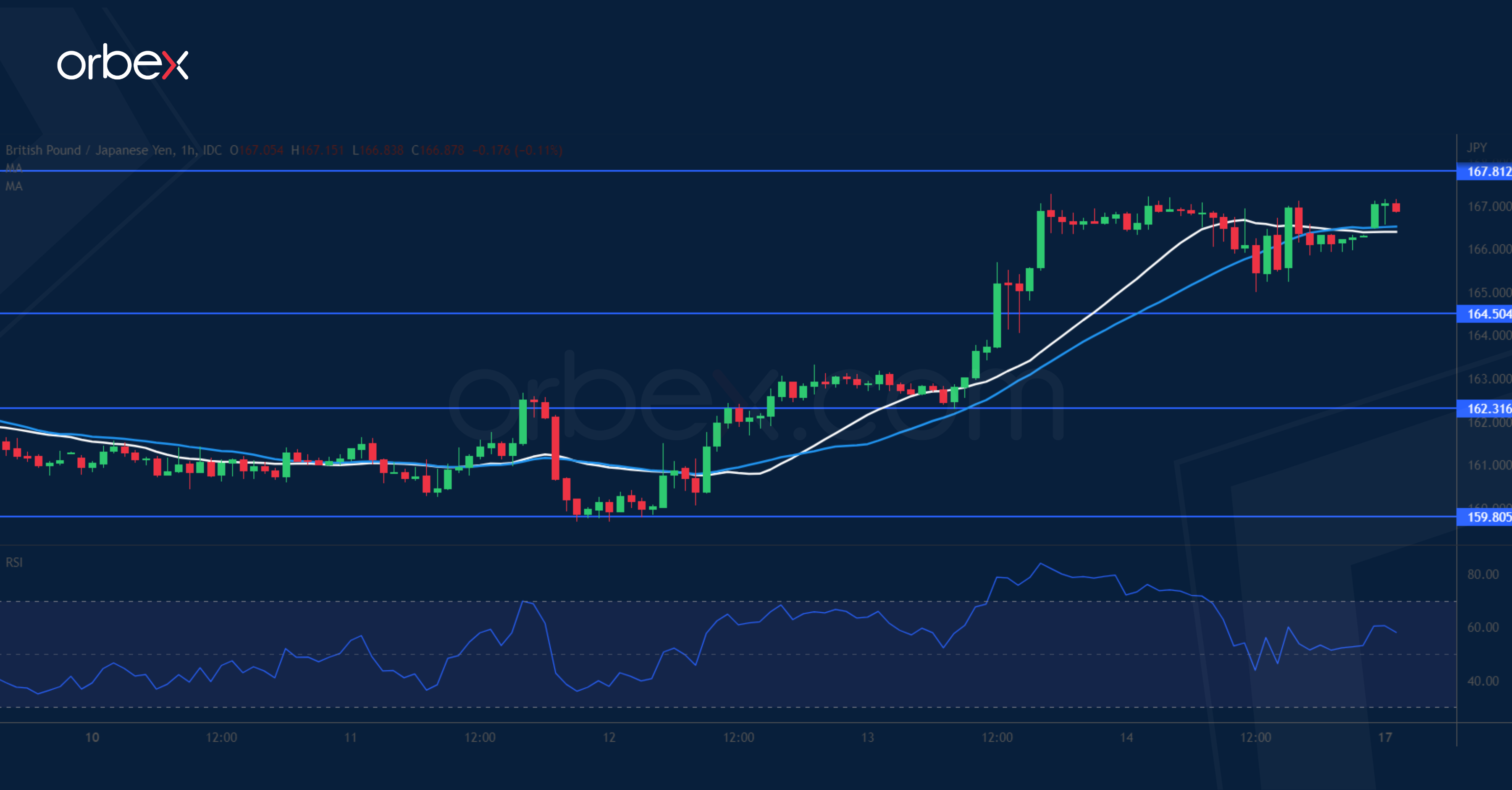
The pound steadied after the firing of the UK’s finance minister. A rally above the previous high at 165.50 has prompted sellers to cover their positions. Improved sentiment leans towards a bullish continuation. September’s high at 167.80 is the last hurdle and a breakout would pave the way for an extended rally above 170.00 in the days to come. The RSI’s overbought situation may cause a temporary pullback to test the bulls’ commitment. 164.50 and 162.30 are the two levels to expect accumulation.
EUR/USD in Brief Consolidation
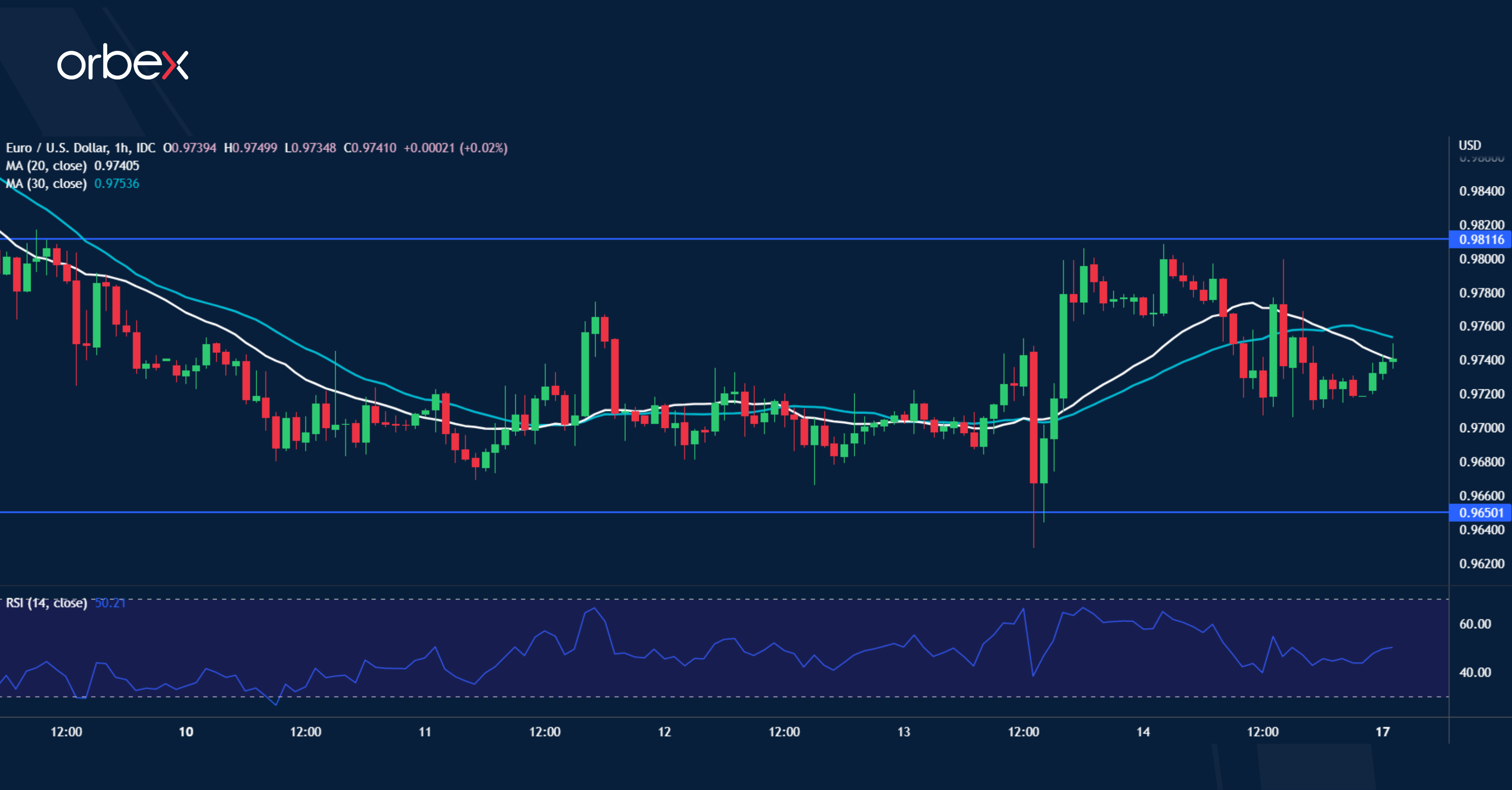
The US dollar consolidated over flat retail sales in September. The euro has struggled to secure bids after it turned lower from the daily resistance and parity level. Sentiment would remain bearish unless the buy side manages to push past this ceiling. In the meantime, the pair is testing the demand zone between 0.9540 and 0.9650. A close above the recent support-turned-resistance 0.9810 would lift the price to 0.9900. On the downside, a bearish breakout would renew the selling pressure and send the single currency to 0.9450.
The British Currency Finds Some Relief in Asian Dealings
Markets
Kwarteng’s sacking on Friday triggered a core bond relief rally with UK Gilts outperforming. Prime minister Truss appointed Jeremy Hunt as his successor and gave a press conference later in which she dropped an £18bn corporate tax cut plan. But it did little to convince markets fundamentally. UK bond yields bottomed, erased previous losses and eventually rose between 11.6 bps (2y) to 23.4 bps (30y) in the UK. It was a screeching intraday turnaround of more than 50 bps, supported by the Bank of England leaving the market after having bought a total of just £1.4bn+ bonds on the last day. European yields rose in lockstep, adding 3.5 bps to 9.8 bps in a steepener. US yields lagged peers but caught up after the release of the Michigan consumer confidence in which one-year inflation expectations unexpectedly rose north of 5% again. The 5-10y gauge (2.9%) topped 2.8% estimates too. Bets for Fed rate hikes lean towards a 5% terminal rate, in line with the analysis of Fed’s Daly last week. US yields advanced 3.2 bps at the front end to 6.6-7.7 bps at longer maturities with the 10y yield closing above 4% for the first time since ’08. US equities tanked more than 3% (Nasdaq), erasing about half of the gains seen in the historical intraday reversal on Thursday. The dollar dominated FX space. USD/JPY soared beyond the 1998 high to close at 148.67. EUR/USD losses could have been bigger though (close at 0.972). Sterling remained in the defensive. EUR/GBP closed above 0.87 and Cable eased to 1.117. The British currency finds some relief in Asian dealings after Hunt in an interview yesterday said nothing is off the table when asked if other measures in the minibudget could be abandoned. It’s a stark contrast with Truss herself last week saying she expects Hunt to agree to no more U-turns. It makes us question the underlying strength of the move this morning. We’re also keen to see the Gilt market open without the Bank of England’s backstop. Things remain interesting politically too. More Tories call for Truss to resign. Hunt met with the BoE and the Debt Management Office last night and will make a statement on the medium-term fiscal plan later today. USD/JPY holds steady near a 30-year high and government officials are back with unconvincing verbal interventions. Chinese authorities fixed the yuan at USD/CNY 7.1095 but you can’t fight market forces. USD/CNY is attacking previous cycle (closing) highs of 7.20 on yuan weakness. Chinese president Xi Jinping at the Communist Party congress said economic development remains top priority but signaled no change in the damaging zero-Covid policy. EUR/USD heads north to 0.975, the DXY takes a breather at 112.97. US Treasury yields lose a few bps and German Bund futures trade higher. We wouldn’t be surprised to see some short-term consolidation in core bonds (UK Gilts not included, to be clear) near their recent highs as markets await new impetus from the likes of the ECB (next week). EUR/USD should hold on in the 0.95-1 trading range.
News Headlines
The FT reports that the European Commission is likely to freeze regional aid to Poland as the country’s suppression of judicial independence still interferes with the EU’s charter of fundamental rights. Warsaw already made some reforms to its system for discipling judges, but these don’t go far enough. At stake is a total of €76.5bn of cohesion funding. The EC did already sign off on three of Poland’s cohesion programme initiatives (big infrastructure & green investments) for which unconditional prefinancing is available (0.5% of the overall amount). The first tranche of the pandemic-related EU recovery fund (€2.85bn in grants and €1.37bn in loans) is also yet to be released. The Polish zloty starts the week on the back foot with EUR/PLN rising from 4.80 to 4.85.
A draft EC proposal seen by the FT suggests that Brussels wants to set a maximum dynamic price at which gas transactions can take place on the Dutch Title Transfer Facility (TTF), the benchmark for the bloc. The proposals also include measures to limit volatility in energy derivatives markets, as well as a longer-term project to create a new benchmark for liquefied natural gas. Urgent measures are also needed to ensure member states co-operate more effectively on gas purchasing, with a particular focus on refilling storage facilities next year. EU leaders meet on Thursday and Friday in Brussels to find joint solutions to tackle the energy crisis.
GBP/JPY Daily Outlook
Daily Pivots: (S1) 165.15; (P) 166.18; (R1) 167.34; More...
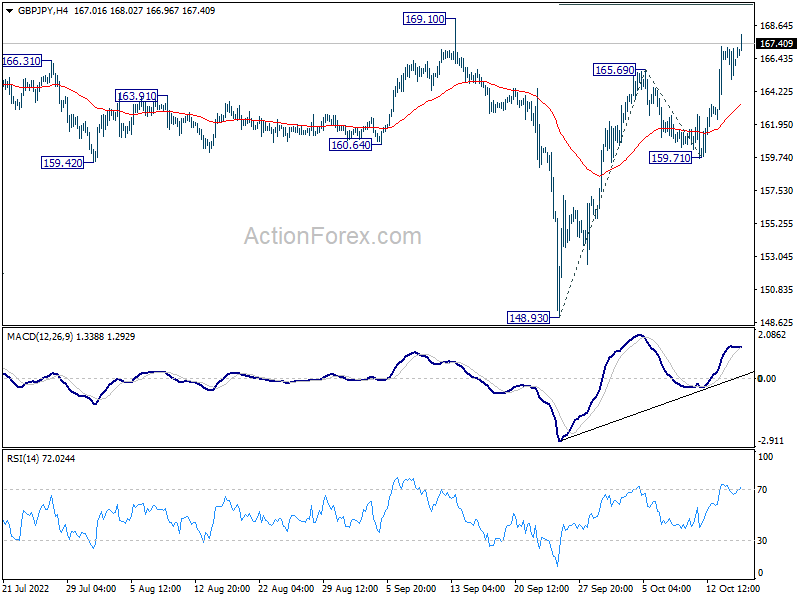
Intraday in GBP/JPY remains on the upside for the moment retest 169.10 resistance. Firm break there will confirm larger up trend resumption. Next near term target is 61.8% projection of 148.93 to 165.69 from 159.71 at 170.06, and then 100% projection at 176.47. On the downside, break of 159.71 support will extend the corrective pattern from 169.10 with another falling leg.
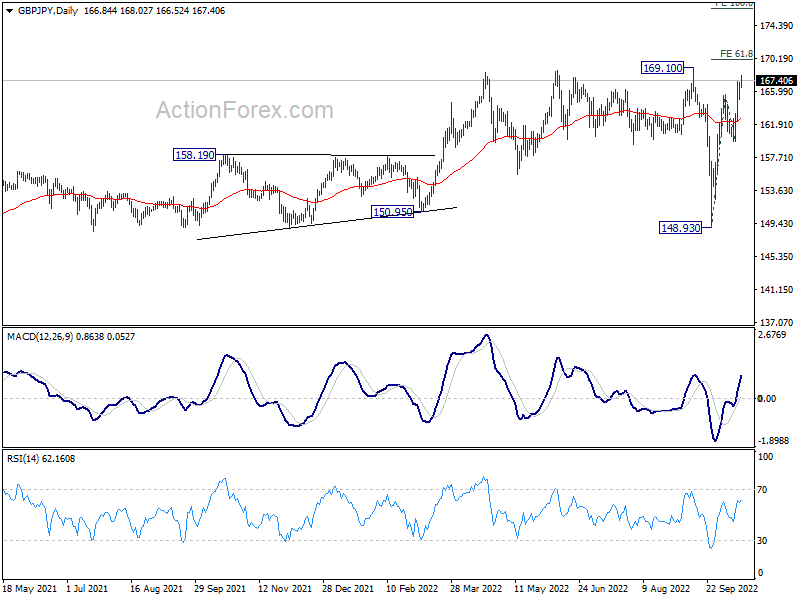
In the bigger picture, current development suggests that up trend from 123.94 (2020 low) is still in progress. Sustained break of 61.8% retracement of 195.86 (2015 high) to 122.75 (2016 low) at 167.93 will pave the way to retest 195.86 high. This will now remain the favored case as long as 148.93 support holds.
EUR/JPY Daily Outlook
Daily Pivots: (S1) 143.80; (P) 144.33; (R1) 145.17; More....
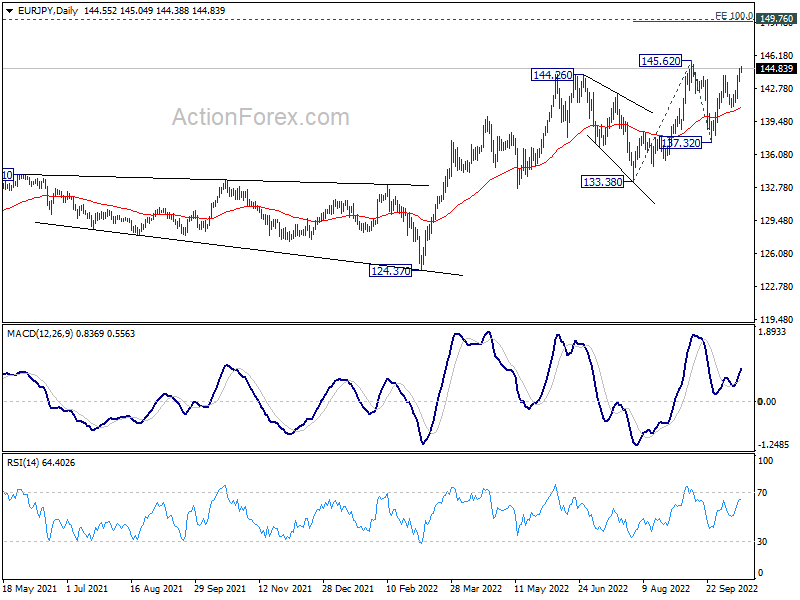
Intraday bias in EUR/JPY stays on the upside for 145.62 resistance. Firm break there will confirm up trend resumption. Next target is 100% projection of 133.38 to 145.62 from 137.32 at 149.56, which is close to 149.76 long term resistance. On the downside, break of 140.88 will extend the corrective pattern from 145.62 with another falling leg.
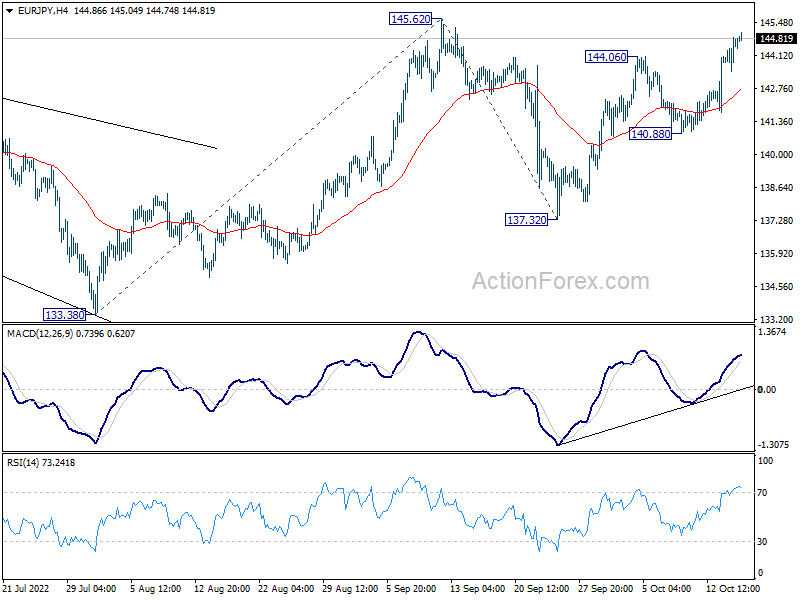
In the bigger picture, as long as 133.38 support holds, the up trend from 114.42 (2020 low) could still extend through 145.62 high. In that case, next target is 149.76 (2015 high). However, sustained break of 133.38 will be a sign of medium term bearish reversal and bring deeper fall to 124.37 support first.
EUR/GBP Daily Outlook
Daily Pivots: (S1) 0.8643; (P) 0.8679; (R1) 0.8735; More...
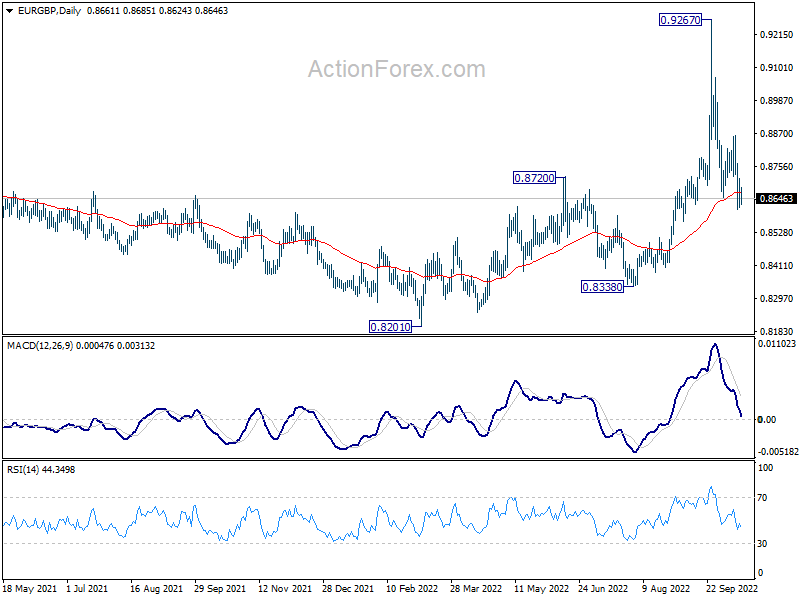
Intraday bias in EUR/GBP remains neutral for the moment , and further decline is expected with 0.8869 resistance intact. On the downside, break of 0.8607 will resume the fall from 0.9267, and target 61.8% projection of 0.9267 to 0.8647 from 0.8869 at 0.8486.
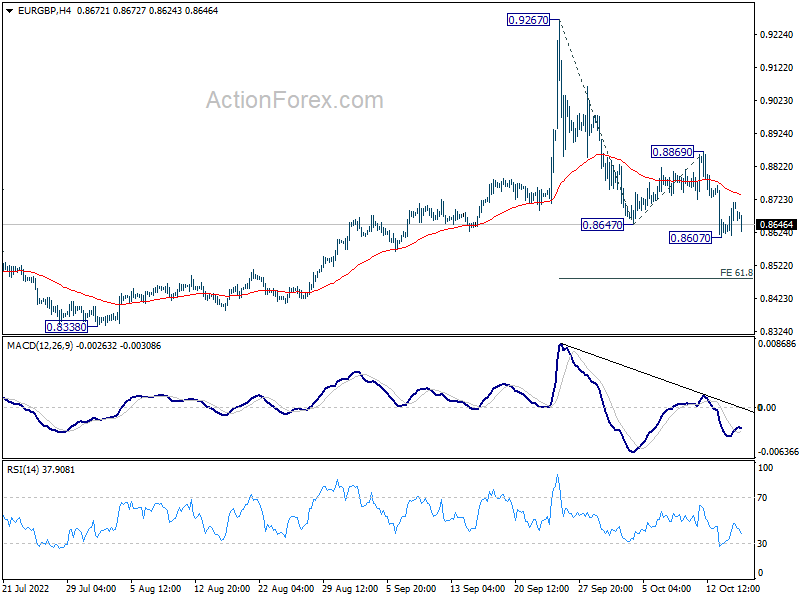
In the bigger picture, current development suggests that fall from 0.9267 is a down leg inside long term range pattern. Deeper fall could be seen towards 0.8201/8338 support zone. But strong support should be seen there to bring reversal.