Sample Category Title
Canada: Business Optimism and Inflation Expectations Soften
The Bank of Canada Business Outlook Survey (BOS) reported a continued drop in Canadian business optimism in the third quarter of 2022. The BOS indicator, a statistical summary of survey results, was 1.69 in 2022Q3, down from 4.87 in 2022Q2.
Businesses expect demand to weaken, with the statement noting that "firms’ sales outlooks have softened. Businesses with sales linked to housing activity and household consumption expect weaker sales growth due to rising interest rates."
On inflation, the statement highlighted that "businesses expect their price increases to moderate due to downward pressure on prices for commodities and other input goods. They also expect their wage increases to soften from high levels."
On labour and supply chain issues, the BOS stated that "pressures on businesses’ production capacity are still high. Firms’ main bottlenecks remain related to labour constraints and supply chain issues. However, survey results provide early signals that capacity pressures are becoming less severe."
Key Implications
In today's release we were looking for signs of slowing economic momentum and a shift in inflation expectations. Given the decline in future sales, we can see that businesses are seeing a fairly quick drop in overall demand. This is passing through to expectations for future inflation, which have declined across all time horizons.
The Bank of Canada should be encouraged by this report. Demand needs to slow in order for inflation to come back to its target range of 1% to 3%. It also needs to make sure that inflation expectations don't become unmoored. Clearly the Bank's past actions are having an impact. Though this justifies past rate hikes, we think the BoC needs to keep at it. For this reason, we expect the BoC to continue with a 50 basis point hike next week, pushing rates even more into economically restrictive territory.
Sunset Market Commentary
Markets
Jeremy Hunt to the rescue! The new UK Chancellor in an attempt to restore the UK’s credibility shelved the lion part of previous Chancellor Kwarteng’s mini-budget, while also lowering the bill to shield UK consumers and companies from expected surges in OFGEM’s regulated maximum gas & electricity prices. Around two-thirds of the £45bn mini Budget (all unfunded tax cuts) are eliminated with only a £13bn national insurance cut and a £1.5bn stamp duty cut surviving. Original plans to cap gas & electricity prices at £2100 between October and March next year and at £2500 until September 2024 are now replaced by an energy price guarantee which will only last until April next year and become more targeted afterwards. A new (long term) debt-cutting plan and OBR forecasts will be finalized on October 31, days before the next Bank of England policy meeting (November 3). UK yields drop by 35 bps to 45 bps in a bull flattening move. The Gilt rally occurs even as the Bank of England is no longer in the market as a stabilizing factor, suggesting that Hunt’s actions have an impact. The expected BoE policy rate peak, based on UK money markets, now stands at 5% in March, coming down from 5.5% last Friday. Sterling didn’t suffer as much as UK Gilts last week and ekes out only modest gains today with EUR/GBP changing hands near last week’s low of 0.8620 from an open near 0.87. Cable (GBP/USD) rises from 1.1184 to 1.1340, also testing last week’s highs.
Global core bonds follow UK Gilts higher. The German yield curve bull flattens with yields 5.1 bps (2-yr) to 13.5 bps (30-yr) lower. US yields drop 6.9 bps (30-yr) to 12.9 bps (5-yr) with the belly of the curve outperforming the wings. European stock markets avoided the drop in the opening following Wall Street’s weak performance on Friday. The latter was linked to a US Treasury sell-off following hawkish Fed comments (tilting towards 5% policy rate peak) and rising consumer inflation expectations in the University of Michigan survey. Main European indices gain up to 1.5% at the moment with momentum building during the session. It gives the single currency a slight advantage over the dollar with EUR/USD moving above 0.9750 in a technically insignificant move. The October US empire Manufacturing Survey was today’s only market release. The indicator fell more than expected, from -1.5 to -9.1 (vs -4.3 forecast). It’s the third straight month in contraction territory (<0). Details were mixed. New order stabilized, but shipments fell. The number of employees was also slightly weaker, but the average workweek lengthened. The forward looking component (6 months ahead) fell from 8.2 to -1.8 and paint a more bleak economic outlook compared to the actual situation.
News Headlines
Sweden’s Moderate Party leader Kristersson won a vote in parliament to become the next prime minister. He got the backing of the four (center-)right parties; his own Moderates, the Liberals, the Christian Democrats and Sweden Democrats. The latter is the biggest party to the right (and second biggest overall) but won’t be part of the government. Instead they have vowed support in exchange for having its policies on crime and migration implemented. One of Kristersson’s government first tasks will be to agree on spending plans for 2023 at a time of inflation biting in household spending and the central bank raising rates to tame it. EUR/SEK held just south of 11.
Polish core inflation in September accelerated into the double digits. At 10.7% y/y (1.4% m/m), the underlying price gauge is up from 9.9% the month before to be at the fastest pace since 1999. Headline inflation quickened 17.2%. It calls the pause in the National Bank of Poland’s tightening cycle into question. At the previous meeting in October, the central bank unexpectedly kept rates steady at 6.75%, citing slowing growth. Chair Glapinski didn’t formally call the end of the cycle though, saying the November projections would decide whether or not additional tightening is necessary. The zloty reacted stoic on the release. EUR/PLN did erase an earlier advance following an FT report on the EC potentially freezing regional aid to Poland. The pair is currently changing hands in the 4.806 area.
Crude Oil has Squandered All of Its Gains
The commodities market starts the new week in October with attempts to stabilise. The Brent barrel had previously "sagged", but is now returning to USD 92.40. It turns out that the entire positive effect of the OPEC+ decision to reduce black gold production quotas for November has now been exhausted.
This week, however, the focus of the commodities market will be on economic data from China. The main thing investors will be interested in is GDP figures for Q3, where a 3.5% y/y increase is expected, as well as figures for industrial production and retail sales. Forecasts look very weak due to the ongoing coronavirus restrictions.
Fresh data from Baker Hughes reflected an increase of 8 rigs in the US for the week up to 610. Oil production in the country stands at 12 million bpd, IEA expects to rise to 12.3 million bpd by end-December.
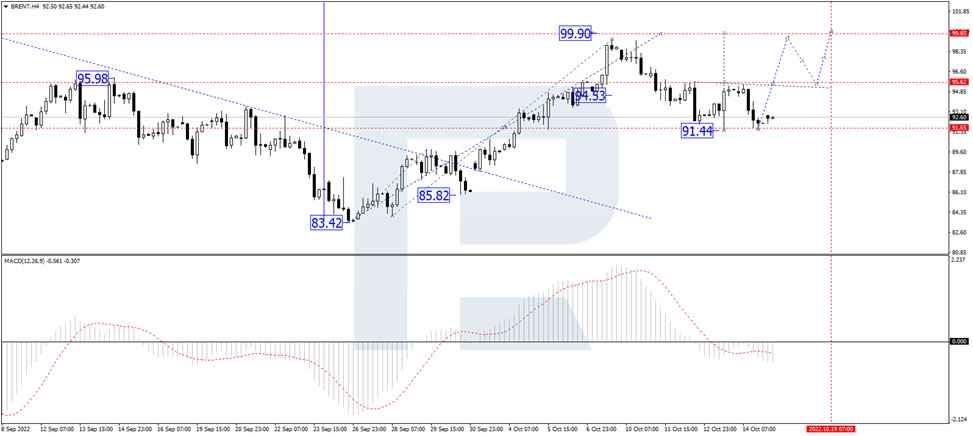
On the H4 Brent chart, an upside wave to 95.40 and a correction to 91.50 have been worked out. Today the market has started to form another upside wave to the level of 95.66. We expect its break up and continuation of the trend towards 99.55. The target is local. After it is reached, we will consider the probability of correction to the level of 95.66. Further - growth to 105,50. Technically, this scenario is confirmed by the MACD oscillator. Its signal line is above the zero mark and it is ready to continue growth to new highs.
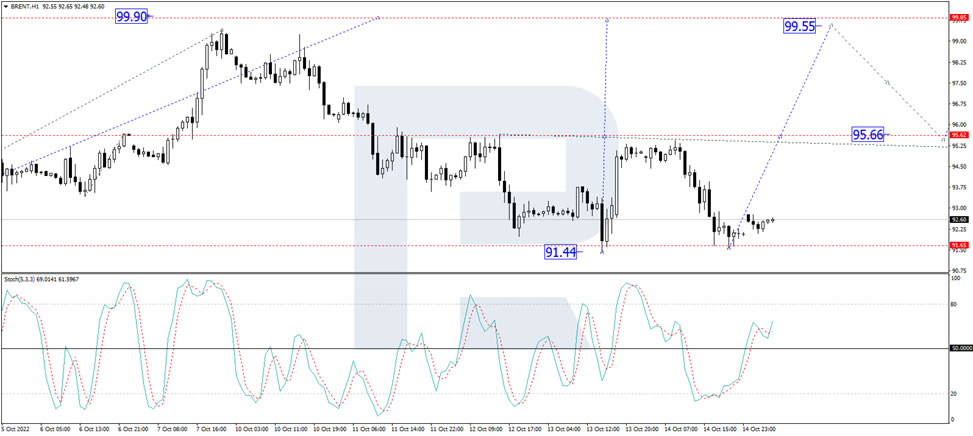
On the H1 Brent chart, the corrective wave channel has been broken upwards and quotations are trading in a rising structure towards the 95.66 level. The target in the next growth wave is the first one. After it is broken down, a correction link to 93.85 is not ruled out. Further - growth to the level of 97.00 with the prospect of trend continuation to 99.55. The target is local. Technically, this scenario is also confirmed by theStochastic oscillator. Its signal line is above the 50 mark. We expect the continuation of growth towards 80.
The Mother of All U-Turns
Another turbulent start to the week, albeit a positive one broadly speaking with equity markets around 1% higher in Europe after a decent start to the week in Asia.
Since Liz Truss became UK Prime Minister, uneventful days have eluded us and this week has also got off to another hectic start. While the Prime Minister had every intention of making waves in her first weeks in charge, she clearly didn't anticipate the storm that was brewing and I'm sure she more than anyone at this point would do just about anything for a more peaceful few weeks.
Assuming she lasts that long, of course. The u-turn this morning was even more historic than the initial mini-budget. A humiliating moment after a chaotic period for Truss in which confidence in her in the markets, the public and her own party, it seems, has been decimated.
That said, we are seeing some improvement from a market perspective. It just took reversing almost all of the unfunded tax cuts to achieve it. Who'd have thought? The job isn't done yet though, the new Chancellor has done what was necessary now but the harder decisions arguably come later this month in the budget.
How low can it go?
The yen is continuing to slide against the US dollar, hitting 148.89 this morning and trading beyond the level the country intervened at in 1998 and, of course, last month. We've had the usual plethora of commentary from various officials overnight; "high sense of urgency", "ready to act" etc.
It does seem only a matter of time until we get another powerful intervention in the FX markets, it's just a question of what they'll do differently this time as doing the same again every few weeks simply isn't sustainable. The question is whether the yen will surpass 150 against the dollar first.
Settling down?
It's been another turbulent few weeks in oil markets from global growth concerns to super-sized OPEC+ output cuts and it seems they're yet to fully settle down. Brent has seen lows of $82 and highs of $98 so perhaps what we're now seeing is it finding its feet somewhere in the middle. Whether that will satisfy the oil alliance only time will tell but there will be some relief that it's not back in triple figures already, even if that is a result of the ever-worsening economic outlook.
An encouraging rebound
Gold is seeing an encouraging rebound after another pretty terrible week. It's trading more than 1% higher on Monday after slumping more than 3% last week. Lower global yields and a slightly softer dollar are probably behind the move, with traders no doubt hoping that peak inflation and rate pricing are nearly in sight. The recent economic data hasn't offered cause for much optimism but that could change over the coming months, with central banks now surely not far from their terminal rates. That could favour gold, especially as the economy falters. Resistance ahead could be found around $1,680 and $1,700, although some traders may be encouraged by the failure to breach September's lows.
A positive start to the week
Bitcoin's relationship with risk assets hasn't been perfect recently but the last week has seen it look far more aligned. The US inflation disappointment almost sent it into a tailspin but then the wild turnaround happened and it quickly bounced back and powerfully. It came within a whisker of $20,000 once more before pulling back and now it's trading on the front foot again with its sight set on that level. The gains today mirror those in equity markets, with risk assets more broadly getting the week off to a good start.
AUDUSD Stays in Downtrend, But Struggles to Go for a Lower Low
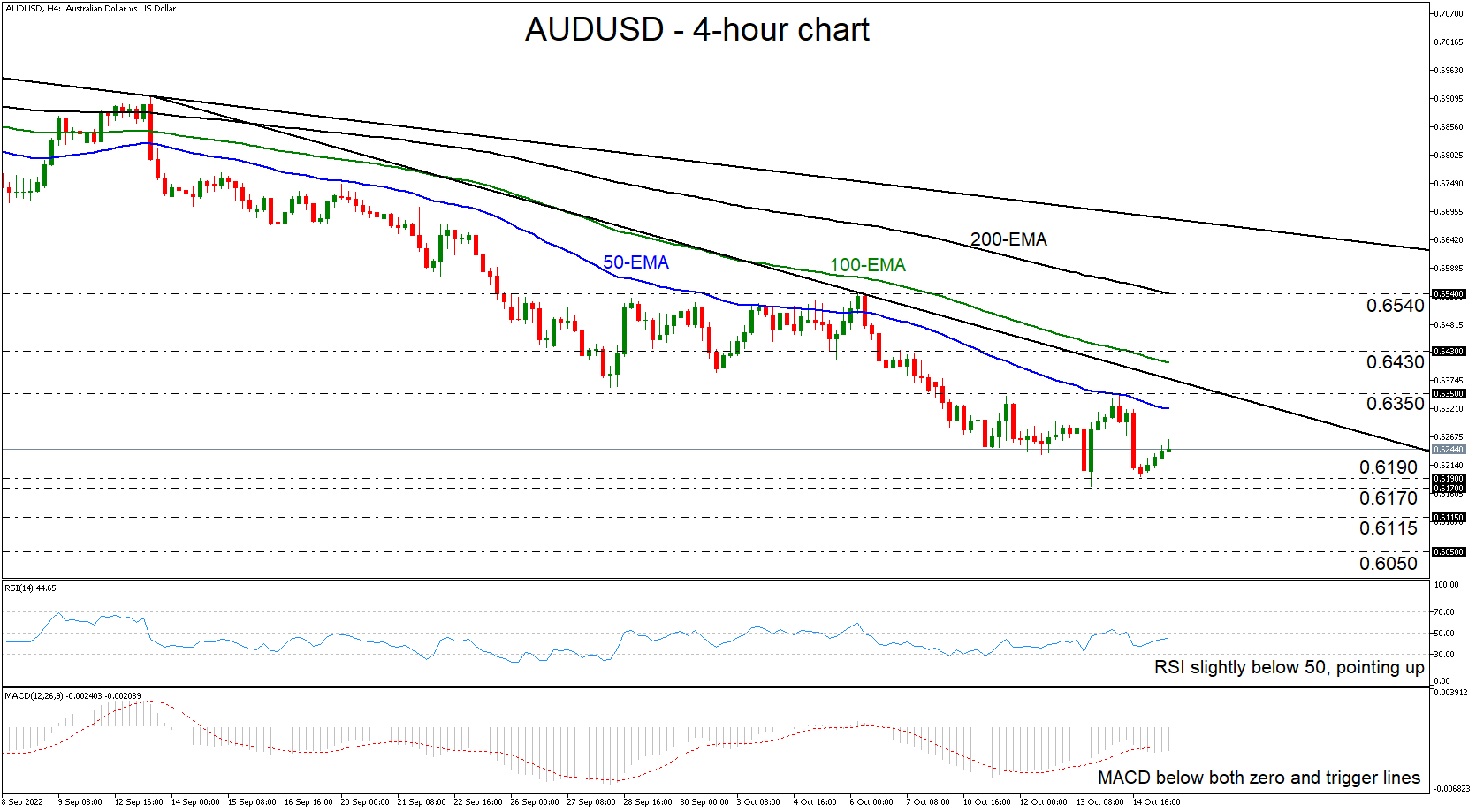
AUDUSD traded higher late on Friday and today after it found support at 0.6190, slightly above the two and a half year low of 0.617 hit on Thursday. Overall, the pair continues to trade below the downtrend line drawn from the high of September 13, as well as below a longer-term downside line, taken from the high of August 11. This keeps the broader outlook negative, but a break below 0.6170 may be needed to signal a continuation of the prevailing downtrend.
Both the short-term oscillators are detecting diminishing downside speed and suggest that some further recovery may be on the cards before the bears decide to shoot again. The RSI, although below 50, has ascended closer to that equilibrium line and it is still pointing up, while the MACD lies below both its zero and trigger lines, but is showing signs of turning north as well.
The bears could recharge from near the 0.6350 zone or the short-term downside line, and aim for another test near the 0.6170/90 area, but a break lower may be needed to justify a downtrend extension. Such a break would confirm a lower low and may pave the way towards the 0.6115 level, the break of which could stretch the slide towards the 0.6050 zone.
On the upside, a move above 0.6350 may confirm the break above the short-term downtrend line, but the pair would still be below the longer-term line. Thus, any further advances could still be seen as a larger correction within a broader downtrend. The bears may allow the bulls to climb towards the 0.64030 barrier, and if they are not willing to reenter the action from around there, then the recovery may extend towards the 0.6540 area, which acted as a ceiling between September 26 and October 6.
To sum up, AUDUSD continues to trade in a downtrend, but it’s been struggling to move below the 0.6170 zone, the break of which would confirm a lower low and thereby the continuation of the prevailing trend.
EUR/USD Mid-Day Outlook
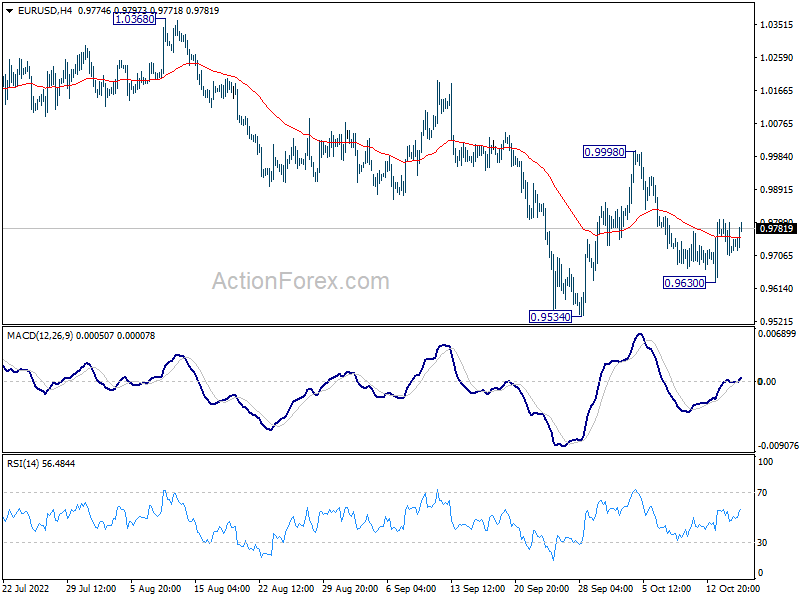
Daily Pivots: (S1) 0.9688; (P) 0.9748; (R1) 0.9789; More...
Intraday bias in EUR/USD stays neutral as range trading continues. Deeper decline is expected with 0.9998 resistance intact. Below 0.9630 will bring retest of 0.9534 low first. Firm break there will resume larger down trend. However, break of 0.9998 will confirm short term bottoming and turn bias back the upside for stronger rebound.
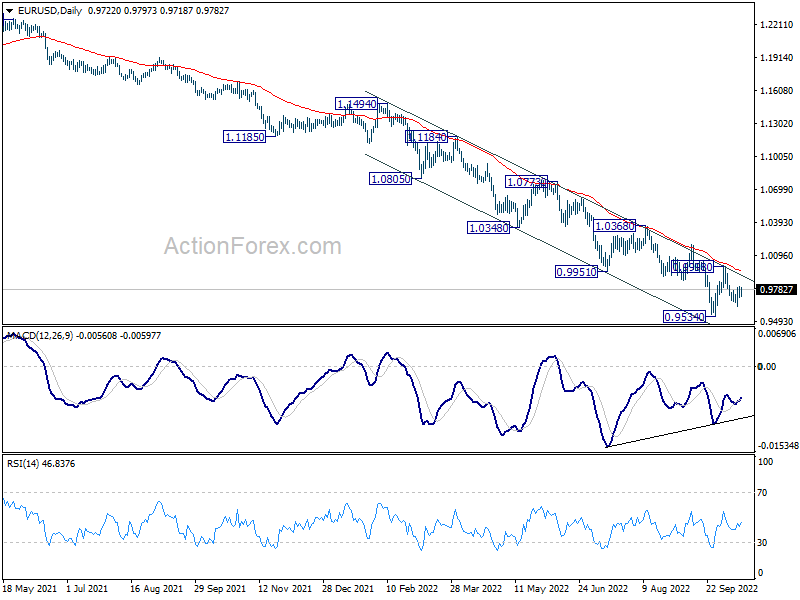
In the bigger picture, down trend from 1.6039 (2008 high) is still in progress. Next target is 100% projection of 1.3993 to 1.0339 from 1.2348 at 0.8694. In any case, break of 0.9998 resistance is needed to be the first sign of medium term bottoming. Otherwise, outlook will stay bearish even with strong rebound.
GBP/USD Mid-Day Outlook
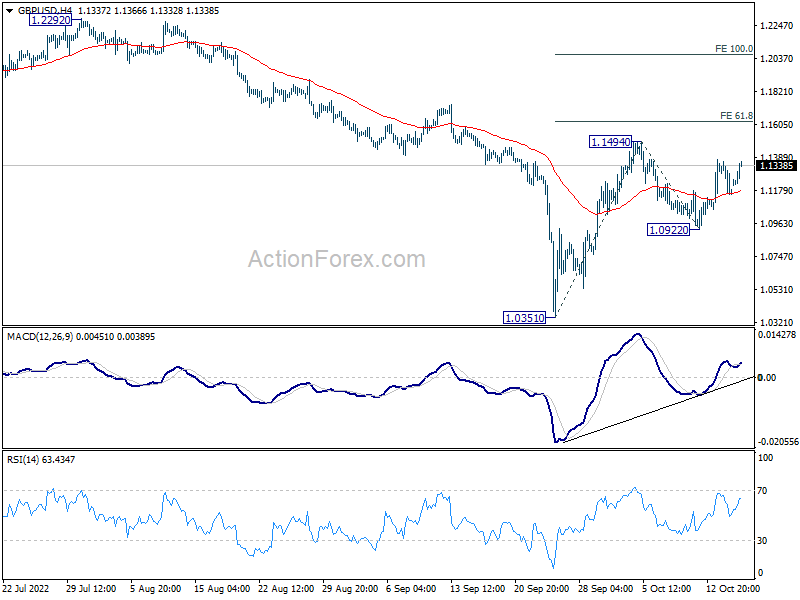
Daily Pivots: (S1) 1.1100; (P) 1.1233; (R1) 1.1314; More...
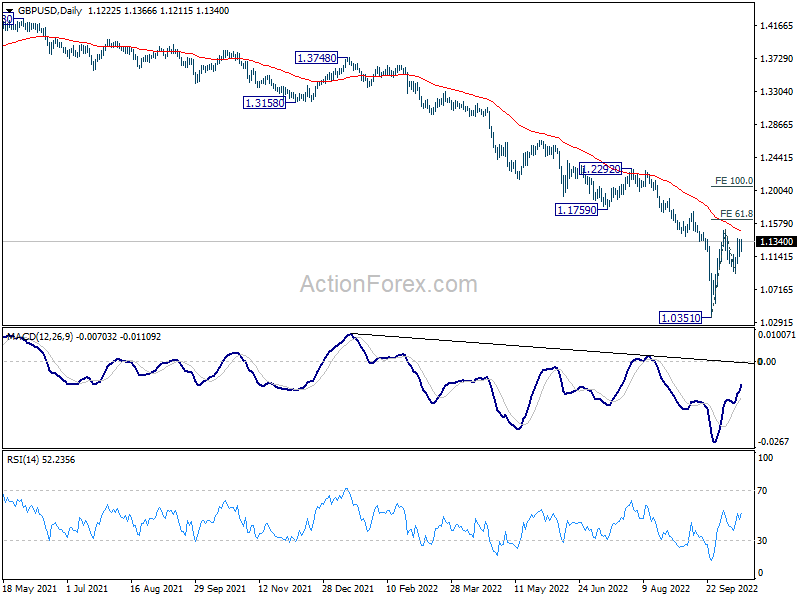
Intraday bias in GBP/USD stays neutral and outlook is unchanged. On the upside, break of 1.1494 will resume the rise from 1.0351 to 61.8% projection of 1.0351 to 1.1494 from 1.0922 at 1.1628. On the downside, below 1.0922 will turn bias back to the downside for 1.0351 low instead.
In the bigger picture, fall from 1.4248 (2018 high) is resuming long term down trend from 2.1161 (2007 high). Next target is 100% projection of 2.1161 to 1.3503 from 1.7190 at 0.9532. There is no scope of a medium term rebound as long as 1.1759 support turned resistance holds.
USD/CHF Mid-Day Outlook
Daily Pivots: (S1) 0.9993; (P) 1.0029; (R1) 1.0094; More...
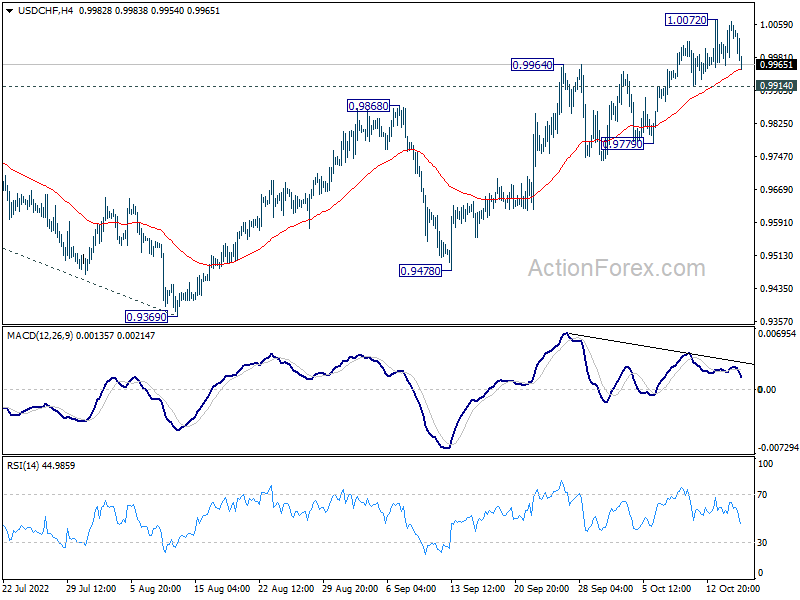
Intraday bias in USD/CHF stays neutral at this point. On the upside, break of 1.0072, and sustained trading above 1.0063, will confirm larger up trend resumption. Next target is 1.0283 projection level. However, break of 0.9914 support will indicate rejection by 1.0063, and turn bias back to the downside for 0.9779 support first.
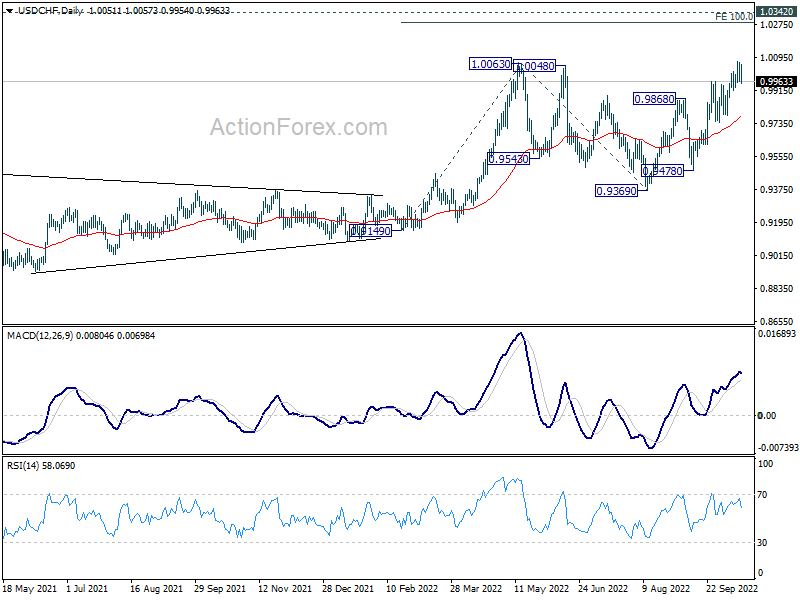
In the bigger picture, current development suggests that up trend from 0.8756 (2021 low) is still in progress. Sustained break of 1.0063 will target 100% projection of 0.9149 to 1.0063 from 0.9369 at 1.0283, and then 1.0342 (2016 high). For now, this will remain the favored case as long as 0.9369 support holds, even in case of deep pull back.
USD/JPY Mid-Day Outlook
Daily Pivots: (S1) 147.59; (P) 148.23; (R1) 149.39; More...
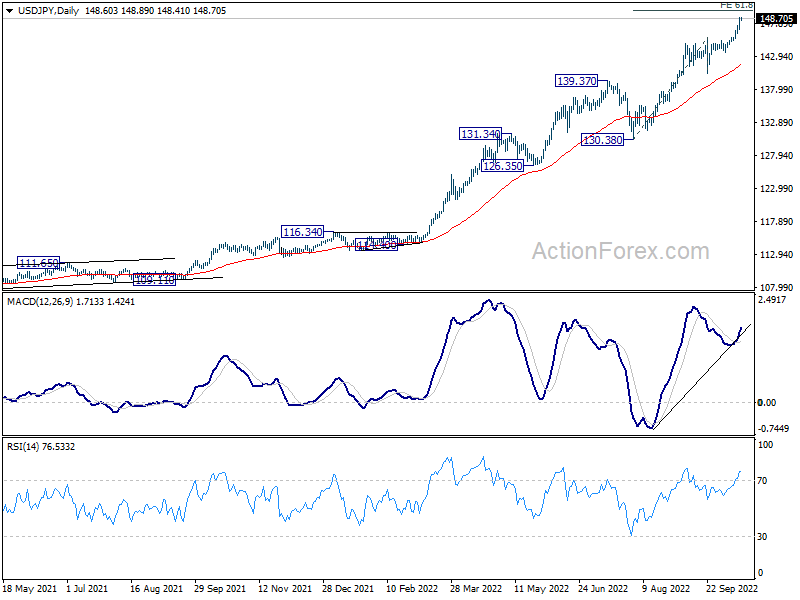
Intraday bias in USD/JPY remains on the upside and outlook is unchanged. Current up trend would target 61.8% projection of 130.38 to 140.33 from 145.89 at 149.91. Beware that Japan might intervene again there close to 150 psychological level. Nevertheless, break of 145.89 resistance turned support is needed to confirm short term topping. Otherwise, outlook will remain bullish in case of retreat.
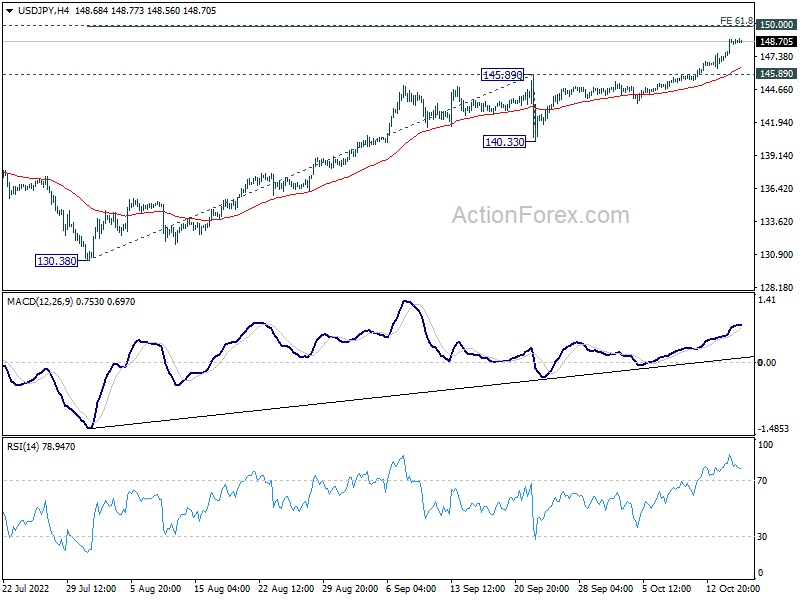
In the bigger picture, up trend from 101.18 is still in progress, as part of the whole up trend from 75.56 (2011 low). 147.68 (1998 high) was already met and there is not clearly sign of topping yet. In any case, break of 139.37 resistance turned support is needed to be the first sign of medium term topping. Otherwise, further rise is in favor to next target at 160.16 (1990 high).
EUR/JPY Mid-Day Outlook
Daily Pivots: (S1) 143.80; (P) 144.33; (R1) 145.17; More....
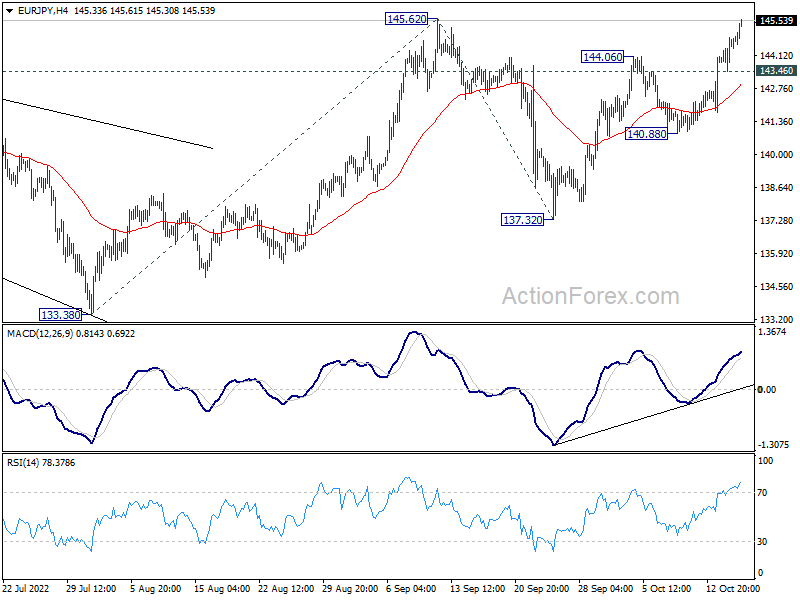
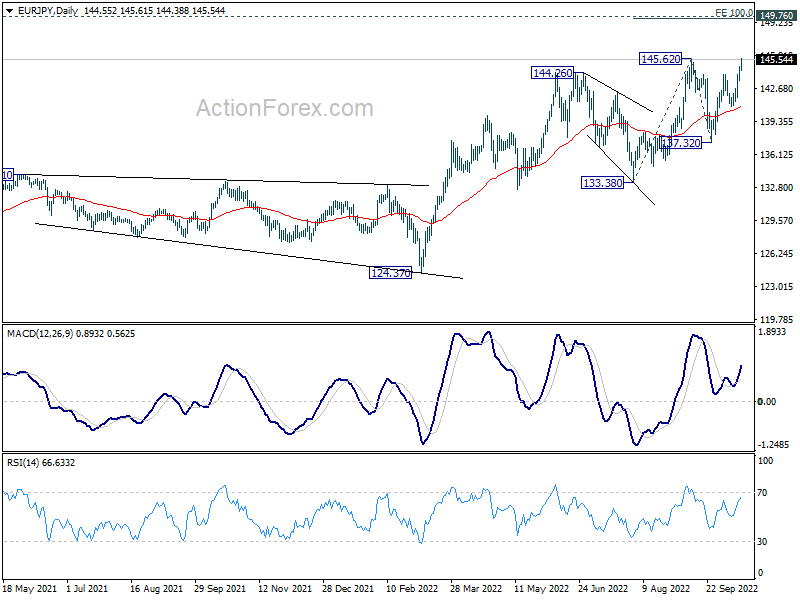
Intraday bias in EUR/JPY remains on the upside at this point. Decisive break of 145.62 resistance will will confirm up trend resumption. Next target is 100% projection of 133.38 to 145.62 from 137.32 at 149.56, which is close to 149.76 long term resistance. On the downside, below 143.46 minor support will turn intraday bias neutral first.
EUR/JPY Mid-Day Outlook
In the bigger picture, as long as 133.38 support holds, the up trend from 114.42 (2020 low) could still extend through 145.62 high. In that case, next target is 149.76 (2015 high). However, sustained break of 133.38 will be a sign of medium term bearish reversal and bring deeper fall to 124.37 support first.