Sample Category Title
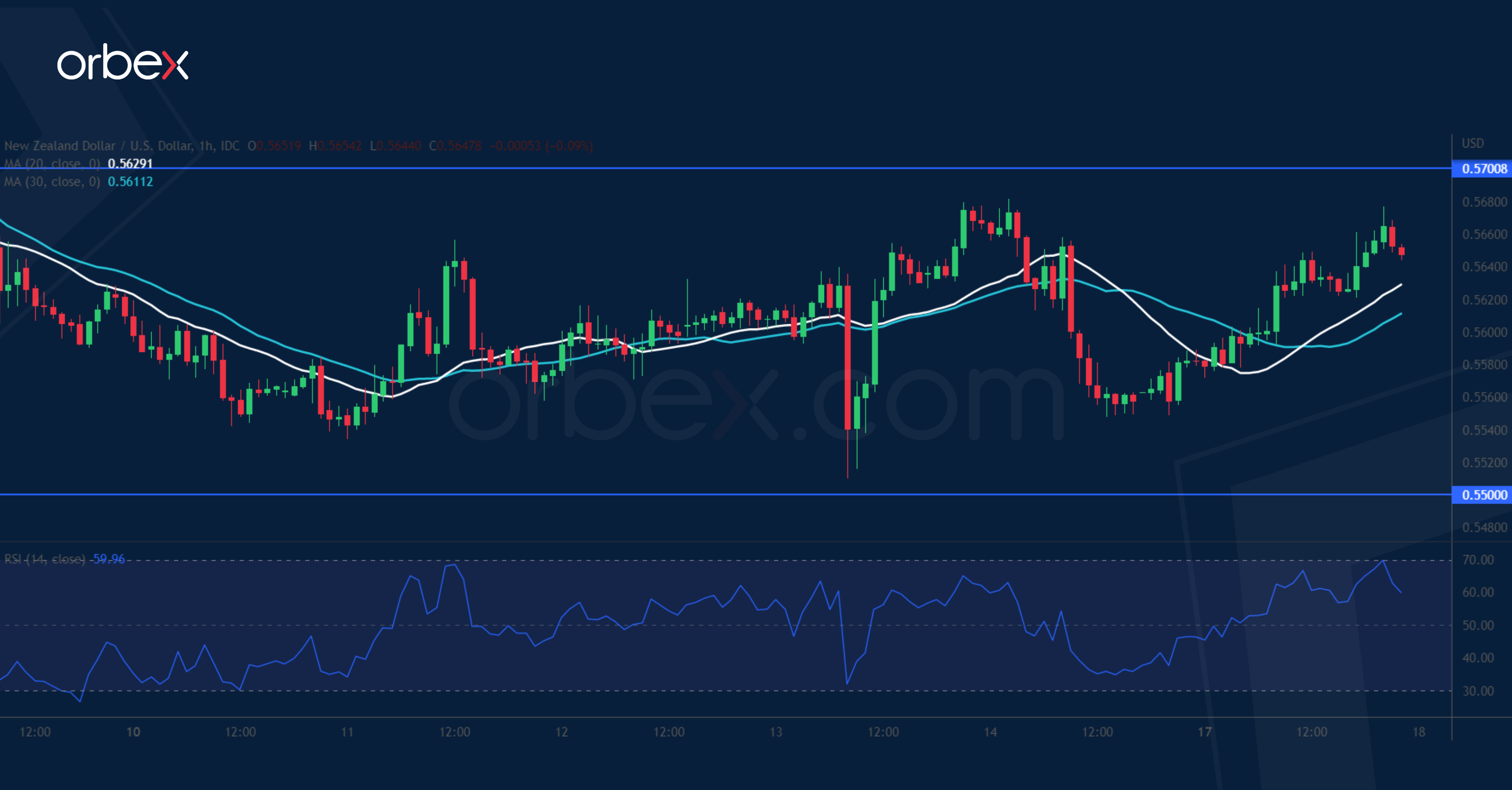
NZD/USD Finds Some Respite
The New Zealand dollar claws back losses on upbeat Q3 CPI. The pair is hovering above March 2020’s low at 0.5500 which has triggered a ‘buying-the-dips’ behaviour. The support-turned-resistance 0.5700 from a previous rebound is the first hurdle. The daily resistance at 0.5810 coincides with the 30-day moving average, making it an area of interest where stiff selling pressure from trend followers could be expected. A break below the critical floor at 0.5500 would signal a bearish continuation towards 0.53s.
AUD/USD Attempts to Recover
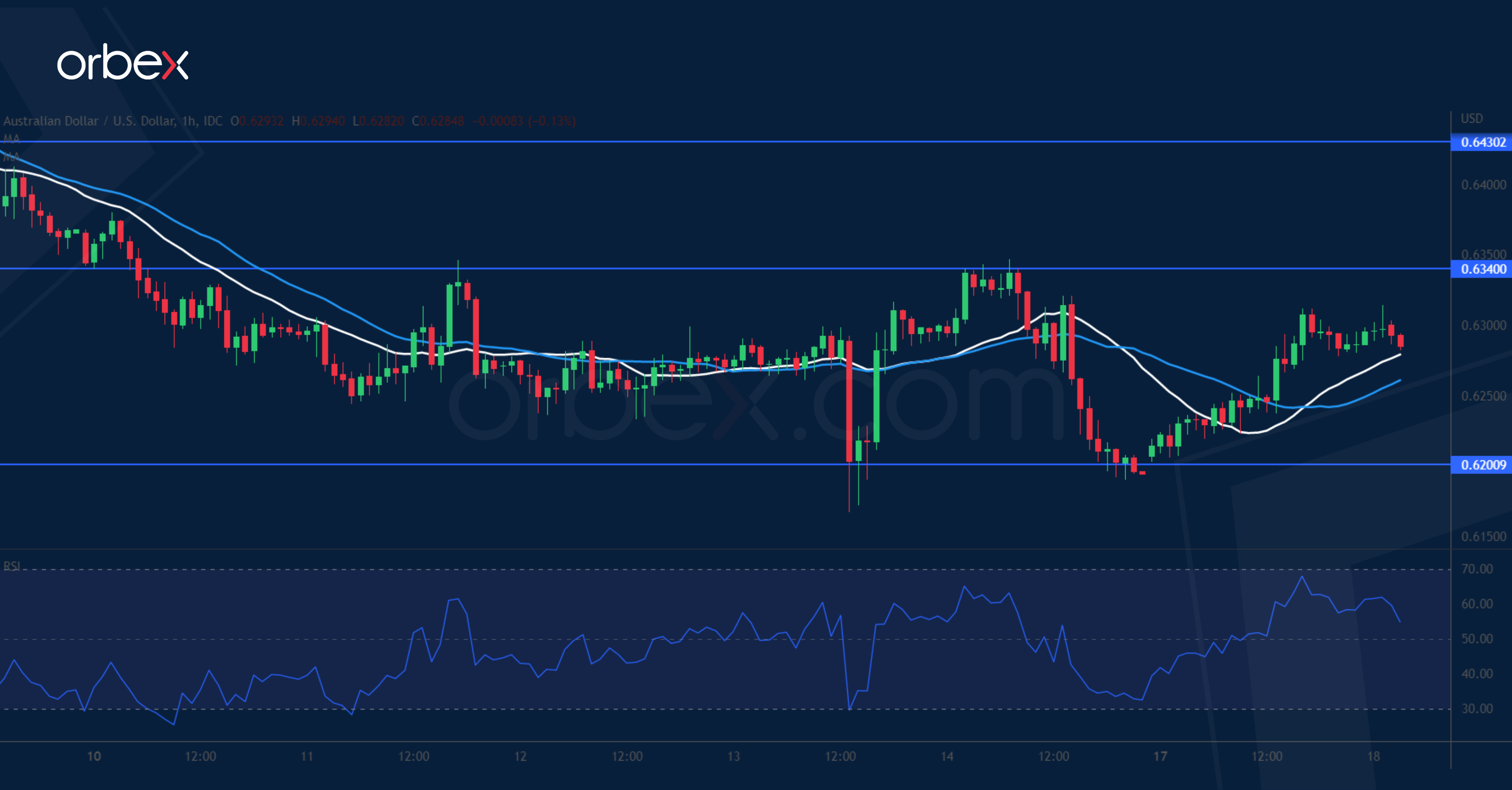
The Australian dollar finds support as the RBA minutes suggest more rate hikes to come. An oversold RSI on the daily chart shows exhaustion in the sell-off. A tentative break above 0.6340 has prompted some sellers to cover their positions, easing pressure on the aussie. Though the bears may be eager to fade rebounds. Short-term sentiment would remain downbeat unless the bulls manage to lift 0.6430 on the 20-day moving average. A fall below 0.6200 would extend the downtrend towards the psychological level of 0.6000.
Flashing Green
Asian stocks were flashing green on the second day of trading, while Europe is poised to open in a similarly positive manner as sentiment continues to improve, albeit from very low levels.
There's still a strong feeling of a bear market rally about trading over the course of the last week. From the post-US-inflation rebound to what has now been a strong start to the week - in part driven by the UK's decision to no longer shoot itself in the foot - nothing about this screams sustainable.
Of course, the last couple of months have been tough for equity markets since peaking towards the end of the summer and a rebound of some kind was going to happen eventually. I'm just not convinced there's much substance behind it as the economic landscape looks treacherous and we don't even know if we're at peak inflation and interest rate pricing yet. Those are substantial headwinds that will make any stock market rebound extremely challenging.
RBA concerned about the outlook as it slows the pace of tightening
The RBA minutes, along with comments from Deputy Governor Michele Bullock alluded to the outlook as contributing to the decision to slow the pace of tightening at the last meeting to 25 basis points. While the central bank will continue to hike rates in order to fight inflation - highlighting the broad-based pick-up in prices and higher wages - it's clearly uneasy about the economic consequences and the lags in policy after hiking rates 2% over the course of four months since the summer. The Aussie dollar has not performed well in that time, falling around 15% from its June highs against the greenback, although it has rallied a little overnight.
When will Japan intervene again?
The yen remains under pressure despite desperate attempts by Japan to influence the currency markets through direct and verbal intervention. Last month's intervention was substantial but short-lived and the commentary before and after has fallen on deaf ears. Overnight there was more of the same - "a high sense of urgency", "will take appropriate action decisively" - and even a refusal to comment on whether the Ministry of Finance is conducting "stealth FX intervention". If it is, it isn't working particularly well, with the yen now very close to 150 against the dollar, a level that may make traders a little nervous. Another big intervention may soon be on the cards, although Japanese officials may be uneasy about the limited effectiveness of the last. What more can and will they do?
OPEC+ defends cut as oil steadies around $90
Oil prices are continuing to stabilse around $90 a barrel as OPEC+ steps up its defence of its two million barrel per day cut amid a backlash from the US, in particular. Meanwhile, the world's largest economy is reportedly considering another release of strategic reserves in order to offset the impact of the cuts and stop fuel prices jumping as midterms near.
How effective the SPR release will be may well depend on whether others join as we saw earlier this year. Of course, at the time oil was trading at much higher levels, well above $100 a barrel, and the willingness to engage in joint action may well depend on whether countries perceive there to be a risk of similarly damaging prices when they're already contending with a weaker economy, even recessions.
Gold rebound struggling
Gold has benefited from slightly lower yields and a weaker dollar over the last couple of days, both of which could resume their uptrend if rate fears persist. The yellow metal struggled to hold onto gains at the start of the week, perhaps a sign of the headwinds continuing to face it in this environment. Resistance remains above around $1,680 and $1,700, with support now around $1,640 and $1,620.
The environment remains challenging
Bitcoin has its sight set on $20,000 once more as it continues to bounce back from last weeks plunge. The sell-off occurred around the release of the US CPI data which could have sent it spiralling lower but risk appetite more broadly quickly bounced back and so did bitcoin. Whether it can continue to do so unless sentiment improves more sustainably is another thing. It continues to show resilience around $18,000 - $20,000 where it's traded for most of the last couple of months but that may not be enough if risk-appetite worsens again.
US Dollar May Take a Breather
Markets
The UK’s new finance minister Hunt teared his predecessor’s mini budget to pieces and that set the tone on global markets yesterday. Nothing survived other than the reversal of the National Insurance increase and the cut to stamp duties. Hunt went even further and limited the extraordinary costly government price guarantee on energy from two years to six months (ending in April next year). Core bonds cheered and Gilts obviously took the lead. UK yields tumbled between 32.7 bps (2y) to 40.6 bps (30y). Such big moves affected peers. The German yield curve flattened too. Rates at the short end recouped opening losses with relative ease (closing flat) but long maturities dropped more than 10 bps. Yields in the US finished lower with the curve turning less inverse. Disappointing NY manufacturing sentiment helped push the front-end 5.2 bps lower. Equity sentiment was bullish. The EuroStoxx50 rebounded 1.8%. Wall Street won back Friday’s losses, surging between 1.9 and 3.4%. A weaker USD made the mirror image with Friday complete. The greenback lost against major peers but the yen (USD/JPY above 149). GBP/USD outperformed, rising from 1.118 to 1.136. EUR/USD rose above 0.98(4). The trade-weighted dollar just made it above 112.
New Zealand inflation eased way less than hoped-for (see headline below). It’s grabbing most of the headlines since the planned Chinese Q3 GDP release has been postponed amid the country having its 20th Chinese Communist party conference. The kiwi dollar surges against a constructive equity backdrop and a weakening US dollar overall. Core bonds build on yesterday’s gains, confirming our view of some short-term consolidation this week. The Financial Times reported this morning that the Bank of England is likely to delay the sale of government bonds from its balance sheet further until the market becomes calmer without ditching the £80 annual target. It had already moved the starting date once, from October 6 to the end of the month in the midst of the Gilt carnage. Such a decision could help sustain the process of core bonds finding a bottom. On currency markets we hold our view that the US dollar may take a breather. First resistance in EUR/USD pops up at around 0.995. The trade-weighted DXY has some (albeit limited) scope left until it hits support from the upward sloping trendline. Sterling in the meantime completely reversed all losses (and more) following the mini budget. Some further gains are possible short term with Hunt having removed the sting but we remain fundamentally cautious on GBP. Political uncertainty lingers (can Truss hold on to power?!) while the risk of a biting recession increased with the lavish fiscal support plans thrown in the garbage.
News Headlines
Inflation in New-Zealand in Q3 stayed much higher than expected. The Q/Q pace of price rises even accelerated to 2.2% from 1.7% Q/Q in Q2, only reducing Y/Y pace of price rises to 7.2% from 7.3% in Q3. An easing to 6.5% Y/Y was expected. Tradeable goods CPI accelerated from 1.9% Q/Q to 2.2% Q/Q. Non-tradeable inflation printed at 2.0% Q/Q up from 1.4%. Growing signs that inflation in New-Zealand is spreading across ever more parts of the economy is putting pressure on the Reserve Bank of New Zealand to decisively continue its hiking cycle. The 2-y government bond yield jumped 7.6 bps and at 4.49% closed at a new cycle top. Markets now see a growing chance of the RBNZ raising the policy rate by 75 bps at the November meeting with potentially two additional 50b bps hikes at the first two meetings of next year. The kiwi dollar tries to regain the NZD/USD 0.57 big figure to be compared with levels near 0.556 at the start of trading yesterday morning.
According to Bloomberg, signs of deteriorating liquidity in the US Treasury market are fueling the debate on a Treasury buyback program to help stabilizing the market. In the quarterly survey of primary dealers preparing the financing plan to be announced early November, the dealers were asked the assess the pros and contras of such a program. Earlier last week, US Treasury Secretary Yellen in a speech also addressed the topic of liquidity in the Treasury market.
EUR/USD Daily Outlook
Daily Pivots: (S1) 0.9759; (P) 0.9805; (R1) 0.9891; More...
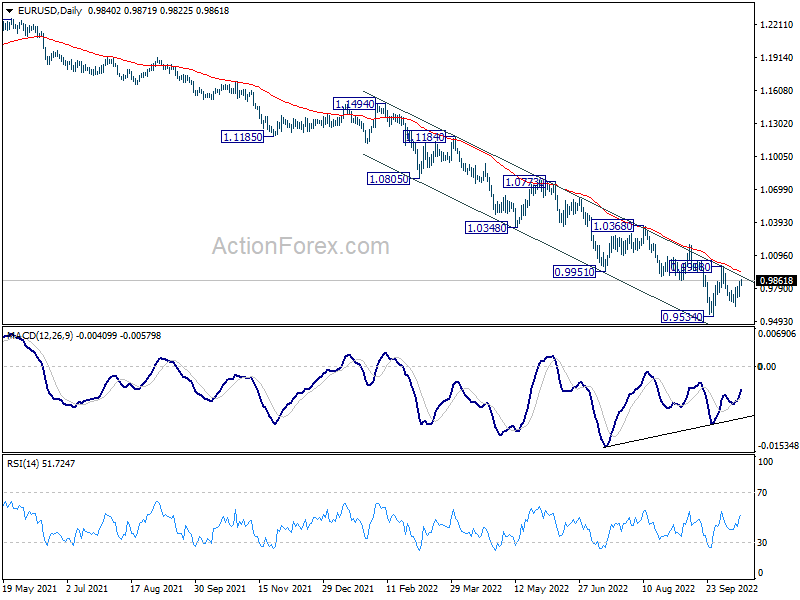
Range trading continues in EUR/USD and intraday bias remains neutral. Deeper decline is expected with 0.9998 resistance intact. Below 0.9630 will bring retest of 0.9534 low first. Firm break there will resume larger down trend. However, break of 0.9998 will confirm short term bottoming and turn bias back the upside for stronger rebound.
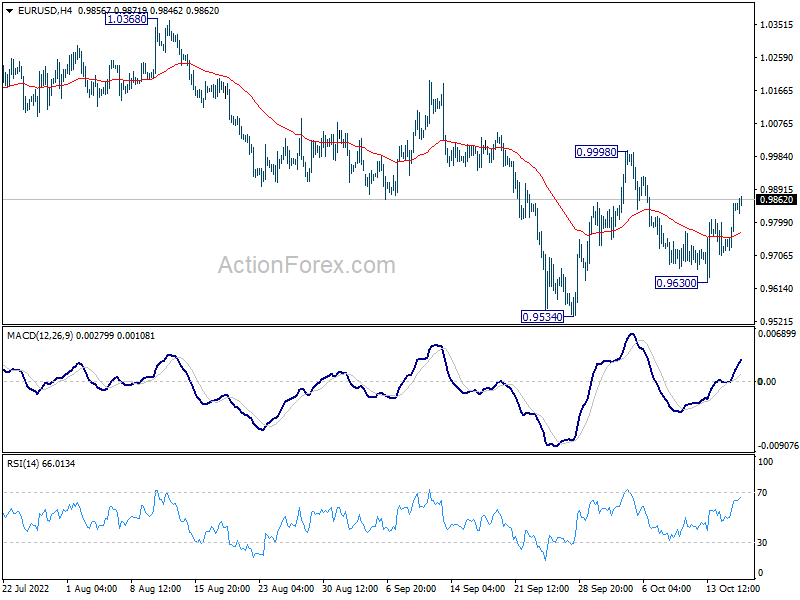
In the bigger picture, down trend from 1.6039 (2008 high) is still in progress. Next target is 100% projection of 1.3993 to 1.0339 from 1.2348 at 0.8694. In any case, break of 0.9998 resistance is needed to be the first sign of medium term bottoming. Otherwise, outlook will stay bearish even with strong rebound.
GBP/USD Daily Outlook
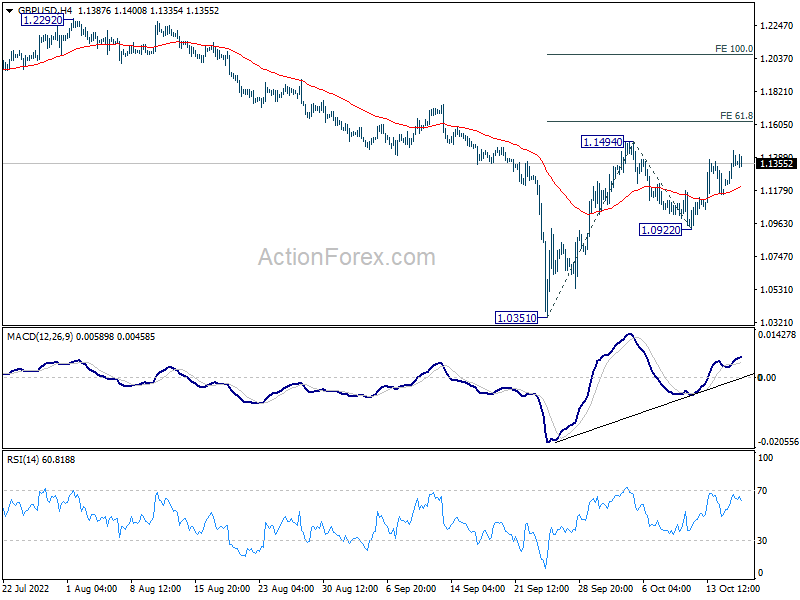
Daily Pivots: (S1) 1.1237; (P) 1.1338; (R1) 1.1463; More...
Intraday bias in GBP/USD remains neutral for the moment. On the upside, break of 1.1494 will resume the rise from 1.0351 to 61.8% projection of 1.0351 to 1.1494 from 1.0922 at 1.1628. On the downside, below 1.0922 will turn bias back to the downside for 1.0351 low instead.
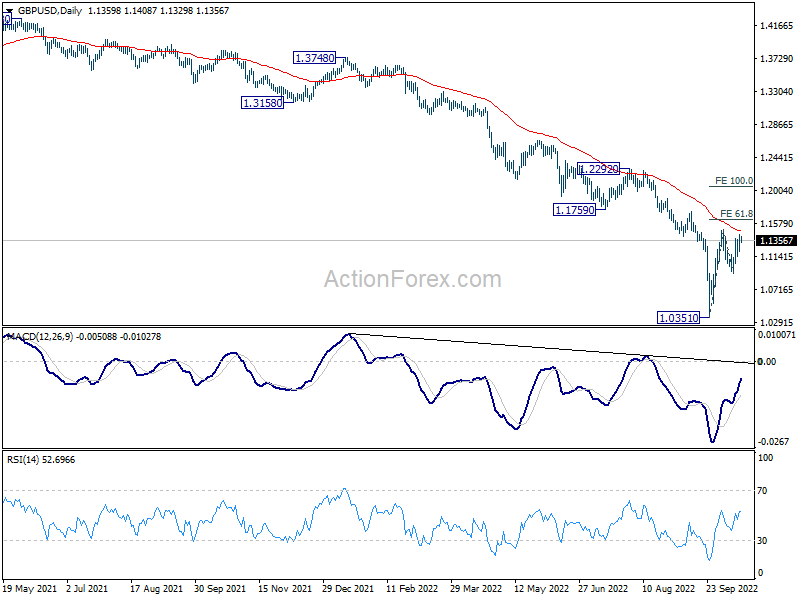
In the bigger picture, fall from 1.4248 (2018 high) is resuming long term down trend from 2.1161 (2007 high). Next target is 100% projection of 2.1161 to 1.3503 from 1.7190 at 0.9532. There is no scope of a medium term rebound as long as 1.1759 support turned resistance holds.
USD/CHF Daily Outlook
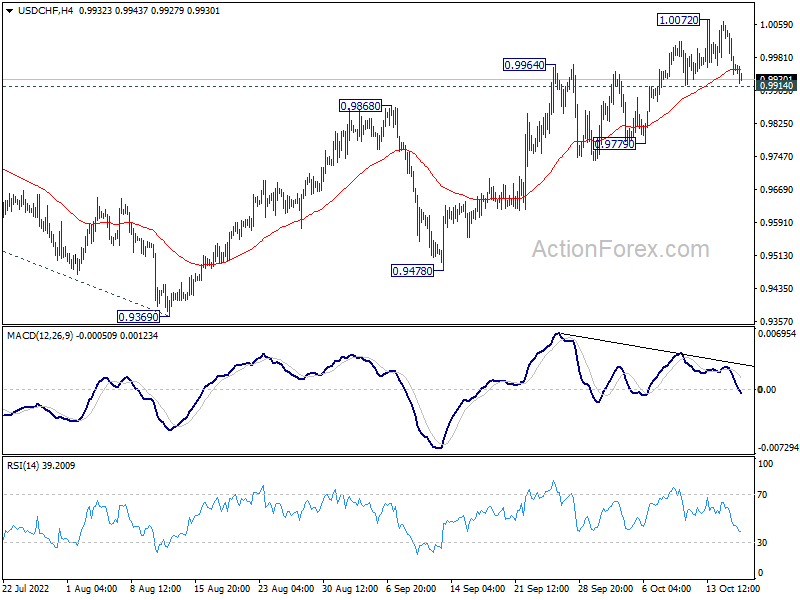
Daily Pivots: (S1) 0.9915; (P) 0.9986; (R1) 1.0027; More...
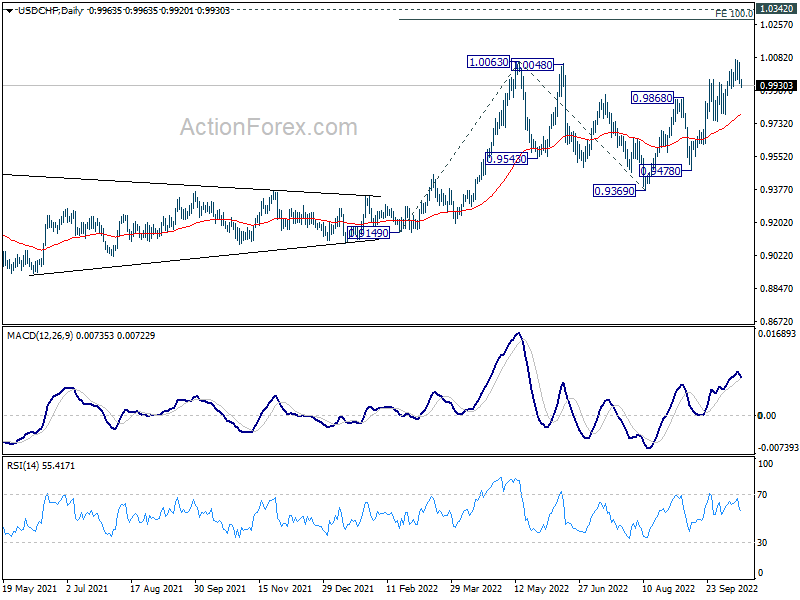
Intraday bias in USD/CHF remains neutral for the moment. On the upside, break of 1.0072, and sustained trading above 1.0063, will confirm larger up trend resumption. Next target is 1.0283 projection level. However, break of 0.9914 support will indicate rejection by 1.0063, and turn bias back to the downside for 0.9779 support first.
In the bigger picture, current development suggests that up trend from 0.8756 (2021 low) is still in progress. Sustained break of 1.0063 will target 100% projection of 0.9149 to 1.0063 from 0.9369 at 1.0283, and then 1.0342 (2016 high). For now, this will remain the favored case as long as 0.9369 support holds, even in case of deep pull back.
USD/JPY Daily Outlook
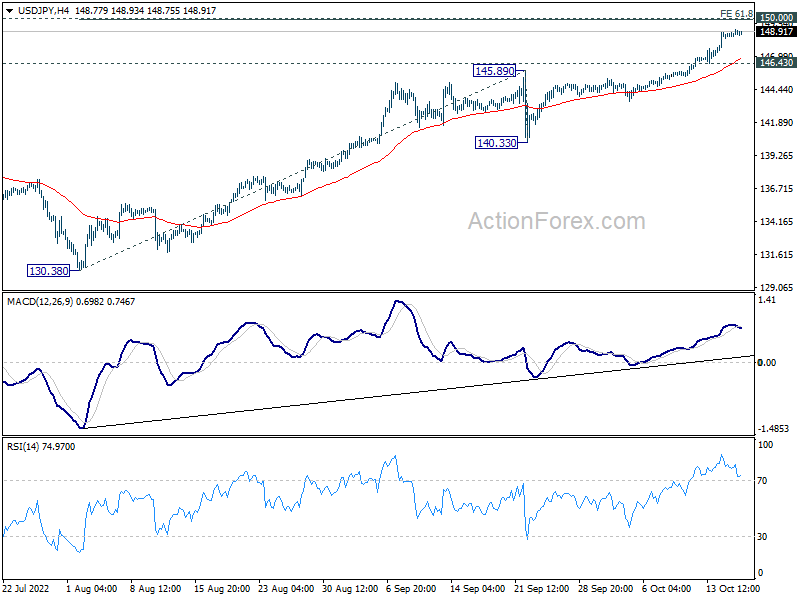
Daily Pivots: (S1) 148.61; (P) 148.85; (R1) 149.27; More...
USD/JPY is losing some upside momentum as seen in 4 hour MACD, but further rise is in favor to 61.8% projection of 130.38 to 140.33 from 145.89 at 149.91. Beware that Japan might intervene again close to 150 psychological level. On the downside, break of 146.43 minor support will indicate short term topping and bring deeper pull back.
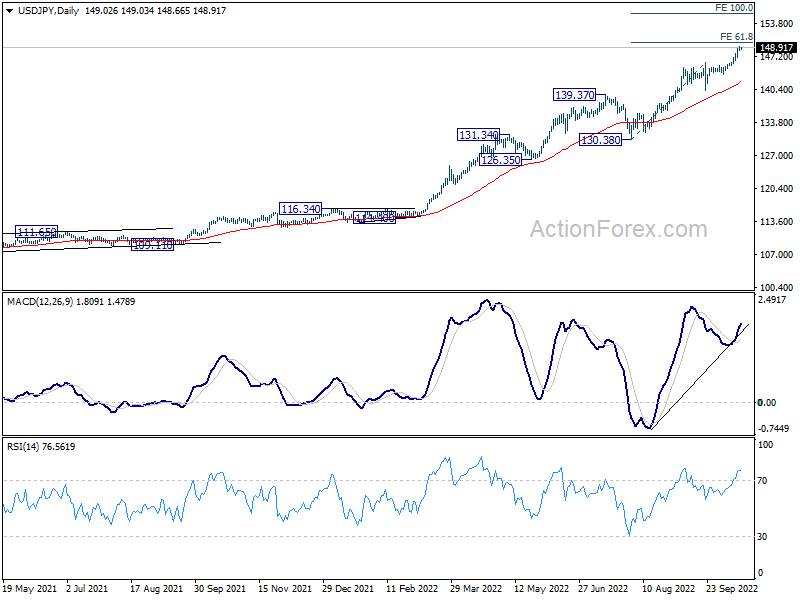
In the bigger picture, up trend from 101.18 is still in progress, as part of the whole up trend from 75.56 (2011 low). 147.68 (1998 high) was already met and there is not clearly sign of topping yet. In any case, break of 139.37 resistance turned support is needed to be the first sign of medium term topping. Otherwise, further rise is in favor to next target at 160.16 (1990 high).
AUD/USD Daily Report
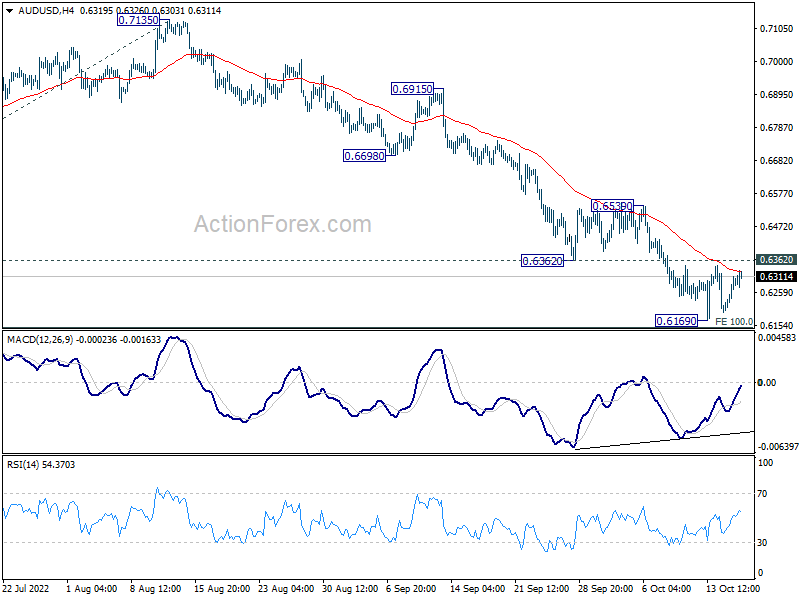
Daily Pivots: (S1) 0.6227; (P) 0.6270; (R1) 0.6335; More...
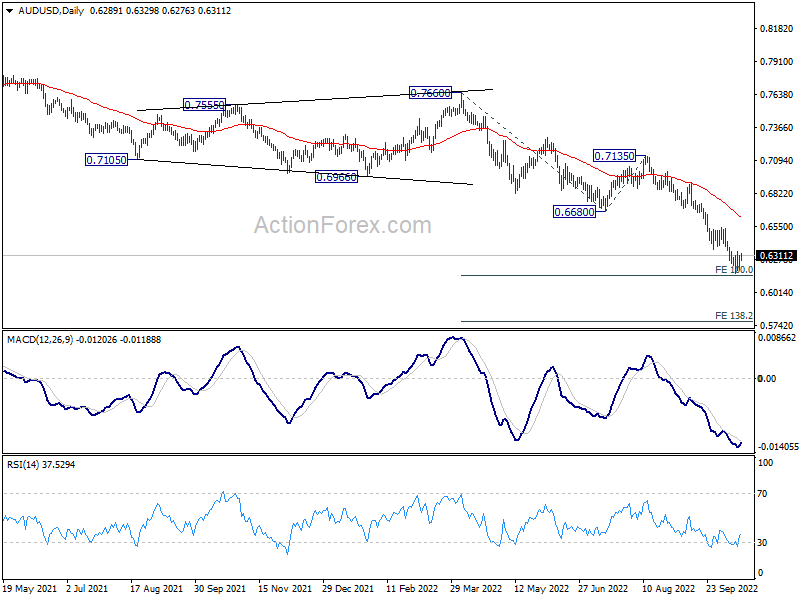
AUD/USD is staying in consolidation from 0.6169 and intraday bias remains neutral. Further decline is expected as long as 0.6362 support turned resistance holds. Firm break of 100% projection of 0.7660 to 0.6680 from 0.7135 at 0.6155 will target 138.2% projection at 0.5781. Nevertheless, break of 0.6362 will indicate short term bottoming, on bullish convergence condition in 4 hour MACD, and bring stronger rebound back to 0.6539 resistance.
In the bigger picture, down trend form 0.8006 (2021 high) is expected to continue as long as 0.6680 support turned resistance holds. Next target is 0.5506 low. Medium term momentum will now be closely monitored to gauge the chance of break of 0.5506.
USD/CAD Daily Outlook
Daily Pivots: (S1) 1.3650; (P) 1.3765; (R1) 1.3832; More...
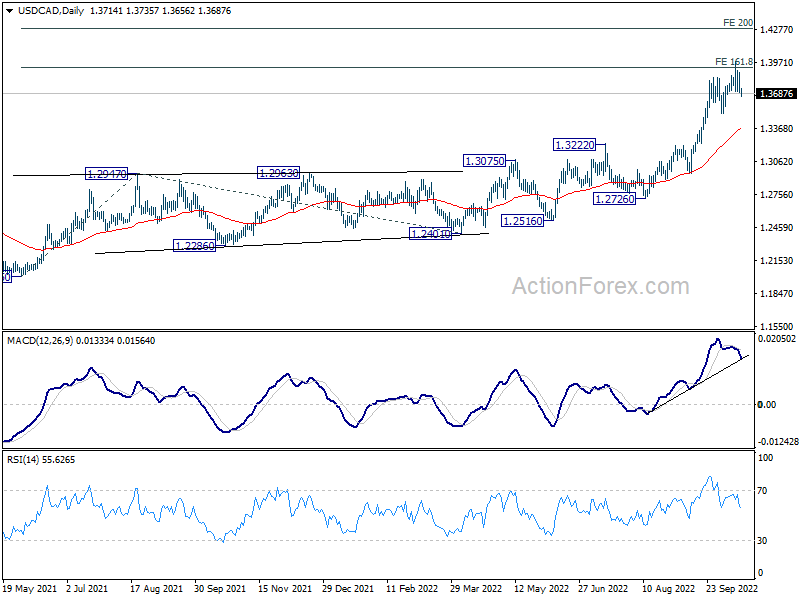
USD/CAD is staying in consolidation from 1.3976 and intraday bias remains neutral. Outlook will stay bullish as long as 1.3501 support holds. Firm break of 1.3976 will resume larger up trend, and target 200% projection of 1.2005 to 1.2947 from 1.2401 at 1.4285.
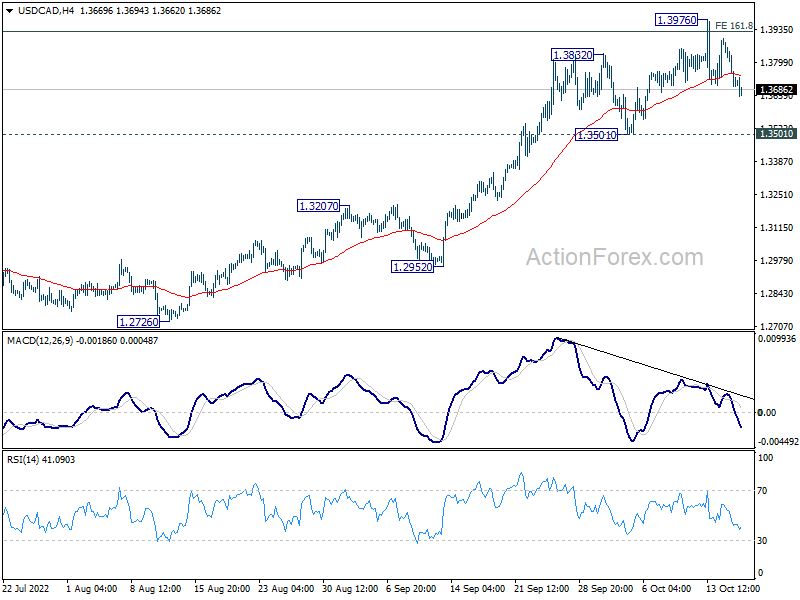
In the bigger picture, up trend from 1.2005 (2021 low) is still in progress. Based on current impulsive momentum, it could be resuming long term up trend from 0.9056 (2007 low). Whether it is or it isn't, retest of 1.4689 (2016 high) should be seen next. This will now remain the favored case as long as 1.3222 resistance turned support holds.