Sample Category Title
AUDJPY Wave Analysis
- AUDJPY reversed from key support level 91.00
- Likely to rise to resistance level 94.70
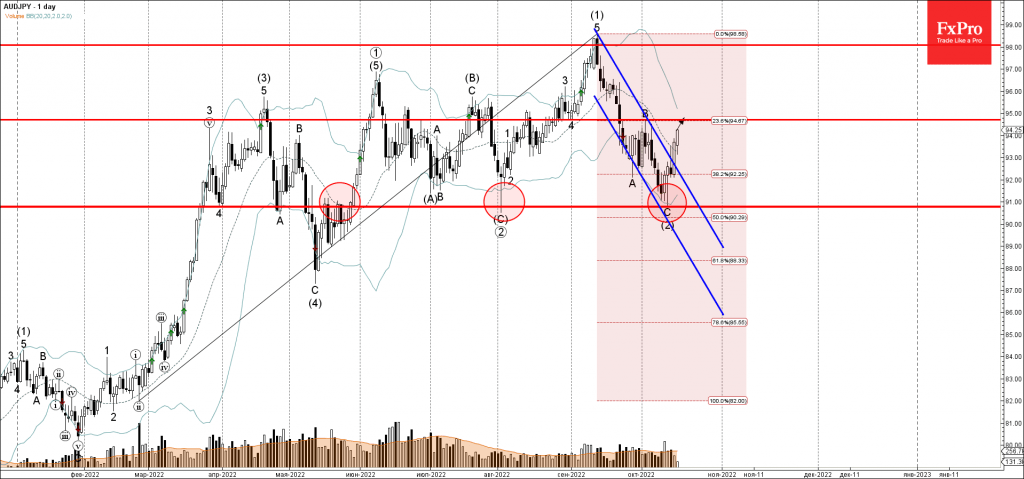
AUDJPY currency pair recently reversed up with the daily hammer from the key support level 91.00 (which has been reversing the price from the middle of May) standing near the lower daily Bollinger Band, support trendline of the daily up channel from September and the 50% Fibonacci correction of the upward impulse from February.
The upward reversal from the support level 91.00 started the active medium-term impulse wave (3).
AUDJPY can be expected to rise toward the next resistance level 94.70 (top of wave B from the start of this month).
Sunset Market Commentary
Markets
Most markets built on yesterday’s moves in a rather dull trading session today. European stocks (Eurostoxx 50) added another 1.8% after taking out a first resistance level around 3451 (July 2020 interim high) shortly after the open. US equities go even further gaining more than 2% after big, 3%+ gains yesterday (Nasdaq). The jury’s still out but such large, countertrend moves have an awful lot in common with bear market, aka sucker, rallies. US Treasuries trade choppy. US yields lost a few bps in Asian dealings. A recovery attempt in European dealings (US 10y briefly topped 4% again) failed quickly. German Bunds’ trajectory was simply a copy paste of that. It suggests that interest rate markets for the time being are in a consolidating mode as they await crucial input from the likes of the ECB next week and the Fed/Bank of England early November. Current yield moves range between -1 bps and -5.3 bps with the belly outperforming in the US. German bond rates in a trade a tight range between -2 and +2 bps. Moves in European swap yields are larger (-3.4 bps to -6.7 bps). UK gilts came under slight selling pressure after surging yesterday when the Bank of England said this morning’s FT report was in accurate. In it, the business newspaper said the UK central bank would further delay active gilt sales from its balance sheet beyond October. UK bond yield changes briefly turned positive but trade conviction was low and momentum faded quickly. The curve currently sheds up 3.1 to 6.4 bps at the middle and long segment. Economic data was limited to the German ZEW indicator, which came in mixed. Expectations marginally improved from lowest level since 2008 at -61.9 to -59.2 vs consensus fearing a further deterioration to -66.5. The current situation reading tumbled to the lowest since mid-2020 (-72.2).
The dollar started on softer footing this morning and that remained the case for much of the session. For the trade-weighted index, this meant edging lower towards the lower bound of the upward trend channel. It came close to a test. DXY is currently narrowly losing the fight with the 112 barrier. EUR/USD ekes out a marginal gain but is still some way of first meaningful resistance at 0.995. The British pound already gives back part of the gains following the UK government’s embarrassing U-turn. EUR/GBP settles above 0.87. Cable (GBP/USD) has a generally softer USD to thank for limiting losses. The pair is hovering around opening levels of 1.133. The kiwi dollar is the notable outperformer in the G10 area today. This morning’s Q3 inflation printed eased way less then hoped-for, keeping pressure on the Reserve Bank of New Zealand to hold on to a strong tightening pace. But despite a strong performance today, at NZD/USD 0.57 is still trading weak from a historical point of view.
News Headlines
At a conference in Sydney, deputy governor Michelle Bullock indicated that Reserve Bank of Australia will likely continue to raise the policy rate further over the coming months even as the RBA earlier this month unexpectedly slowed the pace of rate hikes to a 25 bps step (2.60%). According to Bullock the slowdown compared to other central banks was due to domestic factors. At the same time, the RBA policy rate trajectory also was assessed to be steep(er) compared to other central banks. According to Bullard the high frequency of RBA meetings also allows the bank more frequent evaluation of evidence if necessary. Even so, Bullock indicated that RBA was concerned on the impact of previous rate hikes on household spending, a worry that also emerged from the RBA minutes published this morning. The Aussie dollar yesterday and today joins the broader correction of the dollar. At AUD/USD 0.6335, the Aussie dollar tries to rebound off the cycle low near 0.617 touched last week.
The Central Bank of Turkey announced new measures to support lira deposits and raise the cost of holding deposits in foreign currency. The bank raised the security maintenance ratio for foreign exchange deposits to 5% from 3%. At the same time, the Bank also requires banks with less than 50% of lira deposits to hold an additional 7% of bonds from the start of 2023. The move is seen as a step in the liraization approach of Turkish authorities. Despite the measures, the lira is losing modestly ground against the euro today, trading near EUR/TRY 18.35.
EuroZone and UK September Inflation Figures
Despite all the attention on the mini-budget and the political fallout, the BOE still has to fight rising inflation. It will meet two weeks from now to decide on the next course of action. With the release of the data tomorrow, markets can get back to considering concrete data points and the evolution of monetary policy.
More immediately is the release of EuroZone inflation data because the ECB meets next week. There has been a flurry of commentary from MPC members ahead of the blackout period, with somewhat contradictory statements about just how far the central bank will raise rates. Hawks have moderated their positions, while doves have said that the rate hiking is far from over. Inflation data could be the deciding factor here.
What to look out for
First to announce is the UK, which comes out with a barrage of data just before the market open, as usual. Headline UK inflation is expected to tick back up to 10.0% from 9.9%, which would be just one decimal away from the recent high of 10.1% in July. Given the tight range of recent results, a relatively small miss from expectations could have an outside impact. That's aside from the psychological effect of the inflation rate returning to double-digits.
Naturally if inflation comes in just two decimals above expectations, it would beat the prior high. That could affirm worries that the peak hasn't been reached yet (something the BOE has already warned about). On the other hand, a miss of two decimals would show a continuation of the downward trend over the last three months and provide some relief to the markets.
The underlying figures that matter
The BOE focuses more on the Core inflation rate for policy decisions, and that is expected to continue its recent trend higher at 6.4% compared to 6.3% in August. Expectations that the UK is not out of the woods in terms of price increases is expected to be affirmed with PPI output remaining at 13.7%.
Across the channel, the situation in the EuroZone is expected to show increased justification for tighter policy. The annual inflation rate is expected to be confirmed at double digits for the first time since the currency was adopted, at 10.0%, up from 9.1%. That is driven by an acceleration of the monthly rate to 1.2% compared to 0.6% in august.
The outlook hasn't changed much
EuroZone core inflation rate is expected to be confirmed at 4.8% compared to 4.3% prior. The rise in prices is seen primarily as a product of higher energy costs filtering through the economy. If prices aren't rising primarily because of monetary policy, it's hard for monetary policy to control the increase and stabilize prices.
Earlier today it was reported that the BOE would delay the implementation of QT (selling gilts) due to market conditions. The low interest rates in the Eurozone are creating a similar problem, where investors are keeping to the sidelines ahead of expected economic turmoil. This makes policy tightening even more challenging, even as inflation continues to rise. Therefore, it's likely that a consensus ahead of the ECB's decision might not solidify.
Intraday Elliott Wave Update: EUR/USD Ready to Catch Dax, USD/JPY Approaching Resistance
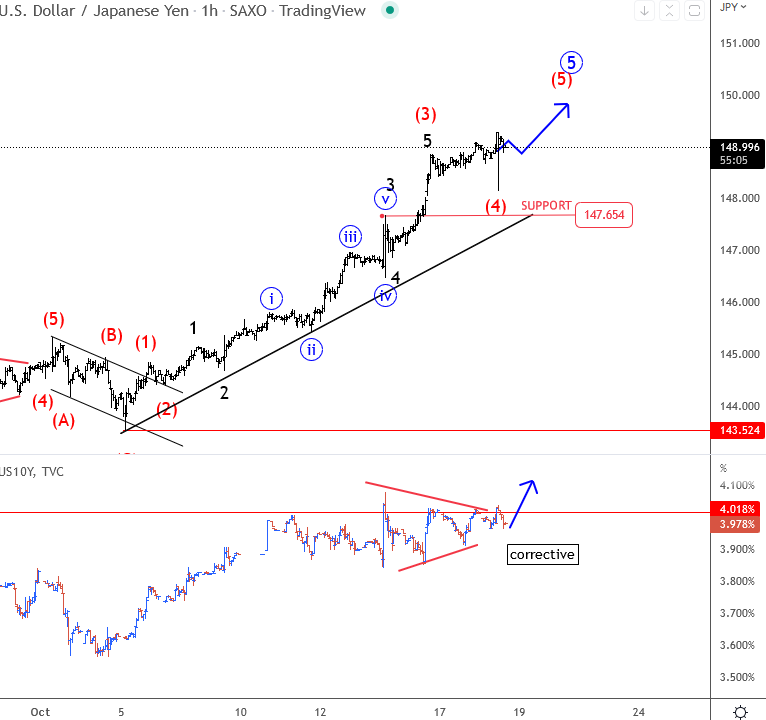
The USD is coming down as stocks pushed higher during the US session yesterday. However, the 10 year US yields are consolidating so we have to consider that the USD can see some more intraday strength if 10 year breaks above 4%. If USD would come higher then watch for USDJPY as this one can move up to 150, within current impulsive uptrend. However, buying USDJPY here can be risky as Japan warned Tuesday of "appropriate" action to counter excessive volatility in the currency market after the yen hit a 32-year low against the U.S. dollar amid jitters over further possible intervention and its impact on the economy.
On the other side of coin, the USD weakness may resume vs the EUR while DAX is moving higher. We see index trading at the highs of the day, so EURUSD may try to catch it up after the pair retested the previous highs, it was new support for wave four. As such, we are looking for further upside into a fifth wave while pair trades above 0.9769.

Pound Steadies after Rally
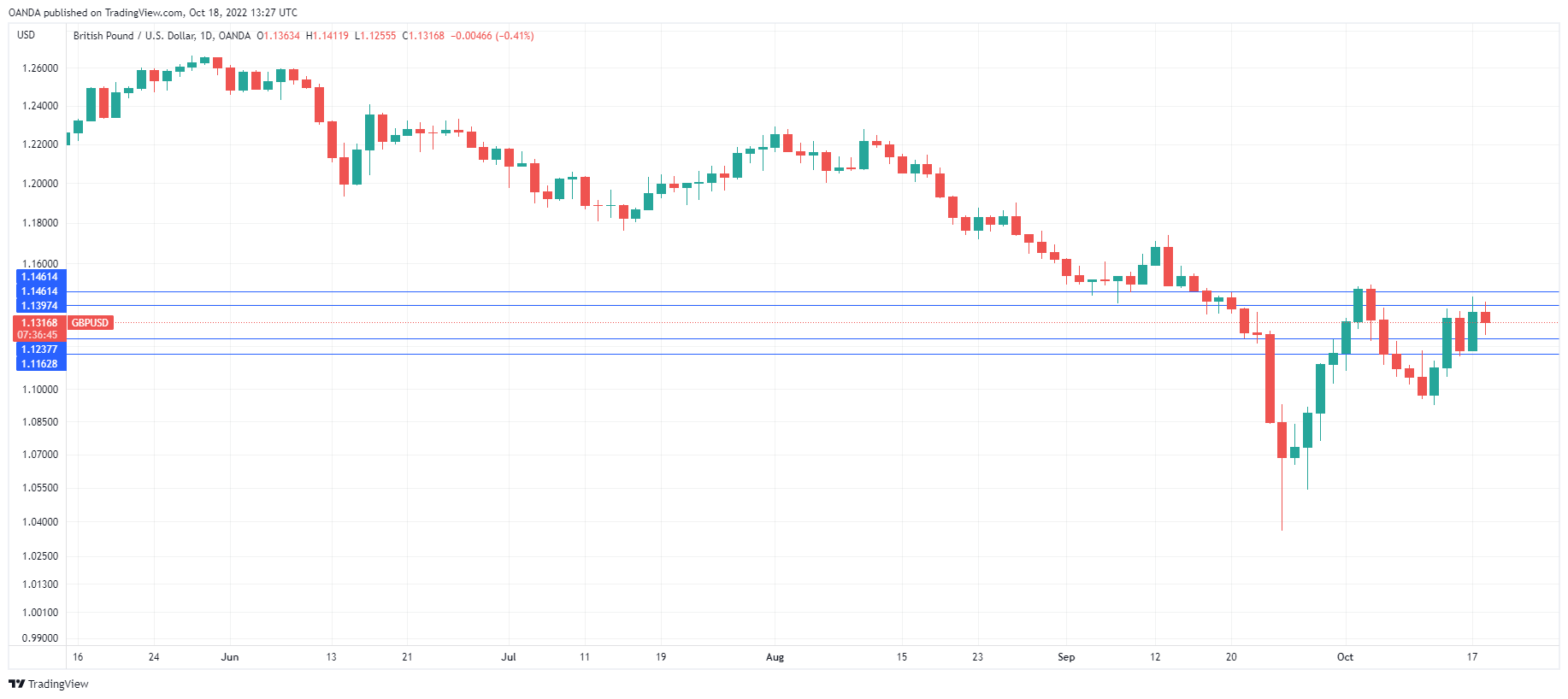
GBP/USD has edged lower today, after starting the week with sharp gains. In the North American session, GBP/USD is trading at 1.1334, down 0.18%.
Pound jumps after Hunt axes tax cuts
The pound continues to show strong volatility as the political saga continues in the UK. Truss finally stopped blaming the markets and “global headwinds” for the decline of the British pound and UK gilts on Monday, saying she was sorry for going too “far and too fast” with her economic plan. Truss has insisted she will continue on as leader, but the restless Conservatives, who have sunk in the polls, could decide to pull the plug on Truss’ disastrous leadership.
Jeremy Hunt, the new finance minister, wasted no time in abolishing most of the tax cuts contained in the recent mini-budget and told parliament that spending cuts and tax increases were coming, an astounding U-turn. Hunt scaled back the plan to cap energy bills for consumers and that could mean higher inflation. The markets liked what they heard and the pound soared by 1.5% on Monday. Still, the soft economic outlook and the political chaos which has rocked the UK are strong headwinds which will likely weigh on the pound .
The UK releases CPI for September on Wednesday, which is expected to edge higher. Headline inflation is projected to hit 10.0%, up from 9.9%, and core CPI is forecast to rise to 6.4%, up from 6.3%. With no sign of inflation peaking, the Bank of England remains under pressure to continue raising interest rates at the November 3rd meeting. Goldman Sachs has downgraded its UK growth outlook, with the economy expected to decline by 1% in 2023, worse than the previous estimate of -0.4%.
GBP/USD Technical
- GBP/USD faces resistance at 1.1373 and 1.1455
- There is support at 1.1214 and 1.1085
US 100 Rebounds from Near 11035, But Still in a Downtrend
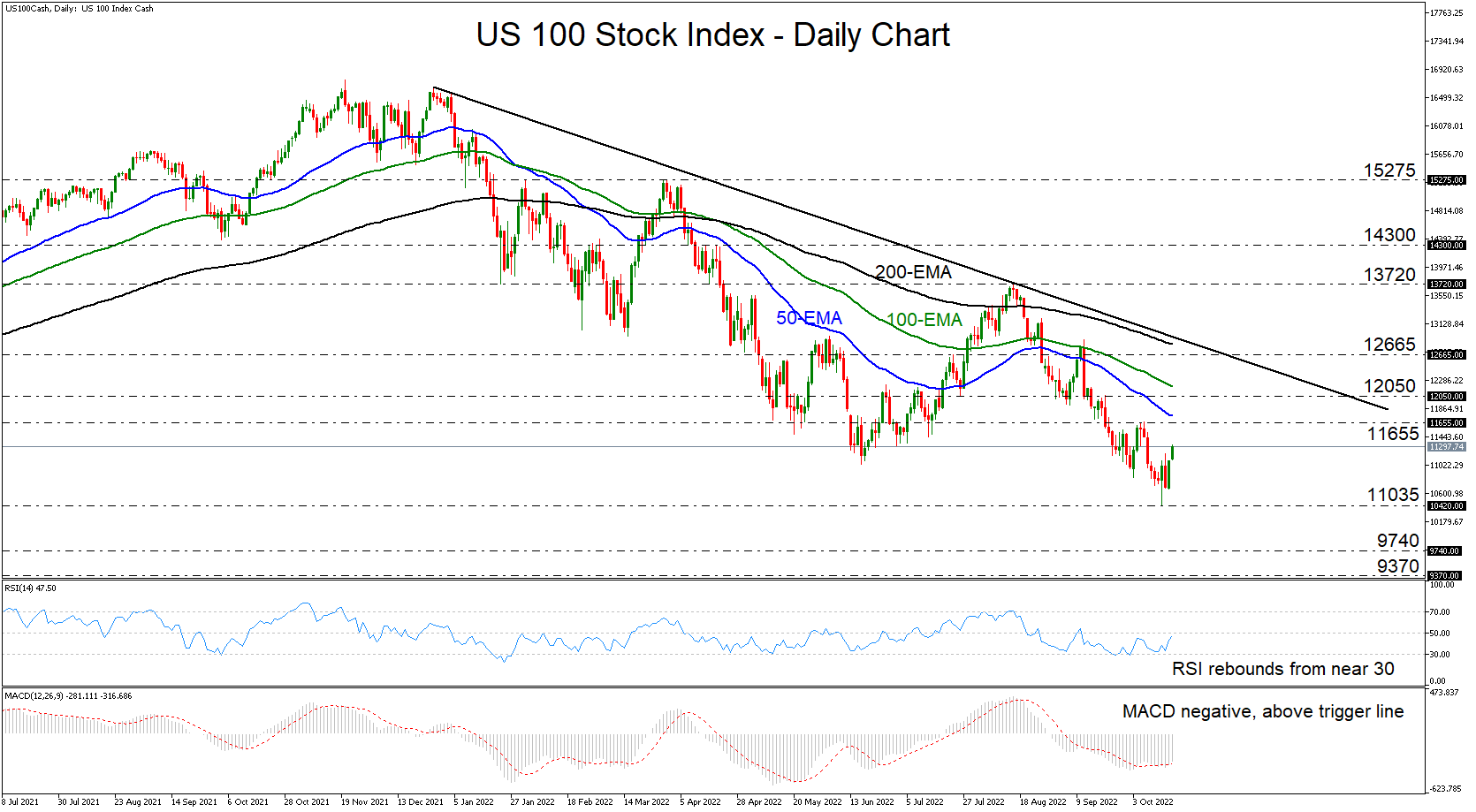
The US 100 cash index rebounded from 11035 last Thursday, with the recovery accelerating this week. That said, the index remains well below the downside resistance line drawn from the high of December 28, as well as below all the plotted exponential moving averages, which keeps the broader outlook negative.
The RSI and the MACD point to weakening downside momentum, which means that some further recovery may be on the cards before the bears take the upper hand again. The former rebounded from near 30 and is now approaching its 50 line, while the latter is lying within its negative territory, but above its trigger line, pointing up.
The bears could regain control from near the high of October 6 at 11655, or even from slightly higher, near the 12050 zone. If so, they could dive all the way down for another test at around 11035, the break of which would confirm, not only a lower low, but a new 28-month low as well. The next zones to consider as potential support areas may be at around 9740 and 9370, marked by the lows of June 29 and 15 respectively.
On the upside, a break above 12665 may be needed before all the bulls get off their couch. This could confirm the breach of the aforementioned downside line and may see scope for advances all the way up to the 13720 barrier, marked by the high of August 16. If investors are not willing to stop there, then we may see them shooting for the 14300 area, marked by the highs of April 20 and 21.
Recapping, US 100 has been in a recovery mode lately, but the bigger picture still points to a downtrend. Therefore, even if there are some more advances in store, the bears could very well recharge soon and aim for a new 28-month low.
EUR/USD Mid-Day Outlook
Daily Pivots: (S1) 0.9759; (P) 0.9805; (R1) 0.9891; More...
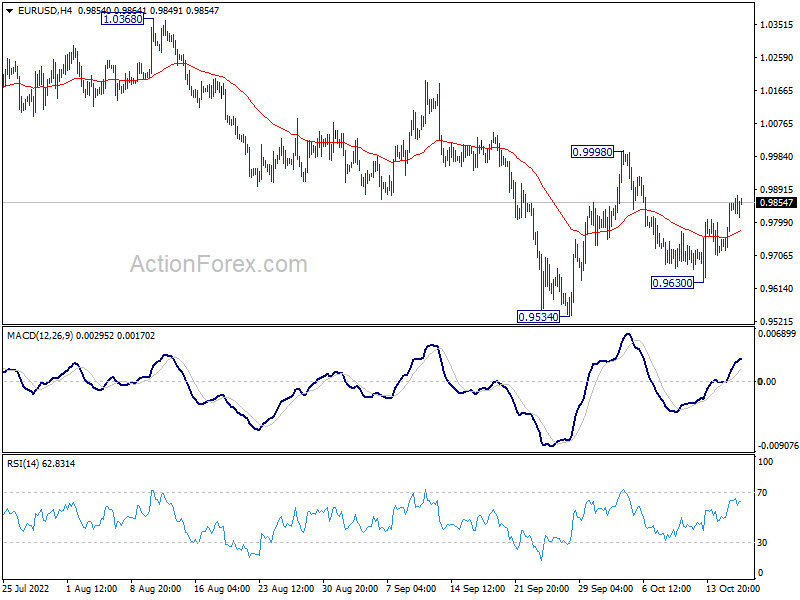
Intraday bias in EUR/USD stays neutral as range trading continues. Deeper decline is expected with 0.9998 resistance intact. Below 0.9630 will bring retest of 0.9534 low first. Firm break there will resume larger down trend. However, break of 0.9998 will confirm short term bottoming and turn bias back the upside for stronger rebound.
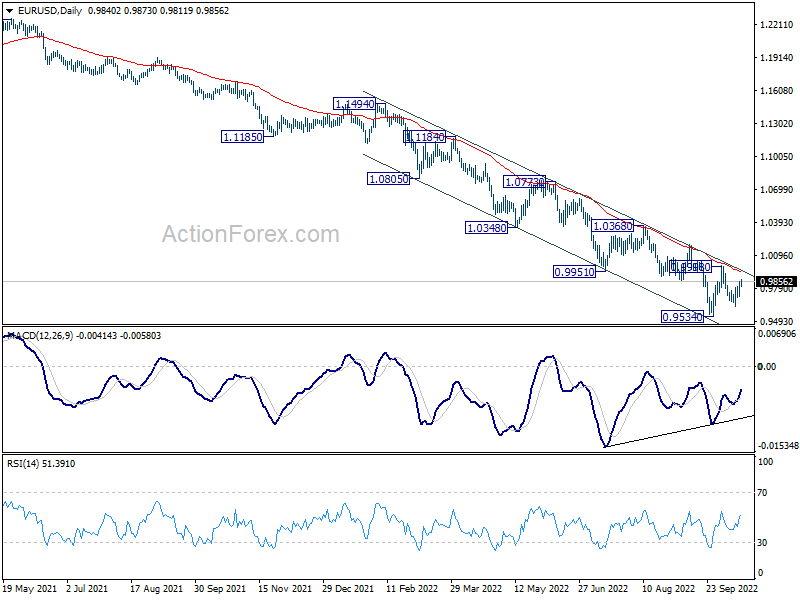
In the bigger picture, down trend from 1.6039 (2008 high) is still in progress. Next target is 100% projection of 1.3993 to 1.0339 from 1.2348 at 0.8694. In any case, break of 0.9998 resistance is needed to be the first sign of medium term bottoming. Otherwise, outlook will stay bearish even with strong rebound.
GBP/USD Mid-Day Outlook
Daily Pivots: (S1) 1.1237; (P) 1.1338; (R1) 1.1463; More...
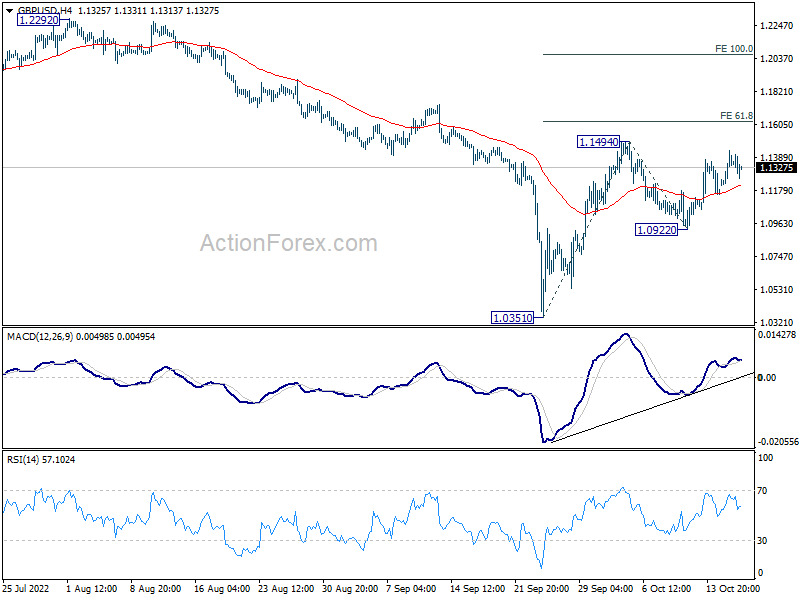
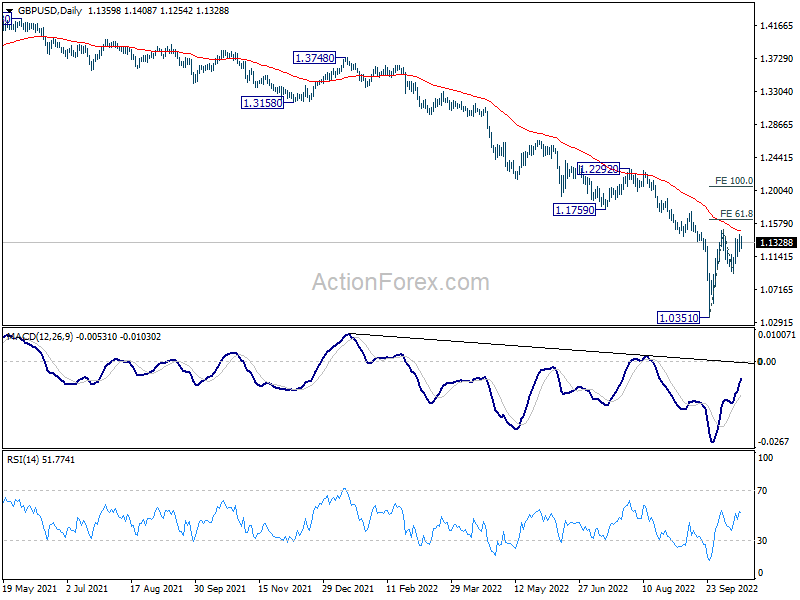
Range trading continues in GBP/USD and intraday bias stays neutral. On the upside, break of 1.1494 will resume the rise from 1.0351 to 61.8% projection of 1.0351 to 1.1494 from 1.0922 at 1.1628. On the downside, below 1.0922 will turn bias back to the downside for 1.0351 low instead.
In the bigger picture, fall from 1.4248 (2018 high) is resuming long term down trend from 2.1161 (2007 high). Next target is 100% projection of 2.1161 to 1.3503 from 1.7190 at 0.9532. There is no scope of a medium term rebound as long as 1.1759 support turned resistance holds.
USD/JPY Mid-Day Outlook
Daily Pivots: (S1) 148.61; (P) 148.85; (R1) 149.27; More...
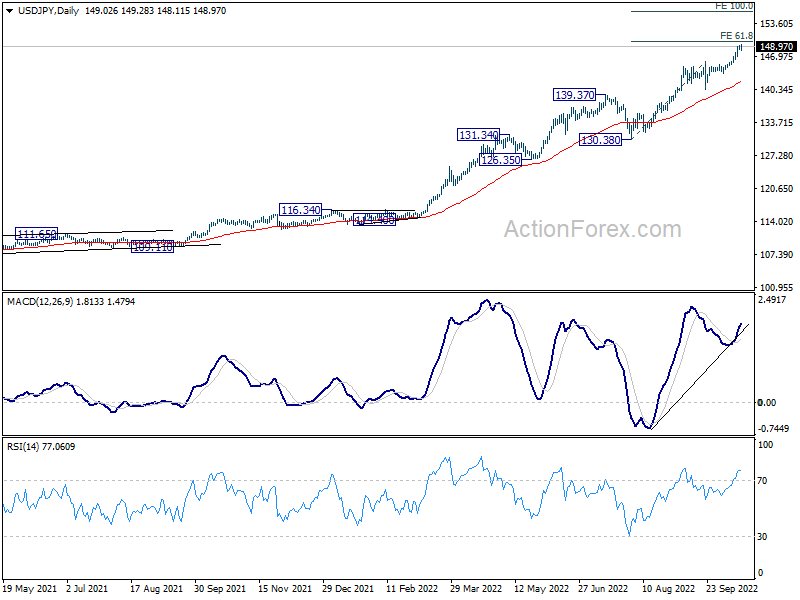
USD/JPY continues to lose upside momentum but there is no sign of topping. Further rise is in favor to 61.8% projection of 130.38 to 140.33 from 145.89 at 149.91. Yet, beware that Japan might intervene again close to 150 psychological level. On the downside, break of 146.43 minor support will indicate short term topping and bring deeper pull back.
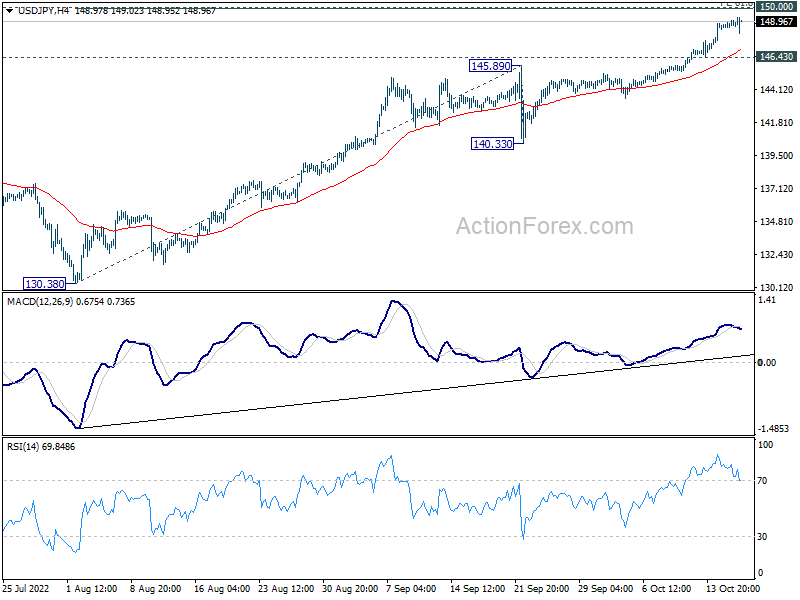
In the bigger picture, up trend from 101.18 is still in progress, as part of the whole up trend from 75.56 (2011 low). 147.68 (1998 high) was already met and there is not clearly sign of topping yet. In any case, break of 139.37 resistance turned support is needed to be the first sign of medium term topping. Otherwise, further rise is in favor to next target at 160.16 (1990 high).