Sample Category Title
USD/CHF Mid-Day Outlook
Daily Pivots: (S1) 0.9915; (P) 0.9986; (R1) 1.0027; More...
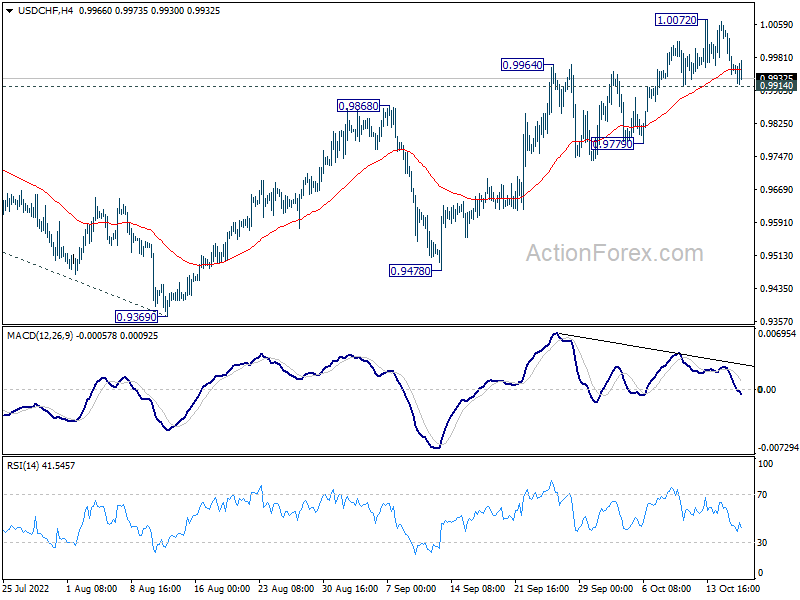
USD/CHF is still holding above 0.9914 minor support and intraday bias remains neutral. On the upside, break of 1.0072, and sustained trading above 1.0063, will confirm larger up trend resumption. Next target is 1.0283 projection level. However, break of 0.9914 support will indicate rejection by 1.0063, and turn bias back to the downside for 0.9779 support first.
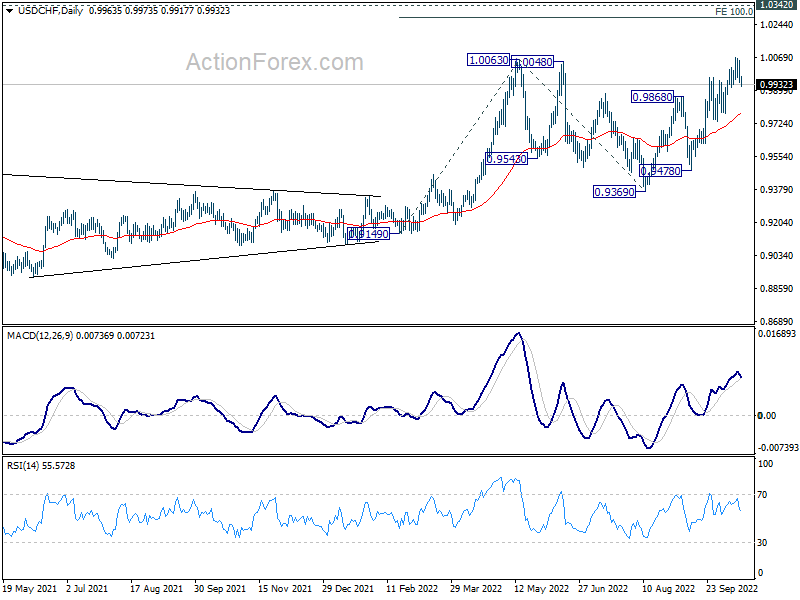
In the bigger picture, current development suggests that up trend from 0.8756 (2021 low) is still in progress. Sustained break of 1.0063 will target 100% projection of 0.9149 to 1.0063 from 0.9369 at 1.0283, and then 1.0342 (2016 high). For now, this will remain the favored case as long as 0.9369 support holds, even in case of deep pull back.
USD/JPY Holding Firm Despite Japan Intervention
Japan appeared to have intervene in the currency markets again today. But USD/JPY is holding its head up, staying resilient around 32-year high. Both Dollar and Yen are among the worst as the financial markets are basically trading with solid risk-on sentiment. New Zealand and Australian Dollar ride on such sentiment and are the strongest ones so far. European majors are mixed, with Sterling on a slightly softer side.
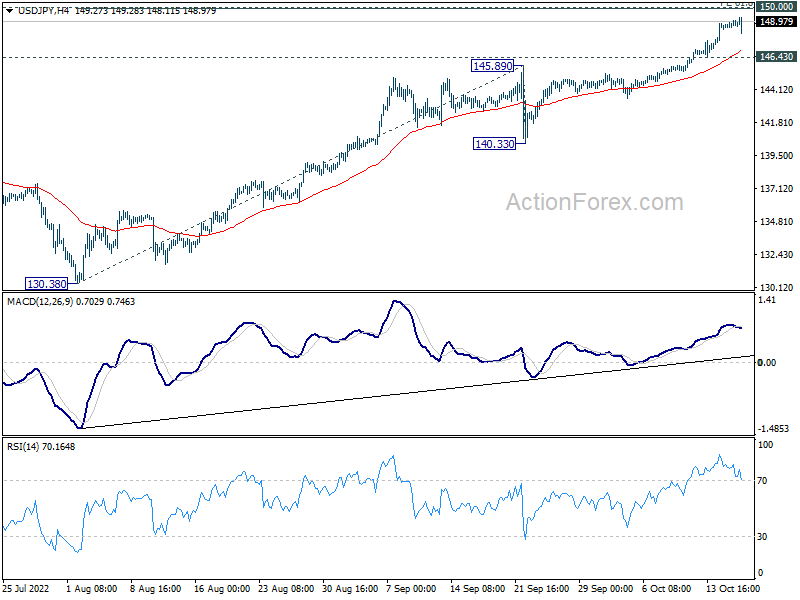
Technically, USD/JPY's dip today isn't half as fierce as it was back in late September when Japan intervened. But in any case, there is no signal of reversal as long as 146.43 support holds. USD/JPY might struggle again on another attempt towards 150. Hence, favor is now on having other Yen crosses, in particular EUR/JPY and GBP/JPY, to rise higher.
In Europe, at the time of writing, FTSE is up 1.39%. DAX is up 2.04%. CAC is up 1.50%. Germany 10-year yield is up 0.001 at 2.272. Earlier in Asia, Nikkei rose 1.42%. Hong Kong HSI rose 1.82%. China Shanghai SSE dropped -0.13%. Singapore Strait Times rose 0.34%. Japan 10-year JGB yield rose 0.0067 to 0.259.
German ZEW situation tumbled sharply, significantly worse
Germany ZEW Economic Sentiment rose slightly from -61.9 to -59.2 in October, above expectation of -66.0. Current Situation Index dropped sharply from -60.5 to -72.2, below expectation of -69.0.
Eurozone ZEW Economic Sentiment improved slightly from -60.7 to -59.7, above expectation of -60.6. Current situation dropped very sharply by -11.7 pts to -70.6. Inflation expectations for Eurozone declined from -23.7 to -35.8.
"The ZEW Indicator of Economic Sentiment rises slightly in October. However, the current economic situation is once again assessed as significantly worse than in the previous month. The probability that real gross domestic product will decline in the course of the next six months has also increased considerably. Overall, the economic outlook has deteriorated again," said ZEW President Professor Achim Wambach on current expectations.
RBA minutes: Case for a smaller 25bps hike stronger
Minutes of RBA October 4 meeting revealed that members "carefully considered two options" of 50bps and 25bps rate hike. The arguments for a 25bps hike "rested on the risks to global and domestic growth, and the potential for inflation to subside quickly".
Wages growth had "not reached levels that would be inconsistent with the inflation target". External inflation pressures "might ease quickly given that the global outlook had deteriorated". There was also an argument to slow for a time to "assess the effects of the significant increases in interest rates to date".
RBA said the arguments for both options were "finely balanced", with the case of 25bps hike stronger. "A smaller increase than that agreed at preceding meetings was warranted given that the cash rate had been increased substantially in a short period of time and the full effect of that increase lay ahead."
At the meeting, RBA raised the cash rate target by 25bps to 2.60%.
RBA Bullock: We meet more frequently than most of our peers
RBA Deputy Governor Michele Bullock acknowledged in a speech that some commentators contracted the 24bps hike in October with those of other central banks that have been hiking by larger increments.
"In part, this reflects our particular economic circumstances," she said. "But it is also relevant that the Board meets more frequently than most of our peer central banks."
RBA is "making monetary policy decisions 11 times a year so it is discussing regularly the evidence on the economy and has more flexibility on the size and timing of rate increases... The incremental change in the policy rate at recent meetings has been smaller than some other major central banks. However, our policy rate trajectory has been as steep, or steeper, than other central banks".
Both Fed and ECB hold monetary policy meetings 8 times a year.
New Zealand CPI up 2.2% qoq in Q3, annual rate at 7.7% yoy
New Zealand CPI rose 2.2% qoq in Q3, well above expectation of 1.6% qoq. Annual inflation slowed from 7.3% yoy to 7.2% yoy, but beat expectation of 6.6% yoy.
The quarterly rise in prices was mainly influenced by the food group and the housing and household utilities group. Vegetable prices rose 24% during the quarter, largest since the the series began in 1999.
The main driver for annual inflation was housing and household utilities due to rising prices for construction, rentals for housing, and local authority rates.
Japan Suzuki: We cannot tolerate excessive currency moves driven by speculators
Japanese Finance Minister Shunichi Suzuki told reporters today, "We cannot tolerate excessive currency moves driven by speculators. We are closely watching currency moves with a sense of urgency."
Suzuki later told the parliament that the government is ready to take actions "decisively" and "we have intervened in the currency markets (last month)".
"Generally speaking, there are times when we intervene by making announcements and some other times when we do without it," Suzuki said.
BoJ Governor Haruhiko Kuroda told the parliament, "Recent sharp yen fall, coupled with raw material price rise, driving up Japan's prices". ''Consumer inflation likely to accelerate toward year-end before sliding below 2% next fiscal year,'' he added.
USD/CHF Mid-Day Outlook
Daily Pivots: (S1) 0.9915; (P) 0.9986; (R1) 1.0027; More...
USD/CHF is still holding above 0.9914 minor support and intraday bias remains neutral. On the upside, break of 1.0072, and sustained trading above 1.0063, will confirm larger up trend resumption. Next target is 1.0283 projection level. However, break of 0.9914 support will indicate rejection by 1.0063, and turn bias back to the downside for 0.9779 support first.
In the bigger picture, current development suggests that up trend from 0.8756 (2021 low) is still in progress. Sustained break of 1.0063 will target 100% projection of 0.9149 to 1.0063 from 0.9369 at 1.0283, and then 1.0342 (2016 high). For now, this will remain the favored case as long as 0.9369 support holds, even in case of deep pull back.
Economic Indicators Update
| GMT | Ccy | Events | Actual | Forecast | Previous | Revised |
|---|---|---|---|---|---|---|
| 21:45 | NZD | CPI Q/Q Q3 | 2.20% | 1.60% | 1.70% | |
| 21:45 | NZD | CPI Y/Y Q3 | 7.20% | 6.60% | 7.30% | |
| 00:30 | AUD | RBA Meeting Minutes | ||||
| 09:00 | EUR | Germany ZEW Economic Sentiment Oct | -59.2 | -66 | -61.9 | |
| 09:00 | EUR | Germany ZEW Current Situation Oct | -72.2 | -69 | -60.5 | |
| 09:00 | EUR | Eurozone ZEW Economic Sentiment Oct | -59.7 | -60.6 | -60.7 | |
| 12:15 | CAD | Housing Starts Y/Y Sep | 262K | 267K | ||
| 13:15 | USD | Industrial Production M/M Sep | -0.10% | -0.20% | ||
| 13:15 | USD | Capacity Utilization Sep | 80.00% | 80.00% | ||
| 14:00 | USD | NAHB Housing Market Index Oct | 43 | 46 |
BoJ Cannot Defend the Yen and is Unlikely to Want to
The exchange rate of the Japanese yen to the dollar is renewing its 32-year lows since the beginning of the week, and there is no end to the move. The USDJPY has touched and exceeded 149 and has gained about 3% since the beginning of the month. The pair has gained an astounding 45% since the beginning of this new cycle in 2021, and there is no solid fundamental reason for the JPY to latch on to this decline.
A few moments ago, we saw another intervention from Japan’s Ministry of Finance to stop the yen’s accelerating fall. The USDJPY was trading close to 149.30, and that sent the pair falling back to 148.12 within a minute.
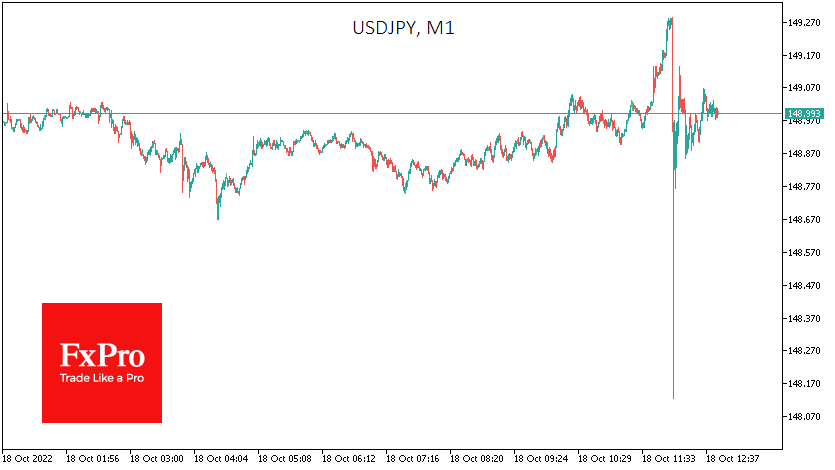
The latest attempt of the authorities to stop the yen’s unilateral decline can only make the markets smile for now. On Tuesday, Finance Minister Suzuki warned that Japan is ready to take appropriate and drastic measures against speculators.
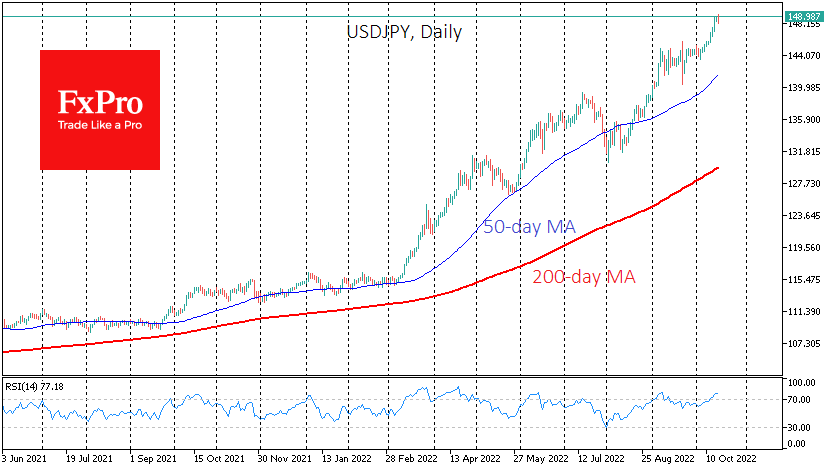
But the speculators are more than a cohort of traders looking for a quick profit. In this case, the market is betting that Japan will not be able to sit on two chairs simultaneously. Even with a trillion dollars in U.S. treasuries as a safety cushion, it is impossible to keep long-term bond rates near zero in the face of extreme rate hikes and seriously assert its intention to defend the yen.
Sooner rather than later, Japan must choose one action, defend the yen, or defend bond yields by abandoning its current controversial policy.
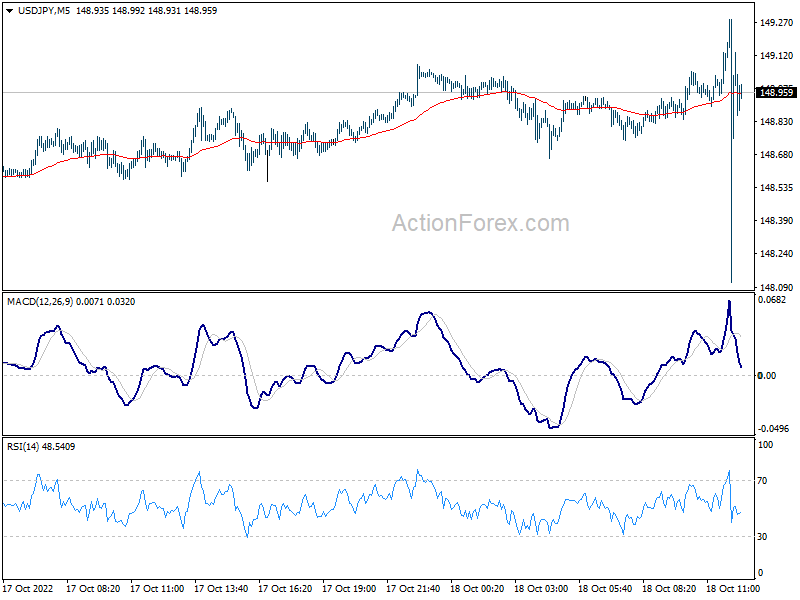
Japan intervenes as USD/JPY breaks149
USD/JPY is knocked down heavily after edging higher to 149.28. At the time of writing, it's trading slightly below 149. Apparently, the unexpected excessive volatility is due to intervention by Japan. For now, it's unsure if 149 is the level Japan would defend, or is it going to be 150. In either case, as USD/JPY looks rather resilient, it's not a wise choice to sell it to ride on the intervention. It's an avoid for the moment.
Earlier today, Japanese Finance Minister Shunichi Suzuki said, "We cannot tolerate excessive currency moves driven by speculators. We are closely watching currency moves with a sense of urgency."
"Generally speaking, there are times when we intervene by making announcements and some other times when we do without it," Suzuki also noted.
German ZEW situation tumbled sharply, significantly worse
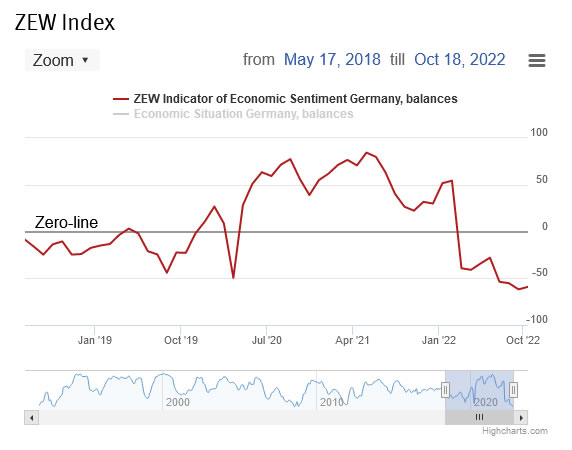
Germany ZEW Economic Sentiment rose slightly from -61.9 to -59.2 in October, above expectation of -66.0. Current Situation Index dropped sharply from -60.5 to -72.2, below expectation of -69.0.
Eurozone ZEW Economic Sentiment improved slightly from -60.7 to -59.7, above expectation of -60.6. Current situation dropped very sharply by -11.7 pts to -70.6. Inflation expectations for Eurozone declined from -23.7 to -35.8.
"The ZEW Indicator of Economic Sentiment rises slightly in October. However, the current economic situation is once again assessed as significantly worse than in the previous month. The probability that real gross domestic product will decline in the course of the next six months has also increased considerably. Overall, the economic outlook has deteriorated again," said ZEW President Professor Achim Wambach on current expectations.
Aussie Steadies Ahead of Jobs Data as RBA Enters the Slow Lane
The Australian dollar has been having a rough ride lately, sliding to two-and-a-half-year lows against the US dollar as the outlook for the world economy has deteriorated. The Reserve Bank of Australia’s recent dovish pivot hasn’t helped matters. However, the jury is still out on whether the RBA’s move was the right one or if it was premature. Thursday’s employment data (00:30 GMT) could be crucial if the numbers cast doubt on policymakers’ cautiousness.
Labour market is tight
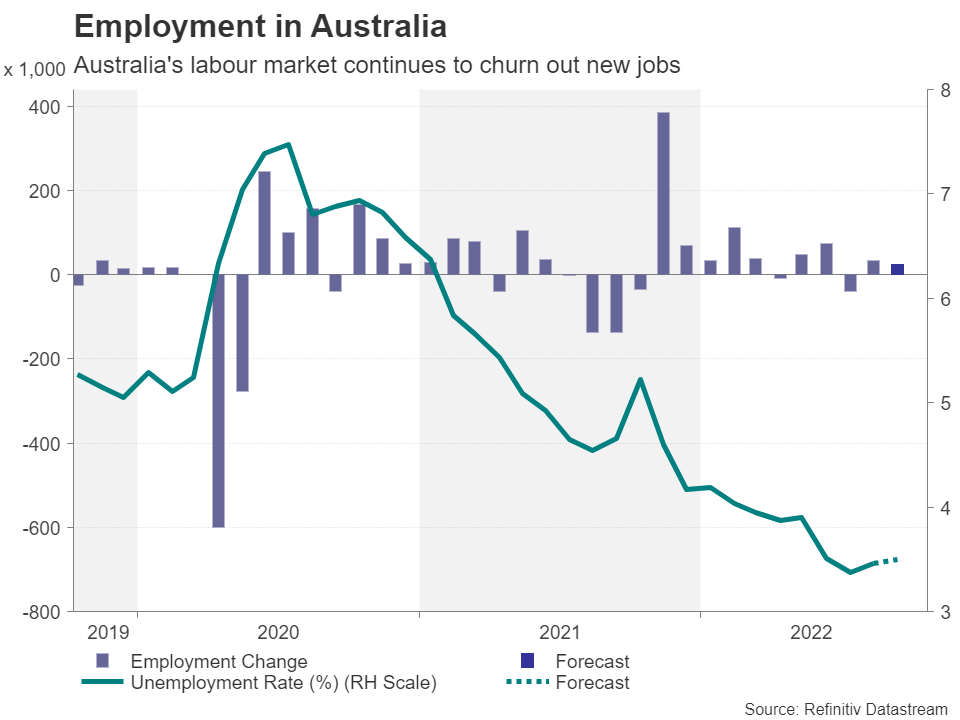
Australia’s economy has been humming along quite nicely in 2022 despite a slightly bumpy start due to the lockdowns to tackle the Omicron wave. There was a solid rebound in GDP in the first half of the year, and although growth has been slowing in recent months, consumption remains strong and at 3.5%, the unemployment rate is the lowest since 1974.
Employment is expected to have increased by 25k in September, following a 33.5k rise in the prior month. The jobless rate is forecast to remain unchanged at 3.5%.
 Are cracks starting to appear in the economy?
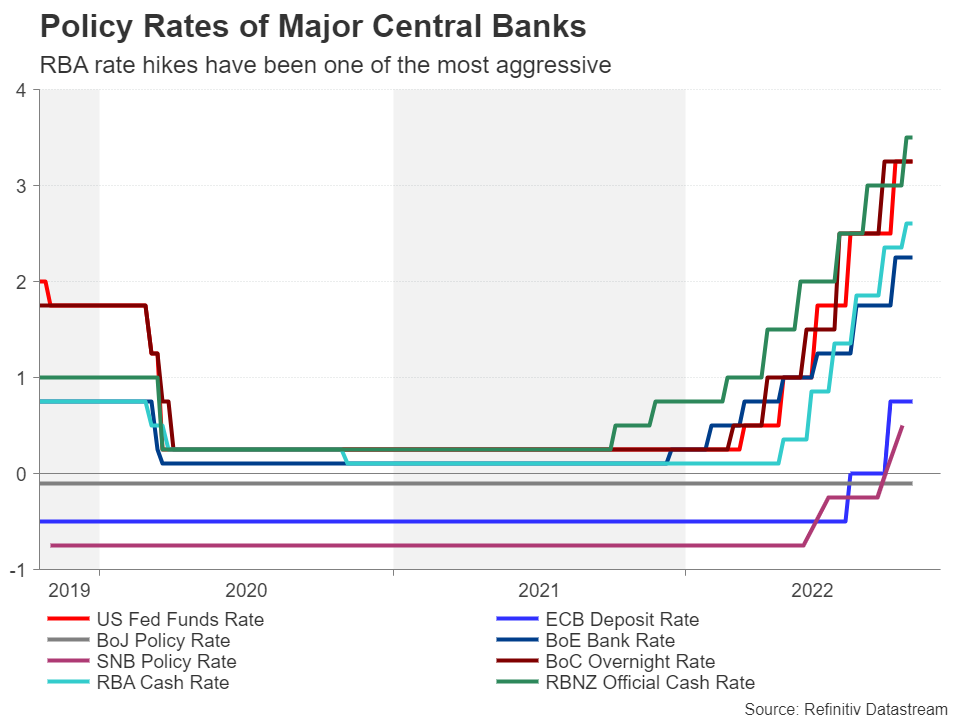
So what prompted this shift at the RBA? One of the things the central bank is most worried about is a crash in the housing market, as mortgage costs have shot up since May on the back of the aggressive rate hikes that have lifted the cash rate by 250 basis points. House prices have already started to fall, dropping sharply in the big cities such as Sydney and Melbourne. The combination of rising mortgage payments and soaring consumer prices is a lethal cocktail for households.
But far from implying that the job is done on policy tightening, it’s important to stress that the RBA is merely signalling that there’s no need to maintain a pace of 50-bps rate hikes. When considering that the RBA sets policy eleven times a year as opposed to eight or less for most other central banks, the dovish pivot isn’t as dovish as it might seem.
RBA pivot puts pressure on the aussie
Still, the decision has caused some angst that the RBA may have let its guard down too early. Thus, should the incoming data contradict policymakers’ concerns about a slowing economy, the aussie’s retracement could go beyond this week’s risk-on-driven bounce back.
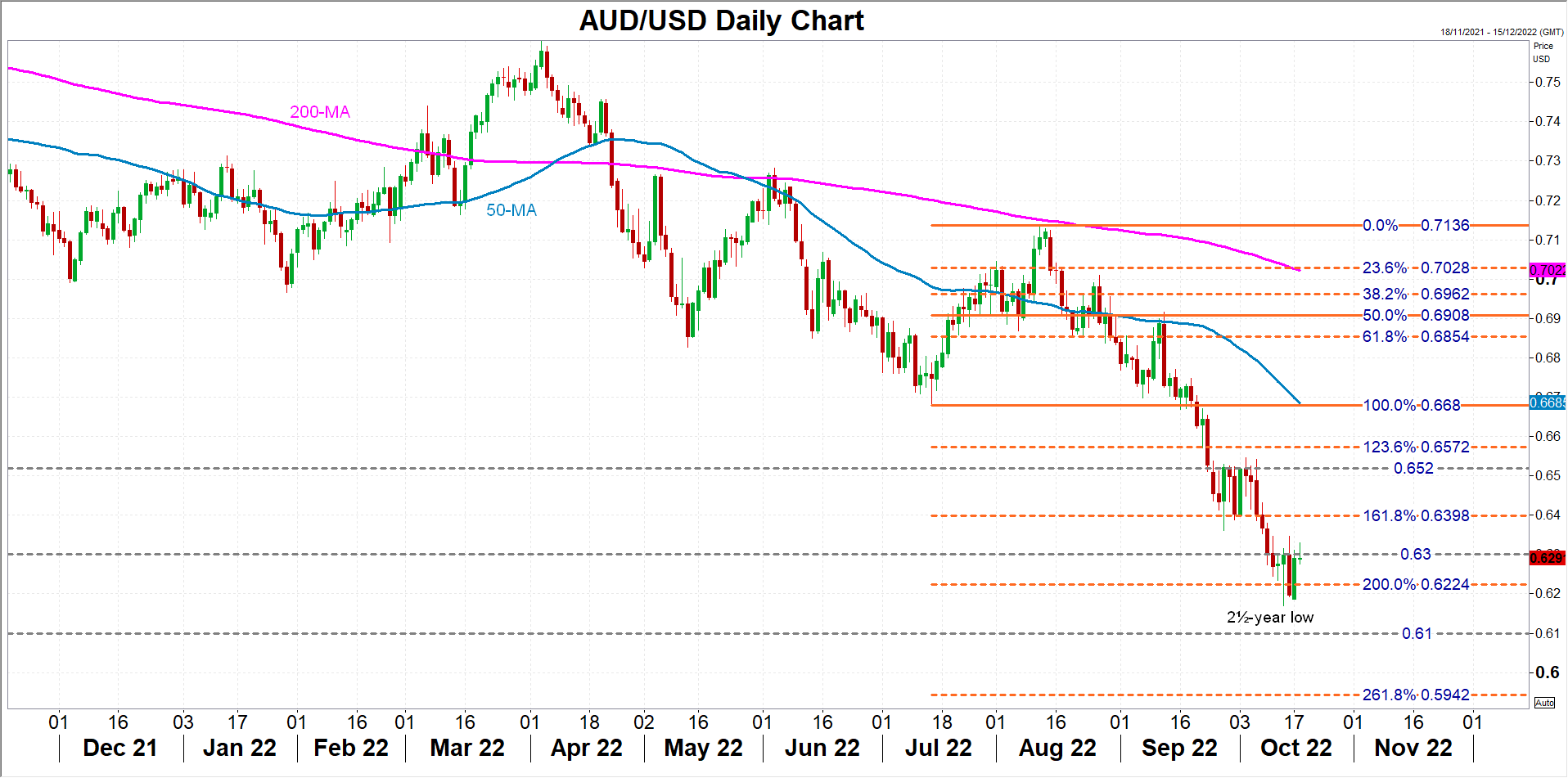
At the moment, the aussie is testing the $0.63 level but another challenge looms at the next handle at $0.64, which corresponds with the 161.8% Fibonacci extension of the July-August upleg. Further up, the $0.6520 level might also be difficult to overcome as it proved impenetrable in late September/early October.
If the current rebound were to falter, the aussie could dip back towards the latest trough of $0.6169. A break lower would underscore the longer-term bearish pattern, opening the way for the $0.61 level, followed by the 261.8% Fibonacci of $0.5942.
Did the RBA make a policy mistake?
Deepening losses for the local dollar could become a problem for the RBA if it sinks any further as it would worsen the inflation problem by pushing up the price of imports. Policymakers will undoubtedly be paying close attention to next week’s quarterly CPI readings to gauge the speed at which inflation is accelerating.
With the Federal Reserve not expected to alter its hawkish policy stance anytime soon, the aussie could struggle for some time yet until either the RBA performs a U-turn on its dovish pivot, or it convinces the markets that it really does intend to keep hiking rates at every meeting, albeit by a smaller 25-bps increment.
EURJPY Advances to Fresh 7½-Year Highs
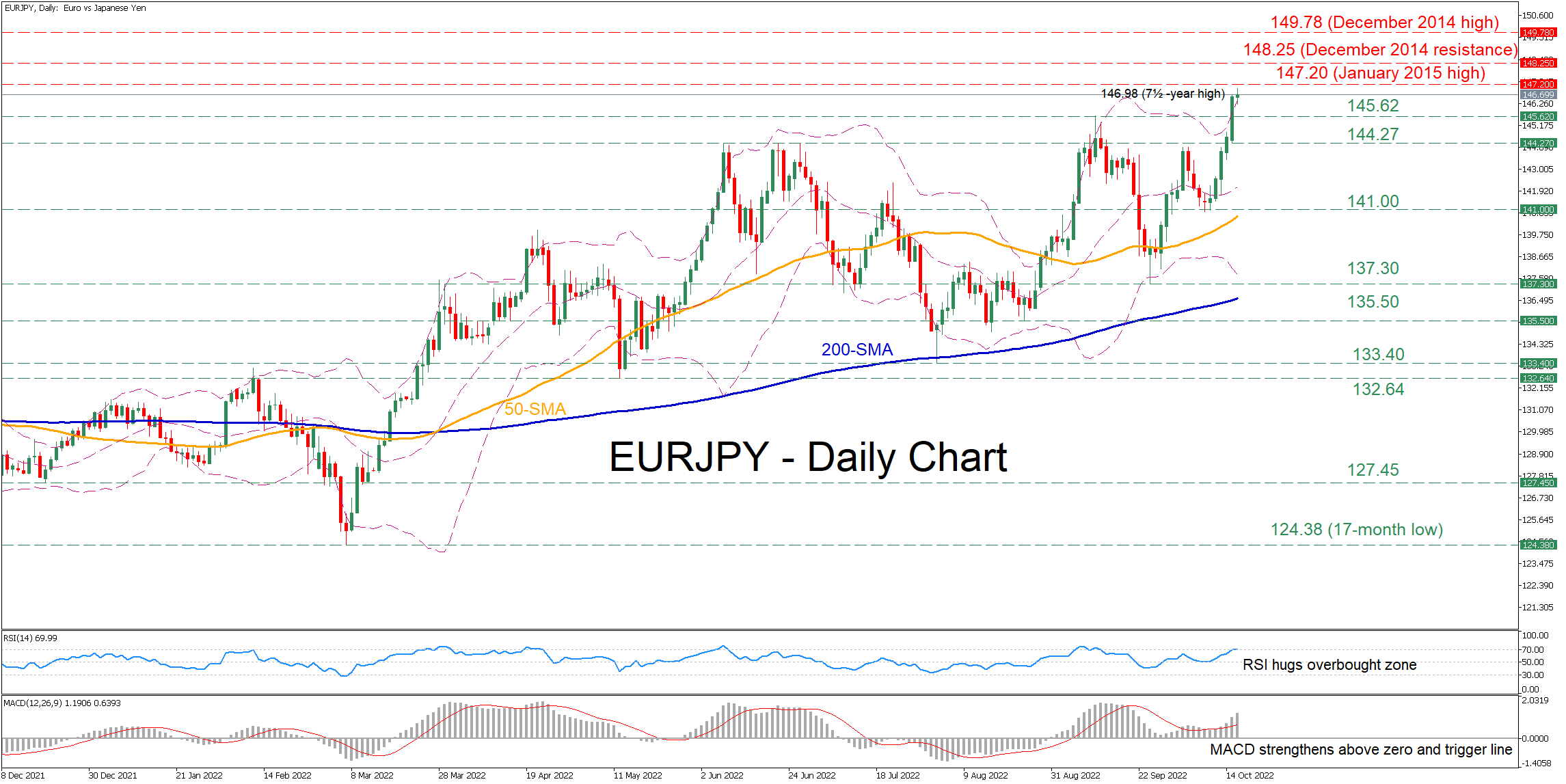
EURJPY has been in a prolonged uptrend since early March, generating consecutive multi-year highs. Moreover, even though the pair exhibited a substantial downside correction in late-September, the short-term picture has improved drastically again, with the price edging higher to a fresh 7½-year high of 146.98 in today’s session.
The short-term oscillators currently indicate that bullish forces are intensifying. Specifically, the RSI has entered its 70-overbought area, while the MACD histogram is strengthening above its red signal line in the positive territory.
Should buying pressures persist, the pair could move higher to form fresh multi-year highs, where the January 2015 peak of 147.20 might curb further advances. Conquering this barricade, the bulls may target the crucial December 2014 resistance region of 148.25. Even higher, the spotlight could turn to the December 2014 high of 149.78, which is the highest level observed since March 2008.
On the flipside, a negative correction could initially come to a halt at the recent resistance region of 145.62, which might now act as support. Should that floor collapse, the price could descend towards 144.27 or lower to test the October support of 141.00. A break below the latter could bring 137.30 under examination.
Overall, EURJPY seems to have the necessary momentum to push even higher and create fresh historical highs. Nevertheless, the bulls should not rule out the possibility of some retracement before the latter is accomplished.
Japanese Yen Breaks above 149
USD/JPY has edged higher today and is currently trading at 149.17. The yen has fallen for eight straight sessions, losing 500 points in that time.
Yen slide continues
The yen continues to set new 24-year-old lows as the dollar/yen has pushed above the 149 line. This is a higher level than when the government intervened last month, which marked the first intervention since 1998. Officials have reacted to the yen’s latest slide with familiar verbal rhetoric. Bank of Japan Deputy Governor Masazumi Wakatabe has said that the yen’s recent fluctuations were “clearly too rapid and too one-sided”. Wakatabe added that there was no contradiction between currency intervention to prop up the yen and the BoJ’s ultra-low interest rate policy, which has been the driver of the yen’s poor performance this year.
Prime Minister Kishida said on Saturday that the BoJ would have to maintain policy until wages rose, and the BoJ has not shown any signs of rethinking its policy, even with the yen sliding and inflation remaining above the central bank’s target of 2%. Japan’s core CPI rose 2.8% in August, the fifth straight month that it has exceeded the 2% level.
The key question is whether the government again step in and intervene in the currency markets. The first intervention clearly didn’t achieve its desired effect of stabilizing the yen below 145 and Japan’s foreign reserves fell by a record amount in September, around 2.8 trillion yen. The game of cat-and-mouse between the government and speculators betting against the yen continues, and another currency intervention could be in the works, but it would likely have to be much larger than the first intervention in order to have a more lasting effect.
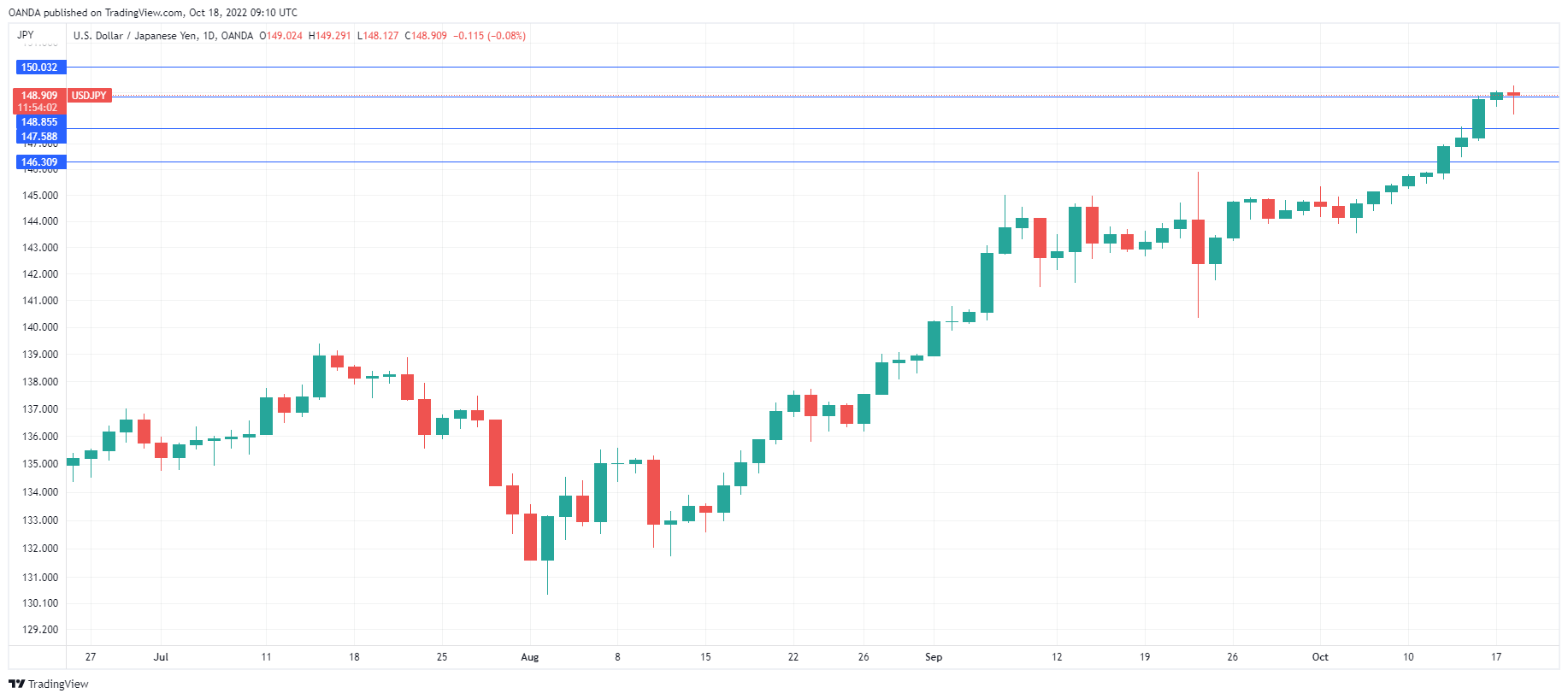
USD/JPY Technical
- USD/JPY faces resistance at 150.04 and 151.32
- There is support at 148.85 and 147.58
GBPUSD Faces a Rocky Path Ahead
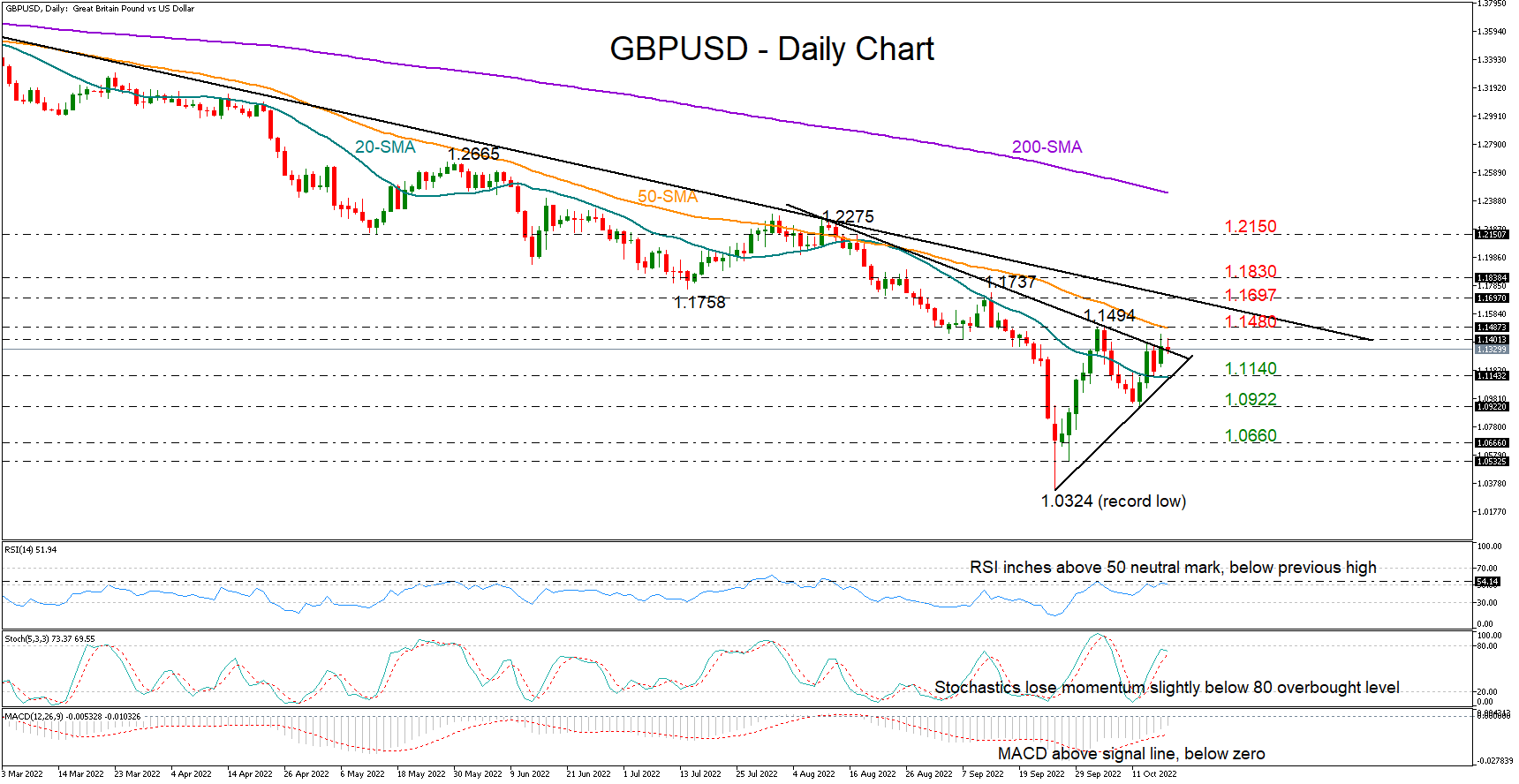
GBPUSD continued to flirt with the 1.1400 round level for the fourth consecutive trading day, despite its muted tone early on Tuesday.
The price was also pushing for a close above a short-term descending trendline, which has kept the bulls under control so far this month.
Despite the efforts, the technical picture continues to question the prospect for a meaningful rally. The RSI has barely increased above its 50 neutral mark, remaining below its previous high, while the stochastics seem to be looking for a bearish reversal not far below their 80 overbought level. Besides, with the 50-day simple moving average (SMA) and a longer-term descending trendline lying within a short distance from the current price action at 1.1480 and 1.1697 respectiv
Should the bulls dominate above the key constraining zone of 1.1830, the recovery could pick up steam to 1.2150.
On the downside, the 20-day SMA at 1.1140 may attract attention given its limitations last Friday. If it proves fragile, the pair may seek shelter near the previous low of 1.0922. Breaking that bar too, the sell-off could stabilize somewhere between 1.0660 and 1.0538 before heading for the record low of 1.0324.
In brief, although GBPUSD is trying to switch to the bullish side, there are still a couple of obstacles which stand in the way higher.
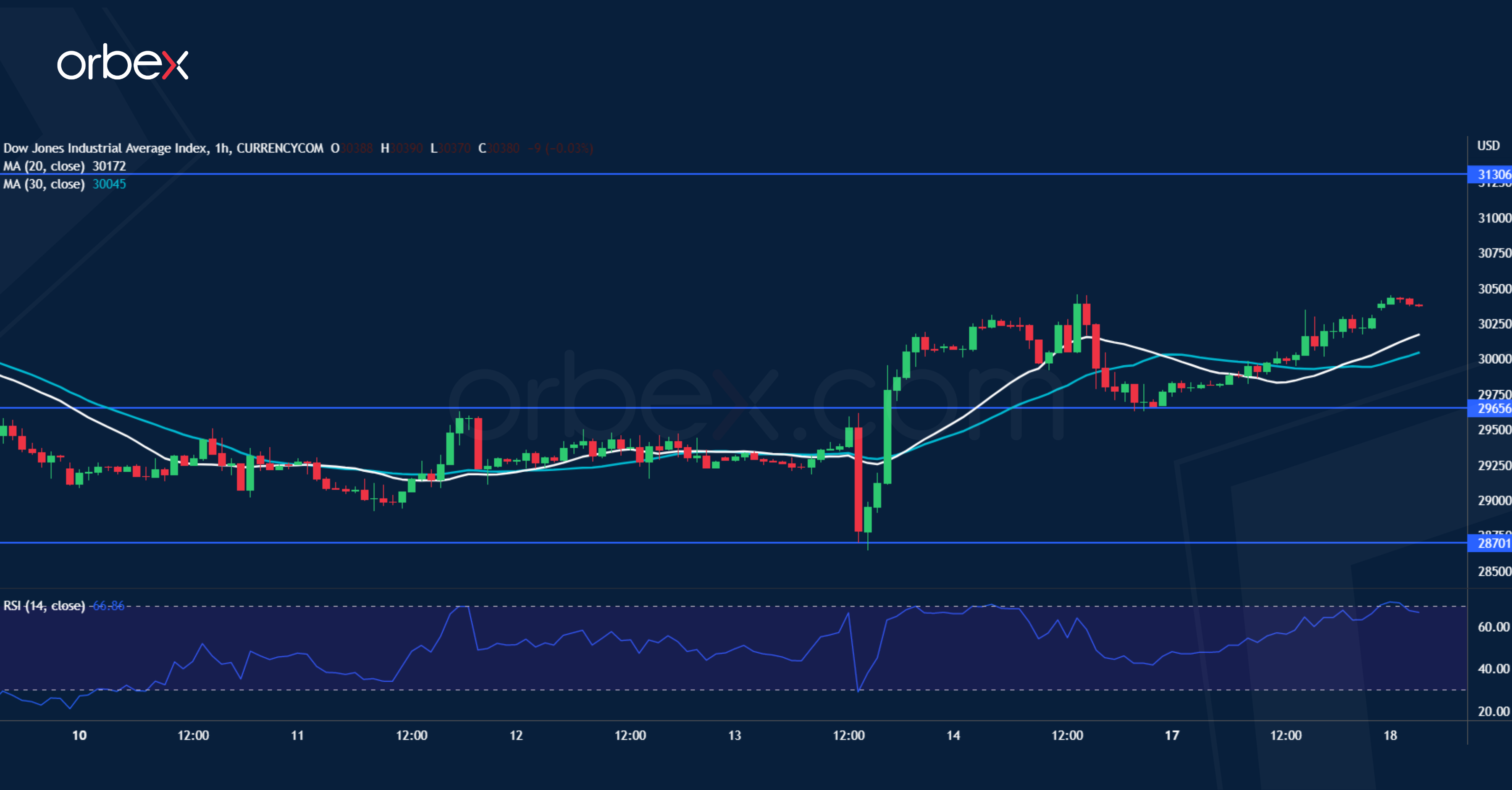
Dow Jones 30 Breaks Resistance
The Dow Jones 30 rallies over the optimism about Q3 corporate earnings. The double bottom at 28700 is a sign of solid buying to keep the index afloat. A close above 30400 next to the 30-day moving average would flush out selling interests and possibly attract momentum buyers. As the bulls regain confidence, 31300 would be the next target with 29650 as a fresh support. However, this could be a mere flag-shaped consolidation from the daily chart’s perspective as the index is in bear market territory.