

Sample Category Title
BoJ Opinions: Inflation Mission Changed to Preventing Inflation Overshoot
BoJ’s Summary of Opinions from July 30–31 meeting points to an important shift in policy thinking: debate is moving away from how to lift underlying inflation toward 2% and increasingly toward how to stop it from overshooting. One opinion captured change explicitly, saying focus of monetary policy has shifted from “lifting underlying CPI inflation to 2 percent” to “avoiding further upward deviation in underlying CPI inflation.” That does not mean immediate tightening is automatic, but it suggests reaction function is becoming more sensitive to upside inflation risks.
Case for holding policy steady in July rested largely on transmission lags rather than diminishing appetite for normalization. One member estimated that rate hikes take roughly one to one and a half years to weigh on inflation and economic activity, arguing that BoJ should first assess impact of previous increase. Yet several opinions simultaneously stressed that underlying CPI inflation is approaching, or becoming anchored around, 2%, while financial conditions remain accommodative. On that basis, members argued it remains appropriate to continue raising policy rate and reducing monetary accommodation as conditions warrant.
More hawkish part of discussion concerned pace and size of future hikes. One opinion said tightening could proceed “faster than market expectations” if economic activity, prices and financial conditions justify it. Another argued global environment has entered “a new phase” in which BoJ should respond more nimbly to overseas financial conditions and discuss size of a rate hike rather than adhering to a predetermined pace. Most forceful warning was that waiting carries its own risk: if inflation overshoots, BoJ could later be forced into “rapid and substantial” hikes, delivering what member described as a “double shock” to economy and households.
BoJ therefore appears to be moving from normalization driven by confidence in reflation toward normalization increasingly shaped by risk management against excessive inflation. Middle East developments, expansion in AI-related demand, foreign-exchange moves and rising medium- to long-term inflation expectations were all cited as factors requiring close attention. July hold should therefore not be read as retreat from tightening. If upside price risks strengthen while activity holds up, debate may shift quickly from whether BoJ hikes again to how fast — and by how much — it should move.
Key Takeaways
- BoJ’s policy debate is shifting from creating durable 2% inflation toward preventing inflation from overshooting.
- July hold reflected desire to assess lagged effects of previous hike, with one opinion estimating transmission takes around one to one and a half years.
- Several members still judged financial conditions accommodative and argued BoJ should continue raising policy rate as underlying CPI approaches 2%.
- One opinion warned pace of hikes could become “faster than market expectations” if economic activity, prices and financial conditions justify it.
- Debate is also broadening from timing to size of future hikes, with one member saying BoJ has entered a “new phase” requiring more nimble policy.
- Strongest hawkish argument was that waiting too long could force rapid and substantial hikes later, creating a “double shock” for economy and households.
- Middle East developments, AI-related demand, foreign-exchange moves and rising medium- to long-term inflation expectations are key upside risks to watch.
China Inflation Misses at 0.5% in July as Goods Prices Weaken, Services Hold Up
China’s consumer inflation slowed more than expected in July, but underlying breakdown was less uniformly weak than headline suggested. CPI eased from 1.0% to 0.5% y/y, below 0.8% consensus, while monthly CPI improved from -0.3% m/m to -0.1%, still missing expectations for a 0.2% increase. Food prices fell -1.5% y/y, while non-food inflation stood at 0.9%. Goods prices rose just 0.2% y/y, compared with a firmer 0.7% increase in services.
Monthly figures showed an even clearer split. Goods prices fell- 0.6% m/m, while services rose 0.4%, suggesting weakness was concentrated in merchandise rather than spreading evenly across economy. Food prices were unchanged overall, with pork rising 4.1% and fresh vegetables 1.3%, partly offset by a -3.8% drop in fresh fruit. Among non-food categories, education, culture and recreation rose 1.0%, while transportation and communication fell 2.2%.
Taken together, July data point to uneven rather than outright collapsing price pressure. Weak goods inflation and another negative monthly CPI reading still argue that domestic pricing power is limited, but resilience in services tempers a simple deflation narrative.
Alongside PPI slowing from 4.1% to 3.5% y/y, below 3.9% forecast, figures should leave Beijing room to support growth while keeping focus on whether services inflation can broaden into a more durable recovery in domestic demand.
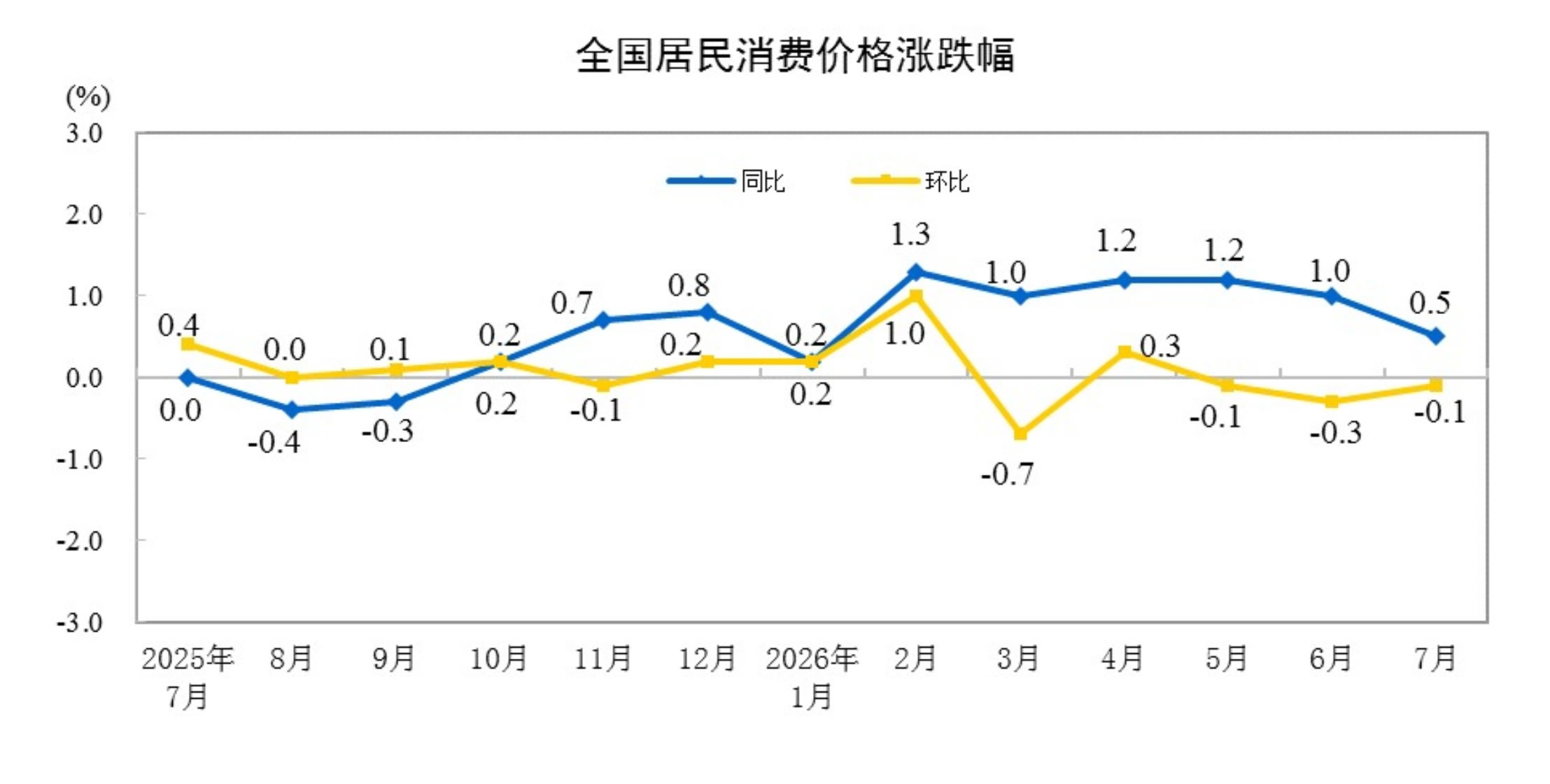
Data Summary
| Indicator | Actual | Expected | Previous |
|---|---|---|---|
| CPI m/m | -0.1% | 0.2% | -0.3% |
| CPI y/y | 0.5% | 0.8% | 1.0% |
| PPI y/y | 3.5% | 3.9% | 4.1% |
Key Takeaways
- China CPI slowed from 1.0% to 0.5% y/y in July, undershooting 0.8% forecast, while monthly CPI improved from -0.3% to -0.1% but remained below expectations for a return to growth.
- Headline weakness was not broad-based. Goods prices rose just 0.2% y/y and fell 0.6% m/m, while services prices increased 0.7% y/y and 0.4% m/m.
- Food prices fell 1.5% y/y, although monthly food prices were unchanged. Pork prices rebounded 4.1% m/m, while fresh fruit prices dropped 3.8%.
- PPI inflation slowed from 4.1% to 3.5% y/y, also below 3.9% forecast, pointing to easing upstream price pressure.
- Overall picture is one of uneven reflation rather than outright deflation: weak goods pricing and softer producer inflation contrast with firmer services prices.
- Data leave Beijing room to support growth without creating an immediate inflation constraint.
USD/JPY in Focus After U.S.-Japan Intervention
The Dow Jones Index reached new record highs last week as strong company earnings and continued buying of AI-related stocks lifted market confidence. Reports that the Strait of Hormuz could reopen also helped improve sentiment and pushed oil prices lower. Gold moved sharply higher after U.S. employment data showed employers cut 23,000 jobs in July, much weaker than expected and a sign that the U.S. economy may be slowing.
The U.S. ISM Manufacturing PMI was stronger than expected, showing that the manufacturing sector is holding up better than many investors had expected. Markets also continued to watch the impact of the recent coordinated currency intervention by Japanese and U.S. authorities, the first joint intervention in 15 years, which supported the Japanese yen.
Japan's Cabinet also approved a plan to reduce the consumption tax on food products from 8% to 1% for two years starting in April 2027. The measure, proposed by Prime Minister Sanae Takaichi, is designed to help households cope with higher living costs and encourage consumer spending.
Markets This Week
U.S. Stocks
The Dow Jones Index surprised many traders by reaching new record highs as positive sentiment returned to the stock market. The trend has turned higher, with the 10-day moving average now rising. Previous resistance around 53,000 is expected to act as support, making buying on pullbacks the preferred strategy this week. Resistance levels are at 54,500, 55,000 and 56,000. Support is seen at 53,000, 52,500, 51,500, 51,000 and 50,000.
Japanese Stocks
The Nikkei 225 moved above its recent downtrend as buyers returned to the market. Even though the Japanese yen remained strong, investors no longer saw this as a major negative. Concerns about U.S. government finances also appeared to have already been priced into the market. Technical indicators have not yet confirmed a new uptrend, so the index may continue to trade in a range. For short-term traders, buying near support and selling near resistance may be the best strategy this week. Resistance is at 67,000, 68,000, 69,000 and 70,000. Support is at 64,000, 63,000, 62,000, 61,000 and 60,000.
USD/JPY
USD/JPY fell sharply to around 155 after the United States and Japan confirmed they had carried out a joint currency intervention. Buyers returned later in the week as traders continued to focus on the large interest rate difference between the U.S. and Japan. Even after weak U.S. jobs data caused an initial sell-off, USD/JPY quickly recovered, showing strong buying interest at lower levels. The pair may continue to move higher this week, although the falling 10-day moving average could slow gains later in the week. Resistance is at 159.00, 160.00, 161.00, 162.00, 164.00 and 165.00, while support is at 157.00, 156.00, 155.00 and 154.00.
Gold
Gold surged higher last week as lower oil prices, continued buying by central banks, and weaker-than-expected U.S. employment data increased demand for safe-haven assets. Gold has traded quietly for several weeks, and last week's strong move could be the start of a new uptrend. In the short term, however, the market is becoming overbought, so short-term traders may find better opportunities by selling rallies. Medium-term traders should be cautious about selling and may find better buying opportunities on pullbacks toward the rising 10-day moving average. Resistance is at $4,400, $4,500 and $4,600, while support is at $4,200, $4,150, $4,050, $4,000 and $3,950.
Crude Oil
WTI crude oil started the week lower after the United States and Iran resumed talks, reducing concerns about supply disruptions. Selling continued through most of the week as traders became more confident that tensions in the Middle East would not get worse. Oil prices are still likely to remain volatile, but selling near the 10-day moving average may be the better strategy this week. Resistance is at $80, $90, $95, $100 and $105, while support is at $75.00, $67.50, $65.00 and $60.00.
Bitcoin
Bitcoin tested the $65,000 resistance level last week as stronger U.S. stock markets improved confidence in risk assets. Buyers were not able to break above this level, but buying interest remains strong. A break above $65,000 this week could lead to more buying, so looking for buying opportunities may be the better strategy. Resistance is at $65,000, $75,000, $80,000, $85,000 and $90,000, while support is at $60,000, $55,000 and $50,000.
This Week’s Focus
- Monday: Japan Current Account
- Tuesday: Australia RBA Interest Rate Decision, U.S. Existing Home Sales
- Wednesday: Japan Reuters Tankan Index, U.S. CPI
- Thursday: Japan PPI, U.K. GDP and Industrial Production, E.U. Industrial Production, U.S. PPI
- Friday: E.U. GDP and Trade Balance, U.S. Retail Sales and Michigan Consumer Sentiment
Another busy week is expected as traders watch U.S. inflation data, with the CPI and PPI likely to have a big impact on all markets. Markets will also follow the ongoing U.S.-Iran talks and any progress on reopening the Strait of Hormuz. Other key events include U.S. Retail Sales and the Michigan Consumer Sentiment Index, while traders will also be watching to see if Japanese authorities carry out any further intervention to support the yen.
How to Trade CPI Inflation Data: USDjpy & Gold Trading Strategies
Knowing how to trade the Consumer Price Index (CPI), one of the most important measures for inflation, is an essential skill for all types of traders, no matter their level of expertise. The CPI report has the power to shape central bank monetary policies and can send ripples through international markets. This comprehensive guide offers useful tips on how to interpret the CPI data, anticipate central bank reactions and execute disciplined trades with clarity while minimizing risk.
Why CPI Matters More than any Other Inflation Release
To start with, the Consumer Price Index (CPI) measures how the prices consumers pay for certain goods and services change over time. It is considered a key metric of inflation for any nation’s economy and an important indicator of economic health. However, the most closely followed CPI report in the world, is the one published by the US, currently the world’s largest economy. The Federal Reserve, seasoned traders and adept investors, take the monthly results into consideration before making their next moves.
A rising or falling CPI can directly influence interest rate expectations, which subsequently impacts the USD, Treasury yields, gold and JPY carry trades. As soon as the report goes public, asset prices start experiencing rapid swings until the markets eventually adjust to a level dictated by whether the data is higher, lower or at the exact same level as forecasts.
Understanding CPI Like a Pro
When looking into the rise and fall of goods and services’ prices, two separate inflation measures come up – Headline inflation and Core inflation. These two figures differ in the products they monitor and even though they are both critical economic indicators, the Core CPI tends to carry more weight for the Fed.
Headline CPI
The Headline CPI rate reflects the total inflation within an economy. This raw figure encompasses all goods and services including highly volatile items, like food and energy products, the prices of which are often susceptible to seasonal changes and can shift irrespective of economic conditions. Their inclusion means the figure is more aligned with changes in real-world costs but also more easily influenced by short-term price swings.
Core CPI
Core inflation is a version of CPI that filters out the prices of food and energy – highly volatile categories that can easily be affected by non-economic factors such as the weather, geopolitical events and more. Omitting these key products leads to a clearer snapshot of underlying inflationary trends which can better guide monetary policy in achieving its primary objective – safeguarding medium-term price stability. That is why the Fed relies more on Core CPI to form its central bank policy.
How CPI Moves Markets
When it comes to market reaction, the CPI forecast matters more than the actual figure. What markets respond to is the difference between the consensus forecast and the actual results. As deviation grows, the reaction becomes more intense resulting in price fluctuation, extensive stop-loss activation and the formation of a strong intraday trend. Keep in mind that the forecast is already priced in, what shifts prices is the element of surprise.
When CPI data exceeds expectations, market participants expect the Fed to raise interest rates to cool inflation down. Higher rates make yield-returning assets like government bonds more attractive to investors domestically and abroad. This scenario tends to strengthen the US dollar causing major pairs like the USDJPY to rise. At the same time, non-yielding precious metals like gold and silver can lose their appeal, which can trigger selloffs and a price dive.
If CPI results come in lower than expected, markets tend to expect a more dovish approach from the Fed. This can send off an instant alarm signal across global markets. Lower interest rates can decrease demand for dollar-denominated securities which in return weakens the US dollar. This could intensify market risk sentiment, driving investors to safe-haven assets like the Japanese Yen (JPY) and precious metals like gold. The increased capital inflows into these two assets can cause gold to rally and the USDJPY to drop.
How CPI Interacts with Other Data
Within the economy, circular patterns are predominantly present – changes in one sector can spill over to other areas. The CPI has a strong correlation with other key indicators like the PPI, the NFP, Wage Growth, and Retail Sales. They are all caught within a dynamic, interconnected feedback loop. None of them moves alone; changes in one tend to trigger changes in the others.
PPI – Producer Price Index
The Producer Price Index measures the change in prices for wholesale goods, revealing changes in raw input costs. Unlike the CPI that tracks price changes paid by consumers, the PPI shows how prices change for producers. Both measures show inflation in a different but complementary way.
When producers see their input costs climb higher, they tend to increase product prices to cover the higher expenses. Thus, customers are often burdened with additional charges. In cases like these, a higher PPI can lead to a higher CPI.
Wage Growth & NFP
Wage growth indicates the rate at which average salaries grow over time. On the other hand, the non-farms payroll report shows how many jobs were added or removed from the US workforce in manufacturing, construction and goods within a month. Both reports are key indicators of economic health, can affect living standards and inflation, and are taken into consideration by the FOMC when making interest rate decisions.
How are these metrics in constant interplay with inflation? A significant increase in jobs and fast wage growth can be evidence of inflationary pressures. Employers who hire more staff and pay them higher salaries need to raise product and service prices to maintain their profitability at the same levels. At the same time, the employees have more spending power which in turn increases the demand for goods and drives prices in the broader market even higher. These conditions can lead to higher CPI rates and can urge the FOMC, the US Federal Reserve policymaking body, to increase interest rates.
In contrast, a drop in jobs and slow wage growth can be a sign of economic slowdown. As salaries show no change and hiring slows down, consumers have less money to spend. This can cause demand for goods and services to decline, pushing product prices and the CPI down. In an attempt to boost the economy, the Fed could lower interest rates.
Retail Sales
Retail Sales is another major economic barometer which shows the total amount of products purchased by consumers within a specific period. In the US, Retail Sales are published monthly and constitute a vital measure for the national economy in which consumer spending represents two thirds of the gross domestic product.
The monthly figure often moves alongside the CPI. High sales can point towards an expanding economy in which consumer confidence is increased and demand is strong – conditions that can lead to higher inflation and potentially tighter monetary policy. Alternatively, declining sales can indicate an economic downturn, decreased household spending and weak demand for goods and services. In this scenario, inflation usually drops, which might prompt the Fed to lower interest rates to help stimulate the economy.
The General Rule
The PPI, Wage Growth, NFP and Retail Sales reports moving in the same direction can reveal a strong economic cycle. High figures provide firm evidence for economic expansion, in which the CPI is expected to rise. Low numbers give a strong signal for a declining economy and a lower CPI rate. In synchronized conditions like these, the CPI trade becomes highly probable.
How CPI Guides the Fed & why USDJPY Reacts Violently
The Fed has a dual mandate: to maintain price stability with a target inflation rate of 2% and keep the labor market healthy. The U.S. economic body closely watches the CPI, the key inflation metric, to adjust its monetary policy.
A low or falling CPI can reflect slow market growth which can prompt the Fed to lower interest rates. This reduces borrowing costs, which promotes business investment, helps boost consumer spending and revitalizes financial markets. However, if CPI comes in higher than expected, it signals that the economy could be growing too fast. In response to higher inflation, the Federal Reserve could increase interest rates which makes borrowing more expensive. This means less money enters the economy, businesses development halts, consumers spend less and investing declines.
USDJPY showcases heightened sensitivity to inflation, and it is a popular currency pair with investors for this type of setup. Let’s break down the why. To begin with, interest rate differentials between the US and Japan can considerably affect USDJPY. As we’ve seen, when the CPI rate climbs higher, the Fed raises interest rates, and Treasury yields increase. This makes the government-issued securities attractive investment options for local and international investors, strengthening the U.S. dollar and pushing the USDJPY exchange rate higher.
Now, let’s consider the opposite scenario. When CPI data comes in lower than expected, the Fed employs a looser monetary policy to boost the economy. This includes lower interest rates and in effect lower Treasury yields. The reduced return on the U.S. government debt securities makes them a less desirable investment option and causes a drop in the USD, which in turn translates into a lower USDJPY exchange rate.
How Gold (XAUUSD) Reacts to CPI
Decoding the relationship between the CPI and the price of gold is crucial if you are looking to capitalize on inflation and its subsequent wave of effects on the precious metal. The first thing you need to be aware of is that gold tends to move in the same direction as CPI and has a moderately inverse correlation to U.S. Treasury yields. Let’s delve deeper into this financial interplay.
Historically, when CPI increases pushing the Fed towards lower interest rates and Treasury yields, the price of gold generally tends to climb higher. This can be attributed to gold’s status as a safe-haven asset. When inflationary pressures cause purchasing power to drop and economic growth has to be slowed down with a tighter monetary policy, investors move funds into gold to protect their capital.
In the reverse situation, when the CPI is relatively stable or declining, the price of gold tends to show more variable patterns of movement, usually leading to a substantial drop. This points to other factors interfering with gold prices, when inflationary pressures are low. The general trend is that a drop in CPI, followed by a decrease in interest rates and Treasury yields, tends to push the US dollar lower and gold higher. However, it is advisable that you consider CPI data within a broader economic framework to ensure your moves align with the overall global market conditions.
The CPI Playbook: USDJPY & Gold
After you get a grasp of the significance of the CPI, the way it interacts with other key economic reports and correlates with USDJPY and gold, you can start trading any inflation-caused chain of reactions with confidence. To increase your chances of a successful outcome, a step-by-step plan of action is essential. We present you with our own expert strategy guidebook based on tested game plans applied by experienced macro traders in global markets.
USDJPY – CPI Strategy
Step 1 – Pre-News Preparation:
- Mark key levels – Note down the previous day’s highs and lows for the Asian and New York trading sessions
- Identify liquidity pools – chart areas where a large volume of pending orders could be triggered. Search for equal highs or lows pointing to consolidation zones. These points gather institutional interest and can turn into magnets for price.
- Reduce your position size – volatility tends to rise around the release of the CPI report
Step 2 – First Reaction:
- Ignore the market’s first reaction – the first spike is market noise, driven by algorithmic trading
- Do not trade during the first 1-2 minutes – volatility surges around this time
Step 3 – Wait for Confirmation
- Look for a Directional Candle within the 5-minute to 15-minute timeframe. The candle should:
- have a large real body and small wicks, giving a clear signal that markets moved strongly in a specific direction.
- close near a key high or low level.
NOTE: Beware of immediate wick rejection. In this case the candle shows significant move towards a particular direction and then reverses to close near its opening price.
- Wait for a Confirmation Candle – this gives the final confirmation for the trend, and it should display the below characteristics:
- Increased trading volume – signaling a large number of traders are active
- Close near the price’s peak or bottom – depending on whether it is an uptrend or downtrend
- Larger size – it is usually bigger than the previous candles
- Alignment with the trend – it should be bullish for a bullish trend, bearish for a bearish trend
Step 4 – Execute Based on CPI Outcome
If the CPI rate comes in above forecasts, the USDJPY exchange rate will most likely increase.
- Check that liquidity is above pre-release highs to confirm the market is bullish
- Place a stop loss below the Confirmation Candle low
- Buy USDJPY
If CPI rate comes in below forecasts, the USDJPY exchange rate will most likely decline.
- Check that liquidity is below pre-release lows to confirm the market is bearish
- Place a stop loss above the Confirmation Candle high
- Sell USDJPY
Start Trading USDJPY
Gold (XAUUSD) – CPI Strategy
Before entering this trade, please note that Gold is more volatile than USDJPY.
Step 1 – Mark the Pre-News Range
- Identify the high and low levels formed 30 – 60 minutes before the release of the CPI report.
Step 2 – Ignore the First Reaction
- The first post-CPI spike is often a fakeout.
Step 3 – Wait for Clear Acceptance
- Study candles within the 5-minute or 15-minute timeframe to confirm “acceptance levels” – levels the price is trading within and that buyers and sellers don’t try to break away from
- If the price breaks the range and holds, there could be trend continuation – the price will most likely continue in the same direction after the first reaction.
- If the price rejects the breakout, a reversal could emerge – the price will most likely continue moving in the opposite direction.
- Look for a Directional Candle within the 5-minute to 15-minute timeframe. The candle should:
- have a large real body and small wicks, giving a clear signal that markets moved strongly in a specific direction.
- close near a key high or low level.
NOTE: Beware of immediate wick rejection. In this case the candle shows significant move towards a particular direction and then reverses to close near its opening price.
- Wait for a Confirmation Candle – this gives the final confirmation for the trend, and it should display the below characteristics:
a. Increased trading volume – signaling a large number of traders are active
b. Close near the price’s peak or bottom – depending on whether it is an uptrend or downtrend
c. Larger size – it is usually bigger than the previous candles
d. Alignment with the trend – it should be bullish for a bullish trend, bearish for a bearish trend
Step 4 – Execute Based on CPI Results
If the CPI rate comes in above forecasts, the price of gold will most probably drop.
- Check that liquidity is below pre-release lows to confirm the market is bearish
- Place a stop loss above the Confirmation Candle high
- Sell XAUUSD
If the CPI rate comes in below forecasts, the price of gold will most probably rise.
- Check that liquidity is above pre-release highs to confirm the market is bullish
- Place a stop loss below the Confirmation Candle low
- Buy XAUUSD
Risk Management – The Most Important Part
Before you enter the markets, there’s one thing you need to understand – not every trade can be a successful one. That is why an effective trading strategy incorporates more than just checking numbers and performing technical analysis to identify the best time to enter and exit a position. It also includes a well-organized risk management plan to contain losses in case the price moves against you. The financial markets can be affected by a number of factors outside the economic sphere, including global politics, breaking news announcements and even natural disasters. Any unpredicted, sudden changes can cause sharp price swings which can be detrimental to your account and even lead to wipe-outs.
A solid risk management strategy helps you prevent uncontrolled losses, protect your capital, reduce emotional trading, achieve consistency, improve discipline and aim for profitability in the long run. To be able to hit all these targets, you need to incorporate tested practices in your trading:
1. Never risk a large percentage of your capital per trade
Ideally, you do not want to be allocating more than 1% to 2% of your balance on a single CPI trade. This ensures you only risk a small portion of your trading funds, and a single loss cannot affect your trading in the long term.
2. Use Limit Orders
The release of a CPI report often triggers high volatility. This can cause trading volume to dry up briefly and increase the risk of slippage – the risk of orders not being executed at the requested level but getting filled at a worse price than expected. Setting limit orders and pre-defining the execution price helps you have better control over limiting losses. However, make sure you set your stops wide enough to allow for normal price fluctuations and retracements without forcing trades to be stopped out prematurely.
3. Reduce Position Size
Choosing the proper position size can protect your trade from the dangers of overexposure and changing financial conditions. To better determine the size of your position, take into consideration your risk tolerance, the post-CPI release market and the probability of your CPI trade based on your technical analysis.
4. Avoid Revenge Trading
When met with setbacks, impulse and emotion can very easily take over from logic. Many of you may have already fallen into the trap of revenge trading – trying to recover from losing trades fast, only to end up with even more hits on your balance. To avoid this pitfall, you need to step away from the trading platform after a loss, give yourself some time to assess the situation and return with a calm, clear and focused mindset.
The Final Overview
Understanding inflation and the economic effects of the CPI report is an advanced skill that can help you make more informed trading decisions and place higher-probability trades in markets whose inner workings you can now see more clearly. From explaining the importance of the US CPI, its interdependent relationship with other key economic indicators, the ways it can affect the decisions of the Federal Reserve and move the prices of USDJPY and gold to detailed step-by-step trading strategies for the globally popular assets, this article covers all you need to trade the CPI with precision and confidence.
Gold – Extended Recovery May Pause for Consolidation Before Resuming Above Daily Cloud
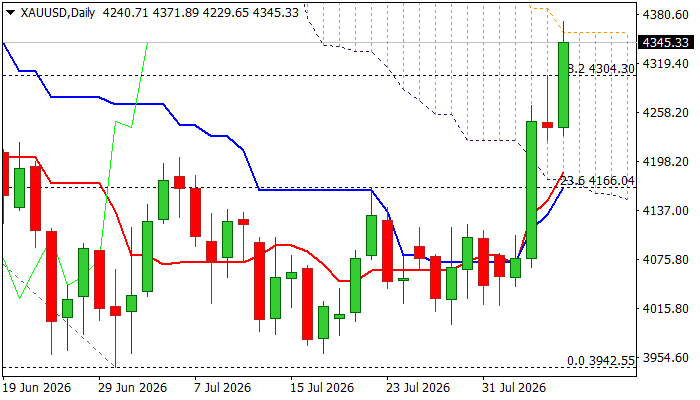
Gold resumes advance on Friday after bulls paused previous day and hit new seven- high ($4371), on track for the biggest weekly gain since the third week of January.
Disappointing US July labor data on Friday contributed to fading expectations for Fed rate hike in September that further boosted demand for the yellow metal, although, markets await release of US inflation report for July (due next week) to get more details about the monetary policy near-term outlook.
Fresh gains broke through important barrier at $4304 (Fibo 38.2% of $4889/$3942 descend) with weekly close above this level to confirm bullish signal and further strengthen near-term structure.
Bulls cracked next barrier at $4358 (daily Ichimoku cloud top) although may take a breather here, due to stretched daily studies and partial profit-taking at the end of the week, before resuming towards targets at target at $4390 (100DMA); $4400 (round-figure) and $4416 (50% retracement).
Dips should be limited and ideally contained by broken Fibo 38.2% barrier, to keep bulls intact.
Res: 4358; 4371; 4390; 4416
Sup: 4304; 4230; 4204; 4175
Gold Wave Analysis
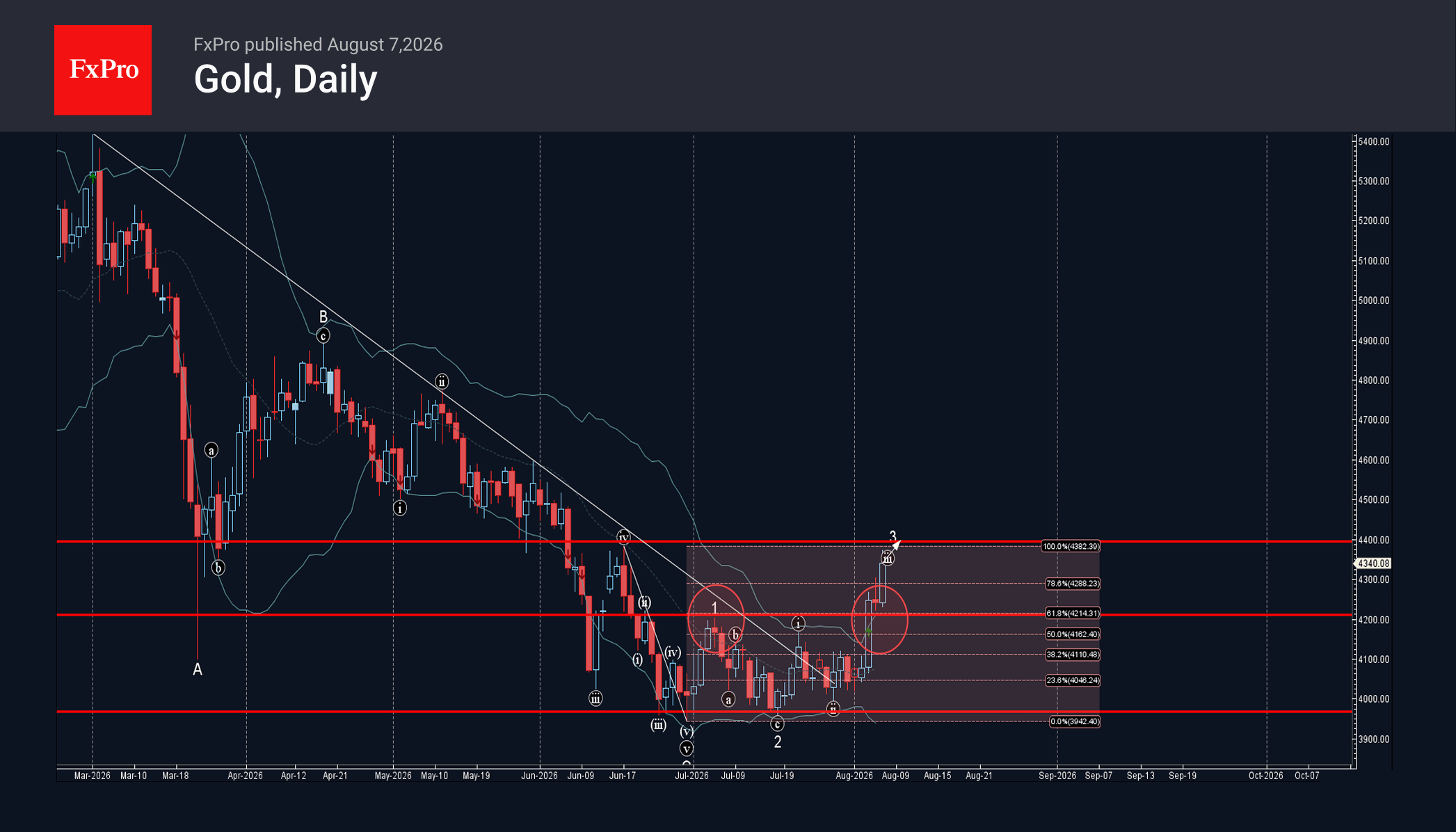
Gold: ⬆️ Buy
– Gold broke resistance zone
– Likely to rise to resistance level 4400.00
Gold recently reversed broke the resistance zone between the long-term resistance level 4210 (top of wave 1 from July) and the 61.8% Fibonacci correction of the downward impulse from June.
The breakout this resistance zone accelerated the active short-term impulse wave iii from the end of July.
Gold can be expected to rise further to the next resistance level 4400.00 (top of wave iv from June and the target for the completion of wave 3).
Natural Gas Wave Analysis
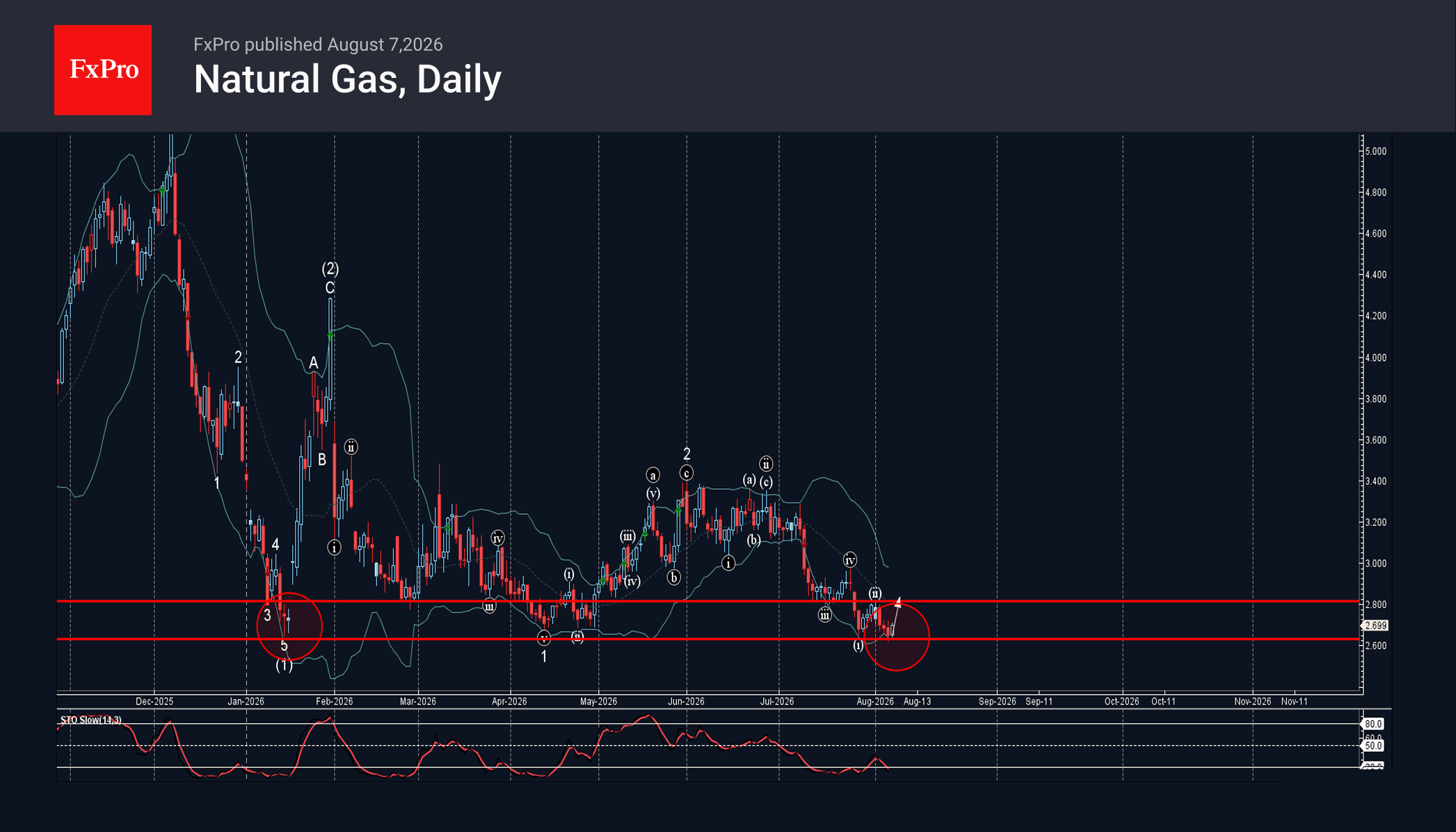
Natural Gas: ⬆️ Buy
– Natural Gas reversed from long-term support level 2.635
– Likely to rise to resistance level 2.800
Natural Gas earlier reversed from the major long-term support level 2.635 (which has been reversing the price from the start of 2026, as can be seen below).
The support zone near the support level 2.635 was strengthened by the lower daily Bollinger Band.
Given the proximity of the support level 2.635 and the oversold daily Stochastic, Natural Gas can be expected to rise further to the next resistance level 2.800 (top of the previous correction ii).
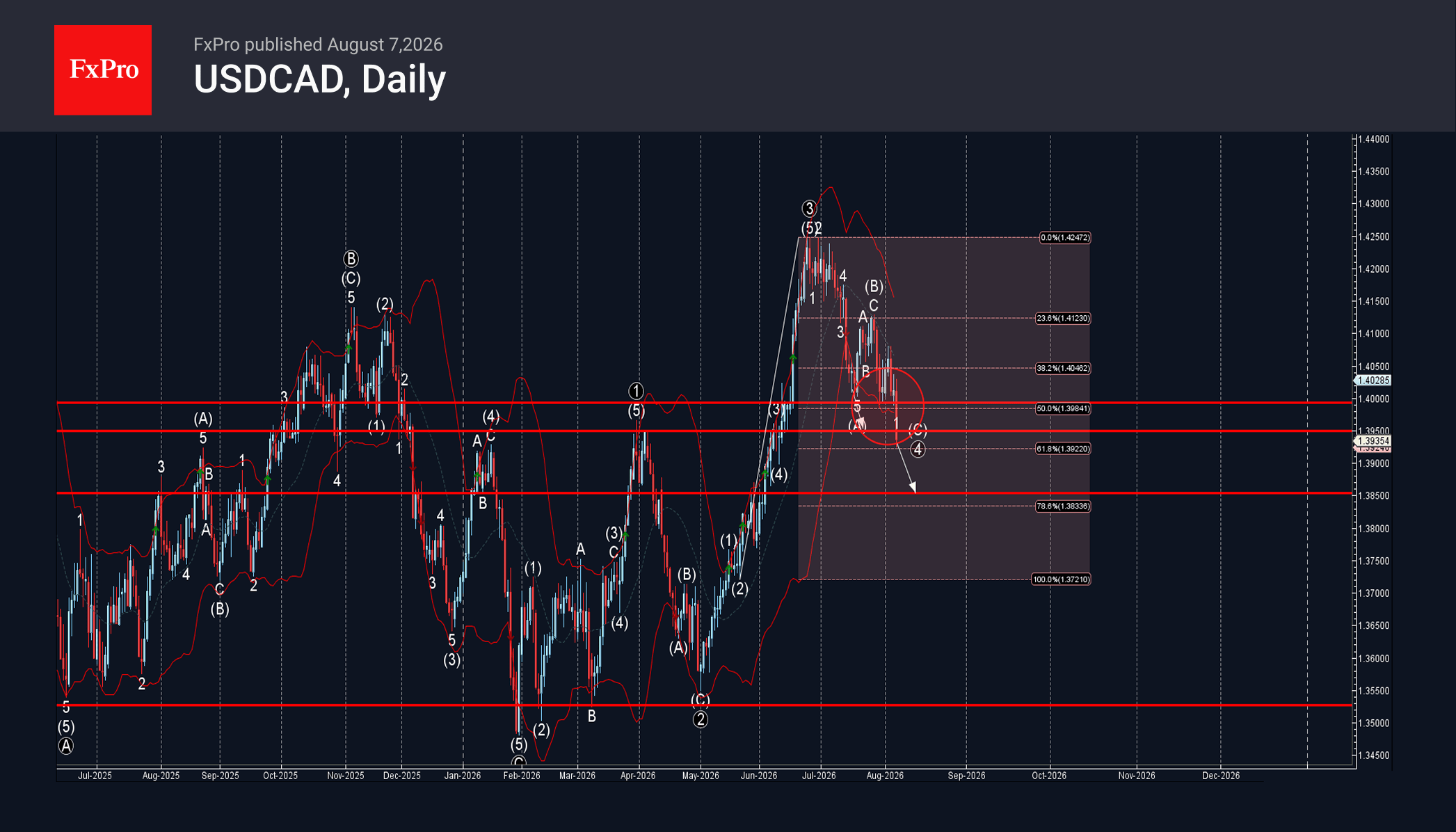
USDCAD Wave Analysis
USDCAD: ⬇️ Sell
– USDCAD broke the support zone
– Likely to fall to support level 1.3850
USDCAD currency pair recently broke the support zone between the support levels 1.4000 (low of the previous wave (A)) and 1.395 (former strong resistance from April).
The breakout pf this support zone coincided with the breakout of the 50% Fibonacci correction of the sharp upward impulse from May.
Given the bearish US dollar sentiment seen today, USDCAD currency pair can be expected to fall further to the next support level 1.3850.
Eco Data 8/10/26
| GMT | Ccy | Events | Act | Cons | Prev | Rev |
|---|---|---|---|---|---|---|
| 01:30 | CNY | CPI M/M Jul | -0.10% | 0.20% | -0.30% | |
| 01:30 | CNY | CPI Y/Y Jul | 0.50% | 0.80% | 1.00% | |
| 01:30 | CNY | PPI Y/Y Jul | 3.50% | 3.90% | 4.10% | |
| 23:50 | JPY | Bank Lending Y/Y Jul | 5.40% | 5.70% | 5.70% | |
| 23:50 | JPY | BoJ Summary of Opinions | ||||
| 23:50 | JPY | Current Account (JPY) Jun | 1.40T | 2.51T | 3.06T | |
| 05:00 | JPY | Eco Watchers Survey: Current Jul | 45.7 | 44.6 | 44 | |
| 08:30 | EUR | Eurozone Sentix Investor Confidence Aug | 0.9 | -1.3 | -3.1 |
| 01:30 | CNY |
| CPI M/M Jul | |
| Actual | -0.10% |
| Consensus | 0.20% |
| Previous | -0.30% |
| 01:30 | CNY |
| CPI Y/Y Jul | |
| Actual | 0.50% |
| Consensus | 0.80% |
| Previous | 1.00% |
| 01:30 | CNY |
| PPI Y/Y Jul | |
| Actual | 3.50% |
| Consensus | 3.90% |
| Previous | 4.10% |
| 23:50 | JPY |
| Bank Lending Y/Y Jul | |
| Actual | 5.40% |
| Consensus | 5.70% |
| Previous | 5.70% |
| 23:50 | JPY |
| BoJ Summary of Opinions | |
| Actual | |
| Consensus | |
| Previous | |
| 23:50 | JPY |
| Current Account (JPY) Jun | |
| Actual | 1.40T |
| Consensus | 2.51T |
| Previous | 3.06T |
| 05:00 | JPY |
| Eco Watchers Survey: Current Jul | |
| Actual | 45.7 |
| Consensus | 44.6 |
| Previous | 44 |
| 08:30 | EUR |
| Eurozone Sentix Investor Confidence Aug | |
| Actual | 0.9 |
| Consensus | -1.3 |
| Previous | -3.1 |
Weak NFP Flips Fed Bets, but Oil Keeps Markets Trapped in Tug-of-War
TL;DR: July's shockingly weak NFP report flipped September Fed odds toward a hold, but with Brent still above $80 and the Strait of Hormuz crisis unresolved, Treasury yields, the Dollar, and equities all stopped short of a full dovish repricing.
An Incomplete Post-NFP Reaction
US markets ended the week caught in an increasingly uncomfortable tug-of-war. July's employment report revealed a much sharper deterioration in the labor market than previously understood, strengthening the case for the Fed to stay on hold in September. Yet the Middle East crisis remains unresolved, with Brent holding above $80 and keeping inflation risks elevated.
The result was an unusually incomplete post-NFP reaction: Fed expectations flipped, but Treasury yields refused to break lower, the Dollar held major technical support, and Wall Street offered only a restrained celebration.
Payrolls provided plenty of reason for a larger response. Nonfarm employment unexpectedly contracted -23K in July, while substantial downward revisions to May and June showed weakness had been developing more clearly than previously reported. Coming after a disappointing Q2 GDP print, the report raised a more serious question over whether the US economy is losing momentum faster than investors and the Fed had assumed.
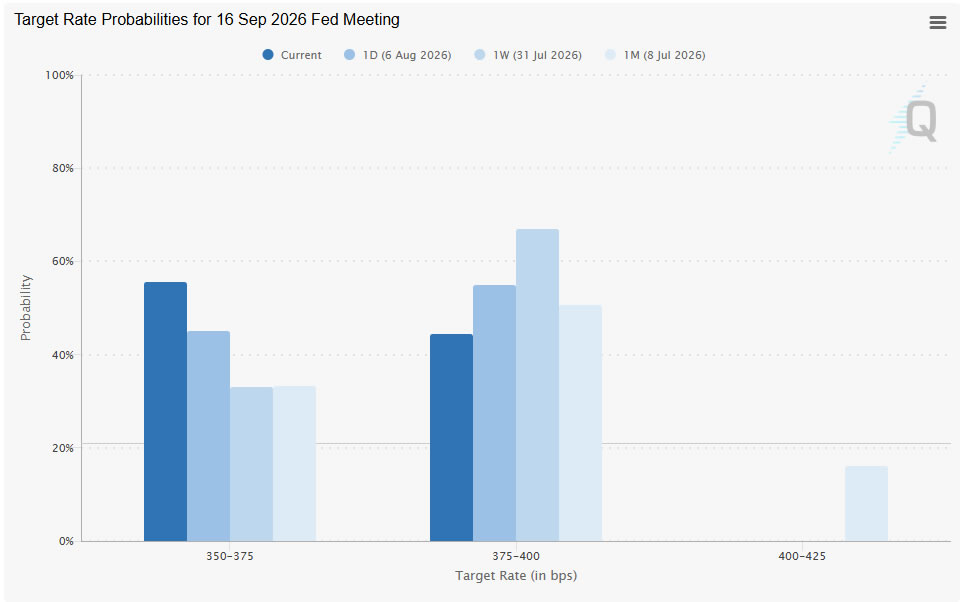
Markets nevertheless stopped well short of embracing a full dovish trade. September pricing shifted from a slight preference for another Fed hike to a slight preference for a hold, but remained close to a coin flip. The 10-year Treasury yield held around the critical 4.60 area, while the Dollar Index stopped its post-NFP slide around key 99.41 support. At the same time, the Dow and S&P 500 had little enthusiasm for rallying strongly on lower rate expectations, despite both reaching records earlier in the week.
That divergence captures the central tension heading into next week. Labor deterioration is making another Fed hike harder to justify, but unresolved oil-driven inflation risk is preventing markets from confidently ruling one out. Meanwhile, weaker growth is limiting how enthusiastically equities can celebrate a more dovish Fed outlook.
Weak NFP Flips the Fed Debate, but Doesn't Settle It
Friday's jobs report significantly raised the hurdle for another Fed hike. More important than July's 23K payroll decline was evidence that weakness had been building beneath the surface for months. May and June employment gains were revised down by -103K combined, while wage growth slowed sharply. Falling unemployment to 4.1% offered some reassurance, but lower labor force participation diluted that signal.
Markets reflected that change without reaching a firm conclusion. September pricing flipped from roughly 55% probability of a hike and 45% for a hold before NFP, to around 55% for a hold and 45% for a hike afterward. That's a meaningful reversal, but still remarkably close given the severity of the employment disappointment.
The reason is that payrolls answer only one side of the Fed's problem. The labor market is weakening, but inflation risk hasn't disappeared. NFP has made another hike considerably harder to justify; it hasn't yet given the Fed confidence that tightening is no longer necessary. For that, markets may need a clearer signal from oil — and ultimately from the Strait of Hormuz.
Hormuz and $80 Oil Explain Why the Fed Repricing Stopped Short
Oil provides much of the explanation for why such a weak jobs report failed to produce a more decisive Fed repricing. Optimism built during the week that the US could soon reach an understanding with Iran to reopen the Strait of Hormuz, helping push Brent down to $78.11. But the expected agreement never arrived, and Brent reversed to close the week at $82.37 — still well above July's $70.14 low.
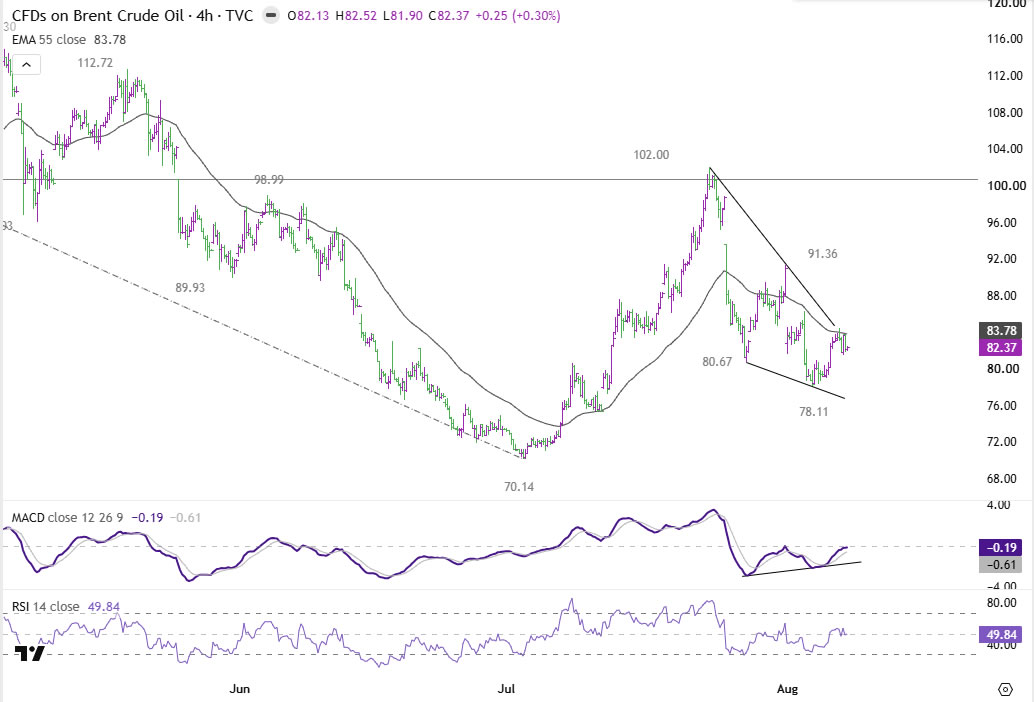
Price action suggests oil traders were willing to price a greater probability of an agreement, but not resolution of the crisis itself. Iran and Oman have made progress on a proposed shipping arrangement, yet important questions remain over how transit would operate, which vessels would be permitted through the Strait, and whether any initial arrangement would provide more than temporary relief. Meanwhile, broader regional military risks have hardly disappeared.
That distinction matters enormously for the Fed. A durable reopening of Hormuz accompanied by a sustained fall in oil would remove an important source of inflation pressure at precisely the moment the US labor market is weakening. Instead, Brent remaining above $80 leaves policymakers confronting both sides of the dual mandate at once: deteriorating employment argues against another hike, while elevated energy prices and continuing supply risks argue against declaring the inflation threat contained.
Treasury Yields Become the Confirmation Test
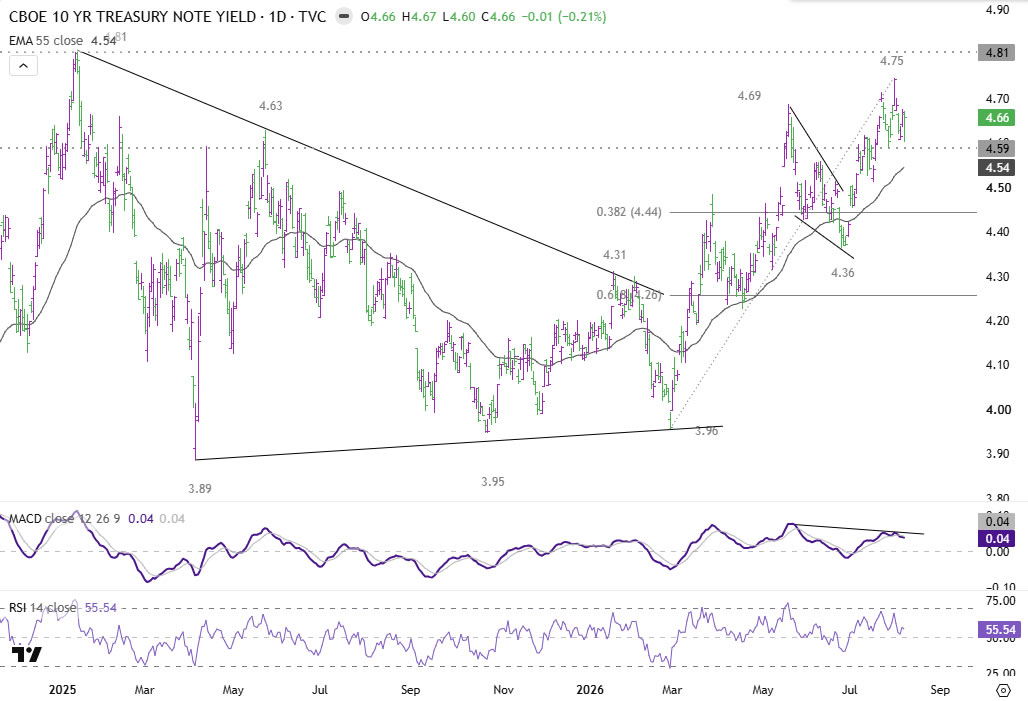
The Treasury market now provides one of the clearest tests of whether the post-NFP dovish shift has further to run. Given the scale of the payroll disappointment and downward revisions, the 10-year yield might ordinarily have been expected to break decisively lower. Instead, it recovered to close around 4.66%, suggesting investors aren't yet prepared to dismiss persistent inflation risk.
Technically, price action from 4.75 can still be treated as consolidation within the rally from 4.36. The 10-year yield continues to hold around the 4.59–4.61 support zone, which also contains the 55 4H EMA. As long as this area holds, near-term structure remains consistent with another attempt at 4.75 at a later stage, while the broader rise from 3.96 stays intact.
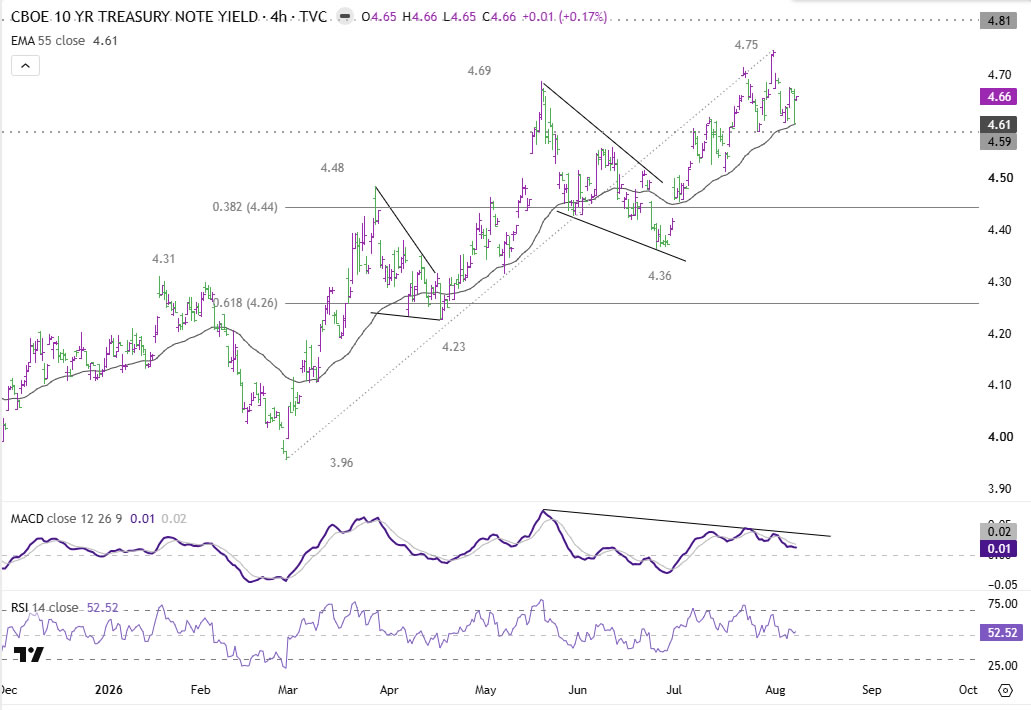
A decisive break below 4.59–4.61 would change that picture. It would argue the decline from 4.75 is developing into a correction of the broader rise from 3.96, bringing 4.44 — the 38.2% retracement of 3.96 to 4.75 — into focus. Bearish divergence in momentum indicators adds weight to that downside risk, but price confirmation is still missing.
Dollar Index Tests Key Support as Yields Refuse to Break
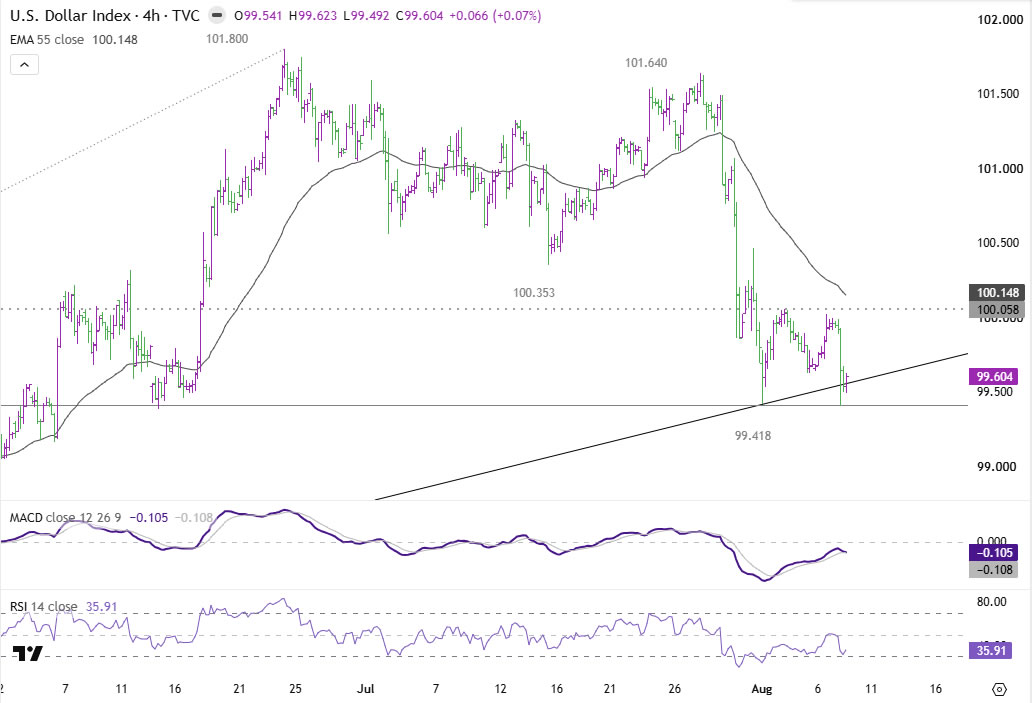
The Dollar's post-NFP weakness is another expression of the same tug-of-war rather than a separate market story. Softer employment data pushed Fed expectations toward a hold, but with Treasury yields refusing to break lower, the Dollar selloff also stopped short of confirming a larger bearish reversal. The Dollar Index ended the week around 99.60, close to an important technical crossroads.
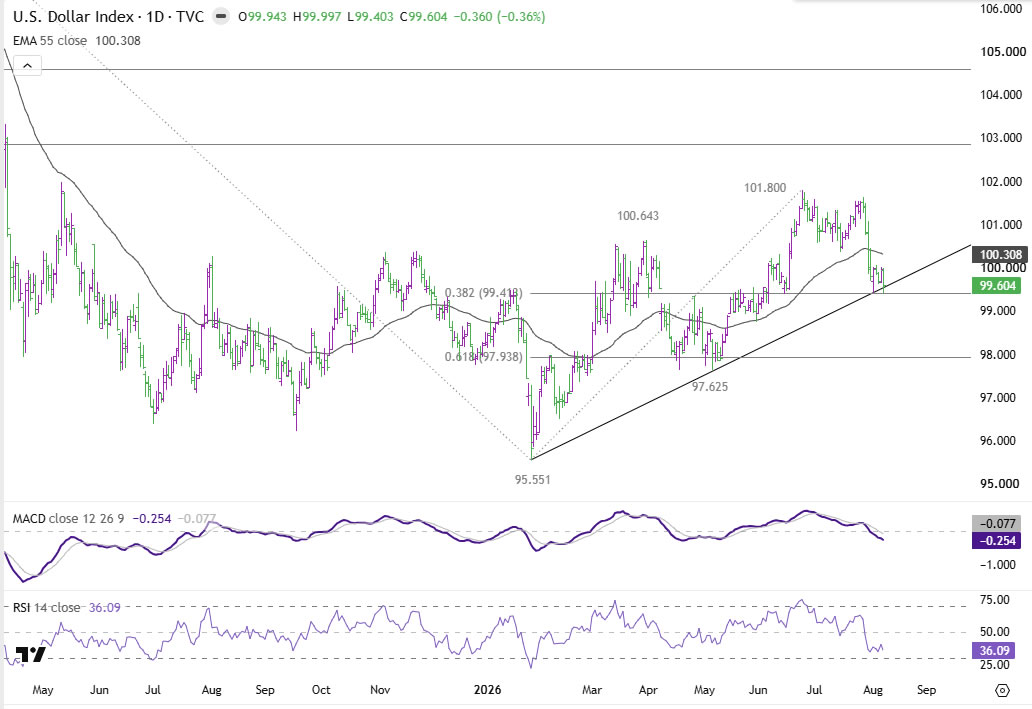
The DXY is currently defending both rising trendline support and 99.41, the 38.2% retracement of the rise from 95.55 to 101.80. A strong rebound from the current area, followed by a break of 100.05 resistance, would keep the near-term bullish outlook intact, leaving room for another challenge of 101.80 and, eventually, resumption of the whole rise from 95.55.
But a decisive break of 99.41 would carry much more bearish implications. It would strengthen the case that the rebound from 95.55 completed at 101.80 as a three-wave corrective move, exposing 97.38, the 61.8% retracement, next. Such a break would also fit with Treasury yields finally giving way below their own support zone.
Why Didn't Wall Street Celebrate Weak NFP?
Equities exposed the other side of the market's tug-of-war. Lower Fed hike expectations would normally provide a strong tailwind for stocks, particularly after such a large downside surprise in employment. Yet Friday's response was restrained: the Dow gained just 0.28%, while the S&P 500 rose 0.62%. The Nasdaq performed better with a 1.30% advance, but remained well below its record high.
That suggests investors didn't interpret NFP as benign Goldilocks weakness. A modest cooling in employment could have been welcomed as exactly what the Fed needs to keep rates unchanged without threatening growth. Instead, outright payroll contraction accompanied by substantial downward revisions raised a different concern: the labor market may be deteriorating faster than previously understood. Lower rate expectations therefore came with a less favorable reason behind them.
This distinction becomes more important while inflation risks remain elevated. A resilient economy operating with above-target inflation and restrictive Fed policy is something equity investors have largely learned to tolerate. More problematic would be weakening growth before inflation has fallen sufficiently to give the Fed freedom to respond — a combination that would push markets closer to a stagflationary scenario, where lower growth doesn't automatically translate into meaningful monetary support.
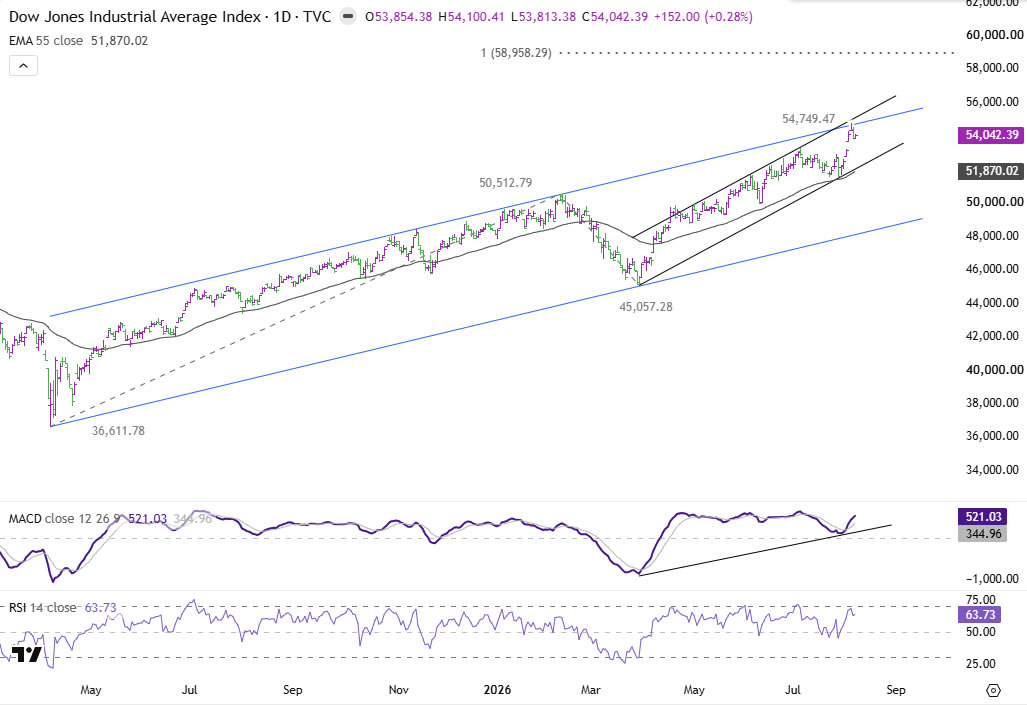
The Dow's technical position reflects that hesitation. The index reached a fresh record at 54,749.47 during the week but is now confronting resistance from both the channel defining the rise from 45,057 and the larger channel governing the uptrend from 36,612. Some consolidation below the record would therefore be unsurprising; the underlying outlook remains bullish as long as the near-term channel floor, currently around 52,000, holds.
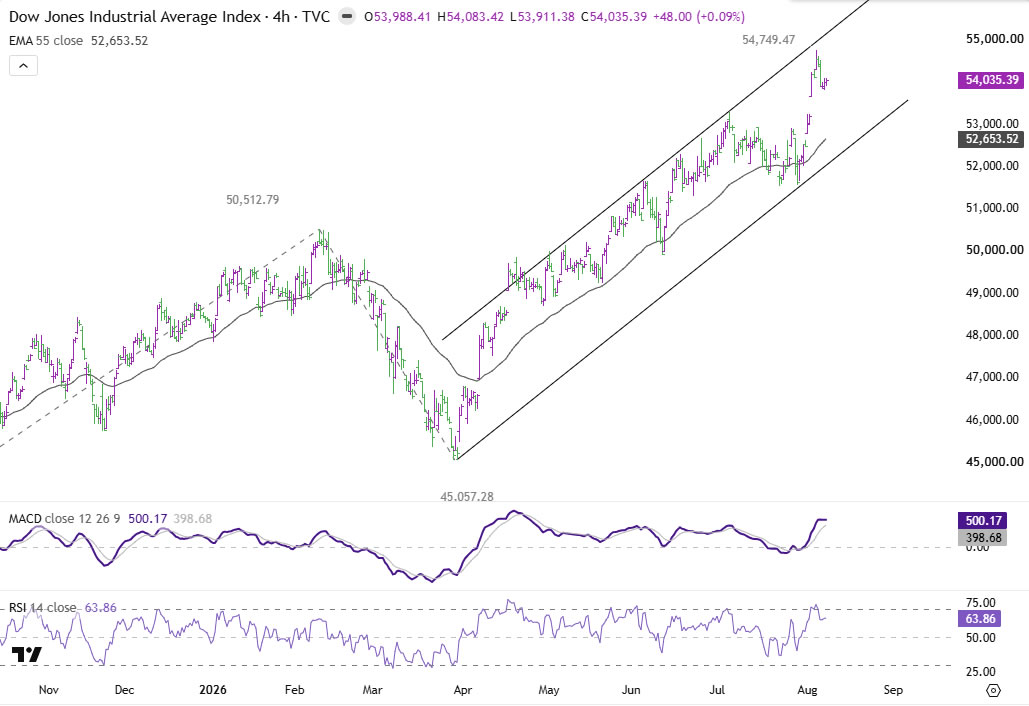
A decisive break through 54,749 would likely require a stronger catalyst than lower Fed hike odds alone. A credible resolution of the Hormuz crisis could provide one: lower oil would ease inflation risk, reinforce Fed hold expectations, and reduce a major geopolitical drag on confidence at the same time. Such a breakout would open the way toward 58,958, based on the 100% projection from 36,612.
What Could Break the Tug-of-War
Markets are entering next week without a clear winner between weakening growth and persistent inflation risk. NFP has established that the US labor market is softer than previously believed, but it hasn't established that the Fed is free to respond. Much could depend on whether Middle East developments finally deliver sustained relief in oil prices:
- Weak employment combined with falling oil is the cleanest scenario. A credible and durable reopening of the Strait of Hormuz that pushes Brent materially lower would ease one of the Fed's most immediate inflation concerns just as labor conditions deteriorate. September hike expectations could then fade much more decisively, putting the 10-year yield's 4.59–4.61% support and the Dollar Index's 99.41 level under renewed pressure, while equities would receive both lower-rate and lower-energy-cost tailwinds.
- US data stabilizing while oil remains elevated would restore some credibility to Fed hawks' argument that the economy can withstand additional tightening. Treasury yields could challenge 4.75% again, the Dollar could rebound from current support, and equities would have to absorb the prospect of restrictive policy lasting longer.
- Further US growth deterioration while oil remains above $80 or rises again is the most difficult combination. The Fed would face weakening employment without corresponding relief on inflation, increasing the risk of a stagflationary environment in which policymakers have little room to support the economy — also challenging current equity resilience, since bad economic news would no longer come with a straightforward promise of easier monetary policy.
Friday's NFP told investors something important: the US labor market is weaker than they thought. What it hasn't answered is whether the Fed can safely respond. As long as Brent remains elevated and the Hormuz crisis unresolved, that question increasingly depends on developments outside the US economic calendar.
Key Takeaways
- July NFP contracted -23K with -103K in combined downward revisions to May and June, flipping September Fed odds from 55% hike/45% hold to roughly 45% hike/55% hold.
- Brent's reversal from $78.11 back to $82.37 after a failed Hormuz agreement kept oil-driven inflation risk alive, preventing a fuller dovish Fed repricing.
- The 10-year Treasury yield held its 4.59-4.61% support and the Dollar Index defended 99.41, both signaling markets aren't yet ready to fully dismiss inflation risk.
- Wall Street's muted reaction (Dow +0.28%, S&P +0.62%) suggests investors read the NFP miss as a growth warning, not benign Goldilocks weakness.
- The cleanest dovish path requires both weak US data and falling oil from a durable Hormuz resolution; oil staying elevated or growth weakening further would instead risk a stagflationary setup.