

Sample Category Title
GBP/JPY Weekly Outlook
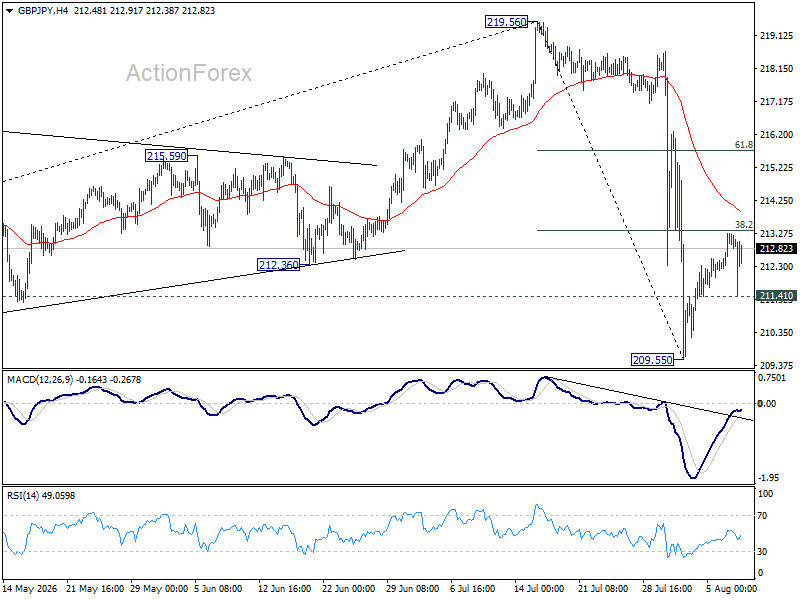
GBP/JPY rebounded after initial fall to 209.55 last week. Initial bias stays neutral this week for some consolidations. Risk will remain on the downside as long as 55 4H EMA (now at 213.94) holds. Break of 211.31 minor support will bring retest of 209.55 low. Firm break there will resume the fall from 219.56 to 38.2% retracement of 184.35 to 219.56 at 206.10.
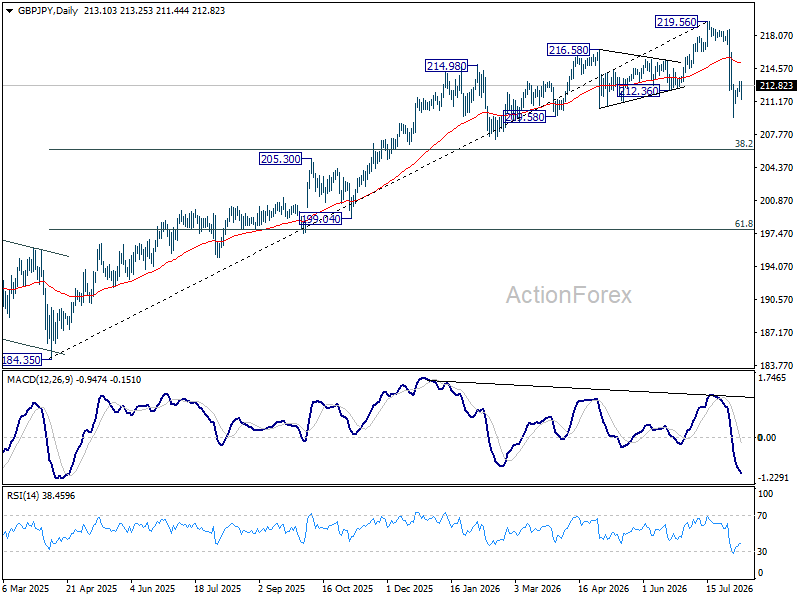
In the bigger picture, focus is on 55 W EMA (now at 208.91). Strong rebound from there will keep the up trend from 123.94 (2020 low) intact. Another rally is expected through 219.56 at a later stage. However, sustained break of 55 W EMA will argue that it's already in a medium term down trend to 184.35 support.
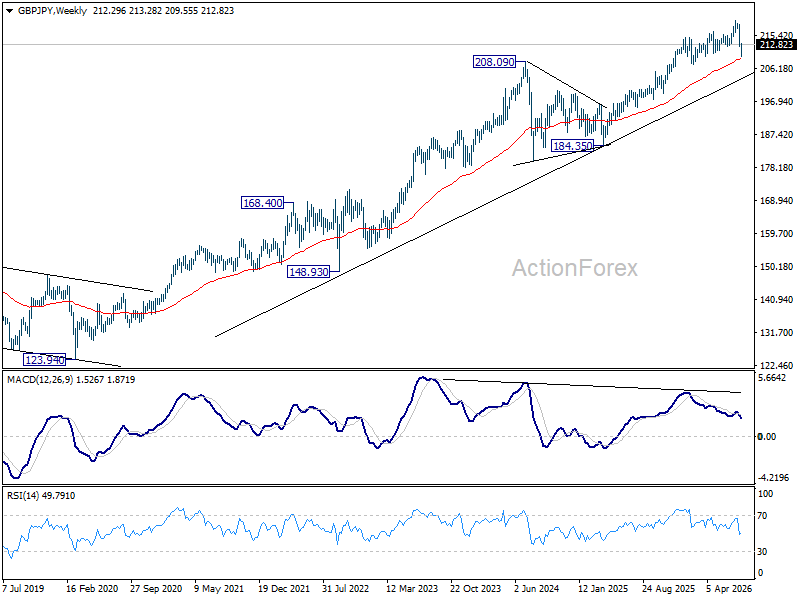
In the long term picture, up trend from 116.83 (2011 low) is in progress. Next target is 251.09 (2007 high). This will remain the favored case as long as 55 M EMA (now at 188.96) holds.
EUR/JPY Weekly Outlook
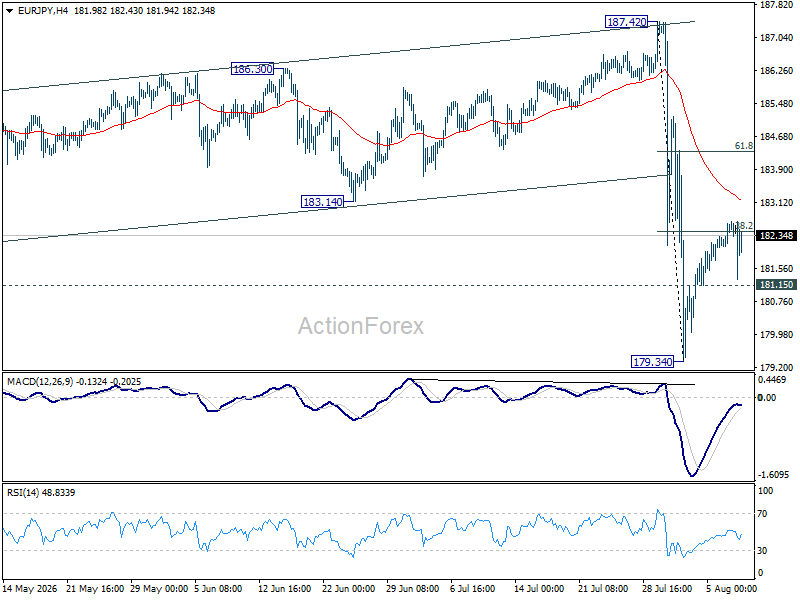
EUR/JPY rebounded after initial fall to 179.34 last week. Initial bias stays neutral this week first and more consolidations would be seen. But risk will remain on the downside as long as 55 4H EMA (now at 183.17) holds. On the downside, below 181.15 will bring retest of 179.34 low first. Firm break there will resume larger fall from 187.93 to 38.2% retracement of 154.77 to 187.93 at 175.26.
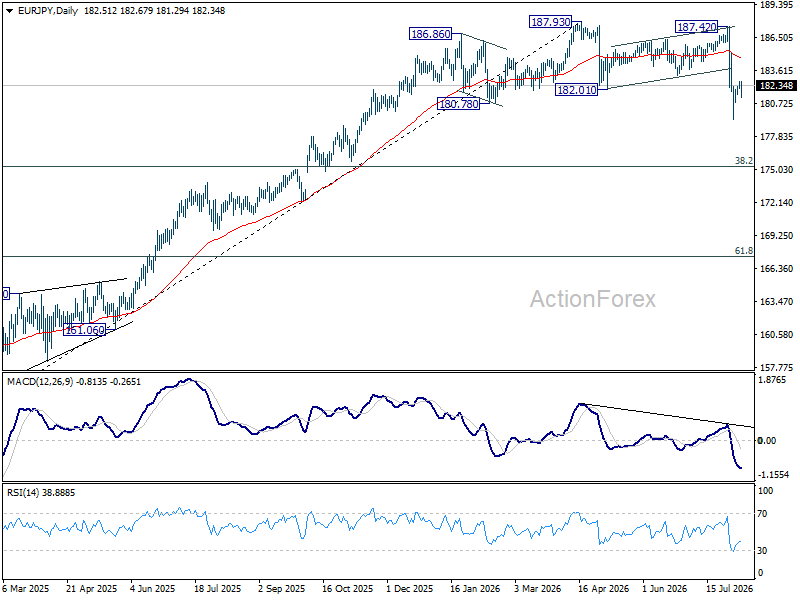
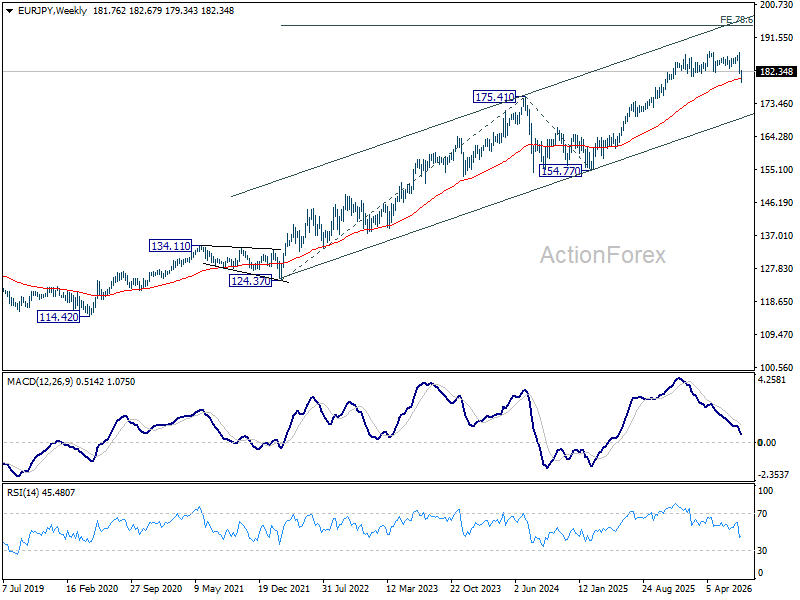
In the bigger picture, focus is now on 55 W EMA (now at 180.17). Strong rebound from there will indicate that the up trend from 114.42 (2020 low) remains intact. That would set up another rally through 187.93 to 78.6% projection of 124.37 (2022 low) to 175.41 (2025 high) from 154.77 at 194.88. However, sustained break of 55 W EMA will argue that it's already in a medium term down trend to 175.41 resistance turned support and below.
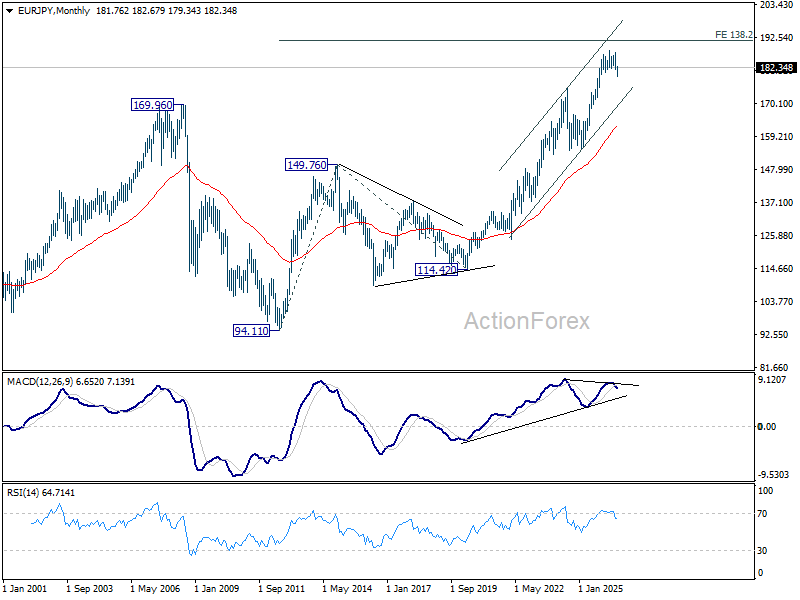
In the long term picture, up trend from 94.11 (2021 low) is in progress. Next target is 138.2% projection of 94.11 to 149.76 (2014 high) from 114.42 (2020 low) at 191.32. This will remain the favored case as long 55 W EMA holds.
EUR/GBP Weekly Outlook
EUR/GBP stayed in tight range below 0.8585 last week and outlook is unchanged. Initial bias remains neutral this week first. While rebound from 0.9453 might extend, strong resistance should be seen from 0.8610 support turned resistance to limit upside. On the downside, break of 0.8528 support will argue that the corrective rebound from 0.8453 has completed, and turn bias back to the downside for retesting this low.
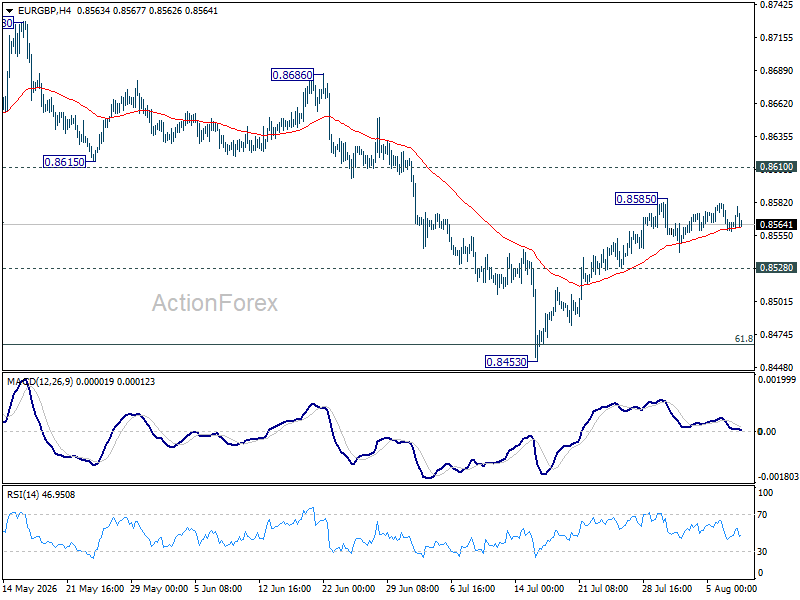
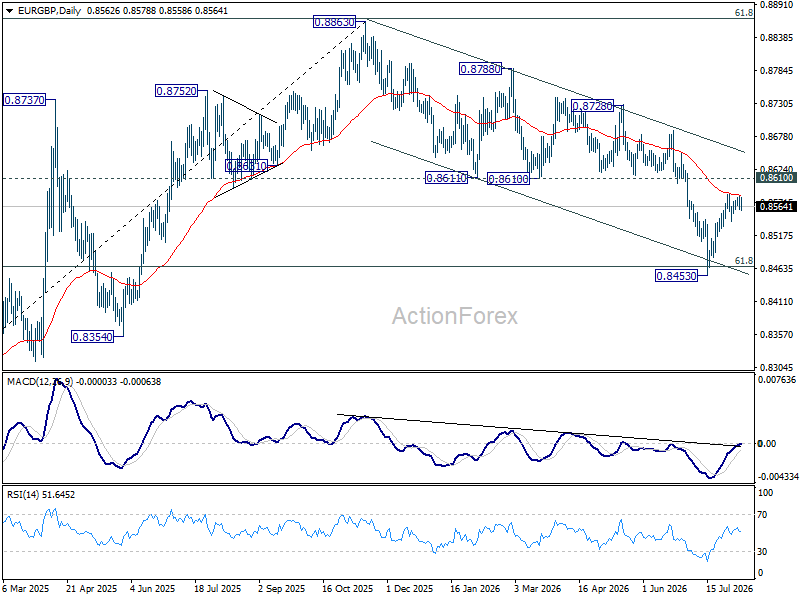
In the bigger picture, rise from 0.8221 (2024 low) should have completed at 0.8863, just ahead of 38.2% retracement of 0.9267 (2025 high) to 0.8221 at 0.8867. Deeper fall would be seen back to 0.8221. For now, outlook will be neutral at best as long as 0.8610 support turned resistance hold.
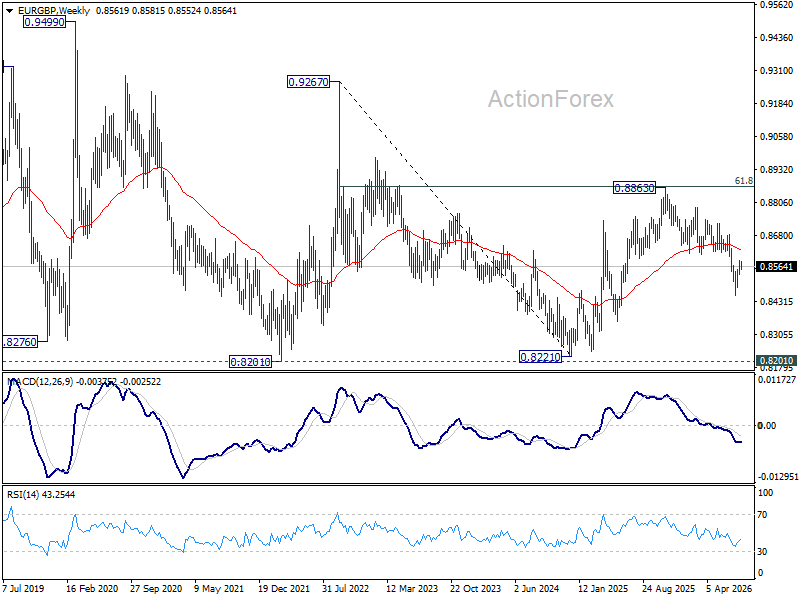
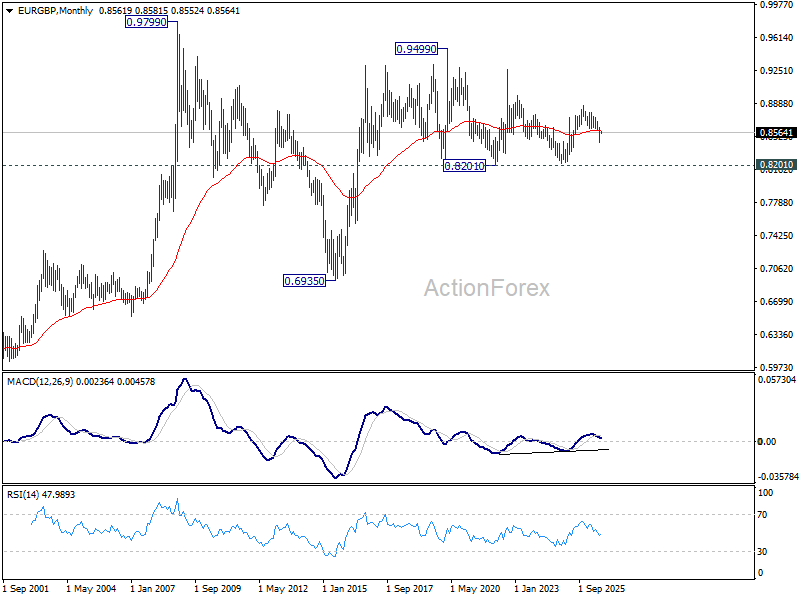
In the long term picture, price action from 0.9499 (2020 high) is seen as part of the long term range pattern from 0.9799 (2008 high). Range trading should continue between 0.8201 and 0.9499, until there is clear signal of imminent breakout.
EUR/AUD Weekly Outlook
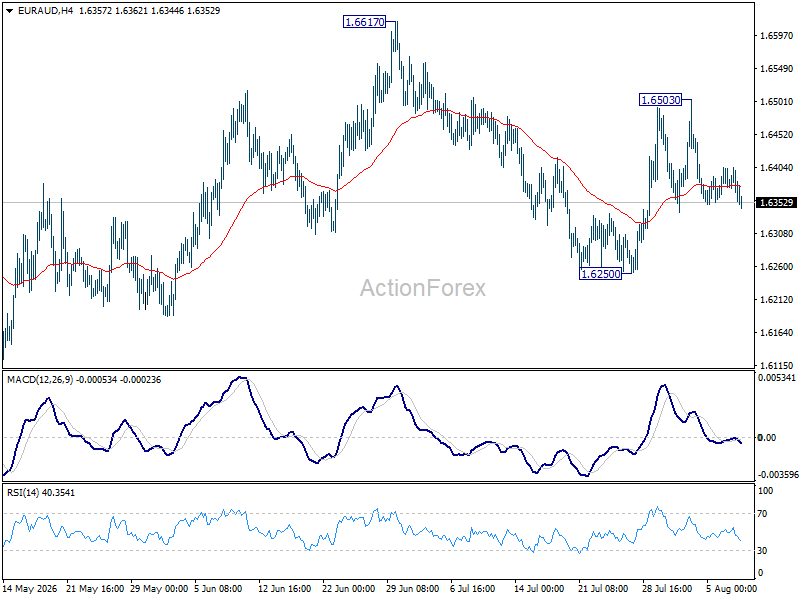
EUR/AUD stayed in range of 1.6250/6503 last week. Initial bias remains neutral this week first. Current development suggests that the corrective pattern from 1.6108 (or 1.6125) is still extending. On the upside, above 1.6530 will target 1.6617 resistance first. On the downside, break of 1.6250 will bring deeper fall back to retest 1.6108 low.
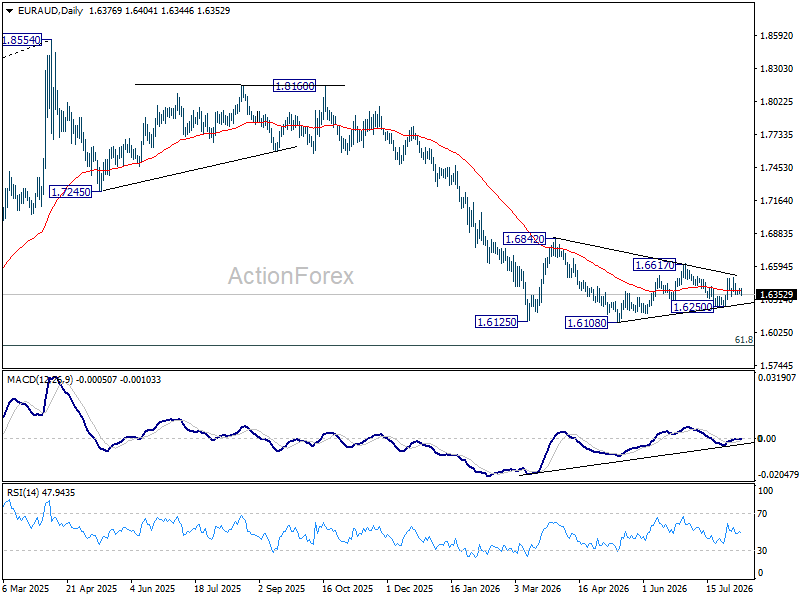
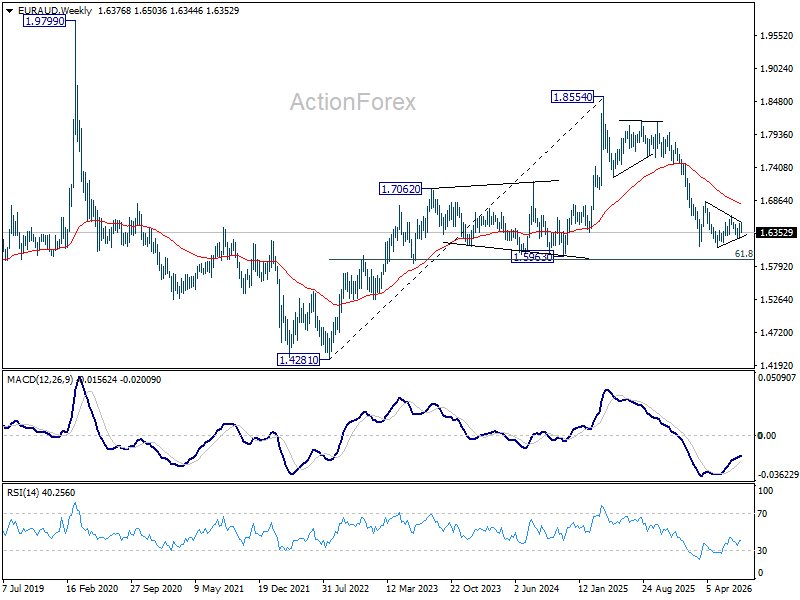
In the bigger picture, outlook will stay bearish as long as 1.6842 resistance holds. Fall from 1.8554 (2025 high) is expected to continue to 61.8% retracement of 1.4281 to 1.8554 at 1.5913. Decisive break there will pave the way back to 1.4281 (2022 low). However, firm break of 1.6842 should confirm medium term bottoming, and bring stronger rally.
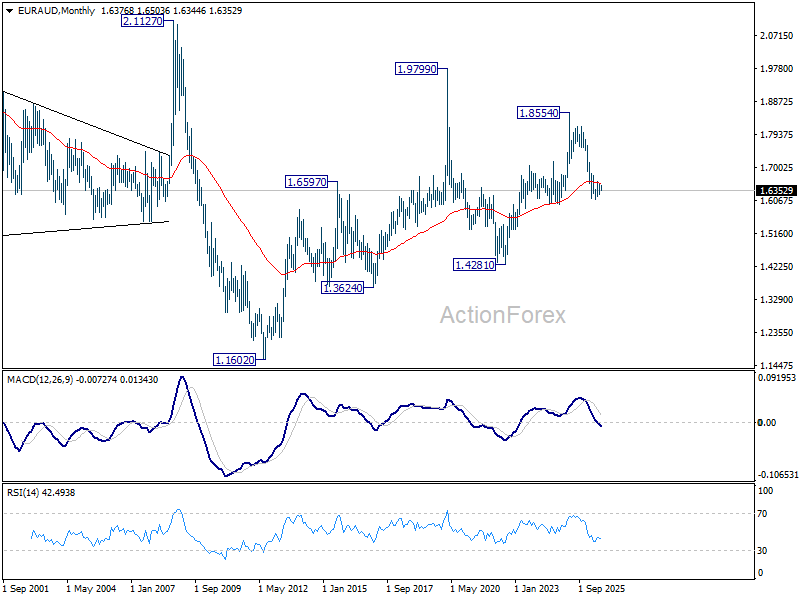
In the longer term picture, fall from 1.8554 is seen as the third leg of the pattern from 1.9799 (2020 high), which is part of the pattern from 2.1127 (2008 high). Sustained trading below 55 M EMA (now at 1.6567) will confirm this bearish case, and pave the way back towards 1.4281.
EUR/CHF Weekly Outlook
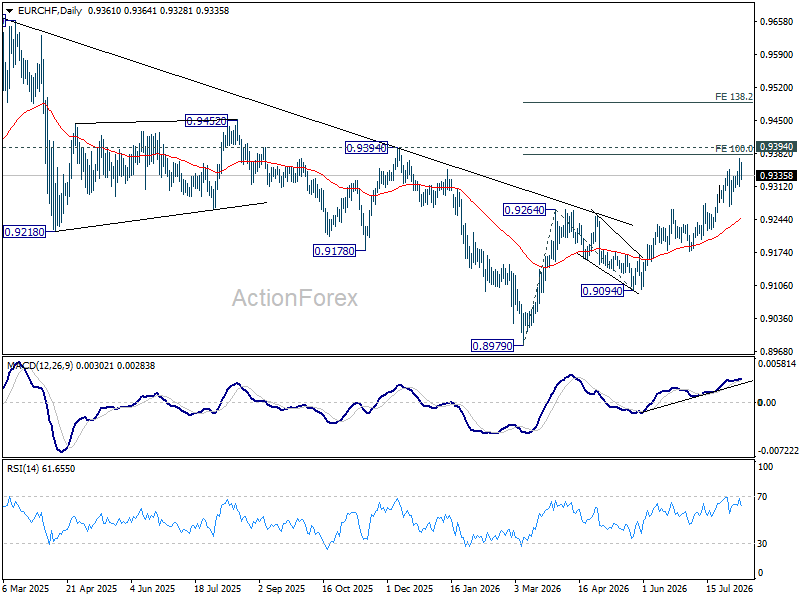
EUR/CHF's rally resumed last week but lost momentum again after hitting 0.9371. Initial bias is turned neutral this week for consolidations. Outlook will remain bullish as long as 0.9270 support holds. On the upside decisive break of 100% projection of 0.8979 to 0.9264 from 0.9094 at 0.9379 will carry larger bullish implications, and target 138.2% projection at 0.9488.
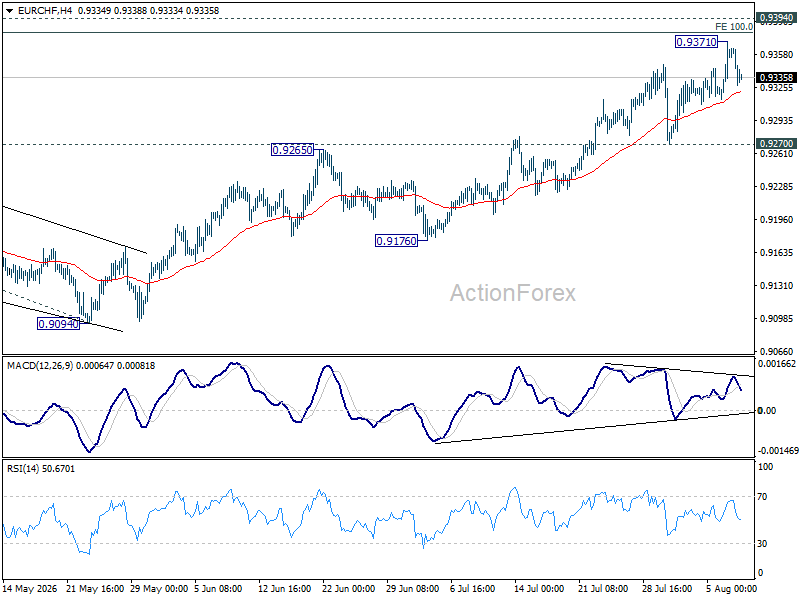
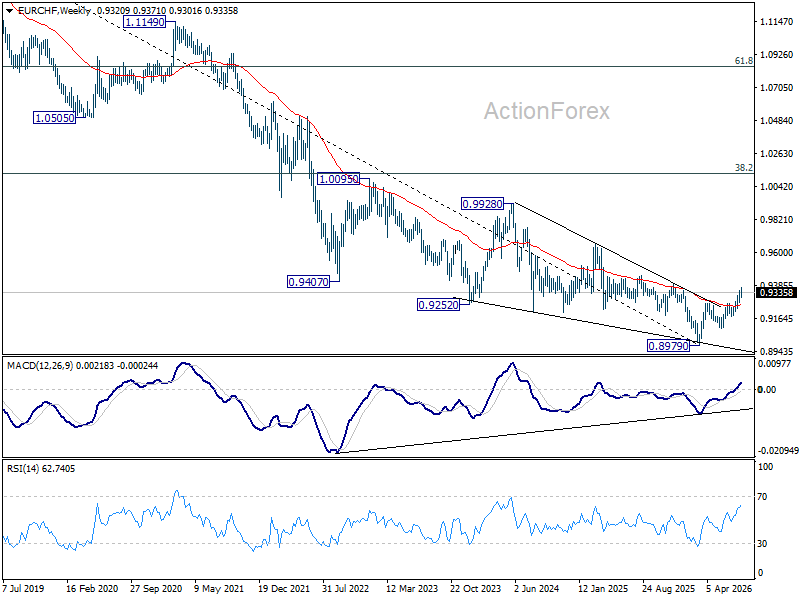
In the bigger picture, considering bullish divergence condition in W MACD, rise from 0.8979 medium term bottom should at least be reversing the fall from 0.9928, with prospect of developing into a medium term up trend. Firm break of 0.9394 resistance will add more credence to this case. For now risk will remain on the upside as long as 0.9094 support holds, in case of retreat.
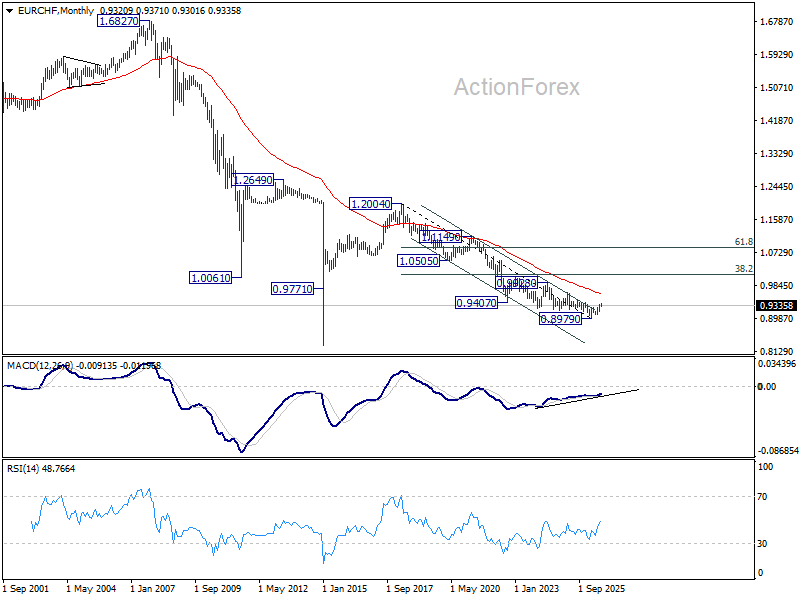
In the long term picture, outlook will stay bearish as long as 0.9407 support turned resistance (2022 low) holds. However, firm break of 0.9407 will argue that the down trend from 1.2004 (2018 high) has completed with five waves down to 0.8979. Stronger rebound should then be seen to 38.2% retracement of 1.2004 to 0.8979 at 1.0135 in the medium term.
The Weekly Bottom Line: Stocks Hit All-Time Highs Amid Mixed Economic Data
Our summary of recent economic events and what to expect in the weeks ahead.
Canadian Highlights
- Canadian employment jumped 75k in July, with broad-based gains across industries, pushing the unemployment rate down to 6.4% and reinforcing signs of economic resilience despite ongoing trade uncertainty.
- Strong labour market and international trade data alongside improving housing activity, suggests the economy got off to a good start to Q3, following what was likely a robust Q2.
- Policymakers are still likely to remain on hold in September given contained inflation and lingering tariff risks.
U.S. Highlights
- Stocks reached fresh all-time highs to start August as oil prices retreated on the back of reports of a potential deal to restart transit through the Strait of Hormuz.
- ISM surveys indicated that manufacturing and services activity continued to expand in July, but elevated input costs point to lingering inflation pressures.
- The labor market lost 23k jobs in July, but this was driven by an outsized decline in local government educational services, likely related to residual seasonality.
Canada – Jobs Market Starts Q3 on the Front Foot
Markets were taken for a late-week ride amid a duo of key July jobs reports in Canada and the U.S. For Canadian bond yields, the latter held sway as surprisingly soft hiring in America downwardly pressured interest rates in both countries. The benchmark Canadian 10-year yield sat at around 3.65% in the wake of both reports and remains near its high for the year. The soggy U.S. jobs report was also bad news for the U.S. dollar, which upwardly pressured the loonie, among other major currencies. For its part, oil slid this week on headlines that a U.S./Iran deal could soon be in the offing.
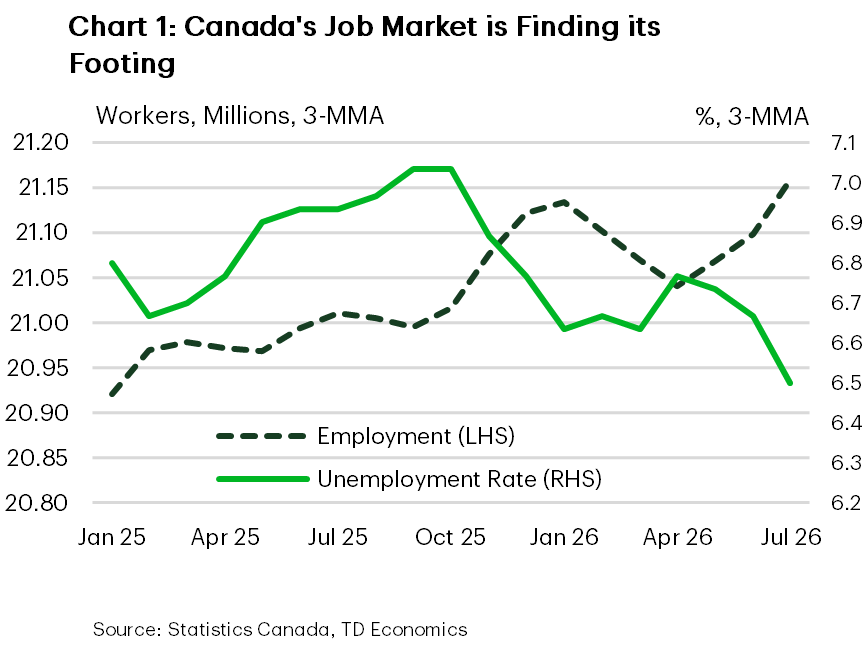
Unlike its U.S. counterpart, the Canadian jobs report was a near picture of wall-to-wall strength (Chart 1). Hiring surged by 75k positions in July, bolstered by the private sector and both full- and part-time positions. What's more, hiring gains were relatively broad-based across industries. Even the beleaguered manufacturing sector managed to add positions last month, although employment is still down about 2-3% since the start of the U.S./Canada trade conflict. Meanwhile the unemployment rate dipped 0.1 percentage points to 6.4% – its lowest level since 2024 – despite a rise in both the labour force and the participation rate. Hours worked advanced a firm 0.6% month-on-month, offering a solid signal for monthly GDP. One fly in the ointment from a growth perspective was that wage growth decelerated in the month.
Canada's healthy July employment gains joined preliminary housing data from local boards released this week in painting an optimistic economic growth picture at the start of Q3. Indeed, the housing data suggests that another sales gain took place last month, which would mark the 4th straight increase. These gains may have been sparked by improved affordability in Ontario.
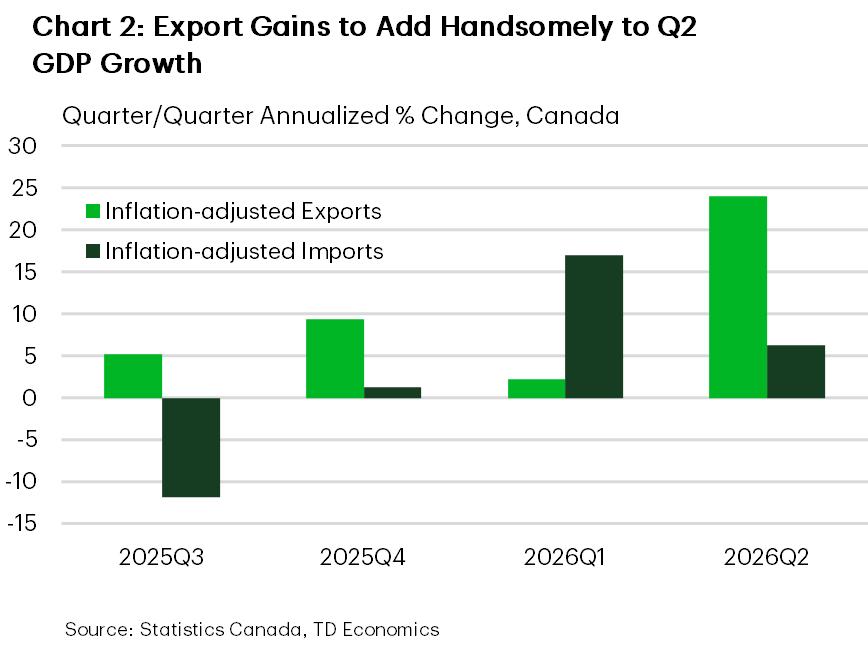
The Bank of Canada's (BoC) expectation was that economic growth would advance 1.5% annualized in the third quarter, roughly in line with our own. However, this follows what looks to be a very strong outturn in Q2. And this week's trade report offered fresh evidence of this. Canada's merchandise trade surplus widened for the fourth straight month in June, supported by a rise in exports that continued the string of sturdy gains over the past few months. Stripping away inflation impacts, export trade volumes rose by 1% month-on-month (m/m) in June, while imports slid 1.5% m/m. For Q2 overall, goods exports were up over 20% annualized, with imports up a lesser 6% (Chart 2), implying a notable contribution to GDP from net trade.
For the BoC, the jobs report was the highlight of the week. Policymakers will no doubt be encouraged by the healthy jobs print, especially considering their recent uncertainty about the durability of Canadian growth after Q2. However, for the upcoming September 2nd meeting, we still see policymakers holding the line on rates. The economy is still facing notable trade-related headwinds (especially the threat of 50% tariffs on 5% of U.S.-bound shipments on the horizon). Also, core inflation remains well-behaved and the jobs market, while improving, isn't out of the woods just yet.
Rishi Sondhi, Economist
U.S. – Stocks Hit All-Time Highs Amid Mixed Economic Data
The first week of August kicked off with stocks hitting fresh all-time highs as oil prices retreated on news of a potential near-term deal to restart transit through the Strait of Hormuz. The deal is reportedly being negotiated between Oman and Iran, but a formal agreement between all parties has yet to be announced as of the time of writing. The S&P 500 rose 3.5% on the week as oil prices fell by 10% and the U.S. 10-year Treasury yield ended the week roughly 10 basis points lower.
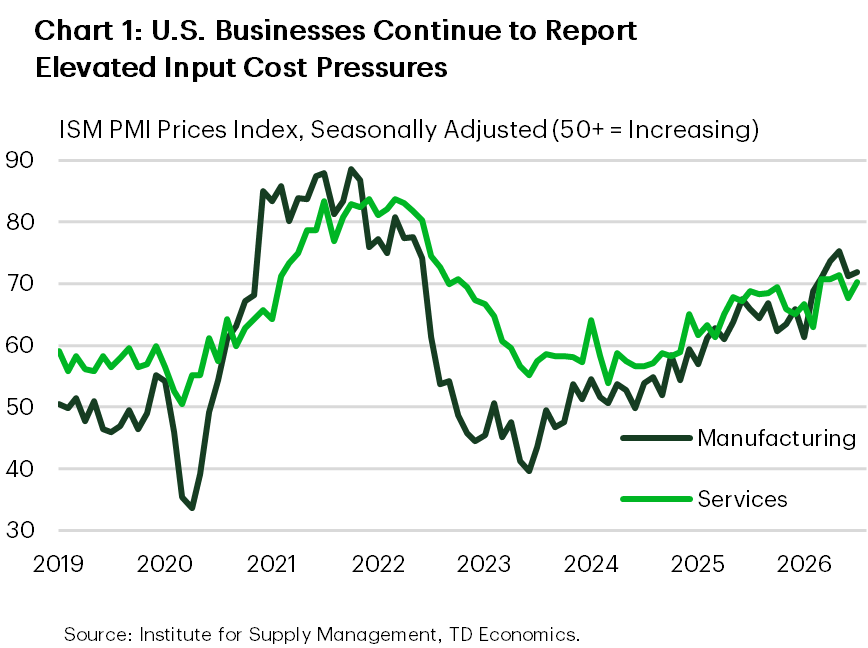
Higher oil prices have contributed to stronger nominal manufacturing activity in 2026, while also helping to push the ISM Manufacturing PMI to a four-year high in July. However, there are reasons to view the survey's strength with some caution. The ISM Prices Paid Index remains near a four-year high (Chart 1), indicating elevated input cost pressures across the manufacturing sector. At the same time, a portion of the improvement in the headline PMI reflects slower supplier deliveries, which the survey interprets as a sign of stronger demand, but can also be consistent with supply-chain constraints. Taken together, the survey continues to point to an expansion in manufacturing activity, though likely at a more moderate pace than implied by the headline reading.
The larger services sector also continued to expand in July according to the ISM report, with new orders and business activity both picking up. However, the report was more concerning for the Federal Reserve, as the employment index slipped back into contraction territory and the prices paid index remained elevated.
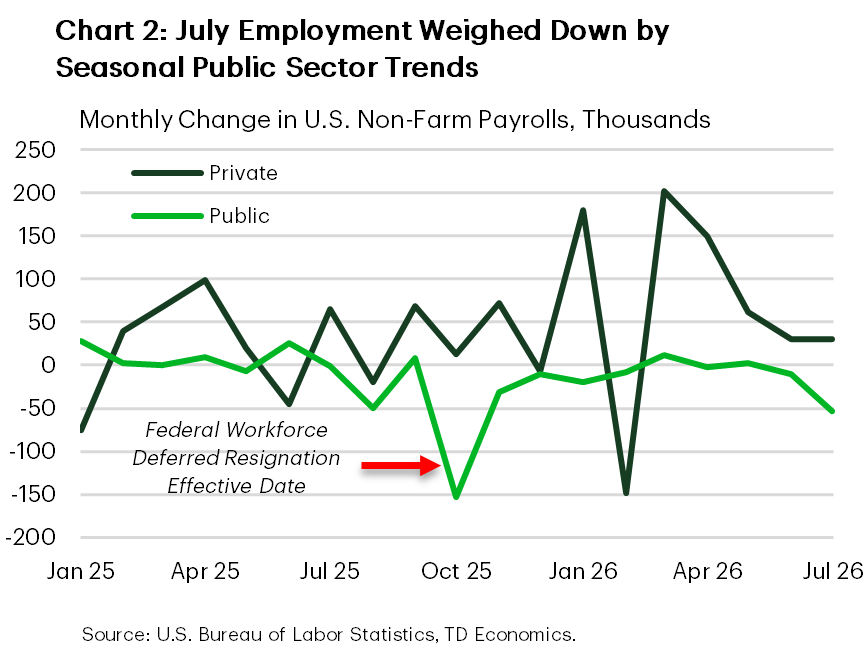
This concern was somewhat enhanced by the headline report for July employment, which showed a loss of 23k jobs. However, looking into the details, the decline was entirely driven by an outsized loss in local government educational services. This is likely driven by unaccounted for seasonality coinciding with the summer break for schools. The private sector added 30k jobs during the month, on par with the prior month trend (Chart 2). In addition, the unemployment rate ticked lower to 4.1%, consistent with a labor market that is steady overall.
Taken together, the Federal Reserve is faced with an economy that has a stable labor market, but persistent excess inflationary pressures. Among the three voting members of the FOMC that we heard from this week, Minneapolis Fed President Kashkari was the most vocal in support of policy tightening, noting he dissented in favor of a rate hike at the July meeting. Philadelphia Fed President Paulson and Governor Lisa Cook were more measured but noted that persistent inflation could require higher rates. After the employment report, odds of a rate hike in September fell from roughly 50/50 to 60% odds for no hike.
With elevated uncertainty over what policy decision will be made by the Federal Reserve at their next meeting, next week's CPI print for July is likely to be closely monitored. Consensus expectations are for an acceleration in total inflation to 3.5% year-on-year, consistent with the uptick in energy prices during the month. Currently we don't expect a rate hike in September, but if current inflation trends prove persistent, then policy action may be required.
Economics Week Ahead
Next week, we expect CPI to have remained temperate in July, with pressures becoming less widespread and more concentrated in specific sectors. Retail spending is expected to rise modestly, and housing activity remains under pressure amid higher mortgage rates.
In Australia, we expect the RBA to leave rates unchanged while maintaining a hawkish bias. In the U.K., we expect resilient Q2 growth, which could support a hike later in the year. In emerging markets, Brazil's inflation likely eased further, supporting gradual policy easing later this year, while India's CPI inflation is expected to tick higher.
- United States: Existing Home Sales (Tuesday), CPI (Wednesday), Retail Sales (Friday)
- G10 Economies: Reserve Bank of Australia (Tuesday), U.K. GDP (Thursday)
- Emerging Markets: Brazil CPI (Tuesday), India CPI (Wednesday)
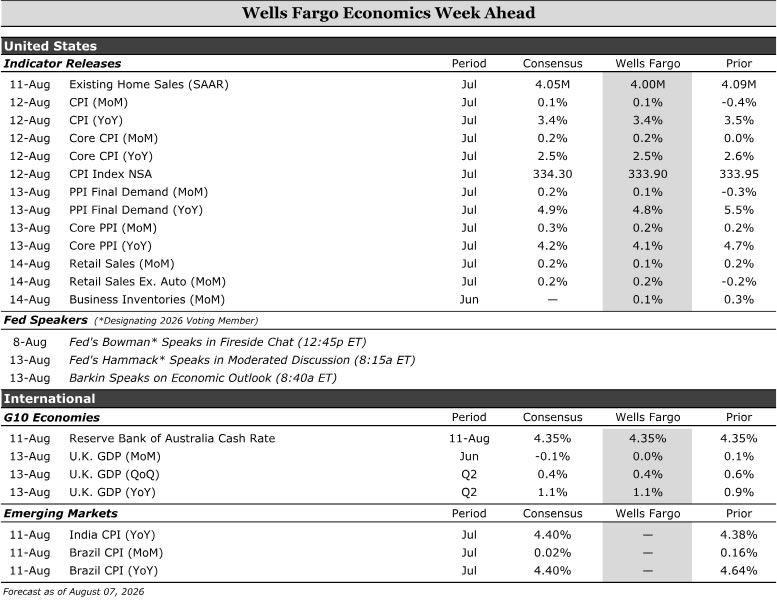
Source: Bloomberg Finance L.P. and Wells Fargo Economics
U.S. Week Ahead
Existing Home Sales • Tuesday
We look for existing home sales to dip 2.2% in July. It is no secret that the housing market is one of the most strained sectors of the economy. Mortgage rates rose to 6.5% on average in June and have since surpassed that. Home prices also continue to rise on a year-over-year basis, especially in the Northeast and Midwest. Pending home sales fell in June and mortgage purchase applications ticked up only modestly. Applications then took a sharp turn lower in July in a nod to ongoing affordability challenges. As we have been noting, longer-term interest rates (including mortgage rates) are being propped up by a variety of factors that are unlikely to subside in the near-term.
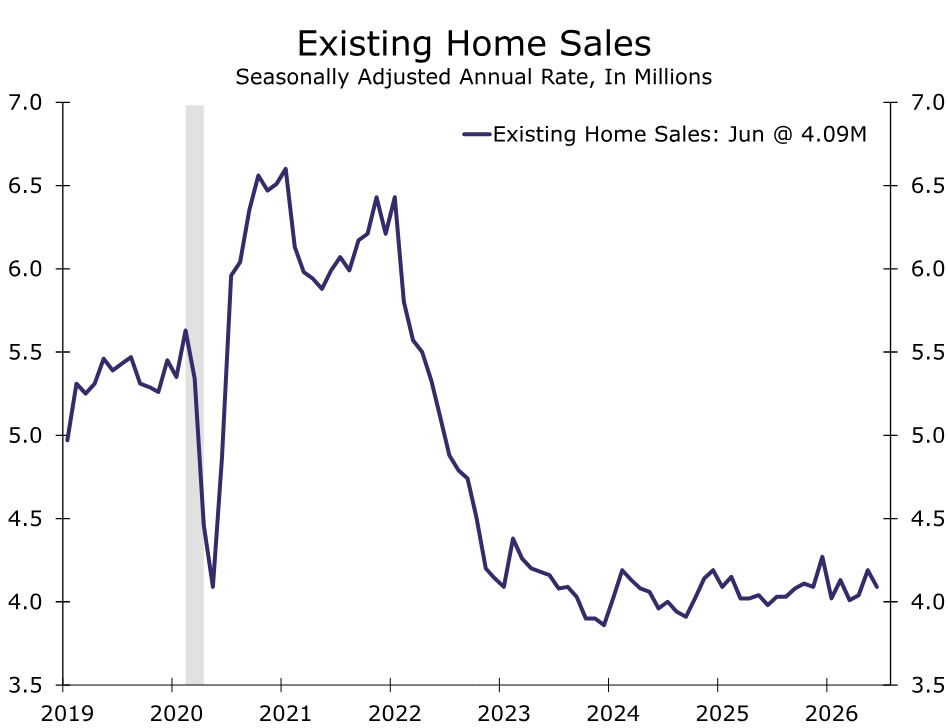
Source: NAR and Wells Fargo Economics
CPI • Wednesday
Inflation was likely temperate in July. We estimate the CPI rose 0.13% in July, as lower gasoline prices offset moderate increases elsewhere. Food inflation also appears to have remained contained despite concerns that higher energy costs would push through to grocery prices. Walmart's price cuts likely helped limit some of that pass-through last month.
Excluding food and energy, we expect the core CPI to rise 0.24%, in a bounce-back from June's unexpectedly soft reading. Core goods inflation should firm, with Apple product price increases lifting consumer electronics prices even as tariff-related pressures continue to fade across other categories. Core services inflation also is likely to run somewhat firmer than in June. We look for some normalization in medical services and a smaller drag from motor vehicle insurance, although broader services inflation should continue to trend lower.
Taken together, we expect headline CPI inflation to ebb to 3.4% year-over-year in July. The report should reinforce the view that the worst of the inflationary effects from a higher-tariff regime and the conflict in the Middle East are behind us. Increases appear driven by a narrow set of categories rather than a broadening in underlying price pressures. Yet, while inflation pressures are becoming less widespread, continued strength in a handful of sectors suggests progress toward 2% is likely to remain gradual.
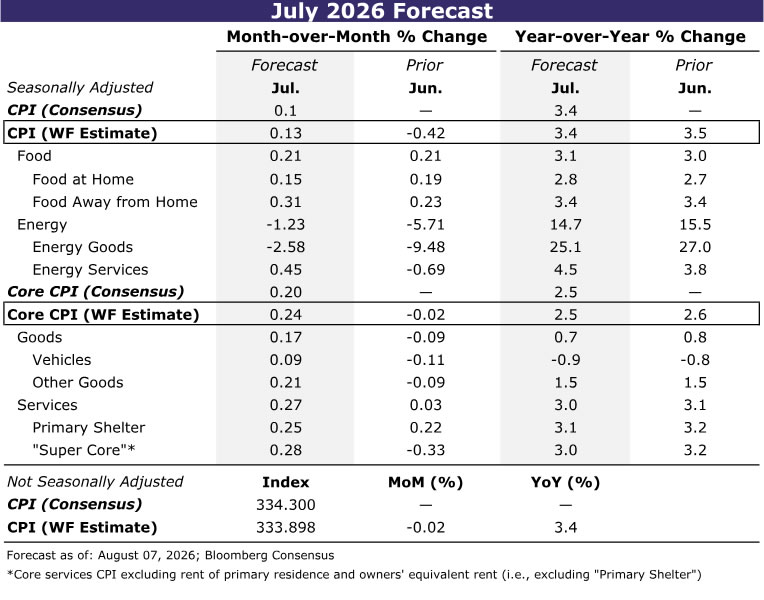
Source: Bloomberg Finance L.P., U.S. Department of Labor and Wells Fargo Economics
Retail Sales • Friday
Retail sales likely notched a modest increase in July as a bottoming in gas prices translates into less downward price pressure than in June. While recent consumer sentiment and labor market indicators signal a more cautious household sector, our informal channel checks with retail businesses suggest that consumers continue to spend, even if that spending is becoming more selective.
Outside gas stations where sales are heavily influenced by price movements, underlying retail spending has been continuing to expand at a moderate pace. We had been braced for some giveback in auto sales, though that category has yet to reflect the sort of pullback one might expect when household budgets are constrained by higher energy costs. Meanwhile, underlying growth in e-commerce should underpin core retail sales.
More broadly, consumers have proven remarkably resilient this year despite higher prices and a soft labor market backdrop. We continue to flag the role of elevated asset prices, a lower saving rate and increased credit usage as factors helping consumers push the game into extra innings. But without a meaningful improvement in wages, growth is apt to be more uneven in the back half of the year.
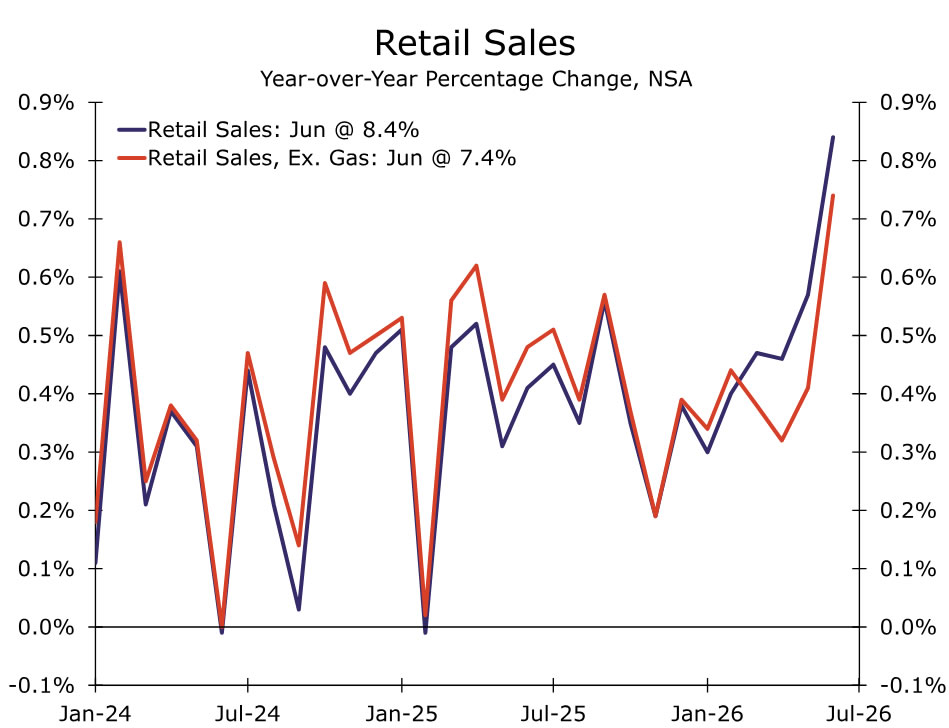
Source: U.S. Department of Commerce and Wells Fargo Economics
G10 Week Ahead
Reserve Bank of Australia • Tuesday
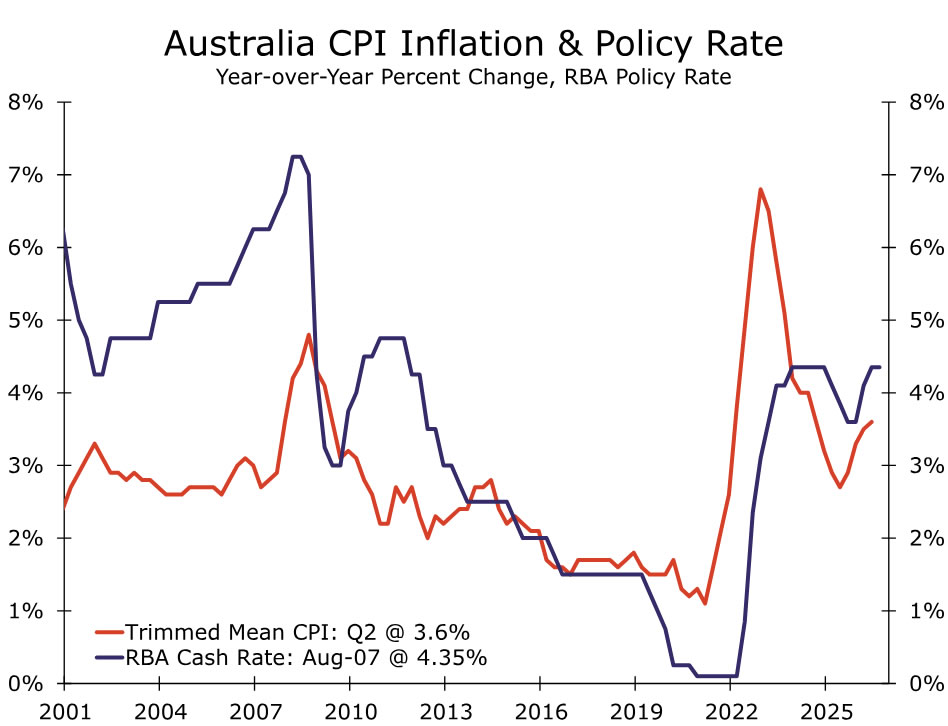
We expect the Reserve Bank of Australia (RBA) to hold the Cash Rate at 4.35% next week. After three hikes this year, the Board will likely allow more time for the effects of earlier tightening to materialize. However, we expect the RBA to maintain a hawkish stance as it remains focused on preventing elevated cost pressures from becoming entrenched in inflation. While recent inflation data provided some encouragement, underlying price pressures remain elevated. Q2 inflation slowed more than expected, with headline inflation at 0.6% quarter-over-quarter (from 1.4%), though underlying inflation remained elevated.
Recent RBA communications have acknowledged the limited ability of monetary policy to address supply shocks. However, officials continue to stress that with inflation still elevated and supply shocks compounding existing pressures, some moderation in demand growth may be needed to return inflation to target. Activity remains resilient and growth is expected to continue into Q3, keeping another hike in play.
While we expect a hold next week, we continue to expect an out-of-consensus 25 bps hike in September as the RBA gains greater clarity on activity and the domestic pass-through from higher energy prices. This would bring the Cash Rate to a peak of 4.60%, where we expect it to remain before a gradual easing cycle begins with a 25 bps cut in H2 2027.
Source: Bloomberg L.P. and Wells Fargo Economics
U.K. GDP • Thursday
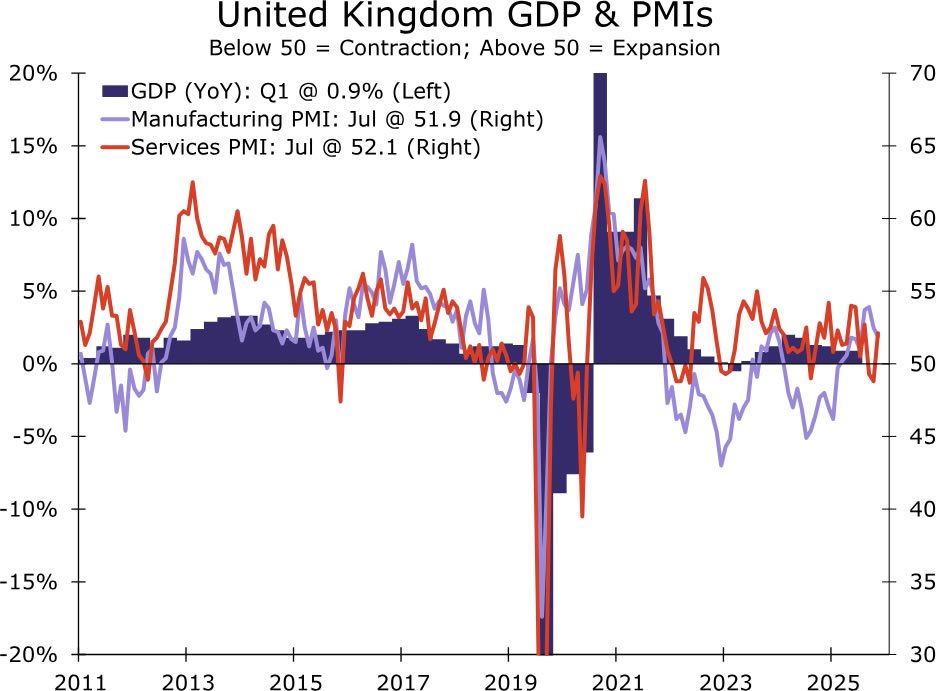
Next week's U.K. Q2 GDP release will provide another test of whether the economy remains resilient despite tighter financial conditions, elevated global uncertainty and a changing domestic political backdrop. We expect GDP to grow 0.4% quarter-over-quarter and 1.1% year-over-year in Q2.
Growth momentum appears to have remained firm through Q2, supported in part by strategic stockpiling amid concerns over higher energy and input costs stemming from the Middle East conflict. The composition of growth will matter, as policymakers have repeatedly pointed to the growth outlook as a reason to remain on hold. As such, a broad-based, stronger-than-expected GDP print could give policymakers greater confidence that the economy can withstand tighter monetary policy.
While recent inflation data have been encouraging, much of the improvement reflects disinflationary progress made before the conflict. The Bank of England (BoE) remains focused on the risk that higher energy prices spill over into wages and broader inflation pressures. We continue to expect the BoE to deliver one rate hike in Q4, bringing the Bank Rate to a terminal rate of 4.00%.
Source: Bloomberg Finance L.P. and Wells Fargo Economics
EM Week Ahead
Brazil CPI • Tuesday
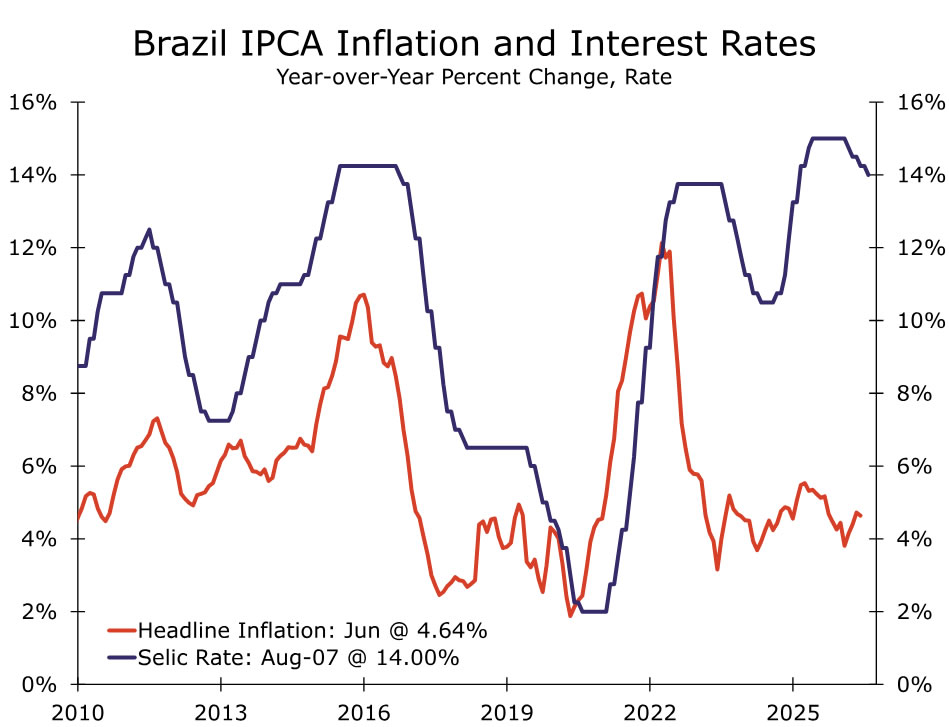
We expect Brazil's July CPI to show a further slowdown in inflation. Headline inflation stood at 4.64% year-over-year in June, while data through mid-July point to continued easing. At its most recent meeting, the Brazilian Central Bank (BCB) also revised its 2026 inflation forecast slightly lower to 5.1% year-over-year.
Despite recent progress, the inflation outlook remains challenging. The BCB's Focus survey expectations for 2026 and 2027 remain above target at 5.0% and 4.2%, respectively. Uncertainty surrounding the domestic election cycle, the Middle East conflict and El Niño also keeps inflation risks elevated.
Against a backdrop of moderating activity, a tight labor market and persistent inflation risks, we expect the BCB to maintain a gradual easing path. We remain comfortable with our call for another 25 bps cut in Q4, most likely in October, which would bring the Selic Rate to 13.75% by year-end.
Source: Bloomberg Finance L.P. and Wells Fargo Economics
India CPI • Wednesday
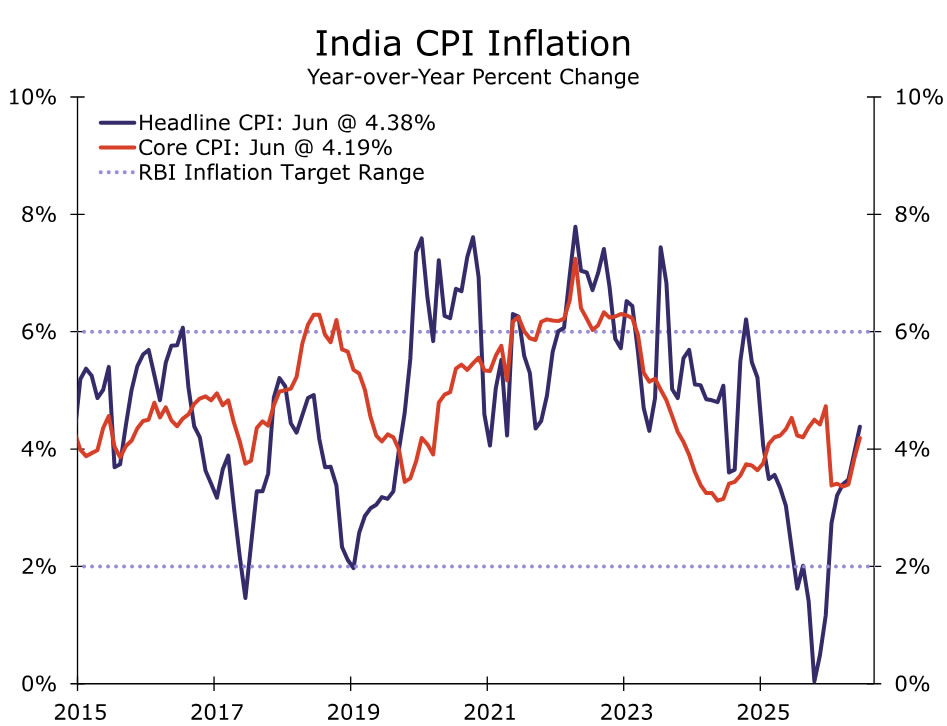
We expect India's July CPI to increase further. Headline and core inflation rose to 4.38% and 4.19% year-over-year in June, respectively, placing both measures above the Reserve Bank of India's (RBI) 4% midpoint target. Producer price pressures also remain elevated, with wholesale price inflation at 9.87% year-over-year. Recent PMI surveys further support the view that firms continue to face higher fuel, labor, material and transport costs, while El Niño conditions pose an additional upside risk to food prices.
At its most recent meeting, the RBI acknowledged that inflation is expected to rise further due to supply-side pressures. Policymakers also warned that higher food, fuel and input costs could generate broader inflation pressures through second-round effects.
With inflation rising, growth steady and higher oil prices adding pressure to both the trade balance and the rupee, we continue to expect the RBI to raise rates in October. In our view, a hike would help support the currency and act as a precautionary measure to keep inflation expectations anchored.
Source: Bloomberg Finance L.P. and Wells Fargo Economics
Canada’s Growth Momentum Likely Persisted Near the End of Q2
Canadian manufacturing and wholesale sales data for June next Friday should reveal readings consistent with more real gross domestic product growth in June, capping off a solid Q2.
The BoC highlighted two-sided risks to the interest rate in their prior policy meetings – risks of cuts tied to potential downside growth surprises and hike risks due to concerns that higher energy prices from conflict in the Middle East could lead to “generalized inflation.”
Wholesale sales are estimated by Statistics Canada to have risen 2.7% following soft readings in April and May, with growth driven by stronger sales in machinery, equipment, and supplies—mirroring a surge in equipment imports from the U.S. in June.
Along with an earlier 0.4% increase in advance retail sales in June (despite lower gasoline prices) and another increase in home resales, these data suggest persistent growth momentum near the end of Q2 and that quarterly real GDP growth is likely well above our earlier tracking of 2.2% (annualized).
At the same time, Canada’s growth and labour market data have looked better after a downside surprise in Q1 gross domestic product growth.
The sustainability of Q2's economic strength remains uncertain, with the path forward highly contingent on volatile U.S. trade policy.
Still, stronger backward-looking data is encouraging after softer readings over the winter. Coupled with subdued core inflation readings this year, it also means the Bank of Canada has more room to remain in data-watching mode while maintaining current interest rates.
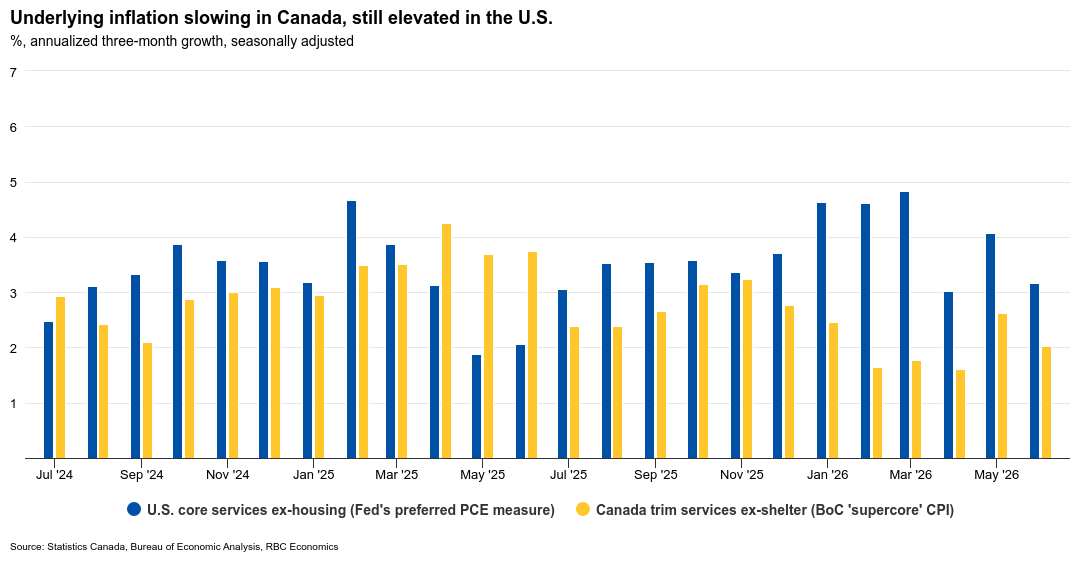
U.S inflation key for near-term Fed decisions
South of the border, the Federal Reserve is facing a more challenging and less balanced trade-off between growth and inflation. U.S. growth and labour markets have remained exceptionally resilient, but inflation remains worryingly high, raising the odds for the Fed to hike interest rates.
July’s Consumer Price Index report on Wednesday could be key to that decision. A lower surprise reading in June CPI’s growth was a reprieve policymakers needed to leave interest rates unchanged in July. But, one downside surprise doesn’t erase a string of hotter core inflation prints earlier this year.
Our base case forecast assumes price growth (outside of energy components) will remain slow enough this year to keep the Fed on the sidelines in September, and through the end of this year. We expect headline CPI will have eased to 3.3% in July from 3.5% in July, reflecting a moderation in core ex-food and gasoline CPI that we expect grew 0.2% month over month in July.
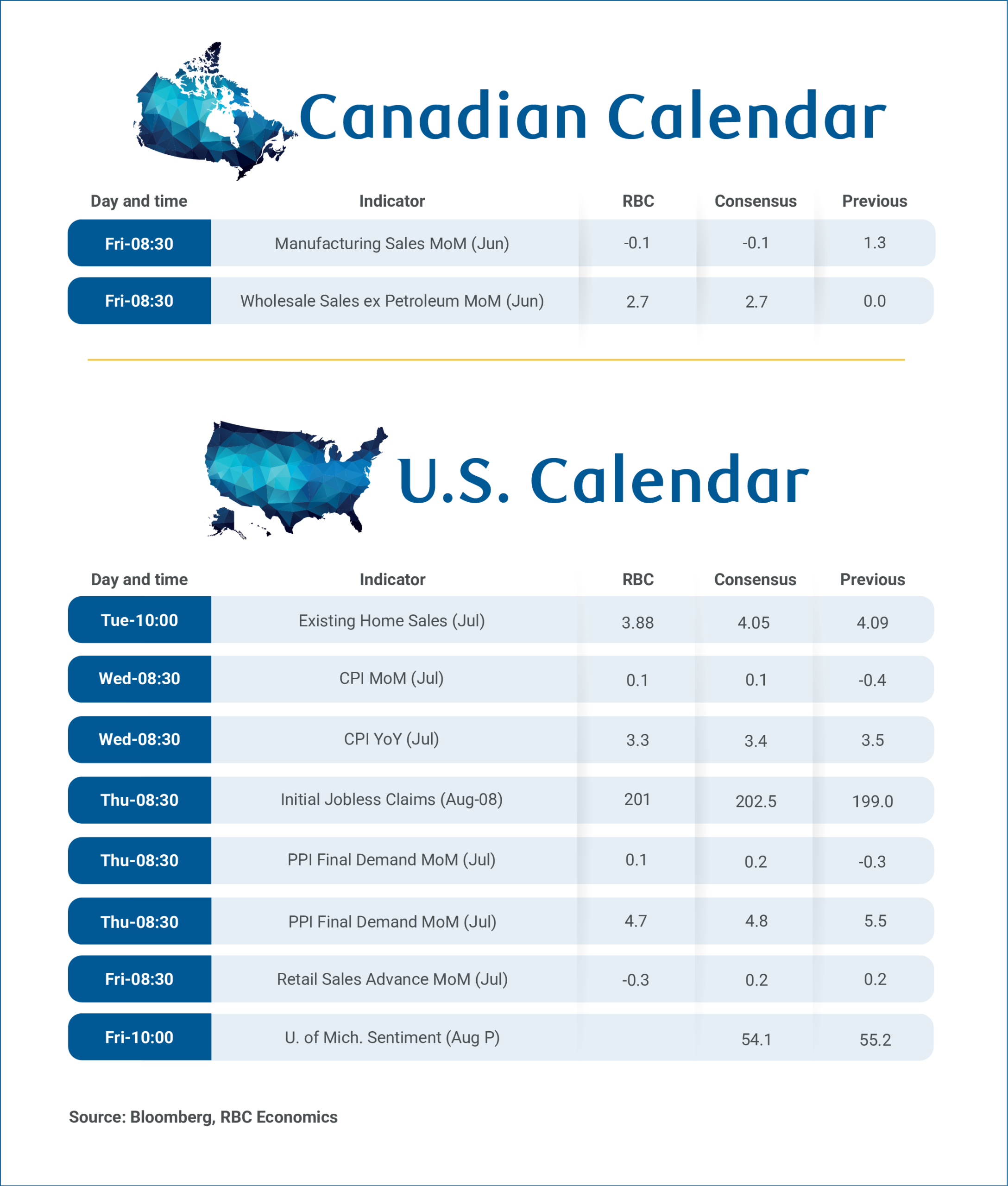
Summary 8/10 – 8/14
Monday, Aug 10, 2026
| GMT | Ccy | Events | Cons | Prev |
|---|---|---|---|---|
| 01:30 | CNY | CPI M/M Jul | 0.20% | -0.30% |
| 01:30 | CNY | CPI Y/Y Jul | 0.80% | 1.00% |
| 01:30 | CNY | PPI Y/Y Jul | 3.90% | 4.10% |
| 23:50 | JPY | Bank Lending Y/Y Jul | 5.70% | 5.70% |
| 23:50 | JPY | BoJ Summary of Opinions | ||
| 23:50 | JPY | Current Account (JPY) Jun | 2.51T | 3.06T |
| 05:00 | JPY | Eco Watchers Survey: Current Jul | 44.6 | 44 |
| 08:30 | EUR | Eurozone Sentix Investor Confidence Aug | -1.3 | -3.1 |
| 01:30 | CNY |
| CPI M/M Jul | |
| Consensus | 0.20% |
| Previous | -0.30% |
| 01:30 | CNY |
| CPI Y/Y Jul | |
| Consensus | 0.80% |
| Previous | 1.00% |
| 01:30 | CNY |
| PPI Y/Y Jul | |
| Consensus | 3.90% |
| Previous | 4.10% |
| 23:50 | JPY |
| Bank Lending Y/Y Jul | |
| Consensus | 5.70% |
| Previous | 5.70% |
| 23:50 | JPY |
| BoJ Summary of Opinions | |
| Consensus | |
| Previous | |
| 23:50 | JPY |
| Current Account (JPY) Jun | |
| Consensus | 2.51T |
| Previous | 3.06T |
| 05:00 | JPY |
| Eco Watchers Survey: Current Jul | |
| Consensus | 44.6 |
| Previous | 44 |
| 08:30 | EUR |
| Eurozone Sentix Investor Confidence Aug | |
| Consensus | -1.3 |
| Previous | -3.1 |
Tuesday, Aug 11, 2026
| GMT | Ccy | Events | Cons | Prev |
|---|---|---|---|---|
| 23:01 | GBP | BRC Like-For-Like Retail Sales Y/Y Jul | 1.50% | 1.70% |
| 01:30 | AUD | NAB Business Conditions Jul | 3 | |
| 01:30 | AUD | NAB Business Confidence | -5 | |
| 04:30 | AUD | RBA Interest Rate Decision | 4.35% | 4.35% |
| 05:30 | AUD | RBA Press Conference | ||
| 10:00 | USD | NFIB Business Optimism Index Jul | 97.2 | 97.4 |
| 14:00 | USD | Existing Home Sales Jul | 4.06M | 4.09M |
| 23:01 | GBP |
| BRC Like-For-Like Retail Sales Y/Y Jul | |
| Consensus | 1.50% |
| Previous | 1.70% |
| 01:30 | AUD |
| NAB Business Conditions Jul | |
| Consensus | |
| Previous | 3 |
| 01:30 | AUD |
| NAB Business Confidence | |
| Consensus | |
| Previous | -5 |
| 04:30 | AUD |
| RBA Interest Rate Decision | |
| Consensus | 4.35% |
| Previous | 4.35% |
| 05:30 | AUD |
| RBA Press Conference | |
| Consensus | |
| Previous | |
| 10:00 | USD |
| NFIB Business Optimism Index Jul | |
| Consensus | 97.2 |
| Previous | 97.4 |
| 14:00 | USD |
| Existing Home Sales Jul | |
| Consensus | 4.06M |
| Previous | 4.09M |
Wednesday, Aug 12, 2026
| GMT | Ccy | Events | Cons | Prev |
|---|---|---|---|---|
| 23:50 | JPY | Money Supply M2+CD Y/Y Jul | 2.10% | 2.20% |
| 06:00 | EUR | Germany CPI M/M Jul | 0.80% | 0.80% |
| 06:00 | EUR | Germany CPI Y/Y Jul | 2.80% | 2.80% |
| 12:30 | CAD | Building Permits M/M Jun | 1.00% | -1.70% |
| 12:30 | USD | CPI M/M Jul | 0.10% | -0.40% |
| 12:30 | USD | CPI Y/Y Jul | 3.40% | 3.50% |
| 12:30 | USD | CPI Core M/M Jul | 0.20% | 0.00% |
| 12:30 | USD | CPI Core Y/Y Jul | 2.50% | 2.60% |
| 14:30 | USD | Crude Oil Inventories (Aug 7) | -1.7M | 2.5M |
| 23:50 | JPY |
| Money Supply M2+CD Y/Y Jul | |
| Consensus | 2.10% |
| Previous | 2.20% |
| 06:00 | EUR |
| Germany CPI M/M Jul | |
| Consensus | 0.80% |
| Previous | 0.80% |
| 06:00 | EUR |
| Germany CPI Y/Y Jul | |
| Consensus | 2.80% |
| Previous | 2.80% |
| 12:30 | CAD |
| Building Permits M/M Jun | |
| Consensus | 1.00% |
| Previous | -1.70% |
| 12:30 | USD |
| CPI M/M Jul | |
| Consensus | 0.10% |
| Previous | -0.40% |
| 12:30 | USD |
| CPI Y/Y Jul | |
| Consensus | 3.40% |
| Previous | 3.50% |
| 12:30 | USD |
| CPI Core M/M Jul | |
| Consensus | 0.20% |
| Previous | 0.00% |
| 12:30 | USD |
| CPI Core Y/Y Jul | |
| Consensus | 2.50% |
| Previous | 2.60% |
| 14:30 | USD |
| Crude Oil Inventories (Aug 7) | |
| Consensus | -1.7M |
| Previous | 2.5M |
Thursday, Aug 13, 2026
| GMT | Ccy | Events | Cons | Prev |
|---|---|---|---|---|
| 23:01 | GBP | RICS Housing Price Balance Jul | -31% | -33% |
| 23:50 | JPY | PPI Y/Y Jul | 7.40% | 7.10% |
| 03:00 | NZD | RBNZ Inflation Expectations Q/Q Q3 | 2.53% | |
| 06:00 | GBP | GDP M/M Jun | -0.10% | 0.10% |
| 06:00 | GBP | GDP Q/Q Q2 P | 0.40% | 0.60% |
| 06:00 | GBP | GDP Y/Y Q2 P | 1.10% | 0.90% |
| 06:00 | GBP | Industrial Production M/M Jun | 0.00% | -0.50% |
| 06:00 | GBP | Industrial Production Y/Y Jun | 0.20% | 1.00% |
| 06:00 | GBP | Manufacturing Production M/M Jun | -0.30% | 0.10% |
| 06:00 | GBP | Manufacturing Production Y/Y Jun | 1.20% | 2.30% |
| 06:00 | GBP | Goods Trade Balance (GBP) Jun | -20.4B | -18.7B |
| 06:30 | CHF | Producer and Import Prices M/M Jul | 0.20% | -0.30% |
| 06:30 | CHF | Producer and Import Prices Y/Y Jul | -0.50% | -2.10% |
| 09:00 | EUR | Eurozone Industrial Production M/M Jun | 0.10% | -0.20% |
| 12:30 | USD | Initial Jobless Claims (Aug 7) | 202K | 199K |
| 12:30 | USD | PPI M/M Jul | 0.20% | -0.30% |
| 12:30 | USD | PPI Y/Y Jul | 4.90% | 5.50% |
| 14:30 | USD | Natural Gas Storage (Aug 7) | 31B | 33B |
| 23:01 | GBP |
| RICS Housing Price Balance Jul | |
| Consensus | -31% |
| Previous | -33% |
| 23:50 | JPY |
| PPI Y/Y Jul | |
| Consensus | 7.40% |
| Previous | 7.10% |
| 03:00 | NZD |
| RBNZ Inflation Expectations Q/Q Q3 | |
| Consensus | |
| Previous | 2.53% |
| 06:00 | GBP |
| GDP M/M Jun | |
| Consensus | -0.10% |
| Previous | 0.10% |
| 06:00 | GBP |
| GDP Q/Q Q2 P | |
| Consensus | 0.40% |
| Previous | 0.60% |
| 06:00 | GBP |
| GDP Y/Y Q2 P | |
| Consensus | 1.10% |
| Previous | 0.90% |
| 06:00 | GBP |
| Industrial Production M/M Jun | |
| Consensus | 0.00% |
| Previous | -0.50% |
| 06:00 | GBP |
| Industrial Production Y/Y Jun | |
| Consensus | 0.20% |
| Previous | 1.00% |
| 06:00 | GBP |
| Manufacturing Production M/M Jun | |
| Consensus | -0.30% |
| Previous | 0.10% |
| 06:00 | GBP |
| Manufacturing Production Y/Y Jun | |
| Consensus | 1.20% |
| Previous | 2.30% |
| 06:00 | GBP |
| Goods Trade Balance (GBP) Jun | |
| Consensus | -20.4B |
| Previous | -18.7B |
| 06:30 | CHF |
| Producer and Import Prices M/M Jul | |
| Consensus | 0.20% |
| Previous | -0.30% |
| 06:30 | CHF |
| Producer and Import Prices Y/Y Jul | |
| Consensus | -0.50% |
| Previous | -2.10% |
| 09:00 | EUR |
| Eurozone Industrial Production M/M Jun | |
| Consensus | 0.10% |
| Previous | -0.20% |
| 12:30 | USD |
| Initial Jobless Claims (Aug 7) | |
| Consensus | 202K |
| Previous | 199K |
| 12:30 | USD |
| PPI M/M Jul | |
| Consensus | 0.20% |
| Previous | -0.30% |
| 12:30 | USD |
| PPI Y/Y Jul | |
| Consensus | 4.90% |
| Previous | 5.50% |
| 14:30 | USD |
| Natural Gas Storage (Aug 7) | |
| Consensus | 31B |
| Previous | 33B |
Friday, Aug 14, 2026
| GMT | Ccy | Events | Cons | Prev |
|---|---|---|---|---|
| 22:30 | NZD | BusinessNZ PMI Jul | 59.7 | |
| 09:00 | EUR | Eurozone Trade Balance (EUR) Jun | -4.2B | -5.0B |
| 09:00 | EUR | Eurozone GDP Q/Q Q2 P | 0.40% | 0.40% |
| 12:30 | CAD | Manufacturing Sales M/M Jun | -0.10% | 1.30% |
| 12:30 | CAD | Wholesale Sales M/M Jun | 2.70% | 0.00% |
| 12:30 | USD | Retail Sales M/M Jul | 0.20% | 0.20% |
| 12:30 | USD | Retail Sales ex Autos M/M Jul | 0.20% | -0.20% |
| 14:00 | USD | Business Inventories Jun | 0.20% | 0.30% |
| 14:00 | USD | UoM Consumer Sentiment Aug P | 54.1 | 55.2 |
| 14:00 | USD | UoM 1-Yr Inflation Expectations Aug P | 4.20% |
| 22:30 | NZD |
| BusinessNZ PMI Jul | |
| Consensus | |
| Previous | 59.7 |
| 09:00 | EUR |
| Eurozone Trade Balance (EUR) Jun | |
| Consensus | -4.2B |
| Previous | -5.0B |
| 09:00 | EUR |
| Eurozone GDP Q/Q Q2 P | |
| Consensus | 0.40% |
| Previous | 0.40% |
| 12:30 | CAD |
| Manufacturing Sales M/M Jun | |
| Consensus | -0.10% |
| Previous | 1.30% |
| 12:30 | CAD |
| Wholesale Sales M/M Jun | |
| Consensus | 2.70% |
| Previous | 0.00% |
| 12:30 | USD |
| Retail Sales M/M Jul | |
| Consensus | 0.20% |
| Previous | 0.20% |
| 12:30 | USD |
| Retail Sales ex Autos M/M Jul | |
| Consensus | 0.20% |
| Previous | -0.20% |
| 14:00 | USD |
| Business Inventories Jun | |
| Consensus | 0.20% |
| Previous | 0.30% |
| 14:00 | USD |
| UoM Consumer Sentiment Aug P | |
| Consensus | 54.1 |
| Previous | 55.2 |
| 14:00 | USD |
| UoM 1-Yr Inflation Expectations Aug P | |
| Consensus | |
| Previous | 4.20% |
3 Events in Focus | 10-14 August
In this video, we’ll explore the key economic events and market trends, shaping the financial landscape. Get ready for insights into financial markets to help you navigate the week ahead. Let’s dive in!
👉 Key topics:
✔️US Inflation Rate
The first major event is the US inflation report on 12 August. Markets currently see a 55% probability of a Federal Reserve rate hike in September, but a weaker-than-expected inflation reading could reduce those expectations and put pressure on the US dollar. June’s softer inflation data already triggered a sharp dollar decline, while some analysts expect the Fed to keep rates unchanged for now and consider cuts next year.
✔️UK GDP Data
The UK GDP report on 13 August will be closely watched by sterling traders. Markets will focus on monthly, quarterly and annual growth figures. A significant surprise in the data could increase volatility across GBP pairs, with weaker growth potentially weighing on the pound.
✔️US PPI
The US Producer Price Index, also released on 13 August, will provide further insight into inflation pressures before they reach consumers. June’s weaker-than-expected PPI and Core PPI readings pushed the dollar lower, and another soft report could strengthen expectations of easing inflation and add further pressure on the US currency.
With several high-impact releases packed into the week, disciplined risk management will remain essential. Geopolitical developments continue to influence commodity and currency markets, while economic data could generate sharp short-term price swings.
Gain insights to strengthen your trading knowledge.
💬 Don’t forget to like, comment, and subscribe for more market insights every week.
Watch it now and stay updated with FXOpen.
https://www.youtube.com/shorts/d1rkq8VgMSE?ref=fxopen.com
This article represents the opinion of the Companies operating under the FXOpen brand only. It is not to be construed as an offer, solicitation, or recommendation with respect to products and services provided by the Companies operating under the FXOpen brand, nor is it to be considered financial advice.