

Sample Category Title
EUR/GBP Daily Outlook
Intraday bias in EUR/GBP stays neutral for the moment. While rebound from 0.9453 might extend, strong resistance should be seen from 0.8610 support turned resistance to limit upside. On the downside, break of 0.8528 support will argue that the corrective rebound from 0.8453 has completed, and turn bias back to the downside for retesting this low.
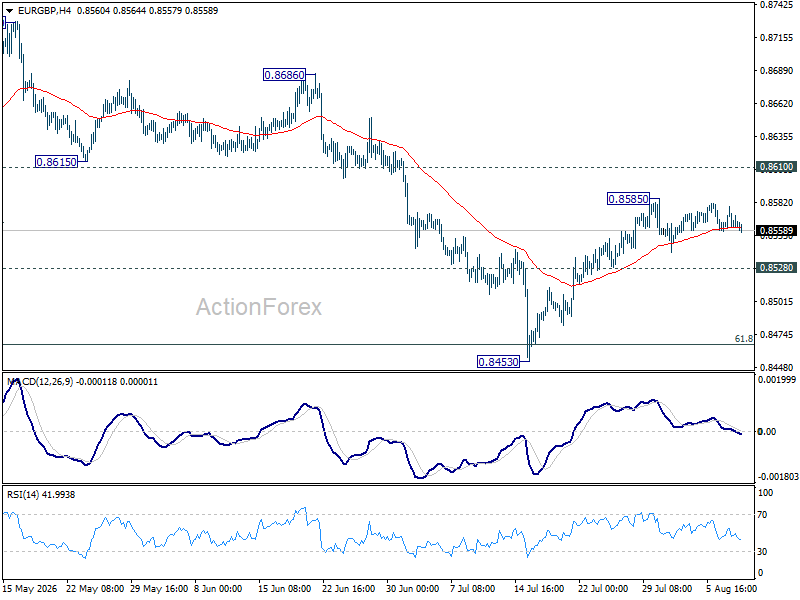
In the bigger picture, rise from 0.8221 (2024 low) should have completed at 0.8863, just ahead of 38.2% retracement of 0.9267 (2025 high) to 0.8221 at 0.8867. Deeper fall would be seen back to 0.8221. For now, outlook will be neutral at best as long as 0.8610 support turned resistance hold.
EUR/AUD Daily Outlook
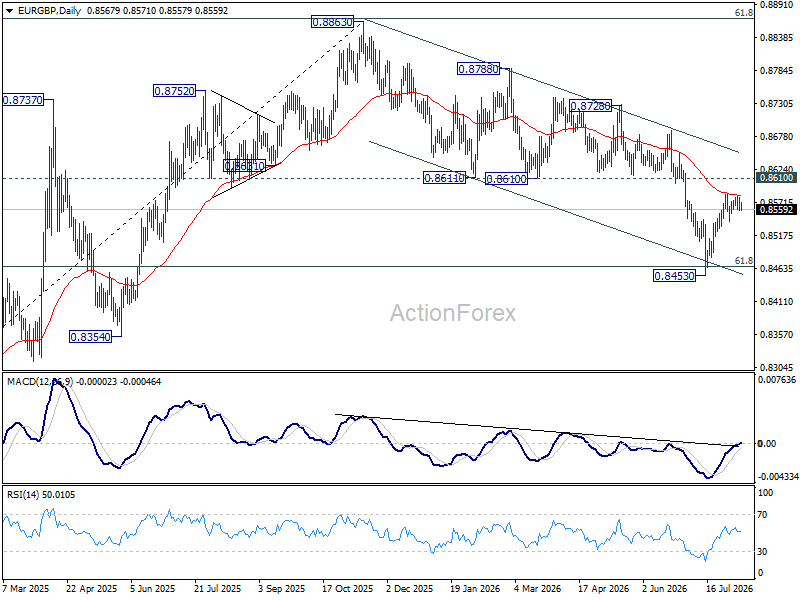
Intraday bias in EUR/AUD remains neutral for the moment. Corrective pattern from 1.6108 (or 1.6125) is still extending. On the upside, above 1.6530 will target 1.6617 resistance first. On the downside, break of 1.6250 will bring deeper fall back to retest 1.6108 low.
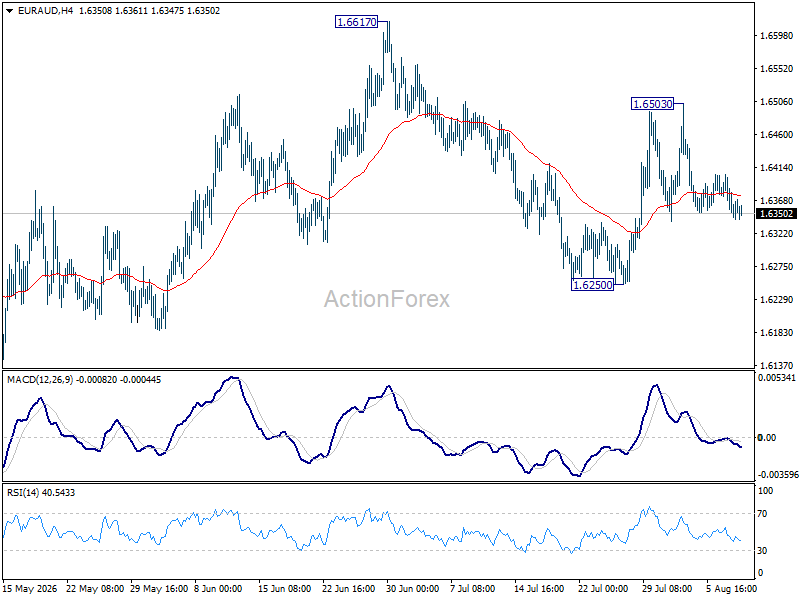
In the bigger picture, outlook will stay bearish as long as 1.6842 resistance holds. Fall from 1.8554 (2025 high) is expected to continue to 61.8% retracement of 1.4281 to 1.8554 at 1.5913. Decisive break there will pave the way back to 1.4281 (2022 low). However, firm break of 1.6842 should confirm medium term bottoming, and bring stronger rally.
EUR/CHF Daily Outlook
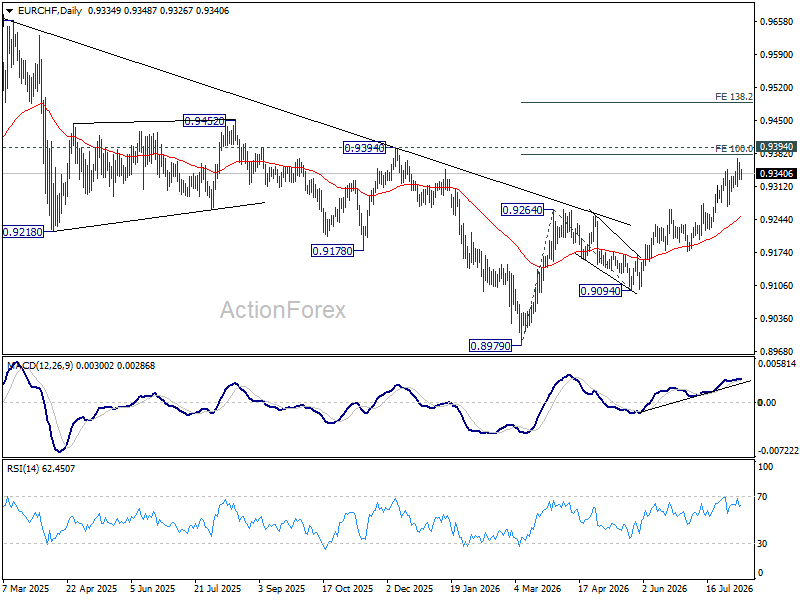
Intraday bias in EUR/CHF remains neutral and more consolidations could be seen below 0.8371. Further rally is expected as long as 0.9270 support holds. On the upside decisive break of 100% projection of 0.8979 to 0.9264 from 0.9094 at 0.9379 will carry larger bullish implications, and target 138.2% projection at 0.9488.
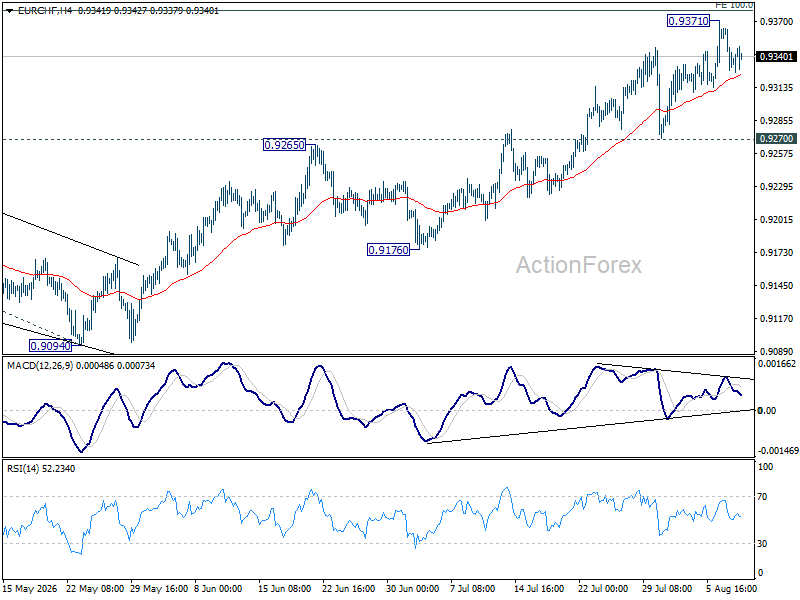
In the bigger picture, considering bullish divergence condition in W MACD, rise from 0.8979 medium term bottom should at least be reversing the fall from 0.9928, with prospect of developing into a medium term up trend. Firm break of 0.9394 resistance will add more credence to this case. For now risk will remain on the upside as long as 0.9094 support holds, in case of retreat.
USD Index – Key Technical Support Zone Remains Under Increased Pressure
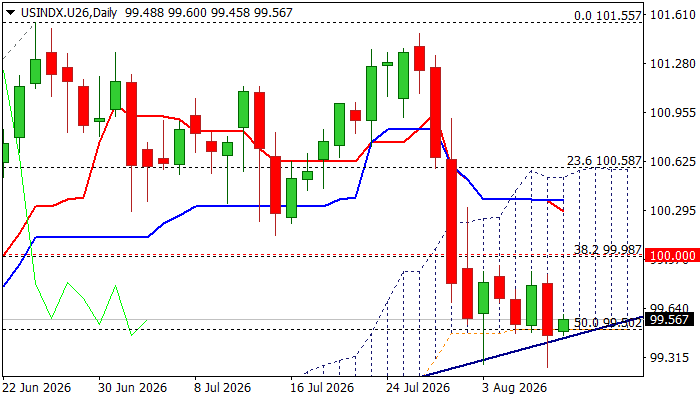
The dollar index consolidates after Friday’s almost 0.5% drop, sparked by downbeat US nonfarm payrolls data which cooled expectations for Fed rate hike and deflated the greenback.
Traders shift their focus on US July inflation report (due on Wednesday) to get more details about the central bank’s monetary policy trajectory.
Economists expect inflation to ease in July (mainly reflecting impact from the latest US-Iran ceasefire), with softer readings to add pressure on the US currency.
Near-term price action moves around key supports at 99.50 zone (50% retracement of 97.44/101.55 / daily cloud base / bull-trendline) which so far contained several attacks
Predominantly bearish daily studies (strong negative momentum / multiple MA bear-crosses) contribute to persisting downside pressure.
Firm break of pivots at 99.50 zone (and recent spikes at 99.25) would signal bearish continuation and expose next strong supports at 99.00 (200DMA / Fibo 61.8%.
At the upside, 99.90/100.00 zone (recent congestion ceiling, reinforced by falling 10DMA / psychological) mark significant barriers, violation of which to sideline bears.
Res: 99.90; 100.00; 100.25; 100.40
Sup: 99.50; 99.25; 99.00; 98.67
Bitcoin Consolidates Around $65K, Setting Its Sights on $70K
Market Overview
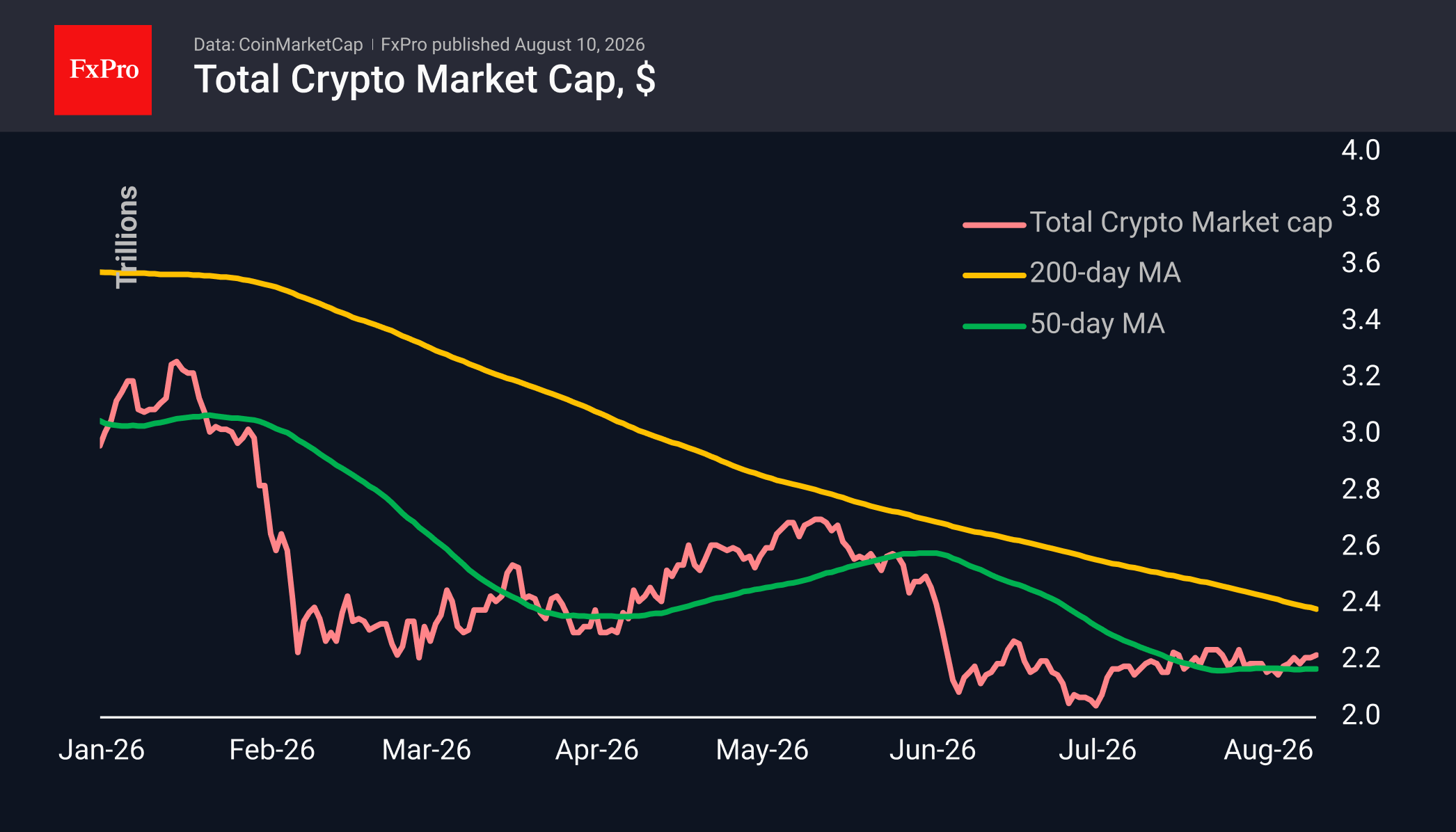
The crypto market capitalisation has risen to $2.22T, returning to the levels seen at its two-week highs. Since the start of August, the balance of power has shifted in favour of buyers, but the pace of this recovery is significantly slower than that of the similar rally seen in early July. This suggests a slight waning of buyer interest following the rebound from the June and July lows, given that the market currently lacks fundamental drivers of growth. Among the most active coins over the past 7 days, the top performers were Theta (+14.3%), as well as SushiSwap and Cosmos (both +8.5%), while the worst performers were Stellar and NEAR (both down -2.9%), as well as XRP (-2.7%), which further points to a predominance of growth.
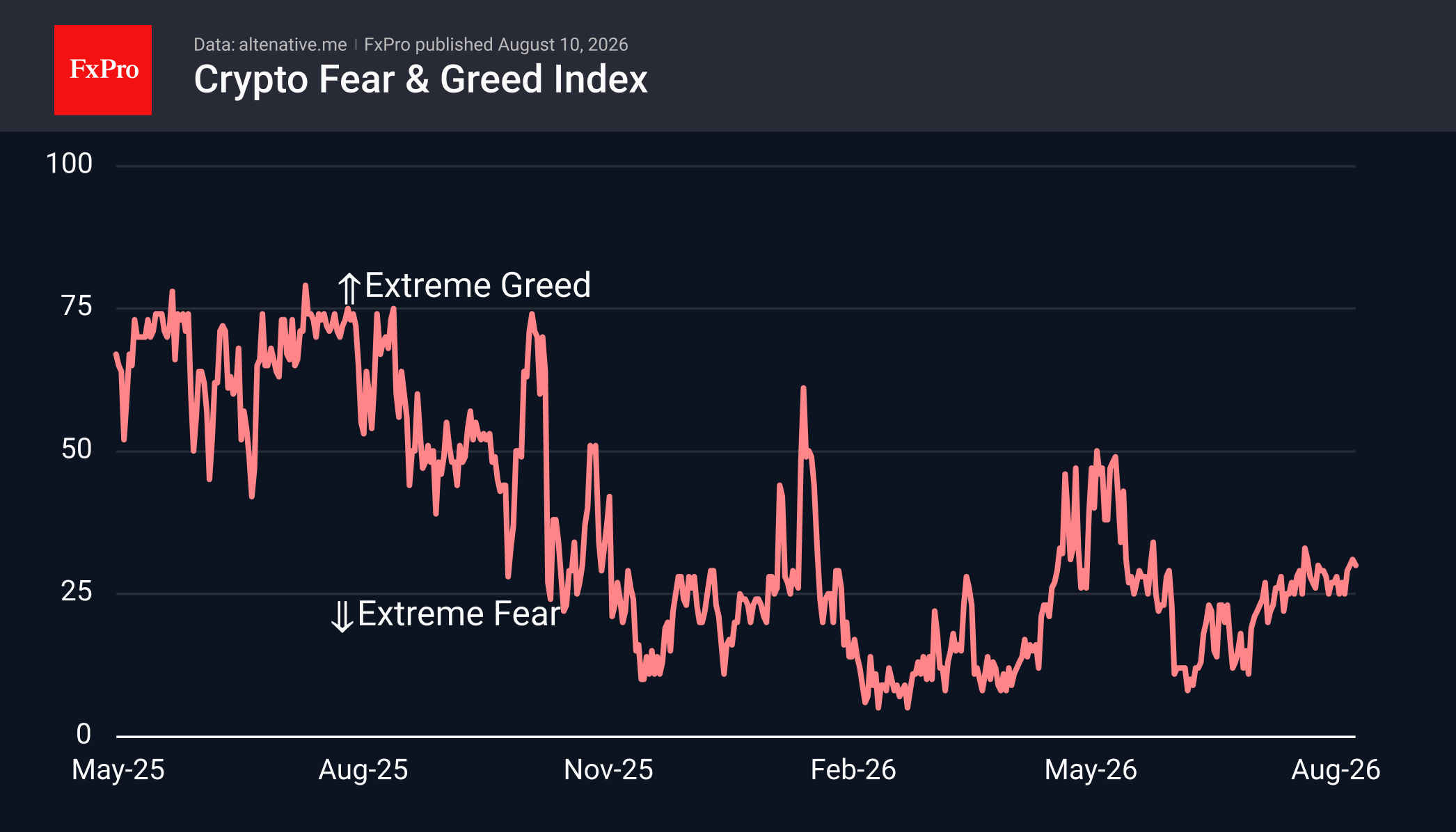
The sentiment index stands at 30 at the start of the day on Monday. Since mid-July, this indicator has been in the ‘fear’ zone, only occasionally touching the 25 level (‘extreme fear’). This is a gradual shift in sentiment that is worth monitoring from time to time. Still, cautious medium-term investors will likely prefer to stay on the sidelines until this indicator consolidates above 50.
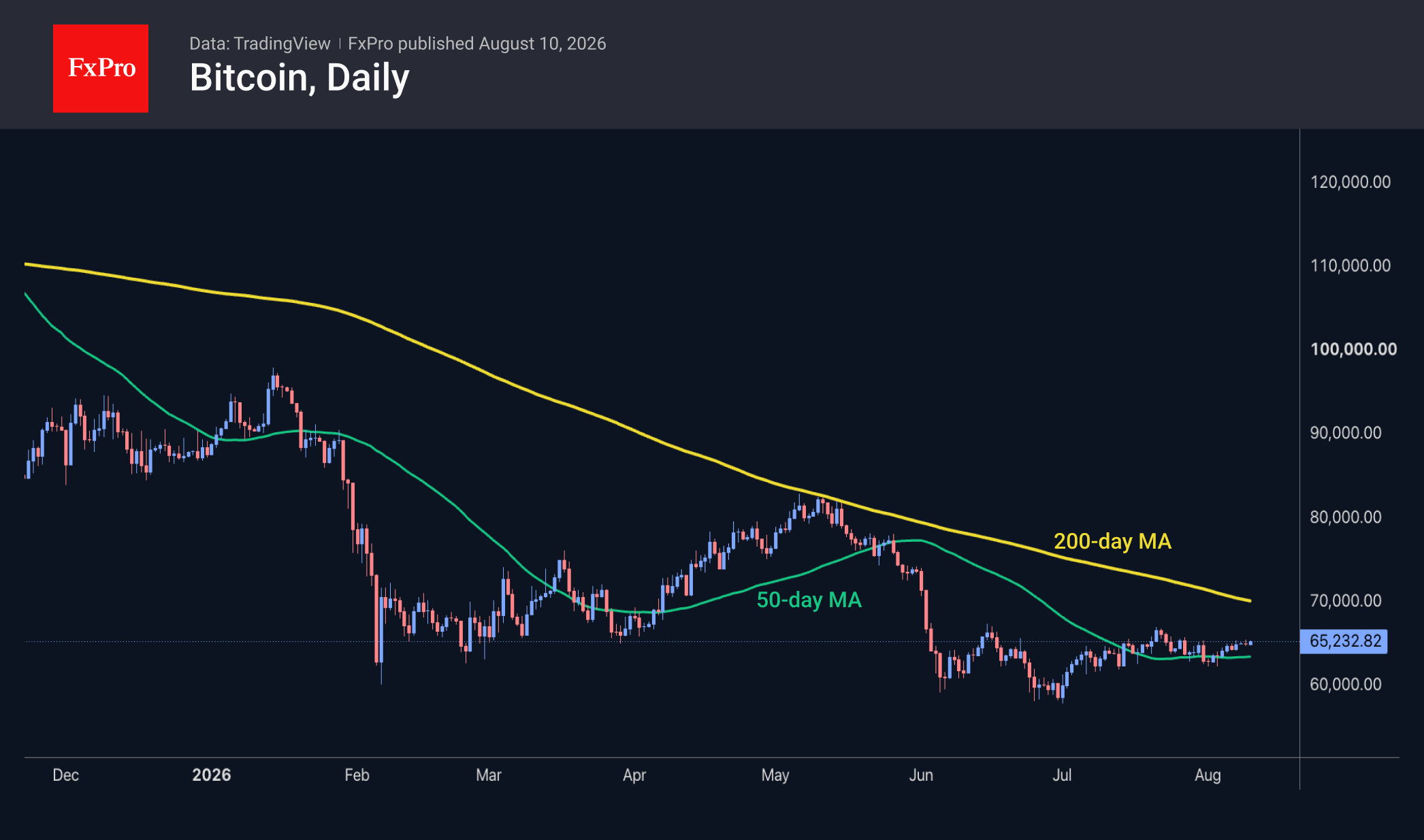
Bitcoin has been cautiously testing the $65K level for the fourth consecutive day. Although there has been no significant surge in buying activity as it approaches this round figure, the absence of sell-offs also suggests a build-up of short positions well above this level. It is quite possible that the next target for growth now appears to be the $70K region – an even more significant round figure, near which the 200-day moving average also lies. This would be above the key area of market contention seen in March and April, significantly shifting sentiment in favour of buyers.
News Background
The negative sentiment in the crypto market is temporary, and investors’ fears regarding a further fall in Bitcoin are greatly exaggerated. The situation is already showing signs of bottoming out, according to Japan’s Metaplanet, which holds 43,000 BTC in its reserves.
MARA Holdings, the largest US mining company, ended the second quarter with a net loss of $611.3 million, compared with a profit of $808.2 million for the same period last year. The decline in BTC’s price was cited as the main reason for the negative result.
According to CryptoRank, trading volume in perpetual futures on centralised crypto exchanges (CEXs) in July was at its lowest since December 2023. On DEXs, trading volume in perpetual futures fell to its lowest level since June 2025.
Trump’s media company, Trump Media (TMTG), has wound down its cryptocurrency operations, abandoning plans to create a public treasury for the CRO token and to integrate prediction markets into Truth Social. However, TMTG will retain its crypto assets. According to Bitcoin Treasuries, Trump Media holds 9,542 BTC worth over $600 million.
The FxPro Analyst Team
The Dollar Let the Labour Market Down
- The USD index plummeted amid a decline in US employment.
- Gold is benefiting from the Fed’s reluctance to raise interest rates.
The US dollar touched a seven-week low after an unexpected labour market report. Employment in July unexpectedly fell by 23K. The figures for May were revised down from 129K to 63K, and those for June from 57K to 20K. As a result, the US economy has added an average of 44K jobs per month over the last six months. The last time we saw similarly weak figures, the Fed cut rates.
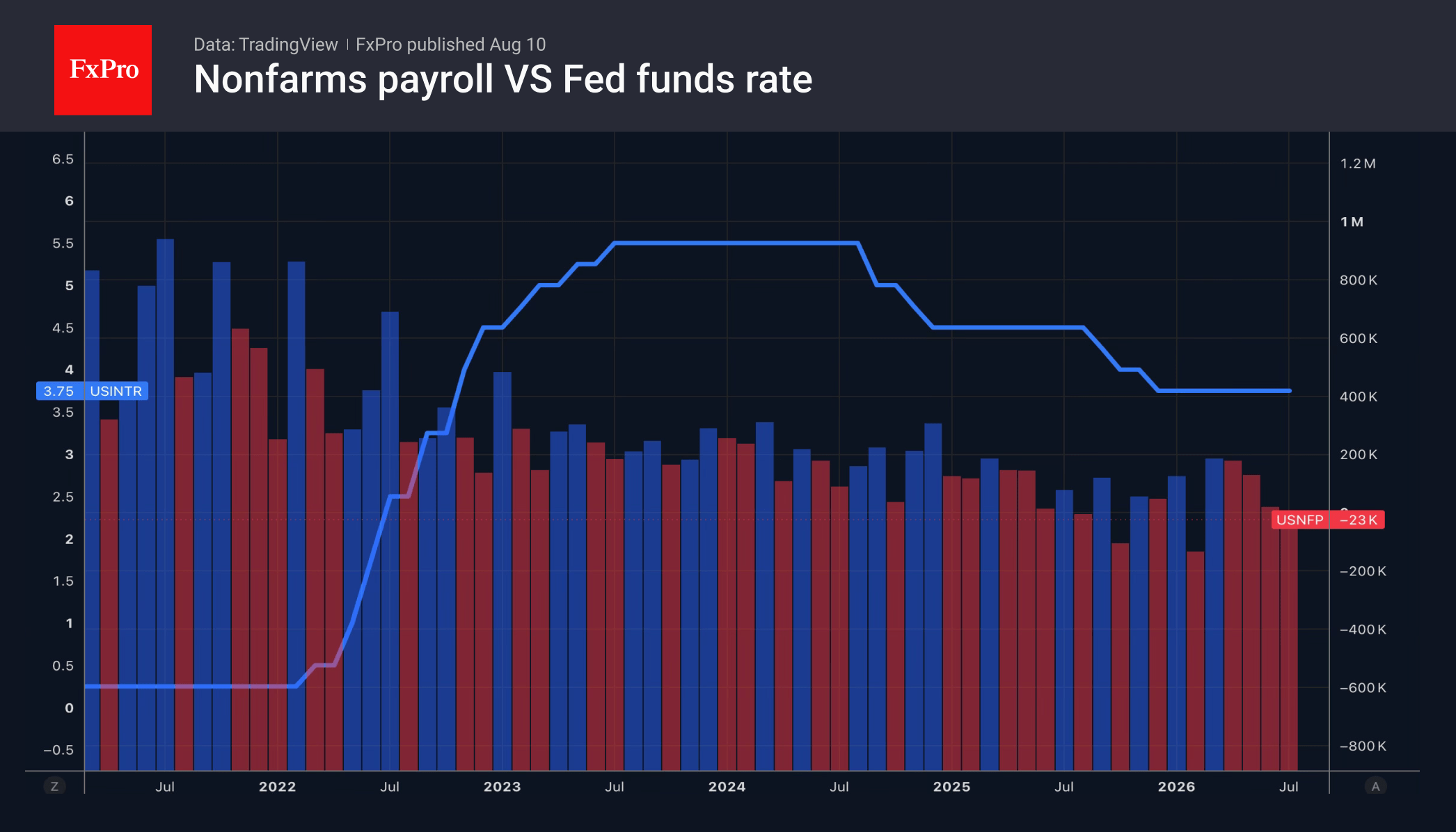
The futures market has reduced the probability of a monetary policy tightening in September to 46% from 67% a week ago. The probability of two hikes in 2026 has fallen from 46% to 32%. This has led to a weakening of the US dollar against majors.
This is all the more so because the White House has resumed pressuring the Fed. The US administration is taking further steps to remove Lisa Cook from her post as FOMC Governor. Coupled with reports of conversations between Donald Trump and Kevin Warsh, this casts a shadow over the central bank’s independence and is one of the reasons for the sell-off in the US dollar.
The Middle East is proving to be a lifeline for the greenback. Iran has announced its readiness to strike a deal with Oman to reopen the Strait of Hormuz, provided some conditions are met. These include lifting sanctions, withdrawing US troops from the region, and reparations. It is doubtful that Washington would agree to this, which heightens the risks of conflict escalation and bolsters the US dollar as a safe-haven asset.
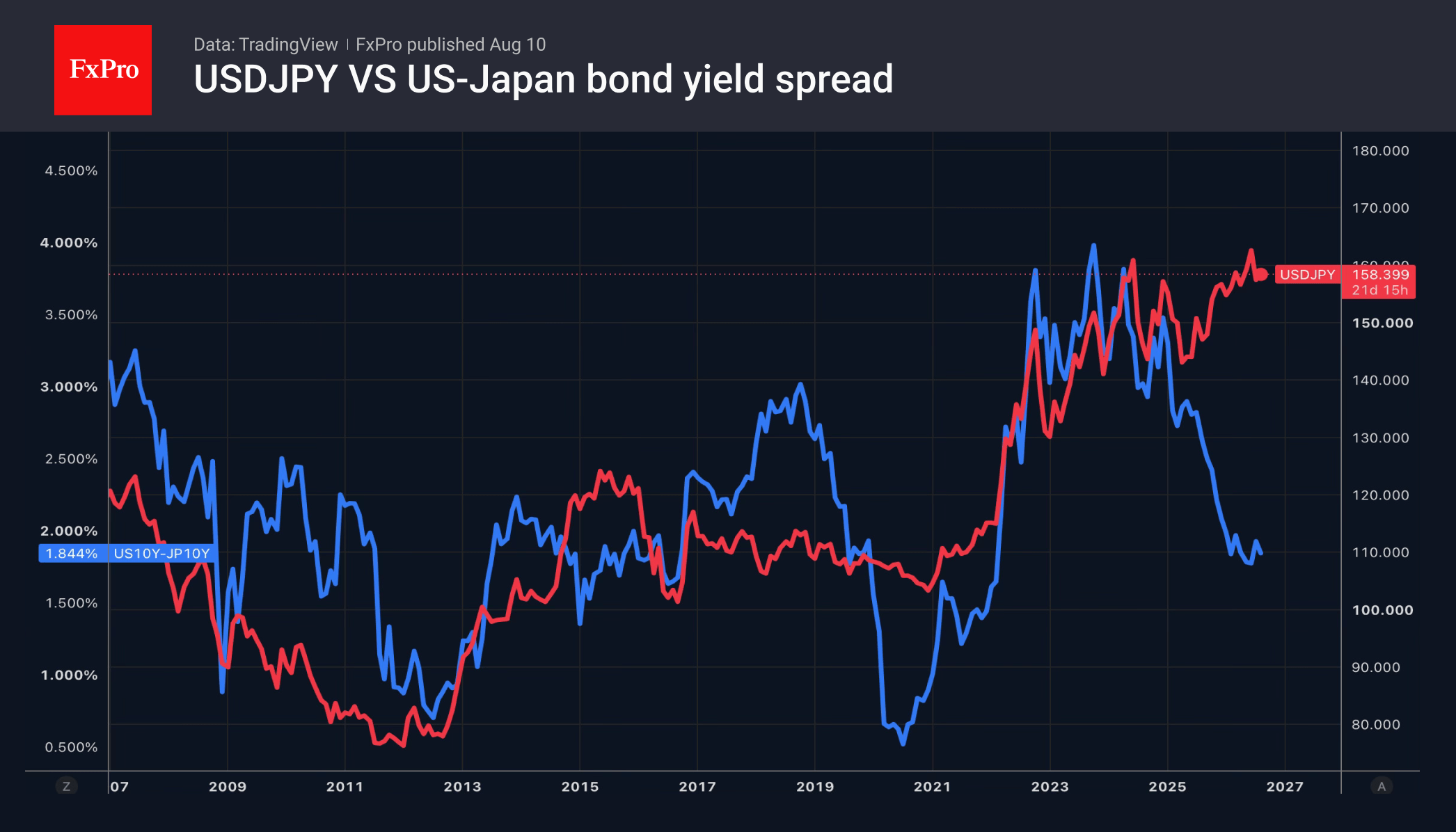
Bears on the USDJPY pair attempted to capitalise on its weakness following the employment figures. The pair slipped below the ¥157 level, and speculators immediately took advantage. The wide interest-rate differential between the Fed and the Bank of Japan creates ideal conditions for carry trades and for selling the yen as a funding currency. The dollar quickly rebounded above ¥158 and is set to continue its rally.
The disappointing employment data came as a catalyst for the gold rally. The precious metal managed to storm the $4,300 mark and consolidate above it. The reduced likelihood of monetary tightening, the associated weakening of the dollar, and a fall in US Treasury yields are providing a strong tailwind for gold. This is all the more so given that when US inflation is high, and the Fed has no intention of tightening monetary policy, gold tends to rise.
The FxPro Analyst Team
GBP/USD Starts the Week on a Strong Footing
GBP/USD enters the week of 10–14 August near 1.3500 – its highest level since 15 July. Sterling is building on the momentum from a sharp decline in the dollar following a weak US labour market report, which reduced expectations of a Federal Reserve rate hike in September. Further support has come from the drop in oil prices: cheaper energy is easing inflation risks and reducing pressure on the UK economy.
Geopolitics remains a key factor. Donald Trump announced progress in negotiations between Iran and Oman regarding the Strait of Hormuz, although no final agreement has yet been reached. A further decline in oil prices would reinforce expectations that the Bank of England can maintain a gradual approach to monetary policy. At its last meeting, the regulator left rates unchanged, and Andrew Bailey confirmed that the disinflation process continues.
The main event for sterling this week will be Thursday’s preliminary GDP estimate for the second quarter. The economy is expected to grow by 0.2% quarter-on-quarter, down from 0.6% previously, with the annual rate projected at 1.6% versus 0.9%. June GDP is forecast to rise by 0.1%. Stronger-than-expected data would support GBP/USD, while a marked slowdown could put renewed pressure on the pound.
On the US side, the key release will be July inflation data on Wednesday, with core CPI expected at 2.5% year-on-year and headline CPI at 3.4%. Thursday brings PPI, followed by retail sales and the University of Michigan’s preliminary consumer sentiment index on Friday. Weak inflation and consumer figures could weigh heavily on the dollar and support further GBP/USD gains, while sustained price pressures would strengthen the case for Fed tightening.
Technical Analysis
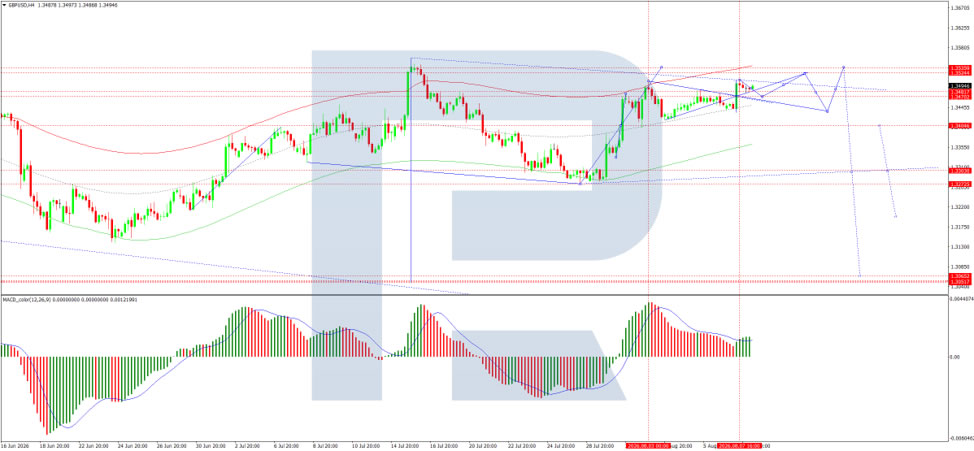
On the H4 GBP/USD chart, a wide consolidation range is forming around the 1.3470 level. An upside breakout would open the way for a move towards 1.3522 and then 1.3535. A downside breakout would suggest a move towards 1.3436, and a break below this level would open the way for the trend to extend to 1.3190. The MACD indicator supports this scenario, with its signal line above zero and pointing downwards.
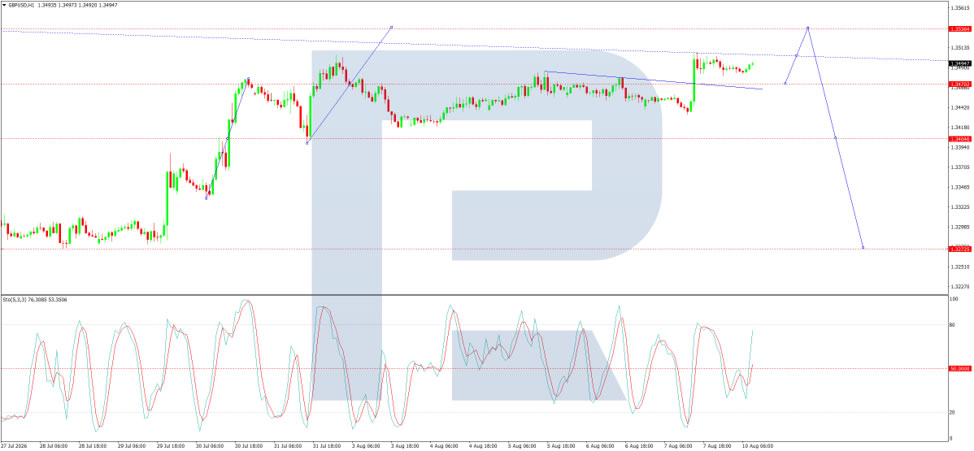
On the H1 chart, the market has formed a compact consolidation range around the 1.3470 level, currently extending between 1.3434 and 1.3500. A move lower towards 1.3470 is expected, followed by a move higher to 1.3535. The Stochastic oscillator confirms this scenario, with its signal line below 50 and pointing downwards. In the short term, a decline towards 20 is expected, followed by a rise towards 80.
Conclusion
GBP/USD has started the week on a strong footing, trading near its highest level since mid-July. The pound has benefited from a weaker dollar following soft US labour market data and falling oil prices, which have eased inflation concerns and reduced expectations of aggressive Fed tightening. Geopolitical progress regarding the Strait of Hormuz has also supported risk sentiment. Markets will now focus on UK GDP data on Thursday and US inflation figures on Wednesday, both of which will provide important clues about the policy outlook for the BoE and Fed. Technically, the pair appears poised for further upside towards 1.3535, with near-term direction hinging on this week’s key data releases. A break below 1.3436 would shift the outlook to bearish, exposing the 1.3190 level.
Why Silver May Be the Better US CPI Trade Than Gold
TL;DR: A weak jobs report already made the case for a Fed hold, but only Wednesday's CPI can confirm inflation is cooling too — and if it comes in soft without reviving growth fears, Silver's dual identity as both a monetary and industrial metal could let it outrun Gold.
Why Payrolls Only Told Half the Story
Last week's payroll shock was enough to send Gold and Silver sharply higher, but it wasn't enough to make the rest of markets comfortable. That difference is important. Weak employment made another Fed hike much harder to defend, yet it did nothing to prove the inflation problem has disappeared. Markets are therefore left with only half of the dovish case confirmed: the labor market is weakening, but the Fed still needs evidence that price pressures are cooling. Wednesday's US CPI report could provide that missing half — and if it does, Silver may have more to gain than Gold.
Why Silver Has a Second Route Higher That Gold Doesn't
Both metals would benefit from the same first-order reaction to softer inflation. Reduced Fed tightening risk should weigh on Treasury yields and the Dollar, improving the monetary backdrop for precious metals. Silver, however, has another route higher. If softer CPI allows investors to price a Fed hold without simultaneously increasing recession fears, equities and broader risk sentiment should also strengthen. That matters because Silver sits between a monetary metal and an industrial commodity — Gold benefits when yields and the Dollar fall, while Silver can benefit from those same forces and from a stronger cyclical outlook.
That second channel was largely missing after payrolls. Negative NFP and heavy downward revisions were dovish for Fed expectations, but they were also bad news for growth. Gold could respond directly to falling tightening risk, while broader risk markets had to decide whether weaker labor demand was becoming something more serious.
A benign CPI surprise would be different. If inflation slows while growth fears don't intensify, markets move closer to a disinflationary soft-landing interpretation. Under that scenario, Silver's industrial exposure becomes an advantage rather than a complication, giving it scope to outrun Gold even if both continue higher.
What the Gold/Silver Ratio Is Already Signaling
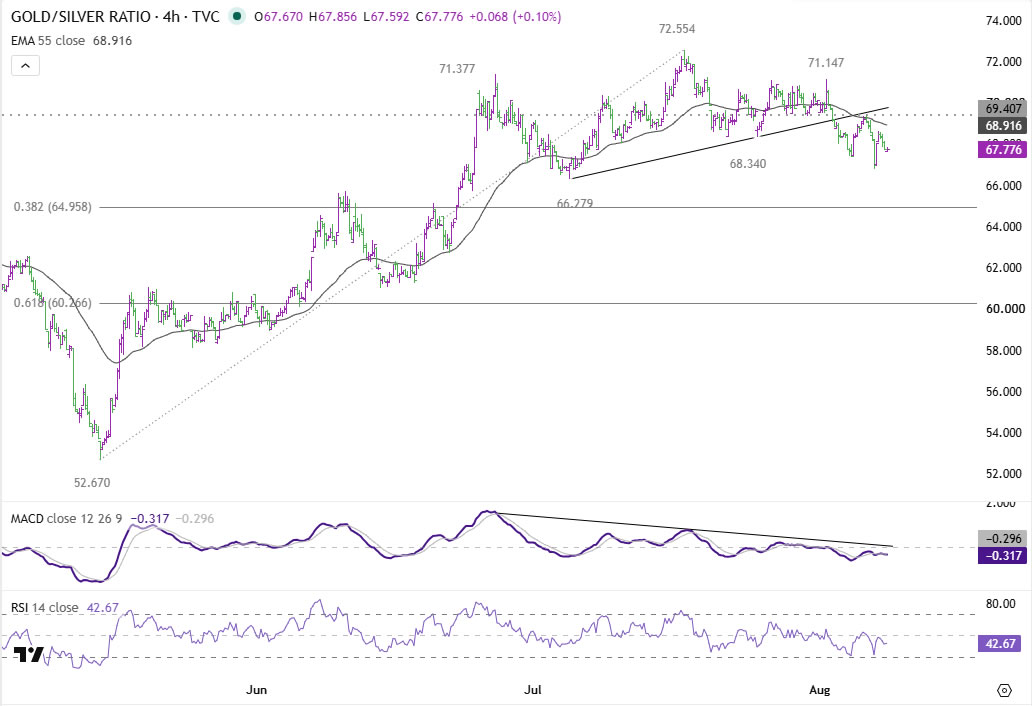
The Gold/Silver ratio suggests that shift may already be starting. On the 4-hour chart, the ratio can be read as having completed a near-term head-and-shoulders top, with shoulders at roughly 71.33 and 71.14 around a 72.55 head. Attempts to recover after the neckline break have been capped by the falling 55 4H EMA near 68.91, while MACD carries bearish divergence. As long as 69.40 caps rebounds, risk stays on the downside toward the 38.2% retracement of 89.36 to 54.77, at 67.99.
That doesn't say Silver must rise outright. It says that, on a relative basis, market structure favors Silver over Gold.
ActionForex's Technical View on Silver
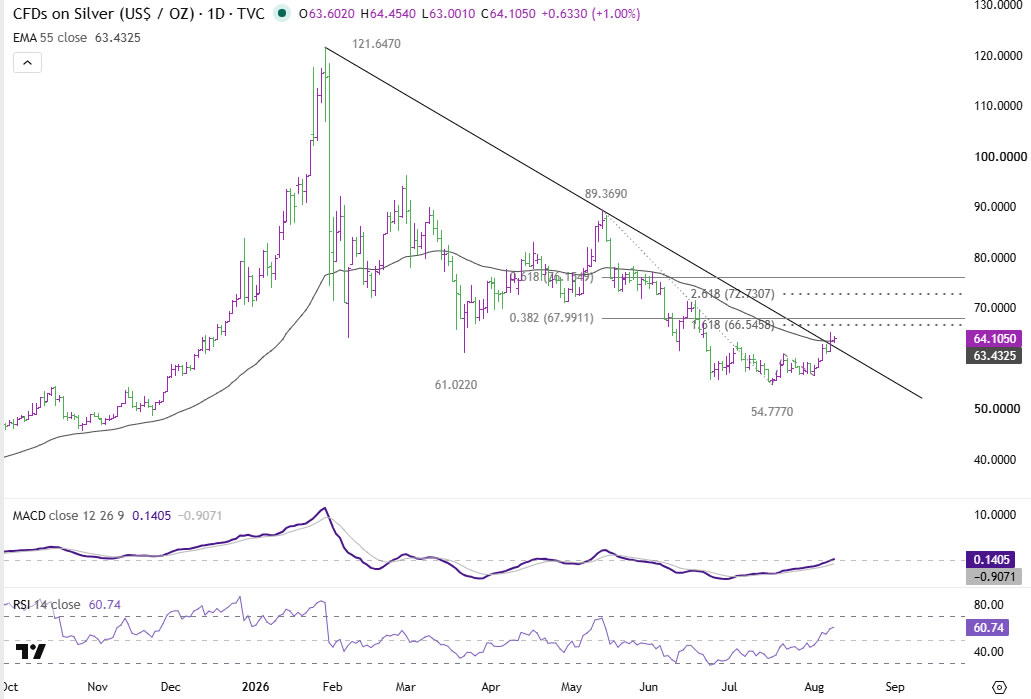
Silver's chart itself is also becoming more constructive at exactly the point CPI is approaching. Bullish divergence in the 4H MACD preceded a break above the 55-day EMA and medium-term falling trendline, shifting the near-term bias higher while 60.85 holds.
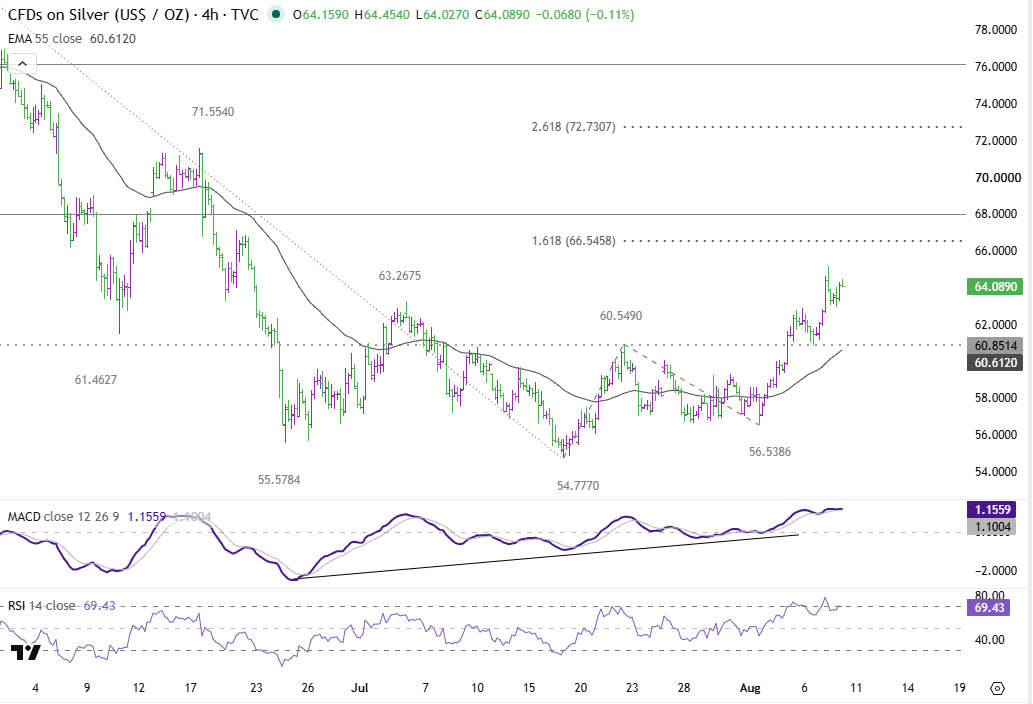
The next test is much tougher: the 66.5–68.0 zone, containing the 161.8% projection of 54.77 to 60.54 from 56.53 at 66.54, and the 38.2% retracement of 89.36 to 54.77 at 67.99. With momentum already stretched, an initial rejection there wouldn't be surprising. But a decisive break would signal the recovery is evolving into something larger, targeting the 261.8% projection at 72.73, or even further to the 61.8% retracement at 76.15.
Why Wednesday Is About the Macro Regime, Not Just the Number
That makes Wednesday less about whether Silver is simply "bullish" and more about whether CPI supplies the right macro regime for its relative advantage to matter. Soft inflation plus resilient risk sentiment is the ideal combination: lower yields and a softer Dollar support both metals, while stronger equities and reflation expectations tilt the balance toward Silver.
Hot CPI would do almost the exact opposite — reviving Fed tightening risk and removing Silver's cyclical edge. Payrolls opened the door to a September hold; CPI now decides whether markets can walk through it with confidence. If they can, Silver may be the better trade than Gold.
Key Takeaways
- Weak payrolls made the case for a Fed hold but didn't confirm inflation is cooling — Wednesday's CPI is needed to complete the dovish case.
- Silver benefits from two channels softer CPI could open: lower yields/Dollar (shared with Gold) and stronger risk sentiment via its industrial demand exposure (Gold doesn't have this).
- The Gold/Silver ratio has formed a bearish head-and-shoulders top, capped below 69.40, pointing toward 67.99 next — a signal already favoring Silver on a relative basis.
- Silver's own chart shows bullish MACD divergence and a break above its 55-day EMA, with 60.85 as near-term support and 66.5-68.0 as the next major resistance zone.
- A soft CPI print without rising growth fears is the ideal setup for Silver to outperform Gold; a hot print would revive Fed tightening risk and erase that edge.
USD/JPY: Was Intervention Enough to Change the Trend?
USD/JPY finds itself at the center of one of the most dramatic currency stories this summer. Having weakened to a four-decade low near ¥164, the yen was pulled back sharply after Japan and the US carried out a coordinated intervention, with Tokyo reportedly spending around $34 billion in a single session to defend its currency. The move briefly pushed the pair toward ¥155, though the yen has since given back some of those gains, trading back near ¥158 as doubts persist over how long intervention alone can hold.
The underlying driver remains the wide gap between US and Japanese interest rates, made worse by rebounding oil prices following renewed tensions in the Strait of Hormuz. Markets are now watching for a possible BoJ hike in September, encouraged by six straight months of rising real wages, while the Fed's own July dissents—three policymakers pushed for a hike over a hold—keep US rates firmly in the driver's seat too.
With both central banks now genuinely in play, USD/JPY's next move looks set to hinge on which side moves first: Tokyo's rate decision, or Washington's next data-driven signal.
Technical Analysis of USD/JPY
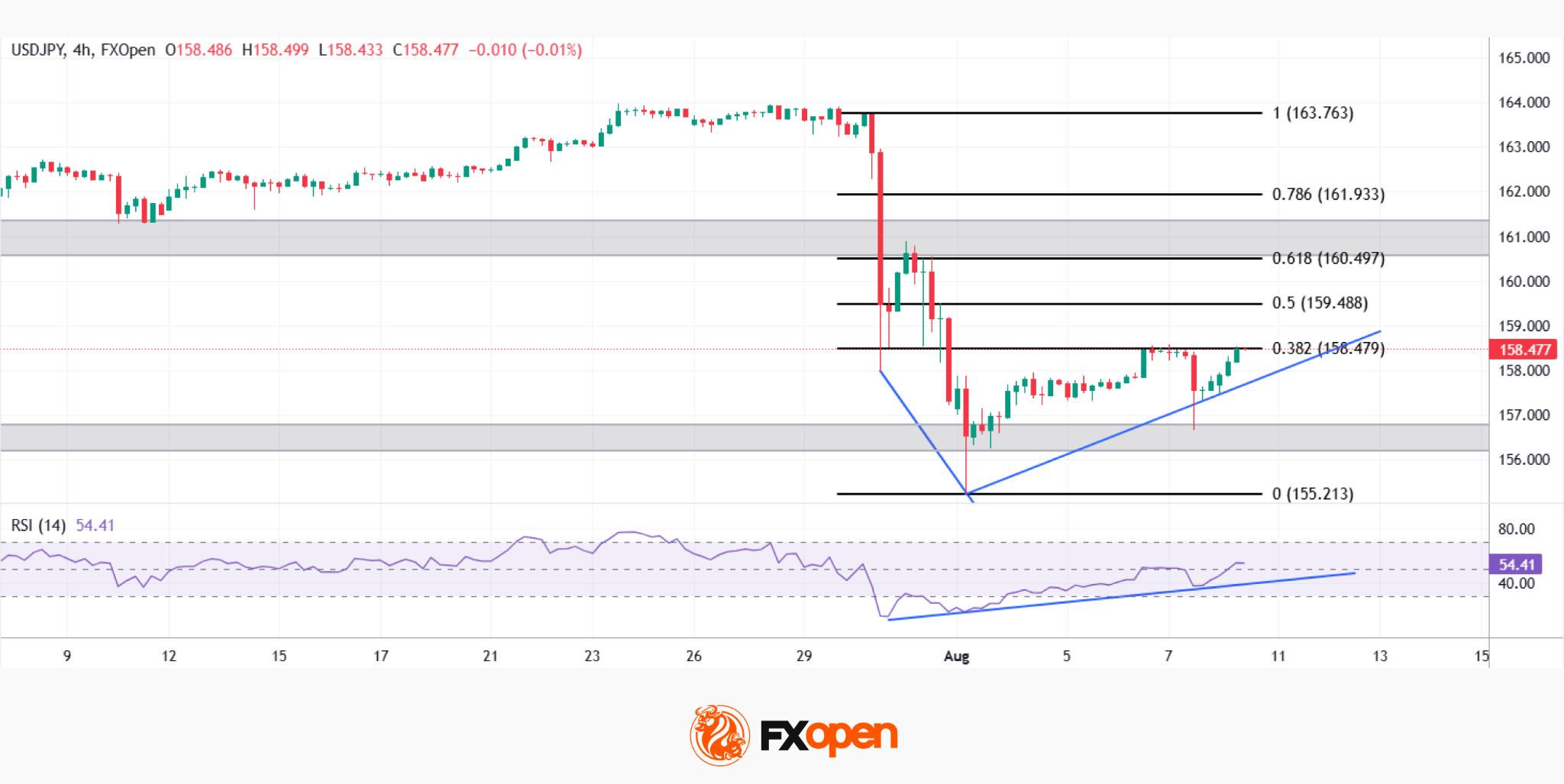
As the USD/JPY chart shows, the pair collapsed sharply after the coordinated intervention, dropping from the 163.76 highs to a low near 155.21 before staging a steady recovery. Price is now testing the 0.382 Fibonacci retracement near 158.48, supported by an ascending trendline off the intervention low, with the RSI showing a bullish divergence as it prints higher lows even as price briefly retested the range.
Bullish Scenario
Should buyers hold the ascending trendline and break decisively above the 0.382 retracement, the path would open toward the 0.5 level near 159.49, with a stronger move targeting the 0.618 retracement around 160.50, where deeper resistance likely awaits.
Bearish Scenario
Conversely, a break below the ascending trendline would invalidate the current recovery structure, exposing a retest of the intervention low near 155.21-156.00, with the RSI divergence losing credibility if price fails to hold this zone.
With price coiled right at the 0.382 confluence, and both the trendline and RSI hinting at renewed strength, USD/JPY looks set for a decisive move—will the recovery from intervention extend, or does Tokyo's defense prove only temporary?
Trade over 50 forex markets 24 hours a day with FXOpen. Take advantage of low commissions, deep liquidity, and spreads from 0.0 pips (additional fees may apply). Open your FXOpen account now or learn more about trading forex with FXOpen.
This article represents the opinion of the Companies operating under the FXOpen brand only. It is not to be construed as an offer, solicitation, or recommendation with respect to products and services provided by the Companies operating under the FXOpen brand, nor is it to be considered financial advice.
Eurozone Sentix Confidence Turns Positive, but Inflation Concerns Return
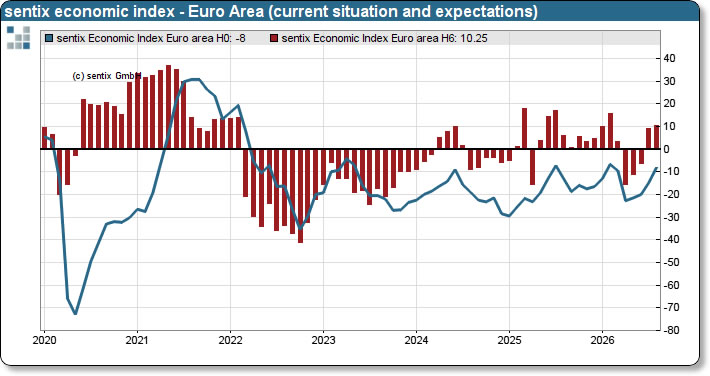
Eurozone investor confidence improved for a fourth straight month in August, reinforcing signs that sentiment is recovering alongside firmer economic data. Sentix Overall Index rose from -3.1 to 0.9, beating expectations of -1.3 and reaching highest level since February. Current Situation improved from -14.8 to -8.0, while Expectations edged up from 9.3 to 10.3. Sentix linked improvement to stronger-than-expected Q2 growth, recovering industrial production and confidence indicators, rising investment and government spending, as well as partial absorption of confidence shock from Iran war. Still, high energy costs and subdued order books continue to constrain recovery.
Improving growth picture is being accompanied by renewed inflation concern. Sentix Inflation Barometer deteriorated sharply from -13.75 to -29.25, indicating investors are again becoming more worried about price pressures after previous month’s improvement, although concern remains below extremes seen during height of Iran conflict. ECB Policy Barometer likewise fell from -8.25 to -15.25, showing markets expect a more restrictive policy environment. Combination of stronger activity and renewed inflation risks therefore argues against an early monetary-policy “all-clear.”
Germany showed a similar but more fragile improvement. Sentix Overall Index rose for a third month from -19.4 to -11.9, while Current Situation jumped from -39.8 to -28.3 and Expectations improved from 3.5 to 6.0. Recent 0.2% Q2 growth and firmer ifo confidence support stabilization case, but deeply negative current-condition reading shows underlying economy is still weak.
For ECB, broader message is two-sided: growth fears are easing just as inflation concerns are rebuilding, reducing urgency for a more accommodative policy turn.
Data Summary
Euro Area Sentix Investor Confidence
| Component | Current | Previous | Trend |
|---|---|---|---|
| Overall Index | 0.9 | -3.1 | Improved |
| Current Situation | -8.0 | -14.8 | Improved |
| Expectations | 10.3 | 9.3 | Improved |
Germany Sentix Investor Confidence
| Component | Current | Previous | Trend |
|---|---|---|---|
| Overall Index | -11.9 | -19.4 | Improved |
| Current Situation | -28.3 | -39.8 | Improved |
| Expectations | 6.0 | 3.5 | Improved |
Key Takeaways
- Eurozone Sentix Overall Index improved from -3.1 to 0.9 in August, marking a fourth consecutive monthly rise and highest level since February.
- Current Situation also strengthened from -14.8 to -8.0, while Expectations edged higher from 9.3 to 10.3, showing recovery is becoming broader but still led by forward-looking optimism.
- Sentix cited stronger Q2 growth, improving industrial production and confidence indicators, rising investment and government spending, and partial absorption of Iran-war confidence shock.
- Inflation concerns resurfaced sharply, with Sentix Inflation Barometer falling from -13.75 to -29.25, while Central Bank Policy Barometer weakened from -8.25 to -15.25.
- That combination of better growth and renewed inflation concern argues against an early monetary-policy “all-clear” from ECB.
- Germany also improved for a third consecutive month, but Current Situation at -28.3 still points to weak underlying conditions despite better expectations.