Sample Category Title
(RBA) Statement by the Reserve Bank Board: Monetary Policy Decisions
At its meeting today, the Board decided to leave the cash rate target unchanged at 4.35 per cent.
Inflation picked up materially in the second half of 2025, and information since the beginning of this year confirms that some of the increase reflected greater capacity pressures. While the impact of the Middle East conflict on inflation has so far been less than expected, headline inflation is still too high. Trimmed mean inflation also remains elevated and is little changed from the March quarter. Oil and most related commodity prices remain higher than they were prior to the Middle East conflict. Some firms experiencing cost pressures are increasing the prices of their goods and services and others are looking to do so. Short-term measures of inflation expectations have eased but remain higher than earlier in the year.
Financial conditions have tightened in response to three increases in the cash rate target this year. Money market interest rates and government bond yields have risen, and the exchange rate has appreciated. There are signs that consumer spending growth is slowing gradually as expected, while growth in business debt and investment is strong. Momentum in the housing market has shifted, with housing prices falling in some capital cities and new housing loans declining noticeably. Labour market conditions have eased by a little more than expected in recent months. Labour market leading indicators point to only limited easing in the near term.
There continue to be heightened uncertainties about the outlook for domestic economic activity and inflation. Resolution of the Middle East conflict remains uncertain, and there are scenarios where inflation is higher and activity lower than forecast. Global oil supply will take time to recover, maintaining upward pressure on global energy prices and inflation, in which case domestic inflationary pressures could be higher than expected. A period of prolonged uncertainty may also cause growth to be lower overseas and in Australia. So far, growth in Australia’s major trading partners has been stronger than expected, as the boost from AI-related investment has outweighed the adverse effects of the Middle East conflict. In Australia, historically weak productivity growth continues to constrain potential growth.
Decision
The disruption to global oil supply is adding directly to inflation and there are indications that higher fuel prices are being passed through to prices of other goods and services, so inflation is likely to remain high for some time. This inflation impulse is in addition to the effect of capacity pressures in the economy.
The Board remains focused on ensuring that high inflation does not become embedded. To achieve this, growth in aggregate demand needs to remain subdued to reduce capacity pressures and bring inflation back to target. Following three increases in the cash rate target since the beginning of the year, financial conditions are now tighter than they were, and the economy appears to be slowing as expected. But inflation is still too high. It is not expected to return to around the midpoint of the target range until late 2027 and there are upside risks to this projection. With monetary policy judged to be somewhat restrictive, the Board decided to leave the cash rate target unchanged while it assesses how the economy is evolving. The Board will continue to do what it considers necessary to bring inflation sustainably back to target, including increasing the cash rate target further if upside risks materialise.
Accordingly, the Board will be attentive to the data and the evolving assessment of the outlook and risks to guide its decisions. Monetary policy is well placed to respond to developments and the Board is focused on its mandate to deliver price stability and full employment.
Today’s policy decision was unanimous.
Gold Reclaims Bullish Momentum as the Rally Resumes
Key Highlights
- Gold started a fresh rally above the $4,250 region.
- It surpassed a major contracting triangle with resistance at $4,095 on the 4-hour chart.
- WTI Crude Oil started a recovery wave above $81.50 and $82.00.
- Bitcoin failed to clear the $65,500 resistance and trimmed gains.
Gold Price Technical Analysis
Gold found bids near $4,065 and $4,080 against the US Dollar. The price started a decent increase after there was a close above $4,120.
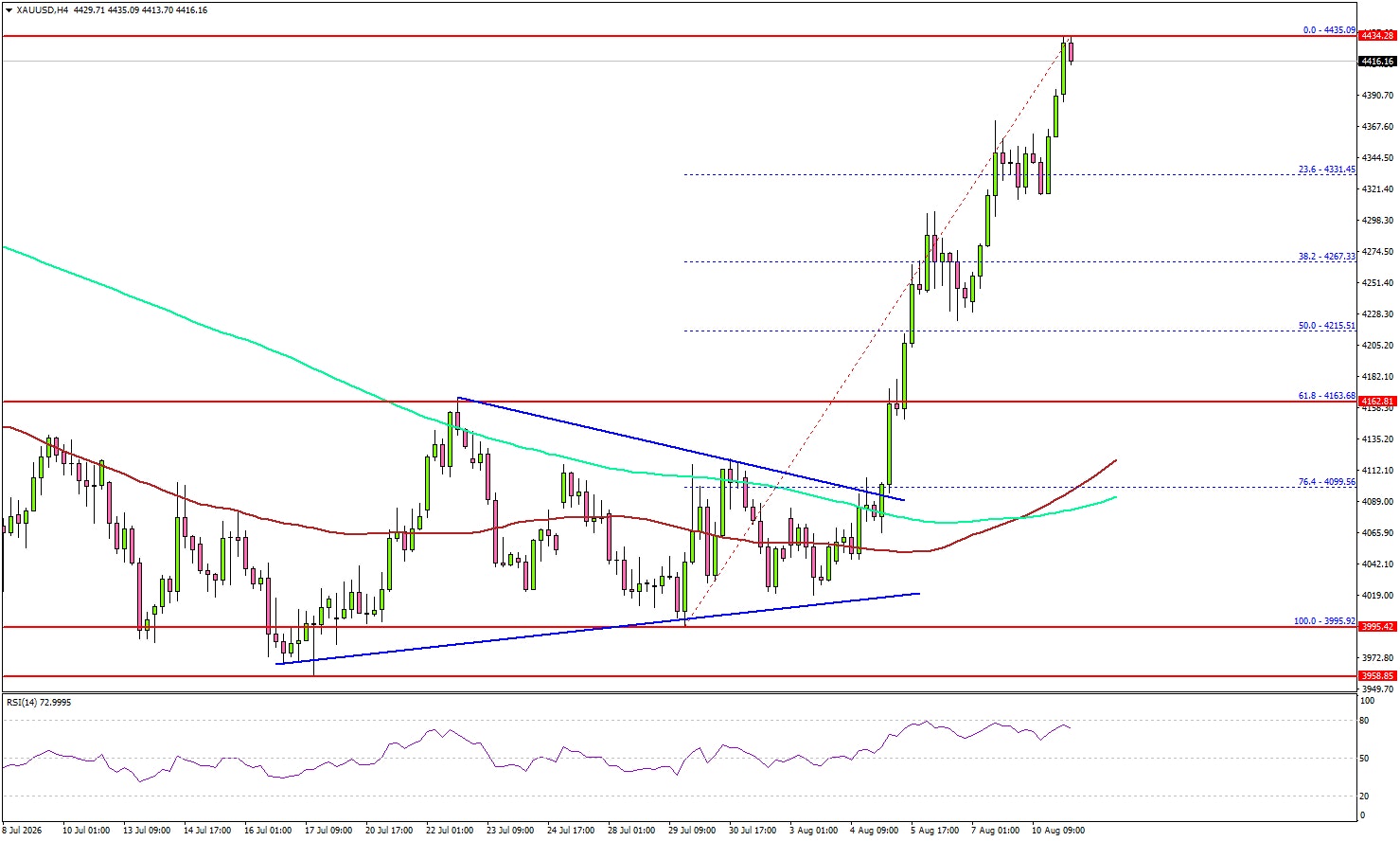
The 4-hour chart of XAU/USD indicates that the price settled above the $4,250 pivot level, the 100 Simple Moving Average (red, 4 hours), and the 200 Simple Moving Average (green, 4 hours). A high was formed at $4,435, and the price remains elevated.
On the upside, immediate resistance could be $4,435. The next major resistance might be $4,450. A clear move above $4,450 could open the doors for more upside. In the stated case, the bulls could aim for a move toward $4,500 or even $4,525. Any more gains might send the price toward the $4,550 level.
If there is a downside correction, the price could test the $4,350 support or the 23.6% Fib retracement level of the upward move from the $3,995 swing low to the $4,435 high.
The first major support sits at $4,320. The next support could be $4,215, below which the price might slide to $4,150. The main support sits at $4,120. Any more losses might call for a test of $4,050 or even $4,020 in the coming days.
Looking at WTI Crude Oil, the price is slowly moving higher and might rally if it closes above the $83.50 resistance.
Economic Releases to Watch Today
- US NFIB Business Optimism Index for July 2026 – Forecast 97.8, versus 97.4 previous.
- US ADP Employment Change 4-week average - Forecast 12K, versus 15K previous.
Brent Breakout Raises $100 Risk as Hormuz Talks Hit the Same Old Wall
TL;DR: Could Brent oil actually retest $100? A confirmed technical breakout and a Hormuz negotiation stuck on the same unresolved dispute suggest the risk is rising.
A Rally That Signals a Deeper Shift
Oil prices' rally accelerated Monday, with Brent and WTI closing up roughly 5%. Both benchmarks advanced for a fourth consecutive session, reaching their highest level in nearly two weeks. The move matters because the market appears to be shifting from pricing whether another Hormuz headline will hit, to pricing how long disruption may actually last.
That's a more durable source of upside risk. Brent had fallen from $102.00 to $78.11 as hopes grew that a negotiated shipping arrangement could eventually restore flows through the Strait of Hormuz. But the latest developments are making that optimism harder to sustain. Talks aren't simply progressing slowly — they're repeatedly colliding with the same underlying dispute that has already caused earlier agreements to fail.
Washington and Tehran Are Still Far Apart
Iran's outgoing National Security Council secretary laid out six formal conditions over the weekend, including compensation, sanctions relief, an end to the blockade, and an end to military threats. US President Donald Trump responded Monday by hardening rather than narrowing the gap, saying he is "likewise demanding compensation from Iran, for all of the people that they have killed and gravely wounded."
That exchange matters because compensation is only one part of the disagreement. The US position calls for unrestricted freedom of navigation through the Strait of Hormuz without Iranian tolls, approvals, or controls. Iran's preferred framework, including its draft arrangement with Oman, builds in exactly those elements.
So while reports that shipping coordinates have been agreed may sound constructive, they don't resolve the central question: who controls passage through the Strait, and under what conditions? That's the same fault line that caused the June 17 US-Iran MOU to collapse before fighting resumed. This week's impasse therefore looks less like a new setback than a repeat of an unresolved structural problem.
This Is Becoming a Two-Chokepoint Story
Physical shipping activity is also reinforcing the concern. Kpler-tracked crossings reportedly fell from 15 on Friday to 11 on Saturday and just 6 on Sunday, suggesting disruption is increasingly visible in actual traffic rather than diplomatic headlines alone.
At the same time, Houthi activity is threatening the Red Sea and Bab el-Mandeb route, while risks have spread toward Saudi domestic infrastructure — making this more than a Hormuz problem. A single disrupted chokepoint can be partly absorbed through rerouting. Two stressed routes are much harder to work around.
Alternative routes only help if they remain sufficiently safe and commercially viable. If Hormuz remains constrained while Red Sea security deteriorates, shipping costs, insurance premiums, and delivery times can all rise together. The market then has to price not just a temporary loss of capacity, but a more persistent deterioration in global energy logistics.
ActionForex's Technical View on Brent
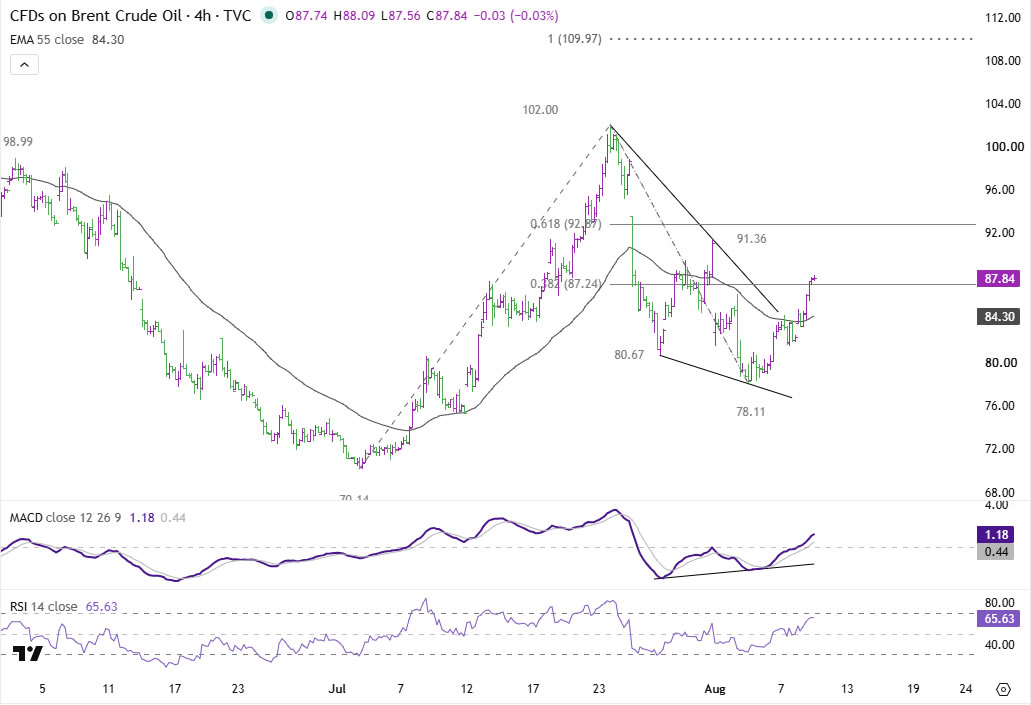
Brent's chart is starting to reflect that change in expectations. Monday's move decisively cleared the 38.2% retracement of 102.0 to 78.11. That strengthens the case that the fall from 102.00 was a corrective three-wave decline that has completed. If that interpretation is correct, the broader rise from 70.14 may still be incomplete.
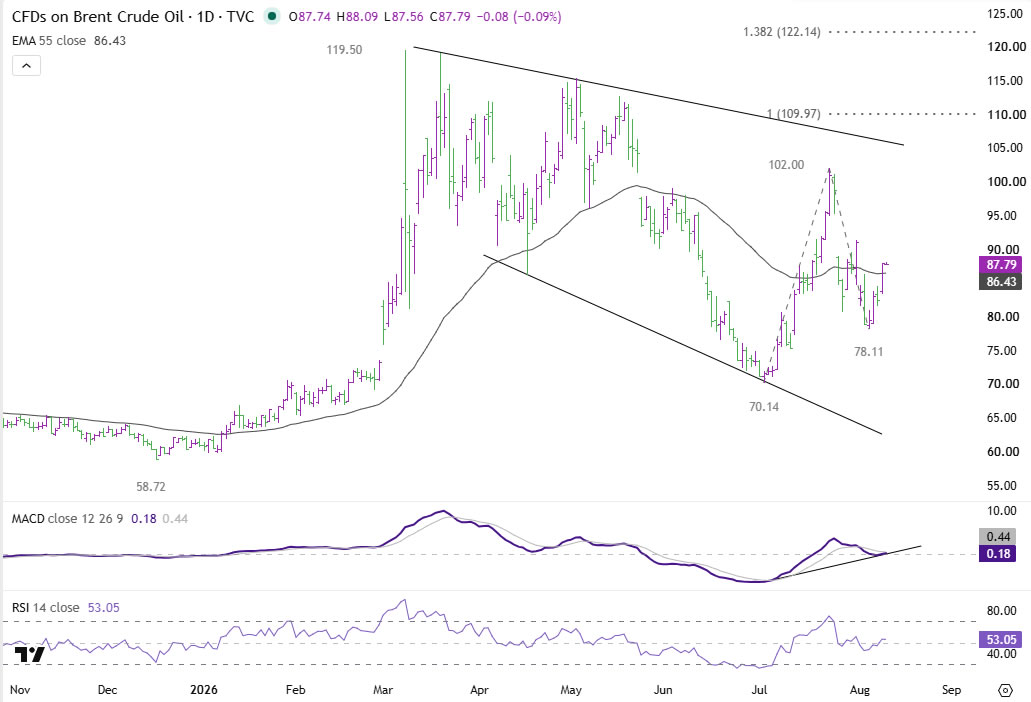
The rebound from 78.11 could either be the second leg of a larger correction below 102.00, or, more bullishly, resumption of that broader advance from 70.14. Either way, the near-term bias now favors further gains while the 55 4H EMA, around 84.30, holds. Brent has also recovered above the 55-day EMA near 86.43, adding further confirmation that recent downside momentum has been broken.
$92.87 Is the Gateway to a Retest of $102
The next major level is 92.87, representing the 61.8% retracement of the 102.00–78.11 decline. That's where the current rebound faces its first genuinely important test. A rejection there could still leave Brent in a broad consolidation below the July high. But a decisive break above 92.87 would materially increase the probability of a retest of 102.00.
At that point, $100 would no longer be simply a geopolitical scenario attached to worsening headlines — it would become a live technical objective inside the next resistance zone. That's why the current breakout deserves attention. Brent doesn't need to reach $100 immediately for the risk profile to have changed; it only needs to keep holding above the broken retracement structure while the diplomatic backdrop continues to deteriorate.
Key Takeaways
- Brent and WTI both closed up roughly 5% Monday, their fourth consecutive gain and highest level in nearly two weeks.
- Talks remain stuck on the same core dispute as the collapsed June 17 MOU: who controls passage through Hormuz and under what conditions.
- Daily Hormuz crossings fell from 15 to 6 over the weekend, while Houthi activity threatens the Red Sea route too, turning this into a two-chokepoint risk.
- Monday's break above the 38.2% retracement of 102.00 to 78.11 strengthens the case that Brent's decline has completed as a corrective move.
- A decisive break above 92.87 resistance would materially raise the odds of a retest of the $102 high; a rejection there would instead point to continued consolidation.
Fed’s Hammack Sees Multiple Hikes, Says Current Rates Aren’t Restrictive Enough
Cleveland Fed President Beth Hammack made one of clearest cases yet for renewed tightening, saying in a Yahoo Finance interview on Monday, that more than one rate hike may ultimately be needed to return inflation to target. Hammack, who dissented from July decision to hold rates at 3.50–3.75% in favor of a 25bp increase, argued that a single move would have limited impact. “One 25 basis point move probably doesn’t do a whole lot for the economy,” she said, adding that “it’s probably some number of [movements],” although she would not prejudge how many or where rates would ultimately peak.
Her argument rests partly on view that current policy is not restrictive enough. Hammack said she does not believe rates at 3.50–3.75% are “meaningfully restricting” economy, noting that businesses are not reporting restraint on investment or growth because of borrowing costs. “So to me that says that now is the time to act,” she said. Hammack compared gradual tightening with pumping brakes before reaching a stop sign rather than waiting to slam them on later, warning that delaying action would leave inflation above 2% for longer and risk making eventual disinflation more costly.
Importantly, July’s weak employment report has not shifted her focus away from inflation. Despite payrolls contracting -23K, Hammack pointed to unemployment at 4.1%, around her estimate of full employment, and said, “I’m still not seeing a problem” in labor market. She was similarly skeptical that inflation will return to target without additional policy restraint: “From where I sit, I just don’t see it coming back on its own.” That puts Wednesday’s July CPI in sharper focus. Core CPI slowed from 2.6% in June and is expected to ease to 2.5% in July; a meaningful downside surprise would challenge Hammack’s assessment, while sticky or stronger inflation would reinforce her case for multiple hikes.
Hammack also pushed back against idea that higher market yields can substitute for Fed action. “Markets are a complement for the Fed. They’re not a substitute,” she said, adding that policymakers must “stand behind our words with our actions when appropriate.” On communication, she argued credibility comes not from extensive forward guidance but from explaining Fed’s reaction function and commitment to 2% inflation. Her remarks underline growing divide ahead of September: weak employment has raised hurdle for another hike, but hawks such as Hammack argue inflation still requires not merely one additional move, but potentially a renewed tightening sequence.
Key Takeaways
- Cleveland Fed President Beth Hammack said more than one rate hike will likely be needed, arguing that “one 25 basis point move probably doesn’t do a whole lot for the economy.”
- Hammack does not view current 3.50–3.75% policy rate as “meaningfully restricting” activity and said “now is the time to act.”
- She remains focused on inflation despite July payrolls falling 23K, saying unemployment at 4.1% is around full employment and “I’m still not seeing a problem” with labor market.
- Hammack also rejected idea that inflation will return to target without further restraint: “From where I sit, I just don’t see it coming back on its own.”
- Her remarks make Wednesday’s July CPI an important test. Softer core inflation would weaken case for renewed tightening, while sticky inflation would strengthen hawkish argument.
- She stressed that “markets are a complement for the Fed. They’re not a substitute,” pushing back against idea that higher bond yields can replace Fed action.
- Comments reinforce widening policy split: weak labor data have raised hurdle for another hike, but some officials still see inflation as requiring a multi-step tightening response.
Dow Jones and Copper: Why the Overlap Reveals a Nest and Signals a Major Risk-On Acceleration
The long-term advances in the Dow Jones and Copper cannot be correctly labeled as regular Elliott Wave impulses. The reason is based on one of the most important rules within Elliott Wave Theory: Wave 4 of a regular impulse cannot overlap the price territory of Wave 1 at the same degree. This overlap is visible in both markets.
In the Dow Jones, the advance from the 2009 Wave ((II)) low contains overlapping price action that prevents the entire rally from being counted as a regular five-wave impulse. Copper presents the same structural condition in its advance from the 2011 cycle. Rather than suggesting that these bullish cycles are approaching completion, the overlap points toward a much more powerful interpretation: both markets are developing Elliott Wave nests.
That distinction is extremely important because a nest represents a sequence of first and second waves at different degrees. Once those structures are completed, the market normally enters the most powerful portion of the Elliott Wave sequence—an acceleration through multiple third waves.
Why the Overlap Matters
A regular bullish impulse follows a five-wave sequence below:
Wave 1 advances.
>Wave 2 corrects Wave 1.
>Wave 3 produces another advance.
>Wave 4 corrects Wave 3.
>Wave 5 completes the impulse.
One of the essential rules governing this structure is that Wave 4 cannot overlap the price territory of Wave 1. When that overlap occurs, the proposed regular impulse becomes invalid at that degree, unless the market is forming a diagonal. This is precisely why the long-term advances in the Dow Jones and Copper should not be treated as simple or nearly completed impulses. The overlapping swings indicate that these markets are developing through a sequence of nested impulses and corrections.
What might initially appear to be Waves 1, 2, 3, 4 and 5 of a single impulse is better understood as a series of first and second waves at progressively smaller degrees. Thus, instead of: 1–2–3–4–5, the structure is developing more like: ((1))–((2))–(1)–(2)–1–2 This is the anatomy of a bullish Elliott Wave nest.
The Dow Jones Nest from the 2009 Low
The Dow Jones established a major long-term low in 2009, ending Wave ((II)). The advance from that low has remained bullish, but the internal overlapping prevents us from labeling the entire move as a regular impulse approaching its conclusion. The correct interpretation is that the Dow Jones has been building a succession of first and second waves.
Each correction has maintained the larger bullish structure and created another base from which the next advance could begin. The 2020 decline ended another important Wave II within the larger sequence, while the subsequent corrections have continued developing the nested structure.
The weekly chart shows the market advancing through several degrees of first and second waves. The correction into the 2026 low completed another Wave (2), and the Dow Jones has already resumed the bullish sequence. This means the market is not simply advancing within a late Wave 5. Instead, it is moving through the early stages of a much stronger phase of the long-term bullish cycle.
The next important pullback should remain corrective and be followed by another extension higher. As long as the important pivot at 36,860 remains intact, the bullish sequence remains valid, and we do not recommend selling the Dow Jones.
Dow Jones Weekly Chart
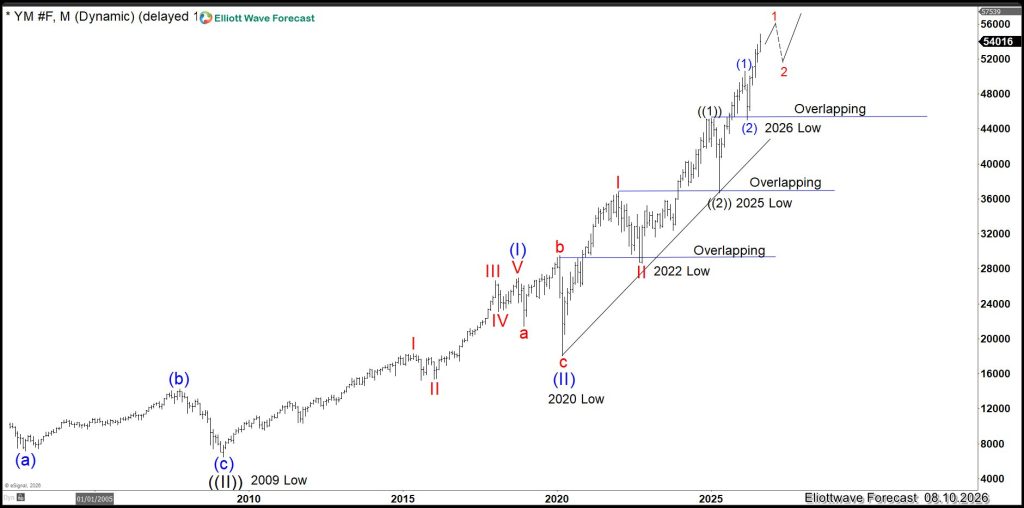
The overlapping structure from the 2009 Wave ((II)) low invalidates the interpretation of a regular impulse at that degree. The sequence is better counted as a bullish nest, supporting additional acceleration.
Copper Is Displaying the Same Bullish Structure
Copper has been developing a similar long-term sequence since its 2011 cycle.
The decline into the 2020 low completed Wave ((II)), and the advance that followed has unfolded through a series of nested first and second waves. The internal overlap means the move cannot be counted as one regular impulse at the larger degree. Following the 2020 low, Copper completed Wave ((1)) and corrected in Wave ((2)). From there, the metal continued higher through another sequence of Waves (1) and (2), followed by smaller-degree Waves 1 and 2.
This creates a powerful bullish nesting formation. Copper is now advancing within the developing third-wave sequence. The weekly structure suggests that the current cycle still has additional upside before completing Wave ((1)). After that cycle ends, a corrective Wave ((2)) should create another major buying opportunity before the next acceleration higher.
As long as the 3.1230 pivot remains intact, the long-term bullish sequence remains valid. Consequently, we do not recommend selling Copper.
Copper Weekly Chart
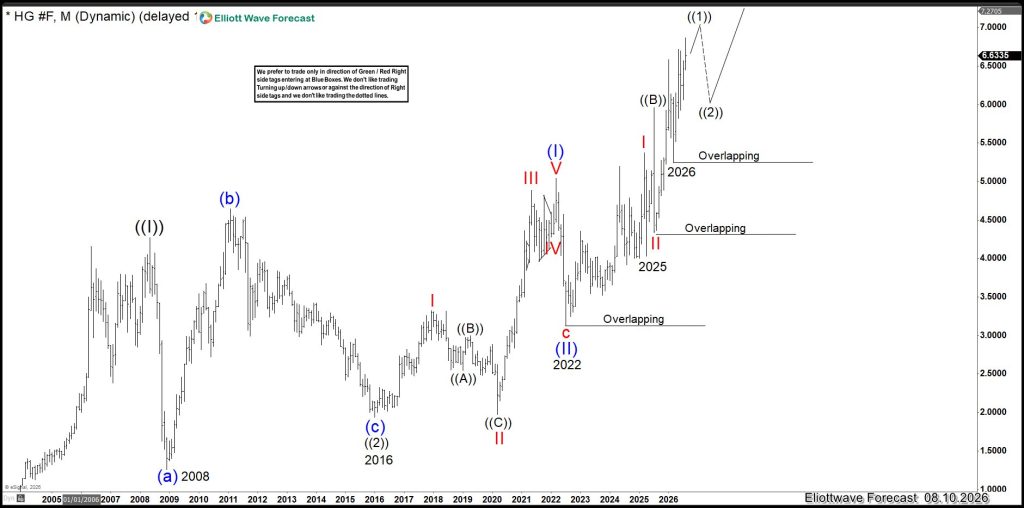
Copper’s overlapping advance supports a nested Elliott Wave structure rather than a regular impulse. The sequence favors additional upside and another acceleration after the next corrective pullback.
Two Major Markets Are Confirming the Same Message
The importance of this setup becomes even greater because the same structural pattern is visible in two markets with a strong connection to global economic activity. The Dow Jones reflects the long-term behavior of major U.S. companies and the broader appetite for equities. Copper is one of the most important industrial metals and is closely connected to construction, manufacturing, infrastructure, electrification and global growth.
When the Dow Jones and Copper both display bullish nested structures, the message extends beyond two individual instruments. Together, they indicate that the larger Risk-On cycle remains incomplete.
Both markets are showing:
Long-term bullish sequences.
Overlapping advances that invalidate regular impulse counts at the larger degree.
Multiple first- and second-wave structures.
Important bullish pivots holding below the market.
The potential for acceleration through a series of third waves.
This synchronization supports the view that the next stage of the market should not be a normal or gradual advance. It should become increasingly powerful as the nested structures begin releasing their third-wave energy.
Why the Nest Points Toward Acceleration
A nest often develops before the strongest part of an Elliott Wave cycle. It can remain overlapping and frustrating for an extended period because the market continues producing first waves followed by corrective second waves. However, every completed Wave 2 creates the foundation for another Wave 3.
Once the corrections end, several third waves can unfold simultaneously at different degrees. This is when momentum expands, participation broadens and price begins advancing much faster.
The sequence can transition from: ((1))–((2))–(1)–(2)–1–2 into: ((3))–(3)–3
That is the source of the expected acceleration.
The overlapping price action is therefore not a sign of structural weakness. It represents the process of building energy before the market enters the strongest phase of the bullish sequence.
What This Means for Risk-On Markets
The bullish nests in the Dow Jones and Copper support a powerful conclusion: the broader Risk-On cycle is preparing to accelerate.
The Dow Jones is pointing toward higher equity prices, while Copper is confirming strength in the industrial and commodity side of the global market. When these two major instruments accelerate together, the movement should support a broad expansion across Risk-On assets.
This environment should favor:
Global equity indices.
Industrial sectors.
Commodities and metals.
Cyclical assets.
Risk-sensitive currencies.
Other instruments correlated with global growth.
Corrections will still occur because markets never move in a straight line. However, those pullbacks should be viewed within the context of the larger bullish sequence. As long as the important invalidation levels remain intact, corrections are expected to produce buying opportunities rather than major long-term selling opportunities.
Conclusion
The overlapping structures in the Dow Jones since the 2009 Wave ((II)) low and in Copper since the 2011 cycle cannot be ignored. Under the rules of Elliott Wave Theory, the overlap between Waves 1 and 4 invalidates the idea that these advances are regular impulses at that degree. Instead, the price action reveals a series of nested first and second waves.
This interpretation completely changes the long-term outlook. Rather than approaching the end of their bullish cycles, both markets appear to be preparing for the strongest phase of their advances. Once the remaining corrective structures are completed, several third waves should begin unfolding at different degrees, creating a powerful acceleration higher.
The Dow Jones represents strength in equities, while Copper reflects industrial demand and expectations for global economic growth. When both markets confirm the same nested bullish structure, the message extends across the entire financial system.
Corrections will continue to occur, but they should remain temporary buying opportunities as long as the major bullish pivots hold. The larger sequences remain incomplete, and selling against them carries significant risk.
The conclusion is clear: the overlapping price action is not evidence that the advance is ending. It is evidence that the market has been building a powerful bullish nest. As that nest begins to accelerate through its third-wave sequence, the Dow Jones and Copper should move substantially higher—and the broader Risk-On environment could explode with them.
CADJPY Wave Analysis
CADJPY: ⬆️ Buy
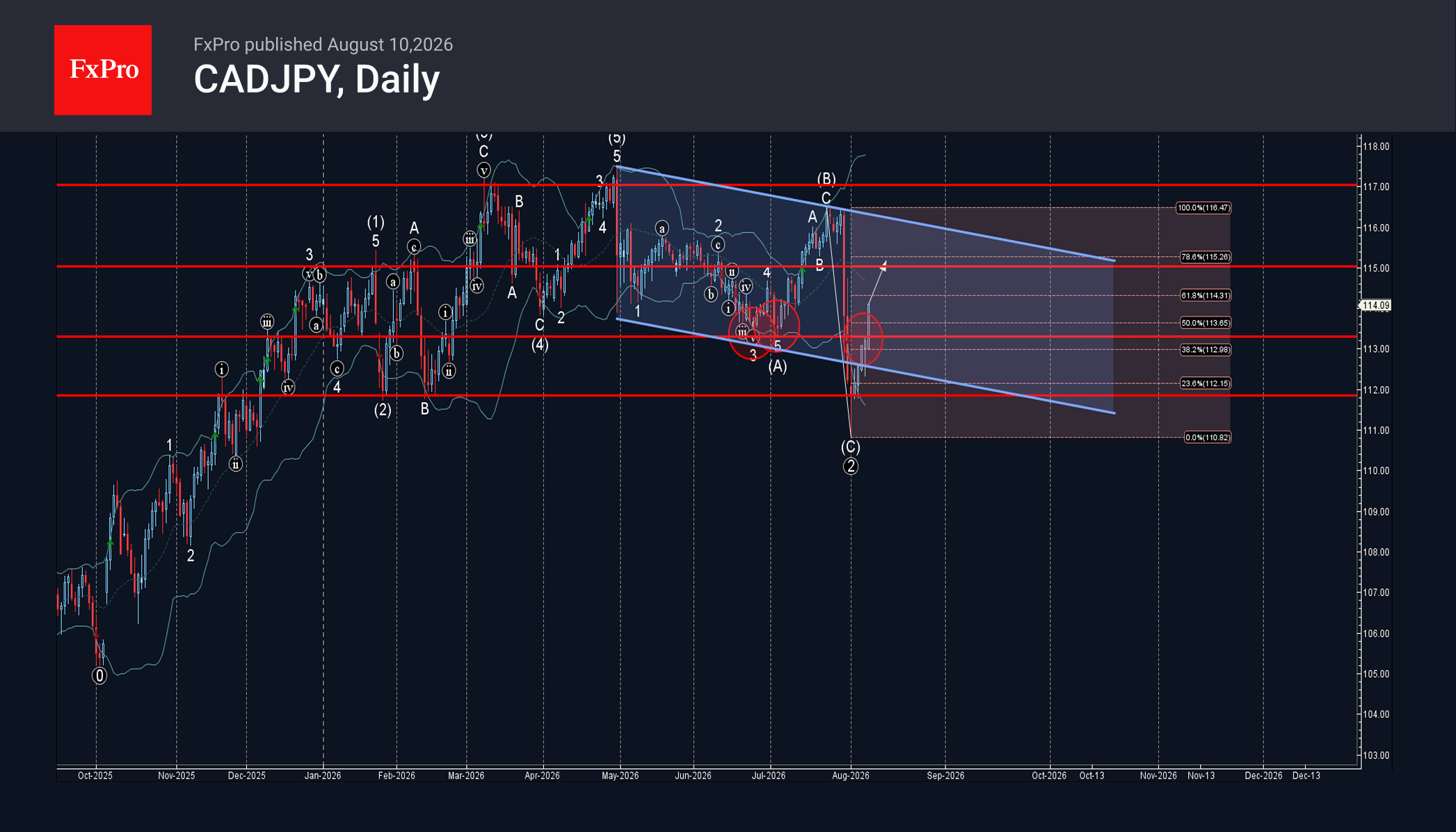
– CADJPY broke resistance level 113.30
– Likely to rise to resistance 115.00
CADJPY currency pair recently broke the resistance zone between the resistance level 113.30 (former support from June and July) and the 50% Fibonacci correction of the downward impulse from July.
The breakout of this resistance zone accelerated the active short-term impulse wave 1 of the primary impulse wave 3 from the start of August.
Given the clear daily uptrend and the strongly bearish yen sentiment seen across the FX markets today, CADJPY can be expected to rise to the next resistance 115.00.
Silver Wave Analysis
Silver: ⬆️ Buy
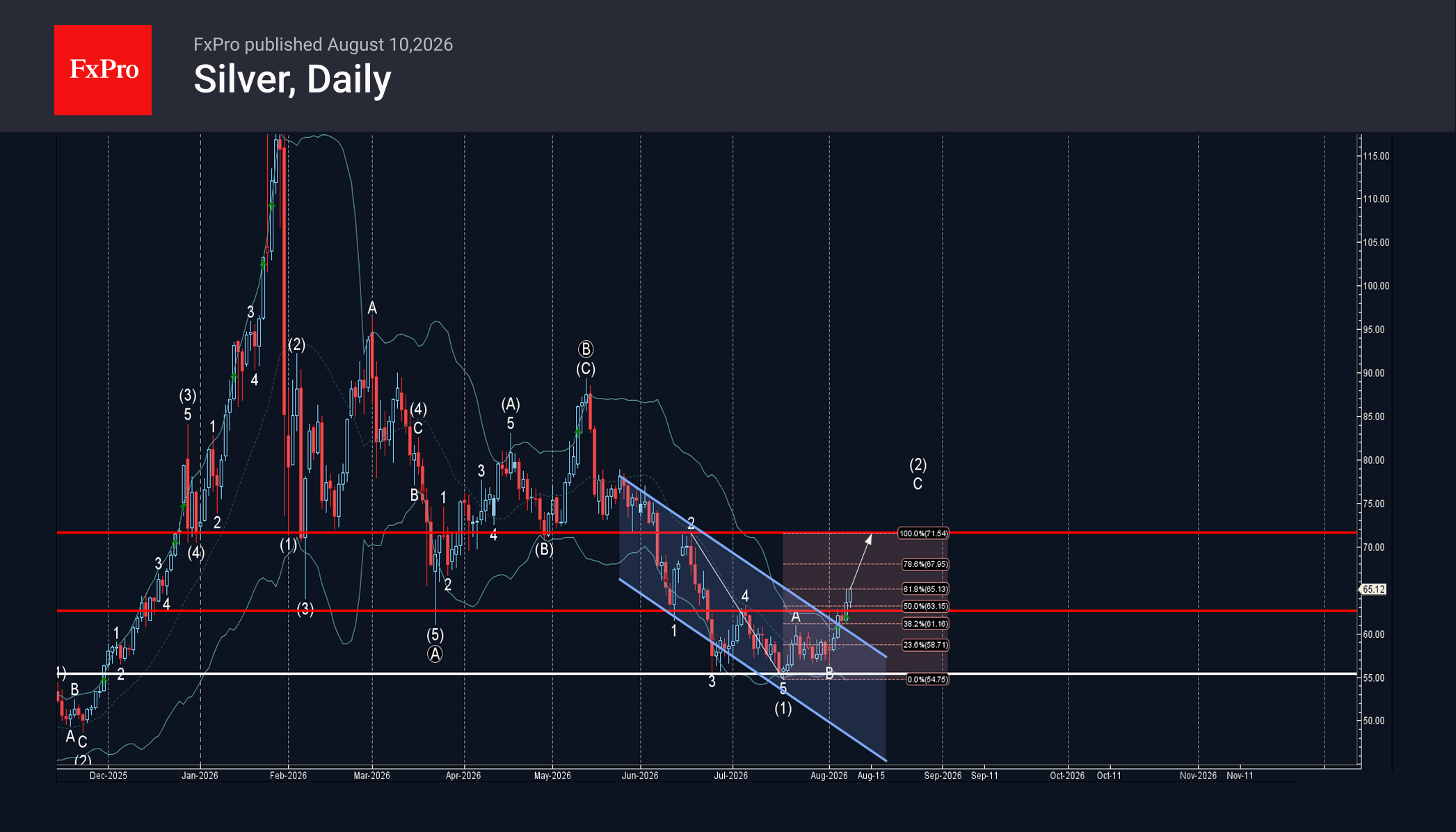
– Silver broke resistance zone
– Likely to rise to resistance level 71.60
Silver recently broke the resistance zone between the resistance level 62.60 (top of the previous wave 2 from July) and the 50% Fibonacci correction of the downward impulse from June.
The breakout of this resistance zone greatly accelerated the active impulse wave C of the ABC correction (2) from the middle of July.
Given the strength of the active impulse wave C, Silver can be expected to rise to the next resistance level 71.60 – top of wave 2 from June.
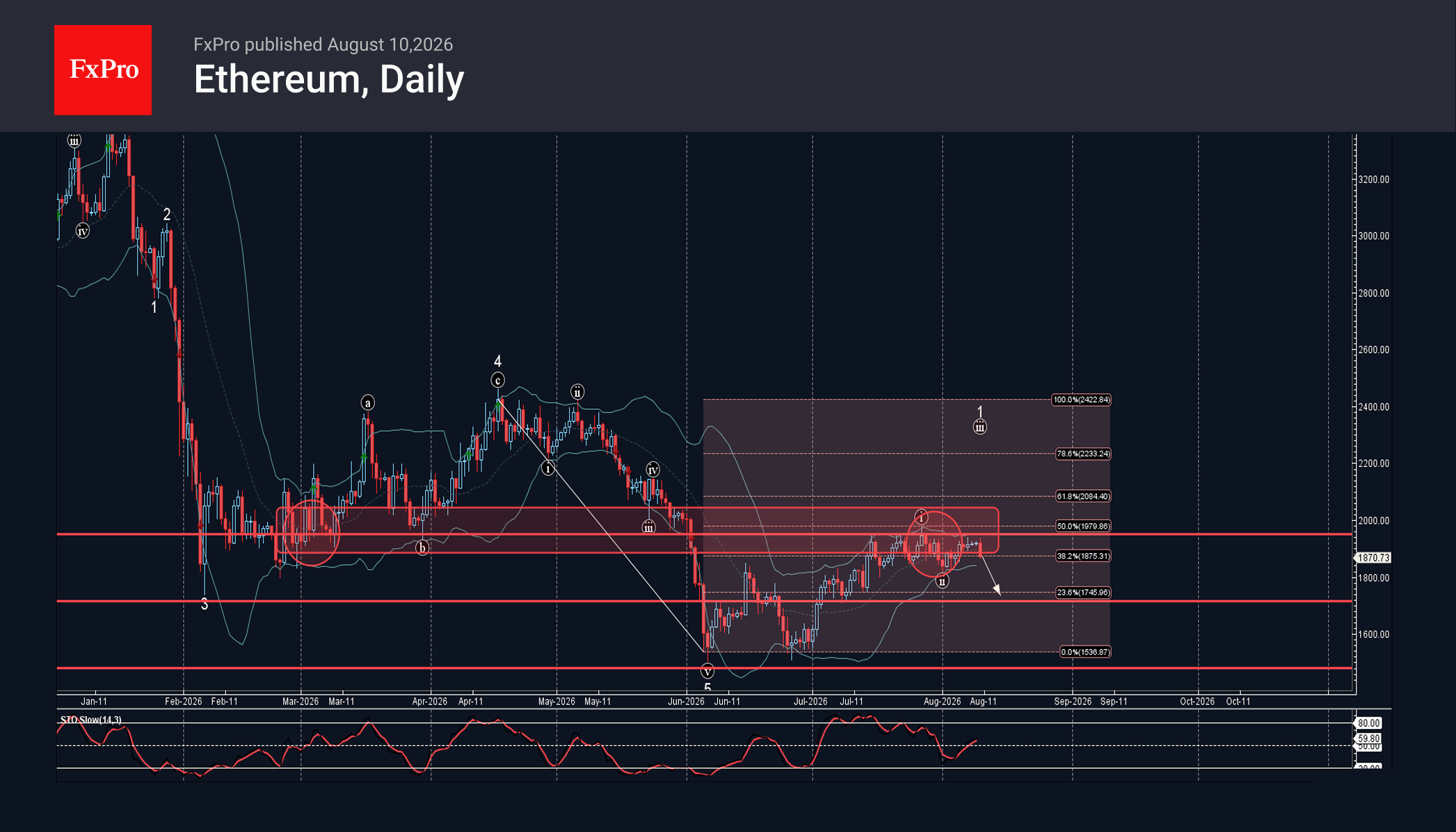
Ethereum Wave Analysis
Ethereum: ⬇️ Sell
– Ethereum reversed from powerful resistance zone
– Likely to fall to support level 1715.00
Ethereum cryptocurrency recently reversed down from the powerful resistance zone between the strong resistance level 1950.00, upper daily Bollinger Band and the 50% Fibonacci correction of the downward impulse from April.
The downward reversal from this resistance zone is aligned with the predominant downtrend that can be seen on the daily and weekly Ethereum charts.
Ethereum cryptocurrency can be expected to fall further to the next support level 1715.00 – former minor support from the start of July.
Eco Data 8/11/26
| GMT | Ccy | Events | Act | Cons | Prev | Rev |
|---|---|---|---|---|---|---|
| 23:01 | GBP | BRC Like-For-Like Retail Sales Y/Y Jul | 1.00% | 1.50% | 1.70% | |
| 01:30 | AUD | NAB Business Conditions Jul | 4 | 3 | ||
| 01:30 | AUD | NAB Business Confidence | -6 | -5 | -6 | |
| 04:30 | AUD | RBA Interest Rate Decision | 4.35% | 4.35% | 4.35% | |
| 05:30 | AUD | RBA Press Conference | ||||
| 10:00 | USD | NFIB Business Optimism Index Jul | 99.8 | 97.2 | 97.4 | |
| 14:00 | USD | Existing Home Sales Jul | 4.06M | 4.06M | 4.09M | 4.13M |
| 23:01 | GBP |
| BRC Like-For-Like Retail Sales Y/Y Jul | |
| Actual | 1.00% |
| Consensus | 1.50% |
| Previous | 1.70% |
| 01:30 | AUD |
| NAB Business Conditions Jul | |
| Actual | 4 |
| Consensus | |
| Previous | 3 |
| 01:30 | AUD |
| NAB Business Confidence | |
| Actual | -6 |
| Consensus | |
| Previous | -5 |
| Revised | -6 |
| 04:30 | AUD |
| RBA Interest Rate Decision | |
| Actual | 4.35% |
| Consensus | 4.35% |
| Previous | 4.35% |
| 05:30 | AUD |
| RBA Press Conference | |
| Actual | |
| Consensus | |
| Previous | |
| 10:00 | USD |
| NFIB Business Optimism Index Jul | |
| Actual | 99.8 |
| Consensus | 97.2 |
| Previous | 97.4 |
| 14:00 | USD |
| Existing Home Sales Jul | |
| Actual | 4.06M |
| Consensus | 4.06M |
| Previous | 4.09M |
| Revised | 4.13M |
EURUSD – Bulls Hold Grip but Continue to Face Strong Headwinds at 100Dma / Daily Cloud Top
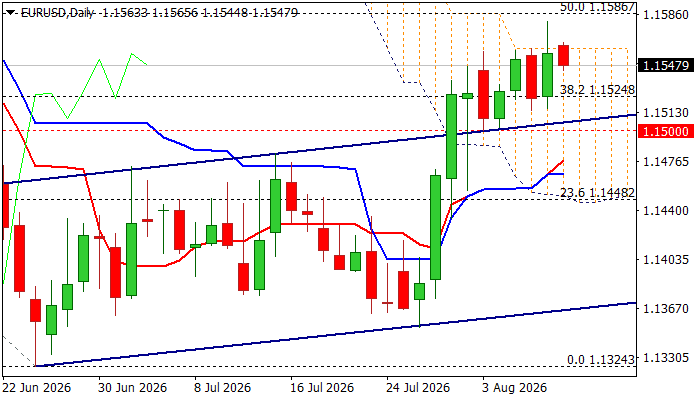
EURUSD probed again through strong barriers at 1.1560/66 (100DMA / daily cloud top) on Monday, following Friday’s false break higher, but continues to face headwinds at this zone.
The single currency benefited from weak NFP data that further deflated dollar on Friday, pressured by fading expectations for Fed rate hike in September, but so far lacks strength for final break.
Near-term structure remains firm as bullishly aligned daily studies continue to underpin the action, with extended consolidation (1.1515/1.1560) likely to precede fresh push higher.
Markets await release of US July CPI data (Wednesday) to add fresh details in near-term policy outlook, with Euro expected to benefit from weaker inflation.
Sustained break of 100DMA / cloud top to generate fresh bullish signal for attack at nearby Fibo barrier at 1.1586 (50% retracement of 1.1849/1.1324) which guards next target at 1.1626 (200DMA).
Extended dips should be ideally contained above broken Fibo 38.2% resistance (1.1524) to keep bulls in play.
Caution on break of 1.1500 support zone (broken bull-channel upper boundary / round-figure) that would signal deeper pullback.
Res: 1.1566; 1.1586; 1.1626; 1.1649
Sup: 1.1524; 1.1500; 1.1484; 1.1460