Sample Category Title
Bitcoin Upside Push Stalls Again at a Key Barrier
Key Highlights
- Bitcoin faced a few rejections near $65,500.
- There was a move below a bullish trend line with support at $64,850 on the 4-hour chart of BTC/USD.
- Ethereum also struggled above $1,920 and trimmed gains.
- The US Consumer Price Index could increase by 3.4% in July 2026 (YoY).
Bitcoin Price Technical Analysis
Bitcoin price made another attempt to settle above $65,500 against the US Dollar but failed. BTC started a fresh decline, but losses were limited.
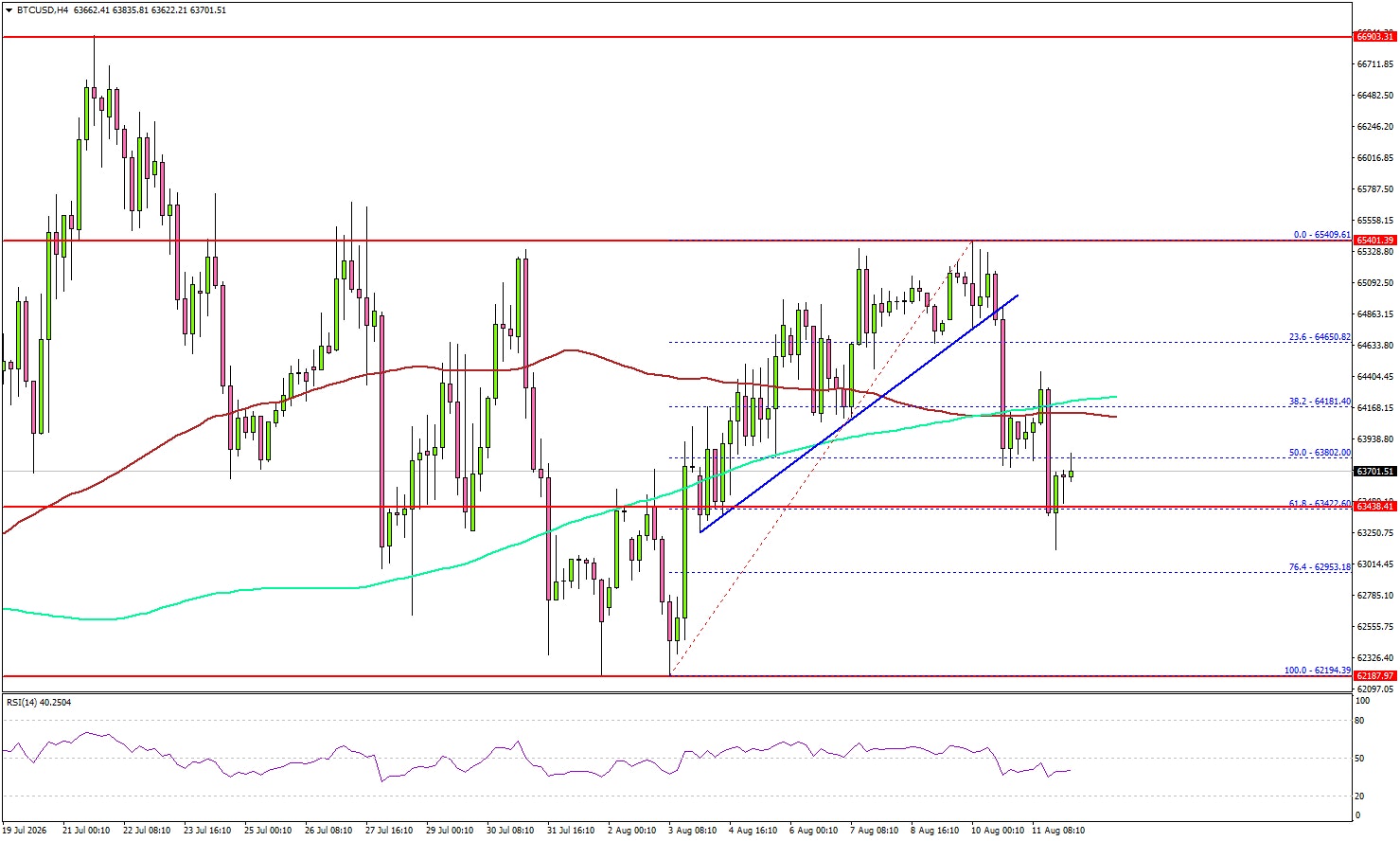
Looking at the 4-hour chart, the price formed a high near $65,409 and started a fresh decline. There was a move below $65,000 and $64,850. The price traded below the 38.2% Fib retracement level of the upward move from the $62,194 swing low to the $65,409 high.
BTC spiked below the 100 simple moving average (red, 4-hour) and the 200 simple moving average (green, 4-hour). If the bears remain in action, the price might find bids near the 61.8% Fib retracement level at $63,420.
A downside break and close below $63,420 could trigger a sharp decline. In the stated scenario, the price could test $62,000 or even $61,200.
On the upside, an immediate resistance could be $65,000. The first major resistance might be $65,500. The main resistance might be $66,800. A close above $66,800 could send the price toward $68,800. Any more gain might call for a test of $70,000.
Looking at Ethereum, the price seems to be facing a major hurdle near $1,920 and $1,950. The key support might be $1,820.
Today’s Key Economic Releases
- US Consumer Price Index for July 2026 (MoM) – Forecast +0.1%, versus -0.4% previous.
- US Consumer Price Index for July 2026 (YoY) – Forecast +3.4%, versus +3.5% previous.
- US Consumer Price Index Ex Food & Energy for July 2026 (YoY) – Forecast +2.5%, versus +2.6% previous.
Elliott Wave View: Russell 2000 (Rty) Impulse Set to Extend Higher
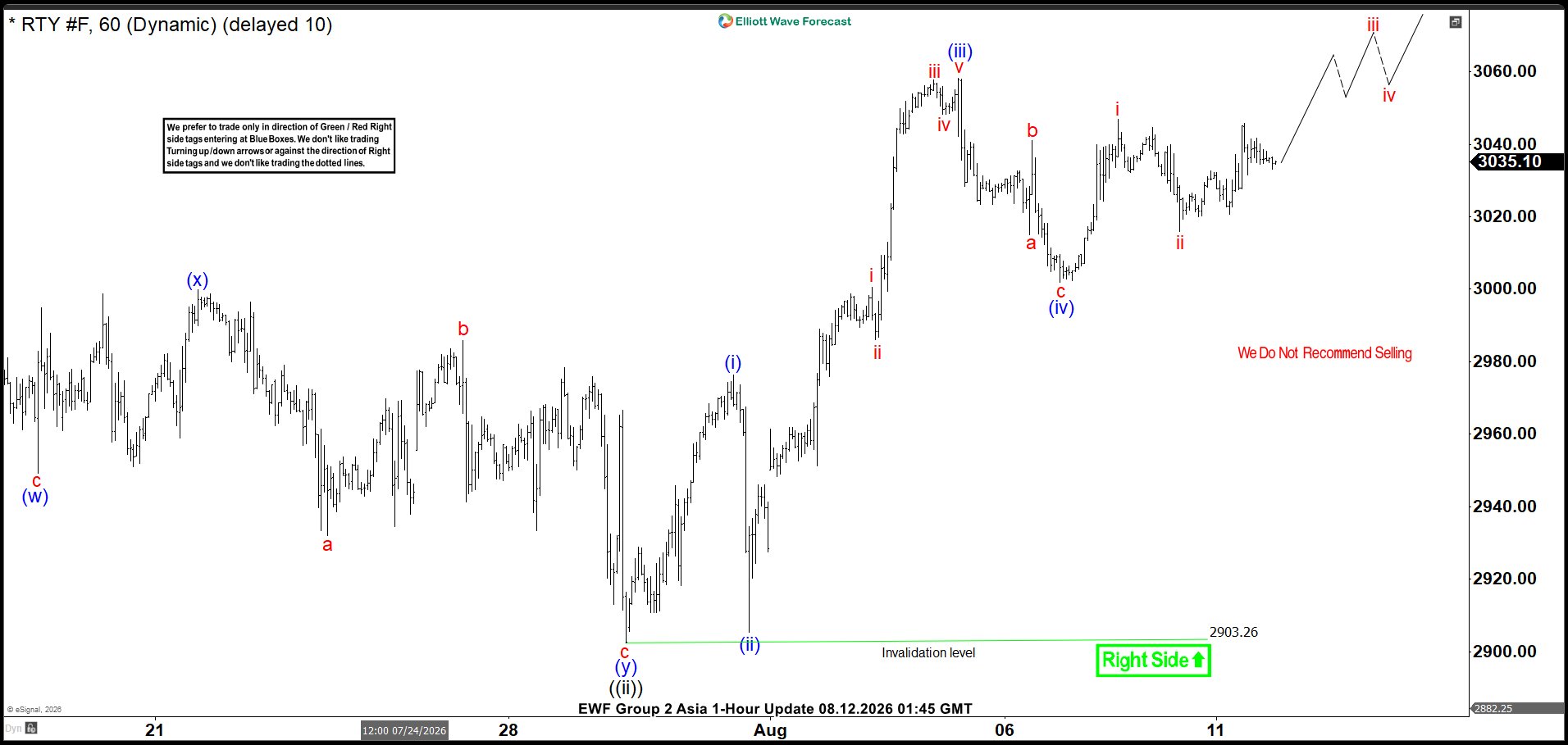
The short‑term Elliott Wave view in Russell 2000 (RTY) shows that the rally from the June 9, 2026 low is unfolding as a five‑wave impulsive structure. From that low, wave ((i)) concluded at 3068.4, followed by a corrective pullback in wave ((ii)) which ended at 2903.26. The one‑hour chart highlights this development clearly. The Index has since advanced in wave ((iii)), which subdivides into another five‑wave sequence of lesser degree.
From wave ((ii)), wave (i) finished at 2976.3, while the subsequent pullback in wave (ii) ended at 2905.3. The Index then resumed higher in wave (iii), reaching 3058.3, before a minor correction in wave (iv) concluded at 3002. This sequence suggests that the Index is poised to extend further in wave (v), thereby completing wave ((iii)) at a higher degree. Once wave ((iii)) is complete, the Index should undergo a corrective phase in wave ((iv)). It should retrace part of the advance before the next upward leg in wave ((v)) resumes to complete the cycle from the June 9 low.
In the near term, as long as the pivot at 2903.26 remains intact, dips are expected to attract buyers. Corrective phases should unfold in either three or seven swings, offering opportunities for renewed strength.
Russell 2000 (RTY) 60 Minute Elliott Wave Chart
RTY Elliott Wave Video
https://elliottwave-forecast.com/wp-content/uploads/2026/08/Elliott-Wave-View-Russell-2000-Impulse-Set-to-Extend-Higher.mp4
EURCAD Wave Analysis
EURCAD: ⬇️ Sell
– EURCAD broke daily support zone
– Likely to fall to support level 1.6000
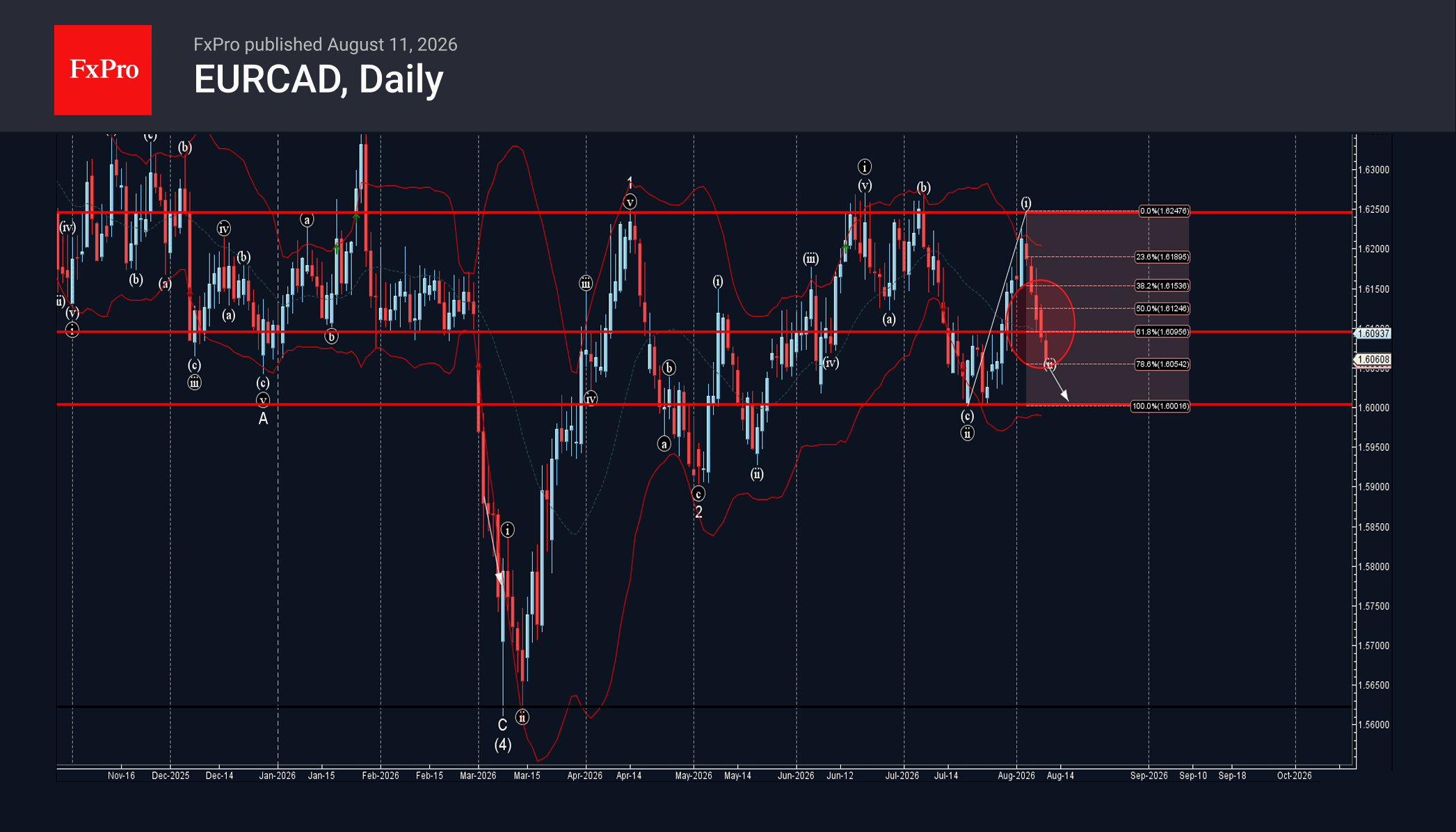
EURCAD currency pair recently broke the support zone between the support level 1.6095 (former resistance from July) and the 61.8% Fibonacci correction of the upward impulse i from July.
The breakout of this support zone continues the active minor correction ii, which stared earlier from the major resistance level 1.6250.
EURCAD cryptocurrency can be expected to fall further to the next round support level 1.6000 (which stopped earlier correction ii in July).
Eco Data 8/12/26
| GMT | Ccy | Events | Act | Cons | Prev | Rev |
|---|---|---|---|---|---|---|
| 23:50 | JPY | Money Supply M2+CD Y/Y Jul | 2.20% | 2.10% | 2.20% | |
| 06:00 | EUR | Germany CPI M/M Jul | 0.80% | 0.80% | 0.80% | |
| 06:00 | EUR | Germany CPI Y/Y Jul | 2.80% | 2.80% | 2.80% | |
| 12:30 | CAD | Building Permits M/M Jun | 18.50% | 1.00% | -1.70% | |
| 12:30 | USD | CPI M/M Jul | 0.10% | 0.10% | -0.40% | |
| 12:30 | USD | CPI Y/Y Jul | 3.40% | 3.40% | 3.50% | |
| 12:30 | USD | CPI Core M/M Jul | 0.20% | 0.20% | 0.00% | |
| 12:30 | USD | CPI Core Y/Y Jul | 2.50% | 2.50% | 2.60% | |
| 14:30 | USD | Crude Oil Inventories (Aug 7) | 17.4M | -1.7M | 2.5M |
| 23:50 | JPY |
| Money Supply M2+CD Y/Y Jul | |
| Actual | 2.20% |
| Consensus | 2.10% |
| Previous | 2.20% |
| 06:00 | EUR |
| Germany CPI M/M Jul | |
| Actual | 0.80% |
| Consensus | 0.80% |
| Previous | 0.80% |
| 06:00 | EUR |
| Germany CPI Y/Y Jul | |
| Actual | 2.80% |
| Consensus | 2.80% |
| Previous | 2.80% |
| 12:30 | CAD |
| Building Permits M/M Jun | |
| Actual | 18.50% |
| Consensus | 1.00% |
| Previous | -1.70% |
| 12:30 | USD |
| CPI M/M Jul | |
| Actual | 0.10% |
| Consensus | 0.10% |
| Previous | -0.40% |
| 12:30 | USD |
| CPI Y/Y Jul | |
| Actual | 3.40% |
| Consensus | 3.40% |
| Previous | 3.50% |
| 12:30 | USD |
| CPI Core M/M Jul | |
| Actual | 0.20% |
| Consensus | 0.20% |
| Previous | 0.00% |
| 12:30 | USD |
| CPI Core Y/Y Jul | |
| Actual | 2.50% |
| Consensus | 2.50% |
| Previous | 2.60% |
| 14:30 | USD |
| Crude Oil Inventories (Aug 7) | |
| Actual | 17.4M |
| Consensus | -1.7M |
| Previous | 2.5M |
Brent Oil Price Falls After Recovery Failed to Clear Important $90 Barrier
Brent oil price rose to the highest in over one week on Tuesday, in extension of Monday’s nearly 5% advance, following the latest verbal escalation by President Trump that quickly changed the sentiment and countered efforts of Iran and Oman to find solution for reopening of strategic Hormuz strait.
The latest demands from President Trump provoked reaction of Iran to stop negotiations with current US administration until the end of Trump’s mandate in 2029.
However, markets have already learned how to filter the waves of usually contradictory news that come on daily basis and how to get the best results in using so-called Trump indicator.
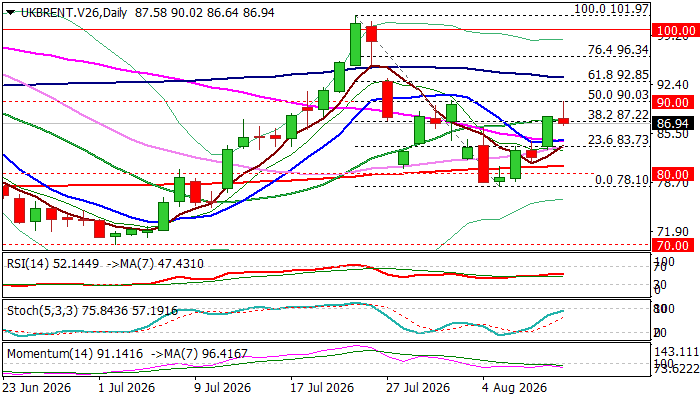
Daily chart still shows mixed signals as moving averages turned to almost full bullish configuration, but 14-d momentum remains in negative territory that partially offset positive signal that was reflected on today’s price action, when the price cracked psychological $90 barrier (also 50% retracement of $101.97/$78.10) but subsequent quick reversal warns that recovery might be running out of steam.
Fresh weakness (price was down over $3 during mid-European / early US session on Tuesday) cracked significant support at $87.22 (broken Fibo 38.2% / 20DMA) with firm break here to open way for deeper pullback and keep the downside vulnerable of possible full reversal of recovery leg (in case of shift in Trump’s rhetoric).
On the other hand, limited pullback (ideally to hold above $87.22) or to find footstep above $85.00 zone (just above 10/55DMA bull-cross) would keep in play hopes of renewed attack at $90 pivots and unmask targets at $92.85/$93.28 (daily cloud top / Fibo 61.8% / 100DMA).
Res: 88.57; 90.00; 92.85; 93.28
Sup: 86.50; 85.00; 84.65; 83.73
Copper (Hg_F) Elliott Wave: Targeting a Buy at the Blue Box
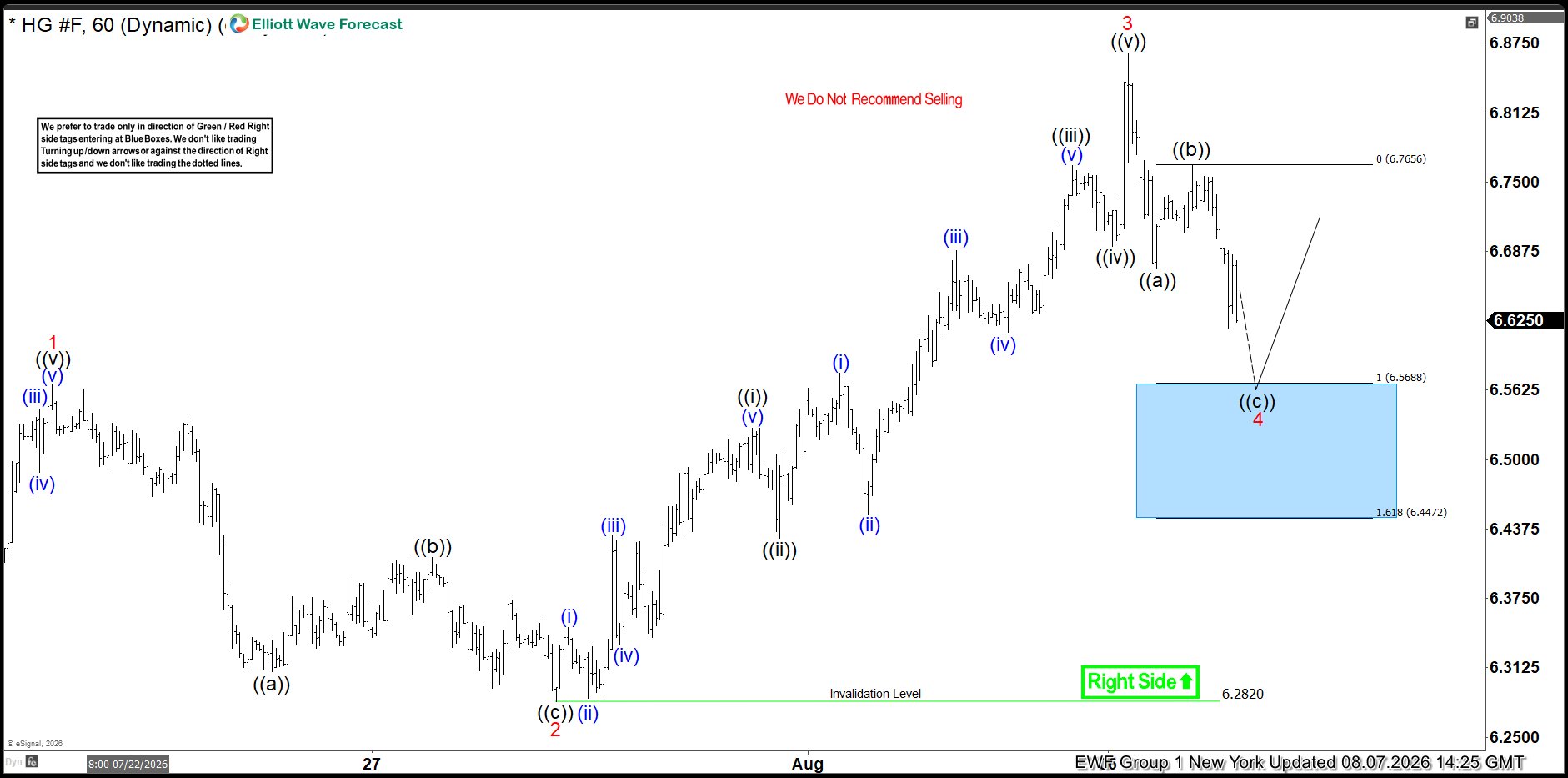
Hello fellow traders. In this technical article we’re going to take a look at the Elliott Wave charts charts of Copper (HG_F) commodity published in members’ area of the website. As our members know, Copper Futures recently completed a pullback that provided a high-probability trading setup. The decline unfolded as a clear Elliott Wave Zig Zag corrective pattern, ending right in the Equal Legs area (Blue Box). In this article, we’ll explain the trading setup and present the target levels.
Copper Elliott Wave 1 Hour Chart 08.07.2026
Copper Futures is forming a 3-wave pullback, correcting the cycle from the 6.282 low. At this stage, the corrective structure appears incomplete, suggesting more weakness in near temr isl likely. Our Elliott Wave forecast called for a decline into the Blue Box area at 6.5688-6.4472, where we expected buyers to re-enter the market. Due to the bullish sequence on the higher time frames, we advised members to avoid selling the commoidty and instead look for buying opportunities from the Blue Box. Once the price reached the 50% Fibonacci retracement of the rally from the connector labeled ((b)) black, the trade became risk-free by moving the stop loss to breakeven while taking partial profits. The setup would be invalidated only if the price broke below the 1.618 Fibonacci extension at 6.4472.
Official trading strategy on How to trade 3, 7, or 11 swing and equal leg is explained in details in Educational Video, available for members viewing inside the membership area.
90% of traders fail because they don’t understand market patterns. Are you in the top 10%? Test yourself with this advanced Elliott Wave Test
Quick reminder on how to trade our charts :
Red bearish stamp+ blue box = Selling Setup
Green bullish stamp+ blue box = Buying Setup
Charts with Black stamps are not tradable.
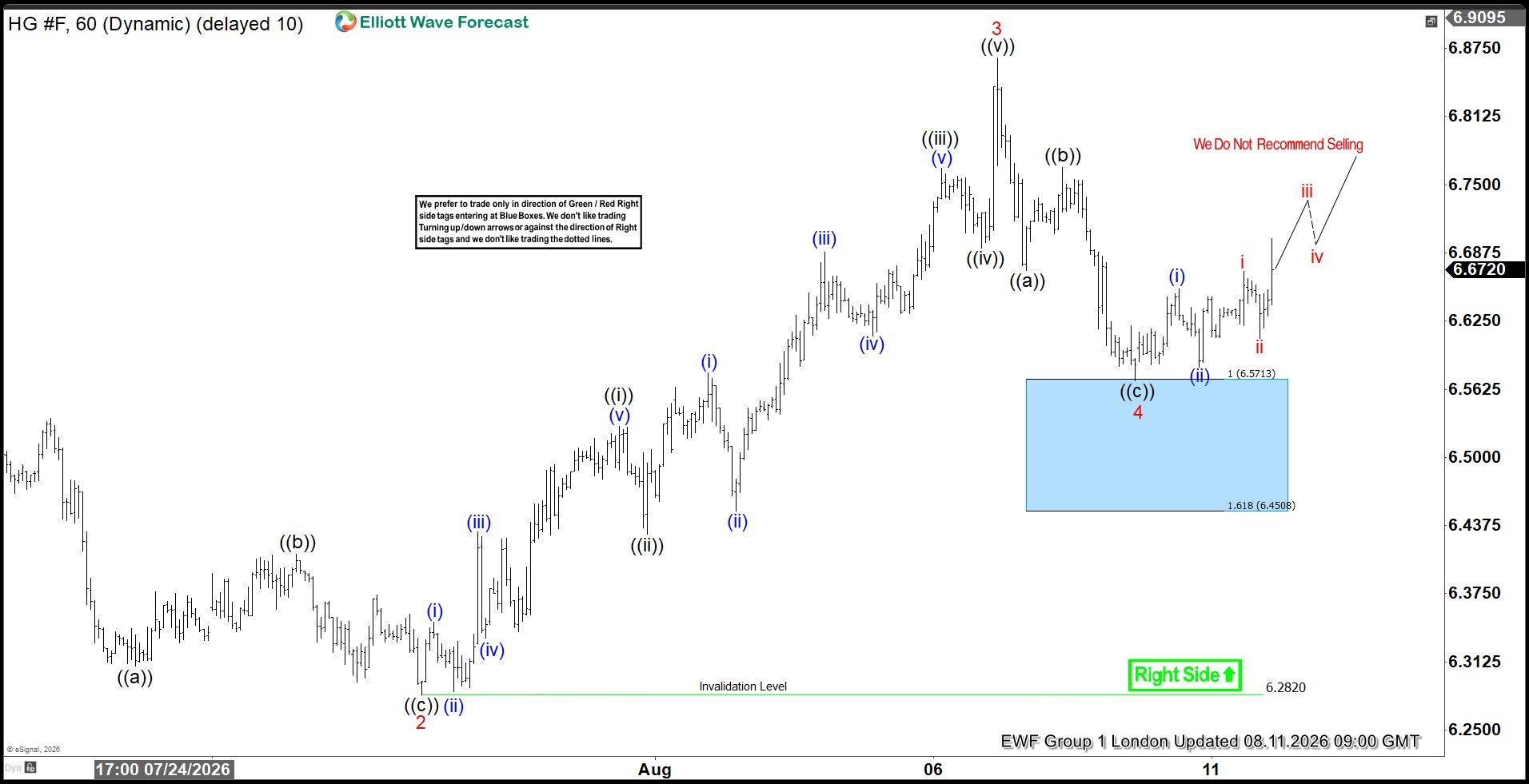
Copper Elliott Wave 1 Hour Chart 08.11.2026
Copper Futures completed its correction right at the Equal Legs level and made a solid bounce. After reaching the 50% Fibonacci retracement of wave ((b)), all long positions became risk-free. We advised members to move their stops to breakeven and secure partial profits, allowing the remaining position to continue with reduced risk. This is the advantage of a structured Elliott Wave process. Instead of chasing moves, our members prepare for high-probability setups and manage risk with a clear trading plan. While above 0.6571 low, we count wave 4 red completed nad wave 5 red can be in progress targeting 6.9360 + area.
Our member chat rooms are open 24/7 and provide ongoing expert guidance on market trends and Elliott Wave analysis. Members are encouraged to ask questions about market structure and technical setups at any time.
 The Next Opportunity Is Already Forming.
Every trading session creates new opportunities. Some traders recognize them early. Others only see them after the move has already happened.
The difference isn’t luck. It’s preparation.
At Elliott Wave Forecast, our analysts monitor 78 global markets every day, identifying potential Elliott Wave setups and helping traders develop a more structured approach to the markets.
As a member, you’ll get more than daily analysis. You’ll gain a process designed to help you analyze opportunities, manage risk, and make decisions with greater confidence.
US: Small Business Optimism Spiked in July
- The NFIB's Small Business Optimism Index rose 2.4 points to 99.8 in July, soundly beating expectations for a roughly flat reading of 97.5.
- Eight out of the ten index subcomponents improved during the month and two deteriorated. The largest improvement came from the net share of firms planning to increase employment (up 9 points to 20%). The net share of firms planning capital expenditures, reporting now is a good time to expand, and reporting higher earnings this quarter all improved by 4-5 points to 25%, 12%, and -16% respectively. Declines were modest in reports of current inventories being too low and expecting higher future real sales.
- In addition to the uptick in the net share of businesses planning to increase employment, the net share of firms with unfilled job openings rose 4 points to 36%. Quality of labor concerns also spiked in July, with 27% of business owners identifying this as their top business problem.
- The net share of firms currently increasing employee compensation rose 3 points to 31%, while the net share planning to do so over the next three months increased 2 points to 19%. The share of businesses 'raising' average selling prices fell 7 points to 31% while the share of those 'planning’ to raise average selling prices fell 4 points to 28%.
Key Implications
- Small business confidence jumped to its highest level in nearly a year in July, with strength in plans to increase employment and capital expenditures leading to the uptrend. However, given the volatile nature of these subcategories, the sustained elevation in the uncertainty index, and the fact that expectations for the economy to improve remain below their pre-Iran conflict level, it would be wise to view the July report with cautious optimism.
- If the improvement in small business employment plans proves durable, it could be a material benefit for the labor market, as the sector accounts for a little under half of all private payrolls. Additionally, the moderation in the share of firms raising average selling prices could also help ease inflationary pressures in the economy, but this is likely to remain a function of developments in energy prices. Financial markets currently see the odds of a rate hike at the Fed’s September meeting as roughly 50/50, making tomorrow’s July CPI report a key focus.
Three FX Winners, Two Trades: RBA Lifts Aussie While Oil Backs Dollar and Loonie
Why it matters: Oil's renewed strength reflects a real shift in the Hormuz story, with Washington and Tehran hardening their positions rather than converging on a settlement. CAD is trading energy directly, USD is trading what energy means for Fed policy ahead of Wednesday's CPI, and AUD has almost nothing to do with either trade. Tuesday's FX leadership is two separate transmission channels, not one macro trade wearing three currency labels.
Why Oil's Rally Is Really About a Hardening Hormuz Standoff
Oil's renewed strength reflects a deeper shift in the Hormuz story: markets are becoming less convinced that Washington and Tehran are moving toward a workable settlement.
The latest exchange makes that clear. Trump said Monday Iran should pay reparations for damage it had caused over decades, directly countering demands from Mohammad Bagher Zolghadr, secretary of Iran's Supreme National Security Council. Zolghadr had laid out conditions for reopening the Strait including an end to the US blockade and sanctions, withdrawal of American forces, war reparations and release of frozen Iranian assets. Rather than bargaining those demands down, Washington responded with a compensation claim of its own. What had already been a difficult navigation dispute is now broadening into a larger confrontation over sanctions, security and reparations.
Iran hardened its tone again Tuesday. Foreign Ministry spokesman Esmail Baghaei dismissed Treasury Secretary Scott Bessent's claim that sanctions were "suffocating" the Iranian economy and accused Washington of escalating sanctions whenever diplomacy fails. He called the approach less a policy than a "compulsive addiction." That does not sound like a negotiation approaching its final compromise. For oil, the implication is straightforward: the longer the Strait remains unresolved, the more difficult it becomes to strip the geopolitical premium out of Brent. The brief move above $90 therefore matters even though prices subsequently pulled back, with $92.87 now seen as the next major technical test before $100 comes back into play.
The Widening Standoff
- Zolghadr's conditions for reopening: end to US blockade and sanctions, withdrawal of American forces, war reparations, release of frozen Iranian assets
- Trump's counter: Iran should pay reparations for decades of damage
- Baghaei: dismissed Bessent's "suffocating" sanctions claim, called the US approach a "compulsive addiction"
- Brent crude: briefly broke above $90, eased back to $87-88
Oil Is Helping Dollar and Loonie for Different Reasons
That oil rally is helping Dollar and Loonie for different reasons. CAD gets the more direct benefit. Stronger crude improves Canada's external backdrop and reinforces support already provided by last week's robust jobs report. Dollar's link is more indirect but equally important. Weak July payrolls raised the hurdle for another Fed hike, yet higher oil keeps the inflation problem alive. Ahead of Wednesday's CPI, the Brent rebound gives markets another reason not to complete a full dovish Fed repricing. CAD is trading energy itself; USD is trading what energy means for rates.
RBA Gave Aussie Its Own, Separate Reason to Rally
Aussie, meanwhile, has almost nothing to do with that trade. RBA held at 4.35%, but the package was notably hawkish. Policy was described as only "somewhat restrictive," another hike was explicitly left available if upside risks materialize, and forecast assumptions incorporate a cash-rate path rising toward 4.5%. Bullock then made the message harder to dismiss. She said the Board had considered hiking and stressed, "It's important people believe that we will act if we need to." More pointedly, she added: "I think personally that it's quite possible we might need to go but we'll wait and see what the data tells us." That was enough to preserve the tightening bias and give AUD a distinctly domestic tailwind.
RBA's Hawkish Signals
- Cash rate: held at 4.35%
- Policy characterization: only "somewhat restrictive"
- Another hike: explicitly left available if upside risks materialize
- Forecast assumptions: cash-rate path rising toward 4.5%
- Bullock: "It's important people believe that we will act if we need to."
- Bullock: "I think personally that it's quite possible we might need to go but we'll wait and see what the data tells us."
Currency Performance: Two Trades, Not One
Aussie consequently leads, followed by Dollar and Canadian Dollar, while Swiss Franc sits at the bottom ahead of Kiwi and Sterling. Euro and Yen are in the middle. The useful takeaway is that Tuesday's FX leadership is not one broad macro trade wearing three different currency labels. RBA gave AUD its own reason to outperform, while the worsening Hormuz outlook pushed oil high enough to support both CAD and USD through separate transmission channels.
Related Coverage
Oil & Hormuz Deep Dive
- Read why Brent's breakout puts $92.87 in focus as the next test before $100 comes back into play: Brent Breakout Raises $100 Risk as Hormuz Talks Hit the Same Old Wall.
Central Bank Deep Dives
- See the full RBA decision, including why forecasts were cut but the tightening cycle wasn't declared over: RBA Accepts Softer Inflation but Still Leaves Scope for One More Hike.
- Read why Fed's Hammack says current rates aren't restrictive enough, and why Wednesday's CPI tests her case directly: Fed's Hammack Sees Multiple Hikes, Says Current Rates Aren't Restrictive Enough.
Currency Technicals
- See why June GDP, not the Q2 headline, is the real test for whether BoE hawks gain more influence: Sterling's Real Test Is June GDP, EUR/GBP Downside and GBP/CHF Upside in Focus.
Frequently Asked Questions
Q: Why are AUD, USD and CAD all higher today if they're not the same trade?
A: They're higher for two unrelated reasons. RBA refused to declare its tightening cycle finished, giving AUD a distinctly domestic tailwind that has nothing to do with oil. Separately, Brent's brief break above $90 gave USD and CAD their own boost, tied to a hardening Hormuz standoff rather than anything happening in Australia. Three currencies moved together, but through two completely separate transmission channels.
Q: Why does CAD benefit more directly from oil than USD does?
A: CAD is trading energy itself, stronger crude directly improves Canada's external backdrop and reinforces support already provided by last week's robust jobs report. USD's link is more indirect: weak July payrolls had already raised the hurdle for another Fed hike, but higher oil keeps the inflation problem alive ahead of Wednesday's CPI, giving markets a reason not to complete a full dovish Fed repricing. CAD is trading the commodity; USD is trading what the commodity means for rates.
Q: What's actually being negotiated over the Strait of Hormuz right now?
A: The dispute has broadened well beyond shipping logistics. Iran's Zolghadr laid out conditions including an end to the US blockade and sanctions, withdrawal of American forces, war reparations and release of frozen Iranian assets. Rather than negotiating those down, Trump countered that Iran should pay reparations for decades of damage it caused. Iran's Foreign Ministry has since dismissed US claims that sanctions are "suffocating" its economy, calling the approach a "compulsive addiction." That's not the tone of a negotiation nearing compromise.
Key Takeaways
- Tuesday's FX leadership is two trades, not one: AUD is trading the RBA; USD and CAD are trading oil. All three currencies rose, but for unrelated reasons.
- The Hormuz standoff is broadening, not narrowing: Trump's reparations counter-demand and Iran's "compulsive addiction" rhetoric show both sides hardening rather than converging on compromise.
- Brent's brief break above $90 matters even after pulling back: It signals markets are struggling to strip the geopolitical premium out of oil, with $92.87 the next technical level before $100 comes into view.
- CAD and USD benefit from oil through different channels: CAD gets a direct lift from stronger crude and last week's jobs data; USD's boost is indirect, since higher oil keeps the inflation case alive ahead of Wednesday's CPI.
- RBA's hold came with real hawkish signals: Policy is still only "somewhat restrictive," another hike remains explicitly available, and Bullock said it's "quite possible we might need to go."
- Don't read Tuesday's currency moves as one broad risk trade: Grouping AUD, USD and CAD together as "the same story" misses that RBA policy and oil-driven geopolitics are doing completely separate work.
What to Watch Next
Wednesday's US CPI is the next test for the oil-driven leg of this trade: a hot print would reinforce the case Brent's rally is already building for USD and CAD, while a soft print would revive dovish Fed repricing despite firmer oil. On the Hormuz side, watch for whether Washington and Tehran show any sign of narrowing their positions, rather than hardening them further.
EUR/USD Daily Outlook
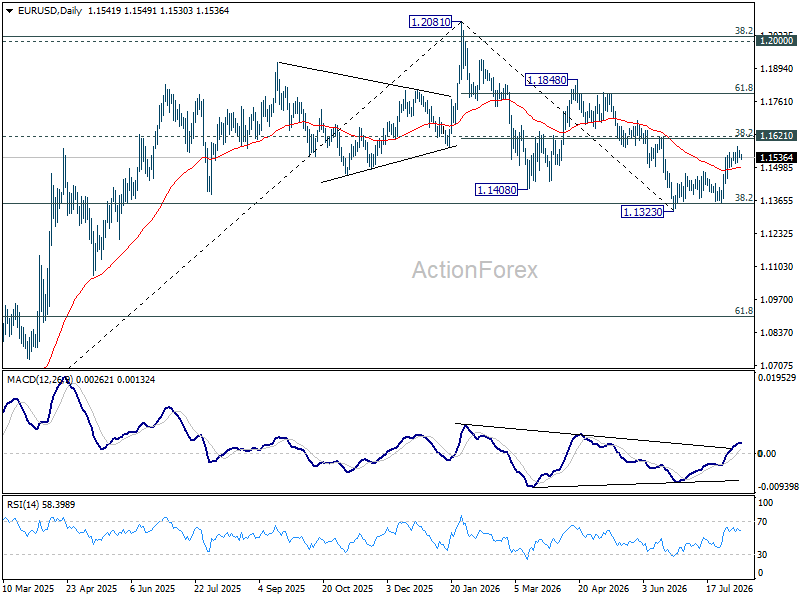
Intraday bias in EUR/USD is turned neutral first with current retreat. Above 1.1580 will extend the rebound from 1.1323 to 1.1621 cluster resistance (38.2% retracement of 1.2081 to 1.1323 at 1.1613). Decisive break there will solidify the case that fall from 1.2081 has completed as a three wave correction at 1.1323. Further rally would then be seen to 61.8% retracement at 1.1791. However, break of 1.1481 resistance turned support will dampen this case, and turn bias back to the downside for 1.1352 support instead.
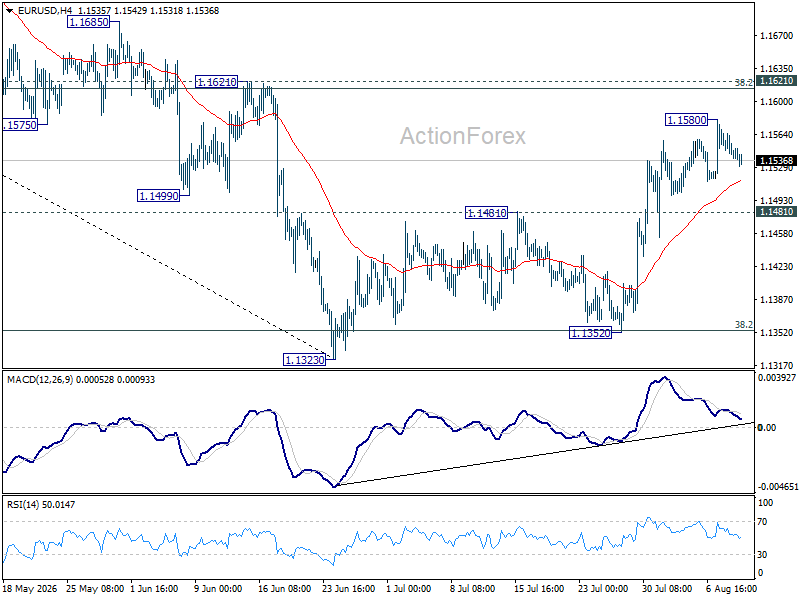
In the bigger picture, focus is staying on 38.2% retracement of 1.0176 to 1.2081 at 1.1353. Decisive break there will revive the case of medium term bearish trend reversal after rejection by 1.2 key cluster resistance level. Further fall should be seen to 61.8% retracement at 1.0904. Nevertheless, strong rebound from 1.1353, followed by break of 1.1621 resistance, will retain medium term bullishness.
USD/JPY Daily Outlook
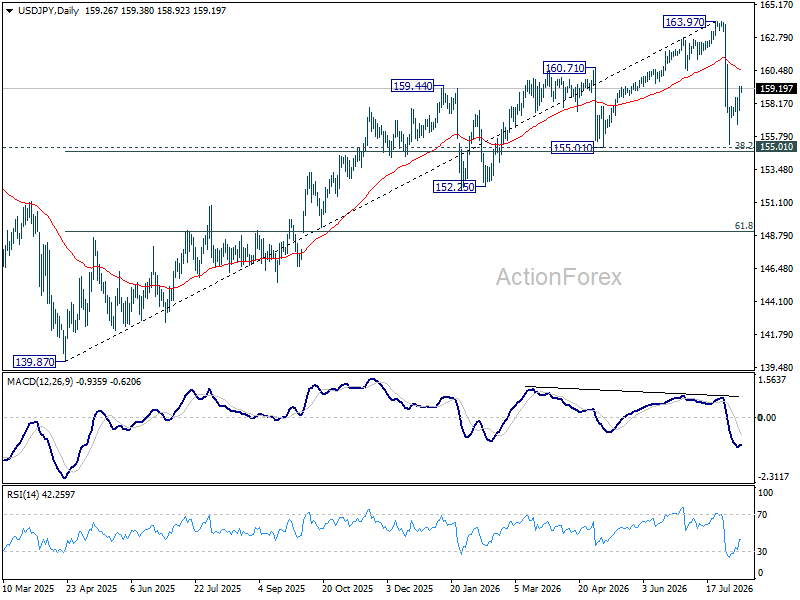
Intraday bias in USD/JPY remains on the upside at this point. Sustained trading above 55 4H EMA (now at 159.16) will argue that fall from 163.97 has completed, and target 61.8% retracement of 163.97 to 155.22 at 160.62. On the downside, though, break of 156.66 will bring deeper fall back to 155.22 low.
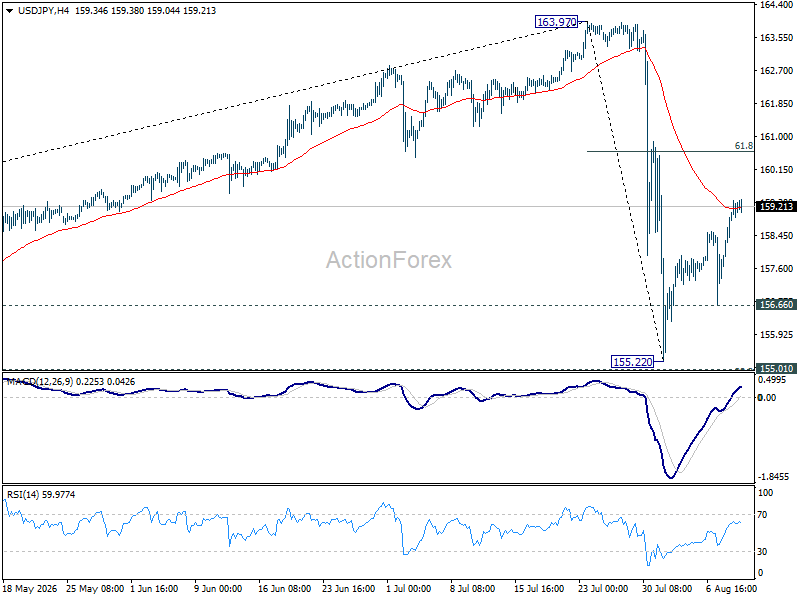
In the bigger picture, as long as 155.01 cluster support (38.2% retracement of 139.87 to 163.97 at 154.76) holds, the larger up trend is still expected to continue through 163.97 after current correction completes. However, firm break of 155.01 will raise the chance that USD/JPY is already in a larger scale correction, and open up deeper fall back to 139.87 (2025 low) in the medium term.