Sample Category Title
Chart Alert: GBP/USD Remains Firm Above 1.3479 Ahead of US CPI
Key takeaways
- Sterling stays firm: GBP/USD remains in a short-term uptrend above 1.3479 after breaking above its medium-term descending trendline post-NFP.
- US CPI is the key catalyst: A hotter-than-expected core CPI could revive Fed-hike bets and pressure GBP/USD, while softer inflation may extend sterling’s rally.
- 1.3479 is pivotal support: Holding above it keeps 1.3547, 1.3580 and 1.3643 in focus; a break below exposes 1.3440 and 1.3400.
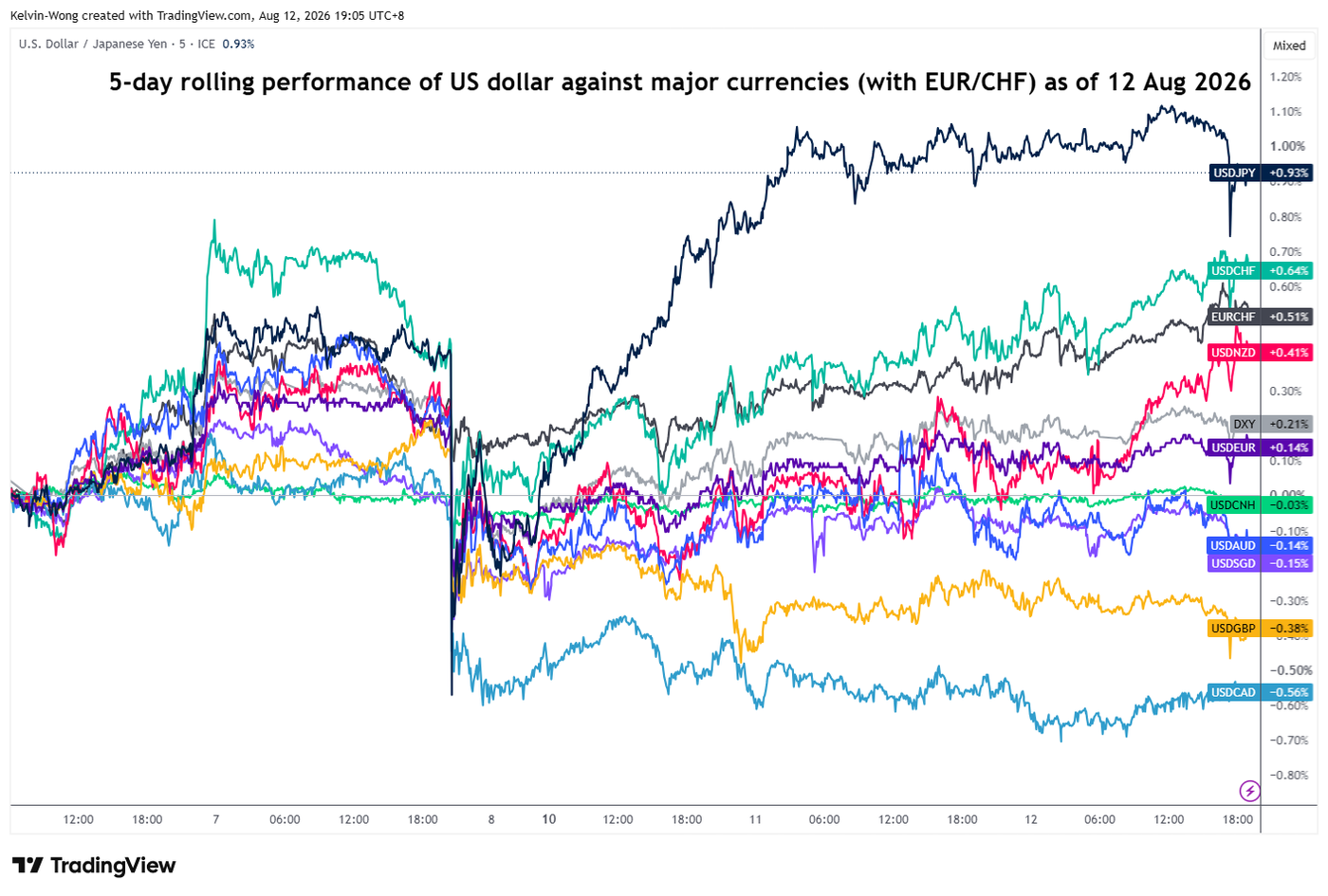
The sterling pound has been one of the best-performing major currencies against the US dollar in the past five trading sessions.
The USD/GBP cross rate has tumbled by 0.38% (a 0.38% gain for GBP against USD) at the time of writing, slightly above USD/CAD, which recorded a 0.56% loss over the same period (see Fig. 1).
Fig. 1: 5-day rolling performances of USD against major currencies as of 12 Aug 2026 (Source: TradingView). The information presented is historical information, and past performance is not indicative of future performance.
Macro divers: inflation trajectory versus Fed pricing
Market sentiment remains closely tied to incoming inflation data as investors gauge whether the Federal Reserve will resume rate hikes later this year. Following recent mixed labour market signals, pricing for the September FOMC decision sits close to a coin toss (based on latest data from the CME FedWatch tool, the Fed funds futures market is only pricing in a 48.1% chance of a 25-bps hike, down from around 70% chance a week ago).
- Hot CPI scenario (Core YoY > 2.5%): A surprise to the upside, driven by core goods price pass-throughs, would likely trigger a hawkish repricing in US short-term Treasury yields. This would provide a strong tailwind for the US Dollar Index, exposing GBP/USD to a rapid downward repricing toward the 1.3400 psychological level (also near the 20- and 200-day moving averages).
- Soft CPI scenario (Core YoY ≤ 2.5%): Confirmation of easing services inflation and softer shelter costs would give the Fed breathing room. A softer dollar would reinforce risk appetite, pushing GBP/USD above near-term hurdles toward multi-month highs.
Let’s now decipher the near-term (1 to 3 days) outlook on the GBP/USD from a technical analysis perspective
Oscillating within minor ascending channel after a bullish breakout ex-post NFB
Fig. 2: GBP/USD minor trend as of 12 Aug 2026 (Source: TradingView). The information presented is historical information, and past performance is not indicative of future performance.
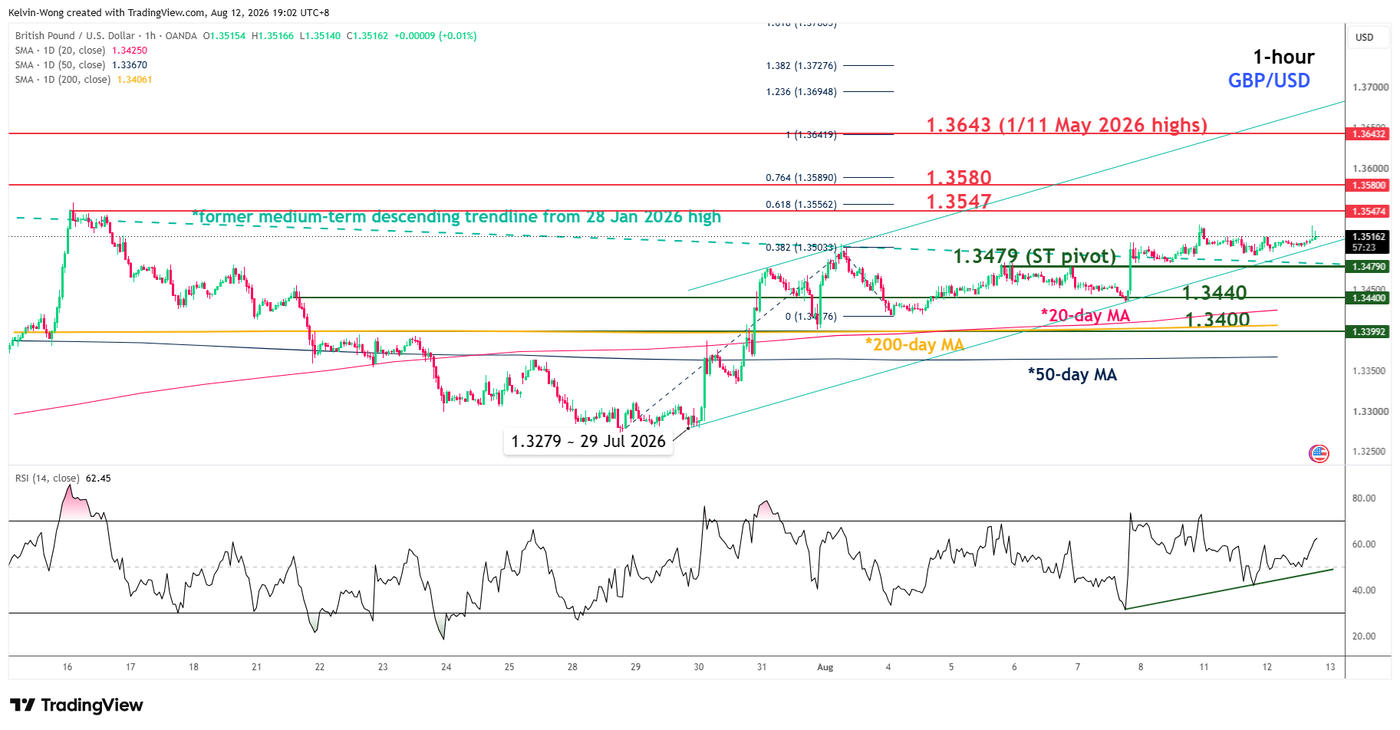
The price action of GBP/USD has cleared a significant medium-term hurdle after staging a bullish breakout ex-post the US NFP release (a major risk event on Friday, 7 August 2026), above its former descending trendline resistance from the 28 January 2026 high/52-week high.
In addition, it continues to oscillate within a minor ascending channel in place since the 29 July 2026 low of 1.3279, with a current bullish momentum reading on the hourly RSI (see Fig. 2).
These observations suggest that GBP/USD is oscillating within a short- to medium-term uptrend.
Watch the 1.3479 key short-term pivotal support to maintain a near-term bullish bias for the next intermediate resistances to come in at 1.3547, 1.3580 and 1.3643 (also a Fibonacci extension).
On the flip side, a failure to hold and an hourly close below 1.3479 invalidates the minor bullish impulsive up-move sequence, triggering a minor corrective decline towards the next intermediate supports at 1.3440 and 1.3400.
EUR/USD Daily Outlook
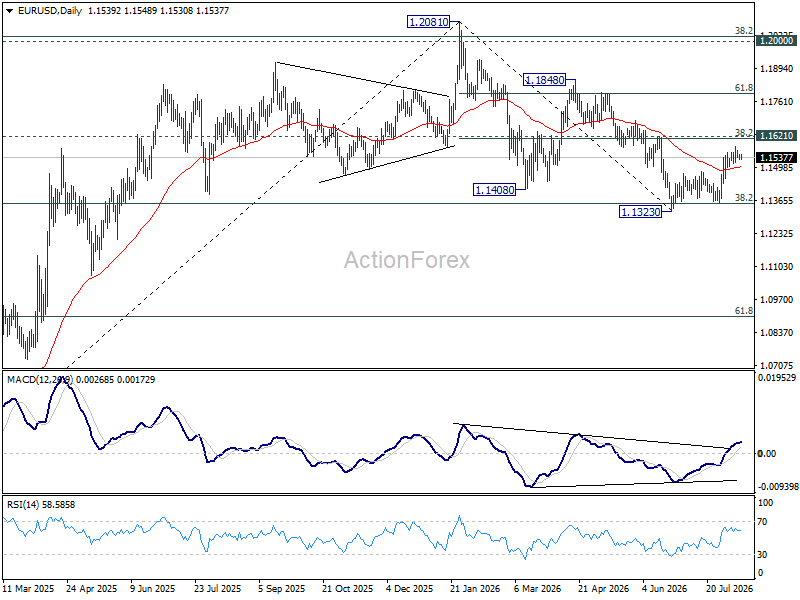
Intraday bias in EUR/USD remains neutral at this point. Above 1.1580 will extend the rebound from 1.1323 to 1.1621 cluster resistance (38.2% retracement of 1.2081 to 1.1323 at 1.1613). Decisive break there will solidify the case that fall from 1.2081 has completed as a three wave correction at 1.1323. Further rally would then be seen to 61.8% retracement at 1.1791. However, break of 1.1481 resistance turned support will dampen this case, and turn bias back to the downside for 1.1352 support instead.
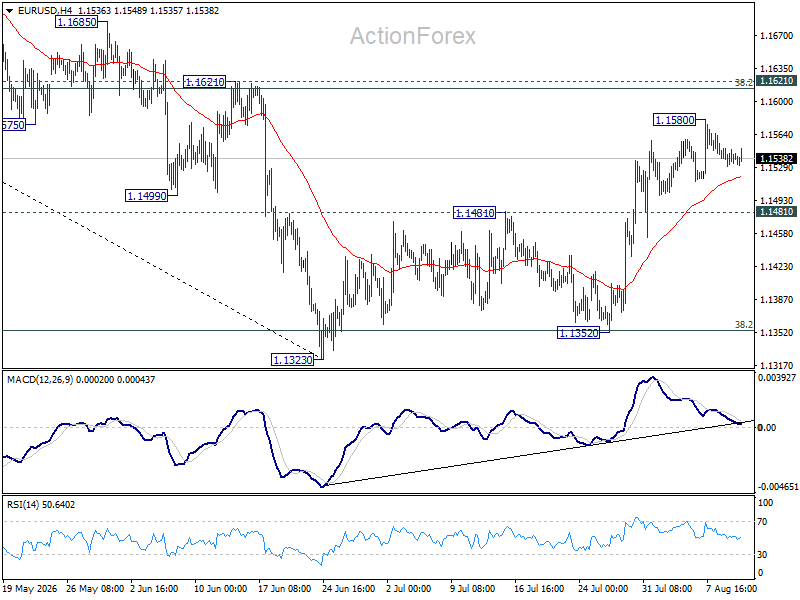
In the bigger picture, focus is staying on 38.2% retracement of 1.0176 to 1.2081 at 1.1353. Decisive break there will revive the case of medium term bearish trend reversal after rejection by 1.2 key cluster resistance level. Further fall should be seen to 61.8% retracement at 1.0904. Nevertheless, strong rebound from 1.1353, followed by break of 1.1621 resistance, will retain medium term bullishness.
USD/JPY Daily Outlook
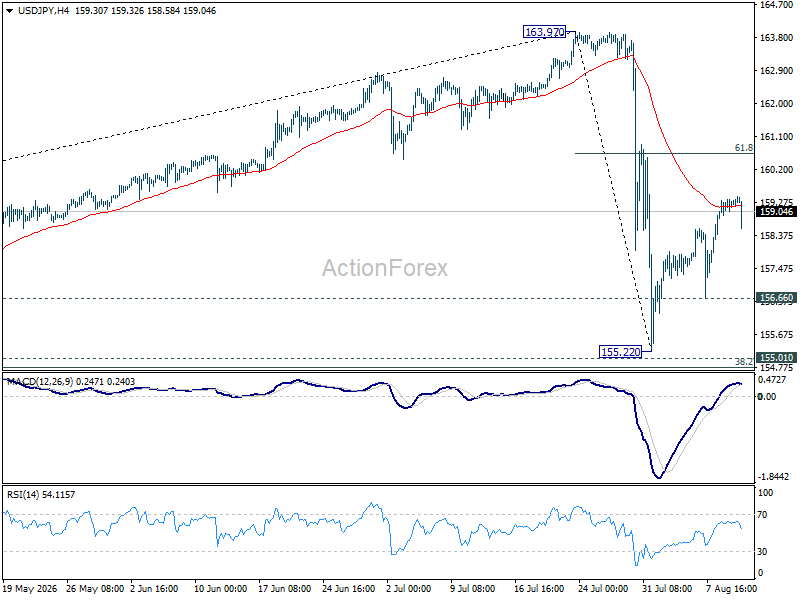
Further rise remains in favor in USD/JPY. Sustained trading above 55 4H EMA (now at 159.19) will argue that fall from 163.97 has completed, and target 61.8% retracement of 163.97 to 155.22 at 160.62. On the downside, though, break of 156.66 will bring deeper fall back to 155.22 low.
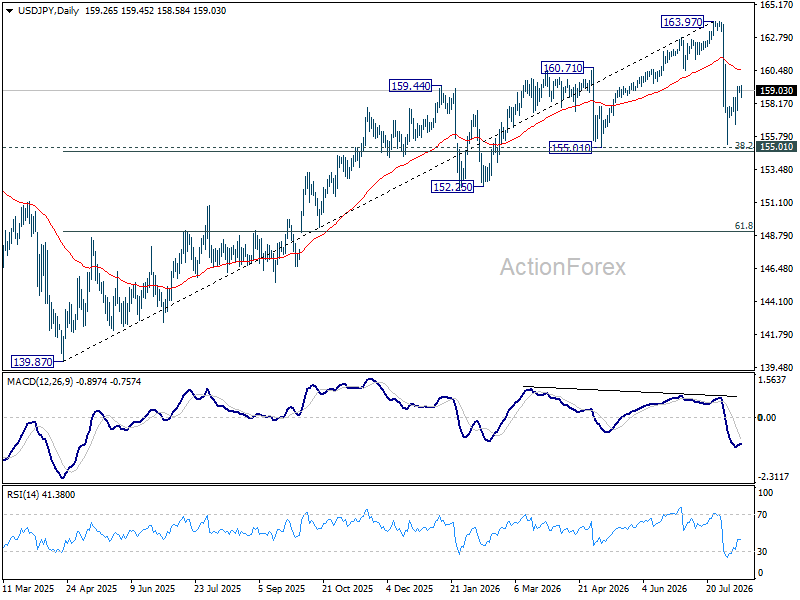
In the bigger picture, as long as 155.01 cluster support (38.2% retracement of 139.87 to 163.97 at 154.76) holds, the larger up trend is still expected to continue through 163.97 after current correction completes. However, firm break of 155.01 will raise the chance that USD/JPY is already in a larger scale correction, and open up deeper fall back to 139.87 (2025 low) in the medium term.
GBP/USD Daily Outlook
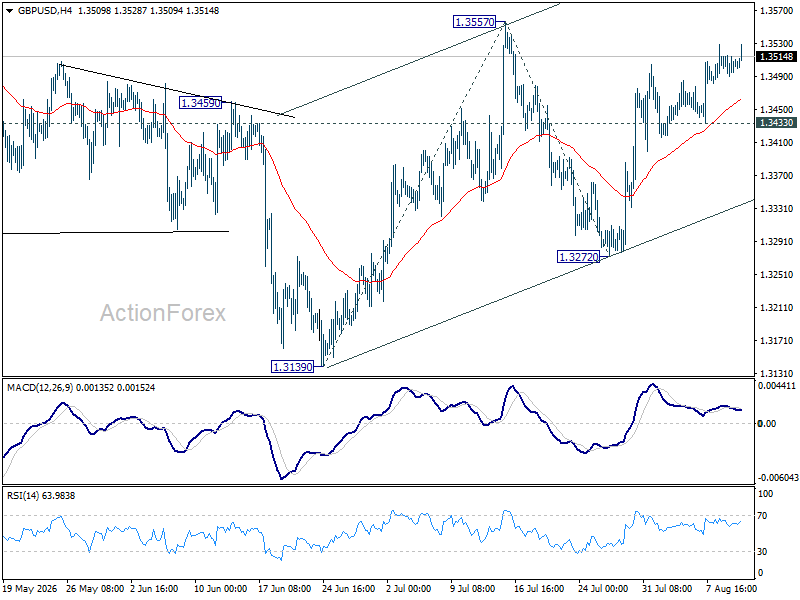
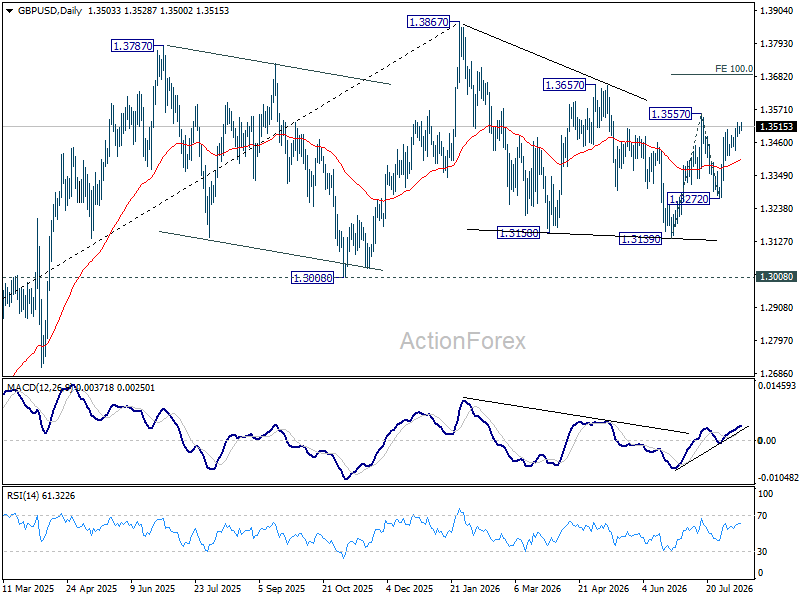
Intraday bias in GBP/USD remains mildly on the upside at this point, and further rise should be seen to 1.3557 resistance. Firm break there will resume the rise from 1.3139 and target 100% projection of 1.3139 to 1.3557 from 1.3272 at 1.3690. On the downside, below 1.3433 minor support will turn intraday bias neutral again first.
In the bigger picture, price actions from 1.3867 are a corrective pattern within the broader up trend from 1.0351 (2022 low). With 1.3008 support intact, medium term bullishness is maintained and break of 1.3867 is in favor for a later stage, towards 1.4248 key resistance (2021 high). However, firm break of 1.3008 will at least bring deeper fall to 38.2% retracement of 1.0351 to 1.3867 at 1.2524, with increased risk of bearish reversal.
USD/CHF Daily Outlook
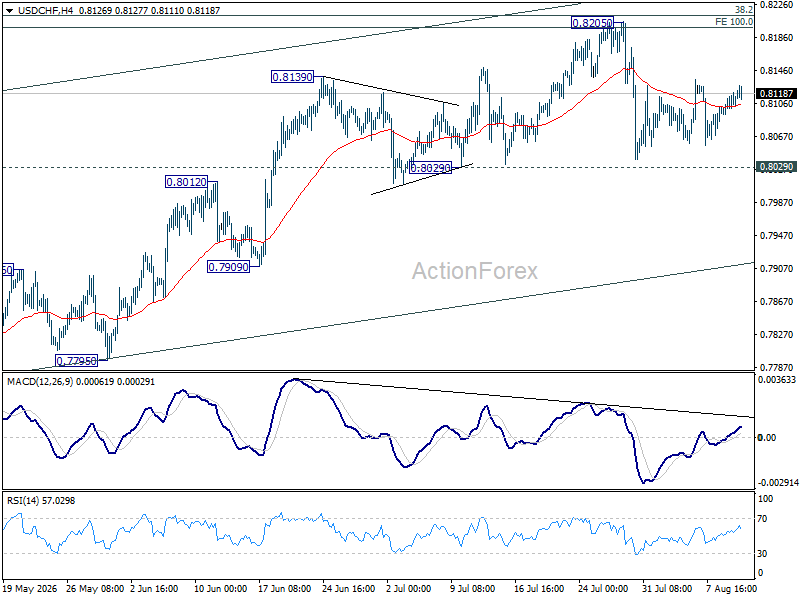
Intraday bias in USD/CHF stays neutral as range trading continues. Further rally is expected as long as 0.8029 support holds. Firm break of 0.8205 will extend the rally from 0.7603 to 161.8% projection 0.7603 to 0.8041 from 0.7600 at 0.8469. However, decisive break of 0.8029 will bring deeper fall to channel support (now at 0.7912).
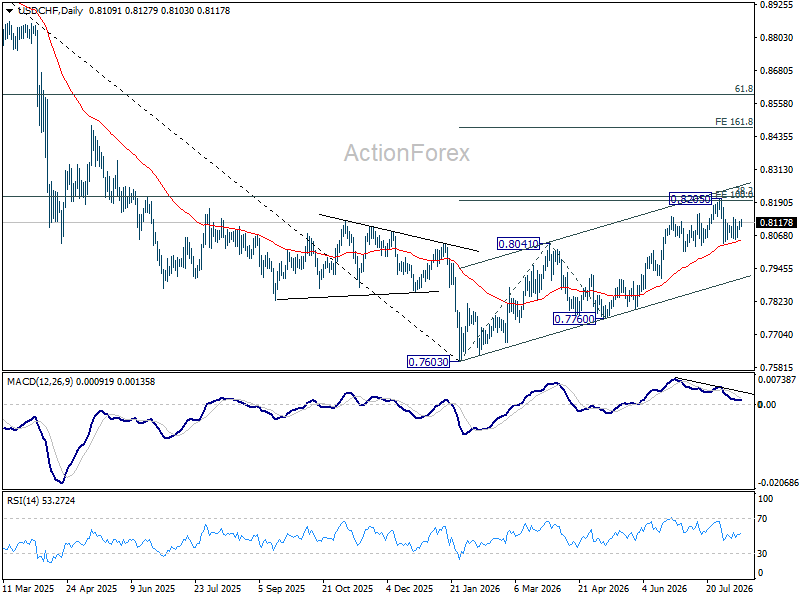
In the bigger picture, focus is now on 38.2% retracement of 0.9200 (2025 high) to 0.7603 at 0.8213. Decisive break will argue that USD/CHF is reversing the medium term trend, and turn focus to 0.8332 support turned resistance (2023 low) for confirmation. Nevertheless, rejection by 0.8213 will maintain medium term bearishness for another fall through 0.7603 at a later stage.
Gold as a Sure-Fire Bet
- Whatever the inflation figures may be, the precious metal will come out on top.
- Japan and the US don’t want to give the yen’s fate to speculators.
The US dollar continues to recover from the blow dealt by the labour market statistics. A rally in Treasury bond yields is driving the rise in the USD index amid tensions in the Middle East and a resurgence of expectations that the Fed will tighten monetary policy in September. The probability has risen to 50% after a dip to 43% following the US jobs report. The futures market still gives a 33% chance of more than one hike in 2026.
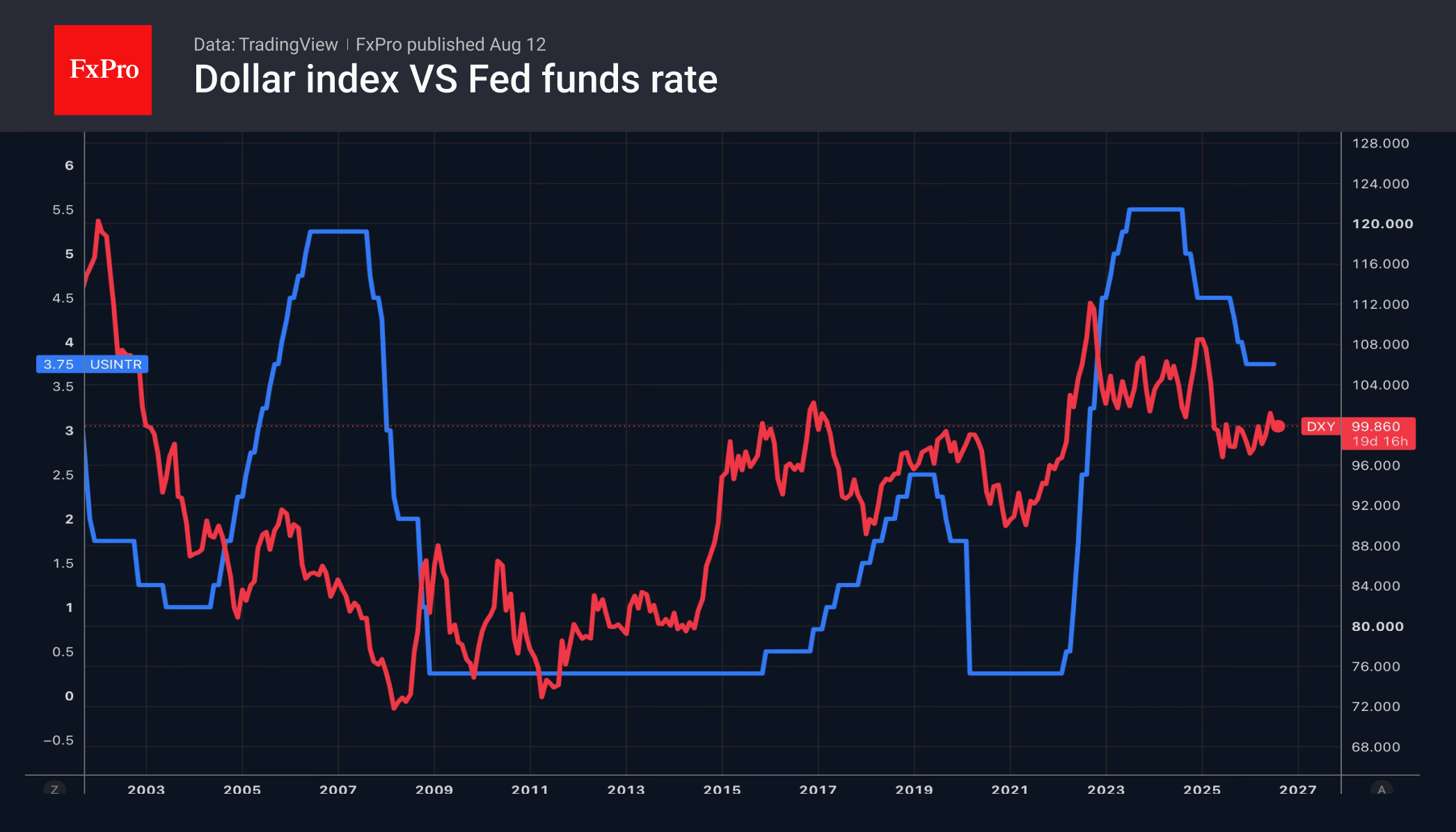
Investors are focusing on the release of US inflation data for July. Factors pointing to a slowdown include productivity outpacing labour costs, the waning impact of tariff effects, and lower oil prices than in May, when CPI indices peaked. Those who believe consumer price inflation will resume its upward trajectory point to geopolitical factors and massive investment in AI technology.
Market sentiment is divided, and gold stands to benefit. Whatever the inflation report may be, the precious metal is capable of capitalising on it. A slowdown in CPI will weaken the US dollar and reduce Treasury yields, benefiting the metal. Conversely, an acceleration in consumer price growth against the backdrop of a clear cooling of the US labour market would point to the development of stagflation. This is traditionally seen as a tailwind for gold.
As a result, there is a sense that the precious metal has overtaken the US dollar as the primary safe haven. It is strengthening in response to news of the escalating conflict in the Middle East more rapidly than the US currency is.
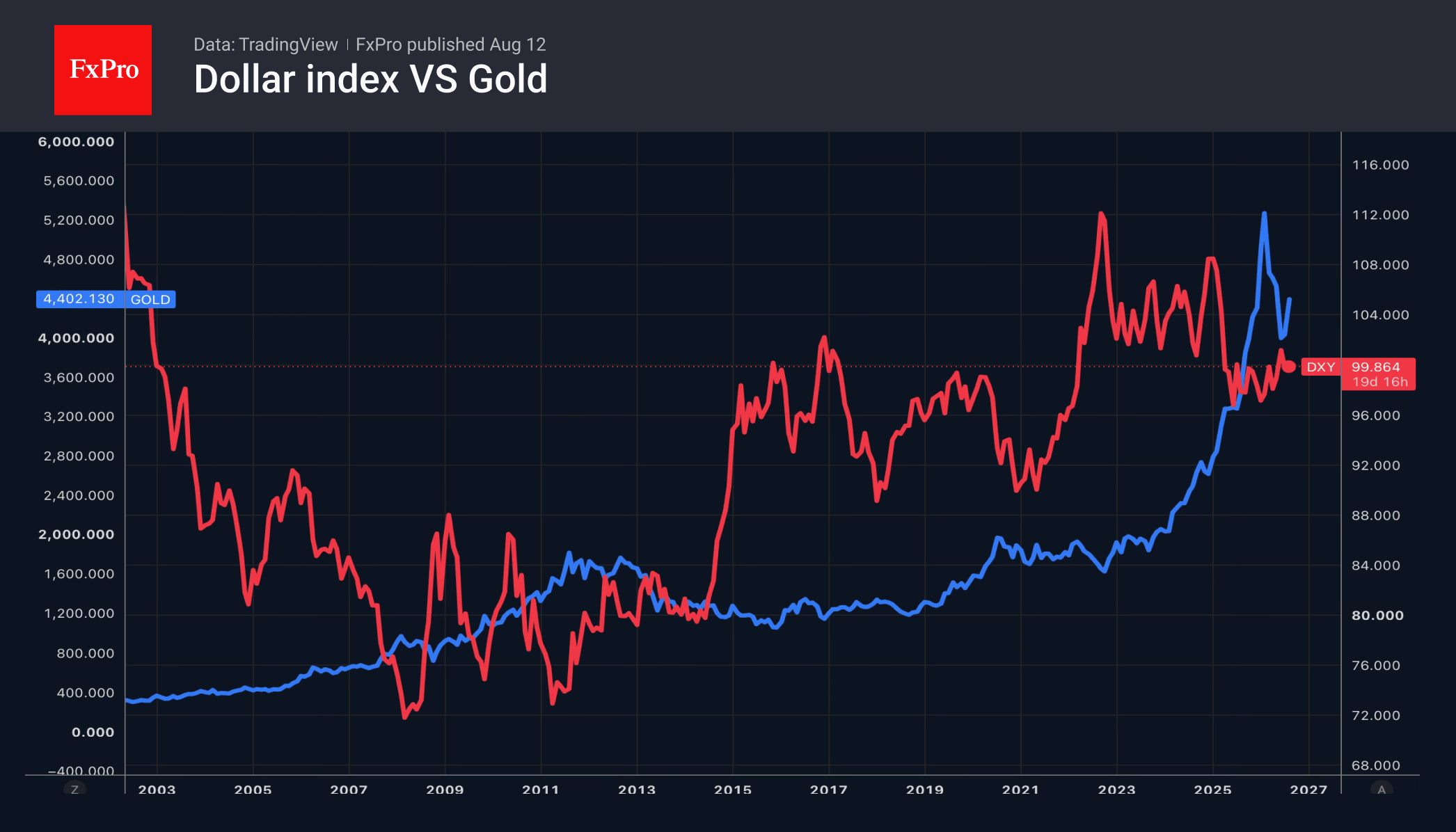
Gold also has support from investors’ flight to safety amid government intervention in the forex market. According to Eurizon Capital, coordinated currency intervention by the US and Japan suggests that USDJPY will not return to its 40-year highs in the coming years. Governments will not give in to speculators. The latter’s resistance is futile.
In fact, the wide interest-rate differential between the Fed and the Bank of Japan, coupled with Tokyo’s dependence on energy imports, is pushing USDJPY higher. As the pair approaches 160, the risks of further intervention increase.
The FxPro Analyst Team
AUD/USD Daily Report
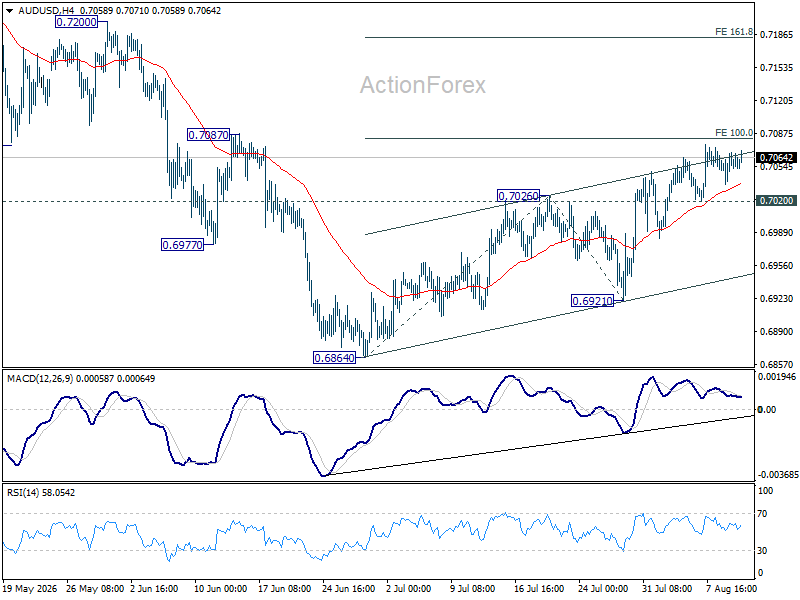
Further rise is in favor in AUD/USD. Firm break of 100% projection of 0.6864 to 0.7026 from 0.6921 at 0.7083 could prompt upside acceleration to 161.8% projection at 0.7183. On the downside, below 0.7020 minor support will turn bias back to the downside for 0.6921 instead.
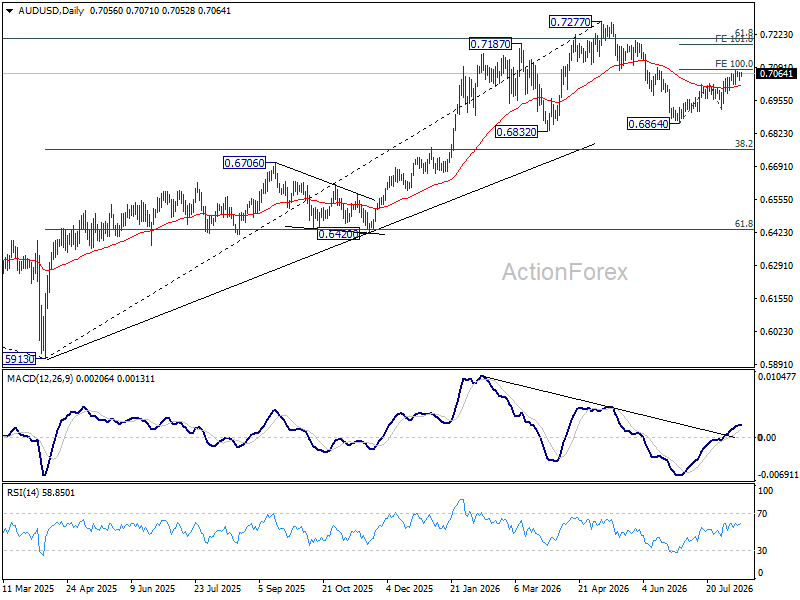
In the bigger picture, price action from 0.7277 medium term top is seen as developing into a correction to rise from 0.5913 only. While deeper decline cannot be ruled out, downside should be contained by 38.2% retracement of 0.5913 to 0.7277 at 0.6756 to bring rebound. Consolidations would continue below 0.7277 for a while, before an eventual upside breakout.
USD/CAD Daily Outlook
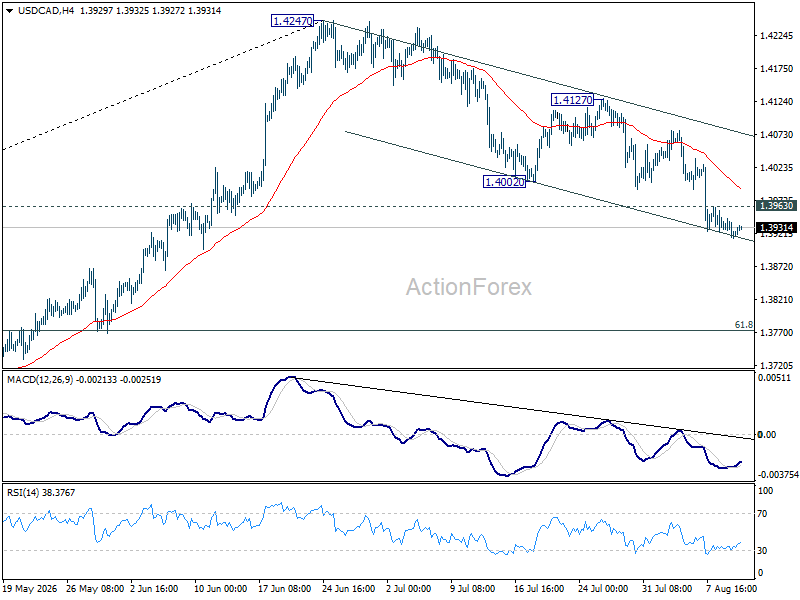
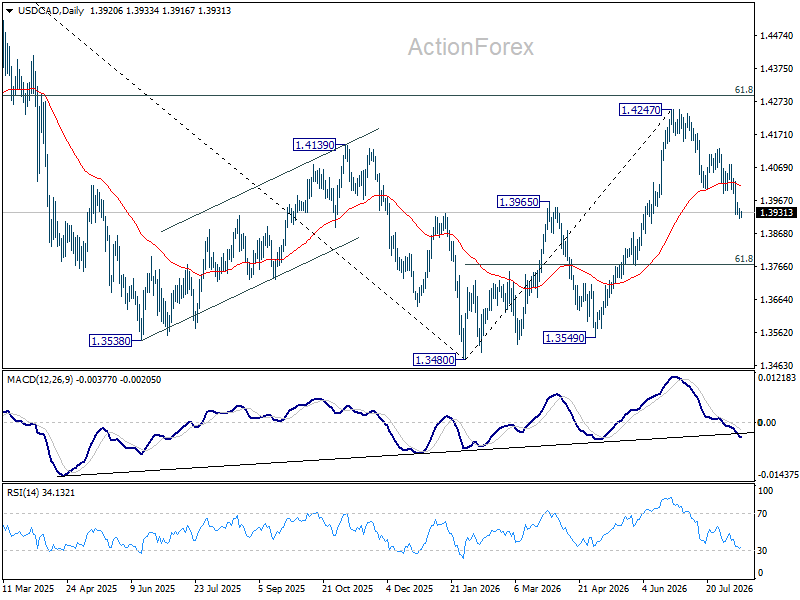
USD/CAD's fall from 1.4247 is in progress and intraday bias stays on the downside for 61.8% retracement of 1.3480 to 1.4247 at 1.3773. Rebound from 1.3480 might have completed with three waves up to 1.4247 already. Firm break of 1.3773 will pave the way back to retest 1.3480 low. On the upside, above 1.3963 minor resistance will turn intraday bias neutral first. But risk will stay on the downside as long as 1.4127 resistance holds, in case of recovery.
In the bigger picture, rejection below 61.8% retracement of 1.4791 to 1.3480 at 1.4290 suggests that the pattern from 1.4791 medium term is still extending. Firm break of 55 W EMA (now at 1.3883) will solidify this case, and bring deeper decline through 1.3480 low.
GBP/JPY Daily Outlook
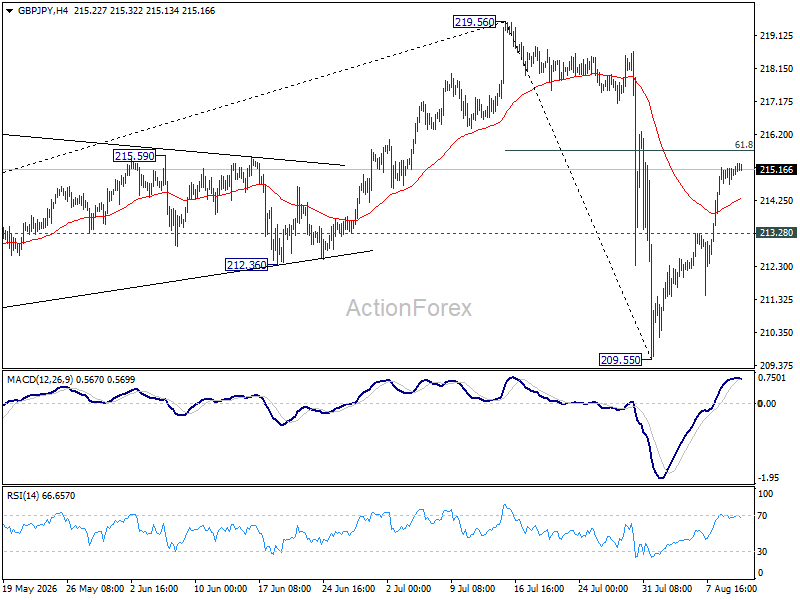
GBP/JPY's rally is in progress and intraday bias stays on the upside for 61.8% retracement of 219.56 to 209.55 at 215.73. Firm break there will pave the way to retest 219.56 high. On the downside, below 213.28 minor support will turn intraday bias neutral again first.
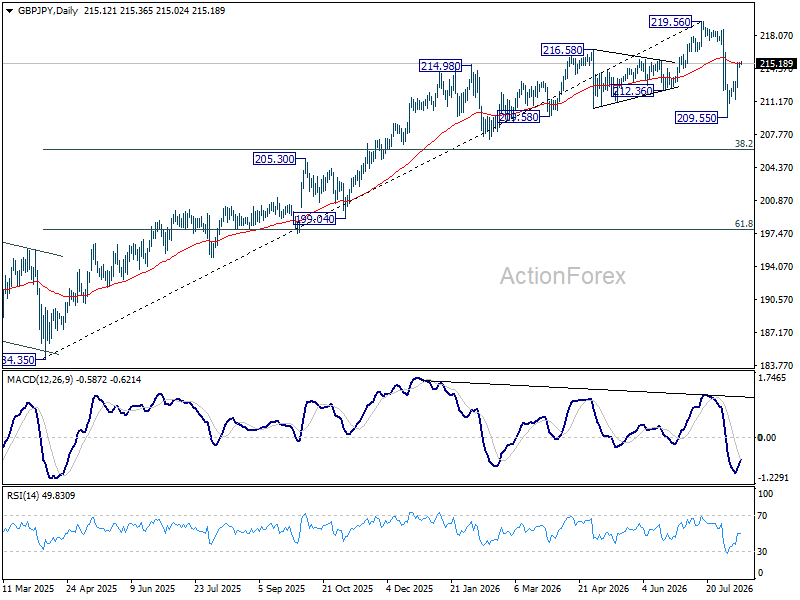
In the bigger picture, focus is on 55 W EMA (now at 209.10). Strong rebound from there will keep the up trend from 123.94 (2020 low) intact. Another rally is expected through 219.56 at a later stage. However, sustained break of 55 W EMA will argue that it's already in a medium term down trend to 184.35 support.
EUR/JPY Daily Outlook
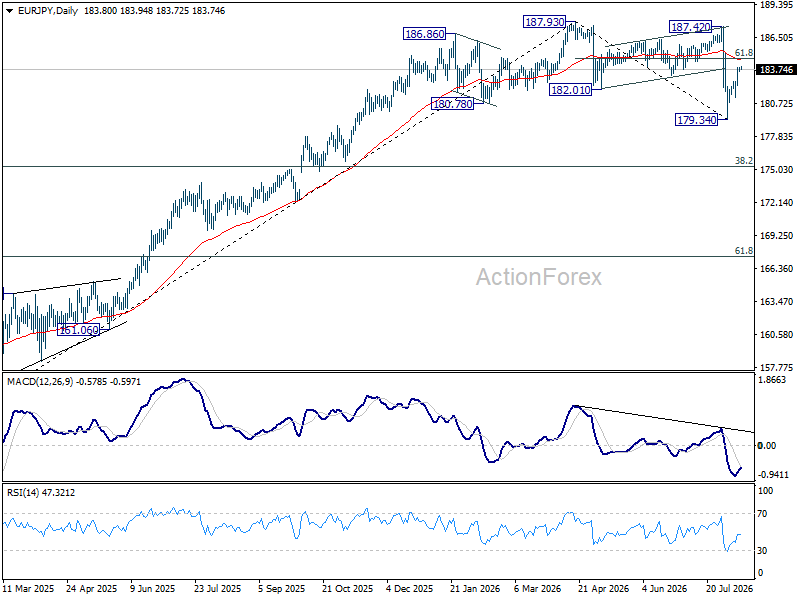
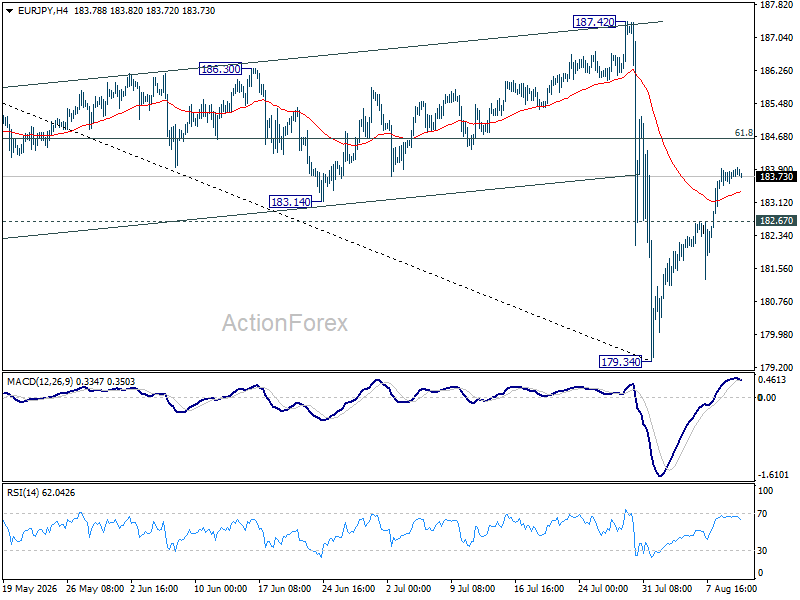
Intraday bias in EUR/JPY remains mildly on the upside for 61.8% retracement of 187.93 to 179.34 at 184.64. Decisive break there will pave the way to retest 187.93 high. On the downside, below 182.67 minor support will turn bias neutral again first.
In the bigger picture, focus is now on 55 W EMA (now at 180.42). Strong rebound from there will indicate that the up trend from 114.42 (2020 low) remains intact. That would set up another rally through 187.93 to 78.6% projection of 124.37 (2022 low) to 175.41 (2025 high) from 154.77 at 194.88. However, sustained break of 55 W EMA will argue that it's already in a medium term down trend to 175.41 resistance turned support and below.