

Sample Category Title
RBA’s Kent Says Tightening Is Working, but Policy Restraint Remains Hard to Gauge
RBA Assistant Governor Christopher Kent said in a speech today that monetary policy is “somewhat restrictive” and that tightening delivered earlier this year is working through economy. He pointed to higher borrowing costs and mortgage payments, weaker established housing market, stronger Australian Dollar and slowing aggregate demand. Importantly, Kent stressed that this slowdown is deliberate, saying it is “intended and is needed to bring inflation back to target.” He added that estimates of nominal neutral rate, while imprecise, also support assessment that current policy stance is restrictive.
At same time, Kent cautioned that cash rate alone does not determine how restrictive financial conditions have become. Housing appears to have softened “by somewhat more than the recent increase in interest rates would imply,” potentially making conditions tighter than otherwise. But global forces are working in opposite direction. Resilient demand driven by AI-related investment and higher offshore yields linked to rising public debt could make Australian financial conditions “less restrictive than otherwise,” complicating Board’s assessment of how much restraint is actually being delivered.
Comments reinforce RBA’s current policy optionality rather than signaling tightening cycle is finished. Kent clearly acknowledged that higher rates are slowing demand as intended, but he stopped short of saying policy is sufficiently restrictive. Instead, Board will continue “carefully considering the wide range of factors that influence financial conditions and the restrictiveness of monetary policy” as it updates outlook. That fits this week’s hawkish hold: RBA sees tightening working, but still lacks enough certainty over effective restraint to rule out another hike if inflation risks re-emerge.
Key Takeaways
- RBA Assistant Governor Christopher Kent said monetary policy is “somewhat restrictive” and that tightening earlier this year is working through economy.
- Higher borrowing costs, mortgage payments, softer housing, stronger Australian Dollar and slower aggregate demand all point to tighter financial conditions.
- Kent stressed demand slowdown is “intended and is needed to bring inflation back to target,” suggesting RBA does not yet view weaker activity as excessive.
- Housing may be making conditions more restrictive than cash rate alone implies, after weakening more than recent rate increases would suggest.
- Resilient global demand from AI-related investment and higher offshore yields are pulling in opposite direction, potentially making Australian conditions “less restrictive than otherwise.”
- Remarks reinforce RBA’s policy optionality: tightening is working, but uncertainty over effective restraint means Board is not yet declaring tightening cycle complete.
Japan PPI Cools Slightly to 7.2% Y/Y, but Weak Yen Keeps Import Inflation Near 30%
Japan’s producer inflation eased slightly in July, but imported cost pressures remained elevated as weak Yen continued to amplify overseas price increases. Corporate Goods Price Index slowed from revised 7.3% to 7.2% y/y, undershooting 7.4% consensus. Monthly increase moderated from 0.5% to 0.1%.
Electricity was largest contributor to monthly increase, adding around 0.23 percentage point, while declines in energy-related and chemical prices provided some offset. Excluding extra summer electricity charges, index was unchanged from June, suggesting domestic pipeline inflation is no longer accelerating as sharply as earlier in year.
External pressure was much stronger. Yen-based import price inflation eased only slightly from 30.1% to 29.1% y/y, compared with 18.1% to 17.7% on contract-currency basis, highlighting how currency weakness continues to magnify imported inflation for Japanese businesses.
For BoJ, data offer only limited comfort. Softer headline PPI and flat underlying monthly reading reduce urgency for immediate action, but producer inflation at 7.2% and import costs close to 30% remain far too high to dismiss. With BoJ increasingly focused on preventing inflation from overshooting rather than simply generating price growth, persistent currency-driven import pressure keeps normalization case intact even as domestic producer inflation cools at margin.
Data Summary
| Indicator | Actual | Expected | Previous |
|---|---|---|---|
| PPI m/m | 0.1% | — | 0.5% |
| PPI y/y | 7.2% | 7.4% | 7.3% |
| Import Prices, Yen Basis y/y | 29.1% | — | 30.1% |
| Import Prices, Contract Currency Basis y/y | 17.7% | — | 18.1% |
| Export Prices, Yen Basis y/y | 18.9% | — | 20.9% |
| Export Prices, Contract Currency Basis y/y | 10.1% | — | 11.4% |
Key Takeaways
- Japan PPI eased from revised 7.3% to 7.2% y/y in July, undershooting 7.4% consensus, while monthly increase slowed from 0.5% to 0.1%.
- Excluding extra summer electricity charges, producer prices were unchanged m/m, pointing to moderation in underlying domestic pipeline pressure.
- Electricity was largest positive contributor to July increase, adding around 0.23 percentage point, partly offset by declines in energy-related and chemical prices.
- Yen-based import inflation eased only from 30.1% to 29.1%, remaining far above 17.7% increase measured in contract currencies.
- Wide gap between yen- and contract-currency import prices shows Yen weakness is still materially amplifying imported cost pressure.
- Data offer BoJ some comfort on domestic producer-price momentum, but persistently high import inflation keeps broader normalization case intact.
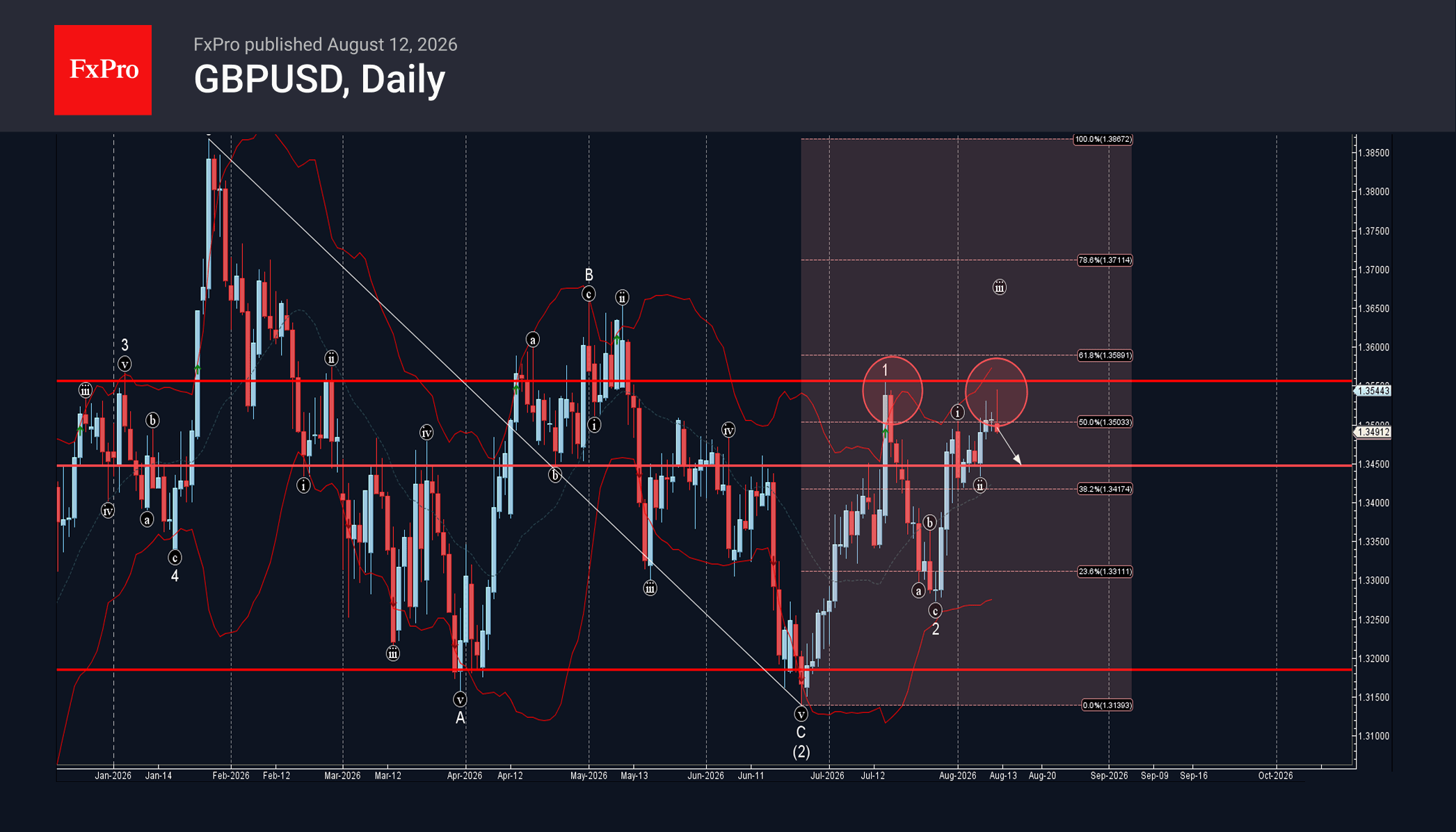
GBPUSD Wave Analysis
GBPUSD: ⬇️ Sell
– GBPUSD reversed from resistance level 1.3555
– Likely to fall to support level 1.3450
GBPUSD currency pair recently reversed down sharply from the key resistance level 1.3555 (which stopped the previous sharp impulse wave 1 in the middle of July) intersecting with the upper daily Bollinger Band.
The downward reversal from the resistance level 1.3555 is likely to form the daily Japanese candlesticks reversal pattern daily Shooting Star.
GBPUSD currency pair can be expected to fall to the next support level 1.3450, low of the previous correction ii.
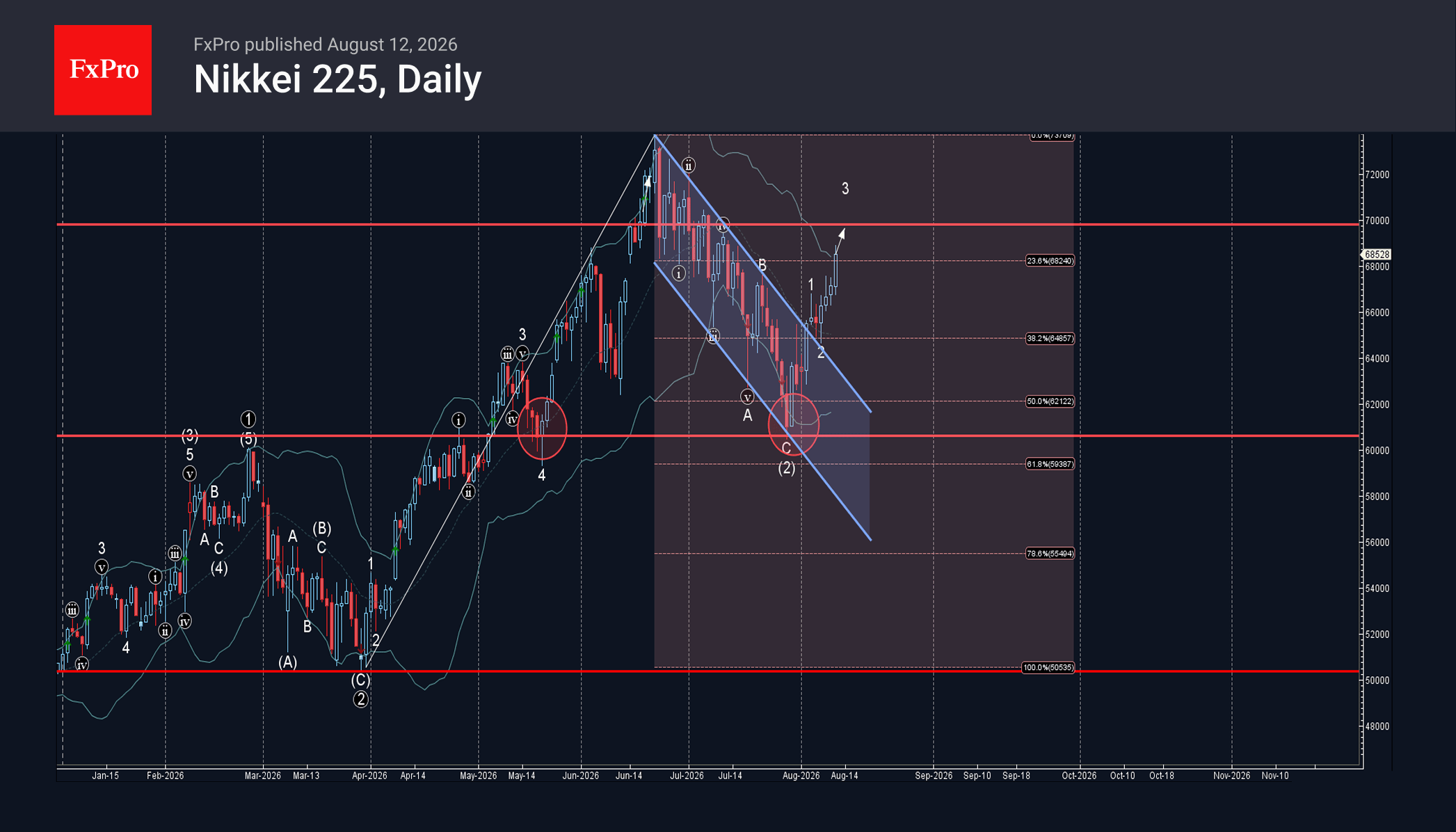
Nikkei 225 Wave Analysis
Nikkei 225: ⬆️ Buy
– Nikkei 225 broke daily down channel
– Likely to rise to resistance level 70000.00
Nikkei 225 index recently broke the resistance trendline of the daily down channel from June – which enclosed the previous ABC correction (2).
The breakout of this down channel accelerated the active minor impulse wave 3 that belongs to the intermediate impulse wave (3) from the end of June.
Given the long-term uptrend, Nikkei 225 index can be expected to rise to the next round resistance level 70000.00.
Eco Data 8/13/26
| GMT | Ccy | Events | Act | Cons | Prev | Rev |
|---|---|---|---|---|---|---|
| 23:01 | GBP | RICS Housing Price Balance Jul | -30% | -31% | -33% | -32% |
| 23:50 | JPY | PPI Y/Y Jul | 7.20% | 7.40% | 7.10% | 7.30% |
| 03:00 | NZD | RBNZ Inflation Expectations Q/Q Q3 | 2.34% | 2.53% | ||
| 06:00 | GBP | GDP M/M Jun | 0.30% | -0.10% | 0.10% | 0.00% |
| 06:00 | GBP | GDP Q/Q Q2 P | 0.40% | 0.40% | 0.60% | |
| 06:00 | GBP | GDP Y/Y Q2 P | 1.20% | 1.10% | 0.90% | |
| 06:00 | GBP | Industrial Production M/M Jun | -0.20% | 0.00% | -0.50% | -0.70% |
| 06:00 | GBP | Industrial Production Y/Y Jun | -0.20% | 0.20% | 1.00% | |
| 06:00 | GBP | Manufacturing Production M/M Jun | -0.50% | -0.30% | 0.10% | -0.20% |
| 06:00 | GBP | Manufacturing Production Y/Y Jun | 0.50% | 1.20% | 2.30% | 2.00% |
| 06:00 | GBP | Goods Trade Balance (GBP) Jun | -23.0B | -20.4B | -18.7B | -21.1B |
| 06:30 | CHF | Producer and Import Prices M/M Jul | -0.10% | 0.20% | -0.30% | |
| 06:30 | CHF | Producer and Import Prices Y/Y Jul | -2.10% | -0.50% | -2.10% | |
| 09:00 | EUR | Eurozone Industrial Production M/M Jun | 0.00% | 0.10% | -0.20% | |
| 12:30 | USD | Initial Jobless Claims (Aug 7) | 209K | 202K | 199K | 200K |
| 12:30 | USD | PPI M/M Jul | 0.00% | 0.20% | -0.30% | -0.10% |
| 12:30 | USD | PPI Y/Y Jul | 4.70% | 4.90% | 5.50% | |
| 14:30 | USD | Natural Gas Storage (Aug 7) | 36B | 31B | 33B |
| 23:01 | GBP |
| RICS Housing Price Balance Jul | |
| Actual | -30% |
| Consensus | -31% |
| Previous | -33% |
| Revised | -32% |
| 23:50 | JPY |
| PPI Y/Y Jul | |
| Actual | 7.20% |
| Consensus | 7.40% |
| Previous | 7.10% |
| Revised | 7.30% |
| 03:00 | NZD |
| RBNZ Inflation Expectations Q/Q Q3 | |
| Actual | 2.34% |
| Consensus | |
| Previous | 2.53% |
| 06:00 | GBP |
| GDP M/M Jun | |
| Actual | 0.30% |
| Consensus | -0.10% |
| Previous | 0.10% |
| Revised | 0.00% |
| 06:00 | GBP |
| GDP Q/Q Q2 P | |
| Actual | 0.40% |
| Consensus | 0.40% |
| Previous | 0.60% |
| 06:00 | GBP |
| GDP Y/Y Q2 P | |
| Actual | 1.20% |
| Consensus | 1.10% |
| Previous | 0.90% |
| 06:00 | GBP |
| Industrial Production M/M Jun | |
| Actual | -0.20% |
| Consensus | 0.00% |
| Previous | -0.50% |
| Revised | -0.70% |
| 06:00 | GBP |
| Industrial Production Y/Y Jun | |
| Actual | -0.20% |
| Consensus | 0.20% |
| Previous | 1.00% |
| 06:00 | GBP |
| Manufacturing Production M/M Jun | |
| Actual | -0.50% |
| Consensus | -0.30% |
| Previous | 0.10% |
| Revised | -0.20% |
| 06:00 | GBP |
| Manufacturing Production Y/Y Jun | |
| Actual | 0.50% |
| Consensus | 1.20% |
| Previous | 2.30% |
| Revised | 2.00% |
| 06:00 | GBP |
| Goods Trade Balance (GBP) Jun | |
| Actual | -23.0B |
| Consensus | -20.4B |
| Previous | -18.7B |
| Revised | -21.1B |
| 06:30 | CHF |
| Producer and Import Prices M/M Jul | |
| Actual | -0.10% |
| Consensus | 0.20% |
| Previous | -0.30% |
| 06:30 | CHF |
| Producer and Import Prices Y/Y Jul | |
| Actual | -2.10% |
| Consensus | -0.50% |
| Previous | -2.10% |
| 09:00 | EUR |
| Eurozone Industrial Production M/M Jun | |
| Actual | 0.00% |
| Consensus | 0.10% |
| Previous | -0.20% |
| 12:30 | USD |
| Initial Jobless Claims (Aug 7) | |
| Actual | 209K |
| Consensus | 202K |
| Previous | 199K |
| Revised | 200K |
| 12:30 | USD |
| PPI M/M Jul | |
| Actual | 0.00% |
| Consensus | 0.20% |
| Previous | -0.30% |
| Revised | -0.10% |
| 12:30 | USD |
| PPI Y/Y Jul | |
| Actual | 4.70% |
| Consensus | 4.90% |
| Previous | 5.50% |
| 14:30 | USD |
| Natural Gas Storage (Aug 7) | |
| Actual | 36B |
| Consensus | 31B |
| Previous | 33B |
US Inflation Eases in July
US inflation slowed in July, mainly reflecting drop in oil prices due to recent ceasefire in the Middle East, and signaling less pressure on the US central bank to raise interest rates in September.
The Consumer Price Index ticked lower to 3.4% (y/y) in July, in line with expectations, from 3.5% in June, while core inflation (excluding volatile food and energy components) rose by 2.5% last month (again meeting expectations) compared to 2.6% increase in June.
Inflation report follows the downbeat July labor data that also cooled expectations for Fed rate hike on signals on unexpected and significant weakening in the US labor market, one of pillars of the economy, along with inflation.
The US central bank kept interest rates unchanged in July policy meeting and did not provide more details about their next steps, except signaling that policymakers will continue to assess the situation through the economic data and act accordingly in the next meeting (the Fed will have August labor and CPI data released before September 15-16 policy meeting.
Analysts expect labor market to strengthen after the latest weakness, partially driven by seasonal factors and expect increased price pressures, as oil prices rose again.
Sunset Market Commentary
Markets
The US July CPI inflation report printed bang in line with consensus today. Headline inflation rose by 0.1% M/M and 3.4% Y/Y (down from 3.5%). The BLS, responsible for the release, said that the index for shelter rose 0.1% in July and accounted for roughly two-thirds of the monthly headline increase. Energy prices dropped by 1.5% M/M after falling 5.7% in June. They are still 14.7% higher than July of last year though. Food price growth was registered at 0.2% M/M (+3% Y/Y). Core CPI increased by 0.2% M/M and 2.5% Y/Y (from 2.6%). The latter matches the lowest level since March 2021. Core CPI indexes that increased over the month include medical care (+0.4%), airline fares (+2.2%), communication (+0.6%), education (+0.5%), and recreation (+0.2%). Conversely, the index for motor vehicle insurance (-0.3% M/M) was among the major indexes that decreased in July. Goods prices, excluding food and energy commodities, rebounded following two months of declines while services prices, excluding energy and rents, rose 0.2% (+3% Y/Y).
US Treasuries spiked slightly higher on the CPI print, but the move remains guarded and smaller than the one seen after last Friday's disappointing payrolls (which was completely reversed by Monday). Daily changes on the US curve currently range between -2.1 bps (30-yr) and -4.3 bps (5-yr). The dollar is a tad softer at 1.1550 (from 1.1535 ahead of the release). Main US equity benchmarks open up to 0.5% stronger. Today's CPI holds a truth for everyone. The dovish reading points to the lowest core CPI pace in 5 years time. It buys the FOMC time to assess the impact of the ongoing energy crisis and its broader impact. The more hawkish reading is that vigilance against upside risks remains required as the length of the current inflation overshoot calls for action before it's too late especially given solid growth and a steady labour market. The market implied probability of a September 25 bps rate hike declined from 50% to 40%. FOMC Minutes of the July Fed meeting (released next Wednesday) and the Kansas City Fed's Jackson Hole Symposium (August 27-29) are the next key events to help shape market expectations on future interest rate policy.
Tonight, the US Treasury continues its mid-month refinancing operation with a $42bn 10-yr Note sale. The timing is tricky given the recent underperformance at the (very) long end of the curve. The more so when it comes to tomorrow's $25bn 30-yr Bond sale. The US 30-yr yield even matched its highest level since 2007 yesterday. Are investors attracted by current yields given that underlying dynamics show that they are an expression of a rising term premium (fiscal worries?!) rather than an inflation risk premium?
News & Views
The International Energy Agency in its August Oil Market Monitor downgraded its global oil demand forecasts from 1.05mn b/d to 1.56mn b/d Y/Y with the Hormuz closure and elevated fuel prices weighing on consumption. Next year demand is expected to rebound by 2.42mn b/d (up from 2.01mn in previous forecast) with consumption seen at 105.7mn b/d. This year's global oil supply forecast was also revised down, from 102.6mn b/d in July to 102mn in today's report. The resulting Q3 2026 supply deficit is 1.8mn b/d — more than double the prior estimate — with global observed inventories falling 69mn barrels in July alone. Next year, global supply is expected to rebound by 8.3mn b/d to 110.3mn b/d, significantly outpacing projected demand growth.
US: Inflationary Pressures Remain Subdued in July
- The Consumer Price Index (CPI) rose by 0.1% month-on-month (m/m) in July – in line with expectations. On a twelve-month basis, CPI edged down to 3.4% (from 3.5% in June).
- Energy costs fell by 1.5% m/m, led by a 2.9% m/m decline in prices at the pump. Food prices rose 0.1% m/m – its softest gain in three-months – and are up 3.0% on a twelve-month basis.
- Excluding food and energy, core prices rose 0.2% m/m, also meeting expectations. On a twelve-month basis, price growth down edged to 2.5% – returning to its February (pre-Iran conflict) pace.
- Price growth on core services rose 0.2% m/m, following a flat reading the month prior. The rebound was driven by some firming in primary shelter costs (+0.3% m/m) and a rebound in non-housing services (+0.2% m/m vs. -0.4% m/m in June).
- Gains in the latter were driven by an acceleration in medical care (+0.6% m/m), education & communication services (+0.5% m/m) and airfares (+2.2% m/m).
- Core goods rose 0.2% m/m, following modest declines in each of the two prior months. The categories that recorded the largest gains included education & communication (+1.3% m/m) – likely related to Apple's price hikes on computers and tablets – recreation goods (+0.6% m/m) and used vehicle prices (+0.4% m/m).
Key Implications
- Despite the rebound in monthly measures, underlying inflation trends continue to move in the right direction. At 3.4%, headline CPI has put further distance from its four-year high reached in May, while the annual change on core inflation fell back to its pre-Iran conflict rate of growth. Near-term trends on core also improved, with the three-and-six-month annualized rates slipping to 1.6% (from 2.3%) and 2.4% (from 2.6%), respectively.
- This morning's report offers policymakers more reassurance that tariff- and energy-driven inflation pressures are fading. Fed futures were little changed after the release, with a September hike still 40% priced. One more jobs and CPI report – plus Chair Warsh's Jackson Hole remarks on August 28 – will be key in steering the Fed's next move. But for now, it appears policymakers are likely to remain on the sidelines
Dollar Falls as July CPI Closes First Oil-Shock Chapter — August Opens the Next
Why it matters: July's data was measured before the current Hormuz escalation reached its present intensity. Brent has climbed from roughly $70 in July toward $90, and negotiations remain stuck. July CPI tells the Fed the first oil shock washed out with no lasting scar. It says nothing yet about whether the second one will do the same, that test arrives with August CPI on September 11.
CPI Gives Dollar Bears a Reason — But Not a Dovish Breakthrough
Dollar weakened broadly after July CPI delivered exactly what markets expected, leaving the Fed with little immediate reason to tighten again. Headline inflation slowed from 3.5% to 3.4% y/y, while core CPI eased from 2.6% to 2.5%. Monthly headline CPI rose 0.1% after June's -0.4% decline, while core increased 0.2% after being unchanged previously.
Markets responded by leaning further toward a September hold. Fed futures raised implied probability to around 58% from roughly 51% a day earlier. The 10-year Treasury yield slipped toward 4.66%. Dow futures gained around 150 points, and Gold pushed back above 4,400.
That is a meaningful shift, but not a dovish regime change. July CPI did not give the Fed a reason to hike again immediately. It also did not give policymakers enough disinflation to start cutting. What it did was strengthen the argument that the Fed's best option for now is simply to wait.
July CPI at a Glance
- Headline CPI: eased from 3.5% to 3.4% y/y.
- Core CPI: eased from 2.6% to 2.5% y/y.
- Monthly headline: +0.1%, after -0.4% in June.
- Monthly core: +0.2%, after being unchanged the prior month.
- September hold probability: rose to around 58%, from roughly 51% a day earlier.
- 10-year Treasury yield: slipped toward 4.66%.
- Dow futures: gained around 150 points.
- Gold: pushed back above 4,400.
Core CPI Has Fully Reversed the First War Shock
The most important feature of the July report is that core inflation has returned to 2.5%, exactly where it stood in January and February before the Iran war disrupted energy markets.
That gives the Fed an important piece of evidence: the first oil shock did not leave a lasting scar on core inflation. Once energy pressure faded, underlying inflation managed to return all the way to its pre-war level.
Unfortunately for the Fed, the oil market has changed again. July CPI was measured before the latest Hormuz escalation reached its current intensity. Brent's rebound toward $90, confirmed tanker attacks, collapsing vessel crossings and a widening US-Iran reparations dispute are predominantly August developments. So July's inflation report closes one chapter just as another begins.
The first shock was much more violent. Brent surged toward $120, while energy CPI jumped dramatically. This time, oil has risen from roughly $70 in July to around $90, but the disruption could prove more persistent because negotiations remain stuck and shipping flows are still constrained.
First Oil Shock vs. Second Oil Shock
| First Shock (Iran War) | Second Shock (Hormuz Escalation) | |
|---|---|---|
| Peak Brent price | Surged toward $120 | Climbed from roughly $70 in July to around $90 |
| Core CPI impact | Jumped dramatically, later fully reversed to 2.5% | Not yet reflected in July CPI; August CPI on September 11 is the first test |
| Disruption dynamics | Sharp, but ultimately resolved | Negotiations remain stuck, shipping flows still constrained, potentially more persistent |
That leaves the Fed with no basis to assume July's favorable energy trend will continue. The cleaner interpretation: July CPI tells the Fed the first oil shock washed out. August will start showing whether the second one does too.
Fed Is Back at Square One — With a Weaker Labor Market
The timing could hardly be more awkward. July payrolls unexpectedly contracted, while May and June employment figures were revised sharply lower. That deterioration has materially raised the hurdle for another Fed hike.
With rates at 3.50–3.75%, policy is already restrictive. If labor conditions continue weakening, more tightening becomes increasingly difficult to justify. But the Fed cannot pivot toward easing either. Core inflation is still 2.5%, above target, while Brent near $90 creates a fresh source of upside risk.
Both Sides of the Mandate, Under Pressure at Once
- Employment is weakening enough to argue against another hike.
- Inflation is still high enough, and oil volatile enough, to argue against a cut.
The Fed has effectively been pushed back into the middle.
September Is Becoming a Hold-and-Wait Meeting
That is why a September hold is becoming the most logical base case, even if markets are not overwhelmingly committed to it yet. The Fed now has two major questions to answer before the September 15–16 meeting.
Two Reports That Matter More Than July CPI
- August employment report, September 4: will show whether July's payroll contraction was an aberration or the start of deeper deterioration.
- August CPI, September 11: will begin showing the impact of the renewed oil surge.
Those two reports should carry far more information than July CPI alone. If employment weakens again while core inflation stays around 2.5–2.6%, another hike would become increasingly hard to defend. If hiring rebounds and core inflation starts moving higher as oil pressure feeds through, the hawkish argument would regain strength quickly.
July CPI therefore does not settle the September debate. It simply gives the Fed a stronger reason not to move before those answers arrive.
Oil Is Still the Counterweight to Today's Inflation Relief
The energy market is making that waiting strategy necessary. Brent continues to hover just below $90, while WTI trades around $83. At the same time, the IEA's latest outlook points to a market caught between weakening demand and shrinking supply buffers.
IEA's Latest Oil Market Snapshot
- 2026 global demand: expected to decline by 1.6 million barrels per day, a downgrade of 510,000 barrels per day from the July forecast, as high fuel prices weigh on consumption.
- Supply: renewed hostilities and maritime disruptions are undermining efforts to increase output, which remained 6.3 million barrels per day lower y/y in July.
- Observed inventories: fell below 7.9 billion barrels, the lowest since April 2025.
- Brent: hovering just below $90. WTI: around $83.
That means weaker demand may eventually cap prices, but the market has less room to absorb another supply disruption in the meantime. As the IEA put it, inventory buffers are being rapidly depleted, increasing the urgency of reopening the Strait of Hormuz.
Dollar Falls, but September Debate Stays Open
In currency markets, Dollar slipped to third weakest on day, ahead only of Swiss Franc and Kiwi. Aussie remained strongest, followed by Yen and Sterling, while Euro and Canadian Dollar traded in middle. Cross-asset reaction was similarly measured, with Treasury yields edging lower and equities rising rather than surging. Markets are trimming Fed hike risk, not embracing a new easing cycle.
July CPI has nevertheless clarified starting point for next decision. First oil shock has washed out of core inflation, but second is arriving with Brent near $90 just as labor market is weakening. August employment and CPI data will determine which risk becomes more pressing before September 15–16 meeting. For now, that uncertainty leaves hold-and-wait as clearest Fed path.
Related Coverage
Fed & Rates Deep Dives
- See the full breakdown of July's CPI report and why it reinforces a hold-and-wait stance rather than a case for another hike: US CPI Slows to 3.4% as Core Inflation Eases to 2.5%.
- Read why Fed's Susan Collins says she could still support a September hike if cost pressures persist, even after backing July's hold: Fed's Collins Open to September Hike as Cost Pressures Persist.
Cross-Asset Reaction
- Read why Gold's rally is betting Brent near $90 won't force the Fed back to tightening, and why CPI is only the first check on that bet: Gold Is Betting $90 Oil Won't Force the Fed Back to Tightening. CPI Is the First Check.
- See why Bitcoin's descending channel is putting $60,000 in reach, and why September 15 is emerging as a cleaner regulatory catalyst than the delayed CLARITY Act: Bitcoin Grinds Toward $60K as the CLARITY Act Catalyst Shifts to September 15.
Frequently Asked Questions
Q: Does July's cooler CPI mean the Fed's inflation fight against the oil shock is over?
A: Only for the first shock. Core CPI fully round-tripped back to 2.5%, exactly where it stood before the Iran war disrupted energy markets, showing that shock left no lasting scar. But July's data predates the current Hormuz escalation, so it says nothing about whether the second oil shock, which has pushed Brent from roughly $70 to near $90, will follow the same pattern.
Q: Why does the July CPI report already look outdated?
A: The report was measured before Brent's rebound toward $90, confirmed tanker attacks, collapsing vessel crossings and the widening US-Iran reparations dispute intensified. Those are predominantly August developments, so July's favorable inflation trend can't yet account for them. August CPI, released September 11, will be the first read on whether the renewed oil surge is feeding into prices.
Q: What will actually decide the Fed's September 15–16 decision?
A: Two reports carry more weight than July CPI: the August employment report on September 4, which will show whether July's payroll contraction was a one-off or the start of deeper labor weakness, and August CPI on September 11, which will show how much the renewed oil surge is feeding into inflation. Weak employment plus contained inflation makes another hike hard to defend; a hiring rebound plus rising inflation would revive the hawkish case quickly.
Key Takeaways
- Core CPI fully reversed the first oil shock: At 2.5%, it's back to exactly where it stood in January and February, before the Iran war disrupted energy markets.
- That's not a dovish breakthrough: July CPI gave the Fed no reason to hike again, but also not enough disinflation to start cutting, it simply strengthened the case for waiting.
- July's data already predates the current oil shock: Brent's climb toward $90, tanker attacks and the widening reparations dispute are predominantly August developments not captured in this report.
- Two reports matter more than July CPI: August payrolls (September 4) and August CPI (September 11) will carry far more information ahead of the September 15–16 FOMC meeting.
- Oil's supply cushion is thinning: IEA data shows observed inventories below 7.9 billion barrels, the lowest since April 2025, even as 2026 demand forecasts get cut, leaving little room to absorb another disruption.
- Dollar fell broadly on the data: It was the third-weakest major currency behind Swiss Franc and Kiwi, while Aussie led, followed by Yen and Sterling.
What to Watch Next
The August employment report on September 4 and August CPI on September 11 will carry far more weight than today's data, together they'll determine whether the Fed can credibly hold at the September 15–16 meeting or faces renewed pressure from either side of its mandate. Strait of Hormuz developments and Brent's path toward or away from $90 remain the key swing factor for the inflation side of that equation.
US CPI Slows to 3.4% as Core Inflation Eases to 2.5%
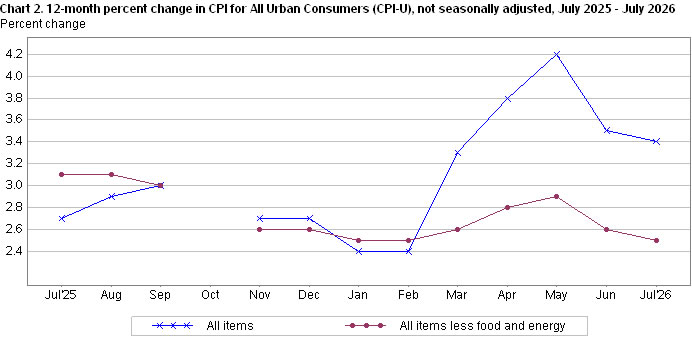
US inflation eased as expected in July, reinforcing case for Fed to stay on hold while it waits for clearer evidence on both prices and labor market. Headline CPI rose from -0.4% to 0.1% m/m, while annual rate slowed from 3.5% y/y to 3.4%. Core CPI increased from 0.0% to 0.2% m/m, with annual core inflation easing from 2.6% to 2.5%. All four readings matched consensus, leaving markets with confirmation of gradual disinflation rather than a fresh policy surprise.
Details were also relatively contained. Shelter rose 0.1% m/m and accounted for roughly two-thirds of monthly headline increase, while food gained 0.1%. Energy prices fell -1.5% m/m, although they were still up 14.7% y/y. Core increases were seen in medical care, airline fares, communication, education and recreation, while motor vehicle insurance declined. Most importantly, core inflation has now returned to 2.5%, matching pre-Iran-war readings from January and February after peaking at 2.9% in May.
For Fed, July report strengthens argument for patience rather than another immediate move. Weak payrolls have already raised hurdle for further tightening, while core inflation at 2.5% remains too high to justify easing. July CPI therefore supports a hold-and-wait stance, with focus shifting toward August employment and inflation data before September meeting. Renewed rise in oil also means July’s benign energy contribution may prove temporary, making August CPI a more important test of whether latest energy shock begins feeding back into broader inflation.
Data Summary
| Indicator | Actual | Expected | Previous |
|---|---|---|---|
| CPI m/m | 0.1% | 0.1% | -0.4% |
| CPI y/y | 3.4% | 3.4% | 3.5% |
| Core CPI m/m | 0.2% | 0.2% | 0.0% |
| Core CPI y/y | 2.5% | 2.5% | 2.6% |
Key Takeaways
- US CPI matched expectations across all four major readings, delivering confirmation of gradual disinflation rather than a fresh policy surprise.
- Headline CPI slowed from 3.5% to 3.4% y/y, while core CPI eased from 2.6% to 2.5%, returning core inflation to its January-February pre-Iran-war level.
- Monthly core CPI accelerated from 0.0% to 0.2%, showing underlying price pressure has not disappeared even as annual rate continues to moderate.
- Shelter rose just 0.1% m/m but accounted for roughly two-thirds of headline monthly increase. Energy fell 1.5% m/m, providing an important disinflationary contribution.
- Weak July payrolls have raised hurdle for another Fed hike, but 2.5% core inflation remains too high to justify near-term easing, reinforcing a hold-and-wait stance.
- July’s favorable energy contribution is already backward-looking. August CPI will be more important for assessing whether renewed oil surge starts feeding into broader inflation.